Jul 312019
 

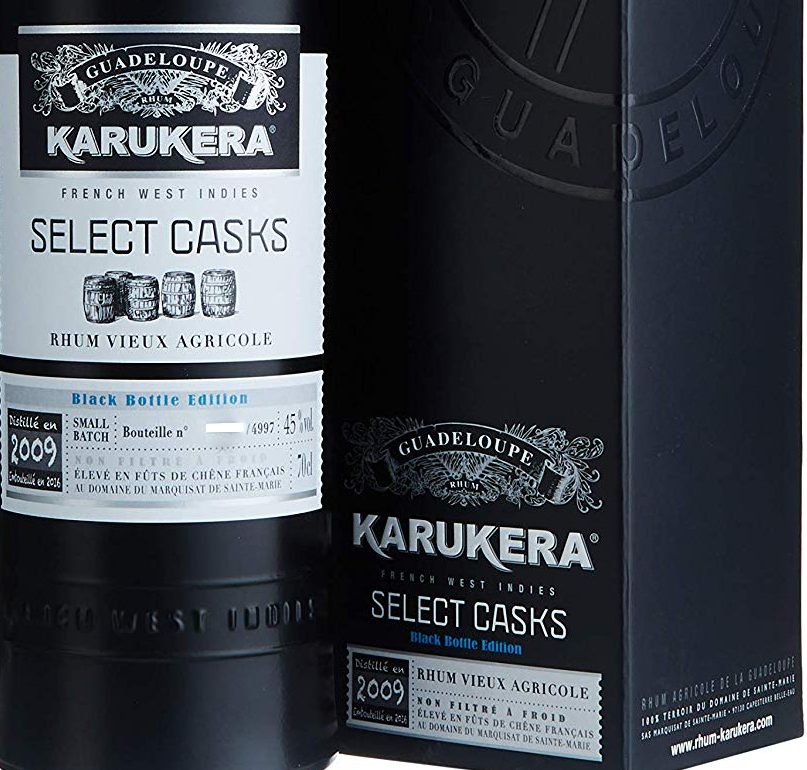
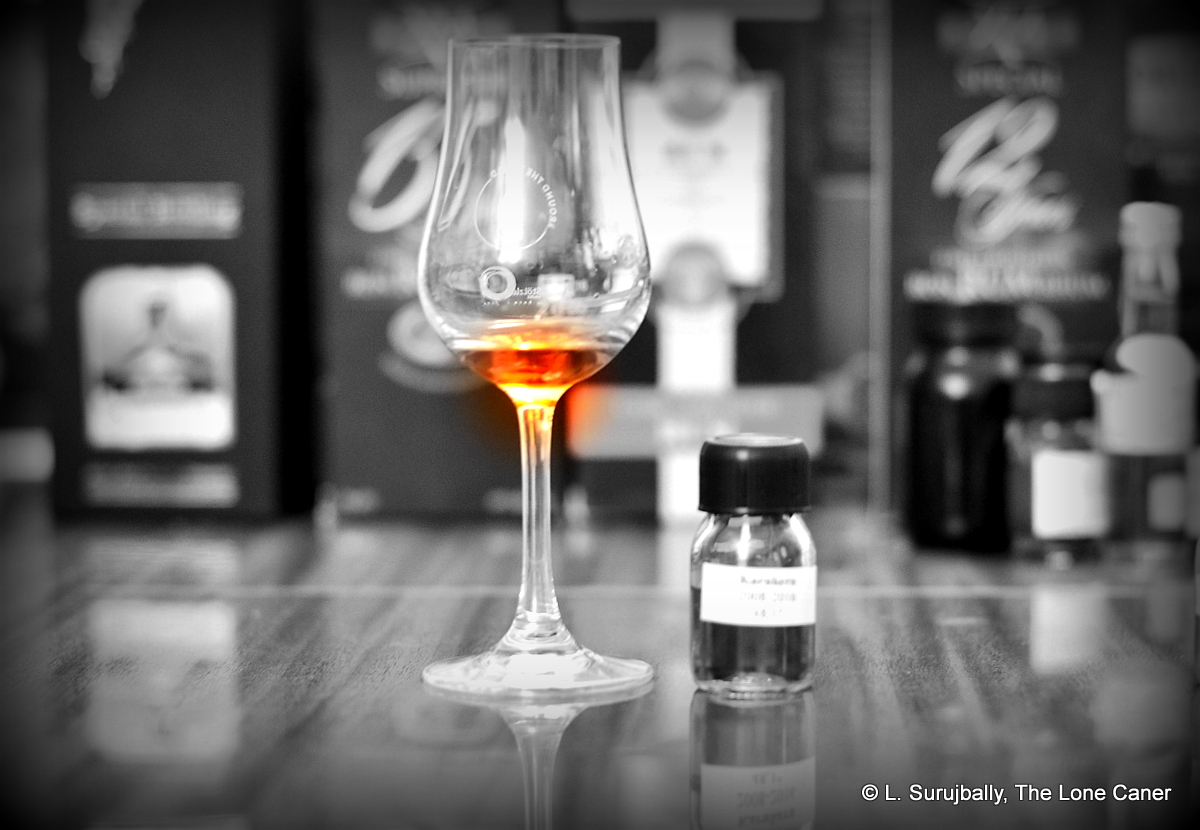
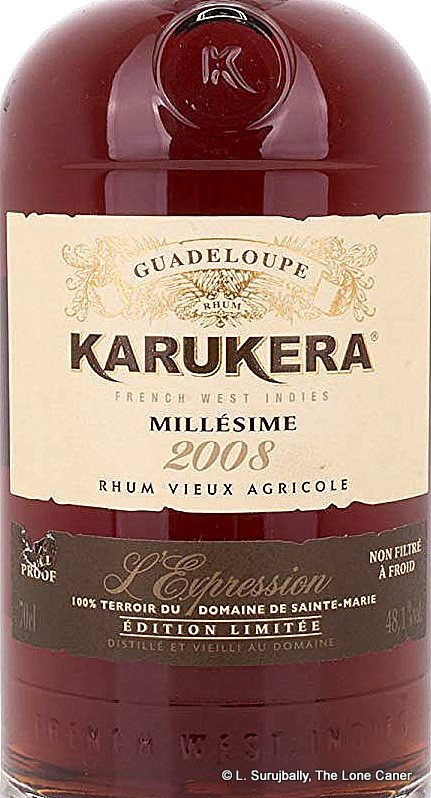
Karukera, that small distillery on the eastern side of the left wing of Guadeloupe also known as Basse-Terre (in the Domain of Marquisat de Sainte–Marie) used to release bottles with an AOC designation — it was clearly visible on the labels of the Millesime 1997 and the Rhum Vieux Reserve Speciale I went through some years ago.  However, by the time 2016 rolled around this apparently had been discontinued, since the “L’expression” 8 year old bottled in that year shows no sign of it. 

While Guadeloupe as a whole has always been somewhat ambivalent about going the whole hog with the AOC, no-one can doubt that their rhums do not suffer from any lack just because they are or are not part of the protocol.  The rhum under review today, for example, is quite a good product, made as it is from cane juice of the famed high sugar-content canne bleue (which also makes a rip-snorting white), column-still distilled, a firm 48.1% ABV, and released to some fanfare in early 2017, during which several prizes came its way.

That said, I did find it somewhat…odd. For one thing, though the nose initially presented as nicely sweet and deep — with pineapple, fresh baked bread, toffee, nuts, bon bons, nougat, vanilla, licorice and salted caramel in particular perking thinks up — there was a background hint of molasses that I couldn’t pin down – what was it doing there, y’know?  There was also some cumin, ginger, fennel and rosemary, a good bit of citrus zest (lemon), so it was a pleasant rhum to smell, but overall it displayed less of the grassy, sap and dry watery aromas that would normally distinguish any agricole. 

Unlike many aged agricoles that have run into my glass (and down my chin), I found this one to be quite sweet, and for all the solidity of the strength, also rather scrawny, a tad sharp.  At least at the beginning, because once a drop of water was added and I chilled out a few minutes, it settled down and it tasted softer, earthier, muskier. Creamy salt butter on black bread, sour cream, yoghurt, and also fried bananas, pineapple, anise, lemon zest, cumin, raisins, green grapes, and a few more background fruits and florals, though these never come forward in any serious way. The finish is excellent, by the way – some vague molasses, burnt sugar, the creaminess of hummus and olive oil, caramel, flowers, apples and some tart notes of soursop and yellow mangoes and maybe a gooseberry or two.  Nice.

So yeah, like I said, it’s good, but a little confusing too — initially, not much seems to be happening and then you realize it already has, and sorting out the impressions later you conclude that what you were getting was not entirely what you were expecting. For my money, it was not anything outstanding. I personally preferred the 2004 Double Maturation a lot more – that one was intriguing and complex, and navigated salt and sweet, soft and crisp, in a way this one tried to, but didn’t. The nose and the palate were at odds not just with each other but themselves, in a way, and it was overly fruity-sweet.  That’s not enough for me to give it a bad score, just to make me look elsewhere at the company’s rhums, for something that might erase the memory of a Hawaiian pizza which the L’Expression so effortlessly brings to mind every time I sip it.

(#647)(83/100)


Other Notes

  • Big thanks to Cyril of DuRhum for the sample
  • A smaller 1500-bottle outturn of the 2008 millesime was released for La Maison du Whisky’s 60th Anniversary in the same year, at 48.4%.  A 2008 Batch 2 was released at 47.5% with 3500 bottles but the year of bottling is unknown – it can be distinguished by a blue portion of the label, missing on the one I tried here.
  • My bottles from 2012-2013 show an AOC moniker on the labels, which is not there now.  The website also makes no mention of it, so I am left to conclude that it no longer conforms to the AOC designation. If anyone has some details, please let me know and I’ll update the post.
Jul 282019
 

If the proposed new GI for Barbados goes into force, it’s likely that rums such as this one will have to be relabelled, because the ageing will have to be done in Barbados, and it’s debatable whether a third party could be permitted to say it was a Foursquare rum(see other notes, below).  Still, even if that happens, that’s not a particularly serious problem on either count given the appreciation most have for tropical ageing these days; and one only has to see any independent bottler saying “Secret Distillery” on a label, for the rum pundits to work themselves up into a lather racing to see who can identify the distillery first, by taste alone.  It’s kind of fun, to be honest.

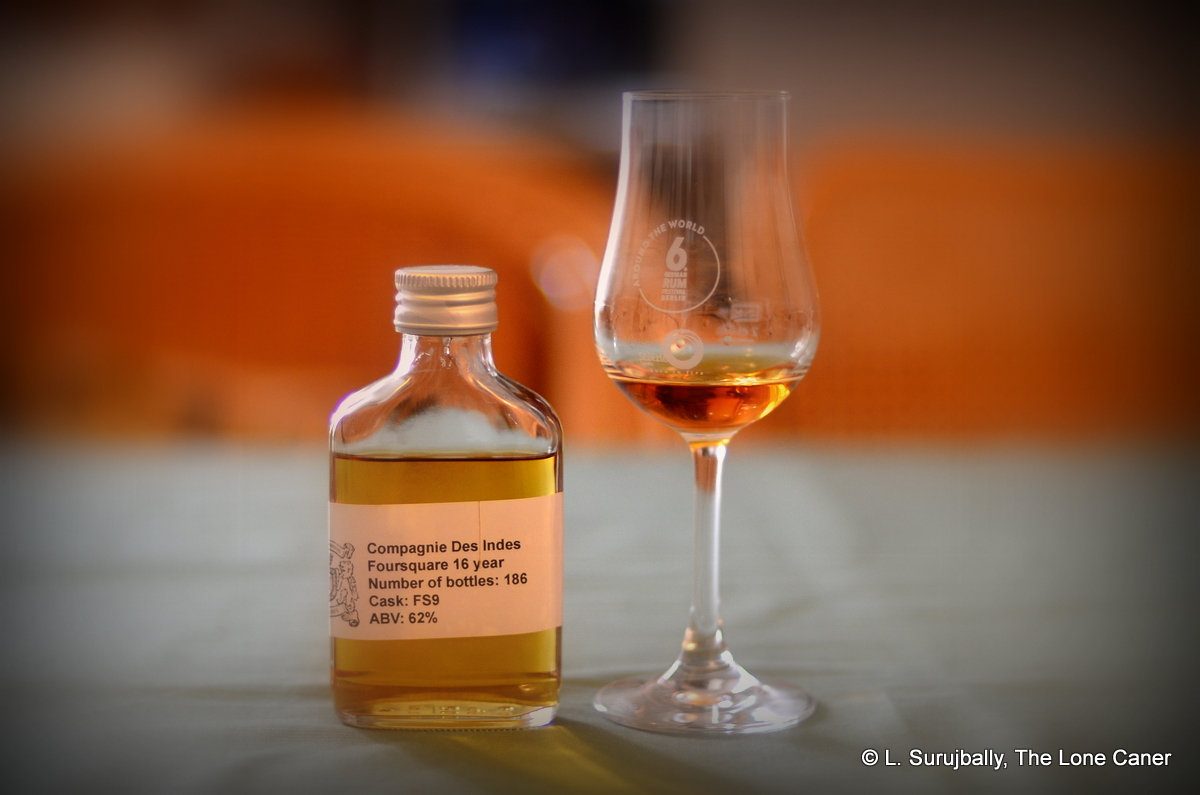
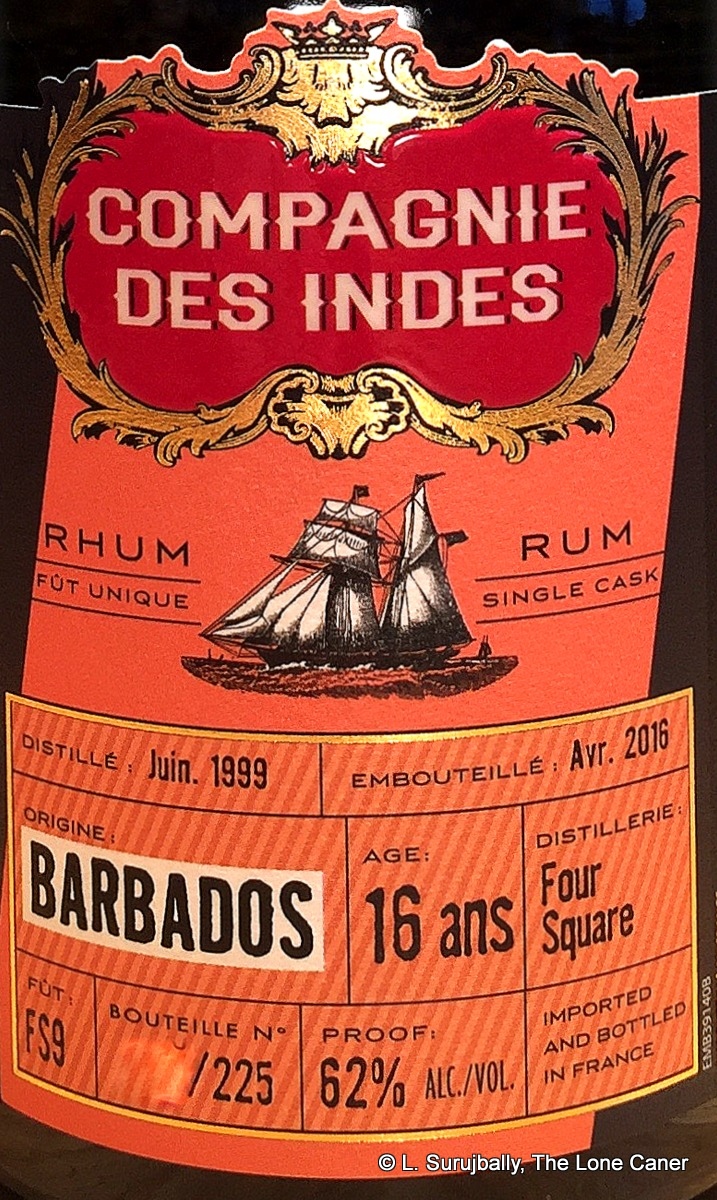
Be that as it may, we do in fact have this rum here now, from Barbados and from Foursquare, so it comes from Europe where it was at least partially aged (which strongly implies Main Rum, since [a] Scheer itself doesn’t do ageing and [b] Foursquare has had a long relationship with them), a near-brutal 62% ABV, and a 225-bottle outturn from a single barrel #FS9 (my sample was mislabelled, noting 186 bottles).  Unlike the TCRL line of rums from la Maison du Whisky, Compagnie des Indes do not show proportion of ageing done in different climes, which is the case here: 8 years tropical in Barbados, and 8 years continental in Liverpool; distilled April 1999 and bottled June 2016…a whisker under seventeen years of age, and a nice amber hue. About the only thing we don’t know whether it is pot or column still, although based on taste, I would suggest column as a purely personal opinion (and Richard Seale later confirmed that).

I don’t have any other observations to make, so let’s jump right in without further ado.  Nose first – in a word, luscious. Although there are some salty hints to begin with, the overwhelming initial smells are of ripe black grapes, prunes, honey, and plums, with some flambeed bananas and brown sugar coming up right behind. The heat and bite of a 62% strength is very well controlled, and it presents as firm and strong without any bitchiness. After leaving it to open a few minutes, there are some fainter aromas of red/black olives, not too salty, as well as the bitter astringency of very strong black tea, and oak, mellowed by the softness of a musky caramel and vanilla, plus a sprinkling of herbs and maybe cinnamon. So quite a bit going on in there, and well worth taking one’s time with and not rushing to taste.

Once one does sample, it immediately shows itself as dry, intense and rich.  The flavours just seem to trip over themselves trying to get noticed: honey, fruits, black tea, plus dark rye bread and cream cheese, but also the delightful sweetness of strawberries, peaches and whipped cream, a nice combination.  It’s sharper and rougher than the nose, not all the jagged edges of youth have been entirely sanded off, but a few drops of water sort that right out. Then it mellows out, allowing other flavours emerge – vanilla, cinnamon, prunes, providing an additional level of fruit that is quite pleasing. It ends with a dry, hot finish redolent of fruits and vanilla and honey (rather less cream here) that may be the weak point of the entire experience, because the integration of the complex profile falters somewhat and doesn’t quite ignite the jock as joyously as the nose and initial taste had done (for me, anyway – your mileage my vary).

Never mind, though. To be honest, even if bottled from a broker’s stocks by a third party independent, even if the Compagnie des Indes has a great rep for selecting good barrels, the truth is that I don’t see how this could not be seen as another feather in Foursquare’s cap…though perhaps not as long or brightly coloured as some of the others  The rum is well made, well distilled, well aged, well balanced, quite complex and a rough’n’tough-but-decent sip that may take some dialling down, yet overall a great advertisement from the distillery and island of origin. This is not to take any kudos away from Florent Beuchet, of course – I think his nose for a good rum doesn’t sneeze, and always sniffs out something interesting, even special – and here, both Foursquare and the Compagnie can walk away, leaving this bottle on the table, (me probably snoring underneath it, ha ha) tolerably satisfied that they made something pretty damned fine.  And if you can get one, I honestly think you’d agree too.

(#646)(85/100)


Other Notes

I requested further information from Foursquare, and Mr. Seale’s response was detailed enough for me to quote it in full here:

“This rum is 8 yrs at Foursquare and 8 years in Liverpool. It is all column.  We did unaged in the past and there are exceptions today where we ship unaged – but not for further aging.

The issue with the GI is complex and its a separate issue to the distillery name issue. I have taken the position that Foursquare should be named on the label. This has resulted in misuse of my trademark (not with malice) and I am trying to work with everyone to have our name present without misusing our trademark. Other distilleries have taken the easier (and perhaps wiser route) of simply prohibiting their name in any form – hence “secret distillery”.

As far as the GI goes, Barbados is a work in progress but Jamaica will only allow certification of age in Jamaica. The practical outcome of this would be a product like this could not say “16 years” and bear the Geographical certification. That is surely correct. How can something not aged in Jamaica be given a geographical certification.

That is not to say a product like this could not exist – as Lance says, it will be about labeling. The EU expressly provides for GIs and it expressly provides a work around. By Article 14, there is whisky aged in France, declared as a product of France that was distilled in Scotland.

The biggest threat to IBs like the excellent Compagnie des Indes is not GIs but availability of rum. If all small independent distillers fell into the hands of global corporations, bulk would dry up. Moving (age driven) value from Europe to the Caribbean is not a threat to rum from IBs, it is the only way to sustain it.”

Jul 252019
 

We hear a lot about Damoiseau, HSE, La Favorite and Trois Rivieres on social media, while J.M. almost seems to fall into the second tier of famous names. Though not through any fault of its own – as far as I’m concerned they have every right to be included in the same breath as the others, and to many, it does. 

Situated in the north of Martinique, J.M. began life with Pére Labat, who was credited with commercializing and proliferating the sugar industry in the French West Indies during the 18th century. He operated a sugar refinery at his property on the Roche Rover, and sold the estate to Antoine Leroux-Préville in 1790 – it was then renamed Habitation Fonds-Préville.  In 1845, his daughters sold the property again, this time to a merchant from Saint-Pierre names Jean-Marie Martin. With the decline in sugar production but with the concomitant rise in sales of distilled spirits, Jean-Marie recognized an opportunity, and built a small distillery on the estate, and switched the focus away from sugar and towards rum, which he aged in oak barrels branded with his initials “JM”. In 1914 Gustave Crassous de Médeuil bought the plantation from his brother Ernest (it would be positively karmic if Ernest was a descendant or relative of Jean-Marie, but it remains unknown), and merged it with his already existing estate of Maison Bellevue.  The resulting company has been family owned until recently, when Spiribam, the Hayot-family-controlled drinks conglomerate that also owns Clement and St. Lucia Distillers, bought a majority shareholding and put an end to one of the last independent single domaine plantations on Martinique.

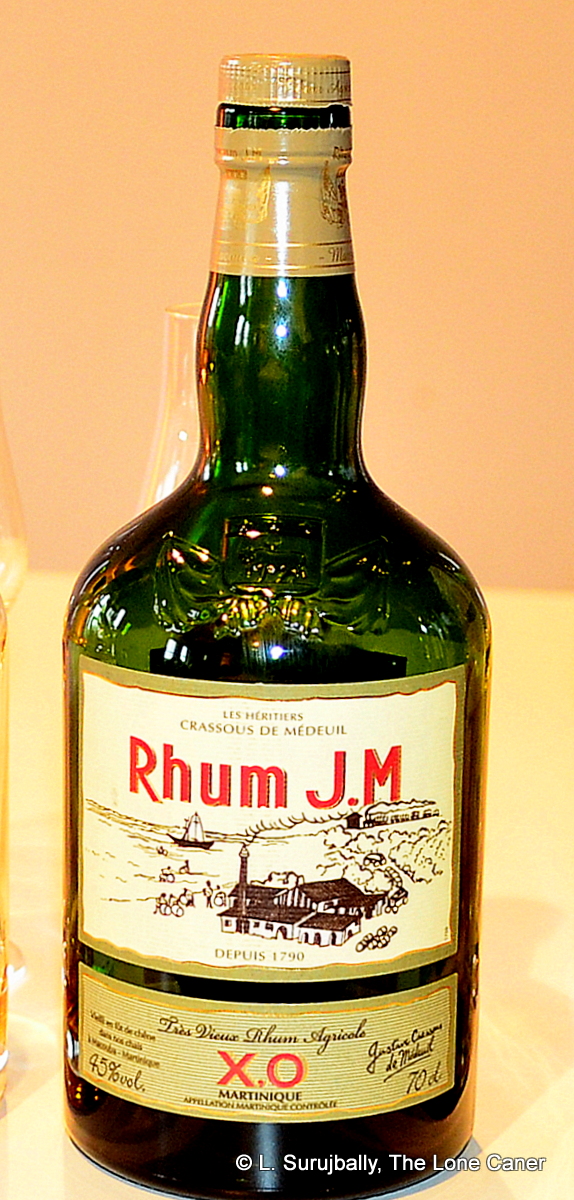
The company makes various general blended rhums like the whites, the VO, VSOP and XO, as well as a ten and fifteen year old rum. The 45% ABV XO is one of the core range of rums JM produces, no particular year of make (otherwise it would be stated on the label and noted as being a millesime), always a minimum of six years old, made in quantity, consistent in taste and quality, and pretty widely available.

Right off, I enjoyed the smell when the bottle was cracked: luscious, well rounded ytet also a tad sharp – let’s call it crisp for now – with bags of soft tangerine zest, honey, vanilla and fudge.  It lacked much of that true herbal, grassy aroma which characterizes an agricole, yet its origin in cane juice was clear, hovering behind softer hints of marshmallow smores, caramel and white chocolate.

Palate, more of the same, with a few extra herbs and spices thrown in for good measure, quite firm and bordering on sharp.  So, some dill, cardamom, cloves, wet grass, dusky flowers (like lilies but thankfully fainter), plus softer tastes of peanut butter (the crunchy kind), caramel bon bons, rye bread and a sharp cheddar.  The finish was the bow tie, not adding anything much, just summing up the notes: medium long, warm, a tad sharp with less florals and more coffee grounds, oak and cinnamon.

This was good drinking, good sipping. I particularly liked the fact that the J.M.’s  inherent qualities kinda crept up on me without hurry: at first there was nothing bad about it, nor anything amazing, just decent quality – one could as easily mix it as sip it. Then a few extra notes began to sound, a few more joined in, and when it all came together at last I was left with a rhum that didn’t seem to have a whole lot of world-beating points of excellence – but what it had, it presented with aplomb. I finally came to the conclusion that the J.M. XO was a good rhum for both general audiences and those on a budget, a near perfect middle of the road product which didn’t seem like it was reaching for anything…but made one realize, after the party was over, that every target it was aiming for, it hit.

(#645)(83/100)

Jul 182019
 

“This is a distillery … which deserve some serious attention” I wrote back in 2017.  I should have taken my own advice and picked up more from there, because this rhum is really well done, and one to share generously. 

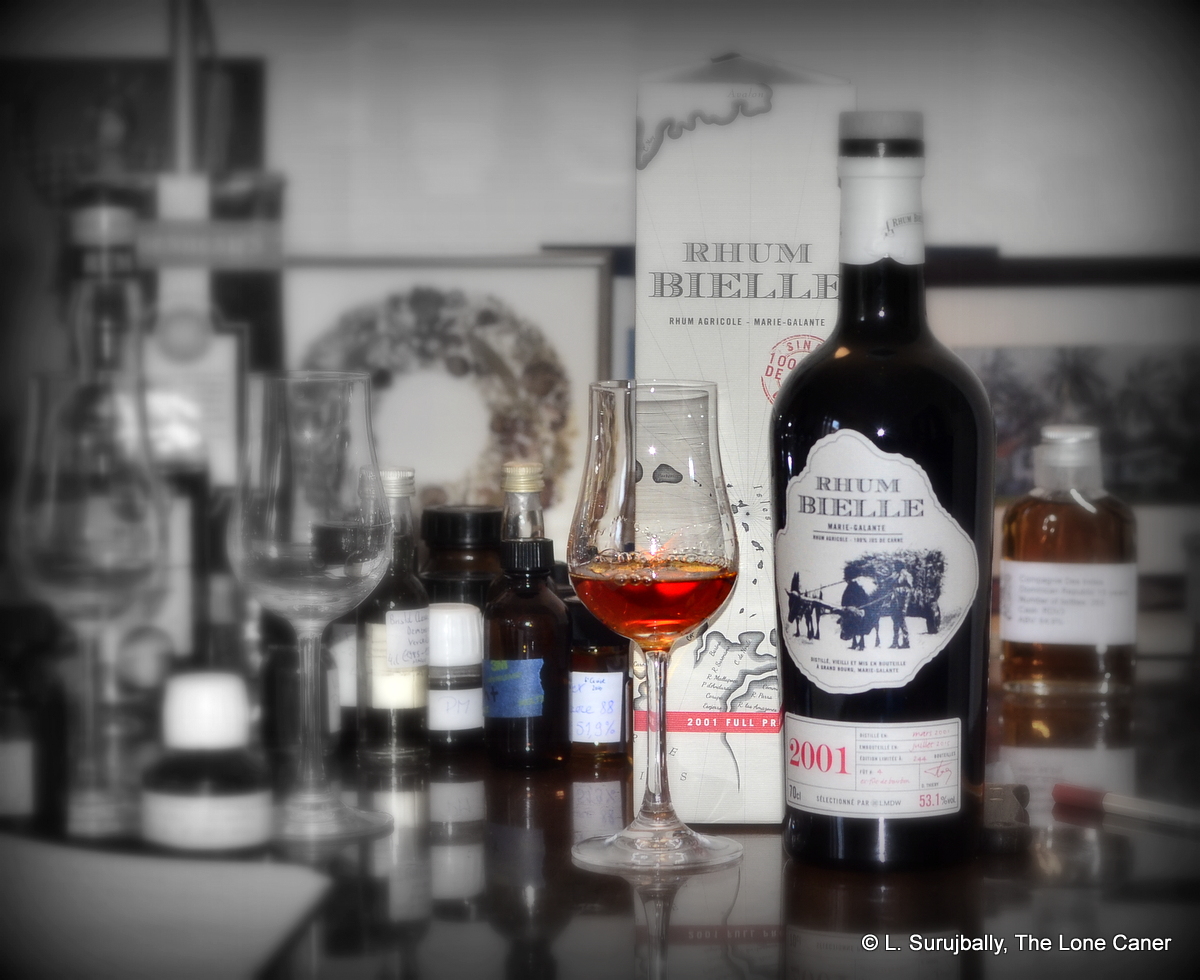
Located just south of dead centre on the tiny island of Marie Galante (itself south of Guadeloupe), Bielle is a small sugar plantation dating back to the late 1700s, named after Jean-Pierre Bielle (he also owned a coffee shop), which went through a series of owners and went belly-up in the 1930s; the property was sold to a local landowner, Paul Rameaux, who had no more success than his predecessors in reviving its fortunes. 1975 marked a revival of Bielle when la Société d’Exploitation de la Distillerie Bielle (SEDB) took over the assets, and nowadays a nephew of Mr. Rameaux, Dominique Thiery, runs the distillery. So, it’s another small outfit from the French West Indies about whom only the islanders themselves and the French seem to know very much.  

This might be a grievous oversight on our part, because I’ve tried quite a few of their rhums (and wrote about one of them before this), and they’re good, very good — both this one and the Brut de Fut 2007 scored high. And if Bielle was not well represented in the medal roundup of the recently concluded Martinique Rhum Awards, it might just mean their work is as yet undiscovered while other, better-known estates hog all the glory.

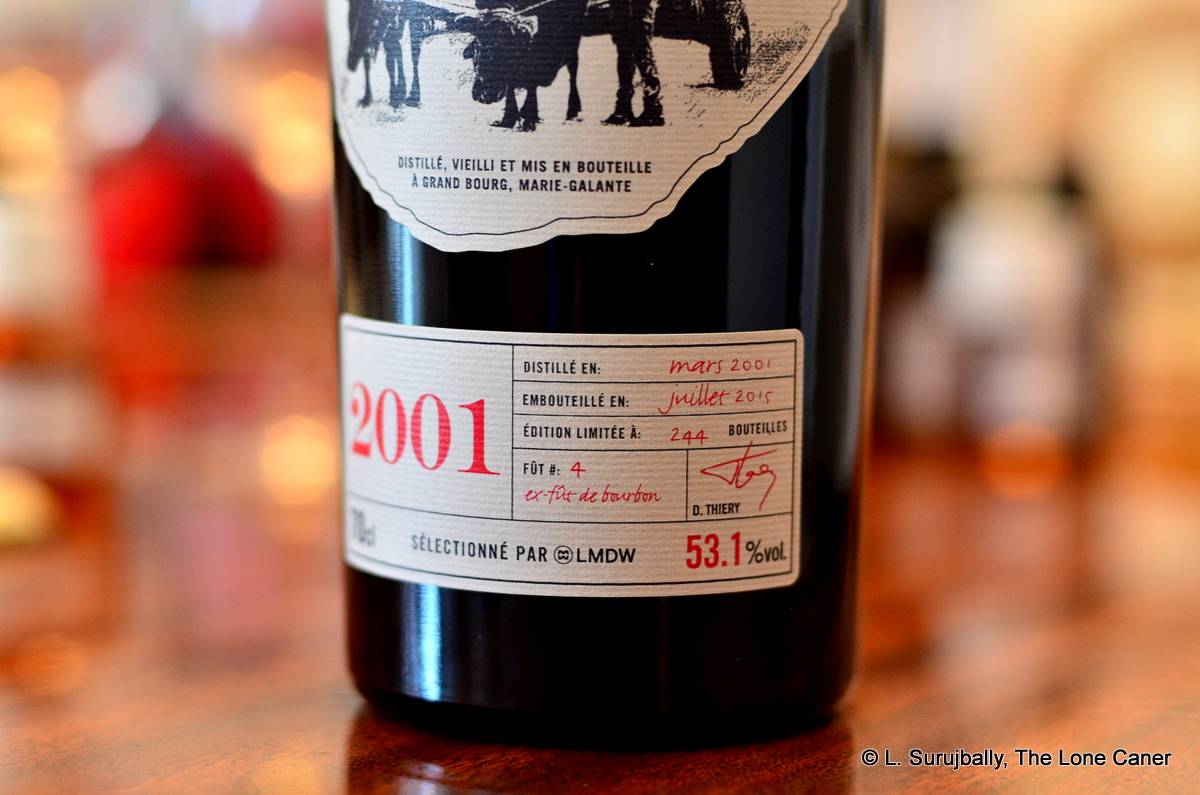
The profile of this 2001 tropically aged 14 year old demonstrated clearly, however, that these were no reasons to pass it by. Consider first the way smelled, dense, fragrant, and rich enough to make a grasping harpy sign the divorce papers and then faint.  Plums, peaches, mangoes, blackberries, molasses, citrus, all jammed together in joyous, near riotous abandon of sweet, acidic, tart and musky aromas. I particularly appreciated the additional, subtle notes of molasses-soaked damp brown sugar, white chocolate and danish cookies, which added a nice fillip to the whole experience.

Even someone used to standard strength would find little to criticize with the solid 53.1% ABV, which provided a good, very sippable drink.  All the fruits listed above came back for a smooth encore, and adding to the fun were gherkins in pickling sauce, brine, anchovies…you know, something meaty you could almost sink your teeth into – a little denser and this thing might have been a sandwich.  But it’s the molasses, overripe bananas, caramel and vanilla combining with all that, which binds it all together (sort of like a rumForce). I thought it was excellent, delectable stuff, skirting a fine line between rich and delicate, dark and light, thick and crisp. And the finish did not disappoint — it was dry yet luscious, exhaling vanilla, molasses, bananas, olives, nougat, cherries and a dusting of nuts

The Bielle deepens my admiration for Guadeloupe rhums, which are sometimes (but not in this case) made from molasses as well as cane juice, Guadeloupe not being subject to the AOC regime. This liking of mine does no disservice or call into question Martinique, whose many distilleries make savoury rums of their own, as crisp, clear, and clean as a rapier wielded by le Perche du Coudray.  There’s just something a little less precise about Guadeloupe rhums that I enjoy too – something softer, a little richer, more rounded. It’s nothing specific I can put my finger on, really, or express in as many words — but I think that if you were to try a few more Bielle-made rums like this one, you’d know exactly what I mean.

(#643)(87/100)

Jul 142019
 

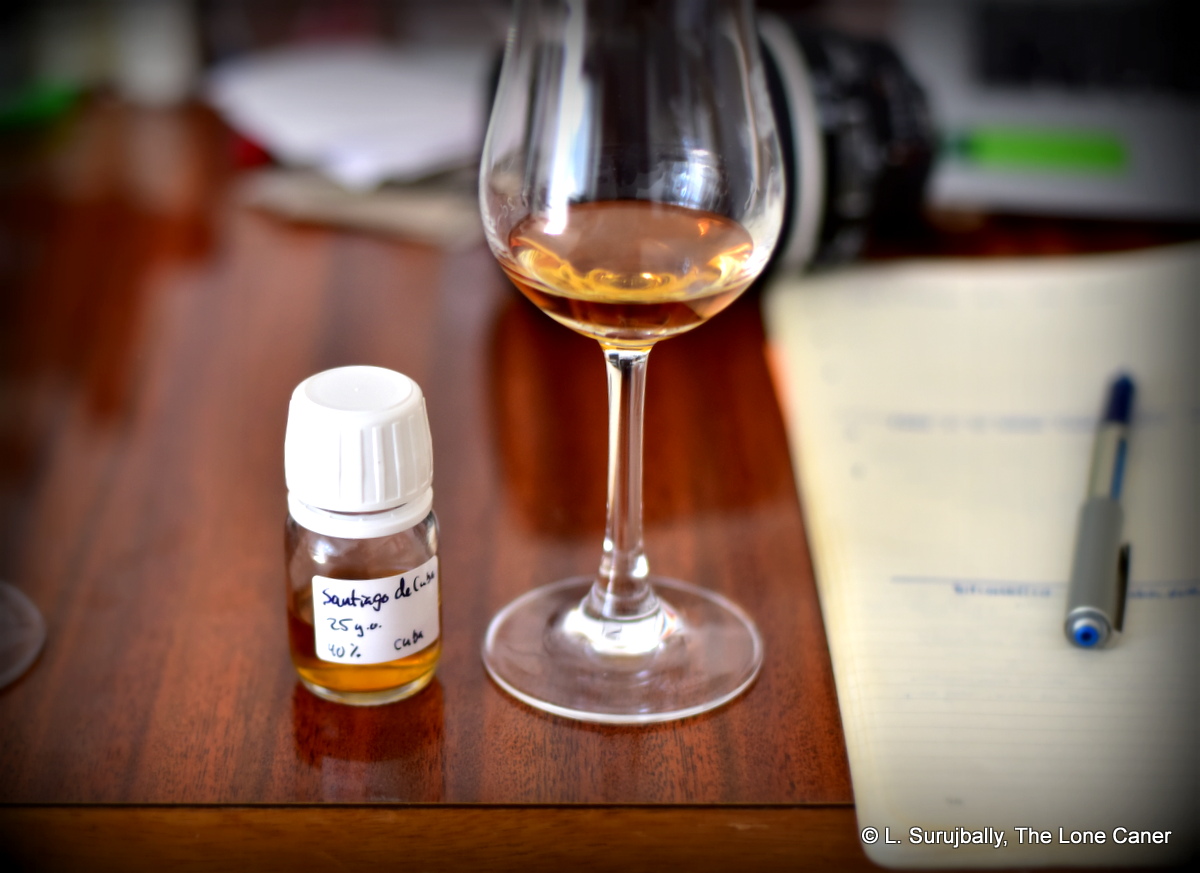
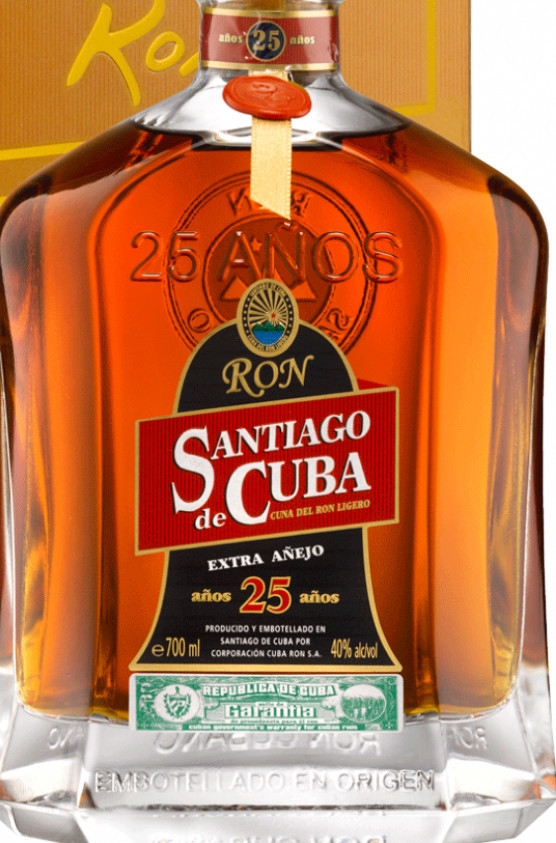
It’s been some time since a current production Cuban rum not made by a third party crossed my path.  Among those was the Santiago de Cuba 12 YO, which, at the time, I enjoyed a lot, and made me anxious to see how older versions from the Cuba Rum Corporation’s stable would work out.  So when the 25 YO became available, you’d better believe I snapped it up, and ran it past a bunch of other Latin rums: a Don Q, the Diplomatico “Distillery Collection” No. 1 and No. 2 rums, a Zafra 21 and just because I could, a Kirk & Sweeney 18 YO.

The Cuba Rum Corporation is the state owned organization located in the southern town of Santiago de Cuba, and is the oldest factory in the country, being established in 1862 by the Bacardi family who were expropriated after the Cuban Revolution in 1960. The CRC kept up the tradition of making light column-still Cuban rum and nowadays make the Ron Caney, Varadero and Santiago de Cuba lines, the last of which consists of an underproof blanca and sub-5YO anejo, and 40% 12 YO, 20 YO and this 25 YO. The 25 YO is their halo product, introduced in 2005 in honour of the 490th anniversary of the city of Santiago de Cuba’s founding and is lavish bottle and box presentation underscores the point (if the price doesn’t already do that).

Could a rum tropically aged for that long be anything but a success? Certainly the comments on the crowd-sourced Rum Ratings site (all thirteen of them, ten of which rated it 9 or 10 points out of ten) suggest that it is nothing short of spectacular. 

The nose was certainly good – it smelled richly of leather, mint, creme brulee, caramel, raisins, cherries, and vanilla.  The aromas were soft, yet with something of an edge to them as well, a bit of oak and tar, some citrus peel and lemon juice (just a little), plus a whiff of charcoal and smoke that was not displeasing. Even at 40% (and I wish it was more) it was enormously satisfying, if unavoidably light.  Good thing I tried it early in the session – had it come after a bunch of cask strength hooligans, I might have passed it by with indifference and without further comment.

The challenge came as it was tasted, because this is where standard strength 40% ABV usually falls flat and betrays itself as it disappears into a wispy nothingness, but no, somehow the 25 year old got up and kept running, in spite of that light profile.  The mouthfeel was silky, quite smooth and easy, tasting of cinnamon, aromatic tobacco, a bit of coffee. Then came citrus, nuts, some very faint fruits – raisins again, ripe red grapes, kiwi fruits, sapodilla, yellow mangoes – that was impressive, sure, it’s just that one had to reach and strain and really pay attention to tease out those notes…which may be defeating the purpose of a leisurely dram sipped as the sun goes down somewhere tropical.  Unsurprisingly the finish failed (for me at any rate – your mileage may, of course, vary): it puffed some leather and light fruits and cherries, added a hint of cocoa and vanilla, and then it was over.

The Santiago de Cuba brand was supposedly Castro’s favourite, which may be why the Isla del Tesoro presentation quality rum retails for a cool £475 on the Whisky Exchange and this one retails for around £300 or so.  Personally I find it a rum that needs strengthening. The tastes and smells are great – the nose, as noted, was really quite outstanding – the balance nicely handled, with sweet and tart and acidity and muskiness in a delicate harmony, and that they did it without any adulteration goes without saying. It would, six years ago, have scored as good or better than the 12 year old (86 points, to save you looking). 

But these days I can’t quite endorse it as enthusiastically as before even if it is a quarter of a century old, and so must give it the score I do…but with the usual caveat: if you love Cubans and prefer softer, lighter, standard proofed rums, then add five points to my score to see where it should rank for you.  Even if you don’t, rest assured that this is one of the better Cuban rums out there, tasty, languorous, complex, well-balanced….and too light.  It’s undone – and only in the eyes of this one reviewer – by being made for the palates of yesteryear, instead of beefing itself up (even incrementally) to something more for those who, like me, prefer something more forceful and distinct.

(#641)(82/100)


Other notes

Pierre-Olivier Coté’s informative 2015 review on Quebec Rum noted the outturn as 8,000 botles.  One wonders whether this is a one-off, or an annual release level.

Jul 072019
 

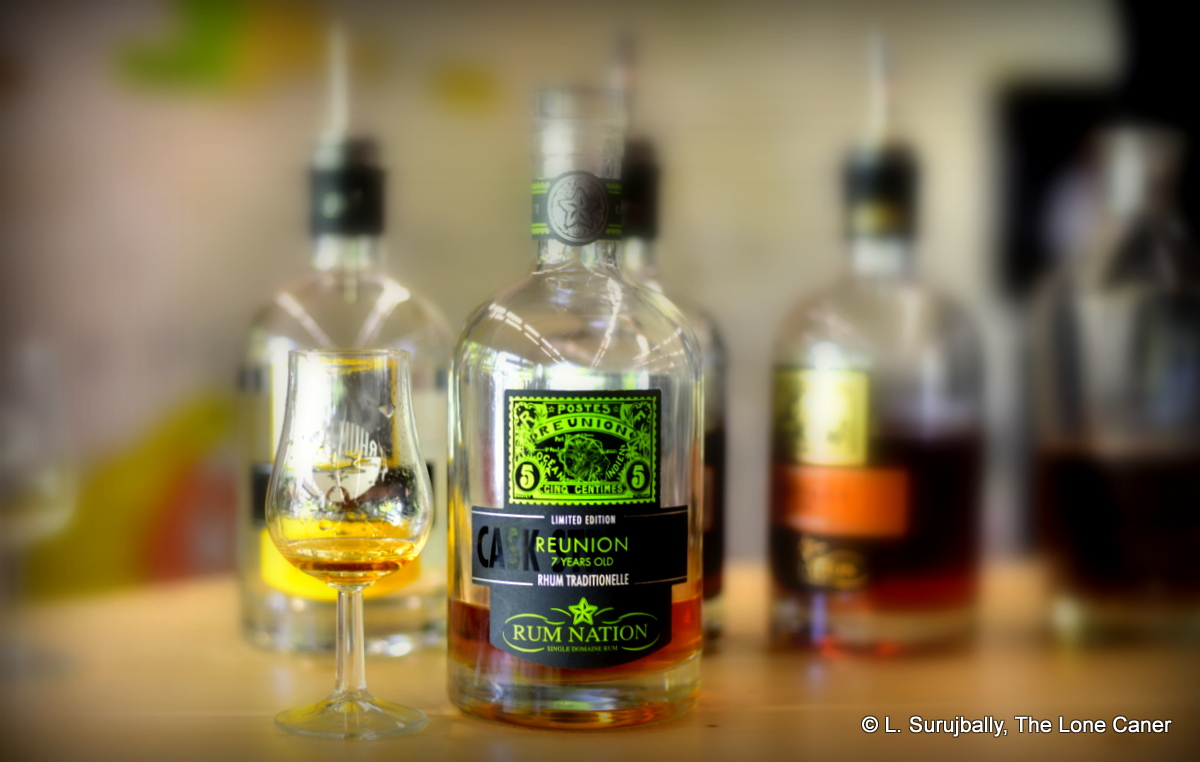
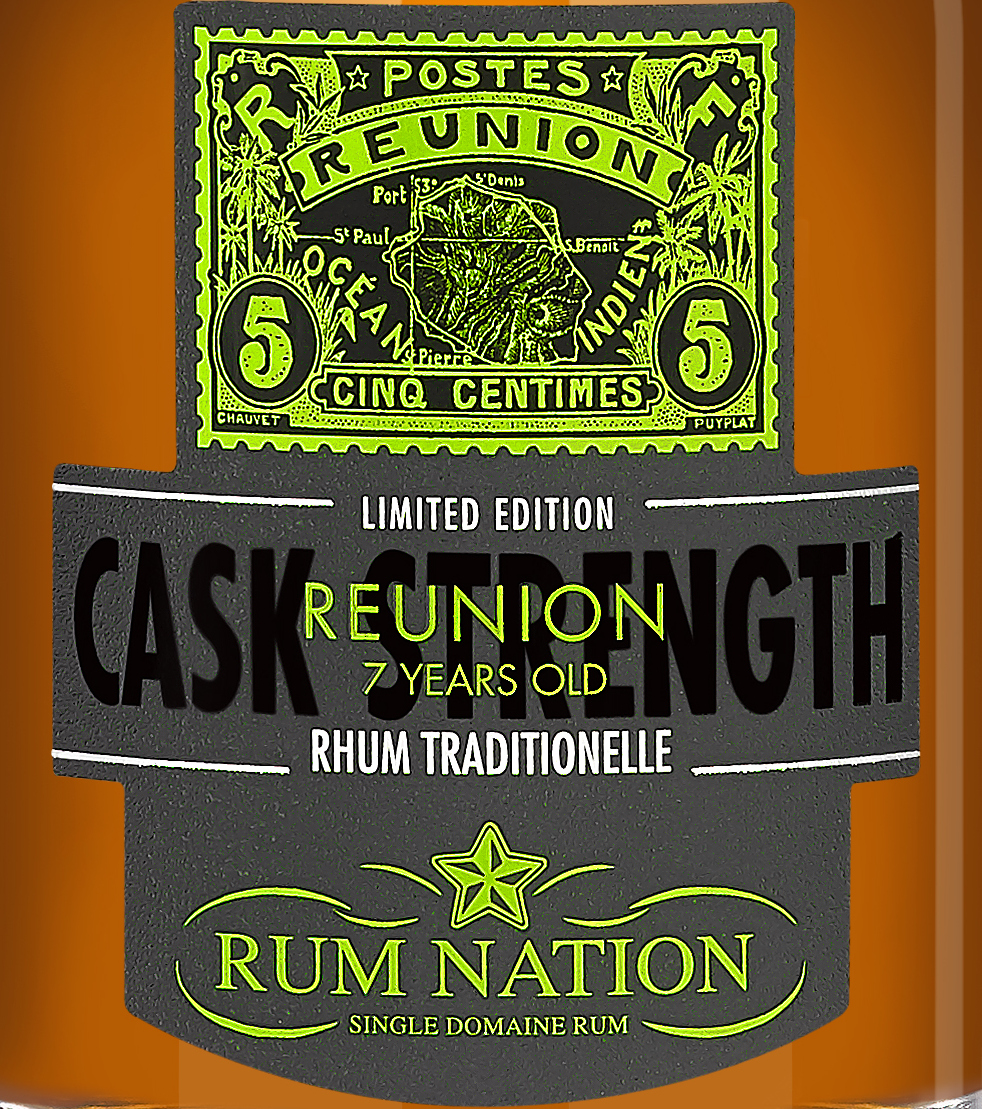
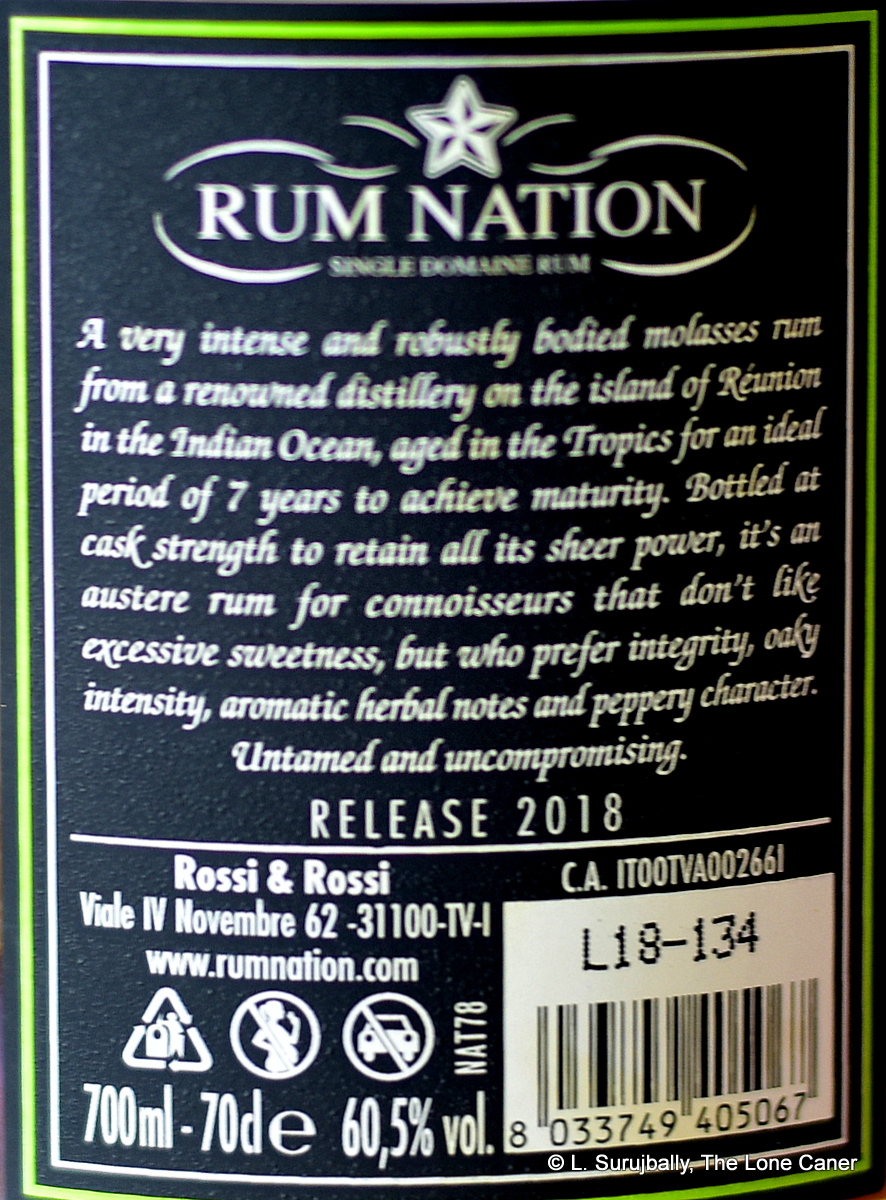
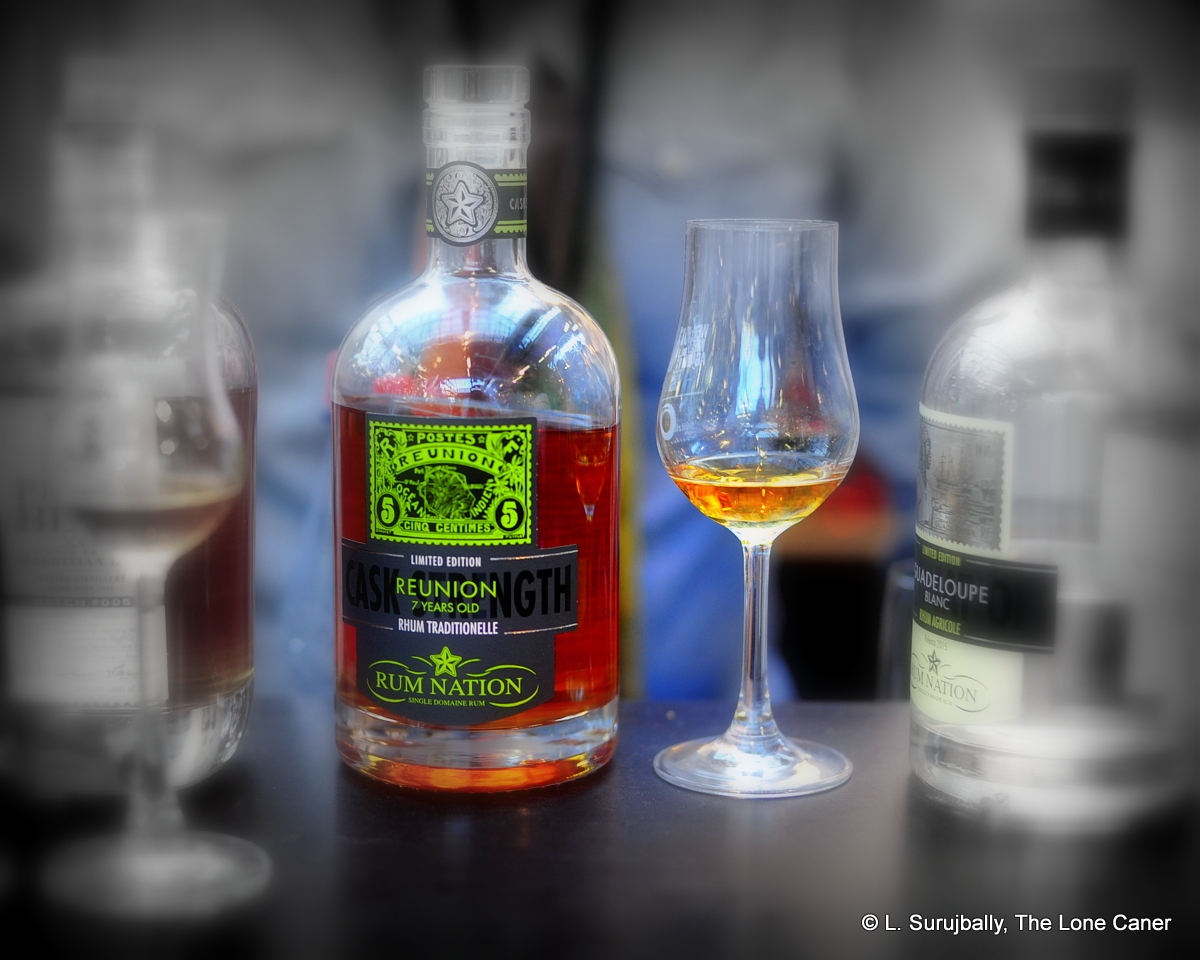
“Austere” says the back label of Rum Nation’s massive rum beefcake from Réunion, and they weren’t kidding. The rhum traditionalle from the French Department is bottled at 60.5% ABV, is seriously violent, a tropically-aged molasses-derived brown bomber, and to my mind it’s quite a step up from the lower-proofed 45% 7 year old agricole they had previously released in 2016.  It is not recommended for people who don’t know what they’re getting into.

HyperFocal: 0

Why?  Because insofar as it has those wild, fierce and pungent smells and tastes, it’s very much like the new wave of Jamaican rums now making such big waves – Hampden and Worthy Park in particular.  Because this presses many of the same buttons, shares something of the same rum-DNA, the major one being that it’s coming off a still stuffed with the potential to crank up the ester-count. And while neither of these two bottles says so — for whatever reason — I’m going on record as saying they’re both from Savanna and the wonder of it is that they come off a savalle copper column still, not pot stills like the Jamaicans.  And yet the ‘Nation’s cask strength version from 2018 is in no way a lesser rum.

Just smelling it tells you that.  It releases such an intense aroma when cracked – a beautifully clear piece of work, smelling of caramel, vanilla, leather, wine, and a lot of red fruits: cherries, red currants and pomegranates, that kind of thing.  And that’s not all…esters come out of hiding after five minutes or so, bubble gum, sharp green fruits, sandalwood, cloves, acetones, and that’s accompanied by a sort of woody, almost meaty smell that’s tough to pin down but really quite interesting.  And as if all this was not enough it continued with sugar cane sap, a citrus line, mint, thyme, and even a twist of black licorice – seriously, you should keep that glass going for at least ten minutes, preferably more, because it just doesn’t seem to want to stop.

Some rums falter on the taste after opening up with a nose of uncommon quality – fortunately Rum Nation’s Réunion Cask Strength rum (to give it its full name) does not drop the ball. It’s sharp and crisp at the initial entry, mellowing out over time as one gets used to the fierce strength. It presents an interesting combination of fruitiness and muskiness and crispness, all at once – vanilla, lychee, apples, green grapes, mixing it up with ripe black cherries, yellow mangoes, lemongrass, leather, papaya; and behind all that is brine, olives, the earthy tang of a soya (easy on the vegetable soup), a twitch of wet cigarette tobacco (rather disgusting), bitter oak, and something vaguely medicinal.  It’s something like a Hampden or WP, yet not — it’s too distinctively itself for that. It displays a musky tawniness, a very strong and sharp texture, with softer elements planing away the roughness of the initial attack. Somewhat over-oaked perhaps but somehow it all works really well, and the finish is similarly generous with what it provides — long and dry and spicy, with some caramel, stewed apples, green grapes, cider, balsamic vinegar, and a tannic bitterness of oak, barely contained (this may be the weakest point of the rum).

I noted that it reminds me of the New Jamaican rums and that’s certainly true.  But for anyone who likes the Lontan rums, the 2006 HERR 10 YO or the two 2018 “57” expressions, its uniqueness can’t be described by simply saying it’s a version of a rum from the Caribbean. It’s fiercely and uncompromisingly itself, with tastes that complement — without replacing — the rums issued by its cousins from Jamaica. It’s dry, intense, rich, searing, complex, and that short tropical ageing period mellowed it enough to let subtler notes shine without dampening them down too much or losing the crispness of the more youthful elements. And so, summing up, what we have here is a relatively young rum that tries to wring the very last whiff or drop of flavour from its distillate — and succeeds brilliantly.

(#639)(86/100)

Jul 042019
 

2014 was both too late and a bad year for those who started to wake up and realize that Velier’s Demerara rums were something special, because by then the positive reviews had started coming out the door, the prices began their inexorable rise, and, though we did not know it, it would mark the last issuance of any Demeraras of the Age by the Genoese concern headed by Luca Gargano.  Yesu Persaud – DDL’s chairman – was slated to retire by the end of that year, and in early 2015 the new chairman terminated the preferential relationship.

That said, it was not entirely a disaster for Luca, because, as he remarked to me in 2018 when we were discussing that remarkable series of rums, he was already seeing a diminution in the quality of the casks he was being allowed to select from. And these consisted of marques of lesser ages, experimental work and overall diminishing returns. So perhaps it was time to move on to other things.

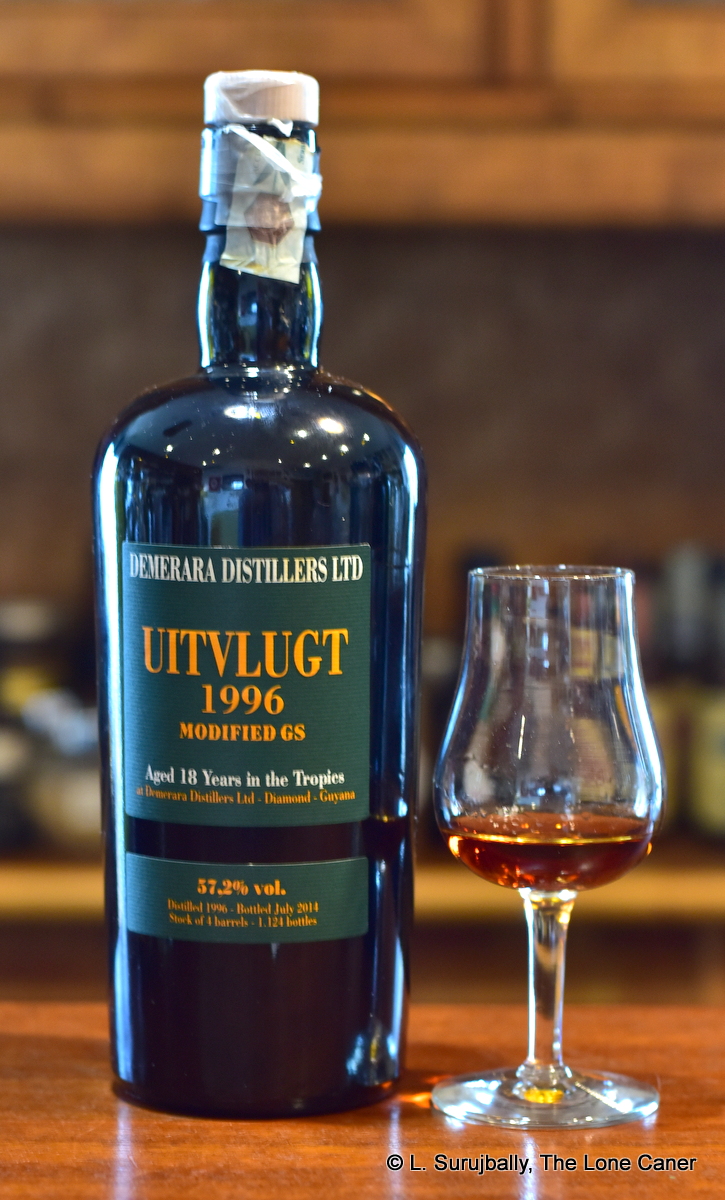
The Uitvlugt rum we’re looking at today, one of the last bottled in that year and in that Age, was still quite respectable based on its stats: distilled in 1996 on the four-column French Savalle Still (at the time housed at the estate, not Diamond); full tropical ageing in Guyana resulting in a 78% angel’s share losses and four remaining barrels which went into 1124 bottles; and a solid strength of 57.2%.

Did it sample well? Judge for yourself. The nose of the dark amber rum was refined, gentle…even easy. This was surprising given it was just about navy strength (one can wonder if that was a coincidence).  But even with that lack of oomph, it was remarkably distinct, even precise with the clarity of the dusky aromas it emitted. These began with molasses, brown sugar, caramel and vanilla, and added a thread of licorice, cinnamon, lemon zest, and then dumped in bags of dark, fleshy fruits like plums, prunes and ripe peaches. In a way it was like stepping back into a time, when those flavours defined “good” without anyone bothering to look for additional complexity – what distinguished this nose was the way they all came together in a refined olfactory melange, orderly, measured, balanced. 

Tasting it showed that the strength which had not been so apparent when smelled was simply biding its time.  It didn’t come across as aggressive or glittering sharp, just firm and very controlled, biting just enough to let you know it wasn’t to be taken for granted. The immediate tastes were of salty olives, cider, apples, quite strong.  Slowly (and with a drop or two of water) this developed into molasses, brown sugar, black currants, prunes plus smoke and a well-worn, well-cared for leather jacket. But what really stood out — over and beyond the rich dark fruits and the sense of well-controlled oakiness — was the sense of a rum-infused hot mocha with caramel, molasses, whipped cream, and a dusting of almonds and sweet spices, and it’s out and out delectable, even elegant.  I spent a lot of time sniffing it, sure, but much more just tasting. This thing is dangerous because it’s tasty enough to encourage rampant sipping, and the finish – slow, long-lasting, deeply flavoured with spices, chocolate, almonds and raisins – doesn’t assist in one’s self control in the slightest. 

For those who have a love affair with rums from the famed wooden stills, the Uitvlugt marques – whether by Velier or other independents, light or heavy, dark or blonde, tropical or continental – occasionally appear to be second-tier efforts, even throwaway fillers made with less elan and dedication than more famous rums we know better. Coming as they do from a column still, they are sometimes overlooked.

But they should not be. Admittedly, the Uitvlugt 1996 was not a severely complex rum with a million different subtleties chasing each other up and down the rabbit hole, the enjoyment of which lay in teasing out all the various notes, and sensing ever more around the corner.  It was more a coming together of all the flavours we associate with rum, in an exciting yet somehow still traditional way, impeccably assembled, elegantly balanced, exactingly chosen, and hearkening back to familiar old favourites from simpler times which now reside only in our memories.

So even then, at the end of the Age, when all was coming to a close and we thought we had seen pretty much everything, Luca still managed to pull a few last Guyanese rum rabbits out of his hat.  The Uitvlugt 1996 will likely not be one of the pot-still decades-old classics that fetches a few thousand dollars at auction, but for those who want to see what all the fuss about Velier is, while not straying too far out of their comfort zone, I can’t think of many better places to start than this unsung gem.  

(#638)(87/100)


Other notes

Jun 262019
 

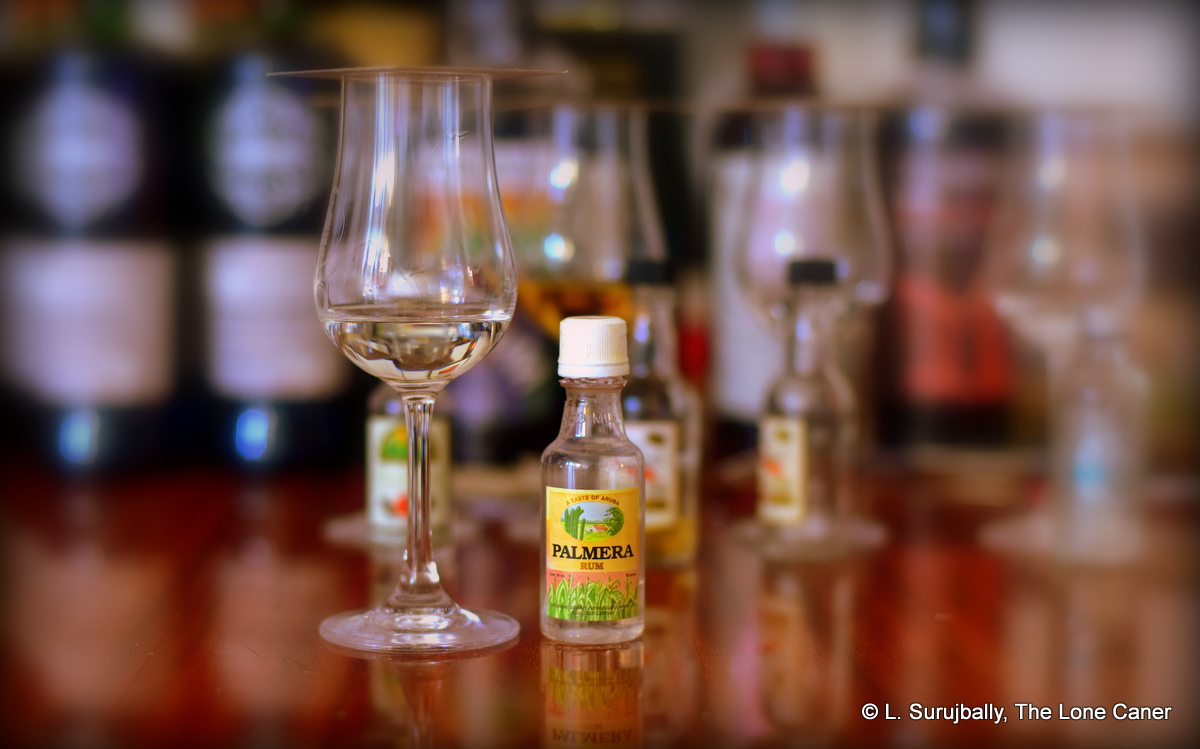
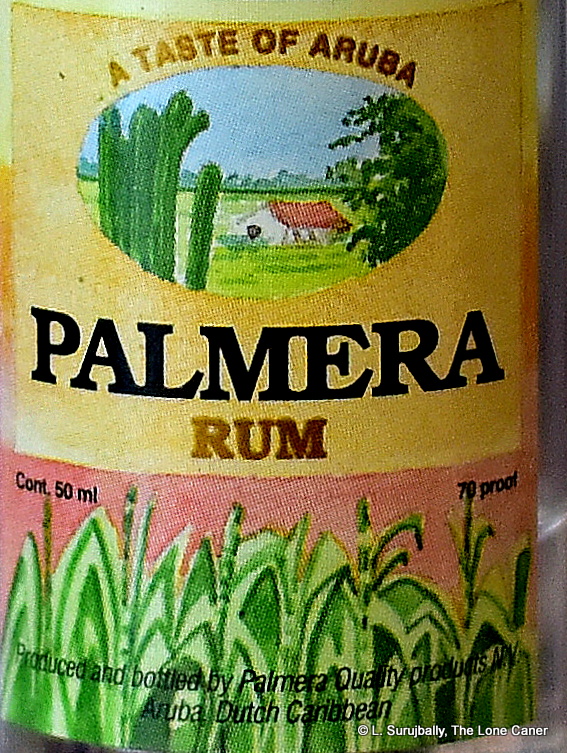
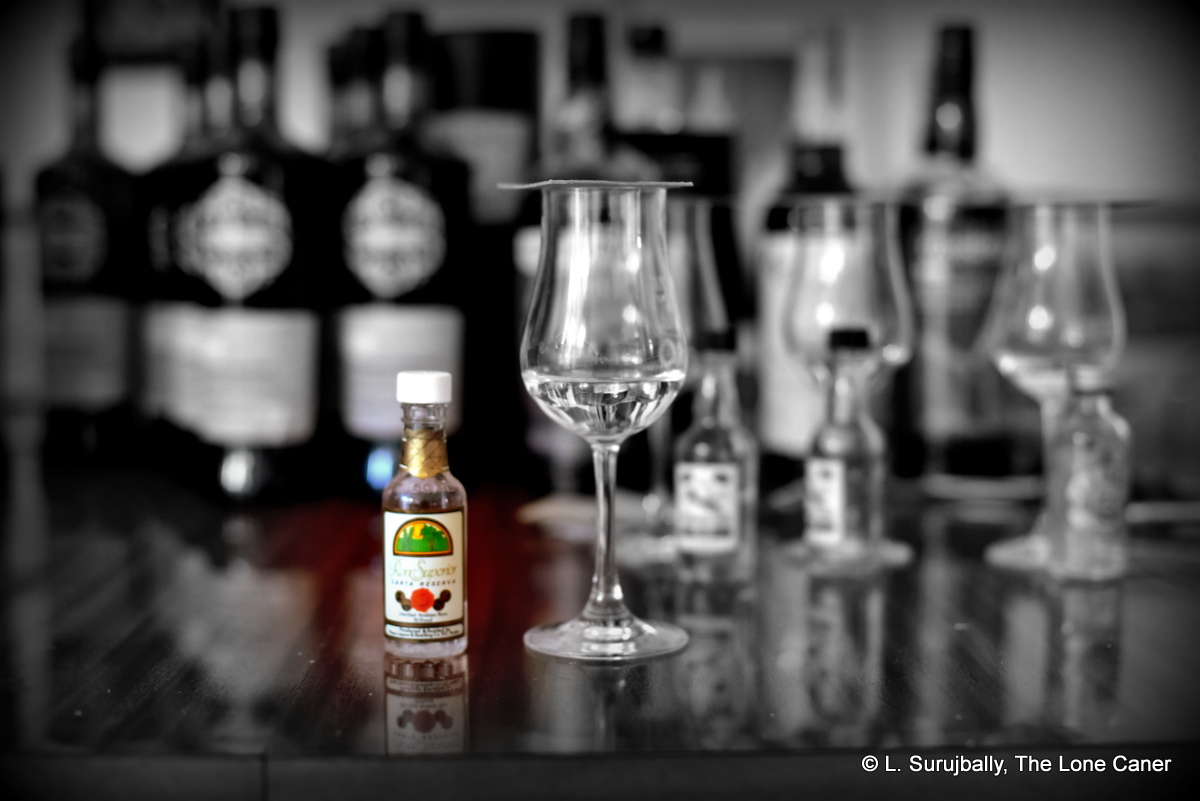
The fourth and last of the four Dutch West Indies rums that I obtained solely to shed some light on the islands is a pale 35% shrug of indifference called the Palmera White Aruba rum. You know me, I have a thing for unapologetically barking-mad high-proofed white rums – but dis ain’ dat, as my bushmen squaddies would say back in the old days.

Were you to google it, you’d find that the Palmera Quality Products company produces several rums – notably the White and the Dark “authentic Arubian rums with a rich heritage flavour” at standard strength, and is at pains to mention on its About page that “…PQP produces many different beverages in its own processing plant…[and] produces products locally from carefully developed formulas that meet international standards.” No mention of a distillery, a blender, a sugar cane source, an ageing regimen. Call me a cynic, but it sure implies a mass-produced neutral-spirits-treatment operation to me, not a rum made by a dynamic master blender who knows his sh*t, let alone by a distillery that can be identified.  

And maybe that’s why I can never find out anything about these companies, and why the Dutch West Indian islands’ rums – the San Pablo Gold label and Platinum White from Curacao and the Carta Reserva from Aruba – have singularly failed to make any lasting impression on the rumisphere. That might also explain why nobody ever posts an ecstatic hosanna on FB saying “I got this!” and then basks in the glory of the hunt concluded, the find immortalized, the cheers of the envious crowd modestly acknowledged.

So then, what was in the glass that day? A white rum, 35%, supposedly from Aruba (I suppose otherwise), and very little to go on beyond that. As befitting its puny mouse-that-roared proofage, it didn’t give off much of an aroma – sugar water, grass, dill, the sweetness of laundry detergent and a tad of lemon juice.  It was marginally more assertive than the Carta Reserva, and maybe a shade better balanced between some sweet and lemony components.

The taste was mostly sodas: 7-Up or Sprite, cream soda.  Some vanilla, coconut, and vague herbaceous flavours, sugar water and pears, and believe me, that was reaching. Maybe it’s an island thing, to make rums this weak (the current rums listed on the website are similarly proofed, bar a pair of 151s), but all a rum like this one can do is juice up a cocktail or give you a headache in hot weather because you won’t think something so mild could affect you, when of course it can.

The Palmera is as unprepossessing as all the others from the region I’ve sampled (bar the untried overproofed 151s).  It’s light and white, weak and meek, and after the first three tries with its cousins, I approached it with distinct lack of enthusiasm, and finished the tasting exercise with relief. The rum just, I dunno, has this indifferent air of “good ‘nuff” that offends me for some reason, like barely enough effort was put into it to make it sell, and no more. Even the Curacao San Pablo rums at least had the courage to go to 40% instead of messing around with this underwhelming strength.

Socrates remarked that “The unexamined life is not worth living.” Where I to apply that here and paraphrase, I’d add a codicil that the Palmera and its cousins makes inevitable – “Sometimes the examined rum is not worth drinking.”  Sorry, but here that’s God’s own truth, and the best I can say about it is that although it’s pointless and purposeless and near tasteless, let’s be grateful that at least it’s painless.

(#636)(64/100)


Other notes

The design of the modern labels is quite different from the one I bought, so I assume there’s been some changes over the years.  I don’t know if the blend or recipe was changed when the label did, nor am I aware when this happened

Jun 242019
 

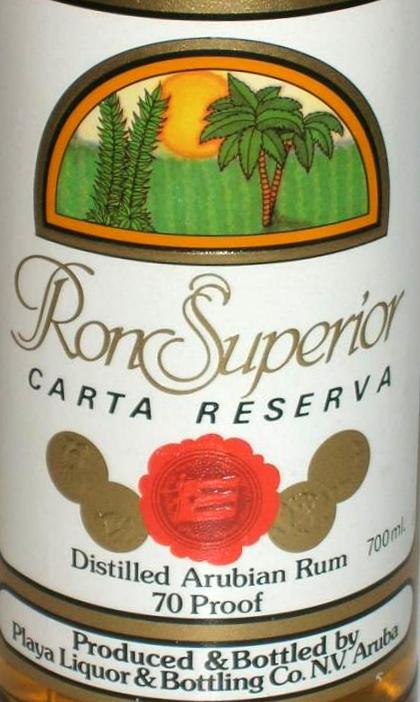
This is one of those strange rums that clearly exists, but about which nobody seems to know anything, even though I was informed it remains on sale in Aruba to this day. Jazz Singh out of the UK couldn’t help – he rather witheringly remarked that the only local stuff he found on the island was “a lot of imported column rubbish” and that the one distillery Aruba used to have is definitely closed. And good luck with finding any info on the company whose name is on the label, Playa Liquor and Bottling Co, ‘cause that’s equally opaque and non-communicative. So for the moment I’ll treat is a sort of low rent tourist trap hooch. In fact, I’m not even sure what else the company does, so spare is Playa’s online footprint, on FB or elsewhere.

There is an air of “generic” about the rum. It has a title used before – “Superior Carta Reserva” was also a 1970s Puerto Rican rum made for E.F. Debrot Inc (a liquor merchant in Aruba), and it’s white, it’s 35%, and that’s about all you’re going to get here.  I’d hazard a guess it’s a column still product, and that it’s made elsewhere under contract by a third party…assuming it continues to be made at all, because there’s simply no way that any rum company would not advertise its own product, even locally, with this kind of promotional black hole. 

Tasting notes, then, because what else can we do? Nose: a thin, watery, a slightly salty cream soda and Angostura bitters…what we used to call a “rockshandy” when I was a boy.  Plus vanilla and a whiff of citrus. There’s not much more – it’s like light alcoholic water and no aroma of any distinctiveness whatsoever.

Palate? Nope, not a whole lot there either. 35% ABV excites little beyond my indifference.  Even having it first thing in the morning with nothing else before, so that the strength would be less of a factor than later, achieved nothing.  A splash of salt water and an olive or two, vanilla again, a short, faint bite of a very ripe apple, and maybe a pear…or was that a cucumber? Who cares?  The thing is so dim, so bland, so lacking anything resembling character, that you be forgiven for thinking it was in witness protection. The best part is the short, sweet, slightly salty, slightly dry finish, because, you know, it finishes. 

So there we are. Probably molasses based, filtered, an uninspirational, boring, flaccid excuse for a rum, distinguished only by its remarkable lack of anything in particular. It’s a hollow rum, a watery alcohol delivery system, eliciting nothing in the rum drinker except perhaps a big yawn. I’ll just leave it there.

(#635)(65/100)

Jun 032019
 

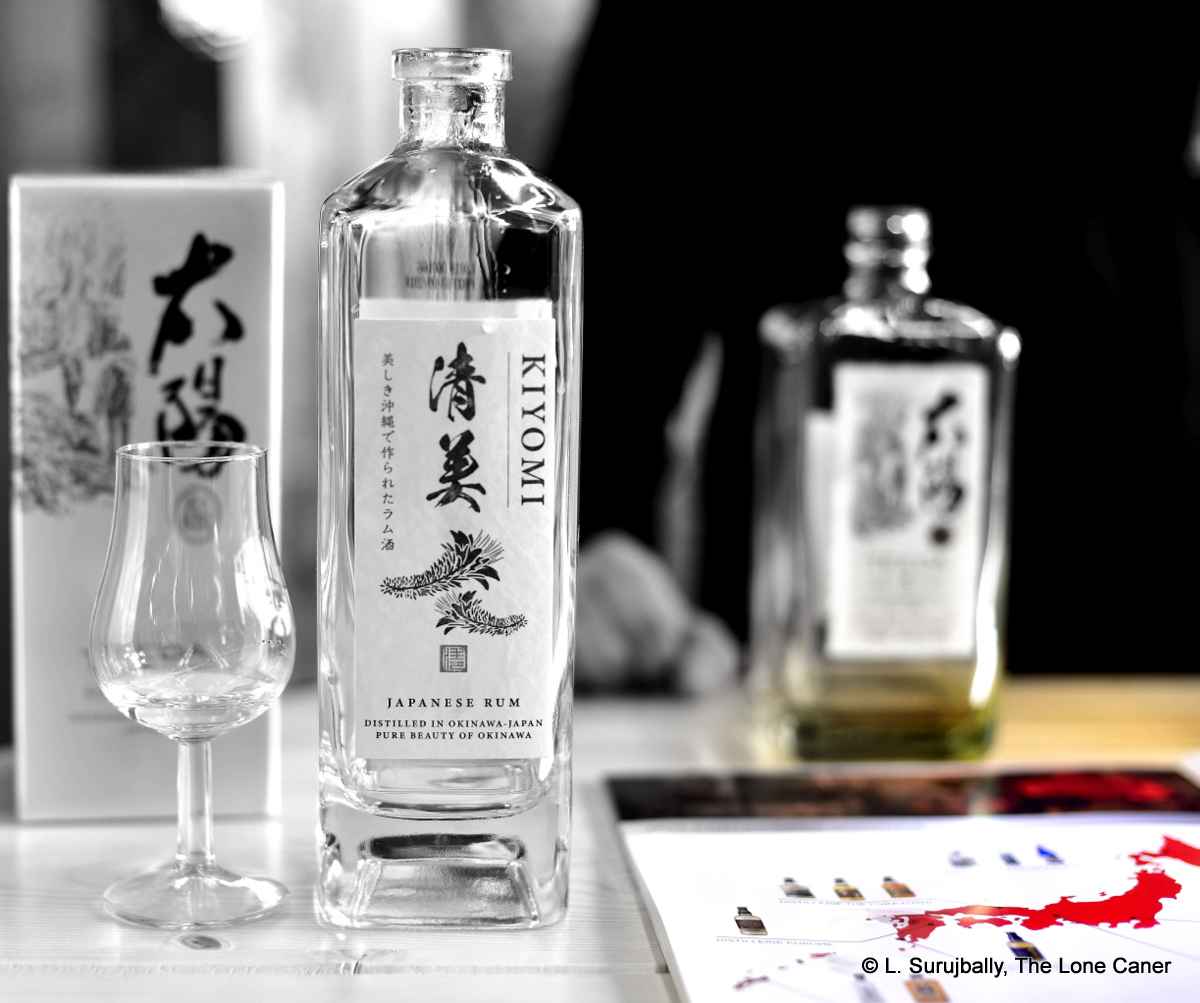
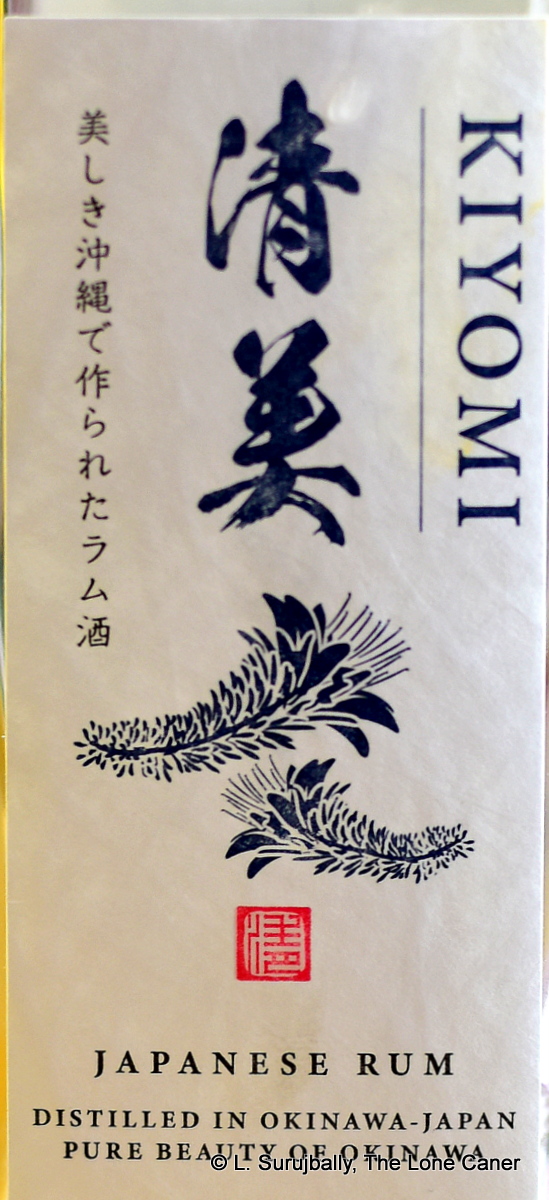
The Kiyomi white rum is made by the Helios Distillery, the same outfit in Japan that makes the very tasty five year old Teeda rum we looked at before. Formed by Tadashi Matsuda in the postwar years (1961) at a time of economic hardship and food privation for Okinawa , the decision was made to distill rum because (a) it could easily be sold to American soldiers stationed there (b) Okinawan sugar was readily available and (c) rice, which normally would have been used to make the more popular local sake, was needed as a food source and could not be spared for alcohol production.

That the company succeeded is evidenced by the fact that it is still in existence, has expanded its operations and is still making rums.  The two most popular are the Teeda 5 YO and the Kiyomi Unaged White, which do not share the same production process: while both source Okinawa sugar cane which is crushed to juice, the Kiyomi rum is fermented for longer (30 days instead of two weeks) and run through a double column still (not the pot).  It is then left to rest (and not aged) in steel tanks for six months and gradually reduced from 60% ABV off the still, to the 40% at which it is bottled.

I’ve never been completely clear as to what effect a resting period in neutral-impact tanks would actually have on a rum – perhaps smoothen it out a bit and take the edge off the rough and sharp straight-off-the-still heart cuts. What is clear is that here, both the time and the reduction gentle the spirit down without completely losing what makes an unaged white worth checking out.  Take the nose: it was relatively mild at 40%, but retained a brief memory of its original ferocity, reeking of wet soot, iodine, brine, black olives and cornbread. A few additional nosings spread out over time reveal more delicate notes of thyme, mint, cinnamon mingling nicely with a background of sugar water, sliced cucumbers in salt and vinegar, and watermelon juice. It sure started like it was out to lunch, but developed very nicely over time, and the initial sniff should not make one throw it out just because it seems a bit off.

It was much more traditional to taste – soft, gentle, quite easy to sip, the proof helping out there. After the adventurousness of the nose which careened left and right and up and down like your head was a pinball machine, this was actually quite surprising (and somewhat disappointing as well).  Anyway it lacked any kind of aggressiveness, and tasted initially of glue, brine, olives, gherkins and cucumbers – the ashes and iodine I had sniffed earlier disappeared completely. It developed with the sweet (sugar water, light white fruits, watermelon juice) and salt (olives, brine, vegetable soup) coming together pleasantly with light florals and spices (cinnamon, cardamom, dill), finishing off with a sort of quick and subdued exit that left some biscuits, salt crackers, fruits and rapidly disappearing spices on the tongue and fading rapidly from memory.

This is a rum that started with a flourish but finished…well, not in first place.  Though its initial notes were distinct and shown off with firm emphasis, it didn’t hold to that line when tasted, but turned faint, and ended up taming much of what made it come off as an exciting drink at the inception. That said, it wasn’t a bad one either: the integration of the various notes was well done, I liked most of what I did taste, and it could as easily be a sipping drink as a mixer of some kind.  What makes it noteworthy in this respect is that it doesn’t entirely become some sort of anonymously cute and light Cuban blanco wannabe you forget five minutes after putting down the glass, but retains a small spark of individuality and interest for the diligent. A shame then, that all this makes you think of, is that you’re holding an unfulfilled and unfinished promise — a castrated clairin  if you will — in your hand. And that’s a crying shame for something that’s otherwise so well made.

(#630)(82/100)

May 262019
 

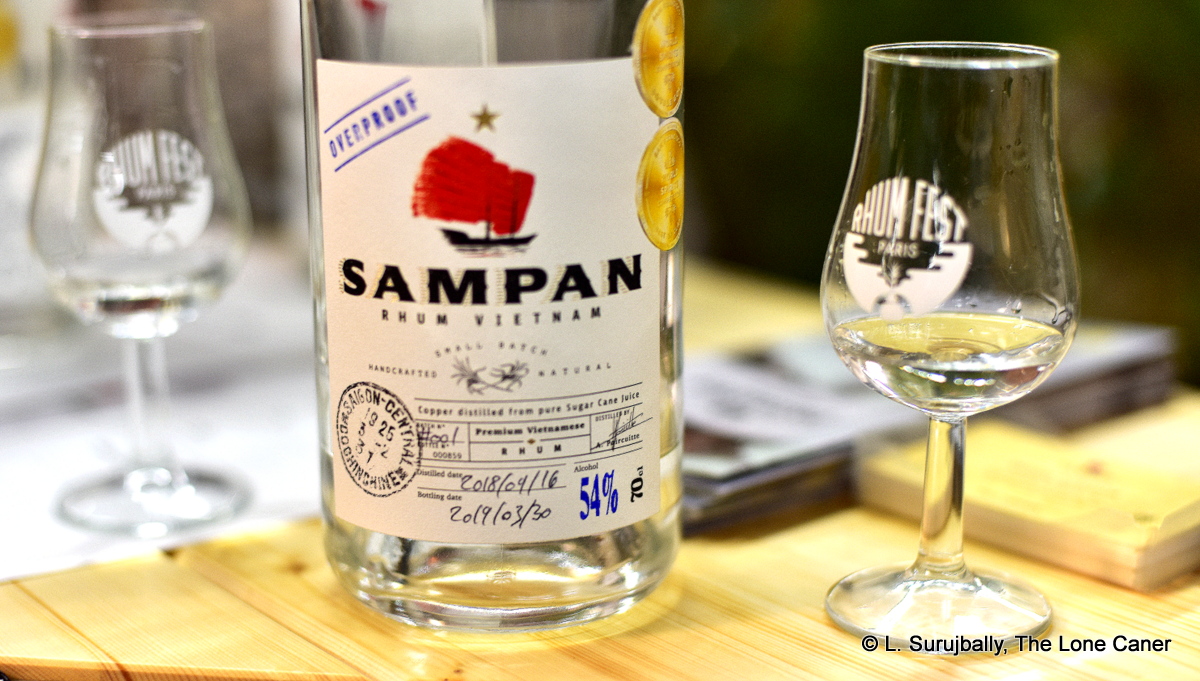
The Sampan Vietnamese Rhum is made by the Distillerie d’Indochine: and Antoine Pourcuitte, a long haired Frenchman who seems to be channelling Fabio and who lives in Vietnam, is the man who bootstrapped his desire to make good rums into a business that combines a small hotel and bar close to the beach with a distillery he pretty much built himself (officially it opened for business in late 2018). This newly constructed establishment, which produces one of those excellent white rhums which must be causing the French islands conniption fits, is his brainchild… and it can take its place proudly in the league of small and new fast moving ops who are taking a pure rhum approach to distillation in Asia.

Vietnam’s common tipple of choice is rượu (ruou), a local artisanal spirit somewhat akin to arrack of Indonesia, made from fermented rice or molasses or cane juice and run through backroad, backwoods or back-alley alembics and home-made stills that puff and fart and produce some low grade (but very palatable) moonshine. Like in other rural regions of the world which have a long history of indigenous small-scale spirits manufacture – Africa, Haiti and Mexico come to mind – these are largely individual enterprises not regulated or even acknowledged by any authority.

Mr. Poircuitte, who came to rum via wine and not whisky (something like Florent of the Compagnie) put a bit more professionalism into his company, and production cycle is not too different from the Caribbean islands, all in all.  The cane is all organic, pesticide free, grown in the area around Hội An, in the Qu lang Nam province, harvested by hand and then transported within 24 hours to the distillery, which is 40km away from the fields, for crushing. The resultant juice is fermented for 3 to 4 days, resulting in an initial wash of about 11% ABV, which is then run through their 11-plate single-column copper still that torques things up to around 70% ABV. Three varieties of this rhum are produced, at various strengths: 45% standard, 54% overproof and the 65% full proof.

What’s interesting here is that Sampan does not bottle it straight off the still, but lets it rest for something under one year in inert inox tanks, and this gives the resultant rum – which is not filtered except for sediments – a taste of serious fresh-off-the-still juice.

Consider first the nose of this blanc, which is stuffed into the bottle at a beefy 54% ABV. It’s musty, redolent of freshly turned sod and grass.  I could say it smells dirty and not mean it in a bad way, and that is not all: it also smells briny, olive-y, balanced off with clear, fresh, 7-Up and lemon juice and sugar cane sap, plus a smorgasbord of light fruits like pears, ripe apples, and white guavas, a little vanilla and cookies.  The strength doesn’t hurt it at all, it’s strong and firm without every being too sharp to enjoy as it is.

Thankfully, it doesn’t sink on the taste, but follows smoothly on from what had been discerned on the nose. Here, we didn’t just have a few olives, but what seemed like a whole grove of them. Again it tasted dirty, loamy, and also pungent, with initially clear notes of sweet sugar cane juice and sweet yellow corn, to which are added some lemon sherbet, vanilla and aromatic light fruits (pears, watermelon, strawberries) plus herbs – dill and basil.  Soft and lightly sweet, and there’s a background hint of anise as well, or licorice, really nice. Throughout the tasting it stays firm and assertive on the tongue, with a near silky mouthfeel leading to an exit that is pleasantly long lasting and with closing notes of fruits, vanilla, coconut water, and breakfast spices.

This is a really nice white rhum – it married the freshness of an agricole with the slight complexity of an entry level vieux and the balance between the various elements was very nicely handled. That pungent opening clearly makes the case that even with the resting period, it was an unaged rhum, something like the Sajous, the Paranubes, A1710, Toucan, Barbosa Grogue, HSE Parcellaire or others of that kind – I liked it a lot, and if it didn’t win any medals, I firmly believe it should at least win a few wallets.

Many of the older Asian rhums which have sold  gangbusters in their countries of origin for decades, catered to indigenous tastes, and cared little for western styles of rum.  They were (and are) sometimes made in different ways, using different materials in the process, are sometimes spiced up and almost always light column-still blends issued at standard strength. We are seeing a gradual change here, as a wave of small distilleries are setting up shop in Asia and producing small quantities of some really interesting juice. This one from Vietnam is now on my radar, and I look forward to seeing not only what they come up with in the future, but what that Overproof 65% of theirs tastes like — and if it blows my hair back and my socks off, well, then I’ll consider it money well spent…as I did with this one.

(#627)(84/100)


Other Notes

  • The company is named after the slow moving boats similar to Chinese junks, which ply the Mekhong River and the coastal areas around South East Asia.
  • My intial review noted that it was aged for 8 months in ex-French-oak casks, based on my conversation and scribbled notes at the Paris rhumfest (not with Mr. Poircuitte but with his pretty assistant, in the maelstrom of the first day’s crowds) – I was later contacted directly to be advised this was a miscommunication, that the rum rested for 8 months in steel tanks, and so I have amended the post for the correction.
May 152019
 

(c) Duty Free Philippines website

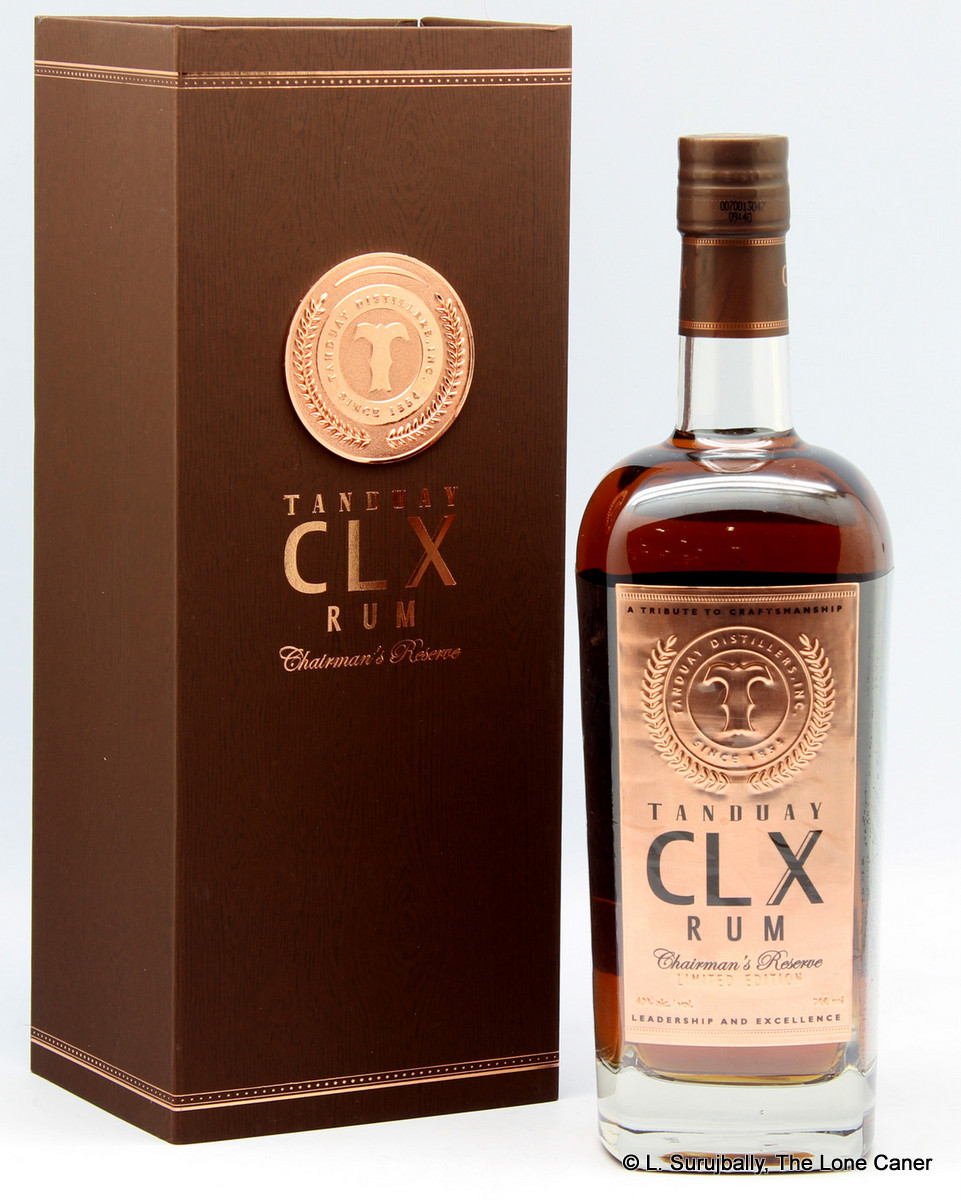
Tanduay, for all its small footprint in the west, is one of the largest rum makers in Asia and the world (they’re either 1st or 2nd by sales volume, depending on what you read and when), and have been in business since 1854. Unsurprisingly, they see fit to commemorate their success with special editions, and like all such premiums with a supposedly limited release meant only for the upper crust, most can get one if they try. The question is, as always, whether one should bother.

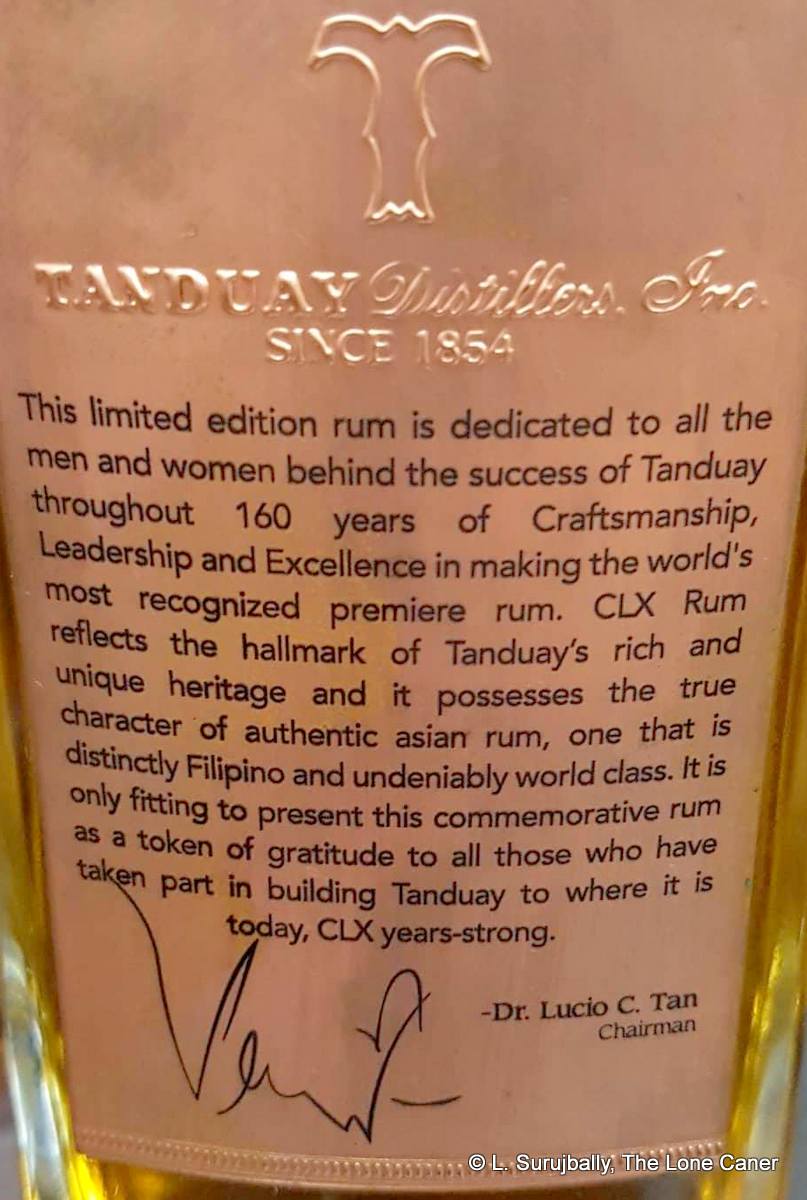
The presentation of the CLX rum is good – boxed enclosure, shiny faux-gold label, solid bottle.  And all the usual marketing tantaraas are bugled from the rooftops wherever you read or look. It’s a selection of their best aged reserves, supposedly for the Chairman’s personal table.  It has a message on the back label from said Chairman (Dr. Lucio Tan) extolling the company’s leadership and excellence and the rum’s distinctive Filipino character (not sure what that is, precisely, but let’s pass on that and move on…). All this is par for the course for a heritage rum. We see it all the time — kudos, self praise, unverifiable statements, polishing of the halos. Chairmen get these kinds of virtuous hosannas constantly, and we writers always smile when we hear or see or read them.

Because, what’s missing on this label is the stuff that might actually count as information – you know, minor, niggly stuff like how old it is; what kind of still it was made on; what the outturn was; what made it particularly special; what the “CLX” stands for…that kind of thing.  Not important to Chairmen, perhaps, and maybe not to those maintaining the Tanduay website, where this purportedly high-class rum is not listed at all – but to us proles, the poor-ass guys who actually shell out money to buy one. From my own researches here’s what I come up with: CLX is the roman numerals for “160” and the rum was first issued in 2014, based on blended stocks of their ten year old rums.  It is more than likely a column still product, issued at standard strength and that’s about all I can find by asking people and looking online.

Anyway, when we’re done with do all the contorted company panegyrics and get down to the actual business of trying it, do all the frothy statements of how special it is translate into a really groundbreaking rum?

Judge for yourself. The nose was redolent, initially, of oatmeal chocolate-chip cookies and cereals…like Fruit Loops, I’m thinking.  There are also light acetones and nail polish remover. There may be an orange pip or two, a few crumbs of chocolate oranges, or maybe some peach fuzz drifting around, but it’s all thin pickings – maybe it’s the 40% ABV that’s at the root of it, maybe it’s the deliberately mild column still character that was chosen. There is some vanilla and toffee background, of course, just not enough to matter – for this to provide real oomph it really needed to be a bit stronger, even if just by a few points more.

The same issues returned on the very quiet and gentle taste.  It seemed almost watery, light, yet also quite clean. A few apples and peaches, not quite ripe, providing the acid components, for some bite.  Then red grapes, cinnamon, aromatic tobacco, light syrup, vanilla, leather for the deeper and softer portion of the profile. It’s all there, all quite pleasant, if perhaps too faint to make any statement that says this is really something special.  And that standard proof really slays the finish, in my own estimation, because that is so breathy, quiet and gone, that one barely has time to register it before hustling to take another sip just to remind oneself what one has in the glass.

How the worm has turned.  Years ago, I tried the 12 year old Tanduay Superior and loved it. It’s placidity and unusual character seemed such a cut above the ordinary, and intriguingly tasty when compared to all the standard strength Caribbean blends so common back then.  That tastiness remains, but so does a certain bland sweetness, a muffled deadness, not noted back then but observed now….and which is no longer something to be enjoyed as much.

I have no issue with the standard Tanduay lineup — like the white, the 1854, the Gold, the Superior etc —  being deceptively quiet and mild and catering to the Asian palate which I have been told prefers rather more unaggressive fare (some of their rums are bottled south of 39%, for example).  I just believe that for an advertised high-end commemorative rum which speaks to a long and successful commercial company history, that more is required. More taste, more strength, more character, more oomph. It’s possible that many who come looking for it in the duty free shops of Asia and blow a hundred bucks on this thing, will come away wishing they had bought a few more of the Superiors, while others will be pleased that they got themselves a steal.  I know which camp I fall into.

(#624)(75/100)


Other notes

As always, thanks to John Go, who sourced the rum for me.

May 092019
 

Like most rums of this kind, the opinions and comments are all over the map.  Some are savagely disparaging, other more tolerant and some are almost nostalgic, conflating the rum with all the positive experiences they had in Thailand, where the rum is made. Few have had it in the west, and those that did weren’t writing much outside travel blogs and review aggregating sites.

And that’s not a surprise. If you exclude the juice emerging from new, small, fast-moving micro-distilleries in Asia, and focus on the more common brands, you’ll find that many adhere to the light latin-style column-still model of standard strength tipple…and many are not averse to adding a little something to make your experience…well, a smoother one; an easier one. These rums sell by the tanker-load to the Asian public, and while I’m sure they wouldn’t mind getting some extra sales, restrict themselves to their own region…for now.

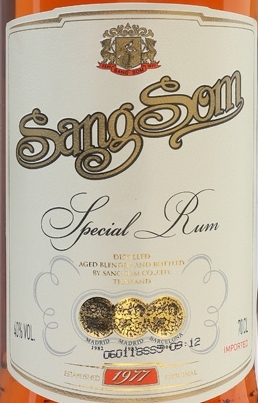
One of these is the Thai Sang Som Special Rum, which has been around since 1977 and has supposedly garnered a 70% market share for itself in Thailand.  This is a rum made from molasses, and apparently aged for five years in charred oak barrels before being bottled at 40% ABV. Back in the 1980s it won a clutch of medals (Spain, 1982 and 1983) and again in 2006, which is prominently featured in their promo literature…yet it’s almost unknown outside Thailand, since it exports minimal quantities (< 1% of production, I’ve read).  It is made by the Sang Som company, itself a member of Thai Beverage, one of the largest spirits companies in the world (market cap ~US$15 billion) – and that company has around 18 distilleries in the region, which make most of the rum consumed in and exported by Thailand: SangSom, Mangkorn Thong, Blend 285, Hong Thong, and also the Mekhong, which I tried so many years ago on a whim.

The rum doesn’t specify, but I’m going out on a limb and saying, that this is a column still product.  I can’t say it did much for me, on any level – the nose is very thin, quite sweet, with hints of sugar cane sap, herbs, dill, rosemary, basil, chopped up and mixed into whipped cream.  Some cinnamon, rose water, vanilla, white chocolate and more cream. Depending on your viewpoint this is either extremely subtle or extremely wussy and in either case the predominance of sweet herbal notes is a cause for concern, since it isn’t natural to rum.

No redemption is to be found when tasted, alas, though to be honest I was not really expecting much here.  It’s very weak, very quiet, and at best I can suggest the word “delicate”. Some bright ripe fruits like ripe mangoes, red guavas, seed-outside cashew nuts.  Coconuts, flowers, maybe incense. Also lighter notes of sugar water, watermelon, cucumbers, cinnamon, nutmeg – Grandma Caner said “gooseberries”, but I dispute that, the tartness was too laid back for that rather assertively mouth-puckering fruit. And the finish is so light as to be to all intents and purposes, indiscernible. No heat, no bite, no final bonk to the taste buds or the nose.  Some fruit, a little soya, a bit of cream, but all in all, there’s not much going on here.

All due respect for the tourists and Asians who have no issues with a light rum and prefer their hooch to be devoid of character, this is not my cup of tea – my research showed to to be a spiced rum, which explains a lot (I didn’t know that when I was trying it).  It’s light and it’s easy and it’s delicate, and it requires exactly zero effort to drink, which is maybe why it sells so well – one is immediately ready to take another shot, real quick, just to see if the next sip can tease out all those notes that are hinted at but never quite come to the fore. The best thing you can say about the matter is that at least it doesn’t seem to be loaded to the rafters with sugar, which, however, is nowhere near enough for me to recommend it to serious rumhounds who’re looking for the next new and original thing.

(#622)(68/100)

May 022019
 

Like those tiny Caribbean islands you might occasionally fly over, the Maria Loca cocktail bar in Paris is so miniscule that if you were to sneeze and blink you’d go straight past it, which is what happens to us, twice. When Mrs. Caner and I finally locate it and go inside, it’s dark, it’s hectic, it’s noisy, the music is pounding and the place is going great guns. At the bar, along with two other guys, Guillaume Leblanc is making daiquiris with flair and fine style, greeting old customers and barflies and rumfest attendees, the shaker never still. Even though he doesn’t work there, he seems to know everyone by their first name, which to me makes him a top notch bartender even without the acrobatic or mixing skills.

In a dark corner off to the side are wedged Joshua Singh and Gregers Nielsen, a quartet of bottles in front of them.  Part of the reason they’re here is to demonstrate the Single Barrel Selection of their Danish company (named “1423” after the number on that first barrel of rum the outfit ever bottled back in 2008) and how they fare in cocktails. Nicolai Wachmann and Mrs. Caner have been drafted to help out and I’m squished in there as well to do my review thing and take notes in the Little Black Book (since the Big Black Book didn’t fit into my pocket when I was heading out).

Three of these bottles are formal SBS releases by 1423, and there’s a Jamaican, a Trini and one from Mauritius. The fourth is a white-lightning tester from (get this!) Ghana, and I haven’t go a clue which one to start with. Nicolai has four glasses in front of him and somehow seems to be sipping from all four at once, no help there. Mrs. Caner, sampling the first of what will be many daiquiris this evening, and usually so fierce in her eye for quality rums, is raptly admiring Guillaume’s smooth drink-making technique while batting her eyes in his direction far too often for my peace of mind. Fortunately, I know he’s engaged to a very fetching young miss of his own, so I don’t worry too much.

“Any recommendations?” I ask the rotund Joshua who’s happily pouring shots for the curious and talking on background about the rums with the air of an avuncular off-season Santa Claus.  How he can talk to me, pour so precisely, have an occasional sip of his own, discuss technical stuff and call out hellos to the people in the crowd all at the same time is a mystery, but maybe he’s just a better multi-tasker than I am.

“Try the Jamaican,” he advises, and disappears behind the bar.

“Not the Trinidadian?” I ask when he pops back up on this side, two new daiquiris in his hand.  Mrs. Caner grabs one immediately, and, with the skill born of many vicious battles getting on-sale designer purses in the middle of frenzied mobs of other ladies, fends off Nicolai’s eager hands and shoves him into the wall in a way that would make a linebacker weep.  He looks at me like this is my fault.

“It’s not a Caroni, so you might feel let down,” Josh opines, handing the second cocktail glass to another customer. “It’s Angostura, and you’re a rumdork, so…” He shrugs, and I wince.

Since I’m writing an on-again, off-again survey of rums from Africa (50 words and I’m done, ha ha), the Ghana white rum piques my interest, and I turn to Gregers, who is as tidy and in control as ever.  I suspect he lined up his pens and papers with the edge of his desk in school. “The Ghana, you think?”
He considers for a moment, then shakes his head and pours me a delicate, neat shot of the Mauritius 2008. “Better start with this one.  It’s a bit more…mellow. And anyway, you tried the Ghana last year in Berlin. If you need to, you can try it again later.”

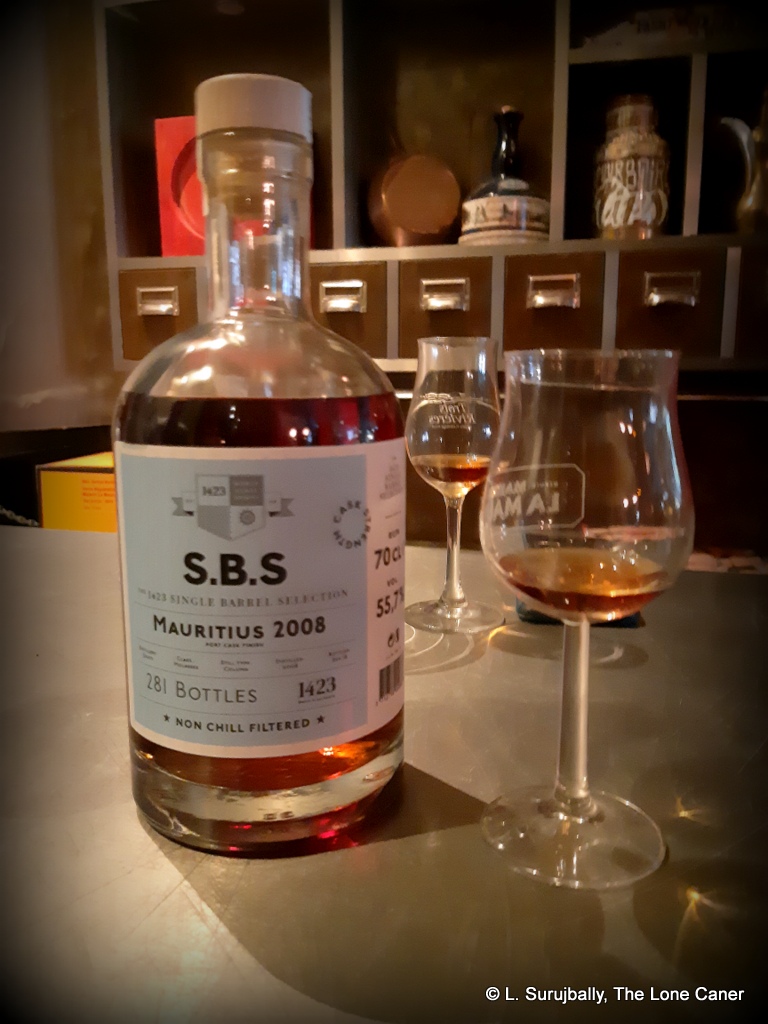
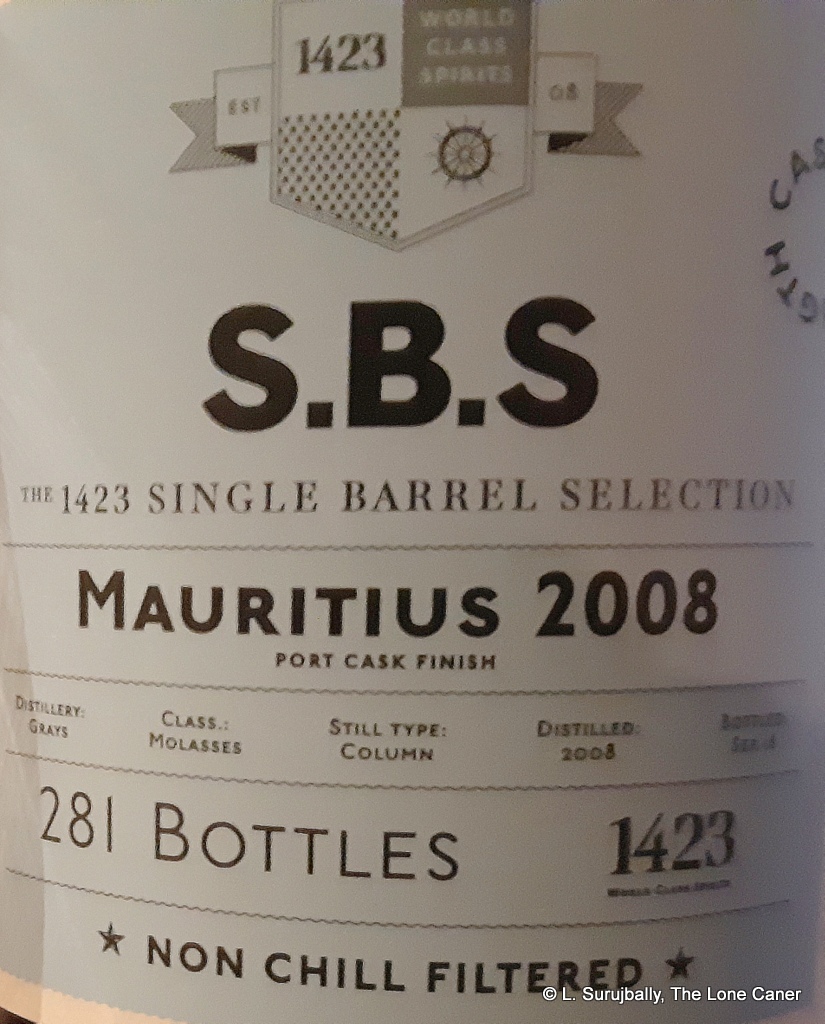
The rum winks invitingly at me.  I take a quick moment to snap some pictures of the bottle, thinking again how far labels have come in the last decade.  Velier started the trend, Compagnie des Indes provides great levels of detail, and others are following along, but what I’m seeing here is amazing. The label notes the distillery (Grays, which is a famed family name as well – they make the New Grove and Lazy Dodo line of rums but not the St. Aubins); the source, which in this case is molasses; the still type – column; distillation date – 2008; bottling date – 2018; and other throwaway details such as the non-chill-filtration, the port wine finish, the 281-bottle outturn, and the 55.7% ABV strength.  I mean, you really couldn’t ask for much more than that.

I nose the amber spirit gently, and my eyes widen.  Wow. This is good. It smells of toblerone, white chocolate, vanilla and almonds but there are also lighter and more chirpy notes swirling around that – gooseberries, ginger shavings, green grapes, and apples. And behind that are aromas of dark fruit like plums, prunes and dates, together with vague red-wine notes, in a very good balance. Musky, earthy smells mix with lighter and darker fruits in a really good amalgam – you’d never confuse this with a Jamaican or a Guyanese or a Caroni or a French island agricole.  I glance over at Mrs. Caner to get a second opinion, but she’s ogling some glass-flipping thing Guillaume is doing and so I ask Nicolai what he thinks. He checks glass #2 on his table and agrees it is a highly impressive dram, just different enough from the others to be really interesting in its own way. He loves the way the finish adds to the overall effect.

As I’m scribbling notes into the LBB, I ask Gregers slyly, “Is there anything you’ve been told not to tell me about the rum?” He is like my brother, but business, blood and booze don’t always mix, trust is earned not freely given, and I’m curious how he’ll answer. Nicolai’s ears perk up and he pauses with his nose hanging over the third glass.  Though he doesn’t talk much, his curiosity and rum knowledge are the equal of my own and he likes knowing these niggly little details too.

“Nope. Any question you have, we’ll answer.” Gregers and Joshua exchange amused looks. Truth to tell, there are two omissions which only a rum nerd would ask for or actively seek out.  I wonder if they’re thinking the same thing I am. So:

“Additives? You don’t mention anything about them on the label.”  And given how central such a declaration is these days to new companies who want to establish their “honesty” and street cred, an odd thing to have overlooked – at least in my opinion.

Joshua doesn’t miss a beat. He confirms the “no additives” ethos of the SBS line of rums, and it was not considered necessary to be on the label – plus, if some weird older gunk from Panama or Guyana, say, were to be bottled in the future and then found to be doctored by the original producer, maybe with caramel, then 1423 would not have egg over its face, which makes perfect sense.  Then, before I ask, he and Gregers tell me that this rum is actually not from a single barrel but several casks blended together. Well…okay (there’s full detail in “other notes” below, for the deeply curious).
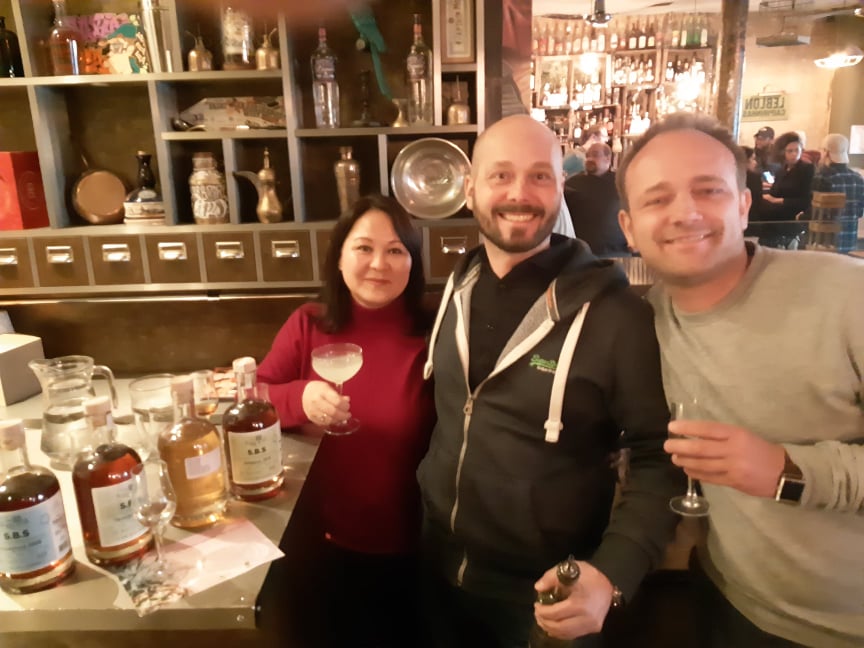
The bar is getting noisier, more crowded.  Pete Holland of the Floating Rum Shack just turned up and is making the rounds, pressing the flesh, because he knows, like, everyone – alas, his pretty wife is nowhere in sight. Jazz and Indy Singh of Skylark are in-country but must have missed this event because no sign of their cheerful bearded forms. Yoshiharu Takeuchi of Nine Leaves is in center-court, telling a hilarious R-Rated story I cannot reprint here (much as I’d like to) of how he was mugged in Marseilles while taking a leak in an alleyway, and Florent Beuchet of the Compagnie is mingling – I shout a hello at him over the heads of several customers.  He waves back. The cheerfully bearded and smiling Ingvar “Rum” Thomsen (journalist and elder statesman of the Danish rum scene) is hanging out next to his physically polar opposite, Johnny Drejer (tall, slim, clean-shaven); Johnny and I briefly discuss the new camera I helped him acquire, and some of his photographs and the state of the rumiverse in general. There are probably brand reps and other French rumistas in attendance, but I don’t recognize anyone else and the ones I do know are AWOL:  Laurent is still on his round the world expedition with his family (but not the poussette), Cyril doesn’t attend these things and I don’t know Roger Caroni by sight. All I can see is that everyone is enjoying themselves thoroughly and the loud hum of intense and excited (and perhaps drunken) conversation is electric. The energy level of the bar is off the scale.

Guillaume has finished his cocktail twirling demo and lost my wife’s attention, I note happily. He’s mixing more drinks for another small group of people who just wandered in. Mrs. Caner is now deep in conversation with Nicolai about his marital status and that of her entire tribe of single female relatives. After landing me like a prize trout all those years ago, my pretty little wife has developed a raging desire to “help out” any single person of marriageable age — and she’s seen Hitch like forty-seven times, which doesn’t help.  Anyway, they’re both ignoring the rums in front of them, so I roll my eyes at this blasphemy and continue on to the tasting.

And let me tell you, that Mauritius rum tastes as good as it smells, if perhaps a little sharper and drier on the tongue than the aromas might suggest. It really is something of a low-yield fruit bomb.  Raspberries, strawberries, lemon peel, ginger and sherbet partied hard with the deeper flavours of prunes, molasses, vanilla, nuts, chocolate mousse, ice cream and caramel…and a touch of coca cola, tobacco and seaweed-like iodine.  There’s even a sly hint of brine, thyme, and mint rounding things off, transferring well into a lovely smooth finish dominated by candied oranges, a sharp line of citrus peel, and a very nice red wine component that completes what was and remains, a really very good drink.  It is like a curiously different Barbados rum, with aspects of Guyana and Jamaica thrown in for kick, but its quality is all its own, and hopefully allows the island to get more press in the years to come. For sure it is a rum to share around.

With some difficulty, I manage to catch Mrs. Caner’s eye and pass the glass over to her, because I think this is a rum she’d enjoy too.  Somehow even after all the daiquiris she’s been getting, her eyes are clear, her speech is unslurred, her diction flawless, and I may be biased but I think she looks absolutely lovely.  As she tries the SBS Mauritius, I can see she appreciates its construction as well and she compliments Joshua and Gregers on their selection. “This is great,” she remarks, then provides me with a whole raft of detailed tasting notes, which I have mysteriously lost and none of which somehow have made it into this essay.

Nicolai, over in his corner, is happy to cast some other comments on to the table regarding the SBS Mauritius, all positive.  We all agree, and I tell Gregers, that this is one fine rum, and if I could, I’d buy one, except that I can’t. My wife, having delivered herself of her earth shaking opinion, immediately beelines over to the bar area where Guillaume’s fiancee and sister have just arrived, most likely because she’s had enough of all the testosterone in our corner and wants some real conversation with people who are specifically not certifiable about rum.
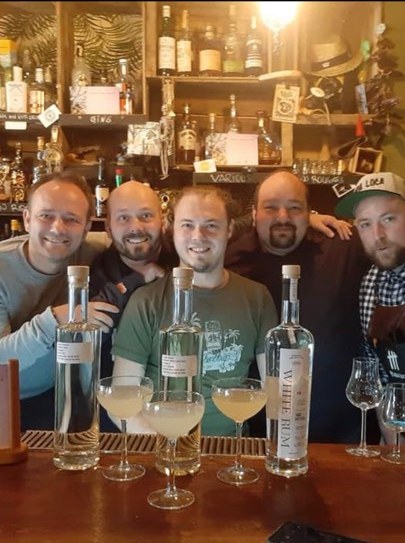
L-R – Nicolai, Gregers, Guillaume, Joshua and one of the bartenders from that evening whose name I did not get, sorry.

I want some fresh air so Joshua and I go outside the bar for a smoke (the irony does not escape us).  The nighttime air of Paris is crisp and cool and I remember all the reasons I like coming here. We discuss 1423 and their philosophy, its humble beginnings more than ten years ago, though that remains outside the scope of this essay.

“So, the Mauritius was pretty good,” I remark, pleased to have started off this fest (and 2019) on a good rum, a tasty shot.  He courteously does not ask for my score which for some obscure reason is all that some people want. “What do you think I should try next?”

He smiles, reminding me once again of Santa Claus in civilian clothes and taking a breather from gift giving, mingling with the common folk. “Oh the Jamaica, for sure.  That’s a DOK, PX finished, pot still aged in 40-liter barrels…and let me tell you, there’s some really interesting stories behind that one -”

I stop him. My fingers are twitching. “Hang on.  I gotta write that down. Let’s go inside, pour a shot, and you can tell me everything I need to know while I try it.  I don’t want to miss a thing.”

And while it’s not exactly relevant to the Mauritius rum I’m supposed to be writing about here, that’s pretty much what we ended up doing, on a cool evening in the City of Lights, spent in the lively company of my beautiful wife, and assorted boisterous, rambunctious geeks, reps, writers, drinkers, bartenders and simply good friends. You just can’t do a rum tasting in better surroundings than that.

(#620)(87/100)


Other Notes

  • In one of those curious coincidences, the Fat Rum Pirate penned his own four-out-of-five star review of the same rum just a few days ago. However, the first review isn’t either of ours, but the one from Kris von Stedingk, posted in December 2018 on the relatively new site Rum Symposium. He was also pretty happy with it
  • Background on the rum itself:
    • Joshua met with a rep from Grays from Mauritius a few years ago at the Paris Rhumfest; he brought a number of different cask samples from the warehouse. 1423 ended up choosing two, which were about 9 years at this time
      • The first was aged seven years in a 400-liter French Limousin oak, followed by two more in Chatagnier (Chestnut).
      • The second was again aged seven years in a 400-liter French Limousin oak, followed by two years in Port.
    • 1423 ordered both of them but ended up receiving 400 liters of the Chatagnier cask and 120 liters of the Port both now with another ageing year in their respective casks. All of this was blended together when delivered to Denmark and the 2018 release was basically the first 200 liters, all tropical aged. The remaining 320 liters are still in the Denmark warehouse waiting for a good idea and the right time to release.
Mar 262019
 

Rumaniacs Review # 095 | 0611

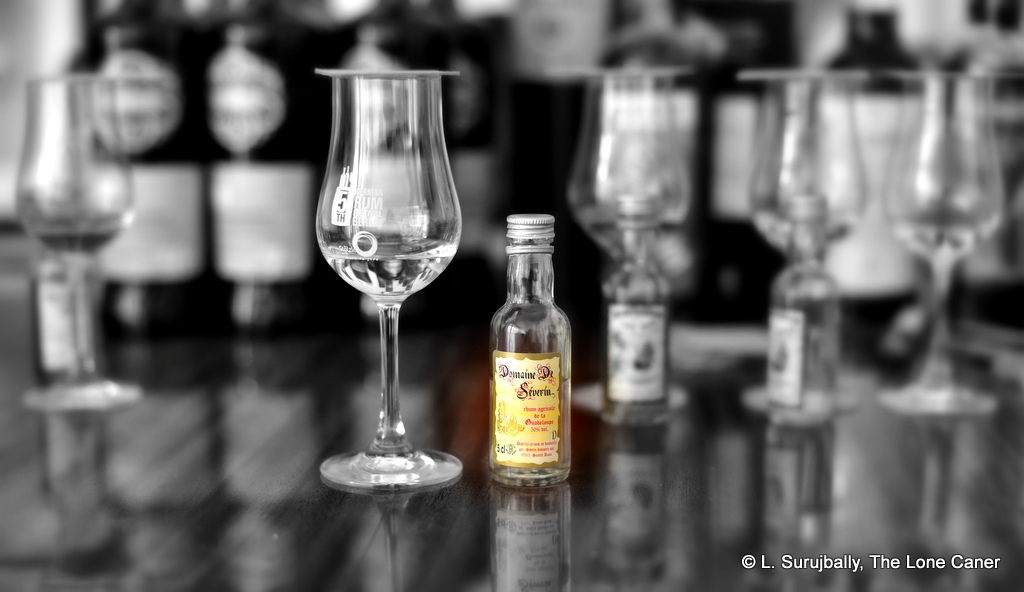
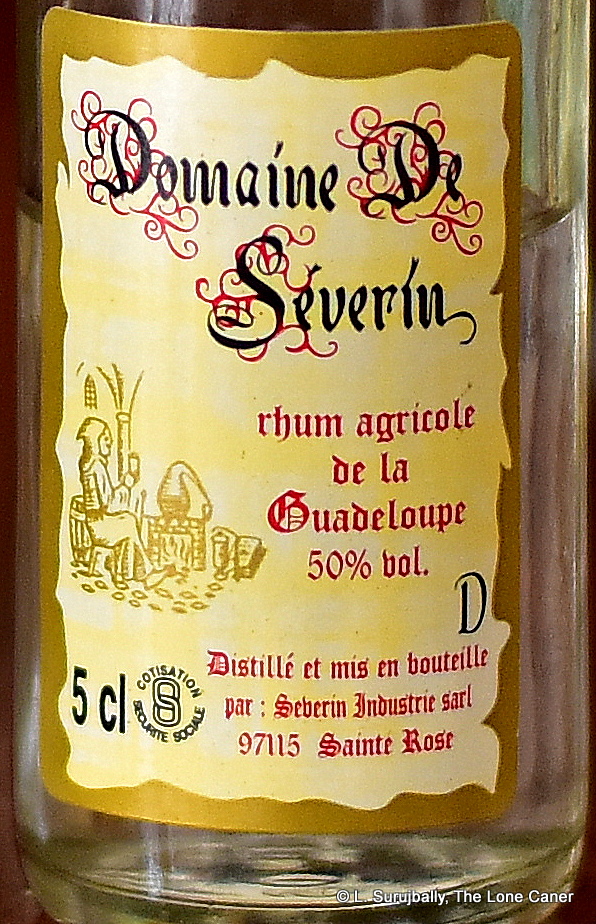
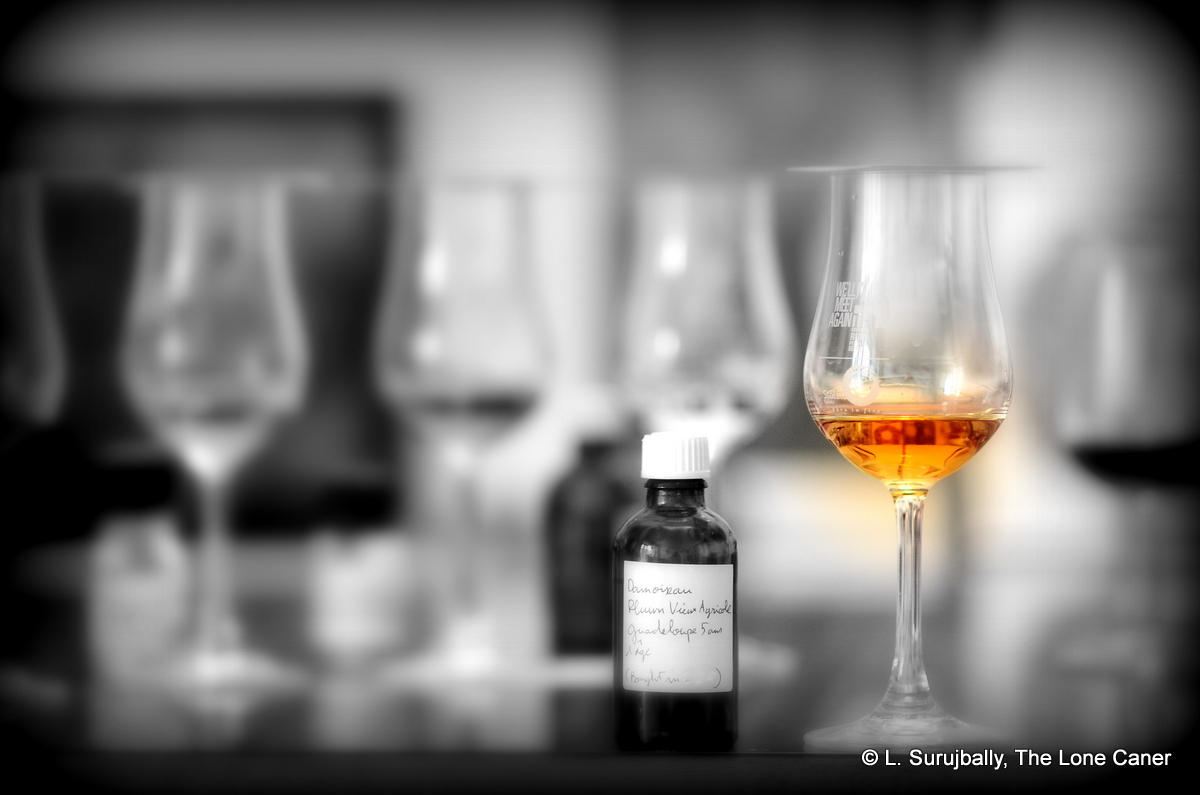
As noted in the biography of the Domaine de Séverin, what we’re getting now from the new owners is not what we were getting before.  The company’s distillery changed hands in 2014 and such rums as were made back in the day immediately became “old”, and more obsolete with very passing year.  From the old style design of the labels, I’d hazard that this one came from the 1990s, or at the very latest, the early 2000s, and I have no background on ageing or lack thereof – I would imagine that if it slept at all, it was a year or less. Over and beyond that, it’s a decent blanc, if not particularly earth shattering.

Colour – White

Strength – 50% ABV

Nose – Starts off with plastic, rubber and acetones, which speak to its (supposed) unaged nature; then it flexes its cane-juice-glutes and coughs up a line of sweet water, bright notes of grass, sugar cane sap, brine and sweetish red olives.  It’s oily, smooth and pungent, with delicate background notes of dill and cilantro lurking in the background. And some soda pop.
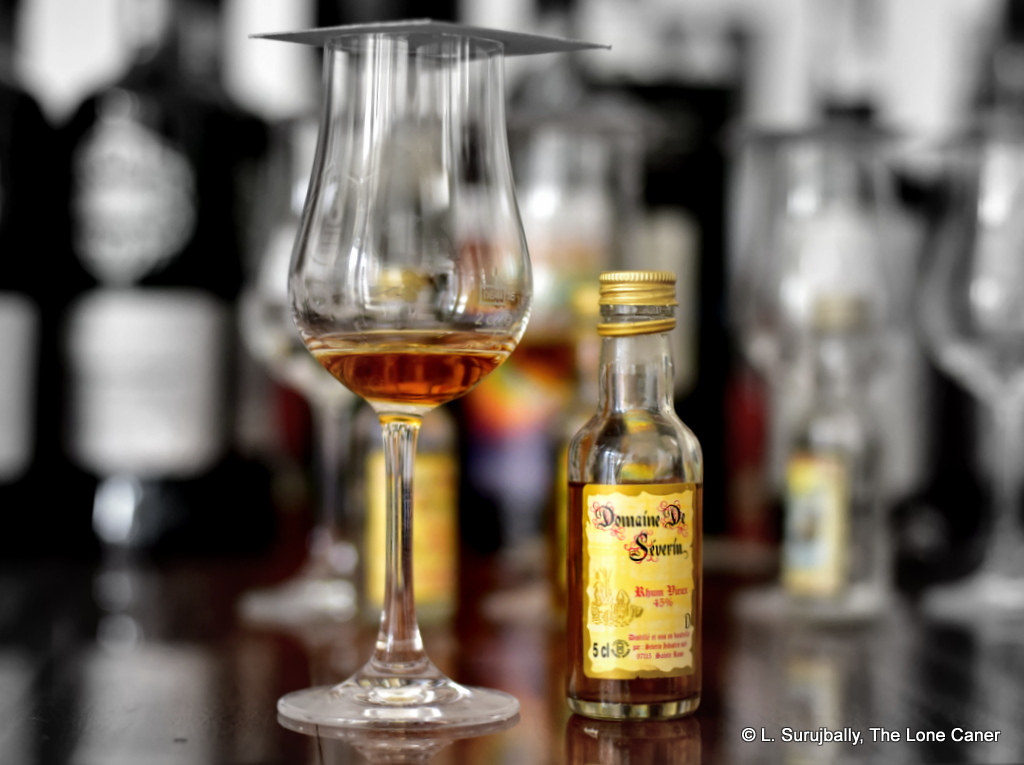
Palate – The rhum does something of a right turn from expectations. Dry and dusty, briny and sweet.  Vegetable soup and maggie cubes mixes up with herbal / fruity notes of cucumber, dill, watermelon juice and sugar water.  Somehow this crazy mish-mash sort of works. Even the vague hint of caramel, molasses and lime leaves at the back end add to the pungency, with the dustiness of old cardboard being the only off note that doesn’t belong.

Finish – Warm, smooth, light, oily, a mix of sugar water and 7-up which is the faintest bit dry.

Thoughts – Guadeloupe is free to mess around with molasses or cane juice, not subscribing to the AOC that governs so much of Martinique, and the bottle states it is a rhum agricole, implying cane juice origins.  Maybe, though those odd commingling tastes do make me wonder about that. It’s tasty enough and at 50% almost exactly strong enough.  But somehow, through some odd alchemy of taste and preference, the odd and uncoordinated way the sweet and salt run apart from each other instead of providing mutual support, it’s not really my glass of juice.

(82/100)


Mar 212019
 

Rumaniacs Review # 094 | 0610

Séverin is a small distillery in the north of the left “wing” of Guadeloupe (called Basseterre), whose history can be divided into three parts: 1800-1928 when different owners held the small estate and grew various agricultural crops like pineapples and sugar, 1928-2014 when the Marsolle family held it and created the marque of Domaine de Séverin for their rhums, and the post-2014 period when the distillery (but not the whole estate) was sold to a local businessman called Jose Pirbakas. Although there was a cessation of operations after the takeover due to differences in management and operational philosophies (for one thing, all rhum prices were jacked up by 45% in 2014), rhums from Séverin are now once again available, primarily in France, and sporting a new, redesigned bottle and label.

That label is key, since the older ones such as on the bottle I had, are no longer in use and therefore serve as a useful determinant as to whether one is buying a pre-takeover rum (which is a Rumaniacs candidate), or a post 2014 version, which is not.

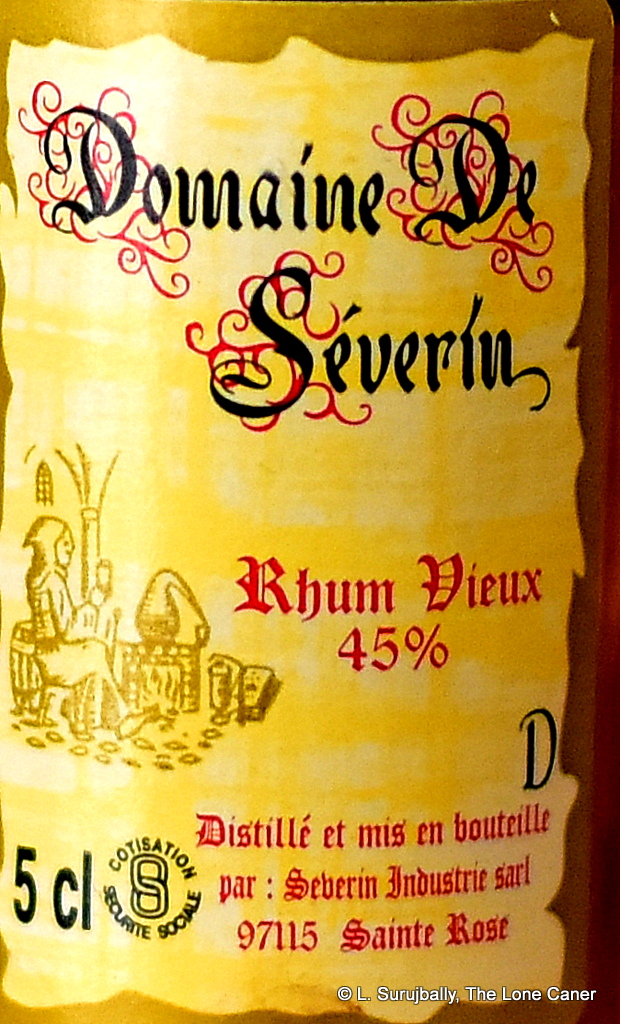
While it is not explicitly stated on the label, the Vieux is about three years old. Séverin have always played around with different casks in their aged rhums (cognac for the most part), but in this case it is very likely that standard oak barrels were used to age the rhum, which itself derives from a creole column still.

Colour – Gold

Strength – 45% ABV

Nose – Clearly Séverin, like many producers on Guadeloupe, played around with both molasses and cane juice for its raw material. Here, the deeper aromas of molasses, coca-cola and nougat steer us towards molasses as the base. There were hints of cinnamon and light coffee grounds, some smoke and vanilla, quite easy-going but also reasonably aromatic.

Palate – A very pleasing profile, if not quite as sharply distinct as anything you’re getting from Martinique with its strict AOC guidelines. Coke, molasses, bitter chocolate and nougat charge out from the gate. There is also some brine, olives and coffee, and coiling around in the background are some vague floral and light fruity notes which provide a pleasing backdrop for the heavier flavours

Finish – Somewhat weak, a flash in the pan, over quickly. Closing notes of cumin and cinnamon, caramel, damp brown sugar, vanilla.

Thoughts – Reminds me somewhat of rums from Mauritius or the Seychelles. I like these indeterminate products that steer an interesting line between a pure molasses product and one made from juice – it’s like they take a bit of the characteristics both without leaning to either side too much. That makes them good rums to drink, though this one is not so exceptional that I’d want it on my top shelf. Still, it was made recently enough that I suspect one can still find it, and if so, it’s worth picking up for more than just historical value.

(80/100)

Mar 132019
 

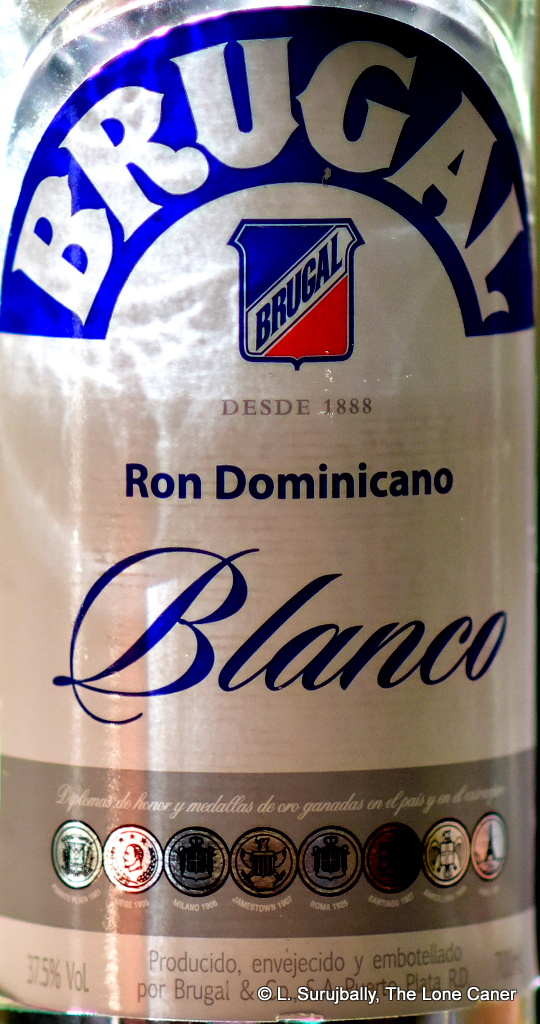
By today’s standards, Brugal, home of the very good 1888 Gran Reserva, made something of a fail in the genus of white rums with this Blanco.  That’s as much a function of its tremblingly weak-kneed proof point (37.5%, teetering on the edge of not being a rum at all) as its filtration which makes it bland to the point of vanilla white (oh, wait….). Contrast it with the stern, uncompromising blanc beefcakes of the French islands and independents which blow the roof off in comparison: they excite amazed and disbelieving curses — this promotes indifferent yawns.

To some extent remarks like that are unfair to those who dial into precisely the coordinates the Blanco provides — a light and easy low-end Cuban style barroom mixer without aggro or bombast, which can just as easily be had in a sleepy backroad rumshop someplace without fearing for one’s health or sanity after the fact. But they also encapsulate how much the world of white rums has progressed since people woke up to the ripsnorting take-no-prisoners braggadocio of modern blancs, whites, clairins, grogues and unaged pot still rhinos that litter the bar area with the expired glottises of unwary rum reviewers.

Technical details are actually rather limited: it’s a rum aged for two years in American oak, then triple filtered, and nothing I’ve read suggests anything but a column still distillate.  This results in a very light, almost wispy profile which is very difficult to come to grips with.

Take the nose – it was so very faint. Being aware of the proof point, I took my time with it and teased out notes of Sprite, Fanta, sugar water, and watermelon juice, mixed up with the faintest suggestion of brine.  Further sphincter-clenching concentration brought out hints of vanilla and light coconut shavings, lemon infused soda water, and that was about all, which, it must be conceded, didn’t entirely surprise me.

All this continued on to the tasting.  It was hardly a maelstrom of hot and violent complexity, of course, presenting very gently and smoothly, almost with anorexic zen-level calm.  It was thin, light and lemony, and teased with a bit of wax, the creaminess of salty butter, coconut shavings, apples and cumin — but overall the Blanco makes no statement for its own quality because it has so little of anything.  Basically, it’s all gone before you can come to grips with it. Finish? Obviously the makers didn’t think we needed one, and followed through on that assumption by not providing any.

The question I alwys ask with rums like the underproofed Blanco is, who is it made for? – because that might give me some idea of why it was made the way it was. I mean, the Brugal 151 was supposed to be for cocktails and the premium aged anejos were for sipping, so where does that leave something as milquetoast as this?  Me, if I was hanging around with friends in a hot tropical island backstreet, banging the dominos down with a bowl of ice, cheap plastic tumblers and this thing, I would probably enjoy having it on the rocks. On the other hand, if I was with a bunch of my fellow rum chums, showing and sharing my stash, I’d hide it out of sheer embarrassment.  Because compared with the white rums which impress me so much more, this isn’t much of anything.

(#608)(68/100)


Other notes

Company background: Not to be confused with Dominica, the Dominican Republic is the Spanish speaking eastern half of the island of Hispaniola…the western half is Haiti.  Three distilleries known as the Three Bs operate in the DR: Bermudez in the Santiago area, the Santo Domingo distillery called Barcelo, and Brugal in the north coast. Brugal, founded in 1888, seems to be the largest, perhaps as a result of being acquired in 2008 by the UK Edrington Group (they are the makers of Cutty Sark, and also own McCallan and Highland Park brands), and perhaps because Bermudez succumbed to internecine family squabbling, while Barcelo made some ill-advised forays into the hospitality sector and so both diluted their focus, to Brugal’s advantage.  

There are other blancos made by Brugal: the Ron Blanco Especial, Blanco Especial Extra Dry, the 151 overproof, and the Blanco Supremo.  Only the Supremo is listed on their website (accessed March 2019) and seems to be available online, which implies that all others are discontinued. That said, the production notes are similar for all of them, especially the 2 year minimum ageing and triple distillation.

Mar 062019
 

So here we have a rum I’ve never heard of before, made by an outfit called Florida Caribbean Distillers (FCD) in (where else?) Florida. For those with better memories than mine, if the company name sounds familiar, it should be – this is the same one that is contracted to make the Noxx & Dunn 2-4-5 Florida rum I wrote about a few months ago.

FCD is located halfway between Orlando and Tampa: they control the Club Caribe Distillery in Puerto Rico, as well as distilleries in Lake Alfred and Auburndale (both in Florida – the latter distillery produces this rum).  They are the oldest continuously running distillery in the US, being formed in 1943, and (somewhat to my surprise) said to be the largest rum producer in the US, bottle all rum for Cruzan and several smaller labels for contract clients including cruise lines and duty free shops as well as providing distillation, storage, ageing and bottling facilities as part of their service.

They make a bunch of other spirits as well – liqueurs, wines, vodkas, whiskies et al, which means that focus on true batch and artisanal production is not part of the programme. So if you’re looking for some kind of pot-still originality from a leaky, farty backwoods micro-distillery run by a grizzled old salt legalizing his moonshine, or a spanking new copper thing bolted together by an eager-beaver yuppie with the ink barely dry on his MBA and a strong minor in ecological distilling, well, this isn’t really either of those things.

What it is, is a blend of “select rums” aged two years in sherry casks, issued at 42% and gold-coloured. One can surmise that the source of the molasses is the same as the Noxx & Dunn, cane grown in the state (unless it’s in Puerto Rico).  Everything else on the front and back labels can be ignored, especially the whole business about being “hand-crafted,” “small batch” and a “true Florida rum” – because those things give the misleading impression this is indeed some kind of artisan product, when it’s pretty much a low-end rum made in bulk from column still distillate; and I personally think is neutral spirit that’s subsequently aged and maybe coloured (though they deny any additives in the rum).

Anyway, tasting notes: the nose is the best part, stop reading if that’s all you need. Nutty cereals and salt crackers with cream cheese.  Citrus, flowers, brine and pickled gherkins in balsamic vinegar.. Soft and creamy, quite unaggressive, but tasty enough. Some white chocolate, brown sugar, cinnamon, but the overarching aromatic notes are the salt of maggi cubes and avocados.

To taste it’s disappointing, and leaves me wondering where the sherry influence went and hid itself. There’s some good stuff going on when you smell it, but to taste it wimps out and goes flat as spit on a hot rock.  There’s traces of oaken tannins, salt, caramel, a hint of white fruits, grapes, unsweetened chocolate. Also cereals, nuts, toffee, with a faint line of citrus twittering in the background, nothing really noticeable unless you concentrate.  All in all, it’s actually quite simple, and tastes very young, even a bit harsh, untamed (and not in the way an unaged white does). This jagged bite carries over into the finish as well, which really could use some taming, and gives little beyond some very light fruits and florals, and a last briny note.

For my money, the Florida Old Reserve Rum is not strong enough to make a statement, not old enough to demonstrate real complexity, not distinct enough in any way to perk up a cocktail; and the sherry cask ageing?….well, it’s something of a challenge to find traces of it at all. Tried blind, I doubt you’d notice its absence (or presence, or care). What it seems to be is something of a product that showcases what the distillery can do for others and maybe to bootstrap industrial scale rum making so effectively done by Bacardi.  Well, say what you will about The Bat, they at least can make decent rums. Here, I’d say that a lot more work needs to be done.

What really amazes me, in doing my background notes, is that the Beverage Tasting Institute gave the rum 93 points in 2014 and 88 in 2016.  Leaving aside the drop in scores over a two year span, one can only wonder what sort of sample set they had and what they were comparing it against, to give such a rating to something this thoroughly unexceptional. If it was up to me I’d never drink the Reserve neat, and mix it without ceremony — always assuming I bought a bottle in the first place, and that’s really unlikely, now that I’ve tried it.  

(#605)(72/100)

Feb 252019
 

Just to reiterate some brief details about HSE (Habitation Saint-Étienne), which is located almost dead centre in the middle of Martinique.  Although in existence since the early 1800s, its modern history properly began when it was purchased in 1882 by Amédée Aubéry, who combined the sugar factory with a small distillery, and set up a rail line to transport cane more efficiently (even though oxen and people that pulled the railcars, not locomotives). In 1909, the property came into the possession of the Simonnet family who kept it until its decline at the end of the 1980s. The estate was then taken over in 1994 by Yves and José Hayot — owners, it will be recalled, of the Simon distillery, as well as Clement —  who relaunched the Saint-Étienne brand using Simon’s creole stills, adding snazzy marketing and expanding markets.

This particular rum, then, comes from a company with a long history and impeccable Martinique pedigree.  It is an AOC millésimé – a rum issued in relatively small quantities, from the output of a specific year’s production, considered to be a cut above the ordinary (2005 in this case) and finished in Sauternes casks.

Given that it is nine years tropical ageing plus another year in the Sauternes casks, I think we could be expected to have a pretty interesting profile — and I wasn’t disappointed (though the low 41% strength did give me pause).  The initial smells were grassy and wine-y at the same time, a combination of musk and crisp light aromas that melded well. There were green apples, grapes, the tart acidity of cider mixed in with some ginger and cinnamon, a dollop of brine and a few olives, freshly mown wet grass and well-controlled citrus peel behind it all.  

Well now.  That was a pretty nifty nose.  How did the palate rate?

Very well indeed, I thought.  It was a smooth and solid piece of work for its proof point, with clear, firm tastes proceeding in sequence like a conga line – light acetones and flowery notes to begin with, then bubble gum, ripe cherries and plums.  The profile proceeded to display some sharpness and herbals — citrus, cider, well-aged sharp cheddar, a touch of apricots and almost-ripe peaches together with softer honey and ginger. What distinguished it and made it succeed, I think, is the delicate balancing act between sweetness and acidity (and a trace of salt), and even the finish – grapes, honey, cane juice and wet grass for the most part – displayed this well assembled character. It impressed the hell out of me, the more so since I walked in expecting so much less.

The other day I wrote about a similarly-aged, light rum from Don Q, which I remarked as being somewhat too easy and unchallenging, bottled at a low 40%; and while competently made, simply not something that enthralled me.

On that basis, you might believe that I simply disdain any and all such low-proof rums as being ultimately boring, but now consider this 41% agricole from Habitation Saint-Étienne as a response.  It emphatically demonstrates to anyone who believes standard strength can only produce standard junk, that a rum can indeed be so relatively weak and still have some real quality squirming in its jock. And with respect to the HSE 2005, that’s a statement I can make with no hesitation at all, and real conviction.

(#602)(86/100)


Other Notes

  • This rhum should not be confused with the others in the “Les Finitions du Monde” series (like Chateau La Tour Blanche or Single Malt finish labelled as exactly that), which are also 2005 millesimes, but not bottled in the same month, have other finishes, and different labels.
  • According to Excellence Rhum, this 2005 edition is the successor to the 2003 Millesime which is no longer produced.  
  • The outturn is unknown.
  • Nine (9) years aging, plus from 12 months of finishing in Château La Tour Blanche barrels, 1st Cru Classé de Sauternes.
Feb 242019
 

It’s a peculiarity of the sheer volume of rums that cross my desk, my glass and my glottis, that I get to taste rums some people would give their left butt cheek for, while at the same time juice that is enormously well known, talked about, popular and been tried by many….gets missed.

One of these is the Don Q series of rums out of Puerto Rico made by the Serrallés family who, like Old Facundo, hailed from Catalonia and came to Puerto Rico in around 1820.  In the 1830s they established a sugar plantation on the outskirts of Ponce in South-Central Puerto Rico and in a short time became very successful, exporting sugar to the US, France and the UK; in 1865 they started to manufacture rum on a pot still brought over from France (see “other notes” below), though the various brands they produced were short lived and not really big sellers.  In response to that, in 1932 they launched the Don Q brand as a way of breaking into the more premium sector, as well as expanding local market share, followed by new distillation apparatus installed in 1935 (one imagines the pot still was marginalized after this, if not discontinued entirely). The rums of the line proved to be enormously popular, overtaking Bacardi which was seen as a foreign brand and not as refined.

These days it is considered the best selling rum in its home turf, exported all over the world, and the recipe remains consistent with the original developed so long ago.  In the current environment where unadulterated rums get a lot of praise, it also grabs brownie points for having none itself.

Technical details: distilled on a column still, 40% ABV, gold colour, no additives. According to their website, the Gran Añejo “contains rums aged between 9 and 12 years, and solera rums aged up to 50 years” which means that by accepted parlance it’s a blend, 9 years old.

Given it’s a column still low proof, I would expect it to be a light sort of experience to smell, and indeed it was – so much so that it took real effort to disassemble.  The nose was almighty peculiar to start, redolent of charcoal, burnt wood, ashes, an overdone ox turning on a spit (seriously). I don’t know if that was intentional, just that it took me somewhat off balance; still, it developed nicely – gradually aromas of rotting bananas, overripe fleshy fruit, and even a little brine, combined with a delicate hint of orange peel.

The palate was pleasant and easy to sip, quite solid for the living room strength. Here notes of caramel, vanilla, lemon peel, apples, molasses and treacle abounded, nicely balanced. It was velvety, but also dry, vaguely sweet with some brine and well-polished leather.  What it lacked was force and emphasis, though that was to be expected, and the finish sort of limped along past the tape, providing closing notes of vanilla, nutmeg and pineapple, all very soft and light, nothing for the rum junkie to write home about, really. It’s soft and easy-going, overall.

For my money this is something of a low-rent Havana Club. Given that the main markets for Don Q are the US, Mexico and Spain (it’s exported to many more, of course), it stands to reason that over-aggressive high-ester profile and a Brobdingnagian strength are not on the cards — that’s not the Catalan style of rum-making brought over to the new world, or preferred in those markets:  That may guarantee it solid sales and great word of mouth where it sells, but I’m not sure it guarantees it future sales in places where there is already a surfeit of such rums, or where something with more character is the norm.

The Don Q, for all its understated quality and its audience in other parts of the world, demonstrates why I moved away from Spanish/Latin American column still rums.  They lack oomph and emphasis. They’re too easy, and too light (for me), require little effort and are no challenge to come to grips with. It may have taken years to come around to trying it, but now, having done so, I can’t honestly say that an amazing undiscovered gem has been missed out on.

(#601)(81/100)


Other notes

According to the company website, the still brought over from France in 1865 was a pot still, though this is odd given France’s love affair with the columns back then; but Tristan Stephenson’s 2018 book “The Curious Bartender’s Rum Revolution” mentions it as being a 5-tray columnar still. If I ever track the discrepancy down, I’ll amend this section of the post.