Feb 112019
 

Rumaniacs Review #091 | 0598

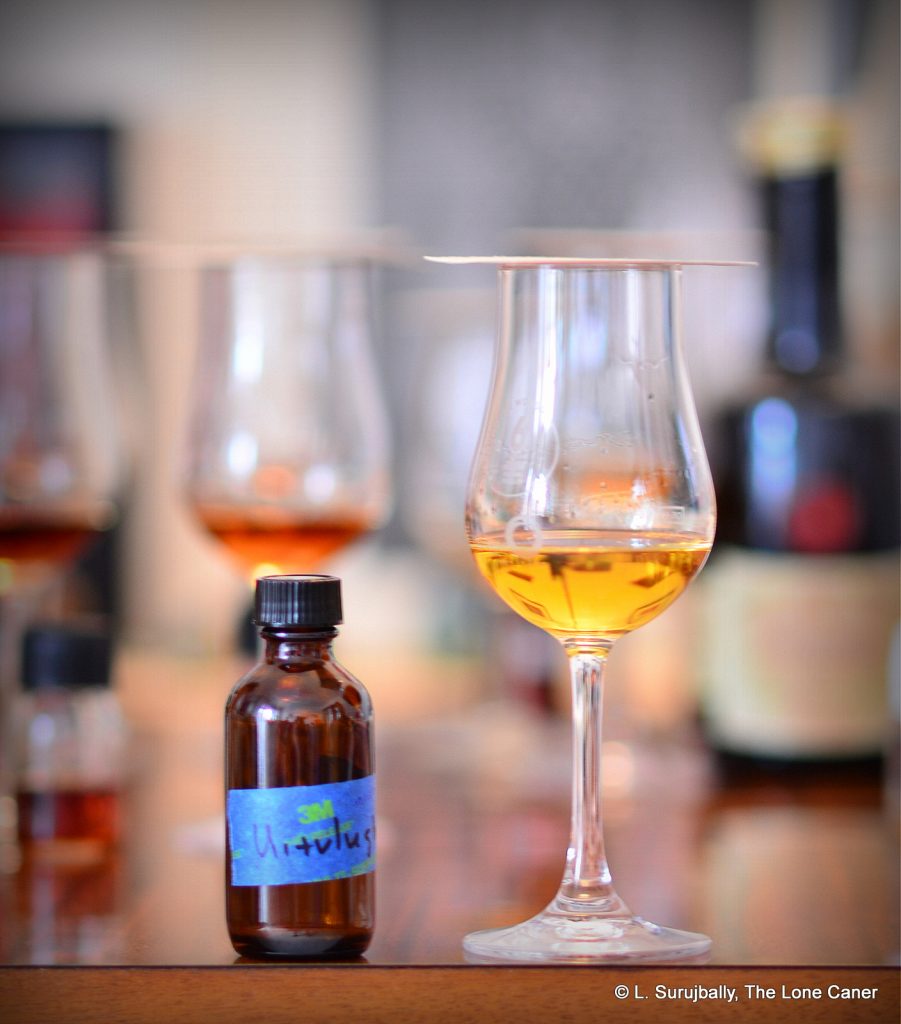
Overproof rums started out as killer cocktail ingredients, meant to boost anything they were put into by, I dunno, a lot. For many years they were pretty much the bruisers of the barflies — low-life, lightly-aged mixers (or occasionally unaged whites) which only islanders drank neat, largely because they had the least amount of time to waste getting hammered.  Still, as time passed and cask strength rums became more fashionable (and appreciated), the gap between the strength of a cool aged casker and an overproof shrank, to the point where a 75% bottling of a “regular” rum that’s not labelled as an overproof is not out of the realms of possibility – I know several that stop just a bit short of that.  

One of the old style overproofs is this rum from the Takamaka Bay rum company located on Mahe, the main island of the 115-island archipelago comprising the Seychelles, in the Indian Ocean off East Africa. The company is of relatively recent vintage, being formed in 2002 by the d’Offay brothers, Richard and Bernard d’Offay, and sourcing sugar cane from around the island – they are, according to their website’s blog, one of the few distilleries in the world that make rum from both juice and molasses.  They have two copper pot stills and a columnnar one, and this white rum, now discontinued and replaced with the 69 Rhum Blanc, is an unaged, unfiltered column still distillate with possibly a touch of high ester rum from the pot still. I’ve read on a Czech site that the rum is triple distilled from cane juice and then diluted, which was later confirmed by Bernard d’Offay.

Colour – White

Strength – 72% ABV

Nose –  Sweet and light soda pop, like a 7-Up…with fangs. Tons of herbs here, grass, thyme, mint, light lemon zest. Sugar water.  Light fruity esters. Bananas, nutmeg, cardamom.

Palate – Fruit juice poured into my glass, clean and light.  There’s the crispness of green apples, cane juice and red cashews, melding well with the tart creamy sweetness of ginips and soursop.  Herbs remained – parsley, dill and mint. It was hot and delicately sweet, presenting with force, yet it also reminded me somewhat of a tequila, what with a background of brine and olives and a faint oily texture on the tongue

Finish – Quite good. Long, dry, spicy, fruity, redolent of bananas, red currants, blackberries, watermelon and sugar water.  

Thoughts – It’s really quite a good rum, and I’m sorry to see it’s no longer being made. Before I got a response from Takamaka Bay, I thought the column still produced this from cane juice spirit (this proved to be the case). It’s a mixer for sure, though anyone who finds it and tries it neat won’t be entirely disappointed.  It’s a fiery, flavourful white which may now no longer be made, but lives on in its slightly lesser-proofed brother…which I have a feeling I’ll be looking for quite soon.

(84/100)

Feb 022019
 

Rumaniacs Review #090 | 0595

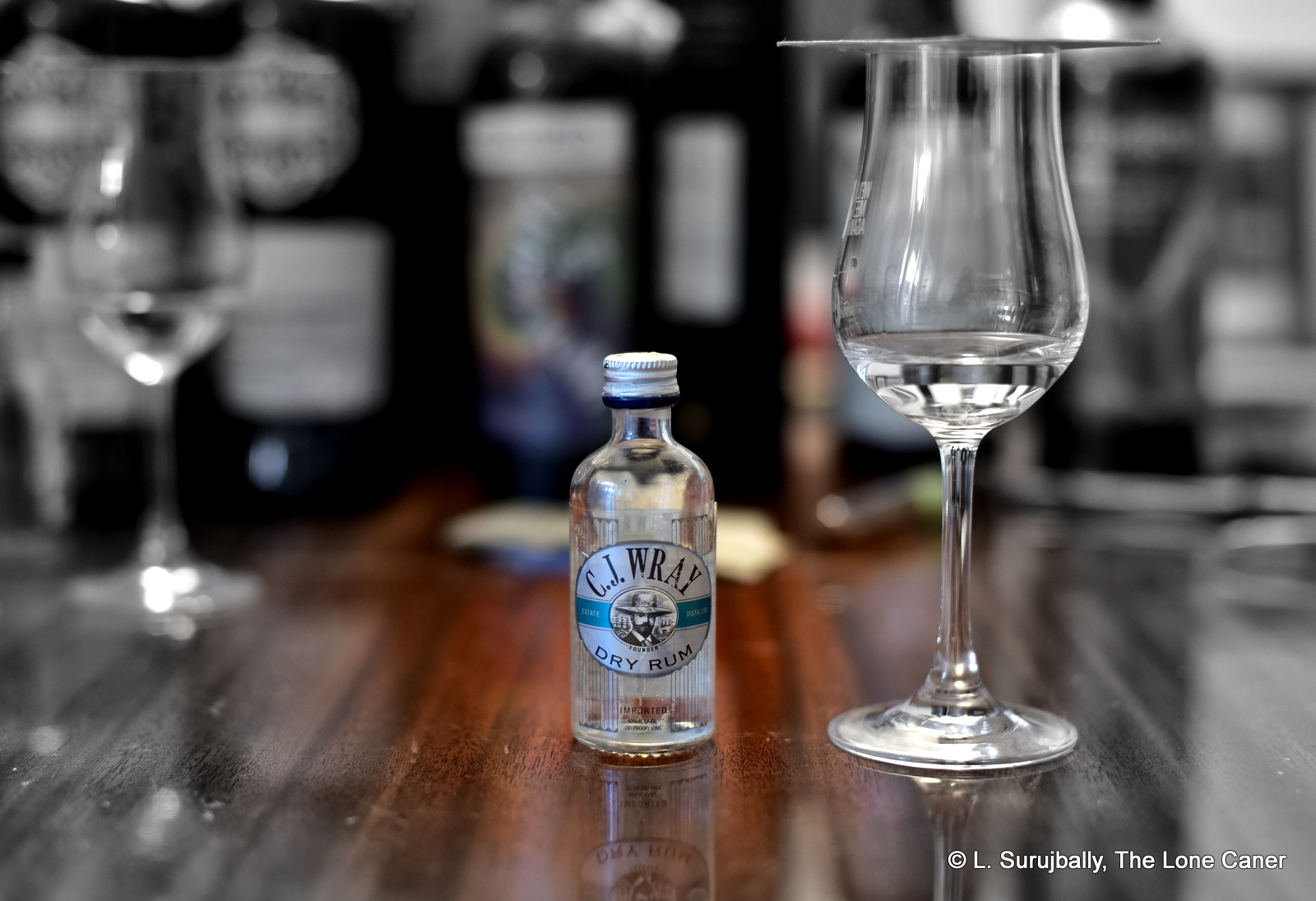
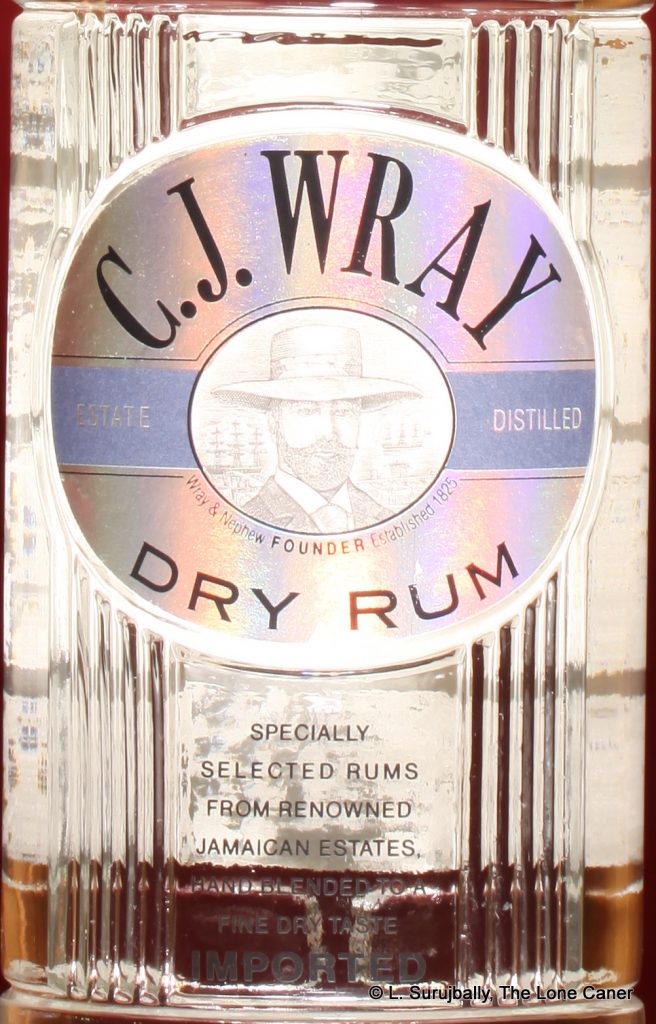
We’re all familiar with the regular roundup of major Appleton rums like the Reserve, the 12 YO, the 15 YO, 21 YO and 30 (old version or new), as well as their halo rum du jour, the 50 YO. But the company also had and has distinct and not so well known brands for sale locally (or niche export markets), such as Edwin Charley, Coruba, Conquering Lion, JBW Estate and Cocomania.  And as the years turned, the company outlived some of its own brands – for example the previously well-known One Dagger, Two Dagger and Three Dagger rums which went out in the 1950s.  Another casualty of the times was the C.J. Wray Dry White Rum, which was launched in 1991 as a broadside to Bacardi; at the time there weren’t many light whites out there and the Superior was the market leader, so Wray & Nephew decided to take lessons from the very successful premium vodka campaign of Absolut (against Smirnoff) and launched their own, supposedly upscale, alternative.

But by the early-to-mid 2000s, the Dry was discontinued.  The reasons remain obscure: perhaps on the export market, it couldn’t compete with the vastly more popular poor man’s friend and bartender’s staple, the 63% overproof, being itself a meek and mild 40%.  Perhaps there was some consolidation going on and it was felt that the Appleton White was enough.  Maybe it just wasn’t deemed good enough by the rum drinkers of the day, or the margins made it an iffy proposition if it couldn’t sell in quantity.

Technical details are murky. All right, they’re practically non-existent. I think it’s a filtered column still rum, diluted down to standard strength, but lack definitive proof – that’s just my experience and taste buds talking, so if you know better, drop a line.  No notes on ageing – however, in spite of one reference I dug up which noted it as unaged, I think it probably was, just a bit.
Colour – White

Strength – 40%

Nose – Light, mild and sweet.   Dry?  Not for this guy’s schnozz.  Initial aromas narrow in on vanilla, nougat, white toblerone and almonds, with a little salt and citrus peel to liven up the party.  It’s very soft (no surprise), gentle, and warm, and going just by the nose, is perfectly acceptable to have neat, though I saw some fans posting back in 2008 who were itching to try it in a daquiri.

Palate – Not as interesting as the nose, really, but every bit as nice.  Tinned cherries and pineapples in syrup was the first thought that ocurred to me as I sipped it; a trace of salt and brine, with perhaps half an olive, vanilla, almonds, and – if you crease your brow, sweat a bit and concentrate – citrus, raisins, cinnamon and maybe a shaving of fresh ginger.

Finish – Short, mellow, slightly fruity, a little herbal.  Nothing to write home about.

Thoughts – For a low-end white, it’s actually quite an interesting drink.  Sales must have been low, margins too scrawny, reactions too muted, and it was put down as an act of mercy (or so the storyteller in me supposes).  That’s too bad because while the profile does suggest that it was doctored (entirely a personal opinion – it lacks something of the punch and edge of a clean and unmessed-with rum, though this may simply be over-enthusiastic filtration), it’s a neat little rumlet if your expectations are kept low and you like easy.  Maybe, had it been left in place to gather a head of steam, it might have found some legs — these days, good luck finding any outside an estate sale or an old salt’s collection.

(80/100)


Jan 312019
 

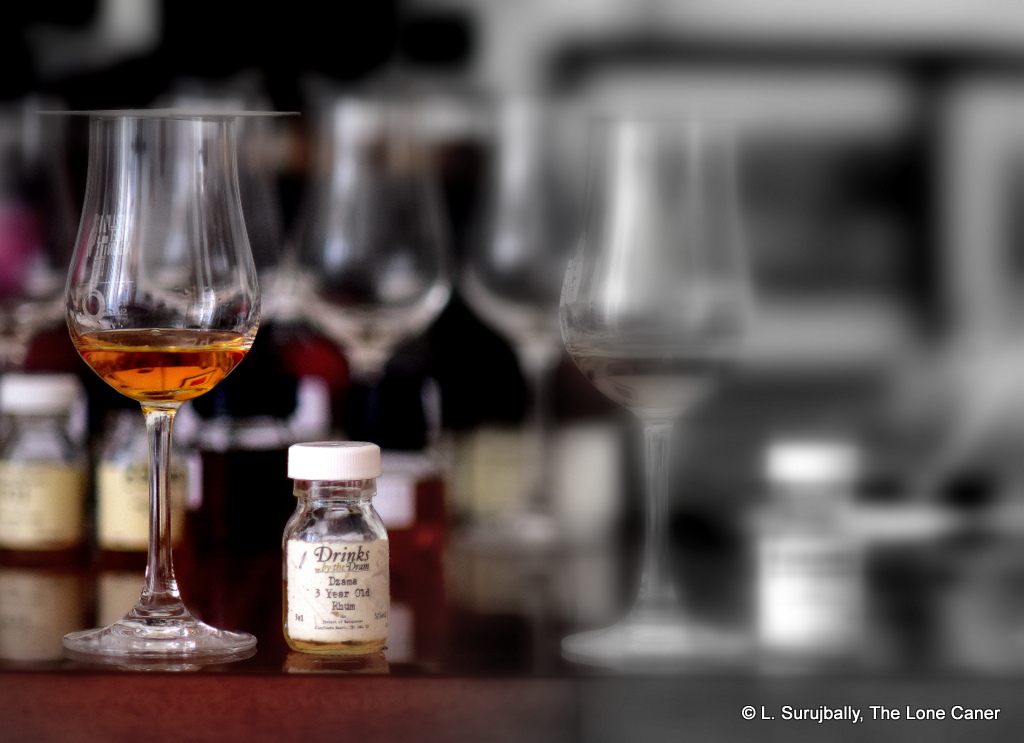
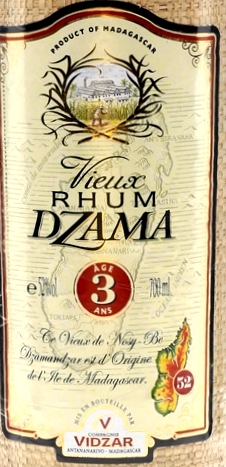
More than four years ago I wrote about the Rhum Vieux Millésimé 1998 10 YO made by Dzama and concluded that I was pretty stoked to see what else the brand had in the larder.  It’s taken a long time for me to make good on that desire, so here we have something lower down on the totem pole from the same company, and I thought it was a good effort, for all its youth and in spite of the niggly questions it raised.

Let’s refresh the memory first: for the geographically challenged, Madagascar is that huge island off the south east coast of Africa; and the Dzama rums are made by Vidzar, formed in 1980 due to the efforts of Mr. Lucien Fohine, who noted that the small sugar factory on the tiny island of Nosy Be produced a distillate that had distinctive flavours which persisted into the final distilled products…mostly low level rum for local consumption, to that point. He concluded it came from the ylang-ylang plant (also known as the macassar oil plant, or the perfume tree) whose roots intermingled with that of the cane.

He formed a company Vidzar (a contraction of Vieux Rhum de Dzamandzar), which initially concerned itself with whisky bottling. It was located close to the sugar cane fields of Nosy Be, near to a village called Dzamadzar, but a few years later, as their operations expanded, they transferred production to Antananarivo (the capital, in the center of the island) The company, which now claims a majority of rum market share in Madagascar, makes a range of rums, including the Dzama Club, 3 YO and 6 YO, the Millésimé 1998 10 Year Old, Dzama 15 and 25 year old rums and a Cuvée Noire. Most of these are untried by the vast majority of rum drinkers, and remain relatively unknown, though many have won prizes between 2010 and 2015, in Miami, Paris, Berlin and Madrid.

All that said, there isn’t much on the company website about the technical details regarding the 3 year old we’re looking at today. It’s a column still rum, unadded-to, aged in oak barrels, and my sample clocked in at 52%, which I think is an amazing strength for a rum so young – most producers tend to stick with the tried-and-true 40-43% (for tax and export purposes) when starting out, but not these guys.
Now, the theory is that the oils and perfumes of the various botanicals to be found on Madagascar (vanilla, cloves, pepper are often cited) leach from their roots into the soil and are intermixed with the cane plants’ own root systems, into their stems, and thence to the ultimate distillate. I’m no chemist or botanist, but one could just as easily wonder why similar processes aren’t observed on the spice island (Grenada) for example, so I reserve judgement on that score.  

Be that as it may, the nose is quietly rich for a rum aged a mere three years – not Velier-Demerara-go-for-the-brass-ring rich, just more than one would expect going in. This nose was initially redolent of creamy feta cheese, brine, red olives and cashew notes, and had a nice line of rotting bananas and funk coiling about in the background which provided an underpinning of real character.  It also gave off subtler aromas of candied oranges, pears and other light fruits, just not enough to take over and make it a fruit bomb. But towards the end there was a more dominant element of toffee, coffee grounds and vanilla which I thought pleasant but overdone, especially since it was delivered with some real force.

Though it teetered right on the edge of being too hot, it presented a solid if sharp drink, an amalgam of salt and sweet…and a lot of brown sugar and vanilla  There were bananas, strawberries, cherries, and some of that tart and creamy sensation you get from an unsweetened fruit smoothie made from, oh, firm yellow mangoes and pineapple.  The vanilla remained, the coffee disappeared, and amusingly, I could actually taste sweet green peas. Much of the saltiness and nuttiness of the nose was gone, though still noticeable, and it did not unbalance the fruity aspects.  The finish was where it failed, I thought – it was medium long, somewhat spicy, just rather mild, with closing notes of fruits, vanilla, salted caramel, coconut shavings, and a little citrus.

Well, what to make of this? The nose was decent, the palate was nearly as good, a reasonable drink even by itself….particularly if you like the hints of spices. Does that mean natural or other spices have been added?  They say no, and hydrometer tests show no obscuration… but I can’t help but wonder.  Rums this young tend to be rather sharp and retain competing notes that saw across the palate, better off in mixed drinks than to have neat; the Dzama 3 YO was sippable and had the edge toned down, and for that to happen at that strength raises the eyebrow.  However, in the absence of more information, I’ll leave it there for now as a note for those who want to know.

That first Dzama I tried, the 1998 10 YO, had what at first sight seemed like an utterly standard profile that then expanded into something quite unconventional and interesting. The 3 year old is not on that level. The vanilla is a shade too dominant, and while fortunately having enough other taste elements in there to move beyond that, it remains ultimately straightforward.  But it is, nevertheless, a good drink for what it says it is, and demonstrates that a rum doesn’t have to be the latest Velier, Worthy Park or Foursquare juice, or from some independent’s minuscule outturn, to be a rum worth checking out.

(#594)(80/100)


Other Notes

Wes was much more disapproving of the spiced profile in his review.  It’s his hydrometer test I referenced.

Jan 282019
 

Speaking in general terms, my personal drift away from Latin- or South American rums over the last few years derives from the feeling that they’re a little too laid back, and lack pizzazz.  They’re not bad, just placid and easy going and gentle, and when you add to that the disclosure issues, you can perhaps understand why I’ve moved on to more interesting profiles.

Far too many producers from the region do too much unadventurous blending (Canalero), don’t actually have a true solera in play (Dictador), have a thing for light column still products which may or may not be tarted up (Panama Red), and are resting on the laurels of old houses and family recipes (Maya) whose provenance can hardly be established beyond a shadow of doubt (Mombacho or Hechicera).  Moreover, there is too often a puzzling lack of easily-available background regarding such rums (more than just marketing materials) which is out of step with the times.

Still, I have to be careful to not paint with too wide a brush – there are many good rums from the region and I’m not displeased with all of them. In a curious turnabout, my favourites are not always released by from or by Latin American companies — at least, not directly — but by independents who take the original distillate from a broker and then release it as is.  This avoids some of the pitfalls of indeterminate blending, additives, dilution and source, because you can pretty much count on a small indie outfit to tell you everything they themselves know about what they stuffed into their bottle.

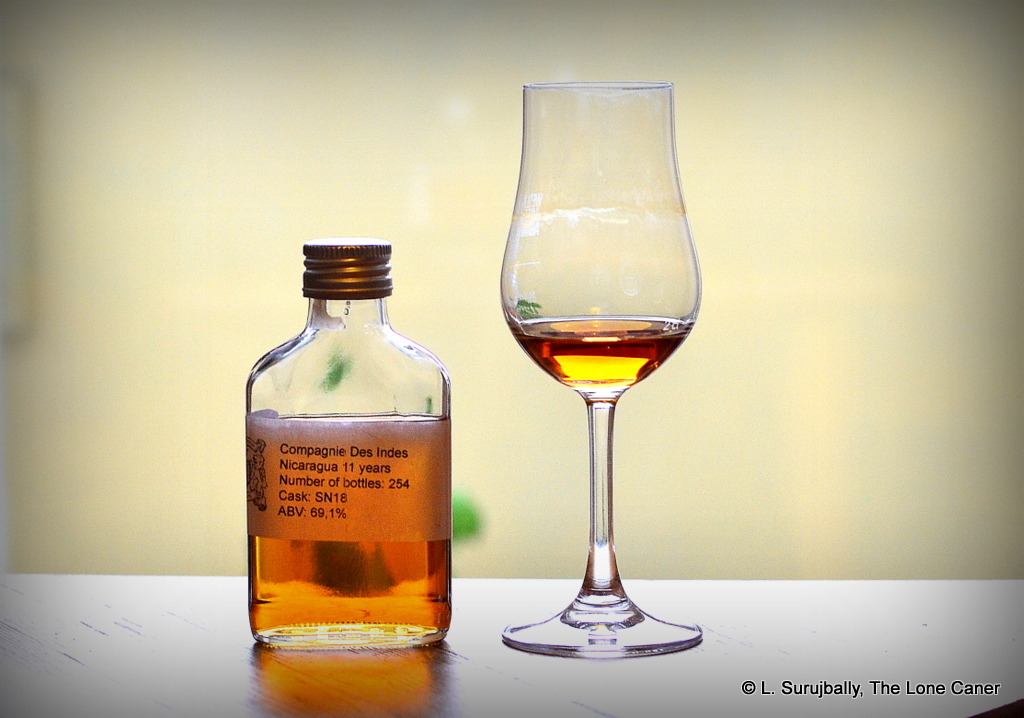
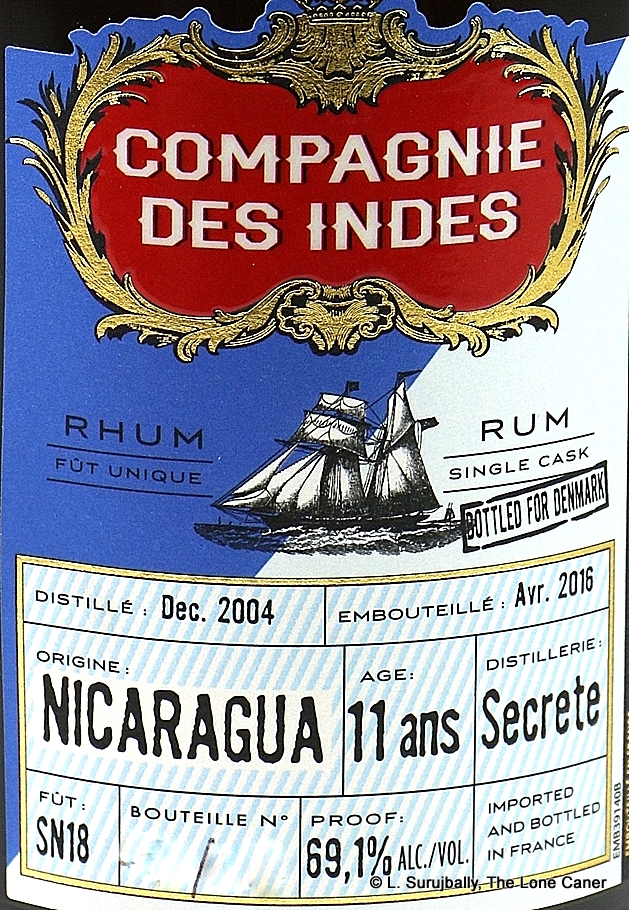
That’s not to say that in this case the Compagnie is a poster child for such disclosure – the distillery on this one is noted as being “Secret”, for example. But I suspect that Florent was a bit tongue in cheek here, since any reasonably knowledgeable anorak can surmise that the 11 YO rum being reviewed here is a Flor de Cana distillate, column still, and aged in Europe.
Compared to the Mombacho 1989 that was being tried alongside it (and about which I still know too little), the nose was much more interesting – perhaps this was because the Compagnie didn’t mess around with a soft 43%, but went full bore at 69.1% for their favoured clients, the Danes (this rum is for the Danish market). Yet for all the strength, it presented as almost delicate — light, fruity (pears, guavas, watermelon., papaya), with a nice citrus tang running through it. When it opened up some more, I also smelled apples, pears, honey, cherries in syrup, and a pleasant deeper scent of aromatic tobacco, oak and smoke, and a touch of vanilla at the back end.

The palate was also very robust (to say the least). It was sharp, but not raw – some of the rougher edges had been toned down somewhat – and gave off rich tastes of honey, stewed apples, more sweet tobacco and smoke, all of it dripping with vanilla. Those light fruits evident on the nose were somewhat overpowered by the strength, yet one could still pick out some cherries and peaches and apples, leading into a very long and highly enjoyable finish with closing notes of gherkins, brine, cereals, vanilla, and a last flirt of light sweet fruits.

Perhaps it was a mistake to try that supposed 19 YO Mombacho together with this independent offering from France.  On the face of it they’re similar, both from Nicaragua and both aged a fair bit — but it’s in the details (and the sampling) that the differences snap more clearly into focus, and show how the independents deserve, and are given, quite a bit more trust than some low-key company which is long on hyperbole and short on actual facts.

As noted above, neither company says from which distillery its rums hail, though of course I’m sure they’re Flor de Cana products, both of them.  We don’t know where Mombacho ages its barrels; CDI can safely be assumed to be Europe. The CDI is stronger, is more intense and simply tastes better, versus the much softer and easier (therefore relatively unchallenging) Mombacho, even if it lacks the latter’s finish in armagnac casks. Beyond that, we get rather more from the Compagnie – barrel number, date of distillation and bottling, true age, plus a little extra – the faith, built up over many years of limited bottlings, that we’re getting what they tell us we are, and the confidence that it’s true. That alone allowed me to relax and enjoy the rum much more than might otherwise have been the case.

(#593)(84.5/100)


Other notes

  • Controls this time around were the aforementioned Mombacho, the Black Adder 12YO, and another Nicaraguan from CDI, aged for seventeen years.  I dipped in and out of the sample cabinet for the comparators mentioned in the first paragraph — not to re-evaluate them, just to get a sense of their profiles as opposed to this one.
  • Distilled December 2004, bottled April 2016, 242 bottle-outturn
  • We should not read too much into the “Secret” appellation for the rum’s source.  Sometimes, companies have a clause in their bulk rum sales contracts that forbids a third party re-bottler (i.e., an independent) from mentioning the distillery of origin.
Jan 222019
 

Haiti is unique as a nation because it is where the only successful slave revolt in the world took place, at the turn of the 18th century. Sadly, it is now the poorest country in the western hemisphere, and successive dictatorships, foreign interference and natural disasters have left the place in shambles.

That any businesses manage to survive in such an environment is a testament to their resilience, their determination, their ingenuity….and the quality of what they put out the door. The country has become the leading world producer of vetiver (a root plant used to make essential oils and fragrances), exports agricultural products and is a tourist destination, yet perhaps it is for rum that its exports are best known, and none more so than those of Barbancourt, formed in 1862 and still run by the descendants of the founder.

Until the mid 20th century, Barbancourt was something of a cottage industry, selling primarily to the local market.  In 1949 they relocated the sugar cane fields of the Domaine Barbancourt in the plaine du Cul-de-Sac region in the south east, and by 1952 ramped up production, increased exports and transformed the brand into a major producer of quality rum, a distinction it has held ever since.  

The rhum, based on sugar cane juice not molasses, used to be double-distilled, using pot stills in a process similar to that used to produce cognac (Dupré Barbancourt came from the cognac-producing region of Charente which was undoubtedly his inspiration); however, nowadays they use a more efficient (if less character-driven) three-column continuous distillation system, where the first column strips the solid matter from the wash and the second and third columns serve to concentrate the resultant spirit…so what is coming to the market now is not what once was made by the company.

Haiti has no shortage of other rhum producing companies – but smaller outfits like Moscoso Distillers or LaRue Distillery are much less well-known and export relatively little, (and back-country clairins are in a different class altogether)…and this makes Barbancourt the de facto rum standard bearer for the half island, and one of the reasons I chose it for this series. This is not to dismiss the efforts of all the others, or the the artisanal quality of the clairins that Velier has brought to world attention since 2014 — just to note that they all, to some extent, live in the shadow of Barbancourt; which in turn, somewhat like Mount Gay, seems in danger of being forgotten as a poster boy for Haiti, now that the pure artisanal rum movement gathers a head of steam.

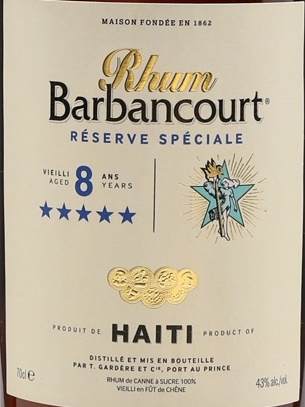
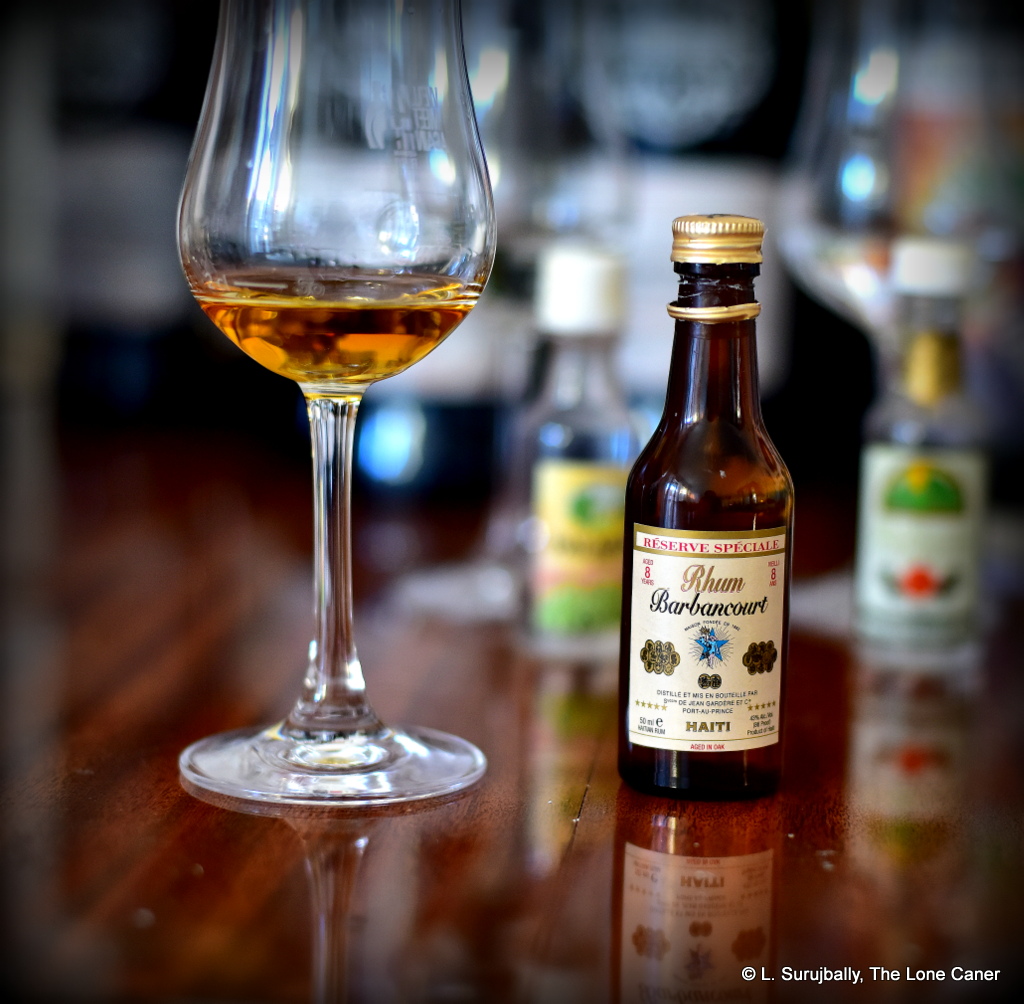
The current label of the 8YO

Barbancourt’s rhums are not issued at full proof: they prefer a relatively tame 40-43%, and every possible price point and strength is not catered to.  The company has a relatively small stable of products: the Blanc, the 3-star 4 Year Old, the 5-star 8 Year Old and the flagship 15 year old (Veronelli’s masterful 25 year old is a Barbancourt rhum, but not issued by them).  Though if one wanted to get some, then independent bottlers like Berry Bros., Bristol Spirits, Duncan Taylor, Cadenhead, Samaroli, Plantation and Compagnie des Indes (among others) do produce stronger and more exacting limited offerings for the enthusiasts.

Yet even with those few rhums they make, whatever the competition, and whether one calls it a true agricole or not, the rhums coming from Barbancourt remain high on the quality ladder and no rumshelf could possibly be called complete without at least one of them.  After trying and retrying all three major releases, my own conclusion was that at the intersection of quality and price, the one that most successfully charts a middle course between the older and the younger expressions is the 5-star 8 year old (I looked at it last way back in 2010, as well as one earlier version from back in the 1970s) which remains one of the workhorses of the company and the island, an excellent mid-level rum that almost defines Barbancourt.

It does display, however, somewhat of a schizophrenic profile. Take the nose, for example – it almost seems like a cross between a molasses based rum and an agricole.  While it certainly possesses the light, herbal aroma of a cane-juice distillate, it also smells of a light kind of brown sugar and molasses mixed up with some bananas and vanilla (it was aged in French oak on Haiti, which may account for the latter). There’s also a sly briny background, combined with a pleasant hints of nougat and well polished leather, plus the subdued acidity of green apples, grapes and cumin.  Not all that intense at 43%, but excellent as an all-rounder for sure.

What the nose promises, the palate delivers, and yet that peculiar dichotomy continues.  It’s soft given the strength, initially tasting of caramel, toblerone, almonds and vague molasses and vanilla (again).  Brine and olives. Spices – cumin, cinnamon, plus raisins, a certain delicate grassiness and maybe a plum or two (fruitiness is there, just understated).  Nope, it doesn’t feel like a completely cane juice distillate, or, at best, if feels like an amalgam leading neither one way or the other, and the close sums all that up.  It’s medium long, with salt caramel ice cream, vanilla, a bit of raisins and plums, a fine line of citrus, a little cinnamon dusting, and a last reminder of oaky bitterness in a relatively good,  dry finish.

What makes the Barbancourt 8 YO so interesting — even unique — is the way the makers played with the conventions and steered a center line that draws in lovers of other regions while not entirely abandoning the French island antecedents. It reminds me more of a Guadeloupe rhum than an out-and-out agricole from Martinique, with perhaps a pinch of Bajan thrown in.  However, it’s in no way heavy enough to invite direct comparisons to any Demerara or Jamaican product.

So, does it fail as a Key Rum because of its indeterminate nature, or because it lacks the fierce pungency of a clairin, the full grassy nature of a true agricole?

Not at all, and not to me.  It’s a completely solid rhum with its own clear profile, that succeeds at being drinkable and enjoyable on all levels, without being visibly exceptional in any specific way and sold at a price point that makes it affordable to the greater rum public out there. Many reviewers and most drinkers have come across it at least once in their journey (much more so than those who have tried clairins) and few have anything bad to say about it.  It’s been made for decades, is well known and well regarded — not just because it’s from Haiti, but because it also has a great price to value ratio. There’s a lot of talk about “gateway” rums, cheaper and sometimes-adulterated rums that are good enough to enjoy and savour, that lead to more and better down the road. It’s usually applied to the Zacapas, Zayas, Diplos and younger rums of this world, but if you ever want to get more serious about aged agricoles, then the Barbancourt 8 YO may actually be one of those that actually deserves the title, and remains, even after all these years, a damned fine place to start your investigations.

(#592)(84/100)


Other Notes

In a curious coincidence, a post on reddit that did a brief review of this rhum went up just a few days before this was published. There are some good links contained within the commentary.

Jan 172019
 

Rumaniacs Review # R-089 | 590

This spite of a light white — to give it its full name, the “Clarke’s Court Superior Refined Grenada Light Rum” – should not be confused with either the current version of the Superior Light being released at 40%, or the best selling and much better Pure White at 69%.  The one here is an older version of the rum, column distilled (Ed Hamilton’s 1995 book Rums of the Eastern Caribbean mentions a two-column still in operation around that time), aged for under a year, filtered to clarity and meant as a low level mixer.  You could argue that it’s meant to take on the Bacardi Superior with which it shares several characteristics, and perhaps it’s a holdover from the light rum craze of the sixties and seventies when cocktails made with such rums were all the rage.

As always when dealing with rums from even ten years back, there’s a dearth of information about the various iterations over the years and decades, and I lack the resources to go to Grenada and ask in person. Still, given that I bought this as a mini, and part of a single lot of rums dating back at least ten years, the “2000s” range of when it was made appears reasonable — and since there are other, more current 43% Superior Light rums from Clarke’s with Grenada shown as green on the label, it may even pre-date the turn of the century.  It’s unlikely that the recipe is seriously different.

Colour – White

Strength – 43%

Nose – Dusty herbal smell, very light, with faint notes of curry and massala. Fennel and rosemary, and a whiff of cardboard.  Provides some brine, sweeter fruity hints (pears, white guavas), and coconut shavings after some minutes.  Quite a vague nose, mellow, unaggressive, easy going.

Palate – Does something of an about face when tasted – turns slightly oaky, which is odd sicne it’s only been aged for a year or less, and then filtered to nothing afterwards.  As with the nose, probably best to wait a little – then some shy nuances of sugar water, apples and pears peek out, accompanied by coconut shavings again, and a touch of raw sugar cane juice.

Finish – Short, light, breezy, faint.  Mostly light fruits, flowers, and pears.

Thoughts – These kinds of whites are (or were) for easy beachfront sipping in a fruity cocktail of yesteryear, or in a local dive with a bowl of ice and a cheap chaser, to be taken while gettin’ tight in the tropical heat over a loud and ferocious game of dominos.  Nowadays of course, there are many other options available, more powerful, more intense, more pungent — and a rum like this is unlikely to be found outside back-country beer-gardens, tourist bars or in an old salt’s collection.  I mourn its loss for the lack of information on it, but not for its milquetoast taste.

(70/100)

Jan 092019
 

Rumaniacs Review #088 | 0587

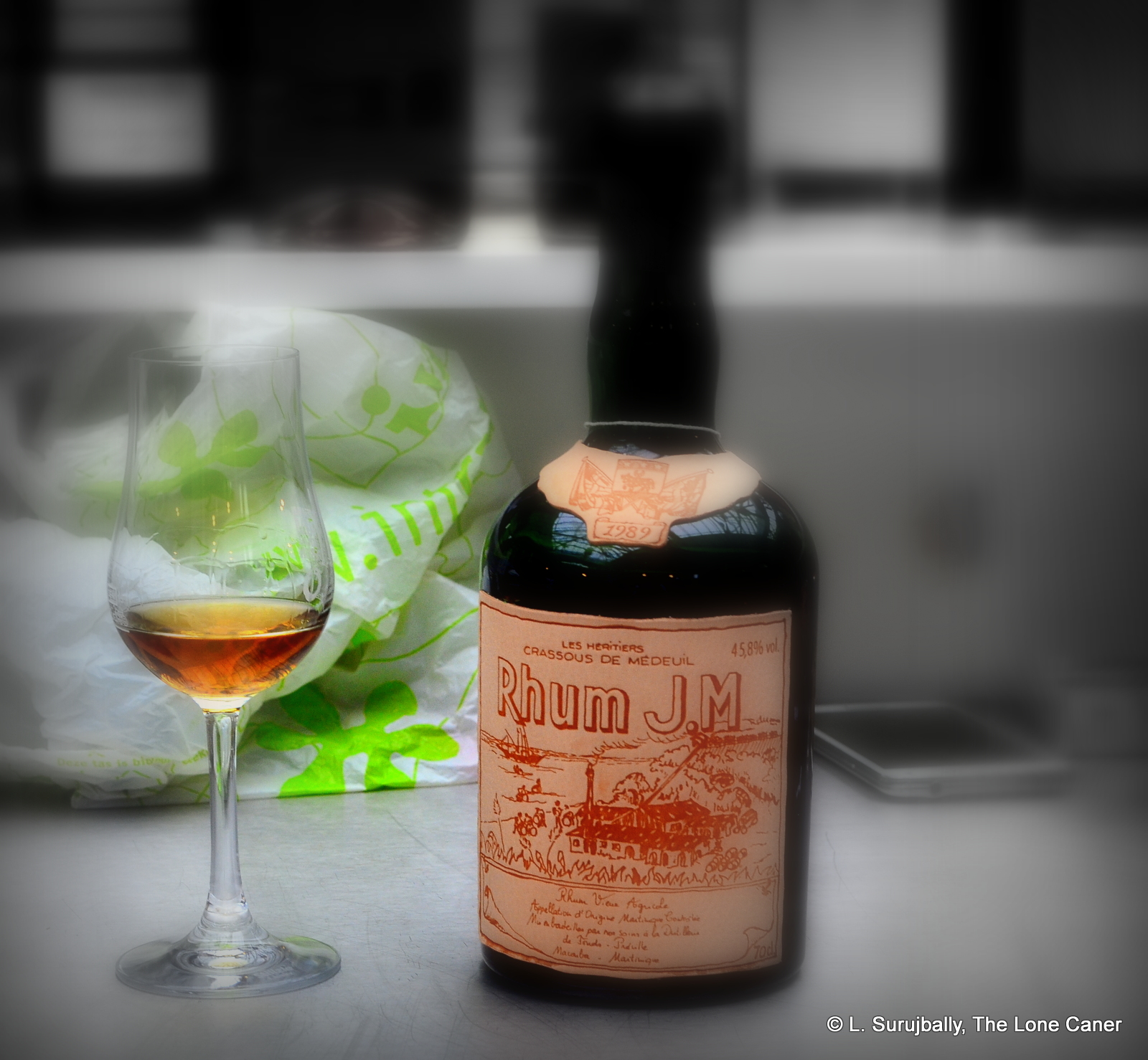
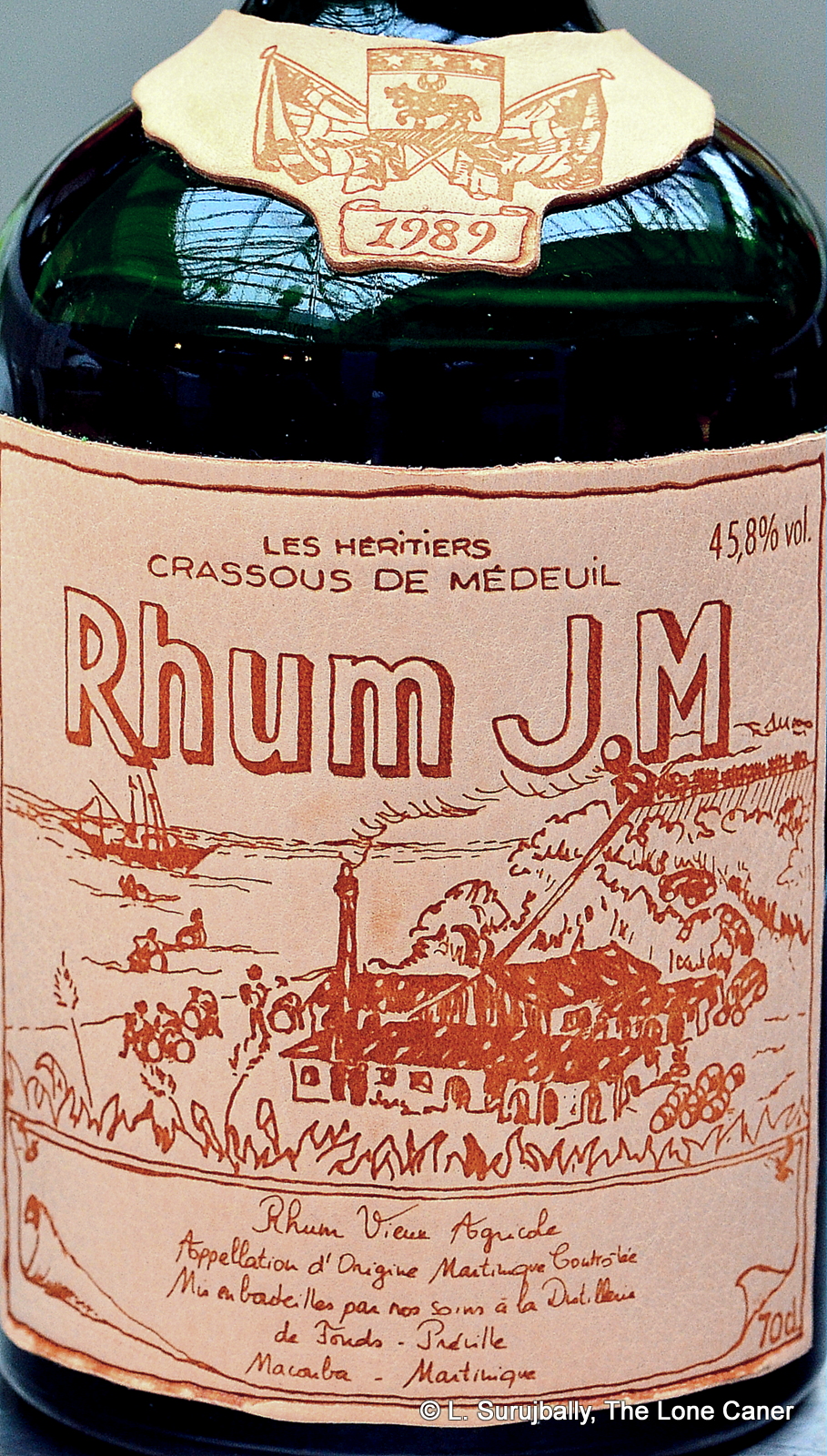
You’d think that a rhum issued less than fifteen years ago would still be reasonably available – you’d be wrong. This amazing leather-labelled, oak-aged 15 year old agricole from J.M. (Martinique) is almost impossible to find, and if you do, it’s not cheap.  It’s long since vanished from J.M.’s online shop, and I finally ended up tracking a bottle down in Switzerland, where it was a fetching a cool five hundred bucks or more, which just goes to show it’s not just other people’s money the Swiss are squirrelling away.  One can only wonder how many (or how few) bottles of J.M.’s juice made up this millésime, or how good it was, for it to disappear so completely.

Colour – Gold

Strength – 45.8%

Nose – Starts off with a small bang of rubber and acetones. Then sweet peppers, floral notes; turns out it’s also chock full of strawberry bubble gum, vanilla, herbs, apple cider, unripe papaya, cherries and something deeper and darker that stays well in the background….spoiled mangoes, maybe.  Really nice, but it doesn’t reveal its secrets easily.  You could nose this for an hour (which I did) and still come up with some last wispy and near-unidentifiable note.  Because it’s just lovely, a nice departure from heavier Jamaicans, Guyanese or Bajans.

Palate – Not quite as rich as the nose, which is a factor of the strength. Okay, I’ll cut it some lack for now, let’s see how that works out. Flowers, sweet fruits, vanilla, leather and aromatic pipe tobacco. Watermelon, grass and sugar water, also dill, rosemary and sage.  The rum’s textire is smooth and warm, there’s very little sharpness here, and the balance among all these subtle flavours is damned fine.

Finish – Not too inspiring, somewhat weak and nothing really new.  It’s light and breathless as if, having used up all its energy providing the nose and palate, it had little left to cough up.  Flowers, light fruits, watermelon and pears, and a little vanilla.

Thoughts –  Some concentration and work required here, but it’s rewarded right up to the finish.  It’s all very light, that’s all – and has a snappy sort of crispness that makes every flavour stand out clearly – you could spend a whole afternoon sipping casually away and then wonder when the bottle went dry. The close is disappointing though, and leaves one wanting more – it’s too good to be indifferent to it, but too indifferent to be really good.  Other than that, this is a really fine piece of work by J.M. — the way it smells and tastes, and possibly the limited outturn, goes a long way to explaining how come the thing is so rare…and so expensive.

(85/100)


Other notes

I’ve written about other J.M. rhums before this and provided some brief biographical notes of J.M.’s background in each, but if you want more details, the Wonk-in-Residence has his usual in-depth recap here, and here.

Jan 022019
 

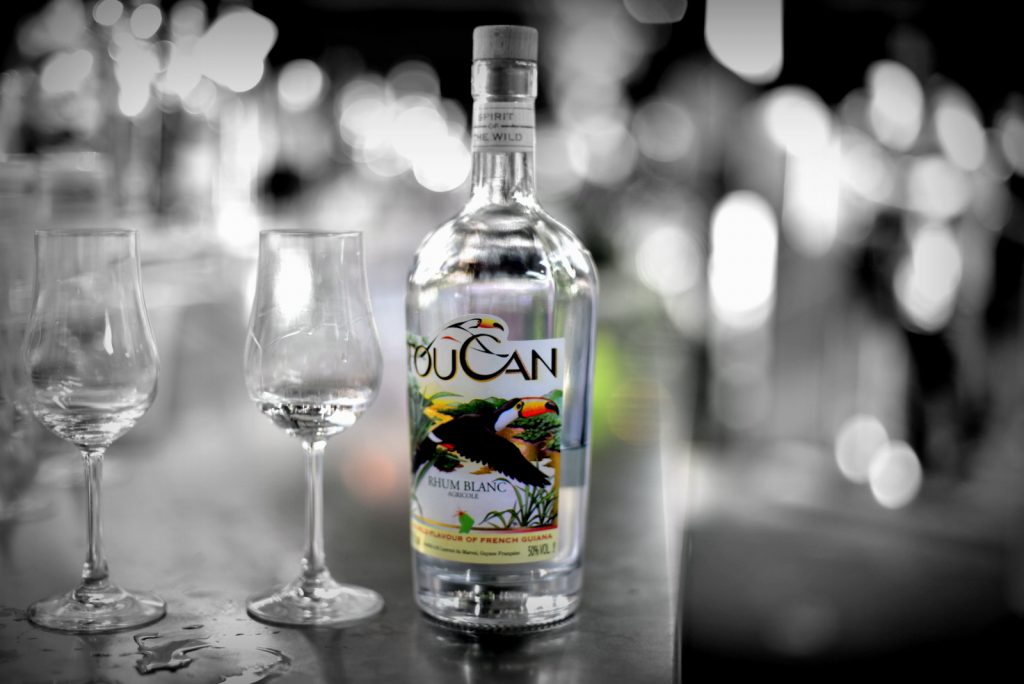
There must be something about the French that just leads them into starting little rum companies in other countries. There was Hembert Achard and Anne-Francois Houzel who formed Whisper Rums from Antigua; David Giallorenzo of Issan; and Marine Lucchini and Thibault Spithakis of Chalong Bay. And of course there’s Toucan, which, if you recall from my posts of a year ago, is a relatively new entrant to the field of rums, yet distinguished itself (in my eyes at least) by making the really nifty-but-underpowered Toucan No. 4, as well as being from French Guiana, a place we have not seen or heard of enough when it comes to rums.

All these companies are small, discreet and self-effacing…almost humble.  Oh sure, they use social media and have slick, marketing-heavy websites and show up on Facebook feeds off and on – who doesn’t, these days? – but what distinguishes them (to me) is both their relatively low-key digital footprint, and their equally unhyped but surprisingly good young rums.  Especially the white ones, which I simply can’t get enough of. In this case, the 50% blanc.

Toucan makes a vanilla (I think this is No. 1), the Boco spiced rum No. 2, the No. 4 slightly aged rum and but for my money this 50% white is the best of the lot. It’s made from cane juice processed at French Guiana’s St. Maurice distillery, and then shipped to Toulouse where it stays in neutral steel tanks until ready for bottling, after being reduced to 50%.

What’s nice about it is immediately summarized by a nose of uncommon delicacy and (oddly) also of heft.  It smelled of sweet light fruit – pears, watermelon, green grapes – but also of salty brine and olives, furniture polish, and something barely noticeable yet also…meatier.  In that it reminded me of the Novo Fogo, though with rather more emphasis and braggadocio, due in no small part to the 50% ABV it was bottled at.

The palate continued that unhurried unfolding or flavour.  It was smooth and pleasant (with a little nip from the strength, no getting away from that), initially tasting of fanta and 7-up, light citrus peel, pears again, a few indeterminate ripe fruits, and (get this) those salt-and-vinegar pringles chips. It was aromatic and redolent of these, and the salt and the sweet and the fruity notes melded nicely in a minor key that didn’t overwhelm, just led slowly down to a gentle finish which gave last hints of marzipan, sugar water, toblerone and nougat.

I must admit that furiously raw clarity of flavour and a powerful terroire profile is not this rhum’s thing.  In fact, it’s rather restrained, almost demure, with each flavour shyly coiling out of the mix to tease and titillate before quietly subsiding, much like many of those Asian white rums I’ve been trying of late – Issan, Vientiane, Chalong Bay, Laodi. Like them, the Toucan white straddles the divide between too much and too little, between pillow and hammer, and finds the balancing point between them all.  It’s an unassuming but really good white rum, one of an increasing number of unsung heroes of the blancworld which one should try for no other reason than to be pleased by something that wants to do nothing else.

(#584)(83/100)

Dec 182018
 

White rhums – or blancs – were not products I paid much attention to back in the day, but over the last five years they have continually risen in my estimation, and now I consider them one of the key building blocks of the entire category.  Not the lightly-aged, blandly filtered and softly murmuring Spanish-style cocktail staples, you understand – those I regard with relative indifference. No, I mean stuff like the Mexican Paranubes, the Haitian Le Rocher, the Guyanese Superior High Wine, Japanese Nine Leaves Clear, Tahitian Mana’o White or the Surinamese Toucan White, to say nothing of the new crop out of Asia – Samai, Issan, Laodi, Sampan, Chalong Bay

What elevates these blancs and all their cousins above the regular run of whites is the way they often maintain a solid connection to the distillate of origin and the land from which they came.  They are usually unaged and unfiltered, commonly around 50% or better. Sometimes they’re raw and pestilential and shockingly rude, at other times they’re almost placid, hiding their bright tastes and clear profiles behind a wall of easy and deceptive complexity that takes time to tease out properly (and for both reasons causes them to be occasionally under-appreciated, I think).

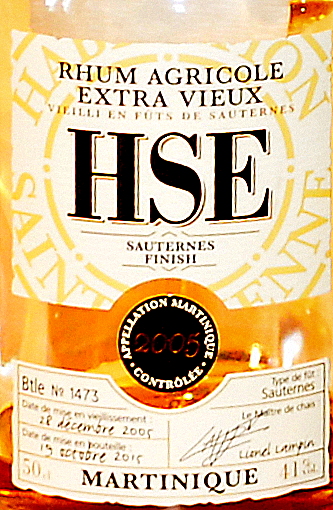
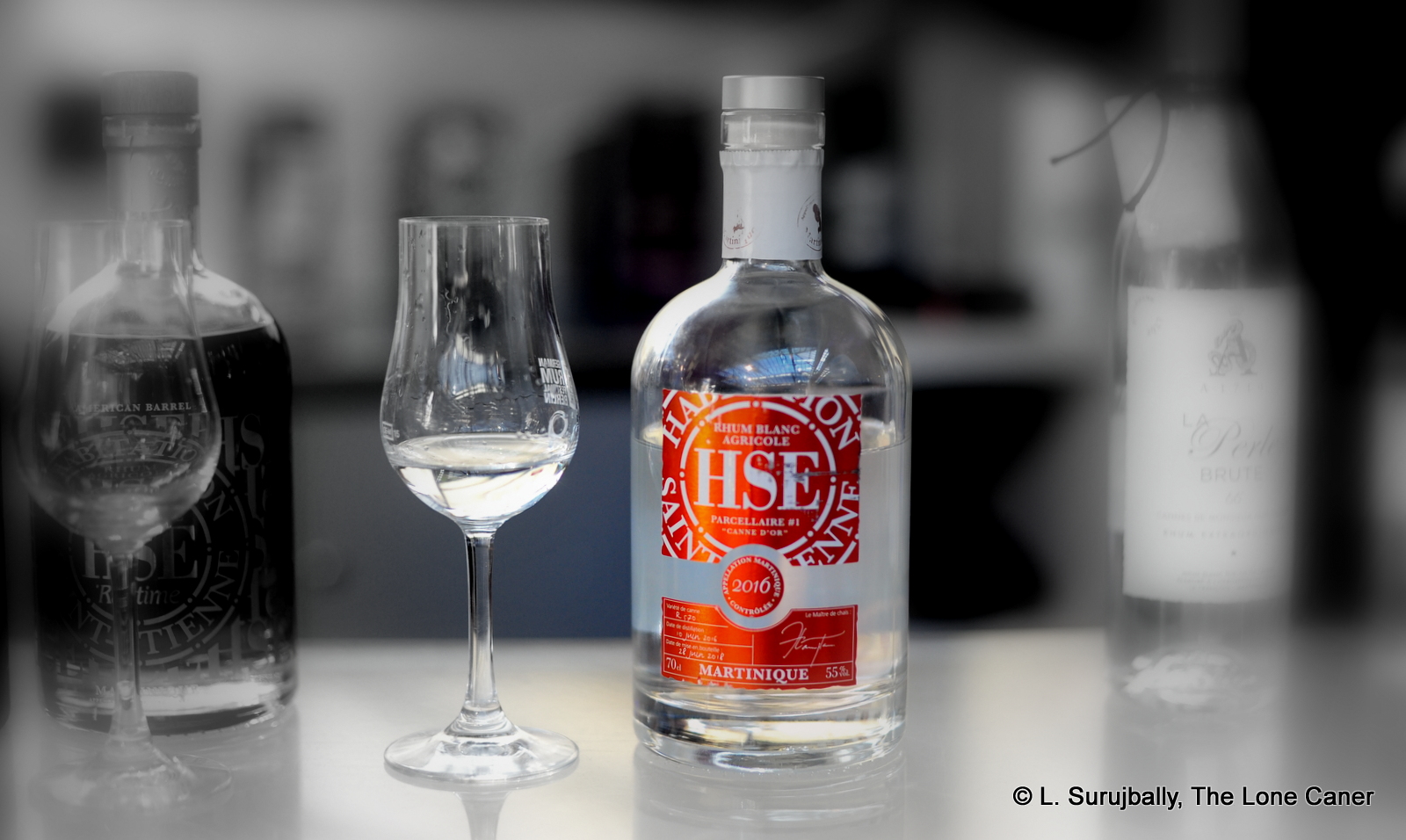
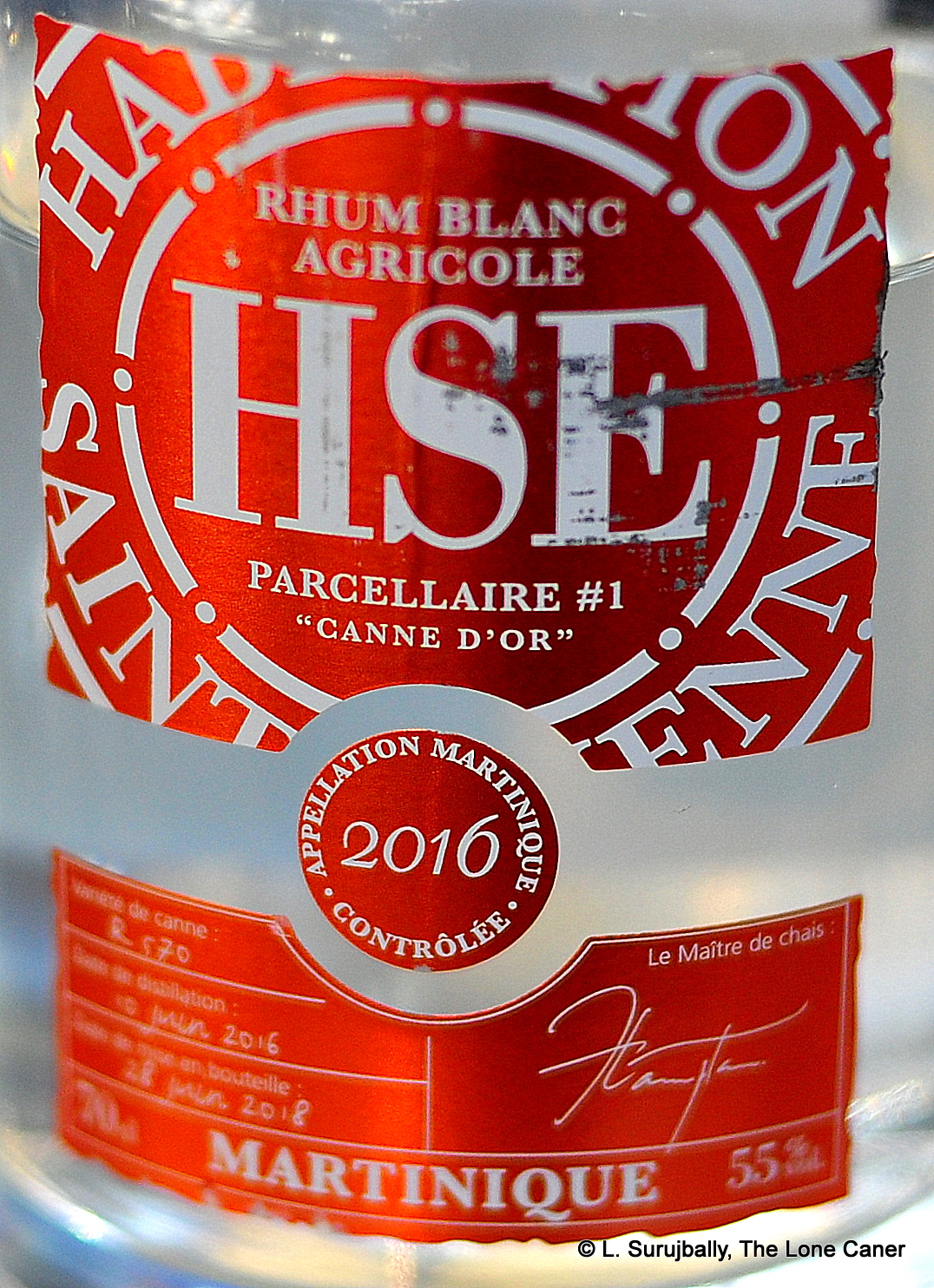
Which brings me to the 55% ABV Habitation Saint-Étienne (HSE) Rhum Blanc Agricole that was distilled in Martinique in 2016 and bottled in 2018 (it rested in steel tanks for the duration and can therefore be seen as unaged). We haven’t talked about HSE for a while, but that doesn’t mean that the Martinique brand has been resting on its laurels, because it continues to produce much good rhum – all AOC compliant – and even taken the whites in a new direction. In this case, perhaps channelling Velier’s Uitvlugt East Field 30 from all those years ago, they selected a special type of sugar cane (canne d’or says the bottle, or “gold cane”, varietal designation R570) not just from their sugar estate in the middle of Martinique, but from a specific part of it – the Verger and Coulon plots of land, issued as a rhum they call Parcellaire #1.  So it’s a sort of micro version of HSE as a whole, showcasing a very small part of its terroire.

Aside from HSE, Longueteau, or the new kid on the island block — A1710 and their white La Perle — such atomized drilldowns into smaller subunits of an estate are almost unknown…but they are intriguing to say the least (even though it may all just be cool marketing – I like to think otherwise). Fortunately the way it smelled and tasted skated over such concerns.  The nose, for example, was quite fragrant, starting off with slightly rotten fruits (bananas), rubber, sawdust, set to a background of soft wax candle, all very restrained. Overall it was a little sweet and relaxed, and as it opened, additional notes of nuts, cereals, almonds and nougat came forward. There was also a hint of olives, brine, pineapple, sweet green peas and ripe oranges in an excellent melange that combined themselves very well, without any single aspect being particularly dominant.

Blanc agricoles’ tastes are usually quite distinct, showing variation only in the details.  This one was slightly different — very smooth, very light, the usual herbs and light citrus and grasses starting things off, just less crisp than one might be expecting. This seemed to be kind of nothing-in particular, but hold on a bit — the other, more complex flavours started to creep out.  Dill, sugar water, olive oil, cucumbers, watermelon, light pimentos and gherkins, all sweet enough not to be off-putting, salty/sour enough for some character. I thought it was really quite tasty, giving aged offerings from the same house some serious competition, and finishing things off with a fade that provided last memories of sweet sugar water, light delicate notes of cumin and watermelon and papaya.

Does that all work? Are the specific plots of origin really that clear? I suggest that as a showcase for such a tiny bit of land, for the general rum drinker, not really.  The differences between the regular run of blancs from HSE and this one can be chalked up to miniscule divergences deriving from batch variation rather than anything so refined.  Admittedly though, I’m not a professional sommelier, and lack the experience such people bring to sensing gradations of wine hailing from neighboring vinyards in France – so someone with a more finely tuned snoot may take more away from this than I did.

But I liked it.  I liked it a lot. Above, I wrote that really good whites are either cheerfully rude or deceptively polite:  this one tilts slightly more towards the latter while still remembering its objurgatory antecedents. It’s a enormously drinkable dram, near perfect strength, with wonderfully delicate and strong tastes mixing up both sweet and salt in a terrific white rhum.  You could drink it alone or mix it as you please, and you’d enjoy it either way, with nothing but a nod of appreciation for what HSE have achieved here with such seeming effortlessness. And for its price? This thing may just be an undiscovered steal.

(#580)(86/100)


Other notes

The Habitation Saint-Étienne is located almost dead centre in the middle of Martinique.  Although in existence since the early 1800s, its modern history properly began when it was purchased in 1882 by Amédée Aubéry, an energetic man who combined the sugar factory with a small distillery, and set up a rail line to transport cane more efficiently (even though oxen and people that pulled the railcars, not locomotives). In 1909, the property came into the possession of the Simonnet family who kept it until its decline at the end of the 1980s. The estate was then taken over in 1994 by Yves and José Hayot — owners, it will be recalled, of the Simon distillery, as well as Clement —  who relaunched the Saint-Étienne brand using Simon’s creole stills.

Dec 162018
 

When we think of independent bottlers, all the usual suspects out of Europe usually come to mind — Velier, Rum Nation, L’Esprit, the Compagnie, the whisky boys up north who indulge themselves in the odd single cask expression from time to time, SMWS, Bristol Spirits, and the list goes on.

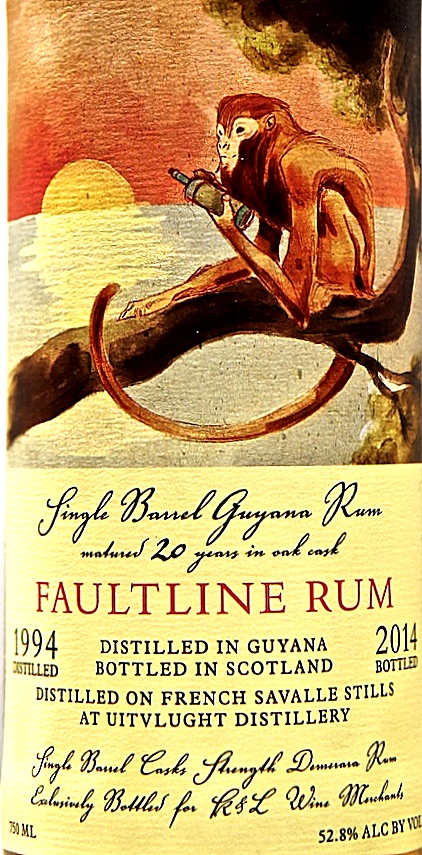
These well-known names obscure the fact that smaller operations — stores and even individuals — can and do in fact issue single barrel offerings as well.  For example, Kensington Wine Market in Calgary does it with whiskies quite often; a bunch of redditors recently got together and bought a cask of a 2005 Foursquare rum; and in the case of the rum under review today, K&L Wines out of California bought a single cask of Uitvlugt Savalle-still juice from an independent warehouse in Scotland, and issued it in the States.

It excites equal parts curiosity and admiration, and not just because of the retro-cool label – although that’s quite attractive. I mean, it’s not as if the US is known for independent bottlings – they’re much more into going the whole hog and creating entire new distilleries (however small). The rum is twenty years old (1994-2014), a robust 52.8% and for once seems not to have been sourced from Scheer.  The name “Faultline” is what K&L uses for its own bottlings, and I gather that The Two Davids of K&L happened to be in Scotland in early 2014 and found two Demeraras (Enmore, Uitvlugt) and a Jamaican Hampden mouldering away, and manned up and bought the lot to issue as was – not a trivial exercise for them, since (as they put it), these casks were “much more expensive than single malt whiskies despite the fact that they’re half as desirable.”

Half as desirable?  Oh please. To American audiences maybe, but I submit that were they to try this thing and go further afield in their polling, the scales would be rather more evenly adjusted.  The nose of an Uitvlugt rum, deriving as it does from a Savalle column still, is a great counterpoint to the woodsy Enmore and PM and Versailles rums (the UF30E remains one of the best Guyanese rums ever made, in my own estimation) — here it delivered quite well. It began with a nose of old leather shoes, well polished and long broken in. It provided smoke, a faint rubber background, and after opening up, the light florals of a fabric softener and freshly sun-dried laundry.  There were more traditional aromas of caramel, vanilla, molasses, cumin, tea leaves and aromatic tobacco, with rich deep fruits (peaches, apples, apricots) dancing around these smells, but never overwhelming them.

The palate was also very approachable and tasty. Soft and warm, tasting of brine and red Moroccan olives (they’re slightly sweeter than the green ones); leather and wooden floors, old and well worn and well polished, so to speak. Fruitiness is again generally light – green grapes, peaches, some lemon zest, raisins – resting well on a bed of salty caramel, butter and cinnamon.  Overall, not too concentrated or overwhelming, and the strength is just about perfect for what it does. It teases and doles out delicate, clear notes in a sort of delicate assembly that invites further sipping, and the finish goes in yet other directions: dry and somewhat tannic, hinting at strong black unsweetened tea, oakiness, some raisins and stewed apples, toffee, toblerone and coffee grounds. Plus a last whiff of those fruity hints to round things out.

There’s not really a true periodic stable of such rum releases by K&L who are more into an “as and when” approach, and therefore such bottlings are, I submit, more like personalized number plates lending street cred to the issuer…something like vanity rums. Fun to get, fun to drink, interesting to have, great to taste, cool to point to — but not really meant to build a brand or a rum-issuing company: K&L is after all a liquor emporium, not an outfit specializing in indie bottlings. So a rum like this serves to draw attention to the store that sells them, providing a sort of exclusive cachet that you can only get if you shop there.  Well, that’s fair, I don’t rain on capitalism – but it does make that kind of release something of a one-off. It doesn’t support a wider array of brands or draw attention to other rums released by the same company, since there aren’t that many to be going on with.

That doesn’t invalidate the Uitvlugt 1994 though.  It’s lovely. It exists, smells the way it smells, tastes as it does, and is a real nice piece of work. I think what it points to is something often ignored by the larger American rum tippling public and the press —  that they have the same potential to issue good single-barrel, limited-edition, cask-strength rums as anyone else…and come up with something pretty nifty at the back-end when they try. This rum, limited as it is and even with its price tag, is really quite good…and single barrel or not, I’m sure the Davids weren’t disappointed with what they got.  I know that I wasn’t.

(#579)(85/100)


  • Big thank you to Quazi4Moto for the sample. It’s taken a while, but I got to it at last.
Dec 062018


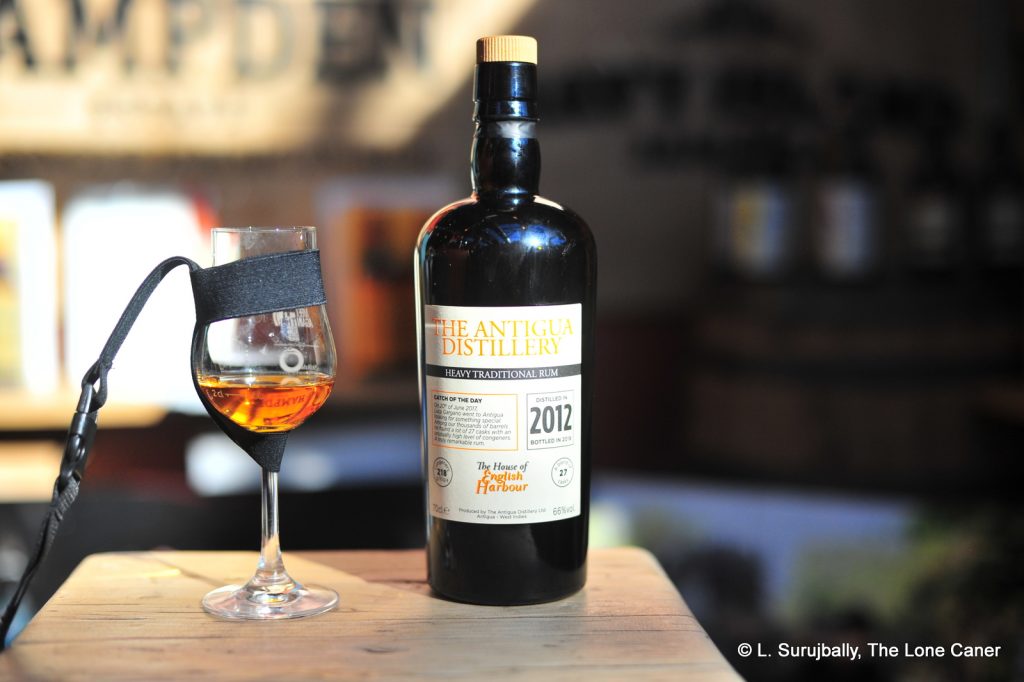
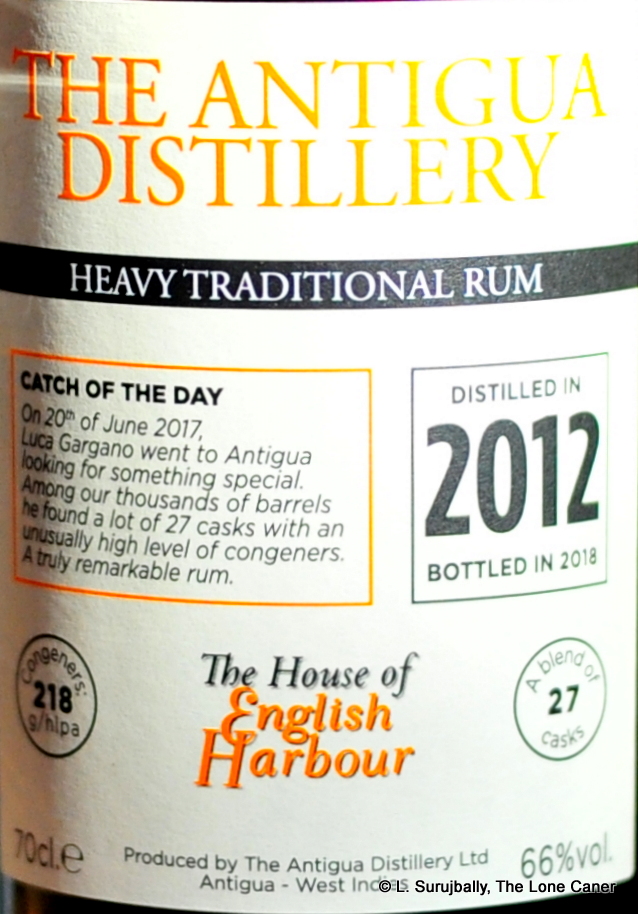
Not only was the Antigua Distilleries’ English Harbour 1981 25 YO the very first rum review posted on this site, but for a long time it was also one of my personal top sipping rums (as well as the highest priced), and ever since, I’ve had a fond place in my heart for their work.  In 2017 I tried their new sherry matured rum and was impressed and intrigued at the directions in which they were going – but the 2012 rum issued the following year as part of the Velier 70th anniversary collection, that one was something really special. I haven’t tried the single barrel offering at 68.5% from this batch, but for my  money, this one at 66% is among the very best from Antigua I’ve ever tried.

The numbers almost tell the tale all by themselves: 1st limited cask release ever to come from the distillery; 6 years old; 26 casks (see note below); 44% angels share; 66% ABV; 70th anniversary edition; 212 g/hlpa congeners (which include more than just esters), placing it somewhere in the low end of the Jamaican Wedderburn category, or perhaps in the upper reaches of the Plummer. Distilled in 2012 on a continuous three-column still, and bottled in 2018, and with that, it’s not like we need to add anything else here, except perhaps to remark that these esters seem to have a differing nationality, because they sure don’t talk the same like the Jamaican bad boys from Long Pond

To be honest, the initial nose reminds me rather more of a Guyanese Uitvlugt, which, given the still of origin, may not be too far out to lunch.  Still, consider the aromas: they were powerful yet light and very clear – caramel and pancake syrup mixed with brine, vegetable soup, and bags of fruits like raspberries, strawberries, red currants.  Wrapped up within all that was vanilla, cinnamon, cloves, cumin, and light citrus peel. Honestly, the assembly was so good that it took effort to remember it was bottled at a hefty 66% (and wasn’t from Uitvlugt).
The taste was similarly excellent, attacking strong and firm without sharpness; it was gently phenolic, with a hint of acetone, balsamic vinegar, veggie soup and crackers — nothing overpowering, though. These flavours were kept subservient to the more forward tastes of caramel, toffee, white toblerone chocolate and crushed almonds, and as I waited and kept coming back to it over a period of some hours, I noted flambeed bananas, salt butter and a very strong, almost bitter black tea. It all led to a rousing finish, quite long and somewhat dry, showing off final notes of aromatic tobacco, almonds, unsweetened chocolate, vanilla and yes, of course some caramel.

Wow! This is quite some rum. It’s well balanced, just a little sweet, tasty as all get out, and an amazing product for something so relatively young deriving from a column still – I’d say it is actually better than the 1981 25YO. It has enormous character, and I’d hazard a definitive statement and say that to mix it or add water would be to diminish your drinking experience – this is one of those hooches best had as is, honestly, and it delights and pleases and leaves you with a twinkle in your eye all through the tasting and after you’re done.  

Velier, who distributes the 2012 is not, of course, an independent bottler — if they were, they’d hype themselves out of shape, market the hell out of their own releases as Velier bottlings, and never give the kind of prominence to the distiller of origin as they have since the Age of the Demeraras. Luca has always respected the source of his rums, and felt he acted as a facilitator, an educator, bringing together three points of the triangle – his own ideas, others’ best rums and the audience’s amorphous, oft-unstated, unmet and unarticulated desires.  At the intersection of these forces lies the desire to find, to chose and to issue rums that are brilliantly assembled, superbly tasty, and exist to shed new sunshine on the land of origin in general and the distillery of make in particular. That’s exactly what’s been achieved here, with every one of their wishes being granted by what’s been trapped in the bottle for us to enjoy.

(#576)(88/100)


Other notes

  • Luca selected 27 barrels from the 2012 production of Antigua Distillers, but one was so exceptional he released it on its own at 68.5%.  The remaining 26 barrels were blended into this rum. The information is not noted anywhere but calculations suggest the outturn is just around five thousand bottles, maybe a shade more.
  • Some other reviews of this rum are from the Rum Shop Boy (scoring it 91), and Single Cask Rum (no scoring). The latter review has some good historical and background details on the company which are worth reading.
Dec 042018
 

Ten years ago, the 151s were regarded with the sort of wry caution with which one approaches a crazy old uncle who may lash out with either invective or drool at any moment, depending on the circumstances.  They encouraged adverbial density, were the strongest rums available to the rumworld, and used exclusively as cocktail bases and mixing agents. Myself, I was always a little amused by their ferocity and used their elephantine profiles as an excuse to write reviews that didn’t take themselves too seriously (like the BacardiLemon HartCavalier, or Appleton 151 reviews, for example).  But what else to do? I mean, back then we had no access to or real knowledge of the cask strength rums that now so dominate the upper echelons of quality rums, and to consider a 151 as anything else but a throwaway effort made to bag the overproof crown and/or to concoct crazy strong cocktails would be to mis-state what they meant to us.

As the years passed, overproofs more or less fell out of the mainstream, even out of favour, replaced by exactingly made full proof rums, some of which are approaching that kind of strength, though comparatively rarely. I can’t remember the last time I saw a review of a 151 aside from Habitation Velier’s new white (not that there were that many to begin with) and mention of any is passing rare.  But me, I never forgot them, and still hold fond memories of their harsh fury, and when I saw a Tilambic 151 sample for sale, well, what’s a reviewer to do?

Cracking it, you’d certainly exercise all the usual cautions, as one would with the SMWS Long Pond 5.1 (81.3%), the Sunset Very Strong (84.5%) or the Marienburg White (90%).  Because like all of those, the Tilambic is frenetic, unapologetic and massively alcoholic – it smokes, it seethes, it exudes badass from every pore: you can almost hear the tinkling plink of minigun shell casings piling up around your feet as you pour. To smell, it’s sharp and extremely hot, spicy and slightly sweet, redolent of raw molasses and sweet corn in a can (weird, I know), to which some light lemon zest and caramel has been mashed in with an oaken club wielded by The Rock. And which – you might be surprised to discover – is actually not bad at all.  I was certainly expecting less.

As for the palate, well, it’s a monster (yeah, big surprise). Briny with olives, pimentos, hot hot hot.  A lot carries over from the nose, but there’s more too, once you adjust to the force with which it attempts to tattoo “151” on your tongue. It has, both before and after a few drops of water, some strawberries, green apples, sawdust, light pencil shavings, licorice, mustard, vanilla and a ton of oak ameliorated by a sly little citrus line.  But it also doesn’t attempt to do too much; and unlike some indie caskers at this level, is not that complicated – in that relative simplicity lies much of its appeal, if your taste runs into high proof drinks. It all gets summed up very nicely on the finish, which is oaky, spicy, briny, dry, with a little fruit and some licorice, vanilla, caramel, and then it’s gone. Probably leaving you gasping.

So who makes this thing? We know about St. Aubin, Lazy Dodo, New Grove and Chamarel, all of which channel the old rum making traditions of the island. But the company that makes this one, Green Island, is actually a UK company which licenses International Distillers Mauritius to provide their rums – IDM also makes marks like the Flamboyant, Cascavel and the well known and positively regarded Penny Blue rums, as well as a number of Green Island starter rums.  So not so much an artisanal rum maker as a local spirits conglomerate, like DDL in Guyana or Angostura in Trinidad. The Tilambic 151 is made on a column still, aged for varying times (“up to seven years”) and has no additives, flavourings, colourings or filtrations.

That puts the it squarely into the mixing category, as are most lightly aged rums of this kind.  That it has more qualities than defects is to its everlasting credit, and our relief. I mean, this thing could take out two defensive linemen in full pads just by cracking the seal – but it was surprisingly light and flavourful too, especially after resting for a while to burn off the alcohol.  And even if it wasn’t genetically enhanced by a team of imported Swiss scientists who had seen King Kong one too many times, I can’t dismiss it out of hand – because for all its coarse and brutish power, it really was quite an interesting rum, with some positives and very few negatives. For a 151, that’s really quite an achievement.

(#575)(78/100)


Other Notes

  • The name “Tilambic” is a creole name for the local farmers’ stills, which they use, much like the Haitians do, to make their own personal hooch.
  • Steve James over at the Rum Diaries took a look at the rum back in 2014, which gives you some idea how long it’s been knocking around.
  • For additional details on the history and development of 151 overproof rums, this article provides all the background
Nov 192018
 

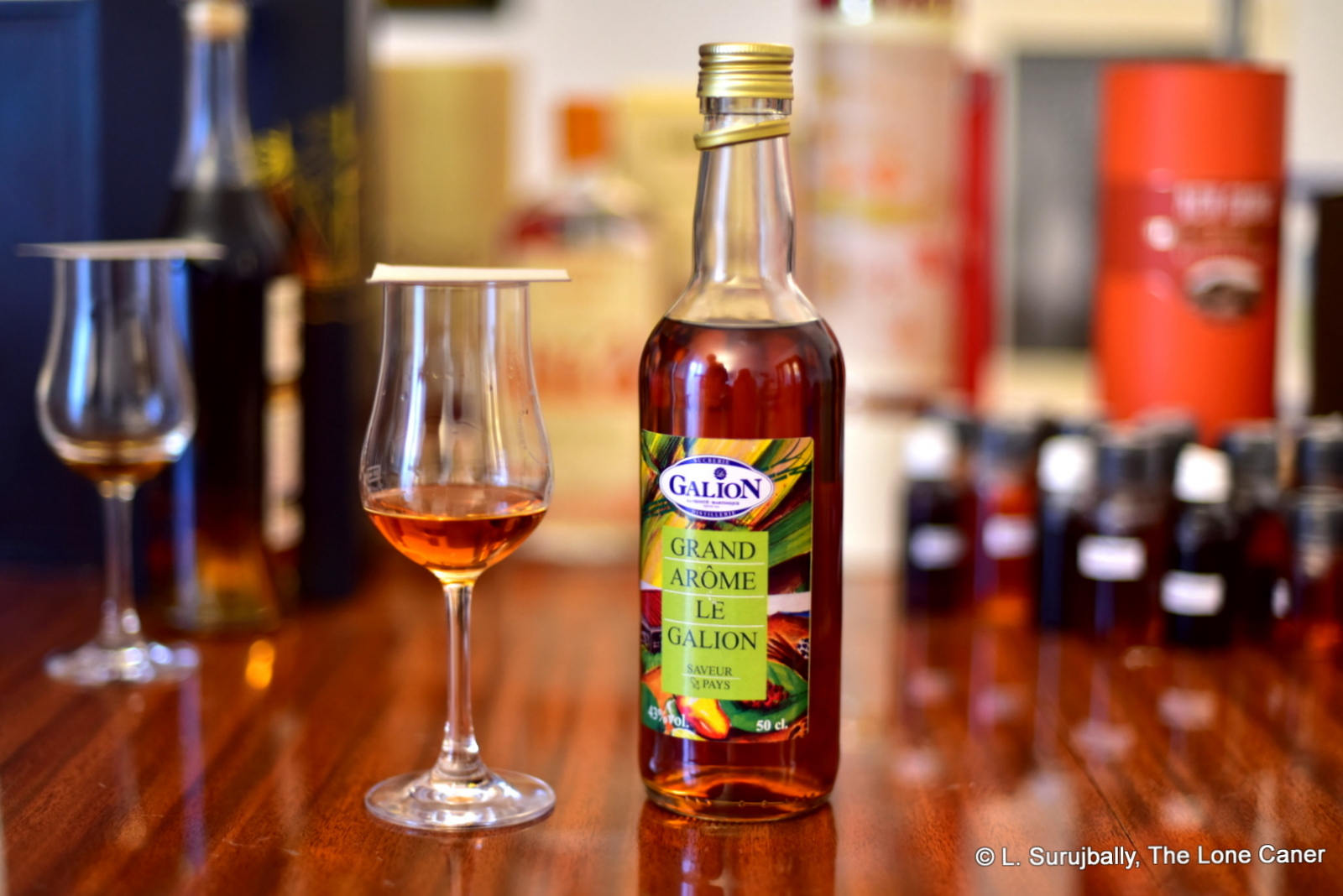
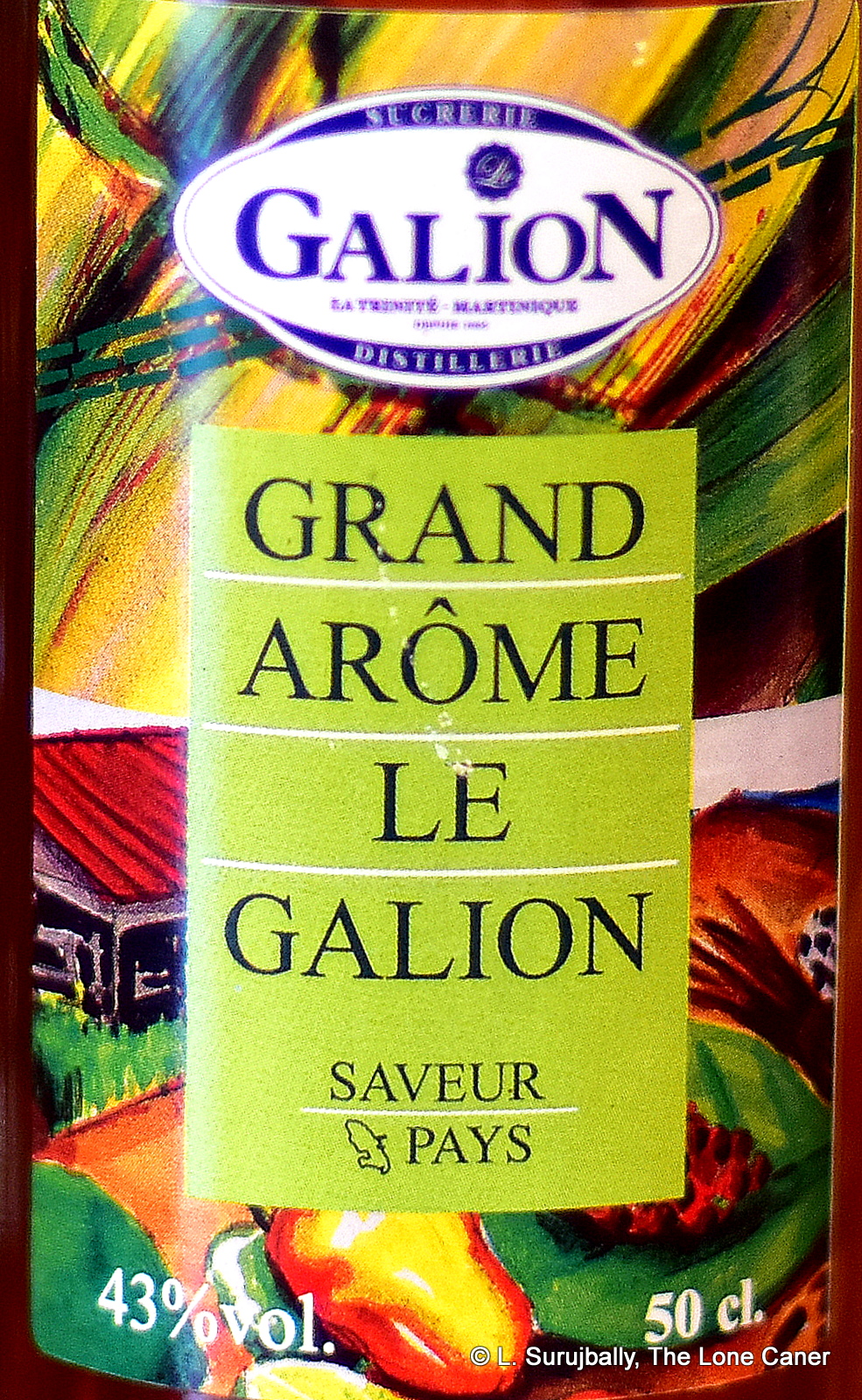
It was the words “Grand Arôme” that caught my eye: I knew that term.  “Galion”, which I seemed to remember but didn’t, quite. And “Martinique,” hardly seeming to go with either.  It had no brothers and sisters to its left and right on the shelf, which, in a shop stocking rows and rows of Plantations, Rum Nation, BBR, Saint James, Bally, HSE, Dillon, Neisson and all the others, struck me as strange (that and the rather “poor-relation-from-the-backcountry” cheap label and tinfoil cap).  What on earth was this thing?

I bought it on a whim and cracked it in the company of some other agricoles that night and did not one lick of research until after it was done: that was probably the right decision, going in blind like that, because here is a rum which lurks behind the Martinique canon the same way the bottle did on that shelf, and it’s rare enough these days to find a rum you didn’t know existed, especially from an island with so many different rhums of its own that are well known.

Rums and rhums titled “Grand Arôme” are high-ester products much associated with French island rhums in general (Reunion Island’s Savanna HERR in particular) and have a lot in common with the New Wave of Jamaican rums we’re currently seeing from Hampden, Worthy Park and others, with their own classification titles like Plummer, Wedderburn and Continental Flavoured.  They are all branches from the same tree – hooches with boosted ester counts to make for a enormously flavourful product.

And you could sense that on the nose, which was one to drive Cyrano de Bergerac into conniption fits.  It lacked the smooth warmth of an aged product, but whether it did or didn’t spend time sleeping in wood, it reeked like a white monster from Haiti, even at the low strength.  Olives, brine, licorice, black pepper, some vanilla, prunes and pencil shavings were immediately noticeable, in a sort of delirious free-for-all for dominance, followed by a lessening intensity over time as it opened up and provided some secondary aromas of vanilla, bags of fleshy fruits (peaches, apricots, prunes, plums, citrus), very light caramel and some aromatic tobacco. Not entirely original, but very very pungent, which for a rum issued at 43% was quite impressive – it was certainly more interesting than the light Cuban-style San Pablo or milquetoast Dictador Best of 1977 I happened to have on hand.  Actually, that smell it reminded me rather less of an agricole than of a Jamaican, with all the funk and rotten bananas and midden heaps (akin to the Long Pond TECC but nowhere near as intense).

The pattern repeated itself as I tasted it, starting off sharp, uncouth, jagged, raw…and underneath all that was some real quality. There were caramel, salty cashews, marshmallows, brown sugar (truly an agricole? I wrote in my notes), plasticine, wax crayons, brine, olives, sugar water, pineapple, raisins, a solid citrus heft to it, and again a lot of varied ripe fruits (and some not so ripe that were just beginning to go off).  It was kind of sweet and salt and sour all at once – practically a roadmap to the esters it squirted from every pore. But what was nice about it, was that if left to rest, it turned out to be smooth enough to sip while retaining that edge of raw quality that would make it a great mixer, and it’s got all the character of profile which the San Pablo (both the Gold and the White) so conspicuously lacked.  Even the finish demonstrated that – it was short, but quite intense, with lingering notes of citrus, light anise, molasses, fruits, raisins and a last hint of salt.
My initial scribbles, transcribed here verbatim, read “Can’t tell what this is, need more background work. Says from Martinique, but it backs away from the crisp/clean agricole party line; seems more like a Jamaica-Martinique stepchild?” (Yeah, I really do write like that).  Because to me, it presented as a hybrid at the very least, suggesting intriguing paths for rum makers – a combination of agricole and molasses rum, made perhaps en passant, but certainly not lacking in brio, aggro or tempo.

So what is it? A local rum made for the backcountry and not for export?  A trial balloon of sorts to suss out the market? A failed attempt at something different, an experiment that somehow got loose from the lab? A bottle of the chairman’s private stash that got smuggled out in someone’s trousers?

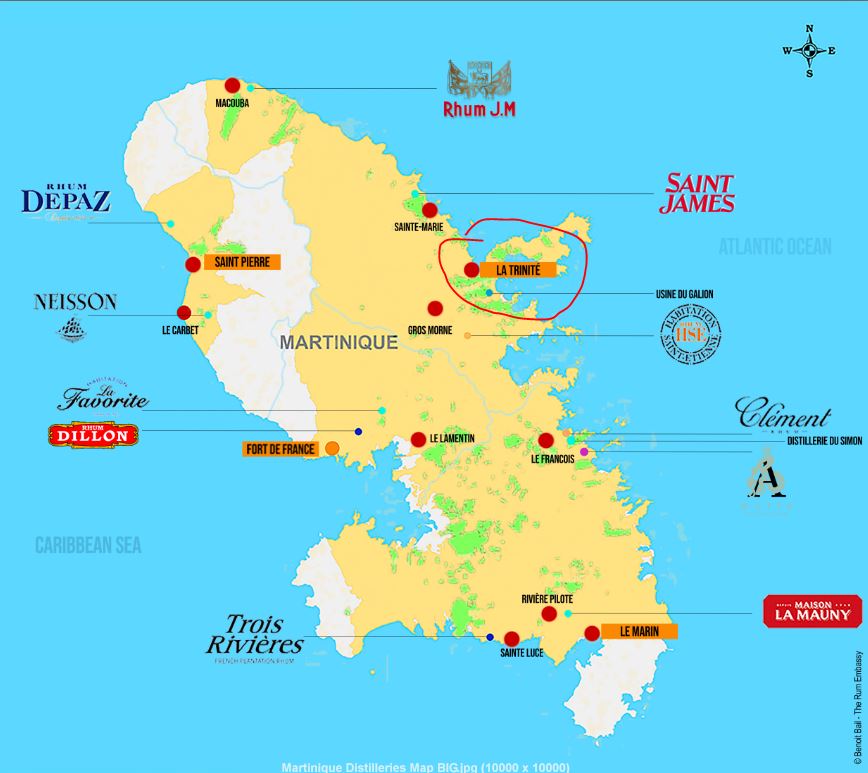
Not quite.  It’s Martinique’s answer to the Jamaican bad boys, made by the last remaining sugar factory on Martinique, Usine du Galion, which has the added distinction of also being the last distillery on the island to make rum from molasses (they source cane from around the island, from areas not AOC labelled). It’s mystifying why there’s such a lack of awareness of the Galion rum itself, but on reflection it’s perhaps not so surprising, because — according to the estimable Benoit Bail and Jerry Gitany who I contacted about this odd lack of profile — the commercial bottled rum is peanuts to them. Their real core business is sugar, and that part of the operation is huge, their primary focus. They installed a column still in the factory to make rum in bulk, which is then almost all exported to Europe, used primarily in the tobacco/candy/pastry industries and pharmaceuticals (probably perfumes).

Map of Martinique distilleries courtesy of Benoit Bail

There are only two Galion rums I’m aware of at this point: a white I’ve never seen at around 50-55%, and this one at 43%, which, according to Nico Rumlover’s enormously informative article here, is made from molasses, fermented with the addition of vinasse for anything between eight to sixteen days in wooden vats, using indigenous yeasts in a continuous cycle through the columnar still.  Apparently it is unaged, with a small amount of caramel added to give the brown colour and generally limited to the ester midrange of around 500 g/hlpa – squarely in the no-man’s land between Wedderburn (200-300 g/hlpa) and Continental Flavoured (700-1600 g/hlpa).

And it’s a hell of a rum, I’ll tell you that – Matt Pietrek in his article on “Beyond Jamaican Funk” mentioned Galion and what they were up to, but missed this under-the-radar rum and suggested that if you wanted French Island ester bombs, Reunion was the place to go.  You might still have to, since the Galion is either available only at the factory, as a blender’s sample from Scheer in Amsterdam (at a whopping 61% ABV), or in some small, dusty forgotten shelf somewhere in Europe. But if you can pick it up, think of it as a high ester funk bomb that could be seen as a cheerfully insouciant French bird flipped at Jamaica; it proves emphatically that you don’t need to go all the way to the Indian Ocean to get yourself some, and provides a really cool comparator to those flavourful rums from all the other places we are only now getting to know so well.

(#569)(85/100)

Nov 152018
 

Smaller Caribbean islands can be sleepy sorts of places where (partly in my imagination, partly in my boyhood experiences) old, lovingly-maintained Morris Oxfords and Humber Hawks sedately roll down leafy, sun-drenched boulevards reminiscent of the colonial era, and pass rumshops on every corner where men slam down dominos and drink paralyzingly powerful local white lightning with coconut water while discussing Sobers, Kanhai, Lloyd and Lara from the Windies’ long-past glory days with plenty “suck-teet” and “styupsin” and “cuss-up”.

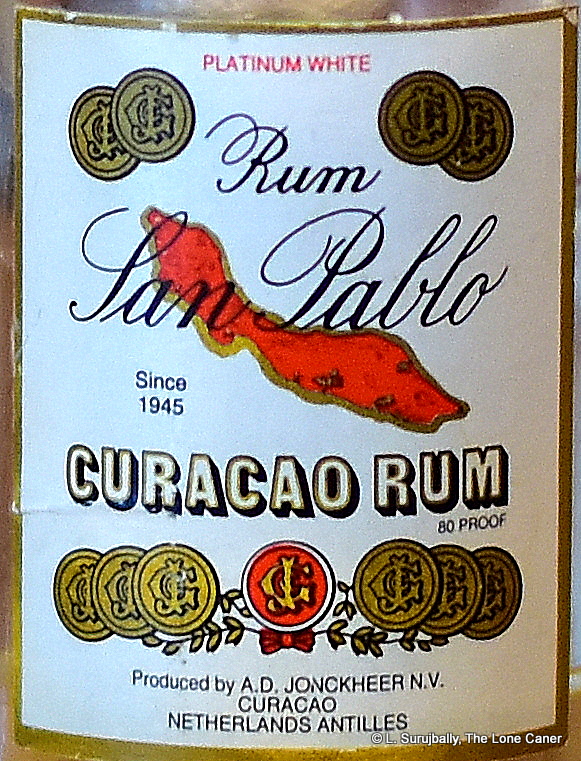
All right so that’s a bit of poetic license, but in my youth, it really was like that up and down the coasts and the banks of the Demerara, and the only difference with any of the Caribbean islands might have been the rums.  Guyana preferred the amusingly named Superior High Wine (three lies in one), in  Jamaica it would be J. Wray 63% white (what else could it be?), Grenada would have gone maybe for Rivers, or Clarke’s white – and in Curacao, it’s not a stretch to think of the rum of choice being the low-strength “Platinum White” from San Pablo. The cars, rumshops, and dominos (maybe even the cricket convo) would probably remain the same all over, though.

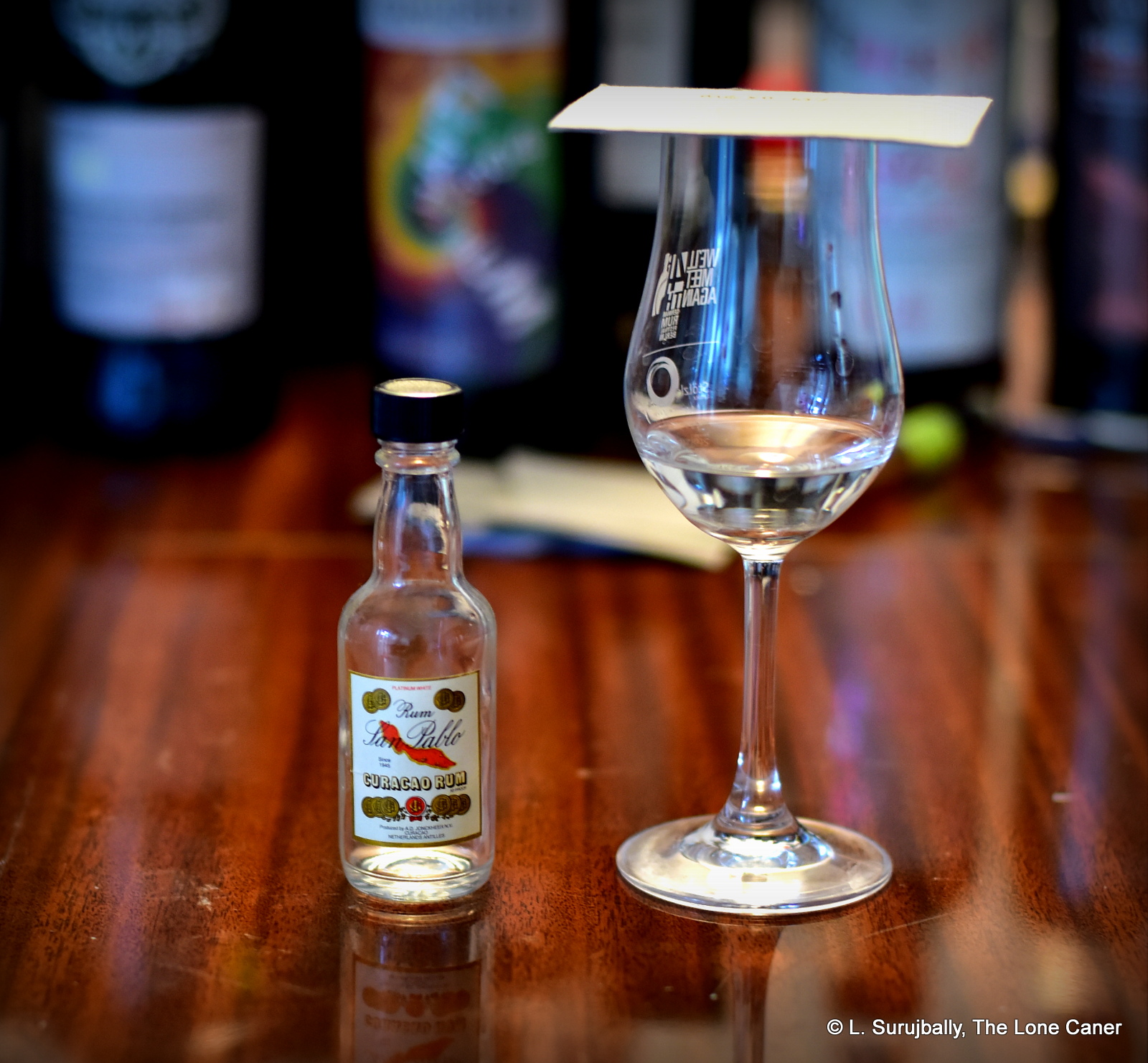
The San Pablo rums may indeed be the most popular brand in Curacao as they claim, but to a beady eyed rum junkie, or one raised on more feral blanc sarissas, their Platinum White is mild cheese indeed, milder even than the Gold rum that is its closest sibling, and that one had all the aggro of a somnolent keebler elf.  It is also 40% ABV, and while their website says almost nothing about the production methodology, I’m going to go out on a limb and say that (a) it’s a column still distillate and (b) it’s been aged just a bit before being filtered through charcoal to remove any residual colour…which implies it may actually be the gold itself, minus the brown.

And that creates a rum of uncommon docility.  In fact, it’s close to being the cheshire cat of rums, so vaguely does it present itself.  The soft silky nose was a watery insignificant blend of faint nothingness. Sugar water – faint; cucumbers – faint; cane juice – faint; citrus zest – faint (in fact here I suspect the lemon was merely waved rather gravely over the barrels before being thrown away); some cumin, and it’s possible that some molasses zipped past my nose, too fast to be appreciated.
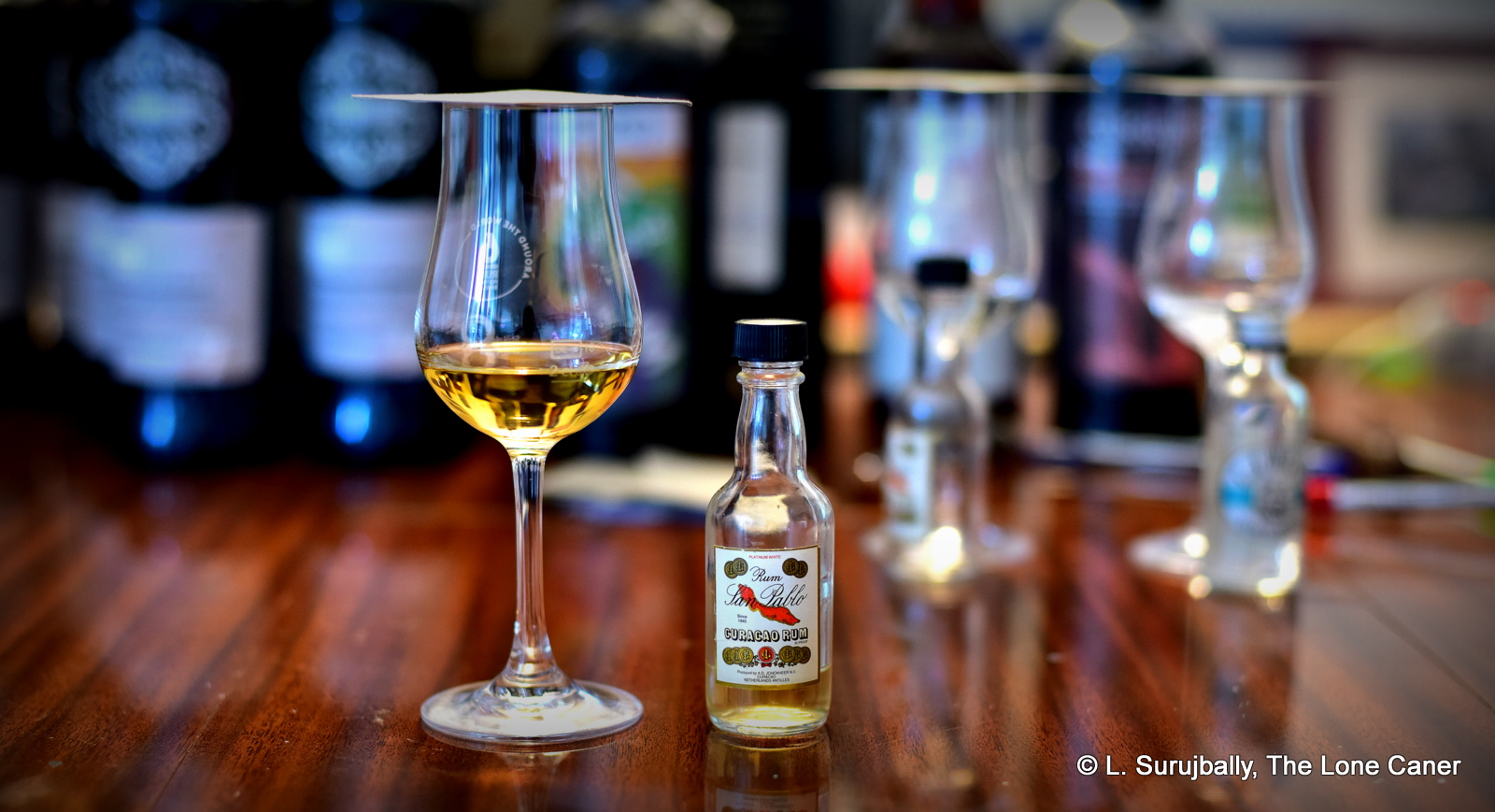
Taste?  Nope, no joy there either.  It’s warm with the faint prickliness of alcohol, and the flavours were again were tranquil, quiet and inoffensive – almost unnoticeable.  Sugar water, some cane juice, pears, a curl of lemon rind, cumin, and again that curious and meek sense of molasses which never quite came out and announced itself.  And the finish? Nothing there, largely because it was over so quickly that there was no time to sense much behind the diffident sugar water and cucumbers

If one has tried nothing but 40% rums one’s entire life, this may work out better, I suppose.  It doesn’t for me. My personal issue is that the column still light distillate, the standard strength and the filtration eviscerate the most vital and living portions of the rum. I am not demanding a pot still, unaged and unfiltered product (thought they could certainly do worse), just a slightly stronger rum with more character. The Platinum White is made to be, and should be, drunk in a mix of some kind; it may be unfair of me to judge it by more stringent standards such as that of asking that it stand by itself without adornment in a cocktail, but I’ve had better 40% column-still, filtered whites, and feel that for all its uniqueness at being from Curaçao (how many of us can say we’ve had a rum from there, right?), it missed an opportunity to make itself a one-of-a-kind little rumlet with its own profile and character.  A rum which would be gunned down by tourist and local and rumgeek with equal joy and appreciation, over dominos and heated cuss-up in a quiet rumshop somewhere…and a reputation that would be as eagerly sought out as a Rivers, a High Wine or a J. Wray 63%.

(#568)(64/100)


Other Notes

Brief historical notes of the San Pablo can be found in the “Gold Label” rum review.

Nov 132018
 

Let’s move away from the full proofed rums released by indies and the major Caribbean companies, and switch over to something we don’t see very often, rums from the smaller islands —  these traditionally sell well to the tourist trade, the minibars of cheap hotels and within their local markets, but don’t make much of a splash elsewhere. Some are considered undiscovered steals, and the internet is rife with throwaway comments on personal blogs and travel sites about some rum nobody ever heard about being the best they ever had.

One of these is the golden 40% San Pablo rum out of the Dutch West Indies (also known as the Dutch Caribbean, Caribbean Netherlands or Netherlands Antilles – the name refers to the islands of Aruba, Curaçao, Saint Maarten, Bonaire, Sint Eustatius and Saba), which likes to call itself Curaçao’s favorite local tipple, a claim hardly likely to be disputed by any resident for patriotic reasons, or by any passing-through cruise-line tourist who might not know any better.

Rum (or Ron) San Pablo is an odd name for a Dutch island product: all becomes clear when you understand it’s actually a rum originally made in Cuba.  Like Bacardi, after being nationalized after the Cuban revolution, Justo Gonzalez brought his last aged stocks and the recipe to his importer on Curaçao and went into business with him to continue the brand (see a slightly more detailed history, below). The rum, then, is actually a transplanted Cuban product in the light Spanish style, and very likely column still produced (a factoid I had trouble confirming but it seems a reasonable assumption) – it continues to be made to this day — the exact distillery is something of a mystery — with distilled water, imported molasses from South America (no further info as to where precisely).  It first got introduced to the US in 2005, and has more or less dropped out of sight since then.

Sampling the rum says a lot for how far rum and consumers have come since those days. For its time it was undoubtedly the bees’ knees, and even as late as 2008 (around the time when it made a small ripple in the emerging blogosphere) people were complimenting its delicacy and smooth taste.  But nosing the pale yellow 40% rum ten years down the road demonstrates its similarities to a low-rent Bacardi rather than establishing any kind of personal individuality or pedigree. It is very delicate, very light, with soft aromas of molasses, cane sap, citrus, caramel and vanilla. It has a nice little woodsy note to it, sawdust maybe, and also a light line of tobacco which segues in and out without ever becoming dominant.

Because of its living room strength and light style of production, it is very difficult to come to grips with it on the palate, especially when compared to the falling sea-cans of oomph represented by full proof island rums — against those the San Pablo is almost like a wispy lace handkerchief versus a purse made from a crocodile’s back. The delicacy and faintness of the profile is at fault here: one can sense honey, cucumbers, citronella, sugar water, aromatic tobacco and cloves, but that’s me after serious concentration in a controlled environment with an hour to spend on the exercise, and who’s got time for that when ordering a rum in a bar somewhere? The finish is just more of the same – light, sweet, warm, soft, mostly vanilla and honey and some sweet breakfast spices, with just a hint of molasses and a sliver of lemon zest, and then it’s gone in a flash.

A rum like this should, I suppose, be taken for what it is – a delicate, quiet drink meant to be chucked into a minibar or a cocktail with equal facility.  I think it’s a rum initially made for Americans in a pre-”Real-Rum” era when all that the local producers in the Caribbean were hoping for was to copy Bacardi, or to  make their own hooch to dump into an exotic fruity free-for-all so it could have some kick.  On that level I suppose it succeeds.  On any other level, it’s a rum to take note of simply because few of us have tried it, and, at the end, I consider it a pretty undistinguished product that makes no waves outside its island of origin, and doesn’t seem to want to.

(#567)(66/100)


Other Notes

The company lore states that a local Curaçao importer, August Damian Jonckheer, began bringing in the San Pablo brand as far back as 1945: no search I was able to construct allowed me to trace the San Pablo brand before that, even though all websites I trolled through are clear that Señor Justo Gonzales was making this rum for many years before that.  Although Gonzalez — like many of the Cuban distilling families — played both ends against the middle in the 1950s by supporting both Batista (in order to keep operating) and Castro (just in case), once the Cuban Revolution was a done deal Castro nationalized all the distilleries anyway – the Bacardi saga is probably the best known. The story goes that after Gonzales importuned Castro not to take over San Pablo, recounting his many donations to the cause, Fidel wrote him a cheque for that very amount on the spot and went ahead regardless. Gonzalez cut a fast deal with A.D. Jonckheer to buy the 150 barrels of rum he had ageing in Cuba (but that immediate payment should be withheld), fled the island with his recipe, and went into partnership with Handelmaatschappij (AD’s company), and formed the Aruba Distilling Company, with a bottling facility on Curaçao. In the 1970s Gonzales sold his share of the ADC to Jonckheer, a situation that continues to this day with A.D.’s descendants, and with the original recipe intact.

It is unknown which distillery currently makes the rum – it was suggested that an outfit on Bonaire does. Also unknown is where the molasses originates, and how long it has been aged.  I’ve sent a message to Curacao to see if I can get some answers, and will update this post with any additional information as or if it becomes available.

Oct 282018
 

Rumaniacs Review #85 | 0561

There are three operations making rum in Grenada – Westerhall, Rivers Antoine and Clarke’s Court, the last of which was formed in 1937, operating under the umbrella of the Grenada Sugar Factory (the largest on the island) and named after an estate of the same name in the southern parish of St. George’s.  This title in turn derived from two separate sources: Gedney Clarke, who bought the Woodlands estate from the French in the late 1700s, and a bay called “Court Bay” included with the property (this in turn was originally titled “Watering Bay” because of the fresh water springs, but how it came to change to Court is not recorded). The company sold rums with names like Tradewinds and Red Neck before the Clarke’s Court moniker became the standard and I’m still trying to find out when that happened.

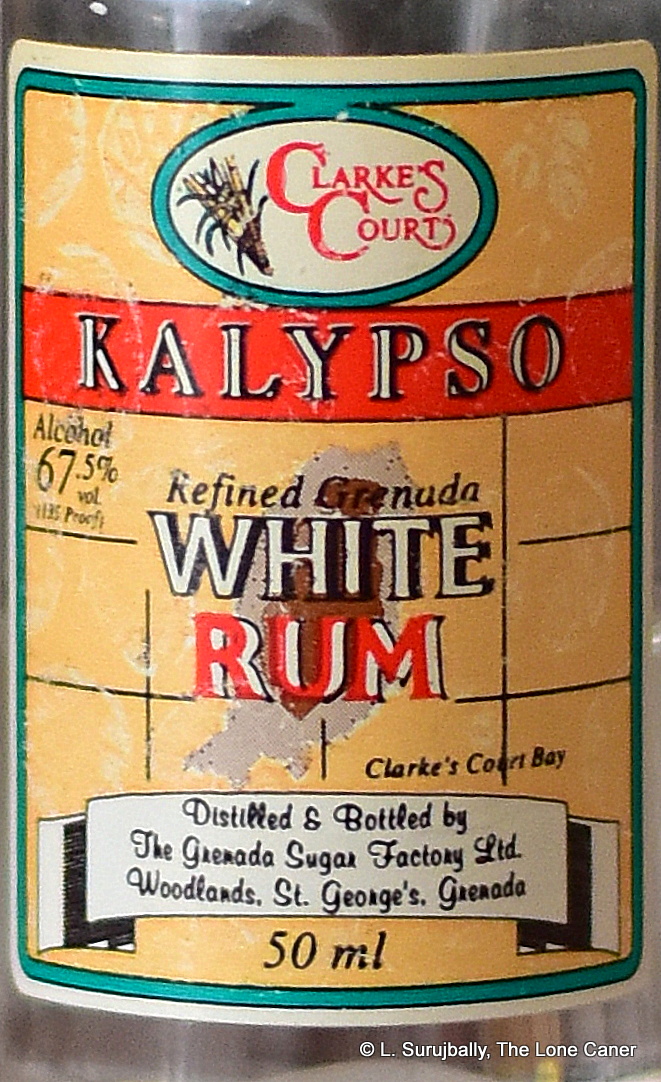
References to Kalypso, a 67.5% white overproof, exist until the late 1990s when it was marketed concurrently with the 69% Pure White Rum, but I can find no trace subsequent to that, and the company website makes no mention of it in the current lineup of their rums.  So I am assuming (subject to further info becoming available) that the two were similar enough in profile and strength for the production of the Kalypso to be discontinued in favour of the better known and maybe better-selling Pure. The rum is unaged and column still produced (the current distillery was constructed in the 1970s and utilizes a John Dore two-column, continuous-distillation still).

Colour – White

Strength 67.5%

Nose – Sharp and very aggressive, not surprising for that strength.  Also quite aromatic – esters, and nail polish, strawberries, pears and sour cream, to begin with.  It smells rather lighter than it is, and sweeter than it tastes, which is nice.  Leaving it to open up results in additional smells of sugar water, nutmeg and the slight bite of ginger.

Palate – Whew.  Pungent is the word to use here.  Some plastic and furniture polish, a little brine.  Most of all the light clear sweetness from the nose comes through and remains firmly in place – pears, watermelon, white guavas, papayas, with the spiced notes of nutmeg and ginger also remaining in the profile.

Finish – Hot and long lasting of course, no surprises there. Mostly light fruit and some aromatic flowers.

Thoughts – The Kalypso lacks the fierce individualism of pot still whites and really doesn’t class with the same company’s Pure White Rum which is an order of magnitude more pungent.  But it’s not bad, and taken with coconut water, bitters, cola or whatever else, it’ll juice up a mix with no problems at all, which is hardly surprising since that’s precisely what it was made for. Too bad it’s no longer available.

(80/100)


Oct 252018
 

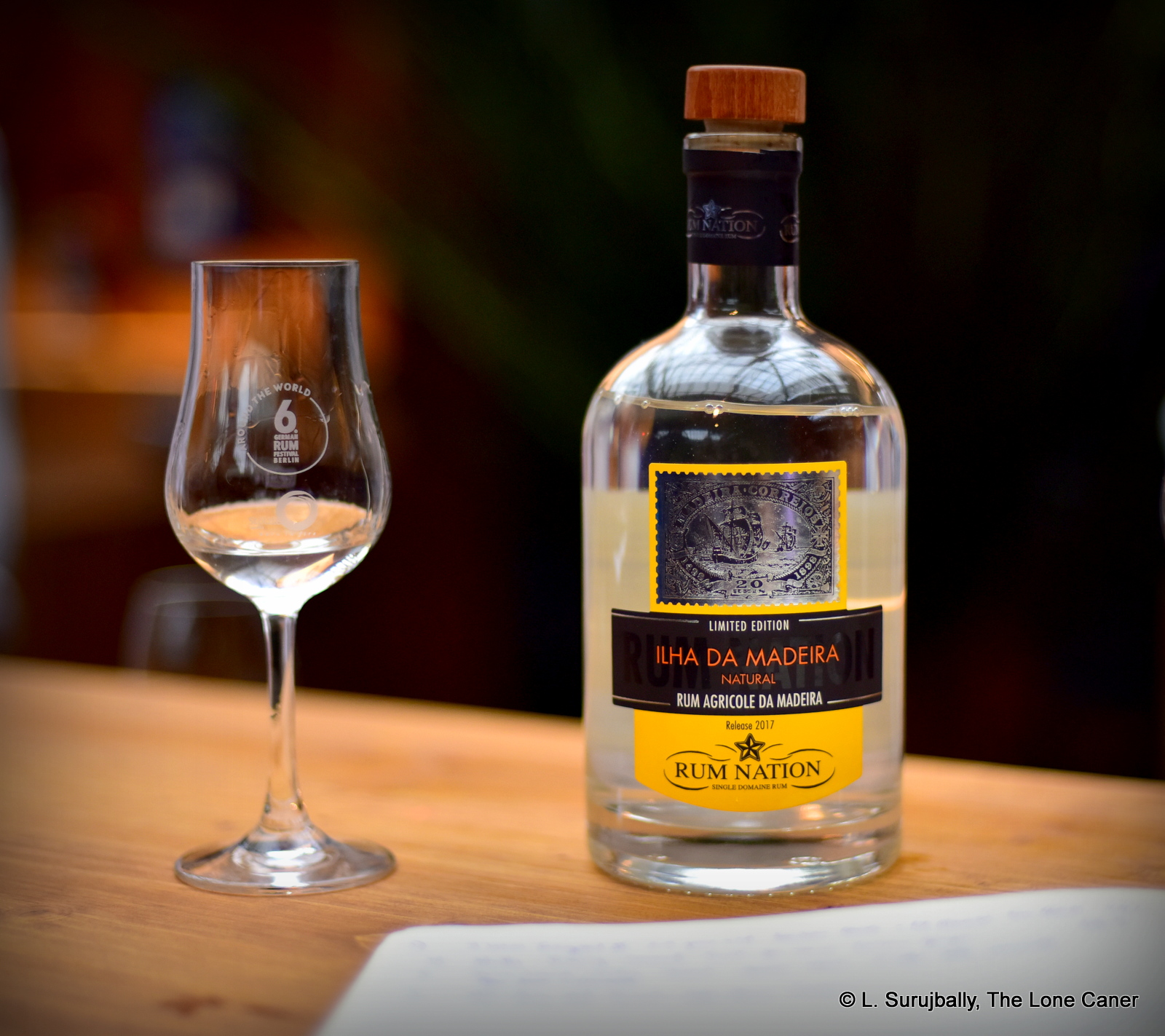
No, that’s not another typo in the title, it’s just the way the bottle spelled “rum” so I followed along even if it is an agricole-style product and by convention it might have been better termed “rhum” (though the words mean the same thing – it’s purely a matter of perception).  Since looking at the Engenho Novo aged rum last time, I thought it would be fitting to stick with the island of Madeira and see what one of their whites would be like, especially since I had been so impressed with the RN Jamaican Pot Still 57% some years ago….would this one live up to to the rep the Caribbean one garnered for itself?

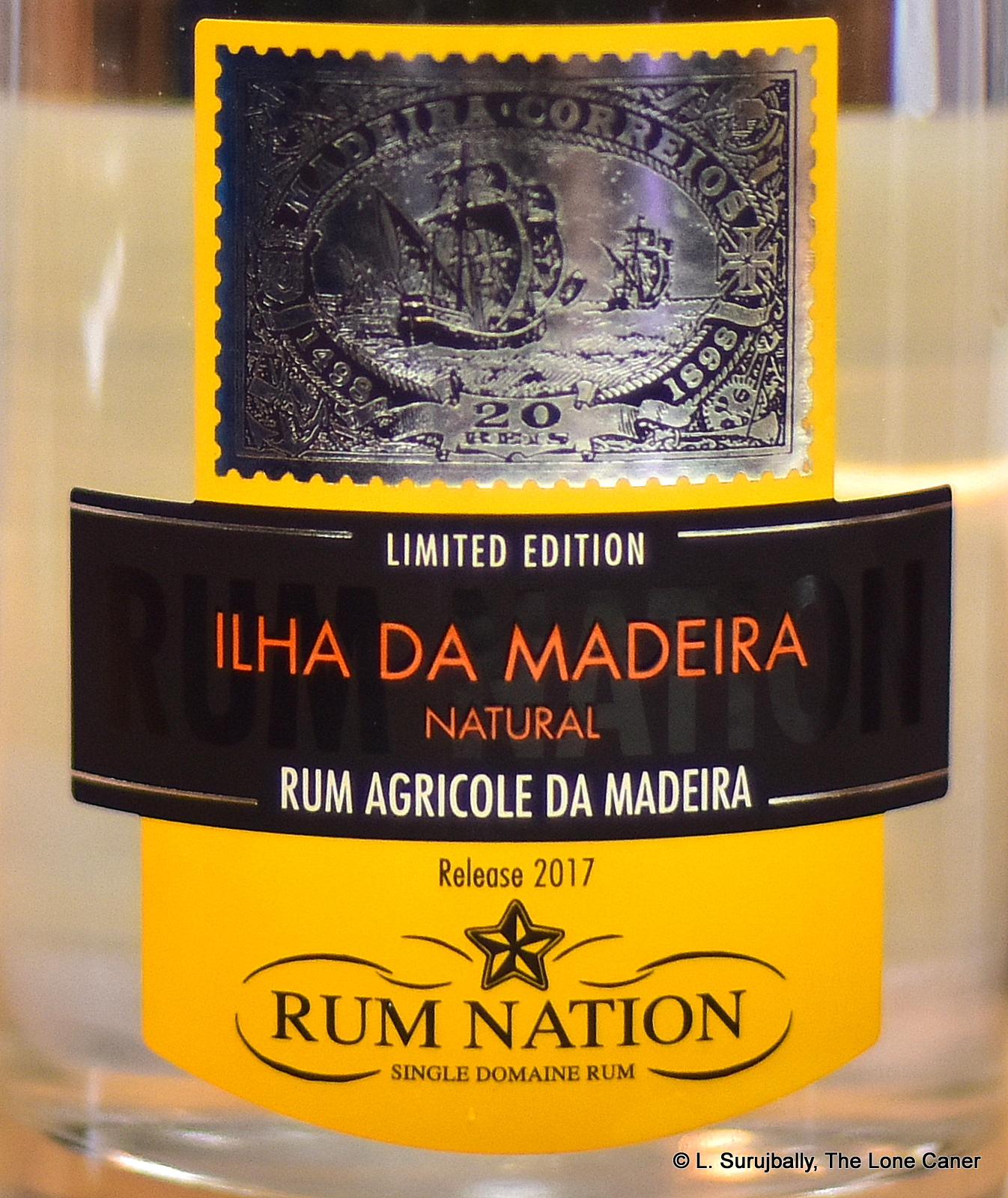
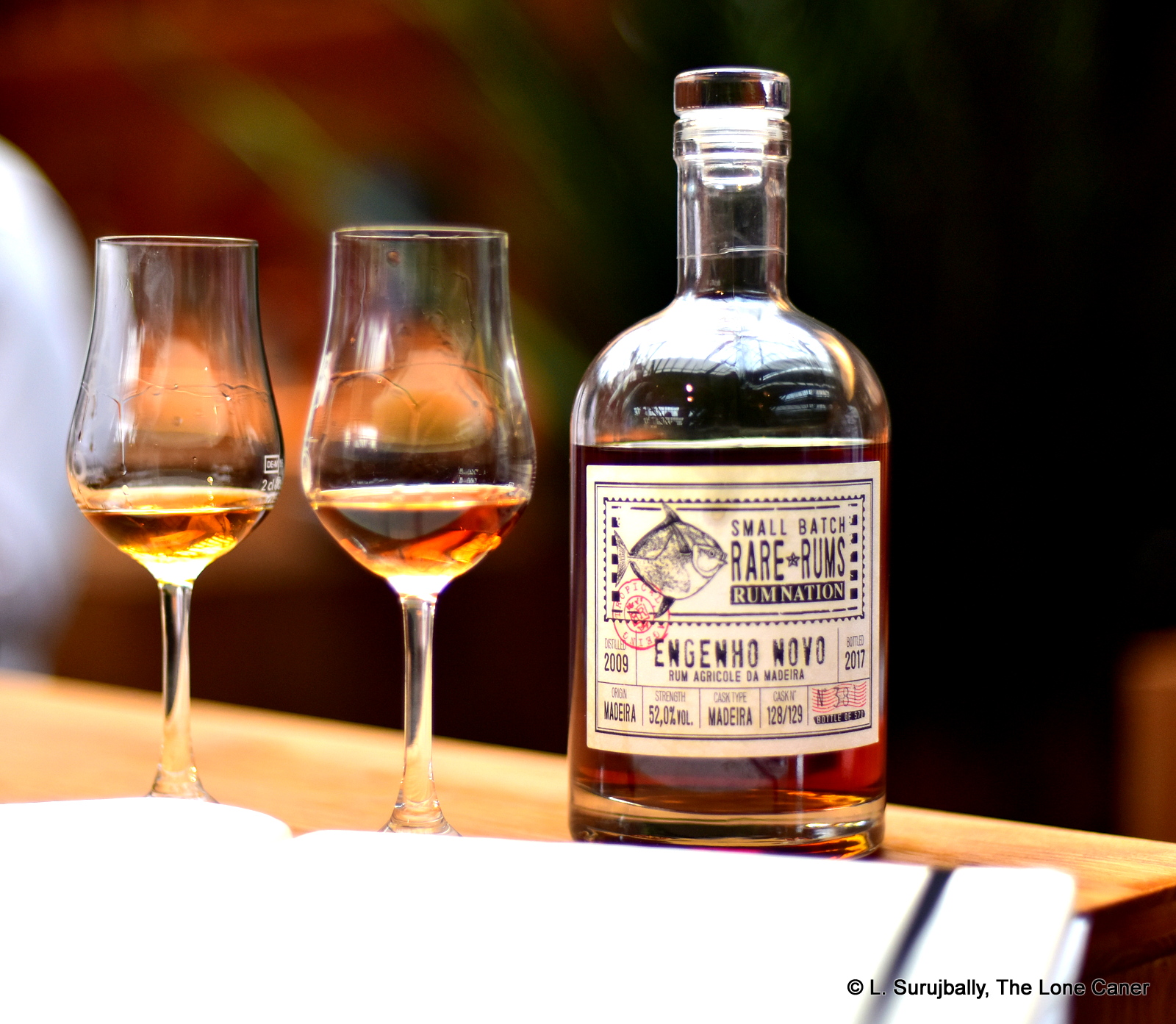
Curiously, there isn’t much to go on as regards the background aside from the obvious: we know it is 50% ABV and made from cane juice in a column column still…but it come not from Engenho Novo (which is to say, the reconstituted William Hinton, and the source of the rum for  Rum Nation’s Rares), but from Engenhos do Norte in Porto da Cruz – Fabio remarked in an email tome that he liked it better for this purpose than the Novo). It’s unclear whether it’s unaged and unfiltered, or lightly aged and then filtered to clarity…and if the latter case is what happened, then what kind of casks. We’re not sure what the “Limited edition” on the label actually means. And, as always with RN, there’s also the question of any additions. We can however infer that based on the chubby, stubby bottle and label style, that the rum is part of their standard lineup and not the higher-proofed, higher-quality, higher-priced Rares (as an aside, I hope they never lose the old postage stamps incorporated into the design), and possibly from the word “crystal” used in their website materials, that it has been filtered. But I’ll amend the post if I hear back from them.

Anyway, here’s what it was like. The nose of the Ilha da Madeira fell somewhere in the middle of the line separating a bored “meh” from a more disbelieving “holy-crap!”.  It was a light melange of a playful sprite-like aroma mixed in with more serious brine and olives, a little sweet, and delicate – flowers, sugar water, grass, pears, guavas, mint, some marzipan. You could sense something darker underneath – cigarette tar, acetones – but these never came forward, and were content to be hinted at, not driven home with a sledge. Not really a brother to that fierce Jamaican brawler, more like a cousin, a closer relative to the Mauritius St. Aubin blanc (for example). What it lacked in pungency it made up for in both subtlety and harmony, even at 50%.
It was also surprisingly sippable for what it was, very approachable, and here again I’ll comment on what a good strength 48-52% ABV is for such white rums.  It presented as sweet and light, perfumed with flowers, pears, green grapes and apple juice, then adding some sour cream, brine, olives and citrus for edge. There were some reticent background notes as well, cinnamon mostly, and an almost delicate vein of citrus and ginger and anise. It tasted both warm and clean and was well balanced, and the finish delivered nicely, redolent of thyme, sweet vinegar dressing on a fresh salad, and green grapes with just a touch of salt.

Average to low end white mixers – still occasionally called silvers or platinums, as if this made any difference – are defined by their soft, unaggressive blandness: their purpose is to add alcohol and sink out of sight so the cocktail ingredients take over. In contrast, a really good white rum, which can be used either for a mixed drink or to have by itself if one is feeling a little macho that day,  always has one or more points of distinction that sets it apart, whether it’s massive strength, savagery, rawness, pungency, smooth integration of amazing tastes, funk, clarity of flavour or whatever.

Honestly, I expected more of the latter, going in: something fiercer and more elemental…but I can’t say what was on display here was disappointing. In October 2018, when I asked him what rums he had that was of interest, Fabio actually tried to steer me away from this one (“It’s good, but not so interesting,” he laughed as he pulled down a Rare Caroni).  But I disagreed, and think that what it really comes down to is that it’s a solid addition to the white portion of the rum spectrum and certainly a step above “standard”. It’s tasty and warm, and manages the cute trick of being dialled down to something really approachable, while still not forgetting its more uncouth antecedents. And if it is not of the pungent power that can defoliate a small patch of jungle, well, it may at least blanch a leaf or two, and is worth taking a second look at, if it crosses your path.

(#560)(83/100)


Other Notes

From the 2017 release season

Oct 222018
 

The mark of the successful long-term independent bottler in the public perception rests upon two main pillars – one is of course the quality of the rums they put out the door (and perhaps, how consistently); and the other is the level of originality they bring to the game.  By that I mean how often do they stray from the mainstream of the standard pantheon and go in new directions, seek out different maturations, different ages, different barrels, different distilleries (or whole countries). It is because Velier nails both of these aspects that they are as successful as they are, though I would certainly not discount Samaroli, Compagnie des Indes or Rum Nation (among others).

Rum Nation, also from Italy, has been somewhat out of the public eye of late, but the point about originality does apply to them – think back on the Jamaican White 57% rum, for example, or the Supreme Lord series, or the 20+ year old Demeraras, or their Peruvian and Guatemalan rums, the latter of which most other indies don’t often go near. In the last few years Fabio Rossi, the founder of the brand, went in yet another direction by issuing a new limited-edition series called the “Small Batch Rare Rums” … and one of them was this intriguing little number from Madeira, from a distillery called Engenho Novo – they are the boys behind the William Hinton brand of rums which have recently become more available in Europe over the last few years.

I’ll provide some more background detail in the Other Notes below, but for the moment let’s just read off the fact sheet for the rum which is very helpfully provided on the Rare Rums website and on the bottle label itself. This is a cane juice distillate and can therefore be classed as an agricole-style rhum; distilled 2009 and the four barrel outturn from a column still was aged in Madeira casks, providing 570 bottles in 2017, with a strength of 52%.

For those not into their lighter spirits, “Madeira” is a fortified wine made in the Portuguese islands of Madeira off the African coast, and can be either dry or sweet.  Given the entire ageing period of the rum took place in such casks, I expected to see a substantial divergence from both an aged agricole or any other kind of “standard” ex-bourbon-barrel profile. In fact, swirling the dark brown rum in the glass made me wonder if some caramel hadn’t been added to colour it…or whether the casks were completely dry of wine before pouring the good stuff in to age.

Still, the nose delivered, if not precisely that clear-grassy-herbal aroma characteristic of the French islands.  Oh no. This was more like one of those mated with a drowsy Demerara from Port Mourant: it smelled of dark ripe cherries and coca cola, fleshy stoned fruits and red licorice, plus unsweetened cooking chocolate, hot black tea, raisins and wasn’t that a bit of brine and olives down the back end?  Sure it was. And very nice too.

And even at 52%, after an initial whiff of its cane juice origins — it began somewhat fresh and crisp before relaxing — the rum proceeded quite softly on the palate, and suggested a taste reminiscent of a stack of old books in a dusty library nobody now visits, the dry mustiness of barnyard hay.  This was set off by the taste of a Haagen-Dasz dulce de leche ice cream (the Little Caner loves that stuff and I pinch it from his tub every chance I get), as well as brine, more olives, licorice, prunes, red wine, citrus peel, cider and the vague tartness of gooseberries and unsweetened yoghurt.  It was quite rich and flavourful, a nice drink, finishing with with warm notes of cherries, raisins, a little herbal, and cider, salt caramel and sour cream.

So where does that leave us?  Well, with a rather peculiar product.  It is unique in its own way, giving you the odd-but-pleasant experience of tasting a well-assembled agricole-Demerara blend, or maybe a molasses-based Guadeloupe rhum.  That may be a Madeiran thing – I can’t tell, since I have not had enough from there to make the claim with assurance (yet). But in any event, Rum Nation doesn’t make bad rums – they’re too professional an outfit for that, and I’ve thought so ever since I ran into them in 2010 and bought that entire year’s output at once. They stratify their products into the starter rums, sweeter ones (the Millonarios), high-end aged rums (the Demeraras and Jamaicans) and these higher proof Rares for the cognoscenti. This one isn’t the best or most original rum they’ve ever made, but it does show Fabio Rossi forging ahead in his own way to expand his company’s range, producing new and fascinating rums for us all to try — and it’s definitely a rum to sample if you’re ever bored with the regular islands’ rums and want to try something different…but not too different.

(#559)(85/100)


Other notes

  • Wes, who reviewed it back in January 2018, rated it as 50% ABV on his hydrometer, which equates roughly to 10g/L dosage, give or take.
  • The sugar factory and distillery was founded in 1845 by William Hinton; it reached a peak production of 600 tons of cane processed per day in 1920, but closed in 1986 (no reasons are given on their website, but perhaps falling sugar prices contributed, or the expense of maintaining extensive sugar cane fields).  It was restarted by Hinton’s heirs in 2006 as Engenho Novo de Madeira.
Oct 112018
 

In the last decade, several major divides have fissured the rum world in ways that would have seemed inconceivable in the early 2000s: these were and are cask strength (or full-proof) versus “standard proof” (40-43%); pure rums that are unadded-to versus those that have additives or are spiced up; tropical ageing against continental; blended rums versus single barrel expressions – and for the purpose of this review, the development and emergence of unmessed-with, unfiltered, unaged white rums, which in the French West Indies are called blancs (clairins from Haiti are a subset of these) and which press several of these buttons at once.

Blancs are often unaged, unfiltered, derive from cane juice, are issued at muscular strengths, and for any bartender or barfly or simple lover of rums, they are explosively good alternatives to standard fare – they can boost up a cocktail, are a riot to drink neat, and are a great complement to anyone’s home bar…and if they occasionally have a concussive sort of strength that rearranges your face, well, sometimes you just gotta take one for the team in the name of science.

The Longueteau blanc from Guadeloupe is one of these off-the-reservation mastodons which I can’t get enough of. It handily shows blended milquetoast white nonsense the door…largely because it isn’t made to sell a gajillion bottles in every low-rent mom-and-pop in the hemisphere (and to every college student of legal age and limited means), but is aimed at people who actually know and care about an exactingly made column-still product that has a taste profile that’s more than merely vanilla and cloves and whatever else.

Doubt me?  Take a sniff. Not too deep please – 62% ABV will assert itself, viciously, if you’re not prepared. And then just think about that range of light, crisp aromas that come through your schnozz.  Speaking for myself, I noted freshly mown grass, sugar cane sap bleeding from the stalk, crisp apples and green grapes, cucumbers, sugar water, lemon zest, brine, an olive or two, and even a few guavas in the background.  Yes it was sharp, but perhaps the word I should use is “hot” because it presented an aroma that was solid and aggressive without being actually damaging.

Taste? Well, it’s certainly not the easy kind of spirit you would introduce to your parents, no, it’s too badass for that, and individualistic to a fault.  Still, you can’t deny it’s got character: taking a sip opens up a raft of competing and distinct flavours – salt, olives, acetones, bags of acidic fruit (green grapes and apples seem to be the dominant notes here), cider, lemon zest again, all toned down a little with some aromatic tobacco and sugar water, cumin, and even flowers and pine-sol disinfectant (seriously!).  That clear and almost-sweet taste runs right through into the finish, which is equally crisp and fragrant, redolent of sugar water, lemons and some light florals I couldn’t pick apart.

There you are, then. Compare that to, oh, a Bacardi Superior, or any filtered white your barman has on the shelf to make his usual creations.  See what I mean? It’s a totally different animal, and if originality is what you’re after, then how can you pass something like this by? Now, to be honest, perhaps comparing a visceral, powerful white French island rhum like this to a meek-and-mild, easygoing white mixing agent like that Bacardi is somewhat unfair — they are of differing styles, differing heritages, differing production philosophies and perhaps even made for different audiences.

Maybe. But I argue that getting a rum at the lowest price just because it’s the lowest isn’t everything in this world (and in any case, I firmly believe cheap is always expensive in the long run) – if you’re into this curious subculture of ours, you almost owe it to yourself to check out alternatives, and the Longueteau blanc is actually quite affordable. And for sure it’s also a beast of a drink, a joyous riot of rumstink and rumtaste, and I can almost guarantee that if you are boozing in a place where this is begin served, it’s one of the best blanc rhums in the joint and probably the most exciting thing going that week.

(558)(85/100)


Other Notes

Sep 262018
 

Few are unaware of the existence of the J. Bally 1929 – for those who troll the online shops it remains one of the few very old bottlings from inter-war Gilded Age times to remain available…if one has over two grand kicking about to buy it.The Bally 1924, on the other hand, is a whole lot rarer – I can’t remember the last time I saw one coming up for discussion, let alone sale. And one could argue that its heritage is much more gold-plated – it’s the first vintage from J. Bally. I’ve tried quite a few from this bottler, one dating back to the 1960s, but to try the very first?  That might be worth a kidney right there.

This bottle being such a piece of heritage, a little history is in order. J. Bally was named after Jacques Bally, a graduate of a top engineering school in Paris, the Ecole Centrale des Arts et Manufactures (ECP, founded in 1829) – he snapped up the Lajus Plantation on Martinique in 1917, a mere fifteen years after Mount Pelee erupted, when memories of that disaster were still fresh and land prices were cheap (Lajus, founded in 1670, was already in foreclosure, having gone bankrupt after the 1902 disaster). By 1920 he had installed new steam engine, fixed up the salvageable equipment he could and (legend has it) pretty much built his own column still from scratch.  In that same year the nearby Habitation Dariste owned by the the Gronier family went bankrupt and Bally bought it in 1923 and moved the distillery equipment to Lajus to augment his own machinery. In 1930, by which time he was already laying away rum stocks to age, he also had a hand in designing the signature pyramidical and square bottles which became so associated with Bally in later years. The rhums Bally made were very popular, sold well, and the company remained in business until the 1980s when Remy Cointreau acquired it, at which point production was shut down at Lajus and moved to Domaine du Simon where (as far as I know), it’s still being made, with cane from Lajus. Note that in 2003 La Martiniquaise bought out Saint James and Bally (to add to their rum portfolio which already contained the brands of Depaz, Dillon, Negrita and Old Nick) which is why the Remy Cointreau’s webpage makes no mention of either one now.

Aside from being made so long ago, what makes the 1924 special is that it was the initial release of an aged rhum from Bally, and one of the first of its kind in the French West Indies, if not the first. Jacques Bally took inspiration from cognac and eau-de-vie makers in France and was apparently the first to consider ageing Martinique rhums in oak. This provided the initial release of his rums in the 1920s with a depth of quality that made them extremely popular and well-known, and one can just imagine all the other distilleries on the island rushing to copy the idea. The inevitable question arises, how old is the 1924 vintage?  “More than six years,” said Luca Gargano in a text to me, and that makes sense if the bottle that houses it was only designed and made in 1930. We can leave it there with only one other great unknown, and that’s how many bottles were released – and nobody knows that any longer, sorry. I hit a brick wall on that one.

Enough of the pedantic stuff. How was it to taste, eliminating all the baggage of history and heritage and rarity the rhum came with? It’s one thing to sing high praises because it’s from so far back, but a cold review is somewhat more challenging, especially considering the august company in which I tried it – the Tasting of the Century in September 2018.  You can bet that I was paying real close attention and took a long time with my glass on this one, if only so I wouldn’t be embarrassed when real writers came out with their own notes.

Nose first: nice! For all its age, the Bally 1924 could have come off the line last year and you’d never know it.  It smelled of fresh squeezed apple juice, pears with oodles of sweet light aromas, flowers, sugar water and watermelon, out of which emerged a nice melange of crushed walnuts, fanta, lemon zest, crisp yellow mangoes and cumin.  If you were tasting it blind you’d swear this was an agricole you could pick up online for some reasonable coin – like the Harewood 1780, it presented a profile not a hundred miles removed from something produced today.

Bottled at 45% ABV, the Bally 1924, for all the noble pedigree granted by being made so far back, in many ways resembled Bally rhums from past decades’ that I went through three years ago. It was slightly sharp on the palate, and as clean and clear as any of its descendants.  Apples, cider, brine and olives came smoothly off the assembly line, bolted on to emergent flavours of pears in syrup, green grapes, spices, more lemon zest, leather, a touch of vanilla and nougat and a vague hint of grass, black tea, earthy musk, and rosemary. The overall balance, cleanliness of the mouthfeel was excellent, and the ageing had definitely sanded down any rough edges – it was quite simply a pleasant drink to have, fading easily into a smooth finish that provided little that was new, just a languorous recap of the highlights – peaches, pears, mangoes, lemon zest, watermelon and sweet flowers and herbs and a pinch of cumin. A neat and near-perfect little agricole, coming together beautifully.

Well. How to score something like this? Well, I’m going to give it a solid endorsement — not that this means anything given its mythical near-unicorn status. But I should note in passing that for all its quality, the Bally 1924 strikes me more as an essay in the craft of agricole than a completely finished product that stands the test of time. It shows what they were before the snapped into focus in the last few decades of the AOC regs.

Perhaps it’s unfair to rate a rhum made nearly a hundred years ago to the standard of today when so much has changed in the interim — and for sure others around the table that day loved it (Matt rated it as his personal favourite for the evening).  To round things up: the Harewood 1780 presented a startlingly modern profile that went in its own brilliant direction way, strong, forceful, distinct; the Skeldon 1978 couldn’t rise above its elder brother but was still quite an amazing drink; and the Saint James 1885 was a rum made in a style quite different from agricoles as a whole, unique and interesting.  The Bally is caught in a limbo between the modern versions of the spirit, and the old ways of the 1885 – that’s in no way a failure, just that the competition is more fierce because we’ve had so many rums that are so similar to it.

But you know, whatever the score, there’s a certain cachet, even honour, in having been able to try a quartet of such grail-quest rums, so old, so rare, so absolutely stinking of rum history, so generously shared.  The Tasting of the Century might one day be exceeded (though I can’t for the life of me imagine what rums would comprise version 2.0); but whether that happens or not, I’ll always be happy to have tried the Bally — because it was one of those rhums that pointed the way to the modern era of cane juice rhums, so exactingly made, so proudly issued, so excellent to drink.  The Saint James 1885 might be the doddering grandaddy of the French island rhum style, but the 1924 with its crisp and clear profile taking us back to the beginning of the modern era, is surely its godfather.

(#552)(86/100)


Other Notes