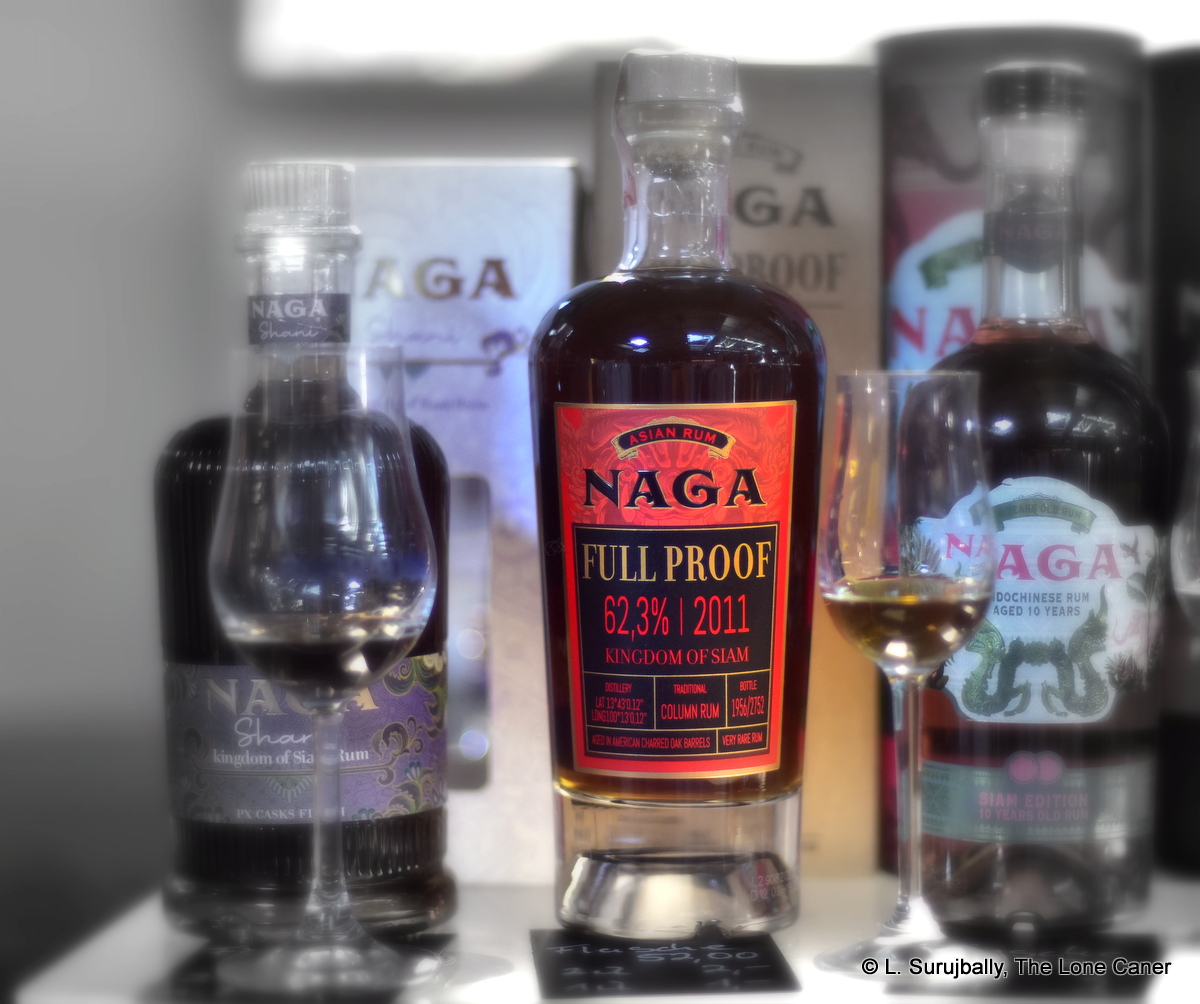
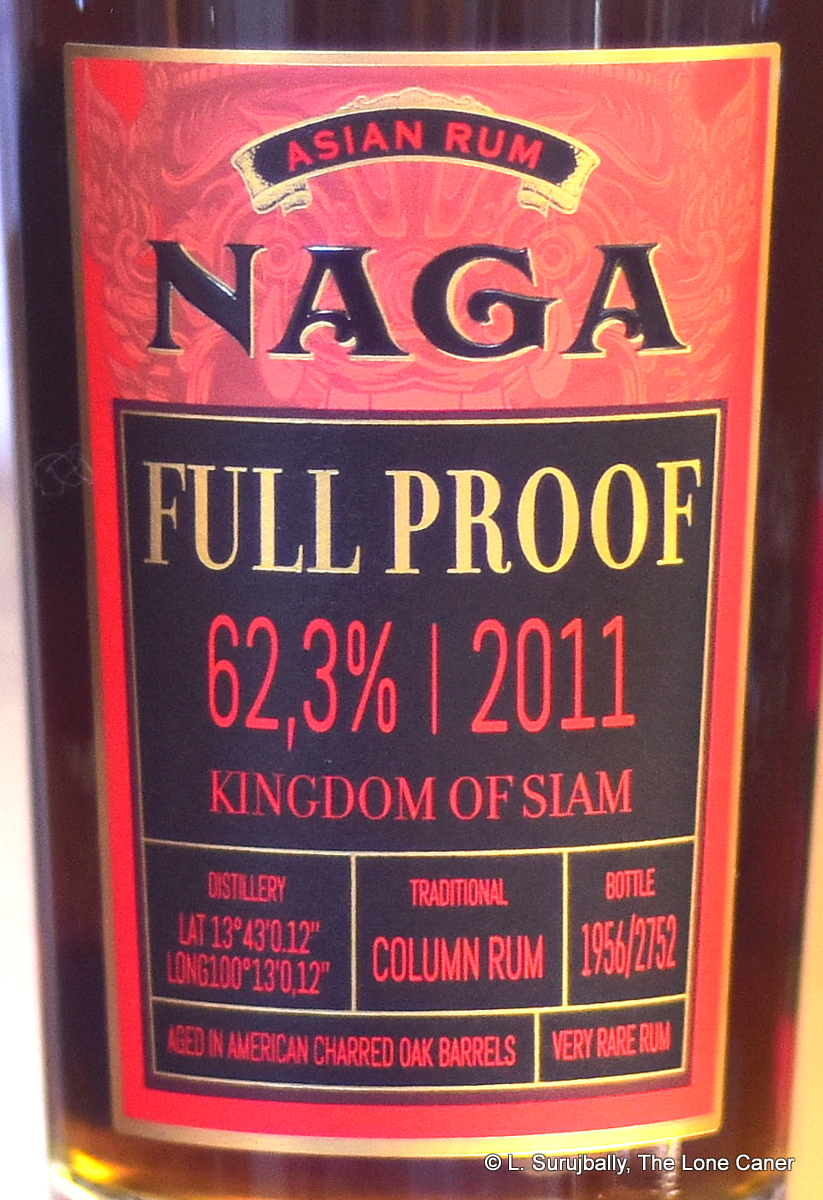
Naga’s full proof 62.3% ten year old rum from Thailand, is the one that lies at the core of all the others in the range. For the standard 10YO, they diluted it to 40%. For the “Shani” version, they aged it an additional year in P/X. But for my money, had they simply started out with this one, their reputation would have instantly gone to where the Issan and Chalong Bay – small Thai distilleries which are not affiliated with ThaiBev – marked out their turf from the get-go.
This is not to say that the lesser proofed releases from Naga are bad. Not at all, they’re quiet, serviceable rums in their own way, and appeal to many. What they don’t do, is make a splash in our mental maps of the rumiverse in a way a high-ester Foursquare might, or a pot still unaged white from Saint James does, or the way Issan and Chalong Bay quietly redefined what we might expect from a Thai rum.
To some extent, neither does this one, because it labours under the same restrictions (I hesitate to say weaknesses) as its siblings – multiple-pass column still distillate bought on contract from a major distiller, aged in charred ex-bourbon barrels, bottled as is. In other words, while the rum allows itself the freedom to be stronger and therefore more intense – the flavour notes really pop here — were one to dilute it down oneself, there’s little that marks it out as significantly different from, say, the 40% 10YO.
 Consider the nose: there’s a lot more the discern here. Some brown sugar, vanilla and coconut shavings again, which is almost like a marker of the brand. More fruits can be picked out than merely chocolate oranges: plums, a soft pineapple, melons. Was that some aromatic shag there in the background? I think so.
The taste is where things get interesting, because here we can spot the additional — though admittedly faint — notes of acetones, rubber and nail polish. Then, a more concentrated jolt of cinnamon and vanilla, and the softening effect of coconut, brown sugar. The fruits remain – the same melons, overripe pineapple and orange peel – and there’s a slightly more tawny aspect to the taste that is probably the barrel influence finally making itself felt. The finish, no surprise, is longer, more intense, and jagged enough to be just on the wrong side of voluptuous: sharp, vanilla, orange peel and light tobacco.
So, if you’ve read the other two reviews, you’ll see that what we are getting is the same as those, but more of it. It’s a variation of intensity, not so much of quantity, or serious complexity. And yet, there is a difference, and we must be aware of it. Softer, subtler notes emerge, the experience is more intense, and overall, it’s just better.
I think Sebastien Folloppe, the founder, is doing what L’Esprit’s Tristan sometimes did with his single cask offerings – issue most of them at around 46%, but also a few bottles at cask strength for those who like sterner stuff. The outturn of this full proof is 2,752 bottles, and I think if stronger rums are your thing, this is the one that’s worth getting.
(#1150)(82/100) ⭐⭐⭐½
From R-1148: Historical Background – Country, Brand and Founder
The Naga line of rums has a word on its label – “Indochinese” – that isn’t often understood, though it seems straightforward enough. Historically, linguistically and culturally it refers to southeast asian countries like Burma (now Myanmar), Thailand, Malaya, Laos, Cambodia and Viet Nam where Chinese and Indian influences melded into a synthesis of their own, with further political subdivisions like French Indochina (the latter three) entering the lexicon over time.
Thailand – called Siam until 1932, and this is also on the rum’s label – was, however, unusual, in that it was never actually a colony, possession or territory of either of the two great colonizing powers (though they exerted significant influence over it via ceding of territory, unequal treaties, and legal and trading concessions). This was because by an 1896 agreement between France and Britain, it served as a buffer between them, which neither would control, and so it allowed Thailand to preserve its autonomy in a way the others did not – at least to some extent.
Well, that’s some historical background, which now leads is to the company that makes the rum. Strictly speaking, there isn’t one – Naga is a brand name, not a company, run by a Frenchman named Sébastien Follope. He had worked for Bardinet (La Martiniquaise group) until 2007, then at a brand development agency until 2011 after which he pivoted to being a consultant and importer for rum brands, helping (for example) to introduce Optimus and Cihuatan brands to European markets. In 2012, feeling the itch to create a brand of his own, he registered the Naga name (it was unique, easy to pronounce and spell, and wasn’t already taken by anyone else) and contacted the largest maker of rums in Thailand – ThaiBev, which has a near monopoly on the local spirits market. Thaibev has some 12 distilleries, of which four make rums – the Phraya brand released by Sang Som is one of them, Mekhong is another.
After some supply issues in 2014 – the supplier abruptly cancelled the initial order – Sebastien pivoted to releasing some Indonesian arracks instead which led to his line of Naga Indonesian rums (Java reserve, Pearl of Jakarta, Anggur, etc). But in 2019 whatever issues the supplier had were resolved and the use of Thai rums was greenlit, with all sorts of restrictions on what could (or could not) be mentioned in the literature – “Thailand” and “ThaiBev” being the two most surprising. This is why the “Siam Edition and “Indochinese Rum” feature on the label. This restriction apparently changed in 2023, but the labels remain as they are for now.
Other notes
- YouTube video review link
- There is now a 2012 edition as well
- Serge Valentin scored this at 77, a mere point above the 10YO. He appreciated it… more or less.