Ruminsky

Aug 032018
 

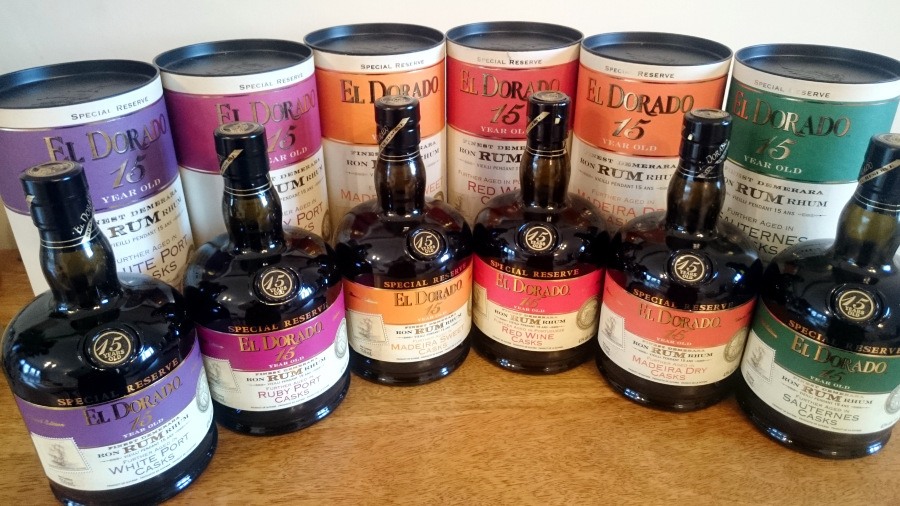
Photo pilfered with permission (c) Simon Johnson, RumShopBoy.com

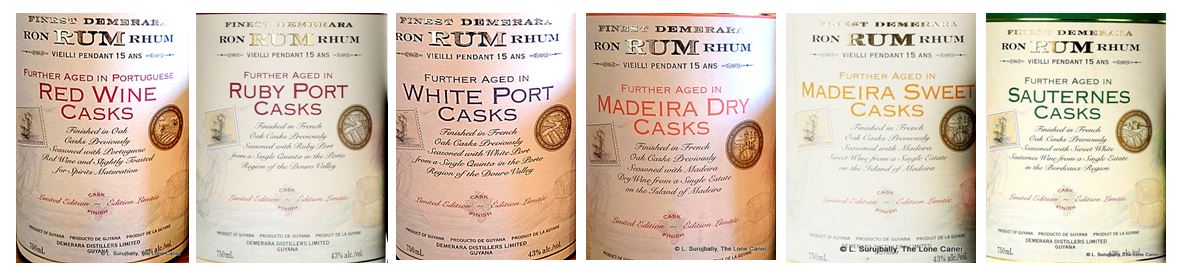
Over the years, there has developed a sort of clear understanding of what the El Dorado 15 YO is, deriving from the wooden stills that make up its core profile – that tastes are well known, consistently made and the rum is famed for that specific reason. Therefore, the reasoning for expanding the range in 2016 to include a series of finished versions of the 15YO remains unclear.  DDL may have felt they might capitalize on the fashion to have multiple finishes of beloved rums, or dipping their toes into the waters already colonized by others with double or multiple maturations. On the other hand, maybe they just had a bunch of Portuguese wine barrels kicking around gathering dust and wanted to use them for something more than decorations and carved chairs.

Few people – including us scriveners –  will ever have the opportunity or desire to try the entire Finished line of rums together, unless they are those who attend DDL’s marketing seminars, go to Diamond in Guyana, belong to a rum collective, have deep pockets or see these things at a rum festival.  The price point makes buying them simply unfeasible, and indeed, only two writers have ever taken them apart in toto – the boys in Quebec, and the Rum Shop Boy (their words are an excellent supplement to what I’ve done here).

Here are the results in brief (somewhat more detail is in the linked reviews):

El Dorado 15 YO Red Wine Finish – 78 points

Lightly sweet with licorice, toffee and fruity notes on the nose. Cherries, plums, raisins and watermelon on the palate, all staying quiet and being rather dominated by salt caramel and molasses.

El Dorado 15 YO Ruby Port Finish – 80 points

Opens with acetones and light medicinal aromas, then develops into a dry nose redolent of peanut butter, salt caramel, fruits, raisins, breakfast spices and some brine. The taste was rather watery – pears, watermelons, caramel, toffee, anise and cognac filled chocolates.

El Dorado 15 YO White Port Finish – 76 points

Very mild, light brown sugar nose, some caramel, brine, sweet soya. Taste was similarly quiescent, presenting mostly citrus, coffee, chocolate, bananas, and of course, molasses and caramel toffee.

El Dorado 15 YO Dry Madeira Finish – 80 points

Nice: soft attack of sawdust and dark fruit: plums, pears, raisins, black grapes. Leavened with ripe orange peel, peaches and olives before muskier aromas of toffee and chocolate take over. Citrus disappears on the palate, replaced by salted butter and caramel drizzled over vanilla ice cream.  Also bananas, kiwi fruit, oranges gone off, cinnamon and cloves. Nice, but weak.

El Dorado 15 YO Sweet Madeira Finish – 81 points

Marginally my favourite overall: noses relatively darker and richer and fruitier than just about all the others except the “Dry” – delicate nose of peaches, raisins, cinnamon, cloves, caramel, peanut butter, cherries in syrup, candied oranges, bitter chocolate. Soft palate, quite dry, oak is more forward here, plus raisins, cloves and cinnamon carrying on from the nose, and the fruitiness of peaches in syrup, cherries, plus toffee, salt caramel.

El Dorado 15 YO Sauternes Finish – 78 points

Subtly different from the others. Nose of aromatic tobacco, white almond-stuffed chocolate and nail polish, then retreats to salty caramel, molasses, vanilla, cherries, raisins, lemon peel and oak, quite a bit of oak, all rather sere. Palate retains the  tobacco, then vanilla, chocolate, coffee, molasses and quite a bit more dried dark fruit notes of raisins, plums, dates, and a quick hint of anise. The oak is quite noticeable, and the rum as a whole is quite dry.
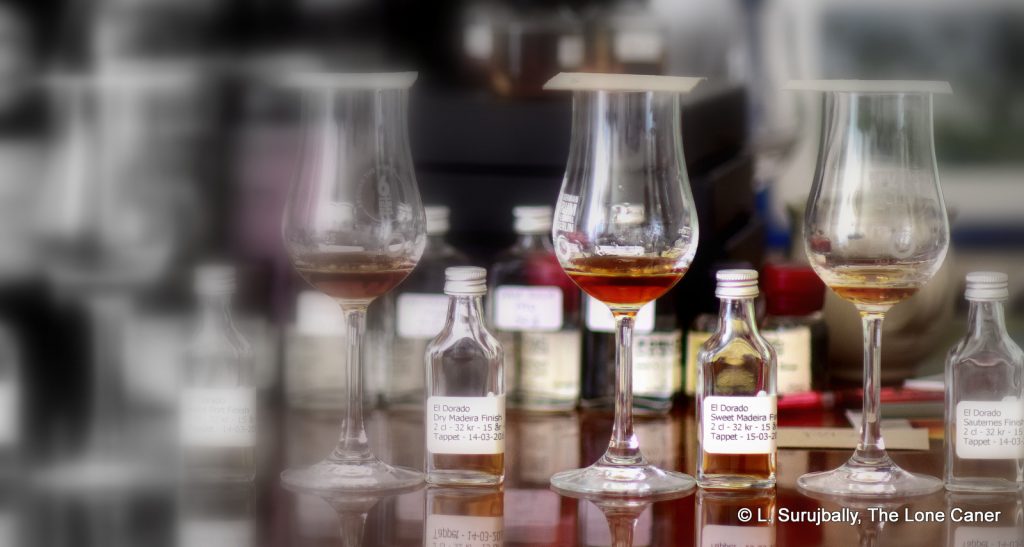

Unsurprisingly, there are variations among those who’ve looked at them, and everyone will have favourites and less-liked ones among these rums — I liked the Sweet Madeira the best, while one Facebook commentator loved the Ruby Port, Simon much preferred the White Port Finish and Les Quebecois put their money on the Dry Madeira.  This variation makes it a success, I’d say, because there’s something to please most palates.

The Finished range of rums also make a pleasing counterpoint to the “Basic” El Dorado 15 Year Old…something for everyone.  But taken as a whole, I wonder – my overall impression is that the woodsy, musky, dark profile of the Port Mourant double wooden pot still, which is the dominant element of the ED 15, is affected — but not entirely enhanced — by the addition of sprightly, light wine finishes: the two are disparate enough to make the marriage an uneasy one.  That it works at all is a testament to the master blender’s skill, and some judicious and gentler-than-usual additions to smoothen things out – the Standard ED-15 clocks in at around 20 g/L of additives (caramel or sugar), but these are substantially less. Which is a good thing – it proves, as if it ever needed to be proved at all, that DDL can forego sweetening or caramel additions after the fact, with no concomitant loss of quality or custom (why do I have the feeling they’re watching Foursquare’s double matured Exceptional Cask series like a hawk?).

What the series does make clear is that DDL is both courageous enough to try something new (the finishing concept), while at the same time remaining conservative (or nervous?) enough to maintain the continuing (if minimal) addition of adulterants. DDL of course never told anyone how popular the Finished Series are, or how the sales went, or even if the principle will remain in force for many years.  Perhaps it was successful enough for them, in early 2018, to issue the 12 year old rum with a similar series of finishes.

All the preceding remarks sum up my own appreciation for and problems with the range. None of them eclipse the 15 year old standard model (to me – that is entirely a personal opinion); they coexist, but uneasily. There are too many of them, which confuses – it’s hard to put your money on any one of them when there are six to chose from (“the paradox of choice”, it’s called).  Their exclusivity is not a given since the outturn is unknown. The unnecessary dosage, however minimal, remains. And that price! In what universe do rums that don’t differ that much from their better known brother, and are merely labelled but not proved to be “Limited,” have an asking of price of more than twice as much?  That alone makes them a tough sell. (Note – the 12 year old Finished editions which emerged in 2018 without any real fanfare, also had prices that were simply unconscionable for what they were). The people who buy rums at that kind of price know their countries, estates and stills and don’t muck around with cheap plonk or standard proofed rums. They may have money to burn — but with that comes experience because wasteage of cash on substandard rums is not part of their programme.  They are unlikely to buy these. The people who will fork out for the Finished series (one or all) are those who want a once-in-a-while special purchase… but that doesn’t exactly guarantee a rabid fanbase of Foursquare-level we’ll-buy-them-blind crazies, now, does it?

My personal opinion is that what El Dorado should have done is issue them as a truly limited series of numbered bottles, stated as 16-17 years old instead of the standard 15, and a few proof points higher.  Had they done that, these things might have become true collector’s items, the way the 1997 single still editions have become. In linking the rums to the core 15 year old while making them no stronger, not explosively more special, and at that price, they may have diluted the 15YO brand to no great effect and even limited their sales.  But at least the rums themselves aren’t crash-and-burn failures, and are pretty good in their own way. We have to give them points for that.

Aug 032018
 

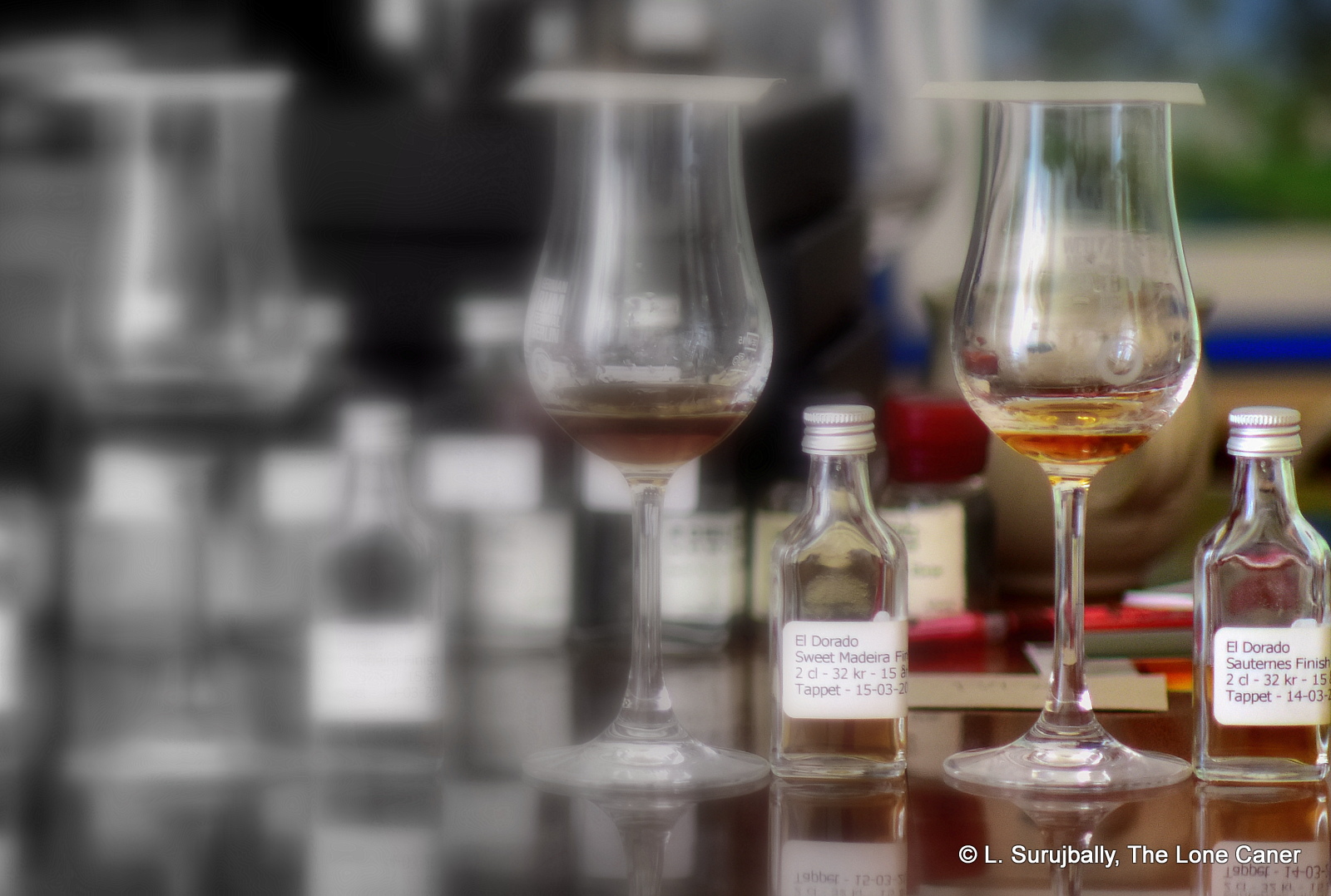
This is the sixth and last short form review of the six “finished” variations of the 15 year old El Dorado rums.  Because they’re all based on the standard 15 year old which is very well known, I’ll be briefer than usual in my descriptions, rather than provide an essay in each case.  Tomorrow I’ll wrap them all up with a summary and such observations as seem relevant.

The rums were all tasted together, blind, in a four-hour session, using the original (retasted) El Dorado 15 with a non-blind score of 82, as a control baseline.  All point scores relate to that rum.


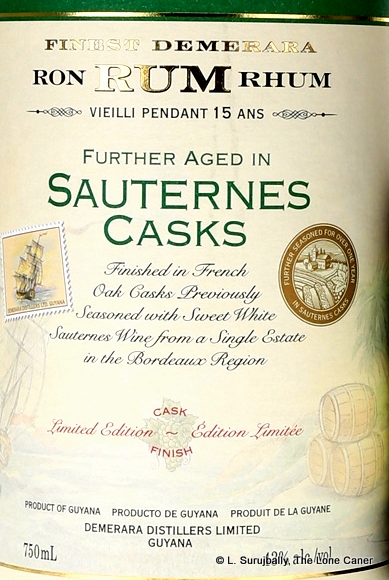
As for all these finished El Dorados, the basic component is the 15 year old, and an additional 18-24 months of finishing is done…strictly speaking that makes it (and all the others) at least a 16 year old rum, which is nice. In this case, the finish is done in casks that once held (were “seasoned with”) Sauternes wine, a sweet white from the Sauternais region in Bourdeaux characterized by concentrated and distinctive flavours. And like with the Sweet and Dry Madeira-finished rums, the source estate of the casks is not named, for whatever obscure reason.

Colour – Amber

Strength as labelled – 43%

Strength as measured (RumShopBoy) – 42%

Nose – In a subtle way this is different from the others. It opens with aromatic tobacco, white almond-stuffed chocolate and nail polish before remembering what it’s supposed to be and retreating to the standard profile of salty caramel, molasses, vanilla, cherries, raisins, lemon peel and oak, quite a bit of oak, all rather sere.
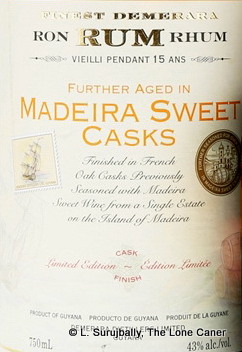
Palate – The tobacco remains but the familiar El Dorado profile is more robust: vanilla, chocolate, coffee, molasses and quite a bit more dried dark fruit notes of raisins, plums, dates, and a quick hint of anise. The oak is quite noticeable for all the rum’s softness, somewhat mitigated by salt caramel and toffee. It is also quite dry, and much of the near-cloying sweetness of the regular El Dorado 15 YO is absent.

Finish – Nope, no joy here, soft, wispy, short and over way too quick. Raisins and unsweetened chocolate, some almonds, and just a hint of orange zest.

Thoughts – Well, it’s intriguing to say the least, and when you have a number  of rums all of generally similar profiles, it’s always interesting to have one that’s a bit bent. I liked it, but not enough to dethrone either the Standard 15 YO or my own pet favourite of the series, the Sweet Madeira.

(#534)(78/100)


Links to other rums in the “additional finish” series:

Aug 022018
 

This is the fifth short form review of the six “finished” variations of the 15 year old El Dorado rums.  Because they’re all based on the standard 15 year old which is very well known, I’ll be briefer than usual in my descriptions, rather than provide an essay in each case; and then wrap them all up with a summary on the last day.

The rums were all tasted together, blind, in a four-hour session, using the original (retasted) El Dorado 15 with a non-blind score of 82, as a control baseline.  All point scores relate to that rum.


As for all these finished El Dorados, the basic component is the 15 year old, and an additional 18-24 months of finishing is done. In this case, the finish is accomplished in French oak casks which once held a sweet madeira wine from an unnamed estate on the Portuguese island of Madeira, so it may be the same estate as the “Dry” I looked at yesterday.  I’m unclear why the estate is a point of secrecy, and, as with all others in the series, the rum is noted as a limited edition without ever actually coming out and stating the true outturn (I’ve read it’s around 3,000 bottles) – so how limited it truly is remains an open question.

Colour – Orange-Amber

Strength as labelled – 43%

Strength as measured (RumShopBoy) – 40.7%

Nose – Leaving aside a slight sweetish note (which I suppose is to be expected, though still not entirely welcome), it noses relatively darker and richer and fruitier than just about all the others except the “Dry”…within the limits of its strength and mild adulteration.  Peaches, raisins, cinnamon, cloves, caramel, peanut butter, cherries in syrup and candied oranges, even a little bitter chocolate. It’s all rather delicate, but quite pleasant.
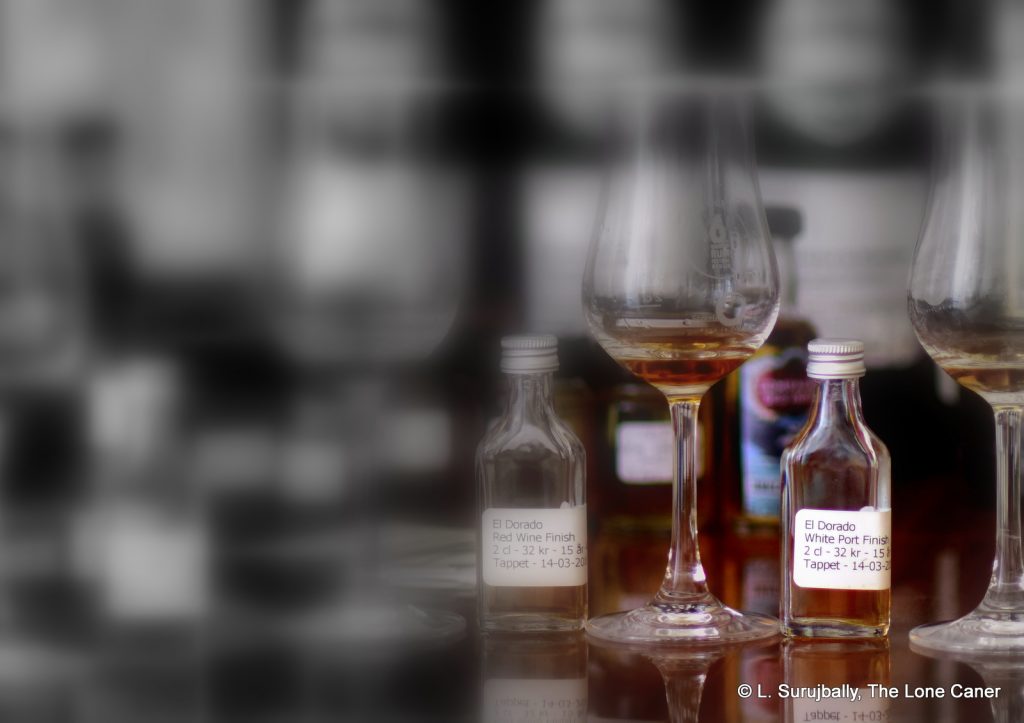
Palate – Also pretty nice, if somewhat mild, but that’s an issue I have with all of them so let’s move on. Soft is a good word to describe it, there’s almost no sharp edge at all, though it is somewhat dry – more so (and more pleasingly so) than the Dry version. The oak is more forward here (while still restrained), plus raisins, cloves and cinnamon carrying on from the nose, and the fruitiness of peaches in syrup, cherries, plus toffee, salt caramel

Finish – Dry, rather longish (always nice), final aromas of almond chocolate, raisins, cloves.

Thoughts – It is supposedly finished in Sweet Madeira casks, but it’s actually less sweet than the Dry Madeira, and more dry. That makes it pretty good in my book, and I felt it was the best of the six.

(#533)(81/100)


Links to other rums in the “additional finish” series:

Aug 012018
 

This is the fourth short form review of the six “finished” variations of the 15 year old El Dorado rums.  The 15 year old is the core of it all, and so I’ll be briefer than usual in my descriptions, rather than provide an essay in each case; and then wrap them all up with a summary on the last day.

The rums were all tasted together, blind, in a four-hour session, using the original (retasted) El Dorado 15 with a non-blind score of 82, as a control baseline.  All point scores relate to that rum.


As for all these finished El Dorados, the basic component is the 15 year old, and an additional 18-24 months of finishing is done, which is edging close to a double maturation territory rather than just a finish, but I’m not a total pedant in this matter, so it’s just noted for completeness. In this case, the finish is accomplished in French oak casks which once held (or were “previously seasoned with”) a dry madeira wine from an unnamed estate on the Portuguese island of Madeira – which, as an aside, is getting its own quiet rep for some interesting rums these days.

Colour – Amber

Strength as labelled – 43%

Strength as measured (RumShopBoy) – 40.5%

Nose – By far the best nose of the six, really liked this one a lot: sawdust and biting dark fruit undertones of plums, juicy pears, raisins, black grapes. Leavened with ripe orange peel, peaches and olives before muskier aromas of toffee and chocolate take over (as they do in all of these rums, eventually).

Palate – Very smooth, but some of the sharp citrus-y element of the nose disappears. Salted butter and caramel drizzled over vanilla ice cream.  Softer fruits here, not sharper ones – bananas, kiwi fruit, oranges gone off.  Oh, and some spices – cinnamon and cloves.  Nice, but weak (which is something all these rums seem to have in common).

Finish – Peanut butter and soya linger alongside toffee and chocolate orange fumes, quite short.

Thoughts – Certainly the best nose, and very nice depth and complexity, though writing this, I wonder where the tartness supposedly characteristic of a dry Madeira went and hid itself (such wines are not quite the same as the red wine, ruby port or white port – they tend to be somewhat sweet, quite dry and have a somewhat tart, or acidic, profile). I also felt that even the taste, for all its complexity, let it down somewhat by — again — being just too delicate. In a mix of any kind, the subtleties of those flavours would all disappear almost completely, and I personally prefer something more distinct or forceful when sipped neat (as this one absolutely can be).  Nevertheless, a good rum by any standard for its strength.

(#532)(80/100)


Links to other rums in the “additional finish” series:

Jul 312018
 

This is the third short form review of the six “finished” variations of the 15 year old El Dorado rums.  Because the basic information is similar in general – the original 15 year old is the core of it all, of course – I’ll be briefer than usual in my descriptions, rather than provide an essay in each case; and then wrap them all up with a summary on the last day.

The rums were all tasted together, blind, in a four-hour session, using the original (retasted) El Dorado 15 with a non-blind score of 82, as a control baseline.  All point scores relate to that rum.


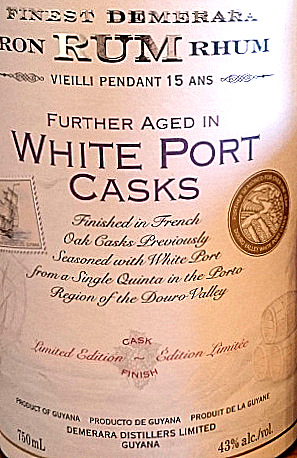
As for all these finished El Dorados, the basic component is the 15 year old, and an additional 18-24 months of finishing is done, which is edging close to a double maturation territory rather than just a finish. In this case, that finish is accomplished in French oak casks which once held (or were “previously seasoned with”, whatever that means) White Port from the Douro valley in north-west Portugal.

Colour – Amber

Strength as labelled – 43%

Strength as measured (RumShopBoy) – 40.6%

Nose – At first there didn’t seem to be much of anything there, it was so mild as to be lightly flavoured alcohol.  But after some minutes it got into gear and revved up some, with a solid core of light brown sugar, molasses, salt caramel, some sweet soya.  Not much deep fruitiness here, just light grapefruit, bananas and nuttiness, and sweet white chocolate.
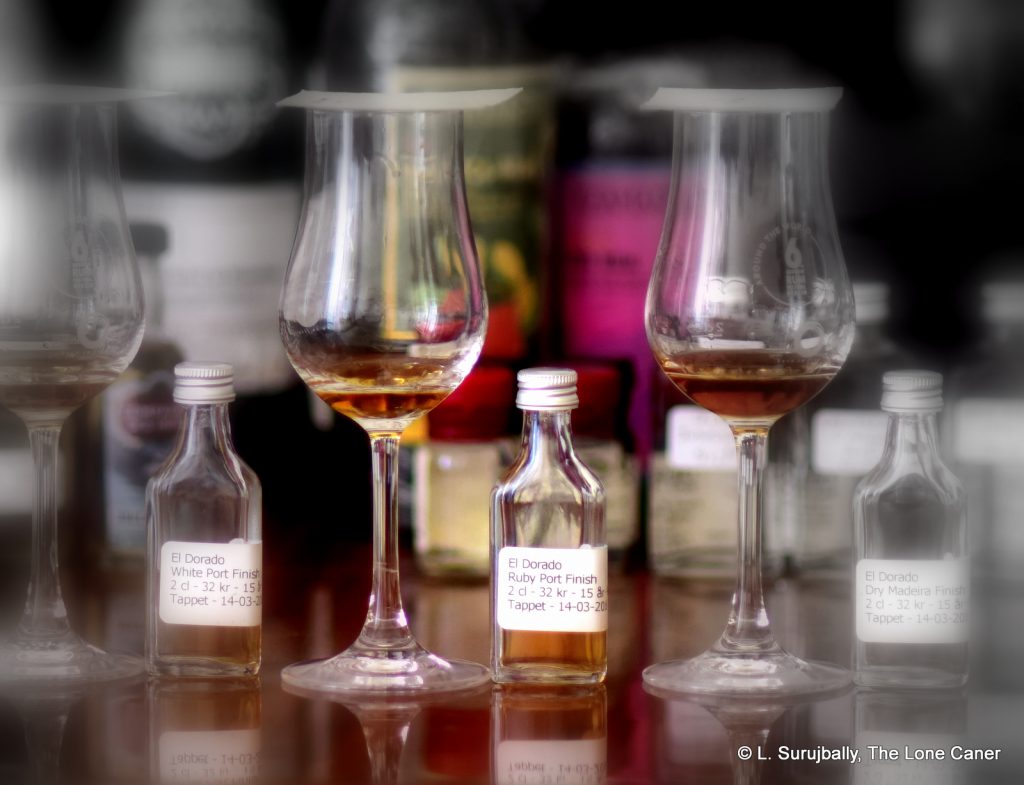
Palate – I came back to this one rum over and over again, thinking it was me, that this weak-kneed profile was palate fatigue or something, but no, there really wasn’t much to talk about both at the beginning of the tasting session, or at the end. There was citrus, toffee, chocolate, caramel, brine, bananas – all the hits from the nose – some vanilla and breakfast spices, and if there was more, I certainly couldn’t get it (which may be my problem, not yours). More subtlety than force here.

Finish – Better: nice and dry, a combination of sweet and tart and salt all at once.  Restrained oakiness, vanilla, nutmeg, citrus peel, and the nuttiness remains consistently noticeable and in the background throughout.

Thoughts – Well, it’s subtle all right – so much so that it actually felt watered down. Weakest of the bunch for me.  If ever there was a case to be made for moving to higher proofs in some rums, this one is a good example of why. I have to point you to Simon’s review here, because he was much more enthusiastic than I was, so for balance, read his notes.

(#531)(76/100)


Links to other rums in the “additional finish” series:

Jul 302018
 

This is the second quick look of the six “finished” variations of the 15 year old El Dorado rums.  Because the basic information is similar in general – the original 15 year old is the core of it all, of course – I’ll use the short form to describe them rather than an essay in each case, and then wrap them all up with a summary on the last day.

The rums were all tasted together, blind, in a four-hour session, using the original (retasted) El Dorado 15 with a non-blind score of 82, as a control baseline.  All point scores relate to that rum.


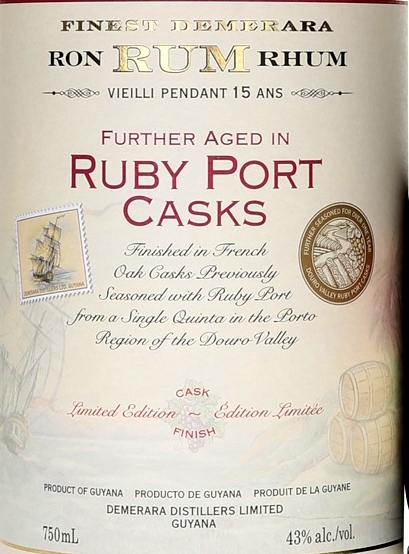
This rum is also finished in a French oak cask, one which held Ruby Port (a fortified red wine from the Douro valley), which is characterized by being bottled young and maintaining a rich fruity flavour.  As for all these finished El Dorados, the basic component is the 15 year old, and an additional 18-24 months of finishing is done, which is edging close to a double maturation territory so effectively colonized by Foursquare in recent years.

Colour – Amber

Strength as labelled – 43%

Strength as measured (RumShopBoy) – 40.5%

Nose – This has a light, sweet, almost delicate series of smells.  There are acetones, flowers and some faint medicinal, varnish and glue aromas floating around (I liked those – they added something different), and initially the rum noses as surprisingly dry (another point I enjoyed). These then morph gradually into a more fruity melange – tinned cherries in syrup, ripe pears, pineapples, watermelons – while remaining quite crisp. It also hinted at salted caramel, crunchy peanut butter, breakfast spices and a little brine, and the balance among all these seemingly competing elements is handled really well.
Palate – Not sure what happened between nose and palate, but it comes across on the tongue as rather watery and mild. The fruits exist, pears, watermelons and so on, as well as the caramel, anise and toffee, but the overwhelming mental image that I get is of rum-and-syrup-soaked pears, and those chocolates with a soft cognac filling.  All very quiet and restrained, with little else.

Finish – Wispy and faint, short, weakest point of the exercise. Plums and cherries, with some vanilla and okay undertones.

Thoughts – Some Ruby Port wines are dry and some quite sweet, but after the nose, little of the former and more of the latter were in evidence with this rum.  Strength remains an issue for me here, I think 43% is simply insufficient to properly showcase the effects of the finish.  It’s there, just not enough of it and it rather chokes on the taste, where the mildness becomes a factor in trying to separate out the various components.  Still, this one is pretty good, and the nose is outstanding, well balanced and a joy to sniff for a long time.

(#530)(80/100)


Links to other rums in the “additional finish” series:

Jul 282018
 

This entire week I’ll look at the six “finished” variations of the 15 year old El Dorado rums, one per day.  Because the basic information is similar in general – the 15 year old is the core of it all, of course – I’ll use the short form to describe them rather than an essay in each case, and then wrap them all up with a summary on the last day.

The rums were all tasted together, blind, in a four-hour session, using the original El Dorado 15 with a non-blind score of 82, as a control baseline.  All point scores relate to that rum.


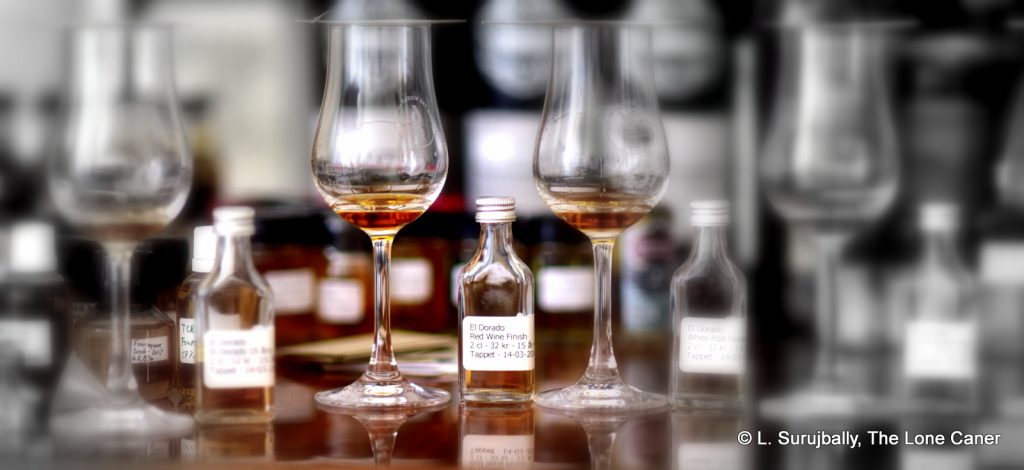
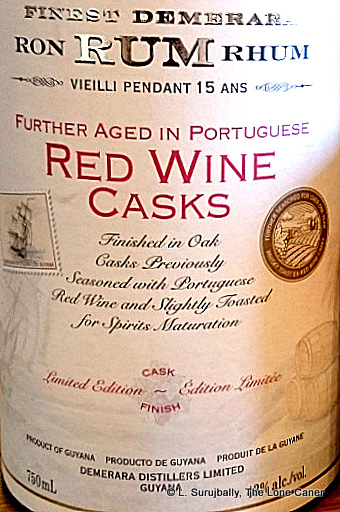
The El Dorado 15 Year Old needs no long winded recap – it’s one of the best known rums in the world, and I’ve looked at it twice now, once many years ago, and again as a Key Rum of the World. In 2016 El Dorado decided to add to the lineup by releasing six rums with varying barrel finishes.  Whether these succeeded in capturing a serious slice of the market is unknown, but certainly they must have liked it because in 2018 they released another six based on the 12 Year Old. In each case, aside from the standard fifteen years of ageing, an additional 18-24 months of secondary finish was applied, in lightly toasted (charred) red wine barrels from Portugal (no further detail) in this case.

Colour – Amber

Strength as labelled – 43%

Strength as measured (RumShopBoy) – 41%

Nose – Somewhat dry and redolent of sawdust, accompanied by delicate flowers an acetones. Quite solid and lightly sweet, and deserves to be left to stand for a while, because after some minutes the molasses, caramel and light licorice notes characteristic of the line begin to make themselves felt, and are then in their turn dethroned by a deep fruitiness of ripe cherries, blackcurrants, plums, raisins and black grapes almost ready to spoil. In the background there’s some leather and citrus, neither strong enough to make any kind of serious impression.
Palate – Much of the fruitiness carries over from the nose: the cherries, the ripe grapes, the plums, blackcurrants and so on.  Not much new is added, maybe some watermelons and pears.  It all remained very much in the background as slight hint and never dominated the entire experience: that was handled by the core flavours which reversed their previous reticence on the nose and dominated this stage of the rum.  So what we get is a large taste of brown sugar, salt caramel, molasses, bitter chocolate, vanilla, sweet breakfast spices, oak and anise…but they eclipse the subtleties of the red wine too much, I think.

Finish – It’s okay, medium long, not really spectacular…at 43% it’s not to be expected, really. Sweet and somewhat indeterminate for fruits (almost impossible to pick out individually here), and with an intriguing peanut butter and caramel core leavened by some light flowers.

Thoughts – Not too bad, an interesting variation on the theme.  Too weak at 43%, though it’s logical that cask strength lovers are not the target audience for it. I think it could safely go to 46% without alienating anyone. Too, the basic ED profile remains too overwhelming, and while the influence of the Red Wine is noticeable, it’s not clear enough or distinct enough. It can be sensed rather than directly experienced.  Still, not entirely something I’d throw away with yesterday’s fish.

(#529)(78/100)


Links to other rums in the “additional finish” series:

Jul 122018
 

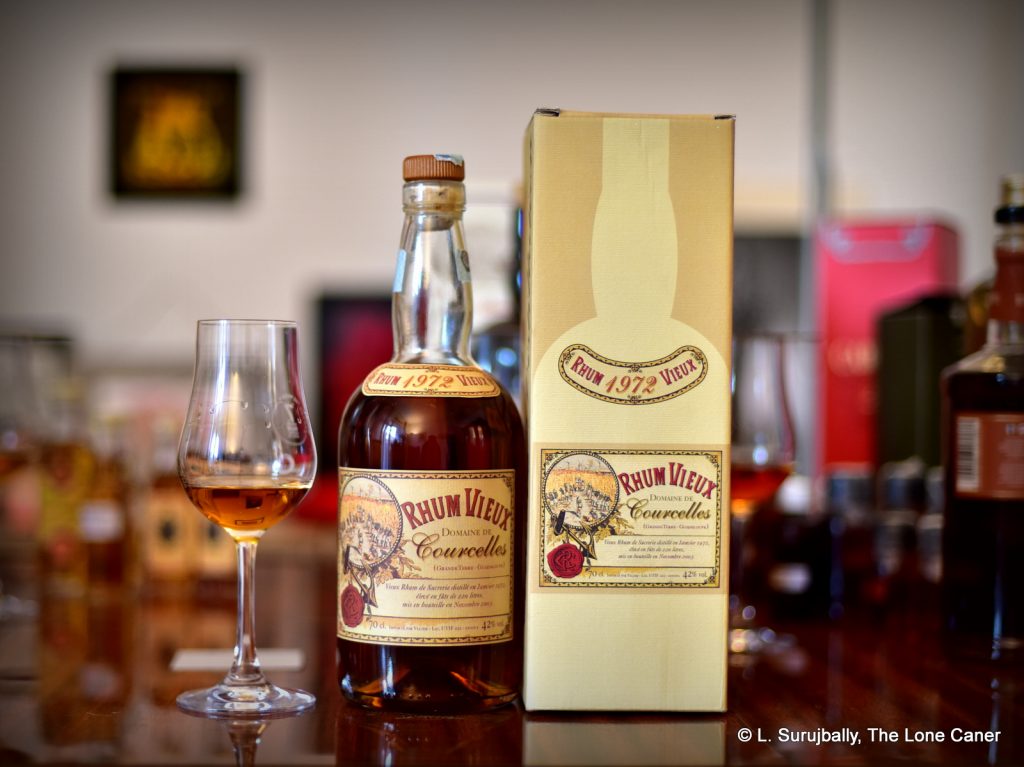
These days, anyone finding a rum three decades old had better hold on to it, because they’re getting rarer all the time.  As prices for the 1970s and 1980s rums climb past the fourth digit, locating one can be an equally fortunate and frustrating exercise…depending on how it turns out. As to why Velier chose to issue two rums of the same distillation and aging dates, at two different strengths, well, we know he has done this before, most famously with the entire Caroni line and some of the pre-Age Demerara rums.

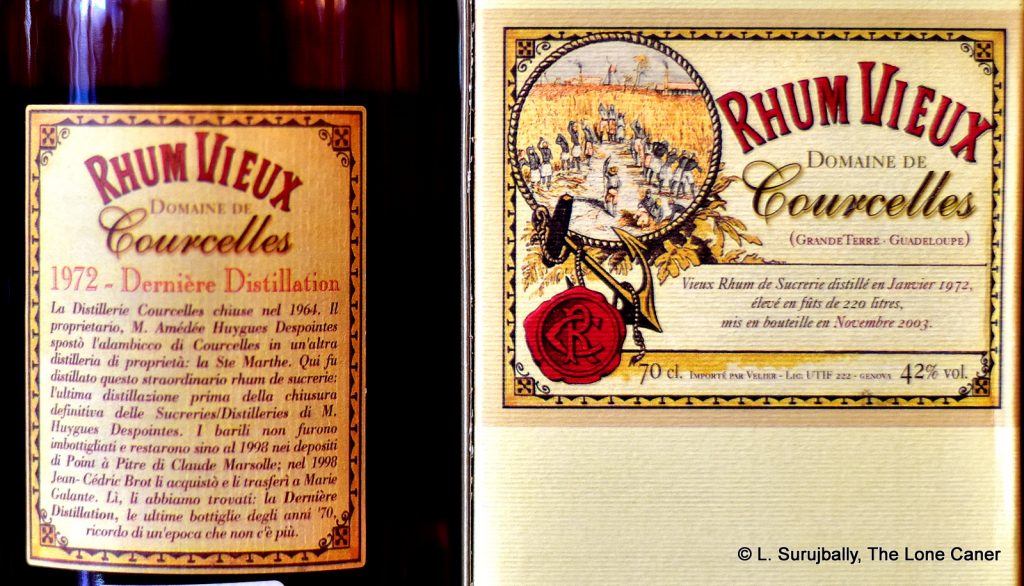
Of course, it’s possible that Velier in this instance worked on the principle of taking a the entire outturn and bottling some at cask strength and the remainder at a more quaffable proof appealing to a broader audience.  That’s reasonable, I guess (L’Esprit does the same) – yet although the 54% Courcelles 1972 and this 42% version share the same years, there’s a difference in that the 54% was laid to rest in steel vats for nearly two additional years, and both are referred to as the dernière distillation which suggests that a bunch of barrels were involved, each with its own peculiarities.

And those peculiarities are important because they make this softer rhum individual on its own merits and different from its brawnier frere. Take the nose for example: it’s lovely and sweet, light without actually being delicate. It presents bags of light fruit – pears, ripe apples, watermelons, cherries – that go on forever, to which are added soft red-wine notes, honey, thyme and a drizzle of hot caramel on vanilla ice cream.  In a way it reminds me a lot of the Savanna 15 Year Old Porto Finish from Reunion (haven’t written about this yet), but somewhat deeper even so, because the scents grow richer over time in spite of its relatively low proof point and their overall mildness.

Tasting a rum like this is a mixed experience – one appreciates the subtlety, but strains to pick apart the notes. That said, it’s quite good, with lovely clear and clean notes of light fruitiness – pears again, watermelon again, some grapes, raisins and ripe mangoes, set off by softer nuances that speak of nougat, white chocolate, a flirt of coffee, rosemary, caramel, vanilla, thyme and some florals. It also has a background of honey that I quite enjoy with a profile like this because it strengthens the whole in a quiet kind of way, provides a bed for the rest of the flavours to emerge onto and do their thing. About the weakest point of the whole experience may be how it ends – the finish is short and faint, a zephyr following from a stiff breeze, with just some barely discernible floral and fruity hints and a bit of orange zest and tart yoghurt, and then it’s all over.

After writing up my notes, I keep coming back to how differently it presents when rated against the 54% version – it’s like they are different branches from the tree, growing in different directions while still conforming to underlying and consistent standards (many of the tasting components, for example, are quite similar). The 42% iteration, I have to somewhat reluctantly note, is less when placed next to its masterful stronger sibling.  On its own, with nothing else to compare it to, it’s quietly, subtly brilliant and will not disappoint the casual drinker. But side by side, its potential clarion call is muted and dialled down, it is deferential and says much less…and when it does, it whispers.

(#528)(86/100)


Other notes

  • The Courcelles distillery in Grande Terre (one of the two “wings” of Guadeloupe island) was established in the 1930s and closed way back in 1964 when the then owner, M. Despointes, transferred the inventory and equipment to another distillery, that of Ste Marthe. They continued using Courcelles’s pot still and distilled this rum in 1972.  This is probably the last year any Courcelles distillate was made – I’ve never been able to find one produced more recently.
  • Distilled in 1972 and set to age in 220 liter barrels until 2003.  Outturn is unknown
  • The profile does not suggest an agricole, and since Guadeloupe is not AOC compliant, it probably derives from molasses. The taste certainly suggests it.
  • About that strength differential – in my essay about the Age of the Demeraras, I remarked that the first three releases of Velier Demeraras were all issued at standard proofs because Luca was nervous about moving too fast with releasing >50% cask strength rums.  I suspect that he had similar feelings about the 42% version of the Courcelles, which was why it was bottled first – two years later, just when he was putting out the full proof Skeldons in 2005, he went full bore with the rest of the Courcelles stock and never looked back.
Jul 102018
 

Now that Americans can bring back Cuban booze without sanction, it’s likely that their rums will get a boost in sales, and if the Havana Club trademark war ever gets resolved – though I doubt it will happen any time soon – then we’ll see many more on the market.  However, at this period in time, over and above the big names from the island like Santiago de Cuba or Havana Club, to get seriously aged juice that’s really from Cuba, we still have to look primarily at the independents for now.

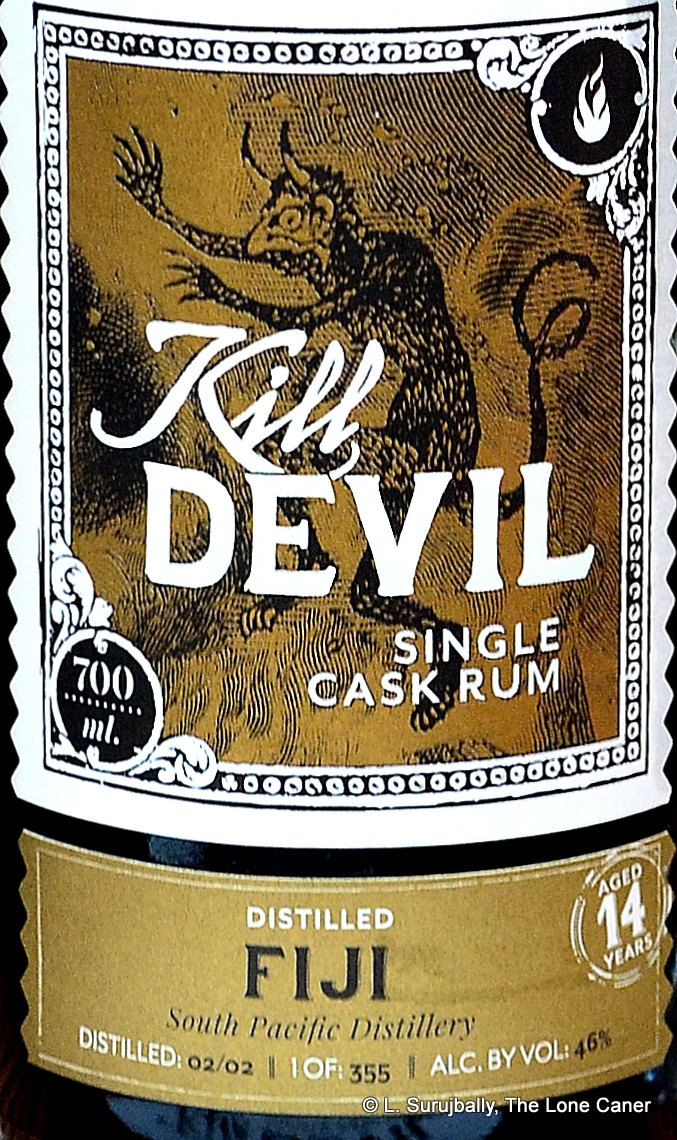
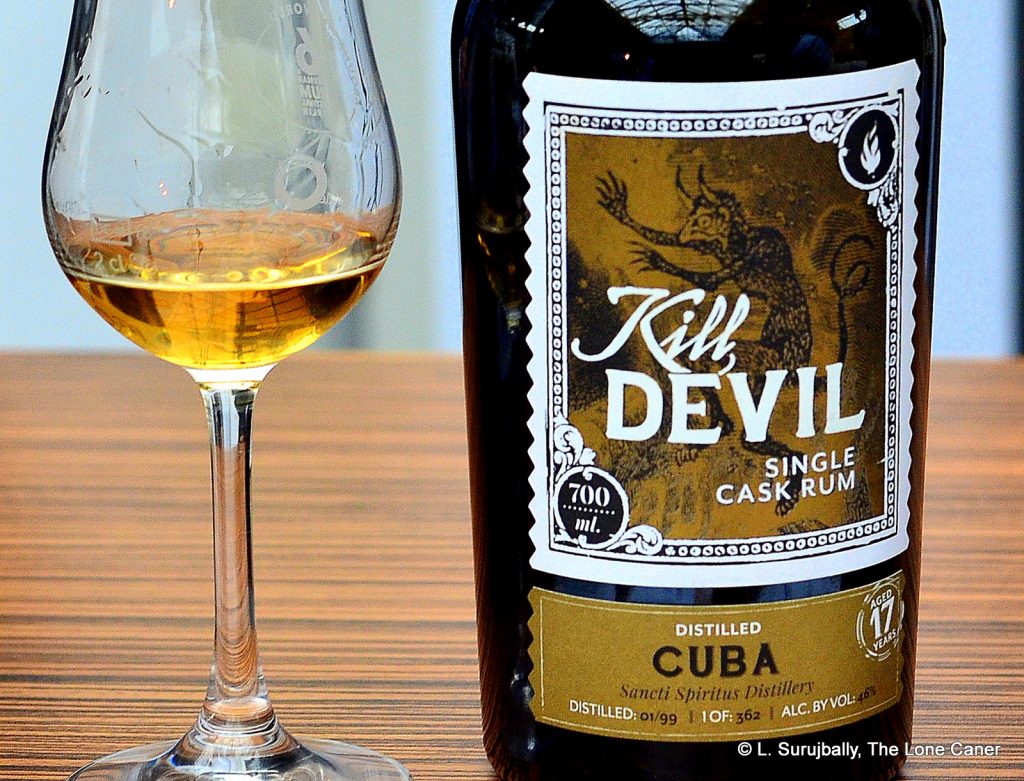
One of these is Kill Devil, named — as any rummie can tell you — after the old term for rum used in its infancy in the Caribbean many centuries ago.  Kill Devil is the rum brand of the whiskey blender Hunter Laing, and they’ve been around since 1949 when Frederick Laing founded a whisky blending outfit in Glasgow.  In 2013, now run by descendants, the company created an umbrella organization called Hunter Laing & Co, which folded in all their various companies (like Edition Spirits and the Premier Bonding bottling company). As far as my research goes, the first rums they released to the market – unadulterated, usually at 46%, unfiltered – came in 2016, and they have issued releases from Barbados, Jamaica, Guadeloupe, Guyana, Fiji and this one from Cuba.  One imagines that they read the tea leaves and realized there was some money to be made in rums as well as whiskies, though by coming into the market so relatively late, they’re butting heads with a lot of other new entrants – good for us as consumers for sure, perhaps not quite as rosy-cheeked for them.

As for Sancti Spiritus, this is a Cuban distillery also known as Paraiso, dating from 1946 (there is some dispute here – another source says 1944) that is located almost dead center in the island.  Much of what is known of their rums comes from independents like Compagnie des Indes, Cadenhead, Bristol Spirits, Secret Treasures, Samaroli, Duncan Taylor, Isla del Ron and Renegade, implying a substantial export market of bulk rum to Europe.  But they also make rums of their own under the Santero brand, like the Añejo Blanco, Carta Blanca 3 YO, Palma Superior, Añejo Ambarino, Añejo Reserva, Carta Oro 5YO, Añejo 7YO and Firewater (none of which I’ve tried, to my detriment). And I’ve heard it said they supply Havana Club as well, so there’s no shortage of places for anyone with an interest to get some.

Some brief stats, for the propellerheads like me: the single-cask rum here is from the above-noted distillery, coloured pale gold, distilled in 1999 and bottled in 2016, with 362 bottles released.  And it has a strength of 46%, similar to rums issued by Renegade and L’Esprit and others, keeping it within reach and tolerance of the greater rum drinking audience.

That may be, but it was still quite a forceful piece of work to smell, much more so than I was expecting, and would perhaps come as a surprise to those who are used to softer, milder Bacardis as “Cuban style” exemplars. Presenting rather dry and spicy – almost hot – it seemed to steer a course somewhere between a light molasses column still rum, and the grassier and more vegetal notes of an agricole…without actually leaning towards either one. It had a mix of cherries, peaches and tart soursop, unsweetened yoghurt, vanilla, oak, cinnamon, nutmeg, and a very faint line of citrus running through the whole thing. It felt somewhat schizophrenic, to be honest – both acidic (in a good way) as well as lightly creamy – and that made it intriguing to say the least.

As it was sipped, it became somewhat less creamy than the nose had intimated – “sprightly” might be a good word as any to describe it. It was quite clean in the mouth, tasting of green grapes, apples, cider, mixed up with something of the saliva-flooding crisp tartness of red currants, or lemons just starting to go off. What made it stand out was the background notes of light flowers,caramel, vanilla, bananas, ginnips, and wet dark brown sugar, plus those spices again, mostly cinnamon. The finish was also quite elegant, and left memories of light caramel and fudge, oakiness and vanilla, with a little citrus for bite. It lacked a certain roundness and smooth planing away of rough edges, but I suggest that’s a good thing – it made it its own rum rather than a milquetoast please-as-many-as-you-can commercial product you’ll forget tomorrow morning.

Overall, the rum shows that even with all our bitching about pot still rums being better and yet not represented often enough, there’s little that’s bad about a column still spirit when done right, and the Kill Devil is a good example.  Even though I don’t know at what strength it came off the line, I feel that whatever complexities seventeen years of ageing imparted managed to provide an end result that was quite a nice rum (Cuban or otherwise). Which likely demonstrates that if we want to have a good column still experience from a juice aged in continental climes, there are certainly candidates for your coin out there, and as long as you come to grips with its slightly odd personality, this is one of them.

(#527)(84/100)

Jul 072018
 

These days Jamaican rums which were previously and mostly blending fodder are getting not only a new lease on life but a resurgence of their reputation that is so massive and enthusiast-driven that it’s led to the re-emergence of names like Longpond, Worthy Park, Clarendon, Inswood, Monymusk, New Yarmouth, Hampden Estate (and others),  that might be giving Appleton some sleepless nights. Lovers of the style can’t seem to get enough of them, which goes a long way to demonstrating public boredom with pallid blended meh-rums that have suffused much of the consuming landscape for the last decades. People were and are simply looking for something more exciting, more distinctive…and Jamaicans are filling that niche very nicely indeed.

In 2017 the French company Compagnie des Indes issued a New Yarmouth rum which excited raves across the Jamaican rum loving cognoscenti, and in 2018 Velier issued two Hampdens themselves as they began their long march to promote the estate – both lit up Facebook like the Fourth of July.  And that’s not even counting the other Worthy Park and Hampdens which have come to market in the last few years. The Hampden I’m looking at today is a bit more modest, however – it is one Compagnie edition of about twenty from the island that were released up to 2017 (of which four were from Hampden).

In terms of background, it’s a 43% rum, pot still origin, barrel #JH46, distiilled in 2000 and bottled in 2016, 339 bottles, sourced in Europe (probably Scheer) – and if you’re really interested I dragged some others from the island to act as controls: the Mexan XO, the Mezan WP 2005, another two Compagnie rums – the Longpond 12 YO (44%) and the Worthy Park 7 YO (53%). Because I was curious how well the Hampden would fare against both other estates, and other strengths.

There was no mistaking the lemon-yellow Hampden for anything but a Jamaican, that was for sure. The nose was slightly sweeter than the Mezans and the CdI Longpond, very clear, redolent of cherries, tart fruits, green apples, rotting banana funk, overripe mangoes, together with a fine line of citrus carving through the whole thing – a medium ester rum, I hazarded, and very crisp and clean to smell.

On the palate, I didn’t think it could quite beat out the CdI Worthy Park (which was half its age, though quite a bit stronger); but it definitely had more force and more uniqueness in the way it developed than the Longpond and the Mezans. It started with cherries, going-off bananas mixed with a delicious citrus backbone, not too excessive. After ten minutes or so it opened further into a medium sweet set of fruits (peaches, pears, apples), and showed notes of oak, cinnamon, some brininess, green grapes, all backed up by delicate florals that were very aromatic and provided a good background for the finish.  That in turn glided along to a relatively serene, slightly heated medium-long stop with just a few bounces on the road to its eventual disappearance, though with little more than what the palate had already demonstrated. Fruitiness and some citrus and cinnamon was about it.

Overall, a solid, tasty Jamaican rum, presenting somewhat younger than its physical years.  It was continentally aged, so the rich voluptuousness of a tropically-aged rum was not its forte. Some of its rough edges were sanded away while leaving enough to give it some character: its strength was right, I think, and it lacked some of the furious brutality of younger ester bombs from the estates, without losing any of its elemental character.  Not all high-ester, funk-driven, dunder-squirting rums are meant for such neat sipping (as has been remarked on before, such intensely flavoured Jamaicans are often used as flavouring agents in other blended rums). But as a rum by itself, tasted and evaluated on its own, this fifteen year old is a very pleasant sipping dram that retains just enough edge to make it a very good experience to have by itself, or to perk up whatever cocktail you feel like adding it to.

(#526)(86/100)


Other notes

For a pretty good historical and production-level rundown on Hampden estate, the Cocktail Wonk’s 2016 article covers just abut everything.

Jul 052018
 

Sometimes looking at companies that have ceased operations is interesting (Renegade was one), and the historical detail behind the Forres Park Puncheon made by Angostura was engrossing enough that some additional research was warranted, not least because the moniker “Fernandes” remains on the labels of some currently available Trinidad rums, and some might be curious as to the background

The Puncheon was originally made by the Fernandes Group in Trinidad & Tobago, which had its roots in the efforts of a Madeiran (Portuguese) immigrant named Manoel Fernandes, who established an import business for wine and spirits in the late 1880s or early 1890s in Port-of-Spain, Trinidad (in that he was similar to the founder of Banks DIH in Guyana).  The date is a little imprecise, but by the time he and his family attained British citizenship in 1895, the business was already bottling its own rums, and one of them (Fernandes Old Rum) won a gold medal at the Crystal Palace Exhibition in 1905. They issued a White Star rum in 1918, the Black Label in the mid-1920s and one called Ferdi’s, a 10 year old, in the 1930s (which was briefly referred to in Part 1 of the essay “The Age Of Velier’s Demeraras.”)

In 1930 Manoel died and Joseph Bento Fernandes (his 27-year-old son) took over Fernandes & Co. He showed his acumen in 1932 after a fire destroyed the Govenment rum bond; Joseph acquired the stocks of remaining rum at a good price, and since the paperwork stated the majority of the spirits were distilled in 1919 (a Trini named Aneil Lutchman wrote to me on FB that Angostura’s Master Blender told him in early 2018 there was some Caroni 1918 in there as well), he blended the lot and labelled it “Fernandes 1919 – Age Guaranteed!” It was the first vintage rum made in Trinidad to that time, and the forerunner of the most successful Fernandes brand for thirty years, with the name changed to “Fernandes Vat 19″ when the original 1919 stock ran out; the still-in-production Angostura 1919 8 YO is this rum’s direct descendant, and even though Caroni had once been part of the original Fernandes Vat 19 recipe, by now it is no longer part of the blend.

These ventures and blended rums were so successful that in 1933 the company acquired the Forres Park sugar estate and its derelict sugar factory, located in Claxton Bay, just north of San Fernando on the west coast (but don’t look for it, because it’s gone). This was becoming necessary because the increased popularity of their blends made supply of raw material from other sugar estates too expensive and often unreliable. Over the next decade JB rebuilt and tinkered with an old wooden still and increased sugar production; but it was the influx of Americans (and their money) during World War II that really grew the business.  JB knew that in order to expand even further he had to move the focus of the company away from blending and bottling and into actual distillation – so in the late 1940s he acquired land in Morvant (a neighborhood just to the east of Port-of-Spain) at a time when the Government of the day was starting to develop it into a sort of planned housing project, and he built a modern distillery there. As a bit of trivia, Angostura was a close neighbor, right over the road.

JB Fernandes (photo (c) Angostura)

By the 1960s Fernandes & Co changed into Fernandes Distillers Ltd and ten years later had a massive 85% market share of the local market, as well as what were reputed to be the largest stocks of ageing rum in the Caribbean.  They had also opened up a strong export market to both Europe and Asia. However, for reasons that are not entirely clear, the company was sold to Angostura holdings in 1973 and while it kept its name (Fernandes Distillers (1973) Ltd.), it was a subsidiary of Trinidad Distillers Ltd, Angostura’s holding company…and the French Savalle still they used was dissassembled once distilling operations were merged. All rums made by either company were then run off the same five-column still, and whatever work Bento had done on that long ago wooden still had been forgotten or abandoned.

But that’s not all because in the Angostura Museum are papers suggesting that while the Fernandes brands were taken over by Angostura, Forres Park itself was transferred or ceded or sold  to the Government at the same time. Because in 1976 another (now-famous) company called Caroni (1975) which the T&T Government had bought from Tate & Lyle, was asked to take over the running of Forres Park “the owners of which had decided to discontinue sugar production in Trinidad” (one can only wonder how and why that ever happened). Evidently the sugar part didn’t interest Angostura, only the rums did.  In any event, the Forres Park factory was closed and sold to St Vincent (probably St. Vincent Distillers, as they are the only distiller there)  and the rest of the property became part of Caroni, which itself was shut down by the Government in 2002. (See “Sources” below for attribution.)

JB Fernandes himself went into real estate and other ventures including tourism, horse racing, art collecting and philanthropy, and died in 1992. Few outside Trinidad (or rum history geeks) now remember his name, or remember his contribution to Trinindad rums;  though of course old timers would recall the famous brands he pioneered and which Angostura still uses. Even the Fernandes name remains on some bottles I have found online (like the Black Label), though their availability is questionable…it’s possible that it is being gradually phased out and what is for sale is unsold stock from the 1990s.

This is a small biography and sources are slim. But it does pull together all strands of information as are available, and I hope that if any Trinis or old salts have further information or stories to enhance it some more, please touch base with me.


A short list of Fernandes Rums (not Angostura’s) are below.

  • Fernandes Crystal Superior White Rum
  • Fernandes Silver Aged 3 YO Rum 38%
  • Fernandes Old Rum
  • Fernandes Original Rum
  • Fernandes White Star Rum
  • Ferdi’s Trinidad 10 YO Rum
  • Ferdi’s Premium Rum
  • Vat 19 Trinidad Rum 37.5%
  • Vat 19 Golden Trinidad Rum 37.5%
  • Vat 19 White Rum
  • Forres Park Puncheon
  • Fernandes Black Label Rum

Fernandes Distillers (1973) post-takeover rums kept with the Fernandes name:

  • Fernandes Crystal White Rum (Angostura version)
  • Ferdi’s Premium Rum (“Uniquely Matured”)
  • Fernandes Vat 19 White Rum
  • Fernandes “19” Rum
  • Fernandes “19” Gold Rum
  • Fernandes Black Label Rum
  • Fernandes BL Original Rum
  • Forres Park Puncheon Rum

Sources:


Jul 052018
 

Photo from Angostura website

What’s surprising about this white triple-filtered column-still overproof – which keeps company with 151s like the Bacardi or Cavalier and others – is that it is not a complete fail, though it does resemble a massive ethanol delivery system that forces you to consider whether a visit to your place of worship is required before it comes alive and does a chestburster on your mosquito physique. It has a few points of interest about it, in spite of its fiery heat and hard punch…and I say that grudgingly, because overall, I don’t see much to shout about.

Part of the problem is the indifference with which – to me – it seems to be made.  I blame the triple filtration for this state of affairs. No real effort appears to have been pushed into elevating it beyond a high proof cocktail ingredient (rather, such effort seems to have been directed towards muting the flavours rather than enhancing them), and one gets this impression right away when (very carefully) nosing it, where the lack of any real complexity is disappointing.  Oh sure, it’s hot and sharp and very intense, but what did you expect? And what do you get for your trouble? — not much beyond sugar water, a few briny notes, some red olives and a small amount of acetones and coconut shavings. And maybe a green grape or two. In short, as West Indians would say, mek plenty plenty noise, but ain’ got enuff action.

The palate is usually where such overproofs really get into gear, pump up the revs and start laying rubber on your face.  Certainly that happened here: as a lip-burn and tongue-scorcher, it’s tough to beat. It presented as very oily and briny and what sweet there was sensed on the nose vanished like a fart in a high wind. There were tastes of dates, figs, soya and vegetable underlain with a weird kind of petrol undertone (quite faint, thankfully). Some nail polish and new paint slapped over freshly sawn lumber – but very little in the way of fruitiness, or a more solid underpinning that might make it a more interesting neat pour.  And the heat just eviscerates the finish, which, although giving some more sweet and salt, sugar water, soya, watermelon (at last – something to praise!), is too faint and dominated by the burn to be really satisfying.

Of course, this is a rum not meant to have by itself – few rums boosted to 75% and over really are, they’re meant for bartenders, not barflies. Too, stuff at that strength is treading in dangerous waters, because there are really only two options open to it: don’t age it at all (like the Neisson L’Esprit 70° Blanc and Sunset Very Strong 84.5%) and showcase as much of the youthful vigour and original taste as one can; or age it a little – not the one or two years of the Bacardi 151, but something more serious, like the SMWS Longpond R5.1 81.3% or the Barbados R3.5 74.8% or the really quite good R3.4 75.3%.

As a puncheon, named after the oversized barrels in which they were stored, this was developed in the early part of the last century as a cheap hooch for the plantation workers and the owners.  It was never really meant for commercial sale – yet for some reason it turned out so popular that the Fernandes (the family enterprise which originally made it on the Forres Park estate) issued it to market, and even after Angostura took over the company, they kept it as the only entrant in the insane-level-of-proof portion of their portfolio.

Like all rums brewed to such heights of strength, it sustains a level of intensity that most full-proof rums can barely maintain for even five minutes, just without many (or any) of their redeeming features.  That’s part of the problem for those who want a neat and powerful drink that’ll fuel their car or blow their hair back with equal ease – because there’s a difference between an overproof that uses extreme strength to fulfill an artistic master blender’s purpose, as opposed to one that just issues it because they can’t think of anything better to do. Unfortunately, here, this is a case of the latter being taken a few steps too far.

(#525)(73/100)


Other notes

  • While the Forres Puncheon I review here is made by Angostura, its antecedents date back much further, to the original company that created it, Fernandes: and that was so fascinating that I have devoted a separate biography of the Angostura-acquired  Fernandes Distillery to it, as it was too lengthy for inclusion in this review.
  • Sample provided by my correspondent Quazi4moto, who’s turned into something of a rum fairy of samples these days.  Big hat tip to the man.
Jul 022018
 

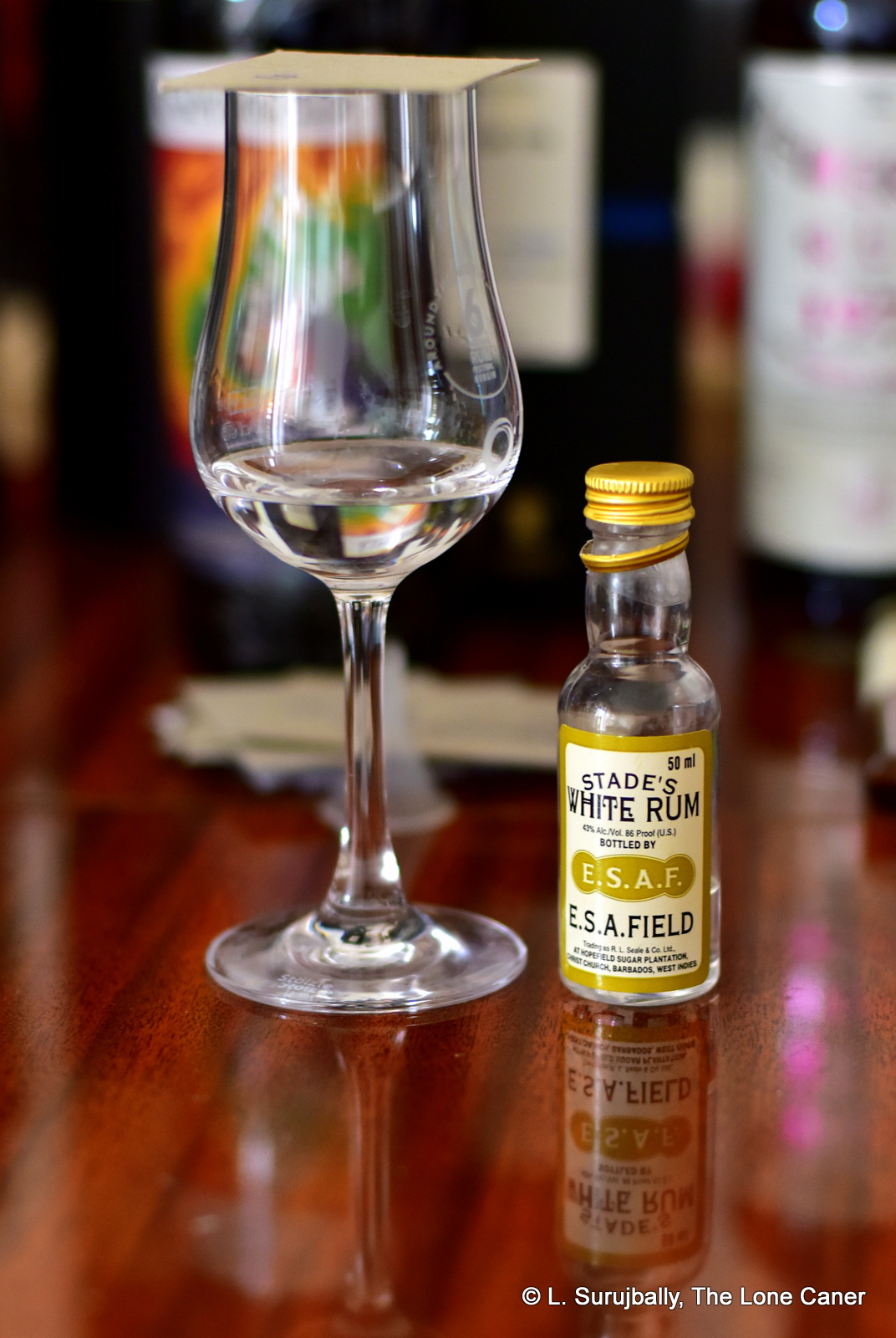
The question that arises when drinking a rum that is 10 years old is whether the relatively placid 40% strength helps or hurts given our rather more discerning palates these days. The blended Jamaican XO from last week’s review, with its indeterminate age and provenance, succeeded modestly in spite of its wispiness because somehow the tastes still came through and provided a showcase for the style…and for its price it was a strong low-end contender that punched above its weight.  While the 2005 10 YO we’re looking at today is also bottled at that strength – subsequent editions are a bit stronger – it is quite a few rungs up the ladder. In fact, it’s a quietly successful offering from Mezan, and should not be passed over by those who disdain anything except cask strength juice.

Speaking immediately about the nose, even though the strength was the same, the 10 year old presented as much more emphatic and distinctive than the XO.  Bananas and lemons, brine, olives, vague sweetness. Time helped to some degree and after a while one could sense cherries, a little funkiness, unsweetened chocolate and a continual background of orange peel, all of which remained light and relatively unaggressive, but quite clear.

The taste was the part I liked this most, because it was light and clear…kinda flirty chirpy, even sprightly.  The 40% does no damage to the palate and is actually quite pleasing in its own understated way. Green grapes, apples, cider, raspberries, tart unsweetened yoghurt, chocolate and nuts underscored by the thin line of citrus peel, and supported by a faint but noticeable set of fleshier fruits (not-quite-ripe apricots and peaches and mangoes) – the funkiness of esters was there, just dialled down, which distanced it somewhat from more traditional hard-core Jamaicans that are getting all the press these days. The weakness of the rum as a whole was probably the finish, which was really too short and fine, and added nothing particularly new to the fruit basket or the tastes – some citrus, cherries, green apples and that’s about it.

Overall, I liked it but the distinctiveness of the estate profile refused to come through that general mildness, which is, of course, something of a fail mark for a country whose rums have been getting a lot of attention in the last few years.  A few extra points of proof would have helped a lot, I think — and indeed, Mezan have issued a 46% version of the Worthy Park 2005 in 2017 which I have not tasted, but which is likely to address the issue (this one was a 2015 bottling).

The finish and aftertaste of the Mezan 2005 (though not the nose and palate) to some extent suggest why some people do not entirely go for softer proof and continental ageing, which is what I believe this is. That final part of the experience is simply too nondescript and inconspicuous and over far too quickly.  But we should not be too quick to trumpet “tropical ageing only!” like it was some kind of universal truth, because we should keep in mind the sterling Worthy Park 7 YO 53% from the Compagnie des Indes, which was a better rum in every way and was also aged in Europe (note also Wes’s admiration for the 2015 10 YO Worthy Park from Kill Devil).  Also the fact that overall for its price, this is a pretty good rum for those who want to know more about the Jamaican style of Worthy Park without getting their faces ripped off by a hot blast of esters bolted to a cask strength bitch slap. On that level, I’d say it’s a qualified success.


(#524)(84/100)


Other notes

  • Worthy Park re-opened for business in 2005 after not having produced any rum since the sixties, so this is from the first year of issue.
  • Distillate comes from molasses and a Forsythe copper pot still.  Actual place of ageing is unknown, but I’m thinking it’s the UK, or maybe partial in both UK and Jamaica.
Jun 282018
 

In Part I of this short series I described the trends within and position of the rumworld as it existed before Velier began issuing its Demerara rums, and in Part II provided a listing and some brief commentary of the rums themselves, as they were released.  In this conclusion, I’ll express my thinking regarding their influence, and also give an epilogue of some of the characters mentioned in Part I.


So, what made the Age? In a time when independent bottlings were already in their ascendancy, why did this one series of rums capture the common imagination to the point where many of the issues have become unicorns and personal grail quests and retail for prices that, on the face of it, are almost absurd?  And what was their impact on the wider rumiverse, then and now?

Part of their fame is certainly the proselytizing dynamism and enthusiasm of Luca Gargano himself. He is born storyteller, very focused and very knowledgeable;  when you meet him, you can tell he is enraptured with the subject of rum. He travels constantly to private tastings and rumfests, and is well regarded and well known around the world. The rise of Velier is in no small part attributable to the business acumen and personal force of this one man and the dynamic team of Young Turks he employs in his offices in Genoa.

But Luca aside, I think that the Age was what it was because it really was a first, on many differing levels. It broke new ground, created (or legitimized) many new trends, and demonstrated that the rum folks would buy top quality rums even with a limited outturn.  It summed up, codified and expanded principles of the rum world the way Citizen Kane did for film.

One has only to look at the way things were and the way things are to see the influence they had, and while it’s perfectly acceptable to state that Velier was only one aspect of the momentous changes in the world and the rum industry — that it was all inevitable anyway, and maybe they were just lucky bystanders who shone in reflected light of greater awareness — I contend that the Demerara series serves a useful marker in rum history that influenced much of what subsequently came along, and which we now take for granted and indeed, expect from a good rum

The Demerara rums released by Velier were several notches in quality above the equivalent rums produced almost anywhere else and entrenched the issue of tropical ageing as a viable way of releasing top quality rum, because aside from the major brands releasing their aged blends (often at 40-46%), it was almost unheard of to have tropically aged rums of such age produced at cask strength and so regularly. Almost without making a major point of it, the Age enhanced the concept of “pure”, and solidified the idea of “full proof” that otherwise might have taken much longer to get to develop.

The series pointed the way to the future of Foursquare rums, Mount Gay cask strengths, the El Dorado Rares, as well as English Harbour’s and St. Lucia Distillers’ new and more powerful expressions.  They provided an impetus for the re-invigorating of Jamaican distilleries, some of which were all but unknown if not actually defunct, and it could be argued that there is a line of descent from the estate-based Demerara full-proofs to the movement of these Jamaican distilleries to not just sell in bulk abroad, but to issue estate-specific marques of their own.

The Age also moved the epicenter of the top-echelon rums (not always the same as super-premiums) away from aged blends (like El Dorado’s own 21 and 25 year old rums, or Appleton’s 21 and 30 year olds) to single-barrel or limited-edition, estate-specific full proofs.  It gave the French agricoles a boost via Velier’s subsequent collaboration with Capovilla (which is not to downplay the impact of the hydrometer tests mentioned below), and provided small, new rum outfits like Nine Leaves and US micro-producers the confidence that their rums made to exacting specifications, at a higher strength and without additives had a chance to succeed in an increasingly crowded marketplace.  

And the Age led to a trend in increased participation of independents and private labels in the greater rum world: new or concurrently existing companies like Hamilton, EKTE, Transcontinental, Compagnie des Indes, Bristol Spirits, Mezan, Duncan Taylor, Secret Treasures, Svenska Eldevatten, Kill Devil, Excellence Rum, L’Esprit, as well as the older ones like the Scottish whisky makers, Plantation, Rum Nation, BBR, and Samaroli, are its inheritors (even if their inspiration was not a direct one and they might argue that they had already been doing so before 2005). Nowadays its not uncommon to see annual releases of many different expressions, from many different countries, instead of just a few (or one).

It would be incorrect to say that the Age of the Demeraras proceeded in isolation from the larger rum world.  While these Demeraras were being made, others were also gathering a head of steam (Silver Seal and Samaroli are good examples, which is why their older bottlings are expensive rarities on par with Veliers in their own right). All the larger independent bottlers increased their issue of stronger rums from around the world.  And I suggest that the work they have done when considered together has led to two of the other great divides in the rum world – cask strength versus standard, and continental (European) ageing versus tropical. To some extent Velier’s Demeraras raised awareness and provided some legitimacy for this trend if not actually initiating it.

Drejer, hydrometers, sugar and the fallout…

One other aspect of the rumworld not directly related to the Age detonated in late 2013 and early 2014, and must be considered. That was the work of the Finland’s ALKO and Sweden’s Systembolaget, closely followed by Johnny Drejer, in analyzing the contents and ABV levels of rums. They used a hydrometer to measure the actual ABV as the instruments displayed, and compared that against the labelled ABV – any difference over and beyond some kind of normal variation was an additive of some kind that changed the density. In the main, that was caramel or sugar in some form or other, and possibly glycerol and/or other adulterants.

Five short years ago, nobody on the consumer side of things ever thought to do such a test.  Who could afford that kind of thing with a commercial lab? — and if the producers were doing such analyses, they weren’t publishing. For years before that, there had been rumours and dark stories of additives going around,  it’s just that public domain evidence was lacking.  Many producers – excepting those prohibited by law from messing around – denied (and had always denied) additives outright, or spouted charming stories about secret cellars and stashes, family recipes, old traditions and rum heritage.   Most of the remainder hedged and never answered questions directly. 

When the Scandinavians started publishing their results, the roof blew off — it quite literally changed the rum landscape overnight. For the first time there was proof — clear, testable, incontrovertible proof — that something was being added to some very old and well-regarded rums to change them. Almost at once Richard Seale of Foursquare used his regular attendance at international rumfests to speak to the issue (as did Luca Gargano), and he, Johnny Drejer, Wes Burgin, Rum Shop Boy, 4FineSpiritsCyril of DuRhum, Phil Kellow, and Dave Russell proved that with some inexpensive home apparatus, you could do your own testing that would at the very least prove something else was in your favourite juice (though not what it was). All the blog owners mentioned above now maintain lists of rums and measurements of the ABV differences and the calculated dosage (that’s where the links direct you).

That direct measurement of, or reference to, a hydrometer test for ABV discrepancies has become a key determinant of honesty in labelling.  Conversations in social media that speak to rums known to have been “dosed” (as the practice has come to be called) are more likely than any other to end in verbal fisticuffs and name-calling, and has created a third great divide in the world of rum drinkers.

This may be seen to be at best peripheral to the Age, but what hydrometer tests and the emergent purity movement did, was instantly (if indirectly) provide enormous legitimacy to the entire Velier Demerara line and those of many of the European indies, as well as the whole pure-rums concept Luca had been talking about for so long. With the exception of the pre-2005 releases, the credibility of these rums was solidified at once, and the increasingly positive word of mouth and written reviews moved them to almost the pinnacle of must-have rums. I’m not saying other rums and producers didn’t benefit from the movement – Jamaican, Bajan and St Lucian rums in particular were were more than happy to trumpet their own purity, as did practically every independent bottler out there – just that Velier reaped a lot of kudos almost without trying, and this helped raise awareness of their Demerara rums. It’s an aside to the main thrust of this essay, but cannot be entirely ignored either.


Epilogue

Many of the players in this short history are still with us, so here’s an update.

The El Dorado 15 remains a staple of the rum drinking world to this day in spite of its now well-publicized dosage.  It has received much opprobrium for the lack of disclosure (DDL never commented on the matter of dosage until an interview with Shaun Caleb in 2020, and for the record the practice is being phased out) and has slipped somewhat in people’s estimation to being a second tier aged product.  Yet it remains enormously popular and is a perennial best seller, a rum many new entrants to the field refer to as a touchstone, even though DDL has moved to colonize the space Velier pioneered and begun issuing cask strength limited bottlings from the stills themselves in 2016 (the 1997 anniversary editions at 40% were essays in the craft but predated the Age and were never continued).

Photo (c) A Mountain of Crushed Ice

Ed Hamilton has withdrawn somewhat from his publishing and promotional work, and the Ministry of Rum website is a shadow of its glory days, with most of the traffic and rum-chum interaction shifting to Facebook, where his group is one of the top five in the world by user base.  Mr. Hamilton is a distributor of many distilleries’ rums into North America and in 2010 began to issue the Hamilton line of rums from around the Caribbean, all pure, all at cask strength. I quite liked the little I’ve tried.

Independent bottlers continue proliferating in Europe and all follow the trail of the Age – full proof, estate (or country) specific rums.  When from Guyana, it is now standard practice for the still to be referenced, with the “Diamond” moniker being perhaps the most confusing.

The internet has enabled not just one rum forum on one website, but a whole raft of international rum review websites from the USA, Australia, Japan, France, Germany, Denmark, Spain, and the UK.  Oddly, the Caribbean doesn’t have any (and I’m not sure that I qualify, ha ha). There are also news aggregators and online shops in a quantity that astounds anyone who saw it develop in so short a time. Aside from private sales on Facebook, websites are now one of the most common ways to source rums as opposed to walking into a shop. The many Facebook rum clubs  are the sites of enormously spirited discussions – these clubs (and to a lesser extent reddit) are the places to get the fastest response to any rum question, and the best in which to take a beating if you profess admiration for a dosed rum. 

Johnny Drejer and the others mentioned above are still updating rum sugar lists. They cover most common rums. The test is now considered almost de rigueur. It has its detractors – it can be impacted by more than just sugar, temperature variations affect the readings, it can be fooled by higher actual ABV being labelled as less, and you never know quite what’s been added – but it remains one of the strongest tools in the ongoing battle to have additives or dosage disclosed properly.

Luca Gargano of Velier, April 2018, Genoa

Velier has grown into one of the great distributors, enablers and independents of the rumworld (though they remain at heart a distributor), and not rested on their laurels, but gone from strength to strength. Luca, always on the lookout for new and interesting rums, scored a massive coup when he picked up thousands of barrels from the closed Trinidadian distillery Caroni in 2004. Velier has been issuing them in small batches for years, so much so that it could be argued that as the sun of appreciation set over the Age of Demeraras, it rose on the Age of Caroni (at least in the public perception). He has championed artisanal rums from Haiti and anywhere else where traditional, organic and pure rums are made. He has forged partnerships and fruitful collaborations with producers around the world.  One, with Richard Seale of Foursquare resulted in the conceptual thinking behind the Exceptional Series, as well as the collaborations of Habitation Velier, which are tensely awaited and snapped up fast by enthusiastic and knowledgeable rum folks. He has an involvement with Hampden out of Jamaica, and when the 70th Anniversary of Velier rolled around in 2017, partnered up with many producers to get special bottlings from them to mark the occasion. Velier has grown into a company with a scores of employees, and a turnover hundreds of times greater than that with which it began.

I appreciate this sounds like something of a hagiography, but that is not my intention.  The purpose of this long essay and this wrap-up, is simply to place the Demerara rums issued during those years at the centre of great changes in our world.  (Not the Caronis, because I contend that the appreciation for them took much longer to gestate; not so much the Rhum Rhum line done with Capovilla, since they remain something of a niche market, however popular; and certainly not the one-offs like the Basseterre 1995 and 1997 or the Courcelles 1972, which were too small and individualistic).  The Age’s rums did not create all the trends noted above single-handedly. But certainly they had a great influence, and this is why we can correctly refer to an Age, even if it is just to mark the time when a series of exceptional bottlings were made.

It is my belief that what the Demerara series of rums did was to point the way to possibilities that were, back then, merely small-scale, limited or imperfectly executed ideas, waiting to be taken to the next level, like Birth of a Nation and Citizen Kane did for movies in 1915 and 1941. Velier came in, took a look around and re-imagined the map, then went ahead and showed what could be done. Certainly, like most innovators, Luca built on what came before while amending and modifying it to suit his own personal ideas; others contributed, and Velier did not work outside the great social and spirituous trends of its time. But somehow, Luca more than most gathered the strands of his imagination and used them to tie together all the concepts of rum making in which he believed.  In doing so he produced rums which remain highly sought-after, and used the credibility they engendered to put his stamp firmly on the industry. We live in the world that he and his rums helped to bring about. Whatever your opinions on the influence of the Age, we had what we had before they appeared, and now we have what we have which is better. The work is worth acknowledging, and respecting. It is to our regret that the Age was over before we even properly acknowledged its existence.

In closing, I should mention that the Age of Velier’s Demeraras was only called that when it was over (and for the record, it was by the Danish blogger Henrik Kristoffersen who first used the term in a Facebook post in early 2016). And even if you don’t believe the Age was so central, or had the sort of rum-cultural impact as I think they do, I believe there’s no gainsaying that the sheer quality of rums that were issued for those nine years supports the idea that there was once an Age, that it really did exist…and the current crop of rums from this company remain at a similar level of quality as those first old and bold ones which were once considered too expensive.  It’s great that even now with all their rarity, we can sometimes, just sometimes, still manage to drink from the well of those amazing Demeraras, and consider ourselves fortunate to have done so.

***


This series elicited an interesting discussion on Reddit regarding topical ageing vs continental, here.

Jun 272018
 

Part II – The Rums

Photograph (c) Rumclubfrancophone.fr

2005 – The Age Begins

In Part 1 I gave a rather lengthy rundown of the events and trends leading up to the unofficially named Age.  There was a reason for that – because I wanted to make it clear how the rum landscape was altered after those rums were issued.  And to do that we needed to get a sense of what it was like before.

To briefly recap, the pieces were in place, at the intersection of culture and history and personality:

  • the world was becoming more interconnected and knowledgeable as a result of the proliferation of internet enabled websites and blogs, books being written and the Ministry of Rum website; in short, communications had undergone a sea change.
  • rums had moved from being primarily blends and cocktail fodder to sharing space on shelves with generously aged expressions;
  • people were starting to know more and had more choice; independent bottlers helped move that along, as did the emergent rum festival scene started by the Miami Rum Renaissance
  • and Luca Gargano, having bought a small Genoese spirits-distribution concern, started issuing a relatively large number of Guyanese rums, which were relatively unsucessful but which crystallized his thinking on what he felt the characteristics of good rums were.

Now, we could argue that since the world was ripe for an expansion of cask strength single editions from all points of the compass (the concept was not, after all, particularly new), that Luca Gargano just did it with more verve and panache, and that everyone else was going to do it anyway.  The development was inevitable. History is replete with stories of groundbreaking ideas being developed simultaneously in multiple places (Newton and Leibnitz with calculus; Darwin and Wallace with evolution; Einstein and Hilbert with relativity…and so on). 

Maybe so.  But I argue that nobody ever did it better, or in such volume and he was there at the right time with the right rums, just as interest was catching on. The rumworld was ready for something new and interesting and dynamic, and Luca filled the niche both in what he produced and who he was.

The Rums, by date of issue

As noted in Part 1, after a few years of developing the company and broadening its portfolio, Velier began its move to craft spirits in 1992 (which may not be a coincidence), by beginning its selection of barrels of rum for its brand.  This led, in 1996, to the issuance of three Guyanese rums – all issued at 40% (see next paragraph) and using a third partly bottler (Thompson & Co.).  All were continentally aged.

Note the two editions of the Diamond 1975 at different strengths. I double checked the labels and the images, and yes they clearly note the separate ABV. This then was the first demonstration of something Velier would become famous for: issuing the same rum at varying power (though likely from different casks), which culminated in the multitudinous variations of the Caronis that so amuse, enthrall and irritate the accountants.

  • Diamond 1975 20 YO (1975 – 1996), 40%
  • Diamond 1975 20 YO (1975 – 1996), 46%
  • Port Mourant 1985 21YO (1985 – 1996) 40%
  • Versailles 1991 5 YO (1991 – 1996), 40%

Luca was dissatisfied with this, and four years later tried again, with three more rums from Guyana.  These were bottled by a Holland-based subsidiary of DDL themselves (called Breitenstein), because by this time Velier’s association with DDL had become much firmer and it was felt to be more cost effective – though they remained continentally aged.  Of particular note was Luca’s find of the LBI marque, quite rare, though which still produced it remains an open question. The Enmore also comes in for mention because of its strength – it was the first attempt to issue at full proof…why he did not follow on from this concept here is unknown, but considering that the Damoiuseau 1980 only got released two years later, perhaps it was nerves, or caution, or simply a lack of confidence (though that would seem doubtful to anyone who’s ever met the man).


By the time the third batch of rums was issued in 2002, now all at 46%, Luca knew something had to change. While he was happy with the ages of the rums — on three separate occasions rums had been released at close or equal to 20 years — they were continentally aged and simply not exciting enough, unique enough, in a field where other independents were issuing similar versions, if not in such quantity. But they were all sipping at one well, that of the European brokers, and he felt he had to get his rums from the source. It was this 2002 series that began to do exactly that: all three rums were fully tropical-aged and selected directly from DDL’s Guyana warehouse, which was a first for any independent bottling to that time. Luca himself dates the Age from this release season, though he admits he lacked the courage to go completely full-proof for it, and told me that Yesu Persaud would probably not have countenanced it either at the time.

As an aside, attention should be drawn to the label design – each release season (1996, 2000 and 2002) is clearly distinct from the others. The wild and joyously near-abstract paintings echoed local artists, and we would not see their like again until Simeon Michel was contracted to provide the artwork for the clairins many years later.

  • Albion 1984 18 YO (1984 – 2002), 46%
  • Diamond 1982 20 YO (1982 – 2002), 46%
  • Port Mourant 1982 20YO (1982 – 2002), 46%

Photo (c) Ministry of Rum

My feeling is that the classic portion of the Age started in 2005. The now famous black bottles and simplified labels were introduced in that year and remained constant for nearly a decade. The level of detail on those labels was unprecedented, by any maker, at any time, for any rum. For the first time consumers got the year of distillation and bottling; the casks, the outturn, the strength, the still and the marque, even (sometimes) the angel’s share. And serious strength was on display for once, real full proof, from-the-barrel power.

In the years leading up to 2005, Luca forged a firm personal alliance with DDL (and its chairman, Yesu Persaud).  They showed him select barrels from their ageing warehouse and he chose some to bottle. 2005’s Diamond and Uitvlugt releases are considered good rums but they were relatively young and lacked an element of gravitas.  But one day as he was walking with Mr. Persaud through the ageing warehouse, he spotted five or six barrels mouldering quietly in a corner. They were from a long defunct distillery of the Skeldon estate (the easternmost estate in Guyana – the distillery is long closed though it still makes sugar), and their age took his breath away.  He tried the 1973 and it was such an impressive dram that he almost begged to be allowed to bottle it as it was. For the only time in this partnership, permission was granted and he was allowed bottle all the barrels himself, and the 1973 proved to be one of the most amazing rums ever issued (myth has it that he also got the single barrel of the Caputo 1973 at this time, but that’s another story entirely).

Photo (c) Barrel-Aged-Mind

The three barrels of the Skeldon 1978 were a different matter.  There was insufficient volume to make a decent outturn (whatever that might mean, given that the 1973 only produced 544 bottles from four barrels), and so it was mixed in with some 1973 — and therefore this is a blend, not a rum conforming to Velier’s usual standards.  Still, all of these rums were tropically aged and released at cask strength, and this was what he wanted. (I have heard another story that DDL themselves blended the 1973 and 1978 and didn’t tell him, admitting it only when pressed because he recognized a difference in the profile after the fact).


2005 and 2006 together saw the issuance of not only eight different Guyanese rums but nine and eight Caronis respectively.  None of these received especially wide acclaim or attention, though my feeling is that the 1991 Blairmont was definitely one of the better rums I’ve tried from the stable and the one occasion I tried (without notes) the PM 1993, it was equally impressive, though relatively young compared to its siblings issued in those two years.


2007 was an odd year, when everything issued was under ten years old, which may just have been a function of what was put in front of Luca to inspect and select. The first Versailles rum since 1996 was issued in 2007, and somehow another LBI rum was found – it would prove to be the last.

In this year some of the first reviewing websites began to go live: however, these were primarily American, with one – Refined Vices – from Australia, and showed the slowly building interest in quality rums (perhaps also aided by the Miami Rum Renaissance which started around this time). But while rums commonly available in North America formed the bulk of the writing on such sites at this stage, the European bottlings Velier was making received little or no attention, and remained on sale primarily in Italy.


When it came to releases, 2008 was a banner year for the company, when eight Demerara rums were issued at once. Yet widespread acceptance remained elusive: costing out at over a hundred euros per bottle, most consumers in Europe, where distribution was primarily limited, felt this was still to expensive (bar the Italians, who I was told were snapping them up). One can only imagine how frustrating this must have been to Luca, who knew how good they were. The standouts from this year’s collection were undoubtedly those amazing 1970s Port Mourants, which are now probably close to priceless, if they can even be found. (And even the others are becoming grail quests – I saw an online listing in June 2018 for the Albion 1983, at close to two thousand euros).


Something interesting happened in 2010, overlooked by many, ignored by the rest.  For the first time reviews of the Velier Demeraras start to appear in the blogosphere, and they were all from Serge Valentin of Whiskyfun.  He had begun in 2009 with a raft of generally available rums, and in 2010 issued his first review of Velier rums — Enmore 1988 and 1990, Albion 1989, Uitvlugt 1990 and Blairmont 1991. And…nobody noticed; those who did hardly cared. He was a whisky guy daring to dabble in rums?  Shame on him. The reviews sank out of sight; nobody else would write about these spectacular rums for nearly three years and modesty be damned, when the next round of reviews were published, they were mine.

That same year Velier only issued two rums, though I have not been able to establish why such a small release. (The Blairmont was offered for sale in June 2018 on FB for €2300, for those who’re interested in pricing their collection).


2011 was another skinny year, with only three rums being released, two of which were from Albion. Why DDL would sell off barrels of defunct distilleries like LBI, Blairmont or Albion is a curious window into their commercial mindset at the time – it’s possible that they simply didn’t see any margins in such niche products which might cost more to bring to market than they would sell for, though Velier clearly showed this was not so.  Since Velier maintained a low profile outside Italy, they probably didn’t see such rums adding value to the DDL brand, and were okay letting them go. The Albion 1994 is particularly fine piece of work and I’ve heard it bruited about that 2018/2019 Release 3 of the DDL Rares will have one.


The Diamond and Port Mourant releases from the 2012 season were rums Luca liked a lot…but when he saw three barrels from Uitvlugt marked UF30E (for East Field #30 – perhaps the first incidence of parcellaire (a specific parcel of land within a terroire) ever found) he immediately snapped them up and produced 814 bottles.  It remains, in the opinion of this writer, one of the best Guyanese rums ever made, perhaps even better than the Skeldon 1973. The PM 1997 was also a very very good piece of work, but could not eclipse the UF30E and it’s just a shame that I never managed to try the 30+ year old Diamond.


Nothing was issued in 2013 (the reasons remain obscure), and by the time the 2014 came around, things were slowing down: although we did not know it, the end was drawing nigh. While still being shown barrels to choose from, Luca felt the quality and age was no longer as spectacular as the early rums he had found just a few years before (that might be because he cleared out all the best juice already, I humorously remarked to him some years later). This led to some experimentation of various blends (Diamond-Versailles, PM-Diamond and PM-Enmore) which were positively received, but whose interesting development was never followed up on. That said, these have become as pricey and hard to find as any other of the classic Demeraras – and, reputedly, every bit as good.

Diamond 1999 15YO (1999 – 2014), 53.1%
Diamond 1999 15YO (1999 – 2014), 64.1%
Uitvlugt 1996 18 YO (1996 – 2014) (Modified GS), 57.2%
Uitvlugt 1997 17 YO (1997 – 2014), 59,7%
Port Mourant / Enmore Experimental 1998 16YO (1998 – 2014), 62.2%
Port Mourant / Diamond Experimental 1995 19YO (1995 – 2014), 62.1%
Port Mourant / Diamond Experimental 1999 15 YO (1999 – 2014), 52.3.%
Diamond / Versailles Experimental 1996 18 YO (1996 – 2014), 57.9%

(Note that in 2014 and 2015, when the Velier Demeraras were beginning to become more well known, both Cyril of DuRhum and Henrik of RumCorner were starting to write about them — both described the Enmore 1995 from the 2011 season — and it was from that point that the Europeans started to sit up and take notice and prices began their climb as Velier’s reputation gained momentum.)

In late 2014 DDL’s chairman, with whom Luca had had such a sterling relationship, retired, and within months the new chairman informed him (Luca) that they themselves would be releasing “Gargano-style” rums, and the arrangement Velier had with DDL would come to an end. The rums listed above are therefore among the last ever issued by the collaboration (until the 70th Anniversary bottling in 2017, which falls outside the scope of this essay).

Nothing was released in 2015, and in 2016 Demerara Distillers came out with the Rare Collection.  This led to a lot of grumbling and online vituperation – some thought it a cheap shot by DDL – but in the main, such annoyance as was expressed focused mostly around the pricing, which was felt to be exorbitant (and continues this day, with the 2018 El Dorado 12 year old wine finished editions which are also considered to be overpriced).  But what the Rares did was seal the fate of the Velier Demeraras.  Once those came out the door, we knew that there would never be any more.

And just like that, the Age was over.


Other Notes


Jun 252018
 

Part 1 – Influences & Developments to 2005

Introduction

Take a look at the rum world in 2018, and several aspects jump out immediately.  The top-end rums getting most of the press and user approbation are almost all rums issued at cask strength; many, if not most, are made by an ever-increasing stable of independent bottlers, with Foursquare being one of the few primary producers making such strong rums as part of their core lineup, and others hastening to catch up.  Rums are often being made “pure,” which is to say without additives, labels are much more informative than ever before, and unaged whites are becoming more and more popular (and appreciated). The major large-company rum brands of ten years ago – many of which were and are aged blends – remain enormously popular but have almost all been relegated to second-tier status in the eyes of knowledgeable aficionados. And the dissemination of information regarding rums – whether via news stories, magazine click-bait, blogs, review sites, Reddit forums or Facebook rum clubs – has enabled the trend in this direction exponentially.

When one considers the state of the rum world prior to 2005, this ninety-degree turn in the drinking habits of the tippling class seems well nigh unprecedented.  It is my considered opinion that the Demerara (and to a lesser extent the Caroni) rums issued by Velier in the years 2005 to 2014 were instrumental in altering the rum landscape in a way few rums before ever had, or ever will again. To this day, many consider them among the best rums from Guyana ever issued, and that includes the independents (of which Velier was surely one in spite of being primarily an importer). Many of the concepts we take for granted when choosing top-shelf rums from Guyana – indeed, from anywhere – were encapsulated and brought to a wider audience by the Demerara series.  We live in the world they helped make, and it is our loss that they ceased being issued almost before we even properly acknowledged their existence.

In this first portion of a rather long three-part essay I’m going to look at the trends, influences and developments that I believe laid the foundations for what is unofficially called the Age of Velier’s Demeraras. I argue that these were the release of the El Dorado 15 year old in 1992, the rise of the internet, three books, a website, proliferating independent bottlers in Europe — all of which led to a more informed and rum-educated drinking cadre, some of whom went on to form the first websites devoted to rums and reviews. Also, oh yes….there was a small Italian importer….

As it was then…

The rum world in the 1980s was a rather staid one, moving along very much as it had for years before.  Major rum companies from around the Caribbean were issuing more or less the same rums they had been for decades – then as now, 40% ABV was practically a standard, age almost uniformly under ten years (if mentioned at all), and the market was full of familiar brands, similar recipes, incremental development, and with column still blends being the majority of sales.

As with all such general conditions, there were exceptions at the margins. Many small companies “made” rum for sale around the world – but they were really rebottlers and independents, not primary producers with sugar estates and/or distilleries of their own. Too, although 40% was a common sort of strength (especially in the United States), it was not an absolute.  The French Caribbean islands made more than their fair share of rums around 50% ABV and rums made for export to European countries often boosted the strength to 43-48%

When it came to market domination, Bacardi was the undisputed leader, and lighter Spanish-style rums seemed to be everywhere – I even found them and not much else in Central Asian bazaars in the early 1990s.  The great Asian houses like McDowell’s and Tanduay were unknown except in their region. Most rums in production at the time were considered mixing drinks at best, which was a state of mind deriving from the misconception that it was a pirate’s booze, a sailor’s hooch, a drink to have fun with…not something to be taken seriously. Not to be had by itself, or to be savoured on its own. Unlike, for instance, whisky.

Although some independent bottlers issued more seriously aged rums in limited quantities, they didn’t expand production or really take it further – the market was a small one, and such bottlings were mostly bought by whisky aficionados and some hard core rum enthusiasts-cum-collectors, who were intrigued by the variations –people like Steve Remsberg, profiled here and here or Luca Gargano, or Martin Cate or the Burrs.  Rum culture in the general public — both in perception and consumption — was primarily about cocktails, the mythmaking of Hemmingway-esque muscularity…today’s social-media-enabled rum clubs, where reviews of the latest bottling of a favoured company go up in days, hours or even minutes after formal release, where minute variations of favourite styles or individual rums are endlessly bickered over, and where discussions about additives erupt every other post, were not even a cloud on the horizon.

This is not to say a wide variety of rums was not being made – quite the opposite. South and Central America had a long and proud history of rum production.  Companies like Varelas Hermanos, Vollmer, Zacapa, Zaya, Dictador, Travellers, Flor de Cana, Juan Santos, and Cartavio were issuing softly blended and solera-style rums since the early 1900s and some even predated the turn of the century. Cachacas had been made for hundreds of years in Brazil. In the East there were almost unknown rums from India and Thailand and Indonesia. Cuba had its national production arm sending rums to Scheer and began working hand in hand with Pernod Ricard to produce the Havana Club line in the 1990s; and while booted out of Cuba itself, Bacardi was selling rums by the tankerload globally (largely due to subsidies provided by the US government).  The French islands, with their plethora of small and fiercely individualistic distilleries sold primarily to the European market (France in particular), and even with the slow demise of sugar and rum production, distilleries in Jamaica, Trinidad, St. Lucia, St. Vincent, Guyana, Antigua and Barbados (to list but some) struggled gamely on. 

Aged rums made by primary producers from the pre-1990s eras were on the market, sure, and there was no shortage of them….but one had to look carefully for the specific trees in the forest (nowadays even more so when most exist in private collections or in memory alone).  Fernandes Distillery in Trinidad made the Ferdi 10 Year Old from as far back as the 1930s and was still making it in the 1960s and 1970s; Appleton produced a 12 year old and a 20 year old from way back in the 1960s, issued a limited 25 year old in 1987,  and old gaffers will remember the Dagger 8 Year Old and Three Dagger Jamaican 10 Year Old from J. Wray, also hailing to the 1930s; and going back even further in time, Jamaica at the Colonial and Indian Exhibition, London, 1886 by Sir Augustus J. Adderley lists 10, 15, 25 and 31 year old rums from merchant bottlers like D. Finzi & Co. and Wray and Nephew (before they acquired Appleton). I know there was an 18 year old “Old New England Rum” from the USA in 1934; Beenleigh in Australia made a five year old rum (and supposedly supplied the Royal Navy); Banks DIH in Guyana made a five year old as far back as the 1950s (though I don’t know when the 10 year old first appeared). La Favorite on Martinique had a ten year old back in the 1950s and 1960s, but like most agricole makers, were much more into millesime rhums, and while I’m sure the agricoles had more than my research uncovered, their naming convention of vieux, tres vieux and XO makes it difficult to see what is aged beyond, say, six to ten years. Most aged rums around the world seemed to be ten years old or less.  A twenty year old was unheard of, thirty the stuff of dreams. (We had to wait until 1999 for the G&M 58 year old, another ten years for the Courcelles 37 year old).

Anyway, much of the primary producers’ rum production went to Europe in bulk (a lot went to E&A Scheer, which was and remains one of the largest brokers buying rum stock in the world) and was then blended into European producers’ rums, of which there were many, none of which achieved any sort of lasting fame (unless it was the navy style of rum made by UK companies like Watsons for the local market).  There were many small merchant bottlers, shops and back-street independents who released extremely limited and now-often-forgotten bottlings of aged expressions into the marketplace. And so the West Indian distilleries consolidated, shuttered, closed, changed focus, modernized, diversified, found new markets…and somehow the rum continued to flow.

But underneath this relatively placid existence of blends and unquestioning rum-is-fun-no-questions-need-be-asked, several seemingly unrelated events occurred which were to lay the foundations of whole new directions for the rum world.

1992 and the El Dorado 15 Year Old

In 1992, what proved to be an enormously influential rum came on the scene – the El Dorado 15 Year Old and its brothers up and down the line, the 5, 12 and 21 and (later) the 25s. It may not seem so now, when so many aged brands are sold around the world, and where every distillery has a few in its portfolio.  But it sure was then.

Bearing in mind the (very) abridged list of older rums mentioned above, it doesn’t entirely surprise me that whatever the age, few or none seemed to ever make a huge worldwide splash. The market wasn’t there, the connoisseurship was lacking, and information interchange was by magazines and snail mail, not the internet (see below). People just didn’t know enough and had few avenues open to self-education that characterizes today’s fanboys. Remember also, most of the aged rums were issued by small rebottlers in Europe or their agents in the producing countries/islands on behalf of the originating distilleries, and that kept outturn relatively small.  Independents like Samaroli and Veronelli had been making such rums since the 1970s, and Scottish whisky makers and re-bottlers certainly issued their fair share, though they were rare in the pre-1992 era.

And a downside to the independents was that they didn’t always made it clear where they originated – bought directly from the distillery of origin, or through a European broker like Scheer. Only occasionally was it unambiguously stated where the ageing had taken place. They varied from expression to expression, and long term consistency was rare. They were not always specific, and commonly labelled as “aged” or “country” rums – Superior Rum, Extra Old Rum, Barbados Aged Rum, Guyanese Rum, Jamaican Rum, and so on. The concept of making the estate the selling point was almost ignored. Many were, in fact, blends of uncertain age, mixing several estates’ marques into a single product. The consumer was certainly not helped to make an informed choice in the matter because exclusivity was the key selling point – you took what you got, trusted the skill of the producing company, and were grateful.

What made the El Dorado 15 (and its brothers) so seminal is that for the first time and over an extended period, a rum was made the same way every time, with an outturn not of a few hundred bottles, but in the tens and hundreds of thousands, year in and year out.  Consumers were getting a true fifteen year old rum of distinctive taste and consistent profile, not some supposedly exclusive and high-priced limited edition of a “Manager’s Reserve” or “Private Family Stock” or “My Dog Bowser’s Anniversary Blend.” Now anyone could buy this rum, which was a cut above the ordinary, had really cool antecedents, and was an absolute riot to drink neat.  Best of all, the El Dorado 15 was approachable – it retailed at an affordable price, had a taste the average consumer would like (toffee, caramel, licorice, citrus and raisins remain in the core profile), could be mixed, swilled or sipped, had great marketing and was issued an unthreatening 40%. The greater rum drinking audience went ape for it.

Within a few years, just about every primary rum producer with a well known brand caught the wave, and the 1990s and 2000s saw an explosion of older rums.  Companies all over the western hemisphere rushed to bring out aged expressions, and such rums soon became staples of many companies’ lines (and Appleton finally got the respect for its 12 YO it deserved, as well as beginning the regular issuing of older variations). The South and Central American and Spanish Caribbean islands’ rum makers took their time with it: they were blenders for the most part, a few solera-style makers, and they saw no reason to go full bore in this direction (many still don’t).  The French islands with their millesime approach and their own ideas on what constituted a good aged rum dabbled their toes, but with a few exceptions (I saw a 12 YO dating back to the 1970s once, so they certainly existed) they rarely ventured over ten years old – and bearing in mind the quality of what they achieved and the recognition their brands already had and have always maintained in their primary markets, it was and remains hard to fault them for this choice.

So the aged rum market almost by default landed, and has remained, with some exceptions, in the British West Indies, led by Appleton and also DDL, the company whose work would produce the next great wave of rums ten years down the road….but not under its own banner.

Books

One development that also raised the profile of rum was the publishing of three books — two in the early 1990s, the other nearly ten years later. To some extent they have been overtaken by events, yet they remain quiet classics of the genre, and carried with them not only the promise of other books written in the decades that followed, but a resurgence of interest in rums as a whole. They remain cornerstones of the literature, not least because they were among the first to try and provide a deeper background to the variety of rums represented without overwhelming the readers in technical minutiae of the rum-making process most neither wanted nor understood.

Released in 1995, Ed Hamilton’s book “Rums of the Eastern Caribbean” was a rich and varied survey of as many distilleries and rums as Mr. Hamilton found the time to visit and try over many years of sailing around the Caribbean.  Because of its limited focus, it lacked a global perspective, but it was a treasure trove of information of the rum producing world in the eastern Caribbean at that time, it was based on solid first hand experience, and many rum junkies who make distillery trips part of their overall rum education are treading in his footsteps. If nothing else, it elevated the knowledge of the curious and made it clear that there was an enormous breadth in rums, so much so that historical info aside, anyone could find something to please themselves. (It was followed up in 1997 by another book called “The Complete Guide to Rum”).


Dave Broom’s 2003 book “Rum” was a coffee-table sized book that combined narrative and photographs, and included a survey of the rum producing nations and islands and regions to that time.  It was weak on soleras, missed independents altogether and almost ignored Asia, but had one key new ingredient – the introduction and codification of rum into styles.  Then as now, the debate over how to classify rum was a problem.  Colour was still used as a main marker and gradation of type (the additives and coloration debate had yet to reach wide attention, and was all but unknown to the drinking public), stills were not considered a way to distinguish rums.  Mr. Broom’s contribution to the field was to at least attempt to stratify rums: in his case, regions that had broad similarities of production and profile: Jamaican, Guyanese, Bajan, Spanish and French island (agricole) styles. Cachacas were not brought into the classification and there was no real way to incorporate multi-regional blends or rums from outside the system (like, oh, Australia) – but it was an remains enormously influential, though by now somewhat dated and overtaken by events (he issued a follow-up “Rum: The Manual” in 2016, the same year as “Rum Curious” by Fred Minnick came out).

What these books did was make rum interesting and more appreciated in the eyes of the larger public, in a pre-internet world where whisky prices were just starting to climb.  They showcased something of the variety that rum provided, and educated many neophyte rum lovers into the foundations of their favourite drink. It showed them the varieties and differences and production methods that allowed a more sophisticated understanding of the spirit.  Rum was clearly not just some blended bathtub moonshine for the sweet-toothed who didn’t appreciate a single malt, or a bland and boring mixing agent — but a spirit with a long and technically rigorous, geographically broad-based history that deserved mention, if not respect.

The Internet

To some extent the remarks here are a subset of larger cultural shifts around the world which were enabled by the internet and the world wide web itself.  Access was available in 1995, but nowhere near as ubiquitous as it became over the subsequent decades. The internet enabled web pages, those pages enabled blogs, blogs became review sites and fora for interaction — and all of it created a communications revolution for rum lovers.  What this allowed and promoted was a new understanding of the spirit, a grasp of its enormous stylistic range and geographical dispersion, as well as quick dissemination of information on rums, brands, companies, personalities, reviews, and opinions. It’s no accident that the sugar imbroglio (see a brief discussion in Part 3) arose only after the internet permitted such exponential interaction and news-exchange among drinkers; or that the first rum festivals began springing up just as the first review sites did, in the mid 2000s.  The importance and impact of the web on rum appreciation simply cannot be overstated.

It took more time for the first write ups of Velier to come out the door on such websites, but before that happened there came one website that proved to be enormously influential, which all bloggers from that era remember.

Ed Hamilton and the Ministry of Rum

It took years after its launching in 1995 for the Ministry of Rum to acquire the central status it held for the next decade, and in its heyday it was one of the key places for aficionados to meet and share information (Capn Jimbo’s site was the other), and likely the most popular.  While it possessed a fair amount of articles and searchable information on distilleries, brands and countries – a first at that time, and a godsend to the researchers – the real basis for its influence and popularity was the forum and discussion area, and, to a lesser extent, the Connoisseur’s Cabinet where occasional reviews would be posted (with Ed’s permission – and for the record he refused it to me when I asked after passing review #50, noting – correctly – that too many new and aspiring writers folded after a couple of years). At its peak, there would be new discussion threads and posts springing up daily, sharing information, raising issues, offering advice and opinions.  Even now in 2018 there’s a steady trickle of people on that site, posting “Hi I’m a new rum lover from ____”.

In these days of Twitter, Facebook, Instagram, Flipboard, Tumblr, Pinterest, blogs, aggregators, instant messaging and full-time online presences, it’s difficult to remember how groundbreaking this trend actually was. Now rum lovers did not have to create websites (a difficult and often confusing task in the early 2000s) and then hope that they would be found – they could simply post on the Ministry.  Many of the older names in the rum writing game started their careers by commenting – extensively – here. This one original website did more than most other avenues to help disseminate information and news about rum, and introduced the vocal, dedicated fans to one another, a process that has accelerated with the advent of social media.

Independent Bottlers / Private Labels

If you put aside the 151 overproofs that Bacardi, Lemon Hart, Cruzan, Don Q, Goslings, Matusalem and a handful of others were releasing, the limited edition “cask strength” market was all but nonexistent until a decade ago, and these 75.5% mastodons were all you got.  All were considered cocktail bases, not rums in their own right: they were certainly not premiums. Such cask-strength rums as were considered a cut above the ordinary were mostly issued by independents, not by major producers (who limited themselves to powerful cocktail mixers like the 151s), and the independents weren’t looking to make overproofs but echoed whisky maker’s full-proof ethos.

Almost alone in the world, then, the Europeans issued a few high-proof bottlings, released by re-bottlers and spirits companies such as Cadenhead, Gordon & MacPhail, A.D. Rattray, Berry Brothers & Rudd among others; as well as smaller concerns like Illva Saronno (Italy), Vaughan-Jones (UK), EH Keeling (UK), Antoniazzi (Italy), John Milroy (UK), Frederic Robinson (UK), Austin Nichols (USA), A.A. Baker (US), Nicholson (UK), Watson’s (UK),  Sangster, Baird-Taylor, Gilbey & Matheson, Henry & White, Lemon Hart, (among many many others). The Germans had their own such companies such as those around Flensburg (Rendsburger, Dethleffson and Berentzen Brennereien for example, who made long forgotten rums under brand names like Asmussen, Schmidt, Nissen, Anderson and Sonnberg). And there was a scattering here and there, like Walter Reid in Australia, la Martiniquaise and Bardinet in France, a smattering of Americans…and quite a few small outfits in Italy.

It was a lonely occupation for these rebottlers and small operations, because the rums they created – whether aged, blended, high-proofed or all these at once – never really sold very well even at standard strength.  Fabio Rossi, who started Rum Nation in 1999, told me it took more than two years to sell the first Supreme Lord and Demerara series of rums he started off with; and as recently as 2012, one could get the entire Velier Caroni outturn to that point for a couple thousand euros (on ebay’s Italian site), a situation which could certainly not happen today.  It was the hard-to-shake perception of rum as not being “premium” that was at the bottom of it, a situation it took another ten years to rectify, and it was the small, nimble companies who we now refer to as “independents” who led the way.

A word should be spared for the work of the Martinique and Guadeloupe rum producers which don’t conform to the title of independents, but which also laid some of the groundwork for the renaissance of strong and singular rums that was about to take off.  These small estate distilleries sold their rums primarily on the local market and exported to France through their own distribution arms there. Among all their lightly aged rums and blends and whites, they also and occasionally produced millesimes which were specific years’s limited productions, bottled when such outturns were considered a cut above the ordinary. And while these were never very consistent (each one was different from the last), never really aged beyond all reason, only occasionally issued beyond 50% – they did showcase that a particular year’s output of rum might be considered a connoisseur’s drink and could be said to be grand-uncles of the single barrel releases by others.  And that is why the Clement 1952 and 1976, the Damoiseau 1953, Bally 1939 and 1960 and 1970, Montebello 1948 remain hugely expensive, yet still-sought-after exemplars of craft rum making by the producers of Martinique and Guadeloupe.

However, it’s the Italian companies which were to some extent key to the emergent Age, because although many were simply importers and distributors, some also dabbled in blending and reissuing of rums under their own labels.  They created the culture of Italian independents that dated back to the 1960s when sweetened “rhum fantasias” were in vogue in Italy, produced by companies like Pagliarini, Toccini and Seveso; they were accompanied by importers and rebottlers (Veronelli, Soffiantino, Martinazzi, Antoniazzi, Pedroni, Illva Saronno, and Guiducci are just a few examples) which led to their more successful inheritors, Samaroli, Moon Imports, Silver Seal and Velier, just about all who started with single barrel whiskies before turning their attention to rums.

Which leads us to that little importing company from Genoa, and its owner – Luca Gargano.

Luca Gargano and Velier

In the 1980s, Velier was a small family-owned Genoese spirits distributor with perhaps a quarter million dollars a year turnover and a staff of less than ten.  It had been formed in 1947 by Casimir Chaix and concerned itself primarily with importing and distributing wines, spirits, brandy, tea and cocoa. Luca Gargano changed all that by buying it in 1986, when he was still only in his twenties.  He had been a very young brand ambassador for St. James (from Martinique) and the experience had left him with a deep appreciation for rums, especially artisanal ones. When the time came for him to start a company of his own, he used Velier as a vehicle for his deeply held beliefs and the outpouring of his ideas.

Luca, who came from a family that was both close to the land and well connected in Italian commercial and political society, had spent years traversing the Caribbean in his time with St. James.  His filial connection with traditional farming and agriculture, his observation of the way technology was changing the world (not necessarily for the better), his feelings about politicians and the slanted biases of the news, led him to create his now-famous Five Principles: nothing happens in specific chunks of time; newspapers and the media are there for sales and not truth; politicians are in it for themselves; telephones tie you to themselves but offer little except conversations that were better and more enjoyably conducted in person; and why stress out about driving a car when one can use taxis?  And as a consequence he stopped watching TV, didn’t waste his time with newspapers or personal vehicles, chucked away his watch and never bothered with a cell phone of his own.

But there was a sixth principle, not often stated, yet deeply held.  And that was that food and drink should be as natural as possible, organic, free from the interferences of technology, fresh from the land.  When one applies that to food it’s one thing, but few before him sought to apply the concept to rums (except perhaps out of necessity). He felt that rum should be bottled as it either came off the stills or out of the ageing barrel without further messing around.  He may have known more than we did in those more innocent times, because although it is now common knowledge that many old favourites which came to the market in the 1980s, 1990s and early 2000s were dosed with additives, back in the day there was a lot more trust going around between consumers and producers.

Whatever the case, Luca wanted to put his name on pure rums that were as close to the still as possible, and if aged, fresh out of the barrel.  He started by finding some old Guyanese rums, continentally aged, and put them out the door in 1996, with a further set of three in 2000. Neither entirely satisfied him, because the first set was diluted down to 40% and the second to 46%.  A third series was released in 2002, also at 46% by which time he was in a better position to negotiate barrels with DDL.

And he needed to go further with his ideas on rums, because these early Demerara rums, to put it bluntly, made no mark, no splash, and fell flat.  They sold, but not well (I’ve been able to pick a few up as late as 2017), and in any event were not exactly what he wanted. The continental ageing and dilution in particular dissatisfied him — he felt something of the intrinsic character of the underlying distillate that showcased the stills and their uniqueness, had been lost.  He pulled in his horns, gave it some thought and was much more personal and involved in his future selections. He wanted to issue a rum that was at the full proof of the barrel, not some milquetoast please-the-most rum which he himself did not appreciate.

He was still wrestling with whether this was a workable commercial concept when he found a stored 18 year old rum at Damoiseau in Guadeloupe which was so spectacular, that he released it at 60.3% ABV in 2002, crossing his fingers as he did so.  The success of the Damoiseau 1980 made it clear that among people who knew their stuff, such rums would sell and find their own audience and he not limit himself in the future, as he had with the past three releases.

He issued no new rums for the next three years, and then emerged with the next outturn in 2005.  Four rums, one of them almost a legend. The Age can be said to have begun here.

In Part 2 I’ll look at the rums of the Age, and in Part 3 make some points about the aftermath of their issue and revisit some of these “historical” figures to see where they’re at in 2018.


Notes

Much of this is written based on my own writing and thinking and life experiences, though I have dipped into other bloggers’ published work here and there (like Matt Pietrek’s essay on Scheer and Marco Freyr’s background essays on Barrel Aged Mind). The research done in writing my own rum reviews and company biographies for nearly ten years has provided much of the remainder.

It’s hard to find people whose memories stretch back that far, to recapture the flavour of what the pre-1990s rum world was like – so some artistic license has been used to describe those times, though the facts are as accurate as I could make them.

The section on older aged rums and independents is by no means exhaustive.  It’s surprising how difficult it is to find exactly when a particular ten- or twelve- or fifteen-year-old rum first emerged on the scene, and to find discontinued variations becomes an exercise in real Holmesian diligence. I used my own photographs from Velier’s 4000+ rum warehouse for some of the examples in this section, and I would be remiss if I did not mention Peter’s Rum Labels in Czechoslovakia, which is an amazing resource, the best one of its kind in the world. I hope that people with large rum collections built up over many decades will one day allow people like me access to their stocks – to photograph and catalogue them (and maybe even to try a few) and for sure to write about them, as I do for the Rumaniacs. Too much history is being lost just because we don’t know enough, forgot too much, and never thought to record things properly.

Needless to say, if any mistakes or errors (especially of omission) are noted, please let me know and I’ll make amendments where required.

Jun 252018
 

“Call me Ishmael.” It may be the most widely known and evocative opening in fiction ever written.

Herman Melville’s daunting, massive, intimidating magnum opus “Moby Dick” has a perhaps undeserved reputation of being hard to read and harder to get through (unlike Dumas’s unabridged “Three Musketeers” where the opposite is true). Like many other “great” novels, it is perhaps more scary in abstract than in reality, because, re-reading it for the first time in thirty years, I was struck by how (relatively) short it actually is. And like many other books I’ve appreciated over the years, it succeeds in marrying perceptive character studies with not only a fully realized, practically foreign world, but solid philosophical underpinnings just tailor made for meandering conversations.

“Moby Dick” is so well known, and so well established in the field of letters, that it seems almost superfluous to assess the plot, which can be summed up by simply noting it’s the whaling voyage of the Pequod, which, under its obsessed, part-mad Captain Ahab, seeks to find and destroy the white whale. But within that simple narrative structure coil greater questions about the nature of good and evil, free will and choice, man’s relationship with God, madness, obsession, racism, defiance, friendship, duty, death, and even ruminations about the meaning of life itself. It channels the Bible and Shakespeare (notably Macbeth and Lear). If one can embrace the rather heavy handed Victorian prose – I highly recommend that a reader take time with this novel and not speed read through it – it will fuel more conversations than half the rums in my collection. I won’t go in depth about the plot, except to note that after many foreshadowings, speeches and events, it all climaxes in a thrilling three day chase, where, at end, all perish but Ishmael, who survives in…a coffin.

Like many books ostensibly speaking to and about a larger than life character, Melville chose to write from the perspective of an observer – Ishmael. Ishmael is an archetypical innocent abroad, and we learn about the business of whaling, and the other people aboard (for this is a “lifeboat” or “ark” story too) through him. His voyage of discovery is ours, right from the point where he naively castigates the innkeeper of the Spouter Inn regarding Queequeg’s selling a shrunken head. Ishmael gradually takes from many different points of view in an effort to form his own opinions, as we must ourselves in our journeys through life. A notable example of his growth is his friendship with Queequeg, a man of a different colour, culture and faith, with whom he finds a common human experience underneath all the differences that supposedly would set them apart – all the more amazing since even handed treatment of an interracial, intercultural (and implicitly homosexual) relationship was written in the pre-Civil War years.

A key point of the novel is whether the whale is consciously evil or not, from which flow other questions like whether his attacks are random and defensive or deliberate and offensive, which in turn allows us to consider the relationship of a civilized, self-aware human being with the more elemental forces of nature (or even the stupidity of hunting an animal that doesn’t have a notion of revenge). My own take has always been (like Starbuck) that the whale doesn’t have any particular beef with Ahab, but isn’t about to get harpooned just for fun either, and will mess up anyone who tries…quite successfully. And I suspect Melville shared this view: observe Ishmael’s perusal of the painting at the inn, where he notes that the whale is “exasperated”. Blinded by his own madness, willing to risk everything (including ship and crew) to kill the whale which so badly damaged him, Ahab imputes motive and villainy to the animal, perhaps projecting his own fierce character onto the whale in a vain effort to suggest that there was meaning to his loss, a greater design of the universe…and that his tragedy was not his own fault. But consider also that a natural creature without morality that fights or defends itself from instinct, also has no mercy, which brings to mind the films “Jaws” or “Alien,” both of which featured impartially hostile forces (and in the latter, a single survivor in a lifeboat).

All this said, Moby Dick has its issues for the modern reader. The chapter on Cetology has probably repelled more students (or put them to sleep) than any exam on obscure points of Shakespeare ever set. The alternating monologues, reflections and lowbrow interludes skewer a narrative which we want to be more smoothly running…it’s like a sputtering engine on a cold day, turning over but not quite catching. At the end we are left with a novel that is a mirror of its own chapters regarding the different parts of the whale (“The more I consider this mighty tail, the more I deplore my ability to express it”) – we see the pieces without every quite coming to grips with the whole. In this lies both its difficulty to the modern reader, and its power. Because when you get down to it, Moby Dick can be approached in many different ways and from several perspectives. And it’s instructive to note that Melville cleverly did not state his own predilections in black and white: he expressed (so far as I could see) no opinions as to which side was “right”. Instead he put all the events and speeches and actions out there, leaving the reader to make up his own mind.

Herman Melville was an American author whose first three novels gained much success in the 1840s before he sank into relative obscurity – though he continued to publish less successful works for many years afterwards – from which he was only rescued in the 1920s by various academics who reviewed his life and works and linked him to the emerging Modernist ethos. Moby-Dick was published in 1851 and was not immediately seen for the classic it now is (probably an inspiration for every unsuccessful novelist seeking to pen the next Great American novel). In point of fact, it received scathing reviews, especially in England where it was first published, mostly by influential critics who were confused by the lack of an epilogue (where Ishmael survives) and did not appreciate the writing style. And in America, reviewers took their cue from there. It did not help that by the time the book came out, the whaling industry was in decline and maritime adventures no longer a focal point of literary curiosity…the west was. It took decades for the novel to receive a fairer hearing.

After all this time, Moby-Dick remains one of those seminal books which had an influence over many generations, and in many fields. In its pages we can see Lovecraft and Stephen King’s themes of monstrosity hidden beneath a banal façade; it supplies a subterranean metaphor for the fight against overwhelming, faceless odds, for American dreams of exceptionalism, the monomania of political and financial overlords who care little for the lives they impact; Jackson Pollock and Frank Stella did paintings referencing the novel; and there are tons of movies that take the unstoppable leviathan as their motif (like the Terminator). And of course, how could I not comment on “Star Trek II” with a deliciously over the top Ricardo Montalban quoting Ahab at every turn (as did Sheldon in “The Big Bang Theory” when he quoted the quote, so to speak).

In fine, Moby Dick is rightfully regarded as a classic, and will remain there for as long as people puzzle over the meaning of life. The novel is an ocean of metaphor and allusion from which we can take any perspective we wish, interpret it how we feel, and still not come up with a definitive answer to anything. A tough read it may be, and a coherent narrative it is not. But for those who take the time to pass through its pages, it can be a literary treasure that rewards the effort taken to complete.

Jun 242018
 

Tasting the Mezan XO is best done by trying it in conjunction with other rums of its strength (about 40%) because it’s a deceptively mild and seemingly reticent sort of product – so if you taste it with some stronger drinks, it falters. It coyly presents as a weak and diffident product, and it’s only after sticking with it for a while that its attributes snap gel more clearly and you realize how good it really is. I started out thinking it was simply too mild and too little was going on there, but by the end of the session I was a lot more appreciative of its quality.

Mezan is an independent bottler out of the UK, formed by a gent named Neil Matthieson who ran a spirits distribution company since the 1980s and used it as the parent company for Mezan in 2012 (he is the managing director of both). Following the usual route for an independent, they source barrels of various rums from around the world and bottle them in limited editions.  However, in the XO they have opted for issuing a blend of rums from Jamaica – not from single distillery, but from several, and The Fat Rum Pirate notes it as having two components from Worthy Park and Monymusk (there are others, unidentified) and Steve James over at the Rum Diaries blog wrote that he heard that the youngest part of the blend is four years old. I myself was told by a rep that all components of the blend were in the 18-24 months range, but that might have been just for the rum from my batch number (#4997).  I’d suggest ageing is continental.

According to Matt in his longform essay about the XO, Mr. Matthieson prefers to bottle at a strength in the low forties.  This has both positive and negative aspects – it becomes more accessible to people not used to cask strength rums, but at the price for the enthusiasts of weakening its clarity.  The nose of the XO makes this clear – it’s nice and aromatic…but thin, very thin. Sure, there are notes of pot still funkiness, brine, olives, dunder, rotten fruit, some plastic – it’s just that they’re faint and light and too wispy. That delicacy also permits the alcohol forward note to be more dominant than would otherwise be the case, and it presents more as something spicy and raw, than a delicate and nuanced rum.

The palate permits the low strength to come into its own, however.  Once one waits a while and allows oneself to get used to it, the flavours become quite a bit more distinct (though they remain light). Esters, overripe bananas and some nail polish to begin with, moving into a smorgasbord of rather light sweetness, plastic, brine, citrus and green apples – a sort of combination of fruits both fresh and “gone off”. Somehow this all works. And I think that the rum deserves a second and a third sip to pry out the nuances.  The finish is no great shakes, short and sharp and spicy with more crisp fruits and brine, but so quick that the memory one is left with is more of a young and feisty rum than a seriously aged one.

Certainly the overall impression one is left with is of a young blend, possessing enough complexity to warrant more careful consideration. No need to mix this if you don’t want to, it’s decent as is, as long as chirpy young Jamaicans are your thing.  As a Jamaican representative rated against the pantheon of better known and perhaps more impressive rums, though, it reminds me more of young and downmarket Appletons or J. Wray offerings than anything more upscale.

What makes the rum a standout is its price. Retailing in the UK at around £30 and of a reasonably plentiful outturn, it’s clear that the XO is an inexpensive way to get into the Jamaican style. There’s a lot of noise online the estate-specific rums like Monymusk, Clarendon, New Yarmouth, Worthy Park and Hampden (and that’s aside from Appleton itself), but not everyone always wants to pay the price for cask strength bruisers or indie bottlings that are so distinctly focused.  When it comes to an affordable, living-room strength blended rum that is middle-of-the-road funky and estery and works well as both a sipping drink or an ingredient into something more complicated, the Mezan Jamaican XO may be a very good place to start, no matter how you like drinking it. And at the very least, it won’t unduly dent your wallet if your own opinion turns out to be less than stellar.

(#523)(82/100)

Jun 222018
 

In early May 2018, following on from a much-envied and jealously-regarded Velier Port Mourant tasting, Nicolai Wachmann and Gregers Nielson busied themselves with some of the new rums issued for Velier’s 70th Anniversary.  These six full-proof rums – carefully chosen from well-known distilleries in Japan, St Lucia, Barbados, Mauritius, Marie Galante (Guadeloupe) and Jamaica – were distinguished by vivid and colourful artwork on their labels, done by a Singaporean artist named Warren Khong.  Strikingly visual in design, the series of rums immediately became known as the “Warren Khong” range, and have excited approbation in equal parts for their look, and their taste.

The following interview and notes are all from the two gentlemen’s efforts, in their own words. And so, the introduction being over, let’s hand off the flight to my Danish friends.


Last year Velier SpA celebrated its 70th anniversary, and if you’re reading this, my bet is that this would be old news to you. Nevertheless, Luca Gargano made certain that most of the rum community was, and still is, saving up money to buy all the exciting new rums that are being released during 2017 and 2018 in celebration of this milestone in the company’s history.

One of the releases is a series of six rums named after an artist from Singapore – Warren Khong.

But who is this Warren guy and how did he come about lending his name to such an awesome collection of rum?

Well we didn’t have a clue and our parents didn’t either, so we decided to do some research online and then write and ask him personally, in order to understand the connection.

W. Kong 2015 (c) Timeout.com


Warren Khong bio:

Warren was born in Singapore back in 1984, studied art in Singapore and has previously worked with LMDW on other spirits labels. So this is by no means the first time he has lent his name to the spirits world.

Warren Khong situates his practice primarily in the field of painting, researching its concepts and its relation to surface and materiality – from selected surfaces to light, colour and reflection, he also explores spaces and site specificity as well as the intangible or immaterial, proposing for material as Idea, as a methodology towards artmaking.

Khong graduated with a Master of Arts, Fine Arts from the La Salle College of the Arts, Singapore in partnership with Goldsmith’s College, University of London. He has had five solo exhibitions, the most recent being Light-Space (In collaboration with Urich Lau) at Objectifs – Centre for Photography and Film, Singapore and Whitewash at the Institute of Contemporary Arts, also in Singapore. Selected group exhibitions included In Praise Of Shadows at the Art, Design and Media Gallery at the Nanyang Technological University, Singapore and Supernatural at Gajah Gallery, Yogyakarta, Indonesia, both in 2017.

Warren Khong’s Kuruizawa design

With regards to LMDW, Warren’s art works were used for their first Artist range of whiskies, as well as the Artifices range of Karuizawa whiskies.

How and when did you end up creating the artwork for this series of rum?

I was asked by Luca during Whisky Live Singapore 2016 if I would be willing to create a series of paintings to be used as rum labels. He was very enthusiastic about it, and I agreed. I started working on the paintings early of 2017.

Is there an underlying meaning or theme behind the artwork and choice of colours?

All Luca had asked for was that I used a brighter colour palette so as to reflect the Caribbean heritage of his rums for the bottlings, to which I agreed. As for any underlying meaning in the paintings, it happens through the execution of it. Let me further elaborate. I believe that in the distillation process, it is very controlled [and] exacting, without much room for mistakes; yet the end result is that you have rum, which is a wonderful, multi-layered drink with so many various notes that comes together in spectacular fashion. I draw a parallel there with how I approached the painting of these works. A number of colours, paint swirls, drops and the like, which appear as though somewhat random yet able to come together as a visual whole and the application of each drop of paint is controlled and exact, right where it is meant to be, non accidental.

Did you get to chose which rums got which artwork/colour?

Nope, nor would I have wanted that. I think it more fitting that Luca was the one who did the pairings!

Did Luca ask you to drink rum before painting the art?

Nope, nor would I have. I don’t drink when making my art, it would have affected my ability to create exactly what I had wanted to create. I drank after the works were done of course!

Do you enjoy rum yourself and have you tasted the rums from the Warren Khong series?

Yes, I enjoy rum myself. In fact, I am happy to say that Luca was the one who introduced it to me, and it was love at first taste. Unfortunately, I have not yet tasted any from the series.

Are you aware of the amount of hype the Warren Khong series has stirred within the rum community?

No, I am not. But I am very flattered to hear about it and am glad to have been a part of it!


And back to the tasting…

Why focus on the Khong Collection you may ask? Well, it’s been one the most hyped series of rum to be released the past year’s time and it seems that not many people have actually sat down and tasted the entire collection in one sitting. So we thought, why not make this happen and as we had access to the entire collection, we decided to do just that.

The facts:

  • The range consists of 6 different bottlings from 6 very different regions and distilleries.
  • In total, the Khong Collection officially boasts 4615 bottles.
  • The average abv of the Khong Collection is 60.31%
  • The average age is 7 years (mainly tropical)
  • The rarest is Nine Leaves Encrypted with 249 bottles
  • The largest outturn is Diamond <H> with 1659 bottles (but seems to be the most popular, so good thing it was “plentyfull”.

Nicolai preparing to do battle….

TASTING NOTES:

A word of note:

This tasting session did not set out to directly compare these six rums in order to find an overall winner. That would be like having six grandmothers compete in different disciplines of athletics and choosing the supreme winner – slow, not interesting and pointless in terms of style and origin.

What we’ve tried to do is taste the rums and rate them independently, while taking into consideration what we’ve previously tried from the various distilleries/regions, and how we found the quality and feel of the rum overall.

As such, we may have favourites amongst them, but we completely acknowledge that this is 100% subjective and therefore not necessarily something everyone else agrees upon (but you ought to agree with us, naturally!)

The grades given are a calculated average of our individual grades. This is simply because we couldn’t agree on a mutual score for each rum (hence why our individual scores are also stated), and therefore we thought, an average would demonstrate the final score more fairly.

In hindsight, we didn’t have a reference rum to kick start the tasting, so a re-tasting would be interesting at some point.

Anyway, enough talk and time for the results:


Chamarel Pure Single Rum Agricole 6 YO 2011-2017 55.5%

(Mauritius, 2 casks, ex-French Oak)

Nose – Citrus and grassy notes combined with an almost cake-like vanilla influence kicks off the experience. The alcohol is pleasant and almost subtle considering the strength. In the far back, hay begins to take form – thoughts of walking into a barn full of hay pallets and moist air springs to mind, with a basket of citrus fruits and green apples. Only brief whispers of lightly caramelised oak and vanilla seem to give evidence to the barrel ageing. After a good swirl, hints of lemon thyme , rosemary and perhaps white pepper, but only subtle. After some more time, elements of medicine cabinet (gaze and pills) emerge as well.

Mouth – Peppery spiciness, dry cake, fruity sweetness, orange zest

Finish – Mix of fresh herbs like thyme and rosemary, ripe apricots, Limoncello (sweet lemon liqueur) and anis. Cedar tree and light wood spice with mild white pepper and vanilla sugar. Bitter orange zest and light tannins finish off combined with a melange of the sweetness from all the fruity notes and dried cake.

Thoughts – Super charming and complex rum in its own right. We were both taken by surprise and fell in love with it’s charm, balance and super integrated alcohol. It passes quickly, but while it’s there, it’s a great acquaintance. Despite all the goodness, it remains just a tad to simple and easy, to make it truly exceptional. But for what it is, this could be a stable in our home bar any day.

Points:    84 (Gregers 86 / Nicolai 82)


Bielle Rhum Vieux Agricole 10 YO 2007-2017 55%

(Marie Galante, single cask, ex-Bourbon)

Nose – Cedar tree, cigar box, green grapes, hints of acetone, there’s an almost yogurt naturelle kind of acidity present; also toasted wood, vanilla, caramelised brown sugar and liquorice powder. The nose is super dry – you almost feel your mouth being rid of moisture just by smelling the rum.

After some time, it begins to develop “Matador Mix” aromas (Danish mixed sweets consisting of fruity wine gums, liquorice, caramelised sugar coatings and coconut in an elegant balance). Incredibly complex and just seems to develop new notes as time passes.

Mouth – Spicy, peppery, pungent alcohol, but not aggressive. It’s sweet and dry at the same time with a nice texture and feel. This rum caresses your tongue and mouth, it’s like a thai massage where you are crunched by a petite beautiful woman.

Finish – The wood spice, cedar tree. oak and tannins give way to more sweet aromas of acidic sweet fruit, liquorice and burned caramel. It lingers for a good time and keeps the flavours rolling in an ever complex plethora of sweet, spicy and dry elements.

Thoughts – Fantastic balance throughout. The dry impression in the nose loses ground to a wonderful sweetness, partly in the mouth yet most apparent in the finish.

Points:    90 (Gregers 91 / Nicolai 89)

Mount Gilboa Pure Single Rum 9 YO 2008-2017 66%

(Barbados, 3 casks, ex-French brandy)

Nose – The high alcohol itches the nostrils a little. Flat Coca Cola is the first thing that springs to mind (in Denmark back in the 80s and 90s, we had small cartons of coke flavoured juice, but without carbon dioxide); immediately afterwards, oak and woodspice appears with nutmeg, allspice, black pepper – one almost expects it to be a super dry sensation judging from the tannins. Dried apricots, dates, dried – almost roasted – coconut begins to emerge.

Mouth – Burnt treacle, oak and tannins, black pepper. Feisty alcohol burn.

Finish – The tannins and oak dominate the finish in a bitter way. A rich sweetness joins in and mellows out the dry bitterness, a sweetness difficult to define, leaving us wondering if it’s down to the high 66% abv. It’s a complex field of wood spice, pepper, tannins, spicy peppers, a cigar box, leather and a profound sweetness which to us resembles caramelised burnt treacle.

This sweetness lingers to the very end along with the rest of the spicy herbal and wooden notes.

Thoughts – We both agreed that this rum would have been incredible to try a year or two ago. The wood has made its appearance just a wee bit to dominant for our liking, with the bitter finish taking down the points. Having said that, it still beats the old Mount Gilboa bottlings by far, for which it deserves credit.

Points:    81 (Gregers 82 / Nicolai 80)

Nine Leaves Pure Single Rum “Encrypted” 3 YO 2014-2017 64.8%

(Japan, single cask, ex-wine)

Nose – Caramelised Bergamot and metallic citrus hints. Limoncello and an almost Sambuca-ish anise background. Elderflower and floral notes. The wine casks shine through with notes of apple vinegar and an oxidised sherry feel. It shows the young age, but incredibly complex and balanced nonetheless. So very different from what we expected. The metallic notes are very dominant – which may be an acquired taste?

Mouth – Perfumed, sweetness, tannin-ish dryness. Hot yet smooth and delicate.

Finish – Wow… this is a wave of floral notes: Elderflowers, rose water, rose pepper and a super balanced kick from the alcohol. The wine cask-notes are there again, with ripe green grapes and fresh oaky tannins. Only vague hints of vanilla seem to come through. The rum lingers in the mouth for some time and keeps reminding you of all the different flavours it’s thrown your way.

Thoughts – This is just a massive surprise! So young, yet superbly integrated. The mix of flavours are completely new and different, yet insanely appealing, delicious and juicy. Who the hell saw that coming? Without doubt, the best rum Yoshiharu has produced so far – huge kudos for this rum, Yoshi!

Points:    88 (Gregers 89 / Nicolai 87)


St. Lucia Pure Single Rum 7 YO 2010-2017 58.6%

(St. Lucia, single cask, ex-bourbon)

Nose – Pot still… this is dirty, full of everything you’d expect from the John Dore 2. It’s a plethora of fusel notes – motor oil, acetone, varnish and rubber with small whiffs of smoke (but in a good way). Oak and woodspice is present with fragrances of thyme and rosemary. But at the same time, you are met with baskets full of dried pineapple, mango and papaya, juicy raisins, dried apricots and hints of lime. In the far back menthol and fresh pepper notes.

Mouth – Dry…tannin-rich, sweet, spicy, hot and wonderfully dirty.

Finish – Woaaa… Minerality, motor oil, acetone, fusel notes and smoky aromas from the ageing in barrels. Sweetness in terms of preserved prunes, raisins, star anise, treacle. The oak and woodspice lingers on in the background, but balanced and submissive compared the rest of the flavours. After some time, sweet pipe tobacco, leather and cedar tree notes appear in a bizarre mix with fresh green grass and herbs.

Thoughts – This is filthy good rum. It’s insanely complex, throwing fusel notes, fruits, minerals, herbs and spices at you while wrapping it all up in dry tannins and alcohol, making sure everything is kept in balance. It’s concentrated, complex end requires your attention if you’re to enjoy it fully, yet allows for a mellow drink as well. Beautiful! And at last, a rum we agreed on, and scored exactly the same.

Points:    91 (Gregers 91 / Nicolai 91)

<H> Pure Single Rum 7 YO 2010-2017 62%

(Hampden, Jamaica, 5 casks, ex-bourbon)

Nose – Hampden, no doubt about it. This is much richer and thicker in the nose than for instance the HLCF, but almost just as pungent.  Overripe banana, succulent pineapple and mango, funky esters, acetone and varnish. The fruity elements are all overripe, on the verge of decomposing (vaguely reminding us of the Savannah’s HERR). There’s also a buttery richness to it with cinnamon and peach. Lavender soap/oil.

Mouth – Acidity, spicy sweetness (almost like the asian ginger sweets) pungent alcohol

Finish – Overripe bananas, pineapple, ester funkiness, fruit candy, dry tannins, toasted oaky vanillins. Ginger candy is back with the sweet and peppery hot touch – and with that, it fades out incredibly quick, makes a Houdini and disappears. Only a residue of the overripe bananas and some esters linger behind, and with that ciao ciao, no more.

Thoughts – Perhaps we had too high expectations of this rum, being huge fans of high ester Hampden rums. And although you cannot compare the <H> mark with HLCF from the Habitation Velier series, the HLCF just delivers so much more. In fine, this is far from the best Hampden out there in our opinion. Other Hampden fans will no doubt like it, but for us, it’s just not quite there.

Points:    87 (Gregers 86 / Nicolai 88)


Summary of scores

  • Chamarel 84
  • Bielle 90
  • Mount Gilboa 81
  • Nine Leaves 88
  • St. Lucia 91
  • Hampden <H> 87

Conclusion

So what exactly do we have here and should Mr. Khong be proud of this rum collection carrying his name? The answer is to the later is hell yes!

What we have here is a remarkable portrayal of (mostly) pure single rums. Each a fantastic example of the region and distillery it derives from and demonstrates yet again that neither age nor region is a definitive marker for quality – and that with judicious selection and decanting at just the right age, young rums can just as easily be superlative.

Are they the best of the best? In some cases perhaps, but this is very much in the eye of the beholder. What we’ve experienced since this tasting, is just how diverse feelings are towards each of these expressions. Encrypted surprised us in an immensely positive way, St Lucia was as anticipated and fully lived up to our high expectations. Chamarel was the charming sweetheart that you could venture back to every day. Bielle hit the spot, for both of us, and just delivered, period. Mount Gilboa, not our favourite of the lot, but after trying it with some added water and letting it stand for a good 30-60 minutes, this rum developed into something much more complex and fruity – alas, this is not taken into consideration here. Hampden, it’s a good rum by any account, but for us, far from the best of its kind out there. Then again, not sure how many <H> Hampdens we’ve actually tried before, so this of course should be taken into consideration as well.

At the end of the day, this series is worth every penny and showcases a diverse series of locally aged rums from exceptional producers and countries. How can you not appreciate something like that?

Gregers & Nicolai

Jun 192018
 

It’s a curious fact that what might be the best all-round aged rum from Antigua is the one that is actually mentioned the least: you hear a lot about the popular 5 YO; the more exclusive 1981 25 YO comes up for mention reasonably often; and even the white puncheon has its adherents…but the excellent 10 Year Old almost seems to float by in its own parallel universe, unseen and untried by many, even forgotten by a few (I first looked at in 2010 and gave it a guarded recommendation).  Yet it is a dry and tasty and solid drink on its own merits, and if I had to recommend a rum at standard strength from the island, this one would absolutely get my vote, with the white coming in a close second (and may yet make the cut for the pantheon, who knows?).

There’s almost nothing going on with rum in Antigua that is original or unique to the island itself.  Even back in the old days, they would import rum and blend it rather than make it themselves. Since 1932 one distillery has existed on the island and produces most of what is drunk there using imported molasses – the long operational Antigua Distillery, which produced the Cavalier brand of rums and the English Harbour 5 and 25 YO  They used to make one called Soldier’s Bay, now discontinued, and a colourful local gent called “Bushy” Baretto blends an overproof he sources from them and then drags it down to 40% in a sort of local bush variation he sells (in Bolan, a small village on the west side of the island).

Since the source of all this rum made by Antigua Distilleries is imported molasses, there is no specific style we can point to and say that this one is “key” anything.  Also, they are using a double column still and do not possess a pot still, or a lower capacity creole still such as the Haitians use, which would distill alcohol to a middling 60-70% strength instead of 90%+ basis of their range that wipes out most of the flavours.  So again, not much of a key rum based on concepts of terroire or something real cool that is bat-bleep-crazy in its own way and excites real admiration.

With respect to AD’s other rums up and down the range — the 65% puncheon remains a somewhat undervalued and fightin’ white brawler; the (lightly dosed) 25 Year Old is too expensive at >$200/bottle and remains a buy for money-bagged folks out there; and the 5 YO has too much vanilla (and I know it’s also been messed with somewhat). Since 2016, the company has moved towards stronger, near-cask-strength rums, is experimenting with finishes like the sherried 5 YO and a madeira, and I know they’re doing some work with Velier to raise their street cred further, as well as sourcing a pot still.  But none of this is available now in quantity, and that leaves only one rum from the stable, which I have been thinking about for some years, which has grown in my memory, but which I never had a chance to try or buy again, until very recently. And that’s the 10 year old.

The nose begins with an astringent sort of dryness, redolent of burnt wood chips, pencil shavings, light rubber, citrus and even some pine aroma. It does get better once it’s left to itself for a while, calms down and isn’t quite as aggressive.  It does pack more of a punch than the 25 YO, however, which may be a function of the disparity in ages – not all the edges of youth had yet been shaved away. Additional aromas of bitter chocolate, toffee, almonds and cinnamon start to come out, some fruitiness and vanilla, and even some tobacco leaves.  Pretty nice, but some patience is required to appreciate it, I’d say.

The most solid portion of the rum is definitely the taste.  There’s nothing particularly special about any one aspect by itself  – it’s the overall experience that works. The front end is dominated by light and sweet but not overly complex tastes of nuts, toffee, molasses, unsweetened dark chocolate and cigarette tar (!!). These then subside and are replaced by flowery notes, a sort of easy fruitiness of apples, raspberries, and pears, alongside a more structured backbone of  white coconut shavings, dates, oak, vanilla, caramel. The finish returns to the beginning – it’s a little dry, shows off some glue and caramel, strong black tea. Oddly, it also suggests a herbal component and is a little bitter, but not so much as to derail the experience. Quite different from the softer roundness of the 25 YO, but also somewhat more aggressive, even though the proof points are the same.

So if one were to select a rum  emblematic of the island, it would have to be from this company, and it would be this one.  Why? It lacks the originality and uniqueness of a funky Jamaican, or the deep dark anise molasses profile of the Demeraras, or even the pot still originality of the St Lucian rums.  It actually resembles a Spanish style product than any of those. By the standards of bringing something cool or new to the table, something that screams “Antigua!” then perhaps the puncheon white should have pride of place.  But I feel that the 10YO is simply, quietly, unassumingly, a sturdy and well-assembled rum, bringing together aspects of the other three they make in a fashion that just succeeds. It is at bottom a well made, firm, tasty product, a rum which is pretty good in aggregate, while not distinguished by any one thing in particular. Perhaps you won’t hear the island’s name bugled loudly when you sip it…but you could probably hear it whispered; and on the basis of overall quality I have no problems including it in this series.

(#522) (83/100)