Feb 092017
 

Wow…

#341

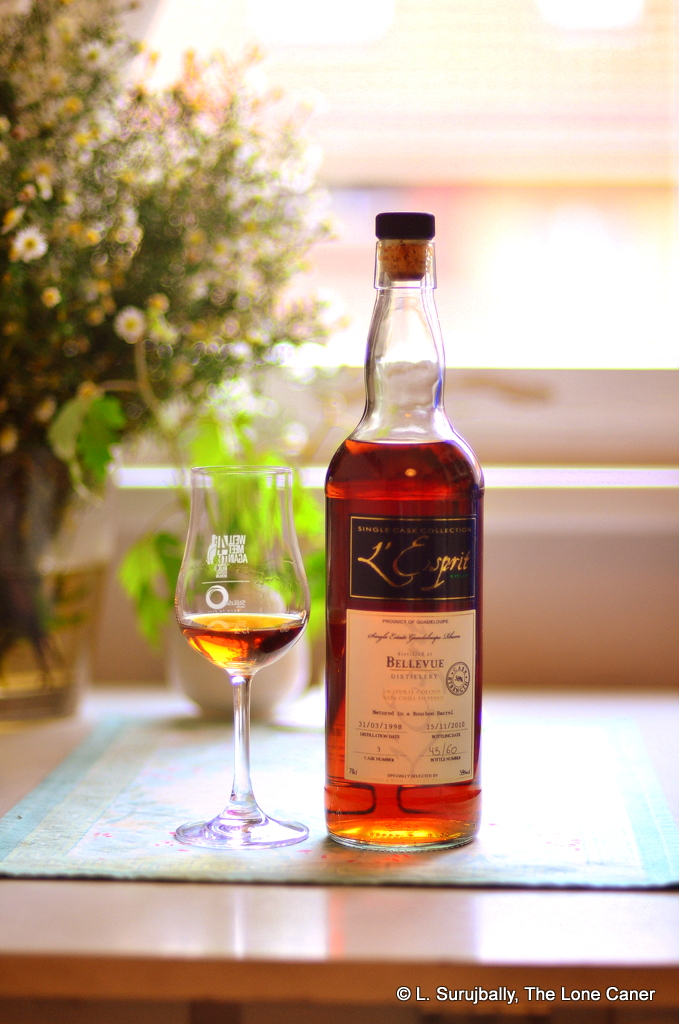
The surprisingly heavy and dark Bellevue rhum made by L’Esprit purred salt and sweet caramel ice cream into my nose as I smelled it, revealing itself in so incremental a fashion, with such an odd (if excellent) profile that it almost had to be experienced to be properly appreciated, and it left me wondering whether this was a molasses rum, not one from cane juice.  It was bottled at the perfect strength for what it displayed, melding power and smoothness and warmth in a nose of uncommon quality.  Yet there was lightness and joyousness here too, a sort of playful melange of all the things we like in a rhum, skimping not at all on the secondary notes of prunes, plums, peaches, and pineapples.  It was plump, oily and aromatic to a fault, and demonstrated quite forcefully that the Epris Brazilian rum that had been my first introduction to the company had not been a one-off, one hit wonder.

Even to taste it, the experience did not falter or withdraw from its exuberance. The Bellevue seemed to operate on two levels of quality simultaneously – first there were the faint oily, rubbery notes, leavened with nougat, pink grapefruit and light citrus.  And behind that, almost at the same time, there was the real deal: honey, vanillas, olives and briny notes in perfect balance, chopped light fruits and flowers, plus a thin thread of licorice coiling through the whole thing.  There was just so much going on here that it rewarded a rather languorous approach to the tasting – usually I do all my tastings at the table with all the comparators within easy reach, but here, after ten minutes, I simply said “to hell with it” and went out onto the balcony, sat down to watch the sun go down, and idly observed the passers by below who didn’t share my good fortune at having a lovely rum like this one growling softly in my glass.  Even the finish kept on developing (not always the case with rhums or rums) – it was crisp and smooth and hot, long lasting, a real delight – it seemed to be a little more oaky than before, here, but the lasting memories it left behind were of a lot of hot, strong black tea, and burnt sugar resting easily on a bed of softer vanilla, tobacco and citrus notes.  It was, and remains, a solid, smooth, tasty, drinking experience, not quite as good as the Damoiseau 1989 20 year old…but close, damned close.

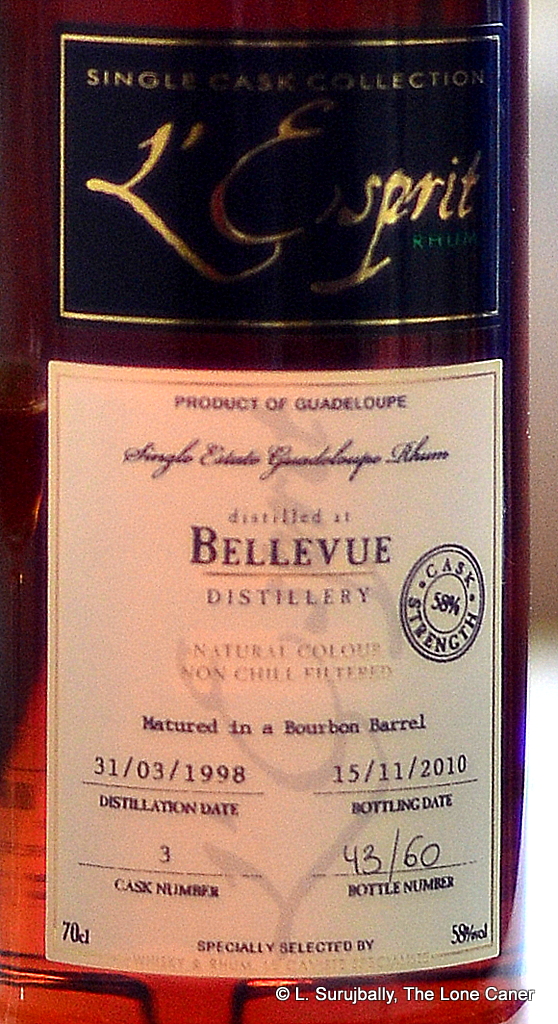
If you’re one of the fortunate owners of this nectar, let me run down the bare bones so that you know what you’re drinking: column still product, cask strength 58%, matured in a bourbon barrel for slightly more than twelve years.  This is not from the Habitation Bellevue distillery on Marie Galante, but from the Bellevue estate which is part of Damoiseau on Guadeloupe (the main island), founded in 1914 and bought by Louis Damoiseau in 1942 – commercial bottling began around 1953.  Like just about all commercial spirits operations in the West Indies, they ship bulk rum to Europe, which is, as far as I know, where this one was bought, so ageing was not tropical, but European.  Which, fortunately for us, didn’t diminish its achievement in the slightest.

My association with L’Esprit, that little French company from Brittany I wrote about earlier this week, came as a consequence of that Brazilian rum referred to above — that thing really impressed me.  And so I kept a weather eye out, and bought the first bottle made by L’Esprit that I saw, which just so happened to be this one…I have a few others from the company to go through so it won’t be the last either.  While thus far L’Esprit hasn’t made a whole lot of rums – twenty five or so the last time I looked – the worth of their wares is consistently high.  This one is no exception, an enormously satisfying rhum with exclamation points of quality from start to finish.

The minimal outturn should come in for mention: I’m used to seeing a “set” of a few hundred bottles from the various indies, a few thousand from Rum Nation, so there’s a fair chance some reader of this little blog will pick one up…but to see one of merely sixty bottles from a single cask, well, I may just be spitting into the wind (it was beaten, for the trivia nuts among you, by the Old Man Spirits Uitvlugt, a measly twenty eight bottles, and by the reigning world champion, the Caputo 1973 which had just one). The reason why the outturn is so relatively small, is because L’Esprit is bowing to the market – they know it’s mostly connoisseurs who love cask strength rums, but they’re few and far between, and it’s the general public who drive sales and buy the 46% versions.  What Tristan does, therefore, is issue a small batch of cask strength rums from the barrel (60-100 bottles) and the remainder gets tamped down to 46% and issued in 200-300 bottles.

After going head to head with as many agricole rhums as I can lay paws on for the last few years, there’s nothing but good I can say about the tribe as a whole.  I enjoy the fierce purity of the AOC Martinique rhums, their almost austere clarity and grassy cleanliness – yet somehow I find myself gravitating towards Guadeloupe a bit more often, perhaps because they have a slightly more experimental, almost playful way of producing their hooch (they never bothered with the AOC certification themselves, which may be part of it).  This gives the rhums from the island(s) a certain unstudied richness and depth that seems to have created a bridge between traditional molasses rums and agricoles (my personal opinion).  If you can accept that, then this Bellevue rhum demonstrates – in its fruity, oily, creamy, complex, balanced and warm way –  the potential and quality of the best of both those worlds.

87/100


Other notes:

  • Outturn 60 bottles
  • Distilled March 1998, bottled November 2010
  • The taste implies a molasses origin rather than cane juice, though I was never able to confirm it.

A last pic: Yeah, it’s out of focus and photobombed by The Little Caner…but we could all use some cheer and smiles once in a while, and I liked this one a lot anyway.

Feb 032017
 

#340

Cachaças are, as any rum pundit is aware, those cane juice based rums that are not called agricoles because they are made in Brazil rather than the French Caribbean islands. Geography aside, they have two major points of difference – one, they are often age in Brazilian woods of one kind or another, and two, those that are available outside Brazil are almost all made to be mixed in a caipirinha, not to be had neat. I’ve heard that over a thousand varieties made domestically, and the best of them are sold only there, and many top end aged variations exist… unfortunately few, if any, are ever exported, which creates the illusion that they are low end rums as a whole, and to this day they take second place to aged agricoles.  Which is a shame, really, for it denies the rum world of potentially world beating products.  

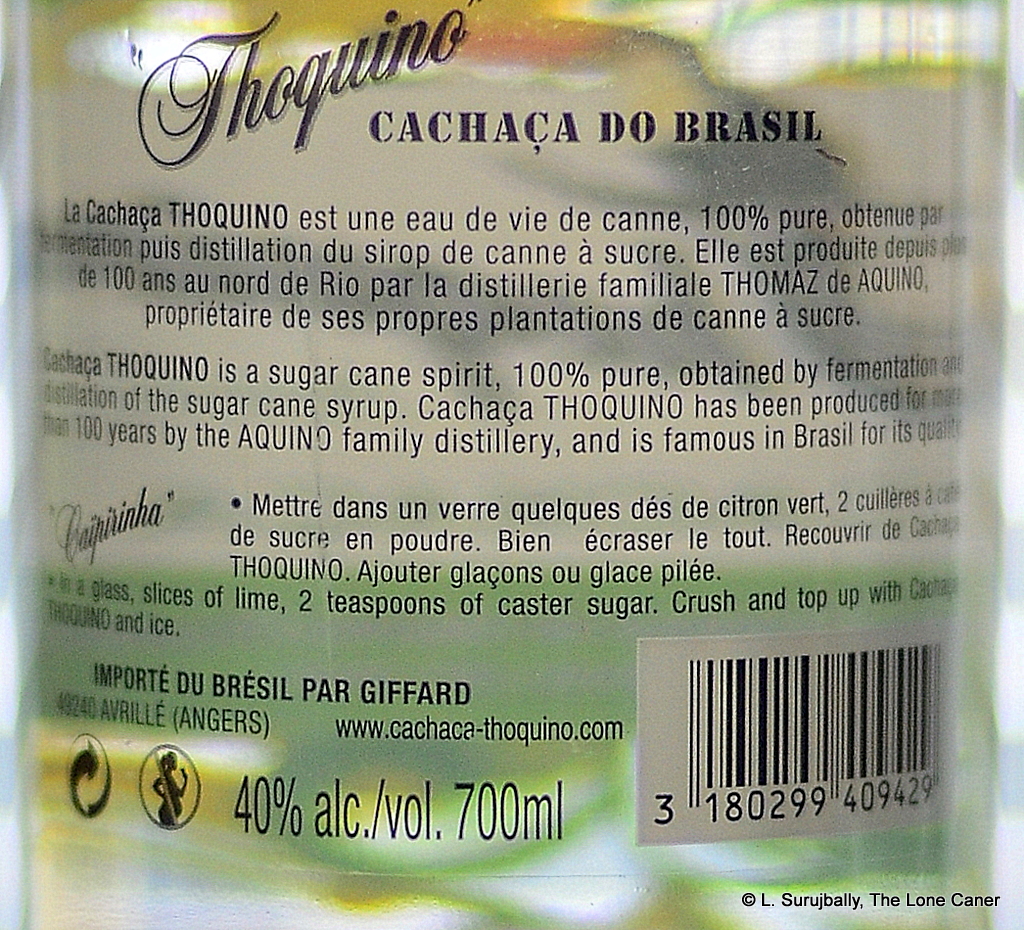
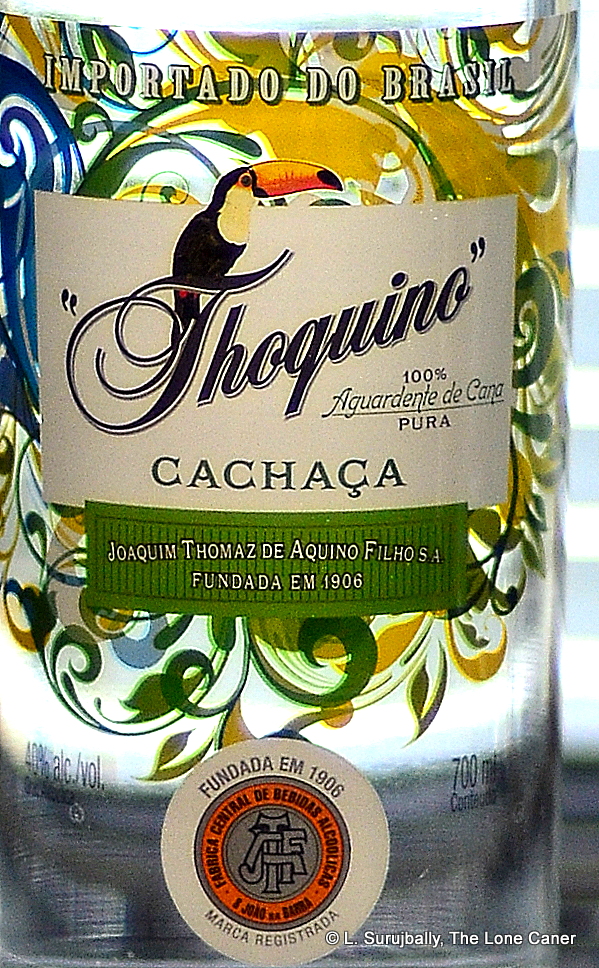
Thoquino is a company formed in 1906 by Thomaz de Aquino, and is located in Sao Joao de Barra, the Campos area just north of Rio de Janeiro, where sugar cane cultivation goes back to the earliest colonization of Brazil in the 16th century and which is considered the “traditional” area from which the best cachaças originate. The company has its own sugar cane fields, which apparently is somewhat unusual for a Brazilian distilling company, and which allows it to control and integrate the entire process from cultivation to the final product, in-house. The spirit derives from fresh pressed cane juice which is fermented for an unusually long eight days, and then double distilled (I suspected it is filtered as well); there is no information available on any ageing, and since normally both age and the wood in the barrels is proudly trumpeted to the heavens, I’d suggest this is a zero year old. No information on stills is available.

Having written all the above, how’s the rum?  Well, nosing the clear 40% spirit made  it clear that it stemmed from the same family tree as the Haitian clairins and the Capo Verde grog, if not quite as raw or brutal aggressive; and I formed the sneaking (if entirely personal and unconfirmed) suspicion that it hailed from a creole coffey still.  It smelled sweet, yes, with black pepper, oil and brine in there somewhere (sort of tequila-like but with less salt), sharp and uncompromising as a zealot’s hot glare.  Over time it turned vegetal, with more pronounced aromas of sugar water, citrus and (get this!) cinnamon rolls hot from the oven.

The taste was initially quite lovely, rolling light and sweet and (relatively) smooth across the tongue.  It wasn’t complex in any way, but it was pleasing in its own understated fashion.  There were some flowers and fleshy fruits —  pineapple, bananas — in an uneasy mix with sharper pepper and citrus rind, sort of held together by the vegetal sugar water, and in the background there lurked the toned-down notes of olives and brine, held under tight control, leading to a short, sweet, light and overall unexceptional fade.  

As tasting notes went, the cachaça more or less confirmed its antecedents without trying to break the mould.  Since it was advertised and marketed specifically as a caipirinha agent, perhaps it would be churlish expect a top end spirit here, and indeed, the company does make an aged version (aged in Jetiquiba wood) which I have not tried. So all in all, a straightforward mixing agent then.

Still, maybe it’s time for some enterprising rum maker to take a plunge and start promoting the best of the cachaças in the western markets.  Not the good quality young stuff, but the really amazing rums which only Brazilians are aware and which remain unknown to the majority.  Bert Ostermann of the German company Delicana has tried with limited success to do so, some independent bottlers like L’Espirit have issued the occasional aged bottle, and we need more.  Although the Thoquino and others I’ve tried may not quite be there (yet),  we should keep an eye on Brazil in the years to come, for their rums point the way to another facet of the ever changing rumiverse.  If Luca ever decides to go there, watch out.

(77/100)

Jan 252017
 

Unique in its own way, but not precisely exceptional.

#338

It’s been quite some time since I’ve tried a Nicaraguan rum. That’s partly because I was unenthusiastic (even indifferent) to the more recent Flor de Caña range of rums where the age statement, through a miraculous stroke of legerdemain, suddenly disappeared; and having gone through a goodly part of their lineup once, I had other interests (and rums) with which to occupy my reviewing time.  Still, just as the islanders have their variations taken to new extremes by independent bottlers, so does Nicaragua, and when I got the chance to acquire not only this rum but two aged full proof versions from the Compagnie, I jumped back into the fray.  Maybe it was time to see how the country’s hooch had developed since the last time.

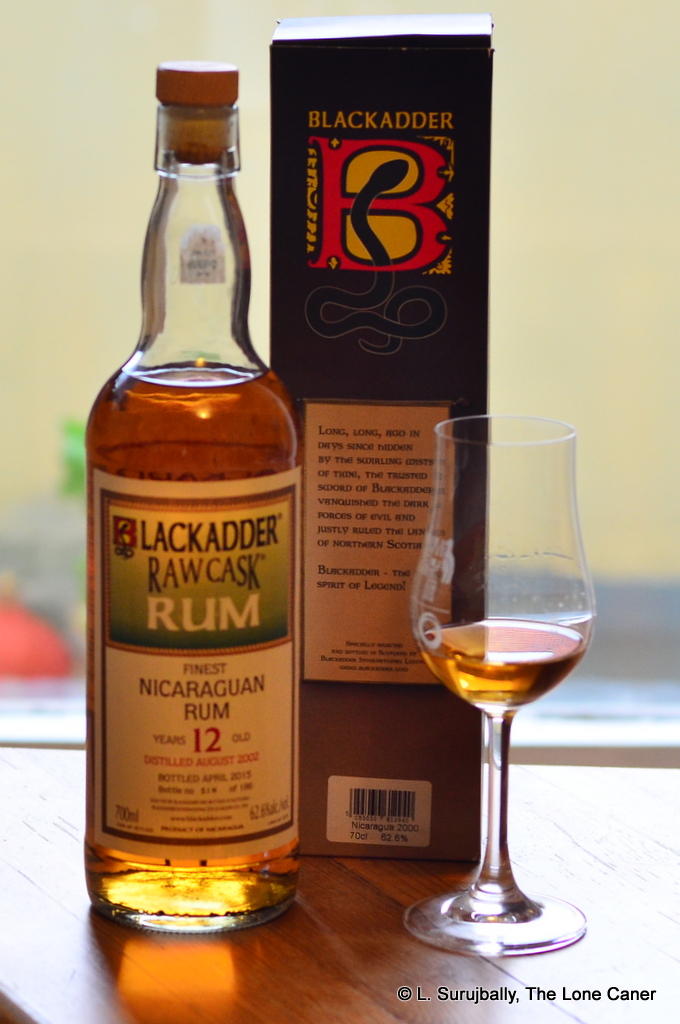
Blackadder is a Scottish indie, known more for whiskies than rums – like G&M and others from that neck of the woods (if less well known than the other bigger guns out there), rum is a sideline for them, an obiter dictum, if you will. They indulge themselves — as with whiskies — in single cask bottlings without additives or filtration of any kind, which they have trademarked as a “Raw Cask” in order to demonstrate how even sediment from the barrel gets transferred to the bottle so as to impart the maximum amount of barrel flavour.  Yeah, well, ok. This particular bottling came through the still in August 2002 and was bottled in April 2015, so a smidgen over 12 years old…and issued at a massive 62.6%, and that’s damned appealing, if only to get us past the milquetoast of the standard strength Flors that are much better known.

Nicaraguan rums are very similar to what you might get if you casually flung together a Guyanese and Jamaican without worrying too much about the provenance or age of either, but over and beyond that they have a certain profile of their own, however much they are usually dampened down.  They lack the distinctiveness of either of those aforementioned rums types, for example, both of which you’d likely know blind….not necessarily the case with the Nic I’m looking at here).

Anyway, what of the rum?   Well, it certainly came hurtling out of the bottle in a nose of raw aggression, so I let it rest for a while to avoid serious injury.  Once it calmed down, the initial scents were of vanilla and faint aromatic tobacco, quite well balanced for that strength, and remarkable for a lack of burn usually attendant from such a high proofage.  The vanilla gave way to honey and marshmallows, some flowers, toffee, sugar water and faint nutmeg, yet overall I came away expecting more…there was a sort of one-note directness here that I didn’t care for, and the vanilla held the high ground too assertively (and for too long) to allow for the full development of subtler flavours I was expecting.

Palate wise, this odd simplicity continued.  It was quite creamy and assertive under the heated taste, of course (“chewy” is not a word I use often, but is perfectly applicable here).  What fruit flavours there continued to keep their distance – one could sense them without actually coming to grips with what they were.  With water, brine, olives, caramel and ice cream were evident, with vanilla again taking something of a front seat (but less than the nose), and the honey was retained, providing that bed of softness upon which lighter florals were laid. On the whole, it was pleasant enough, just somewhat…dour,  guess.  Hardbitten. A bit rough.  It never really developed into something exceptional, and even the finish – sharper, longer and lighter than a Mombacho, or the CDI full proofs – did little to enhance that, simply presenting honey, light florals for a while, before dissipating into a fade that in no way broke new ground.

Overall, there’s something stern and dark and uncompromising about the rum, and for one of the few times drinking cask strength products, I believe that here the thing should have been brought down to a lesser proof (that’s just my opinion, though). With some less starkly elemental rums from Central America there is a softness to them, something redolent of the tropics, a sort of warm voluptuousness which this one does not have. The imagery is more of dark, hard, storm swept cliffs drenched in cold seaspray, than lush tropical vegetation.  I may be wrong but I get the impression it was aged in Europe, not Nicaragua, and that gives it a kind of roughness and power which not everyone will appreciate – it’s made, one thinks, by and for whisky aficionados.  That’s not enough to make it a bad rum by any stretch, but it does imply that one should be careful to understand one’s preferences, before going out to buy it simply because it’s a cask strength rum from a country where easy going profiles are more the norm.  That it’s pure and unmessed with and a true expression of its country is not in question – whether that all works and comes together harmoniously for a drinker, however, is another matter altogether.  In this case it might be all about what other spirits one likes.

(84/100)

Other notes:

Distillery unknown though I suspect it’s a Flor cask.  It has points of similarity to the 18 year old I tried some years ago, and to some extent the “21” 15 year old from that company.

Blackadder has released other rums (from St Lucia and FourSquare among others), the review for which have been generally positive.


Jan 112017
 

A white rhum from Laos, which comes out punching at 56%

#334

The rums we see and drink share a certain geographic commonality. On the shelves are rums from the various Caribbean islands, those old British, Spanish and French (and Dutch, and yes, Danish) colonial possessions. Next to them are South and Central Americans tipples which are the inheritors of the Spanish traditions brought over centuries ago…no shortage of their products either. Then there are those from micro-ops from Canada and the USA, few of which make any sort of big splash but which gain an audience from the communications infrastructure of those developed nations. And of course there are independent bottlers in Europe who take 90% or more of their stock from the Caribbean and further south. We hear about these all the time. But it’s possible that the future undiscovered variations of the rum world lie not west of Greenwich, or close by…but east.

Bar the odd exception like the Fijians, Old Monk, Bundaberg and Nine Leaves (or CDI’s Indonesians), how often do we hear about other rums from Australia, from India, from Africa, from the Far East? I’m not saying they make ninety-point masterpieces of rum which would make a pilgrimmage necessary, but if we consider ourselves Evangelists of the Cane, perhaps some attention should be paid to the outliers as much as the more familiar and popular mastodons of our world.

The problem lies in getting one’s paws on any.  The rum makers of the east (or south) usually lack good distribution networks or agents to bring their products to the western markets, which is why Cabo Verde off Senegal makes grogues like the clairins but nobody ever heard of them, or why Ogasawara and Ryomi are relatively unknown outside Japan.  In other situations, the domestic market is large enough to swallow all the output, so again, unless you’re there it’s not likely you’ll hear much about, for example, Ord River, Substation No. 41 or Beenleigh’s 5 year old, all of which are made in Oz.  Old Monk and Amrut are ginormous sellers in India but not always that easy to find one in your local hoochery, and then there are the Asian nations which make ersatz rum their own way, like Tanduay, Chalong Bay, Mekhong…or this Laotian one, which we’ll poke our snoots into today.

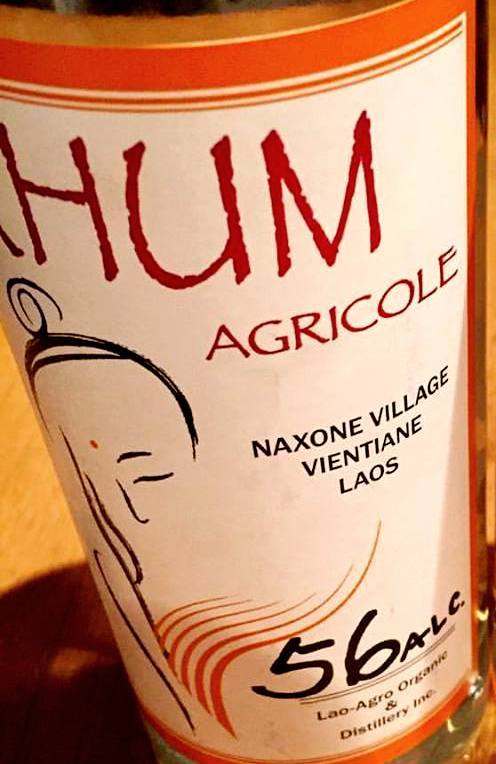
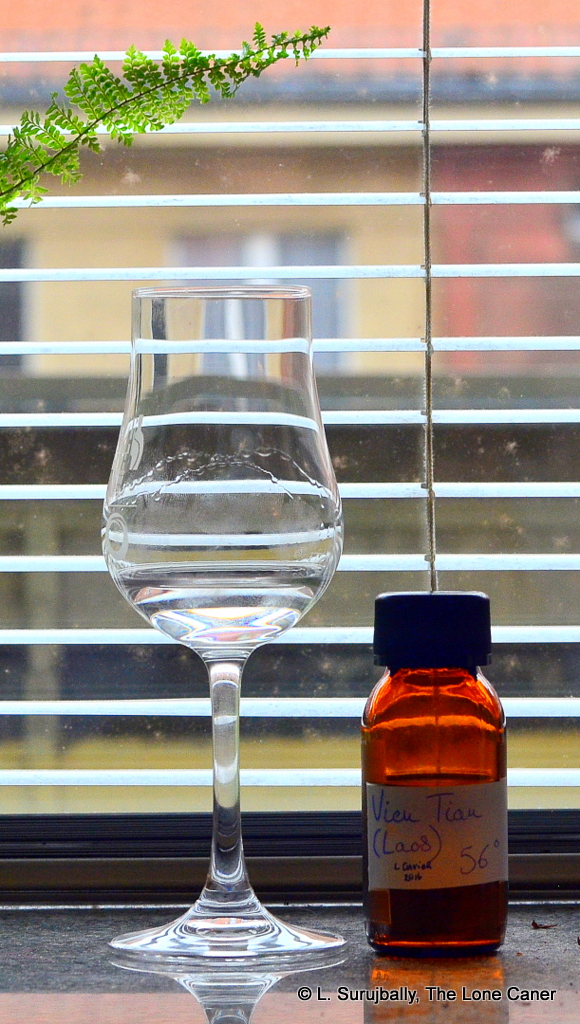
Information on the rhum is as maddeningly hard to find as the product itself. What little I’ve been able to cobble together from mon ami L’homme à la Pousette (the source of the sample, big thanks to the man) and some diligent googling, is that it derives from Vientiane, Laos, and is an organically made agricole bottled at a hefty 56%.  The company that makes it — Lao-Agro Organic and Distillery Inc — has a brand called Laodi which is primarily liqueurs, and they also produce a lower proofed white variation of this rhum, and a slightly aged one.  I gather that it is mostly for local consumption, not export (which may be why few of us ever heard of it before).  But in terms of the production methods, source of cane, filtration etc, there’s not much to go on, sorry.  We have to take it on its merits alone.

All that aside, this was quite some rhum – it reminded me of the clairins, the Rum Nation Pot Still Jamaican, the DDL High Wine (sadly discontinued), oomphed-up French Island unaged blancs, or, for that matter, even some of  those new whites Velier put out last year.  The elements of a raw pot still style 1 was right there up front when one sniffed it – salty, vinegary notes, crisp cool cucumbers, rubber and acetone and nail polish and freshly varnished furniture.  Yeah, it was sharp, and quite stabbing, and there was an odd developing odour of commingled fish sauce, citrus juice, and coconut water nosing around the back end…fortunately, that was controlled and not excessive, and the whole aroma was underlain by that herbal swank and sugar water that so characterizes agricoles.  In that sense it was both similar to and different from, “regular” agricoles with which most of us are more familiar.

Palate wise, the agricole origin was much more evident.  Tons of sweet sugar water and juicy pears, white guavas, grass, lemon juice and also — somewhat to its detriment, because these did not enhance the balance or integrate properly — some wax, brine and red olives.  To the end, it remained harsh and sharp, quite raw, nowhere near as cultured as, say, the Nine Leaves Clear or even the Appleton (Wray) overproof, which was stronger.  Still, say what you will – it was unique, with an enormously long, hot finish, redolent of wax paper and olive oil, more brine, more herbals and grass, and yes, more swank.  

On balance this is a cocktail maker’s dream, I think, and would make a mix that would blow your hair off, but as a sipper it fails, which is no real surprise — much as I like agricoles, white rums and unaged rhums for their sheer machismo and balls-to-the-wall aggro, this one isn’t up in my wheelhouse. That’s because the way the flavours intermingle isn’t quite right, and the sandpaper rawness of the experience is off-putting.  However, I have to concede that I’m somewhat partial to rhums that swing wildly for the boundary, go for a six instead of a safe one, and miss with grandeur, rather than never bothering to come up to the batting crease at all. Is this Laotian rhum a success?  No, not really (or not yet) – but it’s never somnolent, never moribund…never boring.  It runs smack into the wall at full speed, and fails with authority, know what I mean? And that, to me, is something that matters.

(75/100)


Other Notes

  • Two years after this review was posted, Lao-Agro displayed the Laodi series of rums in Paris, and those were damned fine. The review of the white has details on the production process not available at the time I wrote this one.
Dec 272016
 

Rumaniacs Review 027 | 0427

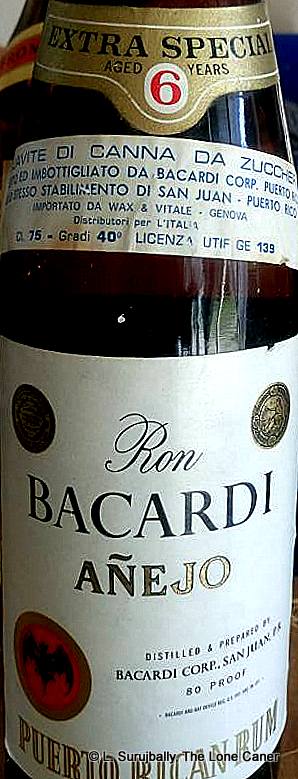
Bacardi has had so many iterations of their rums over the decades, made in Mexico, Puerto Rico or Bermuda (or wherever else they squirrel away production these days), that it’s impossible to state with precision what the genuine article actually is any longer. This version clearly states on the label it was a Puerto Rican rum, six years old, imported into Italy, and I’ve been informed its was made and acquired in the 1980s.  Perhaps it was a forerunner, an experiment, to see whether aged rum sales held promise, and afterwards morphed into the current 8 year old (which isn’t half bad)

Colour – Gold

Strength – 40%

Nose – Dry, almost dusty, very light, grassy and gradually fruity, something vaguely reminiscent of the Alfred Lamb Special Reserve 1949. The fruits are less sweet and more tart – guavas, Thai mangoes yellowed but not soft, unripe pears, with a nearly imperceptible background of flowers and nail polish.

Palate – Light and fresh, yes, perhaps too much so – there’s almost nothing to report, everything has been diluted and dulled down and dampened to the point of nonexistence.  It’s got alcohol, so there’s that, I suppose.  Oak, too much, because there’s too little to balance off against it. Adding water would do no good except to drown it and make what few flavours there were expire without a murmur. Even after half an hour, it evinced little more than the profile of sugar cane juice (without any syrupiness) in which someone mixed some caramel, grapes, vanilla and a lily or two…maybe that was for the funeral, which of course would be in an oak casket.

Finish – Gone so fast it would make The Flash weep with envy.  Again, too faint and vague to appeal – oak dominant, held somewhat in check with clean final scents of half a vanilla stick , a half-hearted squeeze of citrus, one grape and a flower petal.

Thoughts – Perhaps it’s wrong to bring a modern sensibility to a rum made for drinkers from thirty years ago, where Scotch was The Man, vodka was ascendant, cocktails were king and the term “sipping rum” was considered an oxymoron.  Whatever.  It showcases all the current strengths and weaknesses of the brand – column still light rum for easy drinking and mixing, probably at an easy price. The best thing I can say about it is that it’s clean and clear, and better than some modern (and more upscale) Bacardi products.

(77/100)

NB – other Rumaniacs’ reviews of this rum (if any) can be found here.

Dec 202016
 

rn-enmore-rare-1

***

#328

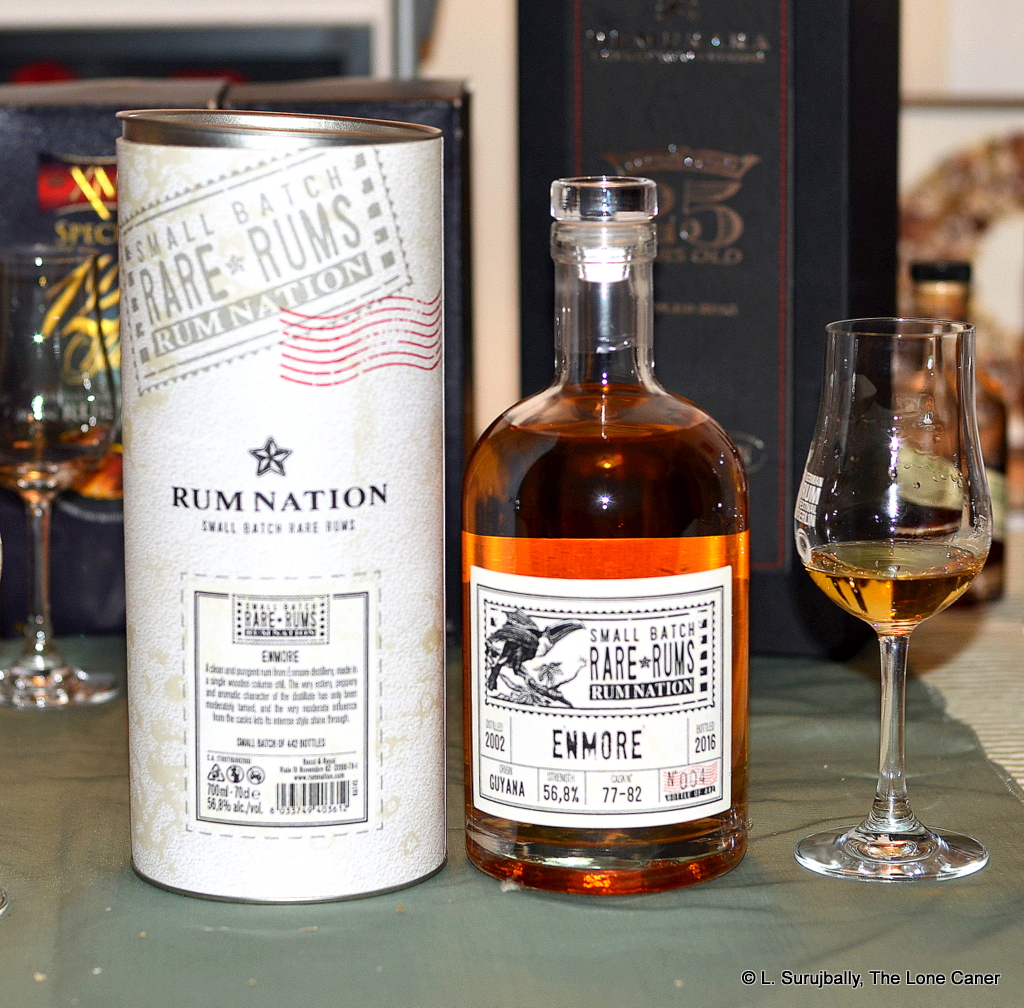
It really is amazing how many different ways there are to express the outturn from a single Guyanese still, Enmore or Port Mourant or any of the others  We might have to approach them like James Bond movies (or Sherlock Holmes short stories)…enjoying the similarities while searching for points of variation, which gives us the rare rum equivalents of  masterpieces like Skyfall versus occasionally indifferent efforts like A View to a Kill.

Rum Nation’s first serious foray into multiple-edition small-batch cask strength rums probably deserve to be tried as a trio, the way, for example, DDL’s three amigos from 2007 are.  Each of the three is unique in its own way, each has points that the others don’t, and if one is weak, it’s made up for with strengths of another and they work best taken together.  Of course, that’ll cost you a bit, since rums made at full proof are not cheap, but to have rums like this at 40% is to do a disservice to those famous stills from which Demerara rums are wrung with such effort and sweat.  Even DDL finally came around to accepting that when they issued their own Rare Casks collection earlier in 2016.

Of the three Rum Nation rums I tried (in tandem with several others), there was no question in my mind that this one sat square in the middle, not just in the trio, but in the entire Enmore canon.  Personally I always find Enmores somewhat of hit or miss proposition – sometimes they exceed expectations and produce amazing profiles, and sometimes they disappoint, or at least fall short of expectations (like the Renegade Enmore 1990 16 year old did)….another property they share with Bond movies  However, it must also be said that they are very rarely boring. That wooden still profile gives them all a character that is worth trying…several times.  

rn-enmore-rare-2

Take this one for example, an interesting medium-aged fourteen-year-old, almost lemon-yellow rum, with an outturn of 442 bottles from six casks (77-82).  It was distilled in 2002 and bottled this year, the first batch of Rum Nation’s cask strength series, with a mouth watering 56.8% ABV…now there’s a strength almost guaranteed to make an emphatic statement on your schnozz and your glottis.  And before those of you who prefer no adulteration ask — no, as far as I’m aware, it wasn’t messed with.

The nose demonstrated that the colour was no accident; it was sprightly, almost playful with clean notes of hay, planed-off wood shavings, lemony notes.  Not for this rum the pungent, almost dour Port Mourant depth – here it was crisper, cleaner. Gradually other aspects of the profile emerged – old, very ripe cherries, apples, cider, vanilla.  As if bored, it puffed out some mouldy cardboard and cherries that have gone off, before relenting and providing the final subtle anise note, but clearer, lighter, and nothing like the PM, more like a cavatino lightly wending its way through the main melody.

Certainly the nose was excellent – but the palate was something of a let down from the high bar that it set.  It was, to begin with, quite dry, feeling on the tongue like I was beating a carpet indoors.  It was less than full bodied, quite sharp and hot, with initial flavours of polish, sawdust and raisins, a flirt of honey; it was only with some water that other flavours were coaxed out — wax and turpentine, orange chocolates, dates, vanilla and Indian spices (in that sense it reminded me of the Bristol Spirits 1988 Enmore), and some eucalyptus, barely noticeable. It was the sawdust that I remember, though (not the citrus)…it reminded me of motes hanging motionless in a dark barn, speared by seams of light from the rising sun outside.  The finish was pleasant, reasonably long, repeating the main themes of the palate, without introducing anything new.

Overall, this is a rum that, while professionally executed and pleasant to drink (with a really good nose), breaks little new ground – it doesn’t take the Enmore profile to heights previously unscaled.  Yet I enjoyed it slightly more than the RN Diamond 2005 I looked at before.  Partly this is about the character of the whole experience, the way the various elements fused into a cohesive whole.  My friend Henrik, who also tried these three Small Batch Rare Rums together, was much more disapproving – he felt the Enmore was the weakest of the three, with light woods and citrus being all there was. My own opinion was that there was indeed less going on here than in other editions I’ve tried, but part of what I enjoyed was the way that what there was melded together in a way where little failed and much succeeded.  And if it did not come up to the level of other Enmores like the Compagnie des Indes 1988 27 year old (91 points), or the Velier 1988 19 year old (89 points), well, I felt it was still better than others I’ve tried, and by my yardstick, a damned good entry into the genre. Something like, oh, Thunderball or Goldeneye – not the very best, but far, far from the worst.

(87/100)


Other notes

  • To provide some balance for those who are curious,see the links to two other sets of reviews:
  • As with all expressions where there are differences in opinion, trying before buying is the way to go, especially if your personal tastes
  • I’m waiting on Fabio to tell me where the ageing took place – I have a feeling a good portion was in Europe.
Dec 182016
 

rn-sbrr-diamond-2005-1

#327

What a change just a few years have wrought. Back in 2009-2010, cask strength rums were hardly on the horizon, “full proof” drinks were primarily Renegade at 46% with a few dust-gatherers from independent bottlers like Secret Treasures, Cadenhead, Berry Bros., or Samaroli making exactly zero waves in North America, and Velier’s superlative rums issued almost a decade earlier known to few outside Italy.  Rum Nation took two years to sell a pair of 1974 and a 1975 25 year old Jamaican rums bottled at 45%….and they were around since 1999!

As 2016 comes to a close, observe the continental drift of the landscape: Velier is the mastodon of the full proofs, DDL released its Rares in February, Foursquare and Mount Gay are both issuing powerful and new versions of their old stalwarts, the Jamaicans are undergoing a rennaissance of old estate marques, and previously unremarked and unknown independent bottlers (some new, some not so new) are all clamouring for your attention.  Companies like Compagnie des Indes, Ekte, L’Espirit, Kill Devil and others are the vanguard, and more are coming.  Even the regular, tried-and-true makers whose names we grew up with, are amping up their rums to 42-43% more often.

rn-sbrr-diamond-2005-2In between all of these companies is Rum Nation, that Italian outfit run by Fabio Rossi, whose products I’ve been watching and writing about since 2011, when I bought almost their entire 2010 release line at once.  They’ve been making rums since the 1990s (like the two Jamaicans noted above), and over the past three years have attracted equal parts admiration and derision, depending on who’s doing the talking – it’s almost always the matter of additives to their rums; it should be observed that at the top end, it’s not usually the case, like with the 23-26 year old Jamaicans and Demeraras which remain among the best rums of their kind available.

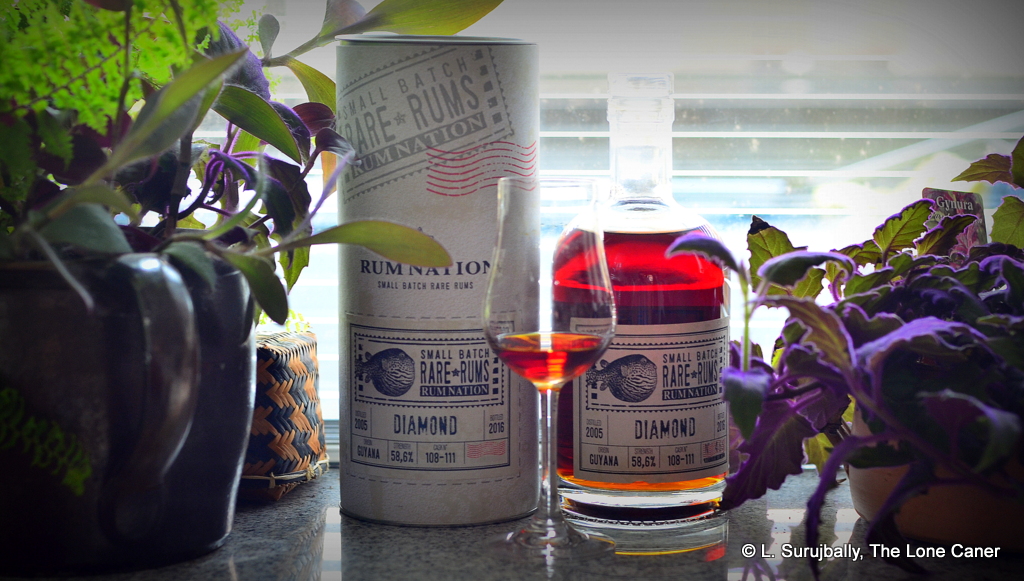
The Small Batch Rare Rums Collection is Fabio’s last old stocks of Demerara rum, and has been on the drawing boards, so to speak, for quite some time – as DDL and Velier showed us with their own Rares, the decision to issue a rum can be made more than a year in advance of the actual first sales, what with all the bureaucratic hoops and logistics a bottler has to go through to bring the vision  to market. Anyway – the Diamond I’m writing about today, the youngest of the three, was from the 1st Batch and is RN’s own foray into the cask-strength market, issued at a rough and ready 58.6%, distilled in 2005 from the double column metal coffey still, and bottled in 2016…the outturn was/is 473 bottles, the presentation of which are the same RN style, but with cardboard tube enclosures, simpler and perhaps more informative labels to go along with them – and which, as always, have the postage stamp motif which has become almost a hallmark of Fabio’s (he used to be a collector in his youth, as I was). And no, no additives as far as I’m aware.

If you’ve been bored to tears by all this set-the-stage introductory material, your immediate and impatient question at the top was most likely, well, how good was the thing? .

All in all, it wasn’t bad – what set it lower on the podium than some others is probably the ageing, which I suspect was not fully tropical (Fabio still has to get back to me on that one but bearing in mind past products, it’s a good bet) and therefore not all the rougher edges had time to be fully integrated with and mellowed by the oak barrels in which it had been aged. It smelled light, with initial easy-to-spot caramel, white toblerone, vanilla and toffee, leavened with some watery fruit (green pears and watermelons), cloves, cumin, marzipan, before settling down to emit some odd background notes of black pepper, sawdust, grapes, raisins, fleshier stoned fruits, bubble gum and a soda pop…maybe pepsi, or 7-up.  Not entirely my thing – it was a bit sharp and raw, needed some snap and firmness to make the point more distinct, and the synthesis could have been better.

Diamond rums, of course, have been among my favourites for a while (comparisons with Velier are unavoidable) and what they lack in the fierce pungent originality of the rums from the wooden stills they regain in blending and ageing skill.  Some of that was evident when tasting the amber coloured rum – it started off hot, lunging out of the gate with first tastes of cocoa and light coffee, vanilla, some brine, some sweet (good balance there, not too much of either), and a muted explosion of fruits.  It was quite a bit lighter in mouthfeel than the PM and Enmore tasted right alongside, which some might mark down because it presents as thin, but to me there’s a world of difference between the two terms – the Doorley’s or an underproof 37.5% rum is thin; well made agricoles are light. So here I think that lightness has to be taken together with the crisp intensity of the tastes that come through, because no scrawny, spavined, rice-eating street cur of a rum could provide this much.  There were peaches, apricots, blackberries, cherries, bonbons and caramel sweets, and with water, all that plus some licorice under tight control, and a light woodsy backdrop melding somewhat uneasily with the whole…and a long, slow finish that provided closing notes of licorice, sweets, more fruits (nothing too citrusy or tart here) and, surprisingly enough, a coffee cake with loads of whipped cream.

All this taken into account, was the youngest rum the best of the three or not?

Well…no.  I found it somewhat austere, to be honest, a few clear notes coming together with the quiet, restrained sadness of a precise Chopin nocturne or a flute sonata by Debussy, and less of the passionate emotional fire of Beethoven, Verdi, Puccini or Berlioz that almost epitomizes the Guyanese rums when made at the peak of their potential.  It requires some more taming, I think, even dialling down — compared with its siblings and a bunch of other Demeraras I tried alongside it, it feels unfinished, like it needed some more ageing to come into its full glory.  Whatever.  It’s still a very tasty tot, and as long as you take what I said about lightness versus thinness alongside the strength and price and tasting notes together, I don’t think you’ll be too disappointed if you do end up spring for it.

(86/100)

Dec 112016
 

cdi-enmore-27-yo-1

Single word summary – superlative.

#325

Compagnie des Indes burst in the scene in late 2014, which may be a rather melodramatic turn of phrase, but quite apt. The first of their line that I tried was the Cuban 1998 15 year old, which enthused me about the company immensely, and as the years moved on I’ve sampled up and down the range, from the less than stellar blends, to an Indonesian and a Fijian, and to more standard Jamaicans (with more coming). In all that time they have rarely made a bad rum, and if they eschew the tropical ageing regime and wild inventiveness that characterizes Velier’s Caribbean rums, that doesn’t mean they aren’t in their own way widening the path that Velier built and coming up with some amazing products of their own.

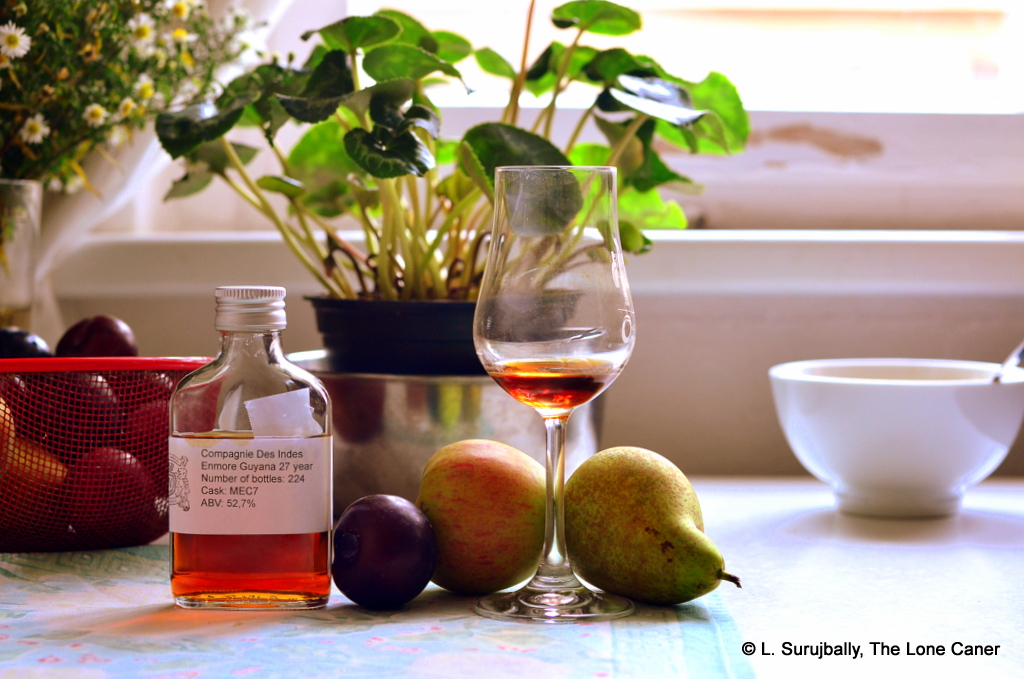
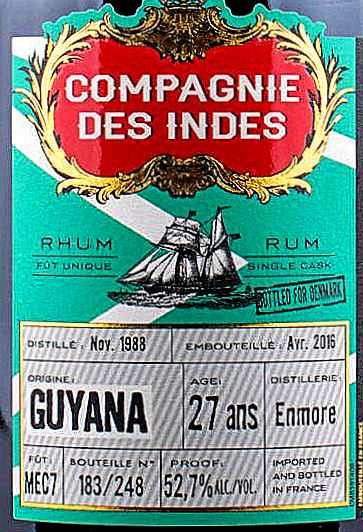
Nowhere is that more evident than in this magnificent 27 year old Guyanese rum, issued at a tonsil-wobbling 52.7%  – it is without a doubt the most Velier-like rum never issued by Velier, and given the difference in owner’s philosophy behind it, a stunning achievement by any standard, a wonderful rum, and one of the best from Enmore I’ve ever had.  One can only shed a tear and rend one’s beard and ask despairingly of the rum gods why the Danes were so clever and so fortunate as to have this 224-bottle outturn made especially for them, because that’s the only place you’re going to get one.

cdi-enmore-27-yo-2Right off the bat, I was impressed when I poured the copper-brown rum into the glass.  I mean, wow!  It was redolent from ten paces, deep and rich and dark and evincing all the hallmarks of a great Demerara rum: initial – and one could almost say boilerplate – aromas of cinnamon, vanilla, brown sugar, caramel and coffee started things off, boiling fiercely out of the glass and around the small room like it was practicing aromatherapy without a license. And then other flavours, firm and distinct and freely distributed as exclamation points in a Ludlum thriller, came out to back up the brass band – some licorice, petrol, wax, furniture polish, acetone, all well controlled (sometimes they get ahead of themselves in an aged Enmore or Port Mourant rum, but here they were in perfect harmony)

And the palate, man, just delicious. Not soft or gentle, not something tamed and easy-going for the unadventurous, but really hefty and strong, making its point with force but without ever crossing over the line into savage. When you drink this, you know you’re drinking a rum, y’know? because no attempt was made to dial things down. The waxy, car-engine notes subsided, allowing olives, brine and black pepper to begin the attack on the tongue, which displayed a medium body in texture.  More licorice and cinnamon followed, and yes, there was the vanilla, the toffee, plus more coffee, red grapes, peaches, a squeeze of lemon rind. And at the end there as some dry in there, a sly sherry influence, winey and sweet and salty at the same time, very nicely integrated into the proceedings. Even the finish didn’t disappoint, being just on the hot side, long lasting to a fault, presenting closing tastes of coffee, nougat, more fruits, and a last series of nutmeg and cinnamon and anise notes.

This is a really well made, enormously satisfying rum from Guyana and does credit to the Enmore estate. Luca might champion in-situ tropical ageing, Fabio a sort of amalgam of both tropical and European, while Florent goes the European-only-ageing route…but how can you argue with the results when after twenty seven years you get something like this?  It was the coolest thing to come out of wood since, I don’t know…a flute, a bar stool, a boat…stuff like that.

Anyway, closing up the shop, I have to admit that there’s just something about Florent and his rums I appreciate.  The other members of my pantheon (Luca, Fabio, Sylvano) are from other planes of existence. Fabio is a cheerful instrument of cosmic convergence, while Luca is a visitor to our plane from a superior universe that only exists in the imagination, with Sylvano being one of the benevolent old Star Trek Preservers that have moved on.  But Florent?  He’s a mortal straining for excellence with the tools he has…which he uses to sometimes achieve the extraordinary. Here, I think he made it.  He really did.

(91/100)


Other notes

  • Cask MEC27
  • The company bio makes mention of why the Danes got the cask strength rums and the rest of the world didn’t, but in the 2016 release season, CDI did start issuing cask strength rums for other than Denmark.
  • Aged November 1988 – April 2016
  • I tag it as an Enmore wooden coffey still but the truth is that in 1988 the Versailles single wooden pot still was in residence at the Enmore estate as well, and the name of the estate and the still often get mixed up if the barrel is not labelled right.  Here, the taste profile suggests it is indeed the Enmore column still.
Dec 062016
 

aldea-tradicion

A unassuming and ultimately flawed 22 year old rum

#324

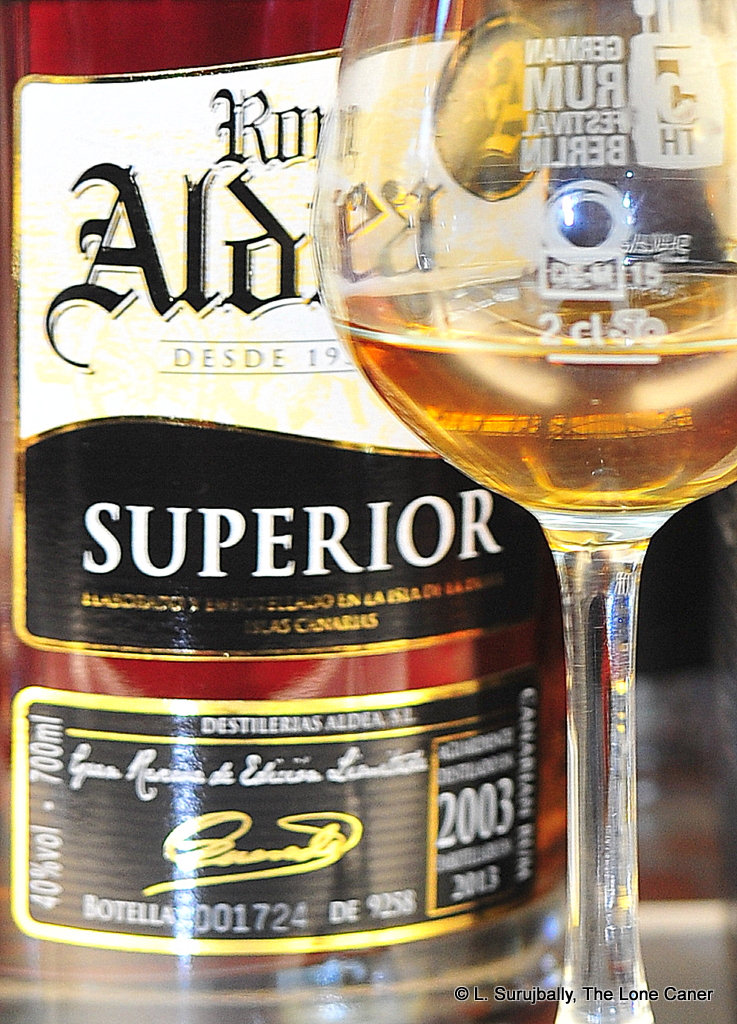
As one goes through the line of the various Ron Aldeas, which are serviceable mid-tier rums, one notices that the clear agricole profile gets progressively more lost, which I attribute to primarily the strategy of using variously toasted barrels in varying proportions.  Depending on whether you want an agricole-style rum to taste like one, this may not be to your liking.  This rum does not hail from the French islands or subject to the AOC (its influences are more Spanish than anything else), and therefore what we are tasting is something from elsewhere – the Canary Islands in this instance. No doubt different taste and blending and ageing influences come to bear when makers from other parts of the world approach the same distillate.

As usual, some general information before we delve into the tasting notes. The Tradición is a cane-juice-derived,  column still product, bottled at 42% with a 3428-bottle outturn. The 1991 edition I tried came out in 2013, making it a 22 year old, and was matured in barrels of different kinds of oak, with differing levels of toast; for the final two years the rum is transferred to used barrels of red wine (not identified) to add finish. Therein lies a problem because while that finishing regime does add some complexity, it also adds sweetness; and when I read that Drejer measured 27 g/L (which is assumed to be sugar), I can understand why it was issued at a slightly higher proof point.

That level of sugar is not immediately apparent. Somewhat at a tangent, nosing the bronze rum makes one wonder immediately where the agricole notes went off and hid themselves, because as with the Ron Aldea Familia (and to a lesser extent the Superior), the clean grassy and herbal smells that characterize the profile are utterly absent.  Still, what was presented wasn’t bad – peaches in cream, toffee, nougat, white toblerone, almonds were immediately apparent, with fruitier raisins and dried fruits coming up from behind, probably courtesy of those wine barrels.  Not a very potent nose, just a soft and warm one.

I noted above that the rum tested positive for sugar.  On the palate, that was unavoidable (my original handwritten notes, made before I knew of Drejer’s results, read “wht’s wth sweet?  ths all cmng from wine barrels?”).  It may be a comfort to those who don’t mind such things that enough flavours remained even after that inclusion to make for an interesting sip.  Initially there was the same vanilla, oak and leather, with a warm, smooth mouthfeel, and as it opened up the fruits came out and did their thing, presenting  green apples, raisins, some cider and red grapes…just not what they could have been. They felt dampened down and muffled, not as crisp and clear as they might have been.  It all led to a finish that was warm and hurriedly breathy as a strumpet’s fake gasps – and alas, like that seemingly spectacular activity, the experience was far too fleeting, without anything new to add to the profile as described.

Of the four Aldeas I tried in tandem, this is undoubtedly the best — a warm, fragrant, almost gently aged rum, lacking the fierce untrammelled power and purity of a stronger drink. The finishing in wine barrels also adds a little something to the overall experience (which the additives then frustratingly take away). In these characteristics lie something of the rum’s polarizing nature – those who want a beefier rum will think it’s too soft; those who see “cane juice origin” and want that kind of herbal taste and don’t get it, will be miffed; and those who want a clean rum experience will avoid it altogether. The rum is rather light, and the sweetness imparted by the finish and the additives work against the delicacy of the distillate, deadening what could have been a better drink, even with the extra two percentage points of proof over the standard.

But all that aside, it’s not entirely a bad rum; as with the Centenario 20, various Panamanians or soleras (which this is not, but the similarity is striking), one simply has to walk into it knowing one’s preferences ahead of time — then buy if it’s one’s thing, try if curious, avoid if turned off. Starting the sip with preconceived notion as to what one wants, what the rum is, or what the makers seek to achieve, might just be a recipe for disappointment.  And that would be unfair to what is, as noted in my one line summary, quite a pleasant and unassuming 20+ year old product. Strength aside, my only real beef with the thing is the utterly unnecessary adulteration – by doing so, Aldea, for all their skill in bringing this well-aged rum to the party, have left several additional points of easily attainable quality behind on the table and diminished my ability to provide an unqualified endorsement for a rum that should have been better.

(84/100)

Dec 052016
 

aldea-familia-1

A decent fifteen year old faux-agricole trying to move away from its origins.

#323

Sorry, but “Chairman’s Select Hidden Treasure,” “Special Top Brass Only Reserve,” “Family Laid Away” casks, you know the kind of special rums to which I refer…stuff like this just makes me smile.  Largely because I see it as nothing more than a name applied so as to move product.  Of course, in the old days of landed estates run by the plantocracy, such special hooch really was made, exclusively for the caudillos and the nobility, for the chairman, business titans, princes, presidents, political hacks, Government apparatchiks, visiting tourists, the special invitees, Santa Claus, retiring veeps and senior managers (are we sure we speak only of the past here?).  

And now, through an enormous stroke of good fortune and generosity of the makers, us. One wonders how it is possible for something made for so exclusive a clientele, by any of the makers who issue them, to ever get into the grubby paws of the the great unwashed masses and the hordes of the illiterate rabble (you know, like me and you), but I suppose economics is economics and the producers of these apparent ambrosias wish to share their street cred just to, well, show they have it in the first place.

In any case, editorializing aside and whatever the source, let’s just call it what it is, a fifteen year old rum with a name meant to showcase its exclusivity, and move on…if I go along this line of thought I might let my snark off the leash, and nobody wants that.

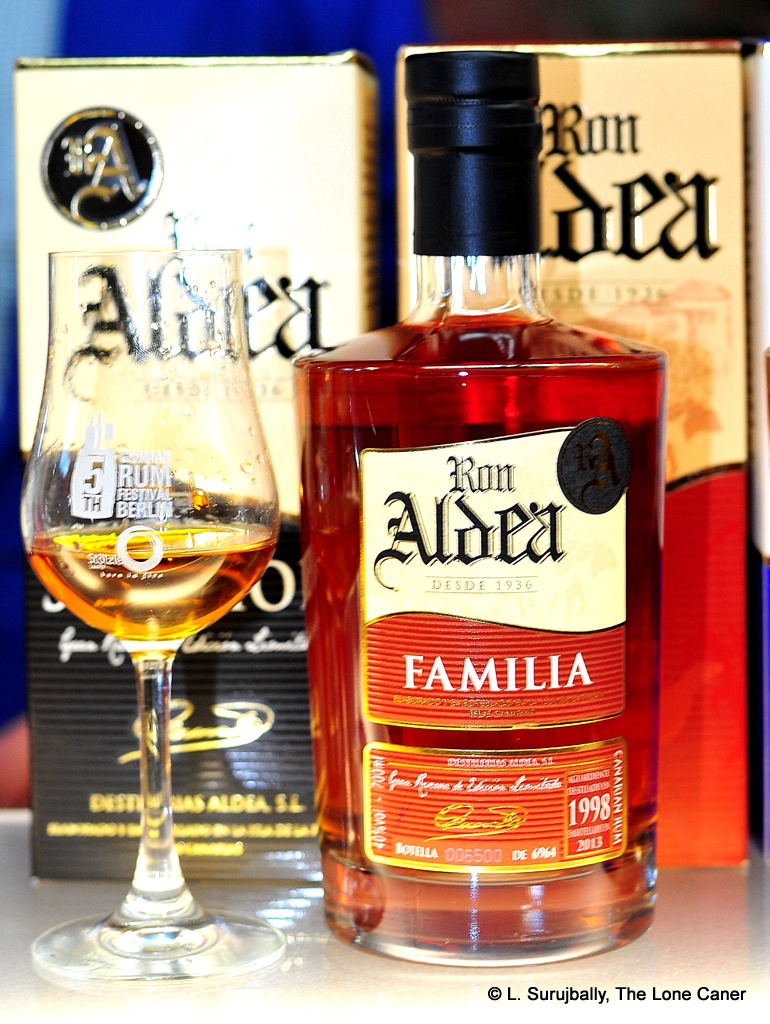
Aside from such historical company details as are already in Cana Pura review, the background to this Canary-Island-made rum are fairly straightforward. This is a true fifteen year old rum limited to 6964 bottles, aged from 1998 to 2013 in French oak of different levels of toast (you could call this an “enhanced” recipe, I suppose), thereby following on from the Ron Aldea Superior’s barrel strategy. The Familia, like the Superior, is derived from cane juice not molasses, although in this instance one could be forgiven for wondering where the rhum went since the profile is so much more “traditional.”

That might be a rather controversial opinion, but observe the profile as we step through what it sampled like. The nose was gentle, subtle, easy, and too faint, really, which is a bitch I have about all 40% rums these days, some more than others – here it’s about par for the course, maybe a bit richer than normal for that strength. There were pleasant notes of vanilla, aromatic tobacco, cheerios with some cinnamon and nutmeg, toffee and caramel. But very little of the agricole content which we might have expected .  Pleasant yes, agricole no, and overall, too light for easy appreciation of the smells.

More of the same was on the taste, nice as the mouthfeel and texture was – vanilla, caramel, aromatic pipe tobacco, some winey notes.  It was a little sharp, no problem, light in the mouth overall, perhaps on the border of thin. Briny, an olive or two.  Fruits, I suppose, but they’re too indistinct and jumbled up in the mix to be easily separated and individually identified and so let’s call it a dampened-down fruit salad and move on. The finish was reasonable, ending things with a warm, medium long, and vaguely fruity close.  It’s the faintness and lack of firmness, that final exclamation point, that makes it fall down, and yes, that’s traceable to the 40%, which in honesty I felt should have been at least five points higher to make a statement worth noting.  Let’s be fair, however – for those who like the lighter Spanish style rons, this will go over well.  Just because I prefer hairier, stronger rums doesn’t mean you do, or will, or should.

So back to that opinion. The rum falls somewhat short of the quietly tasty Superior rum made by the same company.  There, the agricole background was more interestingly integrated into the flavour notes, and you couldn’t miss it.  Though both of these rums are from cane juice (and could therefore be termed agricoles if the term wasn’t restricted so let’s call it them “cane juice rums”), and while neither supposedly have additives***, the French island profile of the Familia has been kind of lost on me, and therefore it presents much more like a molasses-based British Caribbean rum (with some Spanish influences).  That makes it relate to a whole different crop of rums, and in that crowded field, it somehow lacks sufficient gravitas to command either attention or my unadulterated appreciation.  

(81/100)

*** The master rum sugar list shows this to have 20g/L of sugar, so the big question is where’s this coming from, and why isn’t it disclosed?

Dec 042016
 

aldea-superior-1

#322

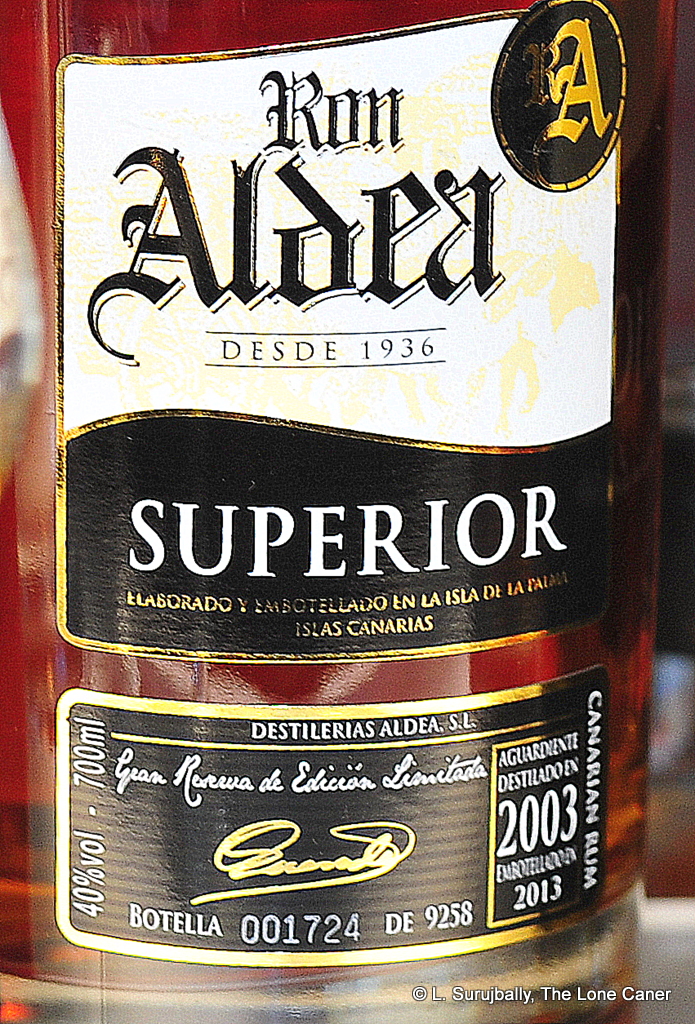
With respect to companies which don’t want to make (or be seen to make) spiced or flavoured sugar bombs, it’s always instructive to observe the techniques that they use to avoid the dreaded “A” word. Some play with ageing or blends, some with finishing (the new El Dorado 15 year old series comes to mind), some with unorthodox schemes (like Lost Spirits or 7 Fathoms), some with toasting, but all are trying to do the same thing – impart an extra smidgen of taste to their rum, without actually adding anything to it, which I’m sure makes any rum nerd’s heart pitter-patter happily. Ron Aldea, a rum company from the Canary Islands, in the place of combined finishing and ageing regimes such as Gold of Mauritius and Mauritius Club utilize, prefer to experiment with their cask strategy – in this case they used brand new American oak barrels with heavy toasting levels, which I take to mean an inordinate level of char – but fortunately without any wine or port sloshing around inside. 2

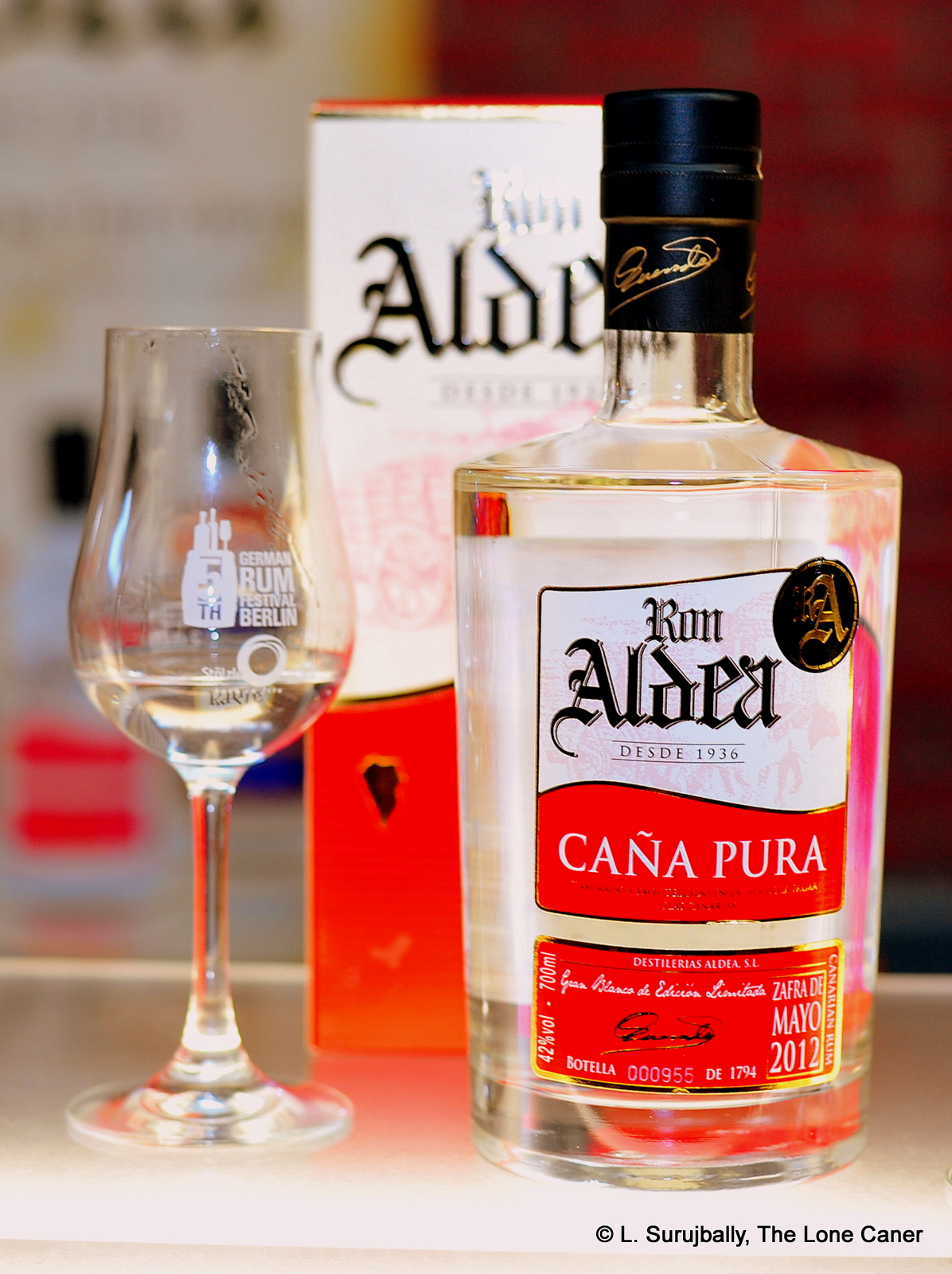
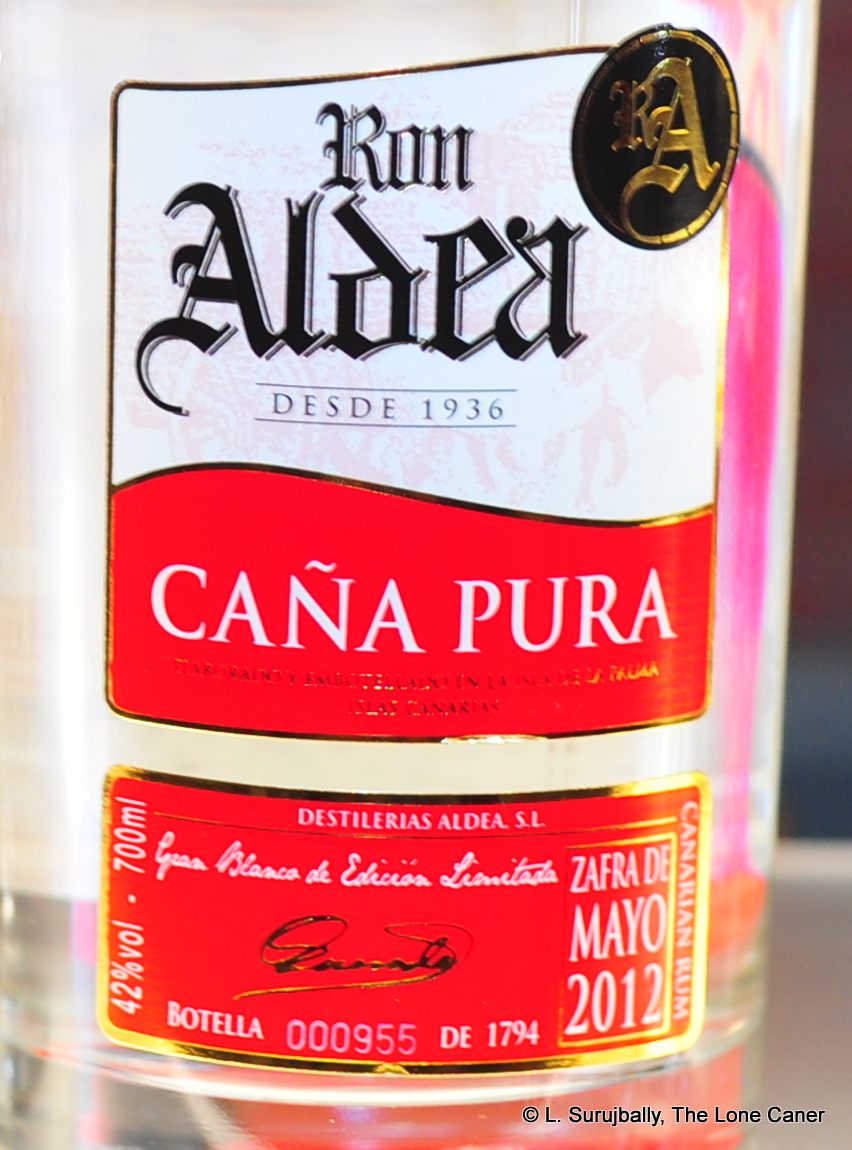
For those who didn’t read about the Caña Pura White Rum (I felt it tried unsuccessfully to straddle some kind of middle ground between soft mixer and individualistic white), it’s worth mentioning that all Ron Alddea’s rums derive from cane juice distilled to 62% in a 150-year-old, wood-fire-fed double column copper still — made by the French firm Egrott — in the Canary Islands. For those interested in historical details of the company itself, the Caña Pura review has it at the bottom of the page.

aldea-superior-3This particular rum, renamed the Maestro for the 2016 release season, was the 2013 edition limited to 9258 bottles, and dialled way down to 40%. It was a darkish gold colour, and initially presented a nose that was quite lovely…breathy even (“Hi sailor-man…want a good time?…”) before thinning out and gasping for air, which is a characteristic all 40% rums share, unfortunately. Still, all was not lost – fresh peaches and apricots were there, weak but accessible, plus clearer, purer aromas – cucumbers, pears, sugar water, cut grass in rain, herbals, and a last rounding off of vanillas and a vague bitterness of oak. Char or no char, ten years in new oak was discernible, though well handled and not overbearing,

The agricole origin of the rum (perhaps I should call it rhum) develops from the hints given in the nose, and blossoms into something much more in the realm of such products: grassy, clear vegetals; more peaches and apricots and softer fruits, yet with some tartness, like unripe but yellow mangoes, under which coiled a creamier background of soft sweet white chocolate coffee and sugar…almost a cappuccino. The divergence from the norm came with an odd taste of ashy mineral-like notes that fortunately stayed well in the background, but were definitely noticeable. The finish was about standard for a 40% rum – short and heated, quite nice in its own way — not overly complex, just as comfortable and easy as an old chesterfield, with closing hints of chocolate and vanilla, and very little of the spicier, fruity notes. Perhaps that was to its detriment – the integration of these various tastes matters, and here it was impossible to pick apart individual notes – but I acknowledge that’s a matter of private opinion. And as a matter of record, I did enjoy the Superior quite a bit.

Overall, for its strength and age it’s a pretty good mid-tier rum (or rhum). It’s not as distinctive as the El Dorados, say, or the various Jamaicans, or even those from St Lucia or the French islands, but I’m not sure that’s the intent. Santiago Bronchales, who I’ve been watching and talking to since his involvement in the interesting if flawed Ocean’s rum, is more of an experimenter, not a copier or a follower-on of old traditional rum profiles, and likes to go in original directions. He takes what he can, does what he is allowed, and is trying to come up with his own version of the perfect profile at the strength he knows will sell. The Superior 10 year old he’s made here is another step on the road to discovery of his own personal truth, and is an interesting rum to try when you have the chance.

(83/100)

Dec 012016
 

mauritius-club-rum

Too young, too dressed up, when it didn’t need to be

#321

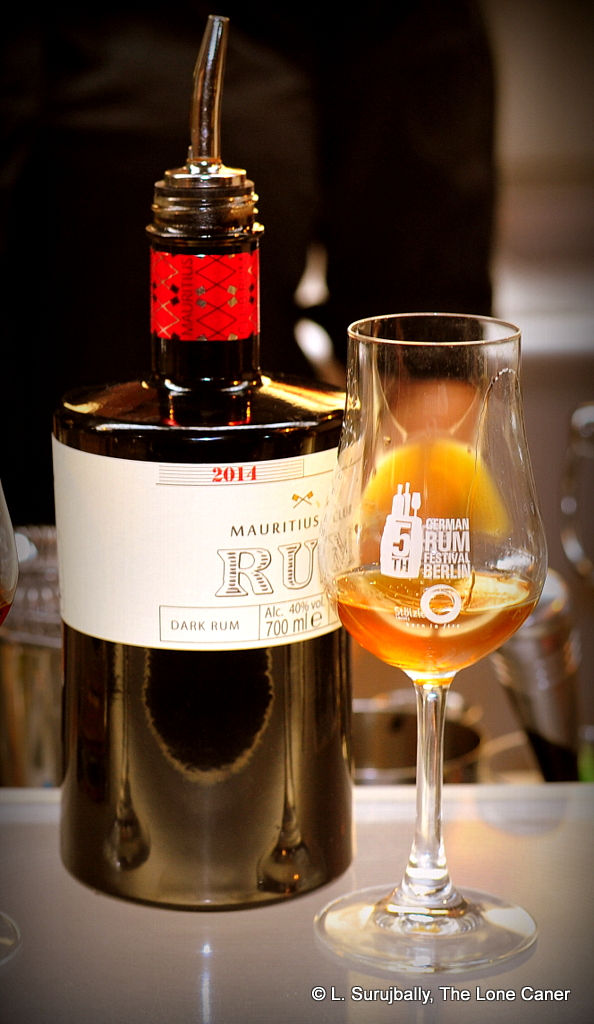
The Mauritius Club Rum 2014 (Sherry Finish) is an interesting essay in the craft, and for my money, slightly better than the Gold of Mauritius Dark rum I looked before. The sherry finishing makes its own statement and adds that extra fillip of flavour which elevates the whole experience in a way that drowning the Gold in port casks for a year did not.  Note that there’s a strange disconnect between what I was told in 2015 by the brand rep, who informed me it was aged three months in oak casks (not what type) and then finished for two weeks in sherry casks; and what I see online these days, where the buying public is informed it is aged for six to eight months in South African wine barrels before finishing in sherry casks.

Well, whatever. Whether three months or six, with or without the sherry ageing, the overall profile strikes me as doing too little and hoping for too much, which is a shame – with a few more years under its belt, this could have really turned heads and attracted attention. The things is, ageing can be either done right and for a decent interval (perhaps three years or more, with many believing the sweet spot is between eight and twelve), or dispensed with it altogether (as with the various unaged whites for which I confess a sneaking love).  But to stay in the middle ground, with less than a year? Plus a finish?…that may just be pushing one’s luck. It’s heading into spiced or flavoured rum territory.

The reason I make these remarks is because when I started nosing it, believing that 40% couldn’t seriously harm me, it lunged out in a schnozz-skewering intensity that caught me unprepared, the more so when had in a series with the far gentler and warmer and more easygoing muffled blanket of the Gold I’d just sampled before.  To be fair though, once it settled down, there were notes of red wine (no surprise), raisins, caramel, chocolate vanilla, and something vaguely sharper, like those chocolate After-Eight mint biscuits.

The palate was softer, smoother, warm rather than hot, after the initial heat burned away..  Again, lots of sweet wine, and the sherry makes itself felt.  Honey, some nuttiness (I was thinking breakfast cereals like cheerios) plus a little fruitiness, cherries, more vanilla, more chocolate and vanilla.  Truth is, too little going on here, and overall, somewhat uncoordinated and quite faint. A 40% strength can be perfectly fine, but it does make for a lesser experience and dampened-down tastes that a shooter wouldn’t capture and a mix would drown and a sipper would disdain.  The finish was okay for such a product, being short and easy, warm, redolent of nuts, more cheerios, honey and a very faint note of tannins. There was some character here, just not enough to suit my preferences.

I know it sounds like I’m dissing the rum, but not really – as noted above, I liked it better than the Gold of Mauritius Dark even though it was younger, which I attribute to a better handling of the blend, and the sherry influence.  Still, it must be said that the rum displayed something of schizoid character, too young and raw to be tamed with the port/sherry for the few months it aged, yet being promoted as being more than an unaged starter (that would lower expectations, which may have been the point).  Moreover, when any maker puts a moniker of a single year on the bottle — “2014” in this case — it creates an impression of something a little special, a “millesime” edition of a good year…and that’s certainly not the case, as it’s simply the year the rum was made.  And lastly, I argue — as was the case with the Gold — that by mixing it up with these external and rather dominating influences, the potential to experience a unique rum originating from a unique location with a very individual taste, was lost — to our detriment.

So after this experience, I resume my search for the definitive rum from the island, the big gun that will put Mauritius on the map and allow us to use it as a quasi-baseline. Something that isn’t mixed, adulterated, finished or otherwise tampered with.  I know it’s out there somewhere – I just have to find it. This one isn’t it.

(79/100)


Other notes

  • The rum was made by a company called Litchliquor on Mauritius.  They act as a blender and distributor under the command of master blender Frederic Bestel.  They source rums from distilleries around the island and blend. age and finish these in their own facilities.  The majority of their sales is on the island itself and in Europe where they have several partnerships with distributors, but also seem to be able to sell in Russia and the Far East, as well as Kenya, Canada and the UAE.
  • Because of the nature of the blend from multiple (unnamed) distilleries, there is no way to tell what kind of stills the rum came from, or whether it was from cane juice or molasses distillate.
Nov 202016
 

marienburg-90-1

To the extent that a shot of this rum is all sound and fury signifying nothing, it achieves its objective. The history is perhaps more interesting than the rum.

#318

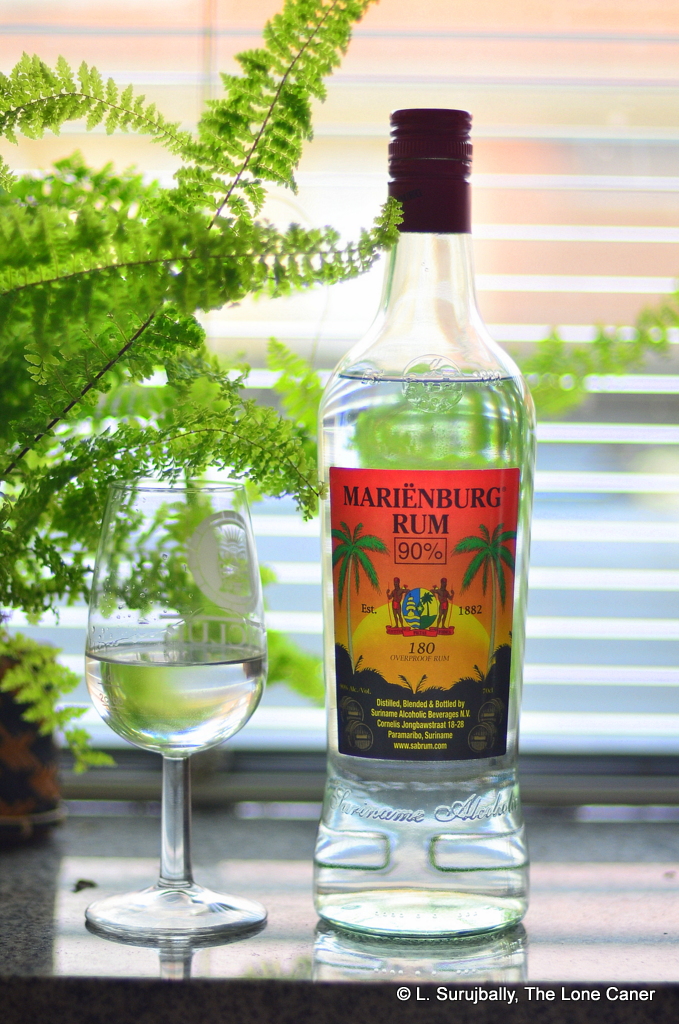
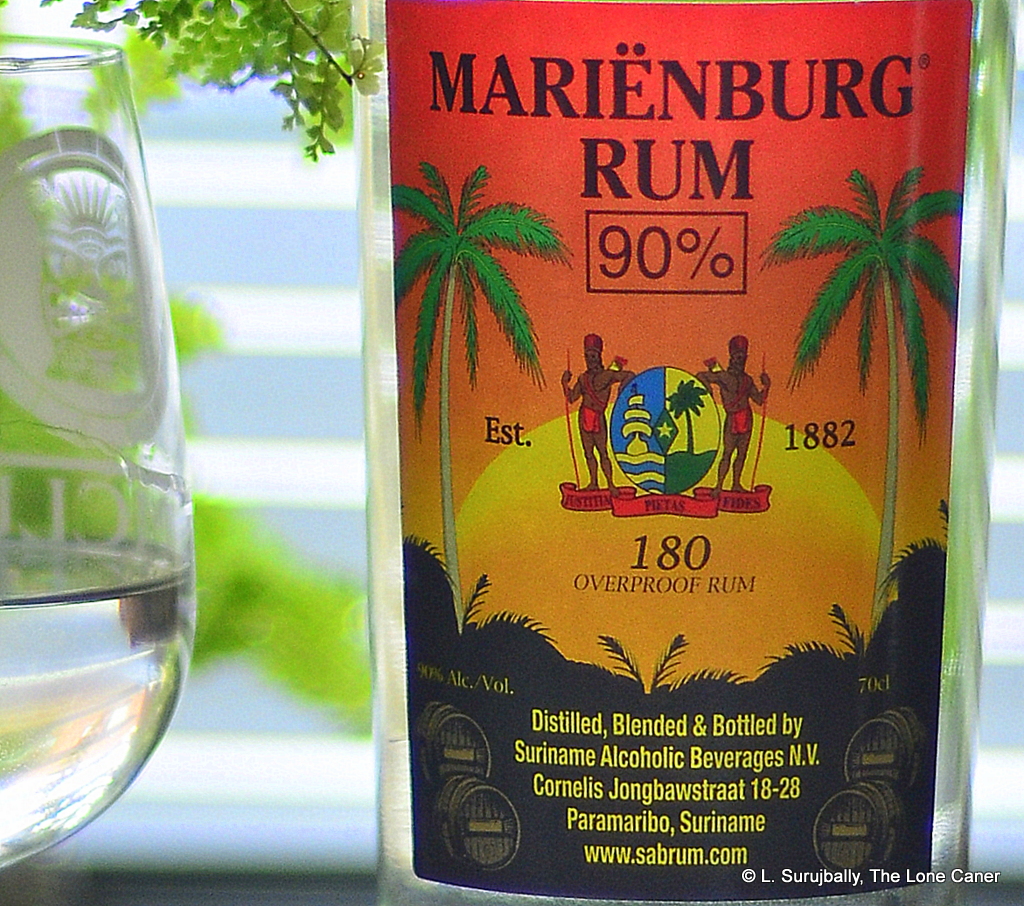
Regular readers of the meanderings of the ‘Caner in the rumiverse know something of the near obsessive (some say masochistic) search for the most powerful rums in the world that peppers these pages.  Back in the day, the 151s had my awe.  Then I tried the SMWS Longpond 9 year old 81.3% and thought appreciatively, “Dat ting wuz a proppah stink bukta.”  Lo and behold I spotted the Sunset Very Strong a year or three later, bought that, and was blown into next week by the 84.5%.  Every time I think I’ve gotten to the top of the ABV food chain, along comes another to upend my knowledge (if not my expectations).  So permit me to introduce the Marienburg 90% white rum, which crows about being (so far) the most powerful commercially available rum in the world, and who knows, maybe they are (unless Rivers Royale in Grenada wants to make a grab for the brass ring).

Who makes this alpha male of rums?  A titan of the industry with deeper pockets and more stills than common sense?  A small up-and-coming indie pushing a leaky creole still to the screaming limit?  The guy next door claiming to use his grandmother’s bathtub?  Actually, it’s made by none of these (though you can’t help but wonder what the three listed candidates might have done, right?) – a  DDL-like outfit in what was formerly Dutch Guiana has the honour of being first on the podium now.

marienburg-90-2The Marienburg 90% rum is issued by a company in Suriname called Suriname Alcoholic Beverages (SAB), formed in 1966 by several local distributors who pooled resources to consolidate the making and marketing of alcoholic beverages in the country.  However, the genesis of the underlying company is far older: the Marienburg sugar factory was established in 1882 by the Netherlands Trading Society, which bought the assets of the abandoned Marienburg plantation, itself founded way back in 1745 by Maria de la Jaille.  Bad luck seems to have dogged the enterprise, as it underwent several changes in ownership, even becoming a coffee plantation for a time before the Society bought it.  The Society felt it could buy sugar cane from all the surrounding smaller plantations and built a processing factory and 12 km of railway line, opening for business in 1882 and gradually buying up more and more of the smallholdings that once supplied it.

Poor business judgement, political issues and falling sugar prices led to the Marienburg factory being closed in 1986 and it’s now a tourist attraction of rusting machinery and overgrown train tracks.  Nowadays SAB does all of its processing in Paramaribo, where it’s offices also are located. Like DDL and other national companies, they produce a range of spirits for domestic consumption, as well as the Borgoes line of rums which can be found in Europe (they used to produce Black Cat and Malbrok rums the latter of which is no longer being made).  Their rums are Trinidad-molasses based, distilled on a column still, with the resultant spirit put to age in american oak barrels: note that they also have a pot still, but I’m unable to establish which rums are made with it.

That’s all there is to tell you. Let me save you the trouble of the rest of the review and simply state that the rum is falls rather flat.  Potent yes, strong yes, masochistic overkill, absolutely…but alas, it serves no useful purpose and contained none of the delicately fierce redeeming features of either the SMWS Longpond or the Sunset Very Strong, which at least coaxed some fascinating tastes out of their barrels to provide a surprising level of heft and interest that backed up the juggernaut of their power.  Still, if you want to make a killer cocktail, for sure this one is your candidate, so there’s that, I suppose.

This the way I felt when smelling the Marienburg, which presented its initial nose with all the grace and finesse of  a somnolent pachyderm. It’s got bulk, it’s got heft, and absolutely nothing happens with it after I passed through the initial scents of  glue, acetone and sugar water, with maybe olive oil, faint petrol, some light flowers barely peeking around the curtain of the stage…and that’s it. One could sense the power behind all that, yet frustratingly, most of it was kept under wraps.  I should also mention this: there was surprisingly little sting or real heat on the nose, none of the potency one is led to expect from something brewed to this level of badass.  

Still, say what you will about the smell (or lack thereof), on the palate the rum was rough enough to make a zombie fear the apocalypse.  Even a small shot, the tiniest sip was a searing oily mass of heat and power on which you could possibly grill a good steak, causing lips to blister, and the tongue to shrivel up, and if you coughed, a thousand flies would die on the spot. On that level, all was as expected…but heat and savagery aside, it was something of a let down – again, there was so very little there.  No real complexity, no real taste such as makes a 60% CdI or Velier rum so amazing, just scraping clear sandpaper and moonshine. Rubber, more acetone, sugar and salt water.  No sweet undercurrent of anything: paint thinner, interspersed with (get this!) the faintest hint of bubble gum.  Cherry flavoured gum at that.

Given that the power was there but not the taste, I was forced to conclude that this rum didn’t get issued and it didn’t get released…it escaped before it was properly ready, and even the finish, long and heated as it was, offered little additional anything to make it perhaps worth a third or fourth look. It was like the elephant never really woke up and stabbed around with the tusks, y’know?  I have a feeling that it was aged a few months and then filtered but there is no evidence for that aside from my own tasting.

So, my recommendation is simply to save it for any mixed drink or cocktail that you feel like making to show off your bartending skills (logically, since no sane person would ever drink it neat), and to embarrass your less-endowed rum friends who bugle loudly about how they can hold their hooch.  They may say that in front  of their girls all they want, but serve them this and it’ll put them down for the count faster than Mike Tyson on a bad hair day.  And maybe that’s all such a rum can be used for, in spite of the high hopes I had for something a little more interesting, that would put its weaker overproof cousins to shame.  But I guess the independent bottlers still have bragging rights for those.

(69/100)


Other Notes

This rum has pride of place in a list of “Strongest Rums in the World” list posted in 2020

Nov 172016
 

rrl-2015

Not quite as good as the 2012…but damned close

#317

One of the genuine pleasures to be had in the field of rum reviews is the unstinting, generous assistance given by members of the subculture.  After I wrote about the Rhum Rhum Liberation 2010, Liberation 2012 and the amazing 2012 Integrale, a reader from Holland contacted me and offered to send along a sample of the 2015 Integrale, for no other reason than because he wanted to see how it stacked up against the others…and to my great good fortune, it arrived while I was still in Germany, and I was able to run all four past each other for a good comparative session.  So big hat tip and many thanks to Eddie K., and may his rum shelf never be empty of the good stuff.

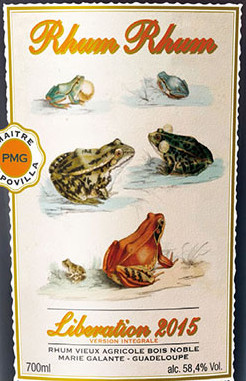
Just to recap the basics for those who don’t want to wade through the other three reviews: all these Libération rhums stem from Bielle on Marie-Galante (Guadeloupe), and are part of a collaboration between Gianni Capovilla and Luca Gargano; cane juice derived, double distilled in small copper stills designed by Mr. Capovilla (built by Muller out of Germany), aged around six years in Sauternes white oak casks.  Need I say that there were no additives or filtrations of any kind here?  Probably not. Also – 2015 is the date of bottling, not the date of distillation (it was ‘liberated’ get it?)

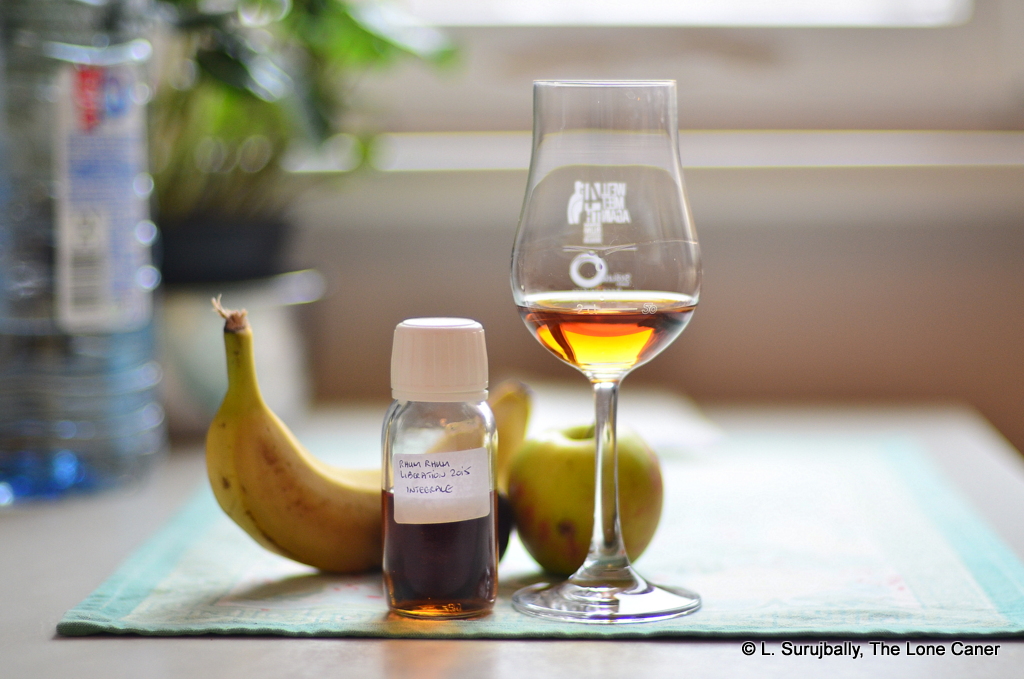
rhum-rhum-liberation-integrale-2015Tasting such a delectable rhum in tandem with its brothers really allows the profile to be taken apart in a way a more casual tasting probably wouldn’t.  Certainly it reaffirmed my initially high opinion of the 2012 Integrale, but you know, this 2015 version bottled at 58.4% ABV wasn’t half bad either.  Consider first the nose, which playfully started the party with light grassy notes and some rubber, as quickly gone as a strumpet’s smile. Then tree sap, some sweet-and-sour teriyaki sauce, a bit of brine, and then the caramel, burnt sugar, cheesecake, bananas and cherries were given their moment to shine, in a smell that was clear and clean and very crisp, nicely leavened by a creaminess which provided a rounded nose I quite liked.

And I savoured the taste of this thing – it was good and solid, hot and punchy, in a good way, with gradually unfolding flavours of flowers and vanillas plus honey (what is it with the Guadeloupe agricoles and that light honey taste?  It’s great). After opening up and with some water, I tasted chocolate, coffee, spices like cinnamon and cardamon, maybe nutmeg.  There was some vague bitterness of oak to be sensed, a slight imbalance, fortunately brief and soon supplanted by the tartness of apples and cider and brine.  Overall, very well rounded and remarkably drinkable, which is one reason that sample is now gone.  As for the fade, it was long, crisp, briny — no vagueness of tastes, none of that inconclusive mashed-up-porridge of a lesser rhum, but bright and clear, with black tea, more honey, fudge and a sprig of mint and a lovely tart fruitiness that resisted my attempts to pin it down.

It was close to the 2012 Libération for sure, maybe even a bit better…and if, as noted above, it wasn’t quite up to the level of the 2012 Integrale, I didn’t feel cheated or let down, since I have a feeling that such remarkable rhums are occasional visitors to our planet rather than regular inhabitants.  And in any case, the 2015 Integrale is a damned fine rhum by any standard, with many strong points and a very few weak ones, which any lover of agricoles would be glad to have. It’s good to see that in an era of commercial sameness by far too many old houses, it’s still possible to find some that don’t let anything like restraint or commonsense stand in their way, and just go ahead and push all their skill and art into making something that’s really very, very good.  When they were done with this one, I can almost imagine them standing around holding their tasting glasses, and all of them with silly grins of appreciation on their faces.  Much like mine, now that I think about it.

(87/100)

Nov 142016
 

Photo copyright (c) Henrik Kristoffersen of RumCorner.dk

Impossible to forget, traumatic to recall. 

#316

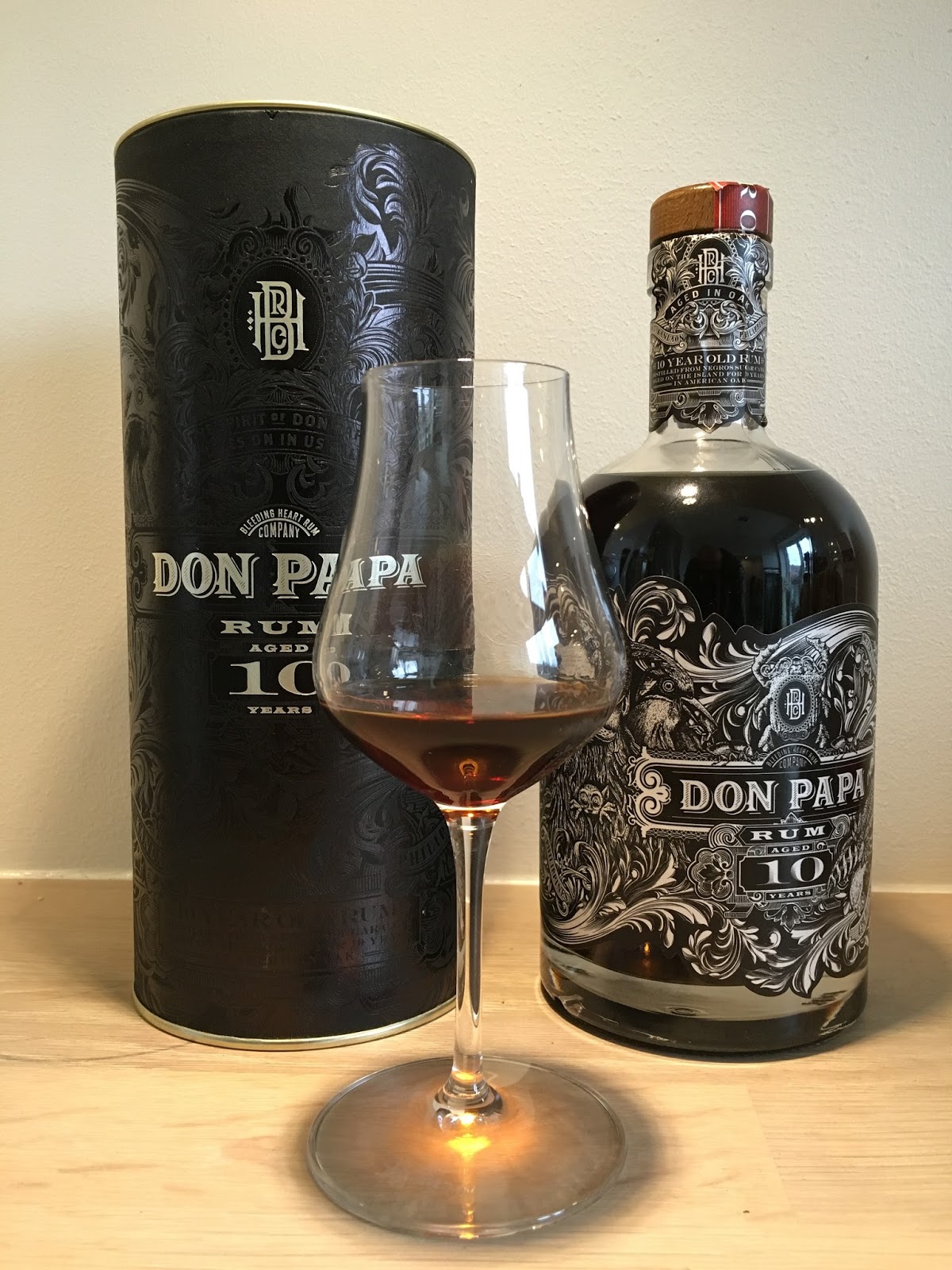
I don’t know why they bothered. This is three years’ additional ageing, pretty much wasted.  It’s Don Papa 7 version 2.0, and just about the whole experience is the same, except the raspberries from the younger variation, which are now dark grapes. Everything else – and I mean everything else, mouthfeel, taste, finish, smell, the works – remains the same, without even some additional oakiness or complexity to make the extra expense worth it.

All right, so by now it’s clear that I’m late to the party here and all the discussions and post mortems have been done on this industrial grade spiced Phillipine rum, which it doesn’t admit to being, but which I say it is. And while there was a firestorm of online vituperation which greeted the release of the rum, making you believe that the majority of the rumworld absolutely hates this thing, the truth is actually more prosaic. Reviewers hate the rum…but most casual imbibers at whom the Don Papa is aimed are actually quite tolerant of the rums they scarf down, and the amount of people in the world who truly want a more detailed sense what they’re drinking — or have access to and desire for what we term top class hooch —  is still a minimal part of the rumiverse in spite of all us bloggers’ doing our best to raise the bar.  But everyone agrees on one point: bad or good or in-between, the makers of the Don Papa should absolutely have disclosed its adulteration. Maybe they thought the age statement would allow them to skate around such petty concerns

If so, they were mistaken. Even bumping it up to 43% for some added bola ng bakal didn’t do much. It had the same nasal profile of sour cream, yogurt, some sweetish fruits, and over-generous helpings of vanilla, bubble gum and yes, there it was again, that distasteful excess of soda pop sprite and fanta and pepsi masquerading as “rumminess”. And no tart raspberries this time, but some dampened down dark grapes, overripe ones, plus a twist of licorice. Oh joy. My glass runneth over.

By now you should have few illusions left: the palate offered no redemption, leading any reasonable tippler to ask in genuine bewilderment, “What on earth was the rum doing for three additional years?” I mean sure, there was some bite and bitter in the mix (which initially gave me hope), just too little.  And the few aromas of peaches and cream were bludgeoned into insensibility in labba time by wave upon wave of more vanilla, soda pop, the syrup in canned peaches (minus the peaches), cola…it was all just too much, too sweet, too cloying, and with few discernible differences from its younger sibling, and a finish that was to all intents and purposes the best thing about it, because at least now the experience was drawing to a close.  

You know, if they had honestly called it a spiced or flavoured rum I would have nodded, smiled, passed it by and never bothered to write a thing. But they didn’t…and so I did. And my evaluation is simply that Don Papa 10 is a hollow rum. Age or no age, it’s column still industrial spirit that’s been tarted up, where no such embellishment was required if they took some time and care and blending mastery to the task.  It takes its place proudly with the Whaler’s, Kraken and Pyrat’s XO and the AH Riise Navy 57% on the bottom of any reviewer’s shelf, and with good reason — it’ll get you drunk no problem, and at a reasonable price, but if you wake up the next morning wondering what camel voided its bowels in your mouth and why you have a tattoo of “Don Papa” on your left buttock in hieroglyphs, don’t come crying saying I and all the others didn’t warn you.

(61/100)


Other notes

  • It gives me no pleasure to write reviews like this.  Oh the words flow easily, the rum really isn’t worth it and I can stand by the opinion. I just don’t understand why, in this day and age, I should have to. We’ve been hearing for years how rum is in its new golden age.  So why would anyone who loves rum enough to actually make one, create something that is so clearly not?  In my more generous moments, I say it’s because they want to make what sells to the tippling masses and will do better as their skills improve; in my blacker moods, I think it’s a full-proof money grab adulterated with the cloying additive of indifference.
  • Compliments to Henrik of RumCorner, who provided both a large sample and the photo.
  • For an enthusiastic and uncritical perspective by a “lifestyle writer” (I will not use the term “journalist” because that would be like saying Don Papa is a real rum) I direct you to this Forbes article from May 2017.  It’s just another in a spate of recent rum-themed articles that are written by people who seem to want to advertise that they really know nothing at all about the subject.
  • The Bleeding Heart Rum Company is the company behind the rum, and this link will answer most other questions about the product. BHRC is in turn a subsidiary of Kanlaon Limited a small single-director, 100-share company registered in a business village in Middlesex, listing Mr. Stephen Carroll as the man in charge, and he apparently worked for Remy Cointreau for some years before striking out on his own (he has other directorships in companies involved in film and video production).  Since I don’t trust much of anything the website says, I won’t rehash its blurbs here.
Oct 242016
 
don-papa-7-ans

Photo shamelessly cribbed from and copyrighted to Henrik Kristoffersen of RumCorner.dk

Caner’s Rum Quality Inverse Square Conjecture: quality of rum is inversely proportional to the square of the sum of [ glitziness of website plus design of the label ].

#311

The presentation and advertising and marketing of this rum is all about fancy bottle and label design, gorgeous visuals, and words to make you giddy with anticipation.  It nails all aspects of those. Everything else is secondary, except the rum itself, which is tertiary.  

Just to set the stage: I honestly thought my amigo Henrik, in his savage takedown of the rum, was exaggerating his despite. However, intrigued, I begged him for samples to save me buying them, and he was prepared to gift me the whole bottle except that his luggage was already full of stuff he was bringing to Berlin (for me).  And just to see if its claim to being a “premium aged small batch rum” held up, I tried the Don Papa 7 year old (and its brother the ten year old) four  times: once with a flight of eight Jamaicans, then with a flight of seven Demeraras, a third time with a raft of agricoles and then with yet another one of nine Bajans.  

Lord Almighty, this thing was annoying. I don’t think I’ve been this irritated with a rum since the Pyrat’s 1623. It’s appalling lack of profile compared to the comparators is only matched by its self evident desire to emulate a soda pop. When I think of the elegant construction of something like the FourSquare 2006 and its years of development, I want to rend my robes, gnash my teeth and weep bitter tears of despair for the future of the rumiverse. It may be the bees knees in the Phillipines, where different rules for rum production are in force and different palates and tastes rule – but maybe it should stay there and not afflict real rums.

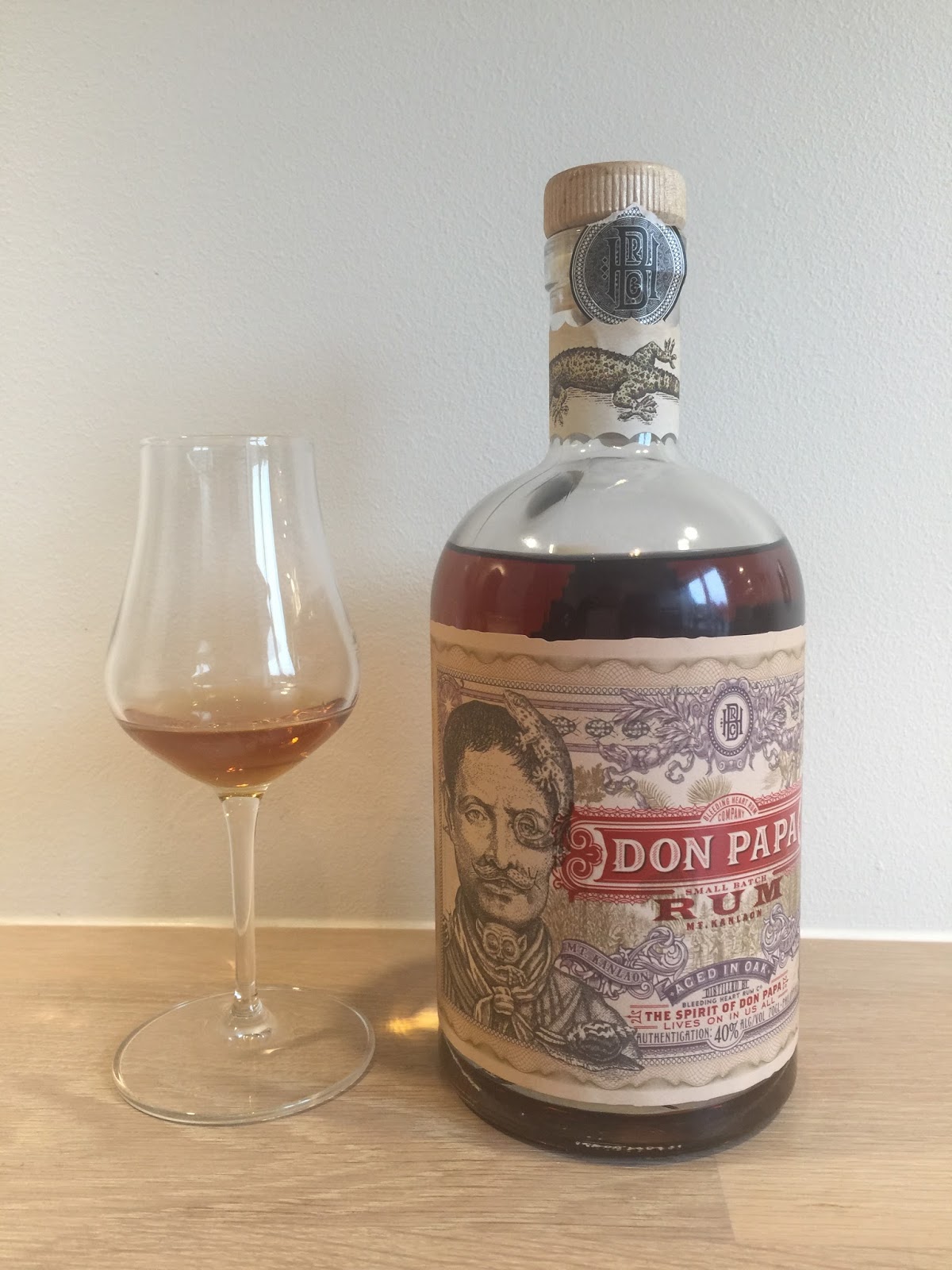
Think I’m being unjust?  Unseemly vicious? That I jest?  Not at all.  The 40%, American-oak-aged amber rum reeked — that’s the only word I can come up with that describes the cloying, thick aroma of yoghurt emanating from the glass, a sort of sour cream and curds kind of smell, leavened with some raspberries and cherries.  It makes the A.H. Riise Navy Rum seem like a masterpiece of blending assembly. And then there was the overdone saccharine citrus smell of fanta, bubble gum, vanilla (gobs of that), and sprite and cream soda…what the hell, maybe they tossed some coke in there too. Rum? I dunno – it smelled like a mixing agent to which one adds rum.

And it was on the palate that its true adulterated nature became fully apparent.  The mouthfeel is where it started – it literally felt like a soda, complete with the slight scrape of what could charitably be called bite but which I’ll call chamberpot-brewed rubbing alcohol.  Again that yoghurt taste was there, this time without the creaminess, the raspberries being replaced by a peach or two…and the vanilla and sprite and coke were still there in abundance, finishing the job of ruining what had been an unremarkable, unprepossessing liquid that wasted too much of my time.  There was no finish to speak of, which was unsurprising, given how dosed and choked up this thing is with so much that isn’t rum.  Even Pyrat’s XO would probably shudder at what the company did here (while taking notes).

This is the kind of rum which drives reviewers into transports of rage, because it gives all rum a bad name, and frankly, with all due respect to the nation of origin which makes the much better Tanduay 12 year old, it’s barely a rum at all.  And yet it sells briskly, calmly splashing around in the great urinal of low-to-mid-level adulterated rum sales, which just goes to show that spice and sugar will always move product.  What most of those don’t do is slap lipstick on a pig with quite the abandon and disdain for quality this one does. It truly has to be drunk to be believed, and trust me, unless you love your dentist, that’s not something I would recommend.

(59/100)


Other notes

  • I might have been less snarky if they had simply labelled it as a spiced rum (which it is) instead of some kind of aged artisinal product (which it isn’t).
  • Cyril at DuRhum had this run through a lab test and that evaluated it with 29g/L sugar, 2.4 g/L glycerol and a massive 359 mg/L of vanilla.
  • Who makes this? Well, the Bleeding Heart Rum Company, to be exact, and this link will answer most other questions about the product. BHRC is in turn a subsidiary of Kanlaon Limited a small single-director, 100-share company registered in a business village in Middlesex, listing Mr. Stephen Carroll as the man in charge, and he apparently worked for Remy Cointreau for some years before striking out on his own (he has other directorships in companies involved in film and video production).  Since I don’t trust much of anything the website says, I won’t rehash its blurbs here.
  • For an enthusiastic and uncritical perspective by a “lifestyle writer” (I will not use the term “journalist” because that would be like saying Don Papa is a real rum) I direct you to this Forbes article from May 2017.  It’s just another in a spate of recent rum-themed articles that are written by people who seem to want to advertise that they really know nothing at all about the subject.
Oct 092016
 

aldea-cana-pura-1

The confusion as to what this white is meant for – a soft mixing rum, or an intro to individualistic macho – makes it, paradoxically enough, falter at both.

#310

You can imagine my surprise when I ran through the Ron Aldea line of rums from the Canary Islands last year, and after talking to the genial guy at the booth at my usual inordinate length, realized with astonishment that here was Santiago Bronchales, who previously was deeply involved with Ocean’s Atlantic, a rum I had thought was perhaps too overambitious for its own good, if reasonably drinkable.  Once he realized that I was the guy who had pestered him with no end of emails about his previous offering, his face split into a grin, and he carefully ran me through the entire history and lineup of the Ron Aldeas rums.

The Caña Pura — “pure cane” to you non-Spanish speaking folk reading this — is a white rum,  bottled at a rather timid 42%, unaged and in this case limited 1794 bottles (for a reason I’m still researching). All of the Aldea rums are rhums, true agricole-style rhums, distilled from fermented cane juice to 62% in a double column copper still made by the French firm Egrott, which Santiago helpfully informed me is 150 years old and powered with a wood-fed fire in the Canary Islands.

“Clear”, “white” or “silver” rums are gaining in popularity as people realize the same old industrially filtered milquetoast we all grew up on is not all there is to the uncoloured rumiverse. Haitian clairins, Cape Verde “grogue” and just about every bathtub distilled moonshine with a label slapped on that’s ever been made are leading the charge with the word “artisan” and “natural” being bandied about as major selling points, and full proof versions of such rums sell briskly.

aldea-cana-pura-2Unfortunately, this rhum isn’t part of that revolutionary vanguard of the peasants charging the barricades or assaulting the Bastille.  It’s more like a timorous, vacillating, middle-class bystander hoping not to get creamed in the chaos. Part of that is the strength, which at 42% doesn’t give much – the nose, for example, was quite weak, sharp on the initial sniff, with flashes of flavour peeking through….salt, olives and wax in the beginning, melding into sugar water and tree sap with some very light fruit after a while, mostly white guavas, a pear or two, and some vanilla.

While I liked the palate more than the aromas, I felt it was still too harsh and sharp (and a little dry, oddly enough).  The flavours opened up quite a bit more here: sweet sugar water, lemon zest, more briny olives, followed by cucumbers, pears, and there was some watermelon in there somewhere, hiding and refusing to be isolated, preferring (if I can extend the metaphor) to hide behind the other bystanders.   The finish: short, sweet, watery, more of the same.

Overall, this is not a narcissistic halo rum meant to laugh in the face of the musketry while joyously singing the “Arrorró” (so look it up).  It lacks the huevos for that kind of thing, and feels more like something tossed off to round out the portfolio (but if that’s the case, why the limited edition of 1794 bottles?). One could argue that a low-proof unaged white isn’t going to provide much so why write so much about it, but I dispute that, having had some crazy barking-mad hooch in my time – they were never top scorers, and never will be,  but man, they sure had character.  That’s what’s missing here.

In the main, then, the Caña Pura is more for the curious who would like to try something in between the more forceful French island blancs and the wussy mixers of the North American market.  Personally I believe the rhum could – and should – be left at the initially distilled and torqued-up 62% which would certainly make an emphatic fist-on-the-table reverbration in today’s world. Even at 42% it’s too tame and too quiescent, nervously peeping over the fullproof fence without every taking the chance to go there. That doesn’t make it a bad white mixing rhum, but not a top-tier one either…and it does leave us wondering rather wistfully what it could have been.

(80/100)


Company bio

The company itself, Distilerias Aldea S.I., is a 4th generation family-run outfit, founded in 1936 by Don Manuel Quevedo German, who was born in 1872 in Arucas, a small northern village of Grand Canary, and whose family seemed to have some energizer bunny in the gene pool, surviving the closure of just about every sugar operation with which they were associated over nearly sixty years. Don Manuel moved to Cuba and Santo Domingo as a young man and apprenticed in sugar mills in both places before returning to Gran Canaria, where he worked with his father an uncle in the Bañaderos sugar factory.  This facility was closed and shipped to Madeira in the sugar slump of the ‘teens and by 1920 all the main sugar concerns in the Canaries were out of business. After the factory in Madeira in turn got shuttered  in 1934, Quevado returned to the Canaries and took his accumulated experience to open his own operation…which also went belly-up in 1960 for various economic reasons, but which his sons restarted in La Palma in 1969 and has kept going ever since.

Other notes

I don’t know if it is filtered or not, or added to. I’ve heard that some mark it down for a certain sweetness and too little originality.  I’ll update this review when I find out.

The rum will be renamed “Single Cane” for the 2016 release season and onwards.

Oct 042016
 

travellers-3-barrel-2

A light, easygoing, tasty three year old that’s better than average.  

#309

Located in Belmopan (capital of Belize), Travellers is a distillery which traces its origins to 1953 when Master Blender Senor Omario Jaime Pedomo opened a bar he named Traveller’s as a nod to the rum sales made to people travelling to and from Belize City. The company currently uses molasses with natural fermentation (both source of the former and duration of the latter are unknown to me at this time) and double distills the result in a triple column continuous still, for a supposedly smoother, lighter taste.  Like many other likker outfits that are big in their own country (DDL comes to mind) they also produces liqueurs, brandies, gins, wines, and vodka, mostly for the local market.

Given that I enjoyed the other rums made by them, it’s odd how long this Belizean hooch escaped my grubby little paws and maybe says something for my purchasing priorities, or where I’ve been buying.  It’s the mid-range companion to the quite interesting 1-Barrel and 5-Barrel expressions (the numbers refer to the years of ageing), which may not have scored in the stratosphere, but were tasty, workmanlike rums by any standard. If I had to stratify them, I’d say they were a kind of mix of the softer Bajan and Spanish styles, but that’s just me.

travellers-3-barrel-1The 3 barrel also evinces a peculiarity of the Traveller’s design philosophy – every one of their three products sports a different label, this one with that “parrot” moniker on it which was absent in the other two, and the five even went with a different bottle shape entirely. It doesn’t really matter, not does it impact my enjoyment, it’s just a curious divergence from the norm of consistency, and I wonder whether it’s deliberate.

Anyway, moving right along: a light orange-gold rum aged three years, distilled at 40% for the North American market (I’ve not seen any Europeans review it, which suggests it’s either attracting zero attention there or simply not available). A quick sharp jab of turpentine and wax flared briefly on the nose, and then was gone, followed by wood, sawdust, salted caramel, Haagen-Dasz toffee ice cream and vanilla.  Only barely could some light fruity notes be discerned, maybe cherries, maybe apricots — in either case they were overripe.  It was an interesting smell, overall, especially in how it developed, but admittedly somewhat schizophrenic between sweet and salt and fruity.

The rum was medium bodied in the mouth, a little sharp, because the ageing had been brief enough to just take some of the edges off a rawer, more jagged profile, not all. In a peculiar reversal of the way flavours usually develop, it started off with large, dominant flavours of butterscotch, caramel, crushed walnuts and toffee, plus a minor key of cinnamon, apricots and faint citrus, maybe orange peel…and crushed apples bleeding juice before being made into cider.  The finish was perhaps the oddest part of my experience with this rum – it was short and the initial smells that I noted did an Alcatraz at the beginning, were back here: wax, paraffin, some turpentine and furniture polish, as well as sweeter, shyer notes of fruits, more caramel, more butterscotch…there really was too much of this.

On balance, the Parrot 3 Barrel showcased rather more potential than actuality.  Digging out my initial tasting notes for the 1 and 5 barrel, it’s clear this falls right in the middle, the tastes of the  former being tamed a little and being more developed, while not quite at the level of the latter. Something about the overall dominance of the toffee and caramel and vanillas was vaguely off-putting, and didn’t allow the subtler flavours to come through as well as they might have.

So although it’s a well made drink, I think it’s a bit of a yawn-through — still not in the ballpark of either the 5-Barrel or the Don Omario’s 15 year old, and yet lacking the 1-Barrel’s unashamed, almost joyous assertiveness and youth. Like a middle child not knowing which one of the siblings to hang out with, this rum uneasily tries to bridge the divide while balancing precariously in the centre.  That it succeeds at all (and it does, more or less) and provides an enjoyable experience, is quite a feat under such circumstances

(81/100)


Sep 282016
 

la-confrere-long-2014-2

#307

Inhaling the powerful scents of this rhum is to be reminded of all the reasons why white unaged agricoles should be taken seriously as drinks in their own right.  Not for Longueteau and La Confrérie the fierce, untamed — almost savage — attack of the clairins; and also not for them the snore-fests of the North American whites which is all that far too many have tried. When analyzing the aromas billowing out from my tasting glass, what I realized was that this thing steered a left-of-middle course between either of those extremes, while tilting more towards the backwoods moonshine style of the former. It certainly presented as a hot salt and wax bomb on initial inspection, one couldn’t get away from that, but it smoothened out and chilled out after a few minutes, and coughed up a few additional notes.  Was there some pot still action going on here? Not as far as I know, more a creole column still.  It was a briny, creamy, estery, aromatic nose, redolent of nail polish and acetone (which faded) watermelon, cucumbers, swank, a dash of lemon and camomile…and maybe a pimento or two for some kick (naah – just kidding about that last one).

The taste of this thing was excellent: spicy hot, fading to warm, and surprisingly smooth for a rhum where I had expected more intensity.  Like many well made full proofs, the integration of the various elements was well done, hardly something we always expect from an unaged white; and after the initial discomfort one hardly noticed that it was a 50% rhum at all. It was comparatively light too, another point of divergence from expectations.  It tasted of all the usual notes that characterize white agricoles – vegetals, lemongrass, cucumbers and watermelon, more sugar water (it hinted at sweetness without bludgeoning you into a diabetic coma with it) – and then added a few interesting points of its own, such as green thai curry in coconut milk, and (get this!) the musky sweetness of green peas. It all closed up shop with a nicely long-ish, dry-ish, intense and almost elegant finish, with an excellent balance of zest, creamy cheese and those peas, and some of the esters and acetones carrying over from where everything had started.  The balance could be better, but I had and have no complaints.

la-confrere-long-2014-1La Confrérie are not independent bottlers in the way Velier, Rum Nation or Compagnie des Indes are.  What they do is work in collaboration with a given distillery, and then act more as co-branders than issuers.  This provides the distillery with the imprimatur of a small organization well known – in Europe generally and France in particular – for championing and promoting rhum, who have selected the casks carefully; and gives La Confrérie visibility for being associated with the distillery.  Note that La Confrérie is also involved in deciding which shops get to sell the rhum, so certainly some economic incentives are at work here.  (There are some other background notes on La Confrérie in the HSE 2007 review, if you’re interested).  The two co-founders — Benoit Bail and Jerry Gitany – are currently touring Europe on an Agricole Tour to promote and extend the visibility of French island rhums, so their enthusiasm and affection for agricoles is not just a flash in the pan, but something to be taken seriously.

When I consider the pain Josh Miller went through to get the twelve blanc agricoles which he put through their paces the other day (spoiler alert – the Damoiseau 55% won), I consider the Europeans to be fortunate to have much greater resources at their disposal – especially in France, where I tried this yummy fifty percenter. And frankly, when North Americans tell me about their despite for white (so to speak), having had only Bacardis and other bland, filtered-to-within-a-whisker-of-falling-asleep mixing agents whose only claim to fame is their ubiquity, well, here’s one that might turn a few heads and change a few minds.  

(83/100)


Other notes

  • Outturn 1500 bottles
  • Source blue cane chopped, crushed, wrung out, soaked and hooched in May 2014, left in steel vats for around six months, and bottled in March 2015.
Sep 222016
 

botran-75-1

The best of the Botrans, deservedly so. But it could have been better.

#305

***

Botran’s top-of-the-line Special Edition is so soft it makes a feather pillow feel like it’s stuffed with discarded syringes. In comparison, the skin on a baby’s bum is rough as the glass shards on the wall around the house of a banana republic’s paranoid dictator. Yet it’s issued at a mere 40%, and that it has more qualities than defects is to its everlasting credit and our relief, for soleras do not often get much huzzah from hardcore rum fans, who prefer to have rums with rock-hard washingboard abs, massive glutes, melon shaped biceps, and both the syringes and the shards thrown in.

botran-75-004Over and above the notes on soleras and the Botran company which I covered in the 15 year, 18 year and Blanca reviews, here are the facts on this one.  9972 bottles of the rum were issued, and it it is a blend comprising rums five to thirty years old, with the average age of about ten – all aged in casks of bourbon, burned bourbon, sherry and porto, with the last six months of ageing spent in white wine casks.  The 75th Anniversary reflects its issue in 2014 (one website says 2015*) to mark the birth of the company as a rum maker in 1939 when Botran was formed by los cinco hermanos.

That it is deserving of the “Special” moniker is something of an opinion.  For the makers, given their heritage and amount of time they spent making it, sure; for solera lovers of the sweet light rums, check.  As a reviewer who judges on taste, I’d have to say “yes” as well…but those who are thinking of shelling out  €160 might pause a little (that gets the buyer a presentation quality box containing a 50cl bottle, a pipette and two additional sample bottles filled with citrus and spicy variations of the rum so they can go off and make comparisons of their own, for whatever reason). For that price, we have to ask whether a 40% solera is worth it, and that comes down to more than just the tasting notes which follow.

What was evident on the nose of the rum was some of the real complexity the previous iterations aspired to but didn’t achieve: it was deep, reassuring, calm, and quiet, in no hurry to give up its secrets. Gradually, warm scents of caramel, dark chocolate and (quite a bit of) molasses sauntered out and stayed there. Over some minutes additional notes of apricots, peaches and red currants joined in, with a background of treacle, and syrup on the Little Caner’s Saturday morning pancakes.  There were enough breakfast spices in evidence to make me wonder why bother providing even more in the sample bottles, but they were muted and ancillary, not dominant, though some vanilla hints crept through at the end.

The taste was equally warm and full at the inception, complex enough to satisfy, but perhaps too mellow and sweet – that 40% strength did it no favours (what is it about so many rum producers that even for something so special, they obstinately refuse to go stronger?).  Prunes and black grapes, bitter black chocolate, licorice, more syrup.  Caramel, burnt sugar, charred wood, coffee and molasses, firm and decisive in their own way, to which eventually were added honey and nuts, maybe a flirt of citrus.  The flavours do make strong individual statements, like a proverbial snooty waiter slamming a meal down in front of you, and they are good — but they do not geometrically improve (in line with the price differential) what could have been a magnificent creation of the blender’s art, had they boosted the amperes a mite.  That sank the finish for me, which was very warm, very smooth and which can’t be faulted except to note it was too short and displayed nothing new, which blocks me from waxing ecstatic, rhapsodic and metaphoric about the thing.

botran-75-2For all the scorn often heaped on soleras, which unfairly damages the rep of many others of the same type, I think Botran makes pretty decent rums.  By officially eschewing additives (there’s some dispute about that) and utilizing barrel selection strategies that work with port, sherry or bourbon influences, they have produced what I think are some of the best solera rums around, not excluding the Cartavio XO**.  Sure they’re too soft and mild for me as a whole when ranked against more intense, masterful indie bottlings, but for a 40% rum to impress me at all these days does require a little bit more than just slick marketing.

So there’s is no doubt in my mind that this is one of the better soleras out there, and of the four Botrans I’ve tried, it is the best.  You could haggle over the 15 and the 1893, which were roughly comparable, but this one is a step or two ahead of them both – and whether it is worth the price,  when so many other good rums compete for your attention at less than half the cost of this package, will have to be a decision you must make on your own.

(86/100)


Other Notes

* The spiritsbusiness website said it was issued in September 2015, which conflicts with the 75th Anniversary dating of the company formation in 1939.

** Yes, I know I scored the Cartavio XO at 88 points.  That was four years ago.  Were I to try it again, it would likely come down to this one’s level (and in the future both might sink yet lower as I keep trying more and more rums). My malty friends patronizingly remark this is called the “evolution” and “development” of taste, and hasten to assure me that one I day I will join them in appreciating whisky.  Sure guys.