May 292017
 

Rumaniacs Review #046 | 0446

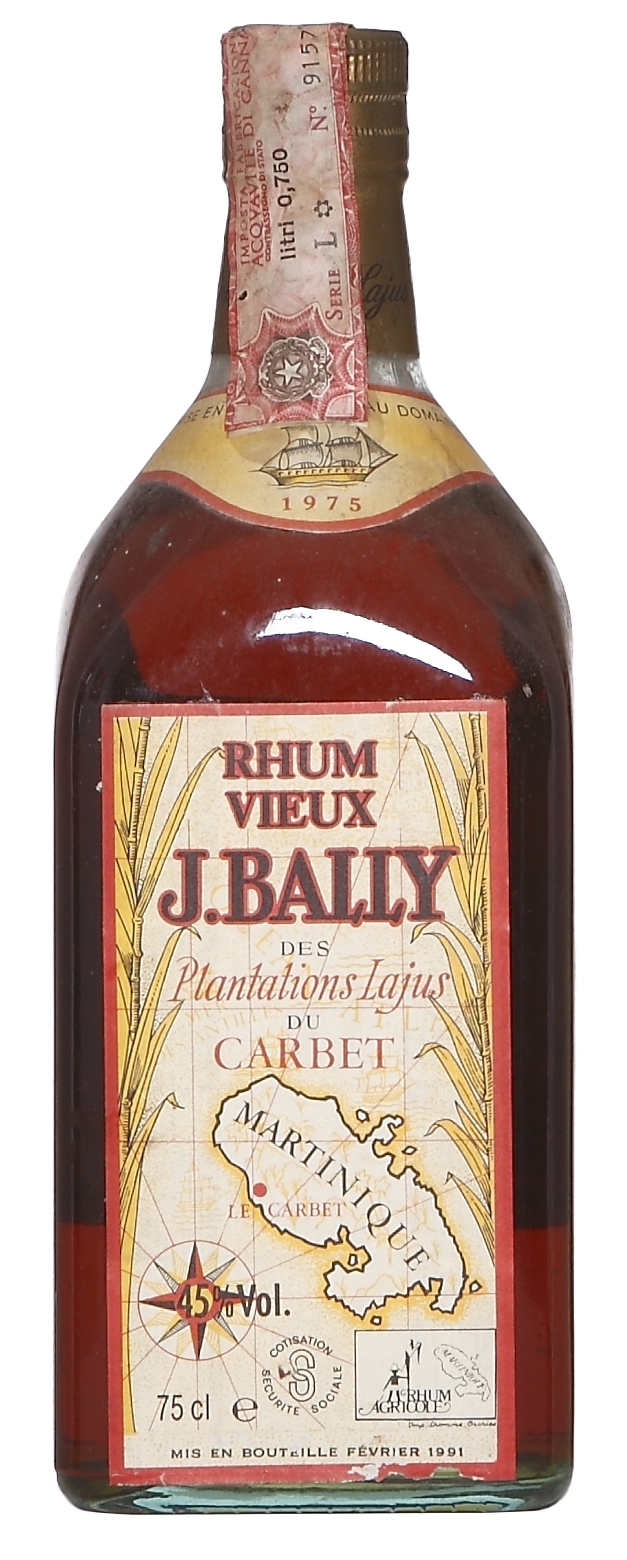
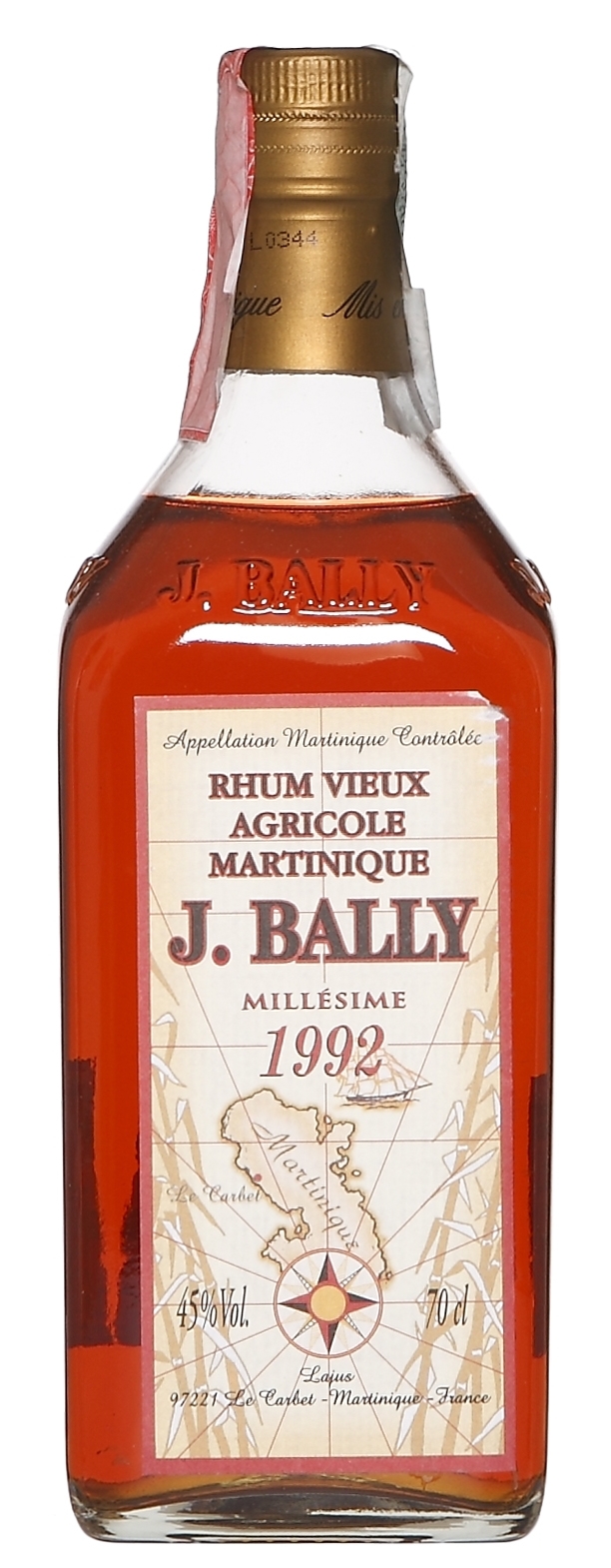
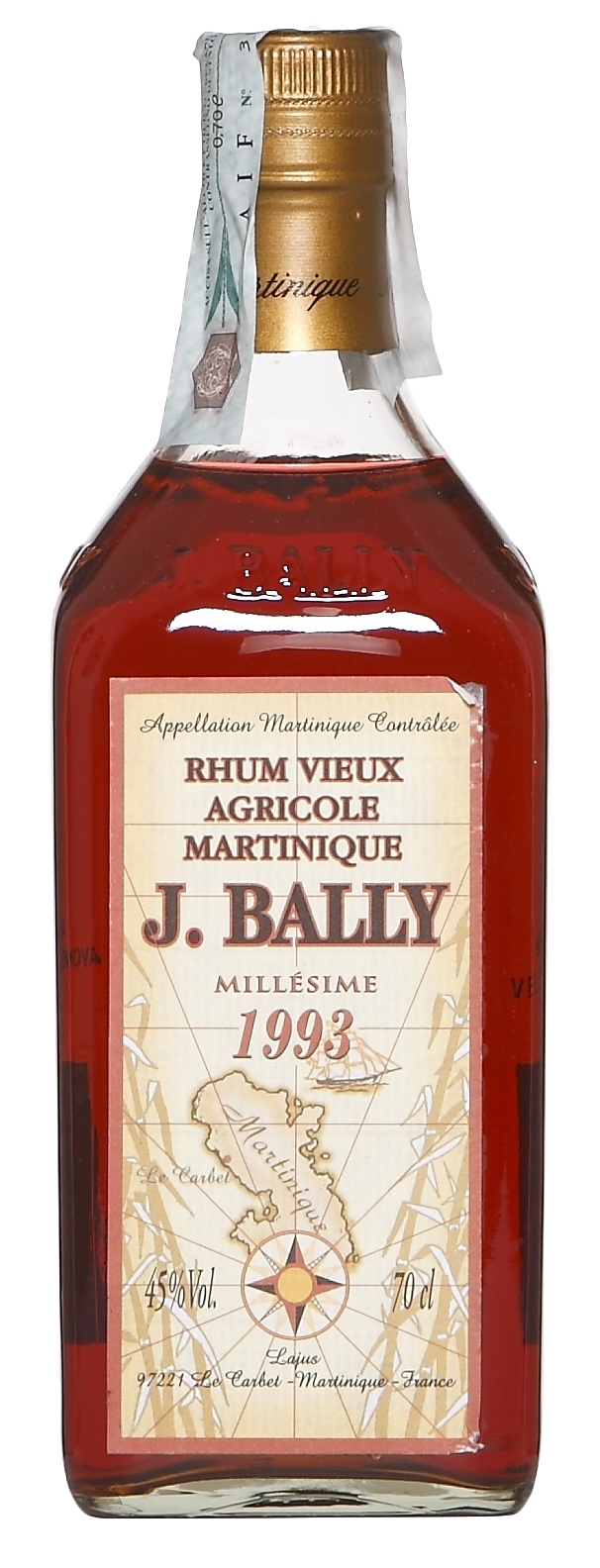
We’re going back down memory lane now, to a point where the AOC designation is a dream on the horizon, and for once we have an age: this rum is sixteen years old (based on the bottom of the bottle where it says “Bottled February 1991” in French).  This of course leads us to puzzle our way through all the others we’ve looked at already, because if here they can call a 16YO a “rhum vieux” then the other Bally rhums are in all likelihood similarly aged – we just have no proof of the matter.

In any event, age or no age, rums and rons and rhums are evaluated based on what they are, not what they are stated to be. So let’s put aside all the whinging about information provision (which is a never ending grouse of mine) and simply taste a rhum made when I was still living in Africa and had never heard of Martinique (or much about Guyana, for that matter).

Colour – Amber

Strength – 45%

Nose – So far nothing has beaten the Bally 1982, but this one is on par…perhaps better.  The nose is amazing – deep purple grapes and vanilla, with the traditionals of sugar cane sap, wet green lemon grass, with a mischievous hint of wet cardboard and cereals.  Threading through these smells are additional notes of Turkish coffee (no sugar), cocoa and some black chocolate, but curiously there’s less fruitiness to sniff in this one than in the later editions, and it’s backgrounded by something vaguely metallic…like licking a small battery, y’know?  Some cinnamon, well-polished leather and honey fill in the spaces.

Palate – It’s creamy, spicy, sweet and salty all at once (plus lemon).  In a way it reminds me of a very well made Thai green curry in coconut milk.  The fruits are here at last – green apples, pears, white guavas, but also pastries and cheese, to which are added very light hints of creme brulee and caramel, milk chocolate, some honey and licorice.  Would be interesting to know the barrel strategy on this one.  Whatever.  It’s a fine fine rhum to try, that’s for sure.

Finish – Medium long, vegetal, grassy and breakfast spices for the most part, some more of the white fruit, and the woody notes are here to stay.  Not the best fade, but pretty good anyway.

Thoughts – It had great balance and the tastes were excellent.  Something like this is best had in conjunction with something newer from Bally because then you gain a sense of its achievement, and how rhum has developed over the years.  People swear by the AOC (and in an era of marketing nonsense dosed with outright lies, quite rightfully so), but sometimes you wonder whether something hasn’t been lost as well.  The Bally 1975 emphatically demonstrates the quality of what was being done, at a time way before regulations changed the industry.

(86/100)

The boys of the Rumaniacs liked this rhum even more than I did.


May 282017
 

Rumaniacs Review #045 | 0445

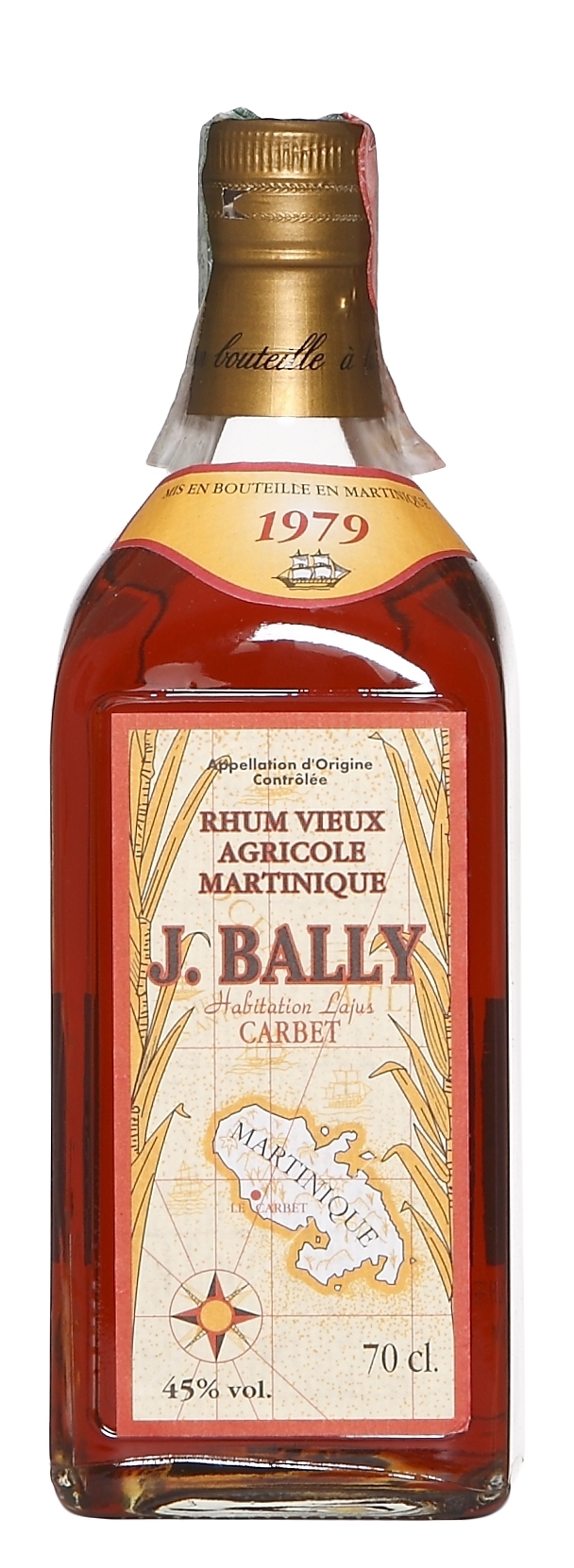
By now two things are clear about these older Bally rhums – aside from some educated guesswork, we don’t know how old they are, and by this time, 1979, the AOC noted on the label is somewhat of a puzzler, unless the thing is seventeen years old, in which case it would hardly be labelled a mere “rhum vieux” but an “XO”.  So maybe after the initial ageing they stored it in tanks or flagons and only bottled it after 1996…or, more likely, it came under a previous version of the official 1996 AOC designation.  At this point, it’s somewhat academic, though — given it was made nearly forty years ago, it presents as a rhum that shows something of the evolution of the agricole world over time.

Colour – Amber

Strength – 45%

Nose – Pungent, grassy, clear and quite light, quite dry.  There were olives in brine, grapes, black tea, some citrus peel and aromatic tobacco, but also something softer, milder: strawberries and bananas, I’d  say, forming a nice counterpoint.  It takes its time opening up, once this happens, it gets somewhat fruitier, while never entirely letting go of the grassy, herbal aromas.

Palate – Creamy and salty, black bread and cheese. It’s also somewhat sharper and more more tannic than the earlier Ballys from 1992 and 1993, with wood taking center stage, and a taste of something green, like grass, fresh sap, Japanese tea.  So also somewhat bitter, and the clean purity of agricoles with which we are more familiar has receded – fortunately I could still taste tart apples, lemon zest and raisins, plus whiffs of dark chocolate and some unripe fruit.

Finish – Pleasant close out – dry, edgy, warm.  White guavas and pears, plus the tartness of soursop, pencil shavings and perhaps too much oak.  Not entirely a success here, perhaps a shade too peppery and not as well balanced as the nose or palate.

Thoughts – Here we have moved away from the almost standard profile of the ’80s and ’90s demonstrated so clearly by the newer Bally rums, and returned to agricole rums’ roots…but also something of a tangent from those profiles we are now used to. A solid rhum, but not one that ascends to the heights.

(83/100)

Other members of the Collective have written about the rhum as well, on the official website.

May 252017
 

#367

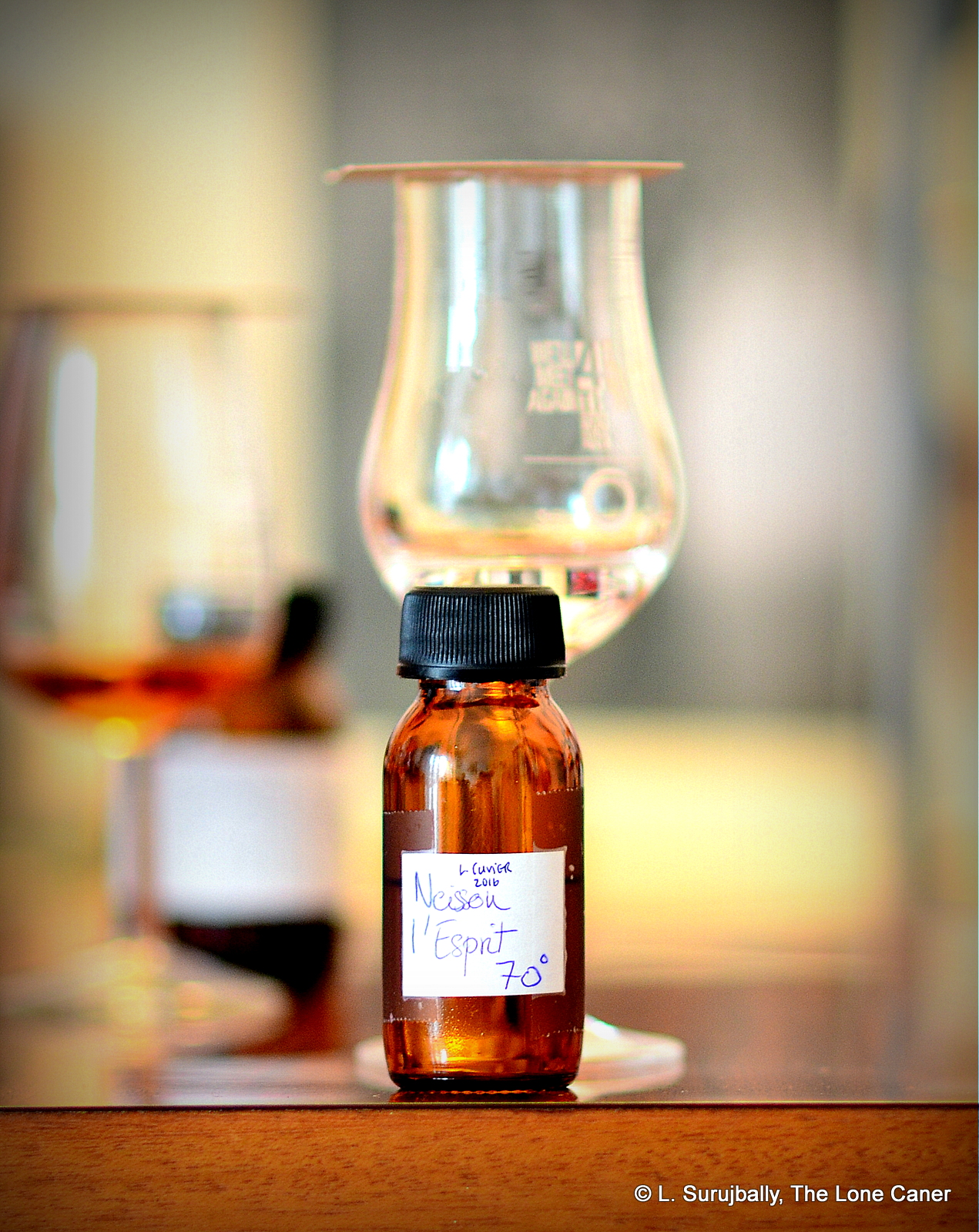
In my own limited experience, Neisson has been one of the most distinctive Martinique agricole makers I’ve come across.  There’s something salty, oily, tequila-ish and musky in those of their rums I’ve tried, and while this might not always be to my liking, the quality of their work could never be denied.  To date, I’ve stuck with their aged rums, but back in 2016 L’homme à la Poussette (I’m thinking his poussette should be retired soon as his kids grow up but I hope he never changes the name of his site) passed along this ferocious white rhino, perhaps to gleefully observe my glottis landing in Albania.  

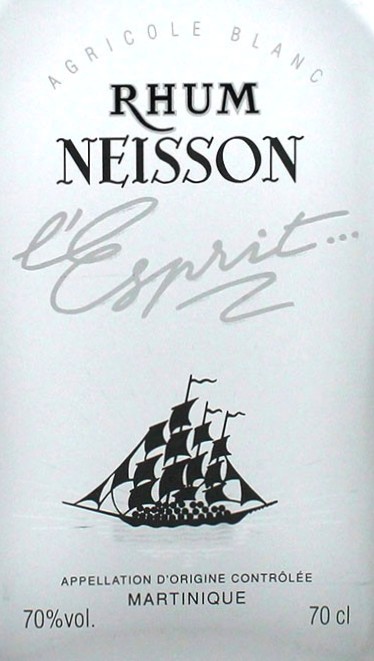
Now, this rum is something of a special edition, initially released in 2002 for the 70th Anniversary of the distillery, and annually without change thereafter – it is rested for six months in steel tanks after being taken off their Savalle still, but it is not aged in any way.  Although the resolutely family-owned distillery is now 85 years old, the rum retains the original title, perhaps because of its popularity among the rabid cognoscenti, who enjoy its 70⁰ ABV and the 70cl square bottle  Maybe some enterprising mathematician could work out how the sums of the corners and angles on the thing added up to or produced 70 — for my money, I’m more interested in whether the company releases more than 70 bottles a year or not, because for anyone who likes white lightning – whether for a cocktail or to brave by itself – this unaged rum is definitely up there with the best (or craziest).

You could tell that was the case just by smelling it: clearly Neisson felt that the subtle, light milquetoasts of the independent full proofs or the clairins (who bottle at a “mere” 60% or so) needed a kick in the pants to get them to up their game and join the Big Boys. The sheer intensity of the nose left me gasping – salt, wax, paraffin and floor polish billowed out hotly without any warning, accompanied by the sly note of well-worn, well-polished leather shoes (oxfords, not brogues, of course).  Nothing shy here at all, and the best thing about it – once I got past the heat – was what followed: coconut cream, almonds, olives, fruits (cherries, apricots, papaya, tart mangoes), all bedded down in a bath of sugar water and watermelon, and presenting themselves with attitude. If I was telling a story, I’d wax lyrical by saying the ground moved, trees shook, and an electric guitar solo was screaming in the background…but you kinda get the point already, right?

Oh, and that’s not all – the tasting was still to come. And so, be warned – 70 degrees of badass carves a glittering blade of heat down your throat, as surgically precise and sharp as a Swiss army knife.  A hot, spicy, and amazingly smooth sweet sugar water — spiked with stewed prunes, lemon zest, wet grass and gherkins in brine — roared across the palate.  With its brought-forward notes of polish and wax and grassiness, I felt like it was channelling the gleeful over-the-top machismo of a clairin, yet for all that enormous conflation of clear and crisp tastes, it still felt (and I know this is difficult to believe) smoother, creamier and more tamed than lesser-proofed whites like the Rum Nation 57%, Charley’s J.B. Jamaican white, the Clairin Sajous or the Klérin Nasyonal….which says a lot for how well the L’Esprit is actually made.  And the finish was no slouch either, long and very warm, salt butter and cereals mixing it up with some citrus, red grapefruit, more grass and even a hint of the smooth salty oiliness of a well-made tequila.

“How the hell did they stuff so much taste into the bottle?” I asked myself in wonder. Perhaps the unwritten, unspoken codicil is “…and not muck it all up into an unfocussed mess?”  Well, they did provide the profile, they didn’t muck it up, I enjoyed it thoroughly, and it was only later that I realized that in a world where Ringling Brothers can fit fifteen fat clowns into a Mini, I should not have been so surprised, when it’s obvious that in the rumiverse just about anything is possible.  Certainly Neisson proved it here.

You know how we hear the old joke about “Rum is the coming thing….and always will be”? This kind of statement is regularly and tiresomely trumpeted by all the know-nothing online drinks magazines who have their lazy hacks attempt to pen a few words or make up a click-bait list about a subject on which they are woefully ill-equipped to speak.  Still…take that statement a bit further.  I honestly believe that as the stocks of old and majestic 20+ or 30+ rums run out or are priced out of existence, it will soon become the turn of unaged, unfiltered white rums to take center stage and become De Nex’ Big Ting.  I accept that for the most part these will be cocktail bases — but for the enterprising, for the slightly addled, for the adventurous among us, for those who are willing to step off the path and enter Mirkwood directly, the real next undiscovered country lies with these white mastodons which showcase much of the amazing talent that remains in our world, needing only the bugling of an enthusiastic drinker or an enthusiastic writer, to bring them to a wider audience.  

(86/100)


Other notes

I should mention that Josh Miller of Inu A Kena ran the Neisson 70 through a 12-rum agricole challenge a while back.  If you’re not into neat drinks so much but love a cocktail, that article is worth a re-visit.

May 242017
 

Rumaniacs Review #044 | 0444

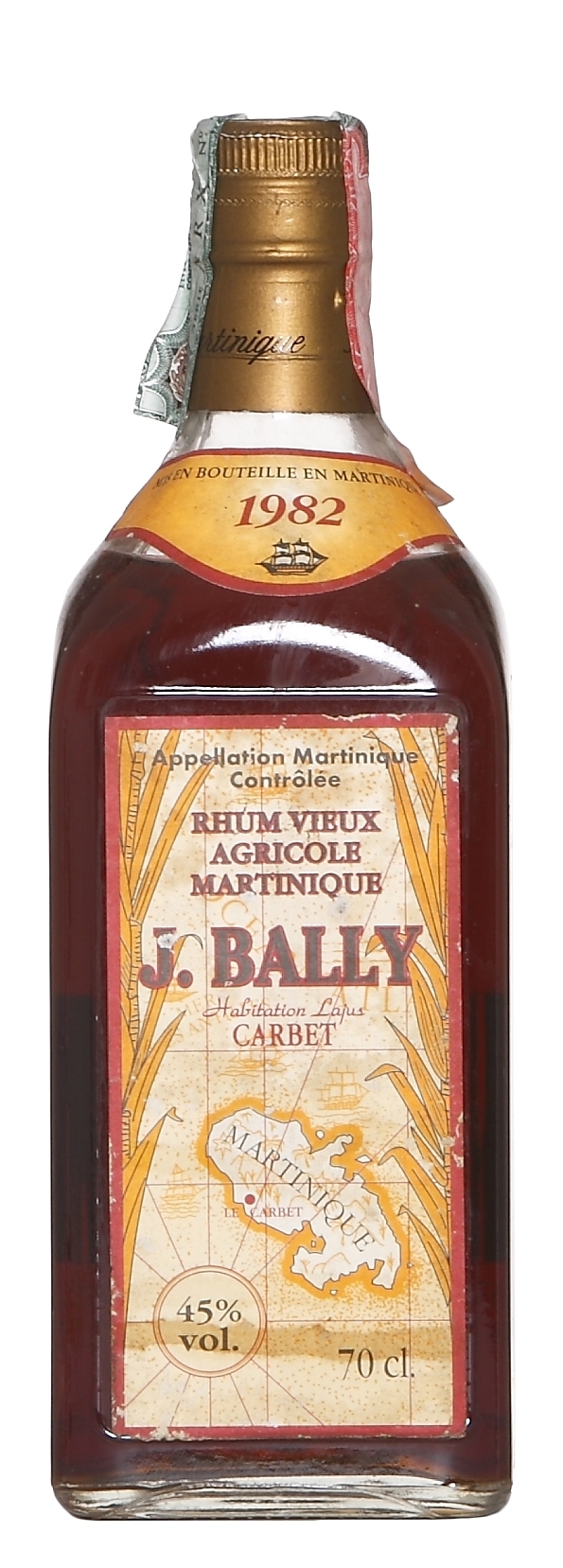
We’re slowly moving past the more recent vintages of the Bally rums and into something not necessarily older, but bottled from longer ago.  Hopefully they’ll throw some light into the development of the profile over the years.  The quality of the older expressions is not necessarily or always better just because it was made thirty five years ago…but yeah, perhaps in this case it is. The 1982 is certainly one fine piece of work, made at the original Bally site before the distillery closed in 1989 and production was shifted over to Simon.

Colour – Dark Amber

Strength – 45%

Nose – Oh, so nice. A smorgasbord of fruity notes right away – raisins, blackberry jam, candied oranges, plus coffee, anise, caramel bonbons and some breakfast spices (and cumin, oddly enough).  It presents as sweeter than the 1992 and 1993 variations, and also somewhat more musky, salty, with those wet earth aromas  being quite distinct, though fortunately not aggressive…more like an underlying bed upon which the other smells were dancing.

Palate – Warm, delicious, sweet and salty, like a Thai vegetable soup with sweet soya. After opening up some, the fruits take over – berries, cherries, jammy notes, nougat, light florals.  Loads of complexity here, well balanced against each other.  There’s the earth tones again, some black tea, bananas, light citrus.  None of the flavours are dominant, all rub against each other in a cool kind of zen harmony.  One odd thing here is that the grassy and sugar-cane sap part of the profile is very much in the background and nowhere near as clearly discernible as modern agricoles lead us to expect.

Finish – Long and faintly sweet.  There was actually some anise and coffee here (and was that molasses? …naah).  Long on spices like cinnamon, cloves and cumin, and the warm wet earth component, which I’ll say is Jamaican even though it isn’t, made one last bow on the stage.

Thoughts – I dearly wish I knew how old the rums truly was.  It’s labelled as an AOC, but that classification only came into force in 1996, so is it possible that the 1982 is at least 14 years old?  I simply don’t know.  Perhaps it’s just as well.  Like it or not, we sometimes unconsciously feel a rum aged for longer is somehow better – that’s a good rule of thumb, just not universally applicable, and here, whether it is that old or not, there’s no denying that for its price (still available at around three hundred dollars, same as the 1992) it’s a remarkable rum, made within the living memory of us rum collectors and Rumaniacs, and leading us by the hand into the misty times predating the iron rule of the AOC.

(86/100)

The other boys in the Bally-house have also looked at the 1982, and you can find their comments in the usual spot on the Rumaniacs website.

May 232017
 

Rumaniacs Review #043 | 0443

Leaving aside the independent bottlers, the agricolistas from Guadeloupe and Martinique seem to like producing a specific year’s output with much more enthusiasm than most molasses based rum producers, who (until recently) preferred to release specific “recipe-style” blends that changed little from year to year.  There’s something to say for both ideas – consistency of taste over time, versus the individualism of specific date points – which just supports my thesis that even in writing about a social spirit, larger philosophical issues about our world can be discussed using them as an example.

In this case, we’re not moving too far away from the Bally 1993 written about in R-042, but the price has definitely gone up (to over three hundred bucks) – and that’s even without knowing precisely how old the rums is, though I maintain that it, like its brother, is around 3-5 years old.

Colour – Amber

Strength – 45%

Nose – It’s initially more hesitant in its profile than the 1993 (and the others), or perhaps just more focused.  Both a strength and weakness, methinks. Salty molasses and caramel notes, green grapes, segueing over time into something darker, deeper: chocolate, cereal, wet cardboard.  Some herbal, grassy notes, just not very clear. There’s also a musky  tinge here, something like rain falling on very hot earth, and at the last, flowers, honey, biscuits. Actually reminded me of a miso soup.

Palate – Crisper, saltier, cleaner.  Something of a right turn from the way it smelled.  Olives, guacamole, brakfast spices, and vegetables more so than the fruits (which came later).  The cardboard and attic-level stuffiness and wet earth make a return bow.  Some jams and citrus notes follow on but don’t claim the high ground from the vegetals.  Not sure this entirely works for me.  It may just be a matter of taste.

Finish – Green grapes, cinnamon, brine, olives, avocados – it took time for the caramel and fleshy fruit to close things off.  A bit too much wood here, I thought, though anise – sensed more than experienced – was a good background.

Thoughts – More individual than the 1993, more oak, more vegetables, less fruits…somewhat less “rummy.”  Bit of a schizo rum and didn’t have that little something extra that I would have preferred – still, that’s a personal opinion, and overall, it’s still a good dram for something so young.

(83/100)

Some of the boys from the Rumaniacs have also taken a crack at this rum, and their reviews can be found in the usual spot.

May 212017
 

Rumaniacs Review #042 | 0442

The first of six Bally rums (no relation to me), which we’ll also post faster than usual, since they are, again, part of a series.  Let’s start with the most recent.

For those who are interested in agricoles (which these assuredly are), J. Bally from Martinique has been around since 1917 or so (land prices after the 1902 eruption of Mount Pelee were low), but the sugar estate of Lajus goes back even further, to the mid-1600s.  Alas, Bally has been closed since 1989, but their stills continue.  The Simon distillery now owns them, and supposedly the original recipe for Bally’s rums, and sugar from the original plantation,  is used to ensure the brand does not die.  And of course, the AOC certification is alive and well with these rums.

True age is always a problem with these millésimes (meaning a specific year of production), because the date of distillation is noted….but not always the date of bottling.  Since a “rhum vieux” is supposed to have a minimum of three years ageing, I’m going to say 3-5 years old, then.

Colour – Amber

Strength – 45%

Nose – Quite solid, very smooth and, of course, crisp as fresh picked lettuce.  Amazingly fruity profile here, prunes and raspberries to start, nicely rich and quite aromatic, adding bananas, honey, hard yellow mangoes (from India or Thailand), and coiling around the background of herbs and grasses…some spearmint chewing gum.  And a touch of oak, cinnamon and caramel.  Seems almost like a Guadeloupe rum, what with the way the herbal and grassy aromas take a back seat and fruits are this rich.

Palate – Mmm, nice.  Fresh and crisp. Sugar cane and saline and gherkins, plus bales of freshly mown grass now taking their place in the front.  Caramel, raisins, a flirt of molasses and olives.  It’s all quite well assembled, and not overly weak, not obnoxiously strong.  Continues with vague honey notes and richer fruits, some more of that spearmint.  There’s some anise floating around there someplace, but not enough to make a statement of any kind

Finish – Vanillas, burnt sugar, honey, sugar cane, grass, and a bit of that olives in brine thing I enjoyed.  Somewhat hotter and sharper than what had come before, oddly enough.

Thoughts –  A young rum, and very enjoyable.  Agricoles do have that trick of making stuff in the single digits take on molasses rums twice as old and leaving them in the dust. I still think overall it resembles a Guadeloupe rhum more than a true agricole (even though it is AOC certified), but whatever the case, I’m not complaining.

(84/100)

Others in the group have written about this rhum on the Rumaniacs website…

May 022017
 

#361

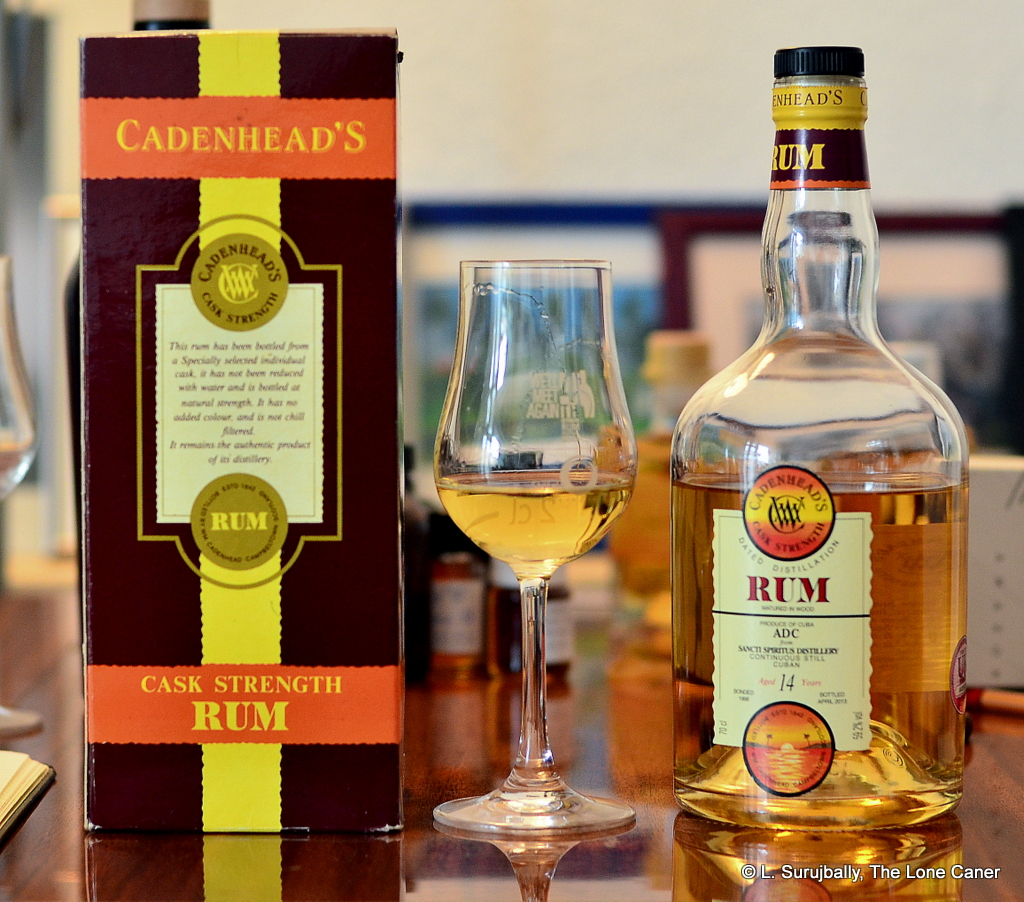
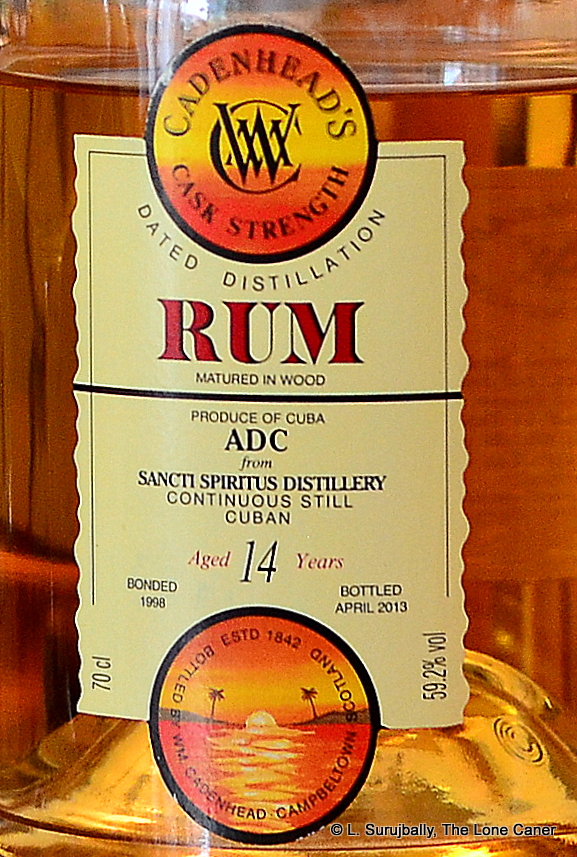
The Sancti Spiritus distillery in Central Cuba, also known as Paraiso, has been making rums since 1946, and other than its history (see “other notes” below) there is remarkably little hard information about its operations, its size, volume or exports on hand. Aside from what must be substantial local production which we don’t see, they may be better known for the relatively new Ron Paraiso brand, as well as from the labels of independent bottlers like Compagnie des Indes, Kill Divil, Bristol Spirits, the Whisky Agency, and, here, W.M.Cadenhead.  Based on what one sees for sale online, barrels seem to have begun hitting Europe somewhere around the mid 1990s, with the one I’m looking at today coming off the (columnar) still in 1998 and bottled at a firm 59.2% in 2013.  Cadenhead, as usual, have amused themselves with putting the abbreviation “ADC” on the label, which could mean variously “Aroma de Cuba,“ or “Acerca de caña” or, in my patois, “All Done Cook” – any of these could be used, since Cadenhead never discloses – or doesn’t know itself – what the initials denote, and I’m tired of asking and getting “Ahhhh…duuuuh….Cuba?” in response.

A number of people who like the heavier, thrumming British West Indian rums (from Jamaica, Guyana, and Barbados for example) have sniffed disparagingly to me about Spanish rons recently, especially the column still ones, which are most of them.  I suspect this has to do with their despite for Bacardi and the light Panamanian stuff that’s been slipping in the ratings of late.   Nothing wrong with that, but my own feeling is that they’re casting too wide a net, and if one throws out an entire region’s worth of bathwater based on a few sampled rums, then one misses the baby that washed out the door as well.  Maybe it’s the occasional lack of verifiable ageing, maybe it’s the lightness, maybe it’s the palate of the drinker. Don’t know. But this Cuban ron does deserve a closer look.

Consider first the nose on the pale yellow ron: it was a sparkling, light dose of crisp, clean aromas, starting off with rubbery, sweet acetones all at once.  In its own way it was also quite tart, reminding me of gooseberries, pickled gherkins, cucumbers and lots of sugar water, stopping just short of presenting an agricole profile.  I don’t think I could have sipped it blind and known immediately it was from Cuba.  At a whisker shy of 60% it attacked strongly, but was too well made to be sharply malicious, and was simply and forcefully intense, which was to its credit and made the experience of smelling it a very good one, especially once some soursop, citrus and baking spices were coaxed out of hiding a few minutes later.

The taste fell down somewhat – there was dry wood, a lot of strange and almost-bitter tannins at the start; which was fortunately not a disqualification, because these tastes balanced off what might otherwise have been an overabundance of light sweetness represented by watermelon and papaya and Anjou pears.  Gradually it unfolded like a flower at dawn, producing additional faint notes of orange zest, almost-ripe yellow mangoes and apricots, balanced by iodine, menthol (!!), tumeric and some strong black tea, all of which led to a conclusion that was suitably long, clear and spicy, closing off the show with nutmeg, more of that tartness, and a flirt of orange zest.

Briefly, Cadenhead’s ADC stacked up well against a raft of agricoles, Spanish and Surinamese rums that were on the table that day. It did make me think, though: reading around others experiences with Cuban rums generally, one thing that strikes me as consistent is that the demonstrably older a Cuban rum is, the more commonly it is scored high.  Now pot still rums made with some skill can be good right out of the gate, and creole column-still juice out of the French islands prove all the time that higher age does not necessarily confer higher praise (or scores).  But with column still rums made in the Cuban/Spanish style, the usual easy 40% young stuff or blended rons of some age just don’t have that sizzle which Cadenhead somehow extracted out of their barrel here. In other words, for such traditionally light rums, additional ageing is a better deal, it would seem.

So, in fine, I believe that this rum is better than the Havana Club Barrel Proof (and the Seleccion de Maestros that succeeded it), better than the Renegade 11 year old (but maybe I should retaste since I tried that one ages ago); it edges out the Santiago de Cuba 12 year old, though is perhaps not quite as good as the CDI Sancti Spiritus (also from 1998).  Those dour Scots took the sunshine of the tropics, doused it with some cold salt sea-spray and foam-lashed rocks, and produced an amalgam of both that’s better than either, and just falls short of remarkable – it’s worth a try by anyone, if it can still be found.

(86.5/100)

Other notes

A few words on the distillery history: called variously the Paraiso or Sancti Spiritus distillery, the founding family, the Riondas, began their sugar business in 1891 with a company called the Tuinucú Sugar Company in the province of Sancti Spiritus (which was also near to the original Bacardi distillery). In 1946 the Paraiso Distillery was created and in 1951, the Tuinucú Sugar Company was consolidated into both plantation and distillery operations. Since the revolution, the Government took over the entire operation not long after and has run the show ever since.

Apr 302017
 

Rumaniacs Review #034 | 0434

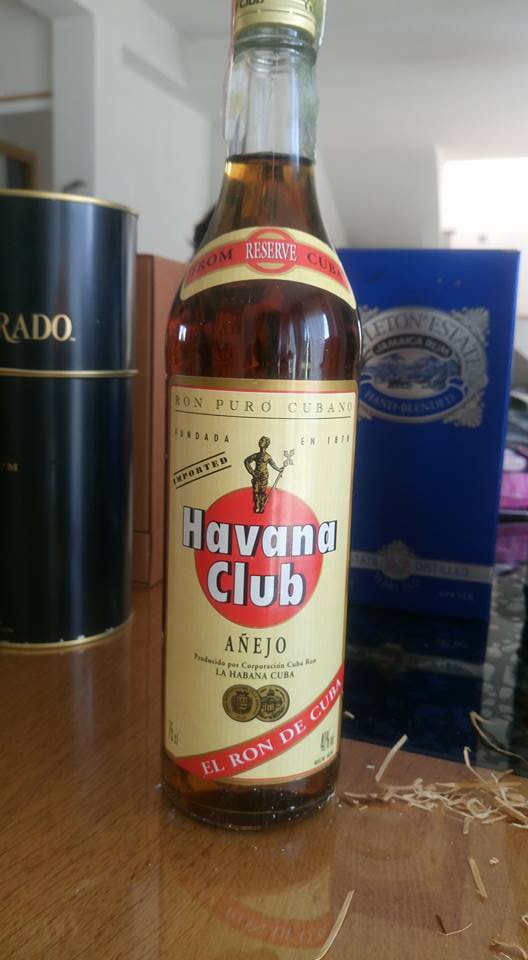
By now we are all aware of the two different kinds of Havana Club.  This rum is the one from Cuba, not the Bacardi version made in “not Cuba” and hails from the 1980s which, coincidentally, is when I started drinking DDL’s King of Diamonds (a useless factoid, I know).  No point rehashing well-known details of the brand, so off we go.

Colour – Amber

Strength – 40%

Nose – Oh well, very nice indeed, quite a few steps ahead of the Facundo Paraiso.  Dare I say “the real deal”?  Better not.  Initially it smells very crisp and floral, with light “watery” fruits (pears, guavas, even watermelon), and then segues gently into something more creamy.  Actually the aroma moves into heavier syrup-from-tinned-peaches territory after a while, but is redeemed from cloying heaviness by remaining reasonably light, adding some brine and genteel gone-to-seed flower gardens with too much earth.  Some traces of toffee, tobacco, maybe a flirt of cinnamon.  Gone too fast, alas.

Palate – What just happened here? Was that licorice, medicinals and plasticene I tasted?  Indeed it was. Just as suddenly, it went limp again, but after standing for a while, with some effort, I could make out additional flavours of green peas (!!), apple juice, vanilla, nutmeg, caramel, cardamon…and some bitterness of over-zealous application of the barrel.  Good potential, but ultimately unsatisfying and again, this being the era of 40%, really not intense enough, while interesting in its own way.

Finish – Well done, reasonably long for the strength.  Cigar smoke, brine, some last herbal notes and a couple of olives.  Dry and dirty and quite pleasant.

Thoughts – Nose and finish are the best part of the experience, with some nice points on the palate.  Not as anonymous and boring as the Bacardis, yet lacks punch in its own way; and even though it may be churlish to grumble about the way rums were made back then, a few extra points of proof would have gone a long way to raising the labial volume to something higher.

(80/100)

Other Rumaniacs reviews of this rum can be found on the website.

Apr 202017
 

“Dale paso al placer” reads the bottle label, which translates into “Give way to pleasure.”  Obeying that would encourage me to give away the bottle.

#358

If the Panamanians (and other rums made in the light Spanish style), don’t up their act soon, I have a feeling they’ll be left behind in an era where tougher, more muscular, and more original rums — many of which are pot still based — are being made both by independent bottlers and more farsighted big distillers in other parts of the Caribbean.  There’ll always be a market for standard strength rums – low price and easy sort-of quality ensures that every hormonal teenager and up-and-coming rum junkie usually cuts their teeth on one of them – yet I believe that the emphasis is slowly shifting from buttercup to beefcake: they are the new premiums, and margins will shift to favour them…and those who don’t get with the program may very well find their rums relegated to third tier supermarket tipple.

These were the thoughts running through my mind as I sampled the Canalero Añejo, which was a 40% Panamanian rum bearing Don Pancho Fernandez’s fingerprints.  That’s no surprise, since he is the master blender for SER Alcoholes, the company that makes it.  SER Alcoholes, whose name is nowhere noted on the label of the rum, is a group of companies now owned by the Grupo Pellas (SER stands for Sugar, Energy, Ethanol, Rum so an “E” is missing there someplace) and operates out of Las Cabras de Pese in Herrera Province in south central Panama where their plant is located. As far as my research goes, it’s a column-still rum based on molasses, and there’s little information online about it beyond that, not even age (I was told it was three years old).

In the smell and taste of this rum, there were aspects of many other Panamanians coiling beneath, somewhat dampening down any originality it may have possessed at the inception. Take the nose: simple and straightforward, spicy and clear, with little beyond some molasses, light citrus and a few fruity hints (mostly raisins and ripe cherries).  The palate was also similar in this way, with more sweet molasses, again some fruitiness of cherries and raisins, perhaps a flirt of vanilla, and even less citrus than the nose.  It was extremely light in texture, hardly worth remarking on, had no real complexity or distinctiveness – it was tough to come to grips with because there was so little going on.  Five minutes after I tasted it I would have been hard pressed to pick it out of a lineup.  Even the finish was like that: short, easy, indistinct and very forgettable.  In other words, a young pup, the runt of the litter, which enthused me not at all, not because it was bad, but because it just didn’t have much of anything.

To me, this is a commercial supermarket rum for those who just want to go on a bender without major effort or expenditure.  It’s soft, it’s light, it’s a rum and beyond that, quite unremarkable. The Ron Maja, Ron de Jeremy, and the Malecon 1979, for all their similarity, were better, the Abuelos were a step up, and the independents’ wares are a class apart entirely.

There are a lot of Panamanians which I’ve enjoyed over the years, many of which are decent markers of the style, reasonably well made, soft and easy to drink. Don Pancho is more or less the poster boy for the entire country because of his extensive consulting work and advice provided to various makers from there.  But perhaps no one person, no matter how esteemed, should have such an outsized influence on an entire region’s production because what it results in is a quiet weakening of true innovation (such as is exemplified by the various distilleries of Jamaica and the French islands, who seem to enjoy making whatever crazy hooch they feel like on any given day while squabbling for bragging rights amongst themselves); and that makes many Panama rums subtly like all the others, with variations being almost too minor to matter – you taste one, you’ve tasted most. Hardly a recipe for maximizing sales or energizing the tippling class to buy every one they can lay hands on.  With respect to the Canalero Añejo, trying it once was quite enough for me since this is a rum where nothing much really happened.  Twice.

(72/100)

Apr 122017
 

Rumaniacs Review #033 | 0433

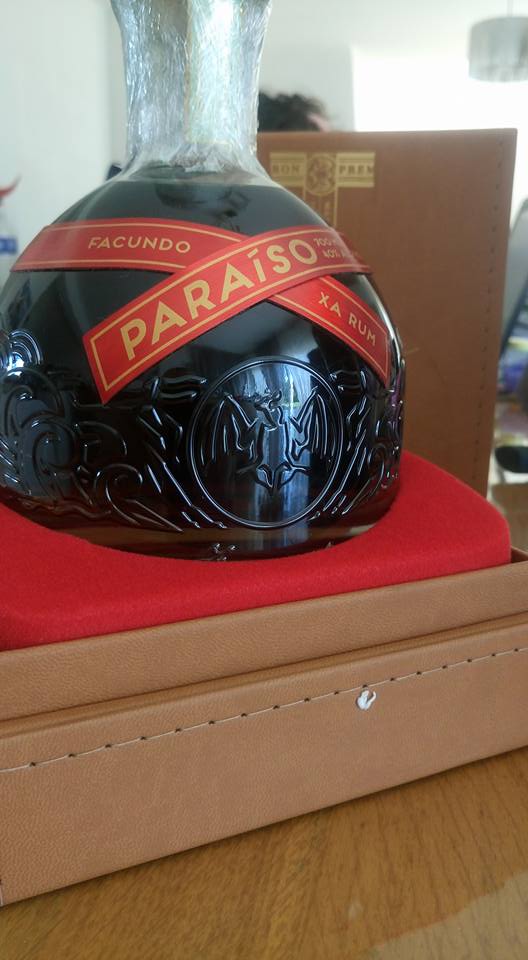
The Facundo rum series from Bacardi which was launched in 2013, is an attempt by the company to insert itself into the premium market with a series of aged blended rums.  Strictly speaking, it’s not a true Rumaniac vintage (the idea is to write about old stuff that isn’t actually in production any longer), but every now and then a more current expression slips through the cracks without having gone through the process of being recalled only by the elderly, filtered through their fond recollections of where they had been when they first tried it.  You know how it is – when you can’t get the vile crap you had in your younger years any longer, it grows in the memory, somehow getting better each time.

The Paraiso is the top end of the four expressions released under the brand (Neo, Eximo and Exquisito are the others) containing various rums aged up to 23 years, finished in old cognac barrels and is priced to match, though one wonders how much of that is the bottle and enclosure rather than the rum itself.  And of course there’s all the old marketing blather about jealously guarded, never-before-seen, private stocks and family casks meant only for visiting royalty, not the ignoble peasantry.

Colour – red-amber

Strength – 40%

Nose – Briny, soft and mildly fruity, with almonds and vanilla. Some toblerone and a whiff of tobacco. Herbal, grassy notes, and oak, and exactly two grapes. Sweet and light and too damned faint.  Not sure what’s stopping them from boosting it to maybe 45%.

Palate – It may be a blend of old rums, but I think it hews too closely to the formula represented in its downmarket mega-selling cousins.  The thing is too light and too weak in both mouthfeel and taste – there’s no assertiveness here. Caramel (weak). Pears and another two grapes (weak). Alcohol (weak). Vanilla (some). Almonds, oak, breakfast spices (almost nonexistent).  Sugar (too much – I read it has 15-20 g/L when doing my research after the tasting, so now I know why).  Plus, all these flavours blend into each other so it’s just a smooth butter-caramel-vanilla ice cream melange at best.  Did I mention I thought it was too sweet?

Finish – Short, kind of expected at 40%. One last grape. Halwa and Turkish delight (seriously). That is not entirely a recommendation.

Thoughts – Unless you’re a fan of light, easy sipping rums from Cuba (or in that style), and are prepared to drop north of £200, I’d suggest passing on it.  It’s not, as the website suggests, “possibly the finest rum ever sipped,” not even close. Still, the presentation is excellent, and for its strength it has a few pleasant notes — but pleasant is not what we want in something bugled to be this old and this expensive: we want a challenge, a blast from the past, something majestic.  This isn’t it, and frankly, it just annoys me. There’s more and better out there at a lesser price from the same island.

(75/100)

Other Rumaniacs were quite irritated with the rum as well, and their reviews can be found here on the Rumaniacs website.

Apr 102017
 

#355

Back in 2015 I wrote about the Ron Maja 12 year old rum which purported to be from El Salvador based on the place of origin of the family behind it, but really wasn’t when one considered the location of the production process.  Here’s another one from that country, which earns its geographical appellation somewhat more, though overall, there isn’t much more to it than its cousin.

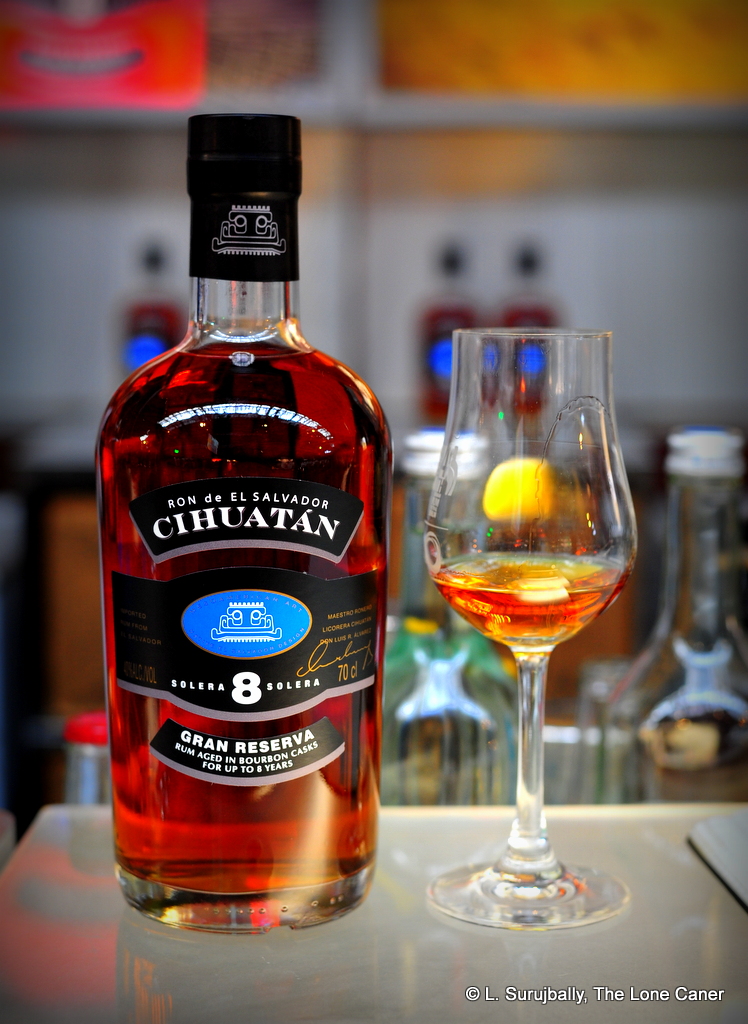
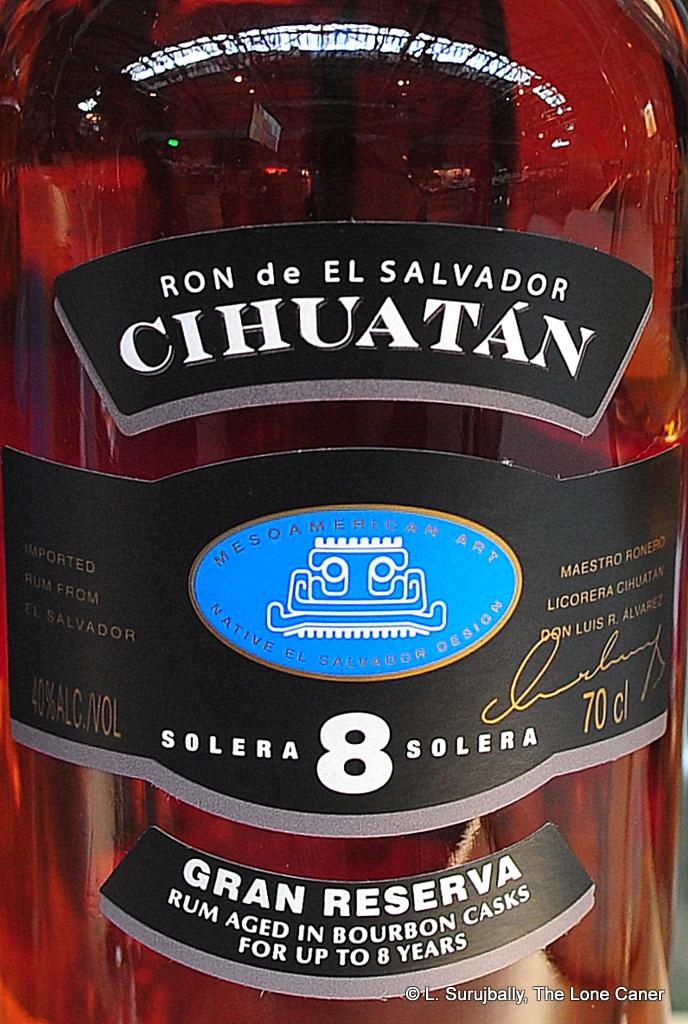
The dark gold Cihuatán is a molasses-based 40% Salvadorean rum aged in white oak ex-bourbon barrels, with the base distillate going into the 5-layer solera system in 2004 for eight years – that does not make it an eight year old rum, of course, just a rum with components up to eight years old inside it.  It is made by Licorera Cihuatan, itself a subsidiary of Ingenio La Cabaña, one of the larger sugar concerns in the country (it was established in around 1920).  It is a diversified company located north of San Salvador, and its main business is based on a sugar cane plantation, a sugar mill and a modern alcohol plant (built in 1999) with a multi-column still that produces various alcohols and liqueurs for both the leisure and industrial market.  Sometime in the early 2000s the company wanted to ride the wave of rum’s resurgence as a premium drink and initiated their own brand, consulting with Luis Ayala (publisher of Got Rum? magazine) in the process.  What came out the other end and hit the shelves in 2015 — mostly locally and in Europe — was this rum, which adheres to all the markers of a mid-tier solera without trying to reinvent the wheel.

I’m not making a case for there to be something fantastically original about any new rum to hit the market, of course, and one cannot expect that from a solera in any case.  Yet even by those standards, this was a remarkably quiet rum. There were no out-of-left-field smells emanating from the glass after the initial pour.  No arrogant or aggressive fumes of pungency and power.  No cask-strength olfactory bruising, simply a warm nose redolent of cherries, plums, some light florals, a touch of leather and somewhat of an excess of vanilla; plus, after some minutes, some oaken tannins. Nothing to write home about – rather simple, actually.

That impression continued with the taste, mild and pleasant though it was – initially it was simply too sweet, and the vanilla was too much in the forefront.  Some cocoa powder, coffee grounds stayed in the background, leaving the vanilla to duke it out with cherries and more plums, sugar cane sap and a touch of citrus, however indistinct it might have been.  As I’ve remarked on several soleras before now, they tend to be more sweet than the norm, and much lighter, though with a good one there’s always some edge to the experience, with sharper citrus and fruity notes that ameliorate the saccharine.  Here this was not the case, and even with water not much more could be picked it out, and so it all led to a soft and warm exit, with some floral notes rejoining the vanilla party.

All right, so I appreciate that it’s a solera (with all that this implies) and it may have some eight year old in it, and it may be part of the revival of rum production in the country (a laudable effort, as I remarked in a comment on the Maja).  But for me it needs some more work. Vanilla too much, sweet could be toned down, the overall gentleness could maybe be tarted up a touch.  Don’t get me wrong, it’s a fine and easy rum with a decent, if uncomplicated palate – it reminds me of the Travellers rums, or Panamanians in general, or of a low rent Panamonte. Which might be why it didn’t make any kind of worldwide splash outside the festival and awards circuit.

In the first three years or so of reviewing rums, I started out with the commonly available, easygoing forty percent rums, which included quite a few soleras, and back then I liked them quite a bit.  Nowadays I think they’re good for lovers of easier fare (or of Spanish style rons) who either can’t get or simply don’t like rums of cask strength aggressiveness.  On that basis, this one works fine…if without flair. If you want a relaxing drink to have around a campfire somewhere, or to unwind after a bad day at the office, a soft, relatively uncomplex rum like this would be just right.  That may be why – much like with the Maja — I’ll take one if offered, but would prefer to save my dinero for its slightly older cousin, the 12 year solera when it comes out.

(77/100)


Other notes

  • The title Cihuatán comes from the name of an ancient Mayan settlement – it’s an archaeological site now — that once existed very close to where the distillery is currently located.  It translates into “next to the woman”, referring to a mountain nearby which looks like a sleeping woman in silhouette
  • The glyph on the label represents Tlaloc, the Mayan god of water
  • The 12 year solera variation, if also made from the 2004 distillate, should be widely available from 2017. My fellow rum chum Paul Senft of RumJourney told me that is is currently available in the USA and the company later confirmed that it is for sale in Europe and El Salvador as well.
  • After I sent some inquiries their way, Cihuatán responded with the following notes: small quantities of brown sugar from their mill are added to the batches in order to maintain consistency on an as-required basis (not as part of a deliberate sweetening strategy); multi-column still, not single as I had originally written (post updated for this fact); and they are working on limited single-barrel editions to be issued in the future.
Apr 012017
 

#352

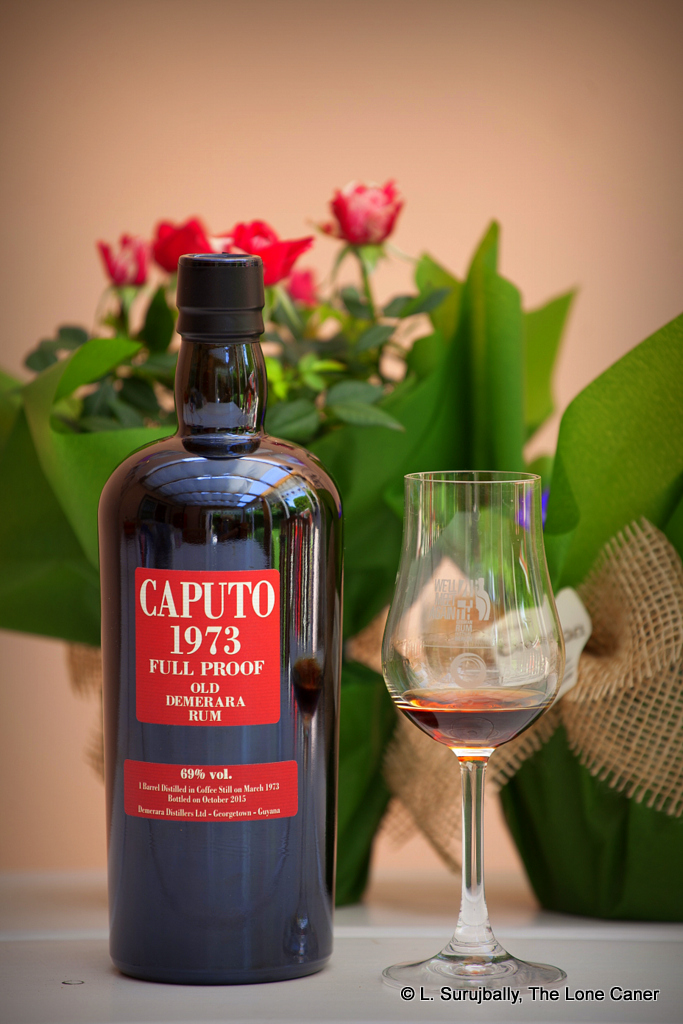
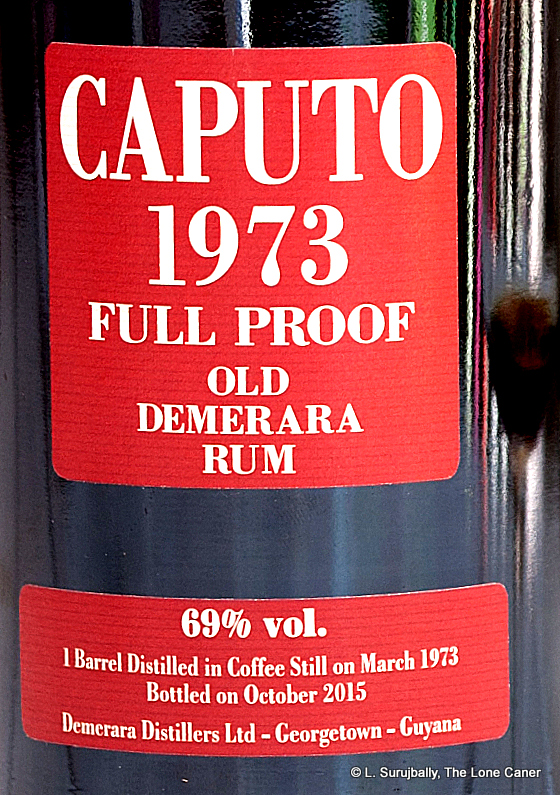
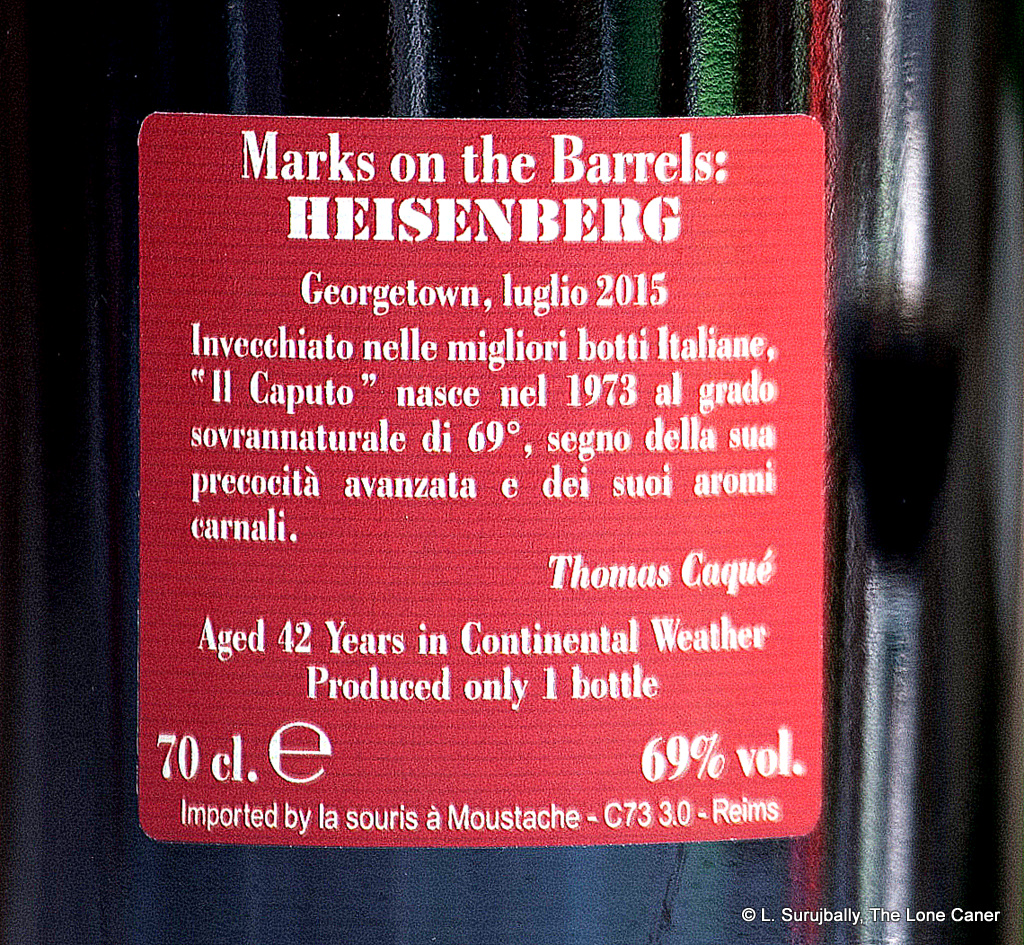
After the near riot caused by the emergence of the Caputo 1973 last year, when (my distant relative) Ruminsky van Drunkenberg was mobbed in Berlin by the horde of reviewers demanding their samples (local police nearly had to declare a state of emergency), they lapsed into silence, and none of them published any review after the fact.  It was only after sampling it myself that I understood the reason for their malfunction: they weren’t being reticent, they weren’t holding off out of some semblance of courtesy — they were recovering from the near catatonic shock of actually having tried it; and spending much of the subsequent months on bended knees in a sort of come-to-Jesus state of thankfulness at surviving.  Henrik of RumCorner, after uncoiling his knotted intestines, literally had to take a sabbatical from rum reviewing, so traumatic was his encounter; my buddy the RumHowler poured his down the sink and local geologists thought a new oil sands block had been found; Sir Scrotimus was still weakly sneering that the Mount Gay XO was miles ahead of this thing as he was being wheeled into the local ER; Cyril snorted that his Port Fagnant 1972 was far better, threw his sample away, and delved hurriedly into some aged Appletons to cleanse his palate, Master Quill fled back to reviewing malt whiskies with almost indecent haste, and the Cocktail Wonk immediately booked himself on a recovery cruise (while pretending to be in Spain). Now I know why.

Parsing the above, it was clear that their opinions of the Caputo 1973 Old Demerara Rum were all negative. And after trying it myself, I can only agree: it is the vilest, nastiest, filthiest oak-infused liquid crap anyone had ever had the courage (or madness) to bottle.  It makes the Kraken and the Don Papa appear to be brilliant models of premium-rum assembly in comparison. I thought Ruminsky was kidding when he related legends I took to be apocryphal – such as the barrels having Bata slippers, decomposing rats, half an old suit and a transistor radio as part of the blend – but now I honestly believe that not only was this the unvarnished truth, but he was actually understating the matter.  No wonder Cadenhead and Lamb’s and Gordon & MacPhail (“We need to give our rums some character – oh, this looks interesting…WTF???”) never acknowledged any of this swill in their own blends.

Readers might think I’m kidding, no? “Oh yeah buddy, if that’s the case how come you’re still churning out overlong crap reviews week in and week out?” I can hear you say. Fair question. Maybe it’s a matter of having an immune system armed with heavy weaponry developed by years of swimming in muddy rivers and trenches only marginally purer than this rum, in the backdams of three continents.  Or the sheer raft of unspeakable hooch I sample and drink, the reviews for which never make it into print.  That’s toughened me up some, sure. Truly, however, nothing prepared me for the shudderingly awful mess that was this rum.

Inky and dark as the inside of a black cat in a coal mine at midnight, bottled at a massive 69%, the rum was made around 1973 and therefore had an age higher than my IQ.  In a sense of utterly misguided optimism, I poured it into my glass and sniffed it without any precautions, lost all sense of time and woke up the following week in Bangkok.  It landed on my defenseless nose like an oversized artillery shell, producing a hurricane-force gale of stink, all of it horrible beyond description. My first thought upon recovering my diminished mental capacity was that it smelled like vomit from a wet mutt that had just eaten rancid curry goat and rotten mangos thrown up by another wet mutt. I suppose I could tell you there was some vanilla and molasses, but I’d be lying, since all of it was overlaid with the feral stench of a stale chamberpot emptied into a dunder pit, with perhaps some pine-scented dishwashing liquid dripped in to make it palatable. And a ripe flatus.

Last eight years or so, it’s been a point of pride for me to taste every rum that crosses my path so you don’t have to, but after that nose, here’s one time when that principle took a beating.  Somehow I found the strength to keep going.  Big mistake.  Huge.  It was molasses transmogrified into gunk, and looked like a gremlin — what’s left of it – after being exposed to sunlight too long. It was thick, mean, strong, and tasted of medicine and mud with a sprinkling of molasses and spoiled gray oranges.  I involuntarily farted and the apartment block had to be evacuated and the HAZMAT team called in (this interrupted my tasting for another week). Frankly, it’s barely a rum at all, because it seemed to be doing triple duty as a massive ethanol (??) delivery system of unparalleled badness, as well as an all-purpose rust remover and emergency fuel for the Humvee parked outside, channeling the powerful and blunderingly pointless staggering of a stoned elephant. I would have made more notes, was just too busy trying to untangle my insides from my backbone, and therefore never got around to writing about the finish, sorry. At the end, once the sample was done, I removed tongue and glottis from my head and cleaned them in the kitchen sink with some Marienburg 90%, because nothing else on hand short of industrial-strength factory cleanser could remove that foul taste from either.

F**k – this is a ghastly rum.  There are insufficient negatives even in my vocabulary to describe the black swill that nobody ever thought could ever be made. If you could find it you could not afford it, and if you could afford it, the seller would never tell you where it was, and if you could find it and afford it, you’d be begging the next guy in line to take it off your hands after the first sniff.  Perhaps it was no accident that it came from a single barrel, long forgotten.

Oh yes, the background: for those unwilling to wade through a epic history of the distillery of origin, the Heisenberg estate is an abandoned Guyanese sugar plantation that went belly-up in the early 1970s and has long since returned to the jungle – it used to be located west of Enmore and east of Port Mourant, and owned by one Count Drinkel van Rumski zum Smirnoff hailing from what was once Prussia. The miniscule estate, founded in the 1800s, was so small that at best it produced a few tons of sugar cane a year, and remained so insignificant that all histories of Guyana routinely ignore it to this day — even Marco of Barrel Aged Mind missed it in his magisterial survey of all the country’s plantations.  An old tome my mother found many years ago called “Schomburck’s Travels in Guiana” dismissed it contemptuously with one sentence: “The Heisenberg estate in Guiana provides no distillate worthy of the name – what they make is vile and tastes of horse manure and we do not deign to speak further of it.”

One report about the Caputo source barrel said that once it was in DDL’s warehouse being used as a table for cleaning rags, another say it was hidden in plain sight, disguised as a toilet Luca carved for himself and sat on whenever he went to Genoa, after it had made its way there.  However, all sources agree that one of the Italian relatives of D.B.Cooper (the Italian corruption of the name became Caputo) purloined the massively aged cask, which, by the time it decanted, yielded just the one bottle.  He in turn sold it (gratefully, I’m sure), to young Ruminsky, who pleaded with me to take it away. Please don’t ask me why I bothered.

Looking back, then, this overlong review can be summarized (for all those who never tried any but wanted to), by simply saying it’s bottom-of-the-barrel crap.  Actually, it’s so far beneath the barrel that maybe it’s unfair to use the words “crap” and “barrel” in the same sentence since it has evidently gone under the barrel, hit rock bottom and started to dig.  I’ll never share it, and would dispose of the thing if I wasn’t so afraid it might breed some kind of supercroc in the sewers where it belongs.  But I’ll tell you one use for it, and am willing to donate what’s left to that purpose.  You want to make some lowlife criminals or enemies of democracy talk, roll over on their compadres, spill their guts?  Feed them a sample of this.  Just a smidgen. Five minutes later, I guarantee you they’ll be singing like sopranos at Carnegie Hall…which is pretty much what all us reviewers have been doing since last October.

(-50/100)

Mar 282017
 

One of Velier’s initial expressions, and somewhat of an exception to their rule of excellence.

#351

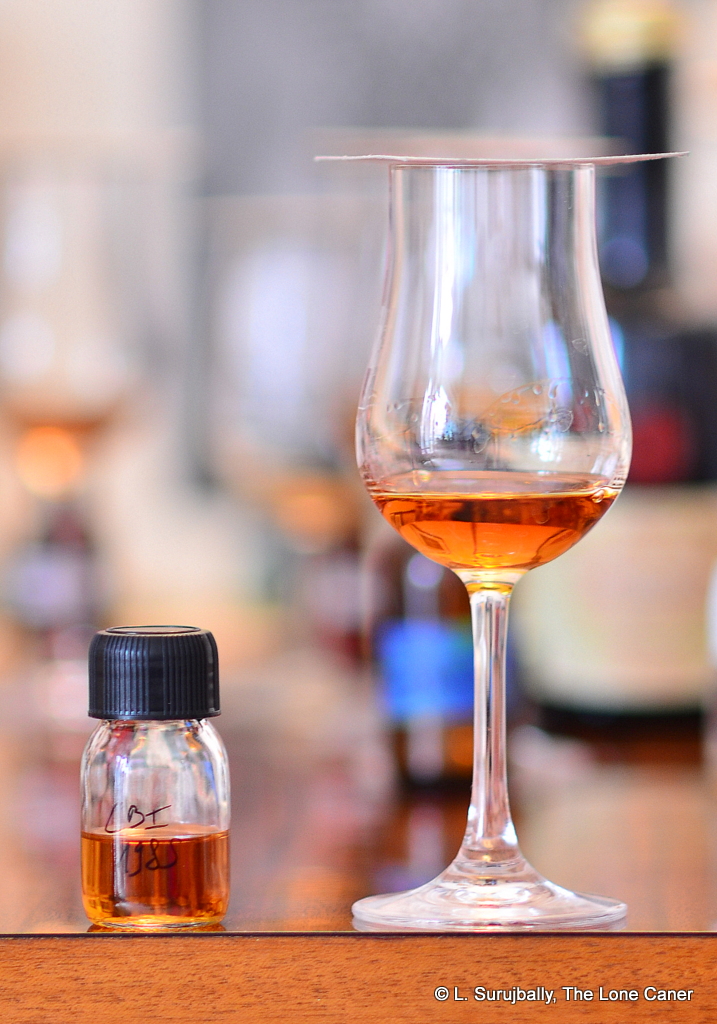
The amber-coloured Velier La Bonne Intention (LBI) Old Demerara Rum 1985 15 year old rum is not for everyone, and is rather more an artifact than a must-have. For aficionados who are used to the fullproof bruisers with which Luca made his bones, it is more a historical relic than truly representative of his ideas, very much as the Enmore 1987 was (perhaps that’s because both rums were bottled by Breitenstein* in Holland in 2000 and imported by Velier, so it’s possible that Luca had somewhat less input into the final product than he subsequently did once he took over his own bottlings). For the curious rum drinkers moving up the scale of rums and seeking an introduction to a softer Velier product (“what’s all the damned fuss about this company, anyway?” is the usual irritated question), it might be worth a try, though with its rarity these days it’s unlikely anyone will ever find it outside of eBay.  And for those who despise adulteration in any form, it’s definitely a pass, unless one likes to take down the Big Guy by gleefully pointing out a rare misstep.

I make these points not to diss Velier – they’ve more than moved past this kind of milquetoast — merely to provide the background for what the rum is – an earlier essay in the craft, before the pure fullproof philosophy had matured into its current form.  The stats tell the tale: for one, the rum is bottled at a mild 40%, and for another it has been graded at around 12g/L of additives (presumed to be sugar).  So in that sense it’s much more like a regular, pre-renaissance indie bottling from Ago than any of the comets that lit up the skies of the rumiverse in the years that followed.

Even tasting it blind (which I did, with other Veliers as controls), you could sort of sense there was something off about it, something less than what we have become accustomed to.  For example, it was so light and clear on the nose to make me wonder if my sample had gotten mislabeled and there was an agricole in the glass. That thought was dispelled when light fruits, grapes, caramel, nougat and not-very-tart yoghurt scents emerged, which slowly deepened into a crème brulee and white toblerone over time, with perhaps some coffee. Overall, nothing particularly over-the-top, and although the underlying quality was there, idling gently, it never engaged with any kind of force or impact.

Still, the taste wasn’t bad for a rum this dialed down – it simply took time (and effort) to nail down the specifics.  For the most part it was warm and light, with gentle, watery fruits – kiwi, papaya, ripe apples without any sharp, tart edges, some whipped cream, quite nice.  With water not much that was new came out – some vanilla and oak, coffee, and that was pretty much it, propelling the entire affair languidly towards a short, light finish with some weak cider, a latte, and an additional flirt or two of the fruitiness.  I didn’t feel the added sugar was particularly noticeable in its impact, unless it was to smoothen things out. Frankly, the only thing to get excited about here was that it was one of the first ones from the company, so anyone who gets a bottle certainly has some bragging rights on that score.

LBI – La Bonne Intention – is a sugar plantation on the East Coast of the Demerara river, a short drive from Georgetown, and I have many fond memories of Sunday mornings spent swimming in the GUYSUCO Sports Club pool there with my brother in the early 1980s.  The old coffey still at LBI was long gone by that time (Marco in his seminal essay on the plantations of British Guiana notes it as being decommissioned around 1960 as part of Booker’s rationalization strategy), and as far as we can speculate, this rum likely derived from a Savalle column still, possibly the one from Uitvlugt. However, the resemblances between various Uitvlugt expressions and this rum are almost nonexistent as far as I’m concerned, and it should be considered on its own.

Nearly two decades after this came to market, to malign Velier is deemed by some to be apostasy of near burn-at-the-stake proportions, but come on, even Luca had to start somewhere, muck around a little, fall over his own feet once or twice (which is why these days, it’s said – always with a smile — he uses only taxis). One long-ago-made, less-than-stellar rum in an oevre with so many masterpieces is hardly enough to either define the brand or sink those accomplishments that were achieved in subsequent years.  So, as I said, it’s merely a lesser effort, an earlier issue, probably not something to sell the left kidney for. And if the additives and relative mildness of the rum turn you off of Velier as a whole and make you sneer at the encomiums they got from all points of the compass since 2012, well, there’s tons of other releases by the company that show the lesson had been learnt.  Dip your toes in anywhere – I’m sure you’ll find one.

(80/100)


Other Notes

Big hat-tip to Cyril of DuRhum, who spotted me the sample of this oldie from the same source as his own review, as well as the 1998 version which I’ll probably look at soon.  Note that he really didn’t like this one much, and for many of the same reasons.

*Breitenstein is a Holland-based trading company 100% owned by DDL, not a separate third party as I had initially thought.

Mar 272017
 

Rumaniacs Review #032 | 0432

Over and above the skimpy details of the company provided in the notes written for the Carta Oro (Rumaniacs-031) there’s nothing new here, except to note that this rum is definitely better, and I enjoyed it a lot more.  So let’s dive right in and be briefer than usual

Nose – Very Spanish in its lightness.  Cornflakes, cereal, lemon peel, vanilla and salted butter come to the fore.  It’s a little spicy and tart for 40%, something like a lemon meringue pie, very nice actually, if a little gentle. Opens up to smoke and leather after some time.

Palate – I’ve moved away somewhat from the Latin style, but no fault to be found here.  Orange marmalade, a little caramel and coffee grounds and white chocolate, and with water there is a whiff of licorice, toffee, more vanilla, leavened by sharper fruits such as ginnips, red currants, red guavas…that kind of thing.  Really a very nice rum.

Finish – Short and delicious, quite light and crisp, with more tart fruity notes and some smoke and very faint licorice and orange peel.

Thoughts – I have no idea how aged this rum is – I suspect five to ten years.  Whatever the case, it’s a most enjoyable dram.  Probably out of all our price ranges at this point, if a bottle could even be found whose provenance one can trust. With the opening of the American market to Cuban products, we can expect to see a lot of rums many have never tried before from companies that will surge to the fore but which until now remain relatively obscure. I really look forward to that.

(84/100)

Mar 272017
 

Rumaniacs Review #031 | 0431

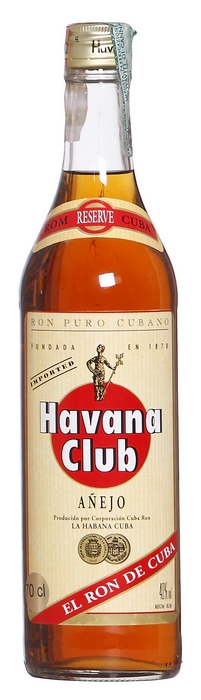
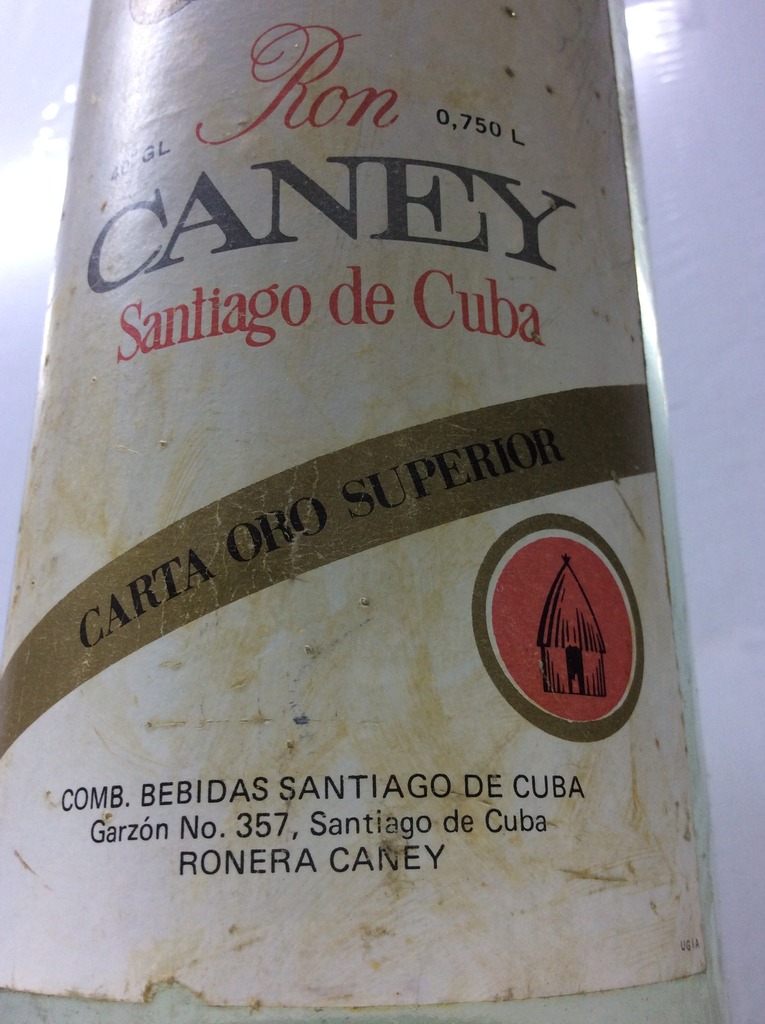
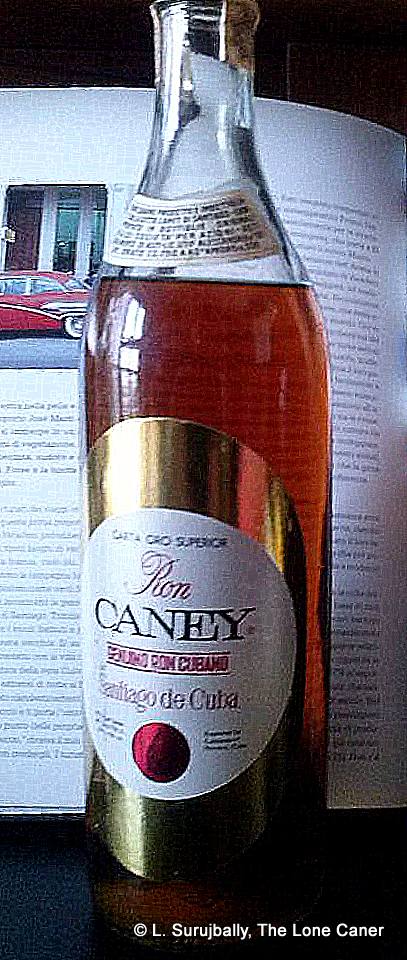
This is a Cuban rum from a company that still exists in Santiago de Cuba and now called Ron Caney: the holding company was (and may still be) called Combinado de Bebidas de Santiago de Cuba and was supposedly formed around 1862…however, it is also noted to be operating out of a former Bacardi factory, so my take is that it’s using expropriated facilities, which is confirmed by Tom Gjelten’s book, Bacardi and the Long Fight for Cuba.  This rum is from the late 1960s or early 1970s, is also known as “Gold,” and for sure is no longer in production, though modern and aged variants do of course exist (the Ultimate Rum Guide has a list for the curious). The export version is the Havana Club marque from Cuba.

Picture here taken from ebay and I’m unclear if it’s the same one as what I was tasting.  The actual bottle pic for the sample in my possession is very low res, but shown below.

Colour – Gold

Strength – 40%

Nose – Soft citronella notes, flowers, relatively uncomplex, but laid back, light and quite clean.  Some cream pie and vanilla.

Palate – Sharp, clean and light, a little aggressive in a way the nose didn’t mention. Started off with a faint medicine-y taste which is far from unpleasant. Some salted caramel and cream cheese. Salty brine and olives, citrus peel, balsamic vinegar and cheese-stuffed peppers.  Maybe I got a dud sample that oxidized too much, ’cause it sure didn’t taste like a normal Cuban.  Still – not entirely a write-off.

Finish – Short, sharp, mostly lemon peel and some candied oranges.

Thoughts – Probably a very young rum. If one can find a bottle, it’s probably worth more for historical value than to actually drink it

(78/100)

Mar 262017
 

#350

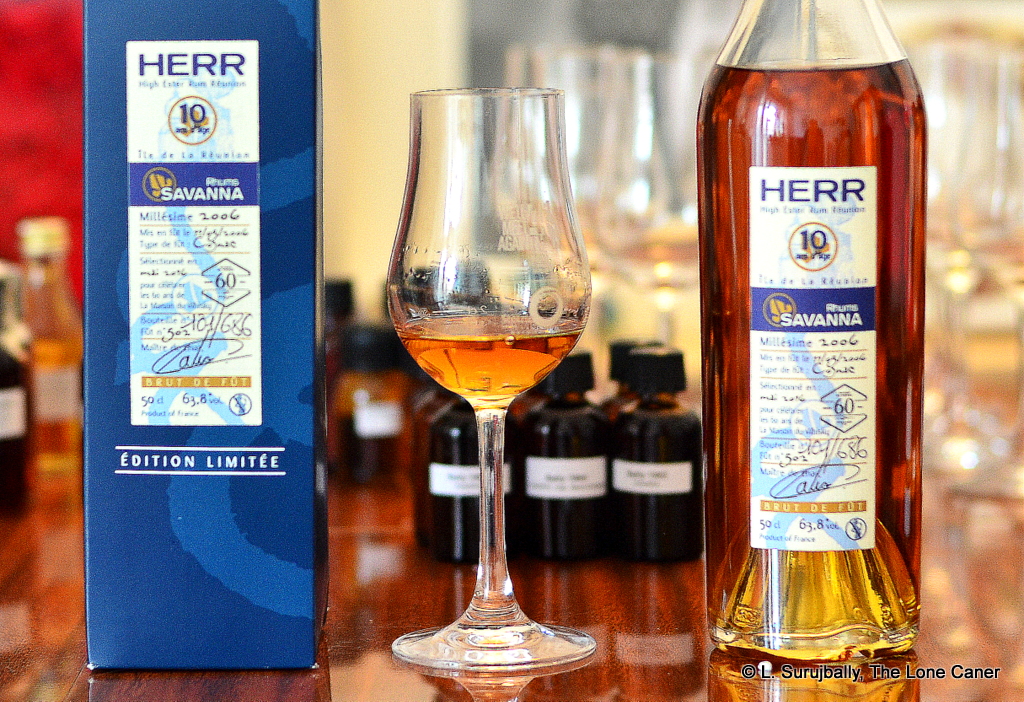
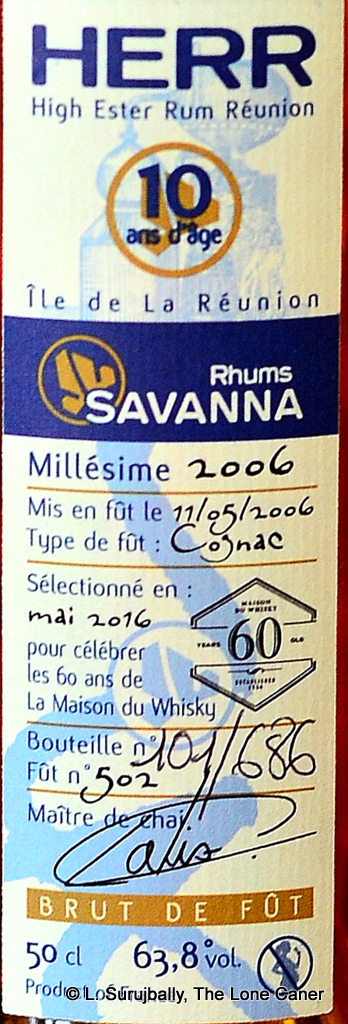
The Savanna Millésime 2006 High Ester Rum from Réunion (or HERR, as it is labelled) is a steroid-infused Guadeloupe rum mixing it up with a Caroni and a Bajan. It may the closest one will ever come to one of Worthy Park or Hampden’s Jamaican taste bombs without buying one, betters them in sheer olfactory badassery and is possibly one of the best of its kind currently in production, or the craziest.  It’s very likely that once you try it you’ll wonder where it was hiding all this time. It emphatically puts Réunion on the map of must-have rum producing nations with not just flair, but with the resounding thump of a falling seacan.

Just to set the background.  I had bought the Savanna Rhum Traditonnel Vieux 2000 “Intense” 7 year old back in April 2016 in Paris, and when I finally wrote about it, remarked on the way it was interesting and tasty and seemed to channel a good Guadeloupe rum in that it walked a fine line between molasses based product and an agricole.  Purely on the strength of that positive experience, I sprung for the HERR, and made some notes to get some of the other “Intense” and “Grand Arôme” Lontan series from Savanna as well (see “other notes”, below).  The molasses-based HERR was distilled in 2006, aged for ten years in ex-cognac casks, bottled at a hefty 63.8% in 2016, bottle #101 of 686, and released for the 60th Anniversary of the Parisian liquor emporium La Maison du Whisky.

Anyway, after that initial enjoyable dustup with the “Intense”, I was quite enthusiastic, and wasn’t disappointed. Immediately upon pouring the golden-amber liquid into my glass, the aromas billowed out, and what aromas they were, proceeding with heedless, almost hectic pungency – caramel, leather, some tar, smoke and molasses to start off with, followed with sharper notes of vanilla, dark dried fruit, raisins and prunes and dates.  It had an abundance, a reckless, riotous profusion of flavours, so much so that one could be forgiven for thinking that not only did Savanna throw in the kitchen sink in making it, but for good measure they included the rest of the kitchen, half the pantry and some of the plumbing as well.  Even the back end of the nose, with some overripe bananas and vegetables starting to go off, and a very surprising vein of sweet bubble-gum, did nothing to seriously detract from the experience; and if I were to say anything negative about it, it was that perhaps at 63.8% the rum may just have been a shade over-spicy.

Still, whatever reservations I may have had did not extend much further than that, and when I tasted it, I was nearly bowled over.  My God but this thing was rich…fruity and tasty to a fault. Almost 64% of proof, and yet it was warm, not hot, easy and solid on the tongue, and once again — like its cousin — weaving between agricole and molasses rums in fine style.  There was molasses, a trace of anise, a little coffee, vanilla and some leather to open the party; and this was followed by green apples, grapes, hard yellow mangoes, olives, more raisins, prunes, peaches and yes, that strawberry bubble-gum as well.  I mean, it was almost like a one-stop shop of all the hits that make rum my favourite drink; and it lasted for a long long time, closing with a suitably epic, somewhat dry finish of commendable duration which perhaps added little that was new, but which summed up all the preceding notes of nose and palate with warmth and heat and good memories.  There was simply so much going on here that several subsequent tastings were almost mandated, and I regret none of them (and neither did Grandma Caner, who was persuaded to try some).  It presented as enormously crisp and distinct and it’s unlikely to be confused with any other rum I’ve ever tasted.

Just as an (irrelevant) aside, I was so struck with the kaleidoscopic flavours bursting out of the thing that I let the sample remain in my glass for a full four days (which is likely four days more than anyone else ever will) and observed it ascending to the heights before plunging into a chaotic maelstrom I’m somewhat at odds to explain.  But one thing is clear – if the sharp fruitiness of unrestrained rutting esters is your thing, then you may just agree with me that the rum is worth a try, not just once, but several times and may only be bettered by the Lontan 2004 12 year old 64.2% made by the same company.

I said in the opening remarks that it might be the best of its kind currently in production, or one of the craziest.  I believe that anyone who tries it will marvel at the explosive panoply of flavours while perhaps recognizing those off-putting notes which jar somewhat with what one expects a rum to possess.  Having read of my experience, I leave it to you to decide which side of the divide you fall on.  The HERR is not so much polarizing as unique, and it demands that you accept it as it is, warts and everything, on its own terms or not at all.  If you do, I somehow doubt you’ll be disappointed, and may just spend a few days playing around with it, wondering what that last smidgen of flavour actually was. Sort of like I did.

(88/100)


Other notes

  • Personal encomiums and opinions apart, I should inject a note of caution.  When tried in conjunction to the muskier, deeper Demeraras, HERR’s relative thinness becomes more apparent.  Too, after some hours, that vein of bubble-gum sweet also takes on a dominance that can be off-putting to those preferring darker tastes in their rums, though such a whinge would not disqualify it from any rum lover’s shelf.  But the chaos I noted earlier comes after you let it sit for the aforementioned few days.  By the fourth day the rum becomes sharp, biting, and almost vinegary, and while one can still get the smorgasbord of fruitiness which is the source of its exceptionalism, it is no longer feels like the same rum one started with.  Pouring a fresh sample right next to it on that day showed me the metamorphosis, and I believe that oxidation is something to beware of for any opened but long-untouched bottle.
  • As it turned out, an amazingly generous aficionado by the name of Nico Rumlover (long may his glass remain full) sent me not one or two additional Savanna samples, but eight more, just so that I could give them a shot…so look for those write-ups in the months to come.  Along with several other rums and rhums, I used all of them (and the Intense) as comparators for this review.
  • Historical distillery notes can be found in the Makers section for those whose interests run that way.
  • Rum Nation looks to be releasing a Savanna 12 YO at 59.5% sometime this year.


Feb 262017
 

#345

All grog-blog hoodlums and Danes know the story, and somewhere out there you can just bet the Danes are smirking.  Back when Compagnie des Indes was a new independent bottler just starting out, selling their initial 46%-or-so editions around Europe, the rum lovers from Denmark shook their heads and said they wanted cask strength rums.  Y’know, the real stuff, the ones dosed with huge quantities of whup-ass, coming with battleaxes taped to the bottle, not frilly pink cupcakes for the weak-kneed. Florent shuddered a little at the thought of a bunch of intoxicated rum-loving vikings turning up in France demanding their hooch in person, and hurriedly advised them that if they wanted that, they’d have to buy the entire barrel; after some haggling it was agreed and a whole bunch of cask strength rums were shipped north.  These proved to be so popular (and not only with the lucky folks for whom it was made) that they sold out in next to no time, left the rest of the world grumbling about how come they didn’t get any, and were the impetus behind the subsequent release of the Cask Strength editions by the Compagnie, beginning in 2016.

Having said all the above, the Uitvlugt outturn from Guyana is somewhat less well known than its brawnier cousins from the wooden stills which have formed a part of every navy rum ever made for literally centuries.  The Uitvlugt marque derives from the four-column French Savalle still, which was originally two two-column stills joined into one since their migration to Diamond, and according to DDL, can produce nine different types of rum (light to heavy).  Still, if you believe for one moment that a column still rum in general, or one from Uitvlugt in particular, is in some way less, then you have not tried the best of them all — the UF30E — or many of the other craft bottlings issued over the years.  And you can believe me when I tell you, this eighteen year old full proof rum that the Compagnie put out the door is no slouch either, and is just a few drams short of exceptional.

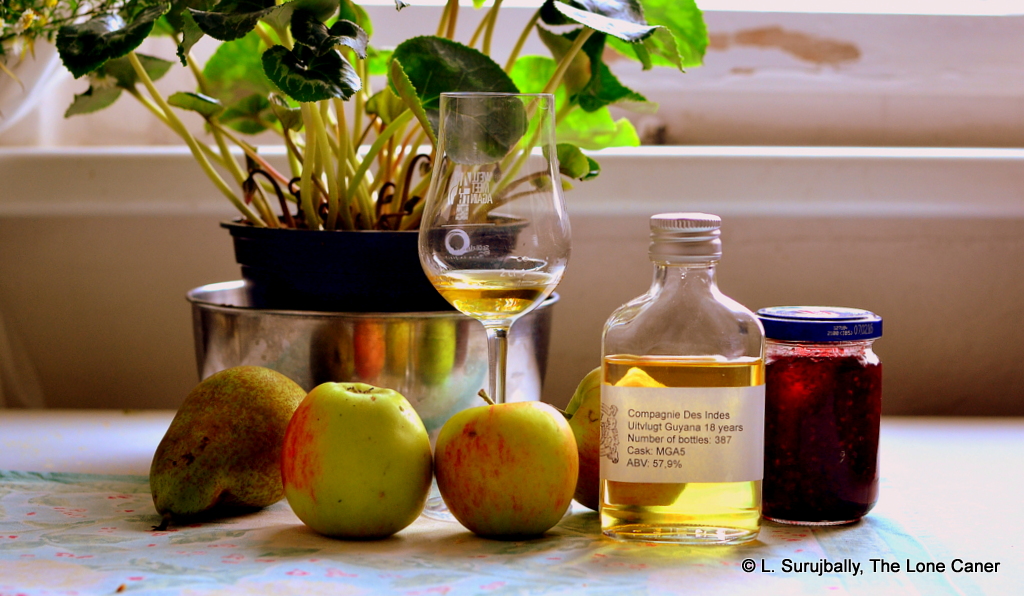
So, brief stats for the number crunchers: an eighteen year old rum, 1997-2016, 387 bottle outturn from cask #MGA5.  This is not the cask strength variation of the 45% 18 YO finished in Armagnac casks as far as I am aware, but a straightforward 57.9%.  And all the usual assurances of no additives, dilutants and other creepy crawly weird stuff that results in abominations like the Don Papa.  Also, it is pale yellow, which is a resounding response to all those who believe darker is somehow older.

None of the musky anise and dark fruits such as accompany the PM and Enmore marques were on display here, of course, but attention was drawn immediately to acetone and pencil erasers, underlaid with the strong smell of rubber laid down by a hot rod on a fresh made highway under a scorching summer sky.  Once this burned off – and it never really did, not entirely – the rum displayed a plethora of additional interesting aromas: mint leaves, wet cardboard and cereal, the tartness of fresh ginnips, and a deep floral sweet scent that was far from unpleasant, though here and there I felt the integration was somewhat lacking.

The palate, now here was a profile that demanded we sit up and take heed. Petrol and fusel oils screamed straight onto the tongue.  It was immensely dry, redolent of glue and fusel oils and bags of dried fruit, feeling at times almost Jamaican, if that isn’t stretching credulity too much.  For all that the rum had a real depth to the mouthfeel, and as it opened up (and with some water), lovely distinct  fruity flavours emerged (cherries, peaches, apricots, mangoes), mixing it up really well with lemon rind, brine and olives.  Even after ten minutes or so it was pouring out rich, chewy tastes, leading to a smooth, hot finish that was quite exceptional, being crisp and clean, giving up last notes of olives in brine, tart apples, teriyaki sauce, and a nice mix of sweet and sour and fruits, something like a Hawaiian pizza gone crazy. It wasn’t entirely successful everywhere – there were some jagged notes here and there, and perhaps the body would have been a little less sharp (even for something south of 60%)…but overall, a really well done piece of the rumiverse.

Bringing all this to a conclusion, the Uitvlugt is a powerful achievement, a delicious, strong, well balanced rum of uncommon quality that succeeds in almost every aspect of its assembly, falling down in only minor points.  It goes to show that while the Port Mourants and the Enmores of Guyana get most of the headlines and are far better known (and distinctive, don’t ever forget that), Uitvlugt may just be the little engine that could, chuggin gamely ahead, year in and year out, producing capable little world beaters every time.  If the UF30E or the 1997 Velier or the other rums from that still made by CDI didn’t convince you already that great stuff could come from this place, well, here’s another to add some lustre to the company, the still and the estate.

(87/100)

Feb 212017
 

#344

Our global rum travels have moved us around from Japan, Panama, Barbados, Guadeloupe, Brazil, Nicaragua, Jamaica, Antigua, Laos and Mauritius (and that’s just within the last eight weeks); so let’s do one more, and turn our attention to Île de la Réunion, where, as you might recall, three companies produce rums – Rivière du Mât, Isautier, and Savanna, with Isautier being the oldest (it was established in 1845 and is now in its sixth generation of the family).  If one wants to be picky Savanna has existed for far longer, but the company in its modern form dates back only to 1948 and lest I bore you to tears with another historical treatise, I refer you to the small company bio written as an accompaniment to this review.

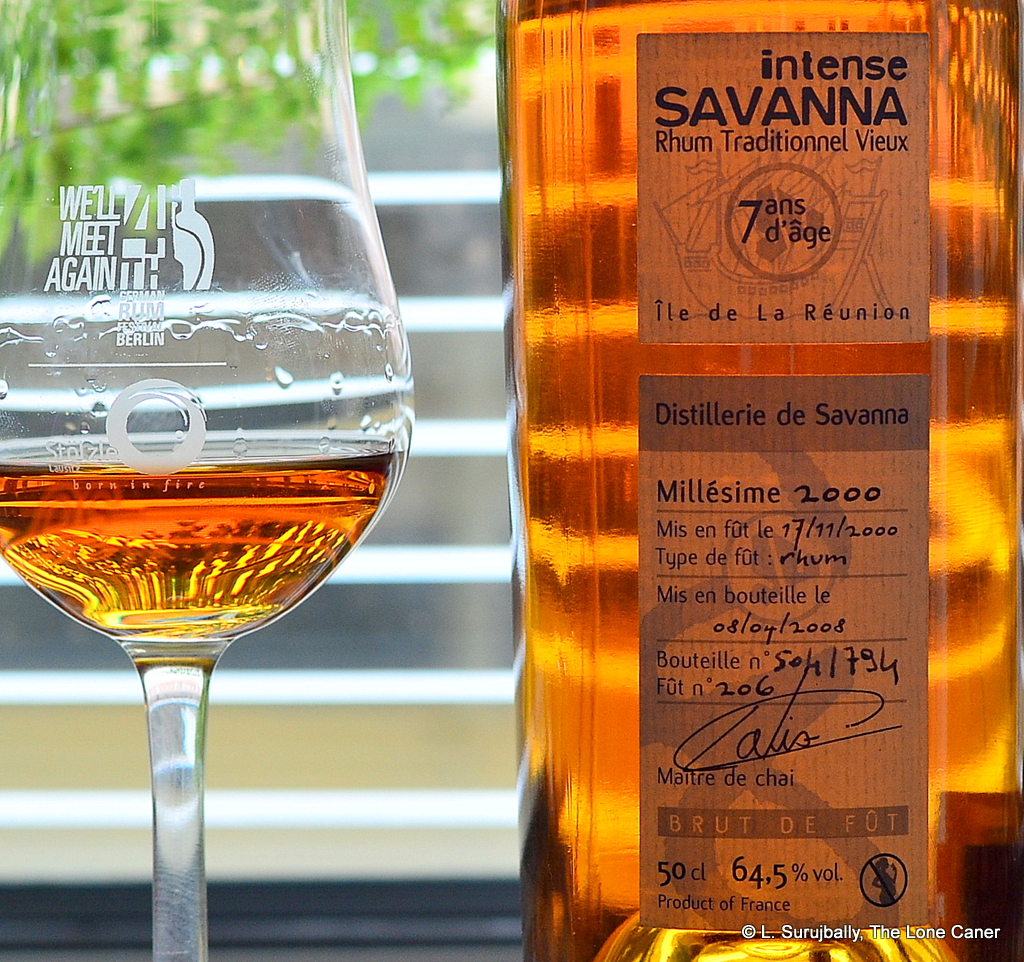
Savanna is unusual in that it makes both agricoles and traditional, so it’s always a good idea to check the label closely – the French word “Traditionnel” refers to a molasses-based product. And take a moment to admire the information they provide, which is quite comprehensive (bar additives, which I somehow doubt they have). The rum I tried here was quite a beast – it was a seven-year-old year 2000 millésime distilled in November 2000 and bottled April 2008 with an outturn of just under 800 bottles, and issued at a whopping 64.5% – and that’s not unusual for them, as there are quite a few of such cask strength bruisers in their lineup.  I’m as courageous as the next man, but honesty compels me to admit that any time I see a rum redlining north of 60% my spirit quails just a bit…even as I’m consumed by the equal and opposite desire (perhaps a masochistic one) to match myself against it.  And here I’m glad I did, for this is quite a nifty product by any yardstick.

On the nose it was amazing for that strength – initially it presented something of the light clarity we associate with agricoles (which this was not), before turning deep and creamy, with opening salvos of vanilla, caramel and brine, vaguely akin to a very strong latte….or teeth-staining bush tea. It was weirdly herbal, yet not too much – that surprising vegetal element had been well controlled, fortunately…I’m not sure what my reaction would have been had I detected an obvious and overwhelming agricole profile in a supposedly molasses originating rum.  And yes, it was intense, remarkably so, without the raw scraping of coarse sandpaper that might have ruined something less carefully made.  I don’t always add water while nosing a spirit, but here I did and the rum relaxed, and gave additional scents of delicate flowers and a hint of breakfast spices.

The palate lost some of the depth and creaminess, becoming instead sharply crisp and clean, quite floral, and almost delicately sweet.  Even so, one had to be careful to ride the shockwave of proof with some care, given the ABV. Frangipani blossoms, bags of tart fruits (red guavas, half-ripe Indian mangos and citrus rind) and vanillas were the core of the taste, around which swirled a mad whirlpool of additional, and very well balanced flavors of green grapes, unripe pineapples, more mangos, and peaches, plus some coffee grounds.  It was powerful yes, and amazingly tasty when taken in measured sips.  It all came down to the end, where the finish started out sharp and dry and intense, and then eased off the throttle.  Some of the smooth creaminess returned here (was that coconut shavings and yoghurt I was sensing?), to which was added a swirl of brine and olives, grapes, vanilla.  The way the flavours all came together to support each other was really quite something – no one single element dominated at the expense of any other, and all pulled in the same direction to provide a lovely taste experience that would do any rum proud.

So far I’ve not tried much from Réunion aside from various examples of the very pleasant ones from Rivière du Mât (their 2004 Millésime was absolutely wonderful).  If a second distillery from the island can produce something so interesting and tasty in a rum picked at random, I think I’ll redirect some of my purchasing decisions over there. This is a rum that reminds me a lot of full proof hooch from Guadeloupe, doing much of the same high wire act between the clear cleanliness of an agricole and the deep and growly strength and flavour of the molasses boyos. It’s a carefully controlled and exactingly made product, moulded into a rum that is an utter treat to inhale, to sip and to savour, and I’ll tell you, with all that is going on under the hood of this thing, they sure weren’t kidding when they called it “Intense.” It’s not a complete success, no, but even so I’m annoyed with myself, now, for just having bought one.

85.5/100


Note: This intriguing 7 year old interested me enough to spring for another >60% beefcake from the company, the High Ester Rum from Reunion (HERR). The entire line of high-ester Grand Arôme rums made by Savanna is supposedly a bunch of experimental flavour bombs, so can you imagine what a cask strength version of that is like?


Feb 172017
 

A very good Panamanian, with deeper flavours than usual.

#343

Panamanians and other spanish-style rum makers are doing themselves serious injury in their contortions to stay “Latin” or “Cuban” or “Spanish” and justify dosing and/or the lack of provision of details behind their work as matter of course. The recent Rumporter interview with Mario Navarro where he did precisely that, lit up Facebook like the 4th of July, and is just one recent example…but it’s been coiling behind just about every major Latin American or Panamanian release dating back to, oh, the Santa Teresa Bicentenario, the Panamonte XXV and last year’s Arome 28.

Still, the fact is that whether we like it or not, rums made in Central and South America generally, and Panama more specifically, are – and have almost always been – geared towards a buying public that dials in precisely those coordinates: light, easy, 37-40%, lots of blending and barrel strategy, some solera style production, with maybe a pinch or two of other stuff thrown in for good measure to smoothen things out. They don’t give a damn about the movement towards greater transparency or purity.  Massive avatars of aggro are not their thing, and it lies with independent bottlers, almost all out of Europe, to up the ante in both these departments.

Which is why one should be grateful for the Rum Club in issuing this fifteen year old. For all its relative rarity and obscurity, you still get something more (informationally speaking) than the Malecon 1979 I wrote about with such disdain last week. First of all, the rum is made by the “RumClub”, which is very unhelpful until you check the fine print and understand that it’s the bottling arm of the Rum Depot in Berlin, which in turn is run by the man behind the Berlin Rum Fest, Dirk Becker.  This is the second edition, available from 2016, a fifteen year old cask bottled at 51.3% (the first edition was issued for the 2015 rumfest, a single cask ten year old at 51.1%).  The source barrel comes from the same aged stock as Don Pancho’s Origines (PILSA) which makes it a column still product, and kudos to Dirk for not wimping out and diluting the thing. One barrel, 411 bottles with no information about additives but I’m suspecting some caramel to get that dark colouration. We can reasonably assume it was distilled in 2000 or 2001.

To be honest, I’ve not been very enthused of late with Panama, so most of the time I buy other stuff which interests me more.  But a cask strength variation piqued my curiosity, and once I sniffed the darkish red-brown rum, it met with my instant appreciation.  The nose was rich and almost deep with a plethora of dark fruits – plums, prunes, black grapes, licorice, and even some olives thrown in to provide a whiff of brine and some barely perceptible breakfast spices.  It really was quite lovely.

The palate proved to be equally well done, being on the heavier side of “light” and benefitting from the higher proof point.  Black cherries again, very ripe, blackberries blueberries, black cake, caramel and crème brulee. Oh this was nice!  It even suggested a certain creaminess, with a light dusting of vanilla, coffee, cinnamon and nutmeg, and while it had a mouthfeel and texture of some weight and heat which would make one think adding water was a good idea, I found that doing so took the quality down so geometrically that it’s probably best to dispense with that altogether.  After the enjoyment I took from the preceding, the finish was disappointing – short, sweet, some caramel and fruity notes, not much else.  Too bad.

Yet overall the rum was a very good one, lacking just some complexity and a finish of note to score higher. Just about everything works properly here. The rum is not overaged, and unburdened by any excessive oaken influence.  It’s decently rich and flavourful, with a forceful, distinct profile within the confines of its lighter Cuban heritage, and while I accept that different drinkers have different preferences, my own are simply that a rum should not adhere to any kind of limitation but be bottled at the power that enhances and displays its inherent qualities.  Which this more or less did.

When one tries this 51.3% fifteen year old bruiser in tandem with a cupcake rum like the Malecon (bottled at 40%), the failings of the latter snap more clearly into focus, even though the former is half the age. In all respects, the 15 is simply better. Bigger, bolder, badder, better. It showcased what Panama rums could be if they wanted to.  The Malecon and Panamonte XXV and their ilk positioned themselves as fine old boys at the top of their food chains and boasted of their quality…then along came the Rum Club which answered with this impressive rum, providing rum lovers with something of what they had been missing.  And made an irrefutable response to all the notions of “premium” that its predecessors had claimed for themselves, but did not entirely earn.

(85/100)


Other notes

“Rum Club” was the name of an unadvertised speakeasy sort of bar Dirk Becker opened up back when he was getting into rum in a big way and before he opened up the Rum Depot (it boasted 300+ different rums for its patrons).

Feb 152017
 

#342

Considering that the Seleccion Esplendida was pushed out as both a specific year’s production and an enormously aged near-thirty-year-old rum – a breed getting rarer all the time now that collectors, enthusiasts and rum lovers are snapping up the old 1970s, 1980s and even 1990s vintages – it’s somewhat surprising how little of a rep the brand or the rum itself actually has.  I mean, when was the last time you saw anyone rhapsodizing about it, or even giving it a casual mention, anywhere? Perhaps that’s because for something that old we kind of expect to see it issued at cask strength in a limited edition of some kind accompanied by smart marketing, none of which occurred here (the company, Caribbean Spirits, doesn’t even appear to have a website).

Let’s pass on that for the moment though, and simply go with what we have here.  For what it’s worth, I was somewhat ambivalent about this pink-brown 40% column still product out of Panama, partly for its proof point, partly for how it sampled and partly for the price (around €200 these days).  Panamanian rums are a subset of the Cuban style of rum-making, molasses and column still derived and generally light and faintly citrusy, and this rum adhered to the profile (to a point) without major deviations, but also without striking out into the sort of amazing directions one could possibly hope for in a rum nearly three decades old.

It was light on the nose, redolent of sugar cane juice and the creaminess of rice pudding, flowers and saffron, with very little of a caramel or toffee or burnt sugar in evidence anywhere.  In fact it was rather easy and warm, with little tartness or sharpness.  It also presented with a some surprising amount of baking spices, cinnamon, vanilla, and after a while, what to me felt like an excess of cherry syrup poured straight from the can (hold the cherries).  So yes there was fruitiness and pleasant aromas, just nothing earth shaking that would make me want to break out the thesaurus. In point of fact, I was reminded somewhat of a dialed-down Panama Red, or something of the Origines series of rums (which I’ve tried but don’t have detailed notes for). But the more distinct and complex notes of the Rum Nation Panama 21 year old or 18 year old were not part of the program so far as I could tell.

The quality on the palate was certainly better once I got around to tasting it…up to a point  Overall it was soft and well rounded, again quite light, with warm flavours of fruit, aromatic tobacco, vanilla and more cinnamon, maybe a dash of nutmeg. Water wasn’t needed for something this easy, but I added some anyway and was rewarded with some black tea, a slightly more tannic and sharper series of oak and toffee hints, leading to a short and almost imperceptible finish of little distinction where the dominant notes were of cinnamon and vanilla.

Here the 40% worked to its detriment — it should have been stronger and not diluted too much, because for one it actually tasted younger and secondly some of the potential complexity was stifled under a feather blanket of wuss.  Frankly, after playing with it for some hours I just gave up on it.  It offered too little for what it advertised, and struck me more as a cupcake of a rum that would fail to impress the hardcore while probably pleasing lovers of lighter fare: in either case they’d be dropping too many pesos for something where the delivery was nowhere near the promise. If you want a Panamanian with some real huevos, I more recommend the Rum Club Private Selection Panama 15 Year Old, which, at north of 50% really gives you value for money. I’ll tell you more about that next time.
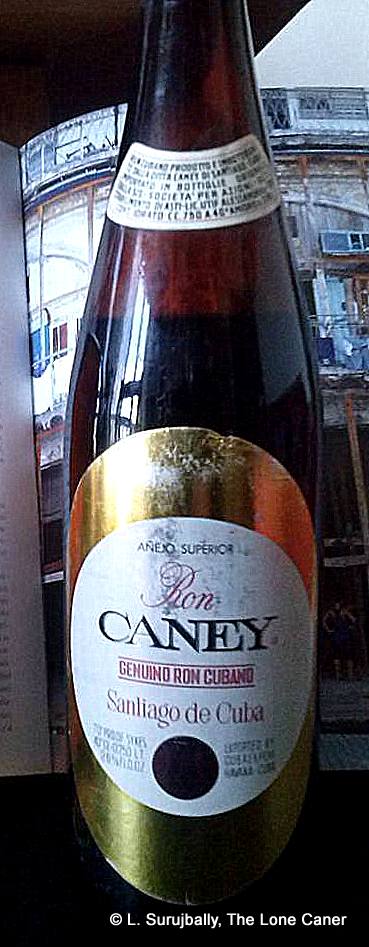
(82/100)


Opinion

The Ron Malecon 1979 is somewhat of an atypical Panamanian rum with which I have a number of issues, not the least of which is the remarkable — and disturbing –lack of background information available about the rum itself, or the outfit behind it.

Here are the few vague “facts” available. 1. The rum is attributed to Caribbean Spirits Panama Ltd, which has the official address in Cheapside, London and about which I can find nothing in Panama proper; 2. The cane used by the company is from “their own harvest”, which leads to more questions than answers; 3. The owners of the (unnamed) distillery hail from Cuba and this rum is made in the “Cuban” style; 4. It is a column-still product; 5. Don Pancho Fernandez is involved somehow, according to an Italian youtube video.  Unfortunately I can’t place the photographs in that video to any of the three distilleries there (Carta Vieja, Ingenia San Carlos or Varela Hermanos). Given Don Pancho’s involvement, I would have expected PILSA (Provedora Internacional de Licores, S.A, established in 2000) and their distillery San Carlos, to be behind the rum (the way the label and the PILSA website speak to their Cuban antecedents suggests it), but as Master Quill pointed out in his own review of this rum a few months ago, this rum predates the distillery, so the question remains open.

When a company which produces several enormously aged expressions has nothing beyond marketing blurbs to promote them and provides little of value on the label, then all sots of doubts start to creep into a rum nerd’s mind. That says a lot for the disrepute some producers have brought upon the field.  We are getting to the point of distrusting them all, if they don’t provide detailed info, up front and every time. Country, source, still, outturn, ABV, barrels, additives and age – these are the minimum requirements many demand, and we have to be able to trust those (I make similar points in the reviews of Dictador’s seemingly ultra-aged Best of 1977 rum, the Mombacho 19, and the Don Papa Rare Cask.
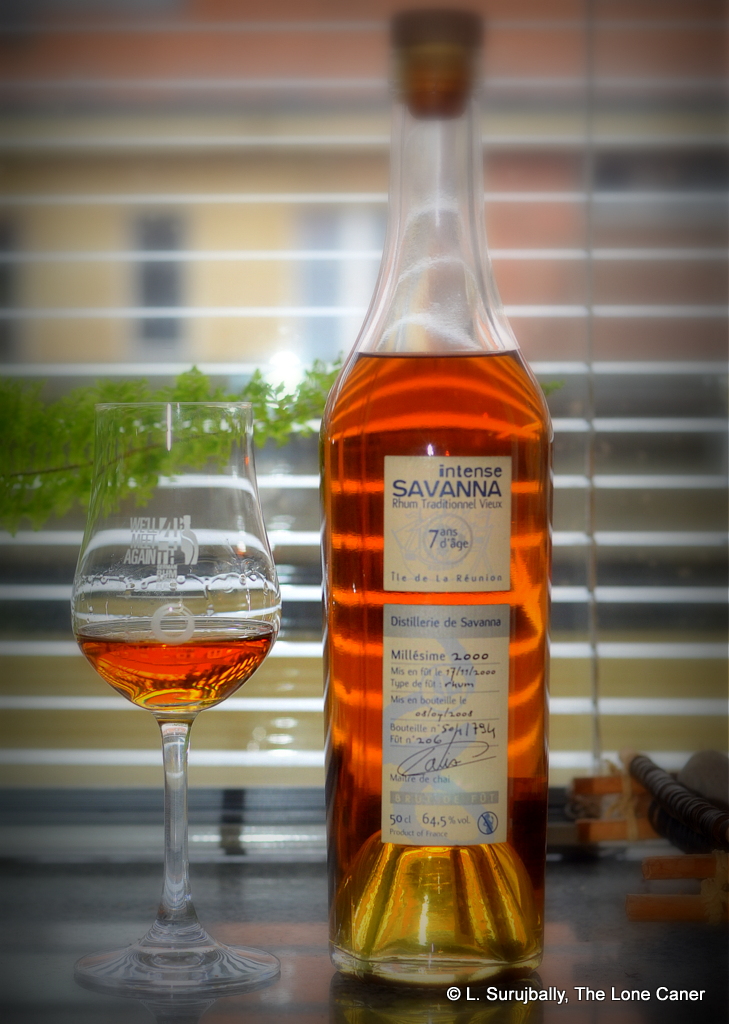
How frustrating it is, then, doing research on a rum this expensive. Are Master Quill’s review and now this one, really the only write up of the Malecon available?  I hope not, but certainly it’s been a chore to find anything concrete, and even the company is damned hard to pin down aside from various notes made on sellers’ websites.  And for a rum fetching north of two hundred euros, which is supposedly aged in white oak barrels, stored in caves (!!) in Panama, for 29 years (1979-2008) – well now, perhaps you can understand my displeasure. We’re living in a time where more, not less is required of the producers of such a rum, sold for such a price. The lack of it coupled with the profile as described casts doubt on the entire age statement and provenance of the product.


Other Notes

  • Many thanks to L’homme à la poussette (the man with the stroller), who provided the sample.  Laurent’s French-language rum site is one of my favourite weekly stopping points as I scour the web for new reviews and articles on the subject, and we trade stuff whenever we can.