Nov 082017
 

Rumaniacs Review #058 | 0458

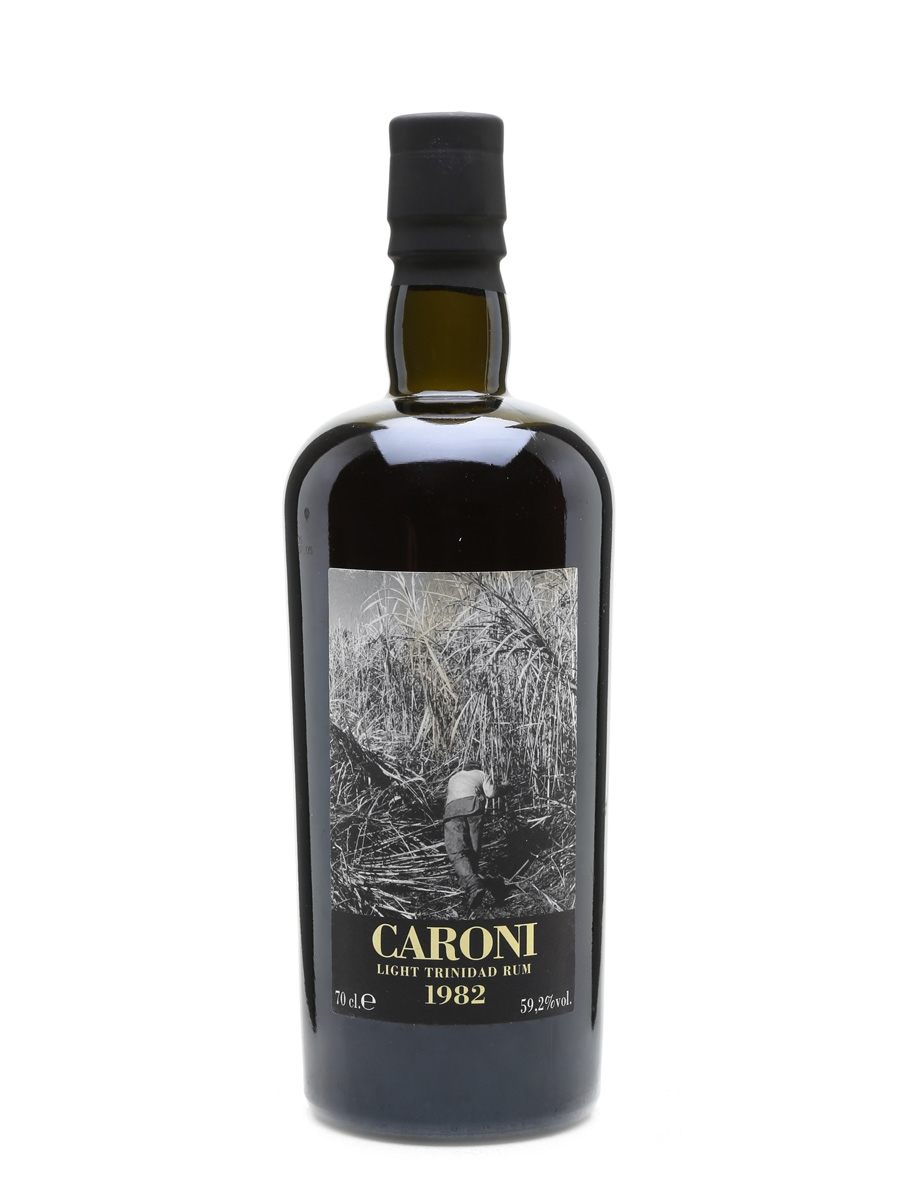
If there ever was a rival to the famed and fabled Demerara rums issued by Velier, it is surely the Trinidadian Caroni line, which is wept over by aficionados and considered the Port Ellen of rum (my personal belief is that Port Ellen is the Caroni of whisky, but anyway…).  They hail from the long-shuttered Trinidadian distillery which closed in 2002, and it has now passed into legend how Luca Gargano found thousands of barrels of ageing rum on the estate in a forgotten warehouse, and managed to buy most of them.

Points have to be awarded for resisting the urge to blend the lot into a homogeneous, equally-aged mass and selling that in the jillions.  What in fact happened is that dozens of expressions of hundreds – or, in many cases, a few or several thousand – bottles apiece exist, just about all greater than ten years old, and many, like this one, over twenty.  It’s a treasure trove the likes of which we will probably never see again.

We have six Caroni rums from the cellars of Velier to look at over the next weeks.  Not a huge amount given my master list so far has 36 entries (and I may have missed a few), but good enough to be going along with. Let’s begin.

Colour – Amber

Strength – 59.2%

Nose – Rich and generous, with aromas of tar, rubber, party balloons.  Letting it stands allows some evolution to occur, moving towards slight sweetness, bubble gum, acetones, flowers, a little chocolate and honey.  In comparison with some of the other Caronis it almost seems delicate, but it isn’t, not really.

Palate – Here’s where it comes into its own.  It glides on the tongue (that strength is near perfect), giving earthy notes, salty, caramel, cherries, pralines, and some dark bread and cream cheese.  A little tar sticks to the back end, and a nice counterpoint of molasses (not much).  Also some bitter chocolate and cloves, and the oak is somewhat excessive here, leading to some sharp spiciness that’s not perfectly integrated, yet in no way poorly enough to sink this as a sipping dram.

Finish – Long, dry and salty (think maggi or knorr cubes), olives, some herbs, more cloves and coffee grounds, and a last bit of caramel sweetness and nougat.

Thoughts – A rich and tasty Caroni, very solid in all the ways that count.  Water helps but is not really needed, it’s delicious all its own, if a little sharp. That nose though…really good.

(85/100)


Other notes

Oct 282017
 

#397

*Warning – This is not a 15 Year Old Rum

In late 2010 an interesting rum crossed my path, one of my first from Asia, the Philippine Tanduay Superior 12 year old, which I thought was quite a nice rum at a time when double-digit aged rums were often beyond the reach of my slender purse (or the interest of importers).  Re-reading that review after a seven-year gap I wouldn’t change much…maybe the word “excellence” in the final summing-up is a bit to enthusiastic (blame it on my youth and inexperience if you wish).  What’s interesting about the review is the observation about the sort of oiliness displayed by the DDL aged expressions which subsequent tests (unavailable at the time) showed to be locally-traditional, profile-pleasing, unacknowledged adulteration – but that 84-point score for the  T-12 remains, I believe, quite reasonable for its time. These days I’d probably rank it somewhat lower.

To this day Tanduay remains generally unavailable in the west, in spite of being one of the major brands in Asia, the most popular in the Philippines, and among the top five by volume of sales in the world.  Yet they are one of the older concerns in Asia, being formed back in 1854 when some local Spanish entrepreneurs in the Philippines formed Inchausti Y Cia – the company was mostly into shipping and fibre production and acquired a pre-existing distillery in 1856 so as to vertically integrate their sugar export business with distilled spirits. Tanduay rums have been around, then, for a long time (one of them won a gold medal in the Exposition Universal in Paris in 1876) and like many national brands as they grew, they came to dominate their local market with a large swathe of alcoholic beverages (including brandy, vodka and gin). While there are some US sales, not many bloggers have written about these rums, which may be too low-key or hard to find, to attract much interest.  Most comments I see are by people returning from the Philippines, or who live(d) there.

Fortunately, I’ve been able to remedy this shortfall: in late 2017, a new FB aficionado and occasional commentator called John Go offered to send me some samples from around the region in exchange for some of my own, and the Tanduay 1854 was one of them. The cheerfully sneaky gent numbered his six unlabelled samples, so I had no clue what I was getting and that means that the notes below are my blind ones.

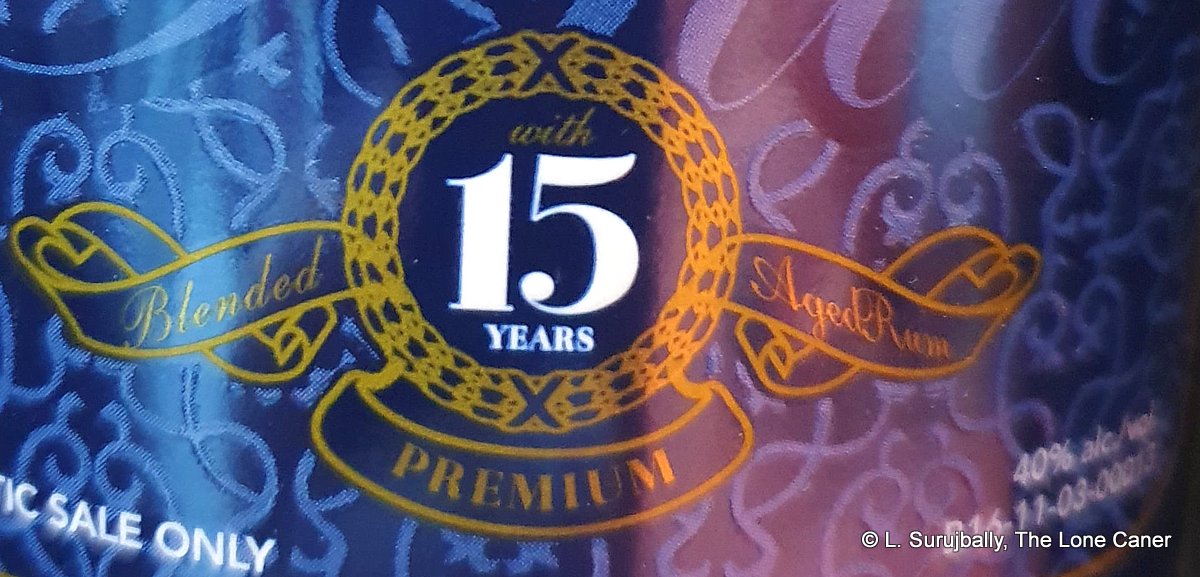
“Thin and somewhat sharp on the nose,” my notes on this apparently 15-year old blended, golden rum go, “But very interesting…could have been a bit stronger.” It was indeed an intriguing aroma profile – briny and a little vinegary, like salt biscuits smeared with a little marmalade, plus musty sawdust and spicy notes – tumeric and cardamom and cumin – redolent of a disused pantry left unattended for too long.  What may have been the most interesting thing about it was that there were surprisingly few real molasses or “rummy” smells, though some caramel emerged after a while: overall it was far simpler than I had been expecting for something this aged.

That changed on the palate, which was better (the reverse of the situation with many Caribbean rums where the nose is often richer and more evocative) – I had few complaints here aside from the feeling that 43-46% might have done the rum more favours. Mostly caramel, vanilla, some breakfast cheerios with milk lightly sprinkled with brown sugar and cinnamon, some cumin, citrus and oak.  Mildly sweet, a little dry, some pineapples and bananas, with additional late-blooming flavours of brine, sweet soya, and finished quickly, without fuss, short, thin, sharp and just more citrus, vanilla, caramel to wrap things up.  

Overall it was workmanlike, not overly complex – it is well constructed, flavours are distinct, balance is fine…but there just isn’t much of anything to really write home about, no singular point of excellence. It’s simply a good blend (in February 2020 I removed the words “15 year old”, see other notes) bottled at 40%, and could easily have been better with some beefing up or imaginative barrel strategy or finishing regime, and I think for a rum this old and at the top of the food chain for the company, that’s not an unreasonable critique to make. Sure it may be primarily for the East where softer fare is de rigueur…but one can always seek to raise the bar too.

Still, let’s give Jack his jacket: compared to the high-test-swilling elephant in the rum room right now (the Don Papa 7 and 10 year old, which I and others excoriated for being mislabelled spiced and oversugared syrups), the 1854 is quite a bit better. Johhny Drejer calculated 5g/L of additives, which is right on the margin of error (0-5 g/L is considered to be effectively zero) and that is evident in the way it goes down.  I think for all its relative simplicity and unadventurousness, it is tasty and straddles an interesting line between various different rum profiles; and has not only real potential but is an affordable, decent product that gives other fifteen-year-old standard-proof rums a run for their money..

(81/100)


Other Notes

  • In January 2020, Jeff S. pointed me to an overlooked discrepancy – the label doesn’t actually say “15 Year Old” but “With 15 Year Old.”  I checked that against the original bottle from which my sample came, and sure enough, it was there too.  The bottle is therefore on par with that famed contradiction in terms, the solera-style “age statement” – and means absolutely nothing. As a consequence, I have stifled my fury at this kind of deceptive marketing, retitled my post and rewritten some of the the narrative – but it’s hugely irritating, to say the least – I mean, come on, can you spot the “with” in the top photo without squinting?  They’re just pulling another Flor de Cana style bait-and-switch on us.
  • I can’t change the score and it stays as it is.  It was tasted blind and scored that way before I knew anything about it, so to change that now to express my annoyance with the labelling would be equally dishonest on my part, as the printing on the label doesn’t change the taste.


Oct 252017
 

#396

Since 2013 when I first wrote about the A.D. Rattray Panama rum from Don Jose, the lack of any real effort by Panamanian rum makers like Origines or Varela Hermanos (among others) to go full proof, issue single barrel, well-aged, or year-vintage bottlings has made me lose a lot of my initial appreciation for that country’s rums and I don’t seek them out with the enthusiasm of previous years.  There’s just too much mystery and obfuscation going on with Panamanian distillate, and other rums which crossed my path more recently, like the Malecon 1979, Canalero, and Ron Maja were relative disappointments.  

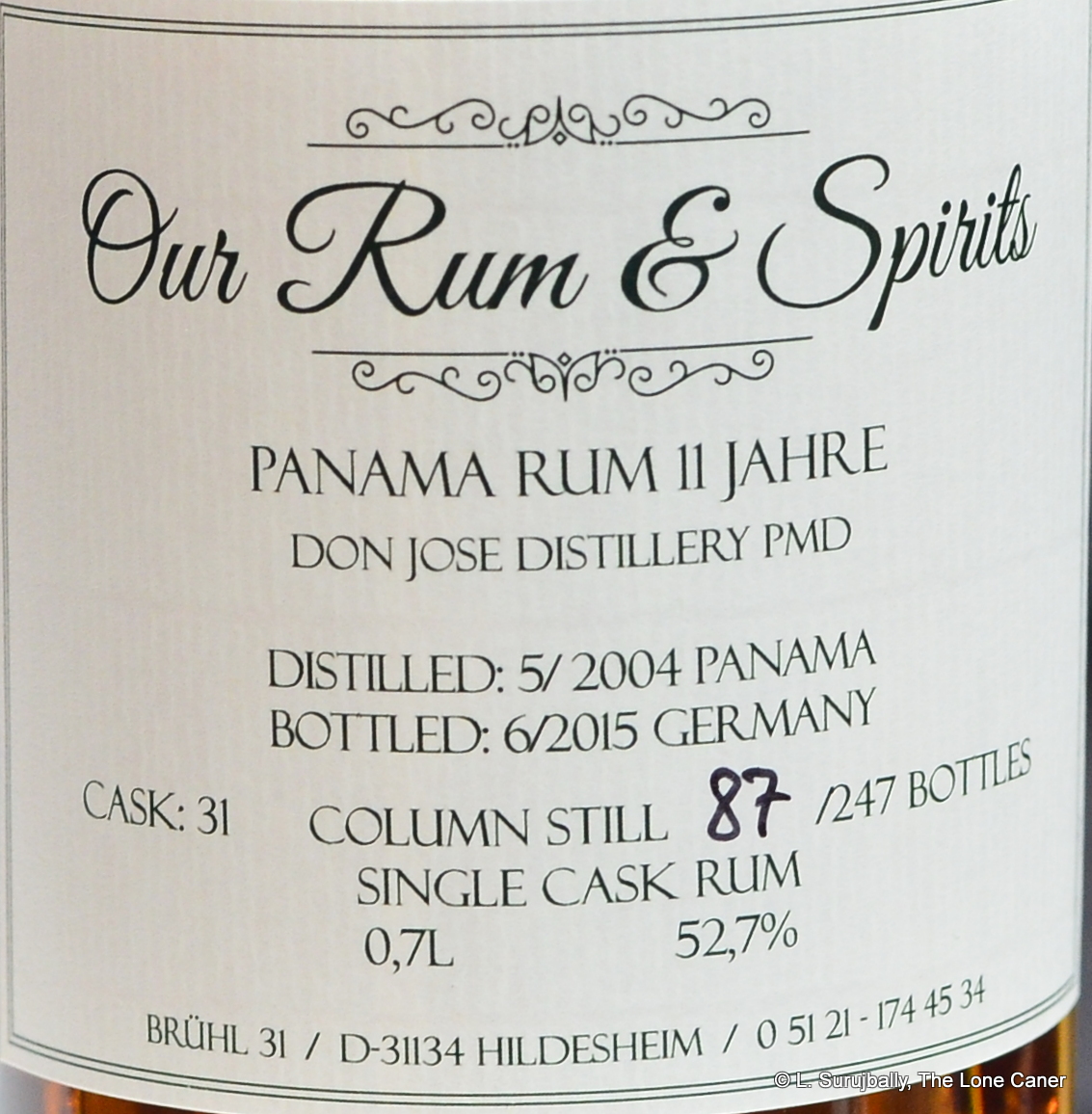
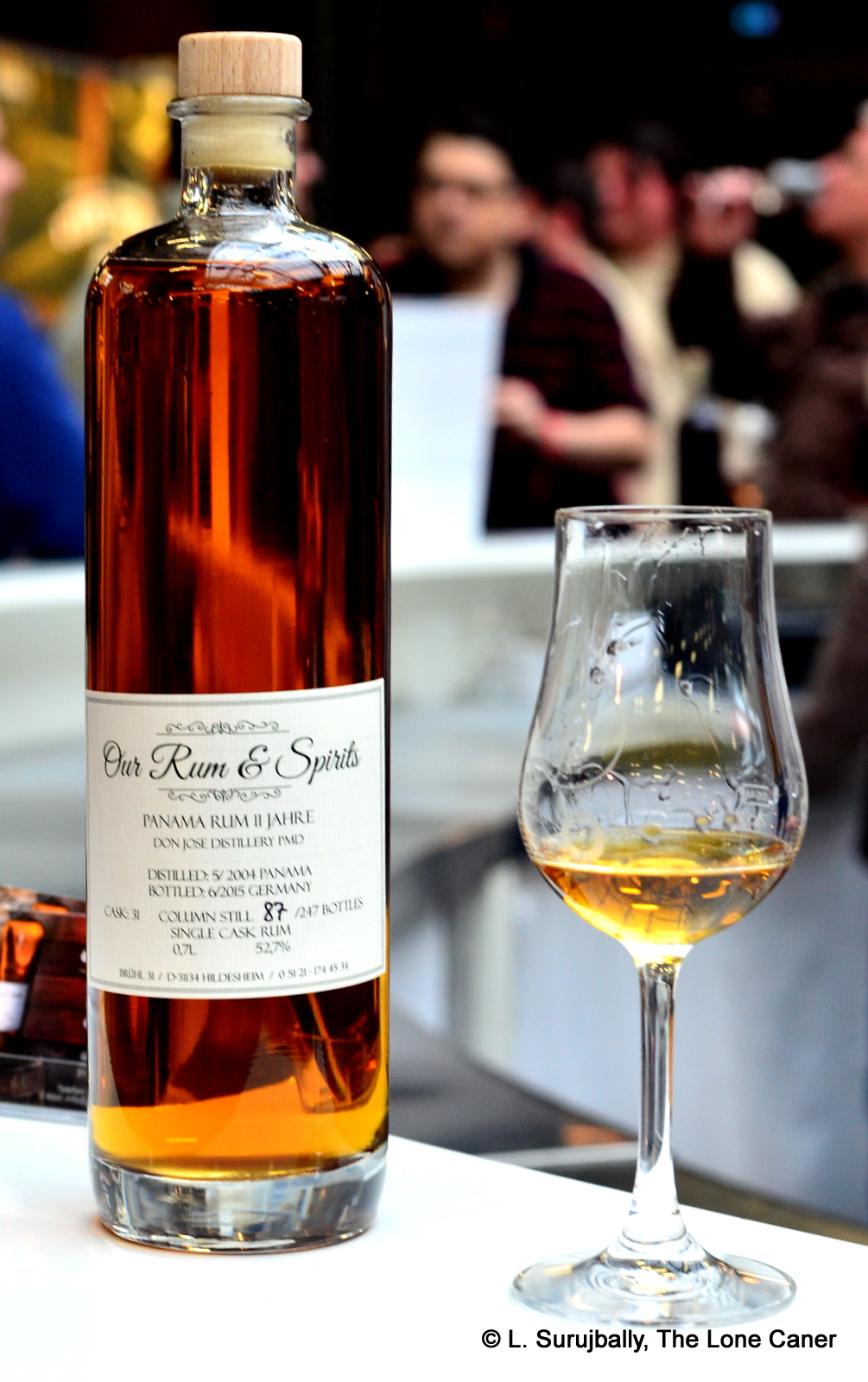
That leaves the independents to carry the flag and showcase some potential, and there aren’t many of those, compared to the tanker-loads of juice coming to the market from Jamaica, Guyana or Barbados.  One of the last I tried was Dirk Becker’s Rum Club Private Selection Panamanian 15 year old issued in 2016 (it hailed from Don Pancho’s PILSA facilities), which I thought gave the country’s rums a much needed shot in the arm and showed that a rum aged for fifteen years and bottled north of 50% was a really good product.  That same year I tried this one: Christian Nagel’s 11 year old rum which was sourced from Varela Hermanos (home of Abuelo), distilled on a column still in May 2004, aged in Panama and then bottled at 52.7% in Germany in June 2015 — and came with an outturn of a measly 247 bottles.  

Like Rum Club’s offering, it wasn’t bad, being a solidly built piece of work, light in the manner of the Panamanians generally, the strength adding more intensity to the profile.  There was a clear sort of white wine fruitiness on the nose – pineapples, pears, some tartness, a little caramel – wound around with a thread of citrus, all in a very good balance. To call it “easy” might be to undersell it – it edged towards the crispness of a dry Riesling without ever stepping over and that made it a very good experience to smell.

There’s nothing to whinge about the palate: it started out with the big players of lemon peel, caramel, and vanilla, with some spiciness of oak well under control. It feels and tastes a mite heavy, somewhat sweet, which suggesting some dosing — however, I was unable to confirm this, and neither was the bottler, Christian Nagel, who was emphatic that he himself had added nothing and expressed his frustration to me at his inability to find an unmessed-with rum from Panama, or a rum where the chain of production-evidence is clear and unambiguous. The finish was short and a little sweet, with crisp fruitiness, more lemon peel, pears, and cherries, all very low key and over quickly.

Christian Nagel, who founded Our Rum & Spirits, is not exactly an independent bottler in the normal sense of the word (or, he didn’t start out that way back in 2014 when he bottled his first one), because the rum business is, for him, a sideshow to his restaurant which serves rums as part of the menu.  Yet he keeps cropping up at the Berlin Rumfest, and has multiple bottlings from Guyana, Barbados, Panama and Jamaica, and in 2017 carted off a few medals to add to his stash and burnish his reputation as someone who knows how to pick his casks….so my opinion is that he’s becoming more of a bottler than he started out as, which is good for all of us.

Overall, the rum presented as perfectly serviceable, very drinkable, but I felt it lacked originality and real top-notch quality. Certainly cask strength Panamanian rums like this one are a step above the wussy forty percenters which corner the market in North America, because by being that way they are more assertive, and allow smells and tastes to be more clearly defined and appreciated. So they are, overall, somewhat better. Still, when it comes right down to it they continue to lack…well, adventure, character. A particular kind of oomph. I always get the impression the distillers are stuck in the fifties, when light Spanish column-still distillate was the rum profile du jour. When one considers the rip-snorting island products coming off the estates these days, the mad-scientist ester-squirting power bombs that get issued, each racing to see which can be more original, Panamanians just fizzle. This one is better than most, but it still doesn’t entirely make me rush to go out and buy a whole raft more.

(84.5/100)

Oct 032017
 

#391

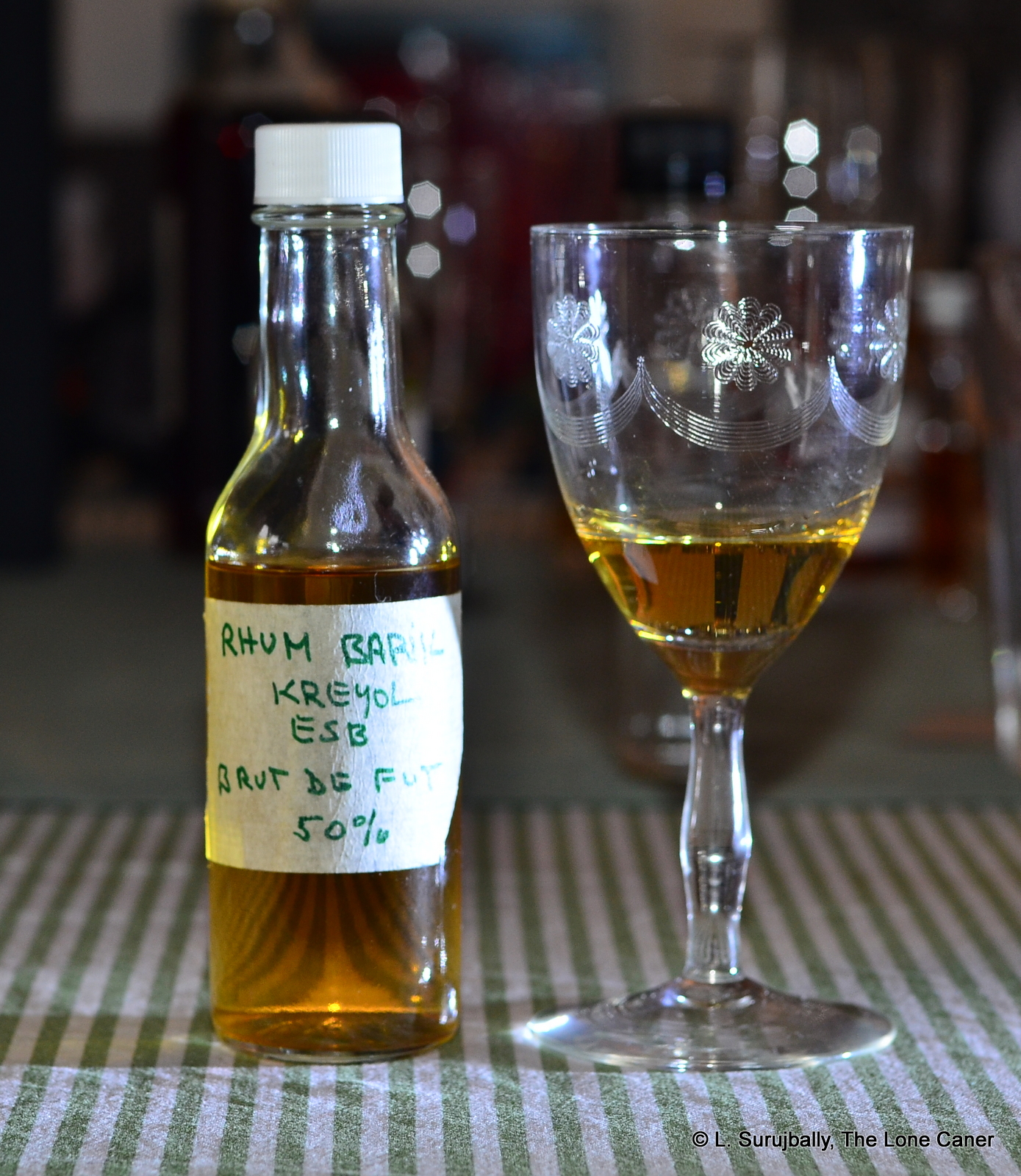
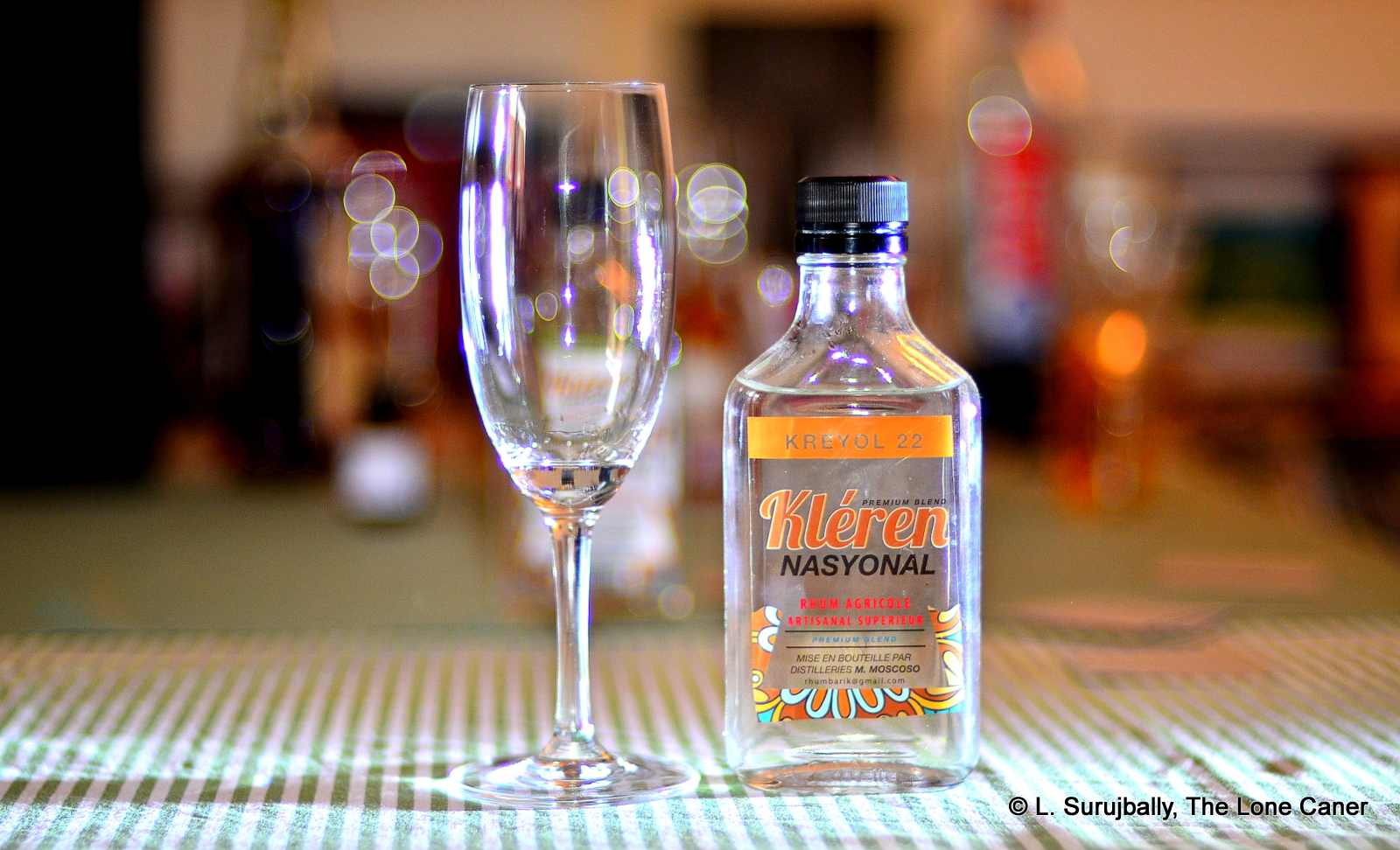
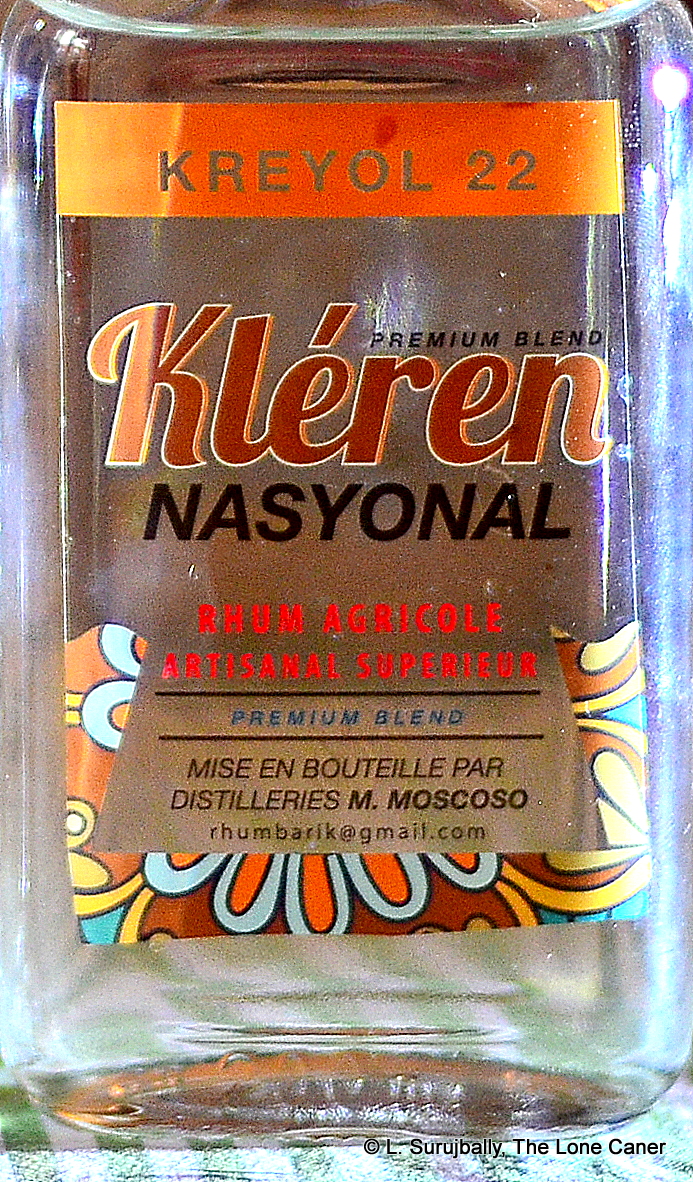
When in your cups, you could argue that Haitian clairins parallel the development of rum as a whole.  Just as rum (and rhum) was ignored for a long time, so were the indigenous likkers of Haiti.  And I posit that just as rum worldwide is going through a new golden age, so are clairins (with cachacas coming on strong). So far we have met amazingly pungent, raw and tasty white lightning from the stills of Sajous, Casimir and Vaval, which were promoted and given great visibility by Luca Gargano of Velier (to his lasting credit) and I’ve been fortunate enough to write about another small producer on the half-island, Moscoso Distillers, who produce the Barik brand of clairins (or klerens) — and I really believe that not only are they worth a look and a buy, but the Kreyol Nasyonal Brut de Fût may be one of the better ones…makes me wonder what Luca would have done had he stopped by there as well as the other three distilleries.

Anyway, I’ve tried the Kleren Nasyonal Traditionnel 22 and its sibling the Premium; this one is from the same source as those two white rhinos, just a little less pugnacious (50% ABV).  It was aged for three months in lightly charred first-fill small (5 litre) white oak oak barrels, which is why the rhum is light gold in colour – even that short time in a barrel was enough to impart some maturation and heft to the bottled product, which I think is better than any of the two unaged siblings,and eclipses the Sajous and the Vaval (but not the Casimir).

Perhaps a sense of my interest and appreciation can come as you run through the tasting notes, made as I tried all six of the clairins together. The nose on this one was definitely the best of the lot.  Some interesting earthy notes under here, not much sweet. A cereal and bean lover’s delight –  lentil soup, dhal, even some cumin with sour cream; roti, fresh baked bread, vanilla, sugar water – I swear to you, this is what I got right out of the gate and it developed into slightly more tart flavours of ginger and citrus rind (nicely balanced), plus bananas and pineapples, green grapes and ripe gooseberries.  It was amazing that at 50% and a mere three months old, it seemed quite tame and well adjusted and it reminded me nothing so much as one of Takeuchi-san’s six-month aged rums from over in Japan, twisted into its own creole style.

Taste wise it dropped a few notches from that nose, though still quite good – and it presented a bit thin compared to the powerful  “consider my cod” animal potency of the 55% unaged Premium edition.  That may be the price paid for civilizing it, I suppose, but fortunately such flavours as were there, emerged with a flourish and elan, and lost little of their own uniqueness – some initial tastes of wax, olives and salt (a wink to its origins, perhaps), then  vanilla and fleshy fruits like peaches and cherries, leading gently back to more bananas and pineapples, plus some astringency and tartness of unripe green mangoes (and those gooseberries again).  Those rich cereal and soup elements of the nose, alas, disappeared and were not to be found, and the finish surprisingly short for something bottled at that strength — lucky for us, it coughed up closing notes of cherries, salt and olives, a faint whiff of caramel, and additional fruits that pulled curtains on the show very nicely indeed.  

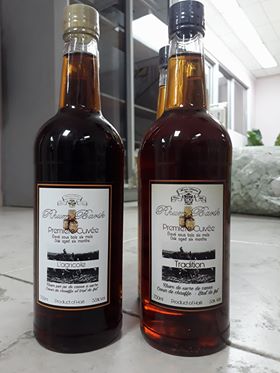
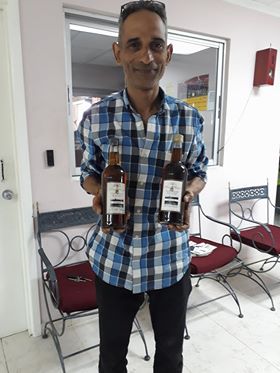
Mike Moscoso with bottles of the next-gen premium cuvee, aged for six months (not three)

In fine, this rum was intriguing as hell, tasty to a fault, with some weak points here or there, but which in no way dissuade me from going after more of Mascoso’s rhums – when researching background with him (the man is great at responding to messages), he remarked that he had some six month old versions coming out soon, and in 2018 he would be making the festival circuit of London, Berlin and Paris.  I can’t guarantee you would like everything he makes – clairins are, as I’ve observed before, something of an individual thing, containing a fierce, barely contained pungency (the French island version of a dunder bomb, I guess you could say) but I guarantee you’ll be as intrigued as I was, as interested, and may even like them enough to give more of them a try as they come out into the wider world to add lustre to Haiti’s spirited output.

(85/100)


Other Notes

  • The “ESB” moniker is French – Élevé Sous Bois – and means simply “oak aged.”
  • The original distillate of the rhum is the same as the Kleren Nasyonal rhums reviewed before
  • Update May 2021: Per the current LVH protocols identifying a clairin, this does not qualify as one.  There is, not surprisingly, some controversy over the protocols and their origination, but the better known clairin makers of Haiti seem to endorse it.
Sep 102017
 

***

Rumaniacs Review #055 | 0455

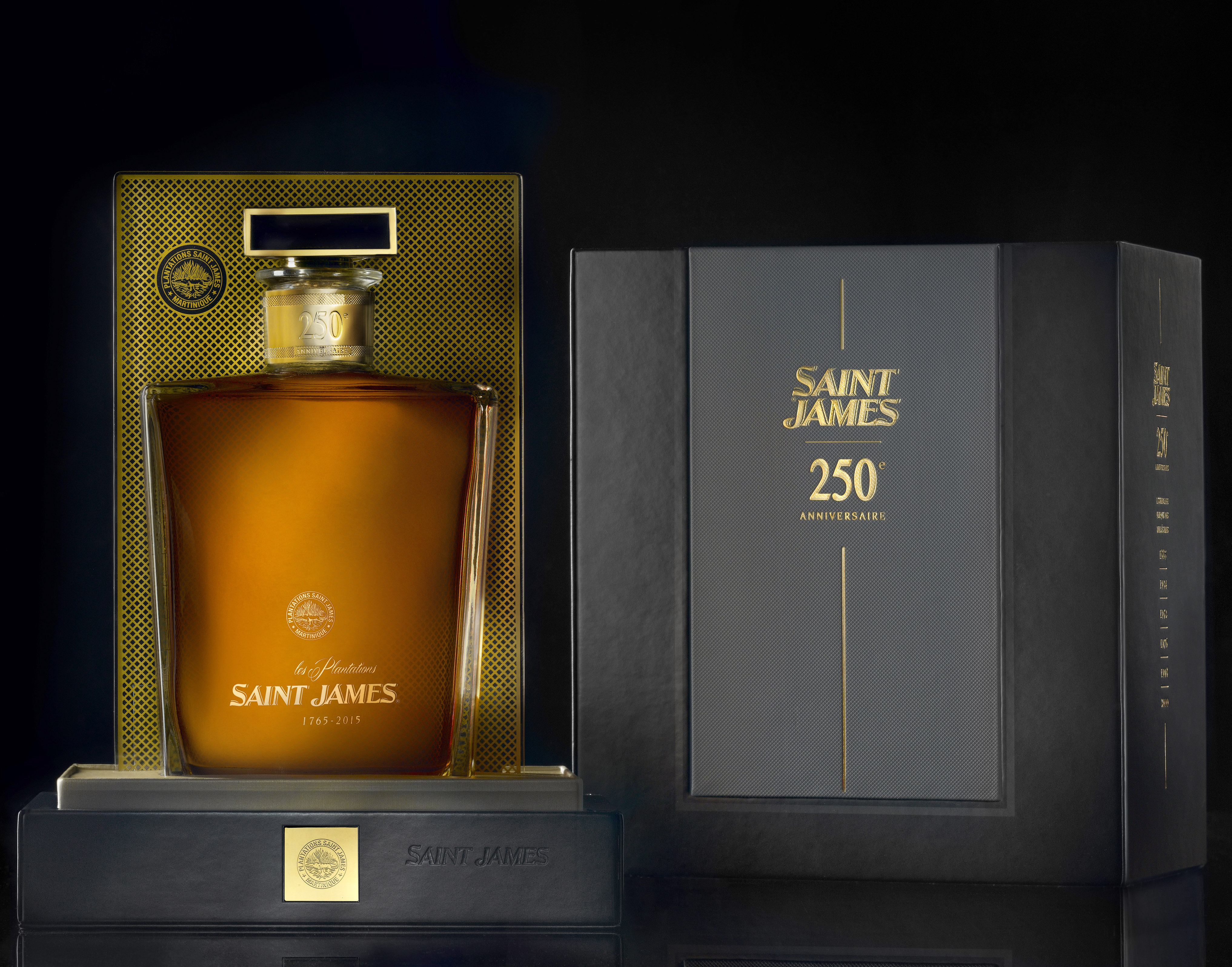
About the only place this rhum falls down is that for all the information we have on it, it leaves us begging for more.  It is a heritage (or “halo”) edition rhum, a bland of six millésimes, those years considered to be of exceptional quality – the legendary 1885 (R-010, remember that?), 1934, 1952, 1976, 1998 and 2000, and yeah, what else could we possibly want? Well, how much of each was in the blend, for one, and how old each of those components was, and further, how much (if at all) the final blend was itself aged.

But I’m not whinging too loudly.  This is an impressive dram, and only 800 bottles were issued for the 250th anniversary of the plantation (I think this was 2015).  One wonders if it was a coincidence that each bottle supposedly retails for €800, and yes, it’s still available, the secondary market has thankfully not gotten into the action here as yet.

Colour – bronze

Strength – 43%

Nose – Luscious, voluptuous. Caramel and dark fruits, hinting at (get this) a column still Demerara, except that it’s much lighter.  Florals and sweet ripe fruit are exhaled with joyous abandon – marula fruit, cashews, light pineapple, and the sweet and over-ripe scent of mangoes that fall under gargantuan tropical trees in such profusion they rot right there on the ground.  Also oaky, somewhat sharp, some freshly sawn lumber, pineapple, tobacco and grated ginger.  Whew…quite a smorgasbord, and well assembled, I assure you.

Palate – After the stronger Neissons, this seems almost tame.  Much of the nose has been retained – ripe fruits, cherries, the crispness of gooseberries, herbs and grass and cream (“krauterquark” as the Germans would say).  Much of the heavier components of the blend lose some definition here, the younger ones take over and contribute a light, frisky, sparkling profile. Pleasant, just not earth shaking.  Light strawberries, vanilla, oak (perhaps a bit much), breakfast spices, cumin, and a vein of citrus and salt caramel through the whole thing.

Finish – A shade brief, with the aforementioned fruit, cumin, citrus, salt caramel and raisins, lots of raisins.

Thoughts – I’d hazard a guess that the more recent vintages, say from 1976 on, contribute some sprightliness and vigour, some of that sharpness and tart fruitiness to the blend, while the older ones give depth and solidity upon which these rest.  For my money I’d prefer somewhat less of the former, more of the latter, or some better balance between the two, and perhaps a greater strength – all the elements of a great rum are in evidence, but it’s too light.  That’s not to say it’s bad – not at all! – but it does make for ease and comfort; I’d personally prefer something more aggressive and complex which would elevate such a great collection of vintages a few points more.

(86.5/100)ruma

Some of the boyos have taken a look at this rhum also…see the Rumaniacs page

Sep 042017
 

Rumaniacs Review #54 | 0454

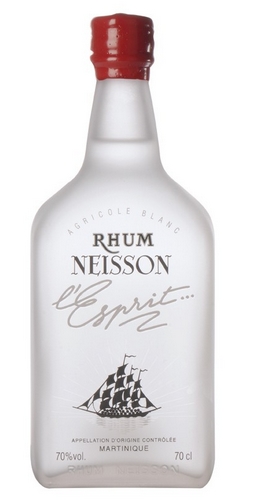
The fourth in the Rumaniacs Neisson lineup (though I’m sure they will be more), this thing is a massive falling anvil of oomph, and takes Le Rhum Par Neisson (R-053), also a blanc, out behind the schoolyard and whomps it with an extra twenty degrees of proof…and while the previous blanc elicited strong opinions for and against its quality, thus far I think the general consensus of this one is that it it one hell of a white rhum, to be had with a mixture of caution and enjoyment.

Colour – white

Strength – 70% ABV

Nose – Sharp as an axe to the face.  Unpleasant? No, not at all.  Some brine and olive notes, with somewhat less of the herbal, grassy aromas one might expect.  Much like a sweetish tequila, and the distinctive Neisson profile emerges rapidly – apples, green pears, tart red guavas, floor polish, leather shoes, some swank, coconut and wax.

Palate – Massive and powerful, heated like a brimstone coated pitchfork.  Sugar water and brine, more olives, sugar cane sap, acetone, rubber and wax, stewed prunes and a general feel of a tamed clairin.  It’s powerful to a fault and can be had in moderation or without it, but either way, it never stops giving up some seriously intense tastes.

Finish – Long, long long.  Sharp, aromatic.  Leather, aromatic tobacco, cocnut, musky herbs, fennel and rosemary.  One finishes this thing breathing hard, but ennervated to a fault, just at having come through the experience in one piece

Thoughts – It’s good, quite good, but my general opinion is, having tried it twice now, that perhaps whites walking around with such a plethora of flavours, might be best between 50%-60%.  I liked it a lot…but 70% may be just a shade much for the average drinker, in spite of – or maybe because of — how rumblingly, numbingly strong it presents.

(85/100)


  • As always, other Rumaniacs’ opinions on this rhum can be found on the website.
  • I read somewhere that the strength was a nod to the 70th Anniversary of the founding of the distillery, but since that was 1931 and I have no idea whether (a) that’s true or (b) this was made in 2009 (currently made bottles look just like it), I merely make mention of the matter for completeness.
Aug 312017
 

#385

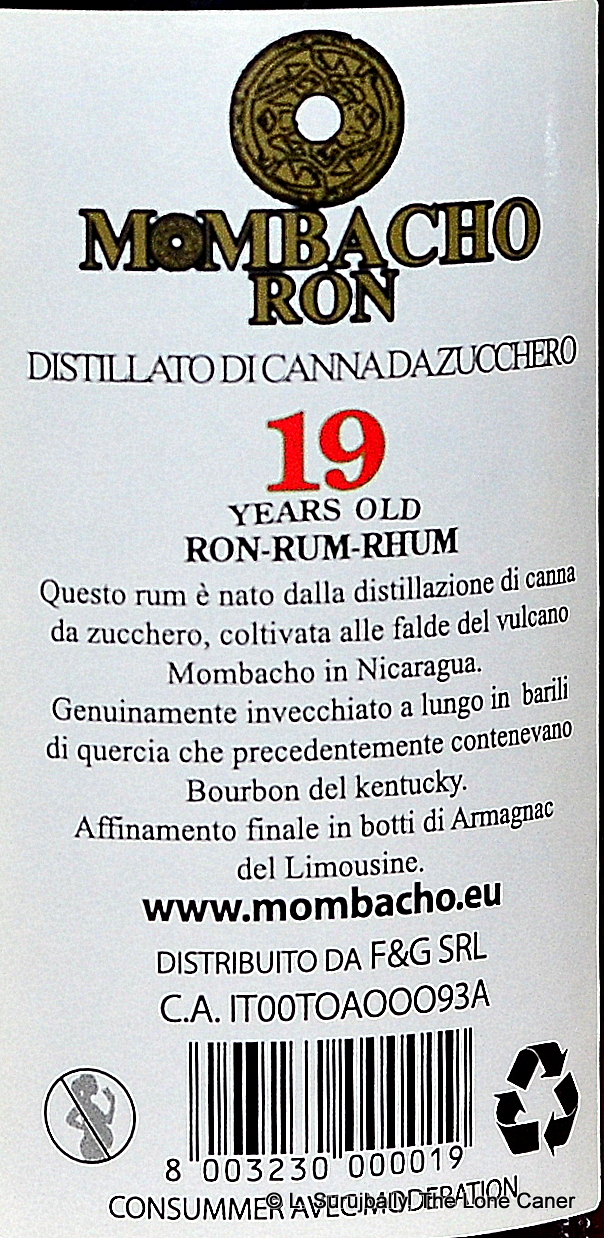
Perhaps it would be better to start with the straightforward tasting, lest my snark bend your mind were I to lead in with the commentary instead of finishing with it. The Mombacho 1989 Central American rum does, admittedly, boast and flourish some impressive chops on the label: 19 year old rum (1989-2008), finishing for the final two years in armagnac casks, reasonable strength of 43% (I said ‘reasonable’, not ‘outstanding’). Looking at other bottles of their range it seems within the bounds of reason to assume it’s from Nicaragua, though the ‘Central American’ noted on the label might suggest a blending with other rums from the region.

The nose is quite good for something I feared would be rather thin: unsweetened chocolate and coffee, some dark fruit – nothing as deep and brooding as a good Demerara, mind, but nevertheless, there’s a kind of muskiness to the aromas that worked well.  Baked apples and a sort of cereal background, something like nice blueberry tart – I assume that was the armagnac finish lending its influence – with an ashy background to the whole thing.

Tastewise, also nothing to sneeze at, with a rich red wine taking the lead, plus prunes, apricots, stewed apples and burnt sugar. In its own way, it felt a little over-rich so maybe something was added?  I tried it in conjunction with the Compagnie des Indes 17 year old and the Blackadder Raw Cask 12 year old (both from Nicaragua) and it is in the comparison that I got the impression that either it was doctored a mite, or the finishing was simply too dominant.  With water additional flavours of honey, vanilla, cereal and tobacco could be discerned, plus licorice and some oakiness, and overall it had a nice rounded feel to it.  Even the finish had that balanced quality to it, though quite short – cherries, peaches, prunes, anise, gone too quickly.  

It was said to be the best rum in the world in 2008, but I’ll tell you frankly, when I read that I just smiled, shrugged and moved on – it was good, but not that good.  Not bottom shelf by any means…and not top shelf either. Let’s put it somewhere in the middle.

(83/100)


Opinion (you can ignore this section)

So what to make of a rum that is purported to be nineteen years old, yet whose provenance is shrouded in mystery?  Mombacho is a rum brand which has a website and a Facebook page (among others) that are masterpieces of uninformative marketing.  About all you get from these sources (and others) is the following:

  • They issue aged bourbon-barrel-aged expressions with fancy finishes
  • This rum is named after a volcano in Nicaragua
  • It’s distributed in Europe by an Italian company named F&G SRL out of Torino.
  • There used to be a moonshine distillery on the slopes of that volcano (the whole area is now a nature preserve) selling a rum called Mombachito
  • The rums in the brand’s lineup are variously aged from 8 to 21 years.
  • Some of the rums from Mombacho are called “Nicaraguan” and others “Central American”.

My personal assumptions are as follows: I believe this is a Flor de Cana based rum. The taste profile, and the absence of any concrete contact info of the producing distillery, if there is one, points to this (some online webpages speak to a distillery, never named, never located). I think it has been bought aged as is from FdC (they laid in a lot of stock in the 1980s as a hedge against hyperinflation and political problems, so the assumption is reasonable), and the rebottler/blender, whoever they are, aged it a further while in the armagnac casks for the finish.  Some blending of barrels is highly likely, because any limited outturn would have the number of issued bottles proudly displayed as well.

Everything else I found in my research is glitzy pictures and self-promoting blah of zero interest to the diligent, curious rumhound. Even on the large Facebook rum clubs where an occasional mention can be found, about all you’re walking away with is that some people got one of the rums from the brand, but without details or facts of any kind on the brand itself. It’s been a long time since I’ve seen such an informational black hole

This enormous lack of background material does not make me a happy camper.  I can’t trust a company which has no information behind it, therefore I can’t trust the provenance, so I can’t trust the age, it throws suspicions onto the entire label,  and with all these doubts, it inevitably leads to suspicions that the price I paid (€120) was excessive for what was on show.  I honestly don’t care if the makers are marketing tyros or business neophytes or freshie rum dilettantes – more should have been provided, even back in 2008.

This is where honesty in labelling becomes so very important.  If this was a thirty-dollar rum, I would not worry overmuch about it, but for three figures it begs some questions.  And when none of this is readily available, it devalues every other statement made in the marketing literature, or the bottle label itself.  If anything positive emerges from this tirade, it is that it shows what is demanded in 2017 for any rum on the market nowadays. I doubt a new entrant to the field could get away with what Mombacho did nearly ten years ago, and the 28 year old Panamanian Arome may be the proof.

So yes, it’s a decent rum, and no, I wouldn’t buy it again.  Not because it doesn’t have some quality, but because I rarely spend that kind of money more than once on a no-name brand with little but air behind it.

Other notes

I sent out a note to many of my rum swilling friends….none of them could tell me anything about the company.  Mombacho’s FB page has so far declined to respond to my message asking for further info, an the mombacho.eu website was similarly unhelpful.  But, if I do get some feedback, I’ll update this post.

Aug 272017
 

Rumaniacs Review #053 | 0453

Another Neisson in the series, one to leave a drinker scratching his head in bafflement.  It’s not a bad rum, just an odd one, exhibiting some of  the characteristics of other unaged whites, then going off to check out some side roads…not always to its advantage

Colour – White

Strength – 52.5%

Nose – Hello Sajous…I mean Neisson, sorry. Whew, quite a bite here – salty, briny, and then…labneh, or fresh yoghurt. And sugar, so weird, like sucking tea through a white sugar cube. Some tar, herbals, iodine and medicine, and light (very light) florals and fruit. Somehow it barely hangs together.

Palate – Okay, so yes, I do like my jagged unaged pot-or-creole still whites, but this isn’t quite one of those.  For one thing, it tastes of sugar, unambiguously so.  This markedly impacts the tastes — of rose water, anise, a few fruits, pears, an olive or two, even some herbal, grassy notes — but not in a good way.  Some of the promise of that yummy nose is lost here.

Finish – Iodine, sugar water, brine, maybe a slug of mixed and overdiluted fruit juice

Thoughts – So…a rather strange white rhum from Martinique, and I wonder whether this slightly lower-horsepower model shares any of the same chassis or DNA with the L’Esprit 70%…I would suggest not.  It’s strange because it veers away from expectations, and though fiercely individualistic whites are great when made with bravado, here it seems like a different – and lesser – rhum altogether, in spite of the firm strength.  It’s that palate, I think – the nose entices, the taste drives away.  Not a failure, just not my speed.

(79/100)

As always, other reviews of this white can be found on the Rumaniacs site.

Aug 202017
 

Rumaniacs Review #052 | 0452

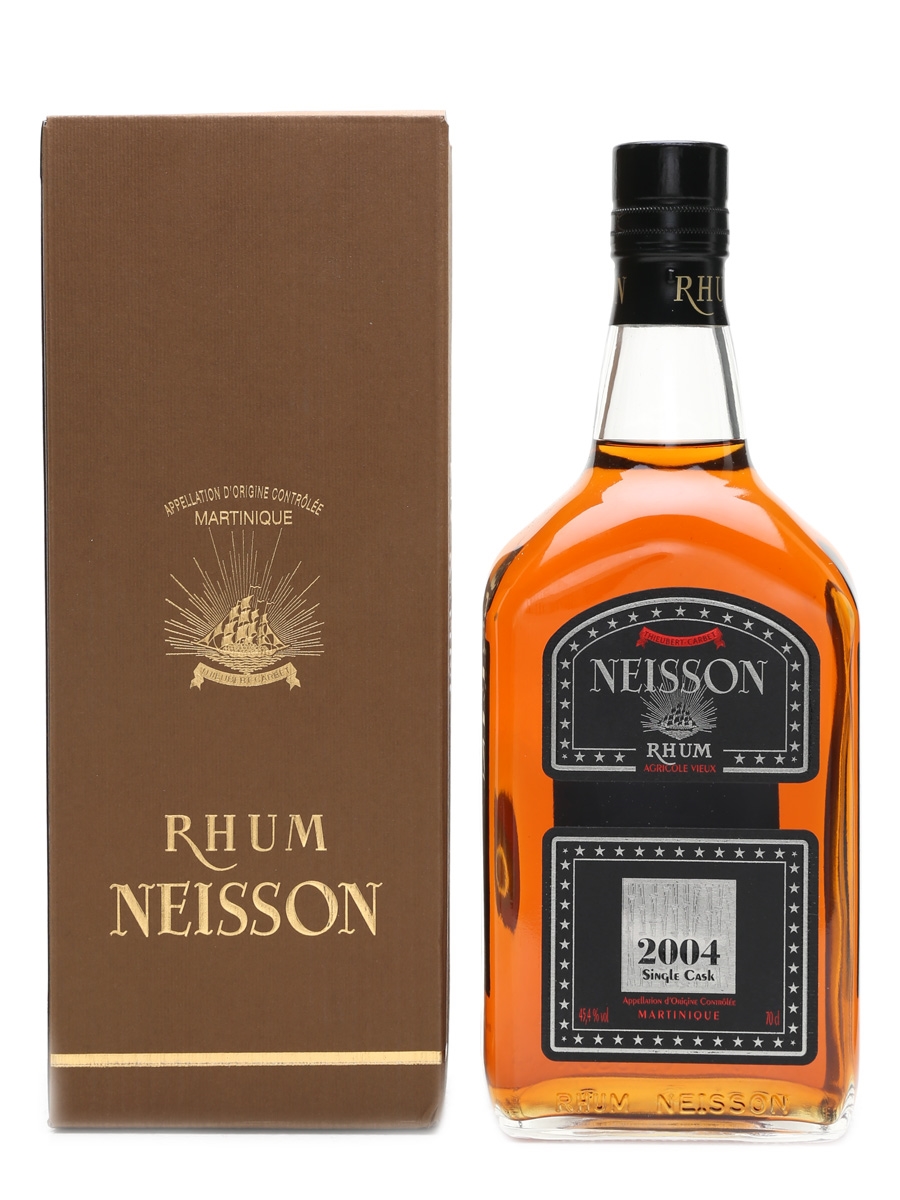
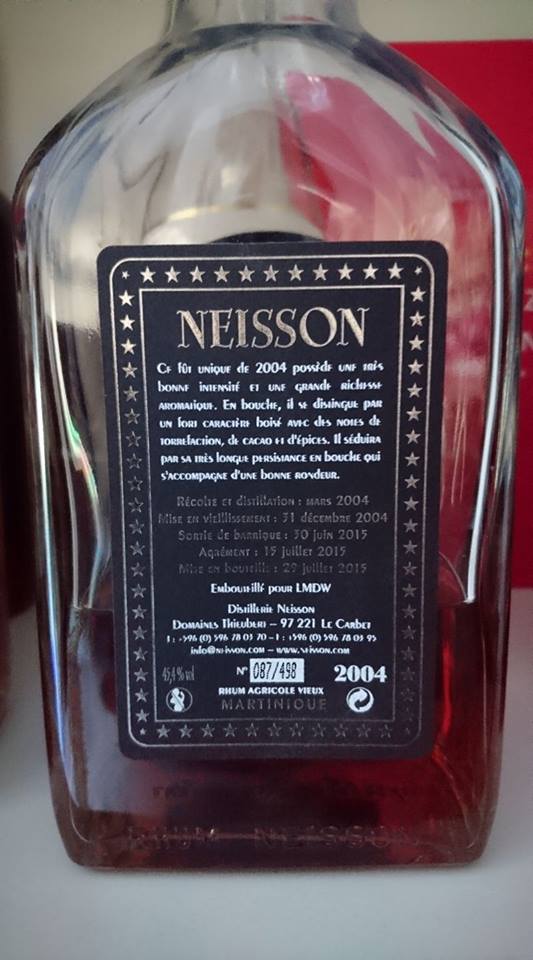
None of the ‘Maniacs seem to have written anything on how old this things is, which is surprising given its price tag (about €170 or so), but both WhiskyAuction and Reference-Rhum say’s it’s a ten year old; the label (below) says its eleven so we’ll go with the older one.  Another odd thing is the strength – my sample said 45%, and various online shops quote it as being variously 45.4%, 46.2% or 42.7% – so after some digging around it seems that 2004 was a particularly good year and several single barrel issues were made, so pay attention to which one you’re getting.  Mine was evidently the 45.4% iteration made for LMDW in Paris and I accept the labelling on my sample was a misprint.

There’s already been enough written in these pages and others about Neisson so let’s move on without further ado because my sample is evaporating and I don’t want to waste any.

Colour – orange gold

Strength – 45.4%

Nose – Deep and controlled without sharpness, very tasty; pears, papaya, green apples; develops gradually with herbs and a sort of vegetable soup with just a hint of soy.  In the background there’s some oak and aromatic pipe tobacco.

Palate – A fragrant bowl of hot soup, really quite amazing. Some floral notes, some fruitiness of tart apples and a potpourri room freshener, far from unpleasant.  Tart apples, fleshy fruits, lemon zest, maggi cubes, brine and olives, more smoke, chocolate, ginger…how the rhum navigates its way among all these flavours, where an excess of any one could sink the whole thing, is really quite extraordinary.

Finish – Very pleasant, medium long, just north of light.  Floral and fruity, guavas and pears mostly, plus some oakiness held way back.  Here sweetness and vanilla come forward which isn’t entirely to my liking…but overall it closes off really well.

Thoughts – A really impressive agricole which demonstrates again why Neisson is one of the better rhum producers from Martinique.  There’s just so much going on here that it demands some patience and leisurely sipping to appreciate fully.  Mixing this into a cocktail might be a punishable offense in some countries.

(85/100)

Other Rumaniacs reviews of the Neisson 2004 can be found on the website.


Photo courtesy of Gaetan Dumoilin

Aug 162017
 

#383

When one tastes a raft all kinds of rums from around the world and across the ages over an extended period, there is a normal tendency to look for stuff that’s a little different while still conforming to commonly-held notions of what a rum is.  After all, how many times can one try a basic rum redolent of molasses, caramel, sugar, banana and maybe raisins and citrus without getting a little bored?  Well, for sure there’s no shortage of new and interesting popskull coming on the market in the last few years, and I’m not just talking about the new agricoles, or the geriatric rarities released by the independents, but actual distillers and bottlers like Hampden, Worthy Park, Savanna…and that interesting outfit called Moscoso out of Haiti.  Drink some of their klerens, and believe me, if you’re afflicted with ennui, this’ll cure what ails ya…if it don’t put you under the table first.

Also called Barik (a creole word for “barrel”), Moscoso interested me enough to write a full profile of the company a few months back, and since that time they are aggressively seeking outlets and distribution in Europe, to say nothing of issuing all kinds of aged or unaged permutations of their booze. And my goodness, when you taste these things, the inescapable conclusion is they’re aren’t just rarin’ to take Barbancourt out back, kick the snot out of it and give ‘em a run for their money, but also casting narrowed snake’s eyes at the Velier-issued Vaval, Casimir and Sajous as if to say “Mwen nan bouda, nou zanmi”.

Perhaps they have good reason. Their 55% Traditionnel 22 was a rum that stunned and smacked the unwary with all the force of a Louisville slugger to the face, and yet I felt it had been reasonably well made, with much of that elemental joyousness that so marked out the other, better known clairins like the Sajous that have so impressed me over the last few years.  

Which is not to say you wouldn’t be a little startled by the initial smells given off by this 55% white rhino. I mean, I nosed it and drew back with widened eyes, wondering if there wasn’t some excess Jamaican dunder or balsamo-infused cachaca in there — because aside from the brine and wax and glue and shoe polish, I was also getting a barrel of rotting bananas and funk, mixed up with musky, damp wood and wet dark earth (which I’m sure you’ll concede is not normal for a rum).  It started out raw and fierce, and perhaps it needed some resting time, because after some minutes of letting it stand there (glowering sullenly around the room the whole time) additional aromas of freshly ground black pepper, cumin, masala, lemon peel and herbs became more prominent. “Meaty” is not a term used often in these pages, but here it was exactly right to describe what I was experiencing.

What elevated the rhum to something better than the nose suggested was the way it tasted. As seemed to be the case with all such Haitian whites I’ve tried, the nose was “da bomb” and the palate calmed itself down quite measurably, and a drop or two of water helped as well.  Here the sugar water and watermelon came through much less aggressively, as well as brine and olives, fresh cane sap, nougat (!!), some nuttiness and citrus (not much of that, a pinch not a handful), coming to an end with a long, somewhat dry finish which reminded me of sharp, damp sawdust of some freshly-sawn unnamed lumber in a sawmill (yeah, I worked in one once), as well as fresh grass, and sugar cane juice.

So…quite an experience.  Strong, distinct, flavourful, uncouth, odd, just on this side of bats**t crazy, and overall a pretty amazing drink – it would light up a cocktail with fireworks, I’m thinking.  On balance the nose of the original Nasyonal earned my favour, but here the taste profile carried it ahead – it was a shade more complex, tastes better integrated. Whether you buy into that premise or not depends a lot, I feel, on where in the spectrum of rum appreciation  you fall. I wouldn’t recommend it to a person now starting to branch out into white full proofs; and for those who prefer the softer, sweeter profiles of Diplomatico, Zacapa, Panamanians or dosed rums like El Dorado or Plantation, stay away.  For everyone else?  Oh yeah. Give it a try, if nothing else. And take a gander at what Mike Moscoso is making — because as he noted so elegantly up above, he’s coming for all of us.

(84/100)

Other Notes

  • This rhum is not a true agricole, the label is an accidental misprint which (at the time) Mr. Moscoso was too poor to fix and reprint. It is made from raw brown sugar liquified to 12-14% brix with 7-12 days of fermentation (using baker’s yeast). Distilled on a 12-plate creole columnar still, final distillate coming out at 65-70% ABV and reduced to 55%. It is unaged and blended from the various returns of the distillation run.
  • Points should be given to the company for issuing 200cl bottles for sale, aside from the standard full-size.  For someone on a budget who wants a taste but isn’t sure, those things are a godsend.
  • The significance of the “22” lies in the proof point.  Under the Cartier scale this translates into 55% ABV, while the more common Gay-Lussac scale equating to 55% / 110 proof is used everywhere else in the world
  • All clairins and klerens in my possession (six) were tried together, blind.
  • Update May 2021: Per the current LVH protocols identifying a clairin, this does not qualify as one (for other reasons than just the source material mentioned above).  There is, not surprisingly, some controversy over the protocols and their origination, but the better known clairin makers of Haiti seem to endorse it.
Aug 132017
 

Rumaniacs Review #051 | 0451

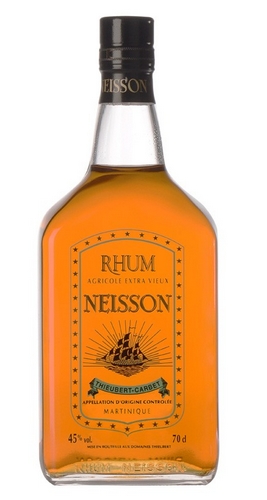
Today we amble on over to Martinique, where Neisson is to be found: I have four of these fascinating AOC rhums to play with, and here’s the first  of them to sate the intangible palate and add to the historical record.

Neisson is, in my own opinion, one of the most singular makers of agricole rhum on Martinique, and I’ve used words like “fascinating”, “unusual” and “distinctive” to describe their remarkable products…there’s always something slightly off kilter in them, some cheerful, almost whimsical, sort of “essayons de cette façon,” or “leh we try dis” approach.  I’m not entirely convinced this makes them world beaters in every instance and iteration…but you’ll always know one when you try it, and perhaps that’s the aim all along.

Colour – Orange-Gold

Strength – 45%

Nose – Yoghurt and sour cream, sharp apple cider, fruit, and buttered green peas (I could not make this up if I tried).  It’s a nice nose, however, with just a tinge of olives in brine, some vanilla, marmalade, and bitter coffee.  How this all comes together is a mystery, but it does work…in its own way.

Palate – Winey, just a bit thin, quite warm.  Where’s the grassy and herbal stuff agricoles are supposed to have?  Let it wait, add a touch of water, and there it is: sugar cane sap, light vanilla and lemon ice cream, and is that some wasabi lurking in the background?  Sure it is.  Sour cream, some red grapes, red guavas wrap up the show.  Definitely not a standard agricole, so I’m going to add “intriguing” to the vocabulary as well.

Finish – Medium short, less impressive. Green grass, brine, vanilla, herbs, some oakiness (not much) and the musky brininess comes back to say a flashing goodbye.

Thoughts – Takes some getting used to.  As a personal thing, too many tequila-like notes don’t enthuse me, but once this meanders off the gradually unfolding of the rhum is remarkable, so apply some patience in assessing it as a sipping spirit.

(82/100)

Other Rumaniacs reviews of this rhum can be found in the website

Jul 262017
 

#380

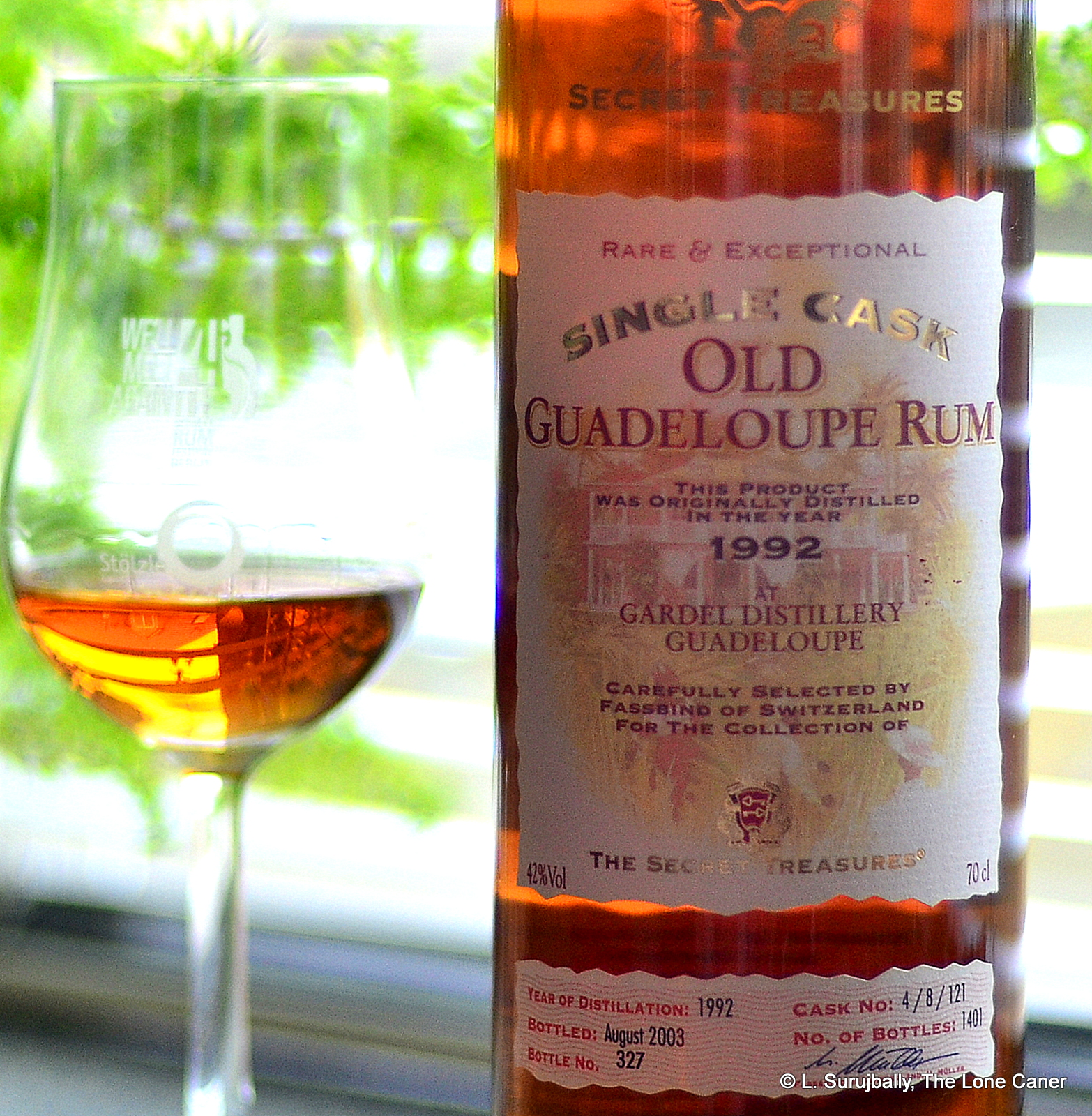
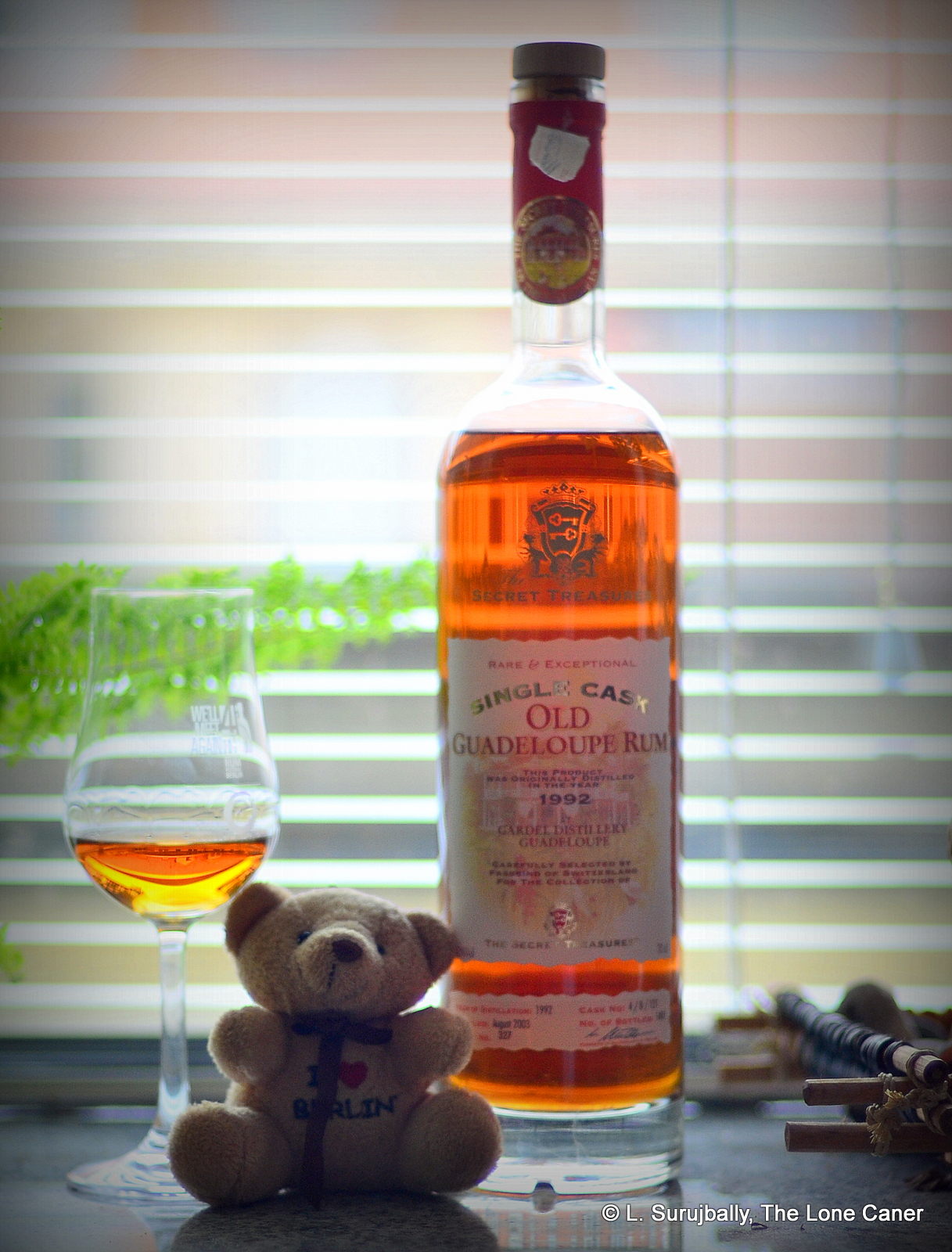
The independent bottler Secret Treasures is no longer the same company it started out as, and this particular and delectable Guadeloupe rum was selected by the Swiss concern Fassbind before they sold off the brand to Haromex in 2005.  So although Haromex is now making a new line of rums under the ST label (like the St Lucia Vendome and John Dore still rums I’ve looked at before), this rhum predates them and is part of the original line up.  

Guadeloupe is somewhat general a term so let me expand on that by saying the rhum originates from the Gardel Distillerie located in the north-east of Grand Terre in the commune of Le Moule.  Gardel, owned by Générale Sucrière, a major player in the global sugar refining industry, is one of two distilleries in Le Moule (the other is Damoiseau) and earns some of its distinction by being the sole sugar refinery on the main island.  I don’t think Gardel makes any rhums of its own but sell rum stock to brokers and others – however, there is maddeningly little information available except this one: Gardel ceased distillation in 1992, so this rhum is among the last that actually derived from its column stills. Afterwards it is conjectured Damoiseau used the “Gardel” title for some 1998 rums, like Renegade’s.

Some basic facts on the rhum then, just to set the scene: it was from the Gardel distillery, distilled 1992 and bottled August 2003 from three casks which provided 1,401 bottles (this was #327).  It was issued at a relatively unadventurous 42% which would have been fairly standard at that time, and one can only wonder what it has been doing for the last fourteen years and why nobody ever bought the thing.  Since I had and retain a sneaking appreciation for Secret Treasures ever since I had their excellent Enmore 1989, there were no battles with my conscience to buy a few more from their range.  Note that it is labelled as a “rum” (not rhum) and I have no absolute confirmation whether it was truly cane-juice derived, or where exactly it was aged (the now-defunct Reference-rhum, that online French-language encyclopedia of rum brands, says “molasses” with a question mark under its entry, while the 2021 entry for it under RumX says “molasses” with no evidence of doubt).

In any event, whatever its ultimate source or point of ageing, I thought it was a zippy and sprightly rhum of initially crisp clarity and cleanliness.  Coloured orange-amber, it nosed in surprisingly bright and clear fashion, immediately giving up aromas of honey, flowers and 7-Up (seriously!); over a period of minutes a more solid briny background emerged, accompanied by perfectly ripe fleshy fruits – peaches, apricots, sultanas and raspberries.  Not particularly fierce or savage – it was too laid back and standard strength for that – but a very enjoyable nosing experience, the sort of easy going yet sufficiently assertive profile to have one curiously going deeper into it just to see where the rabbit hole led.

Aside from a certain lightness to the profile, the palate provided a soft series of tastes, which were fruity, floral, musky and delicate all at the same time.  It was hard to know what to make of it – initially there were flowers, fudge, salty caramel, coconut, and vanilla, counterpointed with lemon zest, green apples, grapes and peaches.  After a while additional flavours evolved: maple syrup, aromatic tobacco and vague coffee.  Some of the crispness of the nose faded into the background here, and overall it did not present the sort of complexity that would advance it to the top shelf, but it was distinct enough to grab the attention, and at the very least it was intriguing, and for sure quite pleasant to drink.  Perhaps the finish was the weakest part, being short and easy and light, mostly reminding one of caramel, light fruits, and raisins, which goes some way to making me wondering whether it was a true cane juice distillate (it lacked the distinctive herbal grassiness of such a product), or from molasses.  One thing was clear though – it was nicely made, and wore its middle age well, without any kind of raw edge or jagged sharpness that distinguishes extremely young bottom-tier rums.

So: trying this clean and playful Guadeloupe rhum in tandem with the L’Esprit Bellevue 58% 8-year-old and the Longueteau 6-year-old VSOP, I felt the last two rhums were remarkably similar, though I liked the soft honey and maple-syrup notes of the Secret Treasures just a little more, and the L’Esprit better than both, which just goes to show that ageing isn’t everything, especially in the world of agricoles (remember the spectacular Chantal Comte 1980?).  Be that as it may, there’s nothing at all bad about the ST Gardel 1992 rhum, and in fact it makes me really interested to try the 1989 variation, just to see how it stacks up. These days Fassbind is long gone from the scene and Haromex is making changes to the labels and the line up – but for those of you who come across some of the original bottler’s expressions dating back from the eighties and nineties, you could do a lot worse than pick one of them up, if for no reason than the pure and simple enjoyment of a well-aged rhum, well made, almost forgotten, and tasting just fine.

(84.5/100)


Other notes:

  • The Gardel plant, also known as Sainte-Marie, is the only sugar plant which still operating in Guadeloupe. It was founded in 1870 and its first owner was Benjamin François Benony Saint-Alarey, who chose to pay homage to his paternal grandmother in his naming of the factory. In 1994, the sugar sector in Guadeloupe underwent major restructuring, leading to the closure of all sugar factories on the island except Gardel which is currently composed of an agricultural part with a 1000 hectares and an industrial area. It produces nearly 100,000 tons of sugar per year. Information about the distillery is much more scant, unfortunately, though there’s a note by Ed Hamilton on the original Ministry of Rum forum, that it was closed by 1994…and the label for Renegade Guadeloupe 1998 mentions both a column still, and 1992 as the last date of any distillation.
  • 2025 Video Review here.
Jul 232017
 

#379

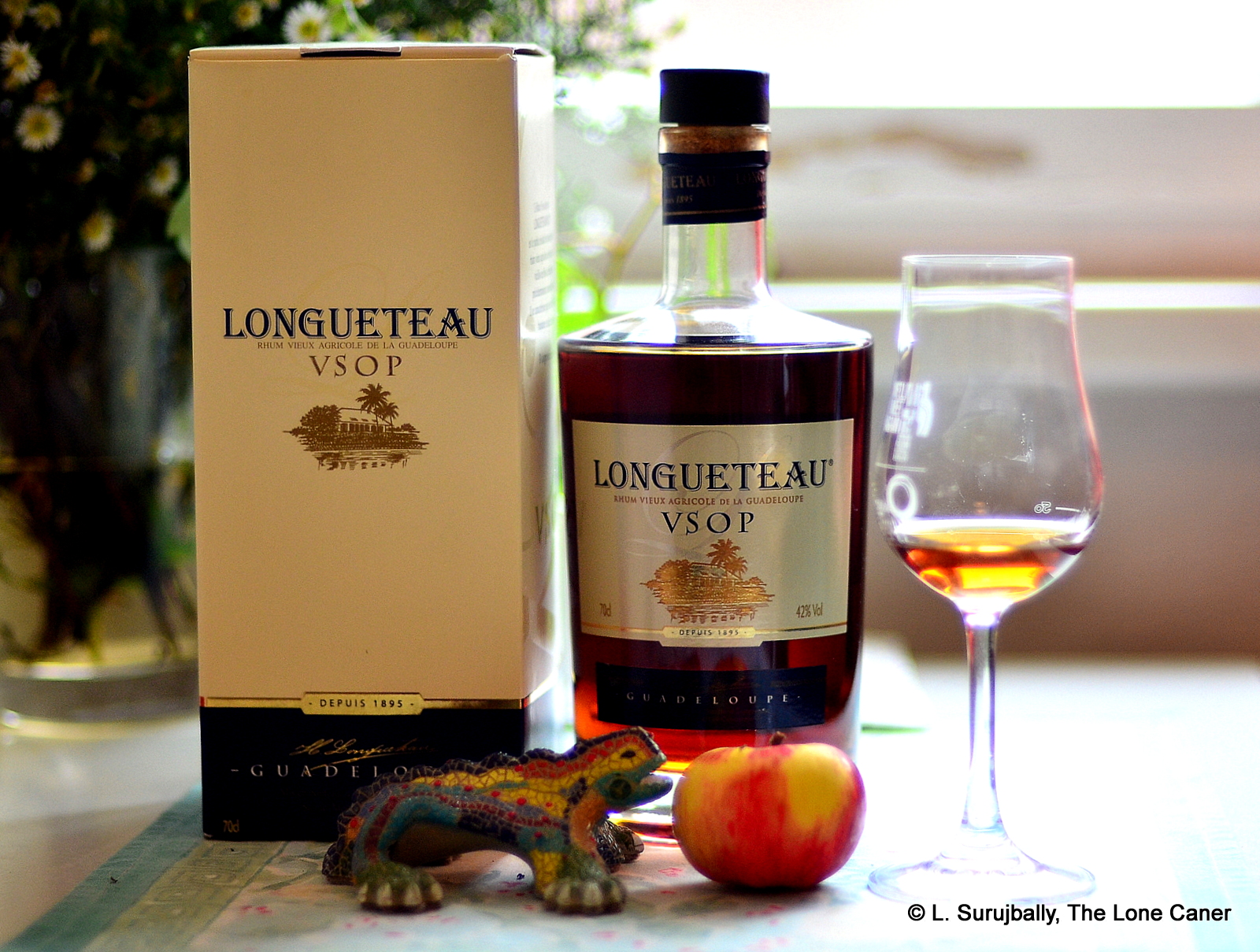
Much as I had with the Longueteau Grand Réserve, a ten year old agricole from Basse-Terre (Guadeloupe), I felt the 42% strength on the six year old VSOP was perhaps too timid and too wispy for a rhum which could have been more had it been made stronger.  Longueteau, a distillery which has been in operation since 1895 and produces the Karukera and Longueteau lines of rhums, seems to eschew fierce and powerful expressions and is quite content to keep on issuing standard strength work, but since their quality is nothing to sneeze at and is readily approachable by the larger body of rum aficionados, perhaps they have hit on a preferred strength and just stick with it.

In any case, the orange amber coloured rhum presented very nicely indeed on the nose, beginning with a light sort of fruit basket left in the sun too long but just missing being overripe.  There was vanilla ice cream and the vague saltiness of rye bread and that spread known as kraüter-quark in Germany, with dill and parsley adding some interesting herbal notes.  Like most agricoles it was delicate and crisp at the same time, and while there was certainly some sugar cane sap and grassiness it, this stayed very much in the background.  After opening up over several minutes more, one could discern olives in nutmeg, brine, watermelon and peaches, light and clear, firm and delicate all at once.

The nose was certainly very pleasant – however much one had to work at it – but on the palate the 42% became somewhat more problematic since it really was too light and easy….though one could say “playful” as well, and still be on the mark.  Oddly, a drop of water (and another ten minutes of opening up) solved that problem nicely, allowing clear, if faint, acetone and fried banana flavours to emerge.  These merged well with some smoke and oaken tannins, more vanilla and a smorgasbord of fruits to come forward – papaya, watermelon, sugar water, pears and white guavas – to which, over time, were added herbs, and some pickled gherkins, leading up to a short, dry finish mostly redolent of soya, brine, dark bread and (again) vanilla and a grape or two. 

Overall the rhum was a very good one, if perhaps just too gentle.  Many will enjoy it for precisely those attributes, since it doesn’t assault the senses but prefers to stroke them with a silken wire of flavour, and draws back from any kind of serious challenge or analysis. A cocktail geek can probably make an interesting concoction with it, but for my money this is a tasty, twittering little rumlet, which, with a few extra proof points, might be even better, and in its current iteration, can be had by itself without any additional embellishment.  It’s both complex enough within its limitations, and unassertive enough for the peaceniks, to give perfect satisfaction on that level,  and in any case, yes, I did like it: whatever my reservations, I also consider it a soundly enjoyable sundowner that adds to the sum total of the delicious variations which agricoles provide.


(84/100)
Other notes

  • Some distillery notes are provided in the review of the Grand Réserve.
  • The company website says aged in oak casks that once held brandy; other sources say ex-cognac barrels.
Jun 282017
 

#376

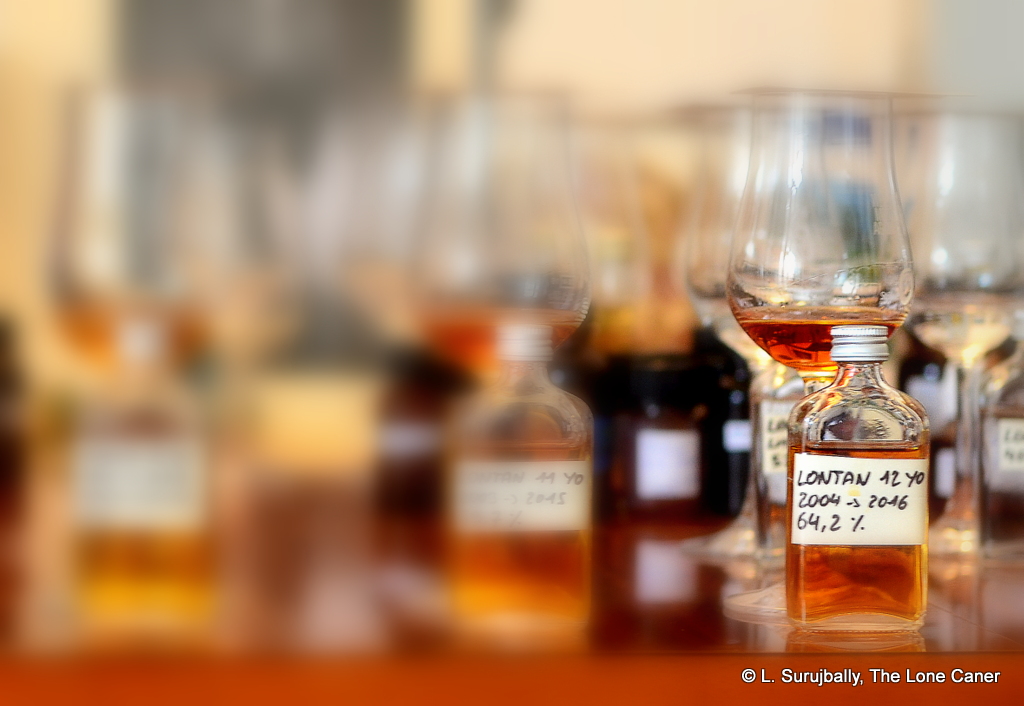
With the advent of the Hampden and Worthy Park rums which pride themselves on high ester counts, it seems that one of the emerging trends in the rumworld may well be such tasty, clear, bags-of-fruit rums with not just a single sapling populating the salad bowl, but an entire damned orchard. Yet on the other side of the world, Savanna has been doing this for some years now with their “Intense” and “Grand Arôme” lines, of which the reigning porn queen might well be the HERR 10 year old that so impressed me.  That rum was startling and original, seemingly cut from wholly new cloth, bottled at a massive 63.8% and aged in cognac casks and my drool dripped into the glass almost continuously as I tried it (well…I exaggerate for effect….but not by much).  And yet, Savanna made one even better than that one – it’s this rum, a Grand Arôme, a rock solid full-proof 64.2% rumzilla that encapsulated all the amazing potential Reunion had to offer, and came in ahead of its own siblings by a country mile.  I’ve now tried about ten rums from Savanna, and it’s my firm belief that this is the best of them all (until I find the next one).

Speaking of Savanna and the stats.  I’ve written a small bio of the company, so won’t bore you with that again, so let’s just reel off the usual details so you know what you’re drinking if you ever try it. It was distilled in 2004 and bottled in 2016, with a strength as noted above, just north of 64%.  It was made on Savanna’s traditional column still (not the discontinuous one of the HERR), and Cyril, in his own excellent 2016 review, writes that it is made from the fermentation of vinasse and molasses, and for a longer period than usual – 5-10 days.  As before it was fully aged in ex-cognac casks.  

Photo stealthily purloined from DuRhum.com

Pause for a second and just look at all those production notes: they make no mention of additives, but for my money they didn’t add anything, and come on, why would they need to? It’s like they pulled out all the stops to make this thing a flavour bomb of epic proportions. Fermentation, distillation, ageing, the works, all that was missing was some pineapples dunked directly into the vat.  And when I tried it, the results spoke for themselves.

The hot, fragrant nose began with dusty cardboard, the nostalgic feel of old boxes in an attic, of a second hand bookshop crammed to the rafters with dry books of ages past nobody now reads.  Ahh, but then it changed – acetone and nail polish mixed with lots of honey and rich (but not tart) flavours of bubble gum peaches, prunes, vanilla, cinnamon and a light trace of brine and avocados drizzled with lemon juice.  Cocoa and some coffee, reminds me some of the Varangue Grand Arôme 40% white, but better behaved and much better constructed. My God this was rich — I spent perhaps half an hour just nosing the thing, and even called over my mother (who was annoyed I wouldn’t let her near my samples that day and was sitting in a huff in the kitchen) to give it a sniff.  Her reaction was so positive I feared for her health and the safety of my table, but never mind – the important thing to note is that even a rum novice loved it, even at that strength.

The real treasures came on the palate, which was firm, strong and intense, as befitted a rum brewed to a ripsnorting 64.2%.  Here the fruits – those amazing, full bodied fruits – blasted out front and center.  The intensity and variety were amazing, yet they lacked something of the single minded purity of the HERR, and somehow manage to create a melange without a mess, each note melding perfectly, combining the ongoing cereals and dusty book aromas with the sweet richness of the orchard without losing the best parts of either.  Some rubber and sweet caramel and honey, warm papaya, and then the fruits themselves – ripe mangoes, peaches in syrup, cherries, cinnamon, cloves, almonds and that yummy Pakistani rice pudding called kheer. There was aromatic tobacco, a faint citrus tang (candied oranges perhaps) and it all led up to a clean, biting finish, gradually winding down to close with green grapes, hard yellow mangoes, lemongrass, caramel and breakfast spices.  Ladies and gentlemen, we have ourselves something amazing here.

When The Wonk and I were discussing this rum, he remarked (rather disbelievingly) that it had to be quite a product to compare with the 89 points I gave to Velier’s 32 year old PM 1975 a few days ago.   It certainly is that, but really, the two aren’t strictly comparable, as they are quite different branches of the great tree of rum.  The Lontan lacks the dark heaviness of Demeraras generally and the Port Mourant specifically, doesn’t have that wooden still licorice background or its overall depth.  In point of fact The Lontan 12 has more in common with the Jamaicans and perhaps even agricoles, while being distinct from either one. In that observation lies the key to why it’s special.

I noted the other day that one of the unsung heroes of the subculture is likely the below-the-radar rums of St Lucia.  Here’s another company not many have heard of that’s making some pretty big footprints we should be tracking.  Because in summing up Savanna’s remarkable rum it’s clear that it’s a shimmering smorgasbord of extravagant and energetic and well-controlled tastes, melding a nose that won’t quit with a body that could make a metaphorical nuncio review his vows of celibacy.  It mixes a glittering clarity with excellent balance, strength with softness, is crisp and complex to a fault and what we’re left with after the fact is the memory of an enormous achievement. To say the rum is “not bad” is to undersell it.  To say it’s good doesn’t cut it. What we need to do is to admit it’s just about great, and oddly, part of that admission is also that it’s made by a relative unknown, without any of that emotional baggage we would bring to, say, a Velier or a Samaroli, a Rum Nation or a product from the Compagnie. I enjoyed it thoroughly.  I think it’s wonderful. It’s a gift to true rum lovers who want to try something they haven’t experienced before, in their ongoing (often lonely, sometimes thankless) search for the next new rum to treasure.


(90/100)


Other notes

  • Samples provided by two generous and great rum people, Nico Rumlover and Etienne S. who asked for nothing in exchange, but got something anyway.  Thanks guys. Wouldn’t have found this rum without you.
Jun 182017
 

Rumaniacs Review #050 | 0450

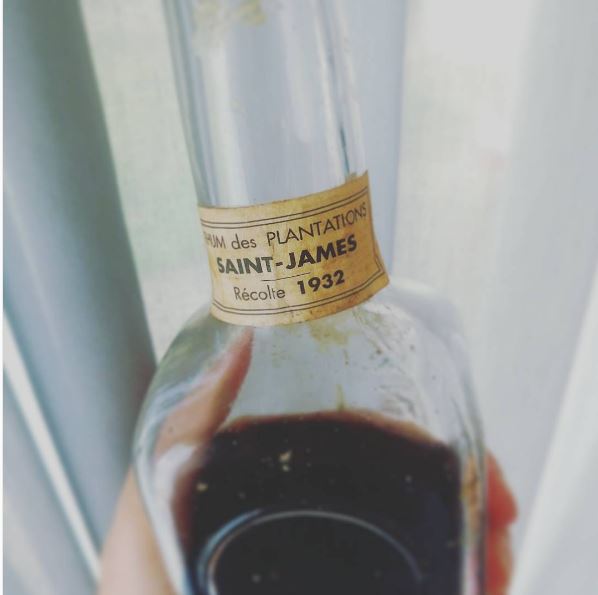
St. James has taken its place as the source of the most ancient rhum I’ve tried in my life (the 1885), and to this day they continue to make some very good agricoles.  But you’ll forgive me for yearning for their old, out-of-production rhums, made in times that predate my own grandfather; and I like trying them not just because they’re so old and so appeal to the collector in me, but because I find it fascinating how different they are to what’s made nowadays with the appurtenances of modern technology and skill.  Such dinosaurs don’t always appeal to the modern palate, true, yet they remain intriguing and beguiling signposts on the road that describes how we got to be where we are now.

Colour – Red-amber

Strength – 47%

Nose – Wow – talk about a rum going off at right angles to expectations. Starts off with old, damp, musty cellars and rotting newspapers paper granny stored there with her preserves; bananas and light oranges, plus the vegetal saltiness of a bouillon into which she dumped one too many maggi cubes.  Also pickled gherkins in vinegar, molasses and peaches in syrup straight from the can.

Palate – Smooth and easy, quite warm.  Opens with a vein of thin honey, to which additional flavours of caramel and bonbons are added; leaving it to open up then provides anise, prunes, more molasses and peachess (less syrup this time), and burnt sugar.

Finish – Short and warm, very pleasant, mostly cocoa, raisins, nuts and again that thin vein of honey.

Thoughts – Well, this is quite some rhum.  Though I like it, I’m also not too sure what to make of it – surely this is not a contemporary agricole, let alone a standard, present-day St. James.  Lekker, one might say…yet much of what conforms to modern sensibilities and ideas of what an agricole is (the grassy, clean profile) is missing. It’s also rather thick – fortunately without being cloying – and that makes one wonder whether it was doctored, messed with or dosed (it’s likely because they boiled the cane juice in the old way as a sort of quasi-pasteurization process).  In any event, when anyone tries a rum made this long ago, it’s a window into a different time and a different rum-making mentality.  It might be worth sampling for that reason alone.

(84/100)
Jun 142017
 

#372

It’s always a pleasure to circle back to the now-established independent bottlers, especially those with which one has more than a glancing familiarity; they are the outfits who have carved themselves a niche in the rumiverse which for us consumers is composed of one part recognition, one part curiosity and eight parts cool rum.  The Compagnie des Indes is one of these for me, and while everyone is now aware they have started to issue the cask strength series of rums alongside lesser proofed ones (much like L’Esprit does), there will always remain a soft and envious green spot in my heart for the now-famous, Denmark-only, cask-strength editions.

This particular Danish expression is a Bellevue rum from Guadeloupe (Damoiseau, not the one on Marie Galante), and here I have to pause for a moment, stand back, and happily observe that in this day and age of rising prices, lowering ages and instantly sold out Bajan rums (did someone say Triptych? … sure you did), we can still get a rum aged for eighteen years.  I am aware that a simple calculus of years (and continental years at that) does not always confer quality – look no further than the Chantal Comte 1980 for an emphatic refutation of that idea – but when made properly, they often do.  And bar some hiccups here and there, this one is exceedingly well done.

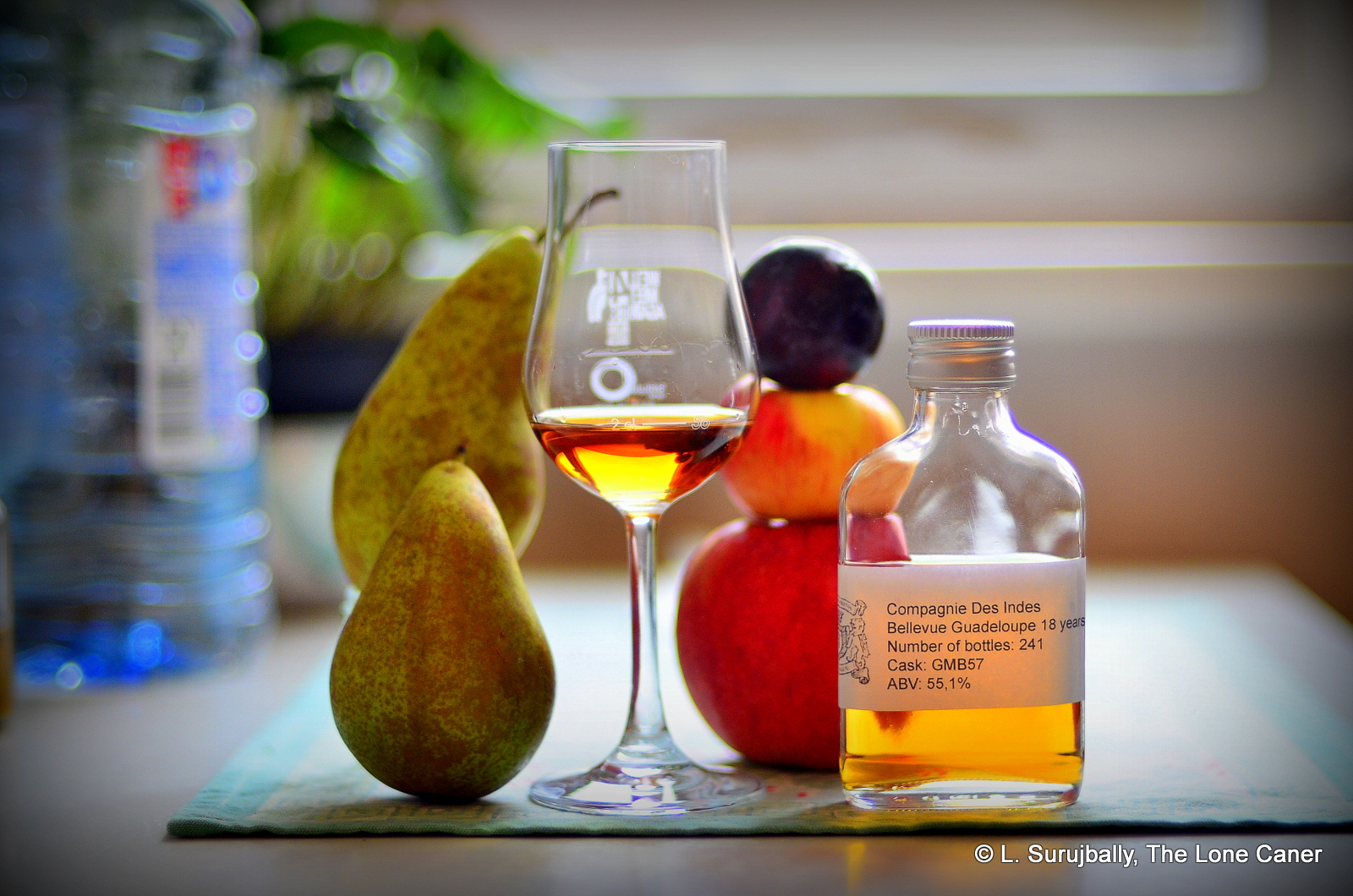
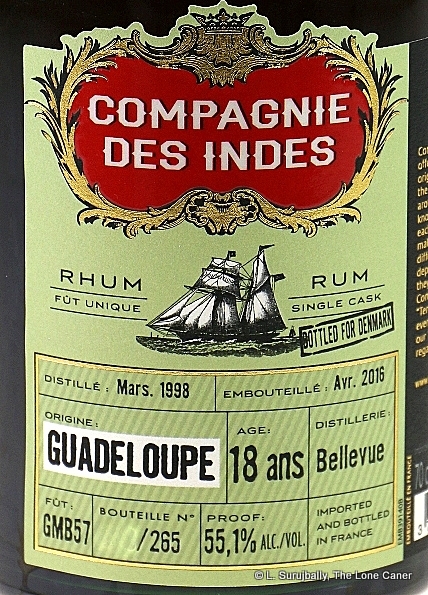
As always, let’s start with the details before getting into the tasting notes. It’s a French West Indian rhum which does not adhere to the AOC designation, bottled at a crisp 55.1%, gold in colour, and with a 265-bottle outturn.  It was distilled in March 1998 and bottled in April 2016, aged in American oak barrels, in Europe – this is, as most will recall, a personal standard of the Compagnie, which does not favour tropical ageing (or cannot spare the time and expense to source them direct from Guadeloupe, take your pick).

Wherever it was aged, there was no fault to find with how it smelled: the nose was creamy caramel and cream cheese with only the very faintest hint of wax and rubber, and in any event, such traces vanished fast, giving way to dark fruits, not particularly sweet, like almost-ripe plums and cashews. At this stage such tannins and wooden hints as came later were discreet, even shy, and there were some light, playful notes of flowers, peaches, apricots, grasses and cinnamon.

Tasting it delivered a crisp, firm mouthfeel that was hot and salty caramel, plus a touch of vanilla.  Here the tannins and pencil shavings became much more assertive, suggesting an oaken spine as whippy and sharp as the cane my house-master used to bend across my backside in high school with such unfortunate frequency. In spite of the attendant orange peel,vanilla, cashews, raisins and lemongrass that could be sensed, it was also somewhat sharp, even bitter, and not quite as tamed as I might personally have wished (with perhaps some more aging it would have been? Who knows).  Behind all that, the additional flavours had their work cut out for them, not entirely successfully, and so I had to concede after a while that  it was well done…but could have been better.  The finish, however, was quite exceptional, showing more clearly the difference between an AOC-determined profile versus a more laid back Guadeloupe “let’s see what we can do here” kind of insouciance – it’s remarkably clear, offering for our final inspection caramel, nuttiness, toffee, with avocado, cumin and a hint of ginger.

So, in fine, a Guadeloupe rhum with lovely notes dancing around a great nose and fade, and quite a decent palate within its oaky limitations (which did admittedly cause it to slide down the rankings).  Fortunately that in no way sank the rhum, which, on balance, remained a lovely drink to savour neat….it just needed a softer comma of oak, so to speak, not the exclamation point we got.  I concede, however, that this was a minor blemish overall.

Although at the top end we are seeing a move towards pot still rums done up in interesting finishes, complete with fully tropical maturation, I believe there is still a place for longer European ageing without any finish at all.  Florent Beuchet, the maitre of CDI, has always championed this quiet, more patient route for his rums, which is perhaps why much of his aged hooch works so well – there’s a subtle, delicate richness to the experience that is not so much as odds with, as a counterpoint to, the badass in-yer-face brutality of those rums which slept for a shorter but more intense period in the Caribbean.  Both such types of rums have their place in our world – the issue does, after all, depend entirely on our preferences – and when a Guadeloupe rum presses so many of the right buttons as this one does, one cannot help but simply appreciate the quality of what makes it into the bottle at the other end.  This is a rum like that — it’s vibrant Caribbean sunshine issued for a colder clime, and I’m damned glad I managed to pilfer some from my snickering Danish friends from up north before they finished it all themselves.

(86/100)


Other notes

Jun 112017
 

#371

While SAB, the only real commercial rum producer in Suriname, makes competent blends and some very nice aged work (like the 8 year old from last week), it suffers, if the word can be used, from the following: a competitor to up the ante and push them harder within their own country; higher proof offerings as part of a connoisseur’s cabinet; a range of true single cask rums that highlights a particular point of interest in an overall oevre; and most of all, as I noted way back in the Extra Gold, that particular note of terroire that would mark it out and set it apart from, and over, more common table tipple.

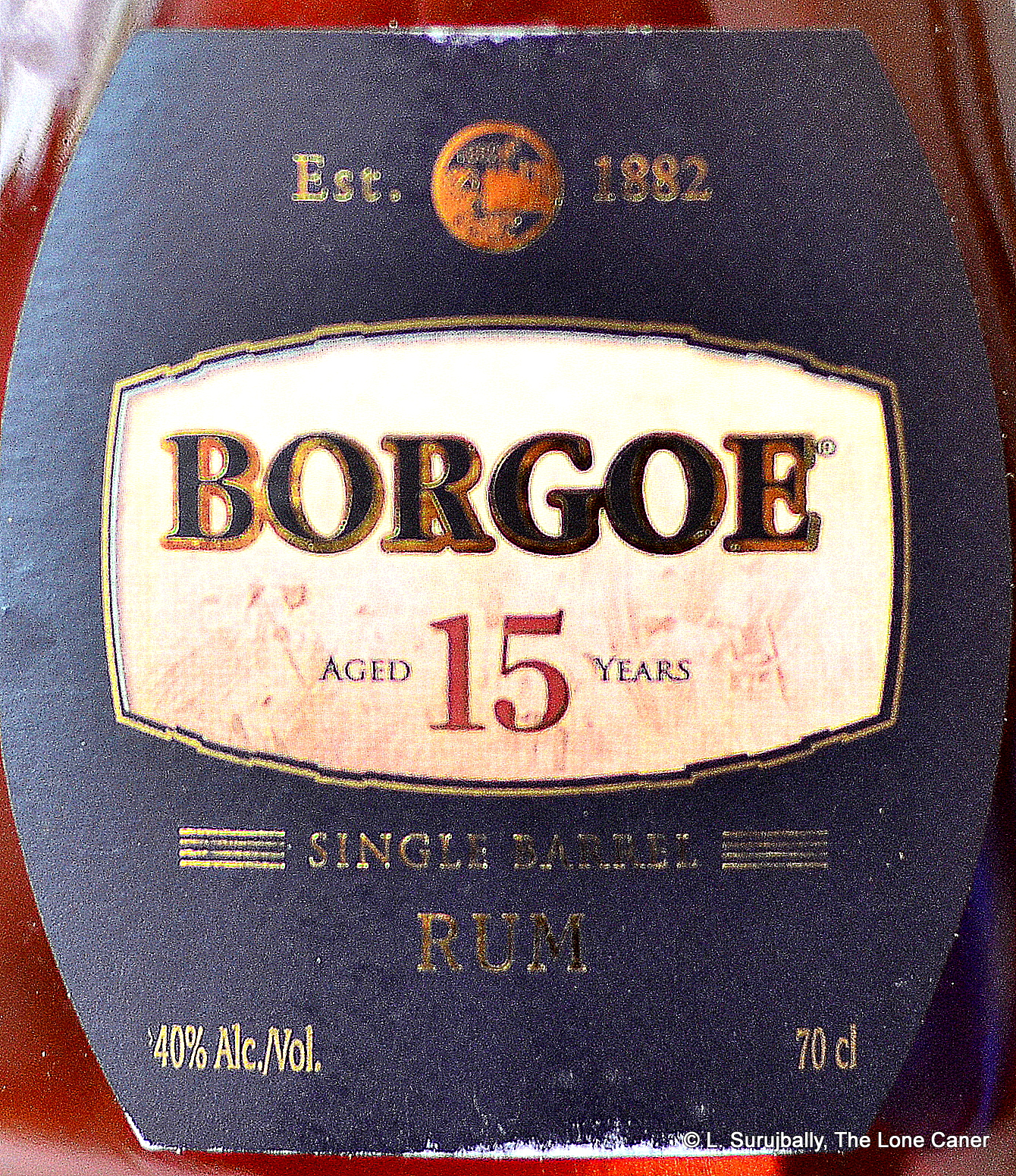
Which is not to say they’re bad – far from it.  The Borgoe 8 year old was a nice step up from the earlier, younger editions, and now the 40% 15 year old takes it to its own new level, even adding a filip of individuality, because it is stated to be a single barrel aged rum — although unfortunately I’m unable to ascertain what the outturn was,or even if it is issued on a semi-regular basis.  The fact that no year is mentioned on the label – single barrel rums by their nature tend to extol a year of make and a volume of bottles issued as a bare minimum – suggests that the moniker may either be totally incorrect or it’s poor  advertising / quality control…because you can be sure that no independent bottler would ever make such an error.

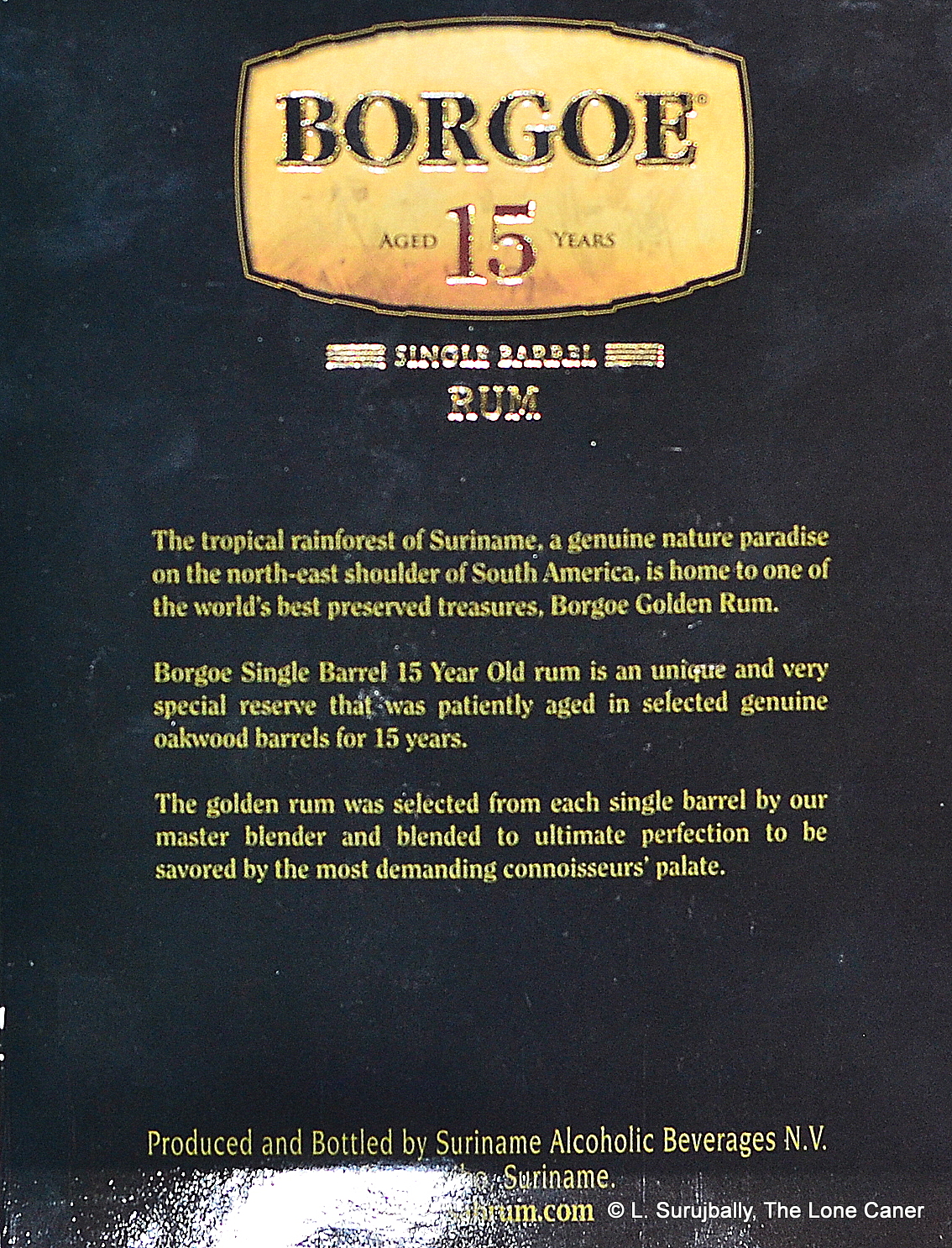
Anyway, beyond those issues, let’s take things at face value and simply accept it as a column still blend based on non-Surinamese molasses, blended from various barrels of fifteen year old reserves, issued at a milquetoast 40%, and if you’ll forgive my rampant and  unconfirmed speculation, with some pot still juice mixed in there for a little edge and torque.  The question is, was it any good?

Yes, and it’s very much the best of the lot, even edging out the Banks DIH Supreme 15 year old, with which it shared several points of similarity.  Even at 40% the difference between the various standard rums I was trying was quite impressive – creamy cereals and milk, oranges and caramel, all emerged to waft around the nose, at once.  There were the scents of walnuts, coconut, tobacco, and the fruitiness of cherries and peaches in cream, with a few flower petals and nougat thrown in for good measure.  And behind it all, barely noticeable, a queer clean sheen of something clear and bright and metallic, almost agricole-like….that’s the edge I was talking about, the point of distinction I liked.

Tasting it was also a pleasant experience, warm and smooth and with a fine texture – it actually presented with somewhat more heft than one would expect.  It was fruity, flowery and musky, all at the same time, redolent of aromatic cigarillos (those port-infused ones I used to like at one point in my life).  Leading off were ripe cherries and tart yellow mangos, apricots, plums and vanilla, with enough of the sharper oak influence to give it some kick.  It was vaguely (but in no way overbearingly) sweet, and with a drop or two of water provided some additional sage and nutmeg, burnt brown sugar, molasses and caramel, plus that faint but clear metallic brightness. Full proof it might not have been, but I had few complaints about what they had managed to achieve.  Only the finish was somewhat of a let-down, being rather short and quick, if easy and warm and without anything new being added to the experience…sort of like an ex-girlfriend’s cheerful goodbye kiss – she knows you well enough to give you a good one, but doesn’t care enough to give you the full treatment, know what I mean?

So all in all, a reasonably complex, well balanced rum which is nice to sip, a decent and very competent product by any standard. I want to make clear that as the top of the line, the Borgoe 15 year old is not a common bathtub hooch which plays it safe and doesn’t go anywhere spanking new – it’s too well made for that. But in the end, it remains a column still blend, it retains that unadventurous strength (not 46% or even 43% both of which can almost be seen as the evolving standards), and has only some of the force and uniqueness and intensity about it that would immediately mark it out as something special. Something special like a rum specifically Surinamese. Something special like a rum we must have.  And that’s a shame, because with some effort and courage — some more oomph, so to speak —  I would surely have marked it even higher, and liked it even more, than I actually ended up doing.

(85/100)


Other notes

  • I deliberately included the word “blended” in the title even though it’s not on the label, in order to not give the misleading impression that it is a true Single Barrel rum (as defined by common useage).
Jun 082017


#370

SAB is a Surinamese conglomerate that is very much like Banks DIH and DDL in Guyana – they have several different kinds of businesses in the portfolio, including various spirits, mostly sold on the local market.  Rums are among the few of its offerings which are exported, primarily to Holland, which comes as no surprise given their historical affiliation with the Netherlands.  At the time when I bought these bottles I was unaware of their availablity in Europe (which says rather more about my miserable googling skills than their advertising) and bought the entire line straight out of Suriname: to this day I’m still wondering how the Marienburg 90% made it past customs in Germany when the rather more tame ~55% Nasyonal from Mascoso nearly caused them a conniption fit.

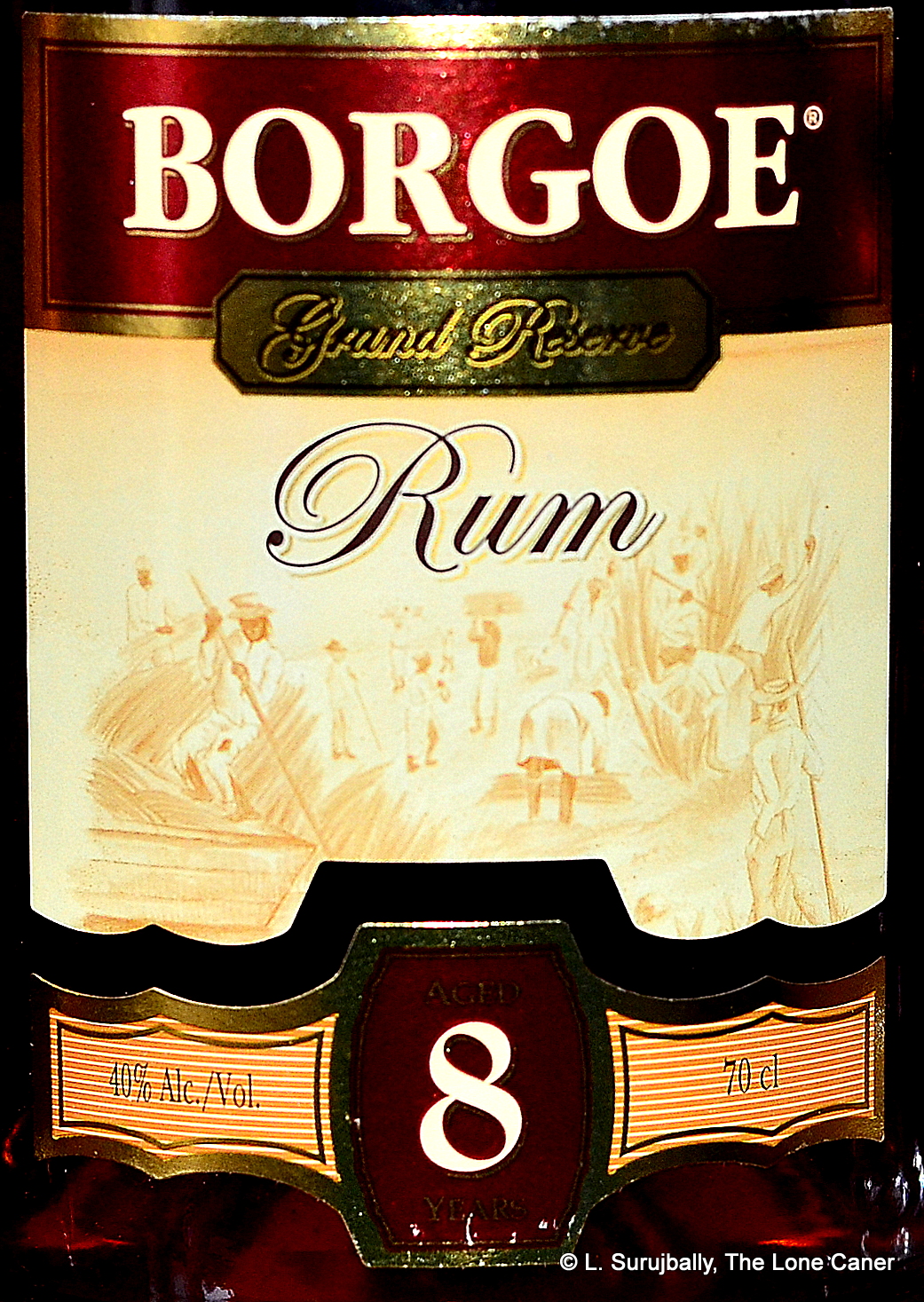
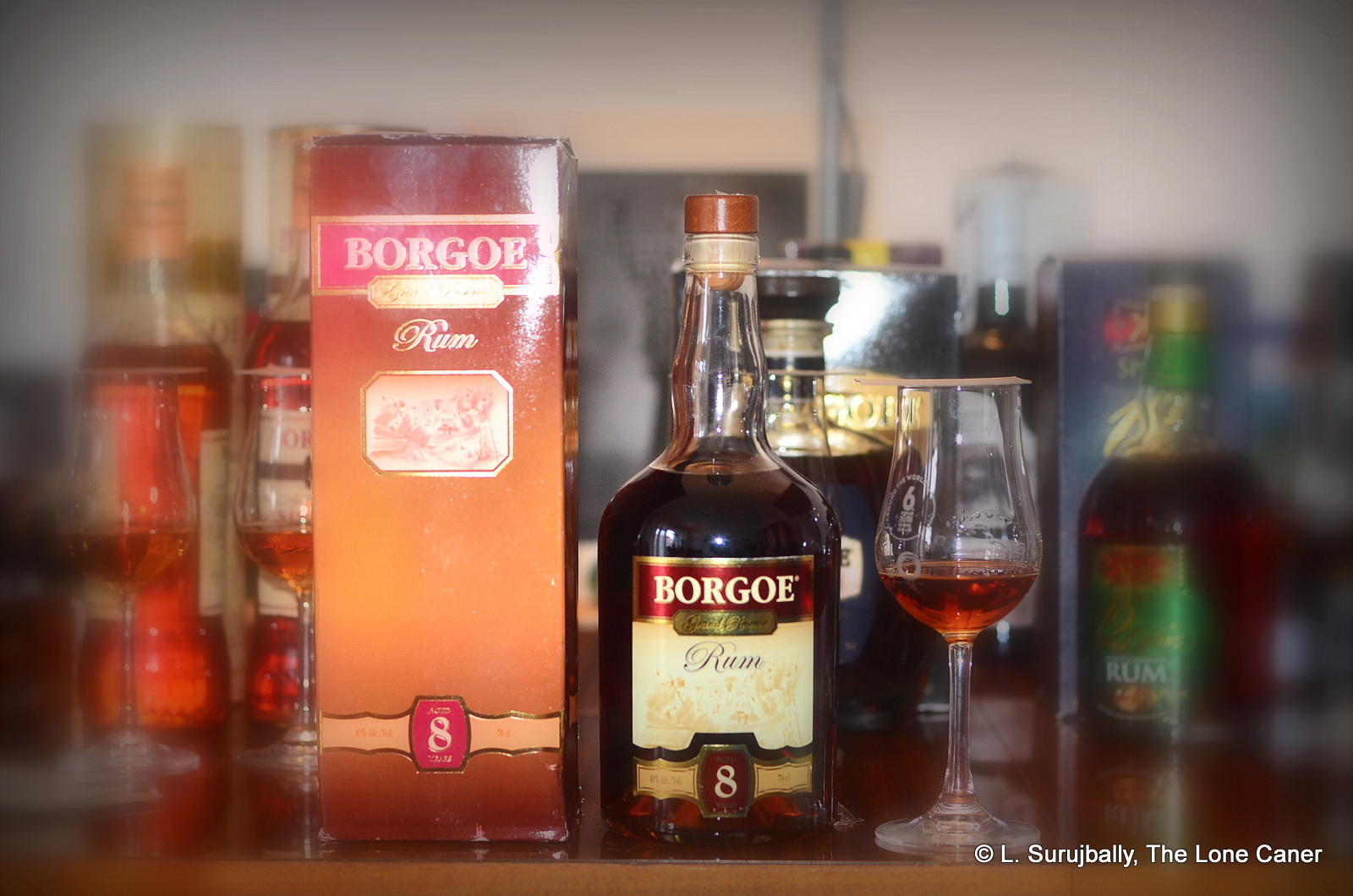
Anyway, after the uncomplicated and placid experience that was the Borgoe Extra and 5 Year Old, I am happy to report that the 8 year old is an emphatic step up the quality ladder.  This is a rum aged a mere three years more than the five, but tastes and smells like a totally different product. Even at 40%, which readers are probably tired of hearing me whinge about, the Grand Reserve manages to produce a complex little tap dance that had me hastening back to all the other glasses to see if it was just me.  To say that about a standard proof product these days is making a rather interesting statement about what it delivers.

Take first the nose, which alleviated many of my issues with the previous rums from the company.  It started off warm and spicy, offering salty caramel ice cream, molasses, raisins, and bananas just starting to go off.  It didn’t burst out of the bottle to overwhelm and cudgel you in the face – it wasn’t that kind of drink; it more like tip-toed out, to slyly coil its way around the nose, gentle and easy, but each note initially distinct, before melting into a pleasant mélange.  It also developed well, because after some minutes, one could sense a thin line of citrus-like tartness, like gooseberries, unripe mangos leavened with some nuts, perhaps some vanilla, and smoke and leather.

This all took some time and concentration, to be sure, because its very mildness required some effort.  The palate was somewhat more assertive and less difficult to analyze.  First there were waves of caramel and candied oranges, more pronounced molasses, plus a musky background of cumin and masala spices which were not overwhelming but simply stayed in the background with an occasional wave to show they were still there.  With water (not really required, but it’s part of the system, so I tried it anyway), cherries, dark chocolate, some cloves and orange peel were noticeable, and after maybe half an hour the molasses was very much a part of the profile.  It also finished well, being remarkably dry, warm, with mostly citrus, leather and caramel winding up the show.

Trying to come to grips with the 8 year old was hindered by the very gentleness and kinks that made it interesting.  I wouldn’t go so far as to say it was a massively sophisticated sub-ten-year-old (I believe that that particular crown belongs for the most part to agricoles), and it certainly did not have the rough-hewn elemental brutality of a cask strength bruiser, but it was a nice, easy drink, soft enough to please, with just enough edge on it to provide a slightly askew drinking experience.  Dave Russell of the Rum Gallery (who tried it at least three times), remarked in his review that it had a “soft polite touch”, and I think he pretty much called it as it was — so rather than indulge my windy vocabulary, I think I’ll let this write-up rest with that pithy and appropriate conclusion.

(83/100)

Other notes

  • Column still blend, aged in American white oak ex-bourbon barrels.  I remarked in the review of the 5 year old that there’s a pot still floating around SAB’s premises, and I can’t rid myself of the feeling that there’s some of that in this rum.  It’s just an opinion, though.
  • Adheres to the Authentic Caribbean Rum (ACR) standard, so we can assume no colouring, additives or sugar.
  • I’ll wrap things up for Borgoe line with the 15 year old next week.


Jun 052017
 

#369

Agricoles and pot still rums aside, one does not usually expect too much from a three year old blended rum such as is the Borgoe Extra Gold we looked at earlier– although they retain their capacity to surprise — and so I had higher hopes for the five, since such lightly aged rums are often the solid pillars upon which many rum makers support the edifice of all their older (and sometimes even younger) rums.  When well made, they may even edge into sipping territory, serve as the first firm introduction to the ethos of the company and can sometimes be a nice bridge between a cocktail agent and something to have by itself (with or without ice). Agricoles and pot still rums are particularly noted for such quality

To some extent this is the case with the Borgoe “Vintage” 5 Year old from Suriname, made by the same bunch of guys who did the “Extra”.  There is, alas, very little hard information to go on here, over and beyond what I’ve already mentioned in the Extra review: it’s a primarily column-still rum issued at 40%, the molasses are sourced from Trinidad (Angostura), there may be some pot still distillate meandering in the blend somewhere, and the whole thing is aged in American oak.  Beyond that standard information, both my contacts and the official webpage are silent. Still, in a way that’s an advantage since it forces us to simply address what’s on show without any extraneous material unconsciously cluttering up our minds.  And overall, there’s little that’s bad about the Vintage expression. If I had to use a single word to summarize this five year old, it would be “inoffensive”, or with two, “happily uncomplicated.”

That might be damning it with faint praise, but not really.  The nose gives an indication of what’s in store: it meanders out calmly and easily, warm and without bite, a little creamy at first; it presents as somewhat sweet, though not overly so – and after settling down, if one takes one’s time with it, there are additional and faint background notes of breakfast spices (nutmeg and cinnamon, perhaps a clove or two), plus cereals, nuts, a little vanilla and some flowers.  It’s certainly not reaching for the stars and seems content to stay with simplicity for effect.

The palate demonstrates more of that placid nature: again it was warm and not altogether spicy or sharp, and although it did seem somewhat thinner than one accustomed to more powerful drinks might appreciate, it was also reasonably smooth, and a rung or two up the ladder from the Extra. Crème brulee, caramel and molasses were the dominant notes at the inception, with vanilla and some oaken tannins bringing up the rear.  Setting it aside for some minutes is probably a good idea for those who want more: after a while, subtler flavours crop up, citrus, flowers, guavas, a few watery pears and a sharper slice of green apple in the mix there someplace.  I particularly enjoyed the languid French toast and honey that shyly danced in the background, and again the breakfast spices were there, not as distinct as the nose suggested they might be.  The finish, short and faint as it was, was at least aromatic, with the fruits fading fast now, and mostly showing off some sweet tangerines and caramel.

All right then, let’s sum up. For one used to aggressive young agricoles and fullproofs of any age, this is probably a rum to avoid, since everything is very much dialed down with a feather blanket, and it might work best in a delicate mix that others know more about than I do. It’s pleasant and inoffensive, as noted above, and I find it too bland to appeal to me personally.  Perhaps its real issue –  one that would not lead to parades of rabid aficionados cluttering up whole Facebook pages with songs of praise – is the fact that is still somewhat generic, and seems have no problem in being an agreeable but indeterminate rum, one that simply exists. Rather than anything particularly Surinamese,  it reminds me of a Botran 15 Solera, a Cacique 500, or a Tres Hombres rum.  It’s light, easy and uncomplicated enough to take by itself, but this comes at the expense of some originality and were I to come back to it sight unseen a month from now, I’m not entirely sure I’d remember it clearly. 

(80/100)

Other notes

For the kind of quality I was looking for, I had to go up to the 8 and 15 year old expressions, which we’ll look at next time.

Jun 012017
 

#368

There is no shortage of agricoles, independent bottlers and flavour-of-the-month rums in my notebooks — but in late 2016, and again in early 2017, I tried the Borgoe line from Suriname – all 40% rums – back to front, front to back and side by side, twice, and it’s time to see what they’re all about.  After all, we all know of the big guns in the rum world but the lesser-known operators deserve their moment in the sun as well.

So let’s start at the bottom and work our way up to the top, young to old, beginning with the  Borgoe Extra, an “Aged Golden rum”: this is the light, low-end mainstay of the brand’s offerings, the way the V/X is for Appleton, or various 3-year olds or “gold rums” are for other makers.  It’s  a successor to the Borgoe ’82 rum first introduced in 1982, and I believe it to be around three years old (other products are the 5, 8 and 15 year old rums), a blend aged in American oak barrels and issued at the usual 40% after being filtered twice.

Smelling it revealed no real markers of distinction such as would make one wonder into what magical terroire of the mind one had just stumbled all unaware.  It was redolent of fleshy fruits, some cherries, caramel and some nougat, nothing terribly complex or ambitious.  After resting for some time and coming back to it I could detect orange peel, a flash of something sharp and bitter, cinnamon and some herbs, so pretty standard, all in all.

I liked the palate more than the nose (usually the opposite is the case with really young rums, at least for me).  It presented as somewhat sharp; then came a swift procession of salty caramel, more nougat, white toblerone, and nuts. An amalgam of a few fruits, — peaches, unripe green apples and ginip, all muddled together — plus the slight citric sting of orange peel again There were faint notes of olives and brine (very faint) and oaken tannins and the bitterness of raw wood chips still bleeding sap, and the whole thing, while quite light, was thin and sharp too, with a short, spicy and rather unremarkable finish mostly providing a closing sense of caramel, apples and sugar water.  

Overall, rather uncomplex and unexciting: there was something going on here, just not too much of it (certainly not enough) and it’s insufficient to get excited about at this stage.  A word should be spared for the notation that it is not really sweet and quite thin (“scrawny” was the word I scribbled down), which leads me to surmise that dosing is not part of the assembly.  

Thinking further through the tasting experience, I believe that thinness aside, what it really lacks is  distinctiveness (and, perhaps, punch). The filtration is part of the problem, as is the anemic 40%, and also the column still makeup of the blend leans heavily towards a lighter, more Spanish style.  It could just as easily be any young rum from the Dominican Republic, Panama or Belize, and I think the company is much like Banks DIH in that it sticks to the low-strength blends without doing enough to create a particular and clearly Surinamese profile which could potentially showcase the land of origin.  It therefore cannot and should not be used on its own; and given its generic nature, I’m not sure whether there’s any particular cocktail that would be made with it to demonstrate and capitalize such attributes it does possess.

I mean, when you taste a Jamaican, a Guyanese rum from DDL, a St. Lucian or a Bajan Foursquare, you can, with a little experience, use them as markers for the entire country. That’s one reason why they’re so popular – it’s their unique and country-specific profile that makes people go after them and actively source really old expressions.  I think SAB might be sitting on some untapped potential just on the strength of this little rumlet — if they were to go with local cane, utilize that pot still more often, and produce some limited editions of greater power. But perhaps we have to go up the ladder to see what the brand has on offer, and if that half-sensed potential I mention can be seen in older variations…or not.

(77/100)


Other Notes

  • Rather than go into a long history of the company, I’ll direct you to the Marienburg 90% review with its thumbnail recap for those who are interested.
  • The production process is based on molasses sourced from Angostura in Trinidad and not from Guyana right next door, surprisingly enough, and after fermentation, the wash is passed through a columnar still, the resultant being used to make the rums which are aged in American oak barrels.  The website of the company notes that a second still is used to make high ABV neutral spirits for the pharmaceutical industry, and they have a third copper still (they call it a “hand still”) for heavier rums – I am assuming this is the pot still some have mentioned to me, though exactly which rums this makes is still unclear at this time.  Since the entire line of Borgoe aged rums is blended, no doubt some portion of the pot still finds its way into the various expressions, much in the same way DDL does it with their various stills and the standard El Dorado line.