Jan 032011
 

A blended rum given enhanced flavour by the addition of Muscatel wine prior to final ageing.  This creates an unusual almost-sipper that is not entirely to my taste but cannot be denied for what it is – an intriguing essay into the craft of playing around with the basic brown-sugar sweetness of rum to get something quite unique.

First posted 3 January 2011 on Liquorature.

Legendario Ron Añejo is a Cuban rum, but makes no concessions to people North of 49 who don’t habla, since nothing on the label is English (or French).  Fortunately, as a travelling vagrant, I have a smattering of several additional tongues (and can curse pretty well in about fifteen or so, but never mind), so this was no barrier.  The rum is exported around the world, and is an interesting entry into the world of aged spirits, not least because its flavor profile is so exceedingly odd.

This was a rum I bought as an impulse purchase, for about thirty bucks, and my opinion was that it’s a middling rung of the Legendario product ladder.  There isn’t much of that to begin with: the entire line seems to consist of six rums both dark and white, with the Gran Reserva 15 year old being the top end. The Ron Añejo is a rum that blends a 47% solera with rums that are one, four and six years old, and then a small smidgen of Muscatel wine is added, after which the resultant is aged for fifteen days in oaken casks prior to bottling.  While produced in Cuba, it is marketed primarily out of Spain and although I’m not sure, I suspect that this final ageing takes place there also.

Legendario poured out as amber brown from an opaque dark-brown bottle with a cheap tinfoil cap. In the glass it exhibited a touch of oily film, yet devolved into remarkably thin legs that scooted back down rather quickly. I regarded it with some surprise, not sure what to make of this: usually when you see a filmy sheen develop on the sides of your glass, the legs tend to be rather lazy, but not here. So was Legendario a rum with good body or not?

The nose suggested it might be.  I didn’t care for it on an initial sniff – I was hit by a deep and cloying fruitiness, like overripe papayas or even the Australian Bundie, neither of which is on my list of all-time favourites – and this proves why it is so necessary never to let your first try dictate your final opinion.  Taking in the nose a second and third time, I got the same aroma, yes, but then it dissipated and mellowed out into scents of honey and dark sugars, infused with the sharper but muted tannins of oak. Not so much as to make it a bitter experience, just enough to prove it had been aged.

The taste was fascinating and continued on from the nose: the Añejo did in fact have a robust medium body, and was smooth and rich on the tongue, leaving a nice oily film that distributed a flavour reminiscent of cigars and tobacco (and oak).  A smoky caramel-toffee flavour slowly developed and married into an emergent taste of cherries and ripe papaya. I was not entirely enamoured of this element: it was quite a fruity little number, perhaps too much so, and it was only when I did my customary research that it occurred to me that the added Muscatel – a black, quite sweet variety of grape – was in all likelihood responsible for these overripe fruity tastes I was getting hit with. I remain unimpressed with the effort while acknowledging its originality.

The fade was pretty good. Medium long and sweet, and while here again the hints of overripe fruit persisted, they were overshadowed by molasses and burnt sugar fumes that were a very pleasant way to have the Legendario go down.

What’s my opinion on this one? Tough call. I do not believe the Muscatel adds anything to it except differentiation from the crowd. It may be that there was simply too much of it, and it sort of crowded out other flavours, to the overall detriment of the whole rum.  As a sipper, then, it’s borderline.  As a mixer, if you take something with less than the normal amount of sugar in it – say, Coke zero or ginger ale or some such – it’ll probably make your day.

Americans, who have maintained their trade embargo of Cuba for longer than many residents of Florida have now been alive, cannot legally import any of the sterling products of the island nation, the most famous of which are cigars and rums (although I’m sure that aficionados get their stocks regardless).  The Legendario is a better-than-middling product, to me: it is not on par with Havana Club’s barrel proof offerings, and I’d really like to give the Gran Reserva 15 year old a twirl on the dance floor – but it’s not bad for all that, even given its initially startling fruity nose.  Legendario is nothing to break the embargo over, mind you – prospective purchasers of this rum in the USA can wait until the embargo inevitably gets lifted – but if you can get it, by all means snag a bottle.

(#060. 76/100) ⭐⭐⭐


Other Notes


A brief Company bio, taken from the Legendario website 2025.07.26

In 1919, the American company Cuban Alcohol Refining Company acquired some land, and on September 30 of that same year, the Santa Cruz Distillery was inaugurated with the aim of establishing a spirits and spirits factory. In 1937, it became the property of the Cuban Industrial Alcohol and Distillery Company SA, and in the 1940s, the distillery, which until then had been dedicated primarily to the production of industrial alcohol and spirits, began to develop and market new brands of beverages under the slogan “From producer to consumer.” In 1946, the Ron Legendario brand was born.

In 1934, Don Francisco Gerardo Smith acquired La Casa de las Culebras, a walled mansion in the center of Havana, which he used for rum production. In the first half of the 20th century, that mansion became one of the 116 rum factories in Cuba: Almacenes Ron Bocoy. Years later, the rums Santa Cruz Carta Blanca, Santa Cruz Carta Oro, and Ron Legendario began to be advertised under the slogan: “The Three Rum Champions,” according to a 1946 advertisement. Although Ron Legendario was already well-known, it wasn’t until 1976 that it was decided to produce it exclusively in Bocoy, due to its exquisite and traditional method of rum production and the excellent Extraseco, a perfect blend of aged spirits of different ages that reflects the origin of the Cuban sugarcane distillates, produced by the great rum master Luis Álvarez.

In 1952, Legendario first appeared on advertising posters

In 1989 the taller, slimmer bottle was introduced and adjusted to 700ml, probably to ensure access to the European market

In 1998, the Valencian company CEXVAL (Comercio Exterior Valenciano SA) became interested in Legendario rums, convinced that such high-quality products should be available worldwide. To this end, it acquired the Ron Legendario trademark and exclusive rights to market its entire range of products in Spain and the rest of the world. In 1999, the first bottles began to be exported from Cuba to Spain, under the identifying attributes of 100% Cuban origin. Commercial strategies were established for the introduction of all products in the range through the various distribution channels. This also paved the way for the corporate image of the new company, Legendario SL.

In 2005, the company began exporting ore internationally, entering new markets in countries such as Italy, France, Germany, and South Korea. It is currently present on four of the five continents.

In 2010, the bottles were tweaked yet again. The Ron Legendario bottle has the slender, graceful shape of the Royal Palm, Cuba’s national tree, while its unmistakable lines pay homage to the silhouette of Cuban women. The shape of the label is another easily recognizable Cuban attribute, as it was created in the shape of a Havana cigar band, an attractive and well known design.

Dec 252010
 

Originally Posted 25 December 2010.  Photo courtesy of Chip Dykstra’s Rum Howler Blog

Let’s assume that there is a place where goodness reigns, the evil get punished, all kittens get rescued from trees and lotteries are won by the deserving. Trust me when I tell you that the Appleton 151 does not hail from here. This raging brown liquid is the Rum of Sauron. No, it’s Sauron’s dark effluent after he drinks the Rum of Sauron. Wussie whiskies such as the cask strength 60-percenters run crying to their mommies when the 151 approaches.

Appleton 151 is a dark, sinful, bottled morals charge, a mischievous indecent wink against our perceptions of rum. It takes no prisoners, expresses itself in four letter words, and is unashamedly, unapologetically vulgar. It’s a barbarian trying to eat with a knife and fork. You show this fella in public, you’ll either be arrested on sight or be accosted on every street corner being furtively, wistfully or eagerly asked “Where the hell can I get me some of that?”

The 151 series from any maker may be the ne plus ultra of “standard” overpoofs1. Rums like this will never really be made fresh or new again. While I may be exaggerating just a smidgen, it is my considered opinion that distilling and blending techniques have now gotten sophisticated enough for overproofs to be taken seriously as drinks in their own right, and not just bases and mixers and cooking ingredients. You see, although generations of gleeful blenders and traumatized drinkers think otherwise, the purpose of an overproof is not really to cause you pain or get you drunk: it’s to deliver a concentrated flavor unobtainable anywhere else, at any other strength. And maybe to make a real bitchin’ cocktail.

As an example, take the Appleton’s nose. I wouldn’t recommend this, but this is what I did and you’re welcome to try: take a hearty sniff of this sour Klingon sweat. A massively alcoholic man-eating lion will leap fiercely at your defenseless snoot. You will fall back, feet excavating spade sized trenches from the ground, pounding frantically on your chest, not the least because your breastbone feels like it’s now somewhere behind your spine. Once the fire goes out and the spirit fumes have finished raping your beak, in between bouts of delirium you will remember that there was a deep caramel taste, a cinnamon shot, and a scratch of vanilla. Really. Personally, I think you’d be lucky to find your sinuses again (ever), but you see what I mean? The nose is a Godzilla of flavor if you stick with it and move through the pain.

Knowing it was my duty to take one for the team and complete the review in an appropriately stiff-upper-lip fashion, I sipped it when I managed to draw a thimble of oxygen into my seared chest and the uranium spill in my lungs reached its natural half life. This roughly equates to rapidly following up stupidity with an act of irredeemable idiocy. You’d think by now I’d learn to mix this stuff, but no…I had to take the taste neat, and a good sized one at that. Never let it be said, guys, that I wasn’t there for you when it counted.

Big friggin’ mistake. A lake of fire exploded. The sobriety I had fondly embraced became the sobriety I had just left behind. There was a concussive cchuuuff of vanilla, caramel and light citrus that scaped across my tongue just before I lost track of ten minutes of my life in one searing amnesiac flash. My tongue writhed like a serpent doing a rain dance, my tonsils vapourized, and my head spun as rapidly as if I had just been hooked up to the high-speed paint shaker at Home Depot. I lost twenty IQ points, and I swear the Appleton 151 caused my DNA to devolve on the spot. Ugh mug kook aagh.

I don’t know about you, but me, I gave up. Forget nose, forget taste, forget finish. Like all highly overproofed rums out there, there’s simply no point to it. It’s got a ferocious taste, sure, but let’s be honest: the 151 is not meant to be a garden party sipper or socializing enabler. Tasting notes are pointless here.

Because, guys, come on: all of you who are reading this and snickering, none of you ever tried this stuff for its bouquet, or aroma or its elegant fade, redolent of whatever-the-hell-they-added. You didn’t drink it because your Tanti Merle made a great Black Cake from it, and her eggnog was to die for. You drank it because you were young, because you were high on life, and because you wanted to get loaded as fast as possible. Because it was your passport to manhood among The Boys, because Grampi always had it, because la petite femme over there on the floor of the bottom-house Old Years party was giving you the eye and might kiss you later if she thought you had some balles. You drank it then because it was your rite of passage to all other rums that came after, and you drink it now because you want to remember the bright sharp days of your youth when the world was an apple in your mouth. So forget this review. Just put it away, pour a shot and enjoy taking your drinking experience to the wild extreme of unreason.

(#061)(Unscored)


Other Notes

  • For additional details on the history and development of 151 overproof rums, this article provides all the background
  • Also, for reference, here’s a list of the most powerful rums in the world, starting at 70% ABV and working up.
  • It is unclear whether as of 2021, this rum continues to be made. Certainly it remains available, but I think that with the rise of cask strength bottlings from around the world, it may have been quietly discontinued without fanfare.
Dec 152010
 

First posted 15 December 2010 on Liquorature

Amusingly named rum which is solid all the way through and that fails through some ineffable lack of chemistry in the final stretch, where the individually excellent elements just don’t quite come together into a perfect whole.

***

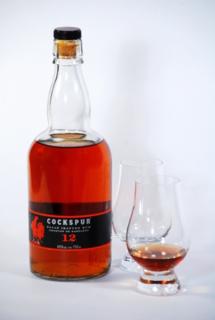
Okay, let’s get the funny stuff out of the way.  “I like going to bed with the C—…”.  “Drank some C— last night and boy, was that good.”  “Really satisfying, there’s nothing like a good C–…” “As a hangover cure, nothing beats a solid red C— in the morning.” And so on.  I can just see the boys of Liquorature taking one look at this review, grinning appreciatively and starting with the Mandingo jokes. Such is one’s lot in life when one brings out as evocatively-named rum as this one. And let me tell you, there isn’t a Caribbean soul alive who hasn’t at some point made a reference to this provocatively named rum with a snicker and a wink.  All I can say is that I’m glad it isn’t called “lash” or “beef” or some other such innocuous sounding but meaning-laden title which only a West Indian would understand.

Cockspur came late to the party of rums in Barbados (1884) compared to the Great Grandpappy of them all, Mount Gay (oh God, more porn references).  Unlike that distillery, Cockspur has stayed with a tried and true traditional bottle and not gone into the designer shape Mount Gay has recently been favouring, but that’s a matter for purists, upon which I pass no judgement (except to sniff disdainfully at the increase in price that went along with it).  The producer of this rum is Hanshell Innis, a ship’s chandlery formed in 1884 by a Dane, Valdemar Hanschell.  Branching out from ship’s stores to rums and other merchandise, it merged with the firm of James Innis in the 1960s, and in 1973, J.N. Goddard & Sons gained a majority stockholding in the smaller company.  Since then the amalgamated company has become one of the biggest enterprises on Little England, and under the Cockspur Brand produces Old Gold, VSOR, Cockspur White and 151 proof.

Giggling rights aside, a 12 year old is never anything to be taken lightly, not least because faster maturation in the tropics usually means it’s the equivalent of a 20 year old or greater from northern climes. I liked the look of the Cockspur 12 right off the bat. Inside the bottle was a copper red rum: it didn’t exactly call my name, but certainly had a most inviting appearance. Poured into a glass it showed an oily film around the sides, and thin but slow legs which suggested an oiliness portending well for its depth.

On the nose, Cockspur had the good fortune to be part of a short tasting I did with the Whaler’s Rare Reserve. Now that rum had a nose that didn’t just tap your hooter for some attention, but knocked you out on your ass with a butterscotch fist: the Cockspur was quite a bit less aggressive, and exhibited a surer, a more solid, a more complex nose that hinted at the faintest bit of spices. Caramel, yes, but also toffee, burnt brown sugar, molasses.  And after I set it down a it and it opened, like a shy lover disrobing (ok fella, yeah, you there in the peanut gallery, I heard you snicker), there came the nutmeg and cinnamon and a faint hint of (and I blush to say it) white roses.

The body and taste aren’t quite up to that standard, I’m afraid.  The feeling on the palate lacks that richness of flavour that real viscosity might impart.  The taste of oak comes too much to the fore, and while it’s not bad enough to detract from the balance of spices – mostly the burnt sugar and nutmeg – which follow on careful sipping, it is noticeable, and readers should be aware of that: it doesn’t seem that much effort was placed into attempting to smoothen it out.  I also, after going back to my glass a few times, sensed the presence of old cigar tobacco, fragrant and faint, like a good humidor when you just open it in a darkened study surrounded by shelves of leather bound books.

I hesitate to pronounce a definitive statement on the finish which is decently long and even a shade toffee-like.  What it gives you, however,  is biting without being sharp, but not so mellow as to be characterized as a low-level warm burn, which to me is the mark of a skilled blender and a top tier product.

I think there is just a bit too much oak left in the Cockspur to merit a really positive conclusion to what is otherwise a solid mid-range rum.  At no point is it bad, and in fact I enjoyed it a lot more than its better known cousins like the Mount Gay XO (yeah yeah, this is heresy to many, sorry guys) – it just doesn’t gel properly, marry all its elements into a cohesive, proper whole.  And that’s a shame, because I do like it, and will probably return to the bottle for a second opinion sometime soon.

(#057. 79/100) ⭐⭐⭐


Other Notes

  • Cockspur rum is based on distillate from WIRD, not any of the other distilleries on Barbados.
  • In 2017 the brand was sold to Woodland Radicle, which cemented the position of the rum as a third party brand, not a primary producer’s marque.
Dec 052010


First posted 5th December, 2010 on Liquorature.

Some rums just upend all expectations, and maybe even redefine your assumptions.  Smooth, amber-dark, just sweet enough, and with a body and a finish that simply don’t give up, Tanduay Superior 12 year old is like that. Where on earth has this rum been, and why can’t I find it in Calgary?

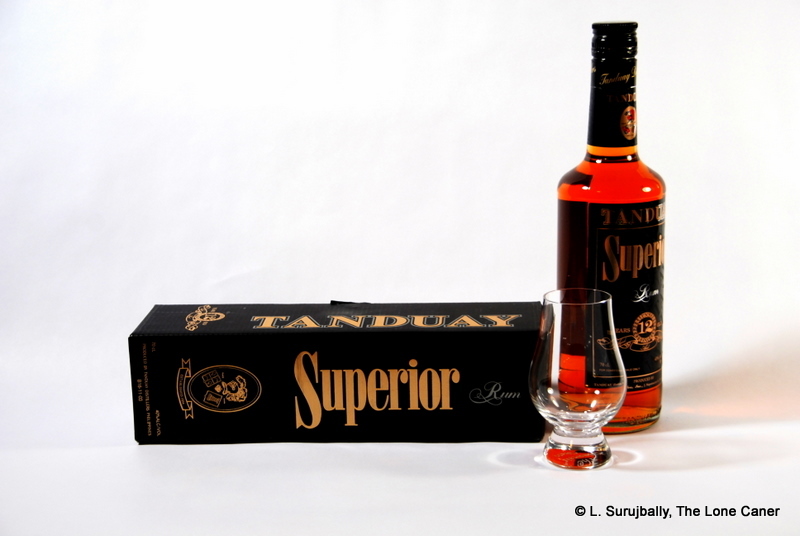
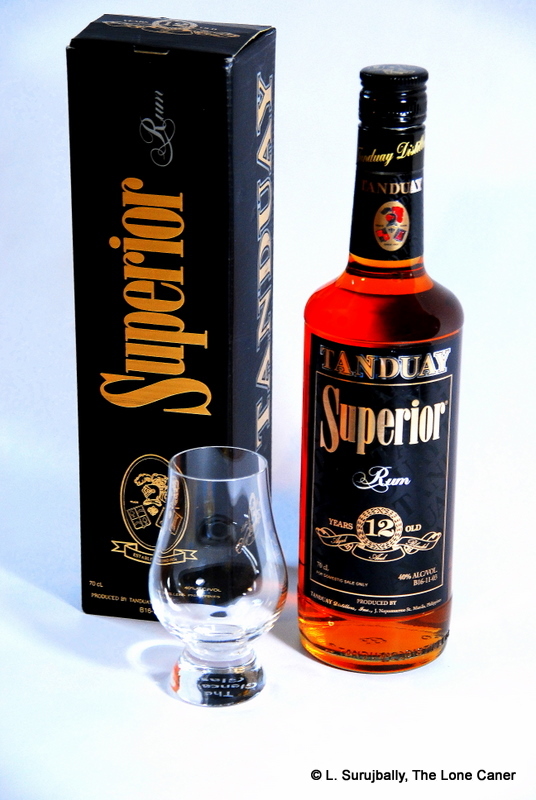
A very affable individual from my office named Rainerio was heading off home to the Philippines the other day, and knowing there were interesting rums to be found there (though unashamedly confessing ignorance of exactly which ones those were since I had never had any) I went down on bended knee, indulged myself in a paroxysm of weeping meant to soften any stony heart, and begged him to bring back a sample for me to review.  Well, I exaggerate a bit for poetic effect, but I did ask.  And Rainerio very kindly brought me back a bottle of this  stunning 12 year old.  Hell I would have been satisfied with any local popskull, and to get something so all-round excellent was a like getting an early Christmas present.

Tanduay is one of the most popular, if not the most popular, make of rum in the east, particularly the Phillipines, and made by the Tanduay Distillery out of Manila.  Like other major distillers – Bacardi and Diageo come to mind – they have a complete range, from light to dark, from the very cheap to the very expensive, and they have been in operation since 1854, which pips Bacardi by, oh, seven years. Yet, for whatever reason – distributors ignorance, lack of channels, unfavourable tariffs or whatever, you really have to look around to find it in North America (my research suggests it may be more readily available in Europe) and yet it may be the third most popular brand of rums in the world.

A dark brown rum of the same hue as the Bacardi 8 year old, the Tanduay 12 year old is an oak-aged product served up in a standard bottle emerging from a hard cardboard black box, and sporting a deceptive cheapo tinfoil cap. I looked askance at it and wondered whether this was a harbinger of things to come, but what the hell, I had asked for it and so dived right in.

On the nose the 12 year was spicy and immediately assertive with equal parts vanilla, caramel and lemon zest in some kind of crazy harmony, as if Michael Jackson suddenly joined up with the Bee Gees and they created a song of their own that just missed being nuts by some strange unknown alchemy. It was bold and immediate, but after allowing it to breathe, a sly delicate note of flowers came stealing around the more powerful notes. Yes there was some sting, but this died away after a while and the medicinal reek I so dislike in younger rums was utterly absent.

The rum took my hand and took me along with it: medium heavy body, coating the tongue with a sort of oiliness I have only had with DDL’s more aged rums.  There was just enough sweet to the Tanduay, and the caramel and vanilla notes were now joined by something softer, perhaps bananas or a tamed light citrus. It slides smoothly down the throat and let me tell you, the fade is simply awesome.  Long and smooth, with one last soft gasp of breathy fragrance wafting back up to remind you of what you just had, and inviting you to revisit the experience with another try.

Unless a distributor for this rum is found or whatever has stopped the importation of Tanduay to Canada is resolved, I doubt I’ll ever taste it again (though maybe I can ask Rainerio to bring another one back in a year or two). I’m glad I had a chance to try it: just when I thought I had a handle on the major brands of the world, this one came out of nowhere and smacked me upside the head.  If nothing else, it says that though I may have tasted and reviewed more rums than most, there are always gems from other places previously unconsidered that will just amaze, delight and please with their overall excellence.  This is the first one in my experience: I know there’ll be others, but Tanduay gives me hope that I’ll actually be able to find them, and share that delight with all those who one day read the reviews I put up about their quality.

(#056. 84/100) ⭐⭐⭐½


Other notes

Dec 032010
 

First posted December 3rd, 2010 on Liquorature

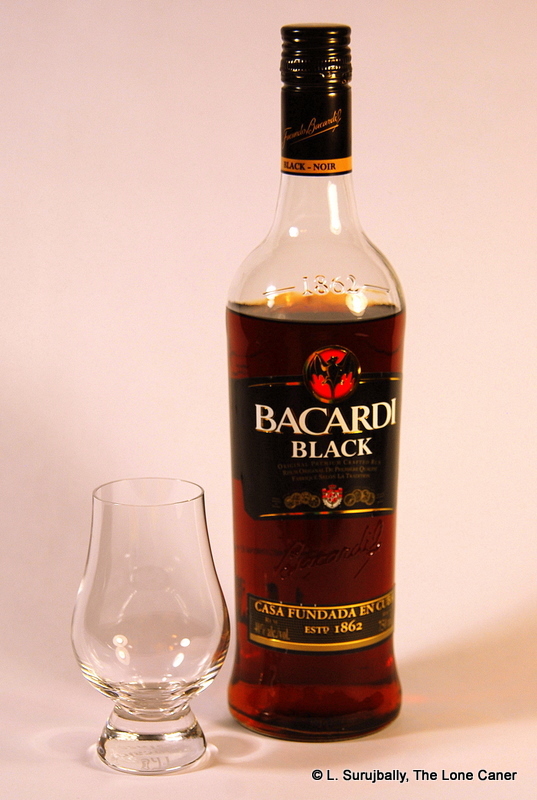
Bacardi Black is a deep, dark rich mixer’s drink just the right side of sweet enough, but lacks the cojones to be a decent sipper on its own merits. 

The mainstays of Bacardi’s massive sales are, to my mind, the low-enders: those rums not good enough to stand on their own, but which have a bold taste, a decent body and – somewhat like Johnny Walker – sufficient overall quality to be a cut above the average.  The normal Joe who walks into a liquor store isn’t after all, looking for a life-changing experience: he’s looking for a decent drink at a good price that won’t make him void his bowels, lose his sight and tie his alimentary canal up into a complex knot.

Such a rum is the Bacardi Black, which I will tell you right out, is not a sipping rum by any stretch of the imagination (unless you like low enders to sip and cause you pain) but will liven up any drink you make with it. It’s a cocktail base, pure and simple, and should be treated as such and I must be equally honest and tell you it’s one of the better ones out there at its price point (less than $30 for 750ml). I should also point out, however that the Black is no longer available as the Black since it has now been replaced as the Bacardi Select rum. Dunno what difference there is between the two.

You can almost always tell tipple for the masses: with a very few exceptions, almost no care is taken tartin’ ‘er up, and this is no exception.  Tin foil cap.  Cheap label with bare minimum of facts.  A reekingly pungent nose that only reluctantly releases its claws and puffs a grudging fart of caramel into your face like a baby’s bum at the exact wrong time. A thin little toot, you understand…the Black is not a heavy dark rum.  But to some extent you are compensated by a transformation of the initial caramel whiff into light cinnamon, some bonbons, and a weakly burnt-wood belch.

The body is, as I say, not for sipping.  A tad on the thin side, tasting of oak and caramel, some vanilla and maybe nuts.  But oddly, for a rum this dark, there is a lack of boldness and assertiveness, a lack of sweet, that’s somewhat at odds with its aggressive styling and bold dark looks: it’s as if Will Smith turned into a wuss, or something.  And that finish: ugh. Lousy. Hobbesian, truth be told – nasty, brutish and short.

I know I’m making a case that this is just another piece of dreck.  But it’s not, really – it’s just not meant to be had neat (and my apologies to all of you who have tried it that way and liked it – but you need to trade up). As a mixer in cocktails it’s actually really good….its weaknesses are compensated for by whatever we chose to add to it.

Bacardi’s 20 million cases of annual sales are more than just a question of a stable of brands or a favourable tariff regime with the US.  They have simply, and for generations, made a damn fine series of rums.  What they lack in uber-quality and premium labelling (they have nothing to even breathe upon the Appleton 30 or DDL’s aged offerings), they make up for in volume of decently distilled spirits that appeal widely because of both their overall quality (sold cheaply) and their ubiquity.

I’ve found Bacardis the world over and always affordable, almost always better than the local hooch. They’re good enough and affordable enough, which sheds a clear light on their marketing philosophy. By eschewing top-end and exclusive premium rums and concentrating on making a series of excellent mid- and low-tier products – like the Black and the Gold – Bacardi have essentially created what every manufacturer dreams of making just once and then selling a jillion.  Simply put, with the Black and its like, Bacardi have made the Model T of rums.

(#054. 77/100) ⭐⭐⭐


Other Notes

  • The “Black” in the title refers to the colour, of course.  I have read different accounts as to how that is achieved – one story says it’s because of heavily charred barrels and then filtered through more charcoal, another other says it’s liberal use of E150 caramel colouring, and third says a bit of both.
  • According to Rum Ratings and this reference, the rum name has now been discontinued, and the same rum is referred to as “Bacardi Select”. The exact year is unclear, since I picked up this bottle in 2010 but BilgeMunky had already noted the change in his review of the Select in 2007. Since the Select does not appear in Bacardi’s catalogue as of 2021 (when I checked again), I assume that it has been rebranded once more, this time as the “Cuatro.” Nothing else in the lineup qualifies, and the fact that the blends making up the rum are aged a minimum of four years suggest this – however, I accept that the Select might simply have been replaced altogether with a new blend that is not using charred barrels quite as much.
Dec 012010


Original Post Date 01 December 2010 on Liquorature.

(#013)(Unscored)

Workable blend that makes for a perfectly solid mixer without shining in any other way, except to maybe pip the low-end Appletons. Best save for the 1919 version.

***

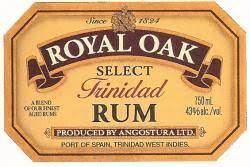
Royal Oak Select Rum is another one of those annoying rums that tell you nothing about how old it is, which instantly informs you it’s a blend.  I don’t care much for whisky, as my humourous posts have made clear (I think the Peat Heads are misguided, but innocently so, and may be dint of effort and tender ministrations be brought to understand the error of their ways), but I do appreciate the fact that every bottle has its age on it. As a rule of thumb, I assume that when this is not the case on rum bottles, then it is less than five years old. Cadenhead Green Label is an exception, of course.

A golden rum, Angostura is young (3-6 years, nothing more definitive), made in Trinidad by the same folks who are now producing the once-superlative but now downgraded Zaya 12 year old, but not a on par with that voluptuous lass. Like with all single-digit rums (SDRs, as I call them), it lacks the polish and finish of older siblings (yes, yes, with the exception of the fabled EH-5), and I think it is not distilled for the export market, really.  Therefore it may be best used as a mixer.

Still, even for young rum, this baby has its admirers, and I’m one of them.  I wouldn’t drink it straight, since it’s a bit too harsh on the tongue and throat for that – the younger parts of the blend certainly assert their prescence early on.  But the nose has an interesting hint of citrus, and intriguing caramel overtones develop more seriously on further tasting, together with coconut and a certain mellow spiciness.  The body is quite good, with a sort of oiliness that leads to a long lasting flavour.  The finish is medium short, quite a bit of burn, but the caramel sweetness remains, mixed with a faint nuttiness. It’s a bit richer in flavour than I had expected, and while I don’t expect that much from an SDR, its strength (43%) and dominating sugar-caramel aftertaste belie the light colour and make it a good choice to go head to head 1:1 with coke.

In summary, a decent mixer about on par with an Appleton V/X but with its own profile and a stronger taste and slightly smoother finish, so not as low-tier as the Bundaberg (which I have gone on record as not appreciating).  Anyone who buys this is not scraping the bottom of the barrel by any means.

Note: I must go on record to express my appreciation to Keenan who raided his pantry to provide me with this bottle to sample. He finds it highly amusing to watch while I try to stay sober and drink four of his rums at the same time.


Dec 012010
 

First reviewed December 1st, 2010 on Liquorature

The V/X is an ostentatious shot across the bows of Bacardi – it may be one of the world’s best mixing, use-for-anything rums that you will have no trouble picking up anywhere, but the spicy sting in the tail makes it unsuitable for sipping.

It’s always the same: the cobbler’s kids have no shoes, the accountant doesn’t do his own taxes, and this reviewer doesn’t review a rum he’s been drinking for years.  I mean, you’d think by now I would have rounded off the Appleton section by at least attempting a review of the V/X, which may arguably be one of the best known and most consistently purchased rums in Calgary.  Some fifty four reviews along, and I still haven’t bothered, even though I have a 1.75L jug in my house at all times for those occasions when I don’t feel like paying attention, or when forty-plus guests arrive and I need something that will go well for everyone, and with which all are familiar.

From the preceding remarks you’ll gather that Appleton’s V/X is pretty much a working man’s drink, a mixer, blue-collar for sure, suitable for those who don’t want to indulge in the more premium lines, don’t have the bling to blow, or simply don’t care.  And that’s perfectly fine – hell, do you honestly believe that everyone who likes rum only goes for the top end, all the time? The thing is, the V/X, for what it is, is good.  It makes no pretensions to grandeur; does not make any claims to a premium or sipper status, and represents the Appleton Estate well.  In this one entry-level rum, you find all the hints, tastes and blending choices which get progressively more pronounced and refined as you go up the scale of the Appletons.

The bottle is the standard bottle with which everyone is familiar. Rounded, thick waisted, fat-battied, well known. The copper-red-brown rum has a medium body, blended from fifteen different rums matured in oak barrels that previously held Jack Daniels (not bourbon).  In the glass it lacks real viscosity and demonstrates thin legs that trail rapidly down the sides.  I know it’s not much of a sipper, but I follow the usual procedures: and on the nose, after I let the glass stand a bit to open up and the sharpness of the initial sniff wears off, there is the brown sugar and caramel, mixed with that slight perfume of citrus which is the Appleton signature (like bananas on the Mount Gay). The smell is sharp and pungent, and you feel something a bit more raw than the rungs further up the ladder: all pretty much par for the course.  On the palate the rum is not smooth (were you seriously expecting it to be? come on, be serious), but the citrus notes balance well with the burnt sugar, caramel and a slightly fruity tang. I’ve heard some people taste nuts, but not me.

What you do get is that slight orange peel, and bitterness from the oaken tannins, that so characterizes the Appleton rums, and in this entry level rum, it comes earlier. It continues through to a spicy finish that is more sting than burn (for those who ask what the difference is, a sting is like sharp cat’s claws, short, sharp and painful; a burn is more like a mellow kind of deep, long lasting not-quite-pain which is like a hot cup of tea carving its way into your system), and for this reason, it’s no surprise that Appleton V/X is more mixer than sipper.  Some brave souls might like it with just ice, which is fine: it’s more complex the more you stick with it, and for this reason, I want to express my opinion that it’s one of the more underrated rums around.  A mixer, yes…but still underrated, like the English Harbour five, for example.

Almost everyone I know in Canada has, at one time or another, tasted the V/X. It is a constant feature at parties (thrown by people of any nationality), and one of those staples of the drinking season one remembers fondly as one moves up the quality scale.  Like Bacardi, it is a rum made to please many: it has good body, a unique taste, and is good to mix with just about anything.  You won’t want to drink the V/X straight – it’s not designed for that – but in any kind of cocktail (and even just the old standby of rum and coke), it performs superbly, each component of the drink enhancing the other; you can simply stretch out on the veranda, watch the sun set and forget your worries for a bit, with a glass of this excellent bottom-feeder in your hand.  And I say that because I do that on just about every Friday evening, and it’s the V/X I reach for the most often when I do.

(#0052)(Unscored)


Other Notes

  • In 2015, the V/X was discontinued as a brand and replaced with the Appleton Estate Signature Blend, though all indications are that the blend components, and the taste, is still very much the same. This was part of a brand-wide update which also saw the Appleton Special title renamed the J. Wray Jamaica Rum Gold and then the Kingston 62 Jamaica Rum. I think it’s all just nonsense myself and probably only justifies some marketing veep’s salary, because all it does is confuse – if the rum is the same and the title is recognized, why mess with it? Ho hum….
Nov 272010
 

First Posted 27 Nov 2010 on Liquorature

A pleasant mixer but not worth it as a sipper…like a date you want to kiss but really aren’t sure you want to bring home just yet.

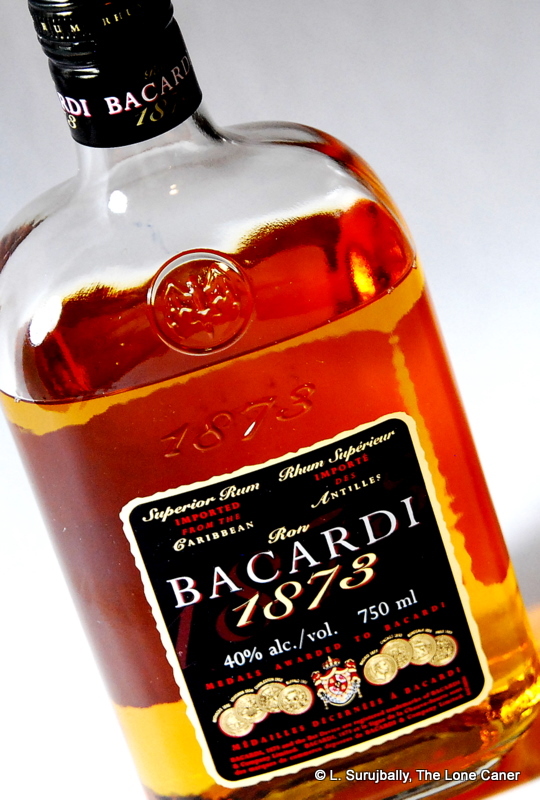
I’m at a loss to say what Bacardi 1873 is, based on what I’m reading.  Research is maddeningly inconclusive: is it a solera, as some bottles advertise themselves to be, or a standard blend of some kind?  Some sources suggest that it’s an aged blend that has now been replaced by the eight year old.  I hesitate to commit myself to any of these positions, because while I can tell my bottle is definitely not marked as a solera (that is usually clearly identified as such on the bottle, and the one I sampled makes no mention of it), I can’t ascertain anything else.

It would also appear that the few rum reviews out there are at odds on whether it is discontinued or not, and if so, replaced by what.  Bacardi’s own (woefully inadequate) website is hardly a fount of information on the matter and thus far they have ignored my inquiries. On the other hand, Chip Dykstra of the Rum Howler Blog was as helpful as ever, and responded that while the 1873 started life as a Solera made in Puerto Rico, production was subsequently moved to Mexico and the specialized solera method was discontinued.

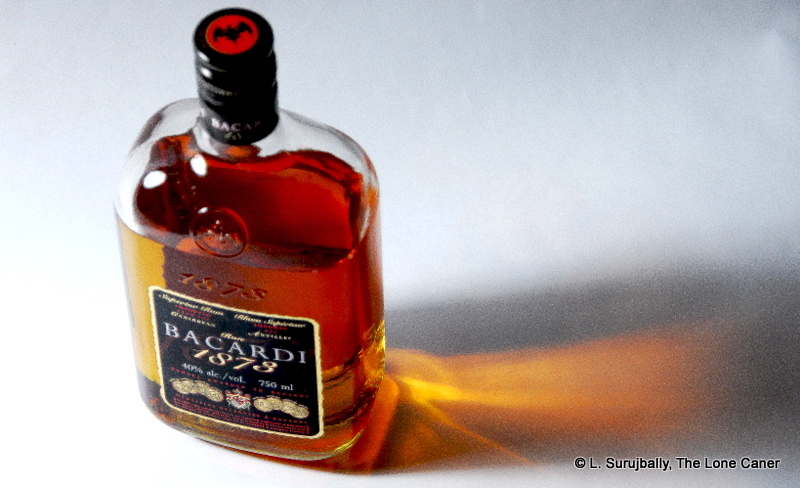
Faced with this dilemma, a reviewer does what he can: he directs an inquiry at the distiller, does as careful a tasting as he is able, and puts a picture of the bottle up to ensure that readers know precisely what they’re reading a review of.  And this is what I’ve attempted to do.

Price wise, nothing to say. About $35.  Bottle, not the rounded shape of the standard Bacardi’s like Black, Gold or White, but more squared off.  Cap is a cheap crap tinfoil press-on.  I won’t go so far as to say these initial indications denote low-end, but it does seem to be trending that way.  On the other hand, I like the rich and deep amber-gold colour of the rum as the light strikes it (something I’ve attempted to show in the picture I took).

Working on the assumption that this is a blend, the trick is to see if a decent tasting can suggest, with a fair degree of assurance, whether it’s an old or young one running up the spine.

On those nose, there is a surprising lack of any kind of spirit burn on the initial sniff, just soft vanilla notes wrapped around a caramel and burnt sugar core. There is a hint of oaken tannins on the back end which suggest some level of ageing, but it’s impossible to say how much: the relatively simple nose doesn’t lend itself much to dissection.  I need to mention, though, that after I left my glass to stand for a bit, a sly citrus hint came sliding out of the softer background of vanilla.

The palate confirmed the overall lack of complexity the nose had suggested.  The body of the 1873 was lighter than I expected for something of this copper-brown/amber coloured hue; and slightly sweet without overpowering you with sugar, and a shade dry (not as much as the Bermudez, however). The rum is spicy, packing a light stinging burn on the tongue, yet perseverance elicits the taste of dried fruits as well, the non-sweet kind, like dates, perhaps; this last is very faint and is no more than a light impression. As for the finish, it’s short and sharp, and the medicinal fumes which thus far escaped you are back to claw their way up your throat and spoil what so far had been an unremarkable, but also not particularly bad, rum.

I’m really not impressed with the 1873 on its own – this one seems to be tailor made for a cocktail base of some kind, and indeed, as a mixer with the usual suspects, I really enjoyed it. I believe it to be a blend of rums aged no more than five years. As a sort of general product, it doesn’t try to be any one thing, but too many, and there we may have hit on the reason for its lack of success with me.  The makers never got around to hanging their hat on any kind of flavour profile, while trying to please everyone: that marks it out as a low-ender, to my mind.

I sometimes wonder how much rum-lovers’ tastes the world over are formed from early exposure to the best selling rum in the world.  When  you think about it, drinkers who start with scotch appreciate the drier, not so sweet variations that hark back to whisky and cognac, while also liking the sweeter, more full-bodied stuff; but drinkers who began with Bacardi and never strayed from the true faith tend to like the former somewhat less, and concentrate their love on the latter. This private theory of mine is anecdotal at best, but who knows.

Be that as it may, Bacardi 1873 is a pleasant blend of no great sophistication, and sports its youthful physique and unpretentious nature like any teenager that ever lived but fails on the finish line. It’s main selling point might be that it’s a cut above the black and gold variations, and works exceedingly well as a mixer. For some, it might work as a low-end, none too stellar sipper (something like the El Dorado 5 yr or English Harbour 5 yr)…not for me, though.

(#049)(73.5/100) ⭐⭐½

Nov 192010
 

First posted November 19, 2010 on Liquorature.

Bermudez is the second rum I managed to find from the Three Bs distilleries in the half-island of the Domincan Republic (Brugal, Bermudez and Barcelo), and is both less and more than its possibly better known sibling, the Brugal Ron Añejo which I took a look at the other day.

J. Armando Bermúdez & Co., C. por A. is a distillery located in Santiago de los Caballeros in the north central region of the DR. It was founded in 1852 (hence the year on the label of this Anniversary edition) by Erasmo Bermúdez, who created the formula of the Bitter Panacea, an early rum meant to be taken as appertif, and which soon became very well known. To this day the descendants of Erasmo run the show, but there are stories about how the various members of the family have squabbled among themselves on the direction of the company, and so it no longer holds the pre-eminent position it once had. It certainly is the oldest of the Three Bs, Brugal being established in 1888 and Barcelo in 1930.

There is no age statement on the bottle, so one is forced to resort to external resouces to see what’s in this baby.  Wikipedia refers to the Anniversario as a golden high-end premium blend (not particularly helpful), and Chip Dykstra’s notes suggest it has either a twelve or a fifteen year old backbone, based on the supplier’s say-so, but añejos are usually under ten years old so I take that assertion with a pinch of salt. Given its middling price of just around forty dollars, he may be right,  but I find it frustrating in the extreme to find the company website unavailable, and no other notes of consequence anywhere to inform the casual reader on the matter.

Anniversario is a tawny gold colour, however hidden it may be in a nearly opaque dark green bottle. I can’t say the tinfoil cap impresses me much – if this is a premium rum you’d think something more would be added to the initial presentation to justify the price, not a cheap covering and an equally cheap sigil on the front above the label. But it’s another indicator, pointing to its less aged pedigree than others claim it has.

A thin oily film devolves into slow thin legs that meander slowly back into the glass; on the nose, the medicinal sting and reek is more pronounced (much to my surprise) than the Brugal I had right beside it and ten minutes previously (I promptly poured another glass of it to make sure this was not an accident and yup, it was confirmed).  After I left it to open up a bit, other flavours emerged: a sort of earthy, dark taste, like rich chocolate, balanced off by a dry and woody flavour and a hint of citrus.  Later it developed a sweet floral hint, though not as light and clear as the Brugal: it was more…heavy, a bit like lilies as compared to white roses.

The Anniversario is a dry, unsweet medium-bodied rum which seems to be characteristic of the Latin islands. Tasting it confirmed some notions, dispelled others.  A sweeter taste shyly emerged from out of the nose, and the driness became more pronounced, as did the slight bitterness coming from the oaken tannins.  On the back end and leading into the finish, the faint traces of molasses and caramel I so like could finally be discerned.  The finish is short and spicy, a slight burn that just misses being sharp (for which I give thanks), but again, is nowhere near as smooth as the Brugal.

I wish I knew more about its distillation and provenance: it smelled and tasted like a single digit rum, yet it was obviously aged and seemed to be marketed as something more. And against that, the 3-5 year blend of the Brugal has a phenomenally smooth finish which this one can’t even approach. In fine, I’m underwhelmed by the Anniversario.  It has a relatively modest price tag, but if it is true that it is a blend of double digit teen rums, then it has a pedigree I simply cannot see as justified (on the other hand I must say that it’s a matter of what one reviewer has said, plus some anecdotal evidence gleaned from hours of searching online – no real hard facts I can hang my shapka on).

At the end of it all, it must come down to my opinion based on what I tasted.  The Bermudez Ron Añejo Anniversario tastes like a dry cognac, not a rum, is not sweet enough and lacks a real body.  The blend just doesn’t work as well as it should for me, in spite of the fact that it may have a blended series of aged components in the double digits. It has an interesting marriage of flavours, but this groom, alas, ain’t buying today.

(#048)(73/100) ⭐⭐½

Nov 182010
 

First published November 18th, 2010 on Liquorature.

Ron Añejo Brugal is one of two rums from the Domincan Republic which I tasted side by side last Friday.  Not to be confused with Dominica, the Dominican Republic is the Spanish speaking eastern half of the island of Hispaniola…the western half is Haiti.  Three distilleries known as the Three Bs operate in the DR: Bermudez in the Santiago area, the Santo Domingo distillery called Barcelo, and Brugal in the north coast.  Brugal, founded in 1888, seems to be the largest, perhaps as a result of being acquired in 2008 by the UK Edrington Group (they are the makers of Cutty Sark), and perhaps because Bermudez succumbed to internecine family squabbling, while Barcelo made some ill-advised forays into the hospitality sector and so both diluted their focus, to Brugal’s advantage

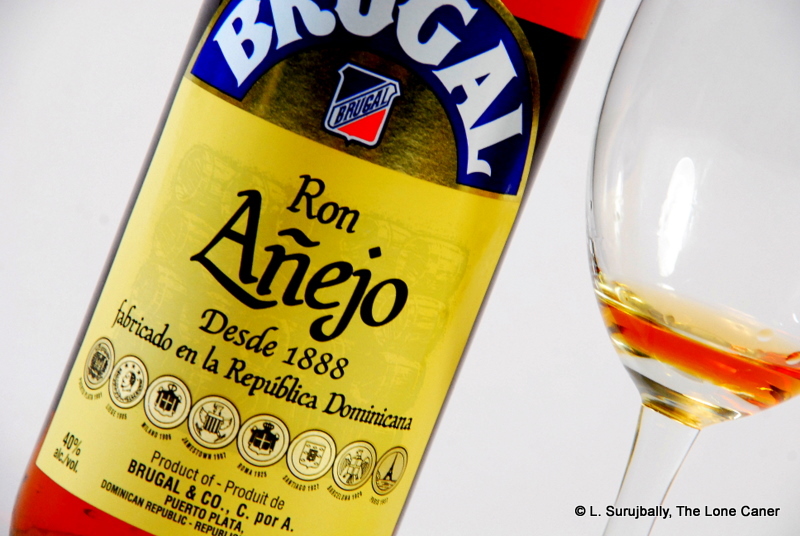
The term añejo simply means “aged”, and in this case it’s just a question of how long.  Given the cheapness of the bottle (~$30 in Calgary Co-op) you can sort of assess that it’s not a double-digit rum, and indeed, after doing some research, I confirmed it to be a blend of rums aged three to five years in the usual used oak barrels that once held bourbon. The rum itself is a solidly mid-tier offering, golden in colour, in an utterly undistinguished, average looking bottle with a white plastic cap (plastic? sigh…). I don’t always agree with the Arctic Wolf in Edmonton on his assessments of rum, but both he and The Bear share this one thing: they despise cheap crap, in particular, bottle caps made of tinfoil or plastic (against this, you have to understand that the Bear in particular hates being dinged for extra crap which adds only to presentation…it gets a bit confusing at times).

All this preamble aside, what’s going on with the profile?  Well, if you want me to cut to the chase, the bottom line is that Brugal Anejo is a solid mid-tier rum, with a smooth finish that makes it just barely edge into sipper territory. Stop reading now if that’s all you needed.

In the glass it’s a clear dark toffee colour, which leaves a nice clear film on the side of the glass which gradually disperses into thin legs. The initial nose is sharp and medicinal (did I ever mention how much I hate this?) which, once the rum sits a while, devolves into light vanilla and caramel notes with a clear sweet floral note that I quite liked. Gradually, a second and third nosing will take you back into the comforting arms of the caramel, molasses and burnt sugar flavours, but they are light and clear in a way that is at odds with the heavier, darker flavours of the Guyanese El Dorados (or even the Jamaican Appletons).

The body of the rum is medium light… in fact, it’s almost thin, the way Doorly’s XO was. Be warned: this rum is not sweet, and this means that the overall feel on the tongue is more like a cognac, an opinion reinforced by its overall driness.  The lack of sweet translates into something almost salty, like an ocean breeze tang, or something autumnal (which may be the oaken flavours coming through), and it’s intriguing without entirely being something I cared for.  And as with the nose, after a moment you can taste the burnt brown sugar flavours coming subtly through on the back end – much more so than the Doorley’s I could not learn to appreciate. On ice Brugal’s is not recommended – the ice will close this baby up faster than a nun’s habit in a brothel – but as a mixer? Hmmm.  Pretty damned good.

The delight of this rum is the finish: Brugal is astonishingly smooth. I don’t like the lack of sugar in the flavour profile because this to some extent affects how long the finish lasts and how heavy the rum feels, but even with the short time you feel the rum on the swallow, you get no burn or scratch or bite whatsoever.  It’s nothing short of amazing, and for this I gave it a high thumbs up. Overall, this is not quite my kind of rum – I’ve made mention  of my liking for heavier, darker and slightly sweeter variations – but I must be honest about it. If your liking is for less sugar than I prefer, then this low priced mid-range likker from the Caribbean will be right up your alley and is absolutely a good value for your thirty bucks. If that’s your thing, go for it.

(#047.  74.5/100) ⭐⭐½


Oct 272010
 

Photo (c) Whisky Antique

First posted 27 October, 2010 on Liquorature.

Excellent presentation; a rich, complex and smooth experience that reminds you why premium rums exist at all and makes for a good gift for aficionados

Somewhere in the midst of an alcoholic haze left by the last gathering of the Gentlemen of Liquorature, I had this vague memory of drinking quite a superlative little sipper.  Pat had, of course, been quite miffed when I wrote the review of the Bacardi 8, since he had wanted to surprise me with something I hadn’t had before  – but he got me on the rebound with this one. Fortunately, my tasting notes survive the bender, and once I sobered up and remembered my name, I dug them out for this review.

Angostura is that Trini distillery that now makes the excellent Zaya (Diageo, via its shareholding in Moet Hennessy, owns the Zaya brand, but do not own the distillery – CL Financial retains majority shareholdings there). They have been making blended rums since the early part of the 20th century (1947, according to them).  At that time Bacardi owned some 45% of the stock, which it held until 1997 when CL Financial – the largest T&T conglomerate with fingers in dozens of pies – bought the shares (they ran into a major liquidity crisis in 2008 and in order to get a bailout, relinquished seats on the board to the Government2).

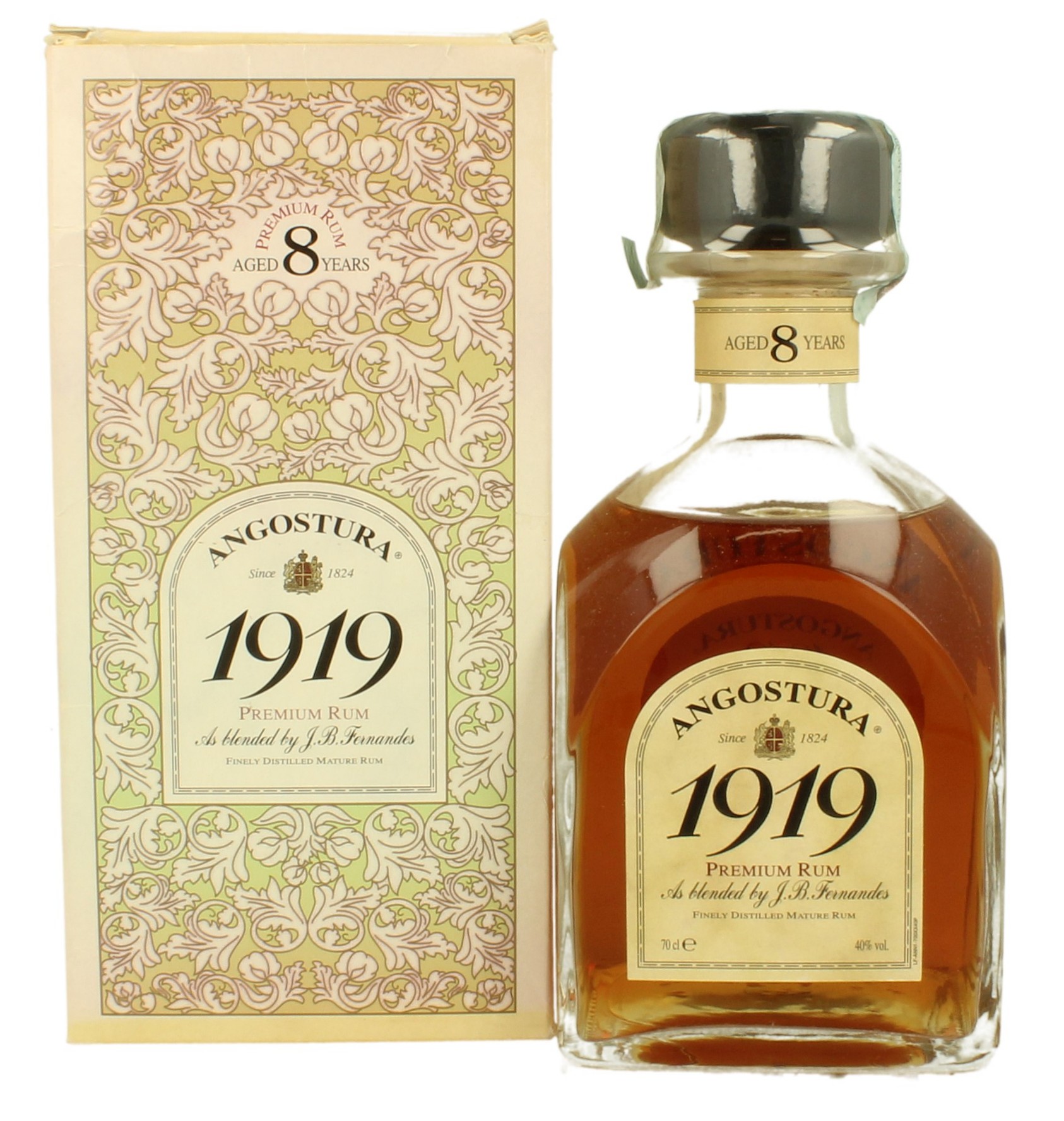
I don’t as a general rule make a comment on the bottle, but in this case I’m happy to make an exception: Angostura, home of the bitters and the Royal Oak, have poured the 1919 variation into a short, squat, square bottle with rounded shoulder and a massive, voluptuous cork.  Its excellence is more in the simplicity than anything overt…I had the same feeling about the English Harbour 10 year old.

The 1919 is a blend of rums aged a minimum of 8 years – both bottle and the company website makes this claim – in charred oak barrels which were previously used to age bourbon whiskey.  It’s a golden brown liquid, quite clear, somewhat reminiscent of the Havana Club Barrel Proof and has that same brilliant hue when the sunlight hits it.

On the nose, there is surprisingly little spirit burn.  There’s a mellow billowing scent when the bottle is opened, in which the smooth odours of caramel, vanilla and flowers balance well and softly together. There is a richness to the nose that is quite unexpected, and it promises an excellent drink.  Sipping it is a uniformly pleasant experience: I don’t usually expect too much from younger rums, though those greater than seven years are usually pretty decent mixers (the Flor de Cana 7 yr old is a perfect example): this one, it must be said, is an exception.  As a ground level sipper, it’s bloody good, perhaps a slightly less sweet and less spiced-up version of the Captain Morgan Private Stock at about the same price, but equally smooth, equally tasty.

The feel in the mouth is warm and silky rather than harsh, and after letting it breath you get flavours of buttery caramel, vanilla and molasses, but not too much of any one: in fact, the 1919 is remarkably restrained and well balanced among these primaries.  Coiling subtly around this backbone are some fruity and softer floral hints that I can’t quite identify but that enhance the central notes excellently. The texture is slightly viscous and smooth as all get-out.  And the finish is long, warm and spicy, with the faintest hint of sharpness that seems to be there just to remind you this is not the best Angostura wants to give (that might be the 1824 rum).

All in all, for a rum that costs in the forty dollar range, I’m impressed. For all its relatively youth, it scores highly in all the right areas: presentation, nose, flavour profile, mouthfeel and finish.  It is equally good as a mixer or as a sipper, again very much like the Captain Morgan Private Stock. And what it lacks in the complexity and sheer brilliance of the older premium rums (like the English Harbour 25, Appleton 30 or the El Dorado 25 and 21), it makes up for by being, quite simply, one of the best low cost rums out there, one which the average Tom, Dick or Harrilall can afford, and enjoy.

(#043)(Unscored)


Other Notes

  • In 2016 or shortly thereafter, the short, stubby and squared bottle (the “old” version, reviewed here in 2010) was replaced with a more standardized cylindrical barroom-style bottle; apparently the blend was tweaked as well, because a couple of commentators on Masters of Malt were scathing in their denunciations of the new taste.
  • Difford’s Guide and my own company biography of Fernandes Distillers both note that the “1919” name derived from a batch of rum recovered from a 1932 Government rum storage warehouse fire by Fernandes; some casks labelled 1919 survived and the rum inside was felt to be good enough to blend and bottle under that title.  As a result it became a standard blend ever after, even transferring over to Angostura when they took over Fernandes in 1973. However, that blend did change over time – for instance there was supposedly some Caroni in the original makeup, but certainly no longer.
Oct 262010
 

First posted 26th October, 2010 on Liquorature.

Something that puzzles, annoys and confuses me about Toronto is the paucity of rum selections in the LCBO.  I thought this was just a Calgary thing, but it seems that there are more varieties of rums available in cowtown than in a metropolitan area that has several hundred thousand West Indians in the population.  Can you blame me for the head scratching and being grateful for deregulation in Alberta?

Fortunately my old schoolfriend Pratima, who also hails from Guyana, had two rums in her cabinet gathering dust (and I mean that literally); I had been after these for a long time as they are tough to get in my area, and she very happily trotted them out for me to sample, probably so that she could giggle at how I swirled, sniffed and tasted.  I laughed too, but drank ‘em anyway…it’s fun doing this in the company of an old friend.

D’Aguiar’s Extra Mature rum was in a plastic bottle with a tinfoil cap, which was surprising (and did less than enthuse me abut Banks’s product line here); it’s definitely a Demerara rum, although not made by DDL (and as of the 2010s can no longer call itself a Demerara rum, as DDL has dibs on that descriptor). It’s darker than the norm, but still lighter than DDL’s el Dorado offerings: a clear dark gold. In the glass it displays a good viscocity and thick sheen sliding slowly down the sides of the glass. On the nose it is pleasantly deep and rich, and redolent of molasses – much more so than the 10 year old which I’ll address in a separate review – but with a bit of spirit smackdown as well…not too much, though. The caramel, vanilla and toffee hints come through quite clearly; the rum overall is slightly dry, and just sweet enough…and coiling around the backend, you get a faint whiff of fruit – citrus, a little banana. The finish is not very smooth, and medium long on the first go – as you get used to it, it subsides somewhat and evens out.

The Xtra Mature is blended from Demerara rum supplied to Banks DIH by Demerara Distillers up at Diamond Estate (note – by 2017 this had ceased and Banks sources distillate from Trinidad and Barbados), and I gotta tell you, the more I find out about DDLs operations – the supplying of rums to other companies, their international scope, their excellent premium rums which they can almost be said to have pioneered – the more impressed I am. This XM product is a challenge to review because so little has been written about what constitutes it.  That it is a rum, and a decent one, is without question: but how long the blends are aged and whether any post-finishing touches (again, like the 10 yr old) are added is not something I can ascertain from either Banks’s website or any other writers. My personal take is that this Xtra Mature is a step above the 5 yr old but not as good or complex as the 10 year.

I’d also have to say that it is not a sipper: it has just a bit too much bite in it for me. I don’t think Banks actually markets it as a sipping premium rum either, since that moniker appears to apply to the Royal Gold Extra Mature, the 10 yr old or the VXO 7 yr old. But both Pratima and I agreed (when she ceased her laughing) it was good, nay, excellent, as a mixer.  Since I’ve never seen it for sale in Canada, and it lacks the international cachet of the El Dorados, I can’t speak to the public awareness, or the price: but whoever gets a Mudlander to bring this or the ten year up from the Old Country for them, is in for a treat without question.

(#042)(Unscored)

Oct 262010
 

First posted Oct 26, 2010 on Liquorature.

Note: I have written a companion piece to this review for RumConnection here: it’s more tightly researched, a bit longer, and takes a more structured approach.  But both this review and that one are of a piece, and I hope you enjoy them

Of all the rums reviewed here, I believe that the only reasonably complete “age set” of a single distillery’s products I’ve managed to buy is the el Dorado line. Somehow, Calgary seemed to have gotten most of the el Dorado aged rums over time, though some of the estate editions are missing – and I’ve snagged everything I ever saw up for sale…except for the ne plus ultra, their fabled 25.

Now the El Dorado 21 costs ~$100, the English Harbour 25 goes for $200, Mount Gay 1703 $110 and Clement XO $126 (with the Appleton 30 at a whopping $300+ in Calgary, and $550 in Toronto)…the El Dorado 25 supposedly retails for a cool $350, but only when you can find it, and that’s about as likely as finding seriousness in a Rajinikanth movie.  So it’s a little like a Grail of sorts for me, and when an old friend in Toronto mentioned he had a bottle of the Millenium Edition  (bottled for the year 2000), and was prepared to let me have a sip under carefully controlled circumstances (lock, key, watchful guards and closed circuit cameras not excluded), well, what can a man do but accede and hustle his behind over there.

The various reviews I’ve done of the El Dorado line give more than enough history of the producing company without me adding substantially to it, but in brief, more than any one company in the world, DDL ushered in the age of premium sipping rums way back in 1992 when the El Dorado aged vintages emerged, led by the flagship 15 year old Special Reserve (which my father told me quite frankly is his favourite of them all). To a great extent this was aided by the tremendous variety of original and modern distilling equipment DDL had (and has), including original wooden stills dating back to the 18th and 19th centuries; these permit a variety of dark matured rums that form the backbone of the range.

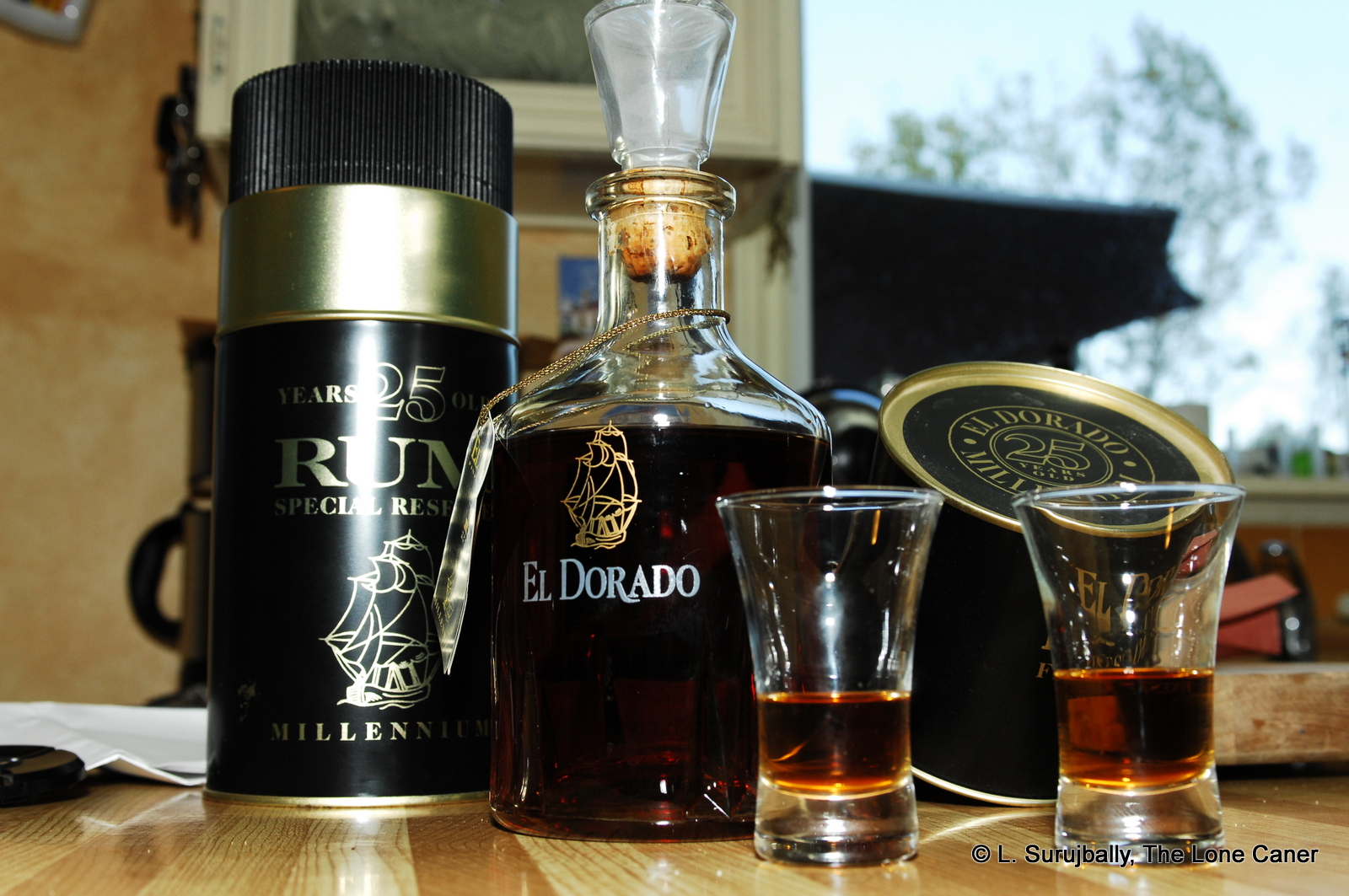
The ED-25 shares, with a few others, the humorous cachet of being old enough to have intimate relations with itself, and to call the bottle it comes in merely “a bottle” is to do it a disservice.  Like the Angostura 1919 and the Appleton 30, it comes in a container best referred to as a decanter, or maybe a flagon (minus the handle).  It may lack the zen-like Spartan simplicity of the EH10, but it’s arresting for all that and the glass-topped cork makes its own statement of quality (I particularly liked the voluptuous popping sound when eased out). You feel, when opening this baby, that you should be on a plantation house somewhere, watching the sun go down over emerald green cane fields moving and rustling in the trade winds.

Right away you are enveloped by warm breathy fumes of your favourite bedtime partner gently blowing brown sugar at you. The nose is not sharp enough to sting, but asserts its prescence in a sort of mild burn that is far from unpleasant and hints of caramel, brown sugar, faint orange peel, spices and perhaps (and I’m reaching here) cinnamon. Slow, fat legs swirl in your glass as it drains in an oily film down the sides.  I had observed before that I loved the viscosity of the 21 year old…this one looks to do it one better.

And it does.  “Oiliness” is a mark of how well the rum coats your tongue and allows the tastes to remain there.  The ED25 is a step ahead of the 21 year old I so admired, perhaps a shade more viscous, a bit thicker in the mouth.  It gives the liquid a richness and feel that I find amazing.  It’s still a spirit of 40% ABV, but dense enough for you to almost feel you’re getting a liqueur. The taste that comes through is of smoke and oak, sweetness (a shade more than the 21) and caramel, molasses, nuts, fresh coconut shavings still damp from the blade, bananas, cherries and a slight hint of licorice; and the sense, never quite solidified, of wet warm ground softly steaming after a tropical drizzle. And there was that wine-like taste of cigarillos soaked in port which I used to love in my smoking days.

The dark brown rum is smoother than any rum has a right to be, and to taint it with any kind of mixer would be sacrilege.  I had it neat and then with ice, but my take would be to just have it neat and sip it one small mouthful at a time.  The finish is long and lasting, and like a playful tabby, it bats you with half-sheathed claws right at the end just to let you know you can’t take it for granted…what a wonderful rum this was, indeed.

I suggested in my review of another uber-rum (the Appleton 30) that I can titivate around with opinions on the low and midrange rums without losing any kind of credibility, but just because a man pays a lot for a bottle of the good stuff does not immediately guarantee  a positive, let alone a sterling, review.  That I paid not a red cent except fuel costs to get to John’s house does not invalidate this sentiment.  Was it as good as I had been led to believe?

In answering this question, I want to stay away from making any kind of unequivocal statement as “this is the best” or, “it’s the epitome of rum” or any such superlative, because at end, what you are getting here is an opinion. Mine, to be exact, and as readers of my writing will have discerned by now, I like smooth sippers of some sweetness, complex flavours and subtle underpinnings, with a good mouthfeel and long finishes.  On that level, the El Dorado 25 is one of the best commercially available 40% rums ever made: in my opinion it’s a top five pick for sure (and note how carefully I phrased that). Where it fails slightly, is in the sweetness component.  It’s just a bit too much, the burnt sugar and caramel flavours being a bit too aggressive: they just edge out the subtler tastes coiling beneath, and while the upside is that this smoothens things out a bit on the finish, masks the smoky oak tannins enough for it not to be a whisky (a problem I had with Appletons), it prevents that coming together of all elements — flavor profile, texture and finish — that would give it the premium many will feel a rum like this deserves, and justify the price tag.

That this is the top end of rums is not in question, and so, at the end, whether you buy it or not depends a lot on how you see rums yourself. Are you prepared to shell out over three hundred dollars for a world class sipper, or are you at that stage where you would prefer to go a rung lower and buy two or three also-premium, almost-as-good rums for that same price and triple your enjoyment? In my youth, I knew exactly where I stood on that sentiment; at my current age, with a little bit of cash socked away to indulge myself (and an understanding spouse who pretends not to notice), I’d have to concede that I’d walk – nay, run — to Willow Park to buy this, if they ever stocked it.

…but only once.

(#035)(Unscored)


Update February 2017 I had the good fortune to re-taste this as part of the Rumaniacs lineup, and  the intervening years made one hell of a difference: it was staggering how my own tastes had changed.  Not only was 40% way too weak (the rum retails at 43% in Europe), but the sweet was now something that could only be described as an epic fail.  I believe that for its time (~2005-2011) it was right and commanded the heights; few other makers could produce a 25 year old rum in any real quantity to compete with this.  But as full proofs became the preferred strength, and lack of adulteration was the signature of top end rum; and as other, sometimes older rums came on the market, DDL never really changed with the times.  To be sure there will always be those to whom this rum appeals.  These days, I’m no longer one of them, until DDL dials down the sugar and issues the rum at a higher proof.

Oct 132010
 

First posted 13 October, 2010 on Liquorature

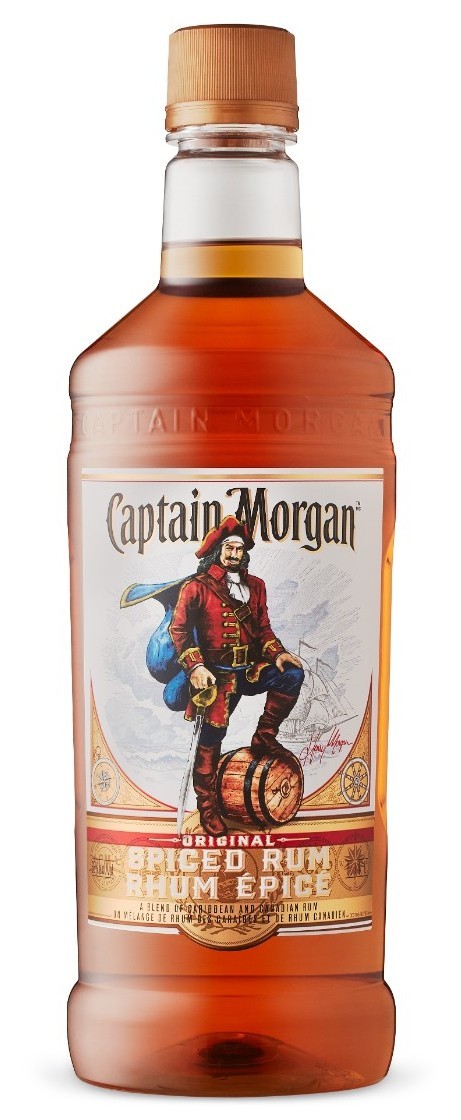
The  best selling and most commonly quoted spiced rum in the world.  It’s the standard by which all other spiced rums are measured not because of its excellence, precisely, but because of its overall “okay-ness”. It’s okay everywhere while being truly outstanding at little. It’s sweetness and spice are part of the appeal.

The fact that this is a low end mixer should not dissuade you from giving it a shot (no pun intended) if you’re in the mood for a reasonably low-priced little something. It’s about on the same level as the cheaper Bacardis (Gold, and Black), but it is spiced and therefore somewhat sweeter than normal, and also not meant to be taken seriously as a sipper.  Yet many aficionados with a less exclusive turn of taste are quite ardent supporters of The Captain’s spiced variant.

As I’ve noted in my review of Captain Morgan’s Private Stock, Seagram used to make the rum, but sold the rights to Diageo in the mid-eighties, and currently it is the world’s best selling spiced rum. The name is nothing more than a marketing ploy, since it enhances the connection to swashbuckling, seafaring pirate days of yore, but beyond that, there isn’t anything else (note that the TV advertising campaign I have seen in Calgary also plays on the whole bit about being like a pirate in breaking the rules and thinking outside the box to achieve success…an interesting bit of moral relativism given Morgan’s history and actions).

Captain Morgan is a tawny gold colour, and displays a medium light body in the glass. The nose is heavy with rum and vanilla, and a bit of caramel thrown in.  I can’t say I detected anything beyond that, because the scent is so overwhelming.  Yet the youth of the rum is evident in the sharpness at the back of the throat (it’s been matured for two years or less in charred white oak barrels), so there’s not much point in trying the rum to sip (unless you’re a slight nutcase like me and want to try it that way nevertheless). The finish is pretty good, though, a tad sharp, though not nearly as much as the nose suggested it would have. Last flavours of vanilla and nutmeg.

For my money, I suppose it’s okay.  It’s a versatile ingredient in mixed drinks, but just too sweet to really appeal to me — and for all those who have read my reviews about liking sugar in my rums, this must sound strange, but there is something as too much and this is a case in point.  Perhaps adding just a smidgen of coke to mitigate the burn is the way to approach it.

However, like Bacardi, the Captain is available just about everywhere, and as a result, if you drop thirty bucks on a bottle when getting something in a hurry, well, you’ll certainly get what you pay for plus maybe a bit extra. Your friends and guests sure as hell aren’t going to refuse it, and, if offered at a party, neither would I.

(#039)(Unscored)

Oct 012010
 

Picture (c) Pete’s Rum Pages

First posted 01 October 2010 on Liquorature.

Lemon Hart is an instructive case study in how one can chose a rum without knowing a damned thing about it. As I’ve noted on more than one occasion, if you go into a store without a blessed clue, you are down to three bases for your decision and only three: the price; the look; and knowledge you have when you enter the joint. Anything different is somebody else choosing for you.

So here, what did I have? Well, the price for a flattie, which was less than twenty bucks; the look, which was simple and unadorned and referred to Demerara – perusers of my writing will know I have a soft spot for the old sod; and my knowledge.  Admittedly, I do have a bit of a larger base of knowledge than some, and so I had certain advantages there.

Knowing the history of the brand though, doesn’t mean anything.  It’s how good the rum in this brand is, in this bottle, that counts.  And I had never had any of Lemon Hart’s variations before, so I couldn’t tell whether any of its cousins were any good and extrapolate up or down, and therefore…well, in the end, I guessed.  How disappointing is that?

Lemon Hart owes its making to the Navy Rums of yore.  I’ve covered this in more depth in my review on the Pusser’s, but to recap, the British Royal Navy, as far back as 1655 until they abolished the practice in 1970, regularly issued a tot of rum to all hands in order to ward off scurvy (they added lime juice to the mix which is why I mentioned before that rum has been mixed since the beginning of its existence, and why Jack Tars are called limeys even today).  Navy rum by tradition is not heavily sugared or added to, which is also part of its distinctive cachet: Lemon Hart, Pusser’s and Lamb’s all pretend to this inheritance (for my money, the Pusser’s makes the strongest case, but that’s just me). Lemon Hart was one of the original suppliers of rum to the Navy, beginning in 1804; Alfred Lamb came a few decades later with his London Dock rum.  Both used raw rum stock that came from the Caribbean, mostly the dark, full bodied rums of Guyana.  Indeed, Lemon Hart states this quite specifically on the bottle I have: Demerara rum product of Guyana. But it is bottled in either Ontario or England.

Lemon Hart is a dark rum, 40% ABV, brown with reddish tints, and has the characteristic thickness and full body of Demerara rums.  When you swirl the liquid in the glass, it has slow fat legs sliding languorously back in. The nose, what there is of it, hints at straightforward rum without embellishment. You can tell it’s young from the harsh burning and medicinal reek, but this is swiftly gone, to be replaced with a powerful molasses overlay. Behind that is a slightly salty tang, just a hint of bitterness as if from some sort of citrus rind. On the tongue it demonstrates its youth with the rawness of the taste.  Yes it’s a bit oily and coats the mouth very nicely, but behind the molasses taste (which is quite overwhelming) and brown sugar, caramel and some fruit, there’s not much here: on the other hand, if simplicity is your thing, LH will definitely shine for you.  The finish is medium long and not very smooth, but since I wasn’t expecting much, it wasn’t too disappointed.

In summary then: a mixer’s rum for sure. Lemon Hart is dense and viscous enough to need only a reasonable addition of cola or ale or Christmas drinks or whatever else your poison is, but it does need it.  Once that is done, you have a decent drink you can enjoy at length without worrying too much about the overall price tag.  And if you have guests, you may even get some brownie points for taking the time to hunt out what appears, in other parts of the world, to be a drink somewhat harder to obtain there than it is here.

(#038)(Unscored)


Note: There is also a Lemon Hart Jamaican rum bottled at 73% which I found many years later.  It was quite good, but no longer made. Lemon Hart is most known for its overproof, 151s and Navy Rums.  I’ve found a few over the years following this review.

Sep 252010
 

Solid all round rum, probably better than most ten year olds around.

First posted 25 September 2010 on Liquorature.


I’ve been a little reticent about trying English Harbour Reserve ten year old, and have put it off for over a month now.  Its younger sibling the Five is such a good mixer and all round rum (it’s been a favourite of the club for some time), and its older brother the 25 is such a powerhouse in its own right, that it seemed almost like trying to make a good aged rum go up against…well, practically a pair of low and high end juggernaughts. And then, there was always the thing that I absolutely hate trying a new rum alone..it’s so much more fun when I can bounce my ideas off someone like the Bear as we get continually more sloshed together.  Our spouses have a hard time containing their laughter as we come up with ever more flowery adjectives to describe out latest object of taste

Be that as it may, I bought this $100 (Can) rum at the local emporium of Willow Park, largely because the bottle I knew existed in Co-Op had disappeared by the time I got around to snagging it, and so, fearing a rum drought of the good stuff (and the jeers of the Maltmonster as he tauntingly raised his current single malt to toast me), I bought the only one they had.  The fact that WP subsequently posted a few more bottles on the shelf suggests my fears were unfounded, but it’s better to be safe with stuff like this. The bottle sat in my pantry for a full four weeks before I finally lost patience with both my own pansiness and my non-materializing guests, and finally cracked it.

I’m a fan of minimalism – the whole Japanese concept of beauty in simplicity appeals to me: the EH10 follows this theme, coming in the same bottle as the EH25, but with a simpler cork stopper, and a lovely, bare-bones label that says what it is without embellishment or hoo-rahs.  In that sense it beats the pants off any other label I’ve ever seen. And the container itself is a solid, non-nonsense straight-lined bottle that harks back to simpler time.  Can’t help but admire that.

The rum is a deep brown-red-gold, like a transplanted flame-haired lassie from Cork.  The legs sliding down the glass when it is straightened are slow and fat and oily, and I have to say I was quite taken with the rum already.  The nose was very impressive. As I expected, it was less harsh than the EH5 and less refined than the EH25, but in this lay its strength, too. Remember, the Ten is a blend of rums aged ten to twenty-five years that have been aged in the usual used oak barrels that once held bourbon, and it takes something from those blends, and adds to that the oaken tannins from the barrels.  Not quite as much care has been taken to mute the wood (the 1981 25 yr old is extraordinary for the balance it achieves with the same elements), but what the 10 has done is create a powerfully complex nose, one where its comparative youth grants it more character than otherwise might have been the case.  Consider: on the first intake, you get soft brown sugar, toffee and caramel hints.  Let it breathe a minute then try again. This time you get a faint citrus, vanilla, some oak or other sweet wood, and now the burnt sugar starts coming at your in soft billowy waves. On a third try, you get those deep notes of molasses and see how all these components come together.  I called my wife and asked her to double check.  She added some fruit to what I had discerned, confirmed most of what had detected, and then went to get the 25 for a quick comparison…and here comes the interesting thing: the 25 is softer, smoother, more refined and interesting – bit it also had a delicate floral hint which the 10 lacked (and more complexity to boot).  Wow.  I couldn’t believe it: while not as good as the 25, the ten year old was giving the El Dorado 15 a run for its money.

Tasting it was another interesting experience. The English Harbour Reserve is soft and smoky on the palate, but it’s not oak I was tasting…something else, some freshly mown green grass or sugar cane leaves, or new sawn lumber of some aromatic kind. The cinnamon hint and spices come straight out, I get notes of mocha and light coffee and perhaps fruit of some kind; and the overall feel is rich, viscous and smooth.  There is just enough sugar to go with the molasses taste to make the experience a voluptuous one, and lose those cognac-like notes that (to me) so diminishes older, more expensive rums (after all, if I wanted a cognac…).

The finish is just a bit too bitchy, a tad too scratchy, to be appropriately classified as fully smooth – it claws rather snidely on the way down (with one claw, not five, so it’s not as bad as this sentence suggests) – but don’t get me wrong: it’s medium long, and the rum takes obvious glee in leaving you with a reminder it was there.  Overall, I think this rum is top class for its age: perhaps it’s a tad expensive for that age, though I’m sure there will be no shortage of opinions on that score as time goes on.  I think I can live with that, however.

The ten year old is a replacement for what once used to be the English Harbour Extra Old, which is now discontinued.  The stocks for that rum – the 1981 vintage now exclusively used for the 25 – were being rapidly depleted by the under-priced extra old’s popularity.  The spine of the EH10 is in fact the 25, yes…just less of it, and it’s bolstered by the various other rums, the youngest of which is the ten.

Many things go into my opinion of a rum – smoothness, sweetness, driness (or not), blend proficiency, complexity and intermarriage of subtle (or striking) flavours, and how well it goes with itself, with ice, or as a mixer. It should be observed that I get no end of a hard time from the Maltsters in my circle, whose snobby zealotry about how no single malt worthy of its name is ever contaminated by ice or anything icky like a mix is legendary.  To some extent they have a point – the mark of a good whisky is how well it stands by itself, and – mistakenly or not – they apply the same standards to rums. But this is to misunderstand rums, I think, because ever since they were first made, they have been mixed in some fashion, and this is as much a part of their heritage and character as the peat used to enhance malted barley…so to me, there is no derision in noting a rum is an excellent mixer. Which this is, price notwithstanding.

Overall, then, how did I like it? Oh, quite a bit, and not just because of its well-known, much admired siblings.  Taking all the above remarks into account, I’d say that on ice or in a mixed drink, the English Harbour Reserve Ten Year old is one well-made, almost brilliant drink.  It’s really good neat, but I don’t think everyone will like it that way (many will, I hasten to point out). It seems a bit ungrateful to say it doesn’t do well in this way, when it succeeds and is top class on so many other levels (taste, richness, body) but the finish is a bit sharp, and I do believe that if you’re willing to mix the thing, you won’t be disappointed, and will have one of the more expensive cocktails you’ve ever tasted.

Is that worth shelling out a hundred bucks for? Tough call.  The stellar El Dorado 21 year old is slightly less than that, as is its fifteen year old.  The dry, cognac-like Clement XO is in the same price range, and the Cruzan Single Barrel and Zaya 12 are both cheaper.  All are good.  So on that basis, I’d have a tough time telling you to run out there and get this one if money is your sole concern.  But my belief is that if you’re looking to buy something in this price range, you either know your rums or you don’t, and if you’ve come this far, drunk this much, had your share of popskull and low end hooch, you wouldn’t be going wrong if you forked out the green to buy this ten year old dark-gold gem.

 (#093. 84.5/100) ⭐⭐⭐½


Other Notes

In June 2018 I revisited the 10 YO and inducted it into the Key Rums of the World series.

Sep 172010


Picture (c) RumCorner.dk

First posted 17 September 2010 on Liquorature

A tentative foray, a single spy, sent into the camp of the premium rums, perhaps to scout out the territory for further invasions to come (we can hope).  Capture one and be surprised by its low price and overall quality. If Bacardi can make this one, I don’t know why they don’t come charging into the high-end market in force.

***

Maybe it’s just me, but I sometimes find stronger notes and more positive tastes at the middle and lower end of the price and snoot scale;  more premium rated rums can get their cachet from age statements, distillery snobbery and the supposed excellence and uniqueness of their maturation process…but don’t consistently please (or awe) the drinker any more than a regular rum could (sometimes even less). A lesson that does not seem to have been lost on the subject of this review: the 8 year old Bacardi.

Observe this brand.  It’s the best selling rum in the world.  It smartly moved its operations to Puerto Rico and then to Mexico in the pre-WW2 years to take advantage of favourable tariff regimes with the US, and created a marketing campaign which made it the pre-eminent tropical drink of its time.  A series of extremely capable family members (some of them in-laws) kept the voting shares and quality control up to scratch into the modern era.  And yet, it is considered fashionable today to bash the brand for its commonality and staid middle-of-the-roadishness.

Part of that is its utility.  The damned thing can be used for anything.  You can cook with it, drink it, mix it, use it as a base, an ingredient or a mixer. It has no real character except its lack of one.  It’s bland.  It’s like the a ’40s jeep or ’50s Land Rover or ’70s Toyota.  It’s the faceless English banker, the anonymous Japanese salaryman  of rums. It is, succinctly put, often seen as boring. But my lord, does it ever sell. The gold, the black, the white…they can be found everywhere

The 8-year old is something else again. Bacardi blends for the most part, but they’ve taken the time to put together this tawny golden blend of rums aged eight to sixteen years old and aged in used white oak barrels that once held sherry.  This might account for a softer and more candied nose than one might expect from what could be seen as just another young rum. It’s a tad sharp, yet not so medicinal as others I’ve had.  I’ve always meant to try it for that alone.

Tasting is a surprising delight: the slight sting to the nose disappears entirely, and a body of some substance makes sipping this without ice a definite must-try. It’s not as sweet as other rums, and the arrival on the throat is more like a dry, rich brandy, or the Bruichladdich Renegade rums.  It’s got a solid flavour profile, with traces of vanilla, nutmeg and light fruity undertones, perhaps peaches.  More to the point, it has real body, not some kind of anorexic thinness reminiscent of its cheaper cousins further down the scale.  And the finish is excellent, with a slow deep burn, not a sting: this rum is more like a decent whisky, I judge, with just enough sugar in it to keep me liking it.  A lot. I’d sip it straight with no problems, on ice without doubt, and as a mixer in any situation.

Bacardi 8 does not try for superiority (although the packaging is quite decent for its price and age…I particularly liked the cork stopper). It really is a good mid ranger, and in its own way, defines what a good rum could be if it doesn’t hanker after any kind of pretentiousness.  A superstar it’ll never be: as an all rounder, it may be one of those undiscovered steals that those who patronize the low-end rums feel is a find all their own, and they’d be right to think so. You wouldn’t be wasting your thirty-plus bucks if you dropped them on this quietly impressive product.

(#0053)(Unscored)


Other Notes

Sep 102010
 

First posted 10 September 2010 on Liquorature #036

The 15 year old is a different animal from it’s older and younger sublings, and resides on the top of the sippers lists of many a rum aficionado.

The 15 year old is the bridge.  It is the last bottle in DDL’s premium line that will not set you back three figures, and still has the cheery character of a younger rum, the cheeky palate that dances and laughs across your tongue and then happily bitch slaps you for your trouble with all the insouciance of the first girl who ever refused you a dance. In it you see the developing hints of the mastery first seen in the 12 year old that culminates the 21 year old.

I was all set to do a vertical tasting of all the El Dorados: the 5 yr, single barrel, 12, 15 and 21 year old, but truth was, the day I had set aside for this I was just to damned tired, and having had the 21 year old not too long before, I contented myself with sipping the 12 year old to refresh my memory, and then cracked the 15 year old I had managed to snag the week before; and that, by the way, was a stroke of luck, because it was the last bottle Willow Park had on the shelf – they may have had more, but I wasn’t taking any chances.

Demerara Distillers Limited is one of the largest and quite possibly the most professionally run international enterprise headquartered in Guyana.  It’s main competitor in the liquor trade, Banks DIH, is a blender of the XM rum line, and producer of other spirits, beers and soft drinks (and of the marvellously named bottled water “Tropical Mist”), but for my money, when it comes to premium hooch, it’s DDL, and that enterprise stands alone.

The El Dorado series is DDL’s premium export line (as opposed to the decidedly mediocre local crap, the King of Diamonds or Russian Bear which people my age cut their teeth on, which even locals avoid(ed) if they can get the XM-5), and readers of my reviews, knowing my preferences, should not be surprised at how much affection I hold for El Dorados.   Part of that comes from the complexity of the blend, coming as it does from fifteen to twenty five year old rums originating in the Enmore and Diamond Coffey stills, the Port Mourant double wooden pot still, and the Versailles single wooden pot still, all blended and aged in old bourbon oak casks. The quality shows.

The fifteen is a rich, dark blend characteristic of Guyanese rums, almost opaque (though not as dark as the inkiness of the Kraken, or, for that matter, its older sibling the 21 year old); it’s redolent of molasses and dark brown Demerara sugar in a freshly opened packet. There’s a sort of charcoal note wrapped around the nose somewhere, something smoky, and not at all unpleasant. Toffee and fruit jam. Like the 21 year, but not quite as much, the medium heavy dark body slowly slides back down the sides of the glass in lazy, fat legs of a Bourda market fishwife.

On the tongue, the rum is a sort of intense marriage of deep flavours. Dark chocolate (unsweetened, dried fruit, licorice, a flirt of anise start you off. You can taste the oak imparted by the barrels the components of the blend were aged in, but amazingly, they never overtake the whole blend.  Note also that DDL, almost alone among premium rum makers, follows the whisky rule of stating the age of the rum as the age of the youngest part of the blend. You can separate out well balanced hints of caramel, molasses, burnt sugar, wound around with the faintest hint of cinnamon and vanilla, and the barest trace of orange peel.  There is just enough sweet for me to appreciate depth and body, and just little enough to pronounce its age.  In fairness, it’s a phenomenally well-balanced drink over all – it can go well neat, on ice or even as a mixer (I do not recommend it as a cocktail, mind you, since it requires no adornment or enhancing).

The finish is an excellent deep burn, not really painful per se, more like a heated liquid – tea! – slowly carving its way down, and it’s excellently long.  Yes it does have a bit of sting to it (like the playful smack I mentioned above), but it’s not malicious in a way I often have complained about in the Appletons or the French agricoles…more like a friendly backslap to say “Later dude,” from a friend who doesn’t know his strength.

I don’t give numerical ratings as a general rule, because I want my explanation to speak for my experience, and maybe that’s a mistake, seeing how much stock readers seem to place in The Last Hippie’s Whisky ratings and the numbers he assigns to nose, palate, finish and intangibles. But in the case of this strikingly original fifteen year old, I think I might make this concession:  while sticking to my guns regarding a numerical score, I will be honest to admit that on a five star scale, El Dorado 15 year old easily demonstrates that it warrants no less than four, and if it wasn’t for its even more stellar older brother, I’d give it a 4.5 star rating right away.

El Dorado 15 is on par with the Zaya 12 year, and handily eclipses the Captain Morgan Private Stock, and gives the Bruichladdich Renegade line and the upper level Flor de Cañas a run for their money at a lesser price. I actually think it’s better than most of these. If you’re looking for an intro to the world of good sippers, or a gift of liquor that is at the top of the midrange, look no further.  You’ve found it.

(#0036)(Unscored)


Update December 2016

After years of selling this top class 15 year old rum, El Dorado has come in for serious opprobium in the rum community for not disclosing the addition of sugar across the line (30-38 g/L for the 15 year old depending on who’s doing the measuring, and when).  I still like the rum a lot, and don’t always have a problem with additions, but I’m a bear on disclosure, and really annoyed by the fact that it was never acknowledged by DDL, to this day.

Update December 2017

After re-tasting this rum and taking account of its enduring popularity and overall worth (in spite of the dosing issues noted), I have named it one of the Key Rums of the World

Aug 282010
 

mount gay 1703

Stunning.  Strong marriage of well balanced flavours, terrific nose and a silky finish marred ever so slightly by a slight bitterness at the tail end. A damned worthy entry at the top-end, showing Mount Gay is still a force to be reckoned with in the premium lines.

First posted  28 August 2010 on Liquorature.

Mount Gay.  The premier house of rum on Barbados, the oldest rum distillery in the world, and this rum, their premium product, first seen in 2009.  I was not entirely enthused with the Extra Old, but here, they have created a small gem that takes the qualities I liked in the Extra Old, and made almost none of the mistakes; and while it may not entirely beat the snot out of the EH25 or the Appleton 30, it is on par with the El Dorado 21, tastes like the Clemente XO, and can quit the field of battle with honour in the company of these exceptional opponents

The top end of their production line was not a part of the Liquorature gathering of August 2010, but because I had just blown the ~$125 on it and wanted to try it in company, I brought it along anyway — it’s become in an occasional thing of mine to bring something high-end to the table when I want the others to sample, because I am fully aware that without that, they’ll never spend the cash on anything but whisky (I’m fighting a valiant rearguard action here, as you might notice).  As the sole ‘Caner here, I consider this my small contribution to their education in Matters of Rum.

All fun aside, let’s look at the 1703.  The bottle is simple, blocky and new age, harkening back to the old jugs of yore (and I adore simple elegance, so this gets mucho brownie points from me); the cork has a sumptuously tight feel to it and is metal tipped cork, tightly settled: it makes a plump, happy sound when popped.  The colour of the rum is a tawny dark gold, with reddish tints hinting of copper…perhaps a freshly minted new coin.  Like both the Doorly’s and XO, it possesses a medium body, lighter than other islands like Jamaica (or Guyana’s molasses beefcakes), but about on par with Martinique’s agricole offerings. It’s a blend of rums between 10 and 30 years old, both pot and column still as far as I know.

I don’t often spend more than fifteen minutes on a tasting before I make up my mind one way or the other: neither my experience nor my sophistication being wide enough to take this further.  However, when reviewing aged rums in particular, a more serious attitude really is needed (well, if you spent over a hundred bucks, doesn’t the object deserve more than just a cursory sip and disinterested demeanour?), and it’s always a good idea to let the opened spirit breathe in the glass.  The initial nose is of cinnamon, nutmeg and a soft whiff of bananas (the Mount Gay signature), but when it has sat in the glass for another few minutes, it opens up like my wife’s arms when I come back from a long trip abroad, and I get that warm comforting whiff of caramel, burnt sugar and toffee coiling around subtle fruits and spices.  And more than a hint of…well, leather.  Maybe that’s just me, though.

In the mouth the 1703 is quite dry and low-to-medium sweet, another thing it shares with both the Elements 8 and the Clemente XO, and for which I marked them down (and again I have to stress how personal a thing this business with the sweetness is for me). However, in fairness I have to mention how smooth the rum is, in spite of the aggressive oaken taste – the 1703 is a blend of rums aged between ten to thirty years in used bourbon barrels – and how subtler flavours slowly seep through the backbone of the tannins: vanilla, caramel, sugar, and baked apples. Yes, taking one’s time with this is almost a given: unlike a young lover who is all energy and power with no character, this one is all about mature and sober reflection of what it means to make love. The lack of sugar makes the overall taste much like a cognac (and the dryness reinforces this impression), and for that reason I myself won’t rank this high on my pantheon of truly great rums, but I fully acknowledge the depth of skill Master Blender Allen Smith utilized in marrying various rums aged ten to thirty years into this excellent synthesis.

The sting in the tail comes at the end. On the pleasantly long and reasonably smooth finish there is that faint hint of bitterness and spite which so marred my enjoyment of the XO – less than that offering, true, but I was watching and waiting for it, and yes, it’s there: unlike the Appleton 30 which expended much time in muting the oaken infusion, here this was not the case, or at least, less effort was made. When one thinks of the overall brilliant beginnings of the rum, it’s subtlety and complexity of married blends, this is – to say the least – problematic. I think, however, that brandy aficionados and whisky lovers will look at me askance and ask me what the hell my problem is, were I to bring it up, and guzzle the thing down with great enjoyment.

As a gift for someone special, as a sundowner in your new McMansion overlooking a lake somewhere, this rum will not disappoint, and overall, it’s an excellent choice for a sipper (no, I didn’t even think of bastardizing this with cola), in spite of its final bitchiness, which is a minor blip on an otherwise straight line, in my opinion (enough to make me mark it down, mind you). Mount Gay has been officially making rums since 1703, and lost a little ground in the premium market over the last decades, but it appears their long tradition of rums for the cognoscenti is in no danger of disappearing anytime soon.

(#097. 85/100) ⭐⭐⭐½


Aug 182010
 

Publicity Photo (c) RockSpirits.ca

First posted 18 August 2010 on Liquorature.

Fresh from the intense concentration I brought to the Elements 8 Gold rum, I trotted out the flattie of Smuggler’s Cove Dark to chillax with.  I would have damaged the Young’s Old Sam, but it was almost done, so off I went to this one.  My more romantic side likes to think that the humourous and positive reviews of Newfie Screech and Lamb’s so impressed the family of one of my Maritime friends at the office, that when she went back to Nova Scotia for some R&R (rather more recreation than rest, I’d say), they chipped in to assist in the purchase of a flattie just for me, to drink, enjoy and review. “Drink, mon!” that gift joyously asks, and I am duly grateful and gave Tanya a big (but chaste) smooch to express my gratitude.

Smuggler’s Cove is blended from Jamaican rum stock by Glenora Distillery in Cape Breton, Nova Scotia which opened its doors in 1990: a good example of how low on the pecking order they consider their rum is the fact that they advertise themselves not as a rum distiller (which to me would make them a damned sight more famous and distinctive), but as the only single malt distillery in America (they make the Glen Breton Rare Canadian Single Malt whisky, and they have a legal battle with the Scotch Whisky Association as a consequence of using the name “Glen”). And yet, you really have to search and peruse and squint to find the shy – almost apologetic – remark somewhere in the fine print, that they make amber, white and dark rums as well.  Given that the Dark won a Gold Medal in the 2003 International Rum Festival, I find that a troubling and sad omission.  On the other hand, that just keeps the price down for me, so maybe it’s all good.

After the complex interactions of the Elements 8 which I likened to a young girl growing up but not out of her braces, and learning how to smooch properly (while not exactly succeeding), it is clear that Smuggler’s Cove Dark is her  45% ABV enhanced boyfriend who was out to teach me a goddamned lesson.  He’s the captain of the football team, doesn’t have a brain in his head, but sports a massive set of biceps and very stern case of hallitosis. The nose practically knocks you off your feet: molasses, sugar and spices, with armpits reeking of flowers. (maybe he’s got questions about his masculinity?).

Honesty compels me to admit that I took one sip of this neat, and, like the Coruba, shuddered and reached for the mixin’s. That powerful taste of caramel, vanilla and molasses is well nigh overwhelmed by Football Boy kicking me in the sack with his steel toed Spirit boots, and the burn ain’t pleasant either. There’s a whisper of real potential – nutmeg, fruit and spices whisper gently – under the strong rum reek, but it’ll never come out on its own.  A cola added 1:1 does, on the other hand, provide an intriguing counterpoint and I think it’s not too far from the Old Sam, though the balance of flavours isn’t quite as good as that particular low-end mixer. The finish on its own is brutally strong, like an uppercut you never saw that lays you out, and scratches the back of your throat as efficiently and sharply as might a hangnail on the finger of the doc giving you a prostrate exam.

I’m not suggesting that Smuggler’s Cove is one of the premier low-class hooches out there, like English Harbour 5 YO or Appleton V/X, or Old Sam’s…but I am saying that as a mixer, it’s quite good, with subtler hints a neat sip would not suggest it had.  I’d actually rate it ahead of the V/X. And, it has to be said that much like every Maritimer I ever met, once you get past the the craggy frontage, the dour kick to the tenders and the glorious lack of sophistication, once you accept it for what it is, you might just end up making a friend for life and a staple that stays — constantly replenished — in your rum cabinet forever.

(#033)(Unscored)


Other Notes

  • Jamaican distillery of origin unspecified; the still of make is also unspecified. According to the NLLC provincial website, it’s been made since 1992.  In 2021, when I was repairing the site and followed up, the rum was no longer listed on Glen Breton’s own website. A Canadian distributor, BID, in an undated article, noted it was a blend of rums aged a minimum of two years, and intimated it was pot still derived.