Ruminsky

Feb 252025


This 7,000-word essay is the transcript of a four part video opinion I released in February 2025, based on an unpublished essay written mostly in 2023 and amended over the subsequent months and years. I have elected to not include a bunch of graphics and pictures to go with it, because it’s long and deserves to be read as it is without distraction.

If video is your thing, they are on YouTube


Part 1 – Introduction and Background

Hello everyone

Today I’m going to do a fairly long four-part opinion piece. This is something that has been on my mind for a fairly long time. It’s part of a much longer essay that I wrote but I never published,whose genesis was a small opinion I tacked on to the end of the OFTD Key Rums review back in November 2023 but it got too long and I removed it. That in turn was based on my observations and thoughts over the last decade, and it kept percolating in my mind ever since, because the subject keeps coming up – as well as questions by new entrants into the rum world, who don’t know the story; and although the rhetoric has died down quite a bit of late, the underlying issues behind it really haven’t. The situation is sleeping, not dead.

To state it succinctly, Planteray (still sometimes referred to as Plantation, its previous name, or Maison Ferrand, its parent company) is a love or hate proposition. There is no indifference, no reflective centre where the opposing sides can meet, no middle ground. Anytime you start mentioning the company or its rums in a public space, a position is taken, will be taken, must be taken — and then inevitably, you’ll be drawn into online fights that stand for one side or another. 

You either like their rums or despise the outfit, or dislike both (few that I know have the courage to say they like both, fewer still accept anyone else can), and if you need to ask “why?” then you’re not as much into rums as you think you are. In all my time of writing about rums and personalities and companies that are involved, I’ve never seen anything near this level of despite, and I go way back to the days of the original Ministry of Rum forum, where Capn Jimbo was always doing his schtick, back in the day.

I think this ongoing brouhaha hurts the category of rum more than anything else…the more so since it is clearly egged on by agendas which are not always clear. And all this incendiary back and forth over the last ten years has not, changed the facts on the ground one iota … and frankly, I doubt it ever will. 

Background

So…let’s rewind a bit and let me give you a precis. Founded in 2003 as a branch of Maison Ferrand the cognac maker, Planteray – Plantation back then –  had a decent enough reputation until about 2015 or so. They made good low rent efforts like the white Three Star and the Original Dark, and were starting to be an independent bottler of some note; they were putting out the same kind of Barbadian or Grenadian or Guyanese or Jamaican rums as others were. I had actually written some reviews of those early releases.

Their labels did leave something to be desired, but this was not unusual for the time, and if eyebrows were raised about the whole business of secondary maturation and finishes — though they were following a practise which was not entirely new — it was mostly because, rather than an exception, Plantation made it a rule for pretty much all their products. But we could live with that.

Starting around 2015 and going on for the next years, however, four things occurred that changed the face of the rum landscape generally, and impacted Plantation quite significantly:

  • For one thing there was the undisclosed sugar controversy which implicated scores of distillers around the world, and several independent bottlers and brands including Plantation (of course, this was the hydrometer test and Scandinavian liquor monopolies that started to do serious tests and publishing them, and this created a huge uptick of interest as to whether rums were adulterated or not, especially since we had been told all these years that “Oh no, we haven’t been doing that”) .. so that was a thing
  • the purchase of WIRD in Barbados in 2017 — after bailout attempts went nowhere and other commercial enterprises declined to buy it, Maison Ferrand bought it
  • Then of course there were the subsequent battles over the Barbados and Jamaican GI – which, by now, has entered the rum zeitgeist and everybody more or less knows about it, and 
  • the eruption of indignation over the name “Plantation” predating but lent strength by the BLM movement (a complete and total PR balls-up by MF), which last finally evoked a promise to change the company’s name to be less offensive in a culturally-charged world…and for which we waited for years, only to get the completely original name of “Planteray” in January 2024 (you just gotta ask yourself what these guys were thinking, honestly).

Those were the highlights that created some of the issues and dislike for the company … but there’s more and other issues raised their heads over time deriving from these:

  • The commentariat in more than one country consider their business practices unethical (at best), dating right back to the acquisition (or “theft of”) of the Ferrand family name and ousting of the original owners of the original cognac company that is the corporate umbrella
  • The reputed and purported strong-arming of retail establishments to stock their products at the expense of others (the old Bacardi distribution model). You know, “you get to stock our rums, but if you do, you can’t stock those from over there if you stock mine.” That kind of thing.
  • They have been accused of misleading the public on their blends and in their various press releases: to the extent that it has become — and I swear this is true — an article of faith that they flat out lie with every breath — this is actually a thing now (which has led to a microscopic examination of their every utterance, every promotion, every ad, every release). And this probably goes a long way to explaining why Mr. Gabriel does not engage in public any longer – he’d get his ass handed to him if he tries
  • Those with long memories would also recall Mr. Gabriel’s somewhat tone-deaf comments that casually invalidated centuries of Caribbean rum-making tradition, by baldly stating how he was there to “save Barbados rum” and how rums should be made like cognac, dating from early years of his public engagement.
  • But more than any one thing, calumny has been hurled in their direction for their intransigent stance on weakening the Barbadian and Jamaican GI proposals, for the stubborn insistence on secondary ageing of Caribbean rums in France and using all sorts of experimental techniques (and calling them “traditional” when they were likely not) while somehow still touting the majesty and originality of the terroire they supposedly represent. 
  • Aaaand…that strikes a lot of people as being not just discourteous and disrespectful comments by a Johnny-come-lately foreign interloper, of rums made for centuries in the Caribbean…and complete and utter bullshit. And that’s consumers, producers, commentators … you know, everyone has a stake in this and talks about quite a bit

Impact

Stoked by online netizens and their like minded supporters who use personal attacks, constant criticism and vicious trolling on social media, this has resulted in an appalling split in the online community. 

The frenzied denunciations of this one company have taken on a life of their own; they are brought up at every opportunity (sometimes with the flimsiest of connections), and in so doing tar everyone associated with the brand, for or against — writer, influencer, blogger, consumer, employee, shop owner, barman…everyone. Liquor store owners have been known to downplay that they even stock the company’s rums; writers withhold their reviews; consumers hardly dare mention that they enjoy the brand’s bottlings for fear of the inevitable backlash; (the only exceptions are the young blood and new reviewers who don’t know the story) it has become so intense that it is no longer possible to have a rational discussion with anyone on the subject. 

In one particularly egregious (I’m thinking of a stronger word) example, a local WIRD employee who copped a prize of excellence in rum making a few years ago was not congratulated for his achievement, as you might expect, but told he (and all other employees) should quit in moral outrage at working for such a company. It’s gotten that stupid.

The anger and associated hate that this thing has started has driven more people away from engaging thoughtfully in public than even the dosage issue from a decade earlier which started in 2014 or so (and trust me, I was there – that was no picnic). If you were to listen to all those who without fail berate, bully, belittle, and correct every single statement and every single action taken by Plantation (or any commentator on, let alone defender of, the company) you’d be forgiven for concluding that this one outfit is Voldemort personified, without the redeeming qualities. Really, it’s like it no longer matters what they do: they could sh*t diamonds from a platinum asshole, donate the entire proceeds therefrom to the eradication of poverty and climate change simultaneously, and still they would be considered one step removed from the sweat of Beelzebub’s sulphur ridden testicles. That’s, really, where this has gotten to

I’ll continue this in Part II


Part 2 – Critical Commentary, Pros and Cons

So, In Part 1, I was talking about the background of the problems that Planteray faces, and the reasons why there is such polarization of opinions about the company, and why people are both fed up with it and love taking sides about it, and how this has split the online rum community.

There’s a lot of critical commentary out there. Some of it is led by advocates for the consumers, some by producers, some by industry advocates, some by bloggers or reviewers, many by consumers themselves, but there is no question that everyone has an opinion, and usually that’s against Planteray.

I contend that this is ultimately not only counterproductive for rum as a whole, but does the reputations of those who indulge in it no favours whatsoever (whatever delusions of being Defenders of the Faith they might tell themselves…and they do). 

It makes the ongoing and condescending ad hominem dismissals, even insults, directed at anyone with a voice raised in favour of Plantation (even those who recount facts and don’t traffic in opinions), seem like personal, private vendettas against them, because it’s always so personal — and, if you read them over time, it’s hard to avoid that many of them actually are, and to me, that dilutes their effectiveness quite a bit.

If you think I’m kidding about this, just go through Facebook and Reddit or whatever, or google the stuff, and, trust me, the arguments will come up, as well as the invective and dislike and even hate — it’s right out there in the open.

But let’s just consider some of the main points of contention

Secondary ageing in another country, which is one of the original bete noirs of the commentariat is a thing, and always has been. 

It’s done by a majority of rum making or rum producing companies and brands – especially the independents –  and with Sheer and various dealers, sellers and brokers in the frame, it is unavoidable. Sometimes it’s all in the country of origin, sometimes it’s in another. It’s not unusual. It happens and always has, and that’s the issue, because real value is seen to be accruing to the country of issue, not the country of origin.

Be that as it may, there is no law prohibiting it – at least, no yet. If the charge is that it should not be called or labelled as a Jamaican or Barbados rum when aged externally for any period – which is a tenet of some (but not all) GI requirements – that’s perfectly fine and should be fought for…but in the courts and with the Government of the affected country and in educational seminars and masterclass sessions of international rum festivals, not in the pages of social media where f*ck, it just goes off the rails and dissolves people’s thinking like acid.

Whether nor not Plantation likes to use the word terroire in its marketing, as another point … and you know, they’ve gotten ten different kinds of shit about it .. but it is just that – marketing…and anyone who expects truth in advertising, in marketing, is clearly not in business and worse, is begging to be lied to. 

To make an argument on the nefarious nature of Plantation because (gasp!) they lie about terroire (or deliberately use it incorrectly in their promotional material) is to repeal modern consumer targeting. 

Moreover, by focusing on this one company, you’re giving everyone else who does the same thing a free pass, which I think is both blinkered and unfair – I mean come on, be consistent and complete in your criticism, would you please? 

And come on – do we really expect truth in advertising? It’s like a real estate agent assuring you as he pats you on the back while picking your pocket “It’s about you, not me.” Sure.

Another point I wanted to make is this: If Planteray fights to get a weak or amended GI in place, that’s a business decision on their part, just as it is a business decision on the part of the other distillers to fight it, and the attendant moral outrage that everyone pretends to, is completely irrelevant: is nothing but a way to get people fired up, because if you think about it, the morality of the case each side supports conveniently aligns with each side’s financial interests – and that highly vocal minority which makes the most noise have exactly zero impact on any of that.

And if you ask what those interests are, well, here are some matters to consider:

A strong GI which codifies local rules of production and labelling – especially the various value-added processes like fermentation, distillation, long ageing and premiumization that speak to the uniqueness of the country’s rum making heritage and the rum’s profile (Jamaica is a really good example of this) is clearly in the interest of producers who set that standard

It is the producers who set those standards – not unnaturally, in their own interest – and the Governments take those recommendations into account when enacting the law that enshrine them. However, as an aside, just because a country has a GI, and many already do, it takes a much more concerted political effort to have that accepted by major trading blocs like the US and the EU. If they see their own tax paying indie bottlers, brands and producers being hamstrung by such rules, they may demand changes from their own position of economic strength.

Existing companies like Planteray have a huge footprint in markets like the EU – in 2022, for example, they moved 400,000 liters of their rums through Sweden alone. Further, In some Scandinavian countries, shelf space, shelf locations and retail access to the Government monopoly stores is determined by a points system based on sales, and the name of the product is linked to that – changing the name of a rum from “Barbados Rum” to “Rum from Barbados” means it is treated like a brand new product and they have to start again from the very bottom (literally), rebuilding a presence and market share that took a decade or more to create – and you wonder why Planteray would fight a regulation that would kneecap them and hand sales to its competitors, for that kind of sales volume in a single country? People, you cannot be serious. 

It somehow seems never to compute that if Planteray fails, or reduces its output and goes under because of such rules, a lot of people will be out of work and a lot of taxes would be foregone, which is also something not often considered or discussed when the GI comes up.

In any case, the final ruling on that GI is ultimately not the province of outspoken European or North American rum lovers (no matter how well intentioned they are), but that of Barbadians and Jamaicans, lawyers, Governments, actual producers, their local employees and consumers, and people who are actually, you know, impacted by this. 

It always irritates me when I see a bunch of people from the global North who have no commercial interest, no Barbadian or Jamaican connections outside their love of the rum, act as if their whole lives will come to an end if Plantation “wins” (whatever the f**k that means) and then go scorched earth with an air of martyrdom in their words. It disrespects the ability of the islanders to come to a decision of their own or anyone else to have a dissenting opinion. So it’s like you can either have one or the other, you’re for us or against us. I mean, what?…whatever happened to constructive debate and engagement in these matters?

Such critics as I mention may not be buying the company’s rum on principle, or even banning the company from their review queue or their festivals – which is absolutely their right —  but in what universe do they think they are doing regular islanders or the country affected a favour? 

By what right do they claim to speak for Jamaica and Barbados? Because they took a holiday there and bought a Foursquare rum? Because their grandparents came from there? Give me a f***ing break. They don’t live there

Richard Seale can do that and has every right to do so because it’s his country, his company, his livelihood and his employees at risk, so he has every right to get up on his soapbox and talk the story that he wants to have told, and to make his case … but… all the other moral crusading asshats I keep reading and hearing (almost all of whom, remember, are not from Barbados or Jamaica at all) should just chill. Their arguments at end don’t matter, because they have no impact, and will have no impact — none — on what the Barbadian and Jamaican Governments will enact into law. All they do is walk around pretending they are influencers, make a whole lot of damned noise, destroy relationships, break friendships and make people swear off rums altogether because it’s “just too much bloody drama.”

Again – who does this help, since all their vitriol has so far not moved the needle one single inch? I submit that their attitudes and for sure those who egg them on with regular incendiary posts of their own, have done more damage to the rum community than to Planteray ever has.

“They make a desert and call it peace” wrote Tacitus nearly two thousand years ago, and that pretty much sums up all that they have accomplished so far.

We’ll continue this in Part III


Part 3 – The Reality And A More Balanced Approach

So, in Part 1, I talked about the background and issues that explained why Planteray is so hated and derided in the global rumworld – the rumiverse if you will. And in Part 2 I discussed some of the points of view and weaknesses, as I saw them, of the commentariat – both who was doing the commenting and some of the arguments they liked to make.

Now, these arguments do exist, and they do sway people’s minds, except that … what have they accomplished? Because to my mind, in spite of all these herculean effort to diminish, control or otherwise hinder the company, Planteray shows no sign of slowing down at all.

It continues to exist, its balance sheet is healthy and sails on in the face of all this dislike and negative online posturing. It is a successful rum producer, like it or not, and a successful indie bottler, like it or not. Moreover, they have actually adapted quite a bit to some of the critiques they have received, so it’s not as if they ignore everyone and do their own thing as conventional wisdom suggests. 

For example, although initially getting a hit for the sugar imbroglio, they now provide this information on dosage levels, and their high-end single barrel offerings are usually free of additives. Too, some of those Jamaicans they have released (I’m thinking the 1996 and 1998 single barrel editions) are really very good.

The company, then, seems to be well run commercially, has a good eye on developing trends and emerging markets, and its line of rums is to be found just about everywhere, which is no small feat. Given the enormity of its output and ageing space in Barbados, you have to ask whether a GI in any form, in any country, would actually hurt them — and, consequently, why on earth they are fighting it so hard – it is not, after all, an existential threat to their business model as it supposedly is for the others, aside from the naming of rums, and shelf space issue I spoke about in Part 2.

On the flip side they may not be impacted very much by the criticism they get from all and sundry, but fuck me, they really are masters of the own-goal at times, and their PR can be summed up as “doofus amateur hour” at best, as attested to by the various intemperate comments, clumsy attempts at justification and damage control, and the long-delayed multi-year name change. They really have not helped themselves very much, and that just gives their critics loads of ammunition.

“What abut their business practices?” you might reasonably ask.

Maybe there have been side deals to get them there and shoulder others aside from markets, bars, cruise ships and store shelves. Maybe they have indeed recruited cold-eyed legal eagles and soulless lobbyists to ram a piss-poor regulatory regime down everyone’s throat. Maybe their business practises skirt the edges of ethics or toe the very fine line of legality as many people claim – I myself don’t know and won’t speak to that, because so far precious little facts that have been put into evidence (perhaps because to do so is to invite a libel suit).

But the harsh truth is that for all the rather innocent comments about how companies should be open and transparent in their dealings, come on, let’s face some reality: business is business, you don’t freely hand out competitive advantage, you do what you have to to get market share, and you make what you have to that sells.

Now, I don’t like this brutally cynical modus operandi, which goes all the way back to the 1970s when the Friedman Doctrine emerged, and various business titans like Jack Welch maintained that shareholder value was the only that mattered, profits by whatever means was everything, and the people can go to hell. I completely despise that attitude.

But it is a real fact of modern commercial operations, and I do live in the real world. 

Few organisations in this day and age have the luxury of ethics not mandated by law, they do the bare minimum they need to comply with the rules, and skirt ‘em every chance they get —  everyone does it and let’s not pretend otherwise. And, fewer still bind themselves voluntarily to such a concept of transparency and fairness. You don’t have to respect or even like Planteray, to accept that this is a business tenet just about all companies practise. 

The idea that companies should somehow forego market share, competitive advantage, sales,  or revenue potential by being honest and open about all things is to close one’s eyes to hundreds of years of corporate shenanigans that prove the exact opposite. And it leads to the farcical conclusion, for example, that the 2008 global meltdown that the unhung criminals who called themselves the financial Masters of the Universe created, was just an honest mistake. And, if those Wall Street hucksters and con artists had accepted Jesus into their hearts and been honest and transparent, it would never have happened. 

Nonsense. No no no no no…. Business is business, the weak go to the wall, and that’s just a fact of life, and we’ve got to accept that — that’s the rulebook that Planteray seems to be playing by. And I’m sure that in one way or the other, so does everybody else. We just don’t know about it, since the incessant and obsessive focus on just this one company makes them a convenient lightning rod that obscures our ability to see – and point out – what everyone else is doing.

So who wins?

In the final analysis, almost a decade of attacking the company has not changed anything at all, and has had no effect on what will end up happening to the company. Even now, they remain every bit as visible as they ever were, if not more. It sure looks like Planteray has taken the approach that all press — good or bad —  is free advertising and that the only thing worse than being talked about is not being talked about. 

Since Planteray can’t be wished away by constant negative articles or made to go away by insulting it in public, let’s just deal with some reality and acknowledge that perhaps, just perhaps, it’s time to consider that an accommodation with the company will have to be reached one day, however distasteful that is to so many people whose egos are now so vested and bound up in this one issue. 

Because you see, if its many critics and detractors in and out of the industry are to be believed, Planteray has a lot of political, legal and commercial influence, and no hesitation in using it. While the GI stalemate goes on and on and wends its way through the regulatory agencies, ministries, Parliamentary committees and maybe one day the courts, while compromise is off the table and no middle ground can be agreed on, time is passing, and WIRD has thousands of barrels ageing nicely in their warehouses that will one day conform to whatever GI is agreed on, strong or weak, and if done right might then cause the existing distilleries some loss of market share anyway.  WIRD is the single largest distiller in Barbados, — whatever it is they produce and whoever they sell it to — employs people and pays a boatload of taxes (which is what Governments like to see) and that ⅓ share in National Rums of Jamaica is not chicken feed either. 

In fact, so potentially lucrative is the whole edifice that is Planteray and WIRD — and even its detractors clearly see that and maybe even fear it — that it really begs the question as to why a consortium of Barbadian producers or investors could not have ponied up or arranged Government backed external financing for the purchase of WIRD themselves, back in 2017 – I mean, wasn’t it sold for something like US$28 million? 

The cynic in me suspects that while Barbadian producers were initially pleased that someone had bought it, privately they would not have been unhappy to let this ageing mastodon go dead because 

(a) the shortfall of the discontinued rum production from the island on existing contracts (like malibu) might go to them 

(b) they wouldn’t have to cover the cost of upgrading and refurbishment to modern standards and keeping employees on payroll and bearing short- and medium- term losses if they themselves bought it

On the other hand, maybe they simply didn’t do a cold eyed analysis of what the long term benefits could be — and rather than thinking about the sort of multi-island blends and brands Planteray came up with, they thought only of the impact on their own. Which is completely understandable, but you see why this is an issue.

I imagine they were all quite surprised that instead of going belly-up, or delving a deep hole in Ferrand’s cash flow, those guys invested, upgraded, spent money, made sales, opened markets, and in so doing, became quite successful. In fact, I have a feeling they may have underestimated Mr. Gabriel from the outset, because I personally believe that this is more than just a business venture for him – sure, that’s part of it, but it seems to be something of a passion project too, and he is willing to stick with it for the long term.

The others are playing a similar game now, trying to distinguish themselves via premiumisation, brand distinctiveness, experimental releases like the 4S LFT or Mount Gay Single Estate Series), linking themselves to one way of rum production (the all-Barbados model) that is the better way, surely, but perhaps harder to sell at this juncture. That it will one day help put a spoke in Planteray’s wheel I don’t doubt, but by the time the smoke clears, perhaps not to the extent everyone hopes.  

Because all this time, Planetary is growing, expanding its stable of rums, adding capacity, issuing new releases – Mr. Fogg is just the most recent example of that — and so again, if and when an accommodation or compromise of some kind will inevitably be forced on everyone to get the GI passed: yes, Planteray will still be there.


Part 4 – Summing Up and Where I stand

So in Part 1 I started by sketching in the background to the Planteray issue and what has resulted from it, in Part 2 I briefly touched on some of the common commentary and flashpoints that surrounded the company, and in Part 3 I talked about business and suggested a more even-handed and reality-based approach for those opposing Planteray.

But in this part I wanted to wrap up, and issue a disclaimer as to what my own personal opinions on this matter are, since I have stayed out of the argument for a very long time

So. Am I onside with Mr. Gabriel and Planteray?  Clearly the preceding paragraphs almost make it seem like I’ve drunk the Cognac-aged sugar-laced kool-aid, been bought from top to bottom, and am now just another soulless, morality-bereft shill toeing the company line (which, for those who will inevitably accuse me of that, says rather more about the brain-dead knee-jerk reflexes, than about their ability to think critically). 

But no, I’m not. I’m absolutely not, and I’m going to say that for the record. I disapprove of their methods and dislike their overly generous interpretation of what constitutes a Barbados (or Jamaican) rum, using any old pretext, deliberate historical misinterpretation, any old document they can find on some failed experiment from f*ck knows how long ago, so that they can muddy the waters just so as to justify whatever it is that they do, and shoehorn that into what will end up being a substandard regulation. I mean, I just don’t like that, and think it’s been taken much too far already.

I also have not asked Mr. Gabriel or Mr. Seale to comment on this article, and with respect to Mr. Gabriel, have met and spoken to him exactly one time in my life (for all of two minutes), never visited his distillery or his place in France, and am in the fortunate position to have never taken any coin from him, which has reliably trotted out to attack one particular freelance writer I know about (but no others).

I’m also not emotionally invested in this, the way that always puzzles me when I consider the anti-Planteray mouthings of some people whose entire online personas seem to be bound up in this one issue, and who you would think would spontaneously combust if Planteray was to ever get it way.

And so, I’m in a position to take a colder, more nuanced approach to the matter. 

Not a more tolerant approach either, because in the matter of the GI my vote – as a Caribbean native – goes for a strong version espoused by the pre-existing distillers who make up “the other side” 

As an aside, I think the nations of the Caribbean and the rum producers of WIRSPA should band together on this one and make a regional GI that encapsulates the best parts of such a strong version. That way value is indeed kept in the islands, and there are movements towards that, but it’s too island-individual as opposed to something a bit more regional and comprehensive, and I’d like to see that happen. Perhaps I’m just as idealistic or naive as everyone else, who knows?

But in any case, I believe this constant refrain about better rums being made with secondary ageing in cognac and the region of Cognac should stop (or at least be reduced), that the completely unnecessary dosing they practise should be reduced if not eliminated and more respect be given to keeping value and production wholly in the islands. Sure, the theory is that using cognac methods to make rum enhances the rum, but come on – rum has a storied and noble tradition of its own that requires little such “enhancement” and if you want to make spirits in the cognac way, then make a bloody cognac and leave rum alone.

I also believe that the company name change took too damned long but now they’ve done it, so that’s gone away, and the only fallout is that they publicly committed to it, people thought it took too long and was being deliberately slow-walked, which to detractors simply proved (as if it was needed) that nothing Planteray ever says can ever be trusted.

Closing thoughts

Okay – so, what I won’t do is proselytise for either standard or either of the two sides: because of course it is – Planteray on one side, versus everyone else. And I have a preference, yes, but not a bias, a subtle distinction that eludes far too many who get all offended when called out on it.  

I will not hammer anyone who professes a liking for Planteray or for Mount Gay or for Foursquare. I won’t bugle my preference from the rooftops, nor will I shamelessly genuflect to either side in order to show my supposed patriotism or support. There’s a reason I don’t have “Save Barbados Rum” apparel — Barbados rum doesn’t need saving, it’s doing just fine on its own – it’s which form of the Barbados rum that needs saving that you might actually talk about. 

Nothing is ever as simple as it seems, or as clear cut, we don’t have enough information to go on, and not enough is known of the moves by the parties behind the scenes to make the case conclusively, no matter how much people believe otherwise. 

Some element of balanced thinking and fairness has to start making its way into the sphere of public discourse, because too much opinion is already masquerades as fact, and too few facts are available at all (the current iteration of the GI, which almost nobody commenting on has actually read but on which everyone has a strident opinion, is a good example of facts not being in evidence). 

I also think – probably with equal innocence or optimism as everyone else’s – that reviewers’ and writers’ egos should be taken out of the equation, and that they all should make a conscious effort to be more honest in their motivations and more alert to being led by the nose by public relations. Opinion shapers, writers and commentators who claim to serve the public good by keeping it informed (and all of us like to believe we do) cannot and should not be seen as taking sides in such a producer-led issue (and it is a producer led issue…it is) – what are we doing, taking sides for one or the other? We are surrendering our own independence and ability to comment objectively and fairly when we so clearly represent one or the other side. 

Now you can, as a human being, have an opinion for one side or the other that is separate from your platform as a reviewer, writer, vlogger, blogger or whatever, but I argue this should be separated. So Lance Surujbally can have his own opinion and voice it offline, but the Lone Caner doesn’t have the luxury of doing so, and owes it to his audience to be more balanced in his reportage if he claims to being an impartial, balanced voice.

And if you think this is all harmless, let me remark that one writer I know, whose work on rum as a whole is exemplary, is so clearly biased in favour of one side here, that the moment I see him publish anything about Barbados or Jamaica, I almost never bother to read it any more. Because what’s the point? His mind is made up, his bias is right there, and nothing I or anyone else can say (including the provision of facts) can shift this immovable point of view. That’s the difference with a preference, which allows for facts and evidence to be weighed and a permits a modification of a point of view which is then not set in concrete, you see?

Can one appreciate or impartially consider a rum if one disagrees with or disapproves of the company that makes it? This was an issue that haunted Flor de Cana about a decade ago – remember how much crap they got for the Chronic Kidney Disease business? I argue that while any consumer can do what he wants because they have that right since it’s their money going out the door, a reviewer cannot be so blase about what they put into the public arena, because anything else — if you start to take sides — would not be in service of consumers, for whom they should be writing, but for producers … on whose behalf they have now become unwitting shills themselves. 

And this goes beyond writers. The hypocrisy of liquor store proprietors speaking for Barbados, wearing the T-shirt and decrying MF’s shenanigans in public while quietly stocking Planteray on their shelves is not the greatest example of putting their money where their mouth is; and when even showrunners of international rum festivals start getting involved, and favour one over the other or even exclude them altogether, well, then there’s surely more than moral indignation at work, and it starts to become obvious that it is all about the money (as I am convinced it always has been).

It’s always strikes me as odd, that the loudest commentators never see a contradiction in taking aim at Planteray at every opportunity but are unable to identify a rum from there in a blind taste test; never seem bothered by not having all the facts and yet opining on things that are nowhere near as clearcut as they make it seem; or that the business case behind the scenes that motivates the players is always left out of just about all discussions, which are then portrayed as if it was all a black-or-white good-versus-evil situation, when the real story is much more complex and nuanced.

But then, as I have found, critical thinking, an understanding of irony or even a sense of humour is way beyond most of these sanctimonious loudmouths who pontificate so often. I can tell you this for sure: most people who observe these ongoing social media fights from the sidelines without ever commenting themselves, privately tell me that they wish that all parties and their enablers, would just calm the f*ck down. Because since they are not part of the solution, it is clear they are part of the problem…

…and for all the histrionics and hate directed at this one company, Planteray is isn’t going anywhere, hasn’t gone anywhere, and surely isn’t going to.


So that’s pretty much my rant.  A four piece thing on Planteray. It’s really quite an emotive matter, all this fallout, and I’m trying hard to be polite, but sometimes … I just saw another one of these heated commentaries start up n the /r/rum subreddit not too long ago, a bit more polite than usual, but it’s never going to stop, and at some point, somebody has to inject some sanity into this discussion before it really and truly gets out of hand … 

Because, I’m going to issue this warning, to everyone.  I once commented in an interview I did that the hate and the invective hon this matter had gotten so bad, that I have no idea where it’s going to end. People are already not talking to each other and sundering friendships over it — is it really going to be a fistfight starting on the floor of a rumfest somewhere, between the adherents of one side and the other, who simply don’t like what one party or the other said in an almost-forgotten post from six months before? Have we really gotten to this level of Trumpism? That this is where we are now? 

It’s just like guy, guys, people…let’s just calm down.


And that’s it from me, four parts on one of the divisive aspects of our little world. If you have a comment – and I’m sure you will – just let me know what it is, and…well, I’ve had to develop a thick skin for this gig… and yeah, I’m actually a little bit nervous about posting this. But I think it’s time somebody does, because nobody else is.

Take care everyone. Goodbye.


Jan 192025
 

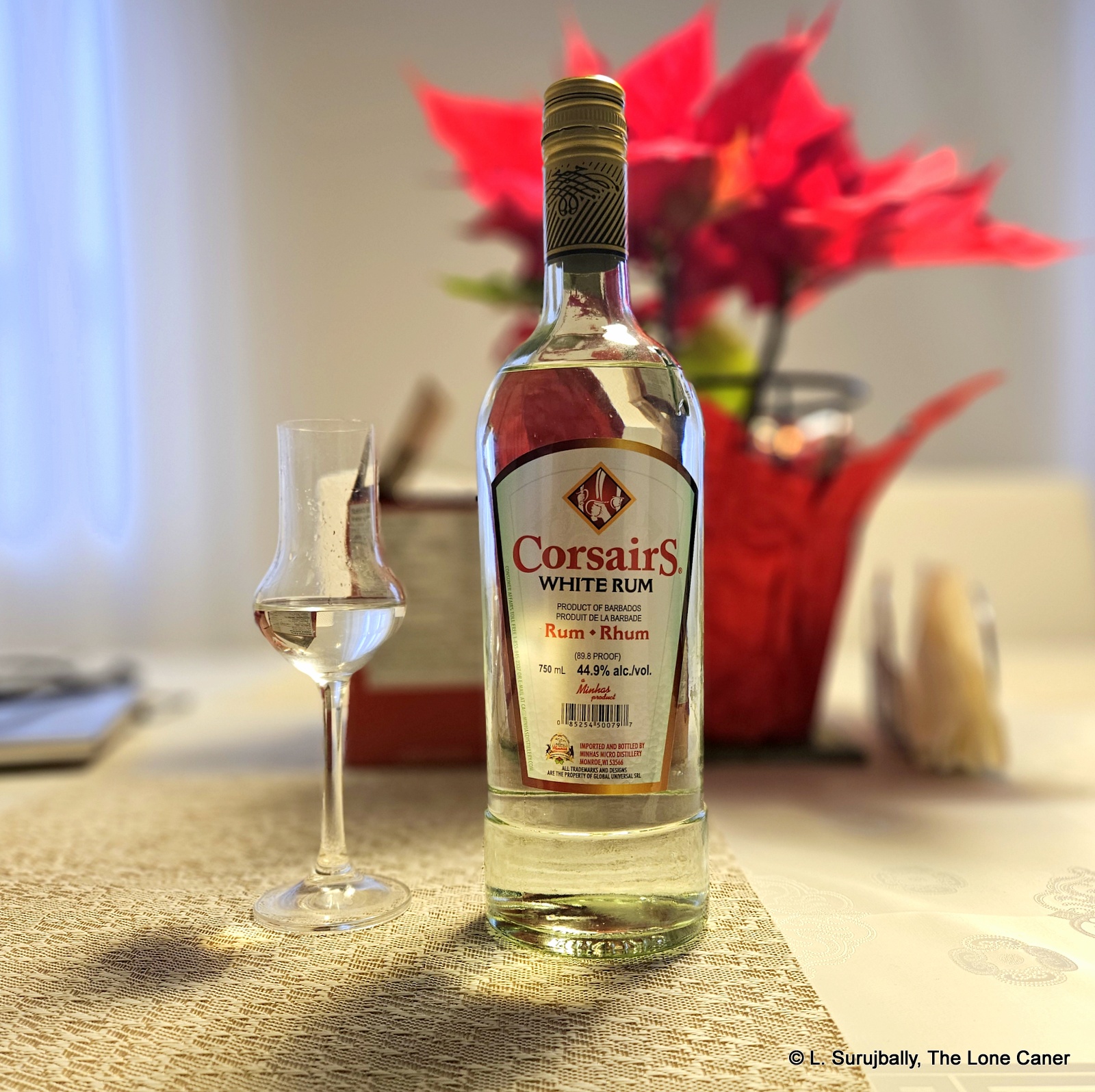
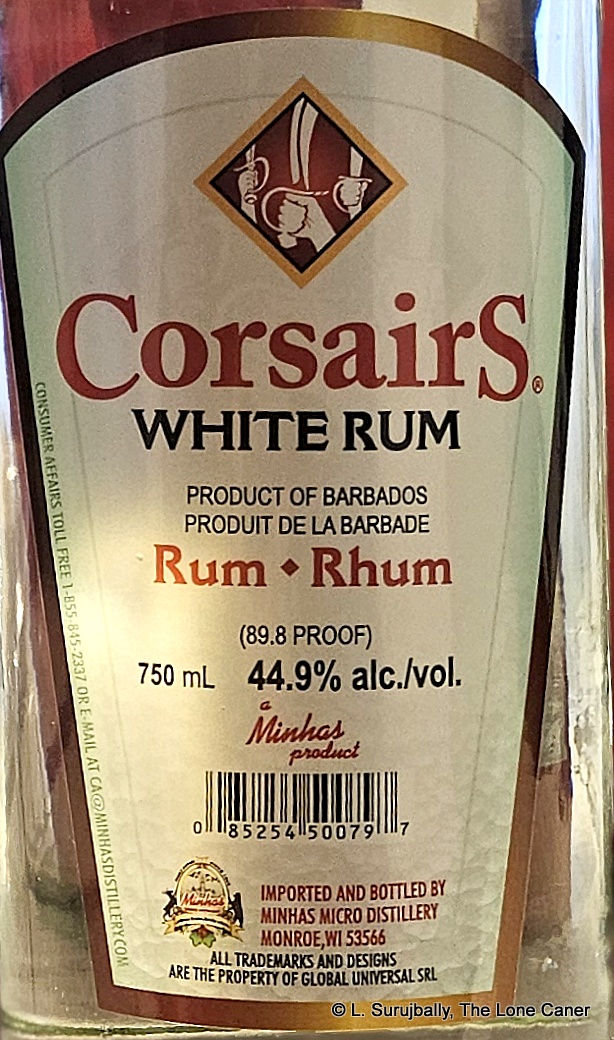
On the basis of the label, you could be forgiven for thinking this rum is something of a steal at under Can$25. Proof is rated at 44.9% – unusual for white rums in this country, so that’s good. “Product of Barbados” – nice, sure to excite interest. Clear white – intriguing. Is there hope for us here?

Nope.

This is where details and knowing what to look for, matter. What is the source of the distillate (juice or molasses – best not to assume)? Is it aged or unaged (not an unusual question even for whites), and if aged, how long, where, and in what? Which distillery on Barbados made it? On what kind of still? You see how this all adds up to even more questions, and no answers. We’re not actually given anything that matters, even on the company website, and for sure not on the bottle.

Let me save you some trouble: this information is not publicly available. And it’s entirely possible that it’s a matter of indifference, intentional oversight and/or wilful ignorance (“the masses will buy what we sell regardless”). Because the cynic in me can’t shake the belief that the production info is withheld so as not to draw attention to the fact that the rum is basically crap. 

No, really. The mediocrity so proudly displayed here is breathtaking. Consider a three hour tasting, summarized:

I always start with the nose, of course, but there there is hardly one of mention. There’s some sweetness, lots of ethanol fumes, a fart of icing-sugar-dusted pastry, and more paint stripper and plastic than can possibly be healthy. And all of it is contained an mishmash of melded aromas that clash and bite at each other so incessantly that it defeats even a schnozz as agile as my own. 

Oh and it doesn’t stop there. Tasting it makes me wonder why they didn’t just bottle pure ethanol and dilute it down to the required strength, because there’s so little on display, that it involves doing nothing, feeling nothing, on the way to nowhere. If it tastes of anything, it’s of vanilla, water mixed with white sugar, alcohol and….well, that’s it. No spices, no fruits, no flowers, pastries, cardboard, wood, nothing. By the time I got to this point I would have been happy with the gangrenous meat profile of a badly made TECA mixed with a lethal dose of paint thinner, but…there was nada. Nichevo. Rien. Nichts. 

And a finish? [Insert snort of derision] What finish? Oh you mean the one where some scrawny ethanol note coats the back of your throat like a swamp miasma and stays there pretending to be something? Yeah, there’s that, I suppose. 

On the basis of my tasting and testing and some little bit of experience, I can say it’s probably from WIRD – Mount Gay distillate would be more expensive, St. Nicks is too small and doesn’t do bulk, and Richard Seale of Foursquare told me he refused to sell to Minhas because the price they offered was too low. My real fear is that it’s only part Barbados, and judiciously mixed in with some neutral spirit from the Wisconsin distillery Minhas owns. No way to know, really. Also, it’s probably a column still product, and aged very lightly, and then filtered like a boss, which I think is a reasonable conclusion given its blandness – everything resembling character has been stripped away. I can only shake my head.

Rums like this make me despair, for, what hope is there when products so bland can be made, and, worse, be bought? Hebrews 11:1 talks about faith being “the substance of things hoped for, the evidence of things not seen”. This travesty has neither the substance to excite faith (let alone hope), nor evidence of anything except the desire to make money. The Corsairs white rum belongs to that subclass of cheap tipple which, if you have the slightest interest in drinking decent liquor, should be left where it is, or, in a just world, be poured down the drain.

(#1110)(60/100)


Other notes


Opinion

This rum is a poster child for why I regard many white rums that dot the rum landscape (and not just in Canada) with such disdain. Look no further than rums like Highwood’s Aged White Caribbean, their Momento Rum, Bayou’s white, the Merchant Shipping Co White, Minhas / Co-Op’s Caribbean White Rum, or, this one. They are all made with such indifference, such cynicism. They makes Bacardi Superior seem like a positively top-of-the-line white in comparison.

Now before you call me an elitist snob who drinks nothing but high end expensive rums, has no truck with the average rummie and who has no handle on the pulse of the budget-conscious working-class proles out there, let me explain. Such rums are, yes, dirt cheap; and they give you the alcohol shot which you can chuck into your mix and reliably get hammered – that’s part of their schtick and selling point. The argument is always made that “we make what sells” but think about it – if you sell only what you make, well, then, of course that’s what’s going to sell…the consumer has no real choice. Anyway, I argue that it’s a race to the bottom that serves no useful purpose even if all you want to do is get loaded on a slim or nonexistent budget (and on occasion, I do so myself, trust me, so yeah, I get it). If that’s all you’re after, why even bother? – getting an even cheaper vodka works just as well.

The problem with these anonymous, androgynous, monotonous and tedious taste-lacking cocktail fodders is that to all intents and purposes they are faux-vodkas — so what’s the point of sullying the reputation of a drink that has such incredible variety and taste profiles with something so indifferent? Especially when you have companies like Carroll’s or Romero out there, who are bending over backward to make decent and unique products, but remain all but unknown. 

Moreover, if this is all we can afford – whether we are young and near destitute students or minimum wage worker bees struggling to make rent – well, then our entire conception of what rum is, is damaged and sullied by such stuff, and we turn away, shift to vodkas or spiced rums or whiskies, and never learn until much later that there is an amazing cornucopia of experiences out there which we have denied ourselves. 

So, I’m just sayin’…. There’s better out there, white or brown.  Go out there and look for it and leave this embarrassment on the shelf to gather dust and traumatize innocent itinerant reviewers, who have to try it so you don’t have to.


Company Bio (from R-0984)

Minhas is a medium-sized liquor conglomerate based on Calgary, and was founded in 1999 by Manjit Minhas and her brother Ravinder. She was 19 at the time, trained in the oil and gas industry as an engineer and had to sell her car to raise finance to buy the brewery, as they were turned down by traditional sources of capital (apparently their father, who since 1993 had run a chain of liquor stores across Alberta, would not or could not provide financing). 

The initial purchase was the distillery and brewery in Wisconsin, and the company was first called Mountain Crest Liquors Inc. Its stated mission was to “create recipes and market high quality premium liquor and sell them at a discounted price in Alberta.” This enterprise proved so successful that a brewery in Calgary was bought in 2002 and currently the company consists of the Minhas Micro Brewery in Calgary (it now has distillation apparatus as well), and the brewery, distillery and winery in Wisconsin.

What is key about the company is that they are a full service provider. They have some ninety different brands of beers, spirits, liqueurs and wines, and the company produces brands such as Boxer’s beers, Punjabi rye whiskey, Polo Club Gin, and also does tequila, cider, hard lemonades. More importantly for this review, Minhas acts as a producer of private labels for Canadian and US chains as diverse as “Costco, Trader Joe’s, Walgreens, Aldi’s, Tesco/Fresh & Easy, Kum & Go, Superstore/Loblaws, Liquor Depot/Liquor Barn” (from their website). As a bespoke maker of liquors for third parties, Minhas caters to the middle and low end of the spirits market, and beer remains one of their top sellers, with sales across Canada, most of the USA, and around the world. So far, they have yet to break into the premium market for rums.

Jan 172025
 

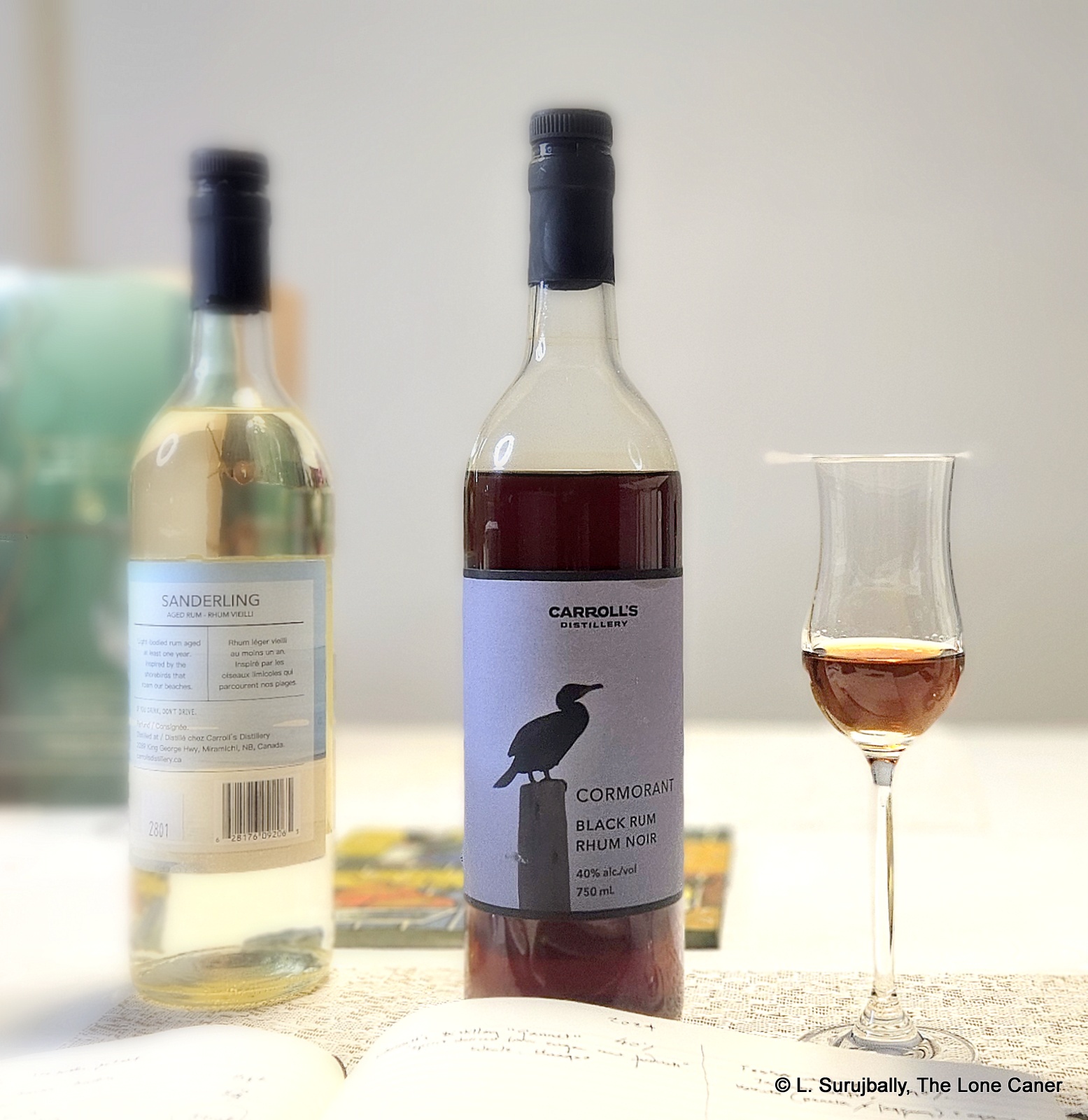
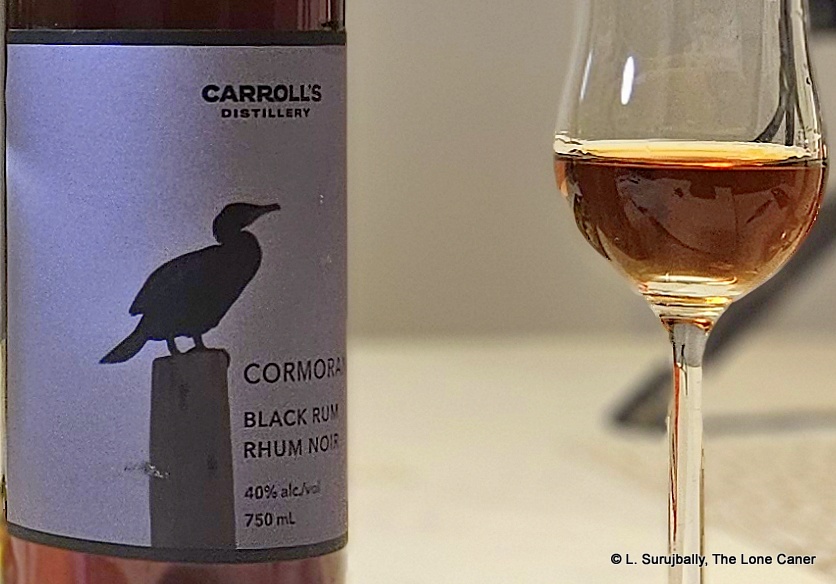
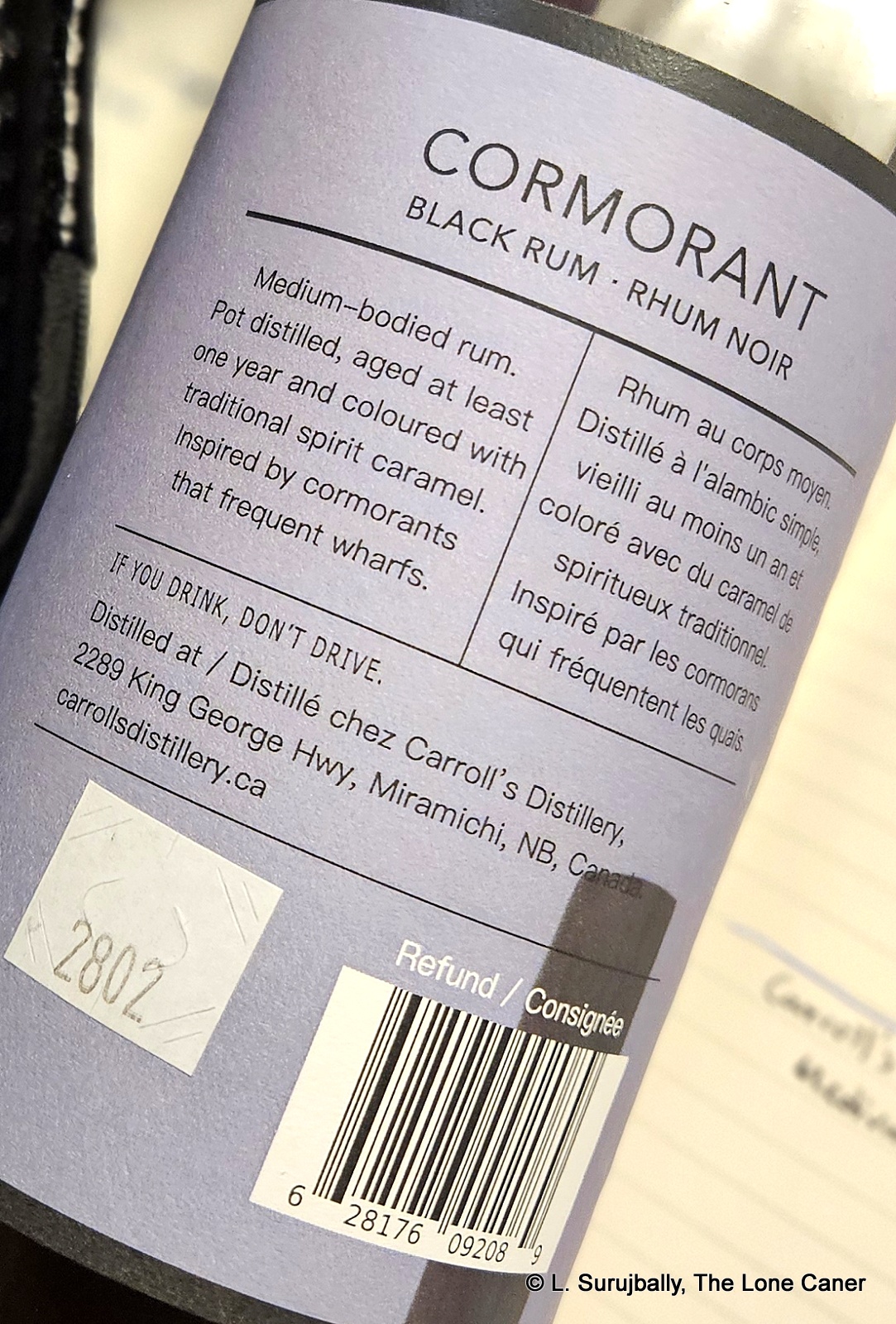
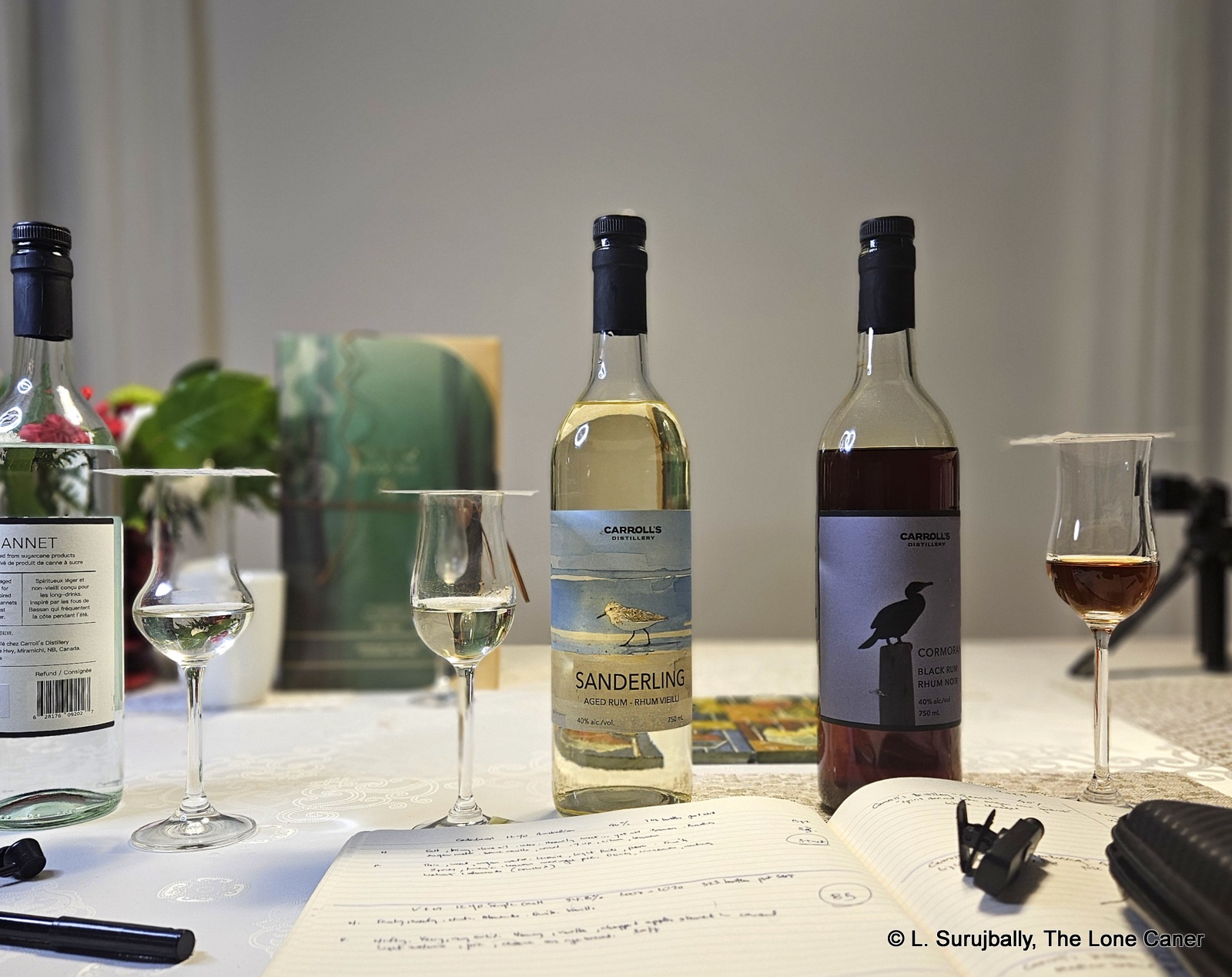
Today we conclude our quick run through of the rums made by Carroll’s Distillery in New Brunswick, by addressing the “Cormorant” “black” rum. For all that it implies, it’s a medium bodied rum, more dark brown than black, from a pot still, slightly more aged than those rums we have looked at so far, and costing a shade more (Can$36). And while it started out generating indifference, I did warm up to it over time.

As before, Carroll’s uses Crosby Fancy  molasses, and a seven day fermentation, after which the wash is run twice through the the pot still, and the resulting distillate aged for a minimum of one year in 200L ex bourbon casks. Caramel colouring is added to darken the colour and add a little extra oomph to the profile. The blend can vary – a current batch in 2024, for example, was made up of half 2YO and half 20 month old rum stocks. 

Dark (or as this one is called, “black”) rums are a mixing agent called for by many cocktail recipes, and because his distillery is a new one and this juice is consequently very young, Matthieu Carroll, the owner, doesn’t really have much choice: a cocktail ingredient is what he’s making with the stocks he’s managed to age. That the rum is as decent as it is, is a rebuke to all those Canadian distilleries out there who actively seek the milquetoast, tasteless low ground in an effort to chase the mass market.

Because look at what he’s managed to accomplish here: now the nose starts kind of weak, true, with cola, citrus, and caramel, plus a few hints of vanilla and brown sugar thrown in. Easy to smell, very traditional stuff. It also presents a few heavy fleshy fruits, quite ripe, and a touch of baking spices, hard to make out, and if I was to summarize the nose it would be to say it smells like a rum and coke in a bottle, minus the citrus. 

The palate is where there is initially unimpressive. It’s not that the mouthfeel is bad, or that it’s too indistinct, or too weak – although there’s some truth to that, because it starts out that way.  When one starts sipping to check it out, there’s seems to be rather little to become enthusiastic about. It has some brine, faint bitter chocolate (very faint), some sweet, a few fruits – peaches, apricots, overripe red apples, red grapes – and it’s all gone almost immediately, poof, before one has time to come properly to grips with it. 

Yet as it stands, it develops more legs than it started with, and to me that’s what makes it worth trying. The nose develops and becomes a bit richer, the cinnamon and cola meld better and the fruits become slightly more distinct; molasses, coffee and the bite of citrus also emerge a bit more assertively on the palate; and the finish, while staying the same, lasts a decent amount of time and is tasty as all get out. It reminds me of some of the younger Demerara rums DDL has, if not quite as pungent.

Admittedly, the rum is living room strength and there’s only so much you can squeeze out of such a product. And yep, I had the peace of a weekend and the time to be able to come to grips with it, which is very different from the busy, conversation-filled social situations in which many will try it (and most won’t care anyway – into the mix it goes, without any ceremony, as a rule, and to hell with the snooty reviewers’ tasting notes). 

So in a way, it’s a pity that the distribution is so limited, and the output of this micro distillery is (in relative terms) so small – unless ordered in-country (as I did), most people will likely never buy it, or care enough to bother. Yet I maintain that this under-the-radar rum is worth a look — it’s a smidgen better than it seems, and deserves perhaps a few more minutes of one’s time to appreciate to the fullest. So many rums entice you to buy them on the basis of a cool label, a famed distillery, or by maxing the mojo: torqued up strength, puissant congener counts, geriatric ageing, that kind of thing. Here we have a label that has nothing to do with rum and is simply art, from an almost unknown distillery that sports no in-your-face big stats. At first blush the “Cormorant” doesn’t seem to be all that special, but I think that if left to its own devices and allowed to open up, it does give a pretty good account of itself. 

(#1108)(84/100) ⭐⭐⭐½


Other notes

  • Video Recap is here
  • The distillery does sell (and mail) rums on its website and for those who want to dip their toes in before going the whole hog, there are small 200ml bottles of each expression available for under ten bucks, which are godsends to penurious reviewers and which I wish more producers could issue.
  • The artwork on the label was a lightly edited photograph, used with permission.
Jan 132025
 

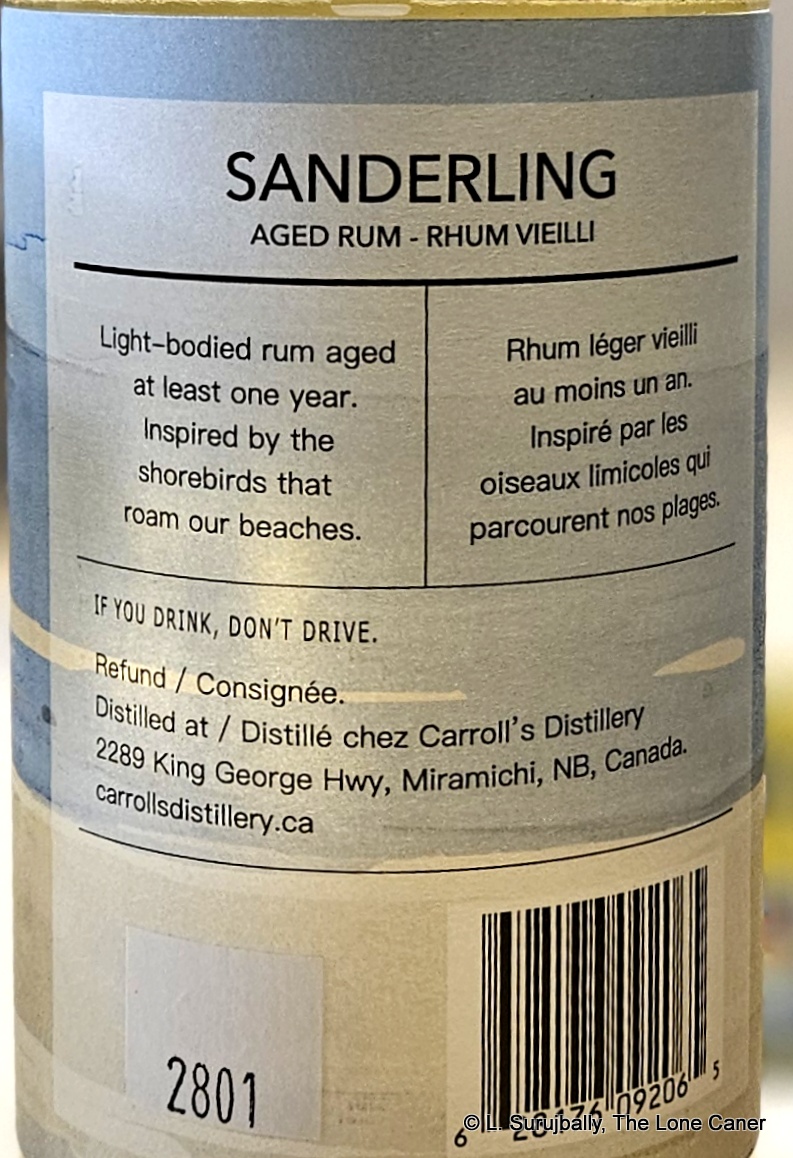
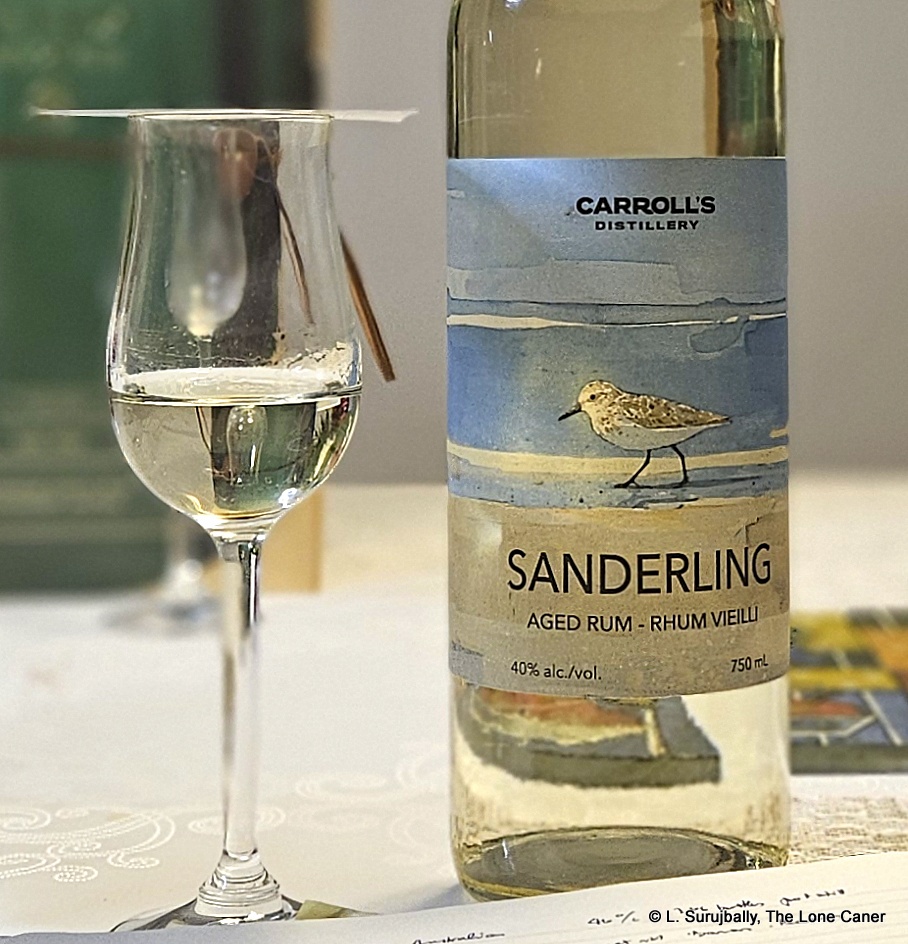
Today we continue our quick run through of another of the rums from Carroll’s Distillery in New Brunswick, by addressing the “Sanderling” lightly aged rum. This rum, now called “Sandpiper” on the website, thought it’s the same rum, essentially shares the production profile of the unaged white rum “Gannet” which we looked at before.

Using Crosby Fancy (or high grade) molasses, and a seven day fermentation, the wash is run through the the pot still, and then a second time on the smaller a reflux still with eight rectification plates, which produces a distillate anywhere between 75-93% ABV. This results in a light distillate, aged for a minimum of one year in ex bourbon casks. As a point of note, each batch of the Sanderling / Sandpiper is from a single barrel. 

The “light” in the descriptor above is well chosen: those looking here for Caroni, Longpond or wooden still action had best seek elsewhere, because this isn’t it.  Yet in no way is this a fail, because the initial nose is quite pleasant: baking spices, some light sour notes of pickled cabbage, kimchi, overripe fruit, a sort of easy going funkiness if you will. Again, there sure seems to be some ester influence in this one, and that promising beginning is followed up by burnt toast, vanilla, sweet bell peppers, licorice (is this becoming signature scent for Carroll’s? One wonders, precious….). The elements make themselves felt a tad more firmly than the white, because honestly, at first nosing it’s nicely pungent.

There is, however, more of a dropoff when one tastes it. Partly this is the standard strength, partly it’s the youth. The barrel has certainly done its part to tamp things down, of course, and the fortunate thing is that at least it’s not giving you a bitchy scratch on tongue or tonsils. Initial flavours are gently sweet, light and floral, with candy floss and watery sliced pears. With some effort one can tease out watermelon, vanilla and there’s just a hint of tartness – unsweetened yoghurt, laban, a sort of diluted pineapple juice from a tin. And the finish is rather short and thin, repeating a few of the above notes but hardly leaving a mark on either mind or memory.

Basically, here’s a rum where the overall the profile presents as “nice” without being “exceptional”. The palate sinks after the interesting nose subsides — the flavours are there, yes, but don’t pop: they are delicate rather than assertive, and too much time is spent teasing them out. That said, in comparison with some other stuff I’ve seen indifferently tossed off by Canadian distillers, it’s a cut above for sure. And that’s because it takes some of the lesser points of its white predecessor and improves on them, while not entirely succeeding at the ones we’d want in a lightly aged product where (minimally) higher expectations apply.

That may be my own failing though, rather than some intrinsic weakness of the rum itself – and the rum is good for what it is, to mix. Yet, curiously and encouragingly, the Sanderling demonstrates something I’ve always maintained real hope truly is: it’s not only and just about relationships and desire, but a positive feeling of life’s amazing possibilities. Here, the possibilities remain discernible, tantalizingly sensed — just out on the horizon for now.

(#1108)(83/100) ⭐⭐⭐½


Other notes

  • Video Recap is here. 
  • The distillery does sell (and mail) rums on its website and for those who want to dip their toes in before going the whole hog, there are small 200ml bottles of each expression available for under ten bucks, which are godsends to penurious reviewers and which I wish more producers could issue.
  • The artwork on the label was produced by David Sheirer, an artist from Maryland in the US, who did this on commission
Jan 112025
 

Well, here we are again, continuing with the lineup of the Carroll’s Distillery rums, which I bought all at once some six months or so ago. The next reviews will all be about this one outfit’s stable, so I’ll push them out fast.

Now, if you recall, this is a small New Brunswick-based micro distillery owned by Matthieu Carroll, and he founded it as a sort of hobby project back in 2016, got serious in 2018, then sourced a 500L hybrid pot still and registered it as a commercial distillery in 2019 — he went full bore into retail a year later. Even within Canada it is not very well known, probably because it sells mostly in its region (the Maritimes out east) and reviews remain as thin on the ground as a sense of irony in Toronto.

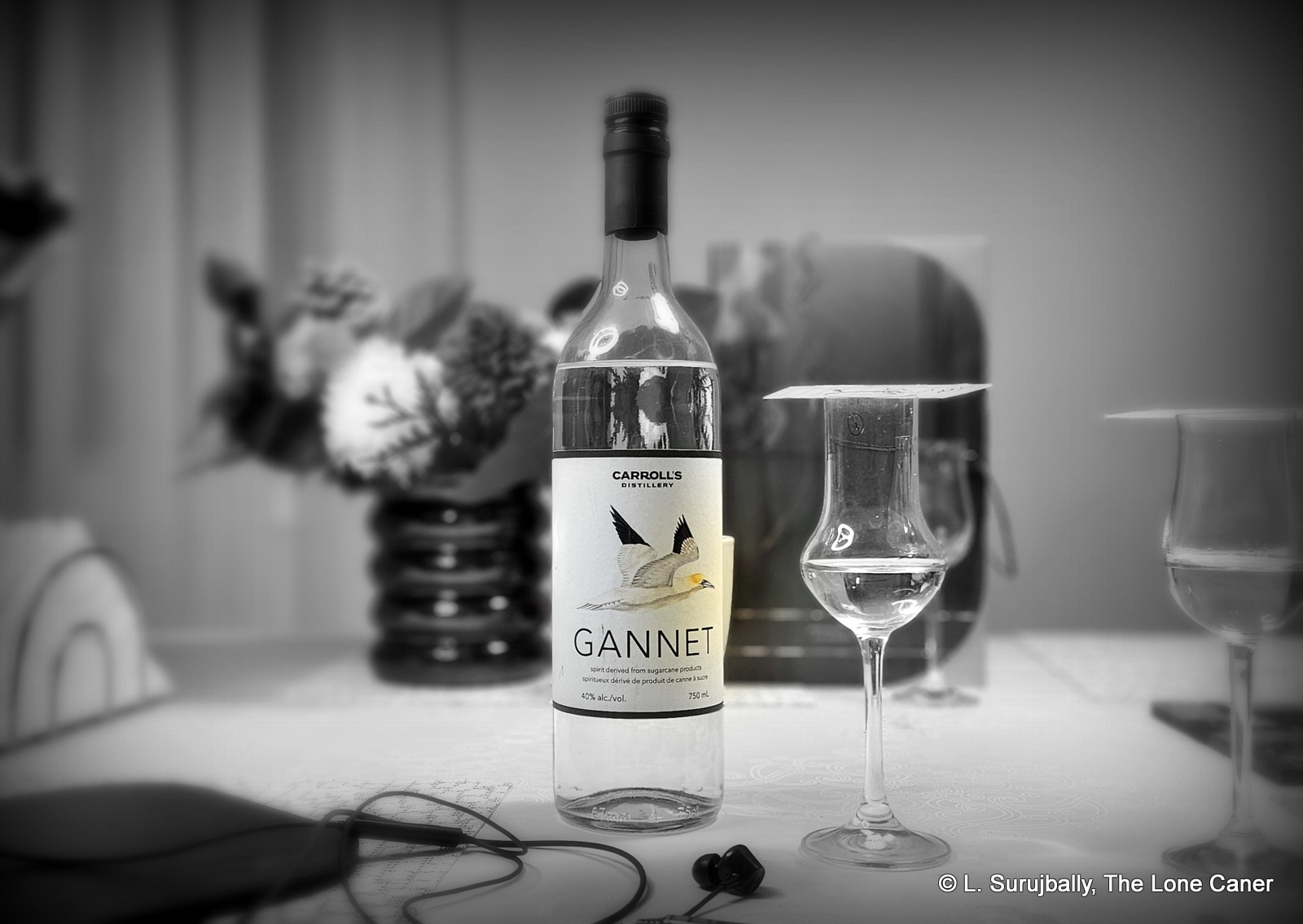
Anyway, so far, we have only looked at the RHE High Ester white, which may be unique in the Canadian rumscape by being both a high ester badass, and a gallumping 65% overproof that makes sphincters clench just by inhaling it. The rum we’re looking at today is another white, much tamer, though it isn’t called a rum – it’s referred to as a “spirit derived from sugarcane products” since Canada also has an archaic rum rule similar to the one that plagues the Australians – one year’s ageing in oak is the minimum requirement to be called a rum, and this one remains unaged.

Using Crosby Fancy (or high grade) molasses, and a seven day fermentation, the wash is run through the the pot still, and then a second time on the smaller a reflux still with eight rectification plates, which produces a distillate anywhere between 75-93% ABV. Although in the beginning the white rum used almost neutral spirit from the reflux as a component, nowadays that’s no longer made and the rum is mostly comprised of an output from the second still that’s configured to leave in more flavour compounds rather than strip them away. There’s no ageing, and it is diluted down to a more approachable 40% living room strength.


Well, that’s kind of a lot to be reading when all you want is tasting notes, so let’s dive in.  Nose first. At 40% it’s very easy to inhale, with minimal sharpness or bite – it smells, at first blush, of vanilla, sugar water, some licorice, salt, sweetish sauerkraut, pineapple, pears, green apples, and some fruits starting to go off. It’s likely that there’s some of the RHE in here (the rum is a blend), because those crisp, tart, and sweetish elements point to a higher than usual congener content. If not, it’s actually a pretty nifty aroma, I think.

It’s unsurprising that the taste falls off somewhat from there. Some of what is smelled comes over when one sips it, but 40% is what it is, and this is why I’m tasting it first thing in the morning, when all senses are screaming for input. The mouthfeel is thin, thought it remains reasonably soft, and much of the tartly sour crispness of the nose is AWOL here. That said, one can sense overripe pineapples, spearmint gum, a spicy vegetable soup, sugar water and a briny note that channels some red Moroccan olives. With some concentration, perhaps bananas and very ripe, sweet peaches, leading to a short, easy, light finish that’s mostly sugar water and freshly sliced cucumbers, pears, and maybe a flirt of red licorice.

So on balance, what do I think?  Well, I believe it’s something of a poor man’s ester-intro, for starters – lighter and easier and more approachable than the raging codpiece of the RHE. Moreover, it scores about the same, maybe a smidgen less, because it isn’t as feral a product (which is a double edged sword, admittedly) and the overwhelming red licorice tastes have been muted and dialled down into a rum that’s much more balanced. On the other hand, it remains a bit too weak for my personal tastes (your mileage will, of course, vary).

For Canadians, or anyone else who can find it or buy it, it’s a rum well worth getting — not just because it’s really quite affordable (and it is – I mean, Can$25?? — that’s not bad at all), but because it shows that the anonymous white dronish nonsense masquerading as rum which far too many supermarket shelves carry with such innocently ignorant pride, is not the only thing we make around here. If we can start to filter out the graceless bland dreck that we buy far too often, and patronise not just better rums but local distilleries, then there is real hope for the Canadian rum industry. This rum is one of those that shows the potential.

(#1107)(83/100) ⭐⭐⭐


Other notes

  • Video Recap is here. 
  • The distillery does sell (and mail) rums on its website and for those who want to dip their toes in before going the whole hog, there are small 200ml bottles of each expression available for under ten bucks, which are godsends to penurious reviewers and which I wish more producers could issue.
  • The name “Gannet” for the rum and the bird shown on the label refers to the Northern Gannet, and was chosen by Matthieu because of its association (for him) with the beach and summertime in the Maritimes, which is what he feels is the best time to imbibe this rum.
  • The artwork was produced by Liz Clayton Fuller, an artist from Nashville Tennessee, on commission.
  • My friend Reuben out of Toronto reviewed an earlier version of the rum back in 2021
Jan 092025
 

“Teeda” is a Japanese word meaning “sunshine”, which is a nice name considering that the distillery in Japan that makes it is called “Helios”.  We have looked at several of Helios’s rums before this – the unaged Kiyomi white, the blended gold rum, the 5YO rum, and of course the pricey but very good 21 YO I just did a video review for last week. It is unusual that they have nothing in the midrange between 6 and 20 years of age, like most other distillers, but maybe they’re just laying down stocks, and the 21YO was something of an outlier.

The Okinawan Helios Distillery has been in the business since 1961 – it is supposedly the oldest such distillery in the country. Then, it was called Taiyou, and made cheap rum blends from sugar cane, both to sell to the occupying American forces, and to save rice for food and sake production. They are probably better known in Japan for their awamoris, shochus and beers, but for our purposes, it’s the rums that excite attention.

This one is a white issued at 40%, and is made from condensed sugar cane juice (the label refers to it as kokuto, or unrefined sugar, which is akin to panela in Mexico, or jaggery in India) – this is also used to make shochus in Japan 1, and it’s hardly surprising that Okinawans would also use it to make this distilled spirit. It’s run through a pot still and aged a little, although I can’t find any indication how long – let’s assume about a year for now, and you’ll permit me a private muttering grumble about how I still have to trawl around too much for this rather minimal information.

That out of the way, let’s get right to it. The nose is all dusty paper, cardboard, peeling wallpaper, with a strong scent of rotting potatoes after you peel them. This is not entirely bad, but one has to admit, it’s unusual. Fortunately, there’s also vegetable soup with extra beef broth and a pimento or two, which then gradually dissolves into scents of sweet soya sauce and figs, dates and fleshy fruits. This is all then balanced off with some citrus that cuts the strong scents that precede it.  It is quite a lively nose for something at living room strength…though it must be said, this sucker will take some getting used to.

Tasting it makes for a better experience, much better – the rum turns a little sweet, with fewer potatoes (although the scent and taste persist). Again, you can taste sweet soya, vanilla, smoke, celery, prunes, figs and some lemongrass-infused soup, and yes, that pimento is still there.  It all leads to a comfortable finish which sums things up with some soup, salt, celery and prunes, not a lot else.  

I can’t entirely rid myself of the feeling that the tum (like the 21YO) used some koji mould to start the fermentation, as well as yeast. There’s a meatiness in some Japanese rums (my traumatic encounter with Seven Seas attests to the peculiarity of the profile) which points in this direction, and while the overall quality can’t be denied, it is something of a connoisseur’s rum – and I mean that not to be snobby, but to illustrate that if you have had a ton of rums and are looking for something unique, this one comes close. 

But if you’re only now starting out, then it’s probably best to skip it for now.  Because that nose and taste, so peculiar and unique, those are simultaneously sleek and buggy in the details, like a software update rushed out too quick. In short, be careful with it.

(#1106)(81/100) ⭐⭐⭐


Other notes

Jan 022025
 

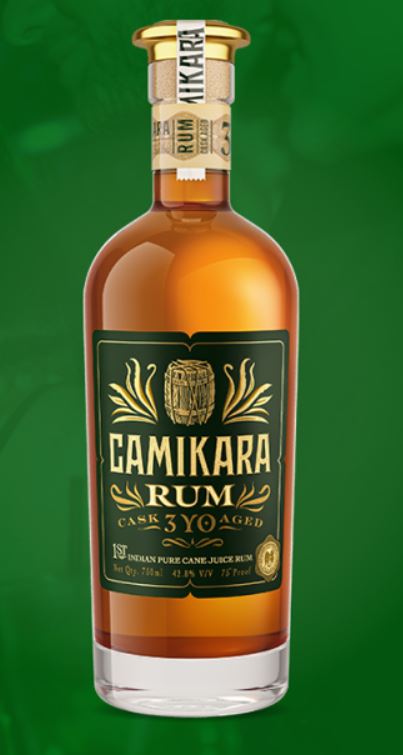
Today I’ll dispense with the third rum in the Camikara line of rums from the Indian company of Piccadily Distillers (their true name is Piccadily Agro Industries Ltd), who also make the very good 12YO, and a rather more middling 8YO that I was less than enthusiastic about. These are all rums that are of relatively recent conception, with the line first introduced in December 2022 (in a splashy extravaganza at the Hyatt Regency in Haryana that gave the Tasting of the Century Hampden launch in 2018 a run for its money), utilizing stocks that had been laid down for the company’s blended rums.

Camikara entered the premium rum space after seeing the potential of premium whiskies (their Indri and Whistler brands had been on the drawing board for far longer, and were launched in the early 2020s), and sought to leverage their license to make alcohol from cane juice into a rum from that source, a first in India at the time. The wash is double distilled using large pot stills in their main facility in Haryana (in the Punjab), and the final distillate aged in ex-bourbon barrels for the requisite period (the production process is covered in more detail in the 8YO review).

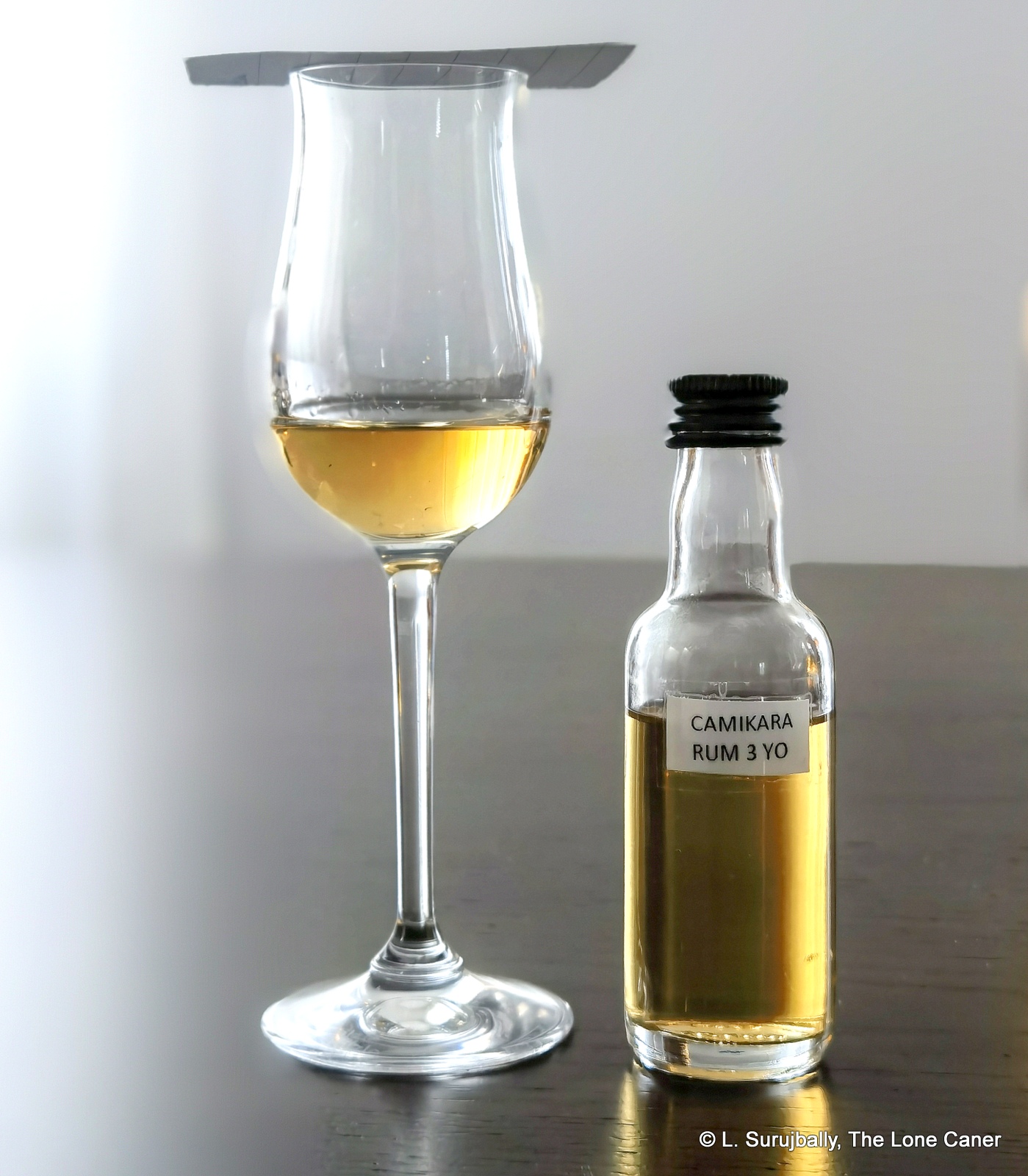
The 3YO is made the same way as the other two older rums in the portfolio, issued at 42.8%, and one expects that for a rum this young, the cane juice nature of the distillate would be quite evident, in a way that the ageing has taken out of the older bottlings which are somewhat more barrel-influenced. Certainly the nose suggests this, because it is quite pungent at first nosing – very tawny, and almost sharp to smell. It noses of sweet grain cereals (think honey nut Cheerios), honey, brine, and is quite astringent, almost sharp. There’s also some of the youth evident here – turpentine, fresh paint, both fortunately mild. Yet at the same time it feels raw and a little uncouth, with few of the herbaceous grassy notes I would expect to at least get a hint of. There are some scents of melons and papaya, cardamom and vanilla, yes — but one has to strain too hard to get any of that

And if the nose was indeterminate, the palate is a disappointment through and through, and goes downhill from there. Thin and flat is the best I can express it, with a scratchy mouthfeel. The tastes are there if one really concentrates, but even the 8YO’s profile exceeds it — and that was no great shakes as you may recall. Some cumin, rice pudding, vanilla, cardamom and brown sugar, a touch of leather and smoky red paprika, but really, haven’t we seen all this before, done better? The finish does the rum no favours either, and just sort of trickles away like a Cheshire Cat’s grin, leaving noting behind but vague memories and the feeling of a target aimed at, and missed.

In fine, even for a three year old there’s just too little here to excite the senses or tickle the tonsils, and it underwhelms at best. I’m sure it was released as a mixing rum and therefore expectations should be tempered with that in mind, yet as the New Brits and Australians have shown us, young rums can be made well, and need not take the low road this one careens down.

(#1105)(75/100) ⭐⭐½


Other notes

  • Video Recap is here. 
  • Because the rum is a consistent and ongoing blend, it lacks a year of distillation and bottling.
  • Once again, my deepest appreciation to Nikkhil of WhiskyFlu for the sample. 

Company Bio (from R-1104)

The company that ended up calling itself Piccadilly had its origins in 1953 when the founder , Mr. K.N. Sharma began a liquor distribution company called Kedar Nath & Sons in Doraha in the Punjab in the Nort West of India. The company expanded rapidly – it was formally registered nin 1967, by which time it had a near monopoly on all liquor contracts in the state. Further growth occurred with the establishment of a restaurant and bar (the “Picadili”) in the late 1960s, movie theatres in 1972, and a Piccadily Hotel in 1975, which led to further investments in the hospitality business in other cities in the Punjab and Himachal Pradesh in the 1970s and 1980s. In 1993 the company expanded yet again with the purchase of a sugar mill and distillery in Patiala, and a second one in Haryana a year later, making it a full fledged alcohol producer. 

Although rum had been made in one form or another for centuries in India, all of it came from molasses or from jaggery – the company decided to buck the trend by getting a license to make alcohol from sugar cane juice in 2008 and by 2009 had started production of alcohol from this source. I have no records that say what their brand was at this time – maybe they just made neutral alcohol to mix into their locally sold whiskies (a common practise) In 2010, however, they commissioned a third distillery specifically to make premium whisky, rather than the bulk malt they had been making up to this point for supply to other liquor manufacturers all over the country. This new distillery opened in 2012, which, more than a decade later, has made Piccadily the largest independent malt manufacturer and seller of malt spirits in India, producing three brands and four million liters annually. Today, as well as across India, it sells to Europe and the United States, and has invested in a project in Scotland, where it also intends to build a distillery.

The 2020s was where it all finally came together, with the Whistler and Indi brands launching in 2020 and 2021 respectively, and Camikara being introduced in 2022, all with an international focus. The Camikara trio have won several medals in spirits competitions like the ISWC and Rum and Cachaca Masters since then, most recently 2024.

The family has also become a very powerful one, with the second generation involved in commercial and political activities (not always positively) – however, since this is outside the scope of the review, I will pass on it for now.

Dec 312024
 

Camikara (“Liquid Gold” in Sanskrit) is a brand of rum from the Indian company of Piccadily Distillers (their true name is Piccadily Agro Industries Ltd), who are better known for their whiskies until a year or two ago, when they introduced the very interesting 12YO cane juice rum we’ve looked at before. That rum was a cane juice product (supposedly Piccadily are the only ones in India doing this), and had two younger siblings that were also cane juice based, a 3YO and and 8YO, the latter of which we are discussing today.

As with the 12YO, Piccadily Distillers made this rum in Haryana, a northern Indian state – it abuts the Punjab, and is just due south of Solan, where Mohan Meakin started things going back in the 1800s. Piccadily themselves are better known, especially in India, for their malt whiskies Indri and Whistler and one imagines they went into premium rum space after seeing the strides made in upscale whiskies and observing the lack of rum equivalents —  the increasing premiumisation of the spirit in the West suggests an opportunity to break into that market with an unusual product from a near-unknown location.

The cane is harvested and then crushed within two days, and the juice chucked into the fermenters with water and cultured yeast for 24-48 hours, resulting in a wash that’s about 7% ABV, which then gets run through the large pot stills (which are also used for whisky production). Initially there is a wash distillation that results in a first low-wines distillate of about 17%, which is then run through the spirit distillation with the heads and tails, that gives a final distillate of around 66% – it is this which is then set to age in ex-bourbon casks for the desired period. The final product is then blended from various ages (the age statement reflects the youngest part of the blend) and bottled at the Indian standard strength of 42.8%.

A rum it certainly is.  Whether succeeds is another question, because when nosing it, it presents as surprisingly mild. One can smell honey, peaches, acetones and nail polish remover, with additional notes of wax, vanilla and cardamom. It smells oddly and heavily sweet, which I find puzzling for a supposedly unadulterated rum that is made from juice – it lacks some of the crisp clarity of a French island agricole, even those that have been aged. There are some vague hints of citrus and raspberries, but overall, not a whole lot to write home about and put one the ‘must-have’ list

The palate continues in this vein. Although still tasting somewhat sweet, it’s less than the nose suggested it would be, and there’s a dry brininess here which is interesting.  Honey, syrup, overripe pineapples and ritten grapes, plus some vanilla, cinnamon and cardamom. That’s about all I can pick up even after a couple of hours — it presents as too simple for real appreciation and the quick finish is rather dry and sharp, which lessens the experience as well, though the mild fruitiness and citrus to help alleviate what would otherwise be a truly substandard rum.

Overall it’s a rum, just not one to get seriously excited about. I’m not sure whether this was made to be a poor man’s sipper or a more upscale mixer, but for my money it doesn’t really work as well as it should. One expects more from an eight year old rum, especially one matured in ex-bourbon barrels in a warm climate (which is bugled as a selling point). Overall it’s nowhere close to its 12 YO upscale sibling, and while pleasant enough, there’s an air of “good enough” about it that suggests the love was given to the older version and this one was made for the mass market’s lower expectations (and price point). Not one I’d buy if there were other options, and in comparison to true agricoles, well, unfortunately it’s not playing in the same ballpark yet.

(#1104)(80/100) ⭐⭐⭐


Other notes

  • Video Recap is here
  • Because the rum is a consistent and ongoing blend, it lacks a year of distillation and bottling.
  • My deepest appreciation to Nikkhil of WhiskyFlu for the sample.

Company Bio (summary)

The company that ended up calling itself Piccadilly had its origins in 1953 when the founder , Mr. K.N. Sharma began a liquor distribution company called Kedar Nath & Sons in Doraha in the Punjab in the Nort West of India. The company expanded rapidly – it was formally registered nin 1967, by which time it had a near monopoly on all liquor contracts in the state. Further growth occurred with the establishment of a restaurant and bar (the “Picadili”) in the late 1960s, movie theatres in 1972, and a Piccadily Hotel in 1975, which led to further investments in the hospitality business in other cities in the Punjab and Himachal Pradesh in the 1970s and 1980s. In 1993 the company expanded yet again with the purchase of a sugar mill and distillery in Patiala, and a second one in Haryana a year later, making it a full fledged alcohol producer. 

Although rum had been made in one form or another for centuries in India, all of it came from molasses or from jaggery – the company decided to buck the trend by getting a license to make alcohol from sugar cane juice in 2008 and by 2009 had started production of alcohol from this source. I have no records that say what their brand was at this time – maybe they just made neutral alcohol to mix into their locally sold whiskies (a common practise) In 2010, however, they commissioned a third distillery specifically to make premium whisky, rather than the bulk malt they had been making up to this point for supply to other liquor manufacturers all over the country. This new distillery opened in 2012, which, more than a decade later, has made Piccadily the largest independent malt manufacturer and seller of malt spirits in India, producing three brands and four million liters annually. Today, as well as across India, it sells to Europe and the United States, and has invested in a project in Scotland, where it also intends to build a distillery.

The 2020s was where it all finally came together, with the Whistler and Indi brands launching in 2020 and 2021 respectively, and Camikara being introduced in 2022, all with an international focus. The Camikara trio have won several medals in spirits competitions like the ISWC and Rum and Cachaca Masters since then, most recently 2024.

The family has also become a very powerful one, with the second generation involved in commercial and political activities (not always positively) – however, since this is outside the scope of the review, I will pass on it for now.

Dec 302024
 

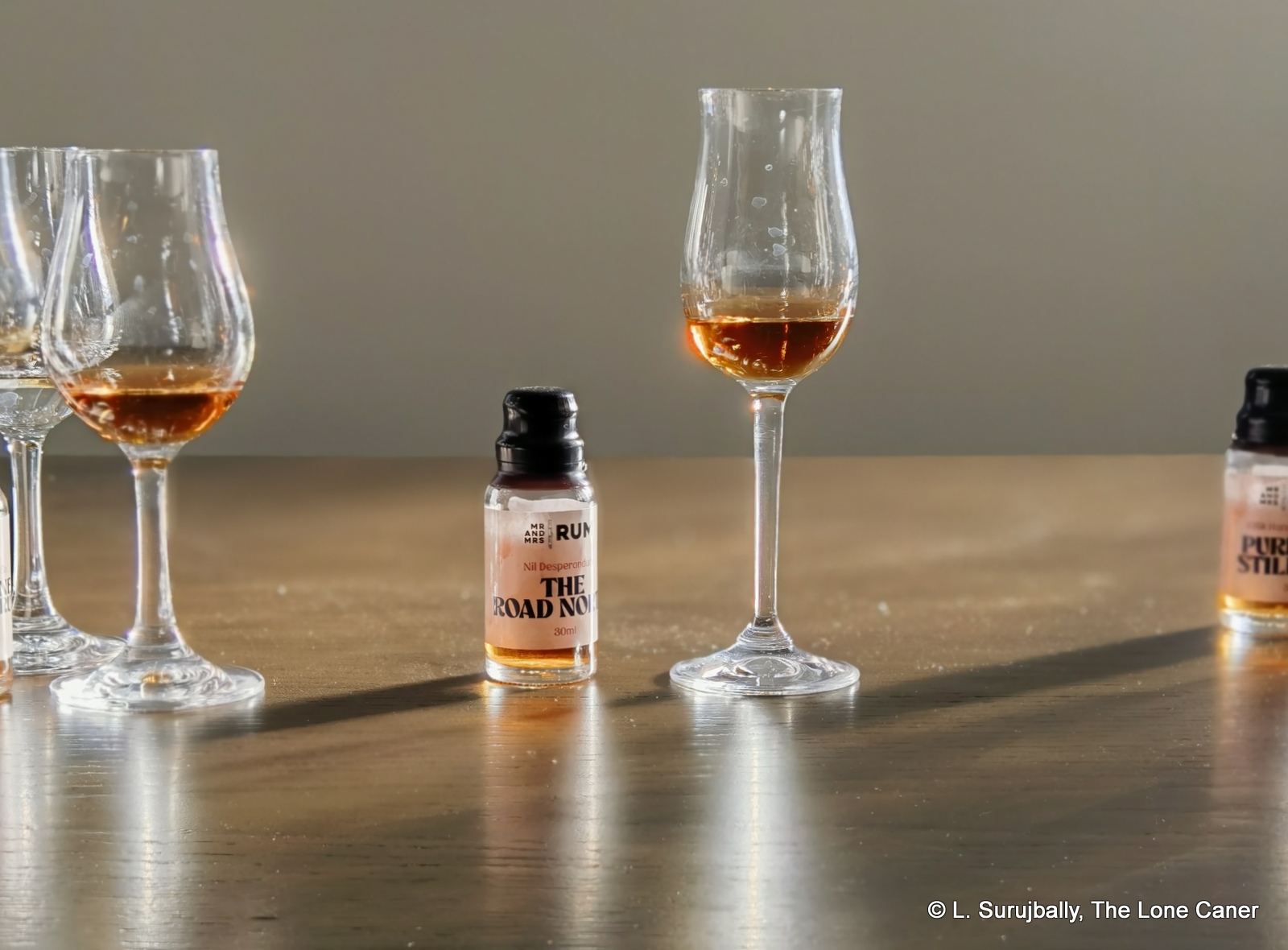
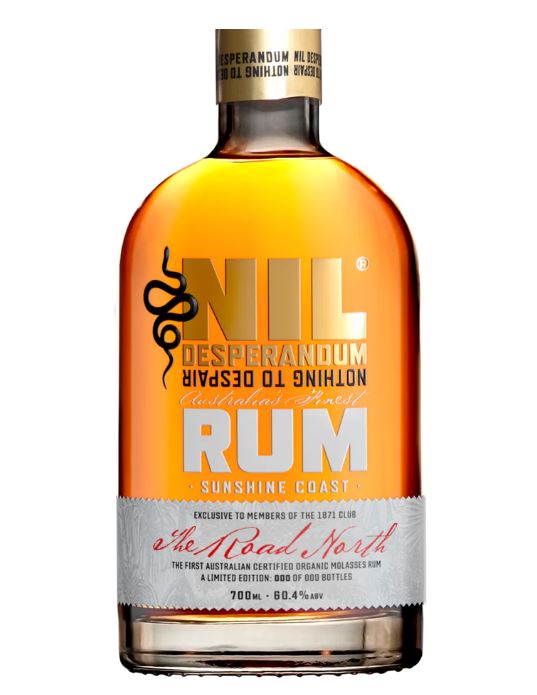
“Nil Desperandum” is a Latin phrase hearkening back to Horace’s Odes that channels some of my old classical studies back in the day – it means (literally) “Nothing to despair of” or “Do not despair” – or, in more colloquial terms, no worries, mate, which might just as easily be the entire country’s motto. It is, of course, the sign that was hung over the bar in the original pub of the same name in Woombye from which the company got its name, which is a nice bit of historical trivia.

Obscure humour and references aside, let’s just observe that Nil Desperandum is part of a parent company named CAVU Distilling Pty, who also have Sunshine & Sons and 4PM Spirits under their umbrella. CAVU — the term is an aeronautical one meaning Ceiling and Visibility Unlimited — was founded in 2019 just north of Brisbane with a pair of pot stills by Matt Hobson and Michael Conrad and is certified as an Organic Distillery. Further, they also provide third party concept to consumer brand creation, distilling and manufacturing. Sort of an all-in-one one-stop shop, so to speak.

The production process for “The Road North” is quite interesting: it comes from molasses sourced from three different certified organic farms in Bundaberg, to which some indigenous yeast was added, as well as dunder (the by-product from the first distillation run) and muck (dunder that has been aged in the rainforest). In the second batch that produced “The Road North” rum, fermentation was ten days, before double distillation in the two pot stills: Maria” a 6,000-litre wash still 2 and “Sarah” a 2500-litre spirit still 3; at that point it was decanted into two French oak barrels emptied of pinot noir and sherry, at 60.4%. To round out the matter, no sweeteners or colour were added, and only one barrel has been emptied – the other one is squirrelled away for another time – providing subsciption-based in-house “1871 club” members (and the advent calendar) with 131 bottles.

This is quite a wall of text, so let’s head straight into the tasting without further ado.

Nose first. It reeks of honey, white chocolates and almonds (and I mean that in a nice way), and behind that are some dusty book pages and old peeling wallpaper. This then develops into something more akin to a bakery: pastries, cheesecake and key lime pie, with notes of lemon zest to liven things up a bit. Everything else pretty much comes out of the woodwork at that point: sweet corn, a touch of caramel and vanilla, and even some rubber and plasticine, which, in a peculiar inversion, emerge after most of the nose has been snooted, not at the inception (which is more usually the case).

The palate is really quite good as well: smooth and warm in spite of the strength. Caramel, vanilla, cinnamon and cardamom continue to be the backbone here, with some hints of biscuits and wafers, white chocolate and crushed almonds again. Here, the fruits take something of a back seat and their presence is more muted, though we do sense stewed apples, red grapes, pears and very ripe mangoes, plus some warm bananas and toffee, sweet balsamic fig-infused vinegar, and even some cooking molasses and sherry. Finish lasts a good long time and sums up most of the preceding very nicely, with noting new to confuse the unwary. Fruits, pastries, zest and spices, pretty much.

Overall, this is quite a good, rough and ready rum, with surprisingly few rough edges (there are some – just not enough to derail the tasting in any way). I particularly like the way that the various flavours complement each other on both nose and palate, and there’s sufficient complexity married to power, to provide for a damned fine drinking experience. It’s comparable with Killik’s pure pot still rum, or Capricorn’s Dumpster Diver, yet stands clearly by itself.  

The only real issue I have with it is the price — AUS$250 on the website. That’s a lot, for something less than five years old (and indeed, the age is never mentioned, though if the distillery opened in 2019 and this is a 2023 edition…you can do the math). Even assuming an iso container can make its way over to where us proles live and economies of scale bring the price down, it remains a hefty price tag, and without a serious Name or brand behind it to lend some street cred, it is likely to sell slowly.

However, price aside, it is my considered opinion that this is one of those really good Aussie rums that everyone who can should try at least once, just to see how good Australian rums have become in such a short time.  One can only imagine what the industry will be like and what sort of quality we will experience, in another ten years.  Perhaps the 2024 advent calendar will help us find out, but for now, this is one rum that shouldn’t be missed, if it can be found, and afforded.

(#1103)(85/100) ⭐⭐⭐½


Other notes

  • Video Recap is here. 
  • From Day 24 of the 2023 Australian Advent Calendar 
  • I particularly like the insouciant naming of the special bottlings in which Nil Desperandum indulges itself: names like 44 Special, Double Dunder, Double Ton, The Fat ladies, First Four, Pineapple Train, The Muck Redux, The Wild Muck and Roasted Cane (among others) always make me smile.
Dec 202024
 

Once again we are visiting India, to look at a rum made by the world-famous whisky producer, Amrut Distillers. The story of this remarkable company has been told already so I won’t rehash it here — but it behooves us to note that for all the ballyhoo about its whiskies (for which it is mostly and justly famed), Amrut has been making rums for far longer, dating back to its initial  establishment in 1948. Also, in a departure from Mohan Meakin (of Old Monk fame), Amrut did not descend from a British-run company from colonial times, but was and remains entirely home grown.

In years past I have looked at two rums from the company – the Old Port Deluxe, and the Two Indies rums; however, this was many years ago, and as I lurch obliviously into doddering and drooling dotage, my memory fails sometimes, so I’ll revisit those — or their current iterations — soon.  Today, however, we’ll fill a small gap in the minimal company rum stable, and review the Two Indies White, which I found at the 2024 Paris Whisky Live — this edition was issued in 2023 —  displayed with a complete lack of fanfare off to the side of more famous whiskies, on the ground floor booth of the company.

“Two Indies” is a moniker given to show off the rum’s antecedents from distillate produced both in the India (the east Indies), and the Caribbean (the west). The white rum is made somewhat at right angles from the two Two Indies variants, original and Dark, which both have at least three Caribbean components (Jamaica, Barbados, Guyana) to add to the Indian part. This one has some Jamaican rum – the distillery is never mentioned – added to a blend of Indian made sugarcane juice rum and jaggery-based rum. 

The source of the juice is the Bangalore facility where the company HQ is also located, from cane grown in their backyard, and the jaggery4 is sourced from India’s sugar city of Mandya, SW of Bangalore. All three parts are pot still distillates, which, after being made, are blended and aged for a short eight-months-to-one-year period in ex-bourbon casks. And, as is usual for India, it’s released at 42.8%, which is the Imperial 75 proof from colonial times that was never abandoned.

Although I’m sure the intentions were well meant, the rum noses as thin and weak. Initially one can sense candy floss and marshmallows, plus some light white fruits (pears, watermelon, papaya), some sweet coconut water, leavened with bananas, caramel, and some lemon zest. Behind all that are wisps of vanilla, cinnamon and cardamom, which one has to really strain to notice at all. One wonders where the Jamaicans are hiding, because weren’t they there to provide some oomph and kick and attitude?  Doesn’t feel like that at all. And the distinctive aggro of a pot still product is decidedly muted (if not absent altogether), which is disappointing, to say the least.

This general sense of puling wimpiness pervades the palate as well. The website and promo materials talk about a “herbaceous” and “vegetal” profile, which I ignore, because it certainly doesn’t taste that way. Oh, we have some easygoing pears and guavas, an intriguing series of notes that channel fresh Danish cookies and pastries, and a light set of spices, but the crisp grassy notes of a true agricole are not in evidence. On the contrary, it’s underpowered and the profile suffers for that; this thing needs to be stronger, otherwise the whole thing, including the finish, is like unsatisfying coitus — brief, barely noticeable as an experience, and by the time you get a head of steam going, it’s over. There are some light fruity notes and a bit of spearmint gum as consolation for disappointed participants – I guess that’s something.

Granted the rum is relatively cheap and made for the cocktail and backbar circuit (it costs about €30), so as an interested reviewer I guess I’d buy it, try it … and then trade it or sample it off. The low strength and general youth and lacklustre profile are not to the rum’s advantage, and whatever the Jamaican portion of the blend is — on the website they stated it was added to “infuse the blend with its powerful, fruity esters” – it’s too little to put an exclamation point to the rum’s taste. It tries to take the best of three different rum styles, and succeeds at none of them, which suggests to me that perhaps it would be better to try and keep the rum as a pure Indian expression rather than try and jazz it up as some kind of exotic blend. Keep this rum on the bar as a mixer if you want, but me, I’d keep it there for something to juice up a cocktail, nothing more.

(#1102)(75/100) ⭐⭐½


Other notes

Dec 092024
 

N4026

Background

In the various reviews of the rums made by Old Monk, Camikara, Makazai, Amrut and Rhea, the observation was made (several times) that Indian rums don’t really have that good a reputation outside their country of origin, especially recently with the move towards greater transparency and purity. The rums there just never really go critical outside the diaspora and are viewed in many quarters inside and outside India as (at best) second tier also-rans.

There are several reasons for this. For one, In India itself rum has always been seen as a commoners’ drink, not a premium one, with all the snobbery this implies (it’s no accident that Amrut supercharged its whiskies’ reputation by first making them reputable outside India). Secondly, the financial incentives are minimal when the companies that make these products have what amounts to a near captive market of many hundreds of millions of local drinkers – why would they export when they can make easier money selling in-country?  And thirdly lack of awareness and lack of perceived quality go hand in hand with a dearth of information about how the rums are made – few companies give out any kind of information about that aspect of things (although colourful origin stories are legion).

Yet the country cannot be ignored forever. Companies like Piccadilly, Mohan Meakin, Amrut and United Spirits (owned by Diageo) are global sellers and massive conglomerates, irrespective of what they make. And so it behooves us to know more about the rums they make, be they ever so humble. This is one of them.

The Rum

Although “humble” may not be the exact word to use for McDowell’s No.1 “Celebration”, the flagship rum made by United Spirits (of which Diageo owns a controlling stake). The rum, first introduced in 1990, is one of only a few made by the company – the others are a white rum called “Caribbean,” a Gold called “Cariba”, and an aged “Old Cask” about which little is known except it was first released in 2004. There are likely others – we just don’t see them very much. But the Celebration is touted as the top selling rum in the world and I’ve seen news articles that proclaim the millions of cases it sells annually, so certainly it’s an elephant among field mice, and does brisk business.

That said, there’s the usual annoying paucity of production details. We know it’s made from molasses, though some dispute this and suggest jaggery may be the true source material. My understanding is that for such mass-market rums, a multi-column still uses molasses to get to 95% ABV or so, and then it’s aged, coloured and blended. What it’s blended with is a subject of some debate – it’s been said that “real” spirits are added, spices, flavourings, take your pick – the lack of disclosure is a common feature in the country were a bottle of this stuff can retail for under two bucks. Also, McDowell’s has 36 manufacturing centres across India and a score or so distilleries, so where exactly it’s made is unclear – Chip Dykstra, in a 2011 review, said it was made in Goa, without attribution. And it’s released at 42.8%, which, as I noted before, is a standard in India and equates to 75 degrees proof in the old Imperial system, which was never quite abandoned.

Even with the slightly-over-living-room-strength, it’s thin pickings on the nose. It smells vague, even indeterminate, first of plastic and detergent, and then of warm caramel drizzled over vanilla ice cream. A few fruits – cherries, ripe red grapes, tangerines – disturb the flow, but after a few minutes it’s paint on new drywall, plasticine, and the scent of a well oiled leather couch that’s old enough to leak some stuffing. It is, in short, a very weird smelling rum and one can only wonder how it beat out Old Monk, which is somewhat more “traditional” in its aromas.

Anyway, on tasting it, that thin profile persists – it’s as scrawny as a hungry cur in a dark alley. Yet some flavours make it through, and this is where we can detect some spices: cardamom, vanilla, salted caramel are the predominating notes; there’s damp tobacco and black tea, a touch of brine (no olives), and not a whole lot of fruitiness, crisp or tart or otherwise. There is some sweetness to it, but not a lot (and a hydrometer tests it as clean), and it goes down easily enough, just without any sort of flavours to excite the palate. Even the finish displays that sort of lacklustre “it’s okay” kind of vibe – short, easy, unaggressive, lots of caramel and vanilla and a few spices to round off the dram.

Reading the notes above, you can see why — even if it is the top selling rum in the world — it is met in the west with a shrug and a meh (if not outright disdain). One must concede that it’s a rum made originally for the indigenous market, where a different mindset exists on how it should be made, or taste like — and where those tastes are considered desirable; those who adhere to its unthreatening, easy charms won’t worry too much about disclosure or distillation or additives. Myself I just wish they would tell us – I mean, my God, we’re almost in 2025, dammit, why does this continually have to something we have to beg for?

Summing up this overlong piece, let’s just say that yes, it’s a reasonable rum, sure it is, just not one that rings the bells and makes for happy “wow!” moments and high fives. You can sip it easily enough and it tastes decent enough, if somewhat different than the norm. It simply lacks what one lady I know tartly refers to as “seriousness.” It’s all promises and no follow through, resting its dandified laurels on the bartop, while resolutely refusing to pony up when the bill comes due. If this rum was her boyfriend, she’d tolerate it for a while, and dump him the following week.

(#1100)(79/100) ⭐⭐⭐


Other notes


Company Bio (summarized from a longer work in progress)

McDowell’s has its origins way back in 1826 when Angus McDowell founded the firm in what was then called Madras (now Chennai). Initially the company didn’t make anything, just imported liquor, tobacco products, and various other consumer goods into India for the expatriate British population. It was clearly successful enough to form itself into a Limited company in 1898 and continued trading until after Independence – however, in 1951 Vittal Mallya of United Breweries Group bought the company and named the combined entity United Spirits Limited. 

The first distillery was built in Kerala in 1959 and initially USL made spirits under contract. By 1963 they were confident enough to launch their own brandy (called “Golden Grape”) and slowly expanded their capacity by buying other spirits making companies, while also building new distilleries and distribution networks.  However, so far as I can tell, rum was never a branded product in the portfolio identified with USL – what was produced stayed with the acquired companies’ already established brands.

The next generation of the family began to become active in 1973 when Vijay Mallya became a director of McDowell’s (as the subsidiary continued to be called – there was no opprobrium attached to the company name as had attended Dyer Meakin, so no reason, apparently, to change it), and ten years later he took over the whole company as chairman. The Celebration branded line of rums came out during his tenure and their distribution had expanded to the point where by the 2010s they had not only exceeded Old Monk’s sales, but had actually overtaken Bacardi as well.

Cash flow problems and declining sales (as well as some poor business decisions and scandals) in the early 2010s eventually forced Vijay Mallya to sell a majority stake in the Group to Diageo, and that’s the situation today.


Dec 052024
 

Slowly I’m reaching the end of the rums of the 2023 Australian Advent Calendar issued by Mr. and Mrs. Rum, with this one: the “Wild Child,” an unaged white rum released in 2023. However, since the distillery only had its formal opening / still commissioning ceremony in mid 2024 (per a video I found on YouTube), one can reasonably ask where the rum came from – something that is absent from the label, the website or any promotional material to be found online (including the calendar). Fortunately, an informative email or two settled this nicely, and if you’re interested in the company background as well as the rum, see below the review.

Now, I know who supplied the distillate but will respect the company’s request to keep that quiet, and so I’ll restrict myself to the production details: fermented in November 2021 from cane juice, toward the end of the cane harvest, and as a result of faster-than-expected fermentation (followed by double distillation on a 1,000 liter pot still) it came out with a much greater grassy agricole flavour. It was bottled in May 2023 after resting in an inert tank, at a shade under full proof (51%), and it’s a limited edition run of 350 numbered bottles.

Those who know of my deepening fascination for unaged white rum (this has no real analogue in the whisky world, which may be the reason such rums have never been been taken that seriously until recently), are aware that part of it is the representation of the terroire it represents. No barrel aging or other additives dilute the sense of place that such rums represent.

Certainly this one had some intriguing notes to it, when sampled. The nose was redolent of the faint chlorine of a swimming pool, sugar water, bright citrus, watery fruit, and a leavening of papaya to tamp it down. Leaving it to open is probably a good idea, because after a few minutes we get additional notes of apple juice (which gradually transforms into a sort of apple cider), balsamic vinegar on maki slices, and (if you can believe it), some thin background hints of dried leaves smoking over a bush fire. Yeah, I know how that sounds.

It presents much more of a traditional agricole rhum profile once you taste it. Initially there are  tastes of rubber, sugar water, brine, lychees, tart soursop, and unsweetened yoghurt. Cucumbers, cider, a faint pimento kick (I liked that), and also some delicate background spices – cinnamon and ginger for the most part, plus some light citrus leading to a clean finish that preserves and shows off some quieter and more traditional cane juice freshness and zest.

Overall I have to say that it’s unusual (to say the least), yet throughout the rum maintains a sort of clean vegetal sparkle and verve, of the sort that characterizes any well made unaged white. There’s still some work to be done here to bring this into full flower, I suggest, and a few re-tastings over the following days confirmed this notion (for me, at any rate). But I liked it, quite a lot, because it showed that it’s not only the French islands that can produce a nifty little cane juice rum. By running this through a pot still and letting it rest for a bit, Burdekin have created yet another agricole style product from Australia, one that can be added without despite, to other such products from Winding Road, Husk Distillers, Devil’s Thumb, Sunshine & Sons and all the others made Down Under.

(#1100)(84/100) ⭐⭐⭐½


Other notes

  • Video Recap is here. 
  • From Day 19 of the 2023 Australian Advent Calendar 
  • The company now has a new still, a 4,000 litre Frilli hybrid still pot/column. This gives the distillery a great deal of control, specifically over reflux, and they can produce a double pot style, or single pass through the pot and column with reflux as they please.
  • My thanks to Tim Lamb, the CEO, who provided the technical details.

Company Bio (summary)

Burdekin distillery was started in 2020. Initially, Sophie and Anthony Duggan ran a water bottling business adjacent to Bowling Green national park in North Queensland, and they own a 100 acre farm with an in situ aquifer beneath. In 2020 — COVID season, if you recall — they reviewed their mineral water business, seeking options, and considered that since they were in the heart of the Burdekin (Australia’s premier sugar cane growing region, with a much higher brix than other areas), they decided to diversify into rum, and specifically French Caribbean style agricole, using their own mineral water as a base.

The first product was released to market in late 2022, and was named “Virgin Cane Spirit” (that pesky two year rule, remember? … and they did not want to trespass on the “agricole” moniker either). Vintage Cane Sprit is aged for one year in PX barrels, and they also released a molasses rum aged two years in ex-bourbon barrels, which they named their Premium Aged Rum.

During 2020-2021, they Duggans played around with a number of experimental batches and recipe developments using contract distillers, to obtain what they termed an ‘elegant, refined’ flavour profile. The ‘Wild Child’ reviewed here is one of those experiments: now, normally, Burdekin uses a specific yeast blend and normally try to apply quite a controlled ferment. But in this case, given it was coming towards the end of the cane harvest (November in the southern hemisphere), the batch actually got away from then, and wild fermented before the yeast could be added, and this developed a more intense rum. Pleased with the result, the quality was deemed  sufficient to make it one of their limited editions, with a name that channelled pretty much what it was.

Nov 152024
 

The other day I did a Rumaniacs retrospective on Edward Young & Co. Blue Mountain Old Liqueur Jamaican Rum dating back to the 1940s, made by an outfit founded in 1797. In doing the usual background research I found that one of my favourite low rent Canadian rums – the Youngs Old Sam – was originally made by the same company, and the current iteration’s label more references this connection more concretely than the original did.

That said, the pickings remain oddly thin. According to those sources I checked, the Newfoundland & Labrador Liquor Corporation (NLLC) picked up the brand in 1999 and have marketed it it as Young’s Old Sam ever since – until, that is, in 2021, when — with increased social consciousness arising from the BLM movement — the stylized drawing of a man on the original yellow label came under fire for being racially insensitive, and was promptly removed…although why they bothered is a mystery, since the “Old Sam 5” has the same drawing on it to this day. Anyway, the current label of this bottle has no graphics of any kind, just text: it says it’s “Old Sam Demerara Rum” (they dropped the “Young” for some reason, and I wonder, do they have permission to use the term “Demerara Rum”?) with additional text stating “Edward Young & Co, London and Liverpool, England.”  

But when all is said and done, it’s a blended Guyanese rum aged for 1-2 years, with distillate wholly or partly from the Enmore coffey still, and is bottled at 40%. For now I’ll accept it was aged in Guyana, if only because the NLLC website makes no mention of warehousing and ageing facilities of its own. The rum, by the way, is also quite dark, which means that it’s been coloured to conform to some non-knowledgeable dweeb’s perception that Demerara rums should be deep brown, or to pretend it’s aged more than it has been.

It noses very much like a Demerara rum, and has all the usual notes one would expect where some wooden still action is doing the tango. Initially the deep scents are of coffee grounds, plums, licorice, brown sugar, and cinnamon. Then, after letting it stand for a bit you can smell some bitter chocolate and well polished leather, and later still there are hints of burnt (yes, burnt) pastries, toffee, caramel, red wine and vinegar. But no real wooden still notes of the kind I would have expected from the Enmore still, not really. Certainly nothing along the line of pencil shavings, wet sawdust or freshly sawn timber.

The palate is less in all ways. It’s rather thin, and scratches bitchily at the tongue as if wanting nothing better than to be gone (and it is). It’s a touch salty, has dark fruits, raisins, figs and sweet soya notes.  Perhaps with some effort you can find the coffee grounds and unsweetened chocolate again, but overall, it’s just a bunch of scrawny but familiar flavours, held together with string, bailing wire and duct tape. It’s not a sipping rum by any means, as the hasty scramble for the exit demonstrated by the lacklustre finish amply demonstrates – it vanishes fast, with just the faint memory of dates, coffee, sweet soya and vanilla left behind (and that not for long).

All right, so perhaps that’s a bit snarky of me too. After all, it’s a low-priced young rum that is made to be put into a Cuba libre or whatever, and at that it does a decent job. And it does have some nice flavours for those who are (like me) somewhat enamoured of the Demerara style rum profiles. But I have to say that it seems a bit too confected to take at face value, and the taste doesn’t really live up to what the nose implies. The original unscored review I wrote was mildly positive about it (admittedly I was somewhat wet behind the ears at the time), but a decade and a half later I can’t really say that it should rate above 80 points, with the caveat that if you are more into cocktails, you might want to bump it up a notch.  That’s about as fair as I can be about it.

(#1099)(78/100) ⭐⭐⭐


Other notes

  • Video Recap is here. 
  • The rum tests out at 38.8% ABV, which indicates something else (~8 g/L) is in there besides the rum. That might account for the thick smoothness the nose suggests.
  • The back label says the rum is a “unique blend of rums…distilled on the world’s last operating Wooden Coffey Still…aged for a minimum of two years in oak barrels.” We need to unpack that brief declaration. For one, the company’s own website says that the blend includes “one of the marques […] produced…on the world’s last operating wooden coffee still” (sic) (while the label implies it’s all from that still); and specifically mentions that it’s aged for at least fifteen months, not two years, thought it adds that ageing is done in Guyana. Given that of late I have heard DDL is no longer exporting bulk rum from the heritage stills, one wonders if this situation can continue – though it is likely that for long term favoured clients, the rules may be bent.

Company Bio (summary)

Rock Spirits is the manufacturing arm of the NLLC which is a provincial crown corporation (effectively a government liquor monopoly, like the LCBO in Ontario) and is the only such corporation with its own manufacturing and bottling division. It was founded in 1954 and currently owns some fifteen brands sold across Canada, including rums like Screech, Cabot Tower, London Dock, George Street, Ragged Rock. Almost all of these are from Guyanese stocks, which implies a long standing relationship with DDL. 

They also have partnership agreements with other brands, which is why Smuggler’s Cove Rum from Glenora Spirits in Nova Scotia is apparently made in Newfoundland (and this makes sense since they don’t list it, or any other rum, on their own website, as they rather embarrassedly did back in 2010 when I first looked in on them). While it’s not stated outright anywhere, it’s likely that they provide blending services and bottling runs for other companies as well.


Nov 112024
 

It is no accident that Winding Road Distillery makes its third appearance in the 2023 Australian Rum Advent Calendar issued by Mr. & Mrs Rum, and is included in the upcoming 2024 edition as well.  The rums which Mark and Camille Awad make in their little distillery (just south of Brisbane in New South Wales) are, and have always been, in my opinion, just excellent – and that’s whether we’re discussing an unaged white rum, the first release of the two year old Pure Single Rum, or this one.

There is a small biography of the company which will provide some historical background of the distillery for those who are interested, but for now, let’s keep things brief and talk about the production stats. 

Winding Road has stayed consistent with using first press cane juice, which they get from a small mill in the Northern Rivers area, and allow wild yeast to start the fermentation process naturally – however, additional strains of yeast are then added to produce more complex ester profiles, and although no specific information regarding fermentation time is provided, there is no indication that the previous length of 3-4 days is not also being done here. The wash then gets run through “Short Round”, their 1250-litre pot still, and laid to rest (in this case) wine barrels from Tasmania which once held Pinot, for something over four years.

What makes its way into the bottles, then, is a 58.5% ABV, aged, agricole-style rum, though they are careful never to use that term (correctly, in my view). And it is, in the very first word of my notes, lovely. The nose is redolent of honey and light acetones, nail varnish and the smell of newly made leather furniture with the polish still evident. The aromas develop into salted caramel ice cream with notes of vanilla, cinnamon, ripe red grapes and a touch of stewed apples, but rather than stopping there, it coughs up a few final hints of chicken soup, a maggi cube, and maybe a last celery stick thrown in for good measure. 

Much of what we sense on the nose is also present when tasted – little of it disappears. There’s the ice cream again, toffee, caramel, salt, vanilla, all present and accounted for. Fruits take on more prominence here, mostly fleshy fruit like soft ripe mangoes and peaches, but we also get black cherries, cranberries, some kiwi fruits and a strong sense of a cinnamon dusted pumpkin latte (go figure). The hint of soup I note above is pretty much gone by the end, unfortunately, but it’s not missed – what we have is more than good enough. The finish sums things up with wine, cherries, light fruits and spices, and lasts a nice long time – it’s a fitting close to the experience, quite pleasant, without introducing any additional notes for our consideration.

Overall, when I look at the companies whose rums have featured more than once in the three advent calendars, the Winding Road’s Coastal Cane 4YO exemplifies a trend I’ve observed across the entire line – Australian rums are improving year on year. I can’t say definitively if it’s because of additional years of ageing of the matured rums, more experience producing unaged whites, the playful experimentation that characterises so many of these new distilleries. I’m just seeing that the bar is being raised, company by company, year by year, rum by rum. 

Sure there are missteps, stumbles, some weak entries – it would be astounding if there weren’t. But in my opinion, speaking about this one rum within the context of all these products we have slowly become familiar with from way down under, is that it’s bloody good. The aromas are enticing and meld well, and the palate is complex and inviting and strong enough to make itself felt, and the whole thing just clicks. I think that Winding Road’s emphasis on making cane juice rums and always going a little further down the rabbit hole has paid dividends, and while at the time of writing the Coastal Cane “Pinot” is not yet released to the market, I can assure you that when it does, it’s well worth picking up.

(#1099)(86/100) ⭐⭐⭐⭐


Other notes

Oct 302024
 

Rumaniacs Review #R-163 | 1097

A good part of the label is missing, but even without that, this is what we know: it’s a rum branded “Blue Mountain Finest Old Liqueur Jamaica Rum” which popped up on one of the two “old rums” auction-site booths I patronised at the 2024 German Rum Festival (unlike the token system at other commercial brands’ booths, here one had to fork out actual coin for one’s dram). It was hand-dated 1930s / 1940s, and the proof point was not noted (the torn label’s missing portion probably had all that). 

Still, using that limited data set I was able to find an almost identical label (minor differences in text layout and colours), which came from a bottle of rum made by a UK company called Edward Young & Co. in the 1940s. Following that company’s filings suggested it existed between 1888-1986, except that other labels and logos made a better case that it had originally been founded in 1797 and officially registered in 1885; by 1936 they were exporting to other parts of the British Empire, including Ceylon and Canada

Unfortunately, there’s nothing deeper – names of founders, 20th century owners, addresses, etc, are all hard to unearth without paying for it, and the company is now inactive. Their blurb does mention they were “distillers and wine, brandy and rum shippers”. The dating of the1940s for this bottle seems about right, but I believe the 1930s is more conjectural.

There remain unknowns: the strength was on the missing part of the label, and other variations of this rum were made, some at 70° proof (40% ABV), others at 35%. Based on my tasting and the label, I’d say 40%. Also, the estate / distillery of origin is never mentioned – in the 1940s there were more distilleries in business than currently, blending multiple sources was common and mentioning a single distillery or estate was not a thing, so for me to say more would be rank speculation – there simply is no information to be going on.


Other points of interest:

The use of the word “liqueur” to denote a more refined and upscale rum was common at one time (the famous Wray & Nephew 17 YO was called a “liqueur rum” for example. If you’re interested, see Matt’s excellent article on the subject) but during the 1960s it appears to have faded into disuse and now the word has a distinct meaning of its own, clearly separated from rum as we understand it.

Edward Young & Co were the originators of one of my favourite low-end mixing staples, the Guyanese / Canadian Young’s Old Sam, which came under the umbrella of the Newfoundland Liquor Corporation in 1999 – to this day the rum’s label sports the date of founding and the name of that original company. However, since there is no Edward Young any longer, and the rum is bulk stock shipped by DDL to Newfoundland for bottling and blending (instead of via the UK as was once the case), one can only assume that the label has all that on it for consistency and as a line to the past – not out of any sense of current commercial reality. But honestly, I sigh when I read stuff like that – I’d love to know more about the connection and its background.

Rum Auctioneer and other auction sites have had the rum or a variant of it for sale a few times. A 1947 edition sold in 2023 for £470, anther for £310 and the Old Spirits Company, in an undated post, advertised another for sale at $2,761 (assumed US$).


Colour – dark brown

Strength – Assumed 40% ABV / 70° proof

Nose – Even taking into account its provenance and relatively mild strength, this is a serious rum. Opens with pungent fleshy fruits – peaches, apricots, range peel, tangerines. Salt, leather, plastic, olives, rubber, and a mild briny solution

Palate – Thin and underpowered, but with many of the same notes. Oranges, candy, flowers, some plastic and rubbing alcohol.  Slightly sweet, some leather and smoke, a touch of bitterness and vanilla from the barrel, but nothing untoward.

Finish – as short and brisk and purposeful as a salaryman’s stride.

Thoughts – Little identifies this as one distillery or another, and indeed, I do believe it’s a blend of pot and column still sources. The nose is really good and the palate, for all the brevity of my description above, does present with authority and verve. Really good rum to taste, not least because it shines a light into what taste profiles were eighty years ago, and how they have developed since then.

(#1097 | R-163)(87/100)


Other notes

Oct 282024
 

With the upcoming release of the new 2024 Australian Advent calendar, I should speed up the process of writing about the 2023 calendar, where we still have about four to go. And so today, I return to one of the first producers whose rums I tried back with the initial calendar, JimmyRum, that casual, humorous, insouciant little distillery down in the south (see a brief bio below the review).

Several ranges of rums are now part of the distillery’s stable, and you want to be careful with them, because while they are clearly and distinctively named — Queen’s Cut, Oaked, Cane ‘n’ Grain, Silver, RumRum and so on — these series are individually issued in batches. And while those batches are identified on the website, I’m not sure whether it’s as clearly noted on the labels, or whether the year is identified anywhere. It can cause confusion to the casual buyer.

Anyway, this rum is Batch #4 and it can be considered part of the “standard” lineup with none of the flourishes or other touches that set apart more romantically named editions (like the Navy or Queen’s Share.e.g.). As noted in my previous reviews, the molasses derives from Sunshine Sugar in New South Wales, and the wash is done in two 5000-litre fermenters, which are temperature controlled to less than 25°C with an initial Brix of approximately 19. Distillation remains on “Matilda” (the 1500 litre Italian-made hybrid still), and ageing is for a minimum four years in four ex-bourbon 200L American oak casks – these were initially filled at 65% ABV, in this case the rum was reduced to 50.3% ABV specifically for the Calendar. It’s also an unfiltered version, hand bottled and hand labelled. Cute. 

Publicity photo (c) JimmyRum

I’ve quite liked JimmyRum from the inception (the Silver scored 79, the RumRum 3YO nabbed 84) and they have kept on creeping up the scale with this one, because it’s a really nifty piece of work. It has, for example, a dusty opening nose, like a wooden barrel filled with apples in the cellar. There are spices, strawberries, peaches, apricots, kiwi fruit, freshly sliced pineapple skins, and to that is added a mild citrus note of 7-Up sugar water and zest. As if this was not enough, a kitchen sink floats by, filled with laban, miso soup, sour yoghurt, sweet balsamic vinegar (the kind that has essence of, say raspberries in it) and whipped cream sprinkled with cinnamon and lemon peel. It really is an aromatic rum.

And the palate is also nothing to sneeze at either: honey, tawny wax notes, brown sugar, brine and olives. Freshly baked croissants with butter, maple syrup, strawberries, butterscotch and vanilla, some bitter chocolate and coffee grounds, set off by the faintest sweet-sour note of a freshly cracked tamarind pod (and that’s not a bad thing in this context, really). The finish is all right – neither overstaying its welcome, nor being overly shy. There are hints of tamarind, ruby grapefruit, apricots, vanilla and cinnamon; not a whole lot more, though, and it leaves without breaking new ground or making any larger statement for itself.

Well, I quite liked this one. Young rums don’t always get a good hearing – witness my own occasional shredding of cheap mixing-grade blends like ambres, golds or other young cocktail fodder made with equal parts indifference and disrespect – but I do find that smaller distilleries often provide a good product. Like here, where we get lots of flavours, a solid strength and more than enough quality to set it apart from others its own age. If I had a quibble, it’s that Golds are cheaper mass market rums that can be had for peanuts, while something like this, even for its youth, costs way over a hundred hucks in Australia (so God knows how much it’ll be when we get it out west)

Still, in re-tasting it, I once again note that there’s a lot of breakfast on this tray. It’s a voluptuous, tasty, well-balanced treat; and while my imagination may be overactive, it’s no small thing for a rum, any rum, by itself, to so easily evoke the kind of autumn thoughts this one does. I keep daydreaming of a confident and beautiful woman in a green coat walking home from work on a crisp cool evening, treating herself to a bag of freshly baked pastries, fruits from the grocery, and a hot toddy steaming in her hand. What can I say? Rum does that to me sometimes. So pardon me while I close this review, lean back to finish my sample, and indulge them some more. I think I want to meet this rum…and maybe, one day, the woman too.

(#1094)(85/100) ⭐⭐⭐½


Other notes

  • Video Recap is here. 
  • From Day 20 of the 2023 Australian Advent Calendar 
  • As of the time of this writing in October 2024, JimmyRum’s website is selling RumRum Batch#5

Company Bio (summary)

JimmyRum is a very new distillery, established around 2018 in Dromana, a small community just south of Melbourne by James McPherson, a former marine engineer. In 2015 or so, after some twenty years sailing the high seas as a Chief Engineer, he decided (initially as a joke) to open a distillery dedicated to rum, a first (and the first) in the state of Victoria. His research relating to rum took him on a whirlwind 3-month 70-distillery tour of the world after which he bought the biggest still he could afford from Italy (before he had actually done a lick of distilling himself), installed it and ran it in, arranged for casks, sources of supply, tested the results and started making stock to lay down to age.

Oct 222024
 

Americans know the Puerto Rican company of Don Q quite well (it is named after Don Quixote, which always struck me as odd, but never mind), and are usually quite enthused with it since it’s an alternative to the ubiquitous Bacardi, as well as supplying them with another Cuban-style rum. Europeans on the other hand, know of the brand without being overwhelmed – they do, after all, have access to better tipple than most — and the rest of the world, I would imagine, falls somewhere in between.

Still, it’s worth keeping an eye on companies that at first sight seem to be aping Bacardi’s mass market appeal and rum-making style. Distileria Serrallés, after all, predates Bacardi on the island — the family patriarch was there since 1820 and his son produced Serrallés’s first rum in 1865 — and is considered to be the most popular rum in Puerto Rico. And the stuff they make regularly turns up on many lists of good rums to try, rums to start with, or to always have on the shelf.

Not too long ago I went through a fair bit of the company’s bottlings, so in this upcoming series of reviews, I’ll start low and work my way up. Today’s rum is simply called the Gold and is part of their “traditional” range which also includes the white Cristal and the stern overproof of the 151. After that everything except the flavoured range is lumped into the Serrallés Collection, but pretty much all of what they make is short-fermentation, molasses-based, column-still product. The variations come from post-distillation barrel and wood management, not earlier stages in the production process, which is par for Latin / Spanish style rons.

The Gold is a rum blended from components aged from 1½  to 5 years in ex bourbon barrels, and is bottled at a mild living room strength of 40% – in that sense it’s similar to the (filtered) Cristal, except that they note it’s been distilled to have more flavour (and then filtered). This suggests that they are using the first column of the 1934 Vendome still to producer a heavier aguardiente to blend into the final product, which makes sense.

But does that translate into a profile where this is evident? To some extent, yes – as long as expectations are tempered to begin with. Consider the nose — the website talks about “rummy flavours” (with all the usual additional superlative adjectives) but here, that’s pretty much what you’re getting. The majority of the aromas revolve around notes of caramel, toffee, vanilla, some cinnamon and a touch of oakiness – can a more standard rum profile be described? Even after standing for a while, there’s not a whole lot more, unless it’s some weakly aromatic light flowers and watery fruits…pears, mostly.

The way it tastes follows on from there. It’s similar to the nose perhaps a bit more tobacco and oak forward. The word that occurs to me is “bright” – it has a sort of scintillating sharpness to the way it tastes that is ameliorated by the easy strength, and the flavours are reasonably distinct: vanilla, toffee, salt caramel, not much more, except a very slight and sharp citrus line. And so the finish cannot be expected to provide more, and it doesn’t – it’s quick, light and gone in no time.

As a sipping rum, this is too thin and light to appeal, but of course it’s in a mix that it shines. It’s perhaps too much to expect a very young blended column still rum to wow my socks off – few Gold rums ever have. They tend to be mass-market mid- to low-range efforts: almost always blends, relatively young, very affordable, found just about everywhere. Their job is not to be a sipping agent but a basic bar staple, and their quality varies wildly. In this example, what we have is a rum I wouldn’t drink neat, one that hints at more upscale work elsewhere in the company’s stable: it has the glimmering of a complex nature that for itself, never quite comes to the fore.

(#1095)(78/100) ⭐⭐⭐


Other notes 

Oct 142024
 

There are not many distilleries in Australia who are known outside of the region – Bundaberg is probably the most famous, Beenleigh is gaining recognition, and of course there are other small operations which the magnificent Advent Calendar from Mr and Mrs Rum have allowed greater visibility. Killik, Cabarita, Brix, Hoochery, JimmyRum and many others.

One of these, about which I have already written twice, is Husk Farm Distillers; they are one of the older of  New Australians, dating back to 2009 when the founder, Paul Messenger, was ensorcelled by Martinique’s agricole rhums and spent the next few years establishing a small distillery in Tumbulgum in northern New South Wales (about 120 km SE of Brisbane) which was named “Husk” when it opened in 2012. Its uniqueness was and remains that it uses its own estate-grown sugar cane to make rum from juice, not molasses, and is an integrated producer unbeholden to any external processing outfit for supplies of cane, syrup, juice or molasses. Initially they used a 1000L Spanish made pot still but as their popularity grew it was replaced with a 6000L Scottish Forsyth hybrid still built in Rothes to Messenger’s specifications.

2021 Edition

What this all leads to then, is something rather unusual, if not outright unique (for Australia) – a pot still distilled cane juice rum, unaged, bottled at 50%. For the geek squad, there are more details below in the Other Notes section, but when one considers how column stills are so common, molasses is used for sheer convenience and ageing is at least for a few years prior to bottling…well, you can understand how interesting this is.

Except that as I have noted before in both the Bam Bam and the “Lost Blend” reviews, there’s a curious lack of agricole-ness to Husk’s rums … and this one does not buck the trend. The nose demonstrates a good initial pot still vibe: varnish, fresh plastic, rubber, some acetones, which is all nice. Gradually, as it opens up one can sense red grapes, overripe apples, raisins, sugar water, a touch of tequila (yes it does), and a light citrus through line. At some point there’s paper, cardboard and the dustiness of old rooms wafting through. Citrus peel, liquid soap and hand lotion…and ashes, with rain drops sizzling on a glowing campfire.

2020 Edition

The palate maintains this intriguing profile, perhaps even more so. Initially the taste is slightly sweet and salt, medicinal, combining light iodine notes with gherkins, ginger, anise and even wasabi, but there is also cinnamon, honey, sugar water, and a moist cheese – let’s settle on brie for now. If you stick with it you may sense a last touch of some pastries, dusty cupboards, before it goes off the reservation with red olives and (I swear I am not making this up) – freshly cut radishes. The finish is relatively tame after all this rather startling smorgasbord of competing aromas and flavours, and plays it pretty much safe – medium long, some sugar water, cucumbers in white vinegar, a few grapes and apples, and that’s pretty much it.

Not sure which year this is from, but it looks current….

Peculiar, to say the least, lacking a whole lot of herbaceousness or grass or “green” notes such as distinguishes most agricole rhums from traditional sources. Initially I thought – and my notes reflected – that the rum lacked character, but that’s not really it. A second, and then a third re-taste made me modify that view, because what it did, and what it does, is upend expectations, especially for a white unaged rum for the style of which i have a sneaking love, and more than a little experience.

The rum is aromatic, tasty, it is at right angles to regular agricoles, and shows that there are still new ways we can experience familiar profiles. Not all the elements mesh completely together and occasionally I feel that the makers tossed everything except the kitchen sink into the mix to see what would come out the other end, not entirely successfully – but in no way is this a fail or something to decry. Overall, as an unaged white rum, as a cane juice product, as a rum, Husk has created a curious amalgam that works, and works well.  We owe it to ourselves to try such a rum at least once, if only to admit there are still discoveries to be made along the many varied branches of the great rum tree. 


(#1094)(85/100) ⭐⭐⭐½

Other notes

  • Video Recap is here
  • From Day 2 of the 2023 Australian Advent Calendar 
  • The main cane variety used is Q240;  selected for its high sugar content and adaptability to the region.Wild yeast from the paddock plays a role in the fermentation process, but additional yeast is added after crushing. Three day fermentation period. The distillate is rested, slowly reduced, and stirred in a stainless-steel tank for a minimum of six months, before bottling. Non-chill filtered. No other ingredients or additives added.
  • Husk Pure Cane has been in production since 2017. The label keeps changing so I’m not sure what the 2023 edition looks like, but in the review are a few examples.
Oct 112024
 

Rums like this, decent as they may be, always strike me as ultimately deceptive: when you delve right in and start to take apart the claims of the advertising they try to sell you on, all you get is emptiness. The pretty label and website blurbs you are generously provided is rather at odds with the grudging paucity of anything resembling actual information, and for us to be running around trying to understand anything about what’s in the rum in this day and age is, quite simply, an affront to rum lovers.

The mild dissatisfaction you might sense in the comment above derives from a tasting of the Bayou white, the XO “Reserve” and the “Mardi Gras” rums that I did side by side back in January of 2024. I wasn’t impressed by the white and this one didn’t do much for me either. Now, just so you know – I taste first and research later, so whatever issues I have with disclosure and labelling and the company’s information provision don’t impact how I feel about the rum as it samples, or how I score.  So let’s just get that out of the way and then I’ll tell you some more about what you’re supposedly drinking

The nose opens with what initially seems an impressive panoply of aromas: caramel, cold wet coffee grounds still in the filter, some toffee, smoke and leather. This is all boilerplate, however, really quiet and light.  After some time one can pick out vanilla, sweet green peas in water, and some faint background notes of stewed apples, flambeed bananas, that burnt fruit kind of thing. If you strain you can get some pastries and stale black tea. Quite sweet, with some licorice and marshmallow notes thrown in at the back end. 

If this had been about five to ten points stronger it would have made a real statement for itself, I believe, but the standard strength undercuts the promises the nose makes. Tasting the rather thinly sweet bourbon-like rum provides a whole lot of nothing in particular: I strain to taste chocolates, cinnamon, unsweetened black tea long since gone cold, licorice, some vanilla and it’s all rather dampened down, with some indeterminate fruits like apples doing a slow dance in the background.  Very little to get enthused about here, very little to get inspired by — at the end, it closes with a lackadaisical indeterminate finish of marshmallows and light fruits one can barely sense before they vanish, and one is left wondering what the point ever was.

So…what is it? According to the website it’s a molasses-based pot still rum, aged for four years or less (the famous words “up to…” are in evidence) in wet ex-bourbon barrels, which implies they couldn’t be bothered to actually try for an actual bourbon but wanted to get the best of both drinking classes enthused with this one drink made on the cheap. The bottle label says it’s a reserve without defining what that is, and the website does nothing better, though it does make a curious comment that suggests that are using a solera system, even if this is mentioned nowhere else on the website or the label itself. On the other hand, we are told this is bottle #003 of 7076, which rather undercuts the special select nature of the release, I would think, but never mind.

“This is a rum for bourbon drinkers” chirps the website — one can only wonder when one reads stuff like that, to what level of bourbon they refer: bottom feeding bathtub-brewed hooch, or something more elevated that’s fallen on hard times, or…what? Me, I’m completely unmoved by it, because it suffers from that most depressing of characteristics, namely, that it has none.  It’s a rum, yes, but bland and completely conventional, without anything to set it apart, a slog through, and not really interesting — I could get more of a buzz shuffling the papers on my desk from the “in” to the “out” tray. 

(#1093)(74/100) ⭐⭐½


Brief company bio (from Review #1053 of the Bayou white )

The company making the rum is called Louisiana Spirits LLC: it was founded in January 2013 by brothers Tim and Trey Litel and their friend Skip Cortes, with Bayou as their flagship brand in January 2013 (the idea had been floated in a duck blind back in 2011). The chosen name was obvious (and survey-tested for its recognition factor, as if this were necessary), and back then the design had a ‘gator on it. By 2018 in a rebranding exercise it had been renamed “White” and the modern design had snapped into focus. The wag in me suggests that maybe more surveys were done but actually that’s when the SPI Group (the owners of Stoli vodka and headquartered in Luxembourg) who had already bought a majority stake in 2016, acquired all the remaining shares and took over. As far as I know, the original founders are no longer much involved in production.


Other notes

Oct 052024
 

In any festival featuring rums, there are always a few that are special (if only to oneself), and the larger the festival the more they are…and usually, the harder they are to find. Sometimes they only exist below the counter, provided by people who know (and hopefully like) you enough to spot a shot. Occasionally, you are alerted to potential finds by fellow enthusiasts who scurry around ferreting out the new, the amazing, the obscure, or the just plain batsh*t crazy, and then they tell you — maybe. Alas, in many cases there are only limited stocks and others are sure to be there before you — so if you dally and tarry, you’re out of luck. And so you hustle to get your dram…if any is left.

At an event as large as Paris’s 2024 WhiskyLive, which I attended a few days ago for the second time, the problem becomes acute because at the VIP area where almost all such nuggets are to be found, all the top end spirits and new releases are jammed together and the booths are five and six deep in people wanting to do exactly what you are. In this way I missed out on a 1950s Cuban rum (sniffed but not tasted), a LMW full proof rum from Cambodia (never even spotted), and several fascinating rums from the Caribbean (the list is long). There just wasn’t enough time or enough energy to elbow one’s way past and through the crowds.

But on the flip side, I managed to try this surprising rumlet, on the very last day, in my final hours: a cane juice rum from Viet Nam’s Quang Nam province, distilled on a French copper column still and then aged in ex-bourbon and ex-Cognac casks (we are not told how much of each), before being bottled six years further on, at 56.9%. That’s pretty much all we get. It has been placed in the annual La Maison collection called Foundations, and is itself a part of the LM&V series called “Flags”, which are all distinguished by labels bearing a stylized – almost abstract – flag of the country of origin. 

Because we see so little rum from Asia that isn’t messed with in some way or issued at some yawn-through low strength, you can understand my eagerness to try it. I can assure yo, this six year old does not disappoint. It noses in a faintly vegetal way, redolent of grass and cane sap. It is quite pungent and aromatic to a fault, channelling a crisp semi-sweet white wine, ripe green grapes, a touch of brininess, combined with vague notes of lychees and green apples.  There are even scents of hot pastries, lemon meringue pie, plus a dash of white chocolate and – I swear this is true – raw potato peelings.

This all comes together in a palate of uncommon restraint, at that strength. It’s salty and very crisp, with a grain background that makes it almost whisky-like, yet there are sweetish notes too, as well as caramel, toffee, white chocolate and almonds and a creamy unsweetened greek yoghurt. There are some watery white fruit in evidence – pears, melons, white guavas, that kind of thing – and the general taste is of something quite light and perfumed, leading to a civilised and easygoing finish, quite aromatic and fruity and floral, yet with some breakfast spices as well. It’s really pleasant rum to drink and not one I’d care to mix, really.

The rum noses really well and tastes even better, and still manages to carve out its own little niche with some subtle hints of terroire that distinguish it from the rhums adhering to more exacting AOC standards, with which we are also more familiar.  That’s its attraction, I think, that air of something at a slight remove from the well known. Yet the final impression one is left with is that the agricole nature of it all has started to recede as the age increases and the barrels take on more of an influence, and dilute the distinct notes of its origin.  

That’s an observation, not a criticism, because overall, the rum is great – and my score reflects that.  I just want you to be aware that even at a mere six years of age, we are losing a little of that clear sense of origin – something that says “Vietnam”.  And to get that, we may have to turn to the source, and check out a white or two from there.  Until we can do that, we must be grateful for this one: because this rum is no slouch, is a good addition to anyone’s collection, and deserves too be sampled. And keeping in mind my desire for the new and obscure, am I ever glad I tried it. 

(#1092)(86/100) ⭐⭐⭐⭐


Other notes

  • Video Recap is here
  • Outturn is 193 bottles. The LMV catalogue says 440+ but since the catalogue goes to print before the final bottling, I take the label as my guide here.
  • The question of course is which distillery made it, and my own educated guess is based on the following factors: the province of Quang Nam, the French copper pot still, and the fact that no fly-by-night small-batch operator would interest Velier or La Maison – at the very least there would have to be some street cred involved, and that eliminates Belami (too small), Mia (wrong location, different still), or L’Arrange (too involved in fruit infusions). Which leaves just one which ticks all the boxes – Sampan, of which I’ve tried just one, and was mightily taken by. If I’m right about that, a brief company bio is in the review of their white overproof rum.
  • Thanks to Kegan, who sent me to the right place just in time to get a final dram from the chaotic counter.