Ruminsky

May 242017
 

Rumaniacs Review #044 | 0444

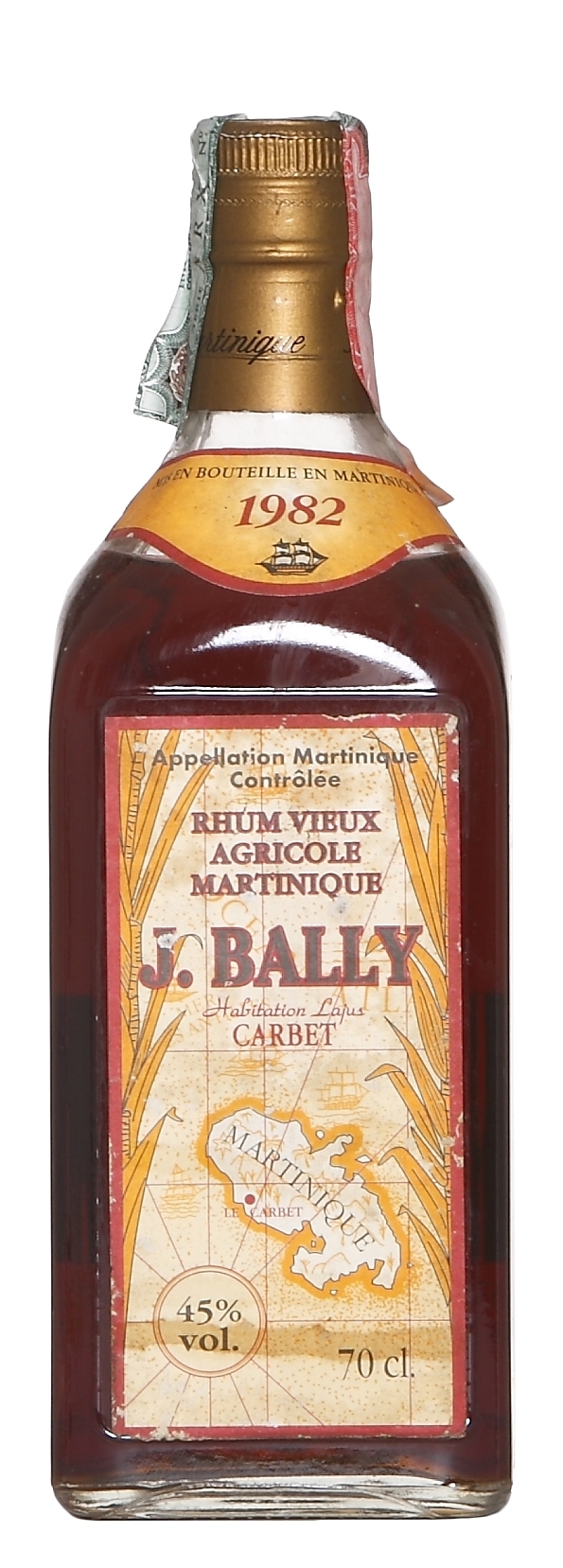
We’re slowly moving past the more recent vintages of the Bally rums and into something not necessarily older, but bottled from longer ago.  Hopefully they’ll throw some light into the development of the profile over the years.  The quality of the older expressions is not necessarily or always better just because it was made thirty five years ago…but yeah, perhaps in this case it is. The 1982 is certainly one fine piece of work, made at the original Bally site before the distillery closed in 1989 and production was shifted over to Simon.

Colour – Dark Amber

Strength – 45%

Nose – Oh, so nice. A smorgasbord of fruity notes right away – raisins, blackberry jam, candied oranges, plus coffee, anise, caramel bonbons and some breakfast spices (and cumin, oddly enough).  It presents as sweeter than the 1992 and 1993 variations, and also somewhat more musky, salty, with those wet earth aromas  being quite distinct, though fortunately not aggressive…more like an underlying bed upon which the other smells were dancing.

Palate – Warm, delicious, sweet and salty, like a Thai vegetable soup with sweet soya. After opening up some, the fruits take over – berries, cherries, jammy notes, nougat, light florals.  Loads of complexity here, well balanced against each other.  There’s the earth tones again, some black tea, bananas, light citrus.  None of the flavours are dominant, all rub against each other in a cool kind of zen harmony.  One odd thing here is that the grassy and sugar-cane sap part of the profile is very much in the background and nowhere near as clearly discernible as modern agricoles lead us to expect.

Finish – Long and faintly sweet.  There was actually some anise and coffee here (and was that molasses? …naah).  Long on spices like cinnamon, cloves and cumin, and the warm wet earth component, which I’ll say is Jamaican even though it isn’t, made one last bow on the stage.

Thoughts – I dearly wish I knew how old the rums truly was.  It’s labelled as an AOC, but that classification only came into force in 1996, so is it possible that the 1982 is at least 14 years old?  I simply don’t know.  Perhaps it’s just as well.  Like it or not, we sometimes unconsciously feel a rum aged for longer is somehow better – that’s a good rule of thumb, just not universally applicable, and here, whether it is that old or not, there’s no denying that for its price (still available at around three hundred dollars, same as the 1992) it’s a remarkable rum, made within the living memory of us rum collectors and Rumaniacs, and leading us by the hand into the misty times predating the iron rule of the AOC.

(86/100)

The other boys in the Bally-house have also looked at the 1982, and you can find their comments in the usual spot on the Rumaniacs website.

May 232017
 

Rumaniacs Review #043 | 0443

Leaving aside the independent bottlers, the agricolistas from Guadeloupe and Martinique seem to like producing a specific year’s output with much more enthusiasm than most molasses based rum producers, who (until recently) preferred to release specific “recipe-style” blends that changed little from year to year.  There’s something to say for both ideas – consistency of taste over time, versus the individualism of specific date points – which just supports my thesis that even in writing about a social spirit, larger philosophical issues about our world can be discussed using them as an example.

In this case, we’re not moving too far away from the Bally 1993 written about in R-042, but the price has definitely gone up (to over three hundred bucks) – and that’s even without knowing precisely how old the rums is, though I maintain that it, like its brother, is around 3-5 years old.

Colour – Amber

Strength – 45%

Nose – It’s initially more hesitant in its profile than the 1993 (and the others), or perhaps just more focused.  Both a strength and weakness, methinks. Salty molasses and caramel notes, green grapes, segueing over time into something darker, deeper: chocolate, cereal, wet cardboard.  Some herbal, grassy notes, just not very clear. There’s also a musky  tinge here, something like rain falling on very hot earth, and at the last, flowers, honey, biscuits. Actually reminded me of a miso soup.

Palate – Crisper, saltier, cleaner.  Something of a right turn from the way it smelled.  Olives, guacamole, brakfast spices, and vegetables more so than the fruits (which came later).  The cardboard and attic-level stuffiness and wet earth make a return bow.  Some jams and citrus notes follow on but don’t claim the high ground from the vegetals.  Not sure this entirely works for me.  It may just be a matter of taste.

Finish – Green grapes, cinnamon, brine, olives, avocados – it took time for the caramel and fleshy fruit to close things off.  A bit too much wood here, I thought, though anise – sensed more than experienced – was a good background.

Thoughts – More individual than the 1993, more oak, more vegetables, less fruits…somewhat less “rummy.”  Bit of a schizo rum and didn’t have that little something extra that I would have preferred – still, that’s a personal opinion, and overall, it’s still a good dram for something so young.

(83/100)

Some of the boys from the Rumaniacs have also taken a crack at this rum, and their reviews can be found in the usual spot.

May 232017
 

#366

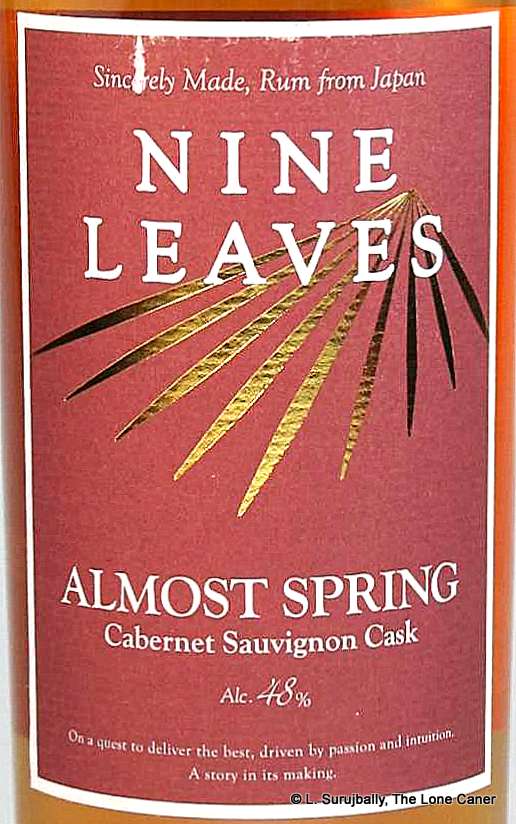
Nine Leaves, for whose intriguing rums I have always retained a real fondness, remains a one man operation in Japan, and while I have not written much about them of late, they continue their regular six month release regimen without pause, and have become must-stop booths at the various festivals they exhibit at on the Circuit.  Every now and then they issue an expression somewhat at right angles to their regular “six-month-aged” line, such as the Velier 70th Anniversary edition from 2017, the two-year-old “Encrypted” from 2016 and this one-year-old from 2015, which was the commercial 48% variation of special 58% 60-bottle run for a Japanese hotel, aged in Cabernet Sauvignon wine casks instead of the regular American or French oak.

So, this is a pot still rum, aged for one year, bottled at 48%, and aged in red wine casks.  How active or soaked these casks were, or how much residual wine there was, remains an unanswered question.  The real question for me was, did it work?  Nine Leaves, after all, have made some rather above-average rums by bucking the trend and staying within some very short time-frames for their ageing, but now this one seemed to be inching towards the line that the Encrypted stepped over the following year.  How was it?

Well, nose first.  It moved on quite a bit from the 2015 Clear (which I enjoyed for other reasons). Though it began with some rather startling waxy paraffin aggressiveness, it was not as pungent as the Clear was, and seemed somewhat more tamed, more soothing.  In fact, it presented very much like a young agricole with a few extra aromas thrown in.  The winey notes were there, kept well in the background – more of an accent at this stage, than a bold and underlined statement – and the smell exhibited a sort of clear, sprightly friskiness, of fanta, grapes, cinnamon, ginger and light florals.

That clarity of aromas was very evident on the palate as well.  Even at the slightly beefed up strength it remained light and clear and crisp.  Flavours of light flowers, vanilla, green grapes, lemon zest and olives in brine mixed it up with salt butter and cream cheese. The wine background came forward here, and if it wasn’t bottled at such a proof and had so many other interesting rummy sensations, it might even be considered a port of some kind.  It was quite intriguing and quite interesting, though the finish was a bit of a let down, being very spicy, quite dry, doing something of a turn towards harshness, and didn’t give much up beyond some green grapes and grass, and a few breakfast spices.

Although it was a decent rum, I think it may be a bit too ambitious, and could best be considered an experimental attempt by the playful for the curious (and the knowledgeable), to make something at odds with better known profiles.  The real success stories of such rums seem to be more with finishes than the entire ageing cycle. To some extent it lacked focus, and the wine background, while making its own claim to uniqueness, also confuses — and although I kinda liked it, the amalgam of rum and wine doesn’t gel entirely. If you recall, Legendario and Downslope Distilling went down this road before, much more unsuccessfully – it’s a tough balancing act to get right, so kudos to Nine Leaves for doing as well as they have.  

Anyway, to wrap up, then– points for the effort, a few approving nods for originality, but ultimately also something of a headshake for not succeeding entirely.  Given that there has never been another major attempt to issue a wine-aged young rum from the company, it’s possible that was and remains an experiment which was left alone after the initial release, which is a shame, really, because I would have enjoyed seeing where Yoshi-san took it after a few more tries.

(84/100)

May 212017
 

Rumaniacs Review #042 | 0442

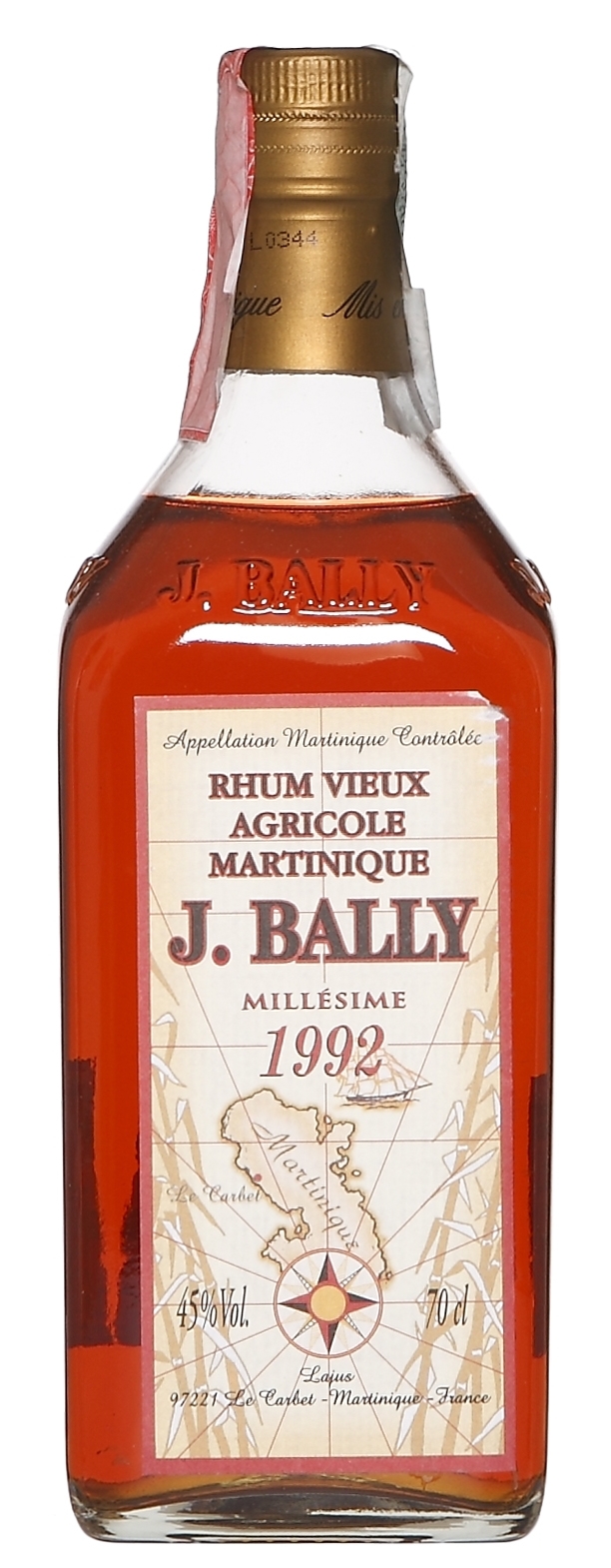
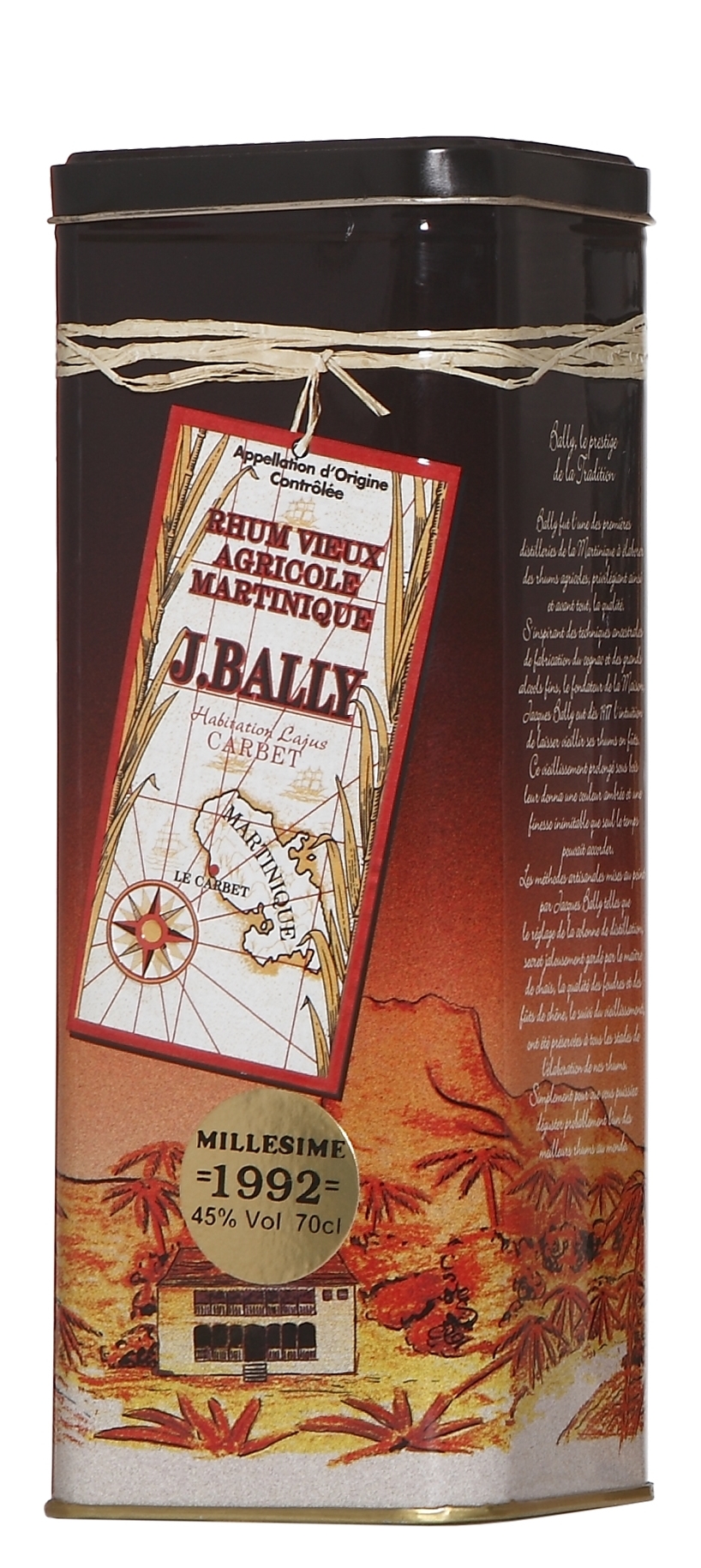
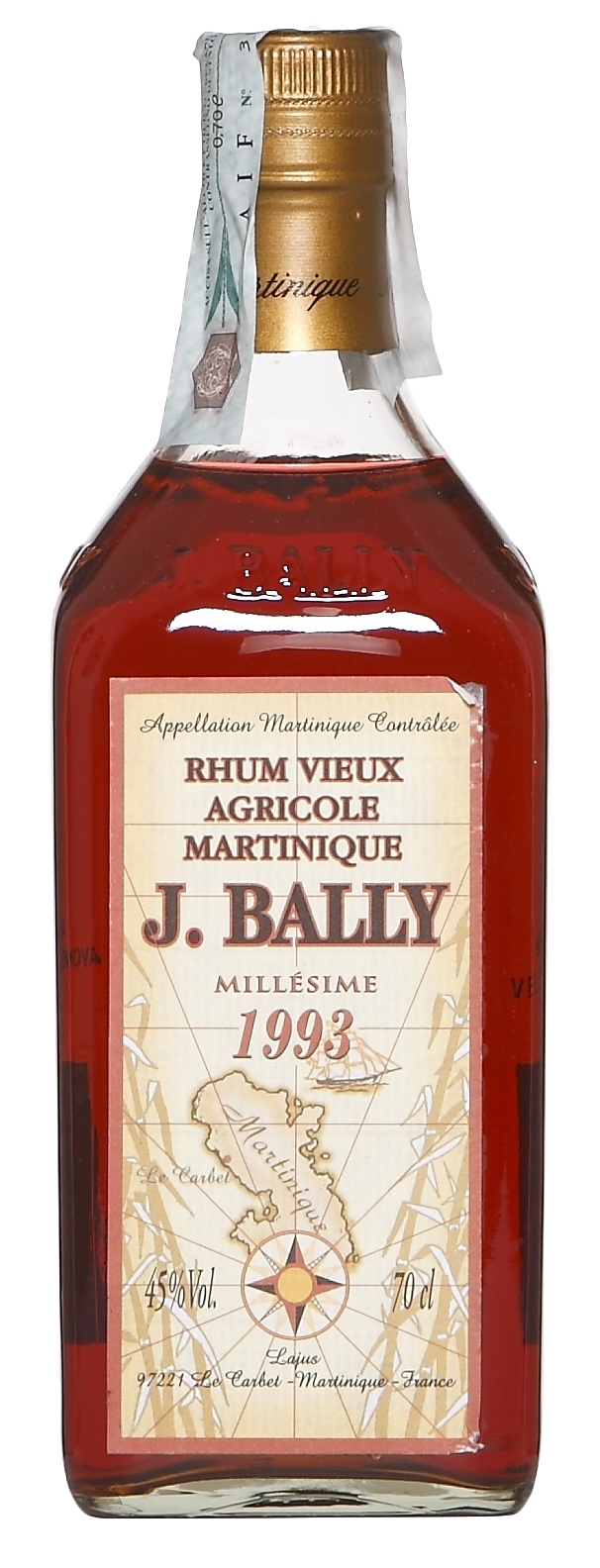
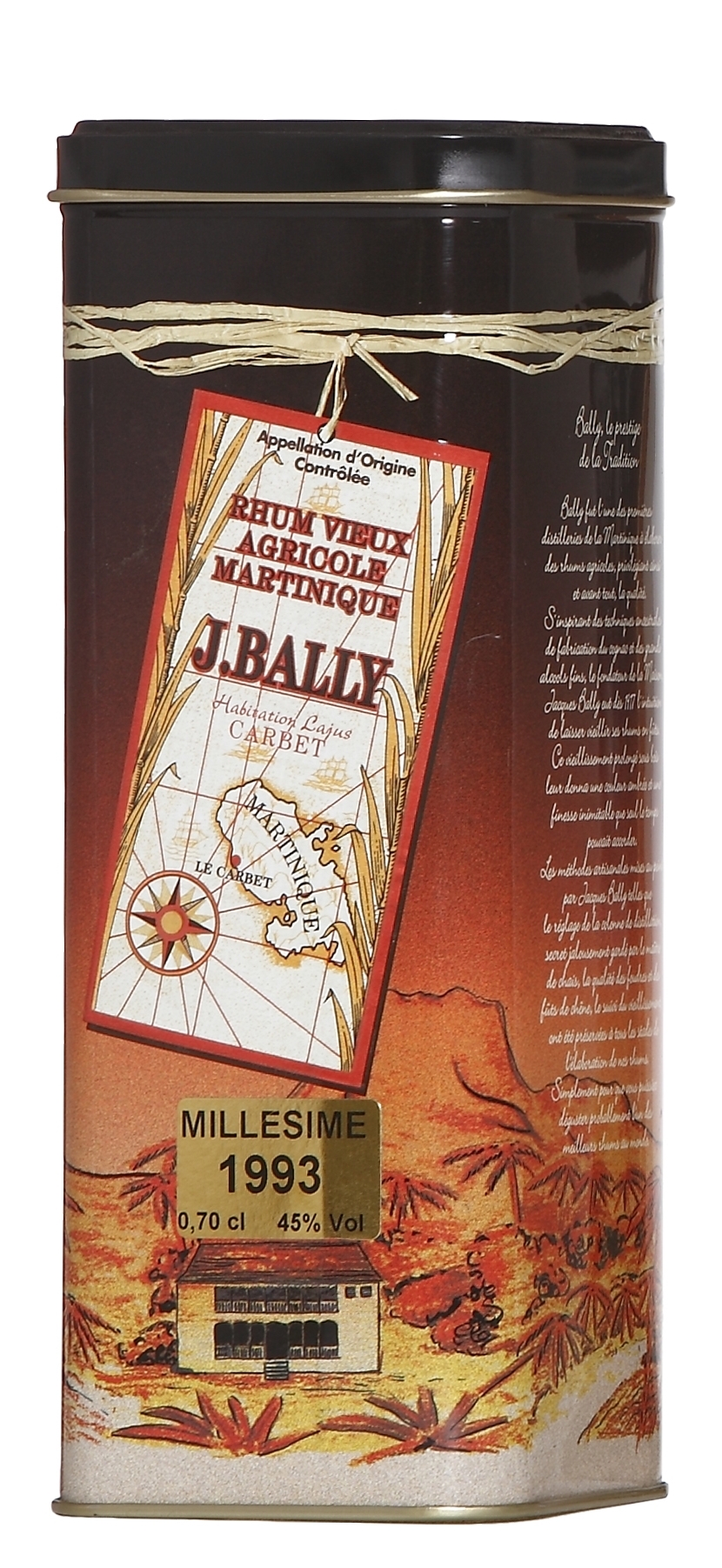
The first of six Bally rums (no relation to me), which we’ll also post faster than usual, since they are, again, part of a series.  Let’s start with the most recent.

For those who are interested in agricoles (which these assuredly are), J. Bally from Martinique has been around since 1917 or so (land prices after the 1902 eruption of Mount Pelee were low), but the sugar estate of Lajus goes back even further, to the mid-1600s.  Alas, Bally has been closed since 1989, but their stills continue.  The Simon distillery now owns them, and supposedly the original recipe for Bally’s rums, and sugar from the original plantation,  is used to ensure the brand does not die.  And of course, the AOC certification is alive and well with these rums.

True age is always a problem with these millésimes (meaning a specific year of production), because the date of distillation is noted….but not always the date of bottling.  Since a “rhum vieux” is supposed to have a minimum of three years ageing, I’m going to say 3-5 years old, then.

Colour – Amber

Strength – 45%

Nose – Quite solid, very smooth and, of course, crisp as fresh picked lettuce.  Amazingly fruity profile here, prunes and raspberries to start, nicely rich and quite aromatic, adding bananas, honey, hard yellow mangoes (from India or Thailand), and coiling around the background of herbs and grasses…some spearmint chewing gum.  And a touch of oak, cinnamon and caramel.  Seems almost like a Guadeloupe rum, what with the way the herbal and grassy aromas take a back seat and fruits are this rich.

Palate – Mmm, nice.  Fresh and crisp. Sugar cane and saline and gherkins, plus bales of freshly mown grass now taking their place in the front.  Caramel, raisins, a flirt of molasses and olives.  It’s all quite well assembled, and not overly weak, not obnoxiously strong.  Continues with vague honey notes and richer fruits, some more of that spearmint.  There’s some anise floating around there someplace, but not enough to make a statement of any kind

Finish – Vanillas, burnt sugar, honey, sugar cane, grass, and a bit of that olives in brine thing I enjoyed.  Somewhat hotter and sharper than what had come before, oddly enough.

Thoughts –  A young rum, and very enjoyable.  Agricoles do have that trick of making stuff in the single digits take on molasses rums twice as old and leaving them in the dust. I still think overall it resembles a Guadeloupe rhum more than a true agricole (even though it is AOC certified), but whatever the case, I’m not complaining.

(84/100)

Others in the group have written about this rhum on the Rumaniacs website…

May 182017
 

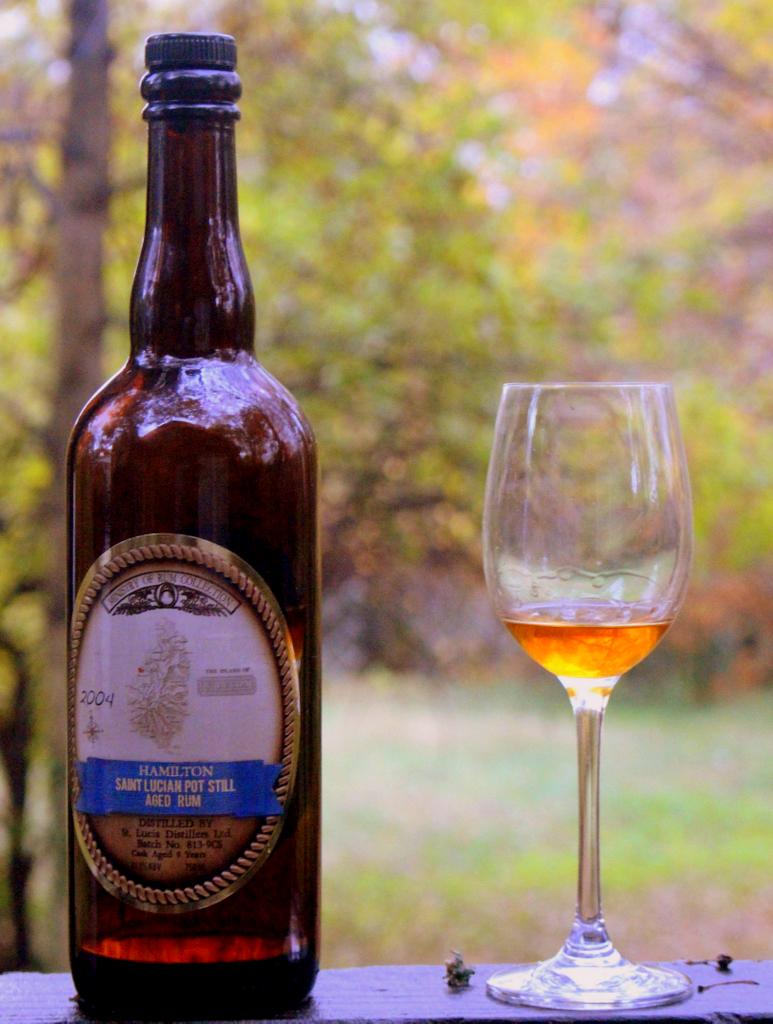
Photo (c) Quazi4moto from his Reddit post. This is the exact bottle the sample was taken from

#365

Just about everyone in the rum world knows the name of Ed Hamilton. He was the first person to set up a website devoted to rum (way back in 1995), and many of us writers who began our own blogs in the 2000s or early ‘teens — Tiare, Tatu, Chip, myself and others — started our online lives writing in and debating on the forums of the Ministry of Rum. He has written books about rum, ran tasting sessions for years, and is now a distributor for several brands around the USA.  A few years ago, he decided to get into the bottling game as well…and earned quite a fan base in North America, because almost alone among the producers in the US, he went the independent bottler route, issuing his juice at cask strength, thereby helping to popularize the concept to a crowd that had to that point just been mooning over the indie output from Europe without regularly (or ever) being able to get their hands on any.

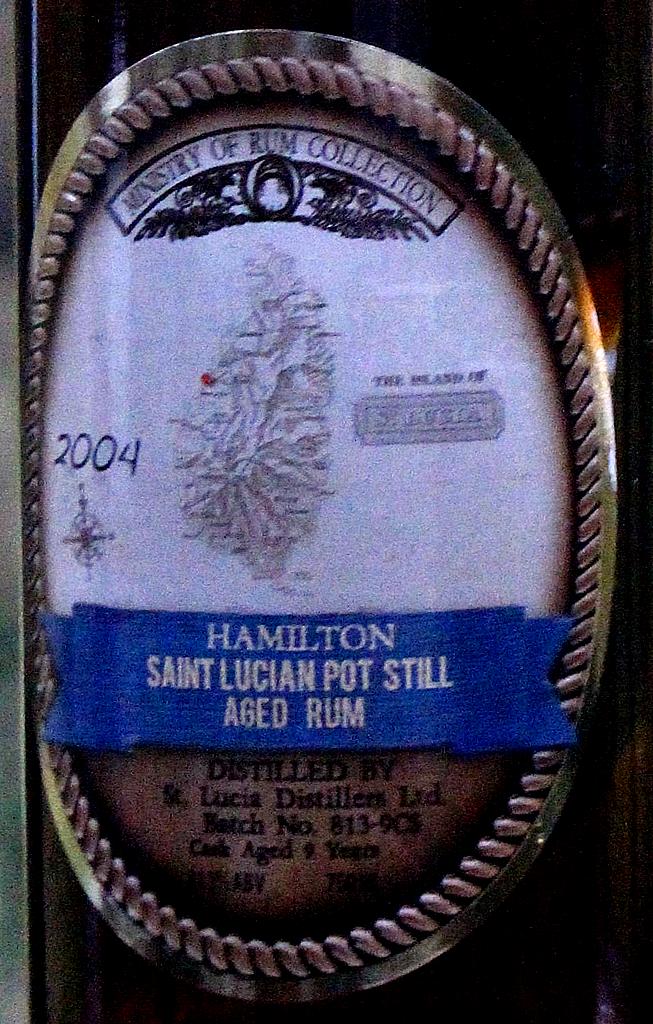
This rum was distilled in 2004 on a Vendome pot still by St. Lucia Distillers, who also make the Admiral Rodney, 1931, Forgotten Casks and Chairman’s Reserve, if you recall. They have both a Vendome pot still and a John Dore  pot still (as well as a smaller one, and the rums mentioned above are made by blending output from all in varying proportions) – Mr. Hamilton deliberately chose the Vendome distillate for its complexity and lack of harshness, and its source was from Guyanese molasses fermented for five days.

With my usual impeccable timing, I moved away from Canada at that exact time, and never managed (or seriously attempted) to pick up any of the Ministry of Rum Collection, since my attention was immediately taken up with agricoles and the European independents. However, one correspondent of mine, tongue in cheek as always, sent me an unidentified sample (“St. Lucia” was all the bottle said), and after tasting it blind, being quite impressed and writing up my notes, I asked him what it was. Obviously it was this one, a nine year old bottled at a rip-snorting 61.3%.  And it really was something.

On the nose, the high ABV was hot but extremely well behaved, presenting wave after wave of the good stuff.  It started off with rubber and pencil shavings, old cardboard in a dry cellar, some ashy kind of minerally smell, coffee, cumin and bitter chocolate…and then settling down and letting the rather shy fruits tiptoe forwards – raisins, some orange peel, peaches and prunes, all in balance and well integrated.  No fault to find here – I was unsure whether a standard proof drink would have been quite as good (in fact, probably not).  Throughout the whole exercise – I had the glass on the table with some others for a couple of hours – there was some light smoke and burnt wood, which fortunately stayed in the background and didn’t derail the experience.

As for the palate, wow – if gold could be a taste, that was what it was.  Honey and burnt sugar, salty caramel all mixed up with flowers, more chocolate and the citrus peel.  The tannins from the barrel began to be somewhat more assertive here, but never overbearing.  In fact, the balance between these components was really well handled.  With water, deep thrumming notes of molasses and anise shook the glass, leading to grapes, pineapple, acetone (just a little), aromatic tobacco and olives in brine; and throughout, the rum maintained a firm, rich profile that was quite excellent.  Somewhere over the horizon, thunder was rolling.  And as for the finish, here it stumbled a little on the line – long as it was, the tannics became too sharp; and while other closing hints remained firm (mostly molasses, caramel and brine plus maybe a prune or two) overall some of the tempering of one taste with another was lost.  

But I must note that the rum is a damned good one.  I think it’s a useful intro rum for those making a timorous foray into cask strength, and for those who wanted more from the Admiral Rodney or the 1931 series, this might be everything they were looking for from the island.

Some years ago I ran several of the standard proof St Lucia Distillers rums against each other, observing that while they were quite good, they also seemed to be missing a subtle something that might elevate their profile and quality, and allow them take their place with the better known Bajans, Jamaicans and Guyanese.  As the rum world moved on, it is clear that in small, patient, incremental steps — perhaps they were channeling Nine Leaves — St. Lucia Distillers, the source of this rum, were upping the tempo, and it took a few European indies and one old salt from the US, to show what the potential of the island was, and is. St. Lucia may have been flying somewhat under the radar, but I’m here telling you that this is a lovely piece of work by any standard, admirable, affordable and — I certainly hope — still available.

(86/100)


Other notes

  • Vendome is a company, not a type of still, and dates back to the first decade of the 1900s, building on experience (and customers) dating back as far as the 1870s when Hoffman, Ahlers & Co. were doing brisk business in Louisville (Kentucky).
  • Aside from the eight St. Lucian rums in the portfolio, The “Hamilton Collection” includes Jamaican and Guyanese  rums.  The Hamilton 151 is specifically intended to be better than (not to supplant) the Lemon Hart 151 which was out of production at the time.
  • Kudos, thanks and a huge hat-tip to Quazi4moto, who sent the sample.  He was, you might remember, the gent who sent me the Charley’s J.B. white rum I enjoyed a few months ago.
May 162017
 

Rumaniacs Review #041 | 0441

Note: The initial full length review can be found in the main reviews section.

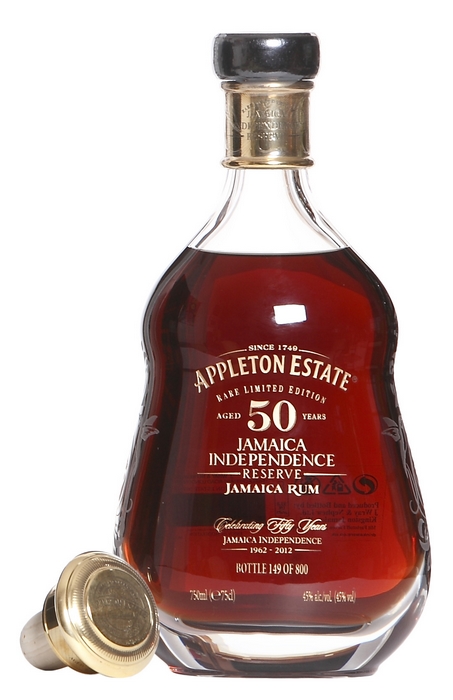
Everyone knows about the 50 year old rum which Appleton pushed out the door a few years ago.  Not only because of the age, which they touted as “the oldest rum ever” even though that was patently untrue, but because of the stratospheric price, which even now hovers around the US$4500 mark (give or take).  I’m not sure if they still make it — it was specifically commissioned for Jamaica’s 50th anniversary of Independence in 1962, so I suspect it was an 800-bottle one-off halo-issue —  but that price alone would make many take a really jaundiced view of the thing.  To their detriment, I believe, because having tasted it five times now, I can say with some assurance that it is still one of the very best rums Appleton ever made.

Colour – Mahogany with red tints

Strength – 45%

Nose – The smell opens the vault of my memories, of Jamaica, of the stately progression of other Appletons rums over the years, of the times I tried it before. Initial notes of glue, fading fast; then honey (I always remember the honey), eucalyptus oil, toffee, caramel, rich milk chocolate with rye bread and cream cheese, developing slowly into luscious candied oranges, molasses and burnt sugar.  Some of that vegetable soup I noted from the 20 year old ceramic jug is here as well, much subdued.  What woodiness that exists is amazingly well controlled for something this old (a problem the 30 year old had).

Palate – The dark richness purrs down the throat in a sort of warm, pleasant heat.  Burnt brown sugar and wek molasses, caramel, toffee, nougat and nutty toblerone chocolate, a flirt of coffee.  More fruits emerge than the nose had hinted at, and provide a pleasing contrast to the more creamy, musky flavours: grapes, bananas, apricots, pineapples.  Then cinnamon, more honey, some cheese.  Oakiness again well handled, and a sort of leather and smoke brings up the rear. I sometimes wonder how this would taste at 55%, but even at 45%, the rum is so very very good.

Finish – Medium long, a fitting close to the proceedings.  Mostly bananas, molasses, a little pineapple, plus a last dollop of caramel.  And honey.

Thoughts – Still a wonderful rum to sip and savour.  Sadly, too expensive for most.  Those who can afford a whole bottle are unlikely to be into the rum world as much as we are, but whoever has it, I hope they’re sharing…generously.

(89/100)

The other Rumaniacs have also written about the rum, and their reviews are in the usual spot.

May 152017
 

Rumaniacs Review #040 | 0440

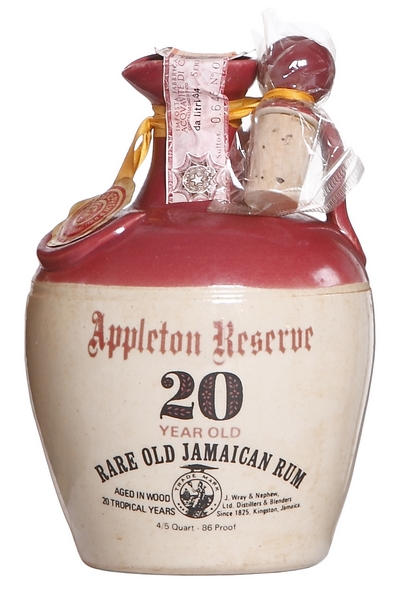
As with the 12 year old ceramic jug, I don’t think that Appleton is exaggerating in the slightest when they call this a “Rare Old Jamaican Rum,” – at the time it was issued in the 1960s or 1970s they might have been hyping the product a tad, but now?  Not likely. Still, you can actually find it if you’re prepared to pay Masters of Malt, who name this a 1970s era rum, the £700 it costs.  And that’s more than the Longpond 1941 fetches these days.  I must confess that for an aged artifact bottled (or “jugged”) at a mouth-watering, drool-worthy twenty years old, I’m tempted.  Consider too – at that age, it means at the very latest it had to have been distilled in 1959, and very likely earlier than that, and what lover of historical rums wouldn’t want to try that?

Colour – Amber

Strength – 43%

Nose – Pure tamed Jamaican, with elements of the profile being showcased, but not strong or violent enough to put one off…a Trenchtown Rasta in a Savile Row suit, if you will. Rolling waves of salt and sweet, bananas, pineapple, chocolate and coffee, with caramel and toffee hastening to catch up from the rear.  Some tobacco and smoke, a touch of vanilla, honey, anise, and very strong black tea.  There’s a persistent — if faint — background odour of vegetable soup in here, both the veg and the soya.  Really.

Palate – More of that dialled down bad boy attitude, nicely integrated into a profile that starts with “dirt”.  By which I mean a sort of loamy, earthy, vegetable taste (far from unpleasant, I hasten to add), rye bread, cumin, garam massala, molasses, and oh, a lovely clear line of florals and citrus.  Did I mention the vegetable soup? All wrapped up in a bow with the usual dessert menu of salted caramel and vanilla ice cream. And as an aside, it’s quite rich and intense…It may be jugged at 43% but it sure feels more powerful than that.

Finish – Falls down here after the high point of tasting it.  It just fades too damn quick, and for some inexplicable reason, the wood starts to take on an unhealthy dominance.  Salted caramel, brine, olives,, breakfast and cooking spices, and a twist of licorice.  All very faint and too watered down.

Thoughts – It’s actually very different from the younger Appletons, the 12 year old jug, or the older 21 year old. Points of greatness are unfortunately ameliorated by weakness and an increasing lack of balance over the hours spent comparing it to all the others.  In short, somewhat of a Shakespearean tragedy — potential and hubris being brought low by inherent flaws. Though even with all that, it leaves me somewhere closer to praising the rum than coming to bury it.

(86/100)

Other Rumaniacs reviews of this rum can be found on the website, here.  Note that Serge was enthralled with it, while Marco was much more disapproving.

May 142017
 

#364

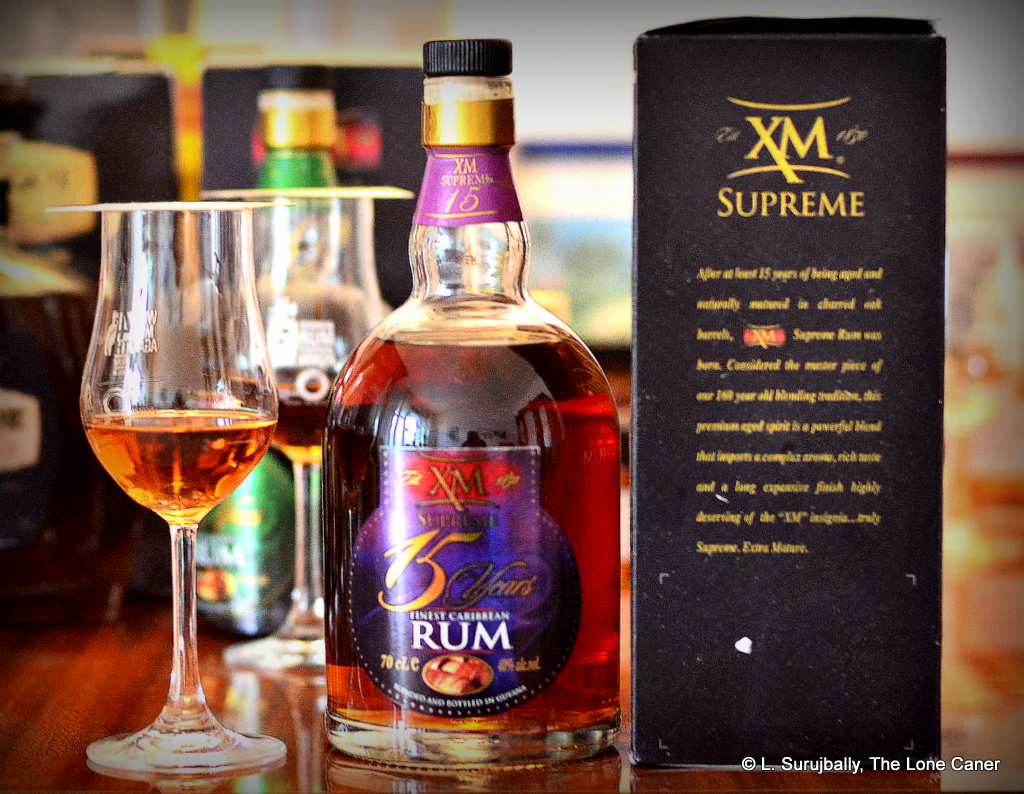
Until the release of the XM Golden Jubilee 20 year old rum in May 2016 for the occasion of Guyana’s 50th anniversary of independence, the jewel in the crown of Banks DIH’s XM line was the fifteen year old.  Over the last five years or so it suffered, in my all-seeing rearview-mirror opinion, by simply following the party line, being bottled without regard for the emerging trend of stronger rums in the minds of the tasting public, and also perhaps from being a indeterminate, mostly column-still blend without a really good barrel strategy.  This relegated it to being an outlier in an increasingly crowded and competitive field; and by eschewing any one point of uniqueness that would make it stand apart (finishing, single barrel, cask strength, a singular taste…that kind of thing), it has slumbered in a sort of quiet corner reserved for also-rans – Guyanese worldwide know of it, but few others do and it sure doesn’t make any waves internationally, in spite of its age.

Which is something of a shame, because setting aside personal preferences, it’s quite a good rum that could use a good dose of aggressive marketing and festival-circuit promotion.  The very first note I wrote down in my tasting book as I was nosing the Supreme, was “Impressive”. It began with aromas of acetone and glue and furniture polish before giving way to very soft notes of dark dried fruit (raisins and plums), before segueing over into the territory of vanilla, caramel and nougat.  What little tartness of the fruit that existed, was kept way back, vaguely sensed but not directly experienced, which to my way of thinking is a very good reason to bump up the ABV not just one notch, but several.  Still, it was impressive, and for a 40% rum to exhibit such discernible richness was a pleasant surprise.

The palate, warm and eminently sippable, led off with the fruit basket: cherries, raisins, apricots and very ripe peaches.  There were a few hint of bananas and white guavas, though without exhibiting any kind of overbearing sweetness, and the overall fruity tastes blended well with the restrained influence of burnt sugar, toffee, caramel, vanilla…all the usual attendant hits.  There was a sort of jammy profile here, quite pleasing, and some very faint molasses hanging around unobtrusively in the background.  It all led to a short and pleasant finish, mostly dates, caramel, vanilla, a bit briny in nature and not at all a tropical smorgasbord

So. The XM 15 is still somewhat generic in nature, but a level up from the 12 year old, and definitely better than the 10 year old.  It’s more subtle, a little richer, yet still had much of that laid back profile that simply did not (or could not) strain too much or escape the clutches of its standard ABV.  Still, leaving these two points aside, the one major — and perhaps surprising — drawback of the Supreme 15 year old is simply that, good as it is, it remains too similar to the Special 12 year old.  I tried all the Banks rums together with a bunch of other forty percenters, and it really was difficult to tell these two apart.  So for an average drinking man who’s looking for an aged living room powered rum that won’t incur the wife’s ire, the step up in quality from the 12 to the 15 is slight enough to not make the 15 a better investment outside of bragging rights.  It’s a good rum to buy if you have the coin, but don’t look for a quantum leap to the stratosphere if you already have the ten or twelve year olds in stock.

(84.5/100)


Other notes

  • Banks DIH informed me that not only was the North American market being more aggressively targeted in 2017, but cask strength and even single-barrel rums would be issued as part of the range in the future.  The majority of the range would continue to be blends, and the sourcing of raw rum stock from Trinidad and Barbados would continue (see the 12 year old review for some notes on the matter)
  • The Jubilee 20 year old (my age statement, not theirs) has components of the blend that are up to 50 years old.
May 132017
 

Rumaniacs Review #039 | 0439

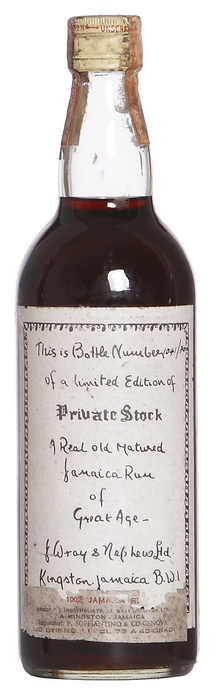
A rum like this makes me want to rend my robes and gnash my teeth with frustration because there’s no information available about it aside from what’s on the label, and that’s hardly very much.  Still, it’s Jamaican, it’s a J. Wray (Appleton) and it’s from the 1970s and that alone makes it interesting.  Imported by another one of those enterprising Italian concerns, age unknown.  From the colour I can only hope it was a real oldie.

Colour – Dark red-brown

Strength – 43%

Nose – “Dirty” might be the est way to describe the nose.  I’ve mentioned “rotting bananas and veggies” before in a review once or twice, and here it’s real.  Quite intense for a standard proof drink – wine, bitter chocolate and black rye bread.  Then molasses and bananas and a lot of compost (wet leaves in a pile) and a lot of fruit way past their sell-by date.  Oh, and anise, strong black tea and some smoky, leathery aromas backing things up.  Fantastic nose, really.

Palate – Smoothens out and is less aggressively crazy as the nose, though still quite assertive, luscious and rich.  Molasses, caramel and dark fruits (prunes, plums, stewed apples, raisins) with the off notes held much more in check.  Then chocolate, black tea and some citrus oil, a flirt of sugar cane juice and the bitterness of some oak.  Some spices noticeable here or there, but nothing as definitive as the nose had suggested.

Finish – Short and easy, mostly caramel, wood chips, more tea, plums, a little brine and a last hint of veggies in teriyaki, odd as that might sound.

Thoughts – I really liked this rum, which didn’t present itself as an Appleton, but more like a unique Jamaican carving out its own flavour map.  I seriously doubt it’ll ever be available outside a collector’s shelves, or perhaps on an auction site somewhere, but if it can be found I think it’s worth picking up, both for its history and its taste.

(85/100)

May 112017
 

Rumaniacs Review #038 | 0438

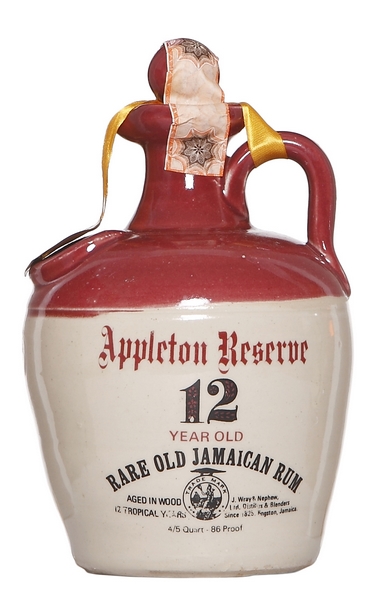
A “Rare Old Jamaican Rum” the ceramic jug says, and I believe it.  In all my travels around the world, I’ve never seen this kind of thing for sale (and buying beer in a glass jar at a kiosk in the Russian Far East don’t count). We’re living through an enormous upswell of interest in rums, with new indies and new bottlers popping up every time we turn around…but stuff like this shows us that even back in the day, there was some amazingly well-presented juice floating around.  Here, cool factor is off the chart.

As for the rum?  Very nice indeed. Aged in the tropics (of course – where else would Appleton be ageing its stock?) and better than both the other 12 year old we looked a the other day, and the modern one.

Colour – Amber

Strength – 43%

Nose – Initial attack is as dusty and dry as a mortician’s voice (and he’s wearing well polished old leather shoes, that’s there too).  Oily, vaguely like cigarette tar (not my favourite smell).  Coffee and chocolate, citrus rind, and then a nice procession of tart ripe fruits…mangoes and red guavas.  Some saltiness and dates and grapes, not much funk action as far as I could tell.

Palate – Some bitterness of unsweetened black choclate starts things off, hot salt caramel over a coffee cake (same kind of dessert taste I got on the last 12 year old).Wood shavings, some more leather, more cigarette smoke, and then the fruits timidly emerge – citrus mostly, also bananas (barely), and a dash of breakfast spices, nothing overbearing.

Finish – Weak point of the experience, after the above-average smell and taste.  Dry, sawdust (the mortician is back, shoes squeaking), leather, light chocolate, caramel, and the barest hint of the fruits retreating.  Not impressed here, sorry.

Thoughts – It’s better than many other, more recent Appletons of various names (like “Extra”, “Reserve”, “Legacy”, “Private stock” and so on) and those of younger ages, beats out the other twelves that have been tried…but not by leaps and bounds.  It’s not a furious game-changer. It sort of edges past them as if ashamed to be seen at all.  A good rum, and I liked it, but it does leave me puzzled too – because I thought it could have been better and didn’t understand why it wasn’t.

(84/100)

Some interesting and divergent perspectives on this one, from other members of the Rumaniacs.  You can check out their opinions in the usual spot.

May 102017
 

Quite a good rum, which unfortunately fails to carve out a distinctive Guyanese profile of its own.

#363

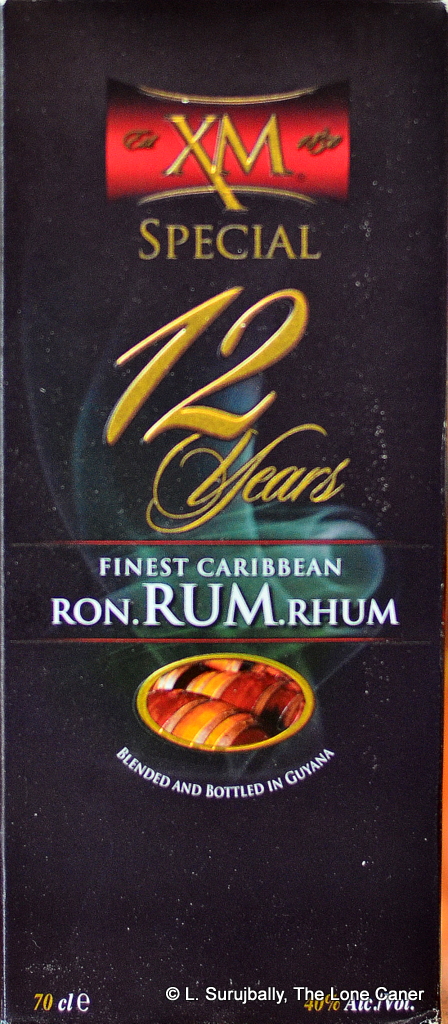
When one thinks of Demerara rums, Guyana and DDL immediately spring to mind.  That company has so dominated the global rum scene for such rums in the past two decades that it may come as a surprise to many that it is not the sole maker of such products, nor the only inheritor to the Guyana rum moniker, and in fact, is somewhat of a late arrival.  Before it was consolidated from the distilleries that were once the property of Bookers McConnell and Sandbach Parker, Banks DIH was already there, making the good stuff since the 1930s, with XM being noted as the #1 rum in British Guiana as far back as 1959.  

The problem for Banks (where rums are concerned) was and remains twofold: rum is actually a small part of its overall business (partly because they have no still of their own) and it also does not possess the right to use the “Demerara” appellation for its XM line – DDL fought and won a bitterly contested court case for that prize – and therefore not only is XM rum less well known, but it’s also less well marketed, and to add insult to injury, is often confused with Banks 5-island and 7-island rums from the UK.  Not the best way to get your hooch to grab the brass ring now, is it?

Banks has always been a blender, never a distiller.  Until the late 1990s they bought raw rum stock from the various estates around the Guyana and blended that into their signature XM line; but once DDL consolidated all the stills in the country into their headquarters at Diamond estate, they ceased providing any.  Banks therefore has, for the last twenty years or so, sourced their rum stock from Barbados (FourSquare)and Trinidad (Angostura) and continued to blend them and age them in Guyana, which goes a long way to explaining why the XM I grew up with is no longer the same rum as what is on sale now.  So it’s not as if Banks doesn’t want to make Guyanese rums – it’s that they can’t, and that also goes some way to explaining the smaller footprint they have, both in the company’s overall operations, and the world at large. (For a more in-depth look at Banks, see the company bio, written in February 2018)

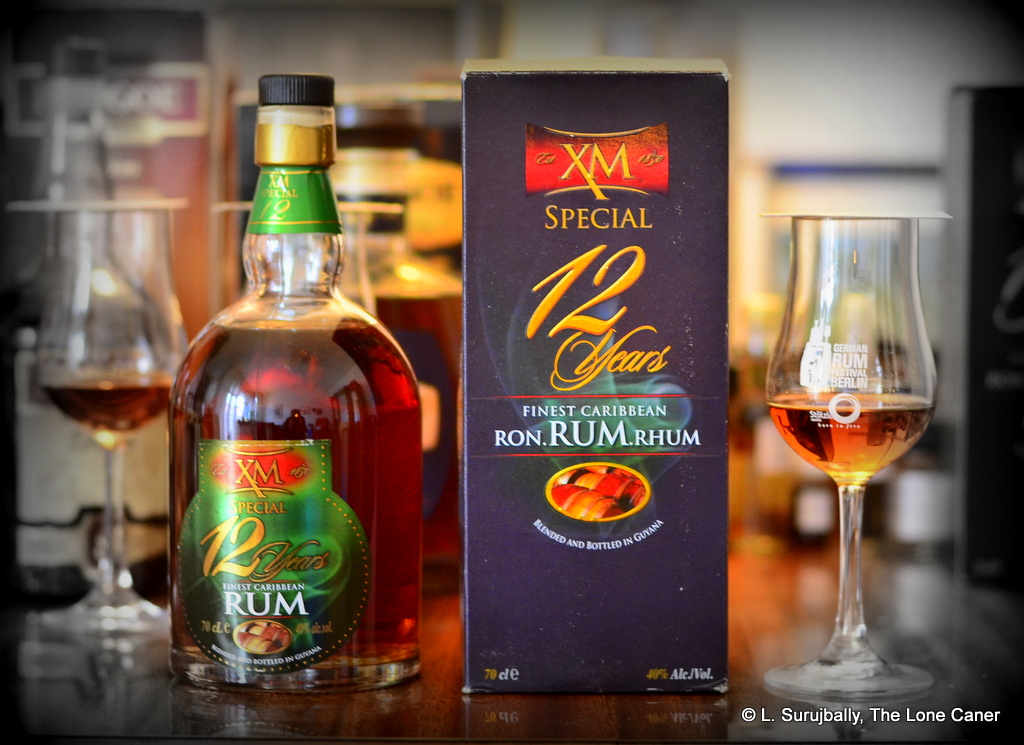
Digressions aside, the rum, now. The 12 year old — bought and tasted alongside the 10 YO and 15 YO last year — adhered to the company philosophy of making blended rum, and for better or worse, this made it present something of a generic profile…and for the reasons explained above, nothing here screamed “Guyana” in the way the El Dorado line does, which says a lot of how DDL’s (and all the other independent bottlers’) products have colonized our mental tasting map of the entire country, for good or ill.  

To illustrate the point: nosing the amber 40% spirit gave up warm smells were of white toblerone, chocolate, toffee and some lemon rind.  The whole aroma reminded me of a very nice dessert my son The Little Caner can’t get enough of: caramel drizzled over The Great Wall of Chocolate (don’t ask, I may lapse into diabetes on the spot).  There was a faint brininess lurking behind the primary aromas, and also something musky and dark, like overripe bananas, and mangoes just about ready to turn.

Moving on to taste, I felt the palate to be quite a bit better than expected, and certainly more than the nose.  Normally 40% doesn’t do much for me, and here, yes that feeling of an scrawny, delicate spirit was here too…it was as thin and precise as my primary school teacher’s sharp excoriating tones (“Pay attention Mr. Caner!”) followed by the sharp snap of her two-foot long wooden ruler on my knuckles (“I warned you, Mr. Caner”). The whole initial profile was like that, very meticulously assembled, each note clear and separable from the next: bitter chocolate, salted caramel, toffee, burnt sugar; raisins, some orange peel.  Then the ruler came, though not as painful – black cake, tart fruits, more raisins, molasses, blanketed by caramel and some breakfast spices. For 40% to give that much is quite something, and the finish is no slouch either – briny and dry, light all over with faint notes of cinnamon, olives, some crumbs of toblerone, with a final flirt of molasses and candied oranges.

So overall, not a bad rum at all, just not one that marks its territory with verve and authority of any kind.  Like I said, if you were tasting it blind you wouldn’t be sure of its origin. No anise or rich fruity notes, no pot still action, nothing that would remind you of the raw thrumming power of a PM or EHP rum at all – in fact, the XM presents as rather restrained, overall.  And this is both the advantage of such a blend, and to some extent its downfall because, sorry, but the comparison is inevitable. Beyond that, if you’re not a connoisseur of specific country’s styles and just want a good drink to pour into your glass at sundown, then none of that is your concern, and this excellent mid-tier sipper will fill the bill very nicely indeed.

(83/100)


Other notes

  • No information on additives (sugar or otherwise) is available.  For my money it has not been tampered with. 
  • The ageing regimen is unknown aside from it being done in situ in charred oak barrels which we can assume to be ex-bourbon.
  • My thanks to Dave of the RumGallery for pointing me in certain directions regarding background; and to Carlton for providing some details on history and operations
May 022017
 

#361

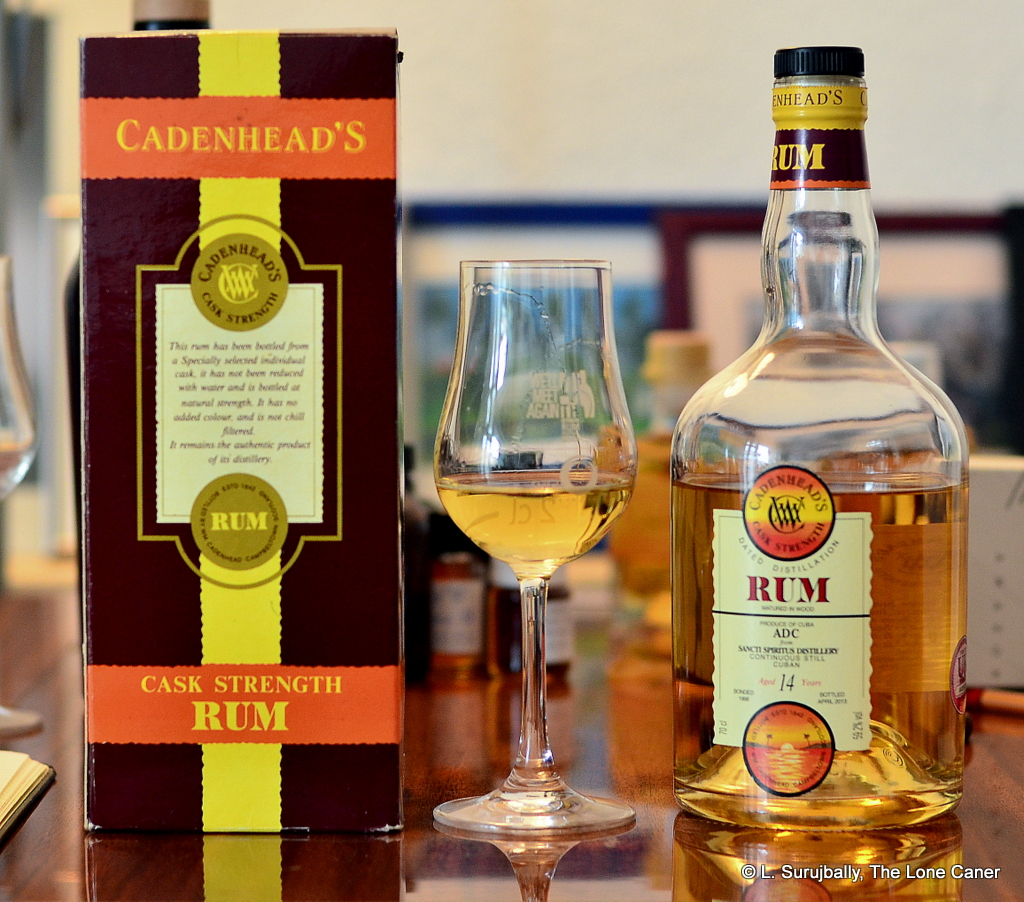
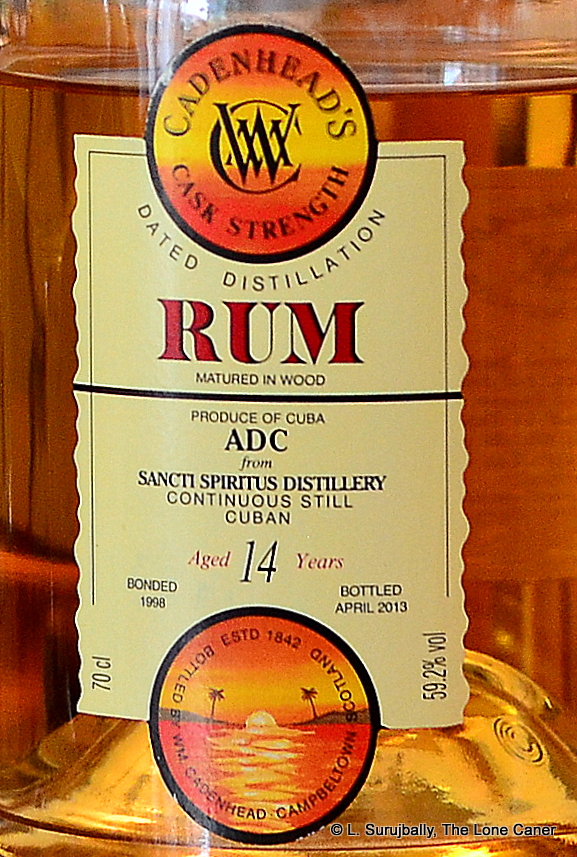
The Sancti Spiritus distillery in Central Cuba, also known as Paraiso, has been making rums since 1946, and other than its history (see “other notes” below) there is remarkably little hard information about its operations, its size, volume or exports on hand. Aside from what must be substantial local production which we don’t see, they may be better known for the relatively new Ron Paraiso brand, as well as from the labels of independent bottlers like Compagnie des Indes, Kill Divil, Bristol Spirits, the Whisky Agency, and, here, W.M.Cadenhead.  Based on what one sees for sale online, barrels seem to have begun hitting Europe somewhere around the mid 1990s, with the one I’m looking at today coming off the (columnar) still in 1998 and bottled at a firm 59.2% in 2013.  Cadenhead, as usual, have amused themselves with putting the abbreviation “ADC” on the label, which could mean variously “Aroma de Cuba,“ or “Acerca de caña” or, in my patois, “All Done Cook” – any of these could be used, since Cadenhead never discloses – or doesn’t know itself – what the initials denote, and I’m tired of asking and getting “Ahhhh…duuuuh….Cuba?” in response.

A number of people who like the heavier, thrumming British West Indian rums (from Jamaica, Guyana, and Barbados for example) have sniffed disparagingly to me about Spanish rons recently, especially the column still ones, which are most of them.  I suspect this has to do with their despite for Bacardi and the light Panamanian stuff that’s been slipping in the ratings of late.   Nothing wrong with that, but my own feeling is that they’re casting too wide a net, and if one throws out an entire region’s worth of bathwater based on a few sampled rums, then one misses the baby that washed out the door as well.  Maybe it’s the occasional lack of verifiable ageing, maybe it’s the lightness, maybe it’s the palate of the drinker. Don’t know. But this Cuban ron does deserve a closer look.

Consider first the nose on the pale yellow ron: it was a sparkling, light dose of crisp, clean aromas, starting off with rubbery, sweet acetones all at once.  In its own way it was also quite tart, reminding me of gooseberries, pickled gherkins, cucumbers and lots of sugar water, stopping just short of presenting an agricole profile.  I don’t think I could have sipped it blind and known immediately it was from Cuba.  At a whisker shy of 60% it attacked strongly, but was too well made to be sharply malicious, and was simply and forcefully intense, which was to its credit and made the experience of smelling it a very good one, especially once some soursop, citrus and baking spices were coaxed out of hiding a few minutes later.

The taste fell down somewhat – there was dry wood, a lot of strange and almost-bitter tannins at the start; which was fortunately not a disqualification, because these tastes balanced off what might otherwise have been an overabundance of light sweetness represented by watermelon and papaya and Anjou pears.  Gradually it unfolded like a flower at dawn, producing additional faint notes of orange zest, almost-ripe yellow mangoes and apricots, balanced by iodine, menthol (!!), tumeric and some strong black tea, all of which led to a conclusion that was suitably long, clear and spicy, closing off the show with nutmeg, more of that tartness, and a flirt of orange zest.

Briefly, Cadenhead’s ADC stacked up well against a raft of agricoles, Spanish and Surinamese rums that were on the table that day. It did make me think, though: reading around others experiences with Cuban rums generally, one thing that strikes me as consistent is that the demonstrably older a Cuban rum is, the more commonly it is scored high.  Now pot still rums made with some skill can be good right out of the gate, and creole column-still juice out of the French islands prove all the time that higher age does not necessarily confer higher praise (or scores).  But with column still rums made in the Cuban/Spanish style, the usual easy 40% young stuff or blended rons of some age just don’t have that sizzle which Cadenhead somehow extracted out of their barrel here. In other words, for such traditionally light rums, additional ageing is a better deal, it would seem.

So, in fine, I believe that this rum is better than the Havana Club Barrel Proof (and the Seleccion de Maestros that succeeded it), better than the Renegade 11 year old (but maybe I should retaste since I tried that one ages ago); it edges out the Santiago de Cuba 12 year old, though is perhaps not quite as good as the CDI Sancti Spiritus (also from 1998).  Those dour Scots took the sunshine of the tropics, doused it with some cold salt sea-spray and foam-lashed rocks, and produced an amalgam of both that’s better than either, and just falls short of remarkable – it’s worth a try by anyone, if it can still be found.

(86.5/100)

Other notes

A few words on the distillery history: called variously the Paraiso or Sancti Spiritus distillery, the founding family, the Riondas, began their sugar business in 1891 with a company called the Tuinucú Sugar Company in the province of Sancti Spiritus (which was also near to the original Bacardi distillery). In 1946 the Paraiso Distillery was created and in 1951, the Tuinucú Sugar Company was consolidated into both plantation and distillery operations. Since the revolution, the Government took over the entire operation not long after and has run the show ever since.

Feb 212017


Savanna, a distillery on the Indian Ocean island of Réunion (it’s east of Madagascar) was founded in 1870 as part of the drive by France to diversify sugar production after the loss of Saint Domingue (Haiti) and Ile de France (Mauritius) in the early 1800s. Distilleries had already appeared on Réunion by 1815 when Charles Desbassayns built the most sophisticated sugar cane mill of the island in the region of Chaudron, but records suggest primitive versions were in existence there for at least a hundred years before that. Rum production began to take on greater importance as a diversification measure after 1865, when the sugar crisis precipitated by the discovery of the beetroot sugar-making process required other sources of income to be exploited.  The sugar crisis also had the effect of requiring consolidations and closures of the various estates – in 1830 there were 189 sugar factories, by 1914 they were reduced to around twenty and now there are only three.

Originally located in Saint Paul on the west of the island, what was later Savanna was then called “Parc à Jacques” or “Bout de l’étang” and was one of the first settlements there. At the beginning of the 19th century, Olive Lemarchand bought the property, which was then called the Sugar Estate of Savanna. In 1876, the Society of the Domain of Savanna was formed and the records of a functional distillery begin around this time, with molasses being the principal source of the spirit.

Photo (c) distilleriesavanna.com

Under various owners the sugar factory and its associated distillery continued operations until the post WWII years. The man most associated with Savanna in its current iteration was an enterprising islander named  Émile Hugot (1904-1993), an engineer.  He trained as a chemist in sugar factories on the French mainland at Artres and Bucy-le-Long before returning to Réunion in May 1928 where his priority was the provision of energy to the sugar factories.  He became the Managing Dirctor of the Adam de Villiers Sugar Company at La Mare in 1932 (this was a factory to the west of the current Savanna location) before the Second World War interrupted his work and he mobilized.  In the post-war years he restructured the sugar-based economy of the island and merged the factories and properties of La Mare, Savanna and Grand-Bois and the properties of La Convenance and l’Eperon) to form the Bourbon Sugar Company in 1948, to which he added the assets of Stella in 1952.

Savanna remained as a separate distillery under this umbrella, and although there were some rhums issued as “Rhum Bourbon” by the parent company (dates unknown) the operation as a whole eschewed what are now known as “own brand” or “estate” rums and shipped off most of its rums as bulk, to be used in the making of blends.  In 1992 the distillery – as noted, it was originally established in Savanna in Saint Paul de la Réunion — was transferred to the Bois-Rouge site in the north-east of the island, near to the sugar refinery of the same name, with the ageing cellars following suit in 1995 and expanded further in 1999. It is completely integrated from the cane fields to the final bottling all taking place on site and, somewhat uniquely, makes both agricoles and molasses based rums as well as continuing to export bulk rum.  The distillery runs with a continuous still which was constructed and put into operation around 1964.

Photo (c) PlanetRum.com

Changing market conditions and expansion into other areas of the Bourbon Sugar Company – most importantly international shipping and retailing – overshadowed the historic sugar-based backbone of the company, and gradually it divested itself of these holdings, and by 2001 it had sold Savanna to Groupe Quartier Français (which already controlled Rivière du Mât). GCF was a Reunion based company headquartered in the north of the island which dealt primarily in sugar and rum. But in 2010 GQF itself was acquired by Tereos, a global French-based conglomerate which had its origins in the 19th century, and deals to this day in sugar, beets and its derivatives, distilleries and cereals. (GQF was dissolved in 2013 and no longer exists).  This is the situation today.

The Distillery of Savanna distills and aging a complete range of rum: light rum, traditional rum, agricultural rum, and various aged rums. It is the first European distillery to be ISO 9002 certified. The French Association for Quality Assurance  awarded it ISO 9001 (2000 version) in July 2003.  Although from the outset Savanna produced rums for bulk sales, with 80% of its production exported to metropolitan France and the European Union, in 2003 the company developed its own range of rums, some agricoles, some not – this was the beginning of a renaissance within the company as it developed its own brands: older ones like the “Varangue” were retired and a whole new menu was created:

  • “Creol,” (agricole rhums from juice, with or without finishes),
  • “Intense” (molasses based, aged and unaged, at all strengths),
  • “Lontan” (grand arôme / high ester, from molasses),
  • “Metis” (blend of molasses and cane juice rums),
  • The limited series of 10 YO Maison Blanche blends (1998, 2000, 2002, 2005 et al)
  • “Millenium” – a premium 15 YO blend issued in 2015

References

Rum list

(Note: because the company has been active for so long, this list is the best I could come up with and I may have missed a few…but as always, it’s a good starting point, and is good as of 2017.  I updated as I found new ones and had the time).

Wild Island Edition 2020

  • Savanna Traditionnel  2003-2019 16 YO Armagnac Finish 52.7%
  • Savanna Grand Agricole 2012-2018 6 YO Calvados Finish 57.6%
  • Savanna Grand Arome 2005-1018 13 YO 56.4%
  • Savanna Grand Arome 2003-2018 15 YO 66.5%
Feb 082017
 

***

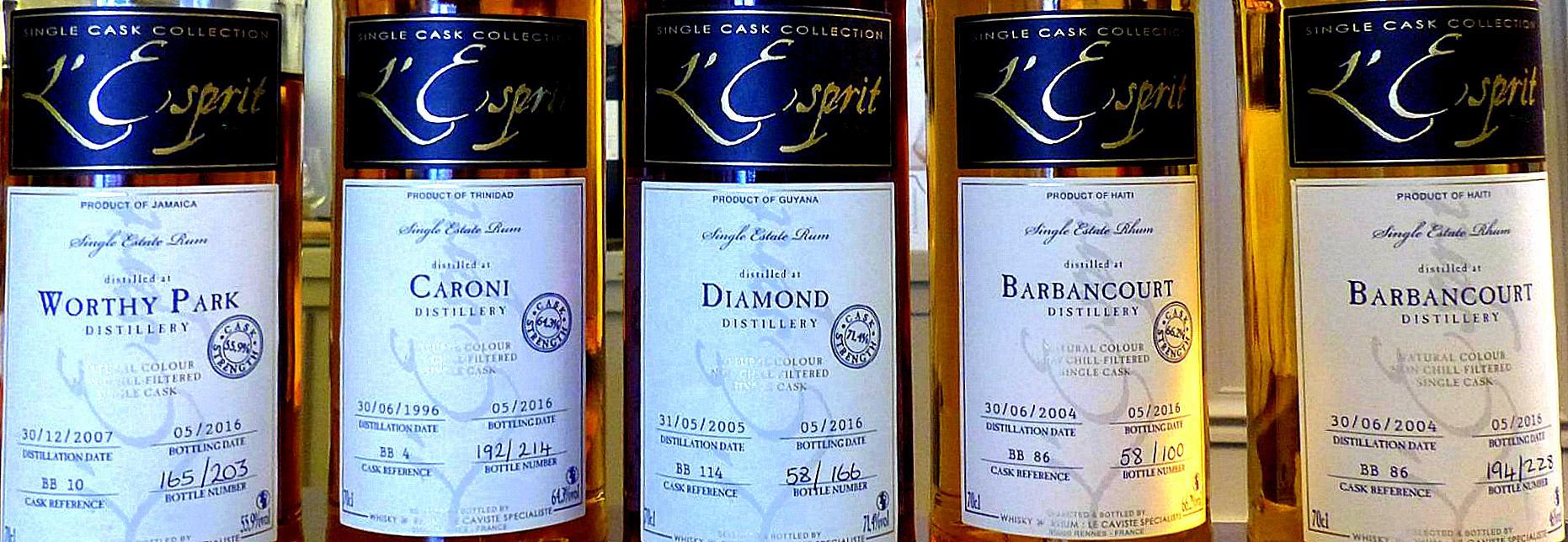
L’Esprit is a small French brand founded by Tristan Prodhomme of mixed Welsh, Scottish and Breton ancestry.  His biography is about as interesting as any I’ve come across.  Strictly speaking, he and his small operation are not into rhums, but whiskies (which miffs me, because I think their relative importance should be reversed, but I can’t have everything, so…).  Somewhat like Don Jose Navarro of Havana Club who gained a degree in thermodynamics and then turned to distilled spirits, Tristan majored in Philosophy before evincing a strong interest in the obscure Scottish tipple, although to that point he had been no more than a dabbler in the field – in other words, he drank it.  In 2003, needing to finance a holiday in Scotland, he ended up working at The Whisky Shop in Edinburgh, and much to his own surprise, did not return to France (Brittany) for four years.  In that time he gained a wealth of experience about the different kinds of whiskies, tasting and selecting and buying them, and something about the fundamentals of the business as a whole.

Photo (c) Whiskyandco.net

By 2007 he was straining at the leash and wanted to return home.  Moreover, he wanted to expand the selection of whiskies available to the French consumers, and he simply could not fathom why, with such a large scotch-swilling population, there were so few stores dedicated to their sale.  He was confident enough by then to feel he could start up his own shop, and set about doing so.  Somewhat like Nine Leaves but without the still, Tristan opened up Whisky&Rhum with his partner, and became the owner, purchasing agent, sales manager, accountant, secretary, designer, webmaster, deliveryman, carpenter, independent bottler, all in one (or two, depending on how you look at it).  Calling himself a specialist, not a generalist, he kept his shelves stocked with what he himself had selected, rather then going on buying sprees and shelling out for everything in sight, a practice of which he disapproves.  This way, one infers, he gets to be able to recommend everything he sells, and knows it by its first name, which may keep sales smaller than an “everything is here” establishment, but permits him to stand behind each and every product he stocks.

Some years later, Tristan remembered his own personal reference rum, the Rum Nation Guatemala 23 year old (for which I have myself been searching for years – it’s one of their earlier bottlings), and in thinking about it, wondered why rum was not as commercialized, or even as well known, as the whiskies were.  Rum had, at this time, just started to take its first real baby steps into its own renaissance, helped by many new bloggers who had become active around this point and were raising the profile of the spirit around the world.  Single-cask full-proof rums “back then” were making small splashes but few ripples, helped along by indies such as Renegade, Silver Seal, Moon Imports, Rum Nation, Fassbind, Samaroli and a few others (in spite of its age, Velier had not yet penetrated the mainstream and changed the game…that came later). But, like others before and after him, Tristan thought that rather than mass produced 40% bottlings everyone drank, he could do better, bootstrapping his experience with The Whisky Shop which also produced their own such variations, the quality of which was always above-par.

Tristan Prodhomme at Paris 2014 RumFest; Photo (c) Whisky-rhum.com – taken from FB page

With this in mind, in 2010 he launched the marque of L’Esprit (“the spirit”, or, “the mind”, which kind of makes sense, right?) with two whiskies and a single rum.  In the following years, for his rums and rhums, he bought one barrel at a time – from brokers, not distilleries, so primarily aged in Europe – and spent time ensuring that what he put on the shelf was something he personally enjoyed.  Because his establishment was still small, he didn’t go the Rum Nation route and never issued hundreds of cases of the rarefied juice at a time, spread out over the entire world.  His expectation and strategy was more modest, and stayed at single casks, at most a couple hundred bottles, and to this day you’ll have to do some legwork to find one outside of Europe in general, and France in particular.  Of course, it’s still whisky that dominates his interest, but in quiet corners of the rumiverse where the grog-blog boys hang out, there are growing whispers that the man makes a decent rhum and it might be worth getting them while they last.

While eschewing filtration and additions of any kind, Tristan doesn’t really go in for the full cask strength experience, preferring to tame the beasts with water – this is why most of his sample kits have a sample bottle with water included.  He believes that dilution is perfectly fine, since “It works!” – it brings out subtler flavours in the spirits, permits perfumes, smokiness, the quieter notes, to shine and become more evident; high-power intensity often masks these.  As a consequence, he prefers a range of 45-50% in his bottlings, though in recent years, bowing to the wishes of the market, he has produced rums that are stronger, always in lots of a hundred, from the same barrels as the lower proofed ones; he noted in an interview that while this is what other shops wanted from him, his own experience was that 46% rums sold much better and were also better value for money in his own estimation, so he produces both.  A proponent of terroire, he doesn’t blindly follow that as a lodestar, and selects the casks he buys primarily because of his notion of their quality, and his own judgement.

That judgement seems to be quite solid: he’s issued rums from Brazil, Belize, Guadeloupe, Trinidad, Barbados, Haiti, Guyana and Jamaica (all the old stalwarts, I like to joke), and it’s likely that as his reputation and brand becomes better known, he’ll expand and go to other countries, issue different variations. Already he has an arrangement to have La Maison de l’Hédonisme distribute his bottlings (including the other drink), and it’s probably just a matter of time before we see more.  There are two shops now, one in Rennes an another in Vannes. DuRhum, ever ahead of the curve, did a feature on the company in 2013, the Rumporter magazine featured his rums twice, Serge of WhiskyFun has consistently rated the rums well (the Caroni got a 91), he was at the 2014 Paris Rumfest showing off his stuff, and there’s no doubt more is coming.

Independent bottlers are not as rare as four years ago when Cyril first wrote about this tiny company and many are much better known.  Most dip from the same well in assembling their single-cask, fullproof rums and rhums – what to some extent marks Tristan out from the others is the slow, patient way he has of improving those casks he buys, incrementally expanding the range and the quality each time.  If the mark of any independent bottler is how much we want to source the earlier rums they made at the beginning of their careers (like Rum Nation’s 1974 Demerara, or Velier’s Skeldon 1973), then I believe that we should pay some attention to L’Esprit as well.  This is a company that, small or not, has potential to grow into something bigger in the years to come, a journey in which I at least, wish the man a lot of luck.


Sources (most are in French):

The list of rums issued as of January 2017 is below.  I’m fairly certain this is most of them, to that point, but it needs updating beyond that date.

Sep 082016
 

300

***

I feel like a literary flea next to someone like Serge Valentin on Whisky Fun, who just published his 12,000th whisky tasting note.  But you know, given the slender reach of my purse, the way I write and the time available to do it all, I’m not displeased with reaching this little milestone.

“About two or three years,” the Last Hippie (who now runs the site AllThingsWhisky) and I remarked to each other many moons ago, when we were discussing longevity. “Maybe a hundred or so rums.”  That’s how long it was thought I’d be able to write for our origin site Liquorature.  I had counted all the rums available in our local stores, and never seriously imagined it could get beyond that. I started writing in mid-2009, began posting in early 2010, and with one break, have kept on ever since.  The hundred rums passed by the wayside, and now, if you can believe it, reviews are into their seventh year, the ‘Caner is passing the three hundredth essay (more if you count the Rumaniacs) and the whole exercise has thrown off branches in all kinds of directions unforeseen at the inception.

Wow.  300 reviews.  I still stand back in astonishment every now and then when I see a number like that.  Such a miniscule output will never impress Serge (640+ rums and counting) or Dave Russell (~380), or whisky sites which boast hundreds, if not thousands of reviews.  Yet I can’t help but thump my scrawny mosquito-physique chest a little, because even though I’m small-fry compared to those guys, I still recall that time when I thought a hundred would be cool to do…and the idea of this many seemed beyond comprehension.

What accounts for it? Well, all kinds of things – a genuine love and interest in the subject, of course.  It’s not a job, really, or anything remotely resembling the drudgery of work.  I don’t have a boss (always nice).  Unlike employment, I actually get (mostly) positive feedback that shows others share this interest, this passion.  People communicate.  And it’s not just enthusiasts, but producers, other writers, bartenders…I’m not a very sociable individual, but I now have more friends, in more countries around the world, then I ever imagined possible, and most are unstinting with advice, samples, corrections, assistance, background materials, commentary, photographs, or just plain old conversation.  It was no accident that Henrik of Rum Corner, Cornelius of Barrel Proof, Gregers and I, were able to talk for six straight hours without repeating ourselves back in 2015, while damaging the hell out of some rums that for their age and price were utterly unobtainable for me back in 2009.  Engagement with the broader community is alternately exasperating or educating.  Most of the time it’s simply fun.

I always have this vision of some guy on a cold winter night, looking at a rum on a shelf, breaking out his phone to scan for a review, reading about it here, sighing at my long-windedness, but then maybe doing a double take, perhaps laughing, and then mumbling to himself, “This s.o.b. ain’t bad.” (Well, okay…I can dream, right?)

So a big thank you for all of you who have taken the time to read along, and who touch base from time to time. It’s not only because of you all, but for you all, that this site keeps running.  

***
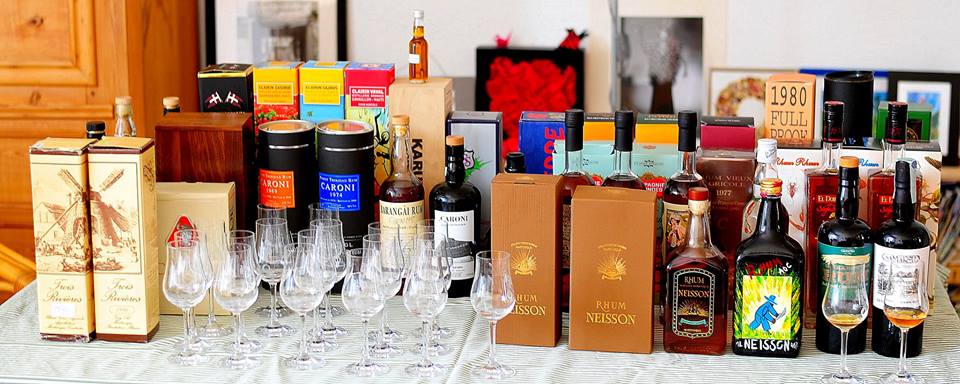
2015 Germany spread

***

Everything below is a review of what’s been happening on the site, some thoughts of my own, and some statistics for those who are curious:

1. Most viewed reviews

The Bacardi 151, which I still think is the funniest, followed by the Velier biography, the latter of which remains the fastest climbing post, ever…it hit a thousand views in under an hour the day I put it up.  The other two highly viewed articles which always surprise me are the Austrian Stroh 80 and the Cuban Guayabita del Pinar, neither of which are sterling standouts or on anyone’s must-have list, yet they keep chugging along, day after day.  Quite astonishing for such niche products.


2. Least read article ever

The Jamel cachaca review (quite recent, so no surprise) and also the Canadian Momento Amber rum, which few would ever have found, let alone bought…it really wasn’t that good, more a backyard rotgut in my opinion. The Renegade Jamaica 2008 is also on the list (and that’s been around for ages), which kinda confirms my opinion that they were ahead of the curve all those years ago, and should have stuck with their special edition rum lines. With the rise of indie bottlers in the last years, they could have maybe been not only one of the pioneers, but in the lead.


3. My favourite rums of these 100, and new discoveries.

Leaving aside all the Velier rums (we all know they’re good, so let’s give somebody else a moment in the sun), here’s what I liked or which enthused me:
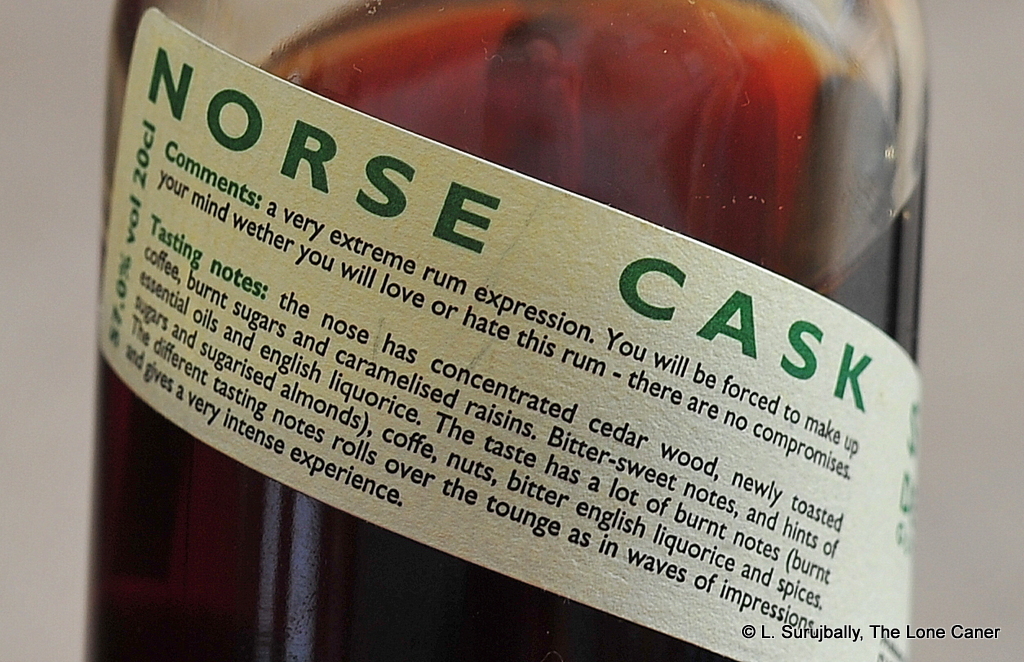
D3S_3789Norse Cask Demerara 1975

An expensive purchase but worth every penny. Over thirty years of ageing of a Demerara rum, leading to a magnificently rich and pungent dark behemoth.  I now wish I had bought the full bottle instead of the smaller (but cheaper) version.  If it had been no more than a raving taste monster dive bombing the palate, that would have been good enough, but when tried in conjunction with the Cadenhead from the same year (at <41%), it became clear why full proofs should be made more often.
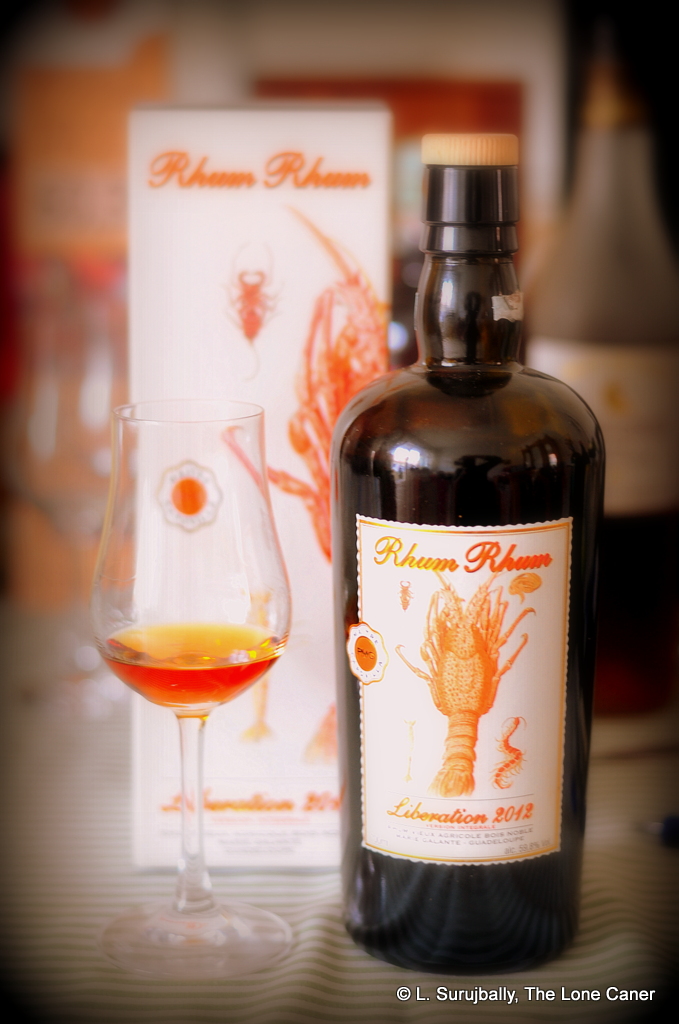
 

D3S_3715Rhum Rhum Liberation 2012 Integrale

If there is ever a choice between the standard strength 2012 and the Integrale 2012, get the Integrale. This thing is an amazing agricole, so good that even regular rummies will have little too complain about. It may be among the best, if not the best, five year old rhum that I’ve been fortunate enough to sample, and proves once again that age is no indicator of quality.


Clairins

Like my father, I mix erudition and peasantry in my character in equal and cheerful doses.  The clairins unabashedly appeal to the lizard brain of the latter. They’re big, brutish, nasty taste hammers, unrefined and uncouth, yet, once we get past all that acetone and paint thinner, we remember something quite remarkable coiling around underneath. Some call that a “unique flavour profile”…I call it pretty damned good, and yes, I know I’m in a minority on this one.
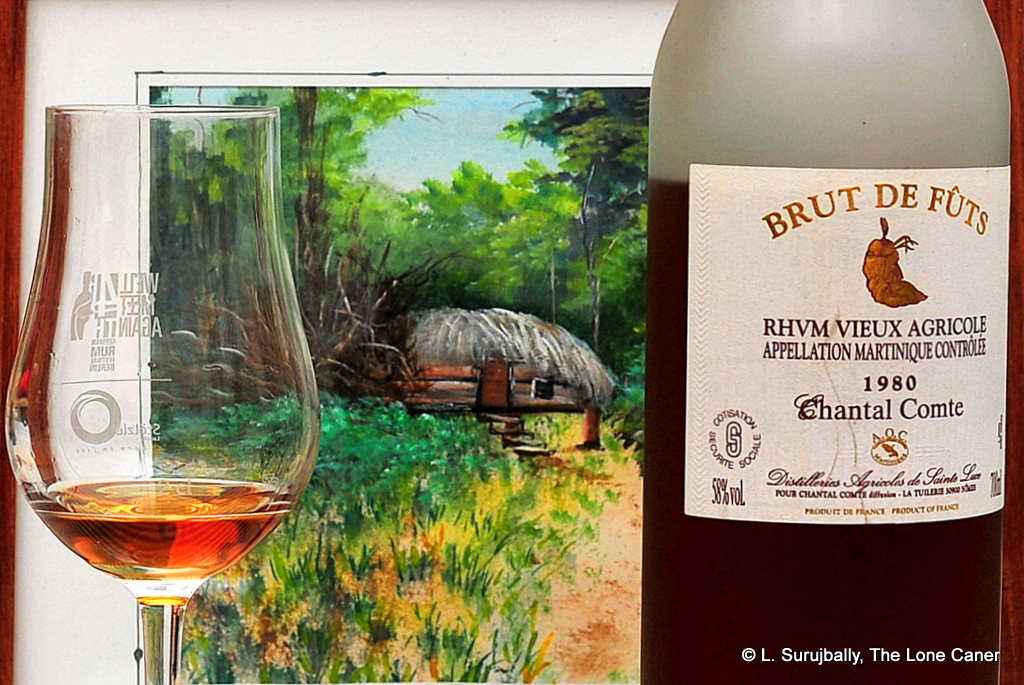
 

Chnatal 1980 2Chantal Comte 1980

Without a doubt, the best sub-ten year old rhum I’ve ever tried.  Ever. At nine hundred euros, it was pricey — okay, it was more than pricey, it was near-divorce-level-pricey (the conversation started “I gave up a Prada purse for this s**t?” at overproof decibel levels, and went rapidly downhill from there).  But man, that combination of sumptuousness and complexity was amazingly tasty, and showcased all the reasons why agricoles are great products we should never ignore just ’cause we never found one we liked.
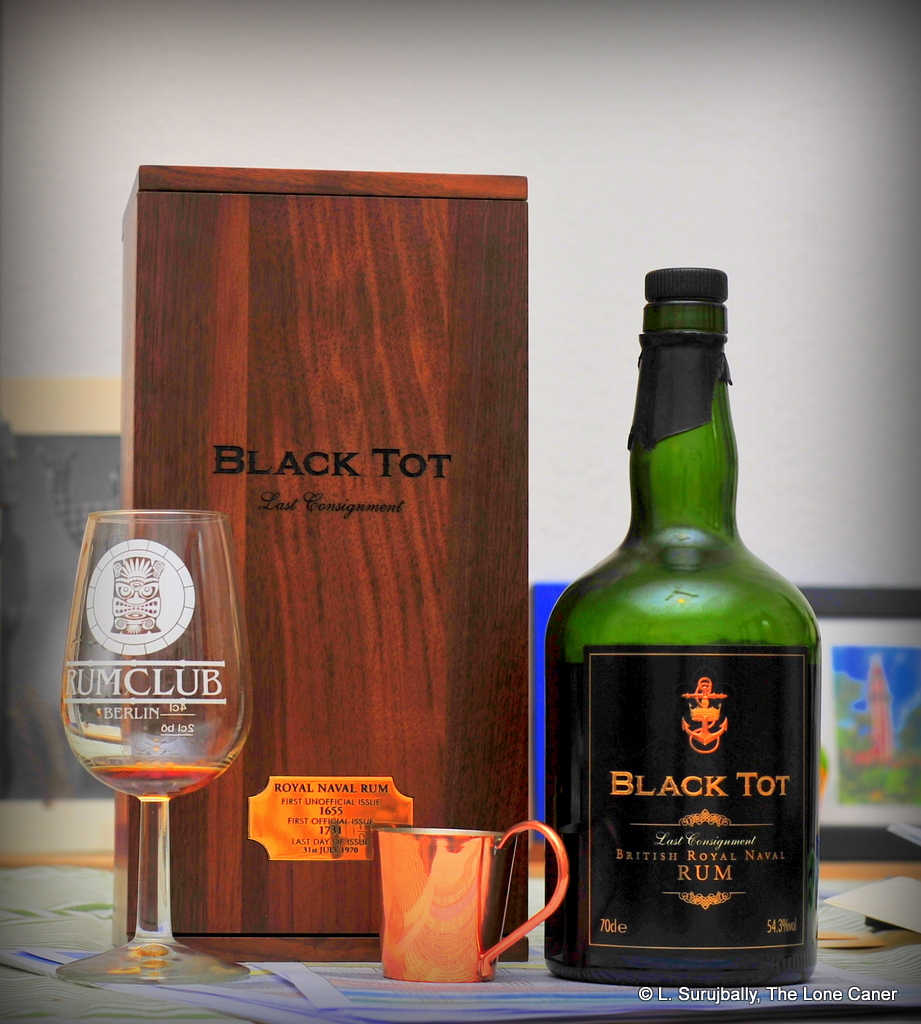
 

Black Tot 1The Black Tot

I appreciate this rum not because of its intrinsic quality – though that wasn’t half bad – but because of its history and heritage.  Sometimes you just get a rum because you want it, and I wanted this one for a long time.
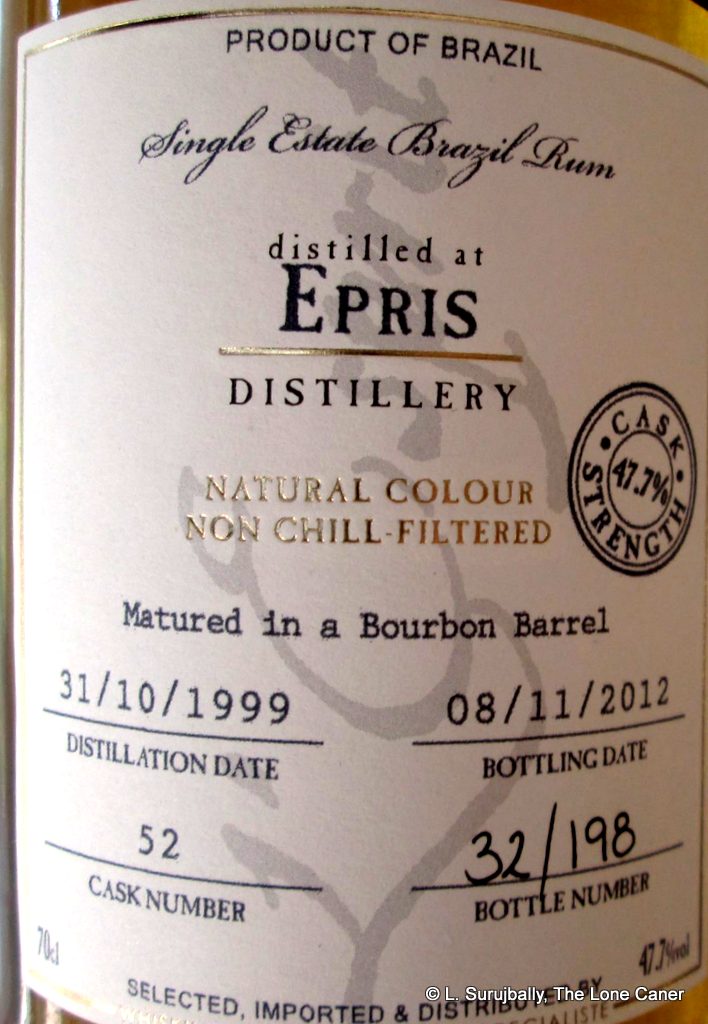


Epris 1L’Espirit Epris Bourbon finished Brazilian Rum

For a small outfit that is practically unknown outside of France, they certainly make some good hooch, these guys.  This one might not have been a true cachaca, yet it exhibited markers of taste and style that was a cut above the ordinary.  Purely on my appreciation of this one rum (provided to me gratis by Cyril of duRhum), I contacted the company to get more, just to see if they were as good as I thought they were.


Compagnie des Indes: Indonesia and Guadeloupe

Undoubtedly my new maker of choice for this one hundred reviews is CDI. I looked at Prichard’s, Nine Leaves, a raft of agricoles, and rums from around the world, and somehow the Indonesia stood out in my memory; and the Guadeloupe, issued at 43% was an excellent and affordable 16 year old rhum. While I may never get all of CDI’s products, I’m sure glad I managed to try these two.

***

4. Other bloggers’ articles

Like any serious interest, writing about rums requires keeping up with the news and issues of the day.  More and more we are seeing bloggers put out informative and thought-provoking essays which enrich our understanding of the subculture.  Here are some of the best articles I read while putting out my own hundred reviews.  The quality of the thinking behind each heightens my appreciation for the writers who take the time to go beyond mere tasting notes and into informative corners of the rumworld which amuse, inform and educate:.

The Cocktail Wonk’s article on E&A Scheer

Matt Pietrek’s essays on the Jamaican distilleries were exercises in depth and detail, and I enjoyed them a lot, not least for the information they provided, but it was the one about E&A Scheer I found the most enlightening.  All of us hear about independent bottlers buying casks from “brokers” without ever going further.  Matt pulled back the curtain on what that actually meant, and how a very old company still provides stock for many of the small companies whose rums we appreciate. An enormously informative and entertaining read.

The Fat Rum Pirate: The World of Independent Bottlings

Wes Burgin from the UK has put out quite a few essays regarding sugar, quality in rums and other issues of the day. I don’t always agree with his arguments, yet that doesn’t invalidate the points he makes, and they always engender valuable discussions.  This one was more factual than opiniated and pulled together many strands of the available information on who and what independent bottlers are.

Josh Miller at Inu A Kena: “Plugging into the Rum World” and the “Cachaca Challenge

Josh and I are in contact off an on through social media, and I usually give him a good-natured ribbing about how he doesn’t write enough.  That’s because I like what he writes, and what he does write is always worth a read.  Two pieces he put out over the last year and a bit are worthy of mention (again): the summary of online websites dedicated to rums and cocktail culture, and the one where he pulled together fourteen cachacas at once to see how they stacked up in a caipirinha. I wrote to him after he published the latter and bemoaned my inability to get that many Brazilian rums at all, at which he laughed and told me his bar is always open to my tasting glass, if I ever get over to San Francisco.

5. Site focus in the next hundred

1. Continuing emphasis on agricoles

Moving into the French-style rumworld opened up huge vistas of enjoyment for me. Like many who started with the usual stuff, I disdained the clear, grassy profiles of agricoles, yet I plugged away and found that they grew on me.  I found more quality rums here than I suspected.  Of course, since I’m closer to Europe than to North America, it’s also easier to find them, and practically the entire French blogging community — many of whom I’m happy to know on a personal basis — is happy to chip in and point me to samples, overlooked gems  and provide information.

2. Leaving the West Indies Behind

Naah…just kidding. The Caribbean will always remain the bastion of the spirit – more rums come from there than anywhere else.  Yet it was and remains intriguing how many local rums there are from other parts of the world. I enjoyed CDI’s Indonesia, didn’t care for the Fijians, and I know there’s stuff from Africa, Australia and Polynesia that many of us have never even heard about. Everyone’s heard of Mount Gay or El Dorado….but it’s the weird ones from, oh, Mozambique, that I want to write about. So for the next few years I’ll be casting a much wider net than before, to see what I can come up with that some might have an interest in.

3. More cachacas

Just as with agricoles, I felt it was time to see what was going on in Brazil.  I’ll likely not have the facility to pick up very many, but I’m trying to buy more than usual, and they will remain a focus of mine for the next few years.  Also, as initially with agricoles, I currently don’t care for them much, so the only way to see whether I’m full of Kraken is to try as many as possible.  Maybe I’ll find the gold nuggets in the mud which I’m absolutely convinced lurk in the backdam, awaiting only a persevering nose to ferret out.

4. More Essays

Maybe.  This is a time issue more than anything else.  Good essays have to express a cogently argued point of view and require a depth of research which takes a lot of time.  But I’ll keep at it.  The Makers section, if nothing else, needs to have more.

***

6. Trends in the rum world I continue to follow

Sugar/Additives

This is an issue that just won’t subside, and never should. It engenders enormous passions on all sides of the divide.  I dislike the hysterical adamance of the purists who sneer at and denounce anyone who likes a sweetened rum, but I’m equally at war with those producers who refuse to disclose additives of any kind under the guise of it being legal.  Legal or not, the consuming class is a far cry from the sheeple who accepted everything as little as five years ago, and it’s vocal proponents of disclosure who are making raising awareness a problem that new entrants to the field cannot afford to ignore.  I can hope, I guess.  Sugar will never go away — it’s too tightly interwoven with the culture of rum — but maybe we can look forward to a day when people get a full brief on what they’re pouring into their glass. People are welcome to like whatever they like, and if we have our way, at least they’ll know why.

Classification

The old standard of grading or classing rums by colour is more or less dead, yet the influential “styles” of Mr. Broome is proving a tougher nut to crack.  As with many things, it’s the adaptation to exceptions that show how good the rules are.  Here, not so much.  More and more we are seeing agricoles issued in other places than the French islands; blends of rums from multiple regions make their appearances more often than before; additives are nowhere to be found; and the difference between pot still and column still rums continue to confound many. Luca Gargano’s system is a step in the right direction, though I still think it does not address outliers satisfactorily, and by ignoring the immediate source of the distillate – molasses, sugar cane juice or “other” – an opportunity may have been lost to win wider acceptance. Still, no matter how it ends up, the issue is definitely getting the attention it deserves.

New Entrants

It’s an old joke that “rum is the next big thing … and always will be”.  Yet nothing suggests the acceptance of the spirit as a class act in its own right as the explosion of smaller micro-producers, especially in the US and Canada, and the surge of independent bottlers in Europe. People are getting fed up with the high price of scotch, maybe, and constant blogging has made everyone aware that rum takes second place to no spirit at the top end. Rum Nation, Plantation, Samaroli, Velier, Moon Imports, Berry Bros., Fassbind…these are decades-old companies who are finding their place in the sun courtesy of a new crop of writers and bloggers who champion their work, but others are muscling into the market as well: L’Espirit, Ekte, Compagne des Indes.  The sheer variety is astonishing and there’s something for every taste, from brute force mastodons at 60% to milder palate pleasers at 40%.

Cask Strength

Nothing pleases me more than the move at the top end to move past 40-43%.  The indies mentioned above were always issuing such rums, of course, in a bottle here and there, and Renegade, who perhaps were ahead of the curve but then dropped out, created one of the first “lines” of rums that took this to 46% in their limited editions.  But perhaps it is Velier we should thank for kicking off the trend, because not only are the majority of independent bottlers now issuing rums at strengths between 50-65% but the big guns like FourSquare, Mount Gay, and DDL are catching on and doing the same.  I look forward to the day when all standard strength rums made by big companies are issued alongside their premium beefcake brothers so consumers can pick one or the other depending on taste.

Truth in Advertising and Disclosure

Too many makers are stuck in the pre-social-media world.  It seems to escape many of them that there is a vocal and knowledgeable community out there that disseminate information faster that was ever possible before. Agreed, most people who like rum simply want an opinion they can rely on (hence the rise of bloggers and online reviewers, since only a fool trusts a company website touting its own quality), but what annoys the Twitterati and Facebook Faithful more than anything else is (a) the lack of disclosure on labels or online materials as to what is actually in the rum, i.e. additives and (b) what the rum is made of, and how, what still, from what raw stock, aged for how long.  Like it or not, people want to know this stuff, which is why Arome (which I have not tried) got an online faceful for being not only evasive but outright condescending.  This of course traces its genesis to the sugar imbroglio from above.

***

And so there you have it.  One person’s ramblings about rum, the rum universe and our place within it. I realize with every passing year that not only will I never taste them all, but can only ever scratch the surface of the sometimes bewildering variety available to us fortunate souls (at a still reasonable cost compared to that obscure Scottish drink). If I were to give a single piece of advice to anyone regarding rum – especially those now getting interested – it’s to never stop with just one, but try many, just to understand how wide an area the rumiverse actually covers. I learn something new every week, make new discoveries and it remains a remarkable experience.

So, walk a little further down the rum road with me.  There’s more coming.  There’s always more coming.

Thanks to all of you who have read not only this far in this essay, but overall.  Your comments and visits are valued, and welcome, and appreciated.

All the very best


The Lone Caner

Jan 262016
 

cdi-logo

***

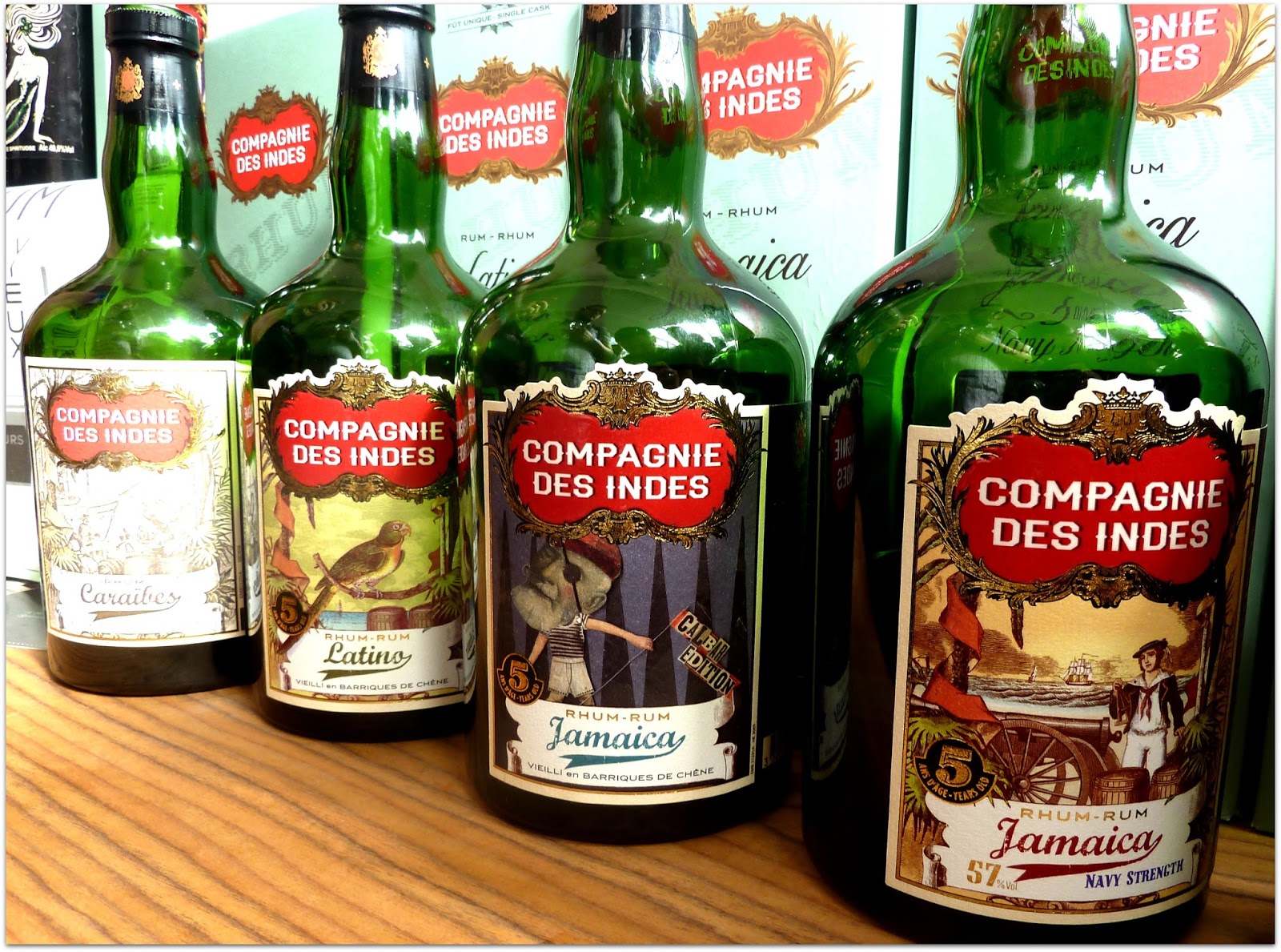
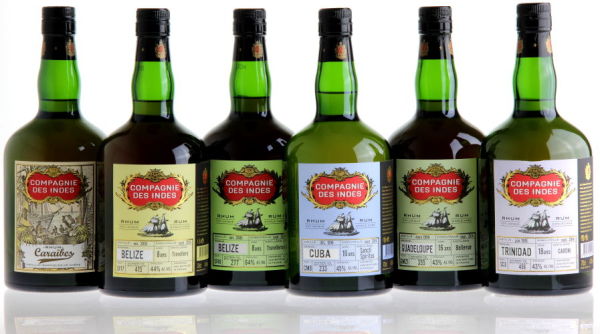
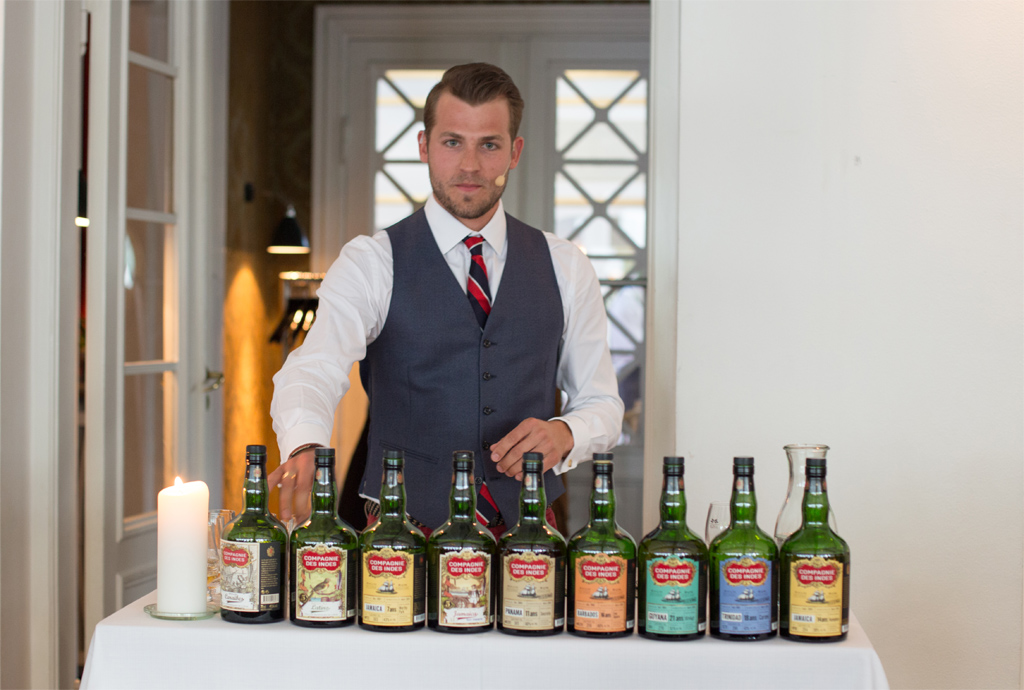
For a company in existence for such a short time, it’s quite impressive what a wide range of rums Compagnie des Indes (which translates as the East India Company, hereinafter referred to as CDI) has managed to put out the door.  As of the 2015 release season, fourteen separate countries are represented (2 from east of Greenwich).  Unlike the trend in the USA and Canada, where creating one’s own new distillery and brand  is more common, in Europe it’s always been more about being an independent bottler (or re-bottler, I suppose).  Such enterprises don’t want to reinvent the wheel or invest in technology – though this does in fact happen as well, of course (e.g. Severin Simon in Germany).  Their strategy is to exhaustively seek out barrels from either source or broker, maybe age them a little more somewhere, and then issue them under their own label, usually in limited quantities of less than a thousand bottles per release.

While it could be argued that this hardly makes them cradles of innovation, it’s tough to fault the results when we can so rarely find the source distillers daring to go in the full-proof direction.  Until very recently, when was the last time you saw St. Lucia Distillers, FourSquare, Appleton, Mount Gay, Angostura, Travellers, Abuelo, Bacardi, Flor de Cana or other major brands, go the cask strength route in anything but their overproof 151s?  So smaller companies, whose founders often emerge from a whisky background, tend to be more into the full proof concept which has only recently started to gain great recognition in the rum world.

Such a person is Florent Beuchet, who pursued international business studies with a specialization as an International Trade Master of wine and spirits in Dijon, France.  After working part time for his father, who himself was a winemaker and ran a small distillery making absinthe and aniseed, Florent became the brand manager for Banks in New York in 2011 (his family owned shares in the company, and Florent’s father acted as a consultant for it).  This lasted for close on to two years, after which he bought a small spirits trading company he named “Diva Spirits” in 2013. This outfit dealt with the import and export of wines and spirits between Europe and the USA, and built on a network his father had created over the previous thirty five years.

cdi logo 2

Photo (c) L’homme a la poussette

While his studies had focused primarily on wines, Florent realized after working with Banks that rum interested him rather more: partly this was its versatility (read: absence of rules) but also because he saw that the concepts of terroire, distillation, ageing and blending were readily applicable to rum just as they were to wine.  More, he sensed that while the Europeans had a rather more sophisticated view of rums than Americans did, many still labored under the impression that it was a disreputable sort of drink, cheaply made, good only for a mix, and very sweet. The potential of exactingly made rums from single casks issued at full proof was still gathering steam (online reviews of rums made to precisely those specs were just beginning to appear at this time, if you discount Serge Valentin, who’d been issuing notes on them since 2010, and modesty be damned, some of them were mine).  So he saw an opening in the field that to this point had been dominated by Samaroli, Rum Nation, Velier, Moon Imports and others, few of which had the visibility and cachet they acquired in the subsequent years.

Seeking to put his ideas into practice, he formed CDI in March of 2014, in France. He sourced the rums he wanted via brokers in Holland and the UK, chose only unadulterated rums, and eschewed Rum Nation and Velier’s practice of going directly to the original distilleries in person to root around the warehouses seeking the perfect barrel (as of 2016, he has only been to Cuba, oddly enough).  The label design, with its old fashioned seal and fancy stylistic touches at the top was a calculated decision on his part – he wanted to provide something of the atmosphere and heritage of old times, sailing ships and galleons and parchment (one wonders how the famous aphorism of rum, buggery and the lash figured in his thinking, but never mind). It’s noteworthy that he had taken a sense of the room, and understood the need for providing clarity and information – and so each label also had a Velier-style section at the bottom on age, source, strength and barrel.

He also doesn’t hide that he is a disciple of honesty in rum making. He has little patience for the solera style of rum making, which he sees as dishonest way to market what is actually a blend with a misleading age statement; and he disdains rectified column-still spirit that is added to with flavourings and sugars and fancy backstories to disguise the fact that it is a commercial low end “rum”…and is then sold to an unsuspecting public as a real rum, when its artificiality is self-evident.  In that he is a follower of Richard Seale and Luca Gargano (among others), who have long championed pure rums and label disclosure.

cdi rums

Photo (c) Whiskyleaks.fr

His initial offerings from that year into the market were modest: first a Caribbean blend, then two Belize rums (same source, different strengths), a Cuban, a Guadeloupe and an 18 year old Caroni.  From the outset he knew he was going after unadulterated, pure rums, but felt that to make any kind of initial splash he perhaps had to compromise the principle, and so has added 15g/L of organic liquid cane sugar to the Caraibes blended rum and the 2015 release of the Latino, as well as 10g/L to the “Calbar” Jamaican (but to none of the others). To his credit, this information is disclosed and he makes no secret of it. (And given the RumDiaries take on the Caraibes, Florent may have been right, though Josh of Inakena disagrees, finding the dosing too obvious; current releases of Caraibes no longer have any sugar). Age is also exactly what it purports to be — meaning the true age of the rum in barrels; and even in the blends, it is never the oldest, but always the youngest portion of the blend which is noted.

Issued to the European market, sales were positive and encouraging.  In April 2015 I tried the Cuban 15 YO in Paris, and was mightily impressed, scoring it at 88 points, and remarking that “…If this is anything to go by, CDI is going to take its place among the craft makers whose rums I want to buy. All of them.” My purse and my time are limited so I have not been able to try as many as I would have liked, but certainly the customer response was gratifying enough for CDI to expand into a larger selection in 2015, when they added rums from Martinique, Barbados, Fiji, Haiti, Jamaica, Panama, St. Lucia and Indonesia to the mix.

The Haitian rhum was intriguing, what with the recent upsurge in interest in clairins issued by Velier; Fiji has some tongues wagging…but the Indonesia rum in particular excited quite a lot of interest because it was so unusual (and because the distillery was not disclosed) – Florent wanted to recreate something of the flavor of Batavia Arrack, one of the progenitors of rum, and whether or not he succeeded, I don’t know – I just know I liked it quite a bit. Jamaica was also a good issue, because most lovers of the funky style are more familiar with Appleton’s work, not Hampden or Worthy Park, or New Yarmouth which was issued in 2017.  So certainly CDI is putting some interesting footprints into the sand of the rum world, and showing that while the trailblazers like Renegade, Samaroli, Rum Nation and Velier provided and continue to make many amazing rums for the consuming public, there remains space for new companies with a slightly different ethos to make their mark and provide greater variety of rums for us all to try.

A peculiar divergence from the norm is the rums issued only in the Danish market.  These are some of the rums certain to pique the interest of the cdigreater rum loving public – especially the aged Guyanese rums and the cask strength 60% Panamanian, which is surely quite an unusual product (I honestly can’t remember when was the last time I saw a full proof Panama rum).  Henrik of RumCorner, as helpful as always, and who had spotted me the CDI Guadeloupe from there which I have to write about soon, informed me that “…those releases were done in collaboration with the Danish distributor. Denmark is one of the fastest growing markets for premium and ultra premium rums, so they asked CDI for some limited cask strength products and voila. In my opinion the Barbados FourSquare 60% rum [for example] really shows what is possible at high strength in comparison with the standard issue 40% horde.”  Florent confirmed that, remarking “Once I started selling single cask to Denmark, my importer and his team told me that they’d like to know if I could bottle rums at cask strength. I told them that I could but due to duties, the prices in France would be too expensive and they wouldn’t sell so that they would have to buy the whole cask. [They did.] That’s why I decided to mention on the label that it was only bottled for Denmark…[Denmark] has quite an educated brown spirit clientele that are willing to pay a lot for pretty exclusive bottles. That’s mostly the story.” 

So where to now? Promotion and marketing will be a big focus.  Florent thinks traditional magazine space is too expensive, and prefers to engage with the public at festivals (which is where I met him and bored him to tears – twice), as well as using social media to interact with his customers.  That’s usually where he can be found lurking.  He will continue to have all his packaging, corking, labelling etc, done in France.  Ageing of his selected barrels is primarily in Europe, though some tropical ageing does take place.  In that he departs from Velier, who championed in-situ tropical ageing because of the accelerated maturation and richer flavour profiles they so preferred; Florent believes that wood takes on an dominance under such conditions, which replaces subtler, fruitier notes which he likes better. (Steve James’s review of the Barbados 16 YO made mention of this difference which he attributed to the ageing regime.)

CDI Florent

Florent in Berlin RumFest, 2015.

The year 2016 suggested that the Danish market full proof editions were no mere flash in the pan.  Whether more were issued for them, or the clamour to have a wider distribution of rums bottled at >50% was acted on, the fact is that the 2016 releases sported no fewer than twelve rums bottled at cask strength (most at around 60%).  Maybe some kind of “twinning” is being worked on, where a standard table strength rum is issued with its mate offered to the cognoscenti at a higher proof point – this makes for higher prices since the volume issued would be less, but it seems as though Florent has sensed a market opportunity here and is working on maximizing it.  Blends which tread the path of the Caraibes will also continue, with rhums like the Tricorne and Boulet de Cannon being issued at intervals. And there’s also a flavoured/spiced rhum called Darklice (licorice and other additions, and the name is evocative if nothing else) added to the stable, which is his first foray in that direction.

The current stable of countries will be expanded upon in the future (2018 and 2019 saw additional rums from Venezuela and Australia join the lineup, for example), though of course there will continue to be releases from each of the existing rum producing islands in the Caribbean.  And just to say “Martinique” is an oversimplification, since one rhum from there that CDI issued was from Dillon and another from Simon, and that is a small percentage of the distilleries over there.  So while they are more expensive than rums from the English and Spanish Caribbean, they can’t be ruled out for more releases, and of course there will always be rums from Barbados, Trinidad, St. Lucia, Guyana and Jamaica to beef up the portfolio.

My own hope is that he won’t be seduced by the sales of the spiced and blended variations of his line, but will sleuth out little known islands and distilleries and geographical regions and do what Luca has done – bottle and promote rums we haven’t seen in a while, or ever, which we’d like to try and which exemplify the global reach of the spirit.  They may not all be the best available (Fiji did not find much favour with me, sorry), but you have to give points to the new kid on the block, who’s really doing something interesting for rum.  That’s worth ten truckloads of Don Papa right there.

***

References:

  1.       Personal conversations and emails and messages with Florent Beuchet
  2.       Interview with FB by whiskyandco.net
  3.       ReferenceRhum.com
  4.       Posts on CDI Facebook page
  5.       Tiare’s post on A Mountain of Crushed Ice
  6.       Rumporter
  7.       Rumconer.dk
  8.       4FineSpirits.de interview with FB
  9.       Online posted interview with FB by Joerg Meyer (2016)
  10.       Rumporter October 2016 article
  11.       Company site

A list of rhums issued by CDI as of May 2019 is below.  As always, if you know something has been missed, send me a correction with the specs.

  • Australia 11 YO 2007-2019 43% #ASS53 (Secret Distillery)
  • Barbados 12 YO 2003-2015 45% #BD91 (FourSquare)(323 bottles)
  • Barbados 12 YO 2003-2015 45% #BD92 (FourSquare)(302 bottles)
  • Barbados 16 YO 1998-2015 45% #BD24 (FourSquare)(354 bottles)
  • Barbados 16 YO 1998-2015 45% #BD36 (FourSquare)(363 bottles)
  • Barbados 16 YO 1998-2015 45% #BD47 (FourSquare)(351 bottles)
  • Barbados 16 YO 1998-2015 45% #MRS236 (FourSquare)
  • Barbados 16 YO 1998-2015 60% #MRS235 (FourSquare)(Denmark only)
  • Barbados 20 YO 1998-2016 45% #BYR5 (Multiple distilleries)
  • Barbados 16 YO 1999-2016 62% #FS8 (Foursquare)
  • Barbados 16 YO 1999-2016 62% #FS9 (Foursquare)
  • Barbados 16 YO 1999-2016 62% #FS20 (Foursquare)
  • Barbados 9 YO 2006-2016 62.1% #MB45 (Foursquare)
  • Barbados 9 YO 2006-2016 62.1% #MB46 (Foursquare)
  • Barbados 9 YO 2006-2016 62.1% #MB47 (Foursquare)
  • Barbados 10 YO 2007-2018 62.9% #BFD019 (Foursquare)
  • Barbados 10 YO 2007-2018 43% #BFD014 (Foursquare)
  • Barbados 10 YO 2007-2018 62.1% #BFD015 (Foursquare)
  • Belize 8 YO 2005-2014 44% #B86 (Travellers) (400 bottles)
  • Belize 8 YO 2005-2014 44% #SF17 (Travellers) (415 bottles)
  • Belize 8 YO 2005-2014 64% #SF48 (Travellers) (277 bottles)
  • Belize 11 YO 2005-2016 66.2% BL11 (Travellers)(Cask Strength)
  • Belize 10 YO 2006-2016 TBA% #TBA (Travellers)
  • Belize 10 YO 2006-2016 TBA% #TBA (Travellers) (Cask Strength)
  • Brazil 16 YO 2000-2016 43% #BR10 (Epris)
  • Boulet de Canon No. 1 2015 46% (blend Guy/Bar/T&T)
  • Boulet de Canon No. 2 2016 50% (blend Guy/Bar/T&T)
  • Boulet de Canon No. 3 2016 50% (blend Guy/Bar/T&T)
  • Boulet de Canon No. 4 2017 46% (blend Guy/Bar/T&T)
  • Boulet de Canon No. 5 2017 46% (blend Florida rums)
  • Boulet de Canon No. 6 2018 46% (blend Nicaragua/Panama)
  • Cuba 15 YO 1998-2014 45% #C67 (Sancti Spiritus) (280 bottles)
  • Cuba 16 YO 1998-2014 45% #CM5 (Sancti Spiritus) (232 bottles)
  • Cuba 16 YO 1998-2014 45% #CM8 (Sancti Spiritus) (280 bottles)
  • Cuba 16 YO 1998-2015 45% #CM34 (Sancti Spiritus)
  • Cuba 18 YO 1999-2017 45% #CSS11 (Sancti Spiritus)
  • Cuba 18 YO 1999-2017 59% #CSS7 (Sancti Spiritus) (Denmark only)
  • Darklice Blend 2016 46% (Guy/Bar/T&T) + licoriced water
  • Dominidad No. 1 15 YO 2000-2016 43% #SB1 (Small Batch)(33% 15YO DR / 67% 16YO T&T)
  • Dominidad No. 2 15 YO 2000-2016 43% #SB2 (Small Batch)(33% 15YO DR / 67% 16YO T&T)
  • Dominidad No. 3 16 YO 2002-2017 43% #SB3 (Small Batch)(33% 15YO DR / 67% 16YO T&T)
  • Dominican Republic 15 YO 2000-2016 64.9% #RDV 3 (Various)
  • Dominican Republic 13 YO 2003-2017 46% #RDM 1 (Various)
  • Dominican Republic 16 YO 2001-2017 62% #RDV 2 (Various)(Denmark only)
  • Dominican Republic 8 YO 2010-2019 43% #DRA3 (AFD. (Acoholes Finos Dominicanos))
  • Dominican Republic 8 YO 2010-2019 62.1% #DRA6 (AFD. (Acoholes Finos Dominicanos))
  • El Salvador 9 YO 2007-2018 43% #A46 (Cihuatan)
  • Florida 13 YO 2004-2018 45% #FMSC1 (Distillery Unknown)(finish Moscatel Cask)
  • Florida 14 YO 2004-2018 44% #FMM21 (Distillery Unknown)(finish French Whisky Casks)
  • Guadeloupe 16 YO 1998-2014 43% #GM 21 (Damoiseau/Bellevue)(355 bottles)
  • Guadeloupe 16 YO 1998-2014 43% #GM 32 (Damoiseau/Bellevue)(355 bottles)
  • Guadeloupe 16 YO 1998-2014 43% #G 51 (Damoiseau/Bellevue)(300 bottles)
  • Guadeloupe 16 YO 1998-2015 43% #CG 91 (Damoiseau/Bellevue)
  • Guadeloupe 16 YO 1998-2015 43% #CG 1704 (Damoiseau/Bellevue)
  • Guadeloupe 17 YO 1998-2015 43% #CG 14 (Damoiseau/Bellevue)
  • Guadeloupe 18 YO 1998-2016 55.1% #GMB57 (Damoiseau/Bellevue, Denmark Only)
  • Guadeloupe 20 YO 1998-2018 43.1% #PLG79 (Pere Labat)
  • Guatemala 9 YO 2007-2016 43% #GOS16 (DARSA)
  • Guatemala 8 YO 2009-2017 58.5% #GDS12 (DARSA) (Denmark only)
  • Guatemala 8 YO 2009-2017 59.1% #??? (DARSA) (Denmark only)
  • Guyana 10 YO 2005-2015 58% #WPM 75 (PM Still, Denmark only)
  • Guyana 13 YO 2002-2015 59% #WPM 36 (PM Still, Denmark only)
  • Guyana 13 YO 2002-2015 58% #MPM 35 (PM Still)
  • Guyana 13 YO 2002-2015 43% #MPM 63 (PM Still)
  • Guyana 21 YO 1993-2015 56% #GU 4 (Uitvlugt Still, Denmark only)
  • Guyana 24 YO 1990-2015 58.1% #MEY 04 (EHP Still, Denmark only)
  • Guyana 12 YO 2003-2016 45% #MSG6 (Diamond)
  • Guyana 12 YO 2003-2016 45% #MSG15 (Diamond)
  • Guyana 12 YO 2003-2016 45% #MSG16 (Diamond)
  • Guyana 12 YO 2003-2016 45% #MSG17 (Diamond)
  • Guyana 10 YO 2005-2016 57.5% #MPM18 (Port Mourant, Romhatten only)
  • Guyana 18 YO 1997-2016 45% #MGA4 (Uitvlugt)
  • Guyana 18 YO 1997-2016 57.9% #MGA5 (Uitvlugt, Denmark only)
  • Guyana 27 YO 1988-2016 52.7% #MEC7 (Enmore, Denmark only)
  • Guyana 14 YO 2003-2017 43% #GDD40 (Diamond)
  • Guyana 9 YO 2008-2017 59% #GYD71 (Diamond, Mahlers Vinhandel DK only)
  • Guyana 11 YO 2007-2018 60% #Gxxxx (Armagnac finish)
  • Guyana 10 YO 2010-2018 43% #GPM51 (Port Mourant)
  • Guyana 29 YO 1988-2018 48% #GEN2 (Enmore)
  • Latino 5 YO 2010-2015 40% (15 g/L sugar)
  • Latino 6 YO 2010-2017 46% (finish Vosne-Romanee red wine cask)
  • Nicaragua 11 YO 2004-2016 69.1% #SN18 (Distillery unknown)
  • Nicaragua 17 YO 1997-2015 64.9% #NCR30 (Distillery unknown)
  • Nicaragua 12 YO 2005-2017 66% #NS10 (Distillery unknown)(Denmark only)
  • Oktoberum 5 YO (2016)
  • Panama 11 YO 2004-2015 60% #MRS 255 (Distillery unknown)(Denmark only)
  • Panama 11 YO 2004-2015 44% #MRS 263 (Distillery unknown)
  • Panama 11 YO 2004-2015 44% #MRS 322 (Distillery unknown)
  • Panama 11 YO 2004-2016 61.5% #PMD 43 (Distillery unknown)
  • Panama 9 YO 2008-2017 43% #PSC 8 (Distillery Unknown)
  • Panama 9 YO 2008-2017 43% #PSC 77 (Distillery Unknown
  • Panama 13 YO 2004-2017 56.9% #PS 99 (Distillery Unknown)
  • St. Lucia 13 YO 2002-2015 43% #SLD 84 (St. Lucia Distillers)
  • St. Lucia 13 YO 2002-2015 56.3% #SLD 46 (St. Lucia Distillers)(Denmark only)
  • Trinidad 16 YO 2003-2019 63.5% #TLBF15 (TDL)
  • Trinidad 13 YO 2005-2018 45% #TT035 (TDL)
  • Trinidad 15 YO 2003-2018 44% #TTW9 (TDL)
  • Trinidad 20 YO 1998-2018 59.8% #TTCR14 (Caroni)
  • Trinidad 23 YO 1993-2017 53.1% #TCC3 (Caroni)
  • Trinidad 25* YO 1991-2016 56.2% #TP8 (Caroni)
  • Trinidad 22 YO 1993-2016 48% #TC4 (Caroni)
  • Trinidad 16 YO 2000-2016 63.6% #TT 96 (TDL)
  • Trinidad 24 YO 1991-2015 56.3% #SC 2 (Caroni)
  • Trinidad 21 YO 1994-2015 57.8% #SC 707 (Caroni)
  • Trinidad 19 YO 1996-2015 53.2% #SC 1 (Caroni)
  • Trinidad 18 YO 1996-2015 61% #SCT 9 (Caroni)
  • Trinidad 18 YO 1996-2014 43% #SC 3 (Caroni) (456 bottles)
  • Trinidad 18 YO 1996-2014 43% #SC 2 (Caroni) (456 bottles)
  • Tricorne Unaged White Rum 2016 43% (Blend cane juice/molasses/arrack)
  • Venezuela 12 YO 2006-2018 43% VCA 1 (Corporation Alcoolés del Caribe (CADC))
  • Venezuela 12 YO 2006-2018 58% VCA 5 (Corporation Alcoolés del Caribe (CADC))
  • Venezuela 16 YO 2003-2019 63.5% VNT 61(Corporation Alcoolés del Caribe (CADC))
  • Veneragua 13 YO 2005-2018 45% (blend, 3 barrels Venezuela + 2 NIcaragua)
  • West Indies Blended 8 YO 2010-2018 40% (blend of Bdos, DR, Pan, Guy)

*Miscalculated as 26 YO on label

Oct 022015
 

asterix

***

I challenge anyone to read the adventures of the two indomitable Gauls, Asterix and Obelix, and not bust out into a belly laugh at least once. Much like Herge’s Tintin, there’s a peculiar flavour to these illustrated graphic novels (for this is indeed what they are – it would be incorrect to deem them mere “comics”) which American illustrators of humour have, for the most part, lost or abandoned – the ability to write and draw a story that is more than just a four strip daily funny, and make it long, absorbing, hilarious and riveting, stocked with a pantheon of characters that not only act funny, talk funny, but are named funny.

As with Tintin, there are many favourites of the series, held by many people – I’ve always preferred the first ten or so myself, and for the purposes of this essay, I don’t think I’ll touch on any in  particular, though Asterix in Britain is a perennial goodie and I always enjoyed Asterix and the Goths, Asterix in Switzerland, Asterix and the Great Crossing, Asterix the Gladiator and Asterix at the Olympic Games.

A short review of the situation is as follows.  It is 50BC.  Ceasar has conquered Gaul.  All?  No…one small village of (you got it) indomitable Gauls holds out against the roman legions by virtue of their druid’s ability to brew a potion that grants them superhuman strength.  So the Romans surround the village with four fortified camps named (and here we start with the naming) Torturum, Aquarium, Laudanum and Compendium.  There are various Romans throughout the series with awesome names like Chrismus Bonus, Marcus Ginantonicus, Gluteus Maximus, Arteriosclerosis, Gastroenteritus…I could go on but you get the picture.

The Gauls in this village all have names ending in “-ix” (a nod to Vercingetorix, a real Gaulish chieftain who surrendered to Caesar), and are a smorgasbord of rib ticklers: Vitalstatistix, the chief; Fulliautomatix the blacksmith (son of Semiautomatix); Geriatrix, the oldest guy in the village who somewhat improbably has a young and lusciously drawn, never-named wife; Unhygienix the fishmonger (son of Unhealthix) with a wife named Bacteria…and of course the titular hero Asterix, Getafix the druid and Dogmatix, the tree-loving little dog Asterix’s best friend Obelix loves.

These laughing, fighting Frenchmen go on to have some of the most unusual adventures in comic books, and in the ancient world – they go (variously) to Switzerland, Britain, America, Spain, Germany, Corsica, Paris, Rome, the Olympic Games, Egypt, even the Middle East – and in each case they meet a colourful cast of supporting characters who are uniquely drawn and have quirky characteristics of their own that reflect something of their national cliches.  Take, for example the Brits and their stiff upper lip and love for having a cuppa in the middle of a battle; the Egyptians and their predilection for obscure (and ginormous) architectural monuments.  I’ll grant you that stereotyping is rife throughout the series – but I see it more as a gentle nudge and wink from the authors than anything malicious or demeaning.

Part of what gives these adventures their charm is the ongoing gags throughout the various iterations: Obelix’s continual efforts to be allowed to drink some magic potion (since he fell into the cauldron as a baby he is permanently super-strong and Getafix won’t allow him to have any more); the inevitable thrashing, bashing or stringing-up which Cacofonix the bard gets any time he wants to sing; the rivalry between Unhygienix and Fulliautomatix; Obelix’s love of collecting legionary helmets (with or without Romans still attached) and eating boars; the pirates on the high seas whose father-son team (never named) have these hilarious conversations (the crippled son always speaks in pig latin), occasionally interspersed with gloomy commentary from the black lookout in the crow’s nest who keeps getting a “sinking feeling.”

Whether you accept and love the series depends on your sense of humour, I think, and whether you feel comics or colourful graphic novels of this kind are a suitable vehicle for slapstick and gags and puns and laughs. My recommendation would be to get them, and keep them and reread them every so often, and share generously. For my money, they are among the funniest, best examples of comic book humour ever drawn, and every time I read one, I feel myself shedding a few years, and becoming a kid again, and laughing just as hard as the first time.


Aug 252015
 

Bloggers 1

Bloggers 2


“I don’t read a lot of blogs because, well, most of them are written by people who aren’t qualified to piss in the ocean,” remarked Ed Hamilton on his blog The Ministry of Rum on July 7th 2015.  To say I was surprised at such a blanket indictment of the majority of the rum blogging community would be an understatement.  He’s not the only one to make such a statement in the recent past: when I wrote a five part series on how to start reviewing rums earlier this year, in an effort to provide some advice on new bloggers who often cease operation after a short while, I got a snarling response from another writer, who suggested that there are too many incompetents writing as it is (myself among them) and more should not be encouraged.

I simply don’t understand this attitude.  It originates from persons who themselves write a lot, opiniate even more, and have a large body of words on their sites (which obviously pass muster by their own definitions of “qualified”), yet they seem to feel that almost all other websites, discussions, opinions and reviews, are a waste of internet space.  I can sort of understand Sir Scrotimus Maximus in Retirement Land, since he despises everyone (and spews a vomitus of condescending and negative opinions just about every day), but Mr. Hamilton, for whom I have a great deal of respect, is a more puzzling enigma.  Especially given his well-known dedication to rum, and the oft expressed moan abut rum not having enough visibility and fighting an uphill battle against other more established tipples.

To make my own position clear: I myself have nothing but distaste for short, ignorant, non-knowledgable click-bait written by writers for online spirits magazines (see here, here, here, here and here for some examples).  Too often they display an abysmal ignorance of rums in general, and make lists of rums that would be amusing if they weren’t so uninspiring.  But I don’t think this is what Sir Scrotimus or Mr. Hamilton were referring to.  Nor do I believe that they are talking about news stories.  Or cocktail sites and writers for them. No, when they refer to monkey mutterings and blogs, they are talking about reviewers.  And since I’m one of them, I think I’ll take up cudgels on behalf of myself and others in my field.

To begin with, who qualifies as a “good” writer?  For my money, this would be someone who writes with prose that engages the reader; who has a good understanding of the industry; who crafts decent tasting notes on the rums that are tried; expresses an informed opinion; has a body of rums to refer to, and self-evidently is involved in not only increasing his own knowledge but that of his readers.

Are there truly none of such writers around? Sure there are.  Henrik from Denmark keeps getting better all the time and that’s in his second language; Marco Freyr from Barrel Aged Mind in Germany is a historian par excellence with enormously detailed articles on the rums he tries; Josh Miller of Inuakena writes well, tastes well and goes far afield whenever it pleases him; Cyril from duRhum fills in with great reviews of more obscure fare, especially agricoles; Steve James of Rum Diaries writes great reviews in depth; The Fat Rum Pirate writes accessible notes for the common man with lots of opinions and off-hand facts, primarily for the UK crowd, and lovingly tends to the low-end and mid-range.  I enjoy Laurent’s work on Les Rhums de l’homme à la Poussette. Dave Russell of the Rum Gallery is a long running stalwart, and while Chip and I happily trade emails back and forth about our differences in opinion, the man does put out a welter of rum reviews that North Americans in particular take seriously.

Why do we need more of such people?

Because, dear reader, there still aren’t enough. Not really.  Excluding cocktail blogs which speak to rum as a secondary enterprise, there are less than twenty focused rum reviewing sites in the whole world. I can’t think of many which are run on a commercial basis.  And yet we constantly complain about rum taking second place to whisky in the minds of the tippling class, not having exposure, people not “getting” the variety it represents.  Well, having more writers who raise the profile would therefore be a good thing, wouldn’t it?

It is online writers like Johnny, Cyril, Dave and Wes who are spearheading the fight against improper labeling, undisclosed sugar and additives and outright deceptive marketing practices. Would less reviewers have the same effect? Not at all.  Because then we’d just be left with the polarizing negativisms of Sir Scrotimus.

We also need more writers because they are the ones who call attention to the rums of the world in a time of declining advertising budgets and quality magazine writing about rums. Yes there’s the RumPorter, and yes there’s Got Rum…but there are scores of such publications on whisky or wine, so we’re supposed to be happy with a mere handful  on our tipple of choice? Hell no.  We need dozens, not just a couple. Reviewers, bloggers and online writers fill this void. You can disagree with what they write, but at least they’re out there providing information. Why would having fewer somehow be seen as better?

Even assuming the statements of these two gentlemen were correct (and I dispute that) they both ignore the obvious question: where are the “qualified writers,” if the ones I mentioned above aren’t representative? No please, educate me.  Who are they?  For whom do they write?  What are their blogs?  Are they active and engaged in the rumworld? Are they the few book authors who exist? To toss out generalized comments about the chattering underclass who supposedly don’t know what they’re doing seems grossly unfair to me, without listing them and their opposite numbers who are worth reading.  If you are going to use your platform to diss someone, by all means provide a list of those who do fit your personal criteria.  More than two, please, and in the same post as your takedown, not elsewhere on your site. Negatives are one thing, but if you have no positives to contribute then your argument lacks substance. More, there’s a puritan ethos of understated censorship wafting through those two comments I find disturbing…y’know, Write what I like, or you’re an idiot.

I think that part of the issue is that such qualified reviewers are somehow expected to spring to life overnight like Athena from Zeus’s brow, and wow us with their Kiplingesque prose, incredible depth of knowledge and scintillating wit, right out of the gate.  But in a world where nobody (well, almost nobody) gets paid for writing about rum  – and to my mind the greater proportion of rum writers write for love, not money – I think it says a lot for the dedication  and devotion of rum aficionados who are also reviewers that they do as much as they do for free.  This is somehow a bad thing?

So it’s my considered opinion that the two comments above do the writing community a disservice.  Yes there is an unmet need for more writers who provide their own perspective and writing style and knowledge. Yes we could use some more professional authors who do more than just blog about cocktails and the tiki culture.  We could have more reference materials and other information out there that raises the bar for the expected knowledge of a rum blogger. We need that kind of talent for those who write about rums specifically, not as an afterthought or a sideshow.  And the reviewers and bloggers that are so casually dismissed, are the ones that provide, as best they can, this level of commitment and growing expertise.  Because nobody else is.

In summary, it’s a shame that opinion makers and commentators like these two, instead of trying to raise the bar with mentorship and good advice for the new blood and existing writers, resort to such unfortunate takedowns.  But you know, Mr. Hamilton called it right: he doesn’t read those he doesn’t like.  Maybe there’s a word of wisdom for us all in that.

Aug 162015
 

Want a rum that says a big FU to your opinion? Here’s one, and then eight more. 

***

It annoys me no end, seeing the same boring rundown of standard table rums extolled by journalists who don’t bother to do the most elementary research on what a good rum actually is, and make no effort to take the subject seriously.  Earlier in 2015, in response to yet another vanilla listing of same-old-blah-blah-blah-rums-you-should-try written by someone who “discovered” rums on a weekend Caribbean safari (or was that the one put together by a hack who only now realized rum was a drink worth checking out?), I asked rather peevishly why a list of crazy rums you’ve never heard about wasn’t issued by some enterprising writer for an online rag someplace.  After waiting around for a while, getting older, with no response, I realize maybe they were waiting for one of us real writers.  Oh. Okay. For my rag, then…

Note – just because they are listed here, does not mean I entirely love these rums…just that they are really at odds with more standard rum profiles. You can buy them, sure. However, let’s not pretend they’ll entirely be to your tastes. They showcase all the illogic and weirdness and wonderful breadth of rum, though, and there’s nothing at all bad about that.

1. D3S_1657Clairin Sajous

Come on, was this ever even in doubt? This friggin rum is utterly nuts, impractical to a fault, unaged, white and simply flat out amazing.  The Casimir and the Vaval clairins are sprigs cut from the same tree, and just about as weird. That gunpowder and wax nose, the amazing taste. Gave it points for sheer originality. 


D3S_89692. Rum Nation White Pot Still 57%

Jamaican badassery in a sleek sexy bottle. Pungent, strong and estery, Rum Nation took a deep breath, threw the dice, ran with it, and I think it paid off.


D3S_7054

3. SMWS 3.4 Barbados 10 Year Old

All right, I admit it, this is tough to find even if you’re a member of the SWMS. And not that many of it were made.  But heavens above what a great, snarling, amazing rum for its strength.  It got the highest score I ever gave a drink that powerful. Wish I could find the “Marmite” 3.5.


D7K_12984. La Occidental Guayabita del Pinar

Leaving aside the issue of whether this Cuban softie is a rum or not (I said it was), here is one of the few flavoured rums I ever tasted that I liked…perhaps because it is made differently rather than having spices chucked into it like Emeril was having a bad hair day.  It remains (somewhat to my surprise) one of the most re-visited posts on this site. I wonder why.


Cadenhead5. Cadenhead’s Classic Green Label Demerara 12 Year Old

The peat is strong with this one, I grumbled when I sampled this rum, and still don’t care much for it.  Whatever. If you ever wanted to see a the result of a tussle between an Octomore and Port Mourant, here’s your chance.  There are many anoraks who swear by it, mind you.


bundie6. Bundaberg Reserve

Quiet, all you there in the peanut gallery. I know that Bundie is seen as a balm to exiled Aussies, and a butt of constant jokes from, about and by the residents of Oz.  The question is not whether you like it neat…more of what a rum can be when it takes not a sharp left turn, but a hundred and eighty about-face, and then smacks you a good hard one on the schnozz. Honestly, I think it’s more tequila than rum. Still, you can’t deny its originality, and you’ll not mistake it for many others.


D3S_68467. BBR Fiji 8 Year Old

The one Berry Bros. & Rudd rum I didn’t care for. Was like a paint thinner, unbalanced, weird to taste, and a rum that can only be approached with head-scratching, jowl-quivering perplexity, wondering how a minor god does not rise up and smite it stone dead.  That said, I felt that way about it because it simply, defiantly, obnoxiously said “I shall not conform to your expectations of me.”  That alone might warrant a taste or two.


D3S_90748. JM 15 Year Old

I’m still coming to grips with what exactly was it about this rum that made it so memorable, so strange, so intriguing.  It was off-kilter, sure, but not batsh*t crazy different…just enough for me to keep it in my taste memory bank and recall it with bewilderment from time to time, still, after all these months, trying to pin down its haunting and elusive weirdness. Yeah, I liked it.


clark's9. Clarke’s Court Pure White Rum – Bush Variation

You will never find this rum in the bars of the east or west or anywhere except its own squat. The already odd white pot still rum was added to by some enterprising bushman-wannabe in Grenada, who cheerfully dumped in bark, twigs, berries and a plump worm (I kid you not), and then sold it to my crazy friend in Toronto.  And mad as this may seem, all that crap made the rum even better.  Every time I see myself starting to get snooty about additives in rum, here’s one that jogs my memory and makes me laugh, and realize that sometimes, it isn’t all a bad thing.

****

A postscript: I do not necessarily recommend that you go after these rums just because I’ve written about them (or because you have a kink in your own mind that such rums would appeal to).  What I am saying is that they are rums which go their own way; have a screw loose somewhere; they do not adhere those more familiar tastes to which we are accustomed.  Some are good, some not so much, at least one is just a rampage of laughably ridiculous insanity, and all are absolute blasts to drink.  

Now that’s how a list should be written, dammit.

Jul 022015
 

Oceans 0

Ocean’s is a relatively new rum making outfit based in Zaragoza, Spain, beginning its life in 2012. Essentially they are an independent bottler, but with ambition: they have ageing warehouses the Ayala Valley (Basque Country, Spain) and La Palma Island  in the Canaries. They have various seven year old rums, the limited editions, and some craft stocks from Jamaica, Trinidad and other places.  So you can tell these boys mean business and want to be around for the long haul.

Small rum companies – from independent bottlers who take favoured casks and put them out the door to actual producers who go the whole hogshead from cane to carafe – tend to have one dedicated, enthusiastic entrepreneur at the helm, in the early years.  All three of the companies I have written about so far conform to that idea: Velier, Rum Nation and Nine Leaves.  Even the larger operations like DDL, Bacardi, Appleton, Flor de Cana etc, can be traced back to a single dedicated rumster whose drive, determination and dedication created and defined the future organization.

So it is with Ocean’s, a rum making concern still making its baby steps, an independent bottler beginning its official life in 2012 when Santiago Bronchales founded the company.

Oceans 4

The company is run by four business partners, three being investors, and Mr. Bronchales making the operational decisions:  he is 36 years old (as of 2015), and a native of Zaragoza (in Aragon, Spain), splitting his time between Villajoyosa (Alicante, Spain, where he lives) and working in La Palma Island in the Canaries.   Something like the sharp dog-leg left turn taken by the maestro ronero for Cuba’s Havana Club brand Don Jose Navarro in the 1970s, Mr. Bronchales studied Computer Science initially, but for reasons known only to himself, decided to change to study Oenology, which had become a passion of his. After having been working for some years as a winemaker, he began doing some experiments on the different process of distillation and inevitably, as he put it to me, got closer and closer to the world of rum.

Mr. Bronchales has been involved with the rum world since 2007. In that year, while working as a spirits consultant (and before that as a winemaker and brewmaster), he was approached and offered a position to lead a new project: to create a brand of rum meant to compete with the mastodon in the room, Zacapa. He didn’t think they were serious at first but they were. So he went to work in the Dominican Republic with the rum producer Oliver & Oliver, and after two year of market research decided to develop a range of rums with the aim of offering different rum ages and tastes. In this way he was able to have a hand in creating the Opthimus line (the 15, 18, 21 and 25 años solera rums), and remained there until April of 2012.

Like with most people who have a personal vision, he decided to branch out and follow his own path.  He had been buying fresh sugar cane distillates since 2009, with the sole intention of experimenting with his own maturation philosophy and process, and to see whether it was possible to make a 100% natural rum, with no additives or preservatives or anything else.  “Just playing with rum, wood and time,” he remarked to me. And thus was born the Ocean’s Rum of the “Singular Blend” concept, in pursuance of which he set up his own company.

Oceans 3

The basic idea was simple: rather than single-island or single-estate rums such as most craft bottlers were making and selling, he drew on his expertise in blending, and sourced different sugar cane distillates from many different producers from all over the world, trying to create taste in a natural way.  If you recall, I had some reservations about the concept – the Atlantic edition had seven different rums in it, and I didn’t think it quite clicked, but Mr. Bronchales explained it to me this way:

“Why so many different origins? Easy! If you want to cook a very good, tasty and pleasant meal, you need to use many different ingredients and make a selection of the highest quality among them, right? It is the same for me. If I want to create taste, I have to use different ingredients of the highest quality. In this way, we have our three rums of seven years old (fully cask matured), into only new barrels. All of them, blends from Trinidad, Barbados, Jamaica, Guyana and Spain, in diverse percentages. Thus, creating three different tastes of rum: Mellow, Tasty and Deep.”

Oceans 1

This kind of blending approach to making rum is also behind the three aged top-of-his-line rums named after three great oceans: “In the case of the Oceans (Atlantic, Pacific and Indian), what I make is a selection of special barrels, with some peculiarities that make me feel strange and new sensations. Unique impressions that make me feel alive. Atlantic 1997 (the 1997 is the date of distillation of the youngest rum in that blend) is a blend of 16 selected barrels from Barbados, Guyana, Belize, Trinidad, Jamaica and Martinique, and even some drops of Dominican Republic. Each is a matured rum from one producer (and usually a solera) and selected, matured a second time by Ocean’s, blended and then finished by myself.” In the case of the Atlantic, he used barrels of red wine from D.O. Somontano in the north of Spain, to do the finishing for a couple of years.

Rums are sourced without prejudice and can consist of either molasses or cane-juice distillates, from pot still or column still … the man plays no favourites. No additives or preservatives or colour agents are included, and it’s all natural. Mr. Bronchales has his own personal technique to give some natural kind of sweetness to the rums he makes: it consists on putting about 25 litres of pure unfermented sugar cane juice into a barrel, letting it sit for a short time, then emptying it and lighting a fire inside just to warm the wood and caramelize what remains soaked in the barrel, but not enough to char the staves themselves.

There’s no question that the technique of blending and barreling is somewhat different from that practiced by other craft bottlers, most of who are much more interested in rums reflecting specific styles or countries.  But Ocean’s is committed to the path it has set for itself: to continue focusing its efforts on the development and the detailed study of alternative maturation techniques that allow them to improve the traditional methods for the rum-ageing process. They are really aware of the effects that climate, wood and time generate in rum, and this in turn leads to them deeply studying cooperage and woods, in an effort to understand the connection that occurs between wood and rum.

Future plans are to continue issuing the seven year old rums (Mellow, Tasty and Deep), release the Pacific and Indian limited editions, and to keep an eye on some single cask, country specific rums which were considered quite special, but with no planned issue date.

You can tell Mr. Bronchales, very much like Mr. Takeuchi of Nine Leaves, is one of these guys who goes beyond merely ageing and tasting and then bottling a rum.  He likes to examine the history and philosophy of his favoured libation. He wants to reinvigorate the rum making traditions of the Canary Islands with his own  style, and he wants to take craft rums in a direction not many others have, blending research about the intricate minutiae of ageing with rock solid rum-making fundamentals, all while adding just a pinch of crazy to the mix.

And I mean that in a good way, because I’m agog with admiration for anyone who can dare mix a bunch of rums from as far afield as the Java, Swaziland and Fiji, and hope to make that work. It may not come together, and it may all crash and burn, but not for the want of trying.  You really have to respect that kind of commitment in a rum maker, from any country, at any time. And maybe raise a glass to their success.


***

A list of rum which Ocean have produced is below

  • Mellow & Singular 7 Year Old Rum
  • Tasty & Singular 7 Year Old Rum
  • Deep & Singular 7 Year Old Rum
  • Triple S Special Edition – Barbados (single cask – December 2016)
  • Triple S Special Edition – Trinidad (single cask – December 2016)
  • Triple S Special Edition – Jamaica (single cask – December 2016)
  • Triple S Special Edition – Dominica (single cask – December 2016)