Ruminsky

Jul 232017
 

#379

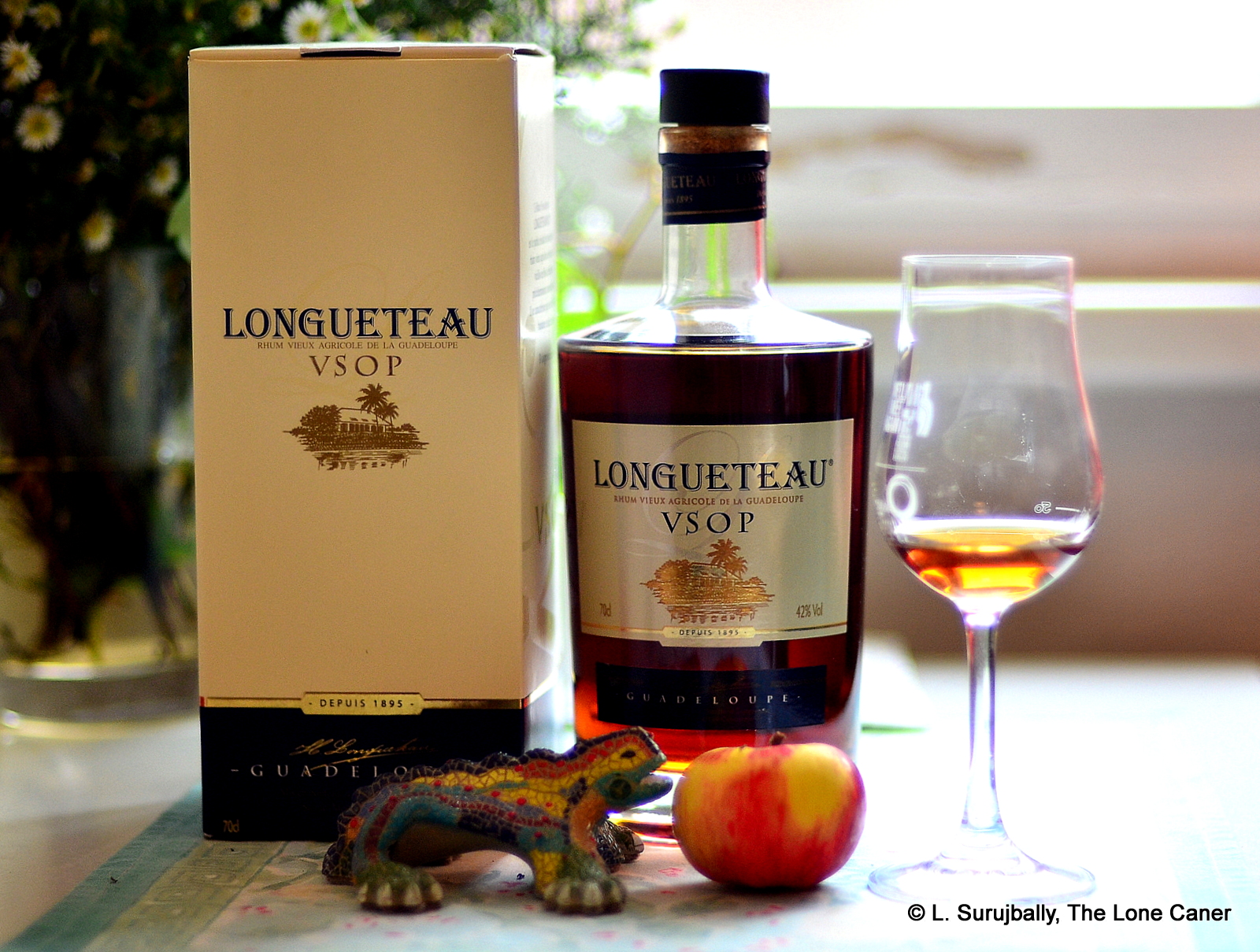
Much as I had with the Longueteau Grand Réserve, a ten year old agricole from Basse-Terre (Guadeloupe), I felt the 42% strength on the six year old VSOP was perhaps too timid and too wispy for a rhum which could have been more had it been made stronger.  Longueteau, a distillery which has been in operation since 1895 and produces the Karukera and Longueteau lines of rhums, seems to eschew fierce and powerful expressions and is quite content to keep on issuing standard strength work, but since their quality is nothing to sneeze at and is readily approachable by the larger body of rum aficionados, perhaps they have hit on a preferred strength and just stick with it.

In any case, the orange amber coloured rhum presented very nicely indeed on the nose, beginning with a light sort of fruit basket left in the sun too long but just missing being overripe.  There was vanilla ice cream and the vague saltiness of rye bread and that spread known as kraüter-quark in Germany, with dill and parsley adding some interesting herbal notes.  Like most agricoles it was delicate and crisp at the same time, and while there was certainly some sugar cane sap and grassiness it, this stayed very much in the background.  After opening up over several minutes more, one could discern olives in nutmeg, brine, watermelon and peaches, light and clear, firm and delicate all at once.

The nose was certainly very pleasant – however much one had to work at it – but on the palate the 42% became somewhat more problematic since it really was too light and easy….though one could say “playful” as well, and still be on the mark.  Oddly, a drop of water (and another ten minutes of opening up) solved that problem nicely, allowing clear, if faint, acetone and fried banana flavours to emerge.  These merged well with some smoke and oaken tannins, more vanilla and a smorgasbord of fruits to come forward – papaya, watermelon, sugar water, pears and white guavas – to which, over time, were added herbs, and some pickled gherkins, leading up to a short, dry finish mostly redolent of soya, brine, dark bread and (again) vanilla and a grape or two. 

Overall the rhum was a very good one, if perhaps just too gentle.  Many will enjoy it for precisely those attributes, since it doesn’t assault the senses but prefers to stroke them with a silken wire of flavour, and draws back from any kind of serious challenge or analysis. A cocktail geek can probably make an interesting concoction with it, but for my money this is a tasty, twittering little rumlet, which, with a few extra proof points, might be even better, and in its current iteration, can be had by itself without any additional embellishment.  It’s both complex enough within its limitations, and unassertive enough for the peaceniks, to give perfect satisfaction on that level,  and in any case, yes, I did like it: whatever my reservations, I also consider it a soundly enjoyable sundowner that adds to the sum total of the delicious variations which agricoles provide.


(84/100)

Other notes

  • Some distillery notes are provided in the review of the Grand Réserve.
  • The company website says aged in oak casks that once held brandy; other sources say ex-cognac barrels.
Jul 192017
 

#378

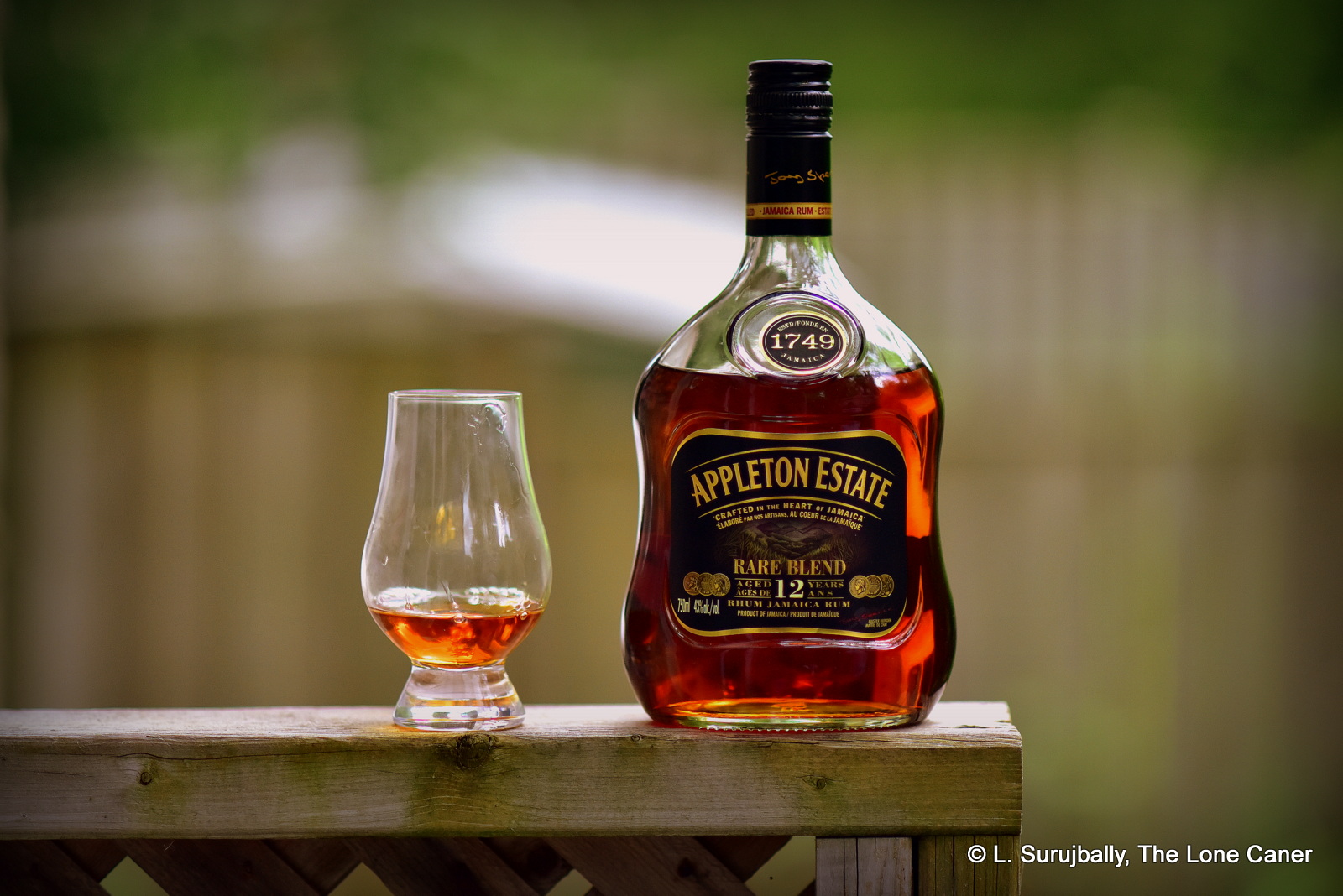
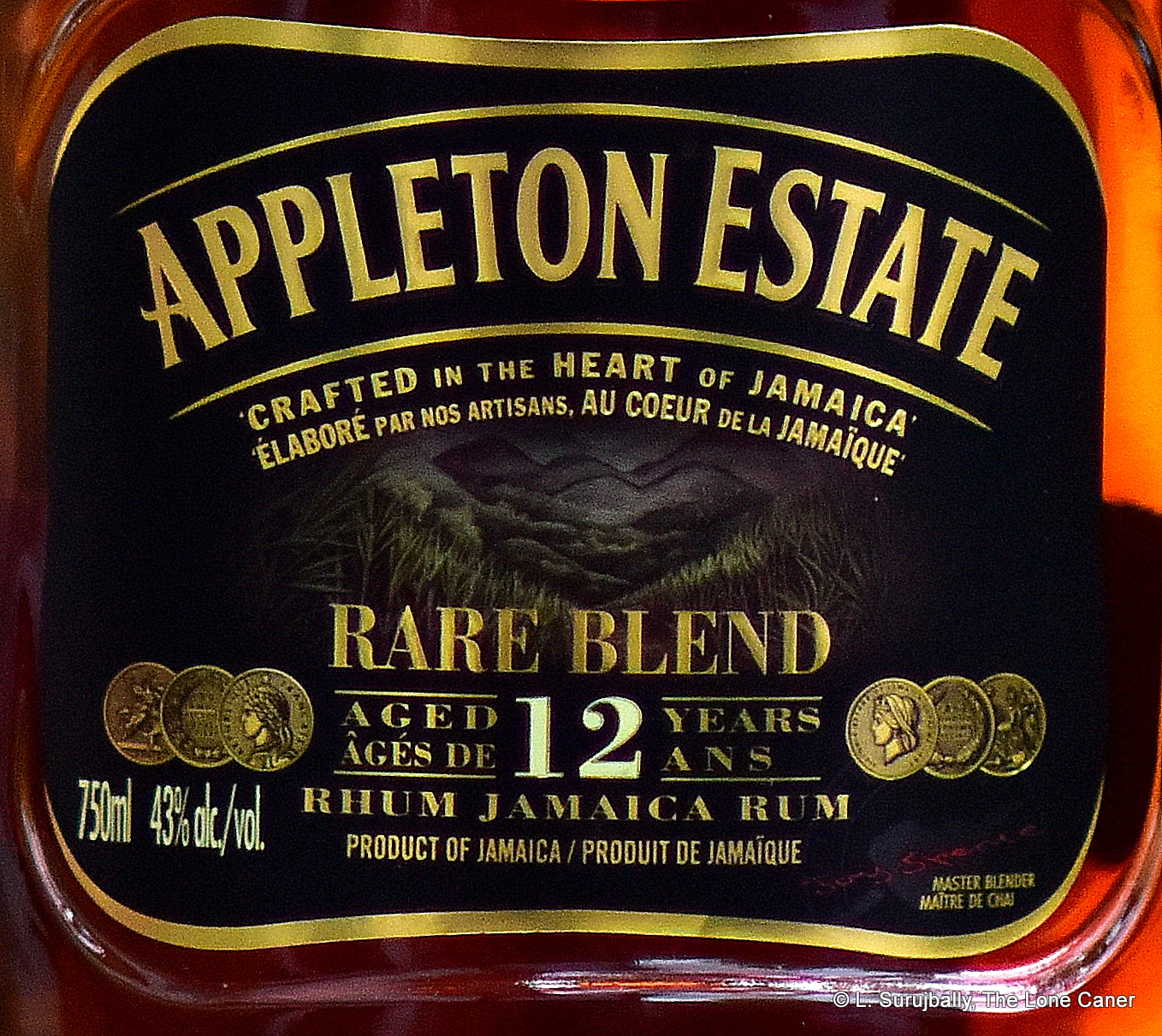
No matter how many other estates or companies make and market Jamaican rum, it’s a fair bet that when it comes to recognition, Appleton has cornered the market in their own land, much like DDL has in Guyana, or how FourSquare is currently dominating Barbados.  Recently I ran a few Appletons past each other (it’s one of the few decent rums one can get in the rum wasteland that is Toronto), and while the 21 year old, Master Blender’s Legacy and 30 year old are not on sale there, the rebranded “Rare Blend” 12 year old was.

Re-tasting the rum after a gap of some eight years was eye-opening.  My first encounter with it as a reviewer was back in 2009 and the short, unscored essay #5 came out in January 2010.  Things have changed in the intervening years – my palate developed, tasting became more nuanced, preferences underwent alterations…and from the other side, the rum and the bottle were worked over.  It was not the same rum I tried back then, nor like older versions from the 1980s and 1970s.  But what was not so evident to me then and which is clear to me now, is that the Appleton 12 year old rum in all its iterations over the years, is one of the core rums of the island and the style, a sort of permanent marker that almost defines “Jamaica rum”.  If one ever asks me in the future, what rum from there should one get first, or which rum should serve as a cornerstone of the Jamaican shelf, I’m going to point at it and say, “That one.”

This is because of its overall solidity of its assembly.  Consider how the nose presented, warm, just short of sharp, well constructed and pleasantly complex – it started with molasses, bananas, cream cheese, brine and dates, some citrus, cinnamon and apples just starting to go.  It provided a little oak (not much), and some tar, anise, vanilla and brown sugar, all very tightly and distinctly constructed – an excellent representation of everything Appleton stumbles a little on with their younger iterations, and which they amp up — not always as successfully — in the older ones.

The real key to capturing the rum’s essence is is the taste. How it feels in the mouth, how it develops over time. The palate is not particularly different from what one sensed on the nose, and I don’t think that was the intention – what it did was consolidate the gains made earlier, and build gently upon them, to provide a sipping experience that is a great lead-in to new drinkers wanting something upscale, without disappointing the hard core whose taste buds are more exacting.  It was smooth and velvety, the characteristic Jamaican funk present and accounted for (without actually becoming overbearing).  Salty caramel ice cream, stewed apples, citrus, cinnamon, gherkins in brine, vanilla and tannins for a little edge (perhaps a shade too much, but I wasn’t complaining).  After some time one could sense the background of rotting bananas, some herbals and perhaps a whiff of dill. The finish, while short, was warm and mellow, and gave up a last whiff of dates, caramel, more brine, and overall I’d say the rum was not overly complex, but the balance between the various components simply could not be faulted.  That’s what makes it a good all-round mid-tier rum.

Now, I don’t want to give the impression that the 12 is a fantastic 95-pointer on par with or better other exceptional Jamaicans which I have scored high in the past.  It’s not.  It lacks their individuality, their uniqueness, their one-barrel dynamism and exacting natures, so no, it’s not that.  What makes it special and by itself almost be able to serve as a stand-in for a whole country’s rums, is that it encapsulates just about everything one likes about the island at once without shining at any one thing in particular or pissing anyone off in general.  It’s a rum for Goldilocks’s little bear – it’s not too hot and not too passive; not too massively funky, yet not too dialled-down either; no one aroma or taste dominates, yet the final product is of a remarkably high standard overall, self-evidently, almost emphatically, Jamaican.  Best of all, it’s affordable for what it provides, and I consider it one of the best price-to-quality rums currently extant.  In short, while it may not be the best rum ever made in Jamaica, it remains a quiet classic on its own terms, and one of the key rums in any rum lover’s cabinet.

(84/100)

Jul 162017
 

#377

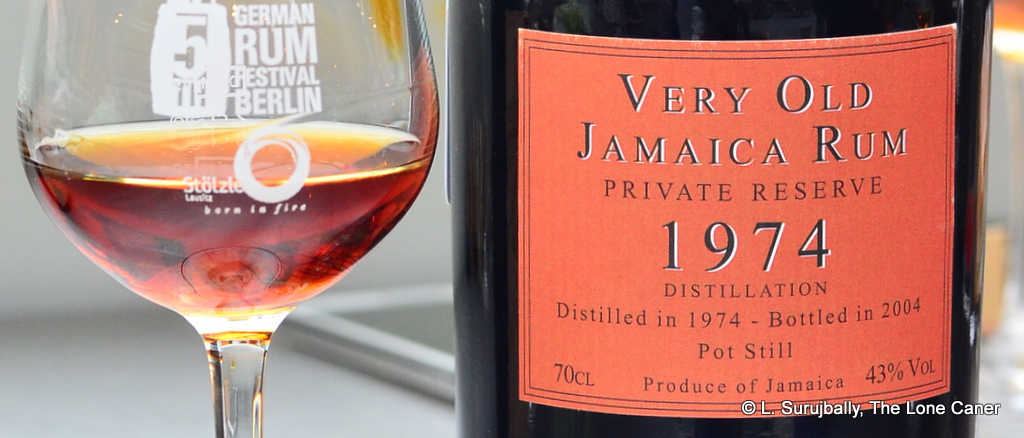
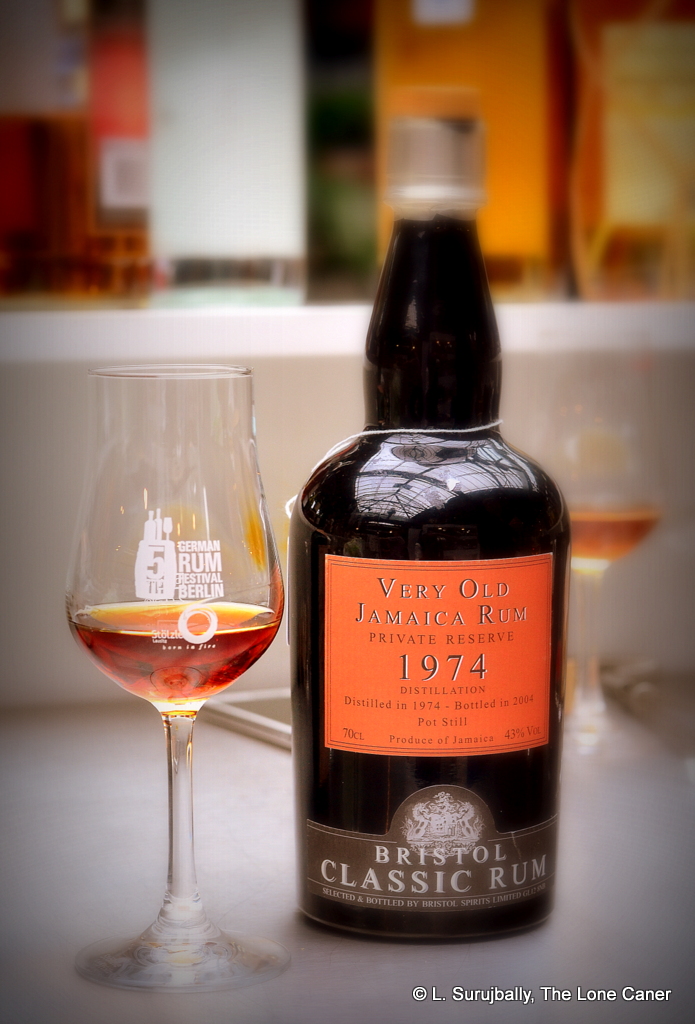
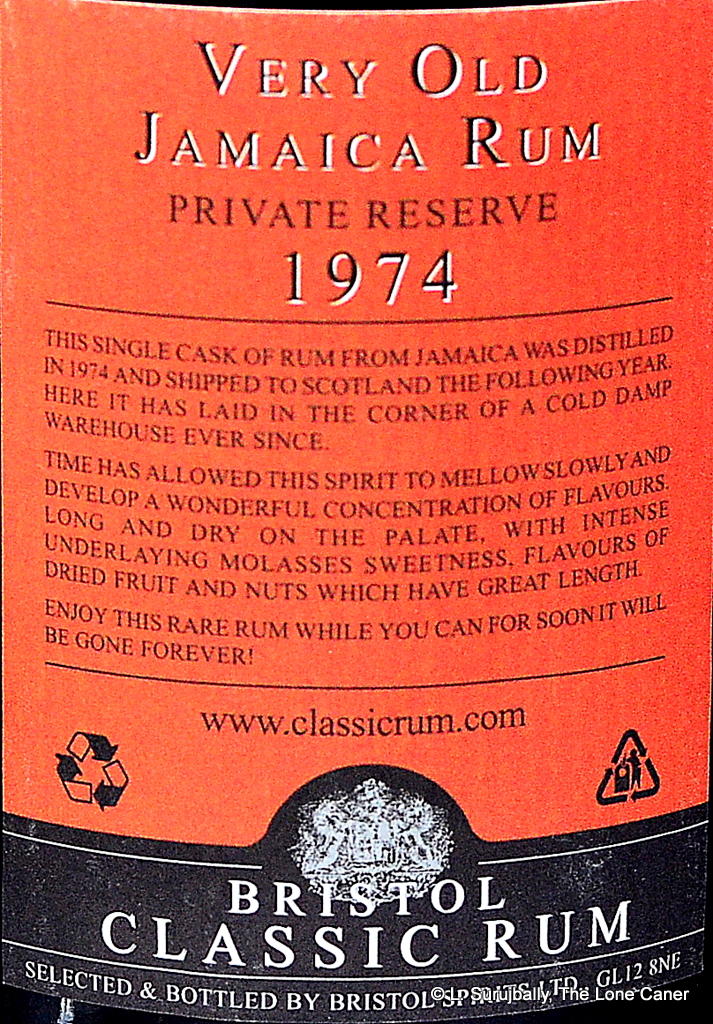
Bottled in 2004 at a lukewarm 43%, Bristol Spirits have somehow transcended the living room strength of this classic 30 year old rum and produced one of the best Jamaicans of its kind.  Even under some time pressure, I still had that glass on the go for two full hours, smelling it over and over, tasting it in the tiniest of sips again and again, comparing, retasting, rechecking, making more and more notes, and in the fullproof company of Guyanese and Jamaicans I was trying alongside it, it was a standout of no mean proportions.  We simply do not see rums of this kind any longer – we can with some effort get 15-20 year olds, we may be able to source a few rums in their twenties, but when was the last time you were fortunate enough to try a thirty year old rum?

Bristol Spirits are no stranger to old stocks, of course.  There was the masterful Port Mourant 1980 and that sublime Caroni 1974, to name but two.  These days, they’ve sort of settled into a groove with more sober-minded middle-aged rums, and while I would never say that what they produce now is not up to scratch — what they put out the door is both imaginative and interesting — none of them have that aura of gravitas mixed up with a ballsy “looky here!” middle-finger-to-the-establishment braggadocio…or yes, the restrained majesty, which three decades of ageing confers on this rum.

Because it was clear that every aspect of that age was wrung out and lovingly extracted from the single originating barrel.  No attempt was made to hold a thing back, and this was evident right away on the aroma, which dumbfounded me by being much more complex and even pungent for what – let’s face it – is not the world’s most badass rum strength.  It was just so deep. It started out with the richness of burnt leaves and charred canefields after the ritual firing, smouldering in a tropical twilight; caramel, toffee, nutty nougat, almonds, burnt brown sugar, tied together with oak and slightly bitter tannins that did not detract but enhanced. What fruits there were — raisins, prunes, plums for the most part — kept a cool kind of distance which supported the aromas noted above without supplanting them, and around them all was a weird amalgam of melons, squash and citrus zest that I was at a loss to pin down at first…but trust me, it worked. Anyone who loves rums (and not just Jamaicans) would go ape for this thing.

The taste was similarly top-notch, and while I would be hard-pressed to tell you the profile screamed “funk” or “dunder” or “Jamaican”, I must also tell you that what was presented had so much to offer that the rum skated past such concerns. It started out with traditional dark caramel, a little glue and warm dark fruit – raisins, black cake, tamarind – and then went for broke.  Over two hours it developed tastes of honey, cherries, flowers, charred wood, ashes and hot damp earth after a rain, underlain with a sort of laid back but crisp flavours of green apples, lemon zest and nuts, and finished off with a surprisingly long fade redolent of raspberries and ripe cherries and vanilla.  Quite frankly, one of the reasons I kept at it for so long was simply that I found myself more and more impressed with it as time went on: to the very end it never stopped developing.

As with many really good rums – and yes, I call this one of them – there’s more to it than simple tasting notes.  The mark of a rum / rhum / ron which transcends its provenance and age and goes for something special, is one that either makes one ponder the rumiverse while drinking it, or one that brings up clear associated memories in the mind of the reviewer – to some extent both were the case here. It was not clearly and distinctively a Jamaican rum, and I wondered how the distinctive profile of the island was so muted here….was it the long ageing in Europe, the original barrel, a peculiarity of the distillate, or the still itself? And as time went on I stopped worrying about it, and was drawn back into my memories of my youth in the Caribbean, the scent of burning canefields, fresh pressed cane juice on shaved ice sold by a snow-cone vendor outside Bourda, and the first taste of a local hooch in a beergarden down the coast served neat with a bowl of ice.  Such things are in themselves irrelevant, but also part and parcel of what makes this rum, to me, quite special, the more so since it happens so rarely.

So, yeah, I’m a drooling fanboy (was it that obvious?).  But how could I not be? You have to experience the emphatic boom trapped within the otherwise standard proof to understand my enthusiasm.  Muted yes; quiet yes; not as intense – of course.  One cannot outrun one’s shadow and get out from under 43%.  But just smell the thing, taste the thing, savour the thing — like some of the Compagnie’s rums, it makes a great case for Continental ageing. You could almost imagine some half-crazed, giggling bottler, half-in and half-out the barrel with a tiny teaspoon and clean white cloth, trying to get the very last drop out just to make sure that nothing was wasted.  Given what was achieved here, assuredly none of it was. It’s just half a shot shy of great.

(90/100)


Other notes

There is no data on the originating estate.  I’m guessing here, but believe it’s either a Longpond or a Monymusk, just on the taste.  If anyone has more info, feel free to correct me on this one.

Jun 282017
 

#376

With the advent of the Hampden and Worthy Park rums which pride themselves on high ester counts, it seems that one of the emerging trends in the rumworld may well be such tasty, clear, bags-of-fruit rums with not just a single sapling populating the salad bowl, but an entire damned orchard. Yet on the other side of the world, Savanna has been doing this for some years now with their “Intense” and “Grand Arôme” lines, of which the reigning porn queen might well be the HERR 10 year old that so impressed me.  That rum was startling and original, seemingly cut from wholly new cloth, bottled at a massive 63.8% and aged in cognac casks and my drool dripped into the glass almost continuously as I tried it (well…I exaggerate for effect….but not by much).  And yet, Savanna made one even better than that one – it’s this rum, a Grand Arôme, a rock solid full-proof 64.2% rumzilla that encapsulated all the amazing potential Reunion had to offer, and came in ahead of its own siblings by a country mile.  I’ve now tried about ten rums from Savanna, and it’s my firm belief that this is the best of them all (until I find the next one).

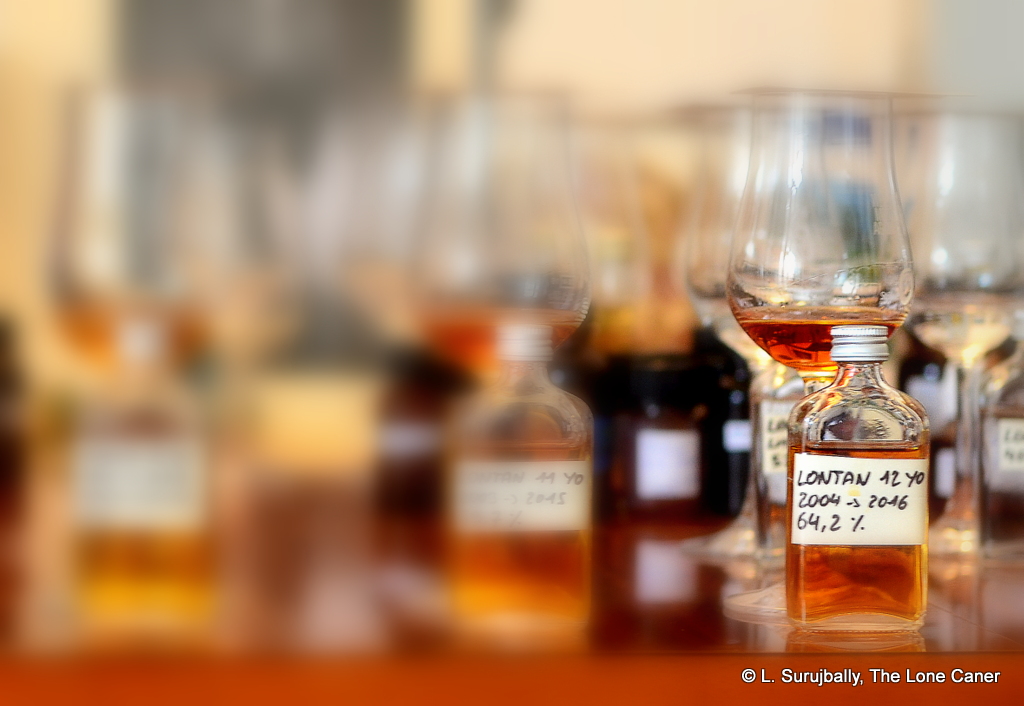
Speaking of Savanna and the stats.  I’ve written a small bio of the company, so won’t bore you with that again, so let’s just reel off the usual details so you know what you’re drinking if you ever try it. It was distilled in 2004 and bottled in 2016, with a strength as noted above, just north of 64%.  It was made on Savanna’s traditional column still (not the discontinuous one of the HERR), and Cyril, in his own excellent 2016 review, writes that it is made from the fermentation of vinasse and molasses, and for a longer period than usual – 5-10 days.  As before it was fully aged in ex-cognac casks.  

Photo stealthily purloined from DuRhum.com

Pause for a second and just look at all those production notes: they make no mention of additives, but for my money they didn’t add anything, and come on, why would they need to? It’s like they pulled out all the stops to make this thing a flavour bomb of epic proportions. Fermentation, distillation, ageing, the works, all that was missing was some pineapples dunked directly into the vat.  And when I tried it, the results spoke for themselves.

The hot, fragrant nose began with dusty cardboard, the nostalgic feel of old boxes in an attic, of a second hand bookshop crammed to the rafters with dry books of ages past nobody now reads.  Ahh, but then it changed – acetone and nail polish mixed with lots of honey and rich (but not tart) flavours of bubble gum peaches, prunes, vanilla, cinnamon and a light trace of brine and avocados drizzled with lemon juice.  Cocoa and some coffee, reminds me some of the Varangue Grand Arôme 40% white, but better behaved and much better constructed. My God this was rich — I spent perhaps half an hour just nosing the thing, and even called over my mother (who was annoyed I wouldn’t let her near my samples that day and was sitting in a huff in the kitchen) to give it a sniff.  Her reaction was so positive I feared for her health and the safety of my table, but never mind – the important thing to note is that even a rum novice loved it, even at that strength.

The real treasures came on the palate, which was firm, strong and intense, as befitted a rum brewed to a ripsnorting 64.2%.  Here the fruits – those amazing, full bodied fruits – blasted out front and center.  The intensity and variety were amazing, yet they lacked something of the single minded purity of the HERR, and somehow manage to create a melange without a mess, each note melding perfectly, combining the ongoing cereals and dusty book aromas with the sweet richness of the orchard without losing the best parts of either.  Some rubber and sweet caramel and honey, warm papaya, and then the fruits themselves – ripe mangoes, peaches in syrup, cherries, cinnamon, cloves, almonds and that yummy Pakistani rice pudding called kheer. There was aromatic tobacco, a faint citrus tang (candied oranges perhaps) and it all led up to a clean, biting finish, gradually winding down to close with green grapes, hard yellow mangoes, lemongrass, caramel and breakfast spices.  Ladies and gentlemen, we have ourselves something amazing here.

When The Wonk and I were discussing this rum, he remarked (rather disbelievingly) that it had to be quite a product to compare with the 89 points I gave to Velier’s 32 year old PM 1975 a few days ago.   It certainly is that, but really, the two aren’t strictly comparable, as they are quite different branches of the great tree of rum.  The Lontan lacks the dark heaviness of Demeraras generally and the Port Mourant specifically, doesn’t have that wooden still licorice background or its overall depth.  In point of fact The Lontan 12 has more in common with the Jamaicans and perhaps even agricoles, while being distinct from either one. In that observation lies the key to why it’s special.

I noted the other day that one of the unsung heroes of the subculture is likely the below-the-radar rums of St Lucia.  Here’s another company not many have heard of that’s making some pretty big footprints we should be tracking.  Because in summing up Savanna’s remarkable rum it’s clear that it’s a shimmering smorgasbord of extravagant and energetic and well-controlled tastes, melding a nose that won’t quit with a body that could make a metaphorical nuncio review his vows of celibacy.  It mixes a glittering clarity with excellent balance, strength with softness, is crisp and complex to a fault and what we’re left with after the fact is the memory of an enormous achievement. To say the rum is “not bad” is to undersell it.  To say it’s good doesn’t cut it. What we need to do is to admit it’s just about great, and oddly, part of that admission is also that it’s made by a relative unknown, without any of that emotional baggage we would bring to, say, a Velier or a Samaroli, a Rum Nation or a product from the Compagnie. I enjoyed it thoroughly.  I think it’s wonderful. It’s a gift to true rum lovers who want to try something they haven’t experienced before, in their ongoing (often lonely, sometimes thankless) search for the next new rum to treasure.


(90/100)


Other notes

  • Samples provided by two generous and great rum people, Nico Rumlover and Etienne S. who asked for nothing in exchange, but got something anyway.  Thanks guys. Wouldn’t have found this rum without you.
Jun 262017
 

#375

Velier rums have now become so famous that new editions and collaborations disappear from the shelves fifteen minutes before they go on sale, and the “classic” editions from the Age of the Demeraras are all but impossible to find at all.  Still, keeping one’s twitchy ears and long nose alert does in fact get you somewhere in the end, which is why, after a long drought of the company’s rums in my battered notebook (if you discount the legendary Caputo 1973), I managed to pick up this little gem and am pleased to report that it conforms to all the standards that made Velier the poster child for independent bottlers.  It’s one of the better Port Mourant variations out there (although not the best – that honour, for me, still belongs to the Velier PM 1974, the Norse Cask 1975, with the Batch 1 Rum Nation 1995 Rare PM running a close third), and drinking it makes me wistful, even nostalgic, about all those magical rums which are getting rarer by the day and which speak to times of excellence now gone by.

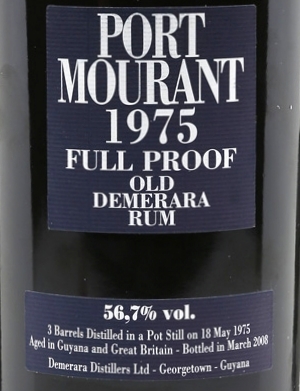
And how could I not be? I mean, just look at the bare statistics. Guyanese rum, check. Full proof, check – it’s 56.7%. Massively old, double-check…the thing is 32 years old, distilled in May 1975 (a very good year) and bottled in March 2008 (my eyes are already misting over), from three barrels which gave out a measly 518 bottles. The only curious thing about it is the maturation which was done both in Guyana and Great Britain, but with no details on how long in each.  And a mahogany hue which, knowing how Luca does things, I’m going to say was a result of all that king-sized ageing.  All this comes together in a microclimate of old-school badass that may just be a characteristic of these geriatric products.

How did it smell?  Pretty damned good.  Heavy and spiced. A vein of caramel salty-sweetness ran hotly through the fierce dark of the standard PM profile, lending a blade of distinction to the whole.  The first aromas were of anise and wood chips, tannins, leather, orange marmalade.  The wood may have been a bit much, and obscured what came later – herbs and molasses, raisins, raw untreated honey from the comb, with a bit of brooding tar behind the whole thing.  Lightness and clarity were not part of the program here, tannins and licorice were, perhaps too much, yet there’s nothing here I would tell you failed in any way, and certainly nothing I would advise you to steer clear of.

On the taste, the anise confidently rammed itself to the fore, plus a bunch of oak tannins that were fortunately kept in check (a smidgen more would have not been to the PM’s advantage, I thought).  There were warm, heavy tastes of brown sugar vanilla, caramel, bananas, and then a majestic procession of fruitiness stomped along by – raisins, prunes, blackberries, dark cherries, accompanied by nougat, avocado and salt, orange peel and white chocolate. All the tastes I like in my Demerara rums were on display, and with a warmth and power conveyed by the 56.7% that no 40% PM could ever hope to match, undone only – and ever so slightly – by the oaken tannins, which even carried over to the finish.  Fortunately, the anise and warmer raisins and salt caramel came along for their curtain call as well, so overall, all I can say is this is a hell of a rum, long lasting, tasty and no slouch at all. Frankly, I believe that this was the rum DDL should have been aiming for with its 1980 and 1986 25 year old rums.

So, how does it rate in the pantheon of the great Demeraras from the Age?  Well, I think the oak and licorice, though restrained, may be somewhat too aggressive (though not entirely dominant), and they edge out subtler, deeper flavours which can be tasted but not fully appreciated to their maximum potential – the balance is a bit off.  This is not a disqualification in any sense of the word, the rum is too well made for that; and in any case, such flavours are somewhat of a defining characteristic of the still, so anyone buying a PM would already know of it – but for those who like a more coherent assembly, it’s best to be aware of the matter.  

Just consider the swirling maelstrom of cool, of near-awe, that surrounds this product, not just for its provenance, or its age, but for lustre it brings to the entire Age’s amazing reputation.  It’s a rum to bring tears to the eyes, because we will not see its like again, in these times of increasing participation by the indies, and the <30 year aged output.  Who would, or could, buy such a rum anyway, at the price it fetches nowadays (I saw one on retail for €2000 last week)?

At this stage in the state of the rumworld, I think we should just accept that we can no longer expect to be able to source full bottles those original monsters with which the giants of the subculture made their bones.  Anyone who has one of these is holding on to it for resale or for judicious sharing among the hard core rum chums who have pictures of every Velier bottle ever made hanging on walls where the Lamborghini Countach or Pamela Anderson was once posted.  You can sort of understand why.  They are all a cut above the ordinary and this one is no exception. In its own way, it’s great. And even if it does not ascend to the stratosphere the way I felt the 1974 did, then by God you will say its name when you taste it, and all your squaddies will doff their hats and bow twice.  It’s simply that kind of experience.

(89/100)

Jun 222017
 

#374

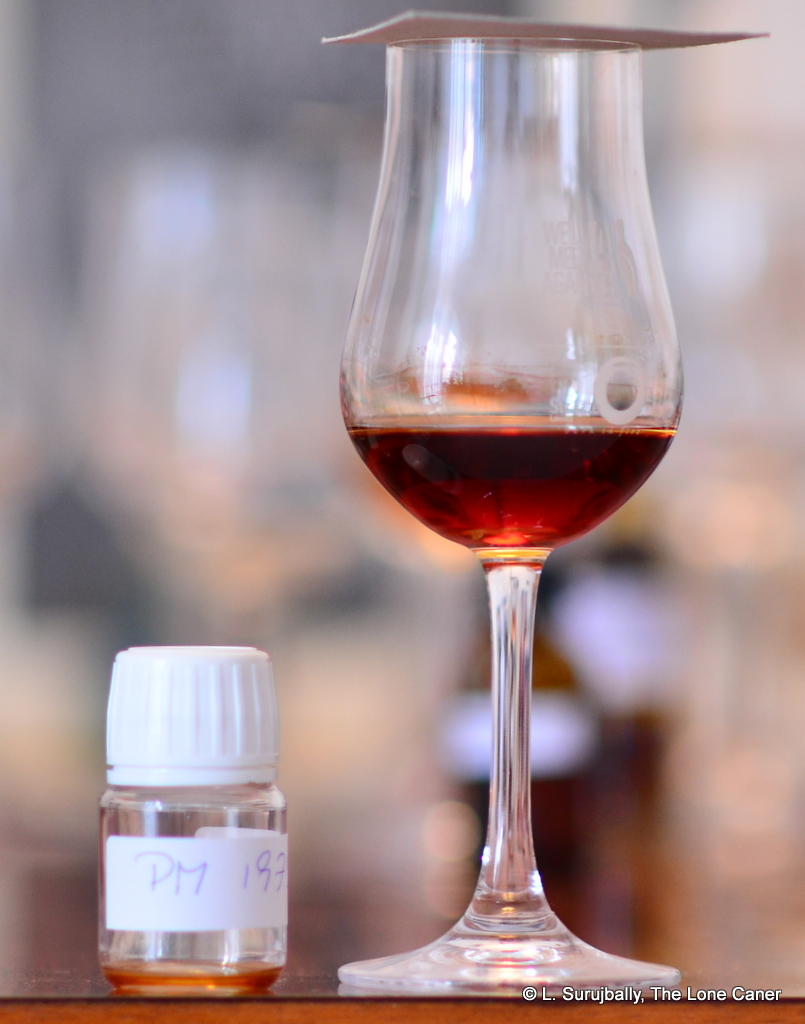
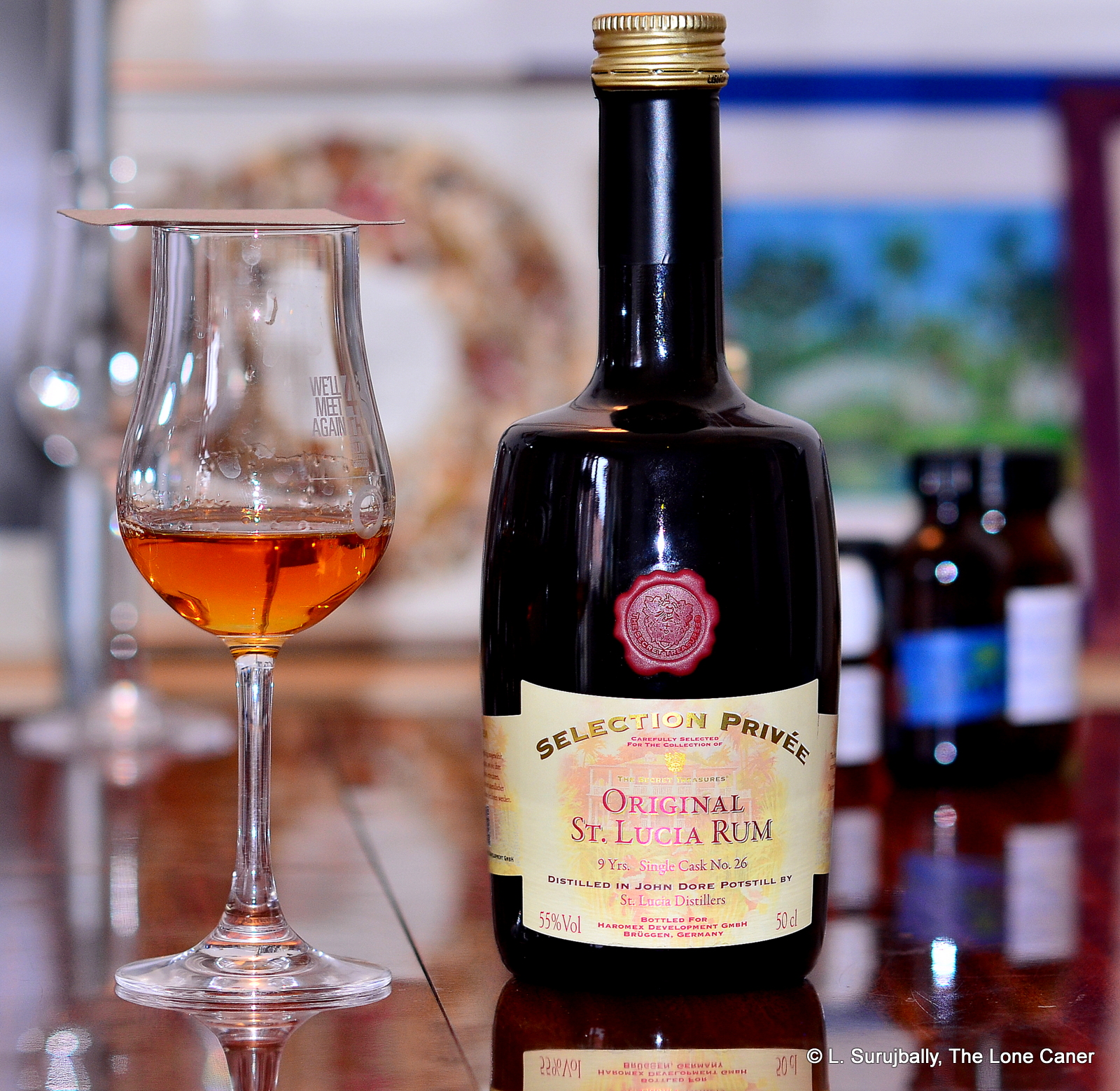
Two bottles of  Secret Treasures St. Lucian rum came my way in early 2017, entirely unexpected and unannounced, and both were fascinating variations on a theme.  Did I say thanks to Eddie K?  I think so, but let’s just tip the trilby to the man one more time, because even next to its very sound brother, this baby from a John Dore pot still is no slouch either, and not much has been written about either one, and it’s entirely possible that they are among the most under-the-radar value-for-money indie rums around.

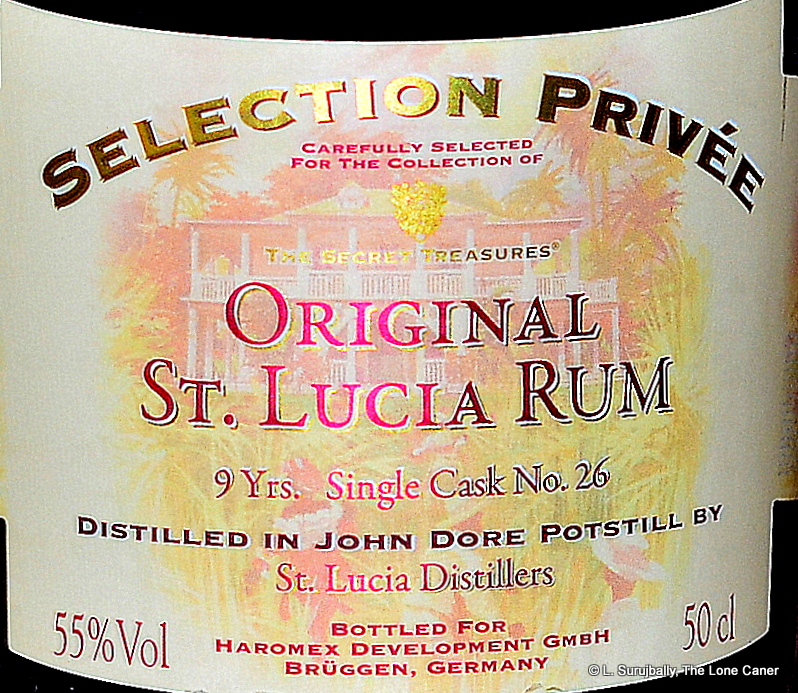
Since there’s not much more to say about the basic details of the originating bottler already noted in the Vendome Pot Still essay, here’s the additional background relevant to this rum: it is from St. Lucia Distillers, made on their John Dore pot still, aged nine years (same as its sibling) in ex-bourbon barrels, issued at 55% and gold in colour.  The outturn is not noted anywhere, and the Haromex website only speaks about “carefully selected barrels” so I have no idea how many bottles are out there (though coming from a single cask, around 300 bottles isn’t out to lunch); or even where the ageing process took place — from the profile I’d hazard a guess that it was done in St. Lucia. I also believe it’s from the same batch as the others in this series, so consider 2005 as the distillation date as reasonable.

That out of the way, what did it smell like.  Different from the Vendome, for sure. The nose was all  low key fruitiness, medium sweet. You could sense something of old furniture lovingly polished and floors well waxed, mingling delicately with a little oak and brine, but the gradually emergent breakfast spices, sugarcane sap, cinnamon, peaches, cherry and pineapple carried the day.  Overall, it’s a firm yet not overbearing, skirting delicacy by a whisker, and noticeably heavier than the Vendome (the comparisons are inevitable, of course, as they were tried in tandem).  As the rum opened up, there was also caramel and nougat and some tangerines, with muskiness and cardboard and dry breakfast cereal, coming together in a very good balance.

The palate was curiously indeterminate when initially tasted, before it settled down.  Yes there was coffee and chocolate with a little caramel drizzle, but the fruits seem reticent and initially took a back seat to muskier, heavier notes.  It was good, just not entirely distinctive.  It also tasted a little winey, possessing the qualities of a zinfandel or maybe even a dry (but not oversweet) Tokaji.  It’s only after waiting ten minutes that the fruits came out full force and became the dominant note – pineapples again, cherries, ripe peaches in syrup, papaya and licorice with vanilla and whipped cream tidying up the loose ends.  The finish summarized all of the preceding, being easy and warm, quite smooth, with chocolate, nougat, cloves and a hint of saltiness and citrus closing up the shop.

On balance, while I could tell them apart, figuring out which is better is a lost cause.  The Vendome pot still rum from last week was an excellent product by itself, with the crispness dialled down and a solid complexity married to individuality and balance in a way one can’t help but appreciate.  Its twin from the John Dore still evinced a somewhat cleaner, more fruity profile, with additional notes of coffee and cocoa forming a tasty synthesis that I enjoyed just as much.  This was why I spent a couple of  days with the two glasses (regularly recharged of course – I sacrifice my liver for the art), going back and forth from one to the other, but truth to tell, for all their individuality and heft, I can’t chose between them in terms of overall quality and don’t really want to.  

So I’m giving them both the same score, and no matter which one you end up with, if St. Lucian rums are your thing, or good quality unmessed-with fullproof rums of any kind turn your crank, you won’t feel shortchanged by either one. This rum and its brother are a useful counterweight to the more distinctive Jamaicans, Bajans, Guyanese or Trinis. And they remind us all that there’s another type of profile – somewhat unsung, occasionally overlooked — that’s also a part of the already excellent British West Indian rum canon.

(86/100)

For an in-depth discussion of the production process and the stills, Marco Freyr has done his usual superb work in his own review of the rum, which he scored at 91.


Jun 202017
 

Two comments I came across in my reading last week stuck in my mind and dovetailed into conversations I’ve had with others over many years.  The first was from a reviewing website which stated (paraphrased) that they don’t review what they have nothing good to say about.  The other, from a high-end watch-review site called Hodinkee, quoted a journalism professor as saying “If you’re going to write about something bad, it needs to be bad in an important way. Just being bad isn’t enough.”

Which got me thinking.  Why write negative reviews at all?  They’re often depressing experiences, however easily the words flow, and I always wonder when I have to write one, how some companies who claim to love the juice can make such bad swill at all.

Now, some sites I visit regularly rarely write serious (let alone scathing) criticisms of poor quality rums.  A few adhere to the above policy of if there’s nothing good to say, then not saying anything at all.  Serge Valentin, who scored one rum I liked 20 points wasn’t particularly negative in his review, just mentioned he didn’t like it (probably because he’s a true gentleman in such cases, and I’m not).  Others use temperate language that skates over any kind of negativity, and their disdain is muted.  Against such easy-going writers, others write clearly and angrily why they don’t like a particular rum (or aspects of it), as The Rum Howler did with the Appleton 30, for example, or Henrik of RumCorner did with the Don Papa rums, and for sure Wes of the Fat Rum Pirate has done the language of snark proud on many an occasion and caused me to nod in appreciation more than once, because his reasoning and preferences were clearly laid out (even if I disagreed).

Looking through all the reviews of rums I’ve written in the last seven-plus years, I note that I’ve published a few very savage critiques of rums that I felt were sub-par, many in the first few years. These days I pick more carefully and dogs rarely piss in my glass, so that may be part of why there are now less negative reviews than formerly. Still, while age has mellowed me, it’s not been by that much, and I still think the opinions expressed back then, and the ones I write now for stuff I don’t like, are relevant.  And there are many reasons for that, and why I wrote, and continued to write, as I did, and why I feel it’s necessary, even important, that we do so.

Firstly, it must be stated that I disagree with the quoted professor as applied to the subject of rums, because this is money being spent by me.  I’m not saying I’m a Ralph Nader style consumer advocate, but I do write for consumers, not for producers.  Having written a few hundred reviews, my concept of the site has tilted slightly away from merely writing a blog about rums I tried and enjoyed – though this aspect remains and always will — to writing about every rum I can lay hands on, as part of a desire to share the experience with those who share my passion. There are actually people who read these meandering essays, and importantly, some base buying decisions on the opinions I express. It implies an obligation on my part to write well and clearly where disappointments occur. Too, since this is my time and my money being expended (a lot of both, trust me), then if I find something that wastes either, I’m going to say so. The language may be tempered or furious, and I basically do it so you don’t have to.

Secondly, I believe that by not writing about mediocre or badly made products – and thereby assuming or hoping somebody else will – I’m essentially giving substandard table-tipple a free pass.  That’s a cop-out, and I am firmly opposed to this philosophy. We are bombarded every day with hysterically positive targeted mass-marketing, meant to entice us to buy the latest new “premium” juice, and without a skeptical and jaded eye, it all fades into a dronish mass of boring sameness, without anyone trusted enough to pay attention to writing a dissent.  Ignoring bad stuff is therefore not the solution. It has to be confronted, whether it is bad in a big or small way, and not just in commented Facebook posts that disappear in a week.  This is especially important when new rum drinkers are entering the fold and are casting around for more than the Diplomaticos, Bacardis, Don Papas or Krakens to which they are accustomed. As writers and opinion shapers, there is a duty of care upon knowledeable bloggers to say when a product doesn’t come up to snuff, and why. Our websites are not facebook pages, but repositories of information and opinion going back many years and are consulted regularly – so why shouldn’t we call out crap when it exists? It detracts from our street cred if we don’t, is what I’m thinking.

Thirdly, there’s the matter of comparability.  When there is a large data set of products about which nothing but good things are written, then there is no balance.  People have to know what is disliked (and why) so they can evaluate the stuff a writer does appreciate (and why).  In other words, an understanding by the reader of the writer’s preferences – it’s not enough to ignore or leave out the stuff one don’t like and expecting the reader to understand why, and where else will one gain that comprehension except by reading a negative review?  This is not to say that I think anyone who disagrees with me is a fool (as Sir Scrotimus evidently does about anyone who disses his pet favourites) – I’m just pointing out that agreements and disagreements over any writer’s opinions exist, and given the wide and varying spread of preferences in the rumworld, one should take encomiums, even my own, with a pinch of salt, with the criticisms as a useful counterweight.  Far too many buyers do no boots-on-the-ground, rum-in-the-glass research of their own and simply go with somebody else’s opinion1…and if that’s the case, that opinion had better be one that has at least a modicum of credibility.

Does a negative review have to be “bad in an important way”?  Not at all.  A bad rum is a bad rum, people pay money for it, whether five bucks or five hundred, and if we as writers don’t say so, the consumer is left with marketing hoopla, vague word of mouth, brief social media comments, and the click bait of ill-informed online journalists who know little about the subject they are writing about. One good example was the Downslope Distilling’s wine aged rum, where, when I did my research, I was appalled to find writers rhapsodizing about how it compared so well with top end Martinique rhums. I can only wonder how many bought the rum on that basis, and how many switched off rums immediately afterwards. Robert Parker, in his essay on “The Role of a Wine critic” stated that as far as he was concerned, good wines should be singled out for praise, and bad ones made to account for their mediocrity.  I feel the same way about rums, whether made by old and proud houses which have been in existence for centuries, or by new outfits who’re trying to break into the business with small batch production. That’s why I wrote a negative about Doorley’s XO and a positive about the Foursquare 2006, and can stand by each.

Also, who defines what “bad in a big way” is?  What is important and big to me is less important and much smaller to Joe Harilall down the street, or even a different reviewer.  Is it taste, additives, design, mouthfeel, price, availability, overinflated marketing? For instance, some love the Millonario XO for the very same sweetness others so passionately hate, so what one considers a catastrophe may to others (or me), be inconsequential.  To attempt to stratify negativity into stuff that matters and stuff that doesn’t is to attempt to rate what’s important to the larger public; and I lack that kind of omniscience, or arrogance.  Better to lay it all out in the open, present the facts, justify the opinion, express the annoyance, and let the inquiring reader or buyer or taster make up their own minds.  To me, that goes as much for a cheap ten dollar spiced rum as it does to a thirty year old rum costing two hundred.

The argument was made to me some years back that I should not embarrass or shoot down small producers who are now starting out, who need good word of mouth and positive feedback in order to grow and improve over time.  They are, after all, employing people, paying taxes and “doing their best, while you, buddy, what the hell are you doing?” (A 2019 article on The Ringer referenced a similar point) We should support them by buying their rums and providing cash flow which they will use to create better products over time. This line of reasoning is fallacious on several levels.  One, it’s my damned money, sweated for, hard earned; purchasing and then giving a pass mark to a substandard product is encouraging the maker to continue making the same product, since it’s clear nothing is wrong with it – so where exactly is the incentive to change coming from? Second, it’s a straightforward conflict of interest, because then I would be supporting not the consumer (on whose behalf I write, given I’m one myself), but the producer with what amounts to free and fake advertising. Thirdly, people aren’t fools and never more so than now where social media allows them to communicate dissatisfaction faster than ever before – my credibility would be shot to hell were I to say, for example, that Don Papa is one of the best rums ever made. Lastly, I think every producer has an obligation of their own not to rest on their laurels or produce low level crap that passes muster among the less-knowledgeable, but to go for the brass ring: if they tart up a neutral spirit with additives up to the rafters and try to sell it as a premium product for a high price, why on earth would I want to be a party to that? Or if they are really a small outfit and are making a poor-quality rum, why would I want to be less than honest and tell them where they are failing, when that’s the very impetus that might make them try harder, do better, push the envelope?

So, for laser-focused sites concentrating on a very small portion of their market like Hodinkee does, their editorial policy of writing only about good stuff can perhaps be justified.  From mine, where all rums in the world are the reviewing base (though they’ll never all be tried, alas), it’s simply untenable because I do my best to try everything that crosses my path.  I write about any and all of them.  And that means taking the good with the bad, the high end and the low end — in fact, I actively search out the younger and cheaper stuff (which is not always the same thing as “bad”) just to ensure I don’t get too caught up with the old and pricey stuff (which is not always the same thing as “good”).

It’s a personal belief of mine that the past decade of amazing, thoughtful writing by so many bloggers has engendered a relationship between the Writers and the Readers based on some level of trust. Therefore I contend that writing a negative review of a rum on which I spend my money, and one day, you might spend yours, is not lazy journalism or a fun way to let off some steam and bile with witty and eviscerating language, but an important aspect of the overall business of critical thinking and writing abut rums — and maintaining that trust.  My own feeling about duty of care towards the audience for which I write may be in a minority, but that feeling is rooted in a desire to provide the best information and opinion possible to an increasingly educated and curious public.  As such, I honestly don’t think that a negative review, in any form, if supported by the weight of evidence and clearly-expressed thought, should ever be considered as something to avoid.


Note: In this opinion piece I am merely expressing my reasoning in support of the thesis that published takedowns of poor quality product serve a useful purpose.  No negative connotation towards any of my fellow rum bloggers is meant or implied.


Jun 192017
 

#373

In recent years, St Lucia and its eponymous distillery has been inching towards its own understated cult status: pot still rums, no additives, a finish-variation here or there, good barrel strategy, all round good stuff, and somehow (don’t ask me why) still lacks the cachet of the big four (Trini Caronis, Guyana’s DDL, Bajan FourSquare and, of course, dem Jamaicans).  Many of my rum chums swear by their rums, however, whether made by independents or issued on the island, and I can tell you, they deserve the plaudits, because they’re good.

Assuming you’ve already gone through various batches of the Admiral Rodney, Chariman’s Reserve, Forgotten Casks, and any of the 1931 series made by St. Lucia Distillers — or have given Ed Hamilton’s 9 year old 2004 cask strength a whirl — and are still hankering after something with equal or greater impact, I’d strongly recommend you go to the full proof offerings in general, and this one in particular.  Why?  Because independent bottlers are not blenders and only satisfy themselves with a single barrel (usually) that conforms to their standards.  They’re not trying to move huge quantities of rum and stock the shelves of supermarkets for purchase by the lowest common denominator, they’re trying to sell small outturns of exactingly chosen rums.  And when you smell and taste something like this, you can see why they’re so good and why they command both cachet and price.

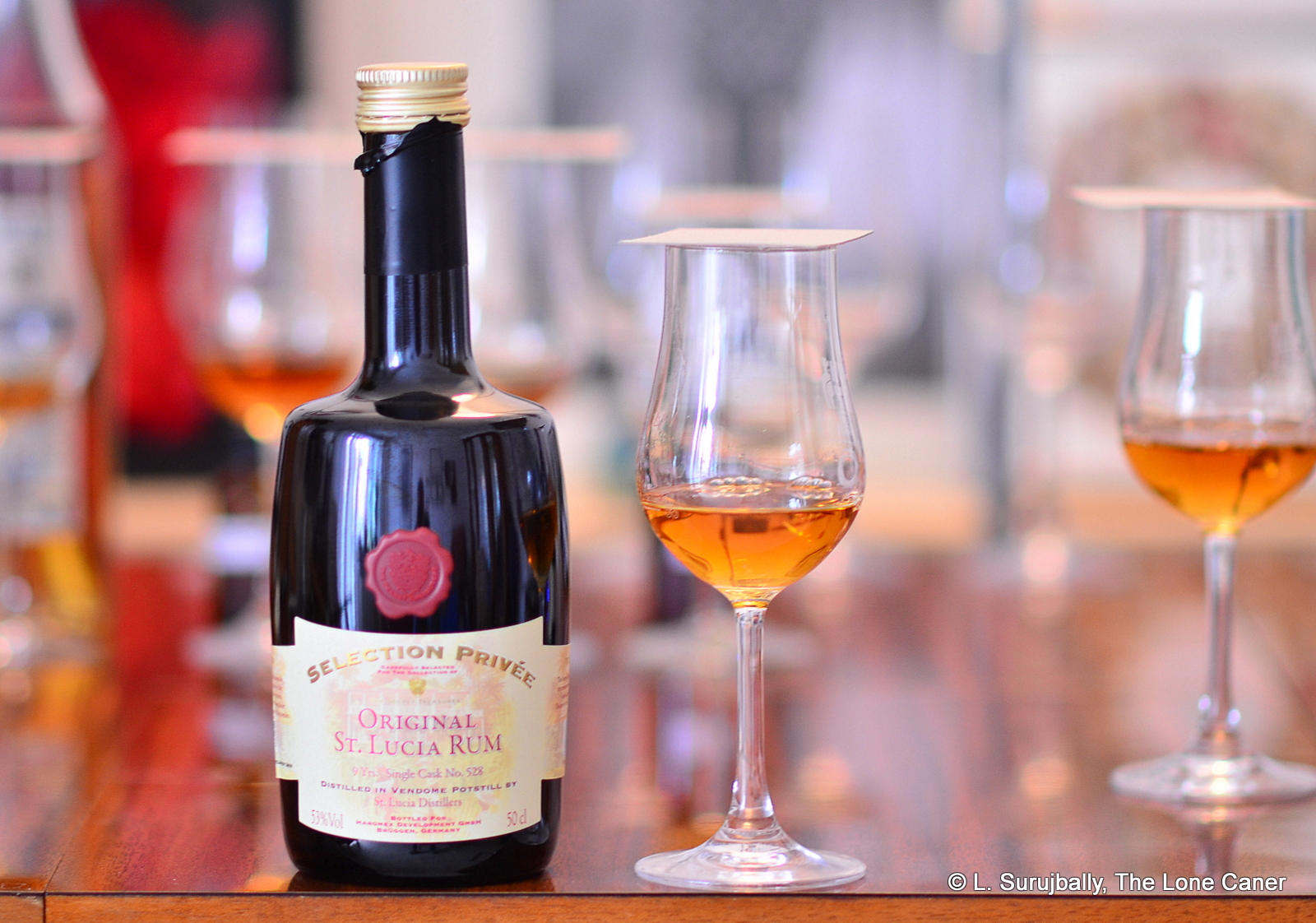
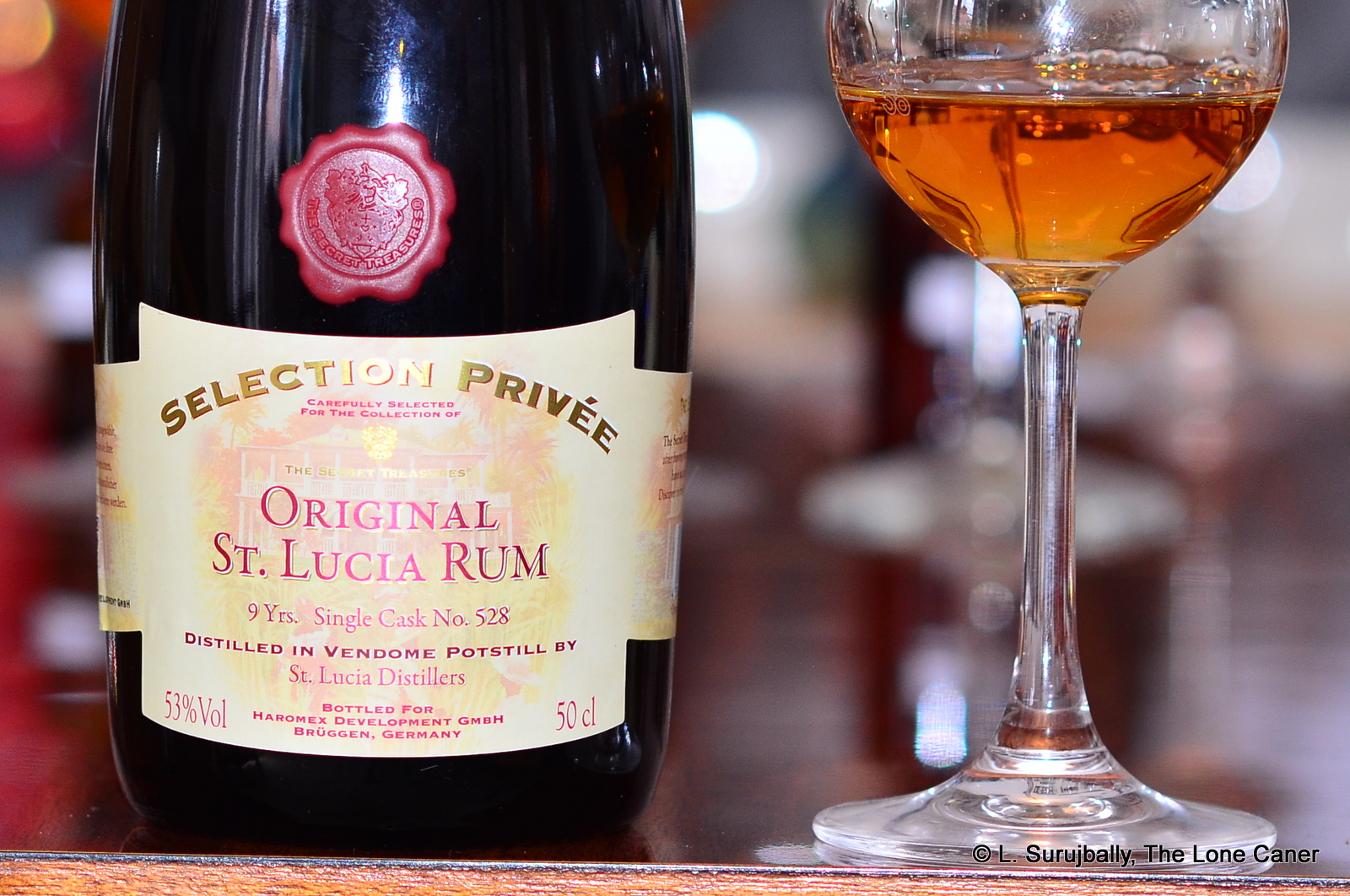
If you doubt me, please sample Secret Treasures’ take on a golden nine year old 53% beefcake from St. Lucia Distiller’s Vendome pot still.  The opening aromas are heavenly – old leather shoes, lovingly polished (and without any sweaty socks inside), combined with acetone, glue and nail polish remover that were present but not overbearing and gracefully retreated over time, giving over the stage to fruitier parts of the nose.  These consisted of delicate florals, vanilla, raisins, prunes and a little anise and oak.  Nine years was a good age, I thought, and kept the tannins present and accounted for, but not dominant – that part of the nose simply melded well and at no point was it ever excessive.

As for the palate, well now, that was relatively thick, smooth, warm, a little sweet, and all-over pleasant to try.  What made it succeed is the balance of the various components, no single one of which dominated — though that in turn was at the expense of some crispness and a feeling that things were dampened down, perhaps too much. Here, citrus and apple cider were the opening notes (unlike the John Dore 9 year old variation by the same maker, where other flavours were at the forefront).  These were followed by green peas and avocados (seriously!), some brine, vanilla, nutmeg, pineapples and cherries, with some smoke and oaken flavours which remained where they should, in the background.  It deserves some patience and careful sipping to bring out the full panoply of what was available, so don’t rush.  The finish was surprisingly short for a rum bottled at this strength, and here the tart notes take a step back and the softer stuff is more noticeable – aromatic tobacco, wine, grapes, cinnamon, and just a bare whiff of tannins and lemon peel.  

Overall, it was a really well made product and I liked it enough to try it several times over a period of two days just to nail down the finer points, but eventually I just put away my notebook, and enjoyed it on the balcony by itself with no other motive beyond having a pleasant, tasty, neat shot of rum.

Secret Treasures, a brand originally from an indie out of Switzerland called Fassbind, has been on my radar since 2012 when I tried their amazing Enmore 1989 rum and initially thought it was “okay”, before it grew on me so much over a period of days that I polished the entire thing off on my own (while fending off my mother’s grasping hands, ‘cause she liked it too damned much herself). Fassbind was acquired in 2014 by Best Taste Trading GMBH, yet curiously neither old nor new company website makes mention of the rum line at all – and the label on this bottle speaks of a German liquor distribution company called Haromex as the bottler, which some further digging shows as acquiring the Secret Treasures brand name back in 2005: perhaps Fassbind or Best Taste Trading had no interest in the indie bottling operation and sold it off.

Whatever the case, the changes in ownership and always small outturn even in Europe meant that the Secret Treasures line are something like Renegade or Murray McDavid rums, and exist in the shadows cast by the Scots, Bristol Spirits, Rum Nation, Velier, Samaroli, the Compagnie, etc (and the new bloods like Ekte and so on).  But it seems that no matter who the owner is, they continue to bottle small batches of single barrel rums, and let me tell you, they’re worth having. This rum and its twin, all by themselves, have made me enthusiastic about cask strength St. Lucian rums all over again.

(86/100)


Other notes

According to Maco Freyr, who reviewed this rum in his customary and exacting depth of detail back in early 2016, date of distillation is 2005.

A somewhat irrelevant aside:

Aide from diversifying one’s collection, there are very good reasons why passing around one’s acquisitions generously, without reservation and irrespective of the rarity, is a good thing – it builds goodwill, it shares the good stuff around among true aficionados, it cuts down on costs for others not so fortunate, and most of all, the reciprocity of people who are on the receiving end of your geriatric jolly juice can often be off the scale.  I’ve shared most of my Skeldon 1973, PM 1974, Chantal Comte 1980, Trois Rivieres 1975, and actually given away a full bottle of a Velier Basseterre 1995 and a Longpond 1941 (with the admonition that the happy recipients in their turn should pay it forwards, as they have).

It’s precisely because of such an attitude that I got sent two of the most interesting bottles in months, if not years: two Secret Treasures St. Lucia rums, both nine years old: this one, and the other (which I’ll look on in the next review) from a John Dore pot still, both at cask strength. To Eddie K., who sent them without warning, advertising, fanfare or expectations, a huge hat tip. You da man, amigo.

Jun 182017
 

Rumaniacs Review #050 | 0450

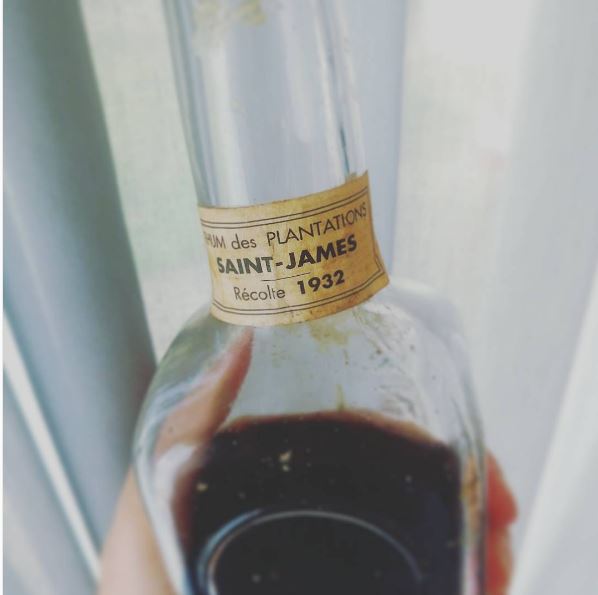
St. James has taken its place as the source of the most ancient rhum I’ve tried in my life (the 1885), and to this day they continue to make some very good agricoles.  But you’ll forgive me for yearning for their old, out-of-production rhums, made in times that predate my own grandfather; and I like trying them not just because they’re so old and so appeal to the collector in me, but because I find it fascinating how different they are to what’s made nowadays with the appurtenances of modern technology and skill.  Such dinosaurs don’t always appeal to the modern palate, true, yet they remain intriguing and beguiling signposts on the road that describes how we got to be where we are now.

Colour – Red-amber

Strength – 47%

Nose – Wow – talk about a rum going off at right angles to expectations. Starts off with old, damp, musty cellars and rotting newspapers paper granny stored there with her preserves; bananas and light oranges, plus the vegetal saltiness of a bouillon into which she dumped one too many maggi cubes.  Also pickled gherkins in vinegar, molasses and peaches in syrup straight from the can.

Palate – Smooth and easy, quite warm.  Opens with a vein of thin honey, to which additional flavours of caramel and bonbons are added; leaving it to open up then provides anise, prunes, more molasses and peachess (less syrup this time), and burnt sugar.

Finish – Short and warm, very pleasant, mostly cocoa, raisins, nuts and again that thin vein of honey.

Thoughts – Well, this is quite some rhum.  Though I like it, I’m also not too sure what to make of it – surely this is not a contemporary agricole, let alone a standard, present-day St. James.  Lekker, one might say…yet much of what conforms to modern sensibilities and ideas of what an agricole is (the grassy, clean profile) is missing. It’s also rather thick – fortunately without being cloying – and that makes one wonder whether it was doctored, messed with or dosed (it’s likely because they boiled the cane juice in the old way as a sort of quasi-pasteurization process).  In any event, when anyone tries a rum made this long ago, it’s a window into a different time and a different rum-making mentality.  It might be worth sampling for that reason alone.

(84/100)

Jun 142017
 

#372

It’s always a pleasure to circle back to the now-established independent bottlers, especially those with which one has more than a glancing familiarity; they are the outfits who have carved themselves a niche in the rumiverse which for us consumers is composed of one part recognition, one part curiosity and eight parts cool rum.  The Compagnie des Indes is one of these for me, and while everyone is now aware they have started to issue the cask strength series of rums alongside lesser proofed ones (much like L’Esprit does), there will always remain a soft and envious green spot in my heart for the now-famous, Denmark-only, cask-strength editions.

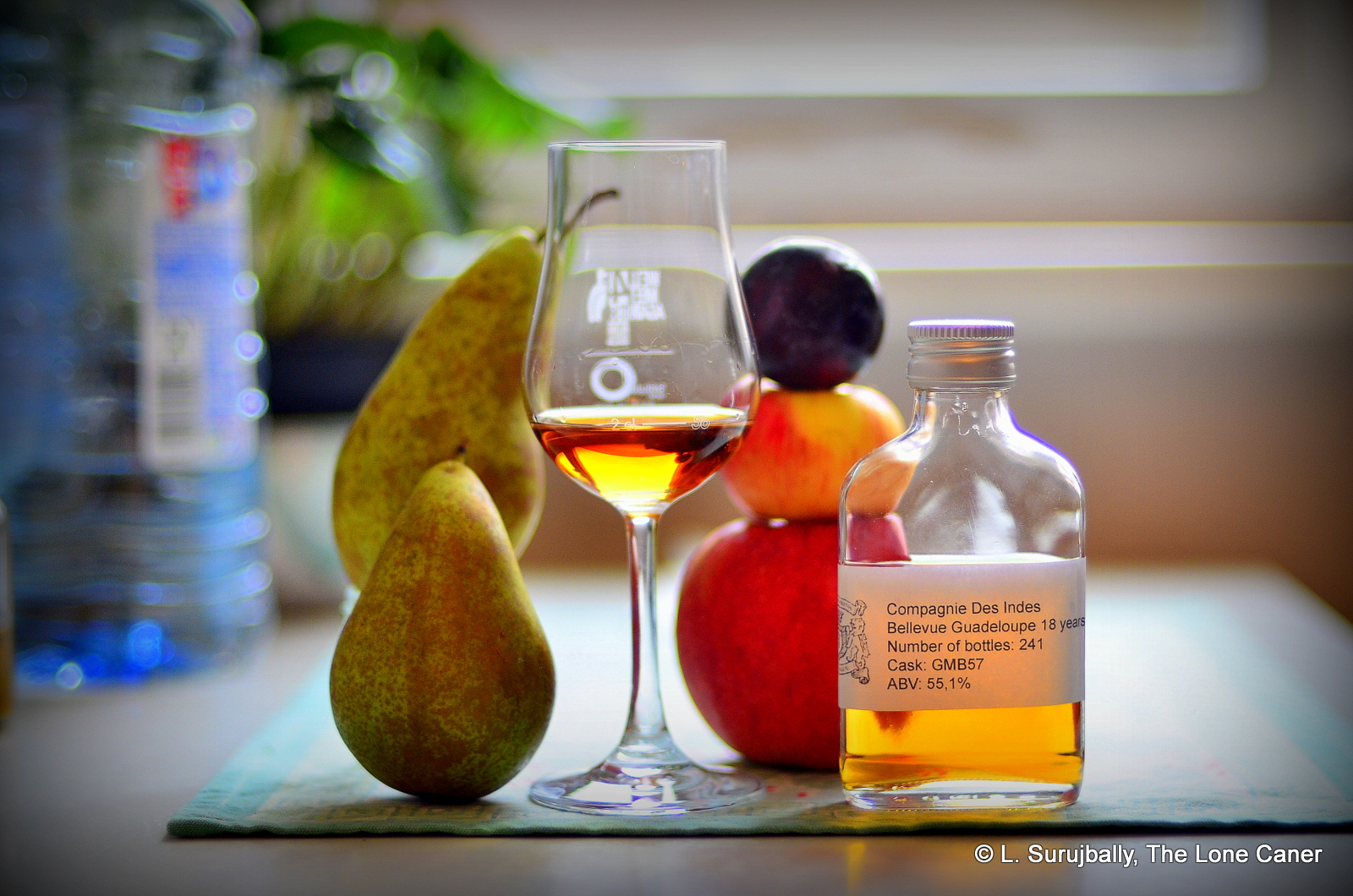
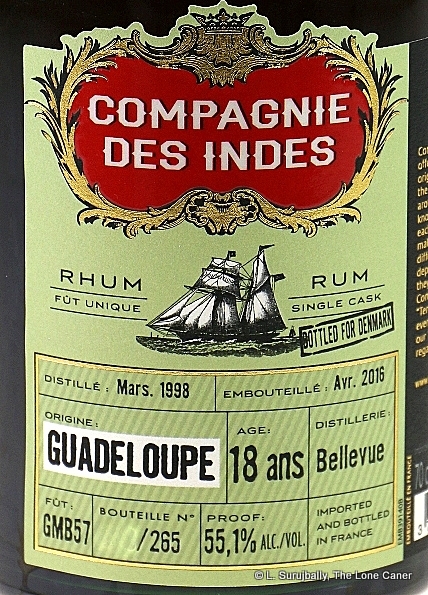
This particular Danish expression is a Bellevue rum from Guadeloupe (Damoiseau, not the one on Marie Galante), and here I have to pause for a moment, stand back, and happily observe that in this day and age of rising prices, lowering ages and instantly sold out Bajan rums (did someone say Triptych? … sure you did), we can still get a rum aged for eighteen years.  I am aware that a simple calculus of years (and continental years at that) does not always confer quality – look no further than the Chantal Comte 1980 for an emphatic refutation of that idea – but when made properly, they often do.  And bar some hiccups here and there, this one is exceedingly well done.

As always, let’s start with the details before getting into the tasting notes. It’s a French West Indian rhum which does not adhere to the AOC designation, bottled at a crisp 55.1%, gold in colour, and with a 265-bottle outturn.  It was distilled in March 1998 and bottled in April 2016, aged in American oak barrels, in Europe – this is, as most will recall, a personal standard of the Compagnie, which does not favour tropical ageing (or cannot spare the time and expense to source them direct from Guadeloupe, take your pick).

Wherever it was aged, there was no fault to find with how it smelled: the nose was creamy caramel and cream cheese with only the very faintest hint of wax and rubber, and in any event, such traces vanished fast, giving way to dark fruits, not particularly sweet, like almost-ripe plums and cashews. At this stage such tannins and wooden hints as came later were discreet, even shy, and there were some light, playful notes of flowers, peaches, apricots, grasses and cinnamon.

Tasting it delivered a crisp, firm mouthfeel that was hot and salty caramel, plus a touch of vanilla.  Here the tannins and pencil shavings became much more assertive, suggesting an oaken spine as whippy and sharp as the cane my house-master used to bend across my backside in high school with such unfortunate frequency. In spite of the attendant orange peel,vanilla, cashews, raisins and lemongrass that could be sensed, it was also somewhat sharp, even bitter, and not quite as tamed as I might personally have wished (with perhaps some more aging it would have been? Who knows).  Behind all that, the additional flavours had their work cut out for them, not entirely successfully, and so I had to concede after a while that  it was well done…but could have been better.  The finish, however, was quite exceptional, showing more clearly the difference between an AOC-determined profile versus a more laid back Guadeloupe “let’s see what we can do here” kind of insouciance – it’s remarkably clear, offering for our final inspection caramel, nuttiness, toffee, with avocado, cumin and a hint of ginger.

So, in fine, a Guadeloupe rhum with lovely notes dancing around a great nose and fade, and quite a decent palate within its oaky limitations (which did admittedly cause it to slide down the rankings).  Fortunately that in no way sank the rhum, which, on balance, remained a lovely drink to savour neat….it just needed a softer comma of oak, so to speak, not the exclamation point we got.  I concede, however, that this was a minor blemish overall.

Although at the top end we are seeing a move towards pot still rums done up in interesting finishes, complete with fully tropical maturation, I believe there is still a place for longer European ageing without any finish at all.  Florent Beuchet, the maitre of CDI, has always championed this quiet, more patient route for his rums, which is perhaps why much of his aged hooch works so well – there’s a subtle, delicate richness to the experience that is not so much as odds with, as a counterpoint to, the badass in-yer-face brutality of those rums which slept for a shorter but more intense period in the Caribbean.  Both such types of rums have their place in our world – the issue does, after all, depend entirely on our preferences – and when a Guadeloupe rum presses so many of the right buttons as this one does, one cannot help but simply appreciate the quality of what makes it into the bottle at the other end.  This is a rum like that — it’s vibrant Caribbean sunshine issued for a colder clime, and I’m damned glad I managed to pilfer some from my snickering Danish friends from up north before they finished it all themselves.

(86/100)


Other notes

Jun 132017
 

Rumaniacs Review #049 | 0449

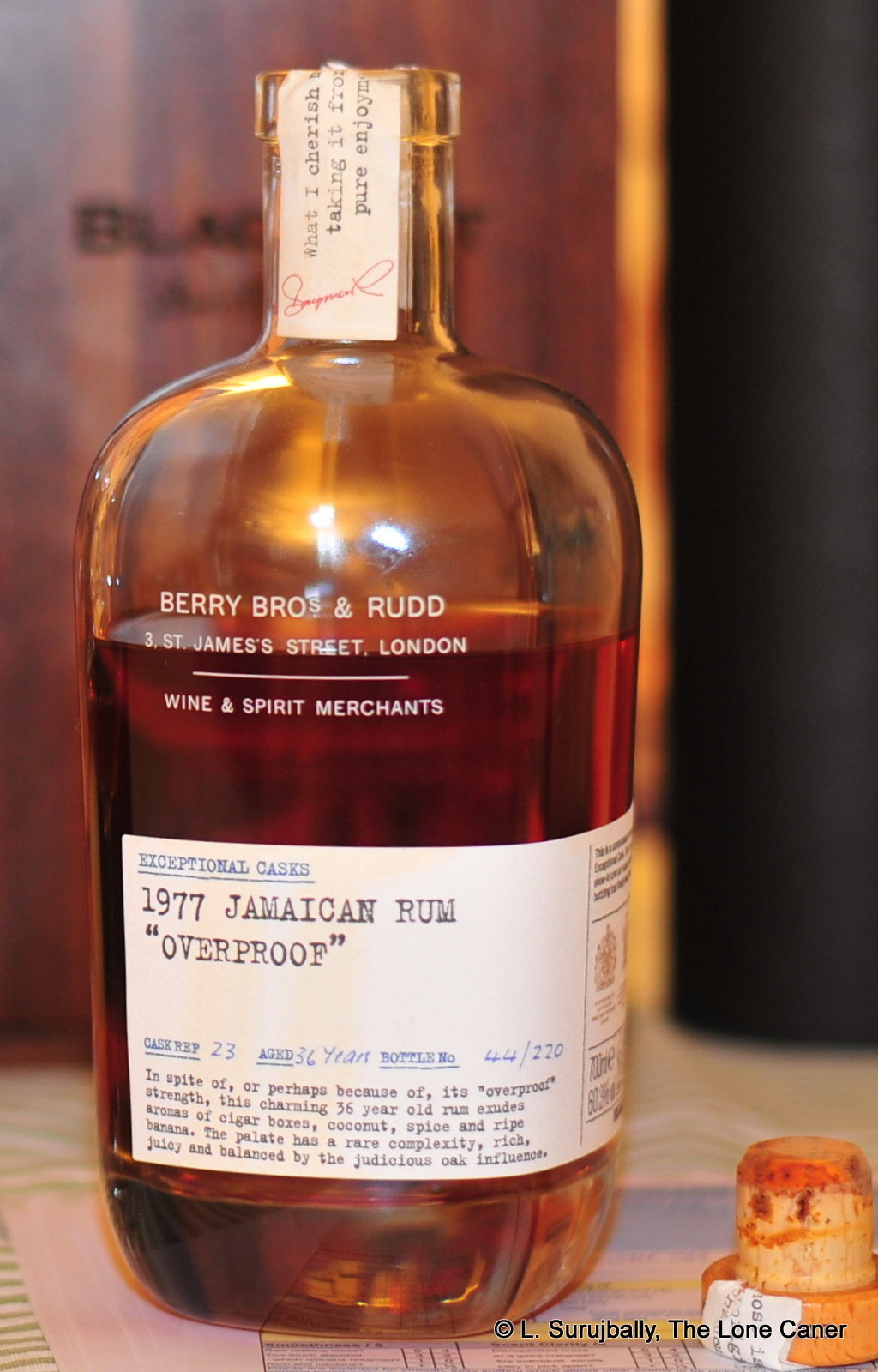
Even now, years after I acquired one of the 220 bottles of this phenomenal 36 year old rum, it retains its power to amaze and, yes, even awe. It still retails in the UK for over six hundred quid, reviews are rare as sugar in a Velier rum, and to this day it is unclear whether it is a blend — or if not, from which estate or distillery it hails.  Whatever the case, it is a great bit of Jamaican rum history and should be tried by any who get the opportunity.

Colour – Amber-orange

Strength – 60.3%

Nose – Pungent, bags of fruits resting on a firm and almost sharp initial aromas.  Vanilla, coconut, aromatic tobacco, and – at least at the beginning – very little in the way of true ‘Jamaican-ness’.  Where’s the funk?  Oak is well handled for something this old – so likely it was aged in the UK.  After some minutes coffee, raisins, bitter chocolate, parsley (!!) bananas, cherries, and faint dunder starts to creep out, before developing into something much more aggressive.  Definitely a rum that gives more the longer it stays open so don’t rush into this one.  There’s also a musty, damp-cellar background to it all that combines well with the wood, and somewhat displaces the fruitiness the esters are trying to provide.

Palate – Whew, hot hot hot.  Started slow, worked up a head of steam and then just barreled down the straight looking neither left nor right. Dusty cardboard and cereals, more of that earthy mustiness, plus some brine, avocados, cumin and maybe ginger.  Adding water is the key here, and once this is done, ther is caramel and cinnamon, more cumin, hay, tobacco and chocolate, veggies, and yes, rotting bananas and fleshy fruit gone off – so apparently it may not start out Jamaican, but sure finishes like one.

Finish – Long and warm and very very aromatic.  Wood shavings, some more citrus (lemons, not oranges), ginger, cumin, those ‘off’ fruits and even (what was this?) some cigarette tar.

Thoughts – Still an excellent, amazing rum.  Honestly, I’m helpless to justify 60.3% and 36 years old and near to a four figure price tag.  How can anyone?  For the average rum drinker, you can’t.  You wouldn’t share it with your card-playing buddies, your kids had better not go near it, you wouldn’t give it away as a gift, and there are so few of these bottles around that it might even never be opened because the event to do so would never be special enough.  But all that aside, we need s**t like this.  Without such rums we would be a lesser people (and cede pride of place to the maltsters). And that’s why it’s a rum to cherish, if you can ever get it.

(90/100)

Jun 112017
 

#371

While SAB, the only real commercial rum producer in Suriname, makes competent blends and some very nice aged work (like the 8 year old from last week), it suffers, if the word can be used, from the following: a competitor to up the ante and push them harder within their own country; higher proof offerings as part of a connoisseur’s cabinet; a range of true single cask rums that highlights a particular point of interest in an overall oevre; and most of all, as I noted way back in the Extra Gold, that particular note of terroire that would mark it out and set it apart from, and over, more common table tipple.

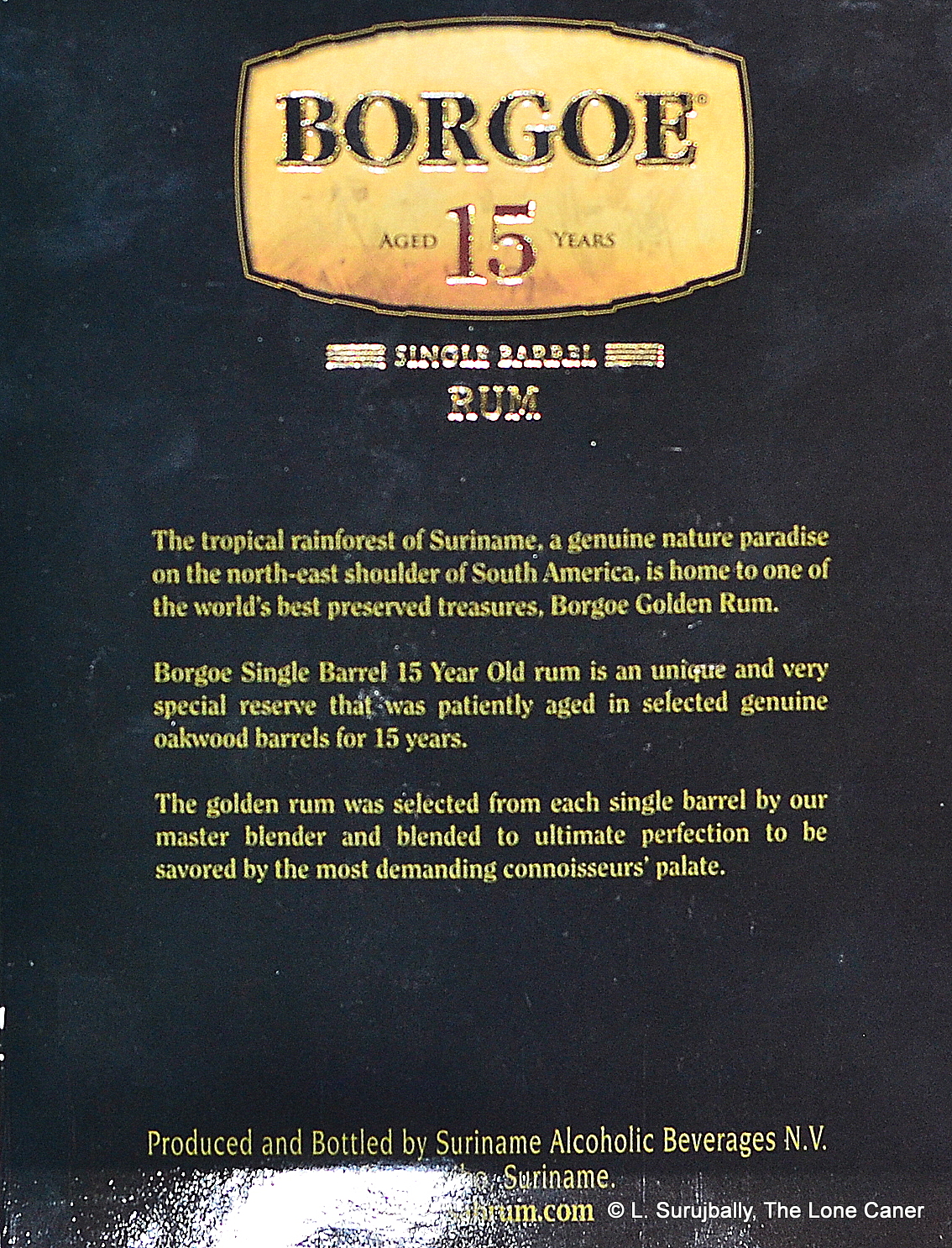
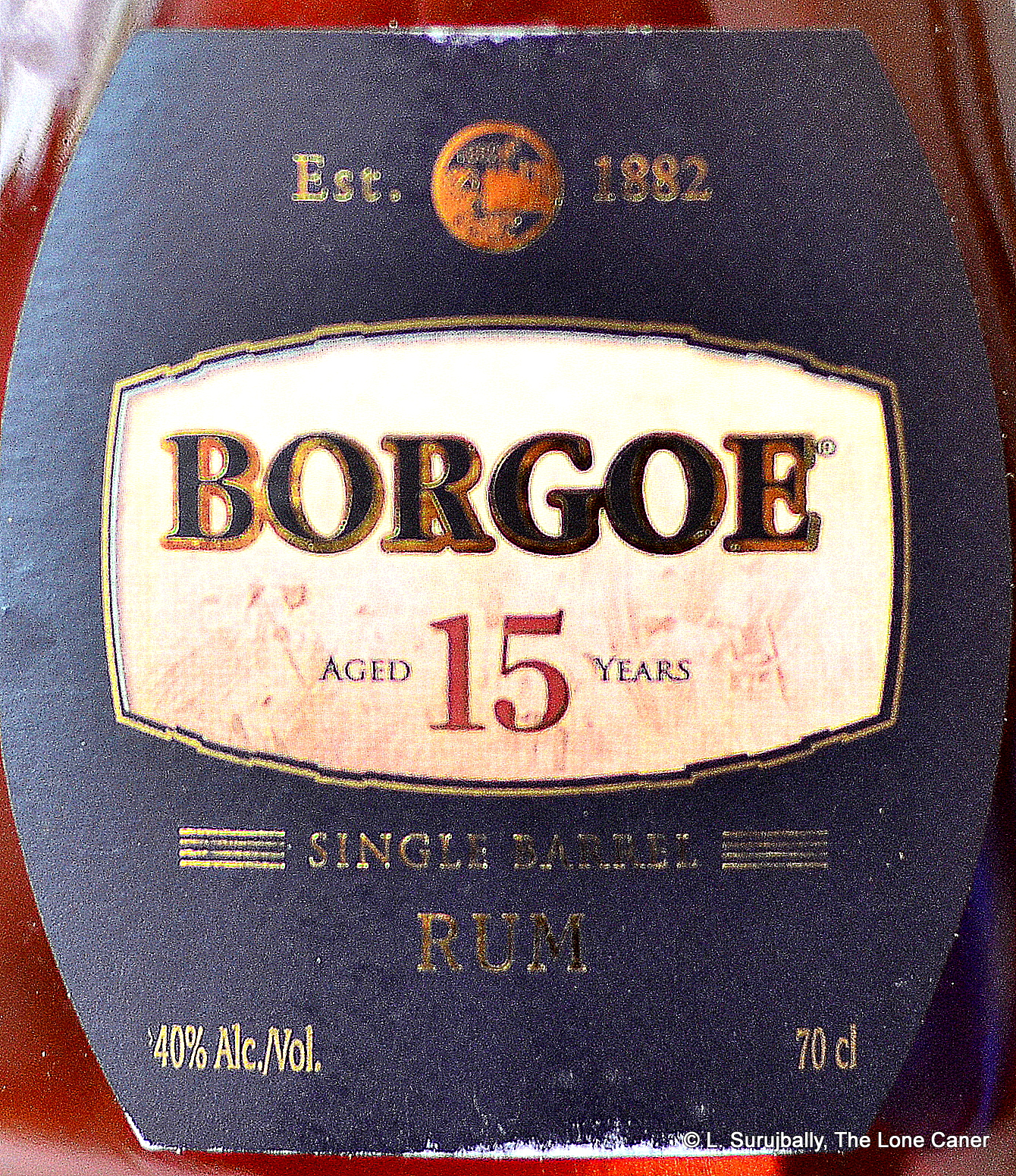
Which is not to say they’re bad – far from it.  The Borgoe 8 year old was a nice step up from the earlier, younger editions, and now the 40% 15 year old takes it to its own new level, even adding a filip of individuality, because it is stated to be a single barrel aged rum — although unfortunately I’m unable to ascertain what the outturn was,or even if it is issued on a semi-regular basis.  The fact that no year is mentioned on the label – single barrel rums by their nature tend to extol a year of make and a volume of bottles issued as a bare minimum – suggests that the moniker may either be totally incorrect or it’s poor  advertising / quality control…because you can be sure that no independent bottler would ever make such an error.

Anyway, beyond those issues, let’s take things at face value and simply accept it as a column still blend based on non-Surinamese molasses, blended from various barrels of fifteen year old reserves, issued at a milquetoast 40%, and if you’ll forgive my rampant and  unconfirmed speculation, with some pot still juice mixed in there for a little edge and torque.  The question is, was it any good?

Yes, and it’s very much the best of the lot, even edging out the Banks DIH Supreme 15 year old, with which it shared several points of similarity.  Even at 40% the difference between the various standard rums I was trying was quite impressive – creamy cereals and milk, oranges and caramel, all emerged to waft around the nose, at once.  There were the scents of walnuts, coconut, tobacco, and the fruitiness of cherries and peaches in cream, with a few flower petals and nougat thrown in for good measure.  And behind it all, barely noticeable, a queer clean sheen of something clear and bright and metallic, almost agricole-like….that’s the edge I was talking about, the point of distinction I liked.

Tasting it was also a pleasant experience, warm and smooth and with a fine texture – it actually presented with somewhat more heft than one would expect.  It was fruity, flowery and musky, all at the same time, redolent of aromatic cigarillos (those port-infused ones I used to like at one point in my life).  Leading off were ripe cherries and tart yellow mangos, apricots, plums and vanilla, with enough of the sharper oak influence to give it some kick.  It was vaguely (but in no way overbearingly) sweet, and with a drop or two of water provided some additional sage and nutmeg, burnt brown sugar, molasses and caramel, plus that faint but clear metallic brightness. Full proof it might not have been, but I had few complaints about what they had managed to achieve.  Only the finish was somewhat of a let-down, being rather short and quick, if easy and warm and without anything new being added to the experience…sort of like an ex-girlfriend’s cheerful goodbye kiss – she knows you well enough to give you a good one, but doesn’t care enough to give you the full treatment, know what I mean?

So all in all, a reasonably complex, well balanced rum which is nice to sip, a decent and very competent product by any standard. I want to make clear that as the top of the line, the Borgoe 15 year old is not a common bathtub hooch which plays it safe and doesn’t go anywhere spanking new – it’s too well made for that. But in the end, it remains a column still blend, it retains that unadventurous strength (not 46% or even 43% both of which can almost be seen as the evolving standards), and has only some of the force and uniqueness and intensity about it that would immediately mark it out as something special. Something special like a rum specifically Surinamese. Something special like a rum we must have.  And that’s a shame, because with some effort and courage — some more oomph, so to speak —  I would surely have marked it even higher, and liked it even more, than I actually ended up doing.

(85/100)


Other notes

  • I deliberately included the word “blended” in the title even though it’s not on the label, in order to not give the misleading impression that it is a true Single Barrel rum (as defined by common useage).
Jun 082017


#370

SAB is a Surinamese conglomerate that is very much like Banks DIH and DDL in Guyana – they have several different kinds of businesses in the portfolio, including various spirits, mostly sold on the local market.  Rums are among the few of its offerings which are exported, primarily to Holland, which comes as no surprise given their historical affiliation with the Netherlands.  At the time when I bought these bottles I was unaware of their availablity in Europe (which says rather more about my miserable googling skills than their advertising) and bought the entire line straight out of Suriname: to this day I’m still wondering how the Marienburg 90% made it past customs in Germany when the rather more tame ~55% Nasyonal from Mascoso nearly caused them a conniption fit.

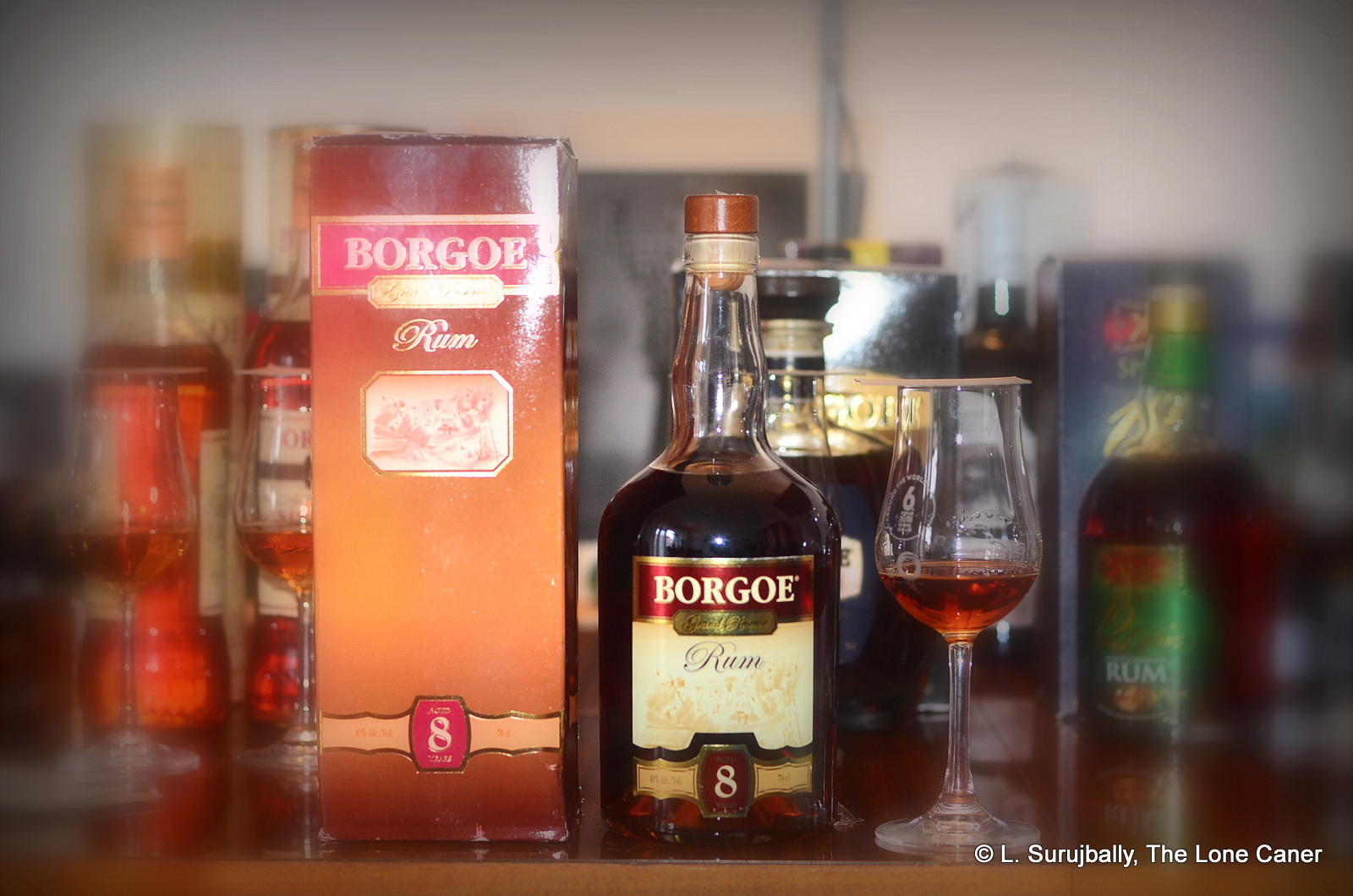
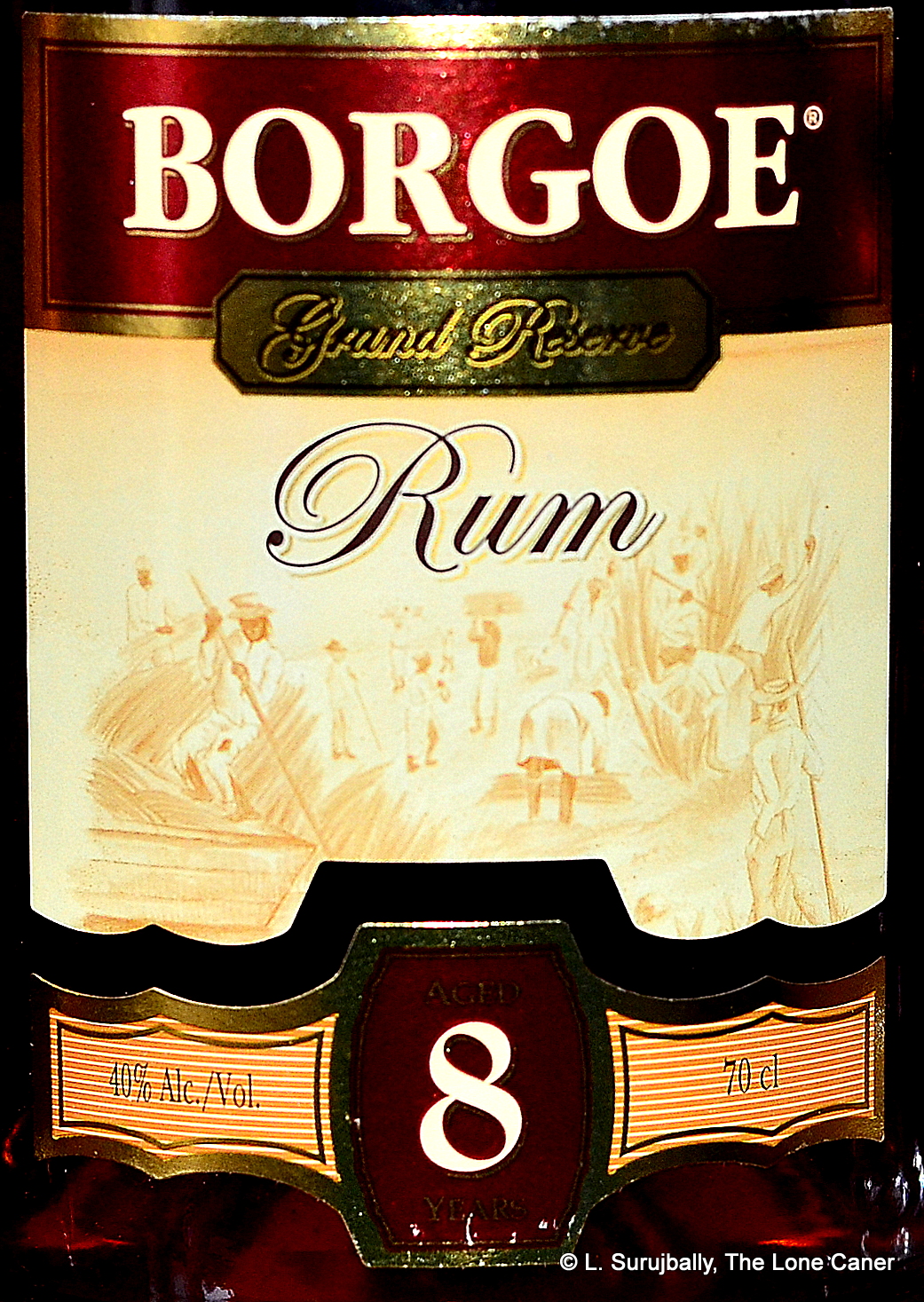
Anyway, after the uncomplicated and placid experience that was the Borgoe Extra and 5 Year Old, I am happy to report that the 8 year old is an emphatic step up the quality ladder.  This is a rum aged a mere three years more than the five, but tastes and smells like a totally different product. Even at 40%, which readers are probably tired of hearing me whinge about, the Grand Reserve manages to produce a complex little tap dance that had me hastening back to all the other glasses to see if it was just me.  To say that about a standard proof product these days is making a rather interesting statement about what it delivers.

Take first the nose, which alleviated many of my issues with the previous rums from the company.  It started off warm and spicy, offering salty caramel ice cream, molasses, raisins, and bananas just starting to go off.  It didn’t burst out of the bottle to overwhelm and cudgel you in the face – it wasn’t that kind of drink; it more like tip-toed out, to slyly coil its way around the nose, gentle and easy, but each note initially distinct, before melting into a pleasant mélange.  It also developed well, because after some minutes, one could sense a thin line of citrus-like tartness, like gooseberries, unripe mangos leavened with some nuts, perhaps some vanilla, and smoke and leather.

This all took some time and concentration, to be sure, because its very mildness required some effort.  The palate was somewhat more assertive and less difficult to analyze.  First there were waves of caramel and candied oranges, more pronounced molasses, plus a musky background of cumin and masala spices which were not overwhelming but simply stayed in the background with an occasional wave to show they were still there.  With water (not really required, but it’s part of the system, so I tried it anyway), cherries, dark chocolate, some cloves and orange peel were noticeable, and after maybe half an hour the molasses was very much a part of the profile.  It also finished well, being remarkably dry, warm, with mostly citrus, leather and caramel winding up the show.

Trying to come to grips with the 8 year old was hindered by the very gentleness and kinks that made it interesting.  I wouldn’t go so far as to say it was a massively sophisticated sub-ten-year-old (I believe that that particular crown belongs for the most part to agricoles), and it certainly did not have the rough-hewn elemental brutality of a cask strength bruiser, but it was a nice, easy drink, soft enough to please, with just enough edge on it to provide a slightly askew drinking experience.  Dave Russell of the Rum Gallery (who tried it at least three times), remarked in his review that it had a “soft polite touch”, and I think he pretty much called it as it was — so rather than indulge my windy vocabulary, I think I’ll let this write-up rest with that pithy and appropriate conclusion.

(83/100)

Other notes

  • Column still blend, aged in American white oak ex-bourbon barrels.  I remarked in the review of the 5 year old that there’s a pot still floating around SAB’s premises, and I can’t rid myself of the feeling that there’s some of that in this rum.  It’s just an opinion, though.
  • Adheres to the Authentic Caribbean Rum (ACR) standard, so we can assume no colouring, additives or sugar.
  • I’ll wrap things up for Borgoe line with the 15 year old next week.


Jun 052017
 

#369

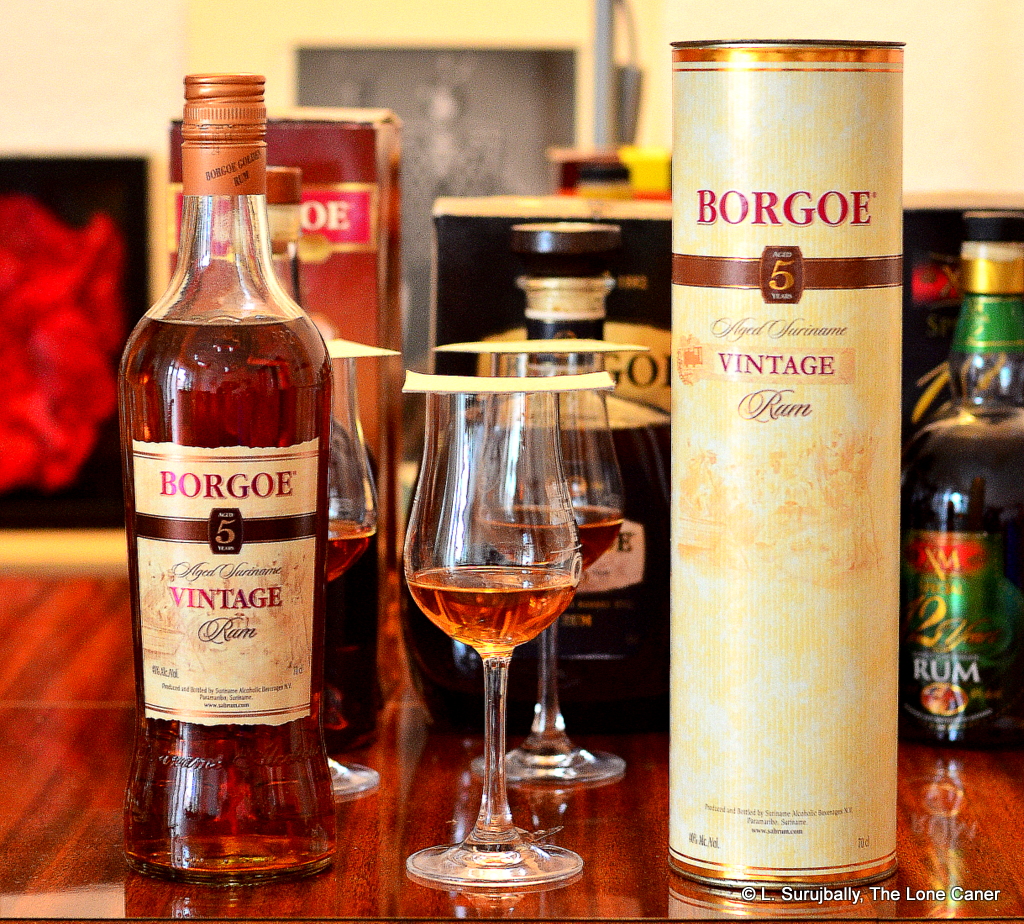
Agricoles and pot still rums aside, one does not usually expect too much from a three year old blended rum such as is the Borgoe Extra Gold we looked at earlier– although they retain their capacity to surprise — and so I had higher hopes for the five, since such lightly aged rums are often the solid pillars upon which many rum makers support the edifice of all their older (and sometimes even younger) rums.  When well made, they may even edge into sipping territory, serve as the first firm introduction to the ethos of the company and can sometimes be a nice bridge between a cocktail agent and something to have by itself (with or without ice). Agricoles and pot still rums are particularly noted for such quality

To some extent this is the case with the Borgoe “Vintage” 5 Year old from Suriname, made by the same bunch of guys who did the “Extra”.  There is, alas, very little hard information to go on here, over and beyond what I’ve already mentioned in the Extra review: it’s a primarily column-still rum issued at 40%, the molasses are sourced from Trinidad (Angostura), there may be some pot still distillate meandering in the blend somewhere, and the whole thing is aged in American oak.  Beyond that standard information, both my contacts and the official webpage are silent. Still, in a way that’s an advantage since it forces us to simply address what’s on show without any extraneous material unconsciously cluttering up our minds.  And overall, there’s little that’s bad about the Vintage expression. If I had to use a single word to summarize this five year old, it would be “inoffensive”, or with two, “happily uncomplicated.”

That might be damning it with faint praise, but not really.  The nose gives an indication of what’s in store: it meanders out calmly and easily, warm and without bite, a little creamy at first; it presents as somewhat sweet, though not overly so – and after settling down, if one takes one’s time with it, there are additional and faint background notes of breakfast spices (nutmeg and cinnamon, perhaps a clove or two), plus cereals, nuts, a little vanilla and some flowers.  It’s certainly not reaching for the stars and seems content to stay with simplicity for effect.

The palate demonstrates more of that placid nature: again it was warm and not altogether spicy or sharp, and although it did seem somewhat thinner than one accustomed to more powerful drinks might appreciate, it was also reasonably smooth, and a rung or two up the ladder from the Extra. Crème brulee, caramel and molasses were the dominant notes at the inception, with vanilla and some oaken tannins bringing up the rear.  Setting it aside for some minutes is probably a good idea for those who want more: after a while, subtler flavours crop up, citrus, flowers, guavas, a few watery pears and a sharper slice of green apple in the mix there someplace.  I particularly enjoyed the languid French toast and honey that shyly danced in the background, and again the breakfast spices were there, not as distinct as the nose suggested they might be.  The finish, short and faint as it was, was at least aromatic, with the fruits fading fast now, and mostly showing off some sweet tangerines and caramel.

All right then, let’s sum up. For one used to aggressive young agricoles and fullproofs of any age, this is probably a rum to avoid, since everything is very much dialed down with a feather blanket, and it might work best in a delicate mix that others know more about than I do. It’s pleasant and inoffensive, as noted above, and I find it too bland to appeal to me personally.  Perhaps its real issue –  one that would not lead to parades of rabid aficionados cluttering up whole Facebook pages with songs of praise – is the fact that is still somewhat generic, and seems have no problem in being an agreeable but indeterminate rum, one that simply exists. Rather than anything particularly Surinamese,  it reminds me of a Botran 15 Solera, a Cacique 500, or a Tres Hombres rum.  It’s light, easy and uncomplicated enough to take by itself, but this comes at the expense of some originality and were I to come back to it sight unseen a month from now, I’m not entirely sure I’d remember it clearly. 

(80/100)

Other notes

For the kind of quality I was looking for, I had to go up to the 8 and 15 year old expressions, which we’ll look at next time.

Jun 032017
 

Rumaniacs Review #048 | 0448

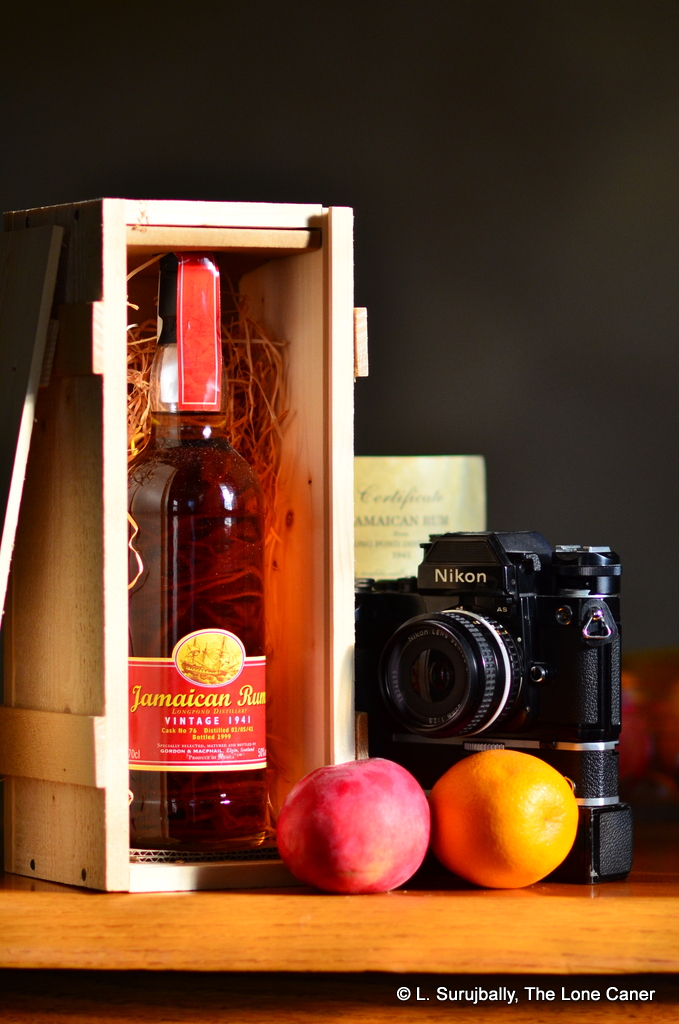
For this writer, the Long Pond 1941 remains, after maybe ten separate tastings (including a Rumaniacs sample), three purchased bottles and numerous sharings, one the most spectacular Jamaican rums ever made and not simply because of the titanic age — 58 years old (beat that if you can, Appleton).  It takes the passage of years, and many other Jamaican rums to be tried alongside, for the rum to snap properly into focus and be seen for its true quality.  And unlike the earlier Velier rums which sometimes sell for €4000-5000 a bottle, if they can even be found, the 1941 remains puzzlingly available and relatively affordable at around the thousand Euro mark.  You might have to search around a bit, but it can be found.  It’s a monument to G&M and Jamaica, the old ways and the old days, when making aged rum was not glamorous, but the same careful, patient quality was used to make them, because they deserved it.

Colour – Gold

Strength – 50%

Nose – Strong, deep, warm and not over-oaked.  All my tasting notes on this thing refer to the sweet aromas freshly-sawn cedar planks, and to that is added rubber, phenols, some Indian spices (tumeric, cumin and massala for the most part)…and that was just the beginning.  After ten minutes or so, mint, grass, some caramel, nail polish, olives, bananas, and plums and dates.  The sweet and salt elements are amazingly well balanced and overall, just a great nose.

Palate – The 50% is perfect.  Less and it would have dissolved into a cupcake, more and some of the subtleties might have been lost.  It’s warm and solid, quite velvety on the tongue. Cedar again, burnt sugar, hay and the dusty notes of a dry barn.   Burnt sugar, prunes, raisins, and also some greener, fresher components, of apples, more bananas (starting to spoil), pears, and some citrus all coming together in a superlative assembly.

Finish – Grapes, cedar, cumin, and some citrus zest wrestle for dominance in a very bright, long finish that does not disappoint. A fitting finish to a lovely rum.

Thoughts – Young and old, sweet and salt, sugar and spice, all delicately balanced against each other…you know it’s Jamaican, just not what kind. I don’t think any rum could possibly be aged that long in the Caribbean and survive. Velier remains wedded to the principle of tropical ageing, and is at one end of the spectrum; Compagnie des Indes is at the other end, specifically going in for slower maturation of the cooler climes of Europe – they believe the slower, more gradual interaction of wood and spirit allows subtler flavours to develop than that given by the brutally fast tropical regimen.  G&M may be the ultimate practitioner of the European ageing route (alongside Silver Seal, which also put out a 1941 rum, and from the same batch) and issued this rum as perhaps the definitive statement in support of that ideal.  Given its quality – dare I say magnificence? – I can’t say they’re wrong.  To paraphrase my original review, G&M did something stunning here – they went right ahead, aged a Jamaican from the war years beyond all reason…and issued this amazing rum, a rum right off the scale, after dreaming mad dreams of greatness.

(92/100)

Other reviews of the rum are available on the Rumaniacs page, here.

Jun 012017
 

#368

There is no shortage of agricoles, independent bottlers and flavour-of-the-month rums in my notebooks — but in late 2016, and again in early 2017, I tried the Borgoe line from Suriname – all 40% rums – back to front, front to back and side by side, twice, and it’s time to see what they’re all about.  After all, we all know of the big guns in the rum world but the lesser-known operators deserve their moment in the sun as well.

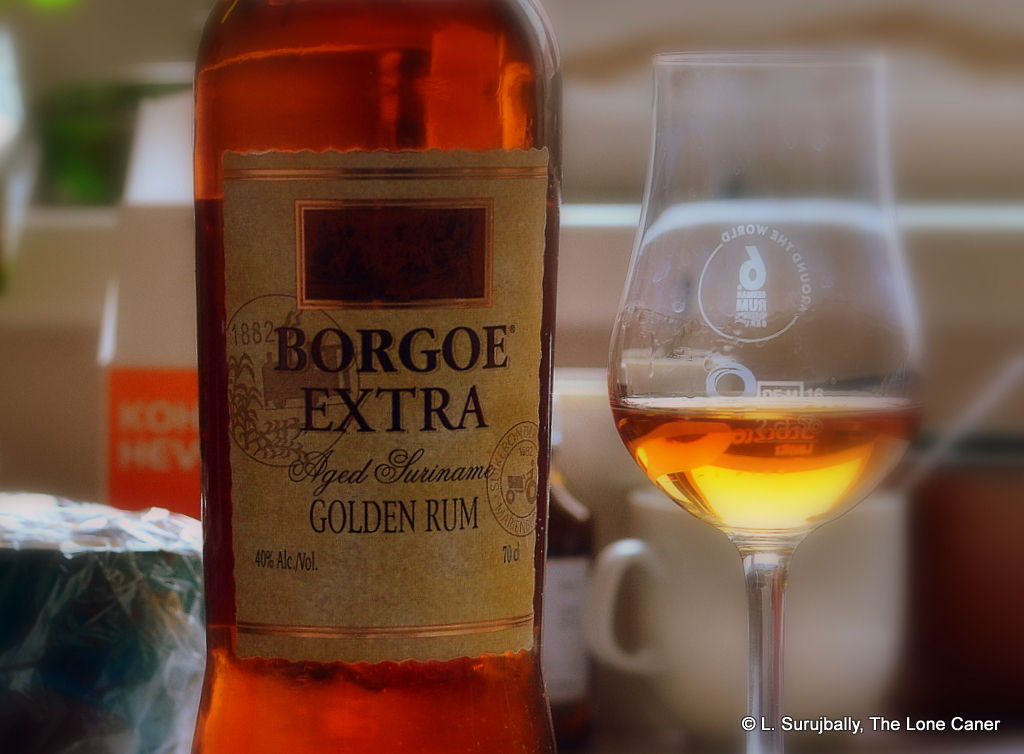
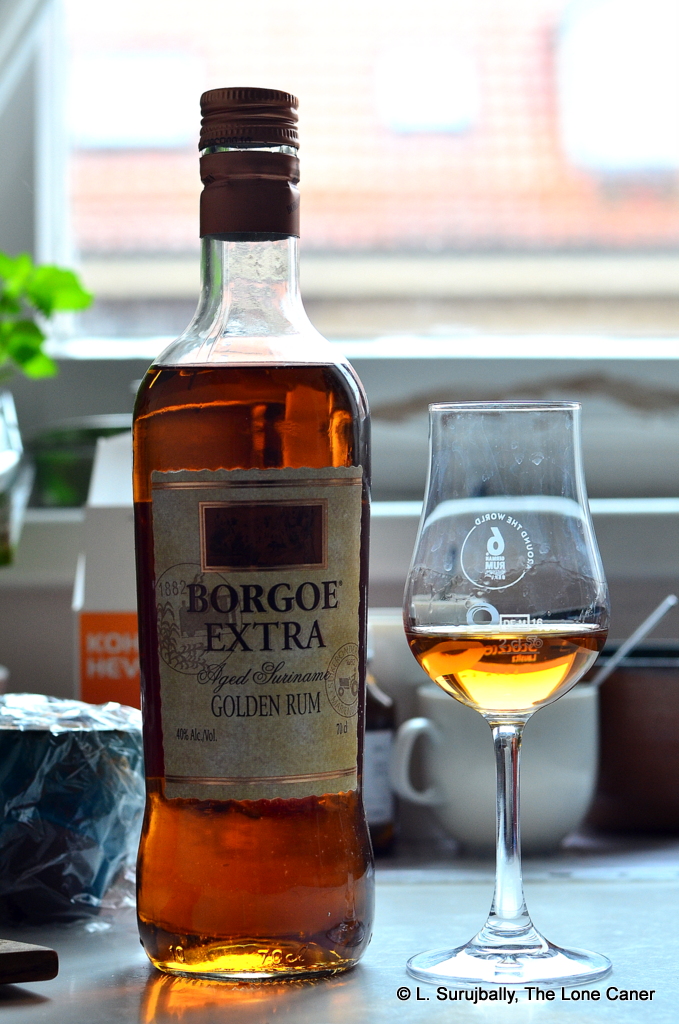
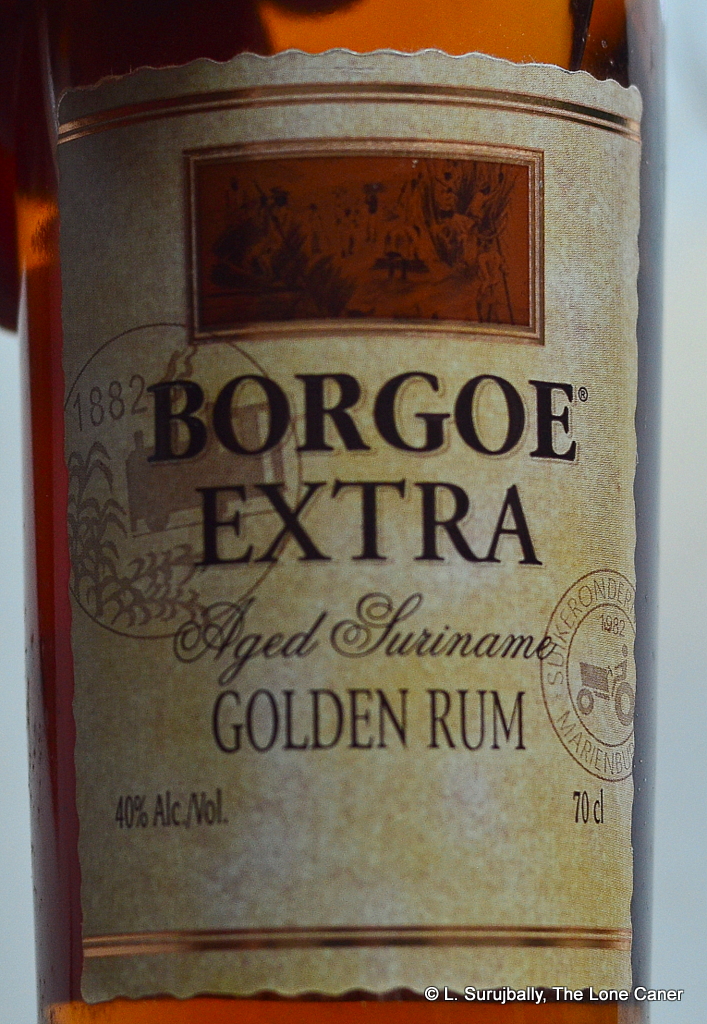
So let’s start at the bottom and work our way up to the top, young to old, beginning with the  Borgoe Extra, an “Aged Golden rum”: this is the light, low-end mainstay of the brand’s offerings, the way the V/X is for Appleton, or various 3-year olds or “gold rums” are for other makers.  It’s  a successor to the Borgoe ’82 rum first introduced in 1982, and I believe it to be around three years old (other products are the 5, 8 and 15 year old rums), a blend aged in American oak barrels and issued at the usual 40% after being filtered twice.

Smelling it revealed no real markers of distinction such as would make one wonder into what magical terroire of the mind one had just stumbled all unaware.  It was redolent of fleshy fruits, some cherries, caramel and some nougat, nothing terribly complex or ambitious.  After resting for some time and coming back to it I could detect orange peel, a flash of something sharp and bitter, cinnamon and some herbs, so pretty standard, all in all.

I liked the palate more than the nose (usually the opposite is the case with really young rums, at least for me).  It presented as somewhat sharp; then came a swift procession of salty caramel, more nougat, white toblerone, and nuts. An amalgam of a few fruits, — peaches, unripe green apples and ginip, all muddled together — plus the slight citric sting of orange peel again There were faint notes of olives and brine (very faint) and oaken tannins and the bitterness of raw wood chips still bleeding sap, and the whole thing, while quite light, was thin and sharp too, with a short, spicy and rather unremarkable finish mostly providing a closing sense of caramel, apples and sugar water.  

Overall, rather uncomplex and unexciting: there was something going on here, just not too much of it (certainly not enough) and it’s insufficient to get excited about at this stage.  A word should be spared for the notation that it is not really sweet and quite thin (“scrawny” was the word I scribbled down), which leads me to surmise that dosing is not part of the assembly.  

Thinking further through the tasting experience, I believe that thinness aside, what it really lacks is  distinctiveness (and, perhaps, punch). The filtration is part of the problem, as is the anemic 40%, and also the column still makeup of the blend leans heavily towards a lighter, more Spanish style.  It could just as easily be any young rum from the Dominican Republic, Panama or Belize, and I think the company is much like Banks DIH in that it sticks to the low-strength blends without doing enough to create a particular and clearly Surinamese profile which could potentially showcase the land of origin.  It therefore cannot and should not be used on its own; and given its generic nature, I’m not sure whether there’s any particular cocktail that would be made with it to demonstrate and capitalize such attributes it does possess.

I mean, when you taste a Jamaican, a Guyanese rum from DDL, a St. Lucian or a Bajan Foursquare, you can, with a little experience, use them as markers for the entire country. That’s one reason why they’re so popular – it’s their unique and country-specific profile that makes people go after them and actively source really old expressions.  I think SAB might be sitting on some untapped potential just on the strength of this little rumlet — if they were to go with local cane, utilize that pot still more often, and produce some limited editions of greater power. But perhaps we have to go up the ladder to see what the brand has on offer, and if that half-sensed potential I mention can be seen in older variations…or not.

(77/100)


Other Notes

  • Rather than go into a long history of the company, I’ll direct you to the Marienburg 90% review with its thumbnail recap for those who are interested.
  • The production process is based on molasses sourced from Angostura in Trinidad and not from Guyana right next door, surprisingly enough, and after fermentation, the wash is passed through a columnar still, the resultant being used to make the rums which are aged in American oak barrels.  The website of the company notes that a second still is used to make high ABV neutral spirits for the pharmaceutical industry, and they have a third copper still (they call it a “hand still”) for heavier rums – I am assuming this is the pot still some have mentioned to me, though exactly which rums this makes is still unclear at this time.  Since the entire line of Borgoe aged rums is blended, no doubt some portion of the pot still finds its way into the various expressions, much in the same way DDL does it with their various stills and the standard El Dorado line.
May 302017
 

Rumaniacs Review #047 | 0447

Unless I start springing a few grand for ancient rums from the 1920s and 1930s, this is likely to be the oldest Bally rum I’ll ever see, or try.  I suppose I could take a stab a guessing how truly old it is – who knows, maybe it’s in the fifteen year range too? – but for the moment I think I’ll just revel in the fact that it was made almost sixty years ago, way before I was born, by Jacques Bally’s boys before the estate shut down in the late 1980s and the production shifted to St. James. And who among us doesn’t enjoy revisiting rums made in ages past?  A piece of the living history of our parents is what it really is.  Too bad they weren’t into rums as much as we are.

Colour – Amber

Strength – 45%

Nose – The modern agricole profile is something of an afterthought on the nose. It smells salty and Haagen-Dasz carmel creamy; not really grassy or vegetal, more olive-y and brine and some paint stripper (the good kind).  Some of the mineral (or ashy) background of the 1975 is also on show here, plus some weird green peas, overripe bananas and off-colour fruits sitting in an over-sterilized hospital.  It’s crazy odd, emphatically different and shouldn’t really work….yet somehow it does.

Palate – The tastes which remind me of more recent vintages coil restlessly beneath the surface of this rhum, occasionally emerging for air to showcase grass, green grapes, sugar cane sap and soursop.  Heavier, muskier flavours tie all of them together: prunes, peaches, pineapple, cinnamon, apples and the interesting thing is, it’s hardly sweet at all.  Plus, the ashy, minerally taste remains (let’s call it “dirt” or “earth” or “sod”), which is not entirely to my liking, although it does succeed in balancing off the other components of the profile. Let’s call it intriguing at least, and hauntingly good at most.

Finish – Medium long, much of the palate comes back to take another bow before exiting stage left. Tropical fruits, some earth again, a flirt of breakfast spices, licorice and tannins.  Pretty good, actually.

Thoughts – Parts of the rhum work swimmingly.  The balance is a bit off, and overall, I felt it had many points of similarity with the 1975, with a few marked deviations too.  What this says to me is that no matter which era (or where) Bally rhums were made in, there is an awesome dedication to consistency over the decades. The Bally 1960 would not be out of place on today’s shelves, and it would surely be better than many.

(88/100)

Yes, the other Rumaniacs have also written about this rhum, and for the record, they all scored it at 90+.

May 292017
 

Rumaniacs Review #046 | 0446

We’re going back down memory lane now, to a point where the AOC designation is a dream on the horizon, and for once we have an age: this rum is sixteen years old (based on the bottom of the bottle where it says “Bottled February 1991” in French).  This of course leads us to puzzle our way through all the others we’ve looked at already, because if here they can call a 16YO a “rhum vieux” then the other Bally rhums are in all likelihood similarly aged – we just have no proof of the matter.

In any event, age or no age, rums and rons and rhums are evaluated based on what they are, not what they are stated to be. So let’s put aside all the whinging about information provision (which is a never ending grouse of mine) and simply taste a rhum made when I was still living in Africa and had never heard of Martinique (or much about Guyana, for that matter).

Colour – Amber

Strength – 45%

Nose – So far nothing has beaten the Bally 1982, but this one is on par…perhaps better.  The nose is amazing – deep purple grapes and vanilla, with the traditionals of sugar cane sap, wet green lemon grass, with a mischievous hint of wet cardboard and cereals.  Threading through these smells are additional notes of Turkish coffee (no sugar), cocoa and some black chocolate, but curiously there’s less fruitiness to sniff in this one than in the later editions, and it’s backgrounded by something vaguely metallic…like licking a small battery, y’know?  Some cinnamon, well-polished leather and honey fill in the spaces.

Palate – It’s creamy, spicy, sweet and salty all at once (plus lemon).  In a way it reminds me of a very well made Thai green curry in coconut milk.  The fruits are here at last – green apples, pears, white guavas, but also pastries and cheese, to which are added very light hints of creme brulee and caramel, milk chocolate, some honey and licorice.  Would be interesting to know the barrel strategy on this one.  Whatever.  It’s a fine fine rhum to try, that’s for sure.

Finish – Medium long, vegetal, grassy and breakfast spices for the most part, some more of the white fruit, and the woody notes are here to stay.  Not the best fade, but pretty good anyway.

Thoughts – It had great balance and the tastes were excellent.  Something like this is best had in conjunction with something newer from Bally because then you gain a sense of its achievement, and how rhum has developed over the years.  People swear by the AOC (and in an era of marketing nonsense dosed with outright lies, quite rightfully so), but sometimes you wonder whether something hasn’t been lost as well.  The Bally 1975 emphatically demonstrates the quality of what was being done, at a time way before regulations changed the industry.

(86/100)

The boys of the Rumaniacs liked this rhum even more than I did.


May 282017
 

Rumaniacs Review #045 | 0445

By now two things are clear about these older Bally rhums – aside from some educated guesswork, we don’t know how old they are, and by this time, 1979, the AOC noted on the label is somewhat of a puzzler, unless the thing is seventeen years old, in which case it would hardly be labelled a mere “rhum vieux” but an “XO”.  So maybe after the initial ageing they stored it in tanks or flagons and only bottled it after 1996…or, more likely, it came under a previous version of the official 1996 AOC designation.  At this point, it’s somewhat academic, though — given it was made nearly forty years ago, it presents as a rhum that shows something of the evolution of the agricole world over time.

Colour – Amber

Strength – 45%

Nose – Pungent, grassy, clear and quite light, quite dry.  There were olives in brine, grapes, black tea, some citrus peel and aromatic tobacco, but also something softer, milder: strawberries and bananas, I’d  say, forming a nice counterpoint.  It takes its time opening up, once this happens, it gets somewhat fruitier, while never entirely letting go of the grassy, herbal aromas.

Palate – Creamy and salty, black bread and cheese. It’s also somewhat sharper and more more tannic than the earlier Ballys from 1992 and 1993, with wood taking center stage, and a taste of something green, like grass, fresh sap, Japanese tea.  So also somewhat bitter, and the clean purity of agricoles with which we are more familiar has receded – fortunately I could still taste tart apples, lemon zest and raisins, plus whiffs of dark chocolate and some unripe fruit.

Finish – Pleasant close out – dry, edgy, warm.  White guavas and pears, plus the tartness of soursop, pencil shavings and perhaps too much oak.  Not entirely a success here, perhaps a shade too peppery and not as well balanced as the nose or palate.

Thoughts – Here we have moved away from the almost standard profile of the ’80s and ’90s demonstrated so clearly by the newer Bally rums, and returned to agricole rums’ roots…but also something of a tangent from those profiles we are now used to. A solid rhum, but not one that ascends to the heights.

(83/100)

Other members of the Collective have written about the rhum as well, on the official website.

May 252017
 

#367

In my own limited experience, Neisson has been one of the most distinctive Martinique agricole makers I’ve come across.  There’s something salty, oily, tequila-ish and musky in those of their rums I’ve tried, and while this might not always be to my liking, the quality of their work could never be denied.  To date, I’ve stuck with their aged rums, but back in 2016 L’homme à la Poussette (I’m thinking his poussette should be retired soon as his kids grow up but I hope he never changes the name of his site) passed along this ferocious white rhino, perhaps to gleefully observe my glottis landing in Albania.  
Now, this rum is something of a special edition, initially released in 2002 for the 70th Anniversary of the distillery, and annually without change thereafter – it is rested for six months in steel tanks after being taken off their Savalle still, but it is not aged in any way.  Although the resolutely family-owned distillery is now 85 years old, the rum retains the original title, perhaps because of its popularity among the rabid cognoscenti, who enjoy its 70⁰ ABV and the 70cl square bottle  Maybe some enterprising mathematician could work out how the sums of the corners and angles on the thing added up to or produced 70 — for my money, I’m more interested in whether the company releases more than 70 bottles a year or not, because for anyone who likes white lightning – whether for a cocktail or to brave by itself – this unaged rum is definitely up there with the best (or craziest).

You could tell that was the case just by smelling it: clearly Neisson felt that the subtle, light milquetoasts of the independent full proofs or the clairins (who bottle at a “mere” 60% or so) needed a kick in the pants to get them to up their game and join the Big Boys. The sheer intensity of the nose left me gasping – salt, wax, paraffin and floor polish billowed out hotly without any warning, accompanied by the sly note of well-worn, well-polished leather shoes (oxfords, not brogues, of course).  Nothing shy here at all, and the best thing about it – once I got past the heat – was what followed: coconut cream, almonds, olives, fruits (cherries, apricots, papaya, tart mangoes), all bedded down in a bath of sugar water and watermelon, and presenting themselves with attitude. If I was telling a story, I’d wax lyrical by saying the ground moved, trees shook, and an electric guitar solo was screaming in the background…but you kinda get the point already, right?

Oh, and that’s not all – the tasting was still to come. And so, be warned – 70 degrees of badass carves a glittering blade of heat down your throat, as surgically precise and sharp as a Swiss army knife.  A hot, spicy, and amazingly smooth sweet sugar water — spiked with stewed prunes, lemon zest, wet grass and gherkins in brine — roared across the palate.  With its brought-forward notes of polish and wax and grassiness, I felt like it was channelling the gleeful over-the-top machismo of a clairin, yet for all that enormous conflation of clear and crisp tastes, it still felt (and I know this is difficult to believe) smoother, creamier and more tamed than lesser-proofed whites like the Rum Nation 57%, Charley’s J.B. Jamaican white, the Clairin Sajous or the Klérin Nasyonal….which says a lot for how well the L’Esprit is actually made.  And the finish was no slouch either, long and very warm, salt butter and cereals mixing it up with some citrus, red grapefruit, more grass and even a hint of the smooth salty oiliness of a well-made tequila.

“How the hell did they stuff so much taste into the bottle?” I asked myself in wonder. Perhaps the unwritten, unspoken codicil is “…and not muck it all up into an unfocussed mess?”  Well, they did provide the profile, they didn’t muck it up, I enjoyed it thoroughly, and it was only later that I realized that in a world where Ringling Brothers can fit fifteen fat clowns into a Mini, I should not have been so surprised, when it’s obvious that in the rumiverse just about anything is possible.  Certainly Neisson proved it here.

You know how we hear the old joke about “Rum is the coming thing….and always will be”? This kind of statement is regularly and tiresomely trumpeted by all the know-nothing online drinks magazines who have their lazy hacks attempt to pen a few words or make up a click-bait list about a subject on which they are woefully ill-equipped to speak.  Still…take that statement a bit further.  I honestly believe that as the stocks of old and majestic 20+ or 30+ rums run out or are priced out of existence, it will soon become the turn of unaged, unfiltered white rums to take center stage and become De Nex’ Big Ting.  I accept that for the most part these will be cocktail bases — but for the enterprising, for the slightly addled, for the adventurous among us, for those who are willing to step off the path and enter Mirkwood directly, the real next undiscovered country lies with these white mastodons which showcase much of the amazing talent that remains in our world, needing only the bugling of an enthusiastic drinker or an enthusiastic writer, to bring them to a wider audience.  

(86/100)


Other notes

I should mention that Josh Miller of Inu A Kena ran the Neisson 70 through a 12-rum agricole challenge a while back.  If you’re not into neat drinks so much but love a cocktail, that article is worth a re-visit.