Ruminsky

Feb 052015
 

200


***

Who would have thought, that when Liquorature first started as a small club in 2009, that the rum reviews portion of its website would split off into its own, let alone ever surpass a hundred reviews? With the review of Rivière du Mât Rhum Vieux Traditionnel Millésime 2004, some three years after passing the 100th write-up and more than five years into it, I have reached the next milestone, the 200th, and I have to admit, it would have been faster if I had not stopped writing for a year when I moved to the Middle East.  It’s not the best in the world by volume (and never will be), yet it still gives me a small sense of accomplishment to have even done this much.

The opening of this site in 2013 was a major shift in the shared review philosophy we had followed on Liquorature.  It was inevitable: like anyone who produces a fair amount of mental product on his own time and with his own dime, I wanted a display case for that and that alone (I’m not much of a community person and don’t do things by committee — the “Lone” in my title is not an accident, and exists on several levels of meaning). The reactions and feedback from our small subculture and miscellaneous passers-by have been generally positive and gratifying, in some cases surprisingly so.  Even when I was on an extended absence in 2013/2014, the hits kept ticking over fairly constantly (if minimally), suggesting that there was a small audience for my eclectic and eccentric writing. I have made no major changes to the site design-wise, except for allowing people to find a rum by name, by maker and by country — I deemed ages, colour categories and styles to be too limiting, if not actually vague, and so stuck with simplicity.

Two developments on the 1st One Hundred which I noted at the time and which continue were the adding of scores and the cessation of accepting, let alone soliciting, industry samples, a policy which I have followed with exactly two exceptions ever since.  I don’t pretend this makes me better than anyone, it simply speaks to my fear of undue influence in the latter case, and (in the former) my desire for calibration and rankings in a collection that is now quite extensive.  Much to my chagrin, I found that descriptions alone didn’t tell the tale of any given rum, and developed a scoring system that worked for me, and which I use to this day. In the coming year, I know I will discard the 0-100 rating with 50 as a median, and move towards a relatively more standardized system whereby 90+ is top end, and an average score will fall around 70-80…I just have to recalculate and recalibrate two hundred reviews to do it, and that’s no small task. (Update March 2015 – I have now rescored and recalibrated all reviews to fall in line with the more accepted 50-100 system)

Also: I still write the same way, still put as much as I feel like into a review, and provide as much information as possible in a one-stop-shopping approach for the reader.  I am in awe of others’ pithy one-liners, and think Serge’s haikus of tasting notes on WhiskyFun are brilliant, but I lack their abilities in this area and must play to my own predispositions and abilities.

As time went on, my palate changed and moved more towards stronger rums.  At the very beginning I decried rums with too much burn and whisky-like profiles.  This approach had to be modified as I tasted more and more and built up a collection I was able to use to cross-taste.  I was already thinking that 40% was too limiting back in 2011, but in 2012 I went to Berlin and bought and tasted the rums of a spectacular company called Velier for the first time, and they convinced me that full-proof, cask strength rums in the 50-65% range, when made right, deserved their own place in the sun.  In 2014 that opinion was solidified at the Berlin RumFest, where so many rums were full proofed that finding a forty percenter was actually not that easy. These days, given my proximity to Europe, that’s most of what I can get anyway, and I’m not unhappy with it.

I also gained a fondness for agricoles and their lighter, cleaner profiles, though they will be unlikely to ever surpass my love for Mudland products, good as they are.  The really good agricoles from the pre-1990s are, alas, very rare and quite pricey. Still, I persevere – aside from Dave Russell’s Rum Gallery, too few reviewers outside France and Italy (L’homme a la Poucette and DuRhum come to mind) really push out or have serious quantities of agricole reviews. So there’s definitely some opportunity to champion them, I think, and who can call themselves rum reviewers and ignore such a wide swathe of product?  Availability might be the problem: Josh Miller from Inu a Kena bemoans his selection in the USA, for example and I know Chip in Edmonton has the same issue.

I started a new and very occasional series called “The Makers” inspired by a conversation the Hippie and I had many years ago, and which I felt had real potential to provide more information to the reader. With whatever information I can glean online and from my books and conversations, I try to put together a biography of the companies that make rums, and (if at all possible) a list of all their products.  To that I added another section called “Opinions” because there are many issues confronting the rum industry and general and bloggers in particular, upon which I at least want to comment.  Still a work in progress.

The one other aspect of the experience of reviewing rum and rhum that has taken off in the last couple of years is the friends I’ve made, the contacts.  To say I have been startled by this development is an understatement because in the first years I worked almost in isolation…but pleased and touched as well. Henrik, Cyril, Marco, Francesco, Luca, Fabio, Curt, Maltmonster, Gregers, Steve, Josh, Chip and all the others… muchas gracias to you all. I get helpful comments, offers to share samples, clarifications, info and all kinds of assist when stuck for a detail or a path forward.  Rum Folks…they’re great guys, honestly.

So here’s looking forward to my next hundred, then.  I know I’m playing a catch-up game with the guys like Serge, Dave and Chip, and it’s not always and only about the numbers.  The important thing is that it remains interesting to me, I like the writing and the research and the back-and-forth…and I still revel the pleasure at discovering a really great rum, previously unknown, about which I can craft an essay that hopefully makes people think about it, appreciate it and maybe laugh a little.

Cheers to all of you who’ve read this far and this long..

Jan 292015
 
Photo copyright morealtitude.wordpress.com

Photo copyright morealtitude.wordpress.com

In December 2014, Ian Burrell put a survey up on FB’s The Global Rum Club Page.  It read: “If you had to pick 5 people who have been a major influence for the rum category, who would you pick ? It can be brand founder, distiller, blender, brand ambassador, bartender, promoter, blogger, marketer, etc. Vote for your pick or add your own major influence. I’ll throw 5 (pre 1950’s) into the mix (in no order) Don Facundo Bacardi Massó ; Ernest Raymond Beaumont Gantt AKA Don the Beachcomer; Admiral Edward Vernon aka Old Grog; Constantino Ribalaigua Vert and James Man (ED & F Man)”

I both love and hate lists.  Perhaps because I’m into the numbers game as part of my day job, I love the exactitude of things nailed down and screwed shut, copper-bottomed and airtight.  And so I devour top ten lists, readers favourites, drinker’s grails and all the various classifiers we humans enjoy creating so as to rank the objects of our passion.  As a reviewer of rum, I dislike them intensely.  Because in any subjective endeavour – be it art, literature, film, food, drink, the perfect significant other – taste and experience and quirks of personality dictate everything, and what one person might enjoy and declaim from the rooftops, another vocally despises (both with flashing eyes and elevated blood pressure).  So for me to create a list of any kind is problematic, and I try not to.

Still, this one piqued my interest.  Until I saw it, I sort of thought I was reasonably knowledgeable about matters of the cane (even if it’s possible I’m the only one, in the country currently called “home”).  But as I went down the list, I could tell that I  was as green as a shavetail louie, and my own knowledge, while extensive, couldn’t come near to figuring out who all these people were, or how they could rank in terms of influence.  And of course, loving a challenge, I decided to create a small glossary for that one person who might have a question.  Indulge my sense of humour as I go along…I’m kinda stoked up on hooch-infused coffee right now.

***

Don Facundo Bacardi Masso – you’re kidding right?  Who doesn’t know the Catalan-born founder of Bacardi, the bête noir of those who prefer premium rums, that guy who founded the company which whips up a gajillion barrels of dronish tipple a year, and has a market cap that eclipses the GDP of small nations.

Don the Beachcomber – actually named Ernest Raymond Beaumont Gantt, hailing from Texas, he was the founding father of tiki restaurants, bars and nightclubs, often with a Polynesian flavour.  A bootlegger and bar-owner (he opened Don’s Beachcomber Café in 1933 in Hollywood), he was increasingly referred to by the name of that bar.  He actually changed his name several times to variations of this, until finally settling on Donn Beach.  He was a lover and ardent mixer of potent rum cocktails, God love him. Supposedly created the Zombie cocktail, Navy Grog, Tahitian Rum Punch, Mai Tai and others. Trader Vic was a competitor of his (the rivalry was reputedly amicable). Died in 1989

Victor “Trader Vic” Bergeron – much like Don the Beachcomber, Victor Jules Bergeron Jr., a California native, founded a chain of Polynesian themed restaurants, which he named after his nom de guerre, “Trader Vic,” the first one way back in 1932 as a pub, which moved into alcohol in a big way as a as soon as Prohibition ended (that one was called Hinky Dink’s, renamed Trader Vic’s in 1936  and it did not have the tropical décor and flavour it later acquired). The first franchised “Trader Vic’s” restaurant/bar opened in 1940 in Seattle.  It supposedly created the franchise model which many other restaurants – not the least MacDonald’s – subsequently emulated.  It hit its high point in the 50s and 60s when the Tiki culture fad was at its height. Both The Trader and the Beachcomber claim to have invented the Mai Tai.  There are a line of rums of the same name that are readily available in the US.

Ian Burrell – London based drinks enthusiast with his own bar not too far from Camden Town.  Instrumental in organizing the annual UK Rumfest, and holds the Guinness Record for largest single tasting event (in 2014).  And he started this list going.  I meant to go visit his rum bar in December that year and hoist a few rarities with him, but got drunk on Woods 100 and ended up in Greenwich.

Ernest Hemmingway – Also known as “Papa” Hemmingway; journalist, war correspondent, writer, deep-sea fisherman, Nobel Prize winning author of superbly spare, masculine tales.  Popularized rum and rum cocktails during his later life when he resided in Cuba, with the amusing side-effect of having every Cuban rum – and quite a few others – claiming to be his favourite and the one he liked best.  Alas, he killed himself in 1960, but one hopes he had a good rum or three before deciding there was no better rum to be had and he’d better go out on a high note.

Christopher Columbus – nope, not my Italian neighbour across the way, nor a film director of fluff puff pieces. A Genoese mapmaker from the 15th century who legend has it, was looking for India when he accidentally bumped into the Caribbean islands in 1492, and promptly named the natives “Indians.”  Sure glad he wasn’t looking for Turkey.

Admiral Edward Vernon (“Old Grog”, died 1757) – popularized the sadly discontinued practice of issuing rum diluted with lemon juice on board Royal Navy ships partly to ward off vitamin C deficiency (scurvy), to make shipboard drinking water more palatable, and – we can hope – to boost morale.  You could argue he therefore created the first cocktail. We still, call rum “grog” because of his being affectionately named after his frock coat, called a Grogram.  As a nice bit of trivia, George Washington’s estate, Mount Vernon, was named after him.

Aeneas Coffey – inventor (or perfecter) of the single column still in 1830 — he enhanced a previous 1828 design of Robert Stein’s , and this led directly to the industrial mass-production of rum; previously, pot stills were the main source of rum production, but suffered from higher costs, wide batch variation and small batch sizes of lower alcoholic content.  The Coffey still addressed all these issues and kicked off the explosion of rum production (and, one can argue, the 20th century resurgence in craft pot still products).  I suspect he was more interested in whisky than in rum, but nobody’s perfect.

Constantino Ribalaigua Vert – Catalan immigrant who began working in the famous Floridita fish restaurant and cocktail bar in old Havana, back in 1914…four years later he became the owner.  Constantine is on this list because he invented what is one of the most famous rum cocktails ever made, the Daiquiri, somewhere in the 1930s, and it became inextricably linked with Floridita’s, which even today is known as La Cuna del Daiquiri. The bar became known for producing highly skilled cantineros whose expertise lay in crafting cocktails made with fresh fruit juices and rum, which he may have been instrumental in promoting.  Hemmingway supposedly frequented the joint.

Homère Clément – founder of one of Martinique’s better known distilleries and rum houses, Clemente, which makes superlative agricoles to this day. Clemente was mayor of La Francois and purchased a prestigious sugar plantation Domaine de l’Acajou in the 1880s, just when the introduction of sugar beets was decimating the Caribbean sugar industry.  He instigated the practice of using sugar cane juice to create rhum agricole, and modeled his rhums after the brandy makers and distillers of Armagnac in southwest France.  I haven’t done enough research to test the theory, but Old Homere might have saved the French sugar islands from utter ruin with his rhum.

Jeff “Beachbum” Berry – Jeff is a bartender, author, contributor and cocktail personality who specializes in cocktails and Tiki culture; thus far he’s written six books on vintage Tiki drinks and cuisine, and he is referred to by the Los Angeles Times as “A hybrid of street smart gumshow, anthropologist and mixologist.”  He’s created original cocktail recipes and been published in many trade, liquor, bartending and cocktail magazines.  He doesn’t exclusively focus on rum, but it’s certainly a part of his overall interest, and he has raised the profile of rums in the published world like few others have.

Richard Seale – 3rd generation rum-maker; owner and manager of 4-Square distillery in Barbados, and therefore the maker of rums like Doorly’s and 4-Square brands, as well as providing barrels for many craft makers in Europe.  He provided the initial distillate for St Nicholas Abbey, as they waited for their own stocks to mature. Has become a global rum icon both as a result of championing pure rums and decrying adulteration, and his collaborations with Velier.

Hunter S. Thompson – No idea why he would be on this list, except insofar as he is the author of “The Rum Diary” which is less about rum than it is about a lustful, jealous men stumbling through life in an alcoholic daze, indulging in violence and treachery at every turn (much like my Aunt Clothilde after a pub crawl). Of course, Thompson was known for imbibing colossal amounts of coke and alcohol (he was, like many young authors of the time, trying to copy the uber-mensch lifestyle of Hemmingway), so maybe this is where the connection arises.  As a man with influence on rum as a whole, I’d say he’s more road kill than idol.

Rumporter – publisher of a French language magazine “Rumporter” which is dedicated like few others to the culture of rum.  Too bad there isn’t an English version around, but then, I grumbled the same thing about Luca’s book.  Maybe I should learn a seventh language.

The average British Navy man – also known as a Jolly Jack Tar; he needs no further intro.  Lovers of Navy rums, these boys, and retired or not, keep the names of Watson’s and Woods 100 alive and well in their memories. And mine.

Don Pancho Fernandez – well known Cuban maestro ronero who worked initially for Havana Club.  Developed the Zafra line of rums that are a perpetual staple in many liquor cabinets. Additionally acclaimed for the work he has done in raising the quality and profile of Panamanian rums like Varela Hermanos’s Abuelo line, Panamonte, Rum Nation and his own line of Don Pancho.  Also the man behind the irritatingly named, but better-than-you-think rum Ron De Jeremy. I met him briefly in 2014.  Nice guy, very courtly.

Edward Hamilton and the Ministry of Rum webpage (combined entry) – founder of the Ministry of Rum website where many rum noobs (myself among them) got their start in networking with other rum lovers. Still a very good resource to start researching producers and distillers and rums in general. Ed is also the author of “Rums of the Eastern Caribbean,” and has recently issued the Hamilton line of rums.  Holds tastings and seminars all over the place and began his own line of rums in 2014. As a guy who started to pull Rummies together into an online whole, his influence cannot be underestimated – almost all rum bloggers in some way derive from what he started. These days his website is moribund, as the FB page eclipsed it.

All The Poor Slaves – and damn right too.  We should never forget the backbreaking labour under inhuman conditions that slaves had to undergo to work in the fields that allowed our ancestors to sweeten their tea and create rumbullion. It is the original sin of rum.

Bartender – a good bartender is the aristocrat of the working class, knows his stuff backwards and forwards, and can whip up any cocktail you want.  A great one not only knows your first name, but that of all the rums on his shelf.

Dupré Barbancourt – Founder of the eponymous distillery and rum maker on Haiti.  He was a Frenchman from the cognac producing region of Charente, immigrated to Haiti and founded the company in 1862.  To this day, they make some phenomenal agricoles.

Don Jose Navarro – A former Professor of Thermodynamics (ask him, not me), Don Navarro is maestro ronero for Havana Club (the Cuban one, or the “real” one).  We should all  be lucky enough to be able to take a right turn from our day jobs like he did in 1971.

Peter Holland – Curator, writer and owner of the website “The Floating Rum Shack.”  The gentleman attends tastings around the worlds, acts as a judge of rum festivals, and is a consultant to various companies in the field.  His site deals with primarily rums and cocktails.  Apparently he was in Berlin in 2014, just as Don Pancho, Rob Burr and some of my other correspondents were, but we passed like ships in the night and never met each other.

Martin Cate – A San Francisco-based rum and exotic cocktail expert who collects rum like a bandit, conducts seminars and judges rum and cocktail competitions around the world; aside from that, he’s the owner of Smuggler’s Cove San Francisco, which specializes in rum cocktails, and was named by the Sunday Times of London some time back, as one of the 50 greatest bars on earth; Drinks International Magazine thought so too…three years in a row, and several other magazines think the same.  I’m beginning to think I should move and crash over at Josh Miller’s place. Or just across the road from the bar.

Robert Burr –A promoter and lover of rum (and Hawaiian shirts), he is the organizer of the premier North American rum expo, the Rum Renaissance in Miami. He and his wife and son publish “Rob’s Rum Guide”, as well as hosting the Rum Renaissance Caribbean Cruise. He created the collective of judges from around the world called the RumXPs and he travels around the world judging and consulting. I met him briefly in Berlin in 2014, but he didn’t recognize my hat, which is something I really have to work on.

Father Pierre Lebat – This should probably be spelled Pere Labat; I’ll assume we’re talking about the man, because there is a rhum by that name still made on Marie Galante (Guadeloupe), where a French missionary polymath called Jean-Baptiste Labat was stationed.  He was a clergyman, mathematician, botanist, writer, explorer, soldier, engineer, landowner – and slaveholder (lest we get carried away with admiration).  A Dominican friar, he became a missionary and arrived in Guadeloupe in 1696 at the age of 33.  While he was the procurator-general of the Dominican convents in the Antilles, he was also an engineer working for the French government; in this capacity and as proprietor of his own estate on Martinique, Labat modernized and developed the sugar industry, building on the pot still of Jean-Baptiste Du Tetre (see below).  His methods for manufacture of sugar remained in use for a long time. The white agricole produced on Marie-Galante is named after him.

Luca Gargano – an exploding comet in the skies of rum, Luca made his bones by sourcing what is arguably the best collection of Guyanese still-specific rums in existence, the largest surviving Trinidad Caroni hoard any one company possesses, and in between that, issuing rums at anything between 50-65% ABV. I speak only for myself when I say that he is upping everyone else’s game, and showing that there is a market for full proof rums, just as there is for that obscure Scottish drink.  And he’s a great guy.

Pirates – These guys sang shanties, shivered their timbers, pillaged, raped and plundered (and were knighted in at least one case), and drank rum.  Lots of it. They may be long gone, them and all their cutlasses and pistols and sailing ships (maybe they migrated to Somalia and the South China Sea), but their shades hang around and inform the culture of rum like nothing else.

Joy Spence – The Nefertiti of the Noble spirit, Joy is the creative force behind J. Wray & Nephew, who make Appleton Estate rums in Jamaica.  Since we’ve all swigged Appleton rums for decades, I’m not sure there’s much I can add here, except to note she was the first female master blender ever, and that’s quite an accomplishment in a rather male-dominated industry. With degrees in Chemistry, she took a job as a developmental chemist with Estate Industries (they produced Tia Maria) but got bored and moved on to J. Wray and Newphew, which was right next door..and there she stayed ever since.  Owen Tulloch, the master blender for JW&N at the time, took her under his wing and when he retired in 1997, she became the master blender herself.  So her hand is behind many of the Appletons we know and admire today.  You could argue that the Appleton 50 is her and Mr. Tulloch’s love child.

Captain Morgan – The rum or the pirate?  The rum is a world famous spiced baby which in some cases is not too shabby at all, and to some extent sets the bar for decent (read “non-lethal spiced overkill”) flavoured rums.  The pirate did himself well.  Henry Morgan, who lived and freebooted across the Caribbean in the 17th century was a privateer, not a pirate (meaning he sailed and pillaged under letters of marque issued by the English crown).  He acted as an agent to harass Spanish territories and shipping, taking a cut of all plunder and ransoms. Knighted in 1674 and made Lieutenant Governor of Jamaica in 1675.  He was replaced in 1681 and then gained a rep for being extremely fat and extremely drunk and extremely rowdy, like many friends of mine (and they’re all fun to hang with). Died 1688. His connection with rum is tenuous at best – about all you can say is he was a licensed pirate and a drunk.  Come to think of it, so is my lawyer.

Alexandre Gabriel – the force behind Cognac-Ferrand’s magnificent Plantation double-aged line of rums.  Not all of them are top end, but many are, and they have been instrumental, along with other European craft bottlers, in raising the bar for rums in general. Mr. Gabriel defends his process of dosing Plantation rums with small amounts of sugar or additives to attain the desired taste profile, which has caused some flak in the current climate regarding sugar, of “disclose or dispose.” Bought WIRD in Barbados in 2017 and in doing so gained a stake in Longpond Distillery in Jamaica.

Christian Vergier – Cellar master of New Grove rums, which is based in Mauritius.  And there was me thinking the gentleman dabbled only in wines.  Not much I can say about man or rum, since I’ve never met either of them.  I’m sure that will change.

Oliver Rums – Created by Juanillo Oliver a Catalan-Mallorcan immigrant to Cuba in the mid nineteenth century. After the revolution in 1959 the family departed, but later re-established a sugar plantation and rum making concern in the Dominican Republic in the 1990s. They make Opthimus, Cubaney and Quohrum rums with what is supposedly the original rum recipe of the founder.

Tito Cordero – who doesn’t love the Venezuelan rum range of Diplomatico?  The Reserva Exclusiva in particular receives rave reviews across the board (although I can’t speak to the ultra premium Ambassador…yet).  And it’s all due to this maestro ronero, who, like Joy Spence, has a background in Chemistry (chemical engineering to be exact). And, oh yeah, he received the 2011 Golden Rum Barrel award for Best Rum Master in the world.  Not too shabby at all.

Andres Brugal – the founder of Brugal and Co from the Dominican Republic.  Also a Catalan (what’s with all these roneros coming from Catalonia?), he migrated from Spain to Cuba and then to the Dominican Republic in the mid 1800s…but not before soaking up equal quantities of rum and expertise.  He introduced the first dark rum from his company in 1888, and over a century later, his descendants repaid the favour by naming one of their top end rums the 1888 (I liked it a lot, as a totally irrelevant aside).

James Man – Ever since I bought my Black Tot bottle, I see references to Navy rums wherever I go.  And so it is here: James Man was a sugar broker and barrel maker who in 1784 secured the exclusive contract to supply rum to the British Navy.  And now, more than two centuries later, his descendants, running a company called ED&F Man still trade in sugar and molasses (they are a general merchant of agricultural commodities).  By the way, Man held the rum contract for 186 years – although not exclusively so for that whole time – which ended on…yup, Black Tot Day.

Silvano Samaroli – Silvano, an Italian craft bottler who started with whisky in 1968, makes this list because he may have been the first bottler to source rum, age it and issue it under his on label as a craft product in its own right.  To this day I have tasted few Samaroli rums (many of my correspondents wonder what my malfunction is), but what little I’ve tried says the man’s work is superb.  He died in 2017, and Fabio Rossi and Luca Gargano are his intellectual heirs.

John Gibbons – a RumXP member, rum judge, bar-trawler, independent spirit ambassador, cocktail enthusiast and rum lover.  Moved to UK in 2010.  Started the website Cocktail Cloister (no updates since 2011) and the Glasgow Rum Club.  Does not appear to have been very active since 2013, but maybe the XP page has simply not been updated.  I’ve met him a few times in Berlin, a really cool dude.

Leonardo Isla De Rum – another XP member, Leonardo Pinto has been a rum enthusiast since 2008, and curates his rum-themed website Isladerum.  Nothing unusual with all this; but Leonardo has gone a step further, developing the Italian Rum Festival (ShowRum) as well as acting as a consultant for brands that wish to enter the Italian market.  Honestly, I feel like a rank amateur next to people with such commitment and drive.

Muhammad ibn Zakariyā Rāzī – this guys gets my vote for sure.  A Persian polymath, doctor, chemist (or alchemist, if you prefer) and philosopher, who lived around 854-925 AD.  Why is he influential, and why should he be in the list?  Well, leave aside his contribution to experimental medicine (he wrote a pioneering books on smallpox and measles as well as treatises on surgery that became de rigeur for western universities in the middle ages); ignore his many philosophical books, his work in chemistry and his desire for factual information not tied to traditional dogma; but just consider that he created (or at least popularized) the forerunner of all modern distillation apparatus – (drum roll) the alembic.  We may now know it as a pot still and he’s the guy who is credited with spreading its usage. I’ll drink to him.

Ron Matuselam – one of the best brands of rum coming out of the Dominican Republic, and, like others, an exile from Cuba after the revolution.

Pepin Bosch – The man who could be argued to have saved Bacardi…twice. Jose M. Bosch, who died in 1994, was born in Cuba, and married into the Bacardi family.  He was instrumental in rescuing Bacardi from bankruptcy during the Depression, and again in the 1960s when Castro seized all the company’s assets.  Mr. Bosch ran the company from 1944 to 1976, when he retired.

E&A Scheer – A Netherlands-based ship owning company formed in the 18th century, heavily involved in the triangular trade between Europe, the West Indies and Africa – they therefore were instrumental in shipping bulk rum to Europe, at a time when (pause for loud cheers) rum was the primary tipple, and whisky wasn’t.  They were also involved in shipping Batavia Arrack from the Dutch East indies at that time.  By the 19th century, the company specialized in just shipping rums and then started their own blending and bulk distillation processes.  To this day, they still concentrate on this aspect of the business (dealing in distillates), though they have expanded into other shipping areas as well.

Retailer –where would we be without the retailers?  Too bad most corner store Mom-and-Pops don’t know half of what they sell, or speak knowledgeably about it.  But then there are more specialty shops like Berry Bros & Rudd, Willow Park, Kensington Wine Market, or Rum Depot, and these guys keep the flame of expertise burning.  Online retailers are going great guns too (this is where I buy 90% of what I taste these days), and if Canada were ever to get its act together regarding postage, I know a lot of guys who would be buying a helluva a lot more.

Pat O’Brien – creator of the Hurricane cocktail in the 1940s (it’s a daiquiri relative), which he made in order to rid himself of low quality rum his distributors were forcing him to accept before they would sell him more popular whiskies.  At the time O’Brien was running a tavern in New Orleans (it was known as “Mr. O’Brien’s Club Tipperary” and required a password to get in during Prohibition). It is still served in plastic cups (New Orleans allows drinking in public…but not from glass containers or glasses).  The name of the cocktail derives from the shape of the glass it was originally served in which resembled a hurricane lamp. O’Brien’s still exists.

Bertrand-Francois Mahe de La Bourdonnais – (1699–1753) French Naval officer and administrator, who worked in the service of the French East India company, primarily in Mauritius and Reunion.  His inclusion on this list stems from his introduction of a free enterprise system on the islands, and the concomitant launch of commercial sugar (and therefore rum) production.  This generated great wealth for Mauritius and Reunion, and sugar and rum have remained pillars of their economies ever since.

Jean-Baptiste Du Tertre – (1610-1687) A French blackfriar and botanist, he spent eighteen years in the Antilles and wrote many books about indigenous people, flora and fauna.  His written work created the concept of the “Noble Savage”.  Why is he on this list? Because he designed a rudimentary pot still (an alembic variation) to process the byproducts of sugar mills on the French islands, and thereby indirectly spurred the development of agricole rhum production upon which Pere Labat built.

Lehman “Lemon” Hart – Like Alfred Lamb and James Man, a purveyor of Navy Rums in the 1800s and liked to boast that he was the first to get such a contract but I think his license, issued in 1804, is eclipsed by Man’s (above).

George Robinson – Another master blender/distiller makes the cut, deservedly so.  George Robinson was the Big Kahuna at DDL in Guyana and was in the company for over forty years (he passed away in 2011 but DDL hasn’t gotten the message yet, because their El Dorado website still has him alive and kicking.  Maybe they think he’s faking it).  The man was a cricketer in his youth, always a path to glory in the West Indies; however, it was his ability to harness the lunacy of the various stills DDL possesses that made his reputation and places him here. RIP, squaddie.

Capt William McCoy – I’m hoping I have the real McCoy here because no glossary of rum could be complete without at least one or five pirates, in this case a bootlegger who paradoxically never touched alcohol. The guy was unique, that’s for sure: he called himself an honest outlaw, never paid money to organized crime, politicians or the law for protection.  He thought the Prohibition was daft (as do I) and made it his mission to smuggle likker from the Caribbean.  He finally got collared in international waters in 1923, spent less than a year in clink, and ended his smuggling activities.  He died in 1948.

Helena Tiare Olsen – Ah, Tiare. Runs one of the most comprehensive, long running and detailed cocktail blogs out there.  She does rum reviews (always with the angle of what it would do for a cocktail), and until Marco of Barrel Aged Thoughts took the crown, had one of the best online articles on the stills of Guyana.  Her site is an invitation to browse, there’s so much stuff there.  She attends various rumfests around the world as and when she finds the time.

Daniel Nunez Bascunan – Danish blogger, rum enthusiast, owner of RumClub bar in Copenhagen and micro-brewer. Don’t know the gentlemen personally, but that bar looks awesome.

Joe Desmond – Rum XP member and mixologist.  Lives in New York, acts as a judge to various festivals, collects rums and is reputed to have one of the most extensive collections in New York.

José León Boutellier – You’d think Bacardi ran out of entrants, but no, here’s another one from the House of the Bat.  Sometime after Facundo Bacardí Massó came to Cuba in 1830, he inherited (through his wife) an estate of Clara Astie; this included a house, and a tenant, the French Cuban Mr. Boutellier, who ran a small distillery there which produced cognac and sweets.  After hammering out the rental agreement, the two joined forces and Facundo was granted use of the pot still, creating the Bacardi, Boutellier y Co. in 1862.  By 1874 Don Facundo and his sons bought out Boutellier’s stake as he declined in health.  But it is clear that without Boutellier’s pot still and the happenstance of him being in that house, Bacardi would not be the same company.  Small beginnings, big endings.

Jennings Stockton Cox – American mining engineer who is said to have invented the Daiquiri, perhaps because at the time when he made it, he had been working in Cuba, close to the village of Daiquiri.  Supposedly running out of gin and not trusting local rum served neat, he added lime juice and sugar.  Some say that Cox just popularized an already existent drink, but whatever the case, he’s now associated with it.

Rafael Aroyo – Author of an ur-text of rum-making in the 1940s – “The Production of Heavy Rum.”  It is used by many home brewers as a veritable bible on how to make home-hooch.  I wish I’d had it when I was a young man working in the bush.  The white lightning we made could have used some expertise, and I could have saved some IQ points.

José Abel y Otero – founder of Sloppy Joe’s in Cuba just after the First World War. Immigrated from Spain to Cuba in 1904, then moved to New Orleans in 1907, then again to Miami, and returned to Cuba in 1918, where he worked in a bar called The Greasy Spoon before founding his own bodega called Sloppy Joe’s.  In 1933 another bar with the same name opened in Florida (and Hemmingway was a patron…the guy sure did get around) which specifically referenced the original from Old Havana.

Alvarez & Camp – the two families who united to form Matusalem.

José Arechabala y Aldama – Founder of the Havana Club rum and the company that made it, before being expropriated following the 1959 Cuban Revolution

Robert Stein – inventor of a columnar still subsequently refined by Aeneas Coffey (see above).  Stein’s 1828 still was itself inspired by the continuous whiskey still patented by Sir Anthony Perrier in 1822

George Washington – Possibly one reason the first president of the USA is on this list is because he liked rum – so much so that he demanded a barrel or two to be on hand for his inauguration.  On the other hand he did operate a distillery himself on Mount Vernon, and it was the largest in the country at that time.  Alas, it mostly produced whiskey.

Owen Tulloch – Joy Spence’s mentor in Appleton, he was the master Blender until 1997. I hope he and Mr. Robinson are having a good gaff somewhere up there, smoking a good Cuban, playing dominos on a plywood table, and arguing about the relative merits of El Dorado versus Appleton.

Alfred Lamb – creator of Lamb’s Navy Rum and London Dock rum in the 1800s.  Another pretender to the crown, if either Lemon Hart of James Man are to be believed.

John Barrett – Managing Director of Bristol Spirits.  They may not be THE name in craft spirits, but that doesn’t stop ’em from trying to grab the brass ring.  Their excellent series of classic and limited edition rums are characterized by bright, eye-catching labels, great enclosures, and a quality not to be sneezed at. Their PM 1980 remains one of my favourites.

Charles Tobias – Founder of Pusser’s  in the BVI in 1979 after he bought the rights and blending information for Navy Rum from the Admiralty, with the first sales beginning in 1980. They have trademarked the “Painkiller” cocktail to be made with only their rum. Mr. Tobias has always ensured that a portion of the sale of every bottle goes to charity.

Cadenhead’s – Possibly Scotland’s oldest independent bottler, founded in 1842 and a family owned and managed concern until 1972, when they were taken over by J.A.Mitchell, proprietors of Springbank distillery.  While they are more staid whisky boys than rabid rummies, their unadulterated, unfiltered rums are excellent and date back to the successor of founder W.Cadenhead (Mr. Robert Duthie) who took over in 1904, and added Demerara rums to the stable. Because of bad business decisions made in the years following the death of Mr. Duthie in 1931, Christie’s auctioned off the entire stock of whisky and rum in 1972 (the same year the fixed assets and goodwill went to Springbank)…so any Cadenhead rums from this era may well be priceless.

Tony Hart – Brit rum enthusiast, rum expert, trainer of barmen, lecturer, taster, who has worked for Tia Maria and Lemon Hart, and all over the globe.  Conducts tastings, workshops and seminars and spreads the gospel

4finespirits – online German rumshop which also has a pretty interesting blog. Not sure what it’s doing in this list since it’s a recently established site (2015).  Somebody must sure like them. Recently started a video blog on YouTube.

Andres Brugal – full name Andrés Brugal Montaner, a Spaniard who migrated from Catalonia in Spain to Cuba (where he learned the fundamentals of how to make rum), and thence to the Dominican Republic, where he established Brugal and produced his first dark rum in 1888.  The first warehouses for ageing there were built in 1920, and the company exists, making good rums, to this day.  However, it is no longer owned by the Brugals, but the Edrington Group out of Scotland, who bought a majority shareholding in 2008.

Bryan Davis – This man may change the rum world, or be conning it.  Opinions are fiercely divided on what the man behind Lost Spirits Distillery has accomplished.  Short form is that by using chemistry and molecular analysis to build a molecular reactor, he can supposedly churn out rum which shows the profile of a 20 year old spirit…in six days.  I’ve heard his rums are pretty good, but never tried any. A good article on Wired is here.

Got Rum? – online rum magazine run by Luis and Margaret Ayala

Samuel Morewood – British etymologist who wrote an essay in 1824 on the origins of the word “rum” in  An essay on the Inventions and Customs of both Ancients and Moderns in the use of Inebriating Liquors.  It’s actually quite a fascinating read, even now.

Cédric Brément – French maker of flavoured rums, and owner of the company Les Rhums de Ced.

Frank Ward – Chairman of the West Indies Rum and Spirits Producers Association and Managing Director of Mount Gay in Barbados.  This gentleman has his work cut out for him. First to try to save the smaller Caribbean producers from the massive subsidies the big guns get, and secondly to impose some order on the crazy patchwork of rum via trying to get agreement on standards.  Part of the solution is to create the Authentic Caribbean Rum Marque.  An interview with Got Rum? magazine is here.

Enrique Shueg – Brother in law of Emilio, Facundo and Jose Bacardi, the three sons of the founder. Born the same year as the company was founded (1862), he steered the company almost single-handedly into the modern area, and was the key link between the small family firm and the global behemoth it eventually became. He played a leading role in the company for fifty years, expanding the reach of Bacardi to jet set visitors, tourists and even gangsters, and making Cuba the home of rum before moving operations to Puerto Rico.

Dean Martin – drinker of rum, singer and film star and member of the 1950s era Rat Pack.

Reviewers – there are so very few reviewers out there for rum (versus the hundreds who blog about whiskies).  Those that enter the field have their work cut out for them, not least because of the paucity of selections which they can review on the budget they have. They serve a useful purpose in that they raise rum awareness as much as any brand ambassador or festival/competition organizer and provide useful (if free) advertising for many small outfits who might otherwise never be heard about outside their state, province, canton or country.

And there you have it.  All the reference points people have made on the list.  This took me the better part of a day to hammer together under the influence of both coffee and some homemade hooch, so please forgive any errors I’ve made in the spelling.  It was fun to do, and I hope you who have had the stomach to read this much and have reached this point (drunk or sober), walk away with an enriched body of knowledge on rum’s past and present Big Guns.

Oh, and one other influence on rums…

All we drinkers: it is we as drinkers, writers and exponents, who make the industry. Cheers to us all!


Jan 202015
 

Photograph Copyright © Niko Neefs


There’s a aspect of Japanese culture which appeals to me a lot – the concept of kaizen, or slow, patient, incremental improvement of a thing or a task, by constant repetition and miniscule refinement, that over time can lead to spectacular results and quality.  Consider Toyota’s manufacturing processes as an example. Or the master chef Jiro Ono, who has been making sushi for decades, constantly making his work simpler, more elegant…and better, much better, Michelin-3-star better.  Or the filmmaker Ozu, who always seemed to make exactly the same film, until his repeated, specific observations on Japanese life became universal generalities (look no further than 1955’s “Tokyo Story” if you are interested).

Given the length of time Japanese stay in their professions, or the years lavished by them on their artistic endeavours before even pretending to any kind of expertise, it may be too early to include Nine Leaves distillery in this august company – yet there’s something in the stated long term philosophy of its founder and sole employee (for now), who began the operation in 2013, which reminded me of this idea and how it is a part of Japanese thinking. And I enjoyed all three of the micro-distillery’s products when I tried them in October 2014, and wanted to know more about the company.

There have, of course, been other Japanese rum producers and brands: Ryoma (Kikusui), Yokosuka, Ogasawara, Midorinishima, Cor-cor come to mind, and most of these are in the south, or in Okinawa, where climate favours the production of sugar.  However, none of them have ever made a real splash on the world scene. And all are relatively modest affairs, much like Nine Leaves is, though one could argue Nine Leaves markets itself somewhat better.

Nine Leaves Distillery is located in the Shiga Prefecture on Honshu island, at the south end along the river Seta.  It sits at the foot of a privately owned, nameless mountain, which is mined for anorthite (feldspar), the glaze used in high-end porcelain. When the bottom fell out of the market as a result of cheaper glaze from China, the owners started bottling the water from a spring under the ground level, which was unusually soft, and it was the prescence of this water which convinced the man behind Nine Leaves to ground his new operation there.

Photograph Copyright © Niko Neefs

Much like all startups, the short history of this outfit cannot be separated from that of its owner: Mr. Yoshiharu Takeuchi.  As I remarked in my review of the French Oak Cask Angel’s Half, nothing in his background or that of his family would suggest that this was a passion of his. The family business was one of those small sub-contracting firms that manufactured precision car parts for the big car companies, and located in Nagoya;  it was started by Mr. Takeuchi’s grandfather. Mr. Takeuchi himself was dissatisfied with the life, and casting around for some creative endeavour of his own — something he could make and control from start to finish, which showcased a long tradition of Japanese craftsmanship – and was drawn to the possibilities of distilling whiskey.  However he was soon diverted more towards rum, because unlike the highly regulated Scottish drink, rum was (and remains) remarkably free of any kind of global standards…which he saw as an opportunity to put his own stamp on the process and end-product. And also unlike the craft makers — like Cadenhead, G&M, Velier, Rum Nation, etc —  Nine Leaves never intended to rebottle from pre-purchased casks sourced in the West Indies or wherever, but is a one stop shop from almost-beginning to end.

There was not a whole lot of rum distilling expertise in Japan, yet Mr. Takeuchi did manage to spend a whole three days (!!) soaking up the advice of another small distillery owner, Mr. Ichiro Akuto of Chichibu (he was the grandson of the founder of the now-defunct Hanyu Distillery), which had been operating since 2008, and used small copper stills from Forsythe’s to make a range of whiskies. On the advice of Mr. Akuto, he ordered a wash and spirit still from Forsythe’s as well, and when they arrived in Japan, assembled them himself; he dispensed with wooden washbacks and went with stainless steel instead, figuring that if it was good enough for Glenfarclas, it was good enough for him. Having found his water supply, established his site close by, and having assembled his equipment (personally), he next sourced his brown sugar from Tarama-jima (a small island in the Okinawa archipelago) …one can only wonder what would have happened had he found the perfect water next to a sugar plantation in the south of Japan.  Most likely he would have gotten into cane cultivation, and made his own sugar as well.

Photograph Copyright © Niko Neefs

All preparations complete, Mr. Takeuchi was ready to commence operations in 2013, two years after having made his initial decision, without hiring any staff…and without quitting his day job.

The source of the fermented wash is neither molasses nor cane juice, but brown sugar (muscavado) and water, which may explain something of the rums’ interesting profiles, seeming to be somewhat of a hybrid of both agricoles and molasses-based rum, without exactly being either. Mr. Takeuchi has noted on his website that this was a deliberate choice: “[I aimed]… to discard the variable of bitterness or off-flavor from sugar cane juice and molasses, and to enhance the clear, refined sweetness and… [lingering tastes] that I had in mind.” After the first distillation of the wash – fermentation takes about four days — Mr. Takeuchi’s process for making rum relies heavily on the second distillation, where careful monitoring of the spirit quality and the cut phases to reduce the amount of undesirable feints (he sometimes tastes every few minutes).  Usually in the three standard cuts (‘heads’, ‘hearts’ and ‘tails’), it’s the ‘heart’ you want to keep – the skill comes in knowing when to start taking out the distillate from that middle phase, before which you throw away the ‘head’ and after which you dispense with the ‘tails’ (unless in the latter case you’re after some interesting effects, or wish to use them both to redistill later).  It would appear that Mr. Takeuchi has a flair for making his cuts just right, which he rather drily attributes to an appreciation for his wife and other’s home cooking in developing his sense of taste and smell. However, one can also assume that something more personal is at work here, as evinced in a remark Mr. Takeuchi made, oddly similar to one Fabio Rossi of Rum Nation also expounded: it comes down to “trusting your nose and your instinct…we all know what’s good and what isn’t.”

Photograph Copyright © Niko Neefs

Because bottle shape in Japan is highly standardized – depending on the bottle one can tell immediately whether it contains local tipples like nihonshu (sake) or shochu – Nine Leaves sourced its glassware from France, and bottles the non-chill-filtered by hand, as well as manually affixing the labels (sometimes the family chips in to help).  At the time when the company began in 2013, it issued an unaged ‘Clear’ rum, bottled at 50% (it’s the same as a ‘white’ – the name was chosen to reference the glaze mined in the mountain).  In that same year Mr. Takeuchi, thinking beyond making just a localized white lightning, sourced 225 liter virgin oak casks, of American and French oak, one of each.  His intention was to set aside perhaps 60% of his production, create two gold variations aged for perhaps six months, and move on to ageing 20% more into a dark set of rums aged for more than two years (the remainder will be white rum). And there are already plans to use ex-sherry, ex-bourbon and ex-wine barrels (this last from California) as well, so certainly we can expect to see the range of Nine Leaves expand in the years to come.

The question is how much, and how soon.  Nine Leaves lacks warehousing space, though plans are afoot to build some.  In speaking to Mr. Takeuchi last year he told me he’ll keep his output minimal for a while, enough to retain his distilling license from the Japanese Government, and to allow him to progressively age his rums, tweak with the taste profiles, perhaps even build some inventory.  A regular release of the six-month-aged gold rums would occur – another batch was set to be bottled around the same time we met (of course, since he was talking to me, he couldn’t be bottling anything…). A lot would depend on the reaction of the rum drinkers in the world to the products he had already issued in early 2014 – the French and American oak Gold “Angel’s Half” rums and the “Clear”, and he was certainly doing his best to attend the various rum and whisky expos in order to build awareness and find potential distributors.

Photo (c) Nine Leaves

Mr. Takeuchi also sees that the process of building a brand name is one that will take years, if not decades, and intends to make this a family operation spanning the generations. It’s not something to be hurried, and since ageing of spirits is intimately involved, having a timeline of years is perhaps not so unusual.

You kind of have to admire that kind of persistence and determination in a man who not too long ago was making machine parts for cars.

***

So here’s an opinion (as opposed to the more straightforward facts above).

I thought his rums were atypical.  They were clearly young, but quite well made for all that. There was a certain clarity and cleanliness to the taste reminiscent of the agricoles, yet some of the slightly darker notes coming from the residual molasses notes in the brown sugar. I considered the French Oak rum slightly better than the American oak version, and the Clear reminded me somewhat of Rum Nation’s 57% White Pot Still rum…not quite as good, but not too far behind it either (they are both recognizably pot still products, for example).  My opinion aside, it bears mention that the “Clear” won an award for “Innovation de l’année” in Paris in 2014 for the silver category and the American Oak won “Best Newcomer” at the 2014 Berlin Rumfest. The difference in Nine Leaves’ products to this point seems to be that western/Caribbean rums, aside from being aged longer, have many things going on all at the same time, often in a kind of zen harmony, while  Nine Leaves’s philosophy is more to accentuate individual notes, a sort of central core dominant, supported by lighter, subtler tastes that don’t detract or distract from the central note of character.  Of course as these rums age for longer periods, I fully expect to see the profile evolve: but there was no denying that at the time I was quite impressed with the first batch (and said so, in my review of the French Oak, even if I had my qualifiers).

Also…

The Nine Leaves logo (also source of the company title) is a modified samurai crest (“kamon”) of the Takeuchi family…nine bamboo leaves.  It is no coincidence that “Take” in Japanese means ‘bamboo’. As a student of history, I’d love to know how that all came about. In an interview with AboutDrinks website in 2014, Mr. Takeuchi noted his family was once involved in the timber/wood industry.  If this was bamboo, the question is answered.

And…

I am indebted to Stefan van Eycken of nonjatta.com, whose five part series on Nine Leaves I drew on for many of the points regarding distillation technique.  Hat tip and acknowledgement to Niko Neefs for permission to use some of his photographs.

Arigato to Mr. Takeuchi himself, who patiently endured my pestering questions for half an hour straight even as my wife was trying to drag me away.  And then responded to more questions by email.

Below is a list of some products issued by Nine Leaves. It’s incomplete because of the swift six month cycle of releases, but I’ll try to keep it up to date.


Sources:

Nov 122014
 

ima_rum nation logo

Anybody who has read my work will know something of my admiration for Rum Nation, a company that came to my attention back in 2011 and which I’ve followed ever since. As Yesu Persaud springs to mind when thinking of DDL, or Luca Gargano is indelibly associated with Velier, Fabio Rossi, the CEO of Rossi & Rossi, is the man whose name is synonymous with Rum Nation.

The Venetian family of Rossi has been in the business of spirits and general trading for a long time, even though Rum Nation has only been in existence since 1999. Its sister company Wilson & Morgan predated RN’s formation by nine years (it’s into whisky — I like to joke that Fabio only realized his mistake after many years and formed Rum Nation to apologize) and the family involvement in spirits dates back to the pre-war years, when the Rossis dealt in wine. The original patriarch of the family, Guiseppe Rossi, was a wine and oil merchant with a small and thriving business, and after the turmoil of the second world war, his son Mario took over the company and expanded it. Rising success and profits in the 1960s persuaded Mario Rossi to begin importing whisky from Scotland, mostly blends – at the time whisky didn’t have quite the same exclusive cachet it later acquired; as time passed and craft and premium blends took center stage, such higher quality spirits were imported directly from the source distilleries in Scotland.

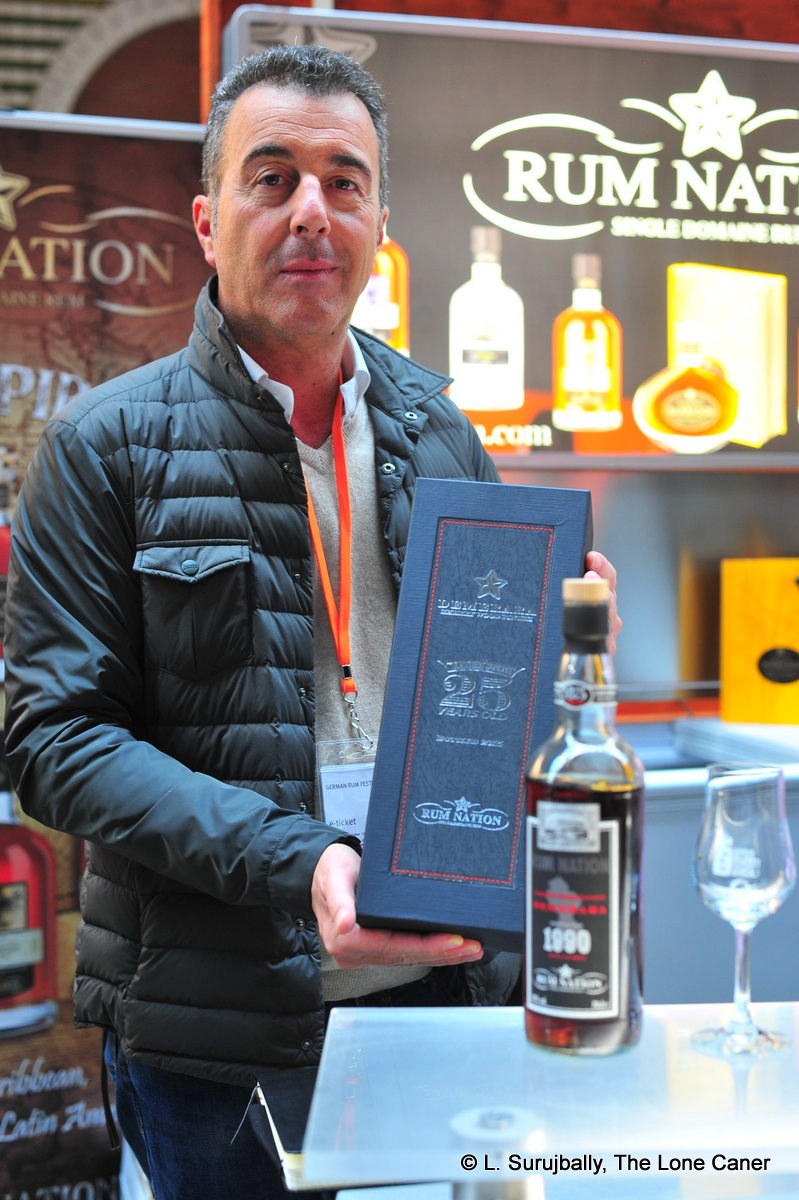
Fabio Rossi, 2014 German Rum Fest

In the 1980s this portion of the business became so successful that the Rossis – both of Mario’s sons, Walter and Fabio, had by then joined the company – introduced craft spirits to their portfolio. These were single malt whiskies, independently bottled by the company, and, as time went on, stocks that made up these bottling were selected by Fabio Rossi. Fabio had trained as an oenologist in Conegliano, and, like many successful independents, married both education and experience into a personal philosophy summarized by the statement: “Trust your palate and your instinct.” The creation of the “King of Whiskies” brand encapsulated that idea – Fabio went personally to Scotland in 1990 to source his selections, went into partnership with W. M. Cadenhead and created the line of “Barrel Selection” whiskies with a new company, which he called Wilson & Morgan.

Wilson & Morgan exists to this day, and rode the wave of independent craft bottling of aged single malts. But as it happened, in his search for whiskies, Fabio often noticed that next to ageing barrels of such single malts, were other barrels: rums, old ones, brought over from the Caribbean to mature more gradually. Often they were blended into the more popular navy rums of the day, rather than being issued in their own right. He conceded that at the time he had no clue about rums, really…he tasted them and moved on. Yet he never forgot; and after the explosion of El Dorado on the scene in 1992, he saw the opportunities. After all, if the expertise garnered in the whisky business should be readily transferrable, then distilleries previously making average grog could produce aged and off-the-scale quality rums with some judicious ageing and blending. Too, the world in the 1990s was already moving towards exclusivity in spirits like vodkas, tequilas, whiskies…why not rum?

He discussed the idea with another Italian, a business colleague of the family, Silvano Samaroli (a whisky broker and bottler since 1968, and who also made and makes craft rums), and that gentleman gave him the necessary background education in the various rum styles, as well as pointers regarding marketing and business strategy. (As an aside, Mr. Samaroli may be one of the first to take craft bottling of rum seriously, but that’s another essay entirely.)

Armed with this information, and being unwilling to blend the recognized W&M brand with an upstart drink which could crash and burn (okay, that’s the storyteller in me reaching a bit), Fabio formed Rum Nation in 1999; many of the characteristics of W&M were copied wholesale for this new company – the rigourous sourcing of stock from obscure and not-so-obscure distilleries, partial maturation in Europe, the finishing in other casks (port, rum or marsala casks, for example). As before in his Scottish adventure, Fabio Rossi went island hopping around the Caribbean, sourcing what he could, buying what he liked, sometimes leaving the barrels in situ, sometimes shipping them to Europe. The ethos of both companies, unsurprisingly, remains very much the same: source barrels from favoured distilleries based on personal investigation, age and blend further as appropriate, and issue. Expand the line into other niche markets and other distilleries and countries and styles, as the business grows.D7K_9376

Unlike the recognized and recognizable distillery-profiles of Scotland – after all, which dedicated Maltster can possibly confuse an Ardbeg with a Glenfarclas? – rum profiles are more generally associated with islands, or even whole regions, not often specific distilleries (though this does, of course, occur). This led to the decision to produce and market rums by such regions – Demerara (for Guyana), Jamaica, Barbados, and so on – though many really rarefied snooters can tell, or at least hazard a guess, whether the Enmore, Longpond or Rockley still produced a given rum for these.

The first rums RN issued were Demeraras and Jamaicans, in 1999 and 2000. I’d dearly like to know what kind of impact they had on the marketplace, but one thing is certain – in 2014 they can only be classed as collector’s items, and are as rare as hen’s teeth. I imagine that the reception of these rums was extremely positive, because Rum Nation expanded the line to include rums from several other parts of the Caribbean and Latin America, in the subsequent years: expressions hailing from Martinique, Trinidad, Nicaragua, Panama, Guatemala were added in short order. Fabio may have eschewed distillery-specific marketing, but he certainly did his best to raise the rum-profile of whole countries, over and beyond national brands previously and solely identified with them (and which were distillery- or estate-specific), like DDL, Mount Gay, Flor de Cana, or Longpond, to name a few. I don’t doubt that he used stock from those places, he just refused to identify them as such, and made his own specific blend from what he found there.

Two rum marques that deserve mention are the Millonario and the Reimonenq line, because both resulted in rums (and in the former case, a company) that were ostensibly apart from Rum Nation, yet beefed up its profile.

D3S_3597
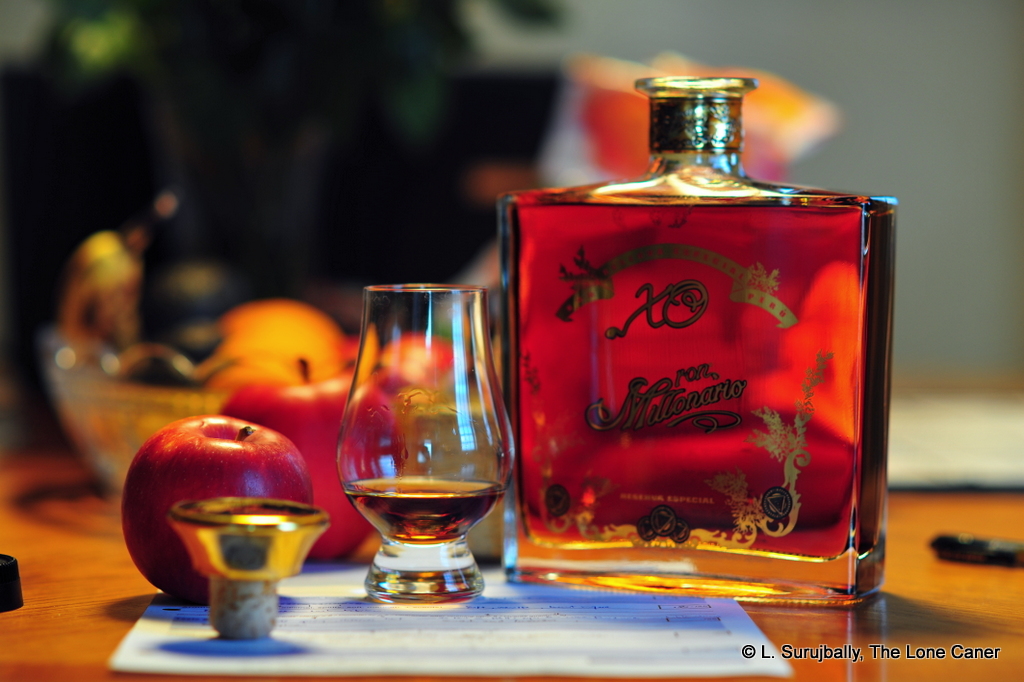
The success of Zacapa in Italy in 2001 made Fabio resolve to find something that could take it on, if not actually exceed it: in Peru in 2004, he discovered a small distillery (he never named it, and while I think I know which one it is, I’m still not 100% certain) that made a delicate and sweet rum in the solera style. With skills garnered from Lorena Vasquez of Zacapa – she, like Mr. Samaroli years before, provided Fabio with the core information on setting up a solera system, how to mix barrels (different sizes and woods) in order to blend distillates with different aromatic profiles and ages to obtain a balanced final vatting. The resulting rum was a phenomenally smooth product – the Millonario Solera 15 and the XO, the latter of which is, in my opinion, a smidgen better (but also more pricey). I leave it to you to decide whether they are either or both better than the new (or old) Zacapa that is a perennial favourite among rum drinkers of the world. The XO in particular has received rave reviews from across the board (mine among them), is a constant favourite of my wife, and the 15 may be one of the best value-for-money rums of its kind ever made.  However, it must also be noted that these rums in particular – as well as several others in the lineup – have received scathing criticism over the years for the practice of “dosing”, or the adding of caramel / sugar / additives. Some writers and connoisseurs refuse to drink them at all and discussions on the online fora both condemn the practice as well as take Rum Nation to task for not providing better disclosure.

Assigning the Reimonenq rums to Rum Nation is somewhat problematical. In this instance the Reimoinenq name of these agricoles maker was left intact, and the rums Fabio found on Guadeloupe distillery (still family owned) were bottled under that name as a special edition exclusive to Rossi&Rossi – so are they Rossi products or not? I’d suggest they are, because he selected them and was instrumental in their issue. When asked about why he chose this path to market the rums – i.e., separating them from the Rum Nation line, which already had a very good Martinique rum or two and a Guadeloupe – he remarked that the extreme character of the rum might have come as shock to the palates of his core constituency, who were more used to the softer rums RN had issued to that point. (I have never tasted any, so cannot comment on the reputed tastes of wood, licorice, coffee, oil and Tobermory and Ledaig single malts which comprise the profile). You might note that this kind of caution has been eroded somewhat with the unaged, feisty and pungent Jamaican pot-still full-proof white rum which Rum Nation issued in 2014. Clearly Rum Nation now has enough hard-won street-cred not to worry overmuch about the potential of one poorly received edition among many.

D3S_3949-001


The technique of acquiring the knowledge and expertise of others in the field did not stop there. A particular point of pride for Fabio was the creation of the two Panama rums (the 18 and 21 year old, released in 2004 and 2010 respectively), which came about after a meeting with Don Francisco Fernández, a Cuban Master Blender well known for his work with the Panamonte line, possibly the Abuelo rums (my supposition – I’m not sure, but the tastes hint at the possibility) and (I sigh to say it) Ron de Jeremy. Don “Pancho” was instrumental in creating the blend of “mezcla” for the luxury 21 year old, about which I was extremely enthused, and which I think is a remarkable rum for its price (Can$100 or so).

The philosophy of the company remains stable, and firmly married to that of Wilson & Morgan. Rum will continue to have a primary ageing cycle in the tropics, and secondary ageing and finishing in Europe. To quote Fabio – “The first [ageing] is more intense, it helps the distillate to lose the ‘young’ notes and to take up sweetness and fruitiness (also thanks to a large percentage of ex-bourbon barrels). The problem is that after some years under the Caribbean sun, alcohol levels fall too low and the wood starts to dominate. Here the second phase comes to our aid, letting the subtler aromas come out slowly and allowing us better control of the flavour profile by means of different barrel sizes, smaller or larger according to how much we want to have oak influence on the rum or simply let it rest and soften up, leaving time to work its magic on the distillate rounding it up with the elegance that only a long wait can give. In this second phase we can play freely, like tailors, to shape our bottlings according to our taste, and it’s as important as the choice of distillate coming out of the stills.” Depending on the desired finish, barrels from the Spanish bodegas are often used – sherry, Pedro Ximenez, or even barrels which once held Spanish brandy.

The years 2014 to 2016 saw Rum Nation moving into progressively different areas, all of them interesting.  The bottle shape was redesigned (the stamps remain on the labels); the Jamaican pot still rum is to be released in progressively older variants, a Panama 18 solera was issued in 2015 and the old Demeraras and Jamaicas got another iteration. And at last, in 2016, Rum Nation went all in and began to sell their Rare Rums, initially made up of three older Demeraras, and additional Jamaican and Reunion rums issued in 2017.  The rationale here was to appeal to the “most jaded” connoisseurs who demanded not only unfiltered, unadulterated country-specific rums, but still-specific, cask-strength products (the Supreme Lord and aged Demeraras were never consistently from the same estates/stills).

I imagine it will be just a question of time before many other countries’ rums get this treatment as well. As far as Fabio is concerned, the search for new products to expand his catalogue is neverending. Like all companies that have found a growing niche market with dedicated consumers wanting to extend their horizons beyond the obvious, you can tell RN is positioning itself to expand even further into rum bottlings as esoteric and eccentric as my questions. So while it was never stated outright, I imagine we’ll be seeing aged and stronger variations of the old favourites, some more agricoles, and maybe rums from even further afield…India, maybe, or even Fiji, Thailand, or Australia. It’ll be a fun experience, watching it all unfold in the years to come, and one thing is for sure, we’ll be enjoying them. I know I will.

***

Some opinions and notes of my own, over and beyond the facts as reported above:

I wanted to remark on the difference between the maturation philosophies of the two companies, Rum Nation and Velier, or, as I like to joke, Athens and Sparta.  Velier, as I noted in their company profile, does not muck about. Cask strength, bam, always fully matured in tropics, so here, take that – there’s something awe inspiring about their commitment to brute simplicity, austerity and quality.  And then there’s Rum Nation – softer and perhaps more elegant stylists, who age their barrels in situ and then in Europe.  They issue rums at middling strengths (generally 40-45%), almost nothing in power like the massive blows of a full-proof (this began to change in 2014, and in 2016 really took off with the Small Batch collection). There’s a soft kind of serene voluptuousness about their rums, yet also a real heft and thickness that transcends mere taste and encompasses texture, mouthfeel, how it fades – it’s really lovely stuff, and even the rums Fabio tosses off as “entry-level spirits” were, to me, a cut above the ordinary. One company adheres to a minimalist, strong-is-better philosophy, and I can just imagine them throwing out the weak or the unfit; the other takes some time, babies its offspring a bit, takes them on journeys, changes their barrels and seems a bit more playful.  Both take their s**t really seriously.  And both deserve enormous respect because of it, different as their products might be.

***

A list of Rums RN have produced is below (updated as best as I can), linked to any review I might have done.  Also included is the Millonarios and Reimonenqs, since these are brands Fabio manages as part of his overall spirits business.  Please note that because of the same rum being issued with the same name in multiple years, it is almost inevitable that I would have missed something.  As always, drop me a line for what I’ve overlooked.

Note that Barrel-Aged-Mind, that great German rum resource, also has a similar page on RN.

  • Barbados 12 YO 1995-2008 43% (2008 release)
  • Barbados 10 YO 2001-2011, 40%
  • Barbados 8 YO 2002 -2010 43%
  • Barbados 8 YO 2000-2008 43%
  • Barbados 10 YO 2004-2014 43%
  • Barbados 10 YO 2005-2015 40%
  • Barbados 12 YO Anniversary (2014 release) 40% (RL Seale)
  • Barbados Anniversary Decanter 2016 40%
  • Demerara 27 YO 1973-2000 45%
  • Demerara 26 YO 1974-2000 45%
  • Demerara 24 YO 1975-1999 45%
  • Demerara 25 YO 1975-2000 45%
  • Demerara 31 YO 1975-2007 43%
  • Demerara 21 YO 1980-2001 45%
  • Demerara 18 YO 1981-2000 45%
  • Demerara 18 YO 1982-2000 45%
  • Demerara 23 YO 1985-2008 43%
  • Demerara 16 YO 1989-2005 45% (private client)
  • Demerara 23 YO 1989-2012 45%
  • Demerara 25 YO 1990-2015 45% (sherrywood finish)
  • Demerara 15 YO 1989-2004 43%
  • Demerara “1989” 12 YO (2001) 45%
  • Demerara “1990” 12 YO (2002) 45%
  • Demerara “1991” 12 YO (2003) 45%
  • Demerara 15 YO 1990-2005 43%
  • Demerara 23 YO 1990-2014 45%
  • Demerara 25 YO 1990-2015 45%
  • Demerara 15 YO 1991-2006 43%
  • Demerara 12 YO 1992-2004 43%
  • Demerara 15 YO 1992-2007 43%
  • Demerara 12 YO 1993-2005 43%
  • Demerara 12 YO 1994-2006 43%
  • Demerara Solera No. 14 Realease 2008 40%
  • Demerara Solera No. 14 Release 2010 40%
  • Demerara Solera No. 14 Release 2012 40%
  • Demerara Solera No. 14 Release 2017 40%
  • Guadeloupe Blanc (Unaged) Release 2015 50%
  • Guadeloupe Blanc (Unaged) Release 2016 50%
  • Guadeloupe Vieux Release 2016 40%
  • Guatemala 23 YO 1982-2005 Release 2005 40%
  • Guatemala 23 YO 1984-2007 Release 2007 40%
  • Guatemala Gran Reserva  2018 40%
  • Panama 10 YO Release 2016 40%
  • Panama 18 YO (3 pre-2004 releases, years unknown, per RN/FR)
  • Panama 18 YO Release 2004 40%
  • Panama 18 YO Release 2005 40%
  • Panama 18 YO Release 2007 40%
  • Panama 18 YO Release 1991-2009 40%
  • Panama 18 YO Release 1994-2012 40%
  • Panama 18 YO Release 2010 40%
  • Panama 18 YO Release 2014 40%
  • Panama 18 YO Release 1997-2015 40%
  • Panama 18 Year Solera 2015 40%
  • Panama 18 Year Solera 2016 40%
  • Panama 21 YO Release 1989-2010 40%
  • Panama 21 YO Release 1993-2014 40%
  • Panama 21 YO Release 1995-2015 40%
  • Peruano 8 YO 2008-2016 46.5% *for Denmark #1)
  • Peruano 8 YO 2006-2014 42%
  • Peruano 8 YO 2007-2015 42%
  • Peruano 8 YO 2000-2008 42%
  • Peruano 8 YO 1999-2007 42%
  • Peruano 8 YO 1998-2006 42%
  • Rhum Reimonenq Rhum Vieux 5 YO 2009-2014  40%
  • Rhum Reimonenq Rhum Vieux 10 YO 2004-2014 40%
  • Rhum Reimonenq Rhum Vieux 2003 40%
  • Rhum Reimonenq Rhum Vieux 1998 40%
  • Rhum Reimonenq 5 YO 2006-2011 40%
  • Rhum Reimonenq 9 YO 1999-2008 40%
  • Trinidad 5 YO 2012-2017 (ABV TBA)
  • Trinidad Caroni 18 YO 1998-2016 55%
  • Trinidad Caroni 16 YO 1999-2015 55%
  • Trinidad Caroni 16 YO 1998-2014 (Batch 1) 55%
  • Trinidad Caroni 16 YO 1998-2014 55%
  • Venezuela 10 YO 1992-2003 43%

The Rare Collection

  • Rare Collection Enmore 2002-2016 14 YO 56.8%
  • Rare Collection Enmore 2002-2016 14 YO 58.8%
  • Rare Collection Enmore 2002-2017 15 YO 58.3%
  • Rare Collection Enmore 1997-2016 19 YO 58.7% Sherry Finish
  • Rare Collection Enmore 1997-2017 20 YO 56.4% Whisky Cask Finish
  • Rare Collection Hampden 1992-2016 24 YO 61.6%
  • Rare Collection Hampden 1998-2016 18 YO 66.3%
  • Rare Collection Savanna 2001-2016 15 YO 52.8%
  • Rare Collection Savanna 2004-2019 15 YO 62.8%
  • Rare Collection Savanna 2006-2016 10 YO 54.2%
  • Rare Collection Savanna 2005-2017 12 YO 59.5%
  • Rare Collection Savanna 2006-2018 12 YO 59.7% Grand Arome
  • Rare Collection Savanna 2008-2018 12 YO 57.4% Sherry Finish
  • Rare Collection Savanna 2007-2017 10 YO 59.3% Sherry Finish
  • Rare Collection Savanna 2006-2019 11 YO 57.6% Traditionnel
  • Rare Collection Savanna 2007-2019 12 YO 62.7% Grand Arome
  • Rare Collection Worthy Park 2006-2017 11 YO 57.0%
  • Rare Collection Worthy Park 2006-2018 12 YO 58.0%
  • Rare Collection Caroni 1997-2017 20 YO 57.8% (Sherry finish)
  • Rare Collection Caroni 2009-2017 8 YO
  • Rare Collection Caroni 1997-2018 21 YO 59.2% “Islay Cask”
  • Rare Collection Caroni 1998-2019 21 YO 57.9%

Sources


Apr 012013
 

One of the pleasures of watching BBC TVs 2010/2012 show “Sherlock” is the sly, tongue in cheek references it makes to the canon of Sherlock Holmes; another is the sheer length of each episode…ninety minutes per; and a third is the precise casting of the eponymous lead and the Doctor. About the only thing I grumble about in this well-written, well-acted TV series is the fact that the Brits don’t seem to understand that a season should not be three episodes a year – even Life on Mars and its follow up had more.  And for someone as iconic as the Baker Street ‘tec, with multitudinous adventures both direct or merely alluded-to…well, there’s no shortage of material here.

But move beyond these issues, watch the show, and tell me that if you have even the slightest interest in Holmesia, that this is not a brilliant recapturing of the spirit of the famous consulting detective and his faithful sidekick. Updated for the modern world, complete with smartphones and texting instead of hand-delivered notes, or London cabs instead of hansoms, delivering sly winks at the iconography at every turn, it’s a treat for anyone who has worked his way through the literary Conan-Doyle canon. I adore this kind of clever construction.

The series opener is a good example of what I mean, down to the title itself: “A Study in Pink.” Watson, recently discharged from the army after being wounded in Afghanistan (the show nudges the ribs in having Watson limp, yet stating his wound was actually in the shoulder – the wound alternated in Doyle’s stories too) is looking for digs, and is introduced to Holmes by an old friend.  It’s in the first meeting and the subsequent conversations that you see the impact that a modern sensibility has on the show: Holmes’s rapid fire delivery, the decision to show his deductions as little texts on screen, his lanky uncoordinated movements and his barely concealed disdain for the lesser mortals who are not quite as sharp as he is. Benedict Cumberbatch, now better known in 2013 as Khan from the second Star Trek reboot (good acting and a workmanlike effort, but one soon to be forgotten…Montalban has a lock on the character, sorry), to my mind made his bones here as an actor to watch even after his work on “Atonement” – observe the body language, the well-modulated voice, the expressions: they’re all perfect for the persona that, over hundreds of films and shows, has taken residence in our collective imaginations.

The writers seem to have a lot of fun upending expectations. The choice of taking the pill from the “A Study in Scarlet” novella, one deadly one harmless, is somewhat reversed here, having a different motivation; the word “Rache” opined by Lestrade in the book as being “Rachel” and dismissed by Holmes as being German for revenge, is here actually referring to a Rachel. Holmes hates the deerstalker hat made iconic in Sidney Paget’s Strand illustrations. Even Moriarty’s plot to discredit Holmes by pretending innocence and that it’s all Holmes’s imagination to create an uber-villain, has echoes of Nicolas Meyer’s “Seven Percent Solution” novel and film (the phrase is referenced several times).  That’s what I mean about the show being clever: it’s got clues and references cheerfully scattered all around it. The blog Watson keeps has playful takes on Holmes’s canonical adventures….I particularly liked “The Speckled Blonde” and “The Six Thatchers”, and the reference to the five pips and to Spock (who may be a relative, if you believe Star Trek VI)

The relative quality of various episodes has a hard time keeping up.  I thought “A Scandal in Belgravia” was well put together – the cat and mouse game Holmes and Irene Adler play with modern technology, as well as their overt and covert relationship were wonderful to watch (although the last five minutes is not actually necessary).  In others: Mycroft is well cast, with delicious dialogue of his own; the ongoing effort of Watson to enter into a romantic relationship is one of the show’s low key humourous delights, as is the running gag of Watson trying to tell everyone he and Holmes are not gay.  And I was intrigued with – how could I not mention the arch-enemy? – the take on Moriarty, who is seen as an evil genius, yes, but less of the old school, genteel, Brit steel, and more of an American warped-genius psycho mentality.  Maybe it was necessary to take the good doctor in a different direction, but perhaps for a character as well known as this one, veering off course might not have been the best way to go (he is neither referred to, nor really gives the impression, of being the “Napoleon of crime”).  However, that’s minor…you kind of have to enjoy the spectacle of clever people facing off against each other in a battle of wits each hoping to be a step ahead of the other.

I’ve long believed that Spock, Sheldon Cooper and House MD (the last probably more clearly than any) are incarnations of the concept of the driven genius so well exemplified by Holmes.  All shy away from, if not actually despise, interpersonal relationships; all are genius-level professionals lacking external interests outside their area of focus; they are always the smartest people in the room, running rings around the merely average intellects surrounding them.  I could mention Hercule Poirot, Lord Peter Whimsey, Adam Dalgleish, or even the many other smart detectives shown on American television (CSI springs to mind), but it’s the coldness and haughty, sneering demeanours covering a certain well-concealed, rarely-revealed (and even more rarely acknowledged) humanity that sets the detective, the Vulcan, the physicist and the doctor apart.

At end, though it’s all about Holmes’s genius and Watson’s everyman persona, and their relationship.  I’ll be the first to accept that the season two closer handles their friendship awkwardly at best (in contrast, the conclusion of A Study in Pink was written just perfectly).  I enjoyed Martin Freeman’s Watson expressing his ongoing exasperation with Holmes’s superiority complex (I was reminded of the way Leonard and the boys always groan “Nooo” whenever Penny asks Sheldon a question they know will result in a long winded and confusing answer), and attention should be paid to the interaction between Holmes and the shy pathologist Molly, to say nothing of his relationship with Mrs. Hudson (“Unthinkable. If she leaves, England will fall”) and even Lestrade, who grudgingly respects him.  Speaking for myself, the various conversations between and with the doctor and the detective remain the heart and soul of the show, as they were in the books and all the other films.  The cases are just convenient backdrop and set decoration for that.

These matters showcase something I’ve always felt: a show’s writing is the key, and it must be about more than just explosions, chases, murders and everything tied up in a bow at the end.  To take up residence in our imaginations, a film or a show must have heart, must involve us in the characters, their inner lives and turmoils, make us feel for them, care for them, cheer for them. Sherlock may be uneven at times, but it’s overall quality of writing, direction, dialogue, music, production design and characterization is a cut above the ordinary, and I look forward to see what the Brits come up with for the world’s foremost consulting detective in the next three episodes. After all, as even Conan-Doyle found out, you just can’t keep the good detective dead forever.

Apr 012013
 

First published in 2011 on Liqorature

I complain and moan a lot about the lack of choice in Alberta’s shelves when it comes to rum, but truth to tell, we get quite a bit more than other provinces around this country, except maybe BC.

Most provinces’ liquor sales in Canada are still under Government control. This is the legacy of the well-meaning, though utterly unrealistic, efforts of elected officials to implement Prohibition – yes, Canada had Prohibition – in 1918 and even before. Unlike the US, Canada came to its senses faster (you migh say they sobered up, ha ha), and most of the legislation across the country was repealed within six years.  However, in the ’20s and ’30’s very powerful provincial liquor control boards were set up across the country, and liquor sales were, and remain for the most part, tightly regulated. This developed over time into a crazy situation whereby the provincial governments ran most of the liquor shops, and the irony of a body responsible for regulation and enforcement running a for-profit business it is supposed to monitor requires no further elaboration.

Alberta, under its powerful premier Ralph Klein, did away with this in 1993, and privatized liquor sales. In practice, there is still some Government control: the Federal Excise tax and sales taxes add to prices, the Alberta Gaming and Liquor Commission approves all wholesale imports of liquors (into privately held warehouses) and then collects on subsequent sales to retailers: taxes, bottle fees plus a flat markup (thereby getting revenue from all points of the value chain).  But in the main, the objective of introducing competition (however imperfect) to the Alberta market has worked.

But how well?

Before we go there, spare a moment to consider what the act of privatization actually meant in practical terms in 1993. To research this, I spoke to a number of native Calgarians (yes, there are still a few around, but they are on the endangered species list), and they all concur on the basics: there was always and only a limited selection of spirits, and particularly wines; opening hours were limited, and God forbid that any opened on a Sunday; prices were the same province-wide, no matter where one went.  There were 208 ALCB stores in the entire province, with another 65 private retailers; and the purchasing process for any kind of bulk (say, for a wedding), was a torturous process requiring the usual forms in multiplicate. Simply stated, it was all limited and a pain, and Hobson’s choice from start to finish.

Fast forward 17 years.  According to the AGLC (the successor agency to the ALCB), there are now 1220 retail liquor stores in the province (up from the 208+65 noted earlier); another 488 off-sales establishments, like hotels, manufacturers or others, down from 530 hotel-only off sales places before, and 94 general merchandise liquor stores now where none had previously existed. Sales of spirits are up 48%, Beer by 52%, Wines by 109% coolers and ciders by 319%.  Revenue to the Government (unspecified but presumed by me to be on direct taxes and levies plus the revenue from the flat markup) climbed from $404.8 million to $716 million.  In 1993 there were 2,200 varying products available…there are 16,328 in 2010.

[prohibitioncanada.jpg]
___

I wouldn’t sound the hosannahs and encomiums too loudly, however.  The figures sound rosy, but they really aren’t that great from a Government perspective.Consider: the revenue numbers climbed 76.8%, but this disregards inflation; if inflation adjusted numbers are considered, the revenue increase has actually climbed a much more modest 29.9%  And this, while the population of Alberta increased from 2,574,890 to 3,786,398…a jump of nearly 50%.  So direct revenue per unit of population has actually decreased. On the other hand, all those newly established liquor stores pay taxes (sales and corporate), and this in all likelihood makes up for the difference, if not actually a bit more: and they provide employment (a climb from 1300 to 4000), and so fuelled an additional purchasing pool.  The flip side is that wages have decreased as jobs went non-union and capitalism went to work. It sounds a bit like the Red Queen’s Race, doesn’t it?

It’s been suggested that increased availability of alcohol in the province would fuel more alcohol related crimes and societal costs, but I came across an examination of this issue (it was done in the late ’90s when a white paper examined the possibility of privatizing Ontario’s system) that implies a rather smaller impact: in the years after privatization, Edmonton experienced a 24% rise in liquor offenses (many having to do with minors possessing alcohol) but a 42% decrease in traffic offenses (you can’t be more surprised than I). And the Calgary police noted that the increase in liquor store related crimes between 1993 and 1995 was offset by the larger number of retail stores opening, so that the risk per store actually decreased, especially when population growth in those years was factored in.  As for increased availability leading to increased consumption, some stats imply the reverse, and there are too few studies linking such availability with increased health burdens on the province. That said, a January 2011 article arguing against the matter in New Brunswick stated that based on a recent University of Victoria study,  there was a 27.5% increase in alcohol related deaths per 1000 population, for every new liquor store opened in BC. And another study comparing the Ontario LCBO and the prices in BC said flat out that not only were the prices comparable, but private stores had a larger price bump over the last five years than the (cheek-by-jowl) Government operated retail stores.

Speaking for Alberta, it seems that the increase in the amount of retail stores roughly parallels the population jump, as do the sales of spirits and beer; I could make a case that the relative affluence of the province has fueled the rise in purchases of wine which greater choice and stocks, as well as better marketing by the stores, have assisted.  I am curious how ciders and coolers have gone up by 319%, though, given that no other category went down in compensation, which suggests it’s carved out a niche all its own…maybe among the young who lack the palates for wine or the cash for good spirits. Looking at the above numbers, on balance I’d have to say that the effects have been largely positive: overall, I have not been able to locate any studies or statistics that say categorically that there have been increased societal costs or social burdens in Alberta (I apologize in advance to families or individuals who have been deleteriously affected by the impacts of alcohol, who of course would not share this sentiment) and alcohol-related crime seems to be on par with the levels before privatization on a per capita basis.  The amount of problem drinkers as a proportion of the population is about the same. The increased taxes and employment and knock on effects of people with jobs spending money and paying taxes is positive.

But statistics can be made to say many things, and at end the debate won’t be solved in this essay.  As the New Brunswick discussion makes clear, it’s a societal issue, dominated by high passions on both sides, and it is as much a philosophical matter as social one. I’m not entirely convinced, but it may be a zero sum game when all factors are taken into account.

I’ll close with this comment.  In the last two years I’ve travelled through The Yukon, NWT, Alberta (hey, I live here), BC, Saskatchewan, Manitoba and Ontario, by road (it’s a relaxation and photo-hobby thing for me).  In no other province have I seen the breadth and variety of products as I have in my home turf.  Alberta is the cheapest of them all in terms of pricing (Appleton 30 year old costs $300 and rubs shoulders with over seventy other rums in the various stores around here, while in Ontario it costs $550 and rather shamefacedly sits with three other “premium” rums – Zaya 12 was one – and another fifteen bottom tier standards like Lamb’s and Bacardo and Captain Morgan). The Yukon is a bit like Ontario, and the other prairie provinces are in between.

And, Alberta boasts liquor stores of nationwide reputation: it’s a running gag on Liquorature that I don’t like whisky, but even I must concede that Willow Park and Kensington Wine Market (Chip, jump in any time with your Edmonton nominations) are famous and maybe the best in Western Canada, stock unbelievably fine products and ranges of whiskies to make a maritimer and an occasional lonesome Scot weep with envy; and the wide selections have permitted myself and two others in this province to begin a labour of love in reviewing spirits.  In no other province has this been the case, to this extent.

Numbers, dollars, stats and revenue may be debated to the end of time, fierce battles will be fought with teetotallers, religious figures, liberals, conservatives and madmen, and maybe nothing will ever be resolved or proven one way or the other. But in terms of intangibles, I’d have to say that privatization with sufficient regulation is a pretty good thing and works for me in Calgary. Usually, it’s unbridled, unchecked, reckless capitalism and over-intrusive Government intervention that’s the problem. Here in Alberta, we may have found a happy median.

Update, November 2017

CTV News posted an article relating to a court case in Quebec which mentioned a poll that overwhelmingly favoured an abolition of provincial alcohol monopolies and briefly covered some of the concepts addressed here.  I disagreed fundamentally with the simplistic idea that Quebec would suddenly lose billions in revenue, because it ignored the ancillary businesses, employment, payroll and tax revenue that would be generated. I’ll be following this issue with interest in 2018

References:
Population stats
Prohibition
The statistics issued by AGLC
Consumer Price Index (alcohol)
Crime, the debate on privatization and other stats
http://telegraphjournal.canadaeast.com/rss/article/1371123 “The Alberta Experience” NB argument for
Some additional reading subsequent to the original article’s publishing in 2011, related to the debate on Quebec’s SAQ and its potential privatization:
Montreal Gazette – anti privatization opinion 2015
Montreal Gazette – pro-privatization opinion 2015
Apr 012013
 

Ray Bradbury is a twisted Isaac Asimov, a literary Dali who painted with his words, a Stephen King before Stephen King was there. If King is the master of the occult, of horror, and of long novels and deep characterizations playing “what if?” with the universe, then one of the wellsprings of his imagination was surely the taut, tightly wound dystopian short stories penned by his prolific predecessor.  And indeed, how much of our subterranean mental landscape has been formed by this one man, a contemporary of the early 20th century dime novels and pulp fictions with which I am so in love?  In Bradbury we see a Golden Age of horror fiction even before it became respectable, a right turn from the prevailing “hard” sci-fi of the day — and yet, even to use such terms shortens and simplifies an enormous body of work encompassing sci-fi, fantasy, horror, mythology, psychology and fictional futurism. Categorizing the man and his output is like trying to nail down Asimov, or King – it’s too much to encompass into a single sentence. To the extent that there is s cultural mythology of the twentieth century, a sort of inner world of our imaginations, surely Bradbury is one of its creators.

Bradbury – and if any of us do not know his name by now we cannot call ourselves book lovers – is one of the masters of the short form. Few of his short stories exceed fifteen pages in length, and are as tightly wound, as clear of expression and as dense in imagery as anything penned by King in his beginnings, by Asimov, Heinlein, Robert E. Howard, Elmore Leonard, Dashiell Hammett or any of the myriad others who dabbled in the field (even Bradbury’s novels – The Martian Chronicles, or Dandelion Wine, for example – are short story collections in disguise, and Fahrenheit 451 began as The Fireman, a short story). And yet, unlike these straightforward writers who are mostly plot – and I don’t mean this in a bad way – there is always something off-kilter and distorted moving beneath Bradbury’s work…something badly reflected, like a mirror with a flaw one can sense but not always see.

While I have read most of his collected works over the years, long and not-so-long, the ones to which I keep returning in order to sip at the well of his genius, are always the short stories of The Illustrated Man, “100 Celebrated Tales” and The Martian Chronicles. In the best of these, there is always a haunting sense of time and place…of America gone sour, perhaps, or of strange places in our memories, or even places that never were. And that feeling of almost – but not quite – recognition, like acquaintances long-forgotten who we feel we’ve met somewhere before.

Consider “A Sound of Thunder” – it combines time travel, a hunting safari, politics and chaos theory….how stepping on a butterfly irrevocably changes the course of history. Or “I Sing the Body Electric” which is only nominally about how a man brings a robot granny into the house to comfort his grieving children after the death of his wife. Or the creeping sense of horror about “The Playground” (which could have been written by King), where a man who changes places with his son to spare the child the cruelties of childhood, only realizes at the close how cruel childhood really is. There is the depth of psychological suspense in “The Veldt” where kids plot to murder their indifferent parents in a Star-Trek-type holodeck meant as a play area; and one of the most clearly realized, utterly atmospheric alien-worlds stories ever written, “The Long Rain”.

Bradbury’s work in sci-fi seems occasionally dated, but he himself argues that he doesn’t really write science fiction (at least not in the engineering style of “Red Mars”), but fantasy, because his worlds cannot exist, unlike those of the realists like Asimov and Heinlein. The reason his work still resonates, even after more than half a century is less because he wrote about futuristic rockets, robots or machines, than because he described people we can recognize – and how the development of the soul-annhilating techno-society he so clearly foresaw alters the way we think, the way we interact…who we are. He is a mordant ethicist who argues for humanity while pointing out how much more human our creations can become…and how little can be left in us if we are not careful.

Think of how “The Murderer” so acurately predicted our mad “always-connected” culture with his brilliant paragraph: Three phones rang. A duplicate wrist radio in his desk drawer buzzed like a wounded grasshopper. The intercom flashed a pink light and click-clicked. Three phones rang. The drawer buzzed. … The psychiatrist, humming quietly, fitted the new wrist radio to his wrist, flipped the intercom, talked a moment, picked up one telephone, talked, picked up another telephone, talked, picked up the third telephone, talked, touched the wrist-radio button, talked calmly and quietly, his face cool and serene, in the middle of the music and the lights flashing, the phones ringing again … Substitute an i-phone, laptop and TV and you’d have a picture of how my daughter spends time in her room.

And always, coiling underneath the spare plotline, is the dark side of Americana, in stories like the one where a child wishes for everyone in the world to disappear…and they do; of machines that stand around telling stories of the men who made them, now long extinct; of a man hurtling in space to his death, wondering what he can do “to make up for a terrible and empty life” before dying; how the Rocket Man wanted to be with his family when in space, and in space when with his family.

Bradbury is neither a Luddite nor a pessimist.  Nor for that matter is he an optimist.  He simply invites us to be alert to the consequences of our actions. He is realistic enough to know technology is not the answer simply because it can clean your house and create a robot replacement for you; just twisted enough to see the hope of machines wanting to act like humans will be overhsadowed by humans behaving like machines; and cynical enough to understand – and make us shudder at – the irony of youthful innocence reposing in adults while children are the amoral, devious homicidical crazies we ourselves allowed to be, and which we should fear. In the richness of his storytelling we see all the possible reflections of ourselves, all the permutations and possibilities of our society: we read his terse and evocative prose with appreciation and amazmenet and wonder…his stories take up residence in our minds. We know them, we love them, we dread them.

“There would be no King without Bradbury”, Stephen King once remarked. Maybe so, although he admits elsewhere to being as influenced by Lovecraft and Wheatley and pulp as by that old master. Be that as it may, it is thanks to Bradbury that we have an enriched body of often unappreciated, undeservedly low-rent work without pretensions of grandeur, that will stand the test of time — and which has become, somehow, part of the iconic literature of our age. If I were to think of which short stories out there I’ll be reading in the twilight of my life, when hope, realism and cynicism have taken equal residence in my heart, then I’ll pick Asimov, King, Heinlein, Naipaul, Lahiri, perhaps half a dozen others…and Bradbury for sure.

Apr 012013
 

“Hither came Conan, the Cimmerian, black-haired, sullen-eyed, sword in hand, a thief, a reaver, a slayer, with gigantic melancholies and gigantic mirth, to tread the jeweled thrones of the Earth under his sandalled feet.”

So goes the introduction to perhaps the iconic hero of all Sword and Sorcery tales, themselves a subset – or bastard cousin – of the heroic fantasy genre.  Is there a man alive who has not at some point heard of Conan the Cimmerian? Or seen the vivid paintings of Frank Frazetta and been transported into the mystical and legendary kingdoms of Hyboria?  In penning these tales of mythical times long past, Robert E. Howard created one of the great characters of modern American fiction, and one I have returned to time and time again when the weighty tomes of non-fiction or the effort to come to grips with some intellectually subtle point of a Booker Prize contender simply becomes too much for me. Conan hearkens back to the dime novels and penny dreadfuls of the disreputable past, reeks of cheap print on cheaper paper, and redolent of a black and white time when unsentimental heroes talked tough and cracked wise. Sure Burroughs created Tarzan earlier, L’Amour the Sacketts later, and Dashiell Hammett , Raymond Chandler and John M Cain also wrote tough tales of pulp: but among them all coils Howard.

Robert E. Howard, who committed suicide at the age of thirty, wrote some eighteen stories of varying lengths about Conan during his lifetime (along with a huge volume of general pulp magazine fiction covering all fields and genres), most of which were published in Weird Tales; eight others were pieced together from his complete and incomplete papers after his death, and published posthumously. L. Sprague de Camp and Lin Carter adapted Howard’s notes and outlines to add another four complete stories and a few pastiches, while other authors as varied as Robert Jordan and Poul Anderson have added another fifty or so to the body of work: but the core of it all remains the eighteen Howard himself wrote. These are the backbone of the ten paperback volumes that document most of Conan’s life, from the first “Conan” where he is eighteen or so, to “Conan the Avenger,” the tenth, where he is in his mid forties, King of Aquilonia, and has a wife and son.

Howard remarked in one his letters that he preferred to write about straightforward heroes with muscles, not brains. His reasoning had a sort of charming simplicity to it: in a jam, nobody expected them to think their way out of things – they just hacked, slashed, brawled or shot their way out of trouble (and all his other heroes – Bran Mak Morn, Solomon Kane, King Kull, Turlogh O’Brien – followed this general trend). In the highly mythological world of Hyboria, all men were cast in a sort of stark relief, with simple, strong characteristics, and all women were curvaceous, beautiful and not at all meek. The impact of Howard’s virile, magic-infested creation was like a blast of colour in a black and white world, and let’s face it: Tolkien might have written about noble sylvan elves in gentle northern climes, but it’s a subtle wine compared to the savage red bouquet of Hyboria’s realism. This kind of writing marries the colour and dash of historical romance fiction with the atavistic supernatural thrills of the weird, occult or ghost story. In short, it’s escapism at its best.

“Conan the Warrior” the seventh book in the cycle, takes place when Conan is in his mid- to late-thirties, and the three novellas in it are called “Red Nails”, “Jewels of Gwahlur” and “Beyond the Black River”.  At this stage in his career, Conan had already been a freebooter, a pirate, a mercenary, gained the name “Amra” and seen much of the world. Howard himself wrote these three, and for my money, they are among the best he ever did: “The Frost Giant’s Daughter” and “Queen of the Black Coast” are also in that exalted company, but in separate books, and so I have selected this trio as an introduction to Howard and his Cimmerian.

“Red Nails” stands as the most evocative of the three, with Conan and Valeria of the Red Brotherhood escaping a monster in a forest to come upon a massive, all-enclosed stone city inhabited by the remnants of two warring peoples, who hammer one red nail into a massive ebony column for each enemy they kill. The arrival of Conan and Valeria tips the balance decisively towards one of the two dying tribes, yet friendship, betrayal, lust, sorcery, action and dark magic all have their turn on this tautly written tale.

After parting company with Valeria (the stories are roughly chronological), Conan heads to the jungle to raid a legendary treasure city of Gwahlur (hidden inside the caldera of an extinct volcano), but finds more than he bargained for when the priests who live there are slaughtered by strange beasts and Conan barely makes it out alive.

Lastly, Conan heads to the pictish frontier along the Black River, just as the tribes unite and boil over the border to massacre all the Aquilonian settlers on the Bossonian marches, under their mad sorcerer Zogar Sag. If “Red Nails” had a sense of time and place in the darkened stone-covered city that was unique and vibrant, “Beyond the Black River” is the best short novel of forest war and magic I’ve ever read, with strong pacing and fast action that never loses or confuses its way.

It’s a credit to the strength of Howard’s writing that after a bit one can tell which is his work and which is done by others. Nothing Sprague de Camp wrote in his reworking of later stories comes even close to Howard. Consider this passage from “Red Nails” – Olmec was as tall as Conan, and heavier; but there was something repellent about the Tlazitlan, something abysmal and monstrous that contrasted unfavourably with the clean-cut compact hardness of the Cimmerian….if Conan was a figure out of the dawn of time, Olmec was a shambling somber shape out of the darkness of time’s pre-dawn. Or this one: In the cold, loveless and altogether hideous life of the Tecuhltli, his admiration and affection for the invaders from the outer world formed a warm, human oasis that constituted a tie which connected him with a more natural humanity totally lacking in his fellows, whose only emotions were hate, lust and the urge to sadistic cruelty. This is pulp fiction at its best: closely worded descriptions of appearance and motivation, stark identity and basic emotions.  And yet I defy anyone to read any of these stories and not admit how vibrant and rich in imagery they are.  How strong and direct when compared against the more subtle offerings to which we are accustomed.

And this is not all.  If they had been merely thrilling reads – which they are – I wouldn’t have bothered putting the work up for consideration.  But Howard’s work presaged much else in modern literature and drew from a well-established wellspring of past tribal lore. Conan is the archetype of the Lone Hero – almost a Nietzschean superman –  scattered throughout mankind’s oldest legends, and can be found in much of present day fiction: in Conan we see shades of Hondo and Jason Bourne, of The Road Warrior, the Hardened Street Cop, or the Solitary Soldier on the field of battle. He’s Audie Murphy with a sword.

In “Jewels” one can sense Michael Crichton’s “Congo;” “Black River” is really a rewritten western of the kind John Ford would make popular in his films and Louis L’Amour in his novels. And the darkness of Howard’s magic and sorcery has echoes of Lovecraftian horror: indeed, the two were correspondents, and some argue that the darkly beautiful fiction of the Cthulu mythos has its origins in Conan (though the reverse has also been posited and that Conan’s Hyboria is a subset of Lovecraft’s more insanely imagined worlds). And from there, a straight line can be drawn into  “Xena”, Dungeons and Dragons, Warcraft, “Wizard’s First Rule,” and Stephen King.

Lastly, attention should be drawn to Frank Frazetta, whose dark and savagely iconic paintings of the sword and sorcery genre practically redefined fantasy art as we know it (The Legend of Zelda computer game explicitly named Frazetta’s Conan work as an inspiration) and took residence in our imaginations of such places: no elves and dwarves and green dales here, but  shambling horrors, beautiful women and ferocious large-thewed men, in bloody battle with sharp glittering weapons under dark stone towers of crumbling and ruined civilizations.

How one crazy young Texan writing for a pulp magazine during the Depression could so completely influence an entire literary genre and have an impact decades hence in fields not imagined in his day is not something about which I can hazard a guess.  All I know is that the cables stretching from his stories to these times are there, and in this one book of three superlative tales one can still find them, tautly vibrating and calling us in with their magic.

Apr 012013
 

(First posted on Liquorature, Feb 2012)

With the write up on the Barbancourt  15 Year Old I have reached a sort of personal milestone. I’ve written a hundred rum reviews and that’s not as easy as it may sound, since I put a lot of effort and energy into crafting each one, chosing the verbiage and doing the research, all the while juggling my photographic hobby, reading, as well as domestic and professional duties which permit me my alcoholic habit. At this rate, if there really are around fifteen hundred rums in production in the world, I’ll be a candidate for a gerontological institute somewhere before I get to finish.

Looking back, it seems quite amazing that two years have already passed since I began writing, three if you count the origins of Liquorature in 2009. In that time, Liquorature has grown from seven members to nine, the much more successful allthingswhisky site has gone up (and it passed a hundred reviews itself no more than a week or two back, so kudos are in order there as well), and a hundred-plus rums have crossed my path…more if you count those on my shelf I haven’t written about or those friends have trotted out. Through the writing of these reviews I have been in contact with makers and distributors, readers and reviewers, forged friendships and had a really good laugh from time to time (the Bacardi 151 review is a case in point)…and, I’m sure, pissed off a person or three.

There’s really no direction in my reviews: I’m not thinking of adding cocktails to my lineup; news from the rum world will never become part of the site; much as I’d like to, I lack the financial and temporal resources to do distillery tours and write ups; and no, I’m not trying to build any kind of collection or collate the ultimate rum list. The two major changes to my thinking in the last two years involved [1] adding a score to the reviews so I could do rankings and see if I preserved a bell curve (I do, and its median seems to be around fifty-ish, which satisfies me); and [2] a conscious decision to eschew deliberately solicited freebies – I found it influenced my reviews too much…others may be able to dissociate their personal feelings at getting a free sample from their reviews, but I can’t.

At end, two things stand out. I like to write, and write well, amuse, entertain and maybe make a point or two about my experience with a given liquor, what I felt and thought and tasted. Some say I overwrite, but come on, guys, there are all sorts of McNugget-sized capsule reviews out there…what on earth do you need another one for? I don’t need to do sound bites. I want to write something that’s more than just the bare bones, something that is part review, part joke, part serious, part history, part philosophical rumination. Surely that’s worth more than a sentence? (For the ADD among you, you’ll note the micro-opinion in italics at the top of each review for the last few months as a nod in your direction).

And secondly, I enjoy knowing that what is written becomes part of a corpus of knowledge people can use to find out more about a rum when they see one on the shelf. A hundred reviews is nowhere near enough to get a sense of what rums are out there – Africa and Asia remain as skimpily represented as a bikini at Cannes, and every time I turn around some European maker comes out with another artsy little offering – but those who bother to read each review as it gets posted will not only get a sense of my evolution in taste, but understand why I felt the way I did about each product I wrote about.

And, of course, perhaps laugh a little. That’s alone might be worth all 100 reviews put together

Here’s raising a glass to the next 100.

Apr 012013
 

May 5th 1992.  A release date that will live for…well, a heckuva long time.

Because, before Assassin’s Creed, before Metal Gear Solid, Socomm or Call of Duty, before Quake and Duke Nukem (long may he reign as King of Vaporware), there was the ur-game of them all, the ancient DNA of all first person shooters, and it was released that day.  Nope, not Doom, but its startlingly original, blood spattered, laughingly and irreverently pixellated daddy, Wolfenstein 3d.

While I fully acknowledge the origin of the game in Muse software’s 1984 incarnation, it was id Software’s 1992 revisit of the game that broke all barriers and ushered in the era of the true first person shooter, where the environment was realistic looking 3d and scrolling and perspective were from that of the player.  But what really made it a breakout success and runaway hit was the stroke of genius Id/Apogee had, of giving away the first episode for free, and then charging for the remaining five. Shareware was well on the way to changing business models for the entire software industry.

Wolfenstein 3d sold like a gazillion copies.  Office managers routinely cursed its name. Parents were constantly kicked off their own computers (when they had them) by their kids, who played all night sessions, and then got hooked themselves after watching it for a while. Until its even better successor Doom came along (with its equally original and innovative network deathmatch play), it was quoted as one of the greatest contributors to loss of office productivity between 1992 and 1994.

One of the reasons for its perennial attraction for just about anyone of any age, was its ease of use.  Left and right arrow keys, space to shoot, and maybe two other keys to throw a grenade or push a wall for secrets.  Compare that to today’s games, which use what seems like every key on my board, plus a few I never heard of.   My son kicks my ass at the Wii and playstation games, but I moider da bum on keys…so long as I can use just a few and I don’t have to think in 3d.  Wolfenstein’s game engine made all that possible.

Wolfenstein 3d ushered in the first glimpse of a true FPS, much as Jordan Mechener’s original Prince of Persia almost redefined how graphics should look in an adventure game (both have now merged into fully rendered 3d worlds, but at the time their innovations were stunning and revolutionary to people who had only ever seen side-scolling images that did not move like real objects)

Seen today, we smile at the archaic graphics and clumsy bitmaps and poorly rendered images.  Relative to today’s sleek gaming worlds, of course they are.  At the time though, we had never seen anything quite like it.  And me and my friends, we stayed late at our offices, played all the levels (plus more freebies), did speed runs and became masters and boasted of our achievements when we met for beers.

I’m sure today’s twelve-fingered, thick-thumbed and iron-wristed Xbox and PlayStation ur-swamis are as bad, as addicted and as dedicated as we once were. But I can almost guarantee that they never had quite as much fun as we did in those days when the technology was so new it had literally never been seen before.  That technologically-inspired sense of wonder and fun, plus ten beers and a pack of smokes would keep us going in our offices until long past midnight, surrounded by tinny speakers, glowing big-ass monitor and other crazies doing exactly the same thing.

Beat that, newbs

Apr 012013
 

Every now and then I get an idea and just run with it.  This is an adaptation of an essay I put together which briefly explored several themes I thought intriguing. And what the hell…I like the arts as well as rum, so why not?

***

As Mulder and Scully, “The Third Man”, “Babylon 5,” “Lucas,” and so many others have showed us so many times, unrequited love is probably the most heart-rending of them all. Done badly, features or shows which do not honour the underlying depth of such feelings are sentimental tripe. Done well, and one watches something luminous unfold.

If I had to chose a movie that stayed with me for long past the day I saw it first, then it would have to be the South Korean piece “3-Iron”. I’m not entirely sure why they called it that, since the club in question is not the central motif, except perhaps in an obscure sense. Critic James Berardinelli suggests that the main male character’s undervalued and overlooked persona make the analogy to golf’s possibly least-used club somewhat inevitable, but I think that may be overanalyzing.

In essence, this gentle film shows what pacing, mood and atmosphere can do to elevate the humdrum into something more special, perhaps even artistic. The journey and travails of the young man and the battered wife have a sense of timelessness about them – it is no stretch to imagine this as a silent movie. To western eyes it is also a very strange story, since the way the youth goes into houses and stays there (in spite of the things he does while in residence) strike a sense of discord in a society more used to people vandalizing and tearing up a home they enter without permission.

Be that as it may, at the very end, the woman, seemingly reconciled with her husband, says “I love you,’ and the way it is said, how it said, make the emotion of that perfect moment nothing short of magical.

And to me, I immediately saw that scene mirrored in another film abut outsiders: “Dirty Pretty Things”, which is not so much about a young Turkish immigrant and a West African one in the streets of London, trying not to get deeper into the quagmire of an organ theft operation, as about survival at the bottom rung, in a hostile, skewed world, where viciousness and cruelty are the order of the day. There again, in a scene of uncommon sadness and power, the two main characters say goodbye at the airport, moments away from parting forever, and then, almost unheard, she admits her feelings before turning away.

Which brings me to the third, and to my mind, one of the strongest animated films ever made (number four in line behind “Princess Mononoke”, “The Incredibles” and “Grave of the Fireflies”), “The Iron Giant,” where Hogarth Hughes delights in the strange mechanical object he befriends in the woods of Maine, at the height of the Communist scare in 1957. While the film makes a strong case for not jumping to conclusions about others and holding back an instinctive urge to destroy what we do not understand, the core of it all is the relationship between the kid and his robot (whose origins are never really spelled out, though the DVD gives some hints of the civilization from which he came). And as in the other two films noted here, at the end, when the giant leaves (for reasons I will leave you to discover), there is a swell of emotion, of sadness, of poignancy, and when Hogarth says “I love you,” there isn’t a dry eye in the house.

I agree that “E.T”. was wonderful, that moment in “The Empire Strikes Back” was great, and that there have been dramas out there which have pulled the heartstrings and misted the eye. It’s something about the backdrop, the fullness of the characters and the story, which make these three films stand out. Forget seeing the latest blockbuster. For three unsung, quiet and overlooked films about the nature of unrequited love, look no further than these

Apr 012013
 

ratracefinish

Dick Francis became a more known quantity in American letters in the last decade or so – one saw his newest offerings on store shelves presented front and center quite often, and they became plumper over the years – but for my money, I’ve always admired and loved his earlier, shorter and tighter works, and have, over the last twenty years or so, picked up most of them. This is in spite of the fact that his name still raises an interrogative eyebrow in most cases when I bring it up: Dick who?

Francis is perhaps better known in Britain than here, and more among older folks than today’s ADD younger crowd.  A former jockey – he went professional in 1948 and retired in 1957 – he won his share of races (350 of them), rode for the Queen Mother, and  in the 1953/1954 season was Champion Jockey.  He began writing immediately after his retirement, a non-fiction book called “The Sport of Queens” which led to him being given a post as a racing correspondent in the Sunday Express newspaper;  his first thriller in a long line came in 1962, and he never stopped until his death in 2010 at the ripe old age of 90.

Unlike many prolific authors who try to vary their output, characters, and settings, in Francis’s work there is an aura of similarity about all his protagonists and their milieu, no matter where the stories are placed or what the crime is (for he is above all, a crime writer).  Consider: his characters are almost always involved, peripherally or otherwise, with horses, and usually in racing.  Just about every story I’ve read is written in the first person, by a nondescript, in-control individual who may or may not be an ex-jockey, is emotionally repressed but has a rich interior life and dreams, and who is brought out of his shell by a crime, a friend, or a woman as a romantic interest (or all of them).  They are all brave, unassuming, sensible and above all, competent. If they were fatter, one might be forgiven for thinking that his heroes are modern-day hobbits.

If this sounds boring and “same” – come on, you might be saying, how often can anyone write about the ponies without getting lazy or repetitive? —  well, you really need to go through a few of his books, because after a bit they kind of grow on you, like familiar vintages from different years, or new expressions of much-loved whiskies where just enough is tweaked to make it a whole new experience.  Throughout the novels you get a sense of a genuine love for and knowledge about, horses. It’s more felt around the corners than seen head on, something sensed and perhaps smelled but never precisely articulated.  It’s in small asides, like how horses are cared for, how punters behave, what bookmakers do, how owners and jockeys and Stewards interact. It’s a window into a different kind of profession entirely, as seen from the inside.  The beauty about his early novels is how well they present this — not written by someone who has done his research, but by someone who has actually been in the business of equines.  And look at how short and taut they are (much like a jockey, really): “Knock Down” (1974) is a concise 188 pages and so is “Smokescreen”, written three years earlier (neither of these is on my list of four to discuss, but I had them in front of me so it saved me getting up to check the others).

Of all these early novels, four stand out as my favourites: “Odds Against” (1965), “Flying Finish” (1966), “Blood Sport” (1967) and “Rat Race” (1970).  Yes there are others – certainly there are others – but these are the ones I’ve picked.  These are the ones I reread.

odds

“Odds Against” introduced the ex-jockey turned private dick Sid Halley, who was to star in three subsequent novels. Possessing a crippled arm, a dead horse-racing career and no particular desire to do anything or get closer to anyone, Halley takes on a case in quintessential noir-fashion (Phillip Marlowe comes to mind, but not Sam Spade); and in the people he meets during his investigation, he learns to pick up the pieces of a broken life. While solving the case.  (Of course he solves the case, come on).

I really loved “Flying Finish” (1966), which is about a poor nobleman appropriately named Henry Grey, who works in a transportation agency that ships horses around Europe. As the plot thickens and people disappear, Grey begins to understand that more is being shipped besides bloodstock.  Also memorable for two top-notch villains, the low-key and capable mastermind, and a pitch-perfect homicidal assassin named Billy. And I can’t leave out the romantic interest, an Italian stewardess who smuggles contraceptive pills on the sly (don’t ask).

bloodsport

“Blood Sport” (1967) took the genre in a different direction by presenting us with suicidal spy-catcher Gene Hawkins (he sleeps with a Luger under his pillow), who is recruited by his boss to go find a missing racehorse in America. It starts out hardboiled but doesn’t stay that way, and while I liked the story, I was particularly moved by the brief and almost tender description of how Gene (in that quietly undemonstrative fashion so characteristic of Francis’s work) knows he loves his boss’s daughter, but also knows he is wrong for her and tries to gently push her away.

And I took great pleasure in the disgraced, divorced ex-airline pilot now flying small charter planes from horse-racing meet to horse-racing meet in “Rat Race” (1970). In spite of himself, Matt Shore makes friends with a champion jockey, gets involved with his sister and stumbles across a nefarious insurance scheme which nearly kills her and later, him.  Like Halley, Matt learns to live again through opening up to others, which makes the quiet moments he has with Julian’s sister simple, unassuming and a pleasure to read.

That’s a quality I really like in the Dick Francis novels: that deadpan, clipped conversational style that teeters on the edge of, but never quite falls into, the rhythms of pulp fiction.  It’s concise, it’s clear, and there’s no waste anywhere.  Even the dialogue is like that:

“You’re bastard,” she said.

“Mmm.”

See what I mean? When a writer uses the bare minimum of words necessary to carry the plot and sort out the dialogue, you find yourself paying rather more attention than, say, to whole paragraphs of a Stephen King tome.  Some may decry this terse, almost unemotional style and sigh about its similarity from one book to another – for me, however, it works.  Oh admittedly, characterization is not always the best – the tough but damaged heroes and their dry mannerisms and taciturn speech have a way of wearing out their welcome after a while – and in a couple hundred pages you won’t get War & Peace, for sure.

You just have to think of these earlier, crisper novels as train fodder…something nourishing and gripping to read on a short train journey.  Small, bite-sized horse McNuggets about mostly small, bite-sized men who get involved in criminal matters, are battered and thrown about a whole lot, but always manage to get back up and gamely battle on.  There may not be a life lesson in that, but there’s sure a lot of fun.

Mar 312013


Here is another in my ongoing series of “favourite” lists.  This one focuses on the premium segment.

***

Make your enemies green with envy, please your friends, impress wannabe hangers-on and have an all-round good time with these expensive rums that will cheerfully excavate your wallet.  Mix not required, and what the hell, ditch the ice as well….you don’t need that either.  I know this is spouting Liquorature heresy, but I think even some maltsters might do well to sample some of these. Yeah Hippie, it’s you I’m lookin’ at.

This posting is meant to list (in no particular order) some decent rums that I thought were worth the hundred dollars or more yet two hundred or less which I paid for them. It’s not a “best” list (that would be futile).  It’s a list of rums that if you knew a bit about rums (and that you liked them), were looking to try sipping quality hooch, wanted to get something out of the ordinary and felt you needed to splash out the cash for a favoured relative or friend…well, you could use this as a reference on where to start.

Of course, once we move into (and upwards past) the three figure price range, a reviewer has a problem, because not every rum costing that much is actually worth it, and opinions vary widely as to what the perfect rum profile truly is – what to one person is a particularly fine example of the craft and worth every penny, is savagely put down by another who despises the very bottle that embraces it.  So, a note of caution.  The higher in price we go, the more objective price and perceived value diverge (this principle is exemplified in the US$5000 Appleton 50 year old).  In no case does the higher price confer practicality or utility to the average Joe, who’d get to work through morning rush hour just as quickly in his Ford as in a Ferrari. After all, I didn’t think the $300 Santa Teresa Bicentenario was worth it, and I know for sure the G&P 1941 58 year old Longpond, on a quality basis alone, doesn’t rank the four figures I shelled out – I could have gotten as much enjoyment out of a Potters, and probably better conversation.

We pay high prices for many reasons – status, narcissism, rarity, exclusivity, quality, angels share losses, or labour manhours that must be recouped by the makers (look no further than the St Nicholas Abbey for an example).  In that sense, uber-rums are something like precision swiss watches: you’re paying a premium for meticulous work (sometimes) done by hand over a long period (and, of course, brilliant marketing), irrespective of how the final result comes out – a Timex would tell more accurate time…it just doesn’t have the cachet of an Audemars, a Patek, or a Rolex.  And that too is part of the reason we pay so much.

I should also point out that at this level of expenditure, you’re absolutely within your rights to demand a better packaging of the product.  If you can blow more than a hundred bucks, why skimp at an extra few that the maker throws in for neat presentation?  Consider the sleek sexy bottle of the Mount Gay 1703, or the etched flagon of the St Nicholas Abbey 12.  Hell yes I want a great look to go along with the great price. Just about all my malt-swilling buddies disagree with me, but on this one I honestly think they’re barking up the wrong tree. When my Breitling chronograph arrives, I’d like it in a leather wrapped box, thank you very much, not a paper bag.

The rums I write about here are drawn from my experience of tasting them every single week for almost four years; my own personal preferences, and what I have been able to sample and find and buy in Canada – and more importantly, what I like.  Your mileage may vary, your availability and cost will almost certainly be otherwise, and you may disagree with the worth of any.  Let that, however, not stop you from trying these lovely products if you can spare the money and can find them.

(NB: All prices are Calgary Can$ and are correct for the amount I paid at the time)

***

St Nicholas Abbey 10 year old ($145) – ever since I had this one, I’ve made no secret of my liking for it. The 12 year old could be on this list as well: my opinion is simply that  the ten somehow gets it all righter and correcter — and is a complex, well rounded sipping rum that should be tried at least once. Apparently, you can get a 1/2 price refill of your bottle right at the Abbey, and get your name etched on it as well. Hmmm….

English Harbour 1981 25 Year old ($188 but trending above $200 these days). One of my all time top five, and the first review I ever wrote (shows by being the shortest too). I’ve never fallen out of love with it, and have given away at least four bottles to date…since two have gone to Central Asia to rave reviews, I may have the dubious distinction of being single-handedly responsible for turning an entire nation’s tastes away from vodka to rums as a consequence.  Well, I can dream, right?


Clemente Tres Vieux XO ($126) – I know this will surprise some, as I marked it down for a certain spiciness I felt was out of place in a product marketed as premium. Oh but that fruity burnt sugar nose, that fade…it’s just grown on me over the years.

Ron Millonario XO Reserva Especial ($110). Not everyone will like this rum, as it may edge too close to the sweetness and borderline liqueurishness of the El Dorado 25. Well, yes – but I argue there’s more here to appreciate than is commonly acknowledged. It’s a smooth, complex, well blended rum whose fade just keeps on giving.  Given a choice I’d buy three of these rather than one of the ED25. It is also, in my own estimation, better than both the Zaya 12 and the Zacapa 23. No, really.

mount gay 1703

Mount Gay 1703 (~$130).  I had to go back to this one a few times to appreciate it more – and although I won’t change my original review which honestly represented my feelings at the time it was written, there is no contesting the overall balance and convoluted taste profile of the rum. A shade spicy, yet mellow on the nose and dark on the finish, redolent of burning sugar cane fields smouldering in the tropical twilight.

English Habour 10 year old ($105) – this just barely made the cut in price terms: not that it’s cheap on what counts, mind you, and neither should it be overshadowed by its bigger, better known and more expensive sib.  It has a zen quality all its own. A solid, excellent all round rum.

Rum Nation 1985 Demerara 23 year old ($165). Fabio Rossi, take a bow.  In no uncertain terms, an Italian outfit takes on the big guns of the Highlands and takes its place among the boutique rum-makers. Big, flavourful, odd, smooth, dark, tasty and a tad rubbery, somewhere Batman is weeping into his cape with envy.

Rum Nation Panama 21 year old ($103).  What?  Another one?  Accidente a me, what are those Italians doing?  Ladies and gentles all, this rum is superlative.  Rum Nation somehow managed to get rid of the slight feinty notes that some will despise the Demerara for, and replaced it with raisins, dried fruit, leather and tobacco and an admirable driness that lifted my spirits just by sampling it. Could be stronger than 40% and still be superb.

Secret Treasures Demerara 14 year old: ($100 in Euros). This rum explains why I want to move back to Europe.  A Swiss concern named Fassbind has produced an enormously excellent dark amber rum with a nose, mouthfeel and finish that had me drain the bottle in labba time, and have to snatch it away from my mother’s grasping fingers after she was on her fifth shot and almost lost her teeth in the glass.

Rhum Vieux Domaine de Courcelles Grande Reserve 58% (~$180)
Although this hails from the French Caribbean island of Guadeloupe, I hesitate to pronounce it an agricole (and the bottle sure doesn’t either)…it has a depth of taste and texture that strikes me more as a pot still product based on molasses.  Certainly it’s an awesome drink, if you can find it, though some might prefer it’s tamer twin (same age) bottled at 47%.  Not me. It’s amazing how the bite of 58% has been tamed into this excellent rum.

***

Closing notes.  So yes, I have not included the Appleton 21 (about which I’m unenthused), or any of the Plantation rums nor the Renegades (the last two are not widely available for purchase in Canada, I don’t have anyof the former and too few of the latter, and so cannot speak to them).  I probably missed one of your personal faves.  Sorry. And I know for sure that many superior rums available in Europe are not to be found on my shelf or in my local liquor emporia.  That’s my (and our) loss. Still, I’ve been at this for going on four years, and the subject remains fascinating and of interest, I still fork out for the privilege of sampling and reviewing, and I know there’s more out there that will eventually come this way.  Consider this list to be a complement to those already written, and one of others to come.

And enjoy the rums.  The products are pricey, yes – but they have worth that cannot always be measured in mere pieces of eight.

Mar 312013
 

(First posted December 2010)

*

Christmas is right around the corner, and soon, if not already, we’ll be having hair of the dog, doing the hearty party and drinking to excess on every possible occasion on our best friends’ dime.  We’ll be buying gifts, attending bashes and often will be tasked with chosing a decent rum for our West Indian friends or rum lovers in general.  What can we buy that is the perfect match of decent quality but won’t bust our slender wallet?  Here’s a list to get you started (in no particular order, and with Calgary prices).

1. Captain Morgan’s Private Stock (~$40). Simple, not complex, rich and dark, with a slight spice hint and more than enough sweet.  What classifies this as a sipper’s intro is the remarkable body and mouthfeel. Good way to get into higher priced premium rums. It’s easy to bash the Captain, but this rum is worth it, I think. As one grows in rum knowledge, it’s likely this one will be cast aside at some point.

2. Young’s Old Sam Demerara Rum (~$26). I didn’t really care for this at first, but it grew on me.  A mixer not a sipper, it’s got powerful growly taste of burnt sugar, molasses and caramel that will perk up our cocktail for sure, and the cheap price means you can buy several, in order to double up on our enjoyment.

3. Cruzan Single Barrel Dark (~$45). Bloody brilliant rum: dark, silky, smooth and with tastes in great harmony, you can use this as either a sipper or a mixer and still have a great time.  Great for Grampy.

4. English Harbour 5 year old (~$28). Regular readers here will know that Liquorature went pretty nuts over this premium mixer. Soft, pungent, lightly spiced, its flavour simply explodes in a cola.

5. Tanduay Superior 12 year old. I don’t know the price of this Phillipine product in Western markets, but the local price there is dirt cheap, and man, is this one stellar rum for its price. Slightly dry, slightly sweet, with a great smooth finish and a lovely dark body. One of the best in its class.

6. Old Port Deluxe Rum (~$35). A new arrival from India, tawny, medium bodied and delicious. I liked it neat, but take it any way you want.  Decent, well priced and bang for your buck. According to the hippie, the Amrut Fusion produced by the same distillery in Bangalore ain’t half bad either.

7. Havana Club Cuban Barrel Proof (~$45). Golden, twice aged in differing oaken barrels, and smooth as all get out, with a taste and feel at once complex and long lasting. Damn this is good. Fill my glass, and pronto. Twice.

8. Bacardi 8 year old (~$40).  It’s considered an easy target for ridicule, but then, everyone hates the big kid on the block. Underservedly so, in this case, because this dry, well aged golden rum is a cut above the ordinary, a great body and flavour profile, and just enough of a whisky driness and lack of sweetness to broaden its appeal among the Maltsters as well as the Caners.

9. El Dorado 12 year old (~$45). Oh man, Guyana knows how to make ’em. Heavy, dark, solid rum with a smooth fade that redefines the midlevel rums. I’m a fan of the 15 and 21 year old, but this one is a worthy younger sibling, believe me, in spite of the backstretch burn. Perhaps because it’s so affordable.

10. Bacardi 151 (~$35).  Fine, it’s an overproof with a muzzle velocity off the scale, but you know what? It isn’t half bad after you pick yourself off the floor, roll up your tongue, locate your rapidly dissolving nose and find your face.

I cheerfully concede that these are selections from my limited reviews thus far (I’ve only been at it for a couple of years), and others will have their own opinions.  Well, let me know that they are…there are fifteen hundred rums in the world, there are gonna be others worthy of the name at a price we can all afford.

Have a great holiday season.

Mar 312013
 

It’s a curiosity of Watership Down that everyone who has ever read it (at least, those I have met) seems to believe it is a discovery all his or her own. People get this look in their eye when the book comes up: it’s like they are welcoming you into a secret brotherhood or something.  There are a few books like that: they’ve dropped out of sight and memory, but their adherents revere them and reread them, constantly.

Watership Down was published in the UK 1972 and has much faded from public view, I think, though Stephen King has mentioned it more than once in his novels.  Like Rowling and Tolkien, two other British writers who had a good grounding in classical literature and who were inspired by tales they told their children, Richard Adams based it on stories he related to his daughters, and thirteen publishers rejected it before it was finally picked up by a small house too poor to even pay him an advance.

Plot wise, this one is at heart deceptively simple: a young and undersized rabbit called Fiver foresees the destruction of the Sandleford warren, and he and his brother Hazel, together with several other rabbits, against the Chief Rabbit’s orders, escape to find another home, safe from The Thousand (as their manifold enemies are called). The first third of the book chronicles their journey to Watership Down, and then the second describes their search for food sources and mates to establish their colony as viable…and how they run into Efrafa. The third describes the infiltration of, and war with, that warren

Given its length (500 pages of dense, closely-set typeset) and subject matter (rabbits), it’s not surprising how little appreciated Watership Down is, these days: but let me dispel any doubts right here: it is a cracking read, a wonderful, magical tale, a thoughtful meditation on character and society, and a rip-roaring adventure story…one of those books that cannot be clearly defined in any particular genre: it is in turns heroic fantasy, naturalist, religious, adventure, mythological, odyssey and Greek tragedy.

It explores themes of exile, survival, heroism, community and political life. It mixes elements of social commentary with models of social systems themselves, from the tightly run but slipping Sandleford warren, to the shudderingly creepy home of Silver and his fat poets, to the casual life of Watership Down, and the brilliantly depicted dictatorship of Efrafa under General Woundwort.

Like many great novels, Watership Down takes us out of our world, and locates us somewhere new, yet tantalizingly familiar (another facet it shares with Middle Earth, or Hogwarts): in this case into the lives of rabbits. Richard Adams researched rabbit life deeply, but the strength of his creation is revealed in the way they speak, in the way they see humans, in the rabbit mythology and customs and all the practices of daily life: feeding, breeding, elimination, foraging. These rabbits have a vocabulary all their own (“owsla”, or police/army rabbits; “hruhdudu” – tractor; The Thousand; and so on).  They have a body of myth and legend, a legendary hero (El Ahrairah, the trickster) hearkening to man’s earliest tales, and more, all the dissensions, problems and arguments of humans, as projected through the lens of lapine life.

The language should also come in for comment; for while the book starts slowly, and the journey to Watership Down takes its time, I challenge any reader not to squirm at the craziness of Silver’s warren, and their odes to the shining wire; not to hold their breath when Bigwig enters Efrafa (the tension in that section is well nigh unbearable); and not to feel their blood pounding in the Last Battle.  Just listen to this: “Word went out that the…feared owsla had been cut to pieces on Watership Down…and then the Thousand closed in.” And the epilogue, where Hazel dies, is nothing short of masterful.

It is my feeling that Watership Down could not have been published in the US (as noted above, it was barely accepted in the UK).  It is too lengthy for a children’s book, too wordy for most adults, has too many passages declaiming the idyllic countryside of England.  My own opinion is that it is one of the great novels of our time, transcending its seemingly commonplace subject matter.

Some critics over the years have found fault with certain themes of Adams’s novel.  It has been considered sexist in its depiction of bucks and does (at odds with the reality of rabbit life), and the somewhat ruthless search for mates after the victory of finding Watership Down came in for criticism; the book has been dismissed as a mere adventure story celebrating male camaraderie (Adams had been a soldier in WW2 which may have had an influence).

The thing is, the overall narrative structure and strongly written passages rise above such matters. We read too much crap in our day and age. Hardly anyone reads classical literature these days, to their detriment.  We are inundated with fingernail parings of rapturously received minimalist prose, experimental literature, Booker Prize winners that no normal person can parse without getting a headache, while truly ambitious and large-themed novels of power and scope which tap into a mythical unconscious are somehow sneered at and spat upon for not being 100% politically correct.

Here’s something that’s not short, doesn’t pander or condescend to you, and is what it is. It rewards those who finish it, and I dare say, who reread it. It’s a plump, well-boned, meaty tale of great passion, and when you’ve put this one down, you know, without a doubt, that you’ve really read a novel.

Mar 202013
 

Wilfred Thesiger, who died in 2003, was the last of the old land explorers, whose likes included Burton, Speke, Younghusband, Lawrence, Connolly, Hedin, Amundsen, and stretched as far back as Marco Polo. Fluent in Arabic and French Thesiger was the first European to cross and extensively map the dreaded Empty Quarter of Saudi Arabia, and wrote acclaimed travelogues of now-vanished times in the middle east, and the Marsh Arabs of Iraq.  An unashamed Arabist, he loved the great empty silences of the desert, and the nomadic culture of the Bedu; he much preferred to travel and live the way they did, and he despised the modern era of travel where all hardship was erased, and man could not longer test himself against the land he sought to describe and explain.

“Arabian Sands” which Thesiger published in 1959, is one of the great works of travel literature.  It stands alongside “The Seven Pillars of Wisdom” and the works of Sir Richard Burton (not the actor), Marco Polo or Ibn Battuttah,  and the old victorian travellers of their day who shared the characteristic of describing not only the journey, but everything they saw on and experienced on it: peoples, customs, flora and fauna, geographical details…a sort of holistic experience that today is rarely found outside of fictional accounts (though I should single out Colin Thurbon’s work, or that of Thor Heyerdahl, and those others who go into the the Third World to attempt to achieve something singular and individual). If I were to name a modern equivalent – which has both greater and lesser value – it would be the Lonely Planet series, though this is not strictly comparable since these travelogues serve a different purpose.

“Arabian Sands” is, like “Seven Pillars”, part autobiography, part travelogue, part adventure story and part an account of various explorations Thesiger did in Abyssinia, and his years of being a civil servant in the Sudan Political Service.  Thesiger did not appreciate the civilized norms of the service, and ensured his own postings to more remote areas.  After the war, having been inspired by the exploits of Bertram Thomas and St. John Philby who had both crossed Arabia in the north, he resolved to try exploring and mapping the area of the Rub al  Khali himself, not least because no European had ever done it. The heart of this book describes his adventures in the Empty Quarter, the vast sands which covered the Southern part of Saudia Arabia, the place where even today the maps read, “Border Undefined.” The first crossing was 1946-47. Wilfred Thesiger persuaded Doctor Uvarov of the Locust Research Center in London to allow him to return to Oman and the Empty Quarter in order to map the area.

The book describes in detail Thesiger’s experiences with the Bedu, his opinions of them, their habits and lives and customs, and how he longed to be part of their culture.  And how, as he travelled with them, he was eventually accepted: there’s more than a whiff of “Avatar” or “Dances With Wolves” in this narration. But over and above the autobiographical details, what we really get is the description of a whole way of life that no longer exists.  The existence of the desert Bedu, even then under threat from rapid modernization based on oil, is evoked in prose that is both Kiplingesque and nostalgic.  Certainly Thesiger had a hankering for male camaraderie and, like many Orientalists, a rather odd attitude towards sexuality for the time; he did not find the wells of his soul filled with water from his own civilization, and found it elsewhere.  It is this blend of honesty, clarity of prose and evocation od worlds gone, which give Thesiger’s books their power.

I’ve read Sven Hedin’s accounts of his trips in Central Asia, as well as some of Younghusband’s work, and that of Burton, Livingstone and Aurel Stein: these explorers all shared a blend of craziness and chutzpah that got them past many hurdles in strange places; however for the most part, they went with expeditions and equipment, all the trappings of their culture.  Thesiger, like Lawrence, is more of an individualist, sometimes adhering to a code more closely seen as fascist or hero-worshipping, someone who wanted to sink himself into a different culture that did live and survive in the places he wanted to explore.  Now to some extent, Thesiger’s vision of man the explorer against the unknown is a classicist and romantic one, more redolent of Rousseau than Hobbes: but the kind of life of manly hardship he extols was even then a vanishing one, and is best appreciated by those who have an option to turn their backs temporarily on a more luxurious lifestyle. These days, in an interconnected, always-on microculture where gender roles are blurred and the “old ways” are seen in a misty, traditionalist haze of nostalgia, some readers might look back at a man like Thesiger and sigh enviously.

“Arabian Sands” reminds us that civilization has its price. The world can support over six billion people but the tag on that is a perhaps more elemental way of life being given up for creature comforts and delicate parsings of justice and law; of fantastical, even obscene aspects of culture, style, fashion, media and privacy. Many people will read Thesiger’s work and either long for a simpler time when matters stood more clear, or despise it for its simplicity and extolling of manly virtues from a different era: I am not one of either of these camps, but I have lived in many parts of the world and travelled to many more remote corners of it, and, aside from my appreciation for the beauty of Thesiger’s writing,  I also fully understand the siren power of its call.

Mar 202013
 

***


Chariots of the Gods (1968)

Before you wince, roll your eyes and question my hold on reality, hear me out. I’m aware of the stigma the subject matter has.

There were always books around me, lots of them: my mother was a librarian, and my father’s jampacked shelves were treasure troves to be unearthed at leisure (he promised me his entire collection “one day”, years ago, and I’m still waiting).  It was from these sources that I picked up “Steep Paths” by a now unknown Soviet writer called Vakhtang Ananyan; the Enid Blyton “Adventure” series, all of Willard Price’s short novels of Hal and Roger.  And some very obscure works by the likes of Andrew Tomas, Frederick W. Drake and Erich Von Daniken, which delved into unexplained and mysterious ancient artifacts and discoveries that in some (but not all) cases defy a reasonable explanation.

Stones at Sacsayhuaman – note the size and jointing


Erich Von Daniken could be argued to be the author who launched the seventies craze for ancient world weird stuff – he published in 1968, at a time when UFO research was still on people’s minds. In one book, he catalogued a list of frustratingly inexplicable – or fantastically coincidental – enigmas from the ancient world. Mysteries of construction like the ever-popular pyramids on two continents, the Easter Island statues and Stonehenge; the Nazca lines; the crystal skull; the Piri Reis Map; Antarctica, the Bible and Atlantis. I gobbled this stuff up, and have never lost my fascination for such matters, largely because, discredited as Von Daniken now is, however hokey the whole field has become, not all of what he brought to public attention has entirely been rationally or scientifically explained.  As Mulder once said in the X-Files: “The evidence against it is not entirely dissuasive.”  Amen to that.

Von Daniken tried to suggest that the ancient cultures of the world were connected with aliens; that all these strange monuments and artifacts represented contact with advanced extraterrestrial civilizations, and odd statuary and depictions of “Gods” were in fact expressions of how primitive people saw these divine personages.  Okay, fine, I’m the first to say that this is reaching a bit (a bit? I can hear you laugh). But the thing is, the artifacts that Von Daniken described and tried to explain are in themselves, real.  The Piri Reis map exists. The Nazca lines, the pyramids, the crystal skull, the cave painting and statuary – it’s all there.

Where I believe he fell down and brought disrepute into a genre much ignored before and since, is his rather dramatic interpretations.  Even at the young age when I first read the book, I thought he was not just swinging for the fences but the next ballpark altogether.  A round hole in a bison skull dated many thousands of years ago was, to him, not a natural occurrence (the thing ran into a sharp branch, maybe?) but evidence that there were guns in them thar days. The Bible’s accounts of Adam and Eve’s longevity suggested they were extraterrestrials (let’s not even discuss Ezekiel’s vision). And so on and on. You gotta kind of cringe when you read something so far out to left field – people can accept a decent premise, but one that’s that farfetched, with no real grounding?  Man, that’s pseudoscience with a vengeance. And it created problems for all who followed – Berlitz, Tomas, Hancock and others.

Graham Hancock, who wrote the much better researched and much less outlandish, but still critically reviled and controversial “Footprints of the Gods” (which I recommend just because he takes a more moderate approach to much of the same material) tried to revive interest in this subject in the 1990s, but I think he’s treading poisoned ground, no matter how fascinating (and it’s no coincidence that Mulder in the X-Files was never believed either, if you don’t mind me delving into pop culture for an analogy). People simply think it’s all crap.

As time went on, various other authors debunked a lot of Von Daniken’s theses, and he is, these days, sneered at, and mentioned in the same breath as “Little Green Men,” Atlantis, and various cults who believe in astral contact from some Lovecraftian universe.  His theories and the facts he brought to public attention are now fodder for mass entertainment: The “Hab Theory” by Allan W. Eckert tries to be serious but fails and is piss-poor writing to boot, Indiana Jones and the Crystal Skull took it to Hollywood; Clive Cussler’s Dirk Pitt, found (yup) a Crystal Skull in “Atlantis Found,” then came Stagate and its TV followers, and all those other novels and films which posit Atlantians, Lemurians, dudes from Mars, or Sirius or what have you. Sigh.  Take me to your leader indeed.

The Palenque tomb carving. Observe hands, nose and seated posture…what is it?


But the mysteries continue to tantalize and confound, holding us in a peculiar kind of thrall.  Science and historians have still not managed to come up with a convincing explanation of how the pyramids were built to such exacting specifications, let alone how old they really are (I leave it to you to decide whether the mathematics supposedly inherent in the dimensions is relevant or not), and to such gargantuan proportions; the Palenque tomb carving (above) does oddly resemble a man sitting in a device of some kind; what the hell was behind the Nazca lines, those huge drawings scraped into the Peruvian earth which cannot be seen except from the air? How did the meso-American and Egyptian civilizations move blocks of stone that weighed many tons (there’s a single block that is estimated to weigh 200 tons, an object our own largest cranes would have difficulty moving); and then build walls that had cunning joints with no mortar, following no rational pattern?

Von Daniken might have taken us for a grand ride, either through misguided ideas of his own or a desire to cash in on a fad he saw. I don’t really care, myself, long since having twigged to the weaknesses of the interpretations, and the theory.  But the objects themselves remain, their stories unanswered. Perhaps one day we will find the real truth behind such peculiarities in our history and culture.  For the moment they nag and tease and beg more questions than can be answered, fascinating us with a potential history we have thus far not bothered to address.

Mar 202013
 

The other day I was having a spirited discussion with a friend of mine in Toronto.  He cautiously started a sentence: “The fall of Constantinople in the 16th century…”

“1453.” I said

He gave me a doubtful look.  It’s not one of those facts you expect a half drunk guest to have at his fingertips, and I kinda feel for him there. It was sort of unexpected. “Are you sure?”

“1453, April to May, when the Ottoman Sultan Mehmet the 2nd laid siege to the city, then took it by storm. It marked the end of the Byzantine empire and the flood of émigrés to western Europe was supposed to have helped fuel the Rennaisance.”  And I buffed my nails complacently, had some more of the excellent rum I was filching from his stocks, and smiled like a cherub.

It takes more than guts to tackle some of the tomes in my library:  it requires a genuine love for good writing as well as an interest in the world.  By carefully parsing that sentence and the conversation above, you may gather that I’m not talking about fiction, but histories. I’ve got quite a few that handily exceed a thousand pages, and can be comfortably used to serve as foundation stones of your new house: A History of the World by J. M. Roberts, for one, and Europe: A History, for another. It was Europe that informed the discussion above.

Much of the blame (or credit, depending how you see it) for the accumulation of such massive works that take weeks, if not months, to get through, belongs to mon pere, who early on in my life suggested I never let a history class pass me by. Years – decades! – later, I still follow this dictum.  And of all the works of the human past I have read, Europe: A History by Norman Davies, stands out as one of the most original, complete and readable presentations in the genre. Yes it’s long, yes it is daunting, but as with all well written works, treasures are there for the tireless reader who perseveres.

Three things make Europe stand apart from the herd.  The first is the fact that here, for one of the few times I’ve ever seen, an author takes the time to go beyond the rather timid interpretations of what and where Europe actually is. Not limiting himself to those places where barbarians invaded – Britain, France, Germany plus a few extras —  Davies remarks “For some reason it has been the fashion among some historians to minimize the impact of the Magyars. All this means is that the Magyars did not reach Cambridge.” And so he takes for his canvas northern, southern, eastern and western Europe…the continent in totality.  What in effect this means is that previously ignored portions of the continent (or those that are the subject of specialist books on their own that do not integrate them into the larger canvas) are given equal weight with the more commonly written about countries.

Secondly, there is the oddity and charm of the “inserts” as I call them.  These are boxes, bordered small essays, on one particulary tiny detail that is of interest in the period he is discussing, like time capsules. One describes why cheeses are similar across Europe; another discusses the origins of the word “jeans”, and yet another talks about the history of printing.  These inserts help break up the admittedly monolithic text and keeps the narrative flow quirky and interesting.  In fact, if you ignore the text and just read the three hundred plus inserts, that alone (in sheer informational and entertainment value) might justify a read of the book.

Lastly there’s the quality of the writing. Davies has a subtly ironic and quietly humourous style that is actually very readable (as the above remark on the Magyars should illustrate).  He tends to take the overview, discussing mass movements, ideas, trends, and then delve in here and there for something more detailed.  He avoids the bias of “western civilization” in the central portion (giving equal weight to other parts of Europe), covers the prehistory to the fall of the Soviet Union in twelve dense chapters, but for all that volume, it’s an entertaining read, however limited in its own way, and the prose helps the mass go down. I may be a bit strange this way, but I’ve read it twice so far, and it looks like a reread is in the cards this or next year.

No one book, no matter how weighty or long, can possibly cover the entirety of the history of such a large area, over such a long period of time, without getting bogged down in minutae or detail or length.  That Davies has done as much as he has, is astonishing in itself, but he himself remarks that it’s an overview, and not much primary research was required. The book is best used as a sort of central point to gather all threads of other more detailed works into a cohesive whole, maybe as a research tool for students.

Professor Davies is a leading English historian who made his reputation with the book  God’s Playground (1981) where he comprehensively reviewed Polish history (he studied in Poland and his doctoral dissertation was about the Polish-Soviet war).  He has written much about Poland, also wrote The Isles: A History, much in the same vein as Europe, with numerous capsules dotting his pages and consistently writes for the mass media.  His interpretation of the Holocaust has been criticized by some (this led to Stanford controversially refusing him a tenured position in 1986).

At 1400 pages and weighing in at 1.6kg (3.5lbs) Europe: A History is absolutely not for the faint of heart: but those who delve into its depths and brave its scope, will surely not be disappointed…always assuming they ever get to the end. I’ve dived into the deep ocean of Davies’s work twice now, and have always emerged months later, dripping, exhausted and tired, but also enervated, and always educated by some new thing I overlooked the last time. It may not be your thing, but what the hell, I highly recommend it anyway. You may only want to read the capsules, or you may brave the whole book, but whatever you read, you will absolutely come out with more than you went in with.

Mar 202013
 

The Coming Plague is a book about disease in the modern world.  Not diseases that originated in the 20th century (though certainly this figures in the writing), but about how diseases in our  world – specifically during the 1950s to the 1990s – spread, were identified, fought, and in some cases, ultimately conquered. It may sound like a dry subject, but Laurie Garrett’s prose, eye for the quirky detail and the topicality of the theme in a world made fearful by SARS, swine flu and H1N1, make it a riveting read.

The book is divided up into chapters that focus on a series of individual tiles that gradually make up a more compelling mosaic.  Rather than solely concentrating on dry statistics and stultifying boring histories, it takes the point of view of the famous CDC  disease cowboys of the era: men and women from the US Centers for Disease Control with scientific degrees and a quest for adventure who roamed the world trying to identify and quell outbreaks of diseases that heretofore were small and localized, but which in an increasingly integrated and mobile age threatened to bloom into something much more serious.  Beginning in 1962, it explores the emergence of hemorrhagic fevers in South America and Africa, and gives us fascinating stories (I’m not trying to make light of the suffering of its victims, merely to say how well the narrative is presented) on the Bolivian hemorrhagic fever, Marburg virus, yellow fever, lassa fever, Ebola…and AIDS.

Interspersed with the major themes of increasingly virulent viral diseases are occasional side trips relevant to the whole, such as that of Legionaire’s disease, the resurgence of sexually transmitted diseases after the optimism of seeing penicillin-based drugs nearly eradicate them; feminine hygiene and the dangers of super-absorbent tampons. And then there are chapters on topics as important as recognizing the cities as centre points for the spread of diseases (particularly their poorest sections where drug use and needle sharing is rampant); the increase in drug-resistant super-bugs; and by far the most poignant series of chapters, on AIDS.

Several things occurred to me as I read this book in 1996, and again to write this review: Garrett correctly sounded the horn on how important it was to control disease by open communication between government, the people and the medical establishment (something that horribly failed in the case of AIDS); how superbugs were becoming more, not less common; how the optimism of eradicating smallpox was cruelly smashed by simple evolution and inconsistent global public health policy; and how correctly she noted that modern mass transit (national and international) coupled with crowded megalopolises and poor urban centers, created optimum conditions for efficient disease spread. It’s not the first time this had been posited: it’s the first time I had read it presented so well, though.

If I had a fault to find with the book it is that it presents, on some subjects, too little: malaria, for instance, could have been more comprehensively dealt with (especially how the banning of DDT promoted its resurgence) – and having had it many times myself I think it criminal how few resources are devoted to its suppression even now; the focus is on disease control from an overall American perspective, but there are fewer mentions about other nations’ efforts in the same areas. In other words, I wanted more, which is perhaps a bit shameless considering this thing is 750 pages as it is.

But I freely admit that modern history is catnip for me.  I like knowing how things developed, how the world I live in was formed by the decisions (good or ill) of those who went before.  I think that in our modern world of popular appeal, instant news and always-on hypermedia, we often lose sight of what’s really important, ignore more global themes and lose ourselves in a vacuous haze of noise. The Coming Plague was a dash of cold water on complacency — and to my mind the news of the last fifteen years regarding global pandemic scares could almost form the next chapters of this fascinating, informative and highly readable work of an often-neglected subject, by an author who knows how to make the case.

Mar 202013
 

I don’t know of anyone from my generation who did not at least hear of Doom.  This one game – first released in 1993 – was the single most eagerly awaited offering of any software company to that time, was a landmark event that crashed the servers of the hosting BBS one minute after the midnight “opening”, and was reputedly the second most common reason quoted for the loss of productivity in offices worldwide (solitaire being the first).

As a working pro who corrupted every team of auditors for three years into playing deathmatch games after hours in our darkened offices, I can testify to that game’s addiction, adrenaline pumping action and (for its time) absolutely stunning graphics in a fully realized, spatially coherent 3d world.  It went beyond the trials of its zany predecessor Wolfenstein, made shareware common, game software respectable and launched a thousand coders into the gameworld. Even its terms have entered the common speech: Deathmatch, BFG, frag, First Person Shooter…Doom started a tidal wave in popular techno-culture that is with us still.

Masters of Doom: How Two Guys Created an Empire and Transformed Pop Culture seeks to go behind the scenes and trace the origins and development of the geniuses behind the game:  John Romero and John Carmack .  They were two guys barely out of their teens, but had already amassed experience coding games, and were the first (together) to create games that scrolled smoothly from side to side.  The success they had with one of these – Commander Keene – led to another game which I obsessively played, Wolfenstein (long range thanks to John, who provided the 1.44mb diskettes which loaded it onto my computers all those years ago), that also enjoyed considerable popularity.

While Romero was the ideas man, it was Carmack who was the programmer who created the realistic 3d modelling engine that gave the games their realism and quasi-3d feel.

And then of course, there came Doom.

The book is a relatively short read at 300 pages, and while it covers the history of the founders, it also is a sort of introduction to the programming subculture made famous years later by the Google corporate ethos. A bunch of guys simply got together with some great ideas, programmed like crazy for weeks on end, living like hermits on pop and pizza and in the process created not only fantastic games but charted a course which all first person shooters subsequently followed. MoD discusses the role of the two egocentric and driven founders of id Software, the way they came up with ideas, the programming of the 3d engine that underlay Doom, and intersperses the lot with witty anecdotes about matters as varied as the reason for naming WAD files as such, what a BFG is, how the shareware concept evolved and the origin of the word Deathmatch.

As with all supernovas, things had to come to an end. Creative differences led to a dissolution of the friendship and business association between the two men and the team they had built up: MoD discusses this frankly and in surprising detail. In fact, the book could be seen as a sort of primer not only of programmers’ secret lives, but on how tech startups start great, develop some kind of killer-app, and then either fly high or flame out. It doesn’t stop with Doom either, but continues into the new century and gives weight to subsequent events like the development of Quake, and where the founders are now (well…then: it was published in 2003).

The reason I post this review is because I not only loved the game and am a bona fide trivia- and history nut, but because it is a remarkably tense, tight and interesting read (especially if the subject matter appeals to you). The chapters on how they posted the first shareware version on the University of Wisconsin – Madison server in December 1993, opened the file up for download at midnight and crashed one minute later due to overload; the section on how amazing the reception was, both by the gaming community and average office Joes the world over;  and the popularity of Deathmatch…they are well written, well paced and a wonderfully fun read.

In comparison with the white-hot writing style portrayed in this short book, I found “The Ultimate History of Video Games” which should have been a great piece of work, simply plodding, pedestrian and  plain boring. No such problems afflict Masters of Doom, and if you have an affinity and sneaking affection for behind-the-scenes work of software (games!) publication, then this book describing the early years of the industry will not disappoint.