Oct 242016
 
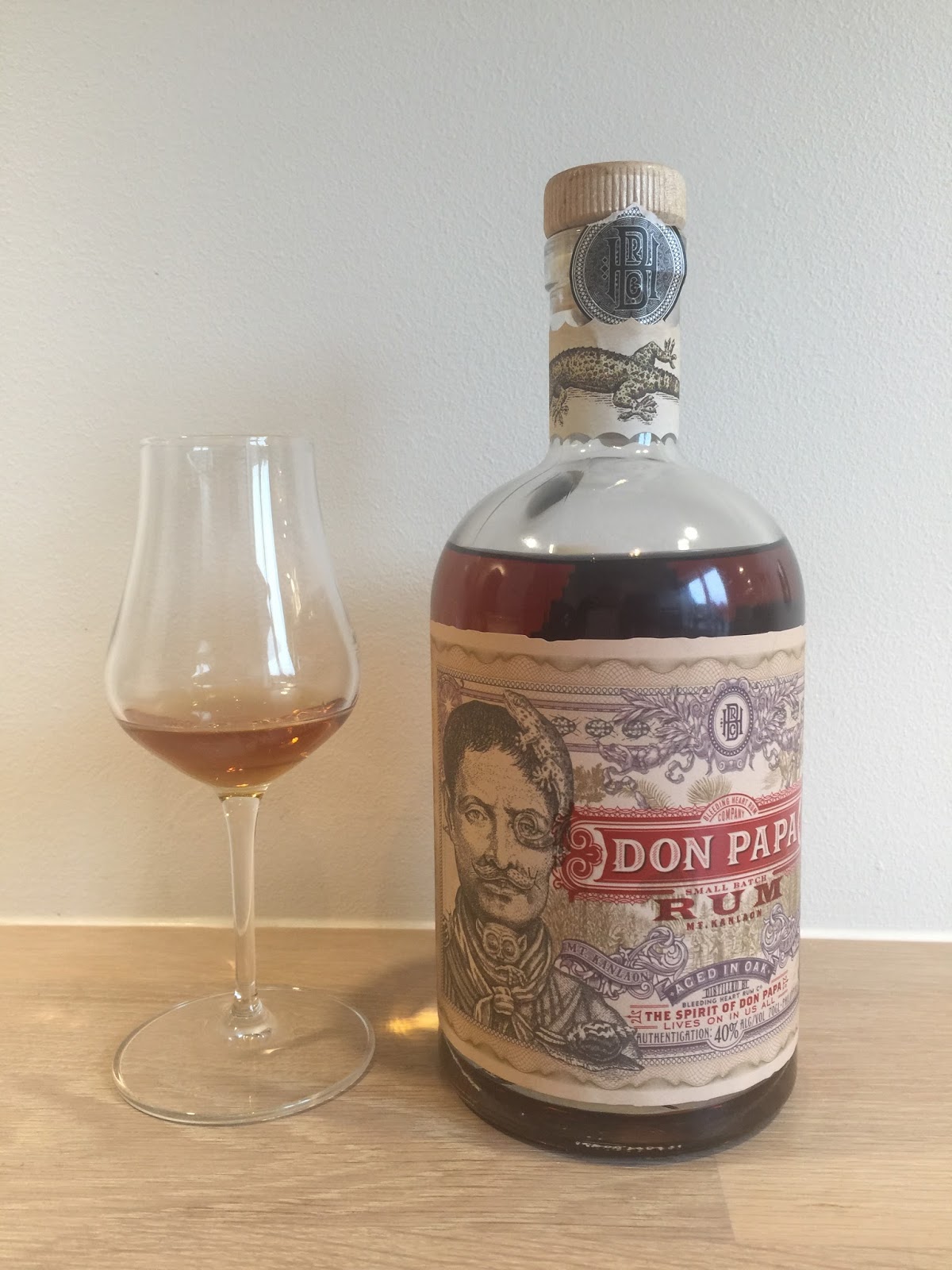
don-papa-7-ans

Photo shamelessly cribbed from and copyrighted to Henrik Kristoffersen of RumCorner.dk

Caner’s Rum Quality Inverse Square Conjecture: quality of rum is inversely proportional to the square of the sum of [ glitziness of website plus design of the label ].

#311

The presentation and advertising and marketing of this rum is all about fancy bottle and label design, gorgeous visuals, and words to make you giddy with anticipation.  It nails all aspects of those. Everything else is secondary, except the rum itself, which is tertiary.  

Just to set the stage: I honestly thought my amigo Henrik, in his savage takedown of the rum, was exaggerating his despite. However, intrigued, I begged him for samples to save me buying them, and he was prepared to gift me the whole bottle except that his luggage was already full of stuff he was bringing to Berlin (for me).  And just to see if its claim to being a “premium aged small batch rum” held up, I tried the Don Papa 7 year old (and its brother the ten year old) four  times: once with a flight of eight Jamaicans, then with a flight of seven Demeraras, a third time with a raft of agricoles and then with yet another one of nine Bajans.  

Lord Almighty, this thing was annoying. I don’t think I’ve been this irritated with a rum since the Pyrat’s 1623. It’s appalling lack of profile compared to the comparators is only matched by its self evident desire to emulate a soda pop. When I think of the elegant construction of something like the FourSquare 2006 and its years of development, I want to rend my robes, gnash my teeth and weep bitter tears of despair for the future of the rumiverse. It may be the bees knees in the Phillipines, where different rules for rum production are in force and different palates and tastes rule – but maybe it should stay there and not afflict real rums.

Think I’m being unjust?  Unseemly vicious? That I jest?  Not at all.  The 40%, American-oak-aged amber rum reeked — that’s the only word I can come up with that describes the cloying, thick aroma of yoghurt emanating from the glass, a sort of sour cream and curds kind of smell, leavened with some raspberries and cherries.  It makes the A.H. Riise Navy Rum seem like a masterpiece of blending assembly. And then there was the overdone saccharine citrus smell of fanta, bubble gum, vanilla (gobs of that), and sprite and cream soda…what the hell, maybe they tossed some coke in there too. Rum? I dunno – it smelled like a mixing agent to which one adds rum.

And it was on the palate that its true adulterated nature became fully apparent.  The mouthfeel is where it started – it literally felt like a soda, complete with the slight scrape of what could charitably be called bite but which I’ll call chamberpot-brewed rubbing alcohol.  Again that yoghurt taste was there, this time without the creaminess, the raspberries being replaced by a peach or two…and the vanilla and sprite and coke were still there in abundance, finishing the job of ruining what had been an unremarkable, unprepossessing liquid that wasted too much of my time.  There was no finish to speak of, which was unsurprising, given how dosed and choked up this thing is with so much that isn’t rum.  Even Pyrat’s XO would probably shudder at what the company did here (while taking notes).

This is the kind of rum which drives reviewers into transports of rage, because it gives all rum a bad name, and frankly, with all due respect to the nation of origin which makes the much better Tanduay 12 year old, it’s barely a rum at all.  And yet it sells briskly, calmly splashing around in the great urinal of low-to-mid-level adulterated rum sales, which just goes to show that spice and sugar will always move product.  What most of those don’t do is slap lipstick on a pig with quite the abandon and disdain for quality this one does. It truly has to be drunk to be believed, and trust me, unless you love your dentist, that’s not something I would recommend.

(59/100)


Other notes

  • I might have been less snarky if they had simply labelled it as a spiced rum (which it is) instead of some kind of aged artisinal product (which it isn’t).
  • Cyril at DuRhum had this run through a lab test and that evaluated it with 29g/L sugar, 2.4 g/L glycerol and a massive 359 mg/L of vanilla.
  • Who makes this? Well, the Bleeding Heart Rum Company, to be exact, and this link will answer most other questions about the product. BHRC is in turn a subsidiary of Kanlaon Limited a small single-director, 100-share company registered in a business village in Middlesex, listing Mr. Stephen Carroll as the man in charge, and he apparently worked for Remy Cointreau for some years before striking out on his own (he has other directorships in companies involved in film and video production).  Since I don’t trust much of anything the website says, I won’t rehash its blurbs here.
  • For an enthusiastic and uncritical perspective by a “lifestyle writer” (I will not use the term “journalist” because that would be like saying Don Papa is a real rum) I direct you to this Forbes article from May 2017.  It’s just another in a spate of recent rum-themed articles that are written by people who seem to want to advertise that they really know nothing at all about the subject.
Aug 302016
 

La Confrerie HSE 1

A lovely, supple rhum from the French island.

(#299 / 87/100)

***

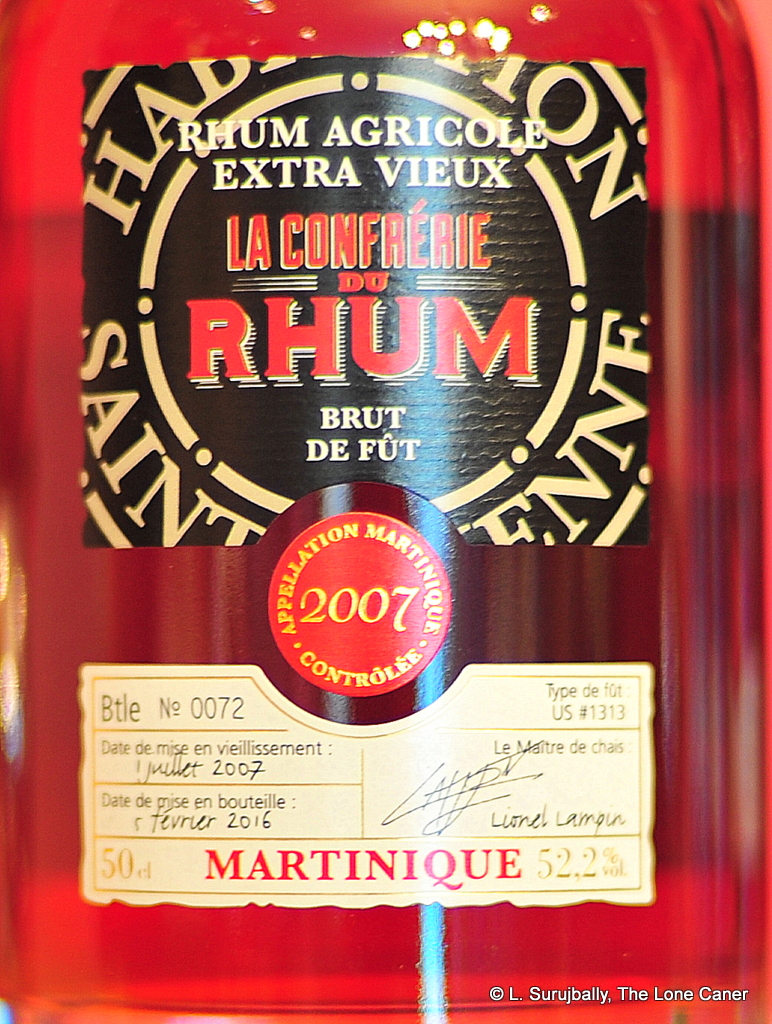
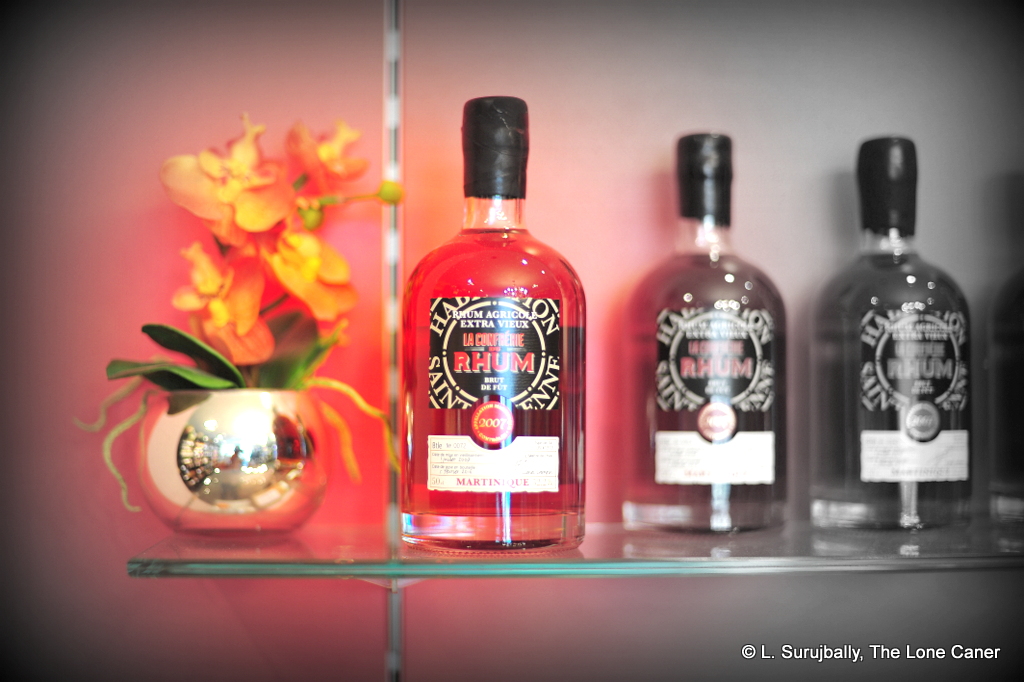
La Confrérie du Rhum’s Martinique Extra Vieux (as labelled), a 2007 millésime rhum bottled at a forceful 52.2% had darker notes reminding me of the Damoiseau 1989, until it went off on its own path and in its own way, which makes perfect sense since it’s actually from Habitation St Etienne. And while I have not had enough of those to make any kind of statement, after trying this one I bought a few more just to see whether the quality kept pace…because La Confrérie’s rhum was quite a lovely piece of work.

The Habitation Saint-Étienne is located almost dead centre in the middle of Martinique.  Although in existence since the early 1800s, its modern history properly began when it was purchased in 1882 by Amédée Aubéry, an energetic man who combined the sugar factory with a small distillery, and set up a rail line to transport cane more efficiently (even though oxen and people that pulled the railcars, not locomotives). In 1909, the property came into the possession of the Simonnet family who kept it until its decline at the end of the 1980s. The estate was then taken over in 1994 by Yves and José Hayot — owners, it will be recalled, of the Simon distillery, as well as Clement —  who relaunched the Saint-Étienne brand using Simon’s creole stills, adding snazzy marketing and expanding markets.

The Brotherhood itself is an odd sort of organization, since it exists primarily on Facebook.  Running the show are Benoît Bail, a sort of cheerfully roving rum junkie without an actual title but with an awesome set of tats and love of rum who currently resides in Germany, and Jerry Gitany who moonlights at Christian de Montaguère’s shop in Paris; among various other rum promotional activities, they dabble in importation of spirits, and starting in 2015 they were first approached to be part of a co-branding exercise (they are not precisely independent bottlers). What this means in practice is that they work with a distillery to chose the rum (a cask or two), put La Confrérie’s logo on the label, and designate which shops get to sell it to the final consumers, and work to promote it afterwards. So far they’ve co-branded four expressions: Les Ti’Arrangé de Céd (March 2015), Longueteau (June 2015), La Favorite (December 2015) and this one.

La Confrerie HSE 2The story of this particular rhum started during one of Jerry’s regular visits to HSE, when Cyrille Lawson, the commercial director, remarked, “Jerry, we want to do a cuvée with La Confrérie.” “Sure,” Jerry said “But you have to do something that you’ve never done before.”  And Cyrille, probably relieved not to be asked to go base-jumping in a pink suit, agreed to come up with something good. One year later, Benoît and Jerry were at HSE picking and chosing among six different samples, the final result being this first full proof 52.2% beefcake. It was distilled in a creole column still, then aged in an American oak barrel between July 2007 and February 2016, had no additives, fully AOC compliant, and turned out at a very nice 800 bottles. It turned up for sale just in time for three hundred to be snapped up at the 2016 Paris rumfest, and for me to walk into the establishment two months later, see it and want to check it out. 

The aromas of the gold-amber rhum were excellent: the initial attack was all about anise, fruits, raisins, coffee and some red wine (I’m not good enough to tell you which) – this was the part that reminded me of the Damoiseaus. But then it went its own way, adding orange zest, more coffee, and some molasses (what was that doing here?), with just the slightest bit of vegetals, lemongrass and sugar cane juice. They were crisp notes that scattered like bright jewels on a field of black velvet, somehow vanishing the moment I came to grips with them, like raindrops in moonlight.

The taste, on the other hand, did not begin auspiciously – I actually thought it somewhat uncouth and uncoordinated, being sharp and spicy and seemingly harsh, but then it laughed, apologized and developed into an amazingly beautiful profile: honey, dill, candied oranges and coffee, bound tightly together by the clear hot firmness of very strong black tea.  And that was just the beginning: as it relaxed and opened up (and with some water), sugar cane juice and herbals and grasses came up from behind to become more assertive (though not dominating).  Again there as that odd caramel and molasses backtaste, and then came one I’m at a loss to explain except to say trust me, it was there: the scent of salt beef in a tub, hold the beef (I am not making this up, honest). It all finishing up with a lovely fade, long and warm, dry, not overly tannic, with some smoke and light dusty haylofts mixed in with chocolate, juice, zest and grass. I mean, guys, I had this thing in my glass for almost two hours while I went back and forth in that shop, and what I’m describing was real – the rhum has a phenomenal palate…less sharp than might be expected for 52.2%, and yet quite distinct and strong, a veritable smorgasbord of cooperating tastes.La Confrerie HSE 3

Years ago when studying the games of go-masters, I remember reading that one of them lost not when he played the most promising or “proper” moves, but when following lines of play which resulted in an elegance and purity of his game which overwhelmed his desire to win.  It was all about the pleasing  arrangement of stones on the board, you see: the beauty. The ending was, in its own way, superfluous. Irrelevant.  The pattern was everything.

I have a feeling HSE’s master blender might know this game. He started with nothing – an empty board, so to speak – and stone by stone, element by element, year by year, built a mosaic, a poem in liquid, that resulted in this fascinating rhum.  He has not won, no — there are indeed weak points in the final result.  But I contend that what has been made here is a thing of rare skill, of elegance, and yes, even of beauty. That alone, to me, makes it worth buying

***

Other notes

A sample straight from the bottle, one of several that Jerry Gitany let me try in Christian’s shop in Paris in early 2016. You could argue that I was positively influenced by it being a freebie, but since I picked it and he didn’t, and since a fair bit of my coin had just vanished into his till, I chose to believe otherwise.

The dates on the label make it clear this is an eight year old. Benoît confirms it is a true millésime.

As an aside, so Jerry informs me, HSE was so happy with this rhum that they asked La Confrérie to collaborate on a second batch, supposedly to be even better. It will be delivered by the end of 2016 (November or December).

Aug 132016
 

JM 1845 Cuvee - 1

After a tough day at work, the Cuvée 1845 is a balm to the exhausted mind.

Even at 42% ABV, The Rhum J.M. Cuvée makes a statement for agricoles that is worth listening to.  It finds a balance between body, mouthfeel, taste, spiciness and warmth in a way that reminds us that agricoles should not be taken as merely a small subset of the greater rumworld, but should hold a place in the pantheon second to none. While these days my preferences run mostly towards stronger, full proof rums, I must say that there’s nothing about this lovely product that makes me want to ask for it to be dialled up.  It’s excellent as it is.

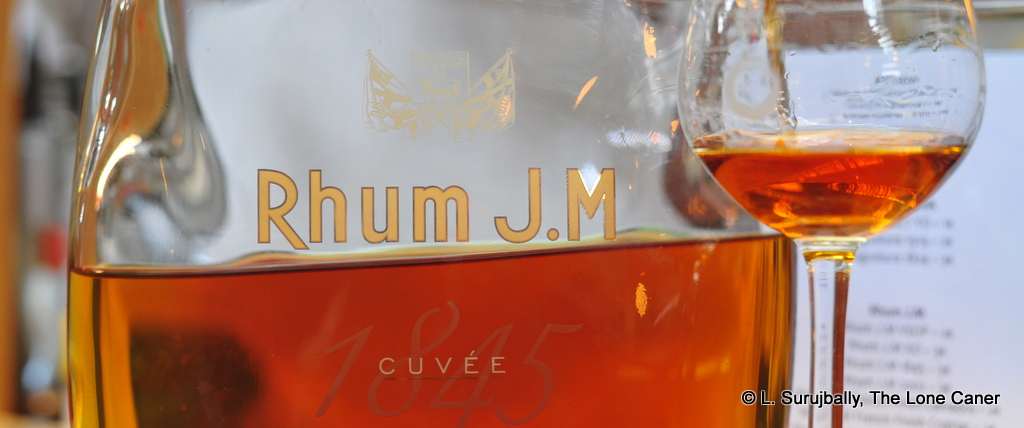
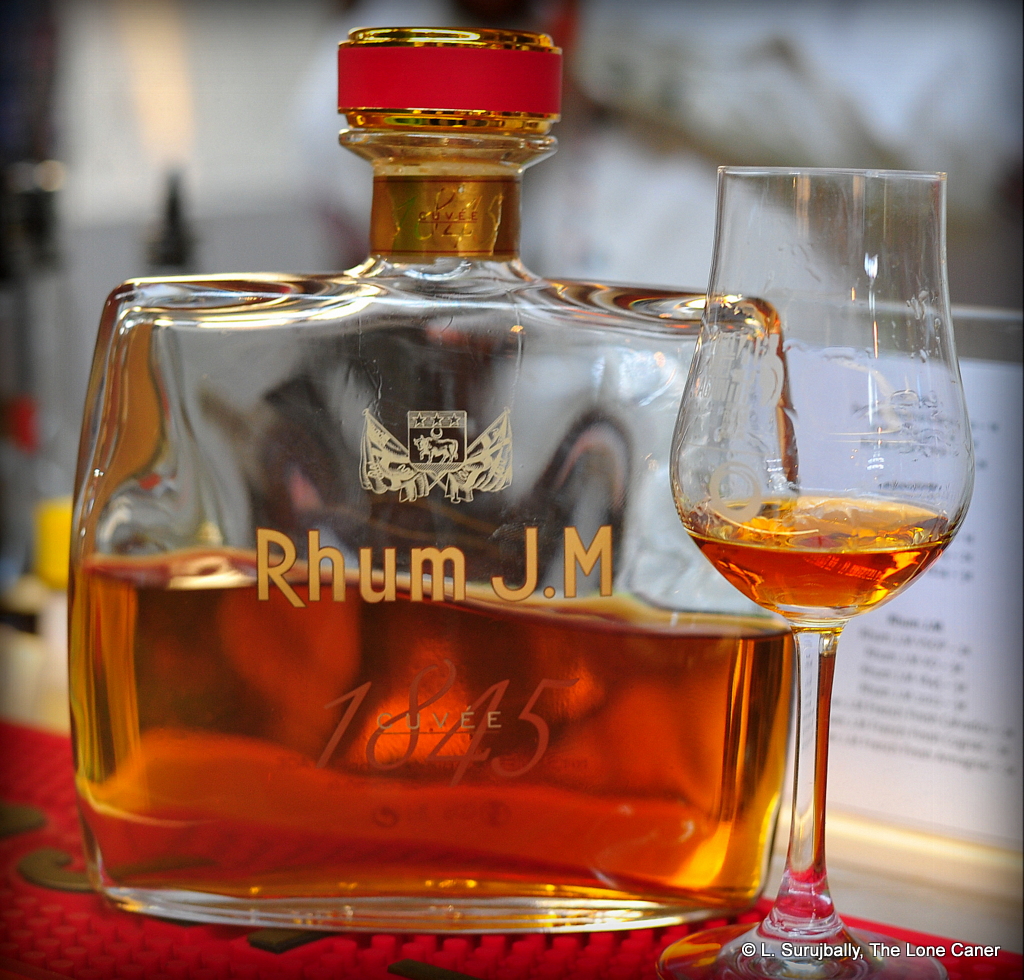
Issued as an anniversary edition for the 170th year of production on the plantation in 2015 (which was when I tried it), the Cuvée is a rhum aged at least ten years in oak barrels, gold in colour, and housed in a handsome gold etched flagon of admirable simplicity.  J.M. is, of course, the old house on Martinique which issued the haunting 1995 15 year old, as well as the equally memorable 2002 Millesime 10 year old, but I think this one is just a shade better. J.M. as a plantation has been in existence for longer than 170 years – Pere Labat founded the sugar refinery as far back as the 1700s, and it is clear that the current owners have forgotten nothing about what it means to make a top notch rhum.

JM 1845 Cuvee - 2There was a certain tartness in the nose that started things off, something like ginnip and soursop, the crisp and firm ripeness of a green apple. It was not sharp or spicy, just heated and well controlled in a way that made smelling it a joy rather than an exercise in pain management – I didn’t have to set it aside to chill out and breathe, but could dive right in.  Once it opened a bit, it softened up, providing additional easy-going scents of vanilla, gingerbread cookies, unsweetened yoghurt and just a dash of pepper and cumin (which is not as odd as it may sound).

It was the taste that elevated the rhum above its 1995 and 2002 compatriots. What sinks an agricole in the minds of many molasses rum lovers is both the clarity and sharpness, whatever the tastes might be.  Nothing of the kind happened here.  In fact, it displayed the sort of originality and balance of crispness and softness which many rums these days seem to shy away from in an effort not to piss anyone off. The feel body was medium, soft, and had the instantly recognizable herbaceous background which marked it as a cane juice product.  Over a period of time, spices, black pepper, vanilla, light citrus and flowers emerged, surrounded by woody notes from the oak barrels where it has rested.  These oaky notes were held in check, providing a background of tannins that did not overwhelm, but enhanced further notes of ginger snaps, orange zest, ripe apples, and created a lovely mix of clear, light softness redolent of these many flavours all at once.  And the finish was equally high-grade – sweet, smooth, warm, tasty (nothing new added here, alas); perhaps a bit too short…more a summing up of the whole experience than any effort to go off the reservation by presenting anything new.

There’s was something almost sensuous about the whole experience.  The 1845, and indeed the rest of the rhums from this company, lacked that peculiar sense of individualism that marked out the Neisson line, yet in their own way are as distinct as any other, and with a quality not to be sneezed at. This is a rhum so well made that sipping it neat is almost mandatory – mixing it might be a punishable offense in some places, and I certainly wouldn’t.  Admittedly, the only J.M. rhums I’ve tried have been fairly high end ones – when you can carry only one and buy only one, you tend to chose from the better end of the spectrum – but even among those I’ve sampled, this one stands out.  It’s a remarkable, tasty, solid accomplishment from one of the last single-domaine, family-owned houses still in existence on Martinique.  And a feather in its cap by any definition.

(#294)(88/100)


Other notes

  • Blend of rhums aged a minimum of ten years in 200-liter oak barrels
  • A brief bio of J.M is provided in the 1995 review
Jun 072016
 

Long

Strong beginning, fine development, chokes on the backstretch

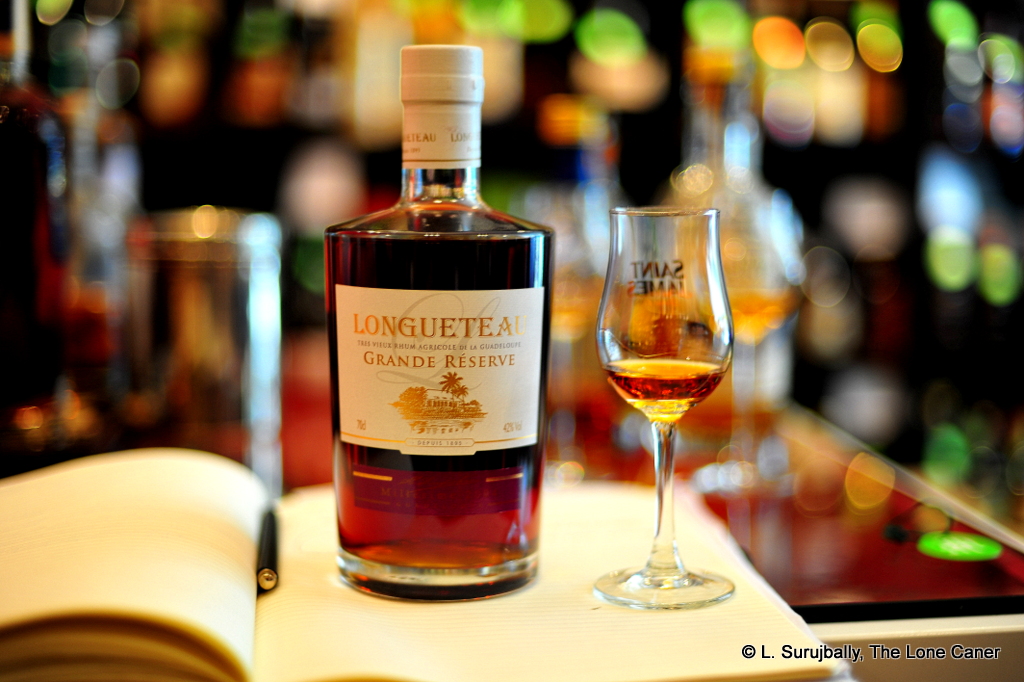
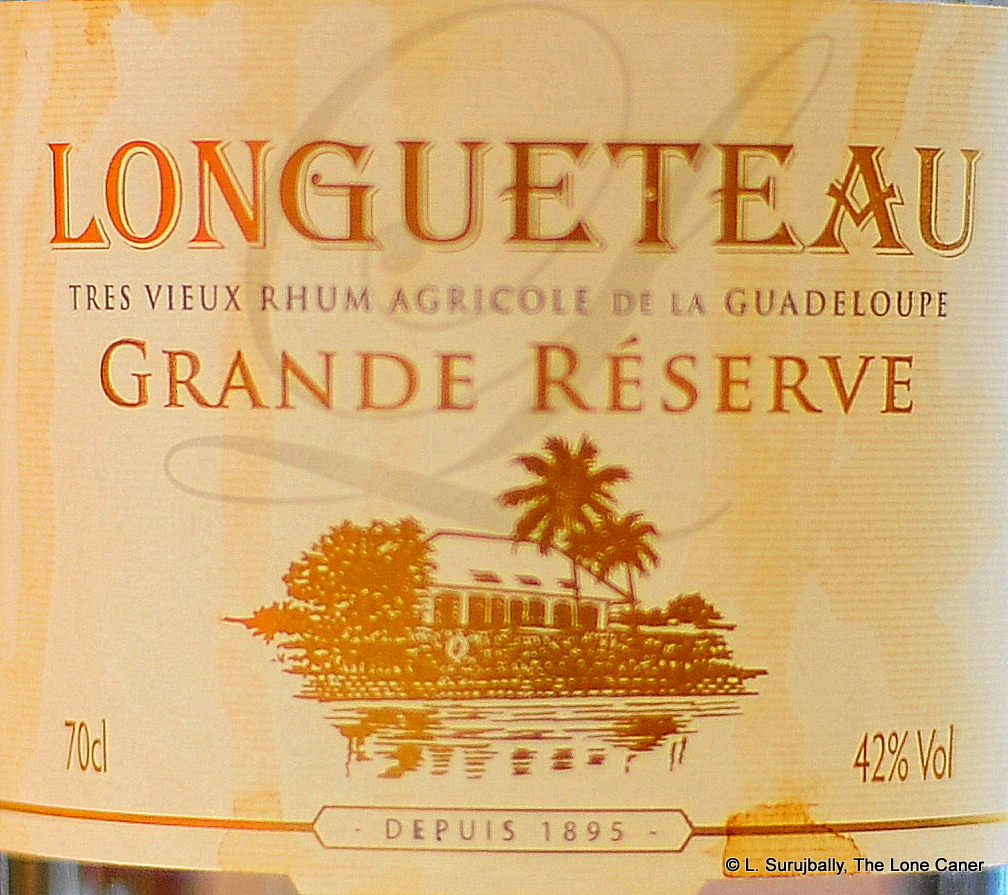
There are many things about agricoles that I slowly learned to appreciate: the clear profiles, the subtleties of their ageing, the differences and similarities with the molasses based rums that some almost indifferently dismiss as ‘industrials.’ So far I seem to be leaning more towards Guadeloupe rhums than those from Martinique, and while the Grande Reserve I sampled in Paris in April 2016 wasn’t one of the shining stars of the firmament, it wasn’t all that bad either and I had several hours to come to grips with it properly

Longueteau distillery has been around since the end of the 19th century, and is located in Domaine Espérance Belair, Sainte-Marie (on a SE corner of Basse-Terre) – it produces the Karukera and Longueteau lines.  Originally the whole estate was part of the the property of the Marquis de Sainte Marie, but the poor chap dedicated himself somewhat excessively to the pleasures of the nobility that came with his station – wine, women and gambling, all the expected high points — and was forced to sell out to Henri Longueteau in 1895 to cover his debts. The notary handling the sale, so local legend has it, passed it to Henri on trust, since that worthy didn’t have enough money either, and that faith seems to have paid of handsomely. Four generations of the family have kept the estate going ever since.

Longueteau-2This dark orange-gold ten year old began well on the nose: phenols, acetone, caramel, sweet red licorice, wet cardboard, it gave a good impression of some pot still action going on here, even though it was a column still product. Then there was some fanta or coke — some kind of soda pop at any rate, which I thought odd. Then cherries and citrus zest notes, blooming slowly into black olives, coffee, nuttiness and light vanilla.  As a whole, the experience was somewhat easy due to its softness, but overall it was too well constructed for me to dismiss it out of hand as thin or weak.
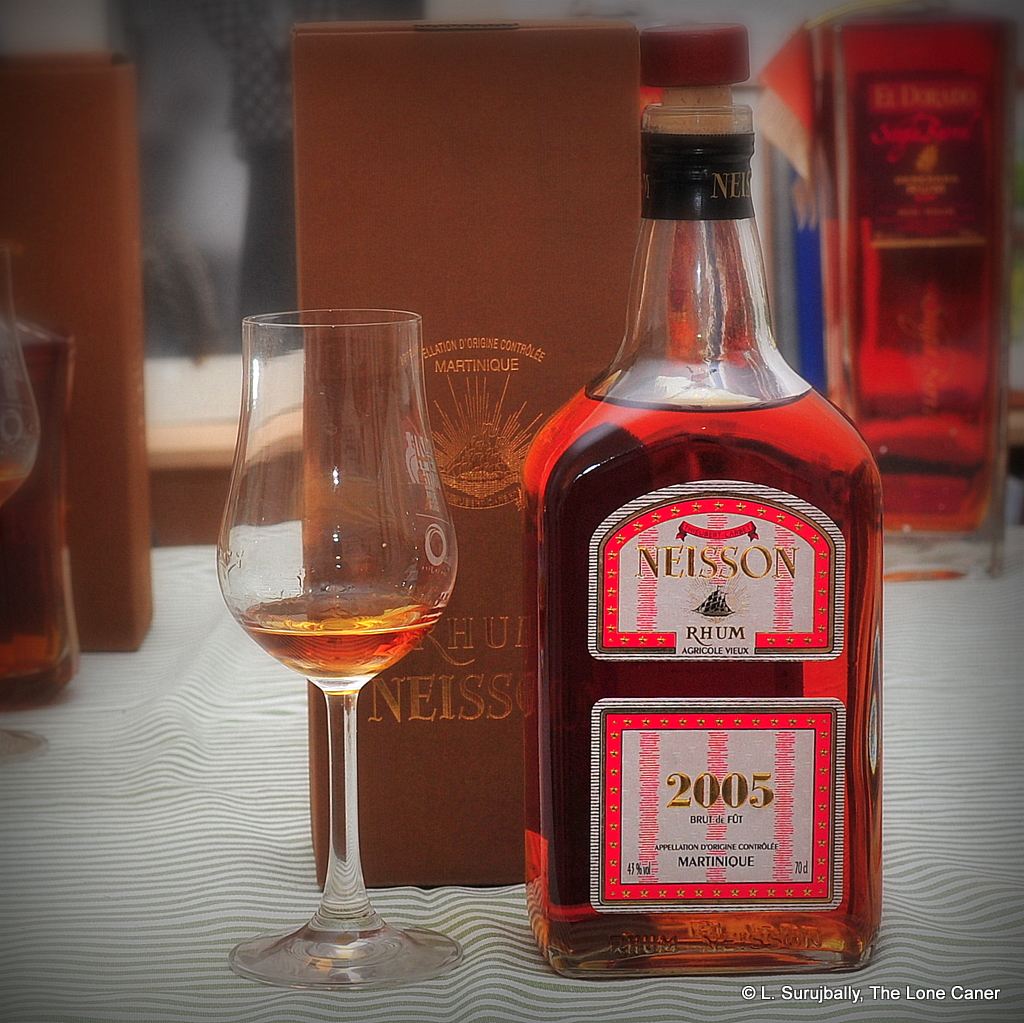
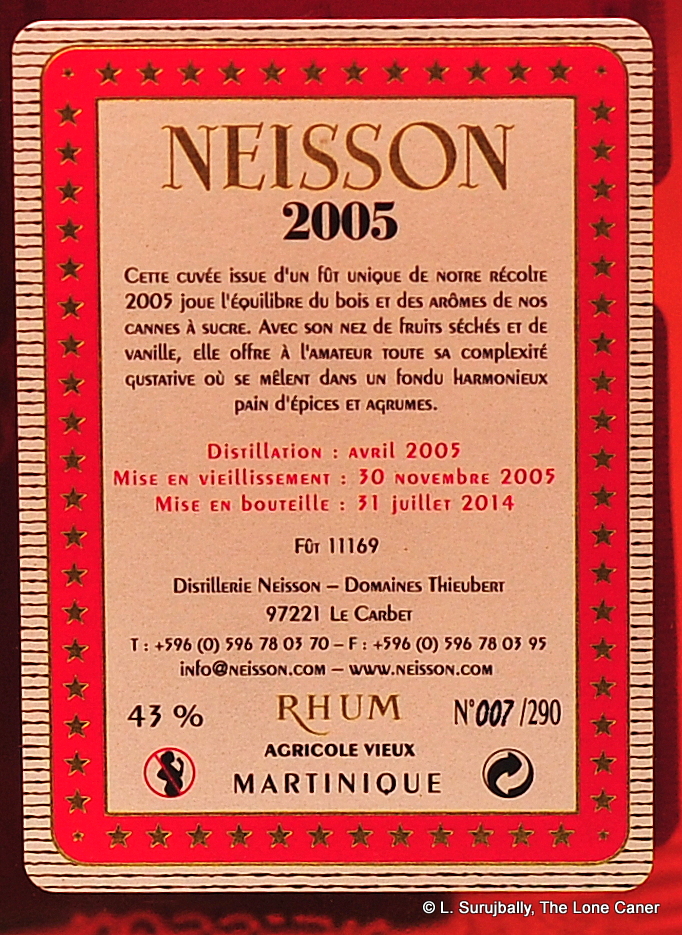
That thin note of acetone and nail polish remover came and went as fast as a man through the window of his paramour’s house  when the husband comes through the door.  Thick and almost full bodied, warm, welcoming, non-aggressive.  Herbal and grassy notes, much less prevalent than in a true agricole (or a white) and I got the impression, right or wrong, as I do with many Guadeloupe rums, that this was a molasses based rhum (which it isn’t).  With water there was more fanta and soda pop, bubble gum, plums and prunes.  Certainly fruit, without the tartness of unripe mangies but something more subdued, like ripe black cherries and soft apricots, and some of that watery soggniess of watermelon just starting to go. But hey, I liked it, and to be able to pick out that much from a living room strength rum is no small achievement — maybe it was the cognac barrels in which it had been aged. The finish was more problematic – short, nutty, giving up hints of salty caramel.  The fruity notes were there but just, I dunno, evaporated.  Nice enough, just the weakest part of the whole experience, which was a shame after noting how well it all started.

So where does that leave me?  Feeling pretty good, all in all, because it is a very well assembled rhum, with few faults except a certain lack of heft, and the finish which seemed in a hurry to either get me to put the glass down, or to refill it.  It shared many points of kinship with another rhum I had that day, the Damoiseau 1989 20 Year Old (which was better).  Part of the issue might be the 42%.  Perhaps it was filtered, I don’t know.  For your average Tom, Dick or Harrilall it would work pretty well, and I would recommend it to anyone who wants to start working his way around to the French islands’ products, without hesitation.  It’s a very good rhum for that — even if for me, it’s not one to add to my pantheon of great rums.

(#277 / 85/100)


Other notes

Distilled Mar 2004, bottled April 2014

LOngueteau-3

May 152016
 

D3S_3819

There are few (if any) weaknesses here: conversely, not many stellar individual components either.  It’s just an all-round solidly assembled product that missed being greater by a whisker.

So here we are, gradually inching up the scale of the Neissons, with a rum I felt was slightly better than the Tatanka I looked at some weeks ago.  Now, that one had a bright, colourful label to catch the eye (Cyril from DuRhum did a review of the lineup, here), and yet appearance aside, this one was, in my estimation, a smidgen better. It’s a subtle kind of thing, having to do with texture, taste, aroma and a quiet kind of X-factor that can’t be quite precisely quantified, merely sensed and noted.  But yes, I felt it was better.  In fact, it was the second best of the raft of Neissons I tried in tandem, and only the XO exceeded it.

Issued at a sturdy if uninspiring 43%, the Neisson Rhum Agricole Vieux 2005 is a nine year old rhum, an amber-red liquid sloshing around the standard slope-shouldered rectangular bottle which came in a sturdy, nicely done cardboard box. As with all Neisson products, it was AOC certified, self-evidently and agricole, and like its siblings up and down the ladder, had its own take on the way a rhum should be put together.

D3S_3822I speak of course of that oily, sweet salt tequila note that I’ve noted on all Neissons so far.  What made this one a standout in its own way was the manner in which that portion of the profile was dialled down and restrained on the nose – the 43% made it an easy sniff, rich and warm, redolent of apples, pears,and watermelons…and that was just the beginning.  As the rhum opened up, the fleshier fruits came forward (apricots, ripe red cherries, pears, papayas, rosemary, fennel, attar of roses) and I noted with some surprise the way more traditional herbal and grassy sugar cane sap notes really took a backseat – it didn’t make it a bad rhum in any way, just a different one, somewhat at right angles to what one might have expected.
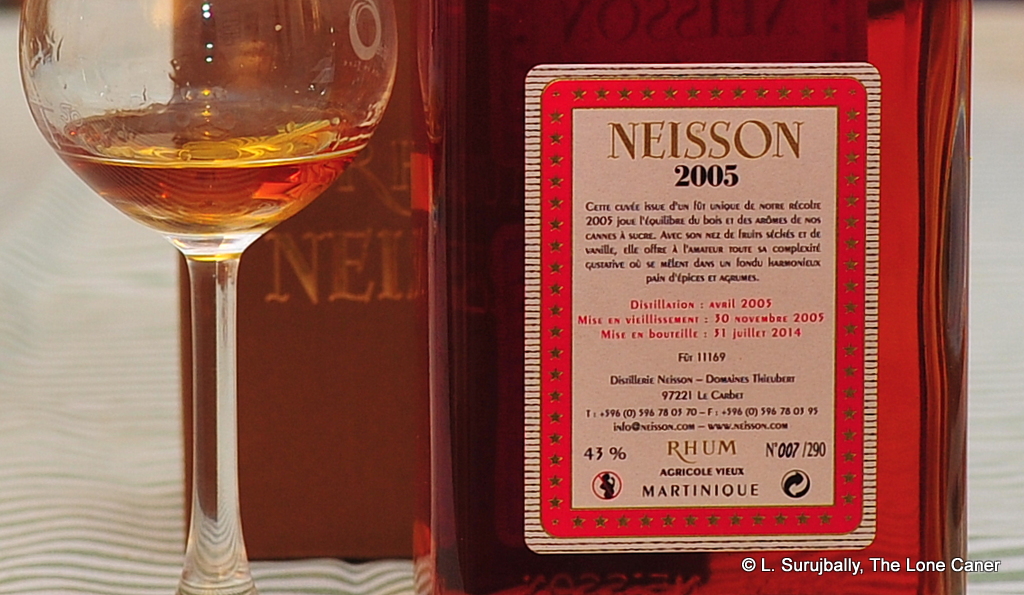
I had few complaints about the way it tasted.  Again the strength made it an easy sipping experience, very smooth and warm and oily.  One thing that I always look for in a rhum is points of difference and originality, a divergence between smell and taste, for example, and the way one blends seamlessly into the other, with some elements disappearing, new ones appearing, and the way they dance together over time — the Neisson 2005 was very nice on that score, presenting as dry, yet also luscious, and just sweet enough.  In fact, that teriyaki style profile had almost totally been subsumed into a tangy, tart texture wound about with half-ripe yellow mangoes, lemon peel, the creaminess of salt butter on dark peasant bread, more fruits, nuts, florals, and some white guavas.  And all of that segued pleasantly into a medium length, velvety fade that gave up last notes of peaches, pecans, and more of that tartness I enjoyed.

There’s very little I disliked here – the texture might have been better, the strength might have been greater (Rhum Rhum Liberation 2012 Integrale did the job exceedingly well, for example though the Neisson really felt thicker to me in comparison).  Nothing major. What it did not do was excite any real passion aside from a rather clinical series of observations on my voluminous notes, like “Good!” and “Nice!” and “Tastes of…” and “Balance well handled” and so on.  I liked it and I would recommend it to you, no sweat, and my essay here provides all the technical notes one might require for an evaluation of its merits.

D3S_3821But I also didn’t get much in the way of wonder, of amazement, of excitement…something that would enthuse me so much that I couldn’t wait to write this and share my discovery.  That doesn’t make it a bad rhum at all (as stated, I thought it was damned good on its own merits, and my score reflects that)…on the other hand, it hardly makes you drop the wife off to her favourite sale and rush out to the nearest shop, now, does it?
(#273 / 86/100)


Other notes

  • 290 bottle outturn
  • Cyril wrote a much more positive 92-point review of the same rhum (in French), so you can compare his point of view and mine.
May 112016
 

D3S_3667

A wonderfully sippable AOC agricole from J.M. in Martinique

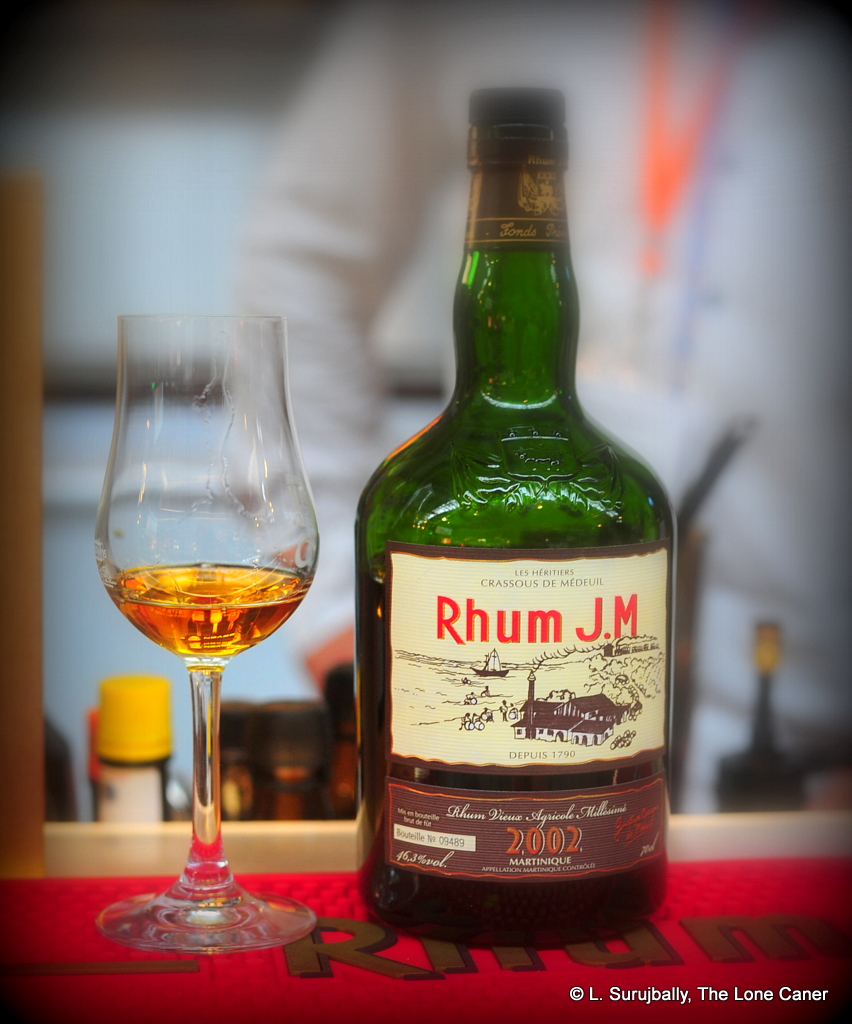
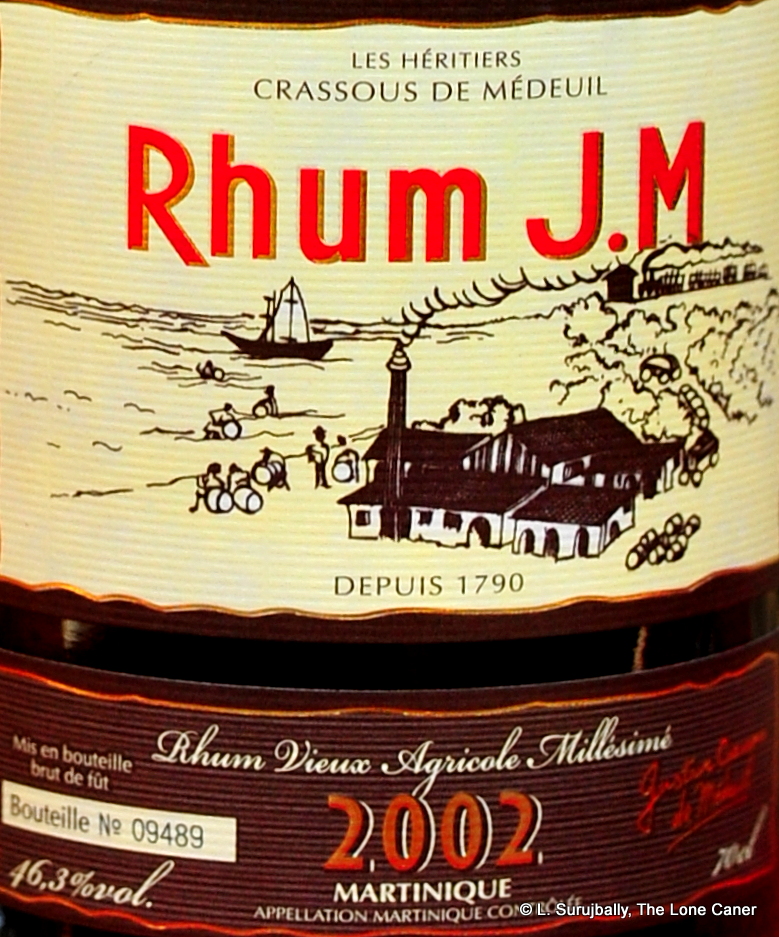
The unquantifiable quality of the J.M. 1995 Très Vieux 15 Year Old has stayed with me ever since I first tried it.  Some aspects of the rhum did not entirely succeed, but I could never entirely rid my memory of its overall worth, and so deliberately sought out others from the stable of the company to see if the experience was a unique one.  And I am happy to report that the Millesime 2002 10 year old is a sterling product in its own way, and perhaps slightly exceeds the 1995…though with such a small difference in scores, you could just as easily say they are both excellent in their own ways and let it go at that.  

For all the enthusiasm of the above paragraph, it should be noted that sampled side by side, the two rhums are actually quite distinct products, each good in their own way, but not to be confused with one another.  Consider first the aromas hailing from this 46.3% orange gold rhum – they presented as quite fruity and aromatic, quite rounded and mellow, not always a characteristic of agricoles. As it opened up over the minute, flavours of cherries, red grapes, herbals, dill, sugar cane and grass rose gently out of it….and, if you can believe it, a sort of weird and persistent bubble-gum and Fanta melange that took me somewhat unawares, though not unpleasant by any means.

On the palate the texture was phenomenal, smooth and warm and assertive all at once.  There was little of the aridity of the 1995: it presented a sort of restrained spiciness to the senses; some vanilla and tannins were discernible, but very well controlled and held way back so as not to unduly influence what was a very well balanced drink. 46.3% was a good strength here, and allowed firm traditional vegetal and grassy notes to take their place, before gradually being replaced – but not overwhelmed – by citrus zest (that was the Fanta doing a bait-and-switch, maybe), mint, cucumbers, watermelon, papaya and rich, ripe white pears.  And then there was more…rye bread, salt butter, very delicate notes of coffee and chocolate…just yummy. It was an enormously well assembled rhum, luscious to taste and with walked a fine line between Jack Sprat and his wife…one could say it was like the last thing Goldilocks tried, being just right.  Some of the dry profile I had previously sensed on the 1995 was evident on the finish, but again, nothing overwhelming – it was warm and aromatic with light tangerines, spearmint gum, more ripe cherries and those delectable grapes I had noted before.  All in all, just a great sipping agricole, with similarities to the Karukera 2004, la Favorite Cuvée Privilège and maybe, if I stretched, even Damoiseau’s products.

D3S_3668

J.M. is located in northern Martinique at the foot of Mount Pele, and I’ve written a company summary in my review of the 1995, if you’re interested.  One fact that came to my attention afterwards was that JM char the inside of their barrels by setting fire to some high proof rum distillate, and then scraping the char off, which may have something to do with the fruity character of the aged rhums they put out.  The rhum itself was distilled on a creole copper pot still to 72% before being set to age and then diluted to “drinking strength.”  I wonder what would happen if they ever decided to take a chance and leave it cask strength.

Most people I speak to about agricoles, especially those who have tried just a few (or none), comment in a way that suggests they are considered pretty much all the same — grassy, herbal, watery, a trifle sweet maybe, and (horrors!) more expensive. A lot of this is true, but after having tried the marvellous variety of rhums from Martinique and Guadeloupe, the sharp industrial chrome of the whites versus softer aged products, I can say with some assurance that there is an equally dazzling variety within cane juice rhums as there is in the molasses based products. And this is one reason why in the last year I’ve really tried to write about as many of them as I could lay hands on. Trying the JM 2002 with its complex, layered and warm profile makes me glad the adventure still has some kinks in the road, and that I began it in the first place.

(#272 / 86.5/100)


Other

  • Aged in ex-bourbon oak, not French oak (Limousin)
Apr 252016
 

D3S_5678

For me this is a rum that evokes real nostalgia, even though I’ve mostly moved past it.

I enjoy storytelling, but if rambling background notes and local anecdotes are not your thing, skip three paragraphs.

It was a fact of life in Guyana in the 1980s and 1990s that as one moved up the income scale from poor to less poor, one upgraded from Lighthouse matches to bic lighters to zippos; from leaky, loosely packed Bristol cigarettes to Benson & Hedges (gold pack, preferably made in the UK, not Barbados), and stopped swilling the pestilential King of Diamonds (which nowadays has gained stature only by being long out of production), younger XMs and High Wine rums, in favour of the somewhat more upscale Banks DIH 10 year old.

Alas, as a young man just growing out of training wheels and nappies, my slender purse (and near nonexistent income) relegated me to matches, Bristols and XM five, which my best friend John and I smoked and swilled in quantities that makes me shudder these days.  We’d sit in the convival open-air tropical atmosphere of Palm Court, smoke up a storm (killing those butch Mudland-sized mosquitoes in their thousands), and call happily to our favourite waiter who knew us on sight “Double five, coke an’ a bowl a ‘ice, Prince!” followed by  “Keep ‘em comin’! I don’ wan’ see de bottom o’ de glass.” I somehow suspect that were we to get together one of these years, John and I, this routine would not change appreciably, as long as Prince is still around.

D3S_5672Starting as “Demerara Ice House” (there really was an ice factory in Water Street, and yes, it’s still there) and now called D’Aguiar’s Industries and Holdings (hence the DIH) at the beginning of the 20th century, the D’Aguiar family built up a huge food and drinks conglomerate, of which rums remain a relatively small part – they were and remain one of the first and largest bottlers in the Caribbean. They have a huge facility right outside Georgetown in the fragrantly named “Thirst Park”, they make beer, soft drinks, distilled water (among many other consumer nibbles) and with respect to rums, act as blenders, not makers like DDL. Their best known rums back then were the 5, 10 and 15 year old, the Premium Blend, and to this has currently been added a VXO, 12 year old, a White and XM “Classic”. Legend has it they have a rum or two squirrelled away that’s 20 or 25 years old, but I never saw it myself. (And if you really are interested in a more in-depth look at Banks, see the company bio I posted in February 2018)
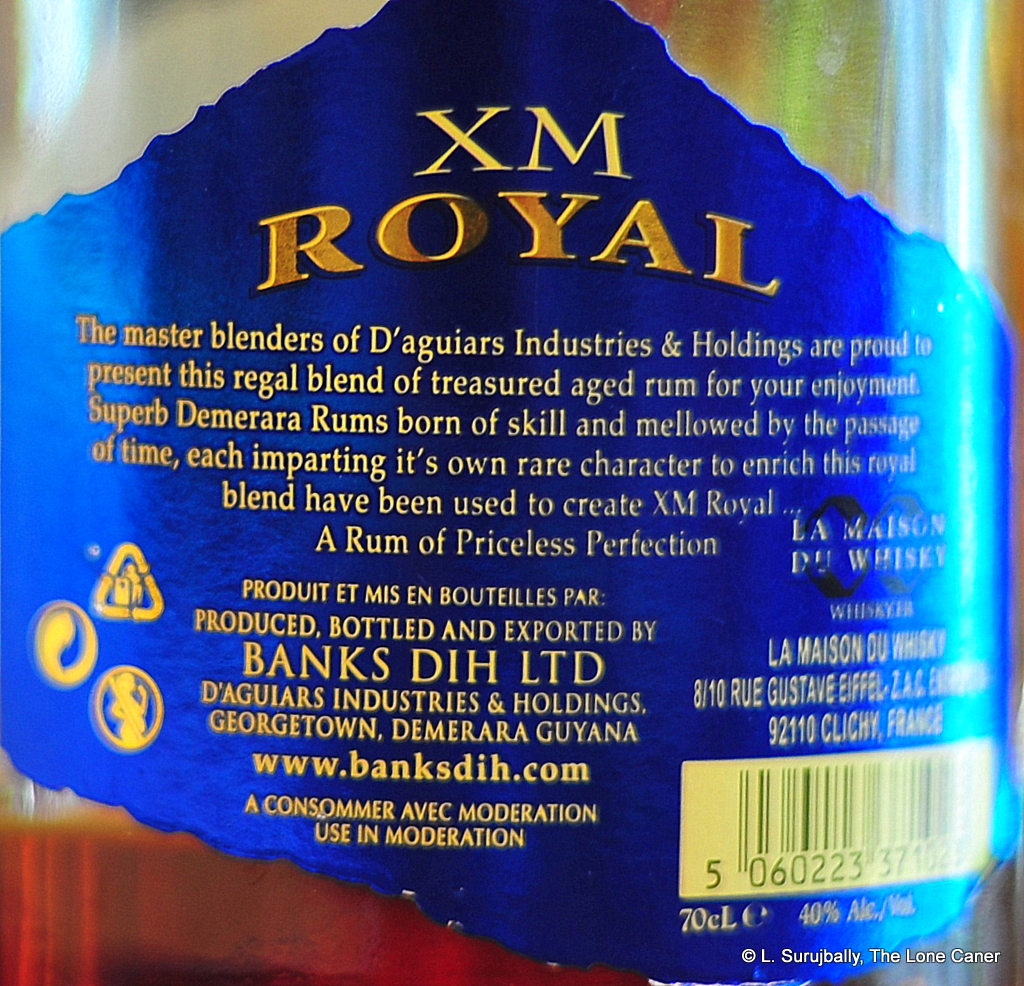
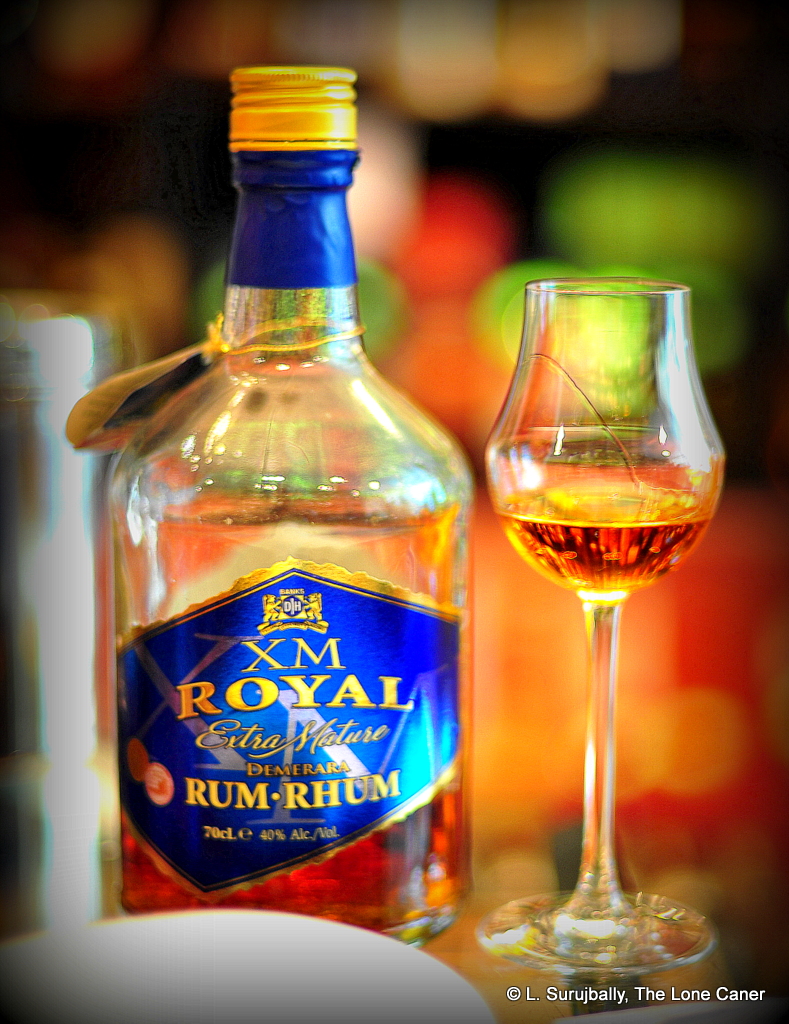
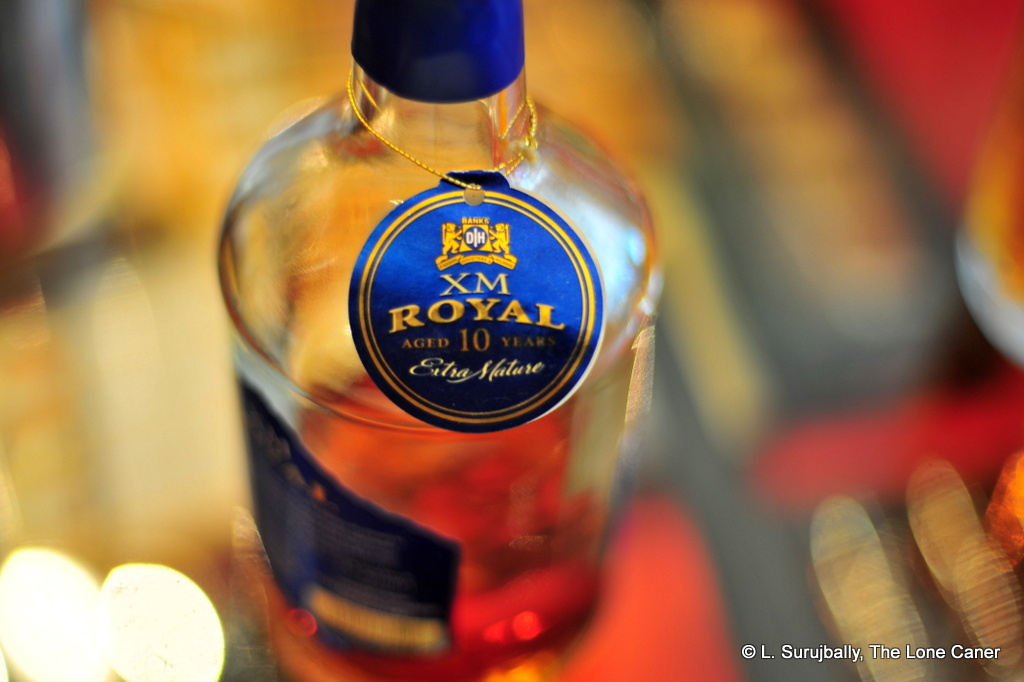
All right, so much for the reminiscing.  What we had here was a tubby bottle quite different from the slim one I recall, containing a dark orange-gold rum bottled at 40%.  The XM in the title stands for “eXtra Mature” and has always been a sort of informal title for the rums, since nobody ever refers to them as “Banks” – that moniker refers to the company’s beer. It was aged for close on to ten years in bourbon barrels, and then finished for another six months or so in cognac barrels, which allows the company to wax rhapsodic in its marketing materials about this being “a cognac of rums”.

Smelling the XM 10 made me wonder whether there wasn’t some Enmore or Port Mourant distillate coiling around inside, even if it’s true they don’t buy anything from DDL.  It was warm and not too sweet, pungent with wet cardboard, cereal, vanilla, licorice, dried fruits and some faint rubbery, waxy undertones stopping just short of medicinal.  It lacked heft, which was not too surprising given the standard strength, though most casual drinkers would have little to find fault with here – it was perfectly serviceable, if ultimately not earth-shaking in any way.

To taste it was quite good, and demonstrated some agreeable heft for a 40% rum (it reminded me somewhat of the Pusser’s 15 in that regard).  Medium bodied, soft and quite warm, there was also a queer kind of thin-ness to the overall profile, which fortunately did not transmute into any kind of unpleasant sharpness.  It entered with a sort of dusty driness, started with tart flavours of mango and anise and ginger cookies, then softened to flavours of red olives, vanilla, caramel, some light toffee, overripe cherries and bananas – overall, after some minutes the lasting impression it left on my mind was one of light sweetness and licorice, and the finish followed gently along from there, being warm and pleasantly lasting. It did not provide anything new or original over and beyond the taste, simply placed a firm exclamation point on the easy going profile that preceded it.  

D3S_5677My own opinion was that it lacked body and needed a firmer texture…the XM 10, while not exactly anorexic, gave the impression of having rather more potential than actuality, and the flavours, decent and tasty enough by themselves, suffered somewhat from dumbing things down to standard strength (this may be my personal preferences talking — I’ve gone on record many times in stating that 40% is just not good enough for me anymore — so take that bias into account).  On the other hand, maybe it’s like the DDL 12 year old, a bridge to the better rums in the XM universe like the 12 and the 15…and since I obtained those the other day, once I review them I can tell you whether this paucity of character is a characteristic of this rum only, or some sort of preference of the master blender that permeates the line. Honestly, I hope it’s the former.
(#268 / 82/100)


Other notes:

  • I find the cheap tinfoil cap to be somewhat surprising for a ten year old rum.
  • Nowadays Banks DIH no longer buy their bulk stock from Diamond and have no sugar cane fields, distillation apparatus or processing facilities of their own.  They remain blenders, and buy raw rum from around the Caribbean (Trinidad and Barbados), which is one reason their juice is not and can not be called “Demerara” rum, the other being that DDL won a court case to have that distinction.  Since this bottle notes the word “Demerara” on the back label, I suspect it was an older one dating back from before the court case, made from original stocks which were sourced in Guyana.
  • I was treated with extreme courtesy by Jerry Gitany and Christian de Montaguère at the latter’s eponymous shop in Paris last week: after selecting a raft of rums – about seventeen altogether –  I plundered ten of their opened stocks, of which this was one.  The Little Caner might have been bored out of his mind for the three hours it took me to work my way through those ten samples (it was meant to be only six…Jerry kept opening new bottles for me to try and my resistance was weak),  but I had a wonderful time.  Merci beaucoup, mes amis.
Mar 162016
 

D3S_3649

More tamed Peruvian sunshine.

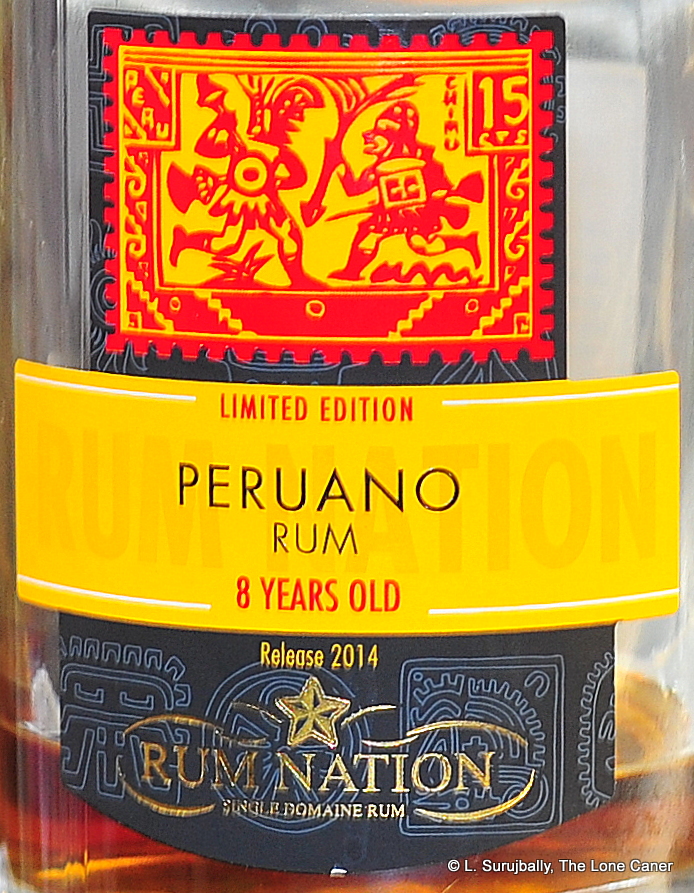
It’s been quite a few months since I picked up a Rum Nation product to write about.  This is not to say that they have either lapsed in sleep or are resting on the laurels of past achievements, since just the other day they put out some promo materials for two new Guadeloupe rums I’m going to keep an eye out for.  However, today I wanted to look at one of their other countries’ offerings, the Peruano 8 year old.

Aficionados are no strangers to rums from that country: both the Millonario XO and Millonario 15 soleras hail from there, Bristol Spirits pushed out an 8 year old Peruvian I quite liked, and Cartavio continues to issue rums such as their own XO Solera — all of which adhere to the medium-to-light, easygoing and sweet profile that excites admiration and despite in equal measure depending on who’s talking.  This one matches most closely with the Bristol Spirits version, and that was no slouch…it made me reconsider my decades long love affair with pungent Jamaican and Demerara rums (just kidding).

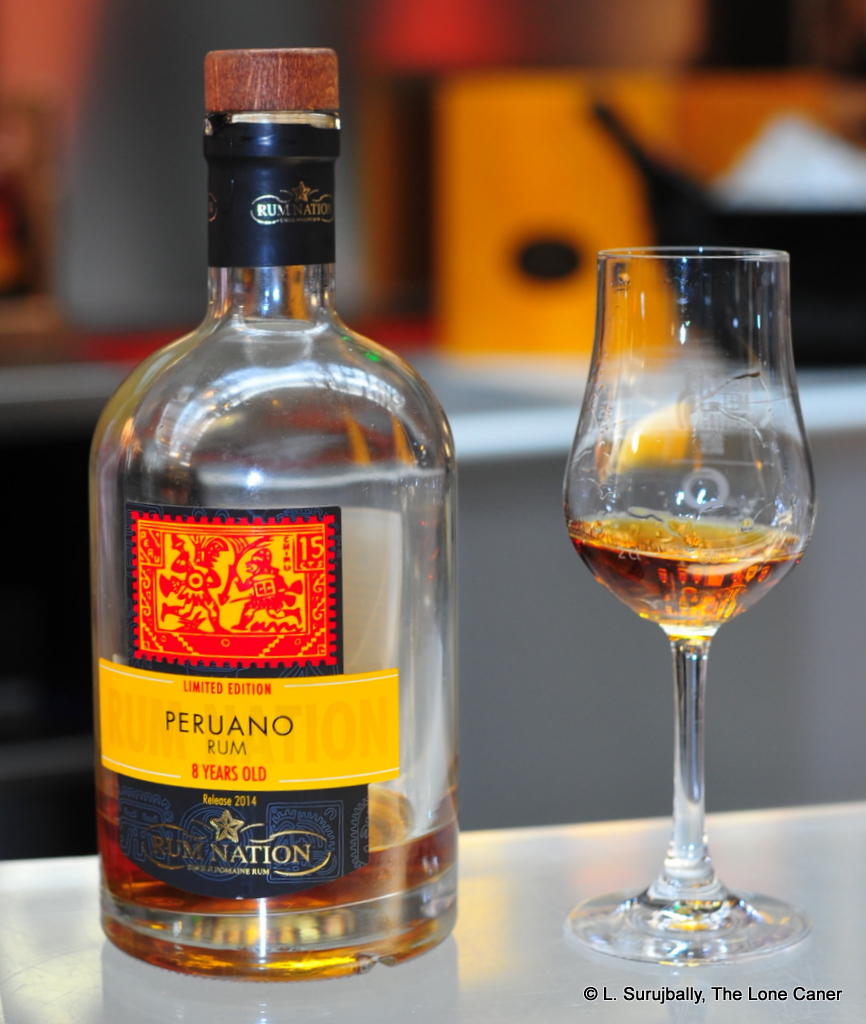
D3S_3650Anyway, the Peruano 8: an dark gold-copper coloured rum, clocking in at 42% ABV, and deriving from the Trujillo gents who also make the Cartavio XO. Fabio told me once that some years back he was seeking a very light, delicate rum to take on Zacapa, and thought he found it in Peru, in the Pomalca distillery which also produces the Cartavio on what looks like a muticolumn still.  The initial rums he got from there formed the Millonario 15 and XO rums, and these were successful enough for him to issue a Peruvian in its own right, aged for eight years in bourbon casks. No more mucking about with soleras here.
I certainly approved.  Rums like this are easy going and don’t want to smack you over the head with the casual insouciance of a bouncer in a bar at the dodgy end of town, and sometimes it’s a good thing to take a breather from more feral and concussive full proof rums.  This one provided all the nasal enjoyment of a warm chesterfield with a couple of broken springs: lightly pungent and aromatic, with a jaggedly crisp edge or two. Cherries, apricots, cloves, nutmeg, some vegetals, chocolate, a slice of pineapple, and sugar water and cucumbers.  Kinda weird, but I liked it – the smells harmonized quite well.

The palate was pleasant to experience, and brought back to memory all other Peruvians that came before.  The light clarity — almost delicacy — was maintained and demonstrated that it is possible to sometimes identify different rums made from the same source…here it was almost self-evident.  Tannins, vanillas, fruits, brown sugar (too much of this, I thought), some caramel, all melding into each other; peaches in unsweetened cream, some easy chocolate and pineapple flavours and a tart cherry and citrus blast or two allowing a discordancy to draw attention to the softness and lightness of the others. What so distinguished this rum and the others from Peru (including Bristol Spirits’ own Peruvian 8) is the way the various components balanced off so no single one of them really dominated…it was like they had all learned to live together and share the space in harmony.  Finish was perfectly fine (if short): sweet, warm, and very much like a can of mixed fruits in syrup just after you open it and drain off the liquid.

I’ve unwillingly come to the conclusion that many Spanish style rums — and particularly these from Peru which I’ve tried to date — almost have to be issued at par proof points.  There’s something about their overall delicacy which mitigates against turbocharging them too much. The Millonario XO went in another direction by the inclusion of sugar (for which many have excoriated it), but one senses that were it and its cousins be too strong, it would destroy the structural fragility of the assembly that is their characteristic, and they would simply become  starving alley cats of glittering savagery and sharp claws, and that does no-one any favours.

The downside of that approach is that it limits the use such a rum can be put to.  Rums this light don’t always make good cocktails, are more for easy sipping (that’s my own personal opinion…you may disagree), and to some extent this drives away those guys who prefer the dark massiveness of a 60% full proof.  Still, I’ve made the comment before, that I drink different rums depending on how I’m feeling, and for a pleasant sundowner on the beach when it’s time to relax and unwind (and I’m not unduly pissed off at the universe), this one ticks all the boxes and is a pleasant reminder that not all rums have to beat you over the glottis to get your attention.

(#261. 84.5/100)


Other notes:

  • It could just be me, but I think there’s something else lurking in the background of this rum.  It’s slightly deeper and smoother in profile, and definitely sweeter, than the Bristol Spirit’s rum which is the same age. Some subtle dosage, perhaps? No idea.  If so, it really wasn’t needed…it actually detracts from the profile.
  • Fabio considers this another one of his entry-level rums, and whenever he says that, I always laugh, since his products are usually a cut above the ordinary no matter what they are.
Feb 102016
 

D3S_3799

A fascinating introduction into the twists and turns an agricole rhum profile can take

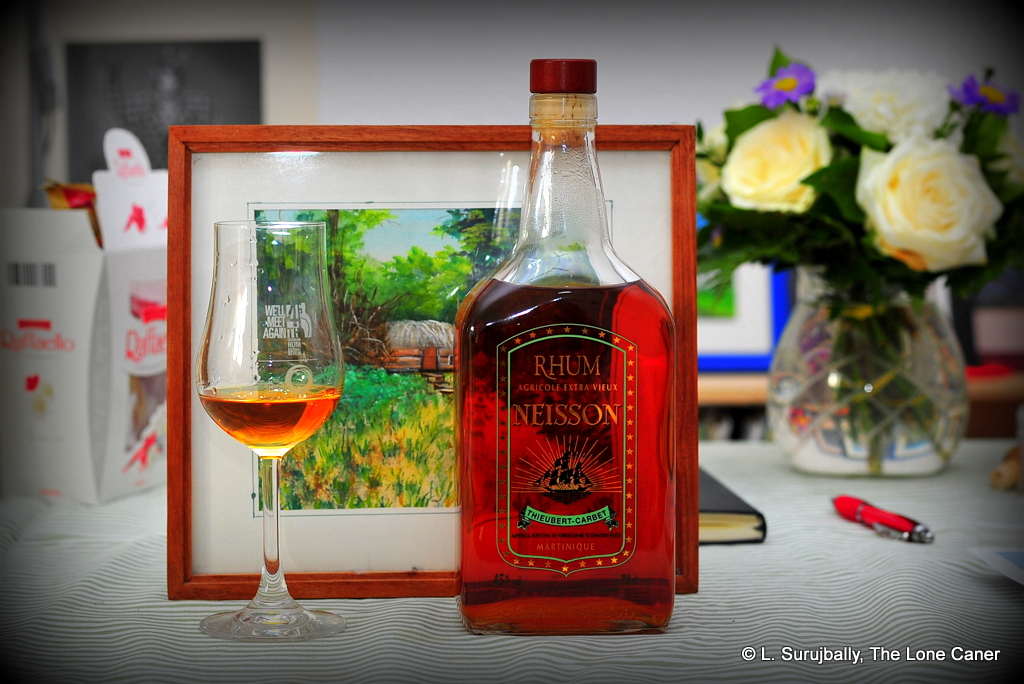
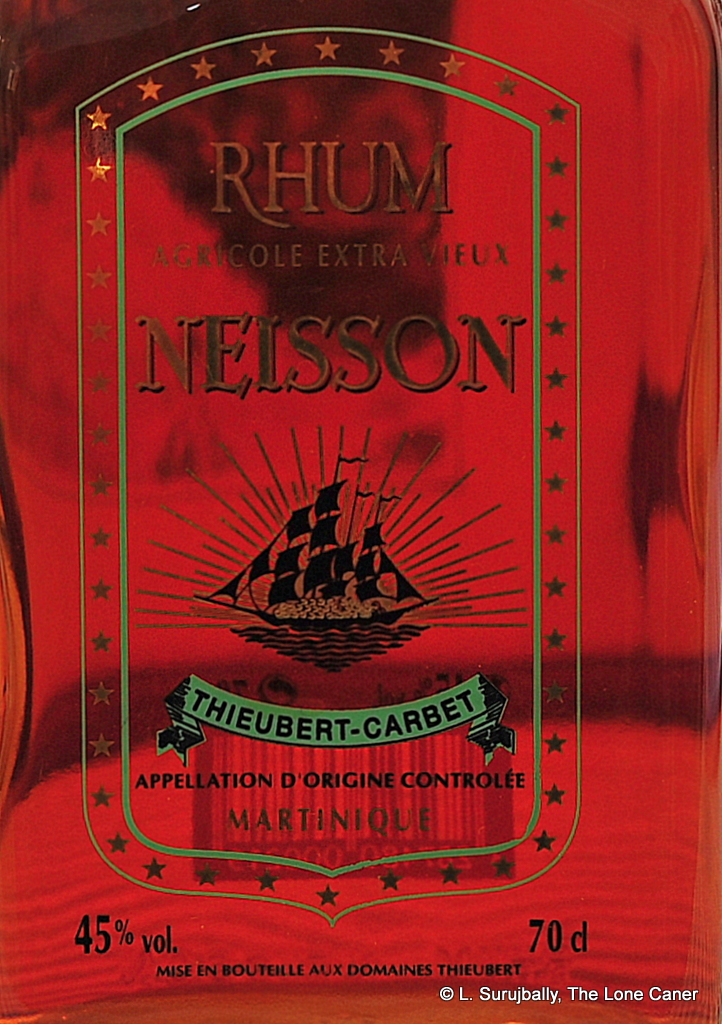
To the extent that agricoles have their own flavour profile, they haven’t surprised me much yet.  My tastes were formed by products from Clemente, Rum Nation, Damoiseau, Depaz, J. Bally, Trois Rivieres and others, and there were always those herbal and grassy notes to them and displayed similar general characteristics. That was until I ran through four Neissons one after the other…and was forced to conclude that agricoles can be just as fascinating and unusual as any other sugar cane drink.  Seriously – Neisson may make some of the most distinctive agricole rhums I’ve ever tried. They’re demonstrably cane juice rums, sure…but then they happily head off into undiscovered country.

The Extra Vieux, which in the absence of better information I’m tentatively saying is 6-10 years old was bottled at 45% and was an amber-brown, which I tried with its siblings from the same company, and then added a Rhum Rhum Liberation and a CDI Guadeloupe 16 YO…just to be sure.

Follow me through the tasting and let me describe what I tried. The divergence from the norm began with the scents it gave off when poured.  Neither overly sweetly scented or too deep in profile, it was had solid fruity credentials, and had some of the muskiness I usually associated with tequila, combining that with the meatiness of salt beef.  So already, some interesting digressions. The rhum’s aromas went away surprisingly swiftly, so re-sniffing was in order, and it was a little less tamed, a little more raw than one would expect.  Once it opened up some more, it also manifested a certain lack of snap and crispness I sometimes associate with younger agricoles, yet one could not entirely fault the result, which was thick and creamy, very well rounded (perhaps I never quite understood the term before now), mixing in coconut shavings, butter and a nice Philadelphia.  Another odd thing was the absence of clearly identifiable grassy notes – others might disagree, but I hardly smelled any vegetals or herbaceous elements at all.

The palate continued in this provocative vein: it was warm, displaying characteristics of fleshy fruit rather than the cleanliness of freshly mown lemon-grass (though some of that crept through, now).  In a way it was quite winey, with tastes of sauternes, vanilla and sour cream mixed in with a fruit salad that had a few too many red grapes and currants.  Yet the smoothness and heft to the mouthfeel, the overall texture, were quite good, once I got past a set of divergent tastes and just went along for the ride without projecting my own expectations or preconceived notions on the thing. The fade was perhaps the most traditional thing about this rhum, being short and lush (not dry at all); sweetish, closing with scents of nuts, red grapes, butter (again)…and, weirdly enough, caramel (what was that doing here?).

D3S_3800

Neisson has existed in Martinique since 1922 when the Neisson family started the plantation (the distillery was started in 1931). Nowadays it is run by the son and daughter of the founder, and they hold almost 9000 acres of cane under cultivation close by Le Carbet in northwestern Martinique (Depaz is up the road, and Dillon a little further south east of it).  Cane is not burnt as it is in Guyana prior to harvesting, and the cane is crushed in a steam engine driven crusher.  Fermentation takes about three days before being distilled in a single column copper Savalle still: the 65-70% distillate is stored for about three months in a stainless steel vat while being regularly stirred to eliminate unwanted volatile elements, before being transferred to 180-200 liter French or American oak barrels for ageing — most for a minimum of four years, but some for only 18 months, the latter to produce what is known as “Elevé sous bois”, or stored in wood, rum.

So all that aside, does the rum work?  Well, yes and no. It’s nowhere near as fierce and individualistic as, say, the Clairins, and that does take some getting used to.  The integration of the taste components is done well, it’s not very sweet, and the mouthfeel isn’t bad at all.  Where it falls down a little, for me, is in that salty tequila-like undertone, and where it succeeds is in the gradual unfolding of character and complexity.

I wasn’t totally enthralled, at first…yet kept getting pulled back to it, largely due to its queer and unique originality, which was like an almost-but-not-quite familiar face one sees in a party. The Neisson Extra Vieux does a right turn and then a twist on the standard conceptions of what an agricole should be, building up to an idiosyncrasy that requires both some adjustment, and some patience.  If you have those and are willing to meet it on its own terms, this AOC rhum is actually quite an experience.

(#255. 84/100)


Feb 072016
 

IMG_6351

Rum Cask makes a slightly better Fijian rum, of the four I’ve tried.

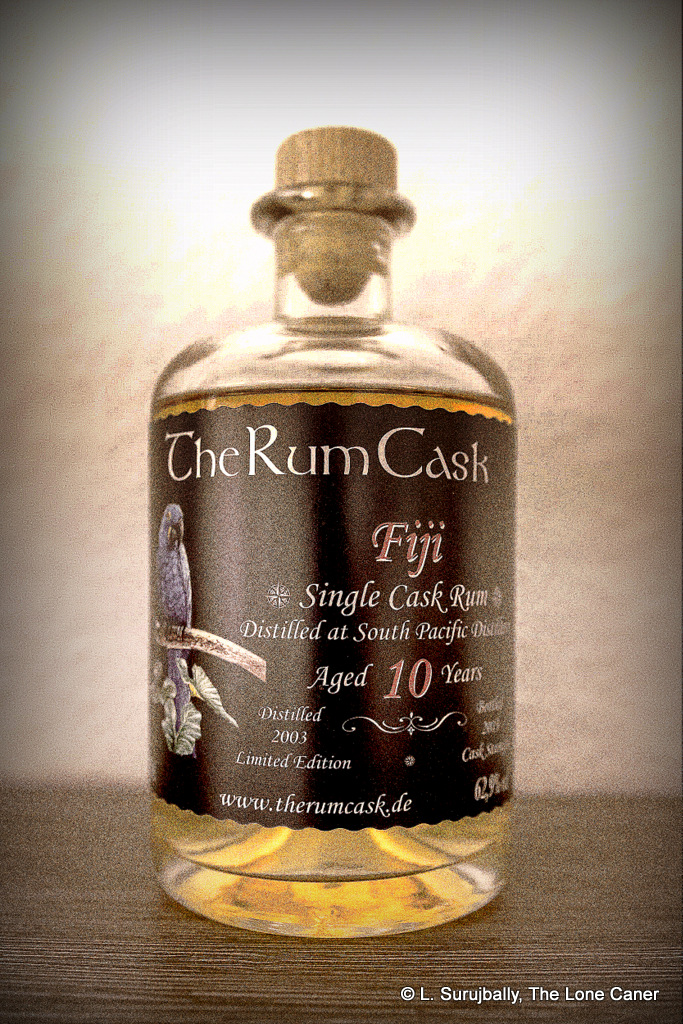
Rum Cask is another one of the smaller independent bottlers – out of western Germany in this instance, very close to the French border –  who do the usual craft bottling thing. They act as both distributors of whisky and rum, and at some point they fell to dabbling in their own marques, issuing cask strength rums from Belize, Guadeloupe, Jamaica, Cuba Grenada, and more, including Fiji, which may be something of an afterthought. In what is probably a coincidence, they issued a ten year old rum from South Pacific Distilleries, and it was also made in 2003, and bottled in 2013, just like Duncan Taylor (or they used the same broker, or something). However similar the provenance, in this instance I felt that while they didn’t succeed in making a rum junkie’s must-have, they did succeed in raising the bar…just a bit.

Take for example the nose, which so disappointed me on the Duncan Taylor from last week. That one was 54.8%…this one dialled things up to a filthy-gorgeous growl of 62.9% and its intensity was right there from the get-go. Much of the same kerosene, fusel oil, wax, and turpentine jammed my sensory apparatus – the rum would cure the clogged nose of a sinus infection with no problems – but here there were also nuts, honey, vanilla, some burnt sugar, and switching back and forth between it and the DT (and the clairins), it suggested an overall better balance.

Unfortunately, it also required some taming. Since I have no particular issues with cask strength rums (how the worm has turned from the days when I despised anything stronger than 40%, right?) the ABV was not a factor: it was its unrefined character. The palate was raw and sharp enough to shave with, and exhibited an unrestrained force that seemed to want to scratch your face off.  So while I spread the tasting over several hours and wrote about sensed tastes of salt beef in vinegar, cereal, brine, olives, some more vanillas and caramel, nuts and honey, plus a whiff of citrus and fresh paint in hot sunlight — and lots of oak — the fact was that the marriage just wasn’t working as well as it might.  Yes the finish was biblically epic, hot and long and lasting, shared more of the flavours of the palate (the citrus and wood really took over here) and made my eyes water and my breath come in gasps – but really, was that what it was all about?  The grandiose finish of a taste experience that might have been better?

In its own way this rum is as distinct from the other Fijians I’ve managed to try as they are from the mainstream, inhabiting a space uniquely its own, though still recognizable as being a branch from the same tree. The enormous strength works to its advantage to some extent, though I don’t think it’s enough to elevate it to the front rank of cask strength rums.  This may be where the concept barrels slumbering in Europe (as espoused by the Compagnie des Indes) has its problems, because the evolutions are subtle and take place over a much longer period of time than the brutally quick maturation of the tropics.  European ageing, when done right, results in something like the Longpond 1941 which survived 58 years in a barrel without the oak eviscerating all other flavours.  Here, the reverse was true and ten years didn’t seem to be nearly enough – the rum shared the downfall of the others I tried, displaying sharp and jagged edges of flavour profiles that seemed to be not so much “married well”, but “raging into divorce.”

The Fijian rums (those I’ve tried, at any rate) seem to have problems with the integration of their various components, and they need more work (and ageing) to be taken seriously by, and to find, a mass audience – this might be one of those rare occasions where less strength is called for, not more. So who is this particular rum for? It doesn’t really work as a sipping rum, and at its price point, would it be bought by a barman so as to make cool tiki drinks? Unless one is a cocktail fan, then, that doesn’t leave much, I’m afraid, unless you are, as one commentator remarked on the DT, a lover of whisky.  In which case, by all means have at it.

(#254. 82/100)


Other notes

This rum is very much about opinion. Cornelius of BarrelProof liked both of these quite a bit (he was the kind source of my samples, big “thank you” to the man), so keep an eye out for his reviews.

Comments on the Duncan Taylor Fijian rum suggested that the profile was quite Jamaican in nature, if not quite as good.  The same applies here. Most Jamaican rum I’ve tried are bit more obviously from molasses, and I didn’t really get that impression from the Fijians. Actually, they remind me more of cachacas and perhaps the clairins.

The outturn is unknown.


Feb 042016
 

IMG_6349

Nope, all apologies to the islanders, but Fiji still doesn’t ascend to the heights of a country whose rums we must have. Yet.

Let’s just dispense with two more Fijian products that crossed my path, provided by my friend Cornelius of Barrelproof, who, it should be noted upfront, liked them both a lot more than I did. We don’t see many products from that country anywhere – “Eastern” rums don’t make it west of the iron curtain very often, so it’s mostly in online emporia that we find find rums from Fiji, Australia, Indonesia or even Japan; these are sold primarily in Europe, not in North America. Bundie, Don Papa and Nine Leaves look to buck that trend but they are small potatoes, really, and you’re still gonna look hard to locate a Tanduay, or even the stuff out of India.

Anyway, independent bottlers Duncan Taylor, the Rum Cask, Compagnie des Indes, Berry Brothers and some others do take the single barrel route, and so perhaps we should be grateful that we do get the chance to try these unusual profiles whenever we can. The rum came from the same distillery as the BBR 8 year old and the Compagnie’s 10 year old: the Fijian South Pacific Distillery now owned by Fosters from Australia, and located in the northwest of the small island.

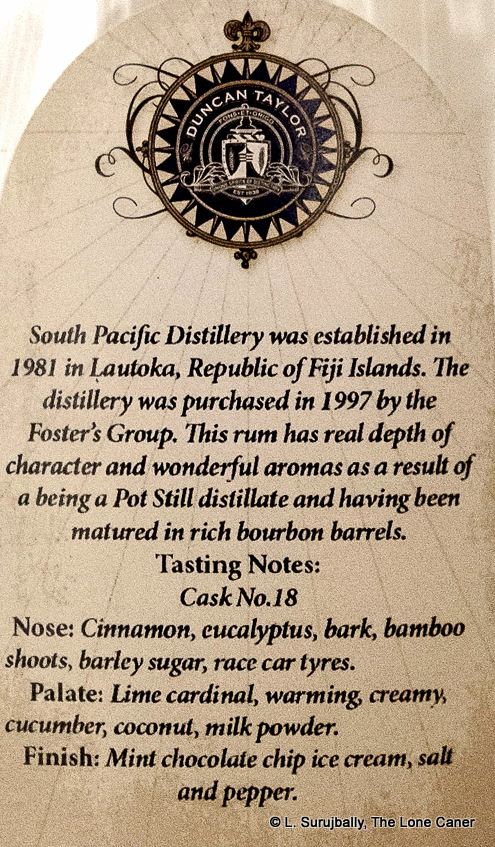
DT Fiji Label

I said “unusual” a moment ago…it was not a word I chose lightly.

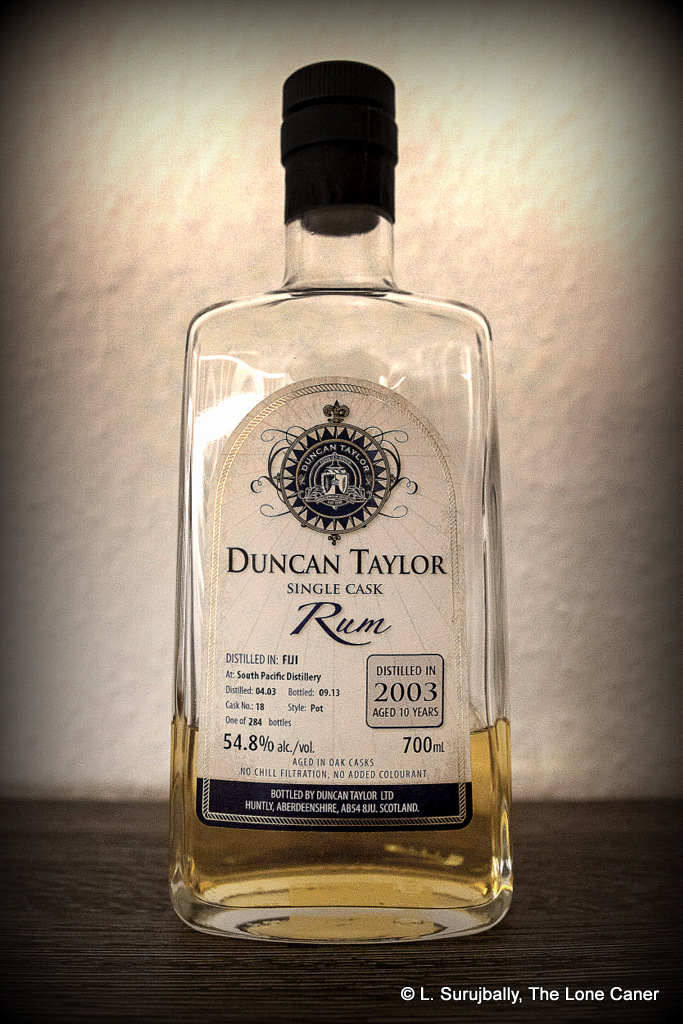
I poured the 54.8% hay-blonde, pot-still spirit into my glass, and flinched as if I had found a roach in my soup (oh waiter…!)  Sharp, snarling smells of kerosene, sealing wax, floor polish emerged fast, like a pissed of genie out of his lamp, ungentle and clashing with each other in a most unbecoming fashion. I went back to the shelf and checked out the Clairin Sajous to see if it was me…nope, that was still better. Ten minutes rest period didn’t help much – turpentine, acetone, wet paint decided to come out now, joined by candle wax, green grape skins…and I was left thinking, if this was pot-still, unfiltered, and issued “as-was” from the barrel, maybe the barrel needed to be changed; and to be honest, if ever I tried a rum that made a strong case for either more ageing or some dosage, this was it.  The smell was simply too raw and unrefined. Most of what it displayed was liquid sandpaper only marginally improved  by some ageing.

To my relief, there was some compensation once I tasted the thing. Better, much better.  Heated and very spicy, medium bodied in texture, and all this was a welcome change from the initial attack.  It tasted of red olives in brine, with a sort of meaty background, like a plastic tub of salt beef just starting to go.  Then at last more familiar notes asserted themselves and stopped mucking about, and I sensed some green grapes just starting to go, vanilla and smoke (not much), a very herbal, grassy element, more brine, sweet soya, some citrus, ginger and a good Thai veggie soup.  Cornelius felt it displayed something the funky charm of the Jamaican style, so if you ever get around to trying it yourself, there would be something to watch out for. The finish, unsurprisingly for such strength, was long enough, and I couldn’t say it was either good or bad – it existed, it lasted, I got notes of lemongrass, vanilla, citrus and soya and brine again, but very little of a more comforting back end. Colour me unimpressed, sorry.

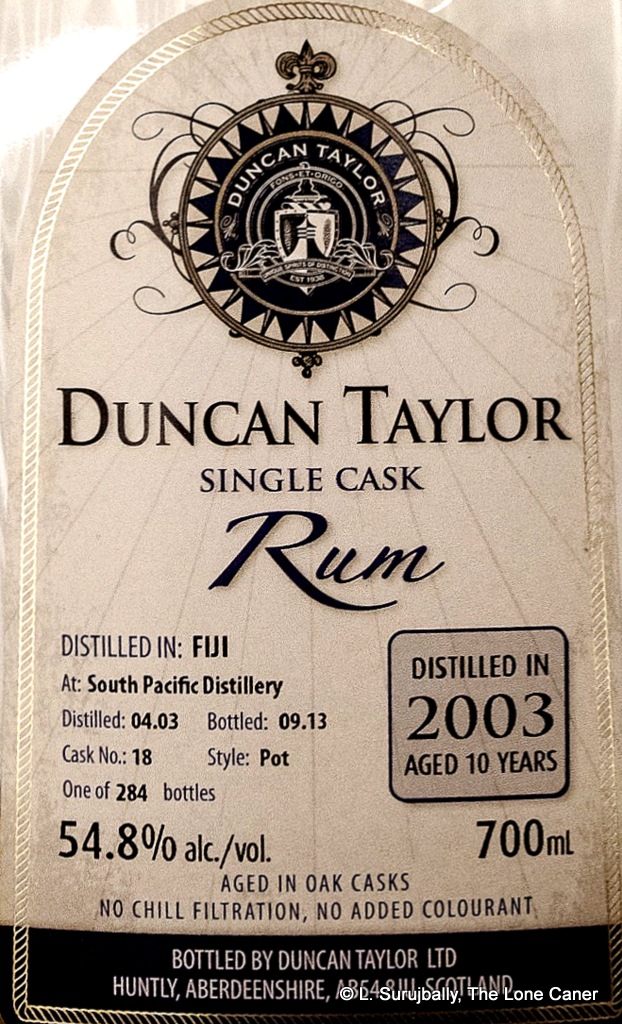
Although the aromas and tastes suggest a cane juice base distillate, the Ministry of Rum and Fiji Rum Co. pages both say molasses.  Which makes the profile I describe even odder, because it was so much like the clairins, but lacking their fierce commingling of the same tastes into a synthesis that worked.  The nose was too jagged and too raw, the palate worked (up to a point) and the finish was nothing to write home about. In my opinion, this rum should have been left to sleep some more. The outturn was 284 bottles from a single cask, and it was aged in an oak cask for ten years, yet honestly, you might think it was no more than a three year old (or even younger) from the way it fended off any efforts to come to grips with it.

IMG_6350

I’ve now tried four or five Fijian rums, and admittedly, that’s hardly a huge sample set; still they do all exhibit a kind of right turn from reality that takes some getting used to, for those of us more accustomed to Caribbean traditionals or agricoles (which is most of us).  They may be proof positive that terroire is no mere subtly abstract concept which is insouciantly bandied about but lacking real meaning, and I believe that rums from other parts of the world do indeed provide their own unique tastes and smells and sensations.  The flip side of that, is that I have yet to acquire a real taste for some of them.  I’m not going to write Fijians off like yesterday’s fish…but thus far I haven’t met any (out of the few I’ve tried) that blow my socks off either. Certainly this rum doesn’t.

(#253. 81/100)


Other notes

  • Aged April 2003 to September 2013, location unknown
  • Yes, if I see more Fijians, I’ll buy.  Still really curious about them.
  • Marco Freyr has put together a short bio of the company (in German)
  • The tasting notes above are my own.  I didn’t see the back label until Cornelius kindly sent me some pictures of the bottle. 
Jan 252016
 

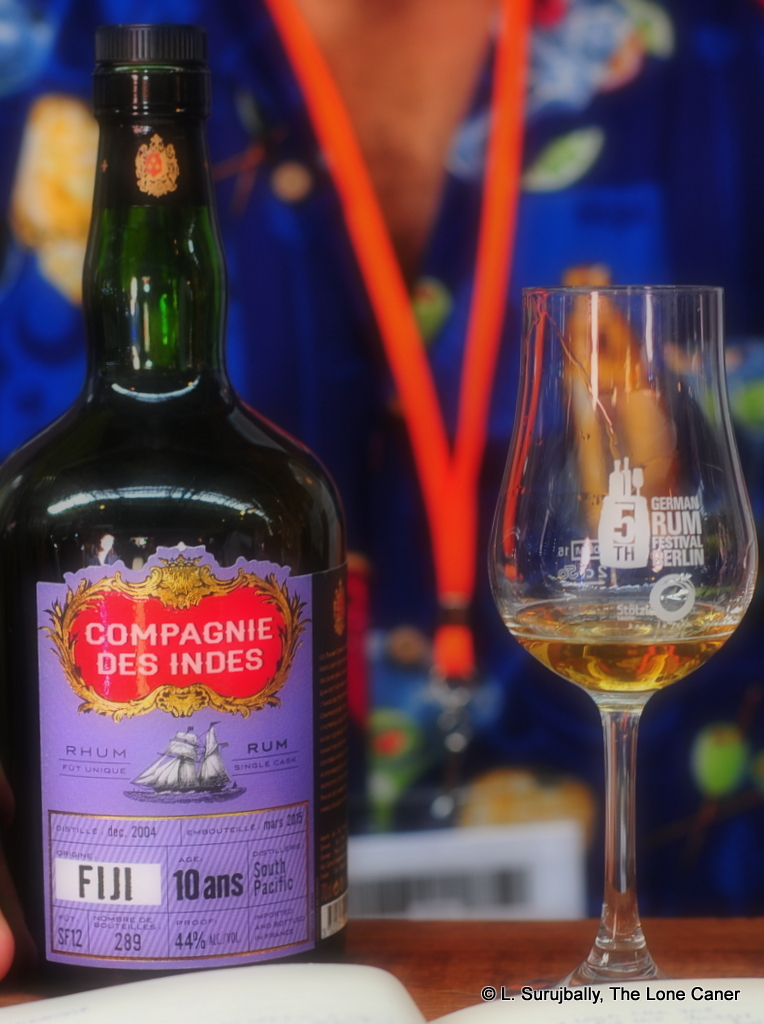
C de I Fiji 1

A well assembled rum made by someone who knows his business, yet, as with the BBR I tried some years ago, not entirely to my taste.

Florent Beuchet, the man behind the independent bottler Compagnie des Indes, really likes to go off the beaten track in his search for proper casks of rum to release: either that or he has access to some broker or other with some cool geographically dispersed stocks.  Think about the rums he has in his young portfolio so far – from Guyana, Cuba, Guadeloupe, Martinique, Panama, Jamaica, Trinidad, Belize and Barbados, all the old stalwarts.  But show me another maker who in a single two year period can also claim to have added St. Lucia, Haiti, Fiji and Indonesia to the mix. St. Lucia alone should draw nods of approval.  But Haiti? Fiji? Indonesia?  

Therefore, yes, I’m a little impressed, more than a bit intrigued, and follow his issues closely, though thus far I don’t have that many…yet.  I was fortunate enough to try several samples of the Fijian 10 year old bottled at 44% in my ongoing effort to draw attention to obscure corners of the world where rums are made (but receive too little attention), and where unsung treasures may be found to the aspiring, perspiring rum collector.

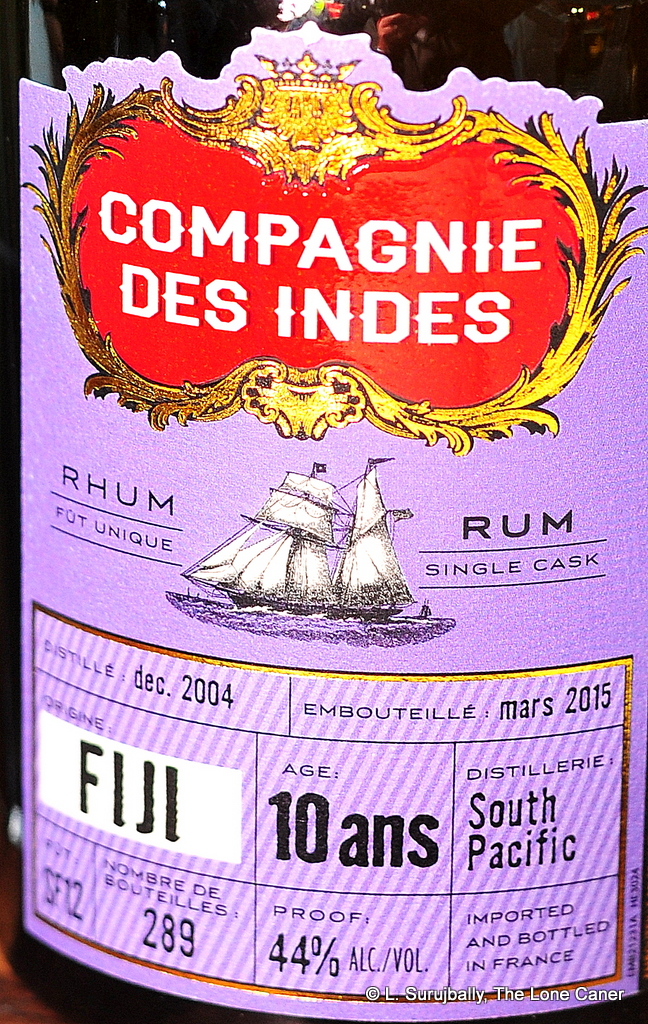
So, this one: it was one of two 2015 Fijian releases CdeI made (each from a separate barrel), and it’s from the South Pacific Distilleries distillery – Florent didn’t tell me, but come on, it’s right there on the label…and anyway, even if it wasn’t, how many other distilling ops are there on the small island? This in turn is controlled by the Carlton Brewery (Fiji) Ltd, and that itself has the parent company of the Australian group Foster’s.  They make the popular Bounty rums (not the same as St. Lucia’s) and so far as I can tell, only BBR, Duncan Taylor and Cadenhead have released any bottlings from there. And full disclosure, I didn’t care much for the BBR Fiji 8 year old.

Still, things started out okay: the yellow rum was spicy and dry to sniff, with sugar water and delicate floral scents.  Watery is a good term for the sort of smells it exhibited – and by that I mean watermelon, juicy white pears, diluted syrup from a can of mixed fruit, grass after a rain.  This was all to the good.  What happened after a while was that waxy notes crept in, black/red olives in too-sour brine, and that C de I Fiji 2palled my enjoyment somewhat.
The taste of this light bodied, column-still-made rum was the best thing about it. Hot, freshly brewed green tea, no sugar, was my initial thought.  Brine again, more white flowers, guavas, sugar cane sap oozing out after you chop a stalk down.  Overall the lightness was somewhat illusory, because the rum displayed a good warmth and firm delicacy (if that isn’t a contradiction in terms), and demonstrated why there remains no “perfect” rum strength – a higher proof would have shredded this Fijian, while 44% was exactly right. In fact, it showed off a lot of characteristics of an agricole, more than a rum coming from molasses (it was confirmed that it did indeed derive from molasses, not cane juice).  The finish was short, smooth, heated and elegant, but nothing really extra was added to the party over and beyond what I noted above…perhaps some faint vanilla, gherkins in weak vinegar, swank, not much else.

I thought it was a decent rum, made by a company which knew what they was doing when they selected it, and you could sense the assembly was done well – the mouthfeel, for example, was excellent.  Where it fell down for me was in the snarly disagreement between the individual sweet versus sour/salt components – they didn’t mesh well, and the wax and turpentine notes kept interrupting like annoyingly plastered gate-crashers at your daughter’s wedding. This is quite a bit better than the BBR 8 Year old I reviewed back in 2013, which had similar issues, just more of them, and there I attributed it less to terroire and more to  insufficient ageing. 

Now, I’m not so sure – the clear and somewhat jagged profile may be characteristic of the area, and if so, we who love rums should try a few more before rushing to condemn and criticize – it’s not like there’s a historically huge sample set out there to compare with.  Suffice to say, for the moment, this isn’t quite my cup of tea. It’s a technically well made rum whose individual components, delicious on their own, aren’t quite cohering the way they should to make the experience a sublime one. Or even a better one.

(#252 / 84/100)


Other notes

  • Florent advised me the barrel was bought through a broker, and no sugar was added.


Jan 212016
 
Photo courtesy of velier.it

Photo courtesy of velier.it

Slow, not entirely promising beginning, with a strong development and finish.

In between its major releases from Trinidad, Guyana and Damoiseau where it made its bones, Velier occasionally took time off to travel the more traditional route of the indie bottler, and issue one-offs like this one (and the 1997).  I consider it a curious addition to the oevre, and not entirely a rum so good that it rates admittance to the pantheon, though nevertheless deserving of praise.

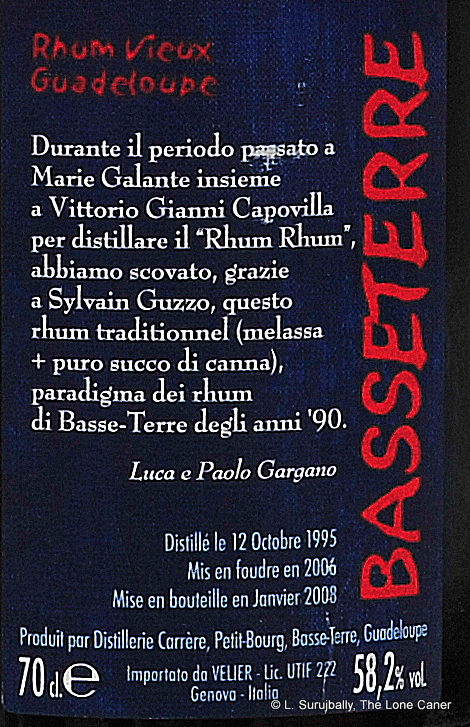
I call it “curious”: it was distilled in October 1995 and bottled in January 2008…but in between those dates, it was, like Velier’s own Damoiseau 1980, stored in dead vats to cease the ageing, from 2006 on.  So it’s up to us to decide whether the resting vat had any residual influence which would make it 12½ years old…or whether it didn’t and it’s just around ten.

(That’s something that seems to be coming up more often in relation to older agricoles I’ve tried – a millesime (the year of distillation) is trumpeted to the heavens, but in some cases the makers aren’t nearly as forthcoming about the date of bottling, and one has to have the sleuthing nose of a Poirot to ferret out these little nuggets.  Fortunately, Velier has always been pretty good about providing the info we need on its labels, and now you know what I do, so let’s move on.)

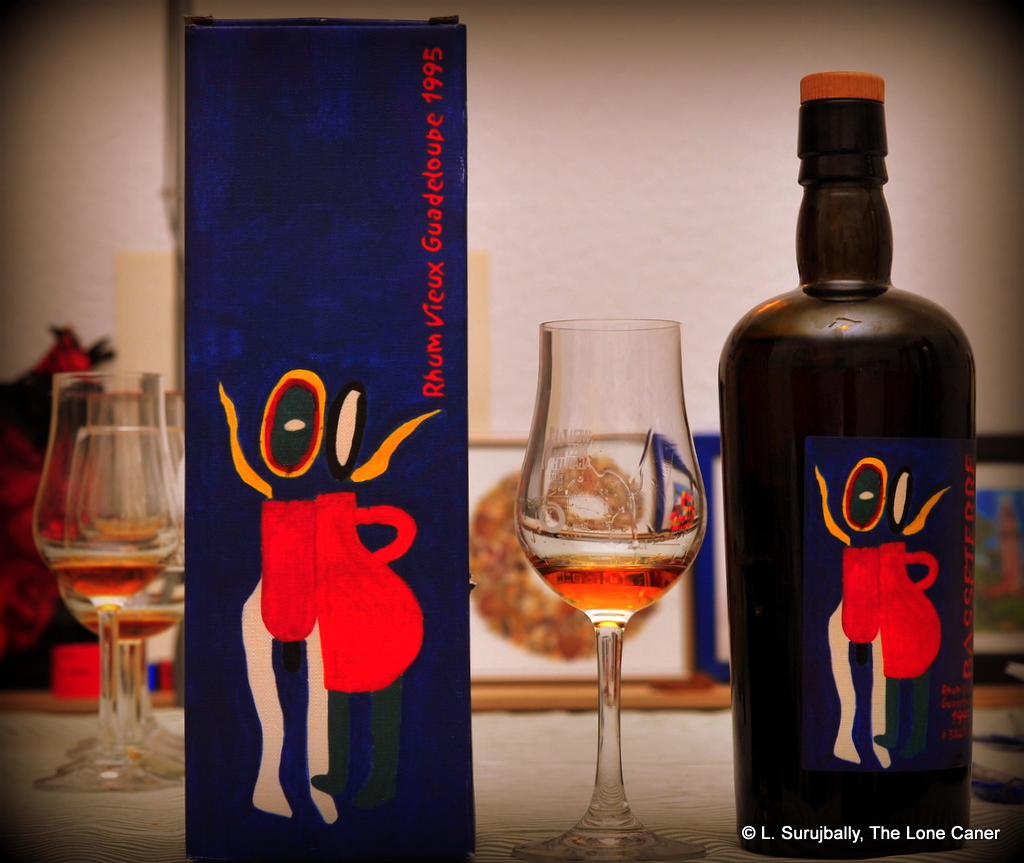
Presentation was the usual bottle, enclosed in a dour blue box with bright abstract art on it. What I liked about it was that it didn’t just say “Guadeloupe,” as most independents would do on their labels, but “Basseterre”, and further along, a notation of Distillerie Carrère in Petit-Bourge – that allowed me to delve more deeply into the history, which is further down for those who are interested in the provenance and background.

Right, tasting notes. The opening aromas were crisp and sharp, even a little uncouth, a little undisciplined – lovers of smooth and easygoing fare are likely to be disappointed here. Both salty with red olives, and sweet at the same time, yet also lightly perfumed with the scent of delicate florals (not much), mixed in with a nice white wine…a good Riesling, perhaps. As the minutes wore on it developed into a light and clear smell, the sharpness wore off and gave over to tree sap, green leaves, wet grass, some vanilla and faint smoke.  It was all pleasantly tied off into a bow with additional cherries and hard yellow mangoes.

D3S_3751

The Basseterre was an amber coloured rum, medium bodied, and bottled at 58.2%, and it hesitated not at all before skewering the tongue.  I was a little surprised at its unrestrained aggressiveness, to be honest (I was tasting it in conjunction with the Velier Damoiseau 1980, Chantal Comte 1977 and two Neissons, all of which were slightly smoother), and while I immediately tasted honey, walnuts and almonds, I put it away for a while to let it open up some more. This was the right approach, because it gentled out more after five minutes, and the shy flavours of flowers, tree sap and aromatic tobacco emerged, behind which coiled sharper notes of tannins, fresh-sliced unripe peaches, citrus and ginger.  In fact, the pendulum swung just a shade too much in the other direction as time wore on, and canned fruit syrup, yoghurt and whipped cream (I kid you not) started to take away from the initial freshness I liked.

The fade was long and spicy and complemented the palate very well.  Not much new going on except for some cereal and milk, more honey and nuts (cheerios?), and that lovely aromatic pipe tobacco finished things off with perhaps some ginger and citrus hanging in there.  

Looking back and considering the experience dispassionately, I must concede that this might actually be one of the few Veliers that didn’t ascend to the peaks of their other (more popular, better known and higher-scored) rums…y’know, like the UF30E. It feels younger than ten years old, somehow. Still, the Basseterre got better as it glared around and opened up: it is a solid, strong, agricole, which started off a little poorly but came up to the finish line with good credentials.  Luca still hasn’t replied to me with what the outturn was, and I paid €190 for mine – for the quality I got, I’d suggest it’s a borderline purchase. If you’re not into agricoles, it’s unlikely this one will turn you into an aficionado…however, if you are, it surely won’t disappoint.

(#251 / 87/100)


History

Guadeloupe is comprised of three main areas: the butterfly shaped conjoined landmasses of Grand Terre and Basseterre making up Guadeloupe proper, with the small island of Marie Galante to the south east. Petit Bourge is on the eastern side of Basseterre, and serves the Montebello distillery — when it was founded by the Dolomite family in 1930 it was called Carrere (named after an even smaller village nearby) but in 1968, after many years of declining revenues it was sold to a Jean Marsolle (whose brother owned the Séverin distillery a little to the north west). He in turn sold it to his sons Alain and Emamanuel in 1974 – they renamed it Montebello in 1975. It remains in the family to this day, and produces 500,000 liters of rum annually. They have the curious practice of not only casking their rums in oak, but then dunking the filled barrels into heated steel containers to accelerate the maturation.  Whether that works to enhance the resultant rhum I can’t say, since I never bought or managed to try any.


Other notes

This is not an AOC certified rhum.

Basseterre 1


Dec 022015
 

Chnatal 1980 2

This rhum is a quietly dazzling masterpiece.

The Chantal Comte 1980 purrs away in the glass, containing so many quietly thrumming riches, revealed in so gradual a fashion, that it embarrasses ordinary rums.  And yet, its characteristics aren’t gaudily thrown before us to entertain or impress.  There are no marketing tricks here, no fancy “finished in…” or “made this unusual way…”. No dosing, adding or off-the-wall ageing. It is only after I tried it for the fourth time that I truly appreciated the full reach of its accomplishment, and realized how well and how subtly it had been made. And all this from a seven year old rum.

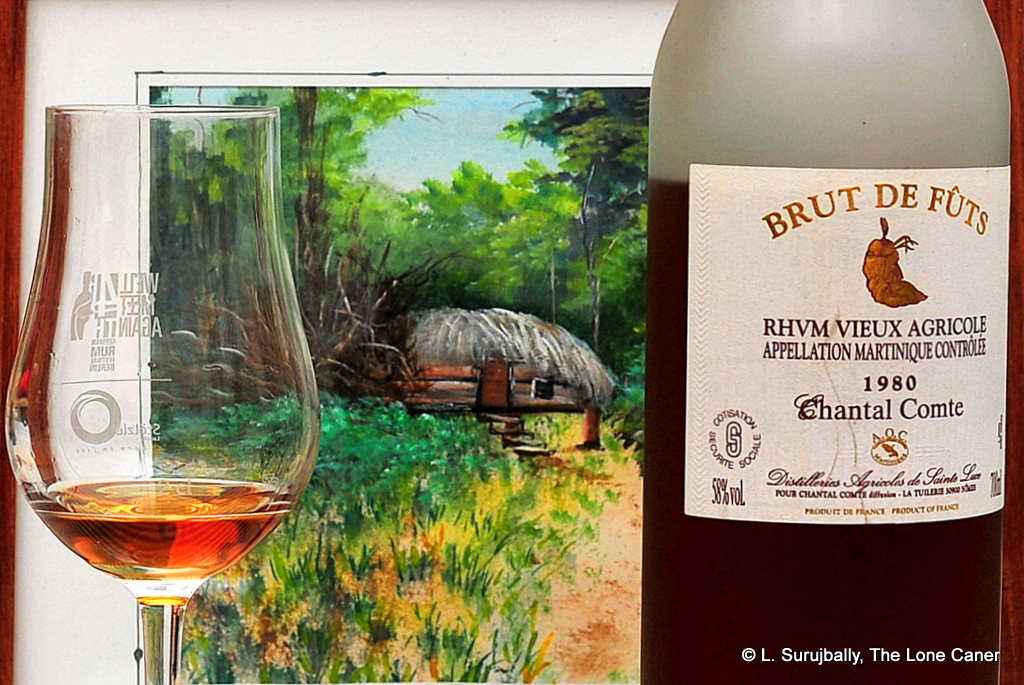
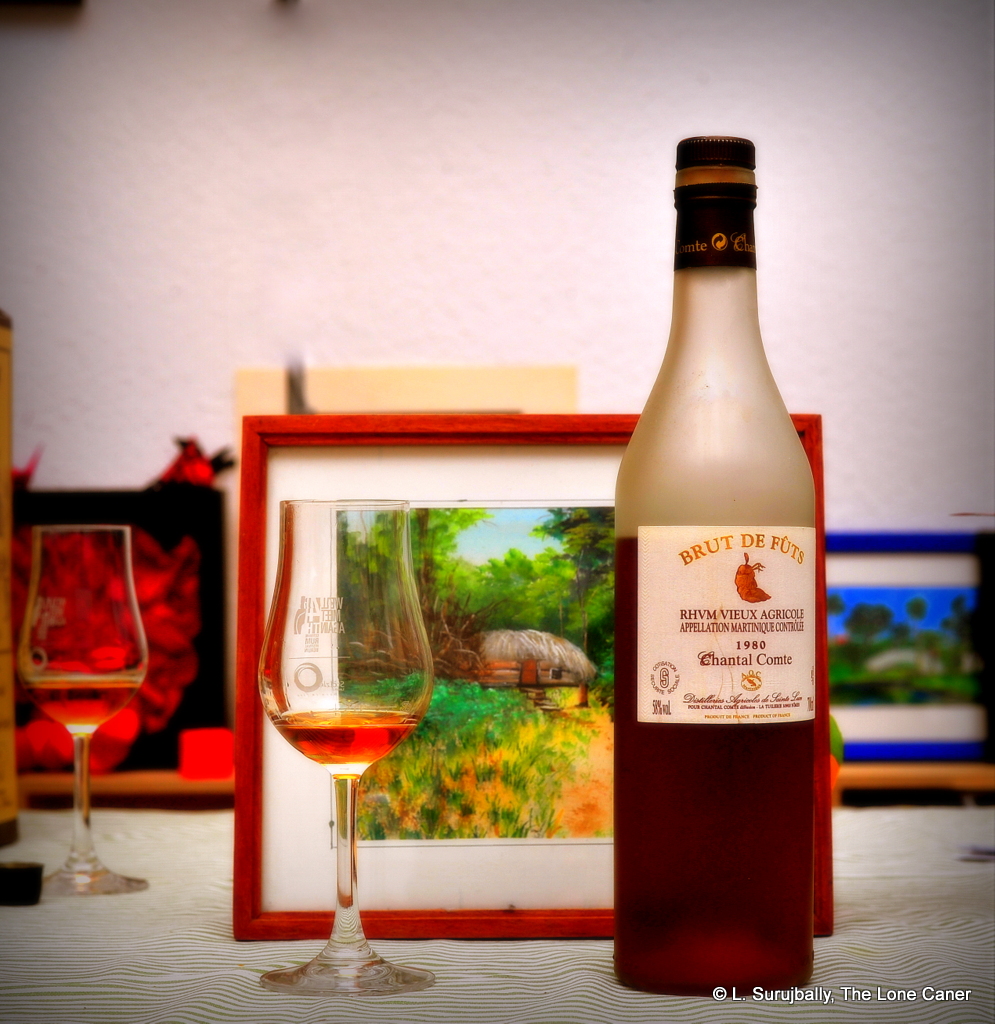
The Chantal Comte Rhum Vieux Agricole Appellation Martinique Controllee 1980 (to give it its full title) hails from St. Luce, which is to say Trois Rivieres. Chantal Comte, a lady who owns the Tullieres estate in France, and who also has a long association with the French West Indies, has an appreciation for rhum which many years ago prompted her to begin issuing aged agricoles under her own label. The Hors D’Age from Habitation Ste. Etienne was a wonderful rhum for example, and the 20 Year old St. Luce 1977 Millesime was also pretty good — yet here she does it one better, and perhaps this is one reason why the price of the seven year old 1980 is more than twice that of the 1977 even though less than half as old (that and the fact that 15,000 bottles of the 1977 were issued, versus 1400 of the 1980).

The presentation was somewhat lackluster for a rhum of this price: a black cardboard cylinder enclosing a very handsome frosted glass bottle.  Never mind,  I’ve made my sniffy observations on this kind of thing before. The label, relatively simple, filled in some of the details noted above.  The age was not stated and it took some sleuthing around to have it confirmed that it’s a seven year old…no idea why that was omitted – were they waiting for a reviewer to talk about it, perhaps afraid people would be put off by its single-digit age? 

Chantal 1980 1

Anyway, forget the preamble and walk with me through the sampling.  It was a dark amber rhum, issued at a solid 58%, and the nose…well, all I can say it was great. It was a beautifully rich yet simultaneously subtle, and complex to a fault.  An initially warm and delicious melange of fruits, flowers and the faintest background of turpentine and well polished floors. This developed into lavender, toned-down lilies, unripe cherries, everything soft and yet edgy at the same time (that was the 58% speaking – it intensified everything without actually moving the rhum into harsh bitchiness).  But this wasn’t the end. We were in the middle of a six hour tasting session and as the hours wore on we kept coming back to this one glass, and by the time it was over, to those flavours we smelled, were added some faint caramel and molasses, vanilla, cinnamon, very faint ginger and baking spices.  And all these in a really harmonious balance.

Since it was a relatively strong rhum, I expected some sharpness at the inception of the taste, and indeed this was there. But that dialled itself down to a strong kind of heat that made the experience a much better one after some minutes. It was quite full bodied and intense, and the immediate sensations were of butter cookies with a strawberry jam centre (for the benefit of my friends Henrik and Gregers who were there with me, I’ll say they were Danish); cinnamon again, black cherries teetering on the brink of over-ripeness, plus an assortment of light peaches, apricots, bananas and dark honey.  And all this intertwined with the sweetness kept way back, a dusting of leather and smoke, aromatic port infused cigarillos, some drier woody notes, and even some brine…but I must emphasize how extraordinarily well this all came together, without any one aspect dominating any other – it was as well balanced and solid as the keystone in a Roman arch.

As for the finish, well, what can I tell you?  It was great, summing up everything that came before: long and a little dry, spicy and wholesome, with both the sweet and the salt of a top-end Japanese soya, finishing things off with some oaky notes, almonds, vanilla, and port.

The construction and gradual unfolding of this thing is amazing. I started by liking it, an hour later I was impressed, and by the time the evening was over I was in love.  It took time for the full effect to sink in.  It lacks the rough hewn brutality and single-minded intensity of the Veliers, and is perhaps more akin to Rum Nation…just better (perhaps because “dosing” is not part of the assembly).  The 1980 may be classed as an AOC agricole, but I honestly think this has aspects of both French and Spanish style rums (with maybe a flirt of Bajan thrown in for good measure). It’s an order of magnitude better than many products twice or three times as old, and thinking I was being too enthusiastic, I tried it four separate times over a week and yep, it was still as good as that first time. It is the best sub-ten year old rum I’ve ever tried.

I truly enjoy rums that are well made and appealing, no matter who makes them, and find that certain companies are consistently top grade. That they are almost all independent bottlers not seeking to dominate their market (though Velier comes close) may be key to the quality of their rums, because they are niche players, not commercial mastodons like Diageo or Bacardi, and therefore they pay careful attention to what they slap their labels on. Their stuff isn’t made by committee, so to speak; perhaps to them money and market share is less important than making rums, not mere products.

Yet, even within the small independent world of Veliers, Compagnie des Indies, Duncan Taylors, Rum Nations, Moon Imports and Samarolis, there are occasional bright shining stars that amaze and awe us with the sheer brilliance of their creations.  While it’s obviously an unknown if all of Mme Comte’s rhums operate at the level of the three I have tried so far…I can hope.  This rhum is one of the absolute best I’ve had all year, and it earns that accolade not because of stratospheric price or fancy bottle or rarity…but because it really is that extraordinarily good.

(#243. 92/100)


Other notes

  • Chantal Comte’s website makes no mention of this rum at all. I contacted the company directly and they told me it was a seven year old, aged in oak (but not what kind).
  • I highly recommend, if you ever try this rhum, to take your time with it.  The scents and tastes simply grow richer over time. 
  • The closest rhum to this profile I recall is the Courcelles 1972 which exhibited many of the same characteristics, but was many years older.

Opinion

I read somewhere recently that “French Island style” (agricole) rhums represent less than 10% of market share for rums as a whole. The wonderment is, perhaps, that agricoles continue to exist at all, given the preponderance of molasses based rums in the world.  I think they remain an unappreciated resource, rums that live in their own space and time, in places we must be willing to visit, to touch, to sample, to experience.  An inability to even concede they are worth trying is a profoundly depressing inadequacy, something like saying black and white, silent or subtitled films have no place in the world overrun by remakes, sequels and superhero retreads. Those who casually deny themselves such rhums are also denying themselves the building blocks of the drinking imagination.


Nov 052015
 

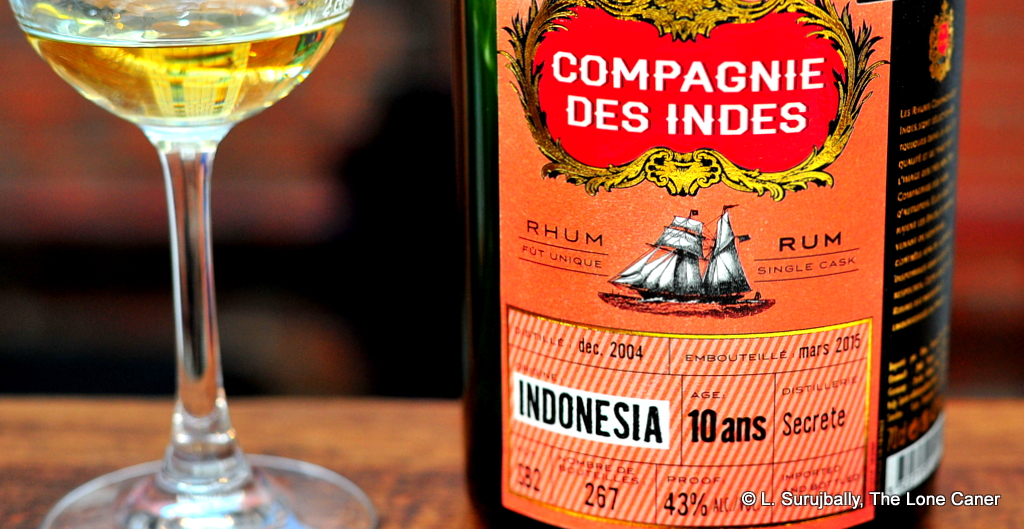
C de I Indonesia 1

In Berlin in 2015, I tasted thirty or so rums at the RumFest. But I only bought one. This one.

Why did I get this rum?

Well, occasionally I get bored with rums that seem to go noplace special, don’t venture beyond their own self prescribed limits. I like originality, the whiff of something new. And so I go far afield and back in time, sniffing out old rums — a 30+ year old Demerara, maybe), different ones (clairins anyone?) and those from varied locations like, oh, Madagascar. I’m still looking for Swaziland; was enthralled to know that Ocean’s picked up some rum from Africa for their Indian edition, had to go after Fiji rums when I found them. Indonesia was definitely a cut above the ordinary.  So there was that.

Also, when I first reviewed Compagnie des Indes’s Cuban fifteen year old rum a few months ago, I remarked that if they continued making rums like that one, they would be one of the craft makers whose entire line I wanted to try. When Florent Beuchet (the founder of Compagnie des Indes) showed me the green bottle, both my interests intersected and came into play at once – my desire to try a rum made in a country from where I had not seen anything before, and my wanting to try more of the Compagnie’s work.

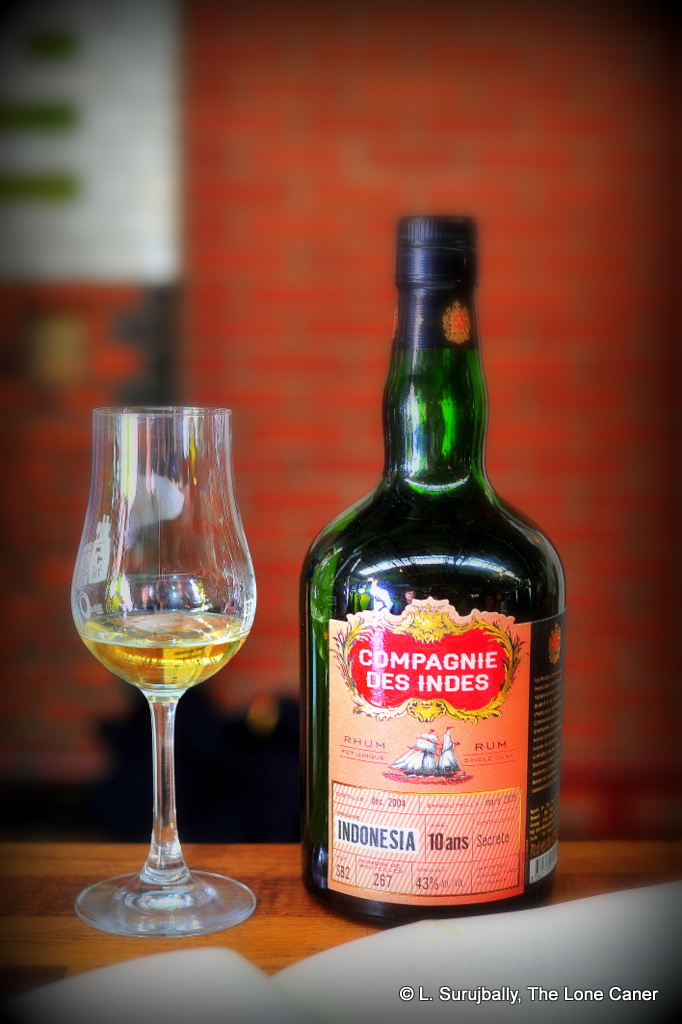
Some background: sugar cane has long been known to originate in the far east, and the first alcohols made with it supposedly derive from Indonesia itself, so this was what Florent was saying when he told me that it was a variation of rum’s grandfather, Batavia arrack. The fermentation began with yeast of white rice (strange, but I’ve heard weirder things). Five casks produced this 267 bottle outturn and it came from an unnamed, undisclosed distillery – I tried to get Florent drunk enough so he would tell me but no dice. It was aged for three years in Indonesia, and another seven in Europe. Arrack, like clairin, is not usually aged. Florent told me it was a sugar cane distillate from a column still, and untampered-with.

Smelling it was like wallowing in a spring meadow. A great balance of softness and sharpness started things off; delicate flowery notes were immediately evident, with vegetal and citrus scents coming right behind. It didn’t have the dusky heaviness of fleshy fruits, just lighter ones…an Indian mango, half ripe, lebanese grapes (love those). It even evinced some gentle brininess, green olives at the back end. but the overall impression was one of delicacy and a sort of easy-going unaggressive character (maybe it was Canadian).

I liked the taste and mouthfeel a lot (which is why I had three samples of this thing as I badgered poor Florent about his company while trying three others at the same time). Conditioned as I was to somewhat more elemental Demerara and Jamaican rums, I found the graceful texture of well-tempered 43% with its firm and sprightly backbone quite intriguing. So, it was light, sweetish, delicate. The tastes of dill and green tea, and sugar cane juice fresh-pressed came out. It was a little herbal and grassy too (and there was a nice counterpoint of lemongrass winding through the whole thing) but these tastes didn’t overwhelm, just stayed well within the overall construction without trying to elbow anything else out of the way. The fade was a bit short, and quite aromatic, with some unripe peaches and new-mown lemongrass tidying things up.

D3S_3620

The Compagnie des Indies Indonesia 10 year old is no macho body builder of a drink, redolent of anise, power, sweat and dunder – it’s too tidy and well-behaved for that, and not strong enough. Still, if your tastes go in the direction this rum takes, it’s kinda brilliant in its own way. It’s a lovely, tasty, dancer of a rum – not the lead ballerina by any stretch…perhaps somebody in the second row who catches your eye and smiles at you. A rum which I think, after a few sips, you’ll remember with fondness for the rest of your life, and maybe hope that other makers make more of.

(#239 / 86/100)


Other notes

  • Presentation is standardized across the line.  Green bottle, old fashioned label, plastic tipped cork.  Not much to find fault with here.
  • 267-bottle outtturn. Distilled December 2004, bottled March 2015.  This makes it the second batch, since there are pictures online with an issue date of 2014
Oct 192015
 

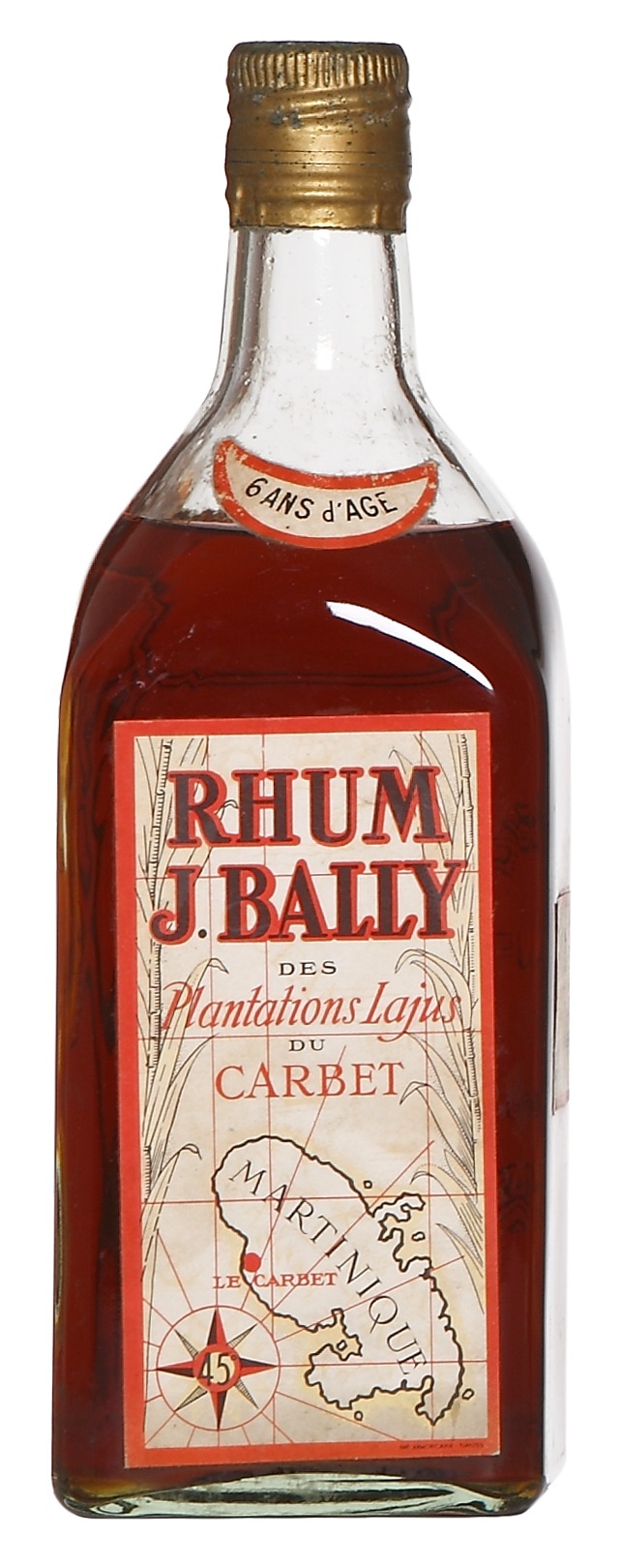
Bally - 6 ans 1Rumanicas Review 009 | 0409

Oh, tough one to research.  Loads of 1929 and 1930s photos out there, rien on this one. Not a millesime, because J. Bally helpfully places the year on that little smiley label at the top for those.  But with that fading old-style label, maybe pre-1980s?  Earlier? Not sure.  Still, J. Bally’s original domicile on Plantation Lajus du Carbet was closed back in 1989 (current rhums are made at a consolidated site at Plantation Simon using the original recipe), so at least we have something suitably aged here.  Whatever.  It was a neat little piece of history to be trying.  Note the cheap tinfoil cap, which perhaps says something about the makers’ esteem for their own product, back in the day…makes a man happy for modern plastic. I spoke to the company history a little here.

Colour – Dark Amber/Mahogany

Strength – 45%

Nose – Heated, not sharp. Very fruity, dark stuff, at the edge of over-ripeness.  Rich and fragrant and oh-so nice. Ripe peaches and plums; apricots just starting to go like an ageing strumpet past her prime; coconut shavings and a squirt of lime juice over the lot.  Also a faint background of musky brininess and sugar, like tequila.

Palate – Nice! Medium to full bodied, firm, warm and silky to taste. Dusty old books, dark sweet chocolate (RitterSport “rum, raisins and hazelnuts,” maybe that was it). More plums, plus some squashy blueberries, plus the taste of cumin and coriander and the same salt-sweet mustiness from the nose.  All in all, very tasty, and had sufficiently heated silky mouthfeel to make it an pretty good rhum, even for only six years ageing.

Finish – warm and lasting. Great black cake and tequila closing notes.  Somehow they didn’t interfere with each other (not always the case).

Thoughts – Wish I knew when it was made.  Actually, I wish I had the whole damned bottle.

(84/100)


Sep 142015
 
Photo Courtesy of Josh Miller @ Inu A Kena

Photo Courtesy of Josh Miller @ Inu A Kena

An unaggressive, bright and clear, sipping-quality rhum agricole that can serve as a bridge between traditional molasses rum and agricoles.

Clément holds the dubious distinction of providing one of the first agricoles I ever tried.  That was five years (and some change) ago. At the time when I tried that Tres Vieux XO, just about the top of their range, I remember the clarity and smooth brightness of it, and how it flirted with a molasses profile without ever stepping over the  line.  That rhum was a blend of three exceptional years’ production…the Hors D’Age I was trying this time around was supposedly a blend of the best vintages of the past fifteen years.  On the basis of such remarks are high prices charged.  Note the “hors d’age” statement – what that means in principle, is that the rhum is aged between three and six years, which strikes me as absurd for a bottle costing in the €90+ range.  Still, it is an AOC rhum, Clément is enthusiastic abut the care with which they assembled it, and all in all, it’s a pretty decent dram.

Clément has a long history, dating back to 1887 and the purchase of domaine de l’Acajou by Homère Clément. Initially it just produced sugar and raw alcohol, but the demand for liquor durting the first world war persuaded him to upgrade to a distillery in 1917. After the death of Homère, his son Charles took over the business. Credited with developing (some say perfecting) the company’s rhum agricole methodology, he studied distillation at the Louis Pasteur School in France, and named the first bottlings after his father.  He subsequently expanded the company by instigating mass exports to France, which became the company’s primary market outside the Caribbean.  When he died in 1973, his sons took over, but thirteen years later they sold the Acajou distillery to another Martinique business owned by family friends (Groupe Bernard Hayot, one of the largest family businesses in France), who have kept the brand, heritage and plantation intact and functioning and modernized. The company gained the AOC designation in 1996.

Agricoles, of course, even the aged ones, trend towards a certain clarity and lightness to them…one might even say sprightly. The nose on the Homère Cuvée broke no new ground, while still being quite delicious to sniff. It presented a tasty mix of the tartness of freshly pressed apple juice (almost cider-like), and softer tastes of under-ripe apricots, freshly sliced.  Some vague grassy hints wafted around, very much in the background, and after a few minutes traces of nuts and yellow mangoes and a little leather and waxy stuff rounded things out.  It was quite soft and smooth, with very little sting or bite to it.

The golden rum was equally gentle to taste, providing very little aggressiveness even at 44% (unless it was just me and my palate being fireproofed by stronger drinks).  The feel on the tongue was quite pleasant, gentle and easy-going to a fault.  It started out smooth and then morphed to something drier over time. Sharper tastes of lemon dueled it out with more apples, mint-leaves and green grass, some brine and dates, all of which came together really well, with additional breakfast spices, cinnamon and hazelnuts being in evidence…even some chocolate.  I found it, in fact, to be somewhat similar to the XO (they were side by side, so I tasted them both simultaneously, one to inform the other), just not quite as good.  Still, even after all those tastes, there was still some faint traces of leather and smoke to round things out, and while I won’t swear to a tinge of molasses in there, it certainly felt like it. The fade was sweet and aromatic, smooth and warm, pretty short, some wood, leather, chocolate and citrus ending the experience.

There’s enough good stuff trapped in the bottle to please, even satisfy, just insufficient excitement to make it a ultra-remarkable drink that would score higher. Of course, chosing which vintages to blend into a rhum like this presents its own difficulties to the makers, and I’d never say it was bad rhum: my feeling is simply that the Cuvée had more modest goals than the rather more impressive XO, and aimed no higher.  Did I like it?  Yes.  Enjoy it?  Surely. It’s a really well-made AOC rhum for those who like agricoles and displays the hallmarks of time and care and blending expertise.  So when I say you won’t feel short-changed by the Cuvée, that’s entirely true…what you won’t be is seriously challenged.  Still, just because it doesn’t rise to the heights of its predecessor is no reason to dismiss it out of hand. It’s a worthy addition to the brand.

(#232 / 85/100)


Other notes

  • It’s possible that this rhum has been made in order to replace the sadly discontinued XO.  Some people disliked the XO (I was initially not enthused myself, though my appreciation grew over the years), and there’s a whole FB thread about varying opinions on the matter; the cynic in me thinks that by not stating which vintages comprise the blend, it allows Clément the freedom to sidestep the issue of what happens when those vintages run out…unlike with the XO, where they couldn’t mess with the assembly because everyone knew which years’ production was inside.  I hope the silence on the components of the Homère is more a trade secret than an end run around the buying public.
Sep 072015
 
Samaroli Nicaragua 1995

Photo (c) LionsWhisky.com

This is a rum that reaffirms my faith in the Nicaraguan rums.  Nothing need be added to it, nothing can be taken away. There’s a purity and minimalism of construction here that is almost zen.

The sheer range  of flavours emanating from the glass that held the Samaroli Nicaragua 1995 tickled my nose and astonished my mind.  Few light coloured rums I’ve tried in the last six years were ever this rich right out of the gate.  For a person whose background in Nicaraguan rum trends more to the Flor de Caña range (of which the 21 remains my favourite), this was not only intriguing, but an outright pleasure.

Samaroli is one of the first modern independent bottlers who’s still around (though Veronelli may be older), having opened its doors in 1968.  As with many other Italian outfits, they initially specialized in whiskies, but in our subculture, it’s their rum bottlings for which they are more highly esteemed. There’s a certain cachet to Samaroli rums, perhaps because there were among the first to begin issuing limited edition craft bottlings for rum which were more than just by-the-way-we-think-you-might-like-this efforts done by scotch makers.  Companies like Secret Treasure, Velier, Rum Nation, Compagnie des Indies are its intellectual heirs.  These newer companies seem to grab reviewers’ attention, headlines and market share much more than the old guy on the block, and  yet there is Samaroli, still quietly putting out the hits.  Maybe it’s Samaroli’s absence from the Facebook or festival circuit. Maybe it’s their comparative rarity – this ten year old 45% rum, for example, only has 378 bottles in existence.  Maybe it’s their overall quality – I have not heard a bad thing said about the decades-long rum lines. Still, it ain’t exactly cheap at €160, and that will make a lot of people pause.

All of this crossed my mind as I nosed a more-than-generous sample sent to me by that estimable gentleman from France, Cyril of DuRhum, so a big hat tip to the man.

Usually a light gold rum almost presumes a certain light sparkly diffidence…not here.  Smooth thick and slightly heated aromas rose from the glass, firmly providing the initial dusting of citrus and ripe oranges, cinnamon and pepper, around which danced scintillating notes of overripe green grapes.  It had a slightly nautical tang to it, of seaspray and brine, black olives…really well put together, not too heated to be unpleasant, not too faint to be unnoticeable.  It did take a while to open up, but that wait was worth it – additional scents of caramel and sugar notes sulkily emerged at the tail end, as if doing me a favour.  Never mind, still liked it.

Ahh, the taste of this thing….just lovely.  It was medium to full bodied in texture, and the various tastes were distinct and separable and came across as sweetly as a series of precise piano notes dropping gently into a pool of silence…something by Mendellsohn, I think, or one of Chopin’s quiet nocturnes.  There was absolutely no bombast or fire here, just one pure thing after another…green grapes to begin with, fleshy apricots, followed by a frisson of plums and the zest of tangerines.  A little water brought out toblerone, honey and nuts…and oddly, very little brown sugar or caramel.  On the other hand, well controlled oak, aromatic tobacco and vanilla rounded things out quite nicely, so no complaints there.  The exit was medium long, warm but not sharp, presenting the final tastes of peaches and citrus oil and leather, and you’d better believe I wasted no time in having another sample.

The Nicaragua 1995 is an completely delicious, professionally made rum.  Mr. Samaroli has always felt that as flavours increase with age the texture and body fall off, and there’s a sweet spot where age, texture and strength intersect.  In this case, ten year ageing and 45% may be just about right for providing a remarkable tasting experience without overreaching.  There are some who have no particular liking for Nicaraguan rums (as represented by Flor de Caña, which has gotten some flak in recent years due to its age-statement  and labeling philosophy) – to such naysayers, I’d simply say that for depth of flavour and overall profile, for an enjoyable spirit that succeeds on practically every level and can be used for whatever you want, you wouldn’t shortchange yourself by trying this rum if it ever crosses your path.

(#231. 88/100)


Other notes

  • No additions or inclusions or chill-filtration
  • Distilled in Nicaragua in 1995, bottled 2005 in Scotland, where it was also aged.
Jun 032015
 

D3S_9106

***

Sweet enough to appeal, smooth enough to enjoy, complex enough to admire. Solid, succulent Bajan rum from 2003, a cut above the ordinary, just like its 2001 brother.

Why Fabio Rossi, the gentleman behind Rum Nation, keeps referring to his Bajan offerings as “entry level” is beyond me.  ‘Cause like Mr. Gump, I may not be a smart man, but I know what entry level is. This is a few notches higher, and that it can do what it does with what for me is a relative anemic 40% strength, is no mean achievement in a pantheon dominated by R.L. Seale, Mount Gay, Cockspur and St. Nicholas Abbey.

That said, it does lack some of that distinctive complexity of character that would make me rank it higher. Consider first the nose of the orange-brown rum: like many of Rum Nation’s products there is that olfactory sense of sinking into the soft ease of a plush chesterfield, with which which any consumer of Barbados rums would be quite happy. Bananas, brown sugar and taffy, some crushed hazelnuts, almonds, and an odd spray of cough drops stealing through the back end (cough drops?…I tried again, and yes, that’s what it nosed like).

To taste, that depth of lushness continued, though the rum presented as a somewhat lighter, even “Spanish” style of mouthfeel.  It moved away from the brown sugar and caramel, and provided initial flavours of smoke and vanillas that the oak had imparted; yet also more sweetness and smoothness here, like running our spoon through a ripe papaya.  Some kick of not-quite-ripe apricots, a bit of green grape, kiwi fruit, aromatic pipe tobacco, a bit of dry must…overall, a very unaggressive, quite friendly rum, extremely accessible.  The finish was not too shabby for a standard strength rum: shorter than I might have wished for, but still impressively redolent of caramel, burnt sugar and smoky notes.

You could mix the rum, I suppose, though with something this easy-going, I question why. It has few of the jagged edges that a cocktail might seek to smoothen out, or enhance. I think it’s fine to have neat – its strength (or lack thereof) makes that no chore at all. In any case, Rum Nation has never really hewed to the elemental brutality of full proof rums issued by the Scots, or Velier, or Samaroli.  They strike me as closer in philosophy to Plantation, with their finishing strategy, dosage. and slightly more voluptuous profiles. In that sense, to me, it is better than the rum many use as their Bajan baseline, the Mount Gay XO, and for sure I enjoyed it more than the Cockspur 12. It actually has more in common with some of FourSquare’s rums, but that’s just me.

According to Mr. Rossi, the rum is derived from Barbados molasses distilled in a column still, aged in American oak barrels in the Caribbean — no mention where, I suppose we can assume also in Barbados — before being shipped off to be finished for 18-24 months in Italy, in ex-Spanish brandy casks before bottling.  As a point of interest, unlike the 2001 RN Barbados 10 year old, this rum did not come from the West Indies Refinery, though you’d be hard pressed to put the two side by side, taste them blind, and know which was which. Although not eplicitly mentioned anywhere, I was told that it was from Mount Gay.

Like Plantation, Rum Nation has been catching some flak recently for adding sugar to their rums. I guess people are having some difficulty marrying the generally positive reviews out there (mine among them) with the mere suggestion of saccharine inclusion. Now I acknowledge the influence that sugar has in making this rum what it is (and that’s not a negative opinion), but am also aware this is a deliberate choice to create the final product, not to make a silk purse out of a sow’s ear, or deliberately tart up and obscure an inferior piece of crap – I’ve spent too much money on, and sampled too many of, RN’s rums, old and young, to believe that for a moment.

In any event, I can tell you that here Rum Nation has produced an affordable, pleasant and drinkable spirit, one I enjoyed thoroughly and would happily buy again.  I may ultimately prefer my high-end aged agricoles and full proof twenty-plus year old taste-bombs, but that is no reason not to give this softer, younger Bajan a whirl.  Even if you believe, as its maker does, that it’s “just an entry level rum.”

Because that it isn’t, not really.

(#217. 86/100)


Other notes

  • New bottle design introduced in the 2014 season
  • 8118 bottles outturn


May 272015
 
New Grove 8

Photo crop courtesy of the Ultimate Rum Guide, as mine turned out to be crap.

A little too thin and out of balance for my palate, though the tastes are intriguing.

A few words about Mauritius, an island nation in the Indian Ocean to the east of Madagascar, which has been at varying times composed of more islands and fewer, and either Dutch, English or French…though Arabs and Portuguese both made landfall there before initial failed colonization (by the Dutch) in 1638. However, its strategic position in the Indian Ocean made both French and British fight for it during the Age of Empires, and both remain represented on the island to this day, melding with the Indian and Asian cultures that also form a sizeable bulk of the population. The volcanic nature of the soil and tropical climate made it well suited for sugar cane, and there were thirty seven distilleries operational by 1878, who sold mainly to Africa and Madagascar.

New Grove is a rum made on that island, and while the official marketing blurbs on the Grays website tout a Dr. Harel creating the rum industry back in 1852, the first sugar mill dates back to 1740 in Domain de la Veillebague, in the village of Pampelmousses, with the first distillery starting up two years later: New Grove is still made in that area, supposedly still using the original formula.  The Harel family have moved into other concerns (like the Harel-Mallac group, not at all into agriculture), but other descendants formed and work for Grays – one of them sent me the company bio, for example, and three more sit on the board of directors.

Grays itself was formed in 1935 (the holding company Terra Brands, was established in 1931 by the Harels and the first still brought into operation in 1932) and are a vertically integrated spirits producer and importer.  They own all stages of local production, from cane to cork, so to speak, and make cane spirit, white rum, a solera and aged rums, for the Old Mill and New Grove brands which were established in 2003 for the export market.

It was the eight year old New Grove which I was looking at this time around. The molasses is fermented for 36 hours and then distilled in a column still; the emergent 65-80% spirit is then packed away in oak for preliminary ageing (about eight months) and then transferred into Limousin oak – about 30% of these barrels are new – for the final slumber.

So all these are technical details, you say, historical stuff…what’s the rum like?

Well, not too shabby, actually.  Even at 40%, the copper-gold 8 year old was intriguing.  I mean…ripe mangoes right off the bat? Although the initial nose presented itself rather sharply – probably because I pushed my beak into the glass too quickly and hadn’t waited a little – it did mellow out a little.  Sharpish yellow fruits – peaches, unripe papaya, lemon peel, green grapes – predominated, and had a tang to it (that mango thing) which was quite unusual. The downside was that the balance of the vanillas an tannins and caramel – the muskier molasses side of things, if you will – was edged out, and some of the overall coherence was therefore lost.

On the palate, the flavours continued their emergence without much more, but the whole mouthfeel was disconcertingly thin, and even a bit spiteful. This gradually retreated and the taste after a bit gave way to a much softer profile of red guavas, firm yellow Indian mangoes (they’re slightly different in taste to Caribbean ones I grew up with), ginger, papaya again…and a taste of white soursop as well.  So taste wise, I liked it – sort of – but the overall balance problem did persist, and the lack of heft and body kinda sank the experience for me.  Things were rescued somewhat by a relatively long fade, smooth and warm, nothing to be afraid of.  A whiff of tobacco, some brown sugar and vanilla at last, a tad of smokiness – it was odd how the fruity nature disappeared, leaving more traditional elements to finally take their moment on the stage only at the final bow.

So overall, not anything to I was going to get hugely enthusiastic about.  I should mention that this eight year old has in fact won silver and gold awards in 2013 and 2014 on the European festival circuit (Madrid, German ISW, Belgium, and UK IWCS) so certainly others take a less unforgiving approach to the spirit than I do. But what can I say – it’s a rum, it’s aged, it’s decently made, but it doesn’t really come together, sock me in the jaw and shiver me timbers.  I’d much rather take a look at New Grove’s 2013 limited single barrel expressions from the 2004 output, aged longer and with a higher proof point…I have a feeling I might appreciate these more.  That said, note that for a US$50 price point, the eight year old will likely be enjoyed by many and is reasonably affordable. Only time will tell how sales and the expression’s reputation develop.

(#216. 81/100)