May 072015
 

D3S_9063

Cool bottle, great product.  Almost the perfect mid-range rhum, not too young to be raw, not too old to be over-pricey, or unavailable.

The zippy, funky young J. Bally Ambrè agricole was an interesting rhum from Martinique, and I enjoyed it, simply feeling it had some growing up to do – which is perhaps natural for a rhum aged less than five years. The Vieux 7 year old certainly addressed many of these concerns, and was a better rhum in almost every way.  Ageing may not always confer quality  (neither does price) I’ve heard it said, but I think the person who tries these two side by side would agree that the 7 is a step up the ladder of value.

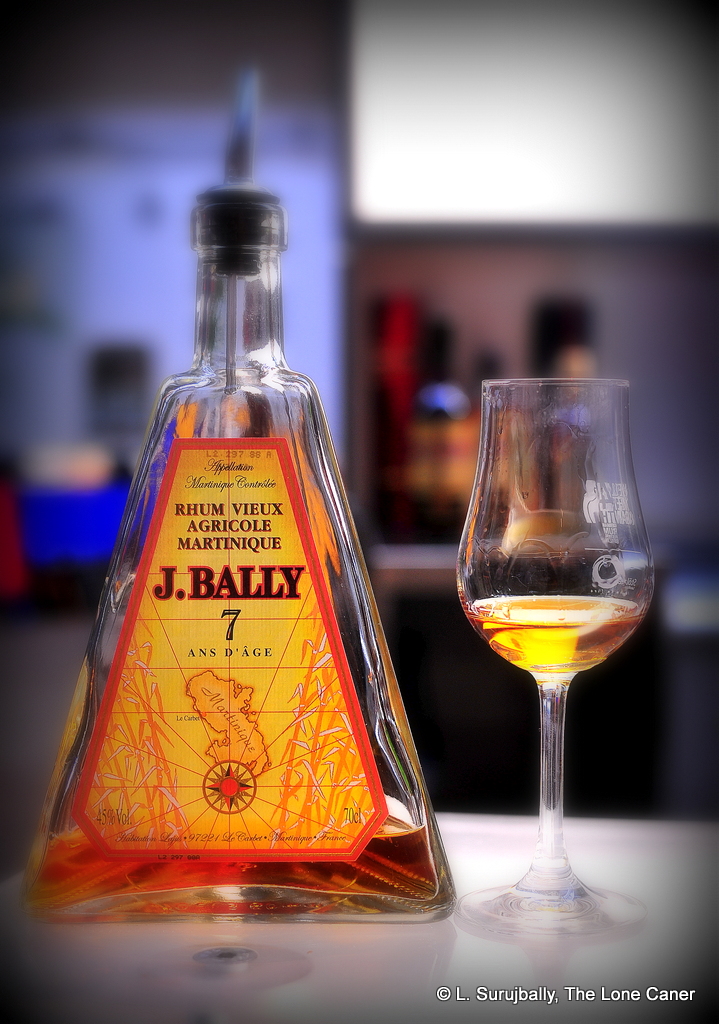
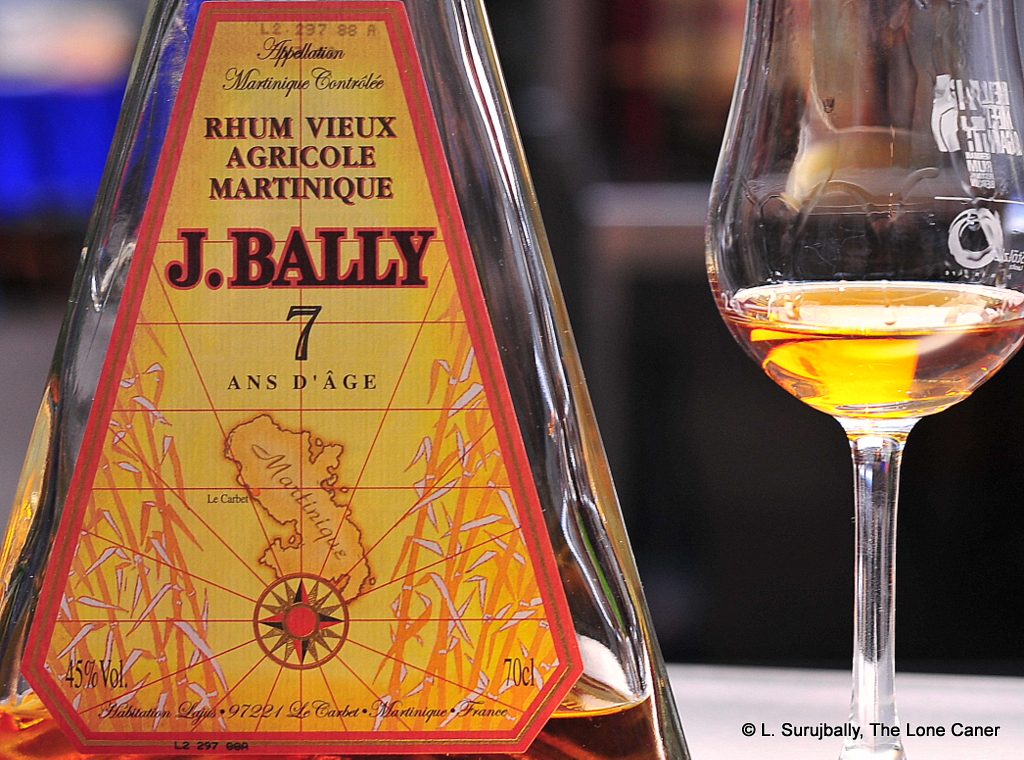
The rhum came in an enclosure that had all the panache of Mocambo’s Pistola, Nepal’s Kukhri, R.L Seale’s 10 year old or Don Omario’s star-shape, and seemed to reiterate J. Bally’s desire to be different (the Ambrè did too, remember?) – and I must admit to doing a double take myself when I first saw the pyramid-shaped 700ml bottle, so the effect has certainly not waned with the decades since it was first introduced. There’s a whiff of the nautical to it – in rolling seas, the tall slim bottle of the Clairin Sajous would be over the side in no time, but drunk or sober, storm or calm, this one would remain rock steady, ready for you to reach out from your hammock belowdecks and get your tot.

Anyway, this was a rhum I savoured right alongside its younger brother, and appreciated even more. Goldish brown with reddish tints, it was aromatic right off the bat even from a few feet away on the initial pour.  I immediately sensed soft flowers and cut grass, that herbal sap-like fragrance so characteristic of agricoles, and given the rhum was bottled at 45%, quite warm and easy going…quiet, almost.  No aggro at all.  I swirled my glass a little wondering if it would grow fangs,  develop into something more intense, but no, it remained quite placid. Once I allowed it to sit around for a while, it opened up a shade, and the ageing became more evident, with background of oak and vanillas becoming more prominent, but never quite overtaking the herbaceous primary aromas.
D3S_9064

At 45%, it showed great technique – I’ve had forty percenters that were more raw and uncouth; it was an impressively smooth and warm drink, and could be had neat with no issues at all. It was heated and yet clear, even crisp.  Although initially my perceptions were of briny notes alongside cheddar cheese on rye bread, cinnamon, burnt sugar, caramel, white flowers (creamy would not be out of place to describe it), these tastes subsided after a while, giving way to tobacco and vanilla and a faint butterscotch without ever being overwhelmed by them.  Underneath it all was that breezy, grassy layer that melded well with what came before.  And I really enjoyed the fade, long and clean, with lovely closing notes of fresh cut green apples, lemongrass and crushed cane at the factory.  You might not think that works well with the vanilla background imparted by the ageing in oaken casks, but yeah, somehow it does.

So…it’s a quietly impressive rhum that would find favour just about anywhere. With some drinks I have to be careful and state that a person who is just looking to start his rum journey might not appreciate it, or one who prefers his molasses might not like it.  In other cases, the taste might be too raw, too funky, too out-of-left-field, too strong, even too original. Those who possess an A-type personality might prefer something else entirely.  But here, J. Bally have provided a synthesis of all the things that make rum such a wonderful drink, something to appeal to the many without catering to any of them.  There would be few, I believe — fan, starter, boozer, mixer, collector or connoisseur — who would not appreciate this very good all round seven year old rhum from Martinique.

Thank goodness, too, because as soon as you crack the bottle and take your first sip, it’s going to be hard to stop at just a single shot. I sure couldn’t.

(#213. 86/100)


Other notes

  • I’ve spoken to the history of J. Bally in the Ambre review, for those who like the background filled in.
  • Like the Ambrè, this rhum is AOC certified
  • Unfiltered, unadulterated.  Aged in oak for seven years
Mar 312015
 

D3S_9014

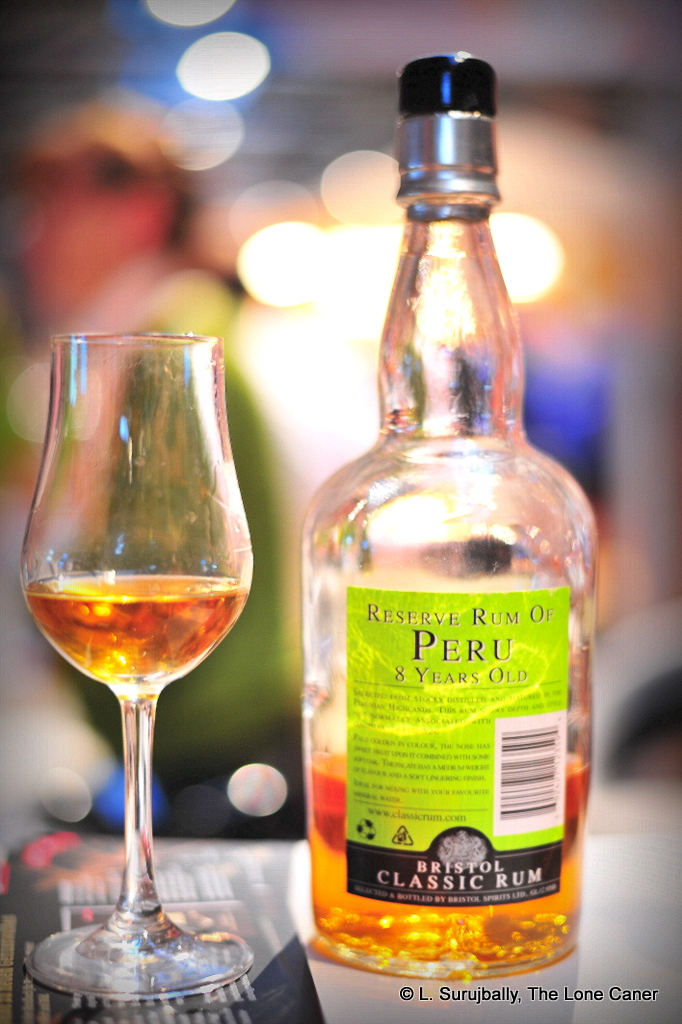
A clean, warm and smooth rum from Peru, which is extremely accessible to anyone who doesn’t like cask strength rums.

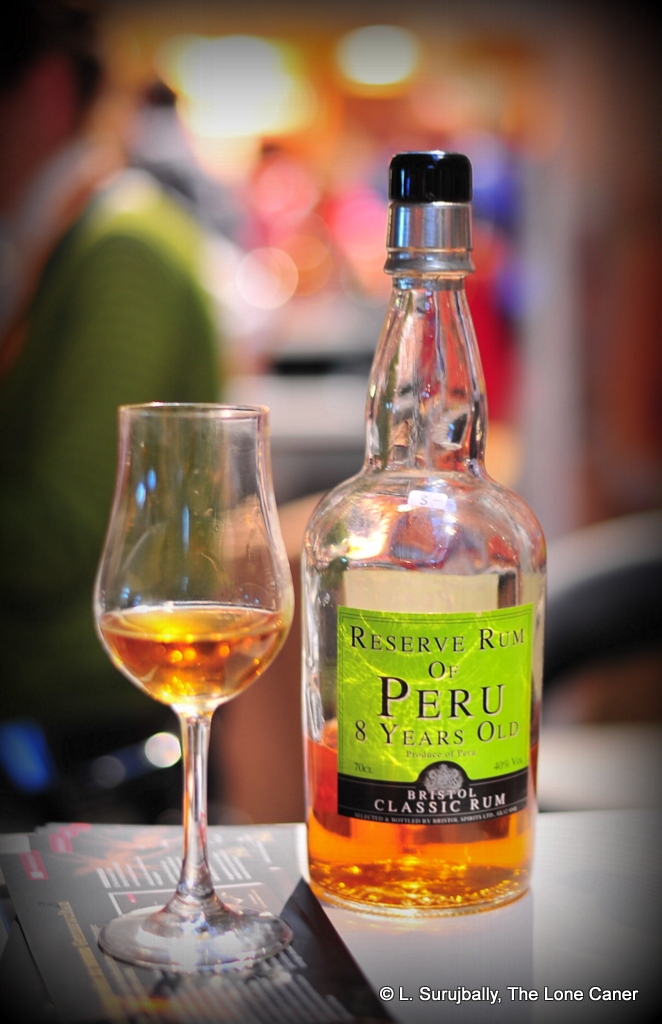
Into the shadowed world of dronish and often-boring label design, the screaming green of the Peruano stands out like a neon tarantula on a wedding cake.  It’s an assault on the visual cortex that can’t help but make you catch your breath, mutter an amused “wtf?” and move in for a closer look. Not that this has anything to do with the quality of the rum inside, of course.  I merely bring up the point to remark on the fact that originality in any form is a vanishing breed in the rum world and we should be grateful for such small winks from the craft makers even if it’s only a marketing plug.

Bristol Spirits is an independent bottler out of the UK which started life in 1993, and is therefore something of a recent entrant to the field (Cadenhead, by contrast, has been around for over a hundred and fifty years).  Their barrel selection from the various countries around the Caribbean has created an enviable track record of limited bottlings; I’ll always have good memories of the Port Mourant 1980, and the 1970s era editions remain on my must-have list. They don’t seem to hew to any particular ageing philosophy – some of their older bottlings were aged in the UK, while others, like this one, were kept in situ.

Anyway, the obligatory opening remarks out of the way, what have we got here? An eight year old, molasses-based, column-still rum from Peru, made from the blend of eight barrels (distillery not mentioned) which were then aged at altitude in used bourbon casks before being shipped to Europe. And bottled at what for an independent bottler, seems a rather low-strength 40% (with some exceptions, they make most of their rums at 43-46%)…however, they noted in an email to me that they were quite happy with that proof.

Nosing the blonde spirit gave some clues as to why the decision may have been made in this instance: it was soft, clean…almost delicate. No pot still could have created something this light and unaggressive (my opinion). Initial smooth scents of hay and vegetal flavours gave way to more luscious soft fruit – peaches, ripe dark cherries, even a touch of mocha, but all very restrained, even shy.  It was a rum that if you really wanted to dissect it, you really had to put some effort in.

As I poured it out and sampled it for the first time, I wondered what Bristol was trying to do here – make a competitor to Rum Nation’s Millonario 15, maybe?  It shared many of the characteristics of that product: light to medium body, slightly sweet, immediately redolent of white guavas, flowers and a smooth cream cheese.  But then it went its own way, and I noted a slight sharp whiff of bitterness emerging, bright and clear like the inlay on a ginsu knife.  It was at odds with the easy-going nature of what had come before, while not entirely detracting from it – it provided, in fact, a kind of pleasing counterpoint, because the balance of the competing elements was pretty good.  Adding water opened up more fruits, vanilla, some oak influence and a whiff of dry tobacco. For a standard strength rum it also exited well, though this was short, shy, bright, a little sharp, as if a can of peaches in syrup had been sprinkled with some cinnamon and lemon juice.

D3S_9017

Independent bottlers tend to be more associated with cask strength behemoths than such laid-back fare, so I was not entirely sure what Bristol’s intentions were, with this Peruvian eight year old. Their recent foray into spiced rum territory makes me worry that perhaps they are abandoning their craft-bottler, limited-edition ethic that produced such incandescent gems as the PM 1980, and now they are swinging for easier sales by diluting down to 40% (they didn’t specifically address that point in they communique to me, and I had not asked).  On the other hand, the rum is gentle, even elegant (I had similar feelings about the Juan Santos 21 year old), and so perhaps this was something that had to be done lest additional proofage obliterate the subtler harmonies of what I detected.

Be that as it may, for anyone who likes standard strength rums without too much intensity or in-yer-face attitude, this is a good one.  I’d be surprised if more editions from Peru don’t follow this one out the door, in the years to come. Because even with its limited outturn, I think a lot of people will enjoy it, and it leaves us all with another colourful tile in the worldwide mosaic of rum…if the label didn’t already provide that, of course.

(#209. 86/100)


Other notes

  • Based solely on the profile, I suspect this hails from the same distillery as the Millonario 15 and XO (Rum Nation never identified it); which implies it was from the Cartavio boys in Trujillo. On the other hand those rums are soleras and this one is not, and Trujillo is at sea level on the coast while Bristol noted the ageing took place at altitude: so the question remains open.  For the record, Bristol declined to provide the distillery name or the number of bottles issued, but Fabio Rossi via Henrik from Denmark (see comments below) did acknowledge the source.
  • Marco on Barrel Aged Thoughts has a company profile and product listing for Bristol Spirits (in German), for those who are interested in other aspects of the company.
Feb 042015
 

D3S_8939

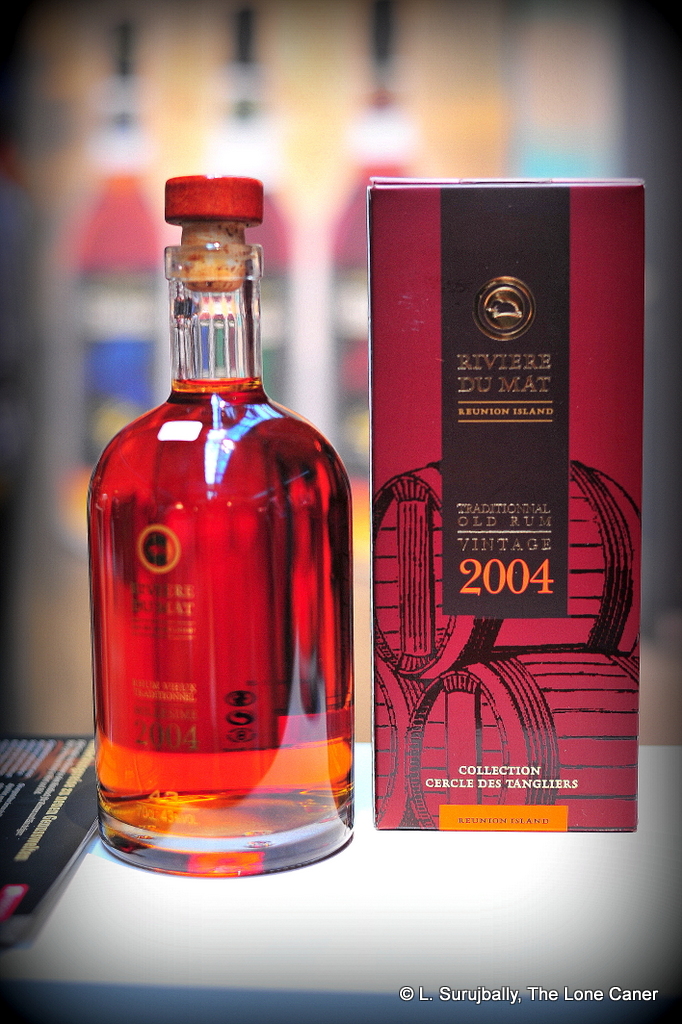
The XO is more expensive, and slightly older, yet I feel this one is better in every way that counts: I’m going to take a deep breath, go out on a limb…and say I think this is among the best rums Rivière du Mât have yet created.

Full of beans and enthusiasm after the frothing delight that was the Rivière du Mât XO, I decided to dump the previous subject of my 200th review, and go immediately to the Millésime 2004, which is close to the top of their range, and one of the better rums I had in 2014. For a rum that is less than ten years old, that says a lot for its quality and the ability of the dude who put it together.

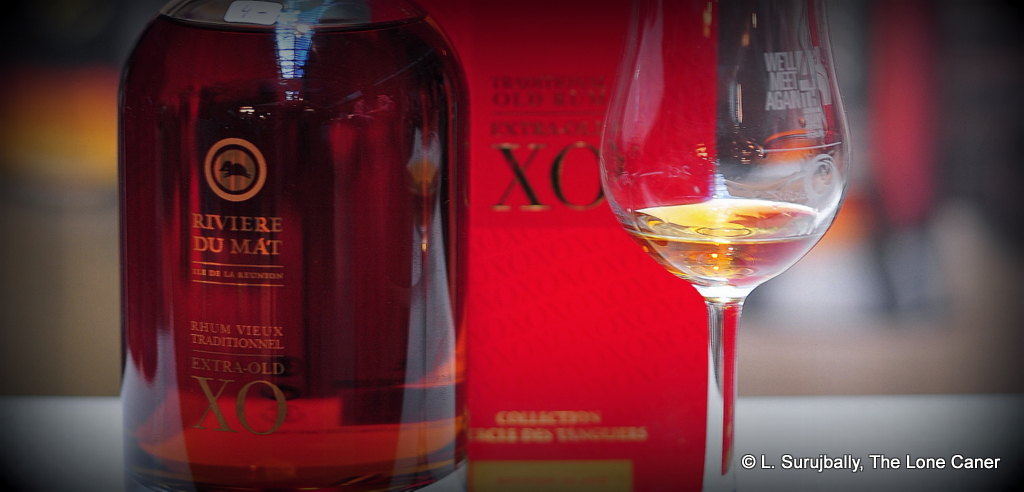
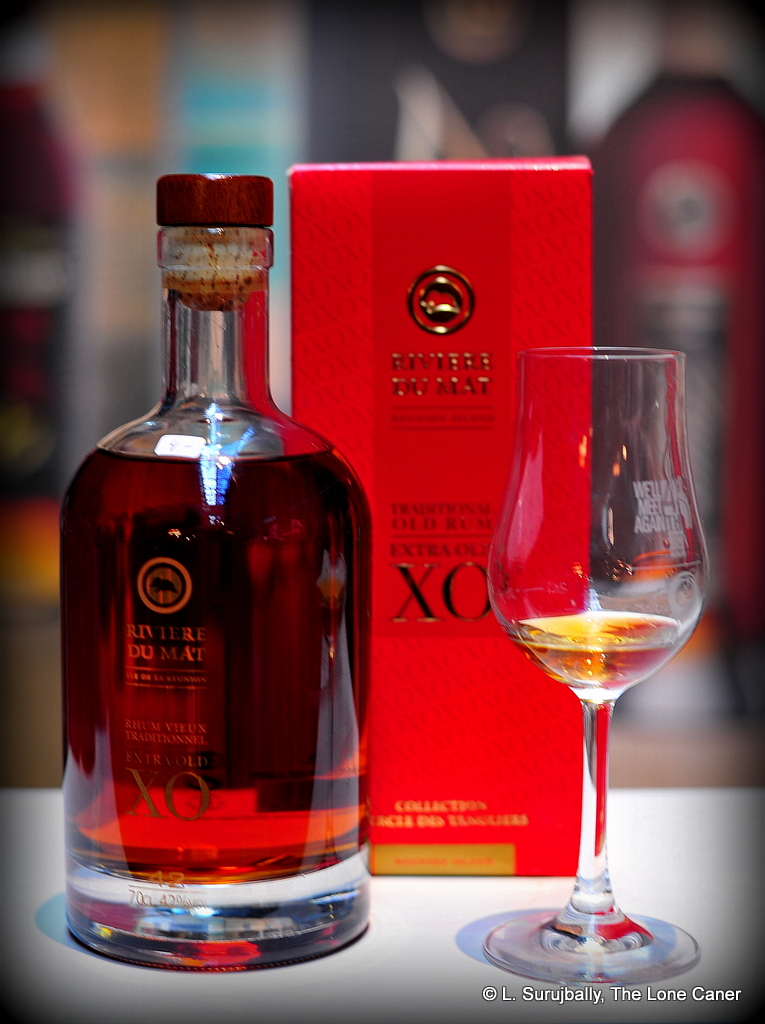
It’s a queer thing that there is not really much to distinguish this rum were you to see it on a shelf next to its siblings, the Grand Reserve, or the XO.  Indeed, with its maroon-brown box and similar bottle shape, it almost fades into obscurity next to the fire-engine red of the XO and the black of the Reserve (which may be good for the patient hunter of high-end rums, not so good for those who just pick a rum ‘cause, y’know, it looks real cool).

The XO had an average age of just over eight years, and this was eight years flat.  Both rums were aged in limousin oak, but with two crucial differences: all of the Millésime stock came from 2004 distillate selected as exceptional by the master blender, and 30% of it was aged in casks that previously held port before being married at the back end.

Perhaps this was where the extra fillip of quality derived, because I’ll tell you, it started right from the nose, which was remarkably smooth and quite soft, easygoing without displaying that delicacy which so often makes a mockery of any attempts to dissect the profile. I remarked on precisely such a fragile profile in the Reserve yet in both these rums (both of which derive from molasses, not cane juice so they’re not agricoles), there was a clean and clear set of tastes: they stated with a melange of crackers and cream cheese, whipped cream, strawberries, cherries and slightly overripe apricots; this then developed on opening into notes of vanilla, ginger and nutmeg with a little coffee, rich and sensuous to smell.  It suggested good future experiences to the drinker, like a girl in the red dress at the bar who’s tipping you a wink and a smile (well, we can all hope, can’t we?).

I find in quite a few rums, that while the nose promises, the taste doesn’t always deliver.  Not here. It was, quite frankly, remarkably sumptuous. The Millesime 2004 was medium bodied and toffee brown, and had an immediate taste of honey and dried flowers to get things rolling, and then more fruits came crowding onto the palate, tobacco and a little aromatic smoke, coffee, ginger, breakfast spices, some of the buttery smoothness of over-soaked french bread.  I loved it. It was smooth and warm and yet distinct and luxurious, like a Louis Vuitton handbag my wife keeps bugging me to buy.  And it faded well, again with warmth and friendliness, no spite, leaving behind the faint backend notes of  caramel and coffee and toffee, and a hint of dried flower petals.

D3S_8940

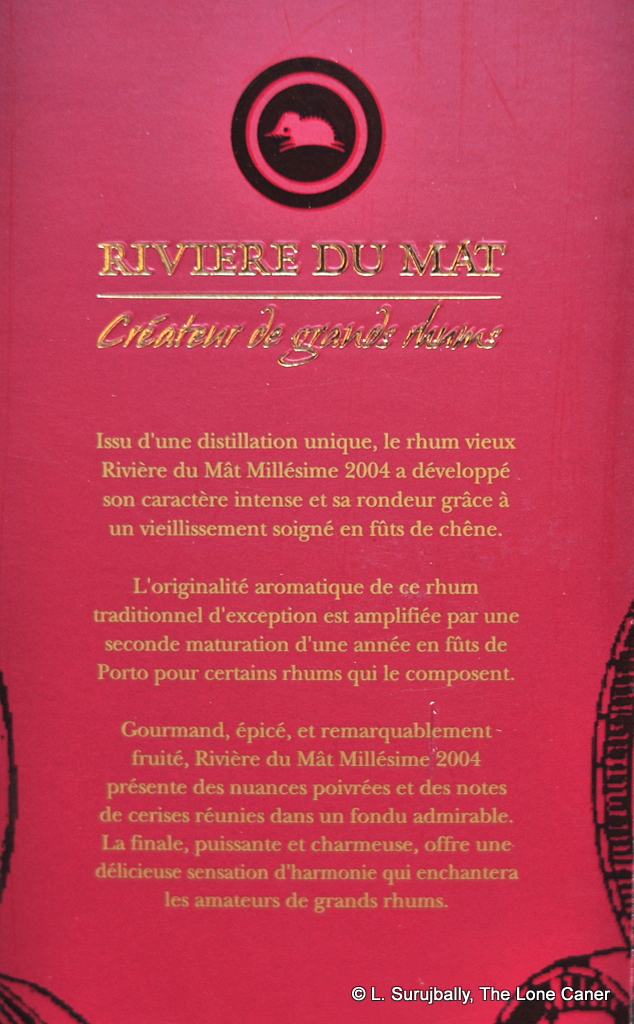
(see translation below)


This is a rum I have no problems recommending. It demonstrates why a lower-costing, lesser-aged rum always wins over a five hundred dollar thirty-year-old. That pricey, geriatric gentleman on your sideboard can never truly go beyond  what you thought it would be (though of course it can fall short)…so it’ll not exceed your sense of, well, entitlement. It’s supposed to be phenomenal – that’s why you grandly forked over the cash your wife was hoarding for that handbag: you’ve coughed up for quality, so that thing had better put out. With a rum like the 2004 Millésime — which, for around €60 can be considered relatively affordable in comparison — you won’t go in expecting a whole lot, it being an 8-year-old and all…and when it over-delivers like it does, it feels like God loves you. And that you’ve made a discovery you can’t help but share.

(#200. 89/100)


Other notes

  • Background to the company is given in the Grande Reserve review.
  • As noted before, the Reserve, the XO and the 2004 Millésime are not agricoles
  • Translation of French label above: “Made from a single distillation, the 2004 vintage has developed its intense character through ageing in carefully selected oak casks. The aromatic originality of this exceptional traditional old rum is enhanced by a certain portion of the rum undergoing a second maturation of one year, in Porto barrels. Gourmand, fruity, with subtle spicy touches, Riviere du Mat Millesime 2004 provides peppery hints and notes of cherry in an elegant fondu (mix). The powerful, charming finish offers a delicious sensation of harmony which will enchant lovers of great rums.”


Feb 012015
 

D3S_8937

Soft, firm, tasty and an all ‘round excellent rum. It could have been stronger, but that doesn’t invalidate the quality of what you do get.

Sometimes a positive review leaves me glumpish.  This is a great rum, older cousin to the also interesting Grande Réserve, well put together, subtle, classy, soft, and possessing a real good taste…yet I guarantee that my inbox will be filled with grumbling queries as to why I bother writing about rums many can’t get. In fact, the majority of people reading this will ask variations of “So?”, “From where wuz dat again?” and the final resigned snort of annoyance, “Well, if me kian gettit, me nah want it.” And believe me, I feel for you guys.

Rum like the Rivière du Mât XO, made on the Réunion island in the Indian Ocean east of Madagascar, gets shipped and sold primarily in Europe, and a few places further afield. Therein lies part of the problem, I think. Not many in North America (or Asia for that matter, because that place has a massive tippling class) will have ever heard of this rum, or seen it, or had a chance to taste it.  It’s not on their shelves, and doesn’t get reviewed often enough, and therefore you can just see some poor rum-loving guy in Kansas, in Manitoba, or Bumpole City in Noplace county, shrugging his shoulders and turning to the Lamb’s or Sailor Jerry. Because what choice does he have? There aren’t enough people trumpeting the “other stuff” and (worse yet) nobody imports it.

And that’s a real shame, because when I uncorked the XO, well, lemme tell you straight out, for a rum bottled at a relatively fluffy 42%, the nose on this thing was good.  Raisins and dates, nicely dried, real solid richness wafted gently into my schnozz, morphing into new chopped fresh and fleshy fruits: peaches in cream.  Vanilla and caramel and white flowers entered stage right and took their bow in the spotlight, and through it all was a really odd steely hint of tonic water…you know, the type you add to your gin.  Sultanas and lemon peel finished things off.  To say I was pleased would be understating the matter: I loved the thing. In fact, I nearly brained my wife with my glass as I swung around in overeager enthusiasm to get her to take a sniff.

D3S_8936

Oh and did I mention the taste?  The palate is damned fine as well. Here the ageing became more apparent because mingling in the marketplace of more dried fruit, dates, figs, and mango — or guava — jam, was cigars, leather, some smoke, well integrated with the whole.  The rum was medium bodied rather than heavy, yet displayed a lovely fullness to the tongue, akin to drinkable honey, that encouraged, nay, demanded, a second, third and fourth taste, and one that even a heavier molasses-drenched beefcake wouldn’t be ashamed to display.  On a 42% rum of such soft pulchritude, I didn’t expect a long and lasting goodbye kiss, and therefore didn’t fault the easy finish too much – it was warm, breathy, didn’t outstay its welcome, and waved some unaggressive flavours of caramel, tobacco and raisins and caramel at me before fading away.

It’s a curious fact that while the company’s younger products are clearly noted by them as being agricultural rums, no such information is given for the older ones.  And as I write this, an email from RdM comes in telling me that no, the older rhums are not agricoles, so consider the matter settled.  The XO is a blend of five rums aged in Limousin oak – cognac – barrels (a lot of them are new), for between six to nine years, the average age being just over eight, and in this they may have done a segue from Plantation who have a similar ageing philosophy, albeit the more traditional ‘finishing’ approach of oak first and longest, and a quick sheep dip into the cognac.

Anyway, without undue effort, I’d have to say that I liked the XO more than the Grande Reserve however indifferent I might have been to the package, which seemed to be somewhat a step down…maybe it’s that glaring fire-engine red box, dunno – the bottle is fine.  Still, I should really stop whinging, because for around fifty euros, this rum gives value for money, even if it can’t be found in many of the watering holes where dedicated rummies go to type annoyed emails to me. So maybe the best I can do is take another sniff and taste (maybe another two, or five) of this excellent rum from Reunion, drown my grumpiness, answer emails…and look forward to the Millesime 2004.

(#199. 87.5/100)


Other notes:

  • I’ve covered the history and background of Rivière du Mât in the Grande Reserve review, so won’t repeat it here.
  • The little hedgehog like device within the circular seal is referred to as a “tanglier”: the company notes that it is a legendary beast, inspired from the Tangue (hedgehog) and the Sanglier (boar). The tanglier symbolizes the alliance between strength and tradition; so a marketing thing, then, like Bundie’s polar bear.


Jan 242015
 

D3S_9097

Clean, clear, dry and old, with a lackluster finish that detracts from the excellent front end.

When I reviewed the Depaz Reserve Speciale a while back, I thought that the flavours seemed a shade sharp, too vague, and departed the scene with all the hurry of a street cur at which you threw a rock…or something to that effect.  Most of these issues were absent from the Cuvée Prestige, which was a better rhum in almost every way.  It is a blend of rhums aged between six and nine years, has a lovely outfit, and probably the top-of-the-line product from Depaz. I hesitate to recommend it at the higher price points I’ve seen, but must concede that I think it’s one of the better agricoles out there (bar the finish), and for those with deep pockets (or who can ferret out a more economical buy), it may be worth that kind of outlay…assuming their tastes bend in that direction.

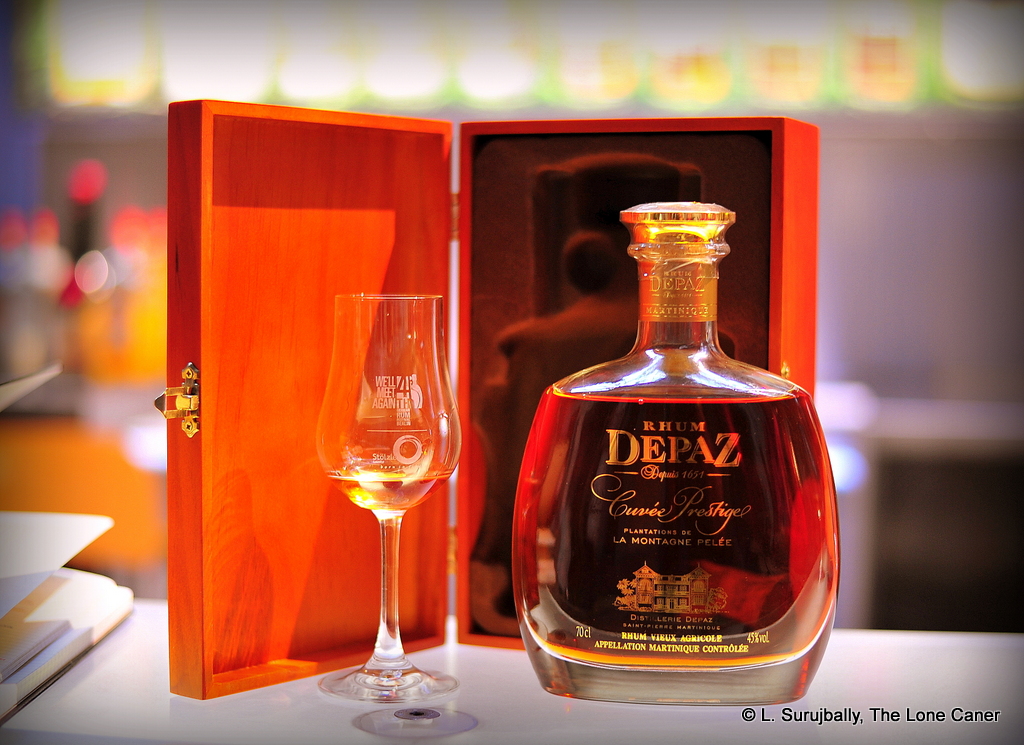
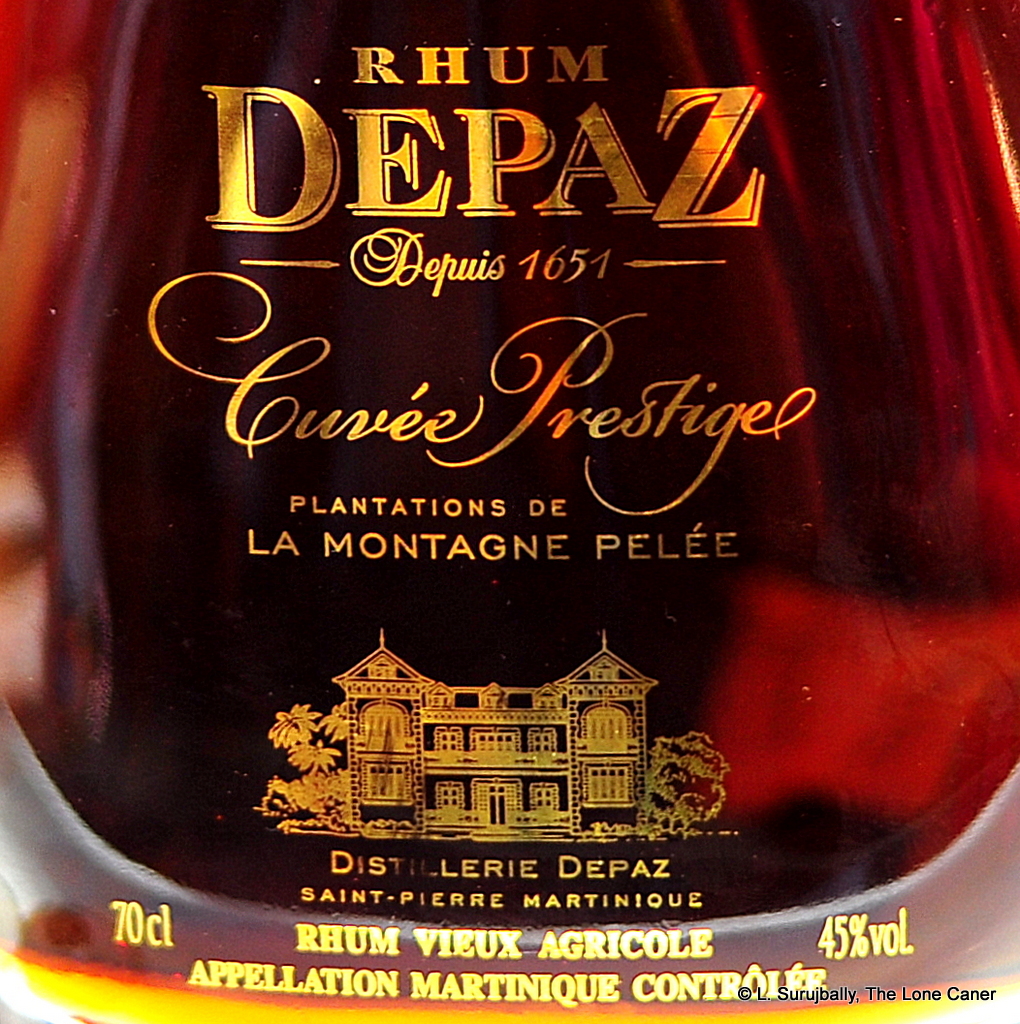
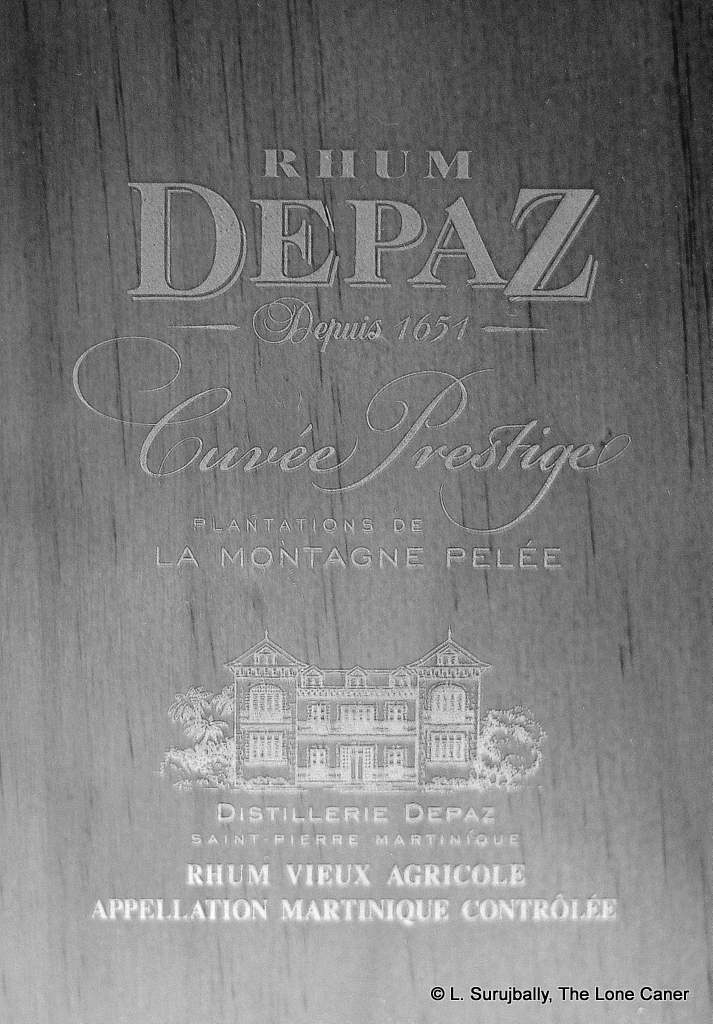
Points should absolutely be given for the packaging (oh come on, lie to me and say you never bought a bottle of something purely on the way it looks).  The carafe-style bottle with gold etching (it shows the “castle” of Depaz and its date of founding, 1651) was surmounted with a gold-coloured cap and thick cork, and came in a wooden box with metal snaps, the design of which mirrored the bottle etching.  It all looked very impressive, which it was: it just exuded an air of expensive Savile Row suits. As I’ve remarked before, when you’re at this price range, you’re absolutely within your rights to ask for some spiff on the wrapping, otherwise what are you spoiling yourself for?  Who can you show off to? An unadorned barroom bottle can contain the elixir of the gods, sure, but who’d ever believe it does until they shell out the money, and who’d take the chance?

D3S_9099

Anyway, the Cuvée Prestige is an AOC agricole from Martinique, made from sugar cane juice rather than molasses, grown on the Depaz plantation at the base of Mount Pelee (which nearly ruined the joint back in 1902 when it last woke up and belched). As with other Martinique rhums, it is terroire specific, and since Depaz is located right close by La Montagne with both volcanic soil and varying weather, some of its distinctive profile can certainly be attributed to those factors.  The initial scents of this 45%, gold brown rhum certainly pointed in this direction. Initially very clean and dry, the vegetal green-grass aromas were to be expected, and did not disappoint – the rhum was extremely pungent, smooth and easy, even deep. It had some of the briny freshness of ocean spray. As it opened the scents moved to display more of that dry-ish, almost-salty profile – dates, figs, nuts and almonds, leather and toast, all nicely soft. No real fruity background to speak of here, just the shy promise of better to come

The taste on the palate did not take any sudden left turns or quick swerves.  It retained cleanliness and smoothness, which were endearing characteristics – I have to be honest, the medium bodied rhum had the smooth and relentless flow of a slow tidal wave of double cream.  And it also continued to display the warmth and aridity of the nose. It hinted at sea-salt and sawdust, still more nuts, nutmeg, hazelnut and almonds. Some caramel, cigar smoke, sandalwood.  It almost felt like one of Renegade’s rums, like, oh, the Guadeloupe 1998 11 year old; also the Cuba 11 Year Old, or even (shudder) the Coruba 12 year old. Letting it stand, and adding some water finally coaxed out the flavours I was hoping to have – figs, dates, some light vanilla and overripe black grapes, all bound together by the smell of crushed sugar cane stalks still weeping juice and drying in the hot sun.  The finish was a weak point for me – smoky and sharper than it should have been (it lasted a good while, I can’t deny that), with not much going on aside from some closing notes of vanilla, and salted peanut butter.

It had a good mouthfeel, nice body, good tastes around the edges, and the nose was heavenly, but I think that here, the slight dominance of the non-sweet brininess made the product falter as an overall experience for me (when related to the price – had it been cheaper, I dunno, I might have been more lenient).  It’s definitely better than the Reserve Speciale, and I could see its overall quality, feel its texture, and acknowledge that in my scoring. But I’m afraid it’s not my cup of tea, really, not entirely. Therefore, dear buyer, if money is an issue, it’s a rum that you might wish to taste first (if possible) and checking it fits in with your personal profile preferences, before shelling out.  It’s a very good rum in its own way, and just because that way meanders apart from my own path doesn’t invalidate the product on its own merits.

D3S_9104

(#198. 86.5/100)


Other notes:

  • Online cost shows wild variation.  I’ve seen everything from €80 to €250, with one reviewer remarking that it can be had for substantially less on the island itself. While I’m not privy to the sometimes obscure pricing mechanisms of web stores, I don’t think I’d shell out more than €100 for this one, both for the cool looks and lovely taste, and also because of the failed backend.  It would have to be a hell of a lot rarer and more in line with the personal preferences I have, to convince me to part with that much of my hard earned balles.
  • Nowadays it’s owned by Bardinet (who also make the Negrita line of rums I’ve never tried), but who, interestingly, make no mention of Depaz at all on their (poorly designed) site.  There are days I wonder how advertising is really done for products this good: maybe that’s what we reviewers are here for.  After all, if we shell out some cash to buy the thing and like it (which is a chance the makers seem to think is worth taking), then they don’t have to.  I’ve made my peace with that situation a long time ago, but there’s no doubt I still feel a twinge of annoyance about it – we should not be seen as a free resource, to act as a substitute for their reluctance to advertise properly on their own account.


Jan 122015
 

D3S_9094

Complex, yes. Quality, not entirely.

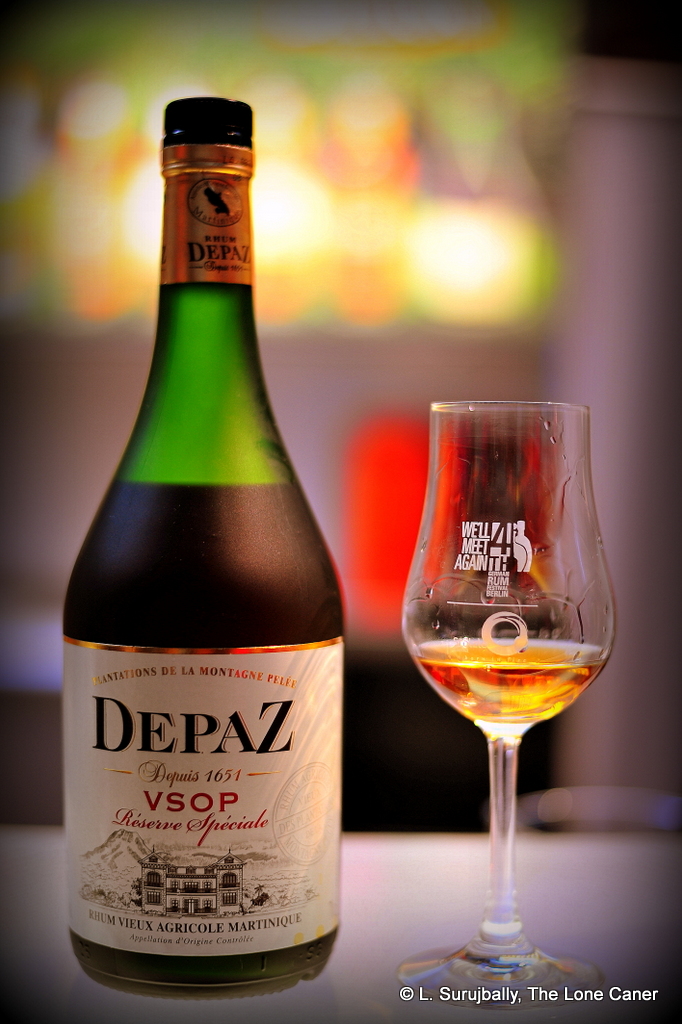
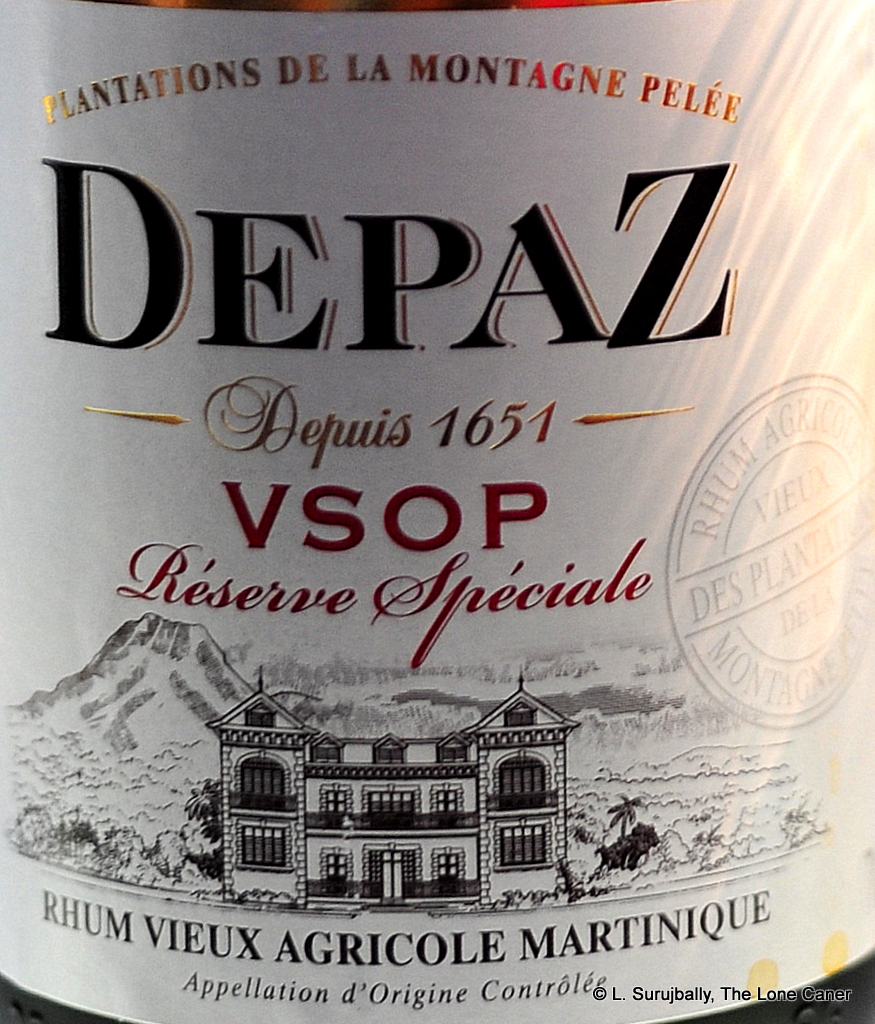
Although the Depaz VSOP Reserve Speciale is noted as being a complex agricole, not much except perhaps the taste of the reddish brown rhum deriving from the Plantation de la Montagne Pelee really works for me as it should, which just goes to show that not every single spirit hailing from a part of the world supposedly making only top-end products can be as good as it is meant to be.  Part of the issue here (I hesitate to say “problem”) is that all sensations go by too fleetingly for any real impression to be left, and what was there just never came out the way it might have.  The Depaz agricole is a Tolkien elf running across the snow, and leaves few footprints worthy of remark.

Which is somewhat odd for a spirit that is bottled at 45%: that strength alone would lead you to assume some intensity and heft in the profile.  But nope, not really.  At least not in this one, and it starts right away in the nose.  Unlike some really stellar exemplars of the craft (think Damoiseau 1980 or even the Karukera Millesime 1997) which wafted a cloud of deep, luscious scents into the room as soon as the bottle was cracked, the Depaz seemed thin and reedy as a hungry rice-eating mongrel’s ribs, and like such a pooch’s snarling attack, it was sharp and fast and over way too quick.  There were underlying aromas of grass, crushed cane and rosemary, some subdued hints of apricots, fruits, flowers and sweet bubblegum, followed by faint leather, and the damp musky smell of cheap cigarettes smoked in the midst of a tropical rainforest with high humidity (having done so in the past, I know whereof I speak).  But it was all too little, too sharp, and too scrawny for the schnozz of this reviewer, who openly prefers more aggressive fare.

The taste in the mouth on the other hand elevated the drink quite a bit, and made me check my glass to see if I had confused my samples.  It was stronger and more assertive, very nicely warm without the spiciness of the nose…a bit more body you might say, entering quite cleanly and clearly. Sweet and solidly fruity, it opened with sugars and some oakiness, chopped light fruits (green grapes, white guavas), licorice (odd in a Martinique AOC agricole), bleeding sap from a fresh cut cane stand, green leaves and even a flirt of vanilla and caramel.  The complexity was hinted at but seemed scared to come out and strut its stuff and therefore, while it was discernible, it never quite took centre stage.

I should however remark on the mouthfeel and texture, which wasn’t bad at all, coating the tongue well and warmly, allowing some of those tastes to take on greater prominence after a few minutes.  Here adding some water had to be done with some delicacy, as too much would have shredded an already unaggressive drink, and too little wasn’t enough to release the additional flavours that lay hidden.  The finish was an overall disappointment, by the way – there was a backtaste of cane juice on a cutlass blade (I kid you not – it had both metallic and vegetal notes), some sugar water, vanilla, a little oakiness, too quick and too sharp to appeal to me.

D3S_9095

Depaz hails from the eponymous estate in St. Pierre in Martinique, and is located at the foot of  Mount Pelée  itself: it’s been in existence for over three hundred years, sicne 1651 in fact, when the first governor of Martinique, Jacques Duparquet, created the plantation, and these days bears the AOC mark of terroire-based authenticity. Although the famous eruption of the volcano in 1902 decimated the island, Victor Depaz, who survived, reopened for business in 1917 and it’s been operational ever since.

The company also makes quite a few other rhums: the Rhum Depaz, a full proof 50% beefcake, a blanc variation, the Blue Cane Rhum Agricole (which are all a little down the evolutionary ladder), as well as an XO and the Cuvee Prestige (a little above quality-wise, a lot more price-wise). I’ve heard that the VSOP was made with a single column copper still (and was unfortunately unable to confirm it), aged for seven years in charred oak casks, from cane juice (of course) and without filtering or additives; it is presented in a bottle more reminiscent of wine or champagne, but you have to kind of admire such audacity – it sure sets it apart from the crowd.
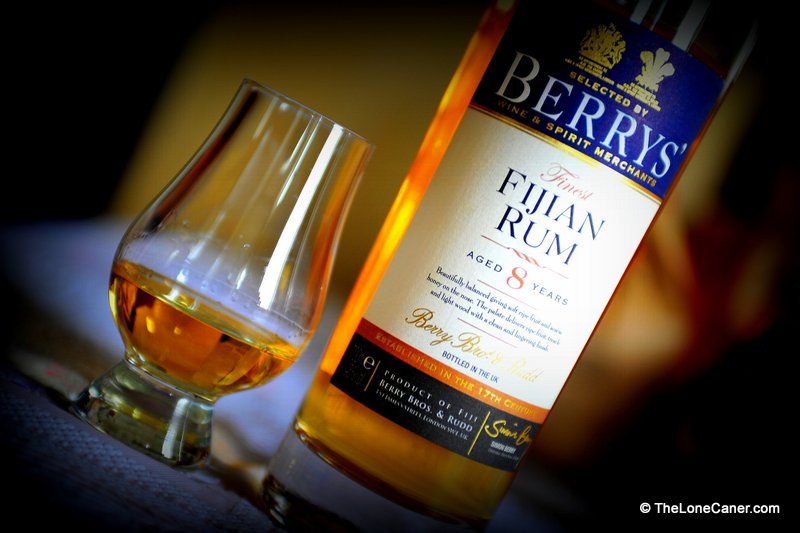
Anyway, let’s pull it all together.  I tried this three times to see whether my opinion changed (and it didn’t), but my overall lack of passion should not entirely dissuade you: there were aspects of the rhum that worked well (the palate in particular).  My own predilection for more intricate, stronger and deeper flavours should not be seen as a blanket indictment of any rum that doesn’t conform, or which those persons with a liking for subtler, lighter rums would enjoy. This is where knowing your preferences comes in handy. Lovers of soleras, Bajan, Panamanian or Demerara rums are not likely to swoon here.  Trinis, maybe; Cubans and Jamaicans, quite likely. And people with a penchant for agricoles will probably like it – for the same reasons I couldn’t muster serious enthusiasm, in all likelihood.

Some might consider this to be like a black mongrel’s left leg – it ain’t right, and it ain’t fair – but that’s the way it is. And that’s also as it should be, because if we all agreed on everything, then all of you reading this would want to pilfer all my rums…and be in love with my wife.

(#197. 82.5/100)


Other notes:

  • In Europe this goes in the €60 range.  My own feeling is that if you can spare the change, go a step or three up the ladder for the Cuvee Prestige, which is a very good rhum indeed, and which I’ll look at in my next review.
  • It doesn’t say so on the label but digging around suggests it is a 7 year old rhum


Jan 082015
 

D3S_9369

A rich, argicole rum of a depth and flavour I savoured for literally hours – it almost qualifies as the perfect comfort drink, and for sure it’s the best sub-10 year old rum I’ve tried in ages.

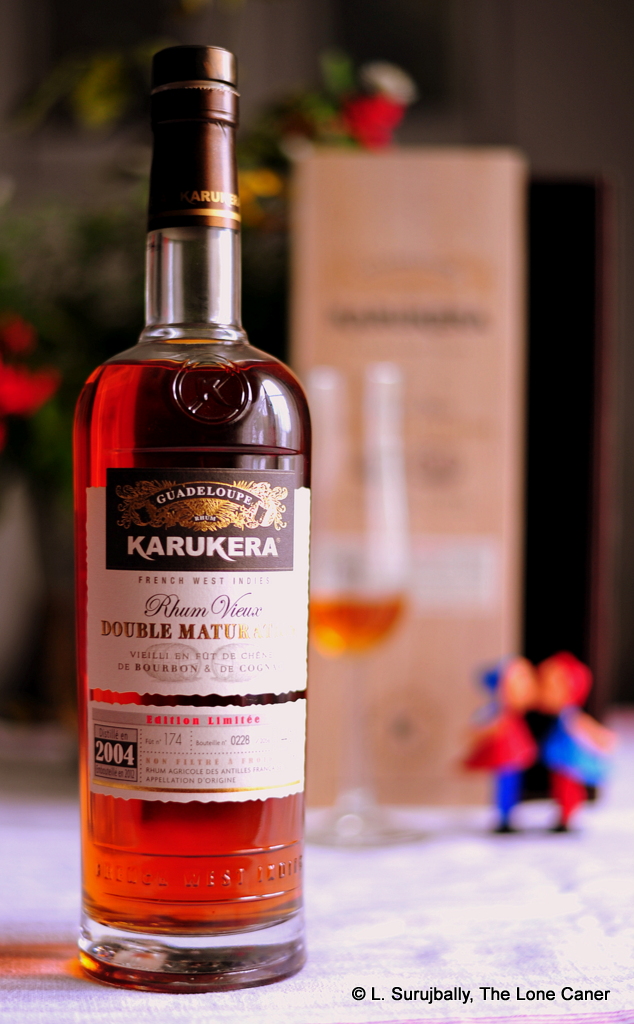
Karukera in Guadeloupe is a distillery for whom I have grown to have a great deal of respect: I was not won over by their Vieux Reserve Speciale, but the 1997 Millesime was something else again, and I often drifted back to it when looking for an agricole baseline, or a control.  On the strength of that positive experience, I decided to step up and shell out for this one, partly because of the strength and partly due to the double maturation moniker, which piqued my interest.

Which is not to say that its presentation didn’t appeal to me also – I’m shallow that way, sometimes.  It may not be a top shelf super-premium rum, true, yet it did its best to raise the bar for any rum that purports to be a cut above the ordinary.  Just look at that wooden box printed with all sorts of interesting details, and the sleek bottle with its cork tip.  All very nice – it looked damned cool on my shelf. And so, my lizard brain having been catered to and placated, off I went into my tasting routine to see whether the implied quality inside the bottle was as interesting as what the outside promised.

D3S_9373D3S_9376

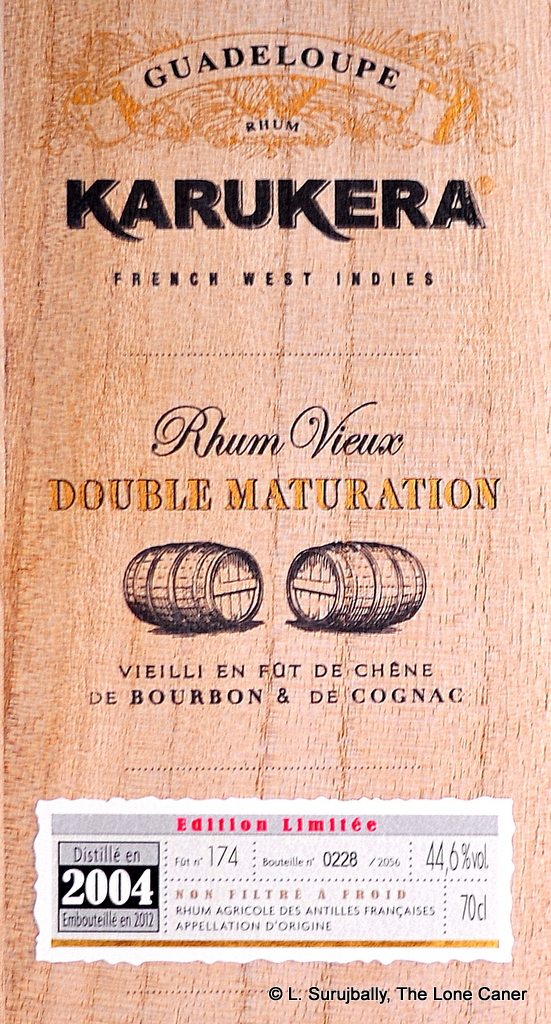
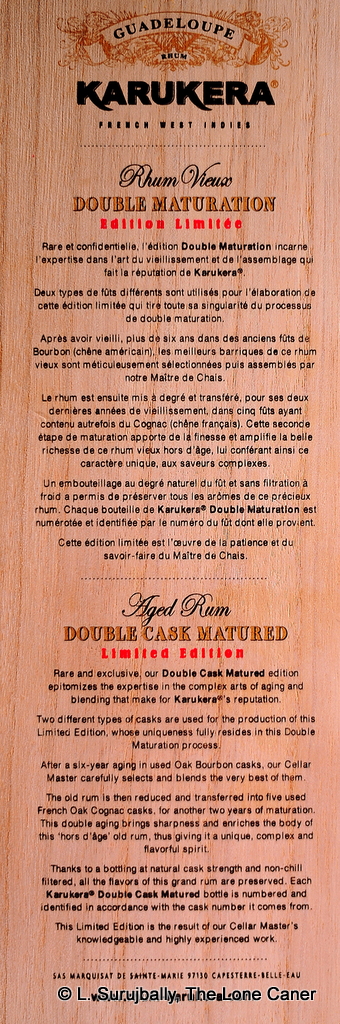
Which it was. Aged for six years in bourbon and then two more in french oak cognac casks, only 2000 or so bottles of honey/amber coloured rum came out at the other end, and mine presented a very interesting aspect, in spite of my having wrestled with mostly full proof pachyderms over the last few months (so 44.6% can almost be considered “standard strength” for me, these days).  Let’s just agree it was…gentler.

 Sleek salt butter, cream cheese and some brininess led right off. To say I was not expecting that would be understating the matter: the rum is made from blue cane grown on the plantation itself, and I was looking for a more standard nose of vegetal notes and some citrus.  But after letting the spirit rest in my glass for a bit, ah, there they were.  Apricots, black grapes, cloves and orange rind sidled shyly forward, to be replaced by hay and freshly mown grass.  There were some spicier oaken aromas at the back end, nothing unpleasant – in fact the whole experience was really quite excellent – a firm mix of salt, sweet, sharp, and pungent smells.

Tasting it was a rewarding experience. It was a medium bodied rum, quite smooth and warm, opening up with white flowers, and soft tanned leather.  As the nose did, some patience rewarded me with mild caramel, smoke, more leather, which in turn morphed easily into mellow tastes of mango, pears, pineapple, cinnamon, cumin, even marzipan and flavoured port-wine cigarillos (used to love those as a young man). And I was also quite impressed with the finish, which lasted quite long, warmly dusting itself off with white guavas, caramel, and half ripe pears. The rum may have caused north of a hundred Euros, but man, it was a pretty awesome drink. My mother and I shared it in her dacha in north Germany on one of the last sunny days of autumn in 2014 as my son ran barefoot on the grass blowing soap bubbles, and it was the perfect accompaniment to a really great afternoon laze-in.

D3S_9371

Karukera continues to be made by the Espérance distillery (founded in 1895) a distillery down by the Marquisat de Saint Marie in Guadeloupe, doesn’t chill filter or add anything to its rums, and proudly wears the AOC designation. I’ve been fortunate to climb the value chain of its products and each one I try raises the bar for its rums. You can be sure I’ll buy others they make in the years to come.

Personally, I’m not sure a rum so warm and friendly, yet also firm and tasty, is suitable for mixing (it was all I could do to see what a few drops of water could do, just to be complete about it) – I know I wouldn’t, on balance.  There’s a remarkable softness and overall quality to the Karukera, which, while excelling at no one thing, came together so sweetly that I honestly can’t imagine what a mix could do to enhance it. The rum is excellent as it is, and whether you like molasses spirits or agricoles (or both), there’s no doubting that here is a rum that sneaks past your defenses, hits the sweet spot of your desire for a good rum, and gives you all the love and comfort you could ever ask for. That alone may be worth all the euros I paid.

(#196. 87.5/100)


Dec 132014
 

D3S_8931

A tasty, svelte, supple rum like this brings home the point of how widespread the world of rum is, how we are too often satisfied with too little, and why should demand more. Even at 40%, this rum is quite a drinking experience.

Réunion? Quick, place that on a map.

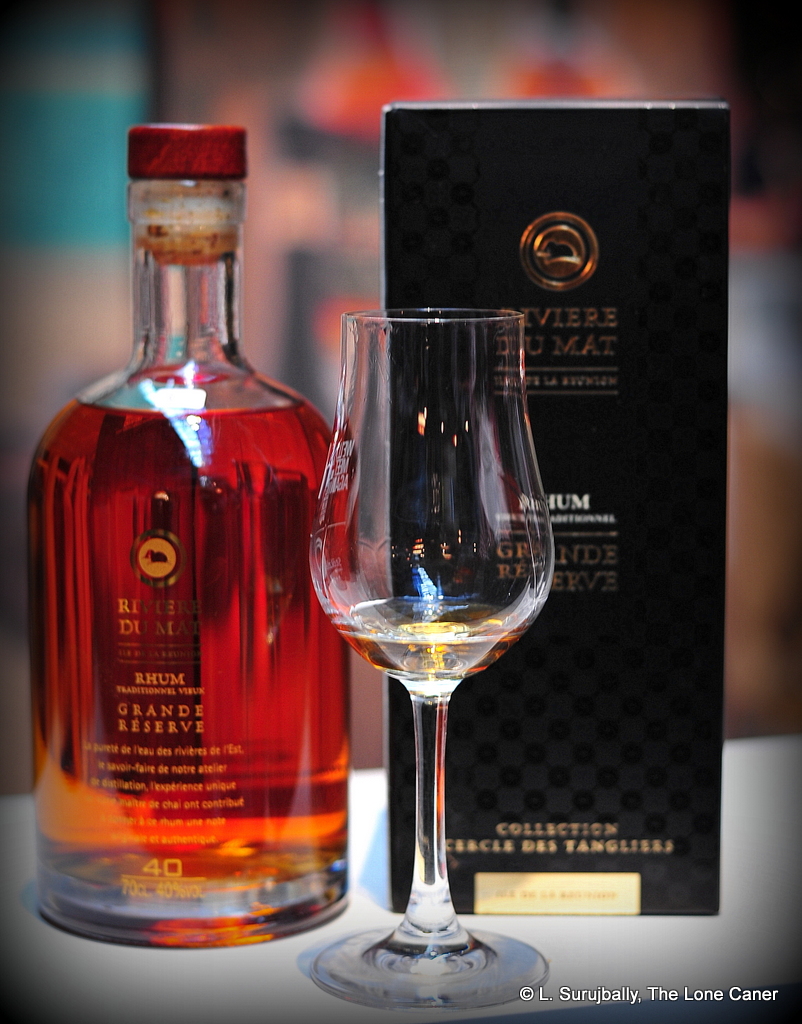
Casting around for something to look at to close out 2014, I settled on this sprightly and supple forty percenter.  This was not just because I wanted to cast a geographically wider net (though this is also true) – but because when you see a good rum, you really want to toot its horn a bit. While I’m no longer as stuck with loving only 40% rums as I used to be, there’s no reason for me to deny this rum its rightful plaudits.  It’s good.

Appearance wise, I had no objections. Stiff cardboard box, round shouldered bottle, plastic tipped cork, all holding within them a golden-brown spirit with tints of red. It certainly smelled great, when I poured it out. For a rum as relatively lacking in oomph (compared to some of the Tiger Bay toughs I’ve been getting mugged by over the last months), the 40% ABV was really kind of fun.  It was…well, zippy.  Happy.  It was zesty, light, clear and vegetal.  I don’t know why, but I kept thinking of daisies, spring picnics on a green sunlit meadow somewhere.  The rum felt like it was frolicking over the nose.  Nothing heavy here, only scents of orange peel, sweet fresh sap, vanilla, light white flower petals dried between the leaves of an old book; guava and sugar cane and fresh mown grass after a light rain.

That same cheerful sprightliness was also evident on the palate.  There were a few references that stated the core distillate was made from molasses, yet it is remarkable how the overall taste was light, and what clarity it displayed: it seemed to be more of an agricole than anything else. Those same easy-going floral notes carried over, and here the ageing was more evident – baked candied apples, ginger, baking spices, vanilla and sweet wooden notes, very well done.  Adding anything to this is pointless because it has a delicacy to it that would be rent apart by anything but the mildest of mixing agents – even water dilutes it too much.  As for the fade, it was medium long, pleasantly aromatic, and tickled your tonsils rather than trying to skewer them.  All in all, a lovely très vieux with a little bit of bite to let you know it was there, and not to be taken as an underproof. You could almost imagine it wearing shades and a Hawaiian shirt on a beach somewhere, watching the tide come in.

The Grande Réserve is a blend of rums aged six years or more in Limousin barrels, and well put together – one hardly tasted smoke and tannins and leather of any kind. It hails from the island of Réunion, which is located in the Indian Ocean, east of Madagascar.  Although originally settled by the Portuguese, by the 16th Century, it was taken over by the French, and these days is a French Department. Because of that, it is considered part of France, as if it was right on the mainland, and therefore also part of the Eurozone.

Réunion has quite a pedigree with respect to rum.  Sugar has always and traditionally been the chief agricultural export crop, and the first stills were brought by the French to the Island as far back as 1704; in 1815  the first modern distillery set up by Charles Panon-Desbassyns and coincided with the start of large-scale sugar-production, which took up just about all the sugar-cane harvested.  The production of local ‘arack’ (or ‘sugar brandy’, produced from sugar-cane juice) was limited to production from the residue of sugar manufacture. The number of distilleries fluctuated from six in 1842 to thirty one in 1928, down to one during the second world war, and three presently: Savanna, Rivière du Mât and Isautier. All three produce the most famous brand of the island: Rhum Charrette. The other well-known brands of these distilleries are Savanna rums, which is a brand that consists of more than 12 different rums (and there I was, grumbling about the seven rums in Ocean’s Atlantic edition, remember?), the Rivière du Mât, Isautier, Chatel, Varangues and Belle-Vue rums.

All in all, then, this is a rum that is light, easygoing and an absolute pleasure to drink neat. As an entry level vieux, it may be a tough ‘un to beat.  I can’t wait to write about the XO by the same company: that one is also good, but also more pricey.  If you’re looking for something off the beaten track, with a taste all its own, not too expensive, with aromatic, clear and slightly fruity notes, then this is as good a rum to buy as any others…others which may be more available and perhaps better known in the bars of the west than Rivière-du-Mât’s rum — but not necessarily better.

(#193. 85/100)

Nov 262014
 

D3S_8929

A remarkably well balanced and tasty rum from the Indian Ocean

In spite of the prevailing belief that rums are Caribbean almost by definition, it’s axiomatic that many other nations and regions produce them.  Over the years I’ve found that the most readily identifiable and distinctive (I don’t say “best”) products, products that have a flavour profile all their own, usually hail from some distant part of the world where climatic and soil conditions are far removed from the norm: consider, for example the Bundaberg, the Old Port, or even the Tanduay.  Now sure, flavourings are sometimes added to the mix with the heedlessness of Emeril chucking spices…but not always.  Sometimes it’s just the terroire.

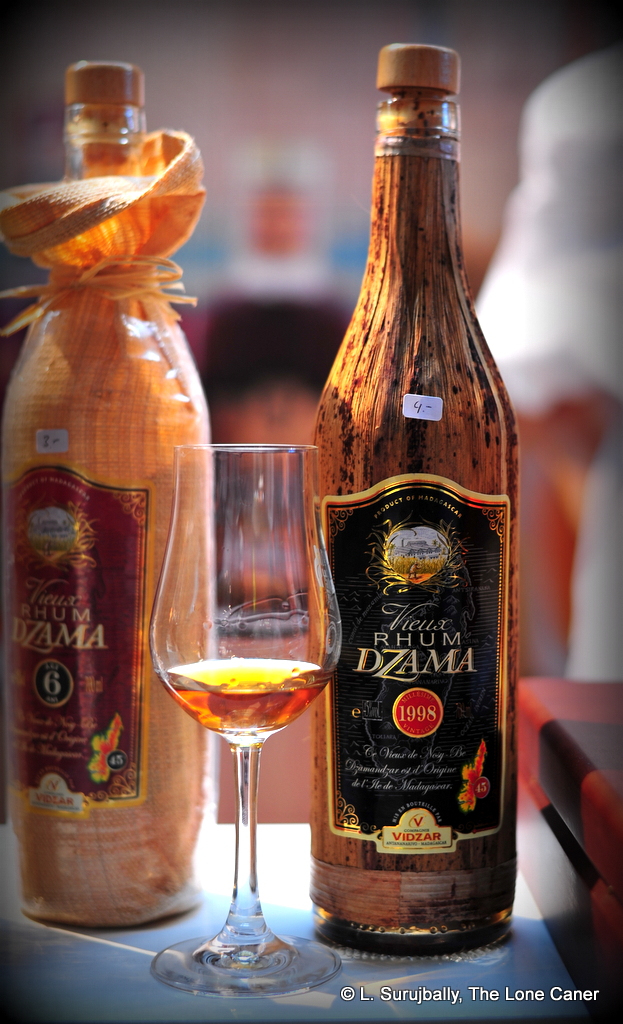
Such a one is the Rhum Vieux Millésimé 1998 ten year old, made and bottled in Madagascar from locally grown cane and molasses, offered at 45% in a bottle that is rather amusingly wrapped in a banana leaf (or a reasonable facsimile thereof).  This is a rhum that won a gold medal at the International Wine and Spirits Competition in 2012, and is one lovely piece of work.

Take for starters, the initial nose: brown sugar, coffee and mocha, straight off, very smooth and inviting – 45% was a good strength for this rum.  I looked at the labelling again with some surprise – was this a spiced rum and they forgot to mention it?  Nope.  What you got was it. It was followed by vanilla, cloves, nutmeg and a soft background of bananas, all quite unaggressive and easygoing.  There was even some vague vegetal note there after a bit, almost imperceptible.

The palate broke little new ground, simply built on that excellent lead-in: more vanilla (not enough to make me suspicious about flavouring, yet I couldn’t dismiss the thought entirely), coffee, burnt sugar, nougat.  Fried sweet bananas (I loved those as a kid), nuts, peaches.  This rum was lovely, just lovely – soft and warm and exactly strong enough for what it was – a higher proof might have made it too spicy.  There was even, after a few minutes and a drop of water, leather and the sweet perfume of aromatic cigarillos.  Some ground walnuts rounded out the profile.  The finish was surprisingly short, yet still that warmth persisted, and closing notes of white pepper, smoke and those walnuts again.

These tasting notes sound utterly conventional, don’t they? Yet they’re not, not really – the balance of the vegetal notes and vanilla and nuts and sweetness of bananas popping in oil is not at all like the Caribbean rums with which many of us are familiar; I imagine some of this taste profile comes from the Pernod Ricard barrels shipped to Madagascar to age this rum the requisite ten years; but perhaps equal credit comes from the cane itself and the environment in which it is made.

Dzama rum is made by Vidzar, one of those local companies like Banks DIH in Guyana, or Clarke’s Court in Grenada, which have a rather larger visibility in their home country than they do abroad (this may change as they expand their markets). The company was formed in 1982 due to the efforts of Mr. Lucien Fohine, who noted that the small sugar factory on the tiny island of Nosy Be produced a distillate that had distinctive flavours which persisted into the final distilled products…mostly low level rum for local consumption, to that point. After some investigation, he concluded it came from the ylang-ylang plant (also known as the macassar oil plant, or the perfume tree) whose roots intermingled with that of the cane. (If this rum is an example of the flavour holdover, he may be on to something, though I’m ambivalent about the science behind that).

In an attempt to distill a decent rum to elevate the craft of his island, he formed a company Vidzar (a contraction of Vieux Rhum de Dzamandzar), located close to the sugar cane fields of Nosy Be, by a village called Dzamadzar. The company makes a range of rums for sale, including the Dzama Club, 3 YO and 6 YO, the Dzama XV 15 year old and Cuvée Noire (untried by me) and is starting to sell in the European market. This particular ten year old was aged in the aforementioned Pernod Ricard barrels and was distilled in 1998 but the date itself is just a marker, not a commemoration of anything special (the current ten year old on the company site is the 2000 Millésimé) – I’ll hazard a guess that it was a series of barrels set aside by the master blender as simply being of higher quality.

I’ve remarked before that one rum does not sink a brand, or define it – yet I have to be honest and say that a bad one tends to make me leery about approaching others in the range, while conversely, a good one makes me enthusiastic to do so – that’s human nature.  With this excellent rum hailing from a region I’ve not tried before, whose profile is remarkably distinctive and far from unpleasant, I’m pretty stoked to see what else Dzama has in the larder the next time I get a chance to buy one.  You could do worse than trying some yourself…and this one would be an excellent place to start.

(#189. 84/100)


Jul 142013
 

D3S_7047


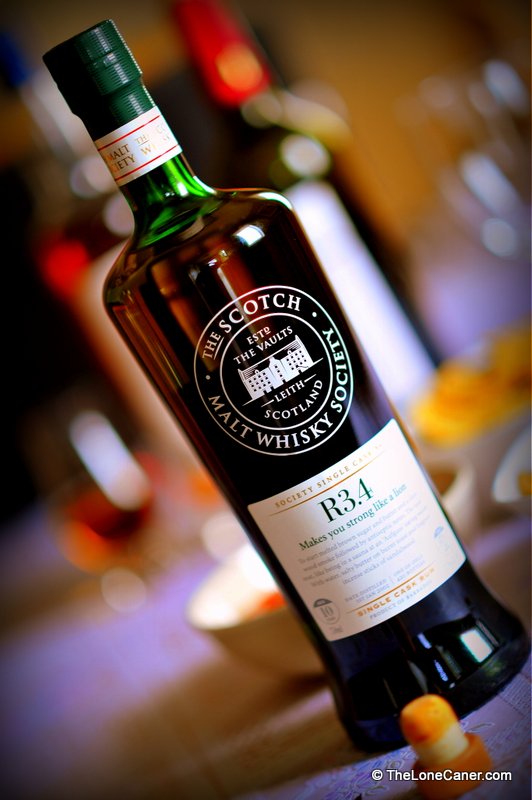
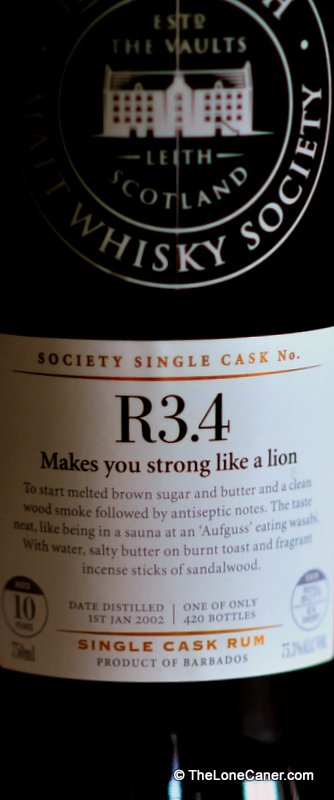
This feels and tastes mean, largely because it is. But just because it treats you like life on Keith Richards’s face isn’t an automatic disqualification…I just call it inspired insanity, and have (much to my own surprise) given it the highest rating I’ve ever awarded to a 75% overproof.

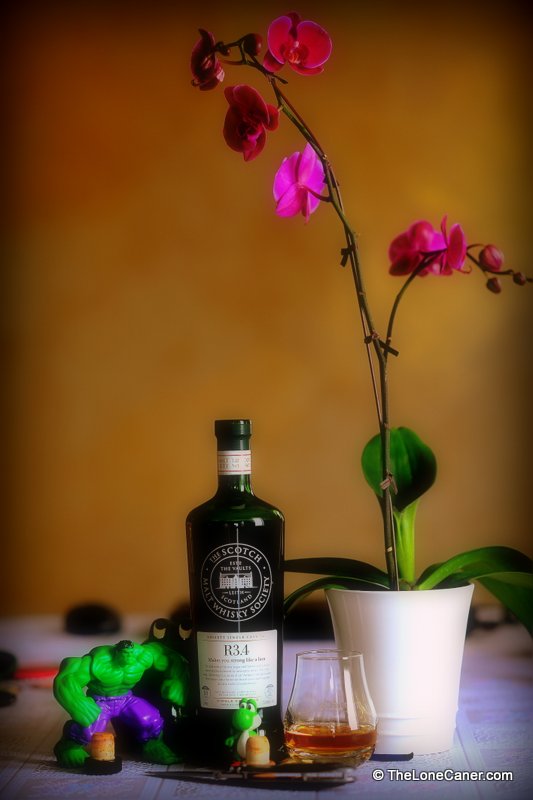
“Makes you strong like a lion”, the label remarks, in one of those tongue-in cheek references with which the SMWS likes to charm its buyers. After being battered into near insensibility (on more than one occasion) by the raging yak that was the SMWS R5.1 Longpond 9 year old 81.3%, you’ll forgive me for approaching the almost-as-torqued up 75.3% R3.4 rum with something akin to serious apprehension. I mean, I love strong and flavourful rums of real intensity, but it’s my personal belief that the folks at SMWS are snickering into their sporrans when they issue these massive overproofs, hoping that the lesser bred such as I will get a hurt real bad, be put under the table for the count, and swear off rums altogether. You kind of have to admire their persistence in the matter.

D3S_7036What we had here was a 75.3% rum issued this year (2013), with the usual obscure moniker “R3.4” which my research suggests makes the rum from the Rockley Still from the West Indian Refinery in Black Rock, Barbados. About which, I hasten to add, I know little, not having tasted their products (Bristol Spirits has a couple from there, which I hope to get my grubby little paws on one of these happy days).

Dressed up in that delightfully tall, menacing camo-green bottle that is their standard, the R3.4 decanted a pungent, blonde-amber rum into the glass, quite innocently. Here, come try me, it seemed to invite, and you just knew it was suckering me in…fortunately, I had previously sampled its sibling, so I was prepared, having learnt my lesson by now: I let it stand, and then nosed it very, very carefully.

Bam! it went, right away, even after a few minutes. My God, but this was strong. Shudderringly odd, this was a rum in psychopath mode, a snorting, rearing mustang of pent up aggression. Creamy, buttery, slightly salty, almonds and peanuts stomped my schnozz right out of the gate. As sharp as a sushi master’s knife, yes, but Lordie, there was a lot going on here. As it opened up it presented even more: bananas, some mustiness and smoke, the faintest odour of Benedictine. I was impressed in spite of myself, and marked it high for sheer originality, because all other 75% rums (the 151s, if you will), were so straightforwardly simple and relatively uncomplex, that finding this plethora of nasal riches was a welcome surprise.

D3S_7038As for the palate, coat your tongue with fire suppressant material before drinking, in case your rum-drinking life flickers before your eyes. Once the fire subsided, the same creamy chewiness from the nose carried over well upon arrival – butter melting in an iron skillet, fried bananas, all wrapped up in a herbal background I couldn’t quite separate out. Intense, very intense. Wood, grassiness, rosemary, sorrel, with a snarky element of smoky peat in there someplace making mischief. It honestly felt like it was powered with fire and brimstone, this one, yet nowhere near as barefacedly badass as any of the other 151 rums I’ve tried in the past…there’s some real couth here, honestly. But of course it is damned strong, and so warning of sobriety transmuted to drunkneness in 2.5 shots is not me being overly metaphorical..

The fade, as befitted an overproof rum, was quite long and very solid, heat and warmth without real spice, somewhat fruity, nutty, salty, and giving up last hints of oats and bran. I s**t you not, this rum was quite something, and Stuart, who was drinking it with me (he had been clouted about the ears with the Longpond as well, and was therefore understandably cautious with this one), liked it so much he immediately started calling around asking where he could get hisself some too.

All right, so let’s sum up. Short version, if you want a good time, no stress or aggro, buy something softer…like the Centenario Legado, for example. If you want to be astonished out of your socks by a rum explosion of startling, glute-flexing originality, this is the one to get (if you can). You don’t need to be a rum snob, collector or even a rum lover to appreciate a bit of overproof blending skill on your table (or your office desktop after hours).

It’s been a long running gag on Liquorature that I resolutely refuse to admit that whiskies have pride of place in the spirits world, and the crown should rightfully go to the rums. Here’s one I wish we could get more of, ‘cause it kinda proves my point (it’s made by whisky lovers, much to my annoyance). Drinking this, trying to describe it in words, I am faced with bafflement. I don’t know. It’s crazy. This rum is liquid, industrial-strength factory effluent that tastes three times as good as it should.

(#174. 88/100)

Jul 092013
 

D3S_7067


Butch mixed in with a bit of Ziggy Stardust.

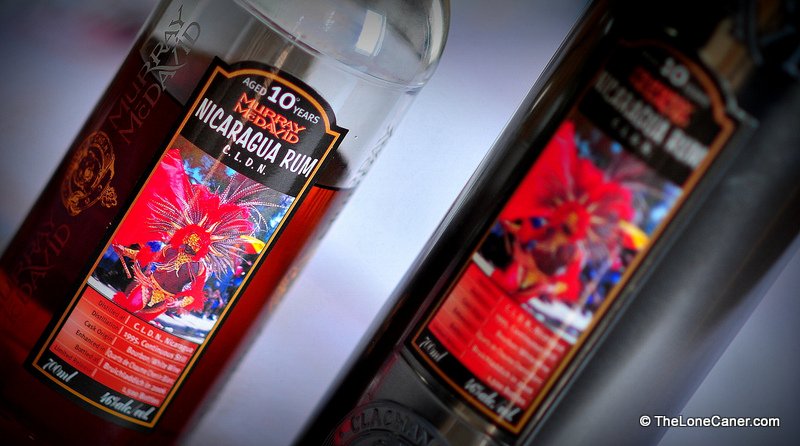
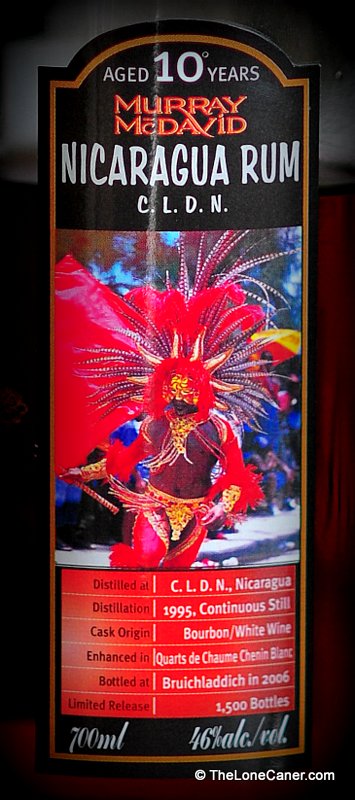
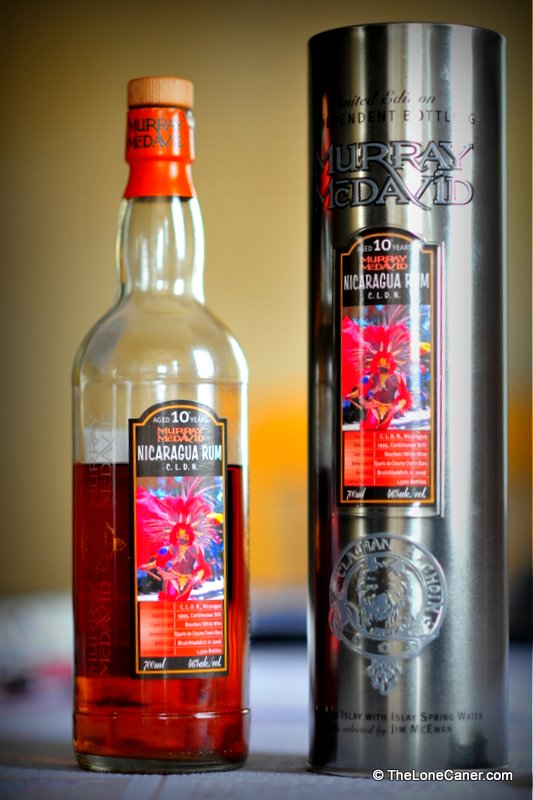
Whisky fans will know all about Murray McDavid, which is part of Bruichladdich, those fine folks who make the many inconsistent (if always interesting) Renegade Rums. It’s actually possible that this rum was a precursor to the whole Renegade line, being made somewhat earlier (mid-2000s) and adhering as it does to many of the principles of those rums: casks sourced from the Caribbean and elsewhere, aged in Scotland and finished in a wine of some kind.

D3S_7072Nicaragua is of course the home of a very decent range of rums, the Flor de Caña line, which I reviewed some years ago (have I really been doing this since 2009?). That series is made by Compañia Licorera de Nicaragua, which was established in 1937 to produce and market the Flor. In 1996 they did a complete factory upgrade which allowed them to attain the coveted ISO 9002 certification, and nowadays they use a 3 column continuous still to produce both the Flor variations, and the bulk rum sold to bottlers and blenders in Europe. Evidently they have done this for a while, since MM bought the distillate back in 1995 prior to the upgrade, and mellowed them in casks selected by Jim McEwan hisself, finally finished in wine casks previously used for Quarts de Chaume Blanc.

That finishing might have accounted for some of the androgynous flavours that presented themselves on the initial nose, because really, this rum had very few of what one might term “standard” rum notes of molasses and caramel or brown sugar – those were there, but they were extremely somnolent, almost reticent, as if afraid to come forward and take their accustomed position on the podium. Instead what I got was a rather light rum nose, musty, even dry-ish, more reminiscent of honey, ripe pears, cashews and pineapple, wound about with some smokiness and a vague and unsettling plastic bubble wrap fillip I can’t say I cared for.

The taste began with some heat deriving from the 46% bottling strength and then settled down into a rather less than aggressive series of flavours – orange peel, pineapple, fresh mangoes, honey, with a dash of salt. It’s a really subtle kind of rum with very little really positive, clear notes one could easily pick out. In fact, I’d have to say that it’s success rests more on the overall texture on the tongue than it does on taste, because there’s something a little bland about the whole experience, and which made my overall opinion much more middling than it might have been with a more striking, clear-cut profile (but then, that’s my preference in these matters). The MM10 departed the scene with a reasonably long goodbye, a little dry, and here again, while I could sense the underlying textural complexity, the final tastes were so vague as to be absent almost entirely, and on that basis I’d say the finish is the weakest part of the whole.

D3S_7064

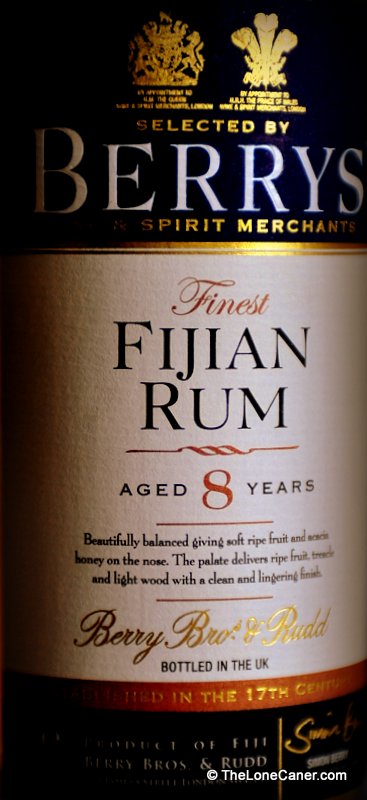
Having made these observations on nose, taste and finish, where does that leave me standing with respect to a final summation? Much like the rum itself, I’m afraid…somewhere in the middle. Aspects of it I liked were the nose and the mouthfeel, and some of the tastes. Aspects I was less enthused by were the paucity and lightness of those same tastes and the lack of a decent finish (which, in a 46% rum, is somewhat of a surprise, really). As with the Berry Brothers & Rudd Fijian 8 year old I looked at not too long ago, I could sense quality moving murkily underneath the pieces that didn’t work for me, and I can relate most of them to that placid “I’m good enough” palate that didn’t really get the attention it should have, that would have raised the bar a bit.

The rum therefore doesn’t quite gel for me as a consequence. I guess they could have injected some oomph into it, made the taste somewhat more assertive. That might have not pleased people with sharper, more consequential and perceptive snoots than mine.  But in my review here, at least that would have bumped it up from promising without delivery, to flawed masterpiece.

(#173. 81.5/100)


Other Notes

  • Bottle provided courtesy of Chip at the Rum Howler so I don’t know how much it costs
  • 1500 bottles were issued in 2006
  • 2024 Video Review is here.


Jun 212013
 

D3S_6841


Quasimodo in a shrink-wrapped muscle-car with overlarge tyres

Rums have gotten, over the decades and centuries, rather civilized. Sweaty muscular beefcakes like the SMWS Longpond 9 81.3% and the Bacardi 151 always exist, of course, accompanied by more uncouth and less cultured rums even than that, made less for export than for local consumption…but for the most part, what we get is soft, soothing, decent, well padded.

This 46% rum, however, made by those genteel fellows in England, Berry Brothers & Rudd, was none of these things…which, when you recall the near-brilliant 1975 Port Mourant they also made, is kind of odd. Civilized? Nope. Smooth? Not really. Calming, easy on the nose? Don’t make me laugh. Berry Brothers have done something rather amazingly insane, or stupefyingly stupid depending on your viewpoint, with this Fijian product. They’ve made it a raw, nasty, brutish, ugly, foul tasting kill divil that I dunno, should be used to scour the paint job off your souped up Ford F150. Or maybe fuel it.

You think I’m kidding, right? Yeah…but no.

Some time ago I reviewed the SMWS Longpond 9, and the Rum Nation Demerara 23 and the Jamaica 25 year old. All three of these had rubbery, almost medicinal notes to them that were initially somewhat disconcerting, but eventually melded into a unique whole I could not help but appreciate. The off-notes I didn’t care for were relatively subdued and well integrated into a fascinating synthesis. No such feeling swept over me as my brother and I nosed the Berry Brothers & Rudd Fijian 8 year old. Because in this case, raw plasticine and rubber notes were so powerful, that I felt a Bugatti had just peeled out of the shop, leaving a black strip on the pavement a mile wide. Medicinal, turpentine, paint thinner was what you got on that nose. Iodine, seaweed, brine, salt biscuits. And then more burnt rubber. They held a commanding stance from the outset, and never let go. Yes there were also timid, trembling scents of grassy and herbal aromas that crept in as if afraid to be noticed; yes, if you paid attention you would get apple cider and perhaps a flirt of not quite ripe pineapple. But it was small consolation. You had to try too hard. They were shouldered aside and squashed flat.

D3S_6846To taste, it was heated and spicy, as befitted a stronger product, and it was reasonably smooth, not raw and clawing, so no issues there. Hay-blonde, quite light, somewhat thin and clear and clean on the tongue. I was kind of suckered in by some lazy background notes of freshly-sawn white wood of some kind, bananas, softer pineapple and an even fainter grassy-green floral note that developed over time, but then the uncompromising rubber returned. Merde, but this was unpleasant. Iodine, seaweed, some peat (I kid you not) mixed it up in the schoolyard with an overweight bully of peeling rubber, turpentine and styrofoam. It’s like I was trying to sample a neoprene suit left behind on the set of “Debbie Does Dallas.” I can concede without hesitation that the texture was pretty good, it felt physically pleasant in the mouth, and the finish was medium long and heated (and may have been the best thing about it, perhaps because we could now see an end to the experience). But I simply don’t appreciate a rum that is redolent of the freshly torn plastic coming off new, over-polished wooden furniture.

So, with all due apologies to BBR (who have made other rums I really enjoyed), this is not a rum I cared for. I asked a dedicated maltster whether, given the profile I described, he would buy it (for $75, which is what I paid), and he said probably, so it may work better for Islay-lovers than it did for me. The thing is, underneath the taste is the texture, and in that texture and mouthfeel you can sense the rum this could have been had it been toned down a bit, perhaps been a bit sweeter (and this is why I scored it as I have). I always thought the Renegades were inconsistent and made by — and perhaps for — whisky lovers, and here we have another in that vein, something of a harnessed lunatic, loud and uncouth and unrefined as a fading rock star’s leopard-skin trousers.

It probably won’t sell much, but you know, I do have a kind of sneaking admiration for the concept, much as I shudder at the taste. It takes a certain kind of guts to make a rum that tastes so crazily off base as to appeal to not just the 1%, but the 1% of that 1% who would welcome the adventure, appreciate the uniqueness and throw caution to the winds when drinking it. Because, for sure, there are very few rums in my whole experience which are anything like this Fijian popskull.

Just be warned – It’s an absolute animal of a drink to have if you’re not prepared.

(#169. 80.5/100)


Other Notes

  • As is usual with craft bottlings such as this one, I could not find much information on the source. However, since there really is only one distillery on Fiji (the South Pacific Distillery, which makes the seemingly well-regarded Bounty brand), it seems reasonable to suppose that the raw stock comes from there. In what barrels it was aged and in which country, is something I’m currently still researching.
  • Given the light and clean profile, I will hazard that the distillate comes from sugar cane juice (like an agricole) and not from molasses, and is probably a column still product. Still, these are merely my conjectures since SPR has both a pot and column still in residence, so if a reader has more info, please post a remark.
  • I notice that there are nine and ten year old Fijian rums made by BBR as well.


May 122013
 

D3S_5540

Schizoid, androgynous, curious rum. Too well made to ignore, but not appealing enough to collect.

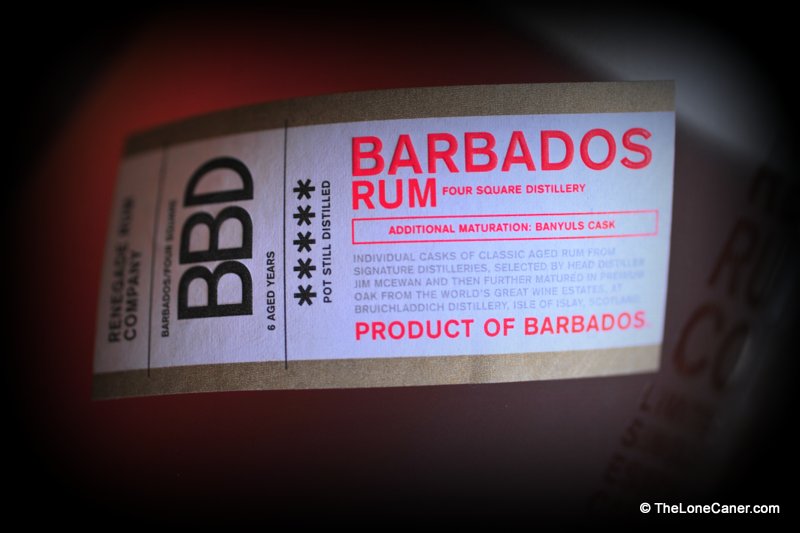
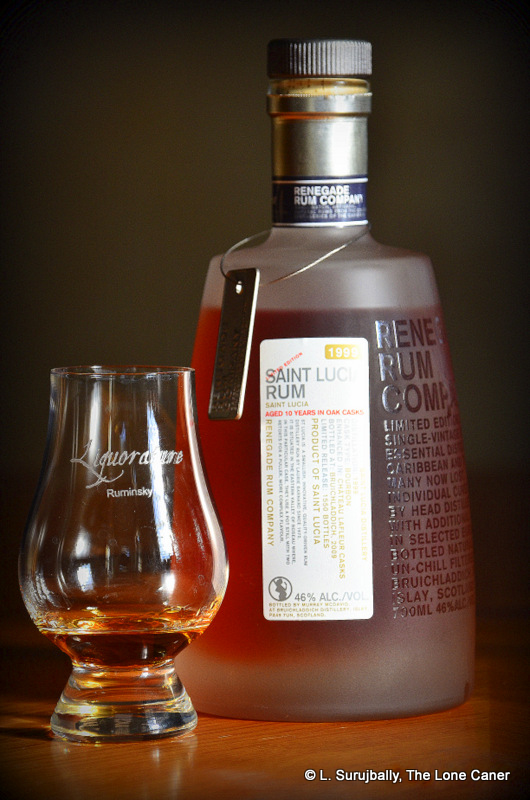
Right during the tasting, before I had done a single bit of research or perused the label beyond the obvious, I looked at my glass, smacked my not quite toothless gums and opined loudly and dogmatically (if not quite coherently) to an empty house that this was a rum from the Foursquare distillery in Barbados.

You might well ask whether my snoot is that good (it’s not), my memory that clear (it’s not) or I knew it for sure (I didn’t). It was more a process of elimination from the Bajan rum canon – it was too clear taste-wise — and not soft enough — to be a St Nicholas Abbey, lacked the discombobulated, raw nature of the Cockspur and sure wasn’t a Mount Gay.  That didn’t leave much, no matter how or with what cask Renegade decided to finish it.

Take the opening: soft, flowery, dark sugars, bananas and unsweetened dark chocolate.  A bit sharp (it was bottled at 46%, so, okay). Red grapes just starting to go off, bananas, orange peel (not anything sharper like grapefruit or lemon), and a final flirt of cherries, yet overall, the scents married uneasily, resulting in something vaguely androgynous, neither strong or puissant enough to be a bellowing buccaneer (it waved the cutlass to genteelly for that) nor weak enough to be an underproof…it was an uneasy mix of delicacy and clarity without strength of real character (did someone say “Prince Myshkyn”?).

D3S_5543

No relief on the palate, however original it turned out to be. The medium bodied amber spirit was drier than I expected, and even a bit briny, and pulled an interesting rabbit out of the bottle…it tasted good enough, full enough, to seem more robust than it actually was. Bananas and white chocolate, a certain creaminess (like unsalted butter, really), white guavas and pecans.  I know this sounds odd, but it almost seemed a shade…crunchy. It’s the craziest thing, a sort of dichotomy between the taste and the nose that had heat and citrus-plus-grapes to sniff, yet more settled and softer to sip, finishing off with a sweet, dry exit, segueing into final notes of bananas, apricots and salt biscuits.

I have some mixed feelings on the Renegade here, admiring its professional make and the clarity of the various notes, without actually enjoying the overall experience due to a discordance in the overall marriage of constituent elements.  It’s not a bad rum at all, just not one I really felt like raving about to any who would listen.  Yet I cannot help but admire how Renegade doesn’t really care – they tried for something off the reservation, and they succeeded. It’s original, that’s for sure.

Unlike most of the Renegades I’ve tried thus far, the label gave me little to work with on the details (I like knowing as much about a rum as possible when doing the write-up). Nothing about the finishing which Bruichladdich usually likes to trumpet front and center, for example…I don’t know why, so here’s what my research (and the bottle) did bring up.  Pot still origin. Finished in Ribero del Duero casks – this is a fruity red wine from north central Spain, which explained something of the profile.  Yes, the Foursquare distillery supplied the rum, so I called it on that one…though it wasn’t until I took a hard look at the label that I saw it self-evidently mentioned.  I should get my glasses changed, or perhaps research before I drink, not after.

D3S_5538

But it’s not that any of this matters, really.  I’ve said before that Renegades are something of an acquired taste, should never be one’s first try at a rum, and are all quite fascinatingly different — this may be, as I’ve remarked elsewhere, because they are made by whisky makers for whisky drinkers with rummies perhaps as an afterthought.  They fail to craft a consistent rum from one bottle to the next (the variations in the line are occasionally awe-inspiring) but they know that the best way to approach making any of them is with a bold and unapologetic take-that attitude that finds ‘em swinging — hard — for the fences, every time, with a sort of giddy, joyous abandon one simply has to admire.  So, the end product may not always be what we expect…but man, it’s like watching a Sobers, Worrell, Lloyd or Lara on a weird day.  It’s never, ever boring.

(#161. 82/100)


Other Notes

May 072013
 

D3S_5509

Crackers and butter

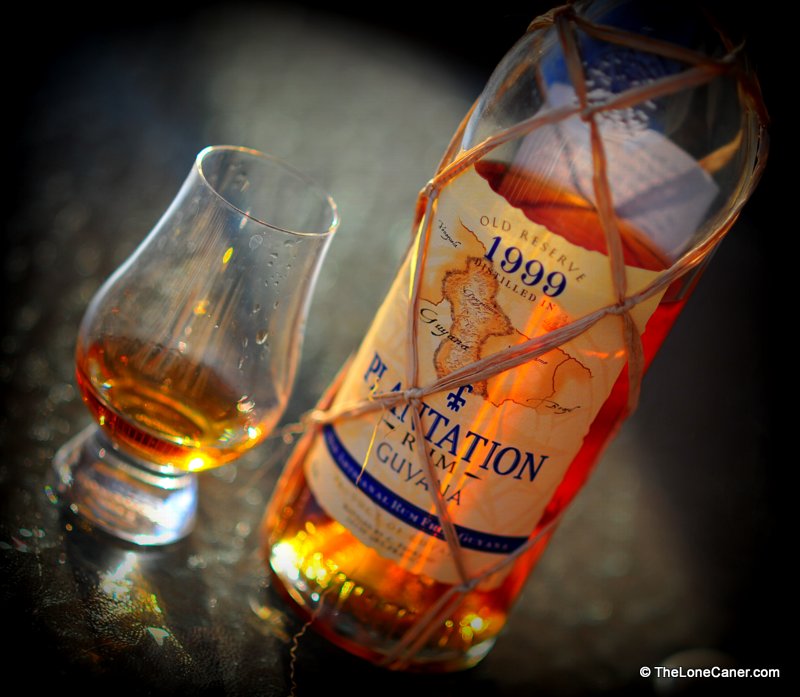
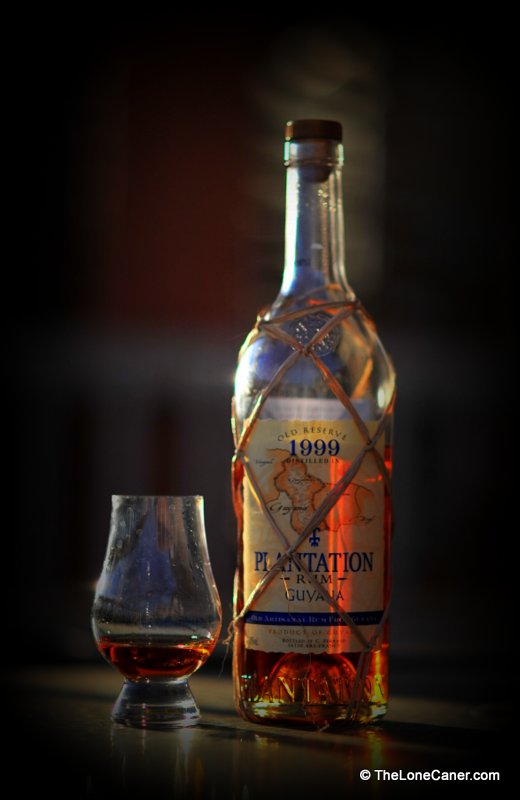
Given how much I care for Guyanese style Demerara rums (even if some of them actually originate from plantations closer to Berbice), and knowing something of the various profiles hailing from these old sugar estates, I must confess to being quite surprised at the sharp left turn this 45% ABV Plantation rum made.

No really. As soon as I opened the bottle to pour the gold-amber rum into my glass, the very first scent that reached me was salt biscuits and creamy, unsalted butter.  This, to me was quite unmistakable, because in my youth I was once caught on a tramp steamer in the Atlantic for three days, and all we had to eat was salt biscuits, crackers and peanut butter (and some jam) – and the Guyana 1999 rum mirrored those scents so faithfully it was, quite frankly, like being back on board.  Okay, it did mellow out, I can’t kid about that – into smoke and wet, rain drenched wood, tannins from oak, only slowly deepening into almonds, faint citrus, hibiscus flowers and softer caramel and burnt sugar (for which I was thankful – I’ve never appreciated salt biscuits since that time).

The Guyana 1999 suggested a certain clarity and hardness rather than softer, more voluptuous tastes.  Very little soothing gentleness here, yet also no real bite and sting on the palate.  Indeed, the somewhat briny, tannic nose transmogrified into a creamier, very pleasantly oily feel on the tongue, and the previously restrained ponies of sugar, vanilla and caramel were allowed freer rein, though they never went so far as to dominate the overall flavour profile. Indeed, were it not for that clear, dominant “I am here” taste of butterscotch and burnt sugar, this rum would have been a lot more delicate and flowery to taste.  And there were few, if any fleshy fruit or citrus notes here at all, nor where there any on the finish.  It’s a very strange rum to try, yet also a pretty good one – this is one case where the palate exceeds the nose (I often find the opposite to be the case). The fade is medium to long, with a rather hard denouement of blackberries and almond nuttiness that goes on for quite some time.

D3S_5507

Plantation is one of the famed rums made in series and in quantity by what is termed an independent bottler – Cognac Ferrand from France, in this case.  There are many others – Rum Nation, Renegade, Fassbind, Berry Brothers & Rudd and Velier are just a few examples – but most of these tend towards a few thousand bottles per run, originating in a few casks, while I get the impression that CF does quite a bit more than that for each of its editions. The claim to fame of the Plantation line, and what gives them such a great street rep, is their finishing for a final few months in cognac casks, which imparts an intriguing flavour to each and every one of their rums I’ve been fortunate enough to try thus far, providing an intriguing counterpoint to the Renegade line, which to my mind attempts the same thing a little less successfully.

Also, I think that the slight saltiness and background cracker taste on the fade makes the rum drop a bit more than usual for me – oh, I liked it, but I enjoyed other Plantations more (the Nicaragua 2001, for example, and the Barbados 20th Anniversary for sure).  For a Mudlander, even one in exile as long as I have been, that’s nothing short of embarrassing.  Still, I have to make this observation – I tried it side by side with the Renegade Barbados 2003 6 year old (coming soon to the review site near you), and doing the tasting in tandem revealed something of the character and richness of the Plantation rum which Renegade lacked…so it’s certainly better than a solo-only tasting or my ambivalent wording here might imply.

There aren’t many rums I try that evoke such strong, definitive memories.  I may not have enjoyed eating stale crackers and jam for three straight days on the Atlantic Ocean, no…what I took away from that experience was more of the black, moonless nights, blazing with stars, phosphorescent green water lapping against the hull, desultory conversations with the mate at three in the morning (while sharing some unspeakable hooch), being young, immortal and seventeen, and considering myself part of a grand adventure.  This rum, with a middling nose and finish and a very pleasant palate, brought back that experience in a way that was nothing short of amazing.

Don’t know about you, but for me that’s beyond price.

(#160. 84.5/100)


Other Notes

  • According to Master Quill, his bottle of this rum has April 2009 on the bottle, so I am taking that as reasonable proof of age.
  • No mention of the stills is made anywhere except Difford’s which referred to it as coming from “a small traditional copper still”. Plantation’s own site page for the vintage series doesn’t go back as far as 2009, let alone 1999, which is an issue of longevity and preservation of information about which I have serious concerns, but a subject too long for a quick comment here.
Apr 182013
 

D7K_1275

*

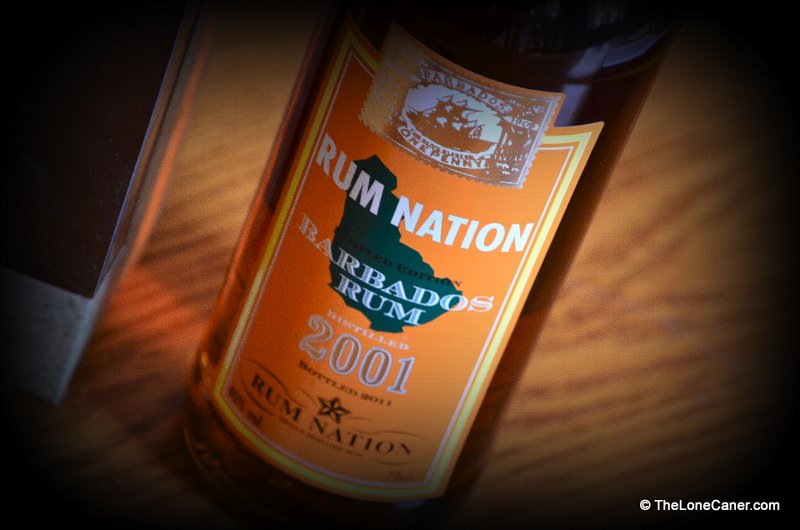
The Barbados 2001 from Rum Nation is a solid plate of eddoes and plantains, black pudding and cookup on a refectory table…the spirituous equivalent of comfort food. It’s a warm bosom against which one can relievedly lean after a tough day…and call it Mommy. A good, warm-hearted, undemanding rum of unexpected depth.

Rummaging idly through my shelves the other day (“Jeez, what am I going to look at this week?”) I came across one of the last two unreviewed Rum Nation products I had bought back in 2011 after having been impressed as all get out by the Raucous Rums tasting session where the host had introduced them. Rum Nation is that Italian outfit which opened its doors up in 1999, and has produced some of my favourite rums – the 1985 and 1989 Demerara 23 year olds, and the Jamaican 1985 “Supreme Lord” 25 year old among others. This Barbados variant was laid down in 2001 and bottled in 2011, and it’s a very decent product in all the aspects that matter, though not of a level that exceeds the pinnacles of achievement represented by the rums I refer to above.

So it’s not a top end rum, but it’s not a lowbrow piece of entertainment either, much as the cheap, plastic-windowed cardboard box reminiscent of an unwelcome bill envelope might intimate otherwise. The nose for example, is very pleasantly warm and almost thick, with initial flavours of bananas, vanilla and crushed walnuts mingling pleasantly with an earthy scent of ripe fleshy fruit, more cashews than peaches. It had an odd kind of richness about it, very near to cloying (though not quite there), that gradually transmuted into a floral hint with a last snap of smoke. Estery, I guess you could call it. Not entirely successful, to my mind, the aromas didn’t quite marry properly into a cohesive whole, but overall, it’s not bad at all.

The palate? All is forgiven, come home please. Oh, this was just fine. Smooth, warm, creamy, like banana ice cream liberally drizzled with caramel, toffee, a little licorice and nougat, all sprinkled with white chocolate and a shade of mint: put a cuckoo clock on top of it and you could almost pretend it was swiss. Rich and pleasantly deep for a 40% rum, and unlike some drinks where the nose was spectacular but the taste less so, here it was the other way around. The denouement was also quite good, pleasantly long and fragrant, exiting to the tune of cinnamon and vanilla and a last bash of the banana.

D7K_1276

According to Fabio Rossi, the owner of RN, this is considered an entry level rum (retailing for about €30…Can$50 in my location), and is Barbados-sourced pot and column still blended rum from the West Indies Refinery, matured in American oak casks and then finished for about twelve to eighteen months in Spanish casks that once held brandy. I was unenthused about Downslope Distilling’s wine aged rum some months ago – this is the rum that it should have been, could have been, had they been more patient and aged it properly.

Is it better than the other Bajans in my collection? Yes and no. It’s not as good as the Mount Gay 1703, but exceeds the XO by quite a bit, I would say, and edges out the A.D. Rattray 9 year old from R.L. Seale I looked at not too long ago. Its relative softness and smoothness is the key here (see other notes, below): it pulls an interesting trick, by seeming to be more full bodied than it is, and therefore coating the mouth with a sumptuous set of tastes that, had that slight cloying over-estery note not been present, would have scored higher with me than it did.

Still, if you’re after a good, solid sipping rum, the Barbados 2001 won’t disappoint. It’s soft, warm and easy on the palate, forgiving on the finish. It may be a rum to have when you’re feeling at peace with the world (or unwinding from it), don’t feel like concentrating too hard, and don’t need to protect your tonsils. On that level, it’s excellent at all it sets out do, and if it doesn’t ascend or aspire to the levels of some of its pricier, older cousins, at least it’s an excellent buy for the money you do shell out.

(#156. 85/100)


Other Notes

  • February 2018 – By now it is common knowledge that Rum Nation, like Plantation, practices the addition of something (usually caramel beyond just colouring) referred to somewhat inaccurately but descriptively as “dosing”.  This rum measures out at ~10g/L of adulteration which actually quite minimal: enough to smoothen out some rough edges, but not enough to make it a mess. Potential buyers and drinkers will have to take that into account when deciding on a purchase here.


Mar 142013
 

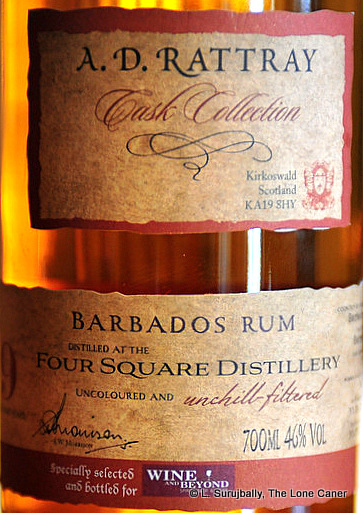
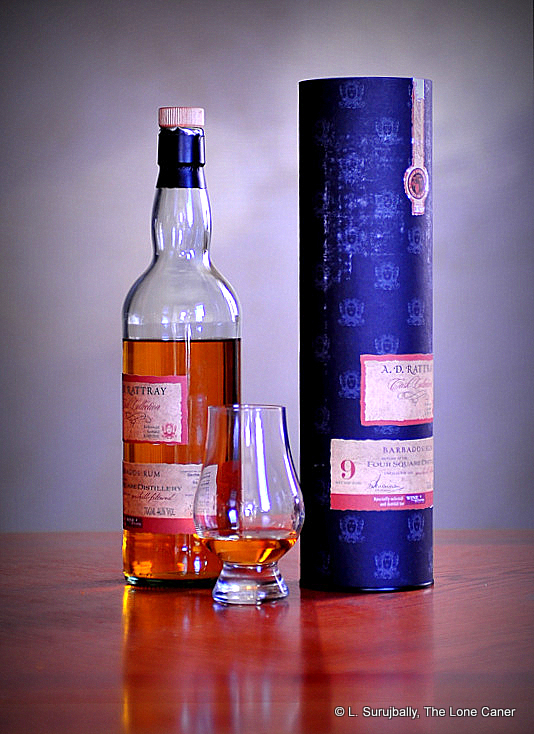
To date, the only A.D. Rattray rum I’ve tried was the excellent Caroni 1997, which was quite impressive, if no longer readily available. To this is now added their Barbados 9 year old, also bottled at 46%, non chill filtered, with exactly zero additives, very much in line with the puritan, zen-like production ethic that so characterizes, oh, Cadenhead. This one was taken from a single barrel for the likker establishment “Wine & Beyond” in Edmonton (they have a few others as well, but my slender purse ran out and Mrs. Caner was watching).

I must say that after decanting this honey-hay-blonde rum into the glass, my first thought on nosing it was a rather startled “This smells like Thai food.” No, really. Sweet, and salty, with faint fruity and vegetal notes, and quite dry at first blush. I wasn’t entirely sure I liked it, but then it kinda won me over, because the aromas morphed into a herbal, burnt lemon-grass smell, which then stopped being pissy, and comfortably settled into cherries, fleshy apricots just on the edge of too ripe, and a subtle light honey. It was like breaking in a new armchair that was too stiff at the outset, but then conformed to my buttprint after I had reposed in it for a while.

This medium bodied rum was initially spicy, sharp – following on from the nose, and probably due to the 46% ABV bottling strength – as well as dry. It rewarded some time for it to have those alcohol fumes to burn off, and then the rather stern, starch-stiff lead-in flowed into a warm and fuzzy embrace, as if a nun stooped to hug me and it became a teddy bear. Really, it followed on from the nose like Mary’s little lamb (if not so gentle) – those sweet/salt notes were there again, followed by a smoky background, and then a softer, creamier taste, quite pleasing, of soft white guavas and bananas. The palate then took me by the hand and sat me down with a flourish of burnt sugar – the grassy hints from the nose were as gone as yesterday’s news. And it all segued into a long and warm and dry finish, with final hints of leather, smoke and caramel.

Note the difference with the Coruba 12 year old “Cigar” I looked at not too long ago. In that product, the lightness, the smokiness, the overall mouthfeel and exit were simply not that pleasant for a rum so aged – A.D.Rattray have managed to take a younger rum and keep the character while losing the bitchiness. Granted the source stock was from two separate islands with different distillation methodologies and starting points, yet to my mind the ADR Barbados 9 year old succeeded in combining its core elements in a way that the Jamaican product did not.

Foursquare distillery is one of four rum producers left in Barbados – the others are Mount Gay (of course), WIRD and St. Nicholas Abbey. The first is something of the big guy (reputation-wise) on the block, the second a behemoth which does noting special and specializes in bulk sales, and the last is a micro-boutique establishment, several orders smaller. Foursquare, part of R.L.Seale & Co and owned and managed by Sir David Seale, sits somewhere in the middle (a good link on the MoR which describes it, is here). They also make the Doorly’s line, with which I have always been unimpressed, but fair is fair: I have not seen enough of their products to make any kind of generalized statements about them.

Summing up: this rum is a spirit meant for those who know what they like, and have slept around a bit in the caramel boudoirs of the rum tasting world. Please don’t take offense if I remark that it should not be the first rum you ever try. I consider it to be a rum very much in the Renegade vein – limited, distinct, with a character and a profile very much its own, that makes no attempt to hew to any kind of generalized “let’s see how many people we can please” philosophy. It’s too early for me to say if the other ADR products I saw that day are as good as the Caroni, or how the overall line will pan out: as far as this one goes, it’s quite a good dram, which should simply be treated with a little respect and a little care, otherwise you might find yourself dismissing it too quickly, to your own detriment.

(#149. 83.5/100)


Other notes

  • Cask #15, 363 bottles. Distilled 2003, bottled 2012.
  • Update, July 2021 – This is a very dated bottling, and provides an interesting insight into how Foursquare was perceived at the time (2012-2013).
  • There is no indication on the bottle as to whether it is pot- or column-still or a blend of both.


Dec 042012
 

Good sipper for the money: if you’re on a budget, get the Admiral Rodney Extra Old, if not, this one is a shade better for not too much extra.

(This is the last entry in my four-rum review series of St Lucia Distiller’s rums, which I tasted together a few weeks ago).

Rum makers occasionally issue an expression which commemorates an event or a date that has particular meaning for them and then turn that into a marketing tool (like the Angostura 1919 or the Flor de Cana “21”) – it’s always touted as being a cut above the ordinary, although I have my private feelings about the veracity of such statements. In this instance,

The sources for this excellent rum were the distillates from three copper pot stills and one columnar (Coffey) still ranging from 1999 to 2004 (which, given that it was made in 2011 makes it a 7 year old): the rums were aged (according to the company site) in white oak casks including Jim Beam, Jack Daniels, Buffalo Trace and a couple of Port casks, then blended and left to marry for three more months before bottling at 43% abv.

Influences from all that bourbon and whisky, as well as the oak, were immediately evident on the nose, which was fuller, deeper – even darker – than its predecessors. Not quite on the level of the El Dorados, but very nice for all that, and got even better as it opened up. Traces of raisins and dried fruits mingled happily with pomegranates, figs, and apples just on the ragged edge of going too ripe, enveloped in a robust smoky background.

The rum itself had a medium to heavy body (I have a personal predilection for that), more dark red fruits, dried raisins, honey, a subtle grapey hint, and again that smoky background which made me suspect that one of the barrels may have been charred to lend some more pizzazz to the profile. Oddly, I noted few soft or fleshy kind of notes (as might have come from bananas), but a hint of orange peel, all tied up in a neat bow by burnt sugar and toffee. And on the finish it was really quite pleasant, soft and unaggressive, yet warm and long as well, with none of the savage elan of, oh, the Appletons, exiting with a hint of old tobacco and dried, well cured leather. It’s often been mentioned that with some experience one could discern a pot stilled product from one that was predominantly column stilled: and I’d guess that the richness of what I was sampling derived primarily from the pot still portion of the blend.

The 1931 was un-chill-filtered, and evinced an overall taste that was quite a bit gentler than we might be expecting to find in a slightly stronger rum (43%, remember) – I remarked in the Admiral Rodney review that this was closer in style to the Barbadians as opposed to the Cubans or the Jamaicans who are a bit more aggressive in their rum profiles and have more perceptible, spicy and citrus notes, and here again, I came to the same conclusion.

Now, on balance, I don’t believe the 1931 is quite as joyous or as interesting or as over-the-cliff a bungee jumper as the Renegade St Lucia 1999, which I liked precisely for those attributes. That one took a chance, went off the reservation, and revelled in its difference: the 1931 played it mostly safe, though it did so exceedingly well. I also don’t rate it as a super premium rum, good as it is — I have some rums in my shelf which really are super premiums, so I have a good basis for comparison and can stand by that remark. Still, for eighty dollars in my location, the 1931 is definitely a great buy.

When you really get down to it, the St Lucia Distillers 1931 expression is quite similar to the St. Nicholas Abbey 8 year old, the Dos Maderas PX 5+5 (perhaps not as heavy), or, more so, the Admiral Rodney made by the same company (though a tad stronger, with that pot and column still blend, 7-12 years old) – similar enough to its sibling, in fact, that you could try the two side by side and not immediately know which was which unless you were paying attention. That’s not entirely a problem though – it’s a subtle, soft, supple, well blended, well-aged, rum of depth and complexity and excellent all round quality. I’d not hesitate to recommend it to anyone who wants a good sipping rum.

***

Epilogue: a summing up of the four St. Lucians

Apologies to the eponymous Islanders, but there’s something subtle missing in these St Lucia rums…an element of, oh…aggressive decisiveness, of oomph and yobishness and in your face “I’m a rum” gobsmack. None of the rums are bad by any stretch, and all can be had by themselves and enjoyed quite nicely, thank you very much….but perhaps they’re taking something away from the laid back nature of St Lucia itself, which has never really had or sought much visibility or power in Caricom. Just as in real life, the Guyanese, Bajans, Trinis and Jamaicans are walking away with all the rum headlines, while little St. Lucia is happy to putter along quietly behind, making its lovely little rums, but not combative or bellicose enough to take on all comers with fire and brimstone and make them world beaters. We rum lovers will know of and appreciate their quality…sadly, not everyone else will.

(#13484/100)


Nov 232012
 

In my opinion, the best of the St. Lucia rums hailing from the eponymous distillery

We choose friends for many reasons: in my case it’s a question of what quality they add to my overall existence and what I can contribute to theirs. I may not like everything about them, or they about me (admittedly, I occasionally piss people off, sometimes just by being in the same room breathing the air they’d rather be smoking) – yet all my friends are interesting, all have quirks and characters that are appreciated and savoured. I feel the same way about rums – they may not be the best at what they try to be, but if they go for the fences with cheerful abandon, well…how can I not appreciate that?

Renegade Rums are a subset of what I term “series rums” (like the Rum Nation, Secret Treasures, Bristol and Plantation series, for example – in years to come they came to be called independent bottlers) with which I have had a love-hate relationship since I first began trying them four years ago. Some were too much like whisky, others were not aged enough, in some cases the finish just didn’t work (for me – others may differ in their assessments), and in yet others it seemed like they weren’t loved enough by the maker. In other cases they succeeded swimmingly

The Renegade St. Lucia 1999 10 year old was firmly in that last camp. Bottled at a pleasant, tongue-titillating 46% and presented in that frosted, etched bottle I’ve always sighed over, it was distilled ina  double retort pot still, aged for ten years in used Bourbon casks and then finished (for three months, I think) in Chateau LaFleur casks, which provided something of a fruity Bordeaux hint to the final profile. It was probably this which made me appreciate it more: quirky it might have been, but I couldn’t argue with the originality.
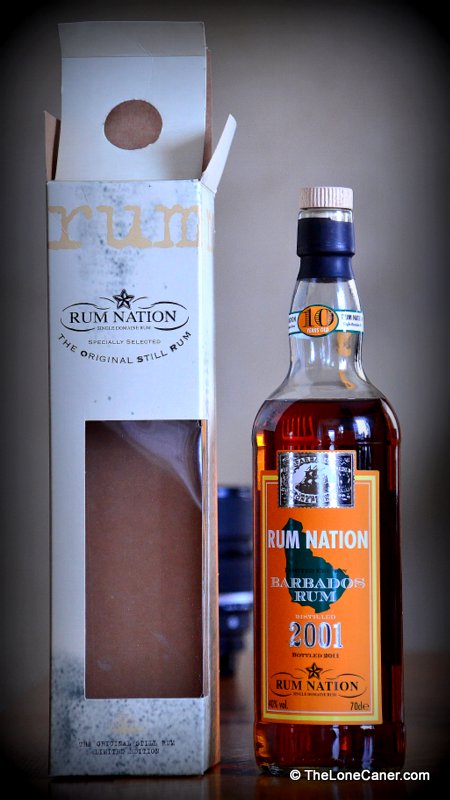
The amber, medium bodied rum was the lightest-coloured of the rums hailing from St Lucia which I tried (Forgotten CasksAdmiral Rodney and the 1931), and right away after decanting it leaped up and stabbed me in the nose with the now familiar pitchfork of Renegade’s slight overproofishness (is that a word?). Plasticine, rubber and play-dough were evinced right out of the gate – not aromas I particularly cared for, but bear with me, reader: stay with it. I had a similar experience with the Rum Nation Jamaica 25 and 1985 Demerara 23, and you gotta let that sucker breathe a bit. Do that and the next wave comes over the beachhead…smokiness, cherries, sweet breakfast spices, nougat, well-polished leather and aromatic pipe tobacco in an antique tobacconists shop found in an old European capital, along a well hidden cobbled street on a blustery day in autumn.

The taste followed right along, heated, yes, just not overbearing and mean. It wasn’t the smoothest of sipping quality rums, no – strength and youth showed in a slight bite for which I marked it down, and it had a dry tang and brininess that at first startled me – but the rum was decently aged, there was a woody backdrop to which was gradually added salt water taffy, candy, caramelized apples…plus cherries and apricots, all held in balance and harmony by scorched pine wood. Coiling around all of these sumptuous tastes were notes of Russian or black china tea…lapsang-suchong. I mean, this was just heavenly, especially since the relative youth of the rum made it spry and agile and almost mischievous, without the deep, mellow ponderousness of grandfathers (in rum years) like, oh, the Panamonte XXV or the El Dorado 25. The long finish was similarly good, exiting in the leisurely, sauntering fashion of a prima donna who knows she’s good, leaving behind the memory of salty biscuits and marzipan.

All three of St. Lucia Distillers rums scored within a few points of each other, weaknesses and low scores in one area recouped by strengths in another. Tough to choose between them all, yet, at end, I absolutely preferred the Renegade version of St Lucia’s rums to any of the others, good as they were. What it came down to was a question of character. The Admiral Rodney and 1931 were solid well-made rums: they merely hewed so closely to the line that some of the characteristics of playful experimentation were lost. For sheer originality, for sheer joy and exuberance and verve, for complexity and interesting profile, the Renegade had it.

(#133. 83.5/100)

Nov 022012


Pretty good all rounder, marred somewhat by an excessive spiciness that lends itself well to a cocktail without enhancing the rum as a sipping spirit.

Appleton’s Reserve rum from J. Wray & Nephew (in business since 1825) out of Jamaica — recently in the news for its 50 year old rum as well as a controlling stake of the main Trinidadian conglomerate being acquired by Campari — is a product that is an order of magnitude better than the entry-level V/X, assuming you use it for what I think it’s meant for: a mixer. The V/X, which is from the low end of the scale of Appleton’s products, is not meant to be a sipping spirit (though of course you can) and the Reserve is a step up from there (still has a cheap tinfoil cap, mind). Yet it still hasn’t broken into the category of rums you can pleasurably have neat – that, in my opinion, begins with the quite excellent 12 year old (although the cap remains the same).

The Reserve is a blend of twenty different Appleton pot-still and column-still rums aged for an unspecified period (I’ve heard eight years) in Jack Daniels barrels. Given that Appleton does not have a five year old rum – an odd omission in its lineup, I think – I find the eight years possible, but surprising that it is not mentioned as such right up front, since rums between five and ten years of age are often referred to as hitting the sweet spot before the blender’s art kicks in to start masking and smoothening out the inevitable oak prescence of ageing beyond that point

Initial arrival of this amber rum was quite sharp, and the characteristic Appleton signatures of orange zest and citrus were evident right away. Once it settled, one could perceive some winey notes commingled with bananas, cloves, caramel and burnt sugar…and an oakiness I really didn’t care much for.

That oak (something I’ve whinged about as far up the food chain as the 21 and 30 year old) made the taste of the medium bodied Reserve somewhat less than it could have been, because really, it was a shade sharp and raw. Uncouth and unlettered, one might say. There was a smoky background that started to come out, enhanced by vanilla, butterscotch and maybe nutmeg and cinnamon to go along with the citrus notes, yet those tannins imparted a sharpness to the whole which I did not find appealing – in fairness, I must simply concede that the V/X was sharper and thinner still, so this one certainly won out by being incrementally better.

As for the finish, it was as short and biting as a pissed off Shetland and to my mind, nothing really earthshaking – it’s about what I would expected taking into account the foregoing, although with some ice to tame it down a shade, it became a lot better, with a sly butterscotch and cinnamon close (I don’t really recommend this, by the way, but that’s a personal thing).

Summing up, then, I think that for all my complaining about the spiciness of the whole, the Reserve is a step up from the V/X. It has the characteristic Appleton taste profile for those who like it, slightly dialled down. It’s edging gently (but not quite all the way) into the territory of rums one can reasonably drink by themselves…is just a shade too heated and biting for true enjoyment in this manner. The problem this creates for the Reserve is that it makes it neither fish nor fowl – I can get a cheaper, decent mixing agent in the V/X, and a better sipping rum at a reasonable price in the twelve year old…which leaves the Reserve sitting — like a forlorn second child not knowing whether to play with its older sibling’s friends or younger one’s dolls — rather uncomfortably in the middle.

(#129 . 77/100)


Other notes

  • Around 2019, this was replaced by the Appleton Estate 8 Year Old Reserve, also a pot-column still blend, when Appleton revamped their entire lineup with new bottle shapes, labels, names, and tweaked blends.
Sep 082012


The most searingly powerful rum you are ever likely to try. Do not simultaneously bloviate and drink this, or spontaneous combustion may occur.

(#119. 81/100) [Video Review]

Don’t be frightened. A rum like the Scotch Malt Whisky Society’s R5.1 Longpond 9 year old, bottled at a grinningly ferocious cask-strength 81.3%, isn’t really out there to kill you: it just feels that way.  I used to laugh at the way Bacardi 151 and Appleton 151 made wussie forty percenters run a hot chocolate delivery into their pants…well, here’s one that takes it a step further and indulges itself in a level of industrial overkill and outright belligerence one can only admire. It’s a Longpond, it’s cask strength, its over 160 proof of tail-whuppin’ badass.  Tread warily, because it smells your fear.
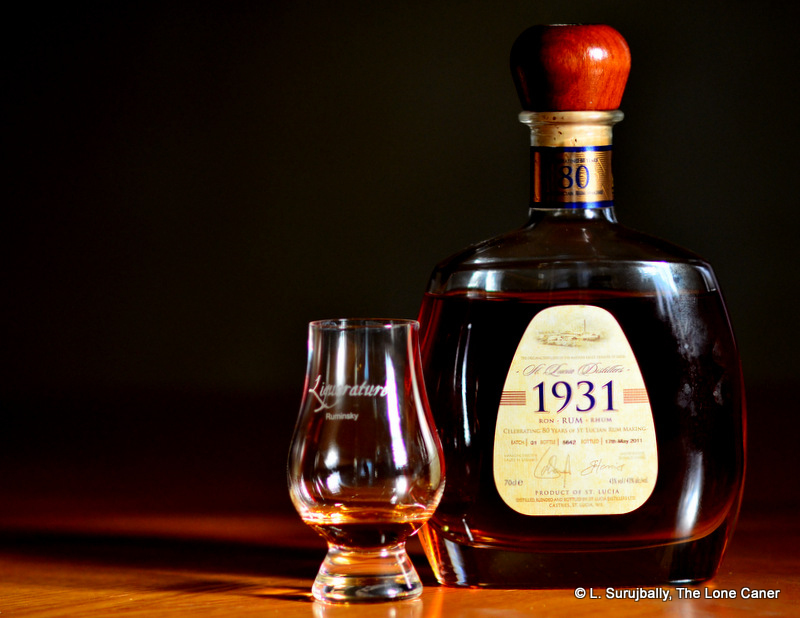
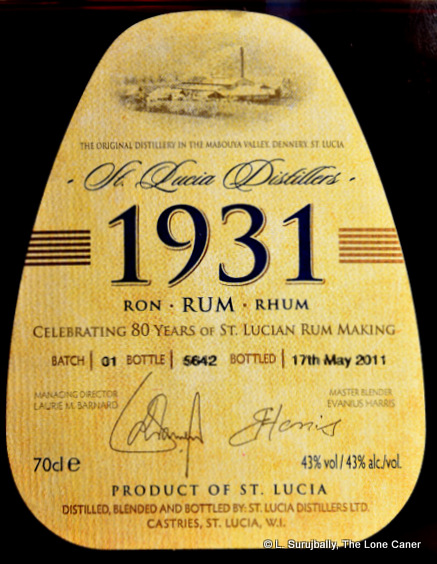
For rummies out there who, like me on occasion, are not so much into whisky lore and tend to flip an insouciant bird at the maltsters (for my whisky loving friends reading this, it’s the other guys, not you), it should be noted that the SMWS has a stated philosophy of taking what is in the barrel out of the barrel, and bottling it as is.  Bam.  Take that. No muckin’ about, no weak-kneed nonsense like “drinking strength” or “dilution with distilled water” – what you had been ageing is what you get (you can just see the boys at the Society politley ignoring the rums of Cadenhead and Renegade).  As for the R5.1, much as you might think this is an amped-up Audi supercar, it just means it derives from the first barrel of rum bought, and the 5th distillery from which they have bought it, in this case, Longpond out of Jamaica.

The corked green bottle was marked with the SMWS logo, details of origin, and tasting notes (clicking on the photo above will enlarge it so you can read, if you wish), but since I don’t read others’ tasting notes until I’ve made my own, I just went straight ahead and decanted a hay-blonde spirit into the glass.  And here I must warn you that while it smelled fantastically original, you simply could not ignore 162.6 proof – that’s not far away from pure alcohol and the aroma is therefore, a shade nuts.  Medicine, grass and freshly turned sod, with strong briny and iodine overtones, yet not so much as to make me suggest peat, more like a weird plasticine some crazy kid wants to play with (note to my friends – I refer to others’ children, not yours).

The arrival was strongly heated, as if Satan’s brimstone-flavoured pitchfork was smoothly stroking my palate.  Yet there was a trace of honey and chocolate mints there also, among the medicine and the grass, and while the turpentine evident in the taste suggested a failed artist had breathed on this baby, I have to acknowledge its overall complexity, even if it wasn’t really to my taste – I’ve continually whinged about rum moving above 40%, but 81.3% is simply too much. Maybe regular cask-strength whisky drinkers would drool over this powerful drink more than I would.  It does make a cocktail that is simply incredible, mind you.

And I must say this — the finish is, quite simply, awesome: it goes on and on and on like a pornstar on a performance bonus…I’ve never had anything remotely like it.  Five minutes after my first swallow, the fumes were still meandering up my throat in what may be the longest finish I’ve ever had, even if it does remind me somewhat of iodine flavoured camphor balls. And then, just when other rums (Lemon Hart 151Stroh 80 or Bacardi 151) run out of steam, the R5.1 burns hotter, pushes harder, gives more. This experience quickly exhausted my curses in six languages and I was reduced to weakly muttered childish wows and holy cows. Trust me, after several glasses of this monster, your eyes wobble and your sphincter seizes up, and still the rum keeps on coming.

So: the taste is biblical, the arrival is extraordinary, and the finish so strong that if it was more it would be practically nuclear and be banned by all free nations: it’s a tonsil tearing, all-out assault on your sanity. This rum should be issued with not only health advisories, but camo-green (oh wait…).  It may not be the best rum you’ve ever had (though it’s probably the strongest you’ll ever try), but you can believe me when I tell you it’s absolutely among the most original.

“If in your travels you see God,” says a modest Hattori Hanzo, the ultimate sword-maker in “Kill Bill,” when the Bride was selecting a katana, “God will be cut.”  I like this kind of becoming humility in a craftsman.  It’s a kind of reverse arrogance, acknowledging a self-evident mastery so overwhelming, so off the scale, so beyond mere hyperboles like “fantastic” or “zoweee” that there’s actually no need  to mention it at all — the product speaks for itself.

The makers of R5.1 Longpond 9 year old fall into this group of such self-deprecating uber-senseis.  It’s not that they have made a rum excellent enough that God will smile, help himself to a second roti and curry goat and pour you both another shot, no (although this is not entirely beyond the realms of possibility) – it’s more like they created a concoction so incredibly powerful, so fearsomely, mind-numbingly strong (and good, let’s not forget) that if, in your travels, you did meet God in a beer garden down by de backdam, then trust me…God would get drunk.


Other notes

Yes, there are rums stronger than this one: the 84.5% Sunset Very Strong out of St. Vincent for one. I tasted that one in late 2015 and it’s not half bad…as long as one exercises all the usual cautions. Oh and there’s the Marienburg 90% from Suriname, which is stronger in proof but weaker in quality than both. In 2020 I finally listed the 21 strongest rums in the world in an article of their own,