Aug 302010
 

First posted 30th August 2010 on Liquorature.

When I was discoursing about rums with a Calgary Co-op liquor sales manager (in my normal sneering way, and for the usual reason), I asked about this odd little label from Austria, because, with my penetrating insight and encyclopedic knowledge, I was aware that Austria didn’t have any sugar cane fields  — Andrea from the cashier’s till was called over, and noted flatly (in that no-nonsense way that people use to inform you they know the Truth even if you’re too ignorant to), that she’d had them all, tried the lot, was Austrian into the bargain on her mother’s side, and Stroh was quite simply the best spiced rum in the world, bar none (except perhaps another Stroh). Abashed into silence and trembling meekness at this powerful and unambiguous endorsement and the fierce look of “Agree with me if you want to live,” I tried to recover my backbone from the yellow paint in which it was soaking, and bought the bottle.

This illustrates the sad state to which us rum lovers have been forced into, in this whisky loving city: we’re so desperate to try something new, that we are pitifully grateful for any new rum that passes through the local shops.  Not the low or mid range from an established maker, but something genuinely new. I ruefully concede that Stroh’s meets every criteria except one: I’m not entirely convinced it actually is a rum.  Oh, it says it is, and it has the suitable origin in sugar cane by-products, whatever those might be (originally it was made from a diluted ethanol base), but note I don’t say sugar cane juice, or molasses. The problem was that when Sebastian Stroh started making this little concoction in Klagenfurt in the early 1830s, Austria was not participating in the scramble for Africa (or anywhere else), and thus lacked tropical colonies from where they could get the raw materials.  So he added his own spices and flavour and additives in order to make an ersatz molasses taste, and created a domestic rum which eventually became something of a national tipple.  Can’t fault the Europeans for trying to make a good likker, I suppose: I just wish they wouldn’t pretend this was the real McCoy.

Stroh’s is made in several varieties: the 80% variation (who the hell would drink this firewater, honestly?), 60%, 40%…I had bought what I thought was the tamer 54% version which apparently is the most popular (I expect outraged posts stating that this is the wimpy stuff and how real men drink the 80%), and was the only bottle for sale anyway. At half a litre for $35, that’s a mid-ranger, and in spite of my doubt regarding overproofs (what’s the point, beyond cooking, creating cocktails, making college freshmen drunk faster or simply causing pain?), it did, as new rums usually do, intrigue me.  Curiosity, I fear, will be the end of me one of these days, no matter how careful I am.

Good thing I was cautious.  Scarfing Keenan’s excellent brunch the next day, I cracked the bottle and I swear the alcohol wanted to strangle me right on the spot.  I’ve had some unique and aggressive rums in my day (Bundie and Pyrat’s to start), but this took distinctiveness to a whole new level.  The smell on this thing was like – and I swear this is true – plasticine. I thought for a moment I had entered a time warp and was back in primary school dicking around with play-do. The assault on my nose was so swift and savage that I shuddered, avoided Keenan’s smirking eyes, and poured a shot at arm’s length over ice: The Hippie complains that ice closes up a drink when one should leave it open, but the poor man is a fan of civilized whisky for retired country gents and has never been boinked over the head and had his nose speared by this raging Austrian drink.  You could make out some cinnamon notes and a hint of ginger when your schnozz was reluctantly returned to you, but the truth was that I thought this a vile, underspiced and overstrength drink that should under no circumstances be had “just so.”  Forget the ice.  Forget nosing, smelling, checking for legs or anything fancy. Drown this one in cola, in sprite, in juice or anything else, and quickly.  But I must make this observation: in a cola (a lot of cola), Stroh’s tastes like a damned ginger ale. Plasticine flavoured ginger ale that gives you a buzz. Weirdest thing. Not entirely a loss, therefore.

Of course, it was only later, doing my research and putting my notes together, that I read it was supposed to be used as a cooking ingredient for cakes and rumballs, as a cocktail base and a mixer with other things to produce smoother drinks of some power (like the B52).  It’s not a drink to be had neat (sure…now they tell me). Well, maybe.  Rums do have this thing about being equal part sippers and equal part mixers, and their plebian origins make it difficult to distinguish which is which, sometimes. I’ll be the first to concede that as an overproof rum, Stroh – any one of the overproof offerings – is not for the meek and mild or those who haven’t seen “300” at least five times.  Stroh’s is a hairy friggin’ barbarian of a drink, a dirty, nasty, screaming crazy, wielding a murderous nose-axe meant to do you serious harm and destroy your sight.  It’s one of the most distinctive liquors I’ve ever had, and while I may not like it much, I ruefully laugh as I recall my encounter with it, will give it due respect and a wide berth from here on in.  Austrians, other Europeans and Andrea are welcome to have it and enjoy it (although, what the hell, I still have to finish my bottle so Ill probably go back to be bashed around a bit one of these days when I’m in a masochistic mood), and if I have one in my house one day, I’ll serve it to him (along with the Coruba).

But I gotta tell you: I don’t care what they call it, or what its antecedents are – a rum, this one really is not.

(#034)(Unscored)
Feb 252010
 

First posted 25 February 2010 on Liquorature.

(#011)(Unscored)

Short, sharp sword to the guts when had neat, this rum is without question something to use as a mix and not to risk taking alone.  Needs refinement to be taken seriously, but since it’s cheap as all get-out, it does have a perverse attraction on that basis alone. Go for it if you’re feeling a bit brave today.

***

This is another one of those reviews that I wrote in order to give some weight to the Single Digit Rums.  Having tasted it, shuddered and reached for the coke, I can understand both why it costs so little, and why it’ll probably never make the table of the Club.

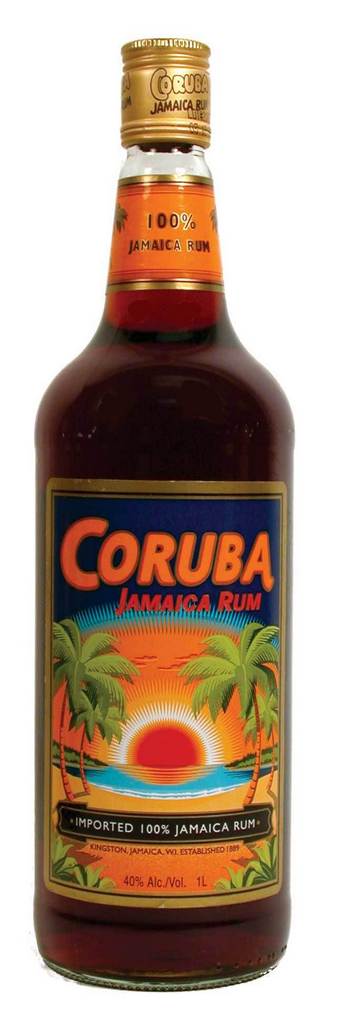
SDRs are in the main the bottom end of the ranking scale, and part of that is because they represent what I term the tipple for the masses – it’s the sort of thing I grew up on, had many a good conversation over, and eventually moved away from as my tastes became more snooty (and hence, expensive).  The Jamaica distillery of J. Wray & Nephew, home of  Appleton makes this low end rum and it’s marketed by Compagnie Rhumière Bale out of Basel, in Switzerland – using 30 marks to create it utilizing the solera method – primarily as a mixer and a base for cocktails and other drinks.  Given that the age is unmentioned anywhere on the label, and taking into account its somewhat raw searing taste, I venture to suggest it’s five years old or less.

The thing is, a rum this dark, I kinda expected just a tad more…a strong molasses taste maybe, a burnt-sugar kind of nose.  Something that was rude, vulgar and overpowering, that happily booted and spurred across the palate and would never see the tables of the rich but which at least had some kind of obnoxious character all its own (say what one will about the Bundie, no-one can deny it has a taste and prescence not readily ignored). None of that is really in evidence in the Coruba, because the spirit fumes overpower everything fast. Now, if one flexes one’s snoot and gives it a long and decent snort, one may be able to separate the fruit and perhaps some whiskey: certainly the taste is there – I detected some apricot and sugar on the way down.

The problem is that the finish is too short and harsh, and you know me: I really have an issue with that damned whiskey burn.  So neat and on the rocks, I’d stay away from it, since this is clearly not a sipping rum.  Even when mixed, alas, it lacks the release of flavour that characterizes the aristocrat of the working class tipple, the EH5 (which has become a low-end baseline all its own, by the way). Which is a shame, because once the burn goes away and you manage to swallow, you do actually taste something of the toffee and caramel at the back of the throat. Unfortunately, that’s more than likely just the coke or ginger beer.

In summary then, Coruba really fails as a sipper either neat or on the rocks. On the assumption that it’s a mixer, I’d put it on the bottom shelf.  If I was desperate for a drink I’d take it, but it’s got so much competition at the same price point that it’s probably best to just use it in one’s cooking without giving it pretensions to your liquor cabinet…unless a favoured enemy is dropping in for a visit, in which case, be generous.

Update 25 Oct 2010: I just reviewed an article on Wikipedia which states that Coruba is not marketed in Jamaica, but primarily in New Zealand, where it has held the top selling rum spot since the 1970s. If anyone from NZ can comment on that I’d appreciate it, since it sure is news to me, and it’s curious that I found a Kiwi rum in Alberta.


Other Notes

The Cocktail Wonk provides some background information on the company behind the brand as he discusses the “Cigar” release, but it’s useful here too.

Jan 252010


First posted 25 January 2010 on Liquorature.

(#009)(Unscored)

***

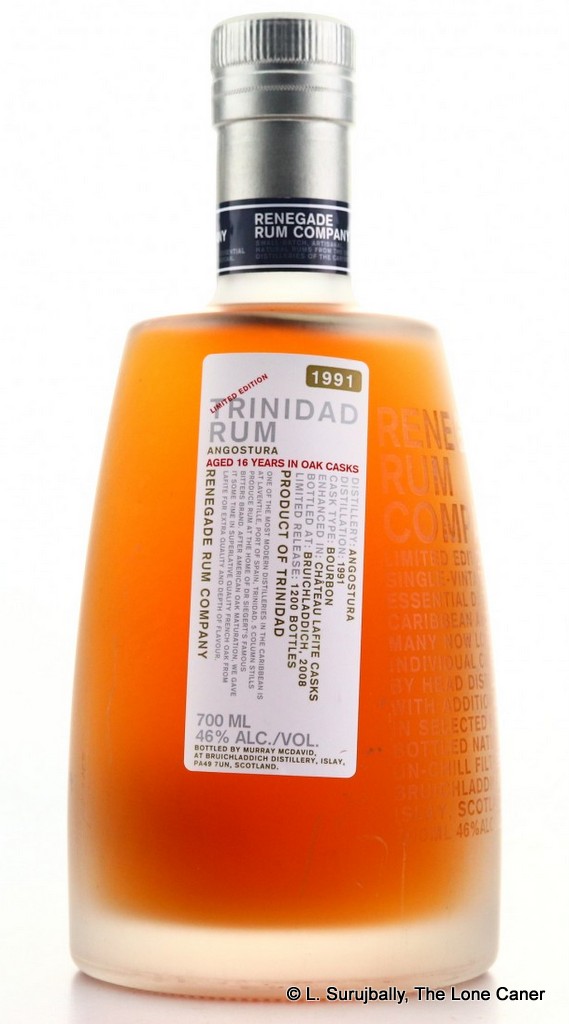
I’m not always and entirely a fan of Renegade Rum, but will unhesitatingly concede that they are among the most interesting ones currently available, and deserve to be sampled. Un-chill filtered at the Bruichladdich Distillery on the Isle of Islay in Scotland, these limited editions have the potential to popularize single-vintage rum if one can get past the whiskey-like finish that jars somewhat with what I expect a rum to be.

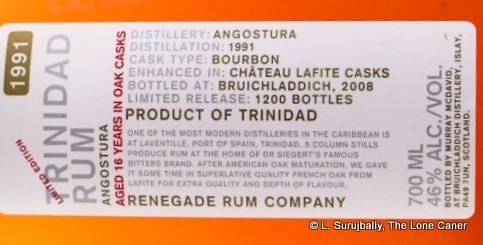
My research notes that Renegade Rums trawls the Caribbean estates for traditional single distilleries that are no longer in operation or have some stock to sell, and purchases supplies from places like Guyana, Panama, Jamaica, Barbados, Grenada, and Trinidad — then completes the maturation in oak bourbon barrels, or those which have held madeira, port or wine. This impacts the taste quite significantly, I’ve found, but more than that, it makes the release extraordinarily limited: this one from 1991 was only 1380 bottles.

I’m unclear how old the 1991 Trinidad rum actually is, since it is advertised as 17, but 16 is printed on the bottle. Whatever the true age, the palate on this 46% (92 proof rum) is uniformly excellent, with notes of port and oak and a very subtle taste of caramel. The finish is not as sweet as I would expect, and does not last as long or as smoothly as a 16 year old rum perhaps should, though hints of burnt sugar and apples can be discerned (this is probably from the French port barrels used for the final ageing). What stops this from being a stellar review is simply the way the somewhat harsh and short finish takes some getting used to – when I first tasted this, I grumblingly compared it to a whisky. See, I’ve been getting sotted on the grog for more than half my life, and us West Indian hicks don’t particularly care to have our national drink turned into a Scottish home brew.

Ok, so that is snooty. Don’t get me wrong, however: I liked it precisely because it’s different, had character, texture, body and a good strong flavour. I wouldn’t drink it neat, though, or with ice (though I did both to write this review). This one, for all its rich provenance and comparative rarity, will be drunk rarely.*

* My good friend Keenan, horrified at my cautiously tempering the good stuff with coke (I was just checking, honest), snatched it away, proceeded to drink it with bowed head and misty eyes on the rocks, complimented it most fulsomely on its character, and disdained the cheap Lambs spiced rum (3rd tier, really) I was happily getting smacked on. I may not compliment Renegade’s creation as much as he did — he had to be dragged off, screaming “Leh we tek wan moh shot, bai” when the evening was over — but at least one person really really appreciated it, and the bottle I have will be kept for his use when next he is let out to play.

Jan 192010


Picture (c) WineSearcher.com, Stock Photo

First posted January 19th, 2010 on Liquorature.

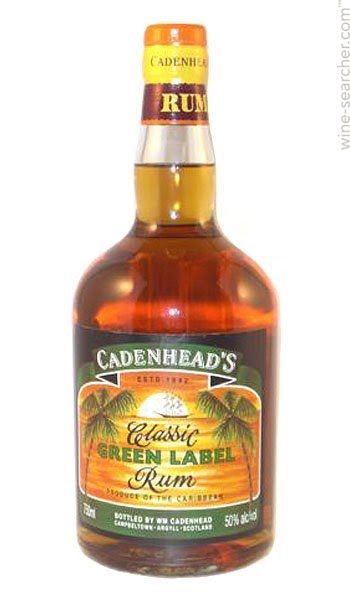
It looks like a rum and occasionally smells like one, but it sure doesn’t always feel like one; Cadenhead’s policy of making the Classic without any additives or subsequent filtering gives it a less voluptuous body than the average and an overall whisky character that only a psychologist could unravel. Decent drink for those who like a little danger and seeing how rums can go to the edge, though.

***

This is as strange a rum as I’ve ever had, and was a selection of the November 2009 gathering, where nothing but rums were served, and it went head to head with two other rums: the Zaya 12 year old (and the winner by a nose, ha ha), and the Appleton Estate Master Blender’s Legacy (which was the most expensive and opined as the least value for the money).  The Cadenhead Green, for all its ~$75 price tag, was considered middle of the road.

It’s a strange one, this. For one thing, I have no idea how old it is. Nor am I entirely certain where it comes from, although I believe it is a Demerara rum that was then further refined in Scotland and watered down a tad to bring it down from cask strength. The website states it remains untreated and no additives brought in for either colour or taste, and its bold taste makes that likely to be true.

Cadenhead Distilleries is a scotch maker, not a rum maker (actually it’s now owned by the Campbeltown distiller J.&A. Mitchell and Co., which runs the  Springbanks distillery in Argyll), but perhaps they took a gander at what good products came out of Bruichladdich’s Renegade line and followed suit. For whatever obscure reason, Cadenhead has chosen not to reveal the provenance of this rum (the “Demerara” appellation refers to the dark colour and body, not the source), but a few people on the internet have speculated it’s Jamaican, or possibly even Cuban – that would be illegal to market in America, so if anyone bought one of these in the US, I’d be interested to hear about it. It’s listed at 50% ABV, making it an fullproof Rum (I use the word “overproof” to denote rums that are insane for all practical applications…you know, like 70% and up).

The nose is candied, with hints of cinnamon, charcoal, and marshmallow. Dark gold in color, clear. It settles out with chocolate notes, caramel, and burnt pineapple, lightly tingling at the back of the tongue. Strong finish and some bite on the way down. I’d recommend this one with a drop or ten of water plus some ice, unless you’re a peasant like me and just say to hell with it and destroy it with a coke (just kidding). Not really a good sipping rum — it’s not subtle or smooth enough for that – but I’ll say this: the thing had character, and kicked back like a spavined mule after the first few glasses. I’m hoping to get another bottle to see if the first was just me. You’d think that our whiskey drinkers would have been in transports of ecstasy with the Green, given its resemblance to a decent scotch, but in fact the opposite was true, and it came in, as I mention above, in the middle. Given our evolution since then, it’s possible that this opinion might change on a second go-around. (2014 Update: it did, and for the better)

Did I like it?  Tough question. I’ve made no secret of my dislike for distillers who refuse to put provenance or age on their labels – it’s too much like a cheat, giving the buyer no chance to make a first-pass determination of quality, or rate it against other, similarly-aged products –  and that goes double for the higher priced babies, where a buyer needs to know what he’d forking out his dough for. Whisky – Scotch whisky – has its rules about what kind of hooch can bear the highland name, but the plebian and slightly disreputable origins of rum seem to mitigate against rum distillers doing the same.  I admired the strength and character that the Green had, and its body was excellent. The strength stiffened the starch in its spine quite well and the complexity was admirable.

So I’ll split it down the middle: I’d recommend it unhesitatingly for true rum aficionados who dislike adulterations, and dedicated whiskey drinkers (these are the guys who have their snoot glasses in one coat pocket, who sniff and sip and gargle and then rinse with distilled water).  For more middle of the road folks I’d say “Give it a shot, for here is something remarkably different you won’t soon forget.”  And for those who just want a decent mixer, I’d suggest getting something cheaper and sweeter to put into your cocktail.

Fairer than that I just can’t be.

(#003)(Unscored)