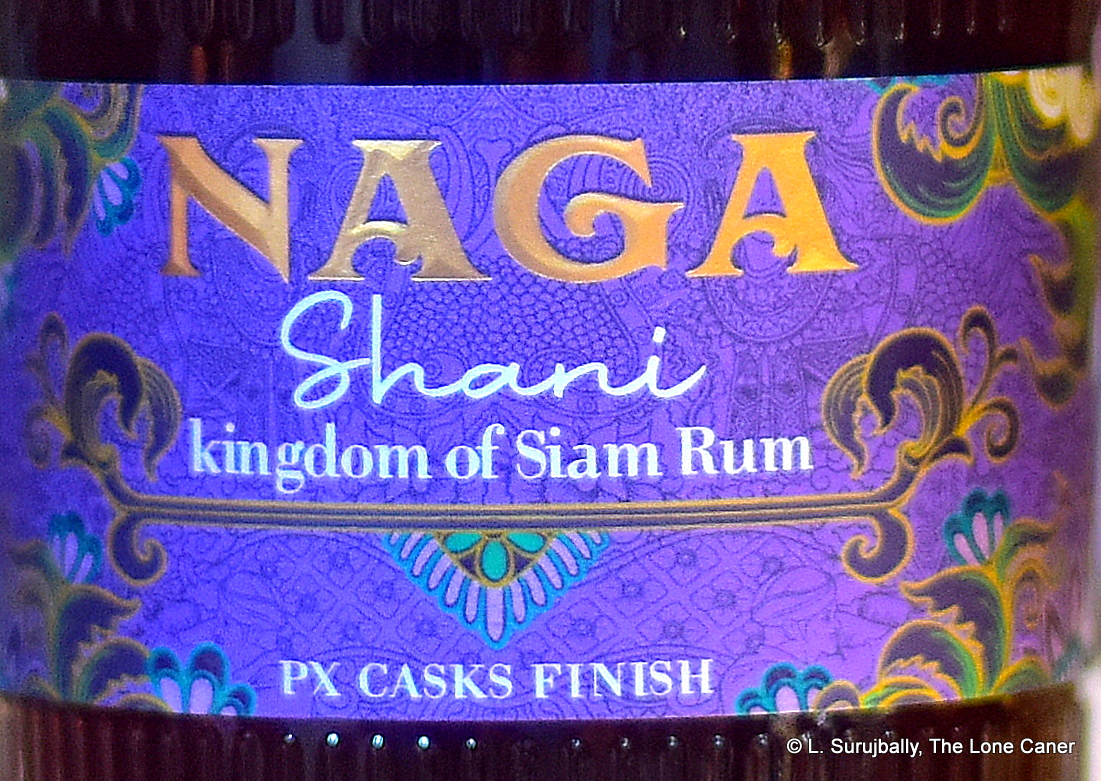
The label of the “Shani” requires some explanation. Part of the branded Naga line of rums — a sort of cross between a merchant bottling, a contract rum and an independent bottling — it is made in Thailand by ThaiBev and released by Sebastien Folloppe, a consultant and marketer in the rum world who once worked for Bardinet. The word “Shani” has a double meaning: on the one hand it refers to the purple and red colours associated with Thai sunsets on Saturdays, and also denotes Saturday itself, or the planet Saturn in Hindu and Sanskrit-derived languages across Asia. And that’s reflected in the colour of the label. As for the “Kingdom of Siam”, well, the historical note below will provide the backstory there.
In the previous review of the standard 10YO “Siam edition”, I remarked that it was a completely commercial rum, made to appeal, to tweak interest, and to sell based on a combination of easy sipping, age, price and strength. To some extent, this one follows from that point. It’s the same ten year old, aged for an additional year in Pedro Ximenez sherry casks in Thailand; and all other production processes – Thai sugar cane molasses source, five times distilled from a column still, initially aged in charred ex-bourbon casks at the distillery – remain the same. The points of difference, then, are the additional year and the P/X, and the six extra proof points, to 46% ABV.
Does that make for a difference, a discernible, definitive, serious one? Judge for yourself, and nose this thing. The P/X makes a strong statement, for sure: the rum smells sweet, wine-y and deep, with a nuttiness and plum-wine type aroma that marks this out as a different rum. Some vanilla and brown sugar and caramel ice cream are evident, and a faint suggestion of stewed apples, perhaps an overripe orange or two.
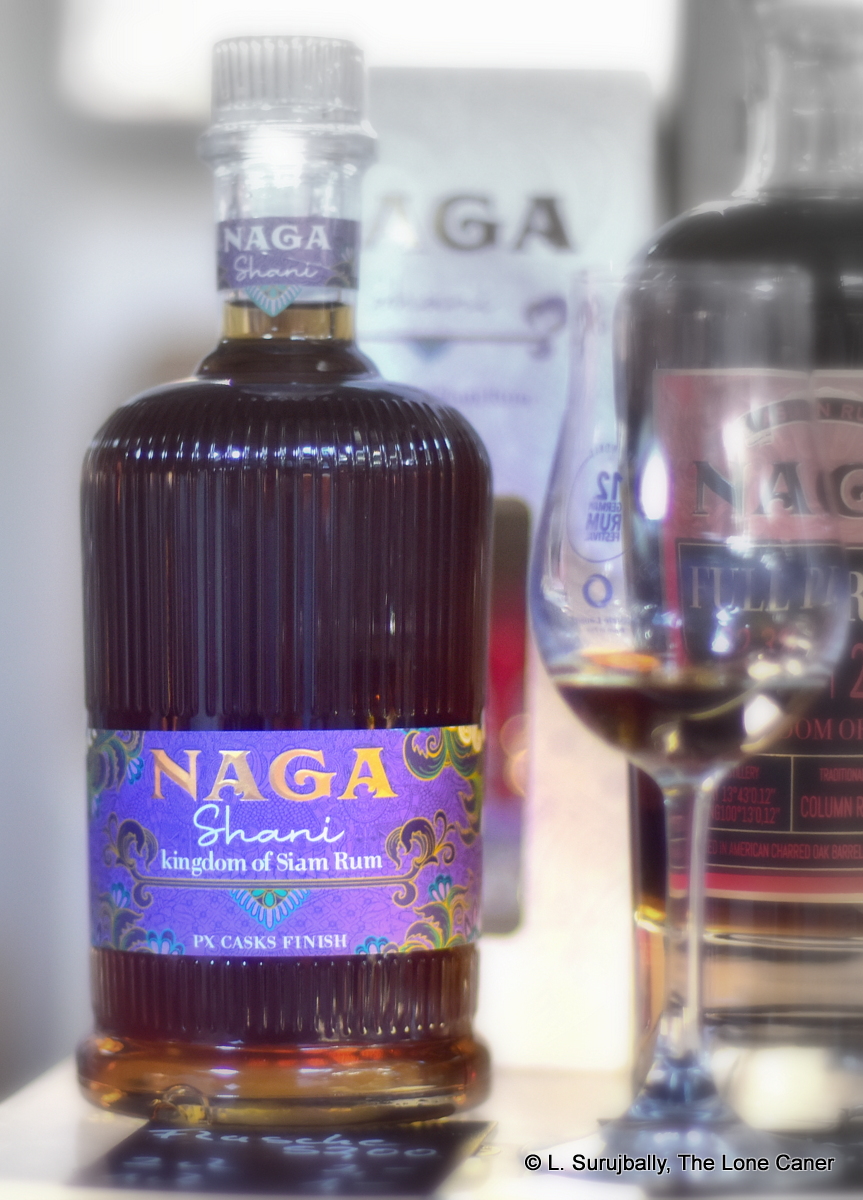 The palate is well served by the middling strength. There’s vanilla, coconut, ripe oranges on the edge of going off, plums and black grapes, and some crushed almonds and walnuts. It’s very soft, even sweet, yet not shark, and the proof point allows it to present a firm profile that is pleasant – it’s a very drinkable piece of work. The finish, surprisingly enough, is short — breathy and sweet, and channels dark grapes, plums, peaches, vanilla and wine, again, and it’s interesting enough that one wishes it would hang around a bit longer.
So those are the tasting notes. What do I think?
The nose is pretty good, but the taste, I believe, is where the rum falls down somewhat. As the vanilla and coconut took on a dominance that dampened down other flavours in the 10YO, here the P/X and wine-like aspects are so far in front that they eclipse other, subtler notes that might balance this off better. It’s too much of one and not enough of the other, is my considered opinion after trying it several times, and maybe it’s just me, but I do think it’s got more sweetness to it than is necessary.
So do those points of difference make it better or worse? Better, I’d say — that departure from the base 10YO is there and clear: but when we come down to it, it’s not an unmixed blessing, for while Baby Rum Jesus may give with one hand (extra age, finish, higher strength), he took away with the other – too much of the P/X, too little of everything else.
It’s still a better rum than the standard edition, though. That much is undeniable – the nuttiness, the slightly stronger series of aromas and tastes, make it a nice drink to have by itself. Yet one may wish for a little less P/X and a little more of things that denote an more elegantly finished rum. There are people who will like and enjoy the Shani for all the reasons I mention here and have opinions opposed to mine, which is completely fair. All I can say is that if you haven’t tried it before, give it a shot – it’s worth trying at least once and maybe buying it just because it is interesting and divergent from the Caribbean fare we are so much more used to.
(#1149)(79/100) ⭐⭐⭐
From R-1148: Historical Background – Country, Brand and Founder
The Naga line of rums has a word on its label – “Indochinese” – that isn’t often understood, though it seems straightforward enough. Historically, linguistically and culturally it refers to southeast asian countries like Burma (now Myanmar), Thailand, Malaya, Laos, Cambodia and Viet Nam where Chinese and Indian influences melded into a synthesis of their own, with further political subdivisions like French Indochina (the latter three) entering the lexicon over time.
Thailand – called Siam until 1932, and this is also on the rum’s label – was, however, unusual, in that it was never actually a colony, possession or territory of either of the two great colonizing powers (though they exerted significant influence over it via ceding of territory, unequal treaties, and legal and trading concessions). This was because by an 1896 agreement between France and Britain, it served as a buffer between them, which neither would control, and so it allowed Thailand to preserve its autonomy in a way the others did not – at least to some extent.
Well, that’s some historical background, which now leads is to the company that makes the rum. Strictly speaking, there isn’t one – Naga is a brand name, not a company, run by a Frenchman named Sébastien Follope. He had worked for Bardinet (La Martiniquaise group) until 2007, then at a brand development agency until 2011 after which he pivoted to being a consultant and importer for rum brands, helping (for example) to introduce Optimus and Cihuatan brands to European markets. In 2012, feeling the itch to create a brand of his own, he registered the Naga name (it was unique, easy to pronounce and spell, and wasn’t already taken by anyone else) and contacted the largest maker of rums in Thailand – ThaiBev, which has a near monopoly on the local spirits market. Thaibev has some 12 distilleries, of which four make rums – the Phraya brand released by Sang Som is one of them, Mekhong is another.
After some supply issues in 2014 – the supplier abruptly cancelled the initial order – Sebastien pivoted to releasing some Indonesian arracks instead which led to his line of Naga Indonesian rums (Java reserve, Pearl of Jakarta, Anggur, etc). But in 2019 whatever issues the supplier had were resolved and the use of Thai rums was greenlit, with all sorts of restrictions on what could (or could not) be mentioned in the literature – “Thailand” and “ThaiBev” being the two most surprising. This is why the “Siam Edition and “Indochinese Rum” feature on the label. This restriction apparently changed in 2023, but the labels remain as they are for now.
Other notes