Jan 122026
 

The practise of wine and spirits merchants releasing their own branded products is a long and storied one, going back more than a century (think of Berry Bros. and Rudd, Doorly’s, Goslings, or even Masters of Malt, as just a few examples). They acted, therefore, as progenitors and continuations of the indie bottling scene that has so defined the upscale market in the modern rumiverse.

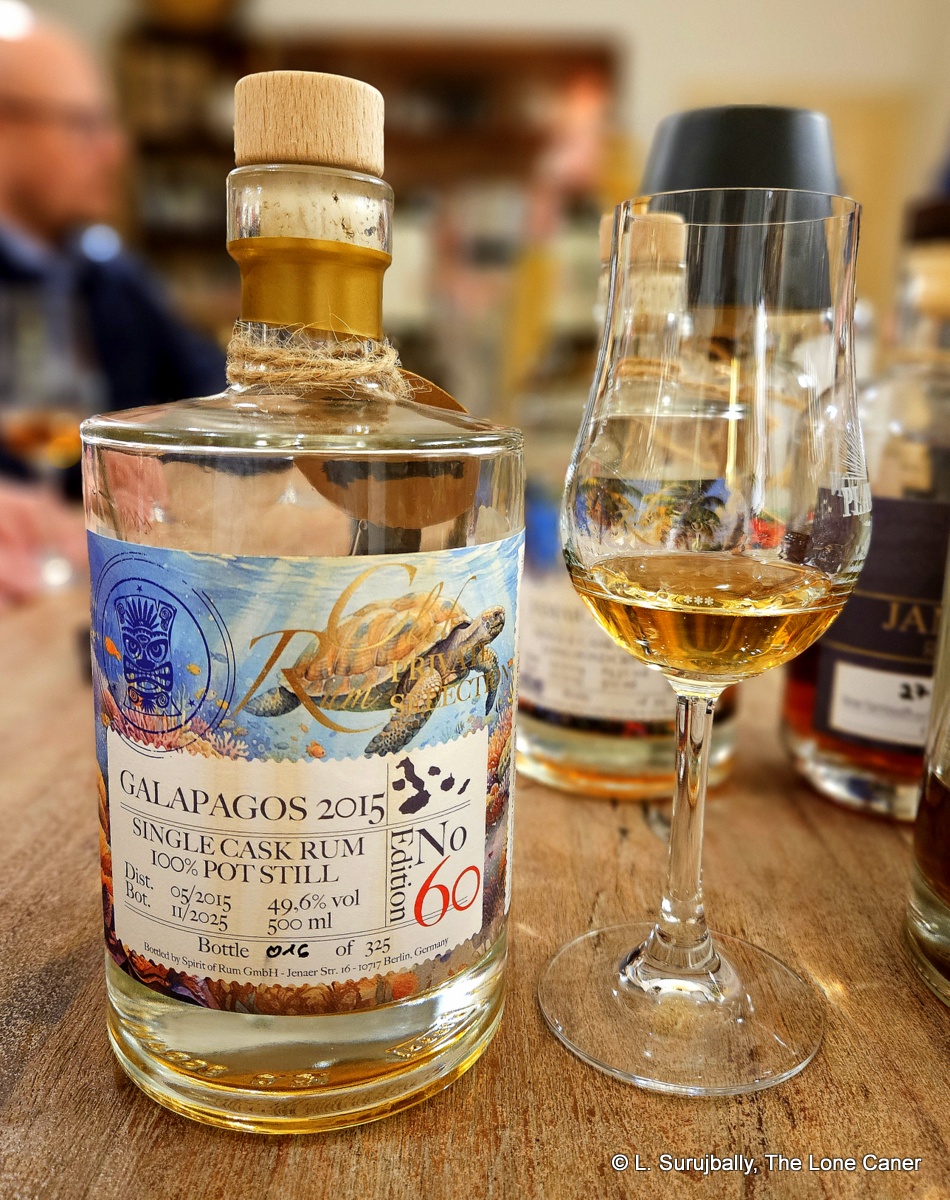
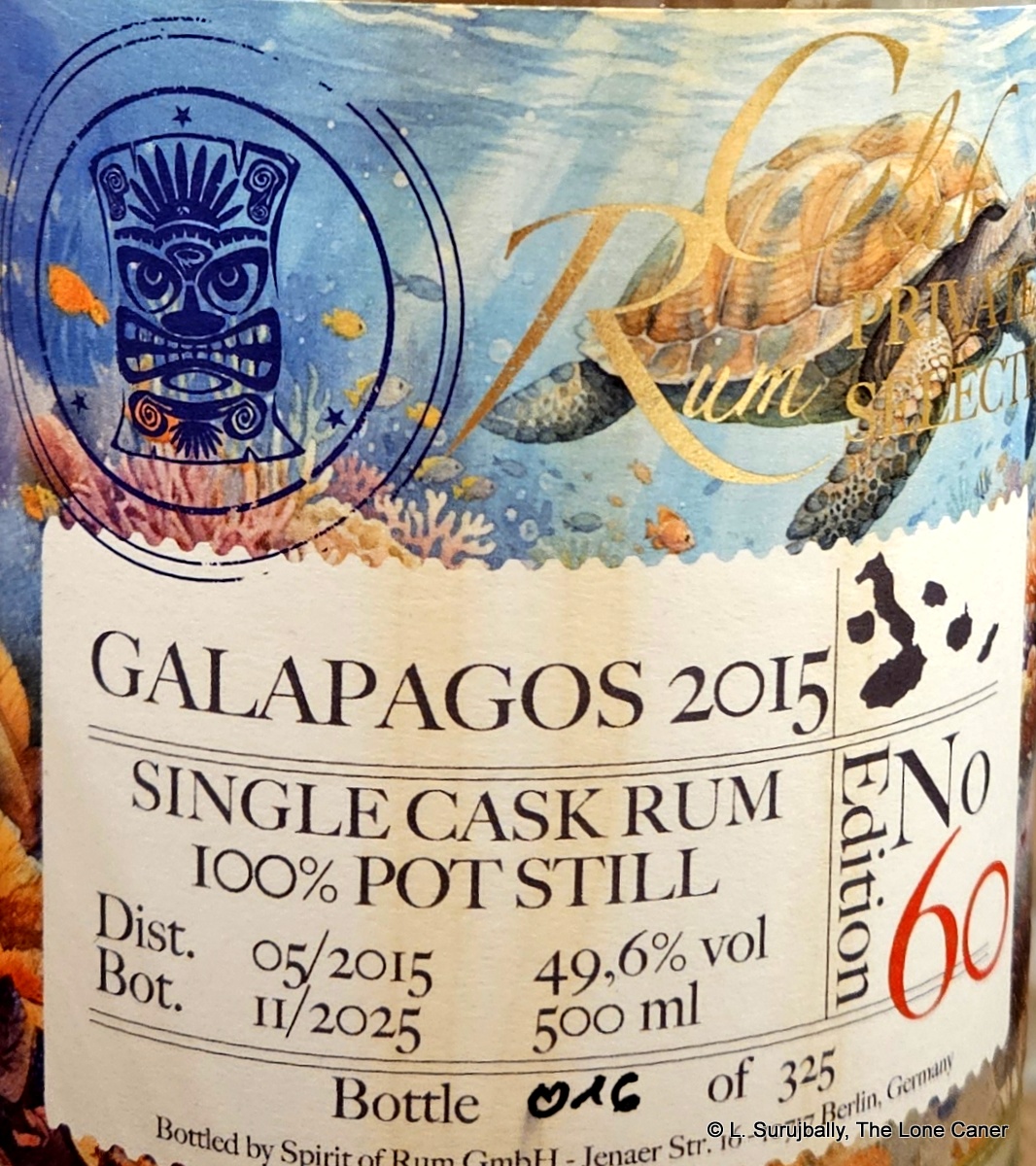
One of the best of such shops in Germany is undoubtedly Dirk Becker’s Rum Depot in Berlin, which I have been visiting on and off since 2012 and remains a favourite stopping place of mine. That same year, they began releasing single cask bottlings under their own brand called Rum Club Private Selection, and have steadily added to the stable until they just arrived at #60 in 2025, with this highly unusual bottling from – and yes, it really is – the Galapagos Islands in the Pacific Ocean, and I’ve provided a bit more in-depth background below the review for those who are interested and asking wtf? (as I did).

Stats: distilled in 2015 from sugar cane juice and double distilled in a pot still (it may actually be a trapiche), then set to age in situ for ten years — the barrels are not mentioned, though we can reasonably assume ex-bourbon. How precisely it got into Rum Depot’s stocks – whether a direct purchase on the island or via a broker as part of a batch, is unknown. The label makes mention of “one of a few barrels” which makes it unlikely to be a bulk sale (e.g. an iso-container that was later decanted), but whatever the case, the rum came from one barrel, and has an outturn of 325 bottles, at a solid 49.6%.
What I liked about it right off the bat is that it had that vaguely rough vibe of an artisanal back-country rum that’s not quite smoothened out by decades of commercial manufacturing experience. It immediately gave off fumes of dialled-down Jamaican funkiness – orange rind, overripe pineapples, gooseberries, pickled cabbage, glue and plastic – and here I think the middling strength worked well to tamp it down. It also presented vanilla, cinnamon, cardamom, a slight musky sweetness, like Indian kheer, leavened with the faint bitterness of black chocolate. And here I must point out that that the crisp vegetal tang of a true agricole really wasn’t very noticeable, which is somewhat surprising.

Tasting it confirmed that impression. It landed nice and firm, no sharp scratchiness here. Immediate notes of light citrus, soda-pop (say, 7-Up), cola, vanilla and the sour hint of both overripe fruits (gooseberries and pineapple and mango) and pickled cabbage. Once it opens up you can detect some brininess, tartness, funkiness, dark cherries, and a touch of honey. Not as complex as the nose suggests, yet it quietly shines in its own way, and if the finish is a little spicy and goes away too fast – final notes of caramel, vanilla, cinnamon, unsweetened chocolate again, light citrus and kefir – it’s by no means a slouch.

So what did I think?  Well, I’m a bit conflicted. Strictly speaking, this is an agricole style rum (off a pot still, no less), yet much of the grassy and herbal profile of rhums from Reunion or the Caribbean French Islands, is mostly AWOL. One would be hard pressed to call it for what it was if tasted blind, and this reinforces my belief that there is a diminishing return on cane juice rums once they are aged past a certain point, after which the barrel influence is simply too pervasive and the terroire and originality starts to go.
Taken on its own terms, it’s pretty good, though. The strength is solid, the tastes are a lovely amalgam of salt and sweet and sour with just a bit of green funk thrown in for good measure —  and if perhaps the terroire is not as clear as we might like, everything else is really well integrated into the alcohol and the overall texture and mouthfeel. It’s like a cross between a lightly-aged Jamaican, a young Guyanese without the lumber, and, yes, if one reaches, some sweet cane juice rhum notes too. For €65 or so, there is no reason not to get it, not least because… well, come on, the Galapagos?  Who else can lay claim to having something from there, right? It’s unusual and has great production specs, from a place we know little about, and is a damned enjoyable drink. Taking that  into consideration, I’d suggest that if you can, and if Dirk hasn’t sold out yet, go get yourself a bottle.

(#1136)(85/100) ⭐⭐⭐½


Other notes

  • Video review link
  • There aren’t many reviews out there for the rum – most of what I see is quick notes left on Rum-X or online stores. I guess that the limited release and its specialized nature make it more likely to appeal to collectors or serious geeks (or certifiable reviewers).
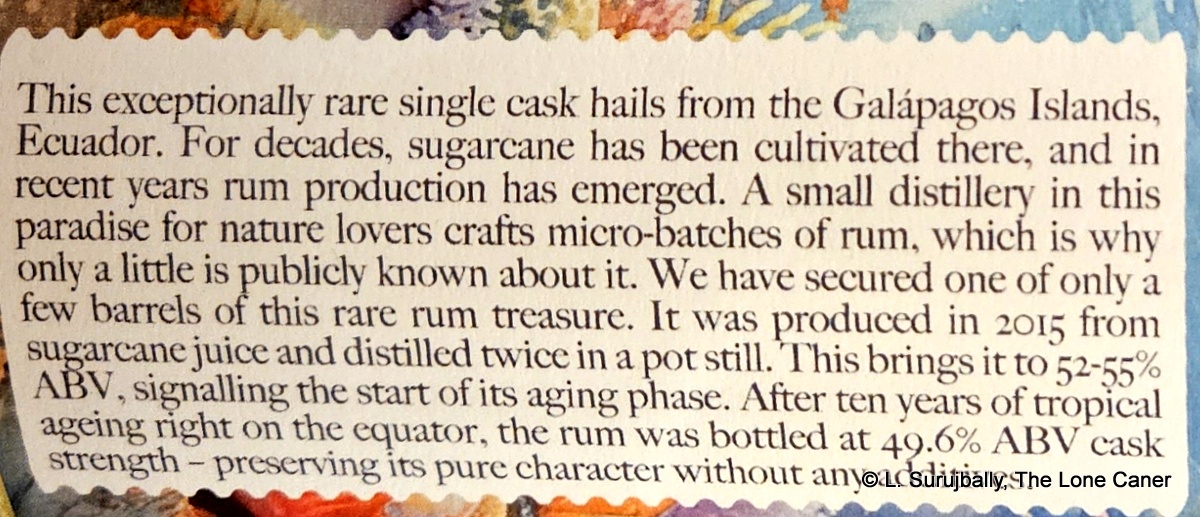
  • Given the ecological status of the islands, and since they are protected as part of Ecuador’s Galápagos National Park and Marine Reserve, it’s reasonable to ask – is there really a distillery there, or is it from Ecuador, of which the islands are a province? Well – yes. There is a outfit called El Trapiche Ecologico Galapagos, which is a tiny family-run artisanal farm and distillery located in the highlands of Santa Cruz Island, and is a popular tourist destination. But it seems to be more an organic operation that grows coffee, cocoa and sugar cane and does some distillation on the side. It was once known as Darwin’s Lab, Dirk told me, and research suggests it is now more involved with environmental and ecological matters than distillation proper. What is interesting about it is that Johan Romero, who does run a full fledged family-owned distillery in Quito (many independent bottlers’ Ecuadorean rums come from here), helped build that trapiche and advised on cane, fermentation and distillation. 
Jun 212013
 

D3S_6841


Quasimodo in a shrink-wrapped muscle-car with overlarge tyres

Rums have gotten, over the decades and centuries, rather civilized. Sweaty muscular beefcakes like the SMWS Longpond 9 81.3% and the Bacardi 151 always exist, of course, accompanied by more uncouth and less cultured rums even than that, made less for export than for local consumption…but for the most part, what we get is soft, soothing, decent, well padded.

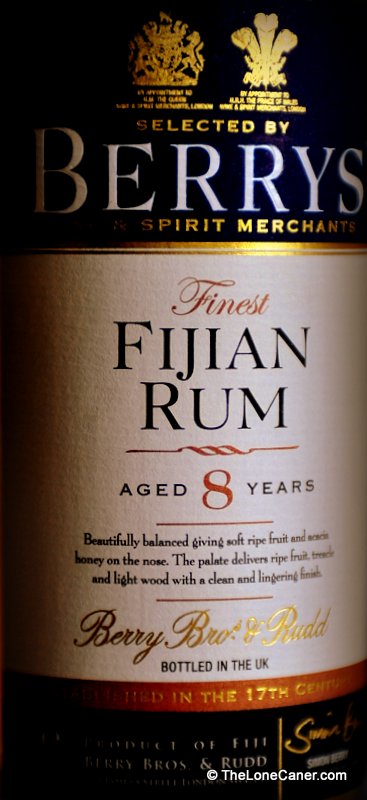
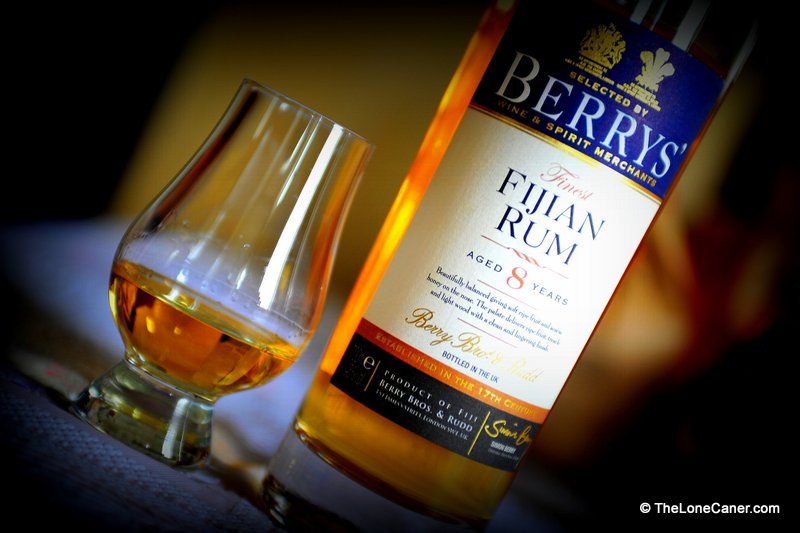
This 46% rum, however, made by those genteel fellows in England, Berry Brothers & Rudd, was none of these things…which, when you recall the near-brilliant 1975 Port Mourant they also made, is kind of odd. Civilized? Nope. Smooth? Not really. Calming, easy on the nose? Don’t make me laugh. Berry Brothers have done something rather amazingly insane, or stupefyingly stupid depending on your viewpoint, with this Fijian product. They’ve made it a raw, nasty, brutish, ugly, foul tasting kill divil that I dunno, should be used to scour the paint job off your souped up Ford F150. Or maybe fuel it.

You think I’m kidding, right? Yeah…but no.

Some time ago I reviewed the SMWS Longpond 9, and the Rum Nation Demerara 23 and the Jamaica 25 year old. All three of these had rubbery, almost medicinal notes to them that were initially somewhat disconcerting, but eventually melded into a unique whole I could not help but appreciate. The off-notes I didn’t care for were relatively subdued and well integrated into a fascinating synthesis. No such feeling swept over me as my brother and I nosed the Berry Brothers & Rudd Fijian 8 year old. Because in this case, raw plasticine and rubber notes were so powerful, that I felt a Bugatti had just peeled out of the shop, leaving a black strip on the pavement a mile wide. Medicinal, turpentine, paint thinner was what you got on that nose. Iodine, seaweed, brine, salt biscuits. And then more burnt rubber. They held a commanding stance from the outset, and never let go. Yes there were also timid, trembling scents of grassy and herbal aromas that crept in as if afraid to be noticed; yes, if you paid attention you would get apple cider and perhaps a flirt of not quite ripe pineapple. But it was small consolation. You had to try too hard. They were shouldered aside and squashed flat.

D3S_6846To taste, it was heated and spicy, as befitted a stronger product, and it was reasonably smooth, not raw and clawing, so no issues there. Hay-blonde, quite light, somewhat thin and clear and clean on the tongue. I was kind of suckered in by some lazy background notes of freshly-sawn white wood of some kind, bananas, softer pineapple and an even fainter grassy-green floral note that developed over time, but then the uncompromising rubber returned. Merde, but this was unpleasant. Iodine, seaweed, some peat (I kid you not) mixed it up in the schoolyard with an overweight bully of peeling rubber, turpentine and styrofoam. It’s like I was trying to sample a neoprene suit left behind on the set of “Debbie Does Dallas.” I can concede without hesitation that the texture was pretty good, it felt physically pleasant in the mouth, and the finish was medium long and heated (and may have been the best thing about it, perhaps because we could now see an end to the experience). But I simply don’t appreciate a rum that is redolent of the freshly torn plastic coming off new, over-polished wooden furniture.

So, with all due apologies to BBR (who have made other rums I really enjoyed), this is not a rum I cared for. I asked a dedicated maltster whether, given the profile I described, he would buy it (for $75, which is what I paid), and he said probably, so it may work better for Islay-lovers than it did for me. The thing is, underneath the taste is the texture, and in that texture and mouthfeel you can sense the rum this could have been had it been toned down a bit, perhaps been a bit sweeter (and this is why I scored it as I have). I always thought the Renegades were inconsistent and made by — and perhaps for — whisky lovers, and here we have another in that vein, something of a harnessed lunatic, loud and uncouth and unrefined as a fading rock star’s leopard-skin trousers.

It probably won’t sell much, but you know, I do have a kind of sneaking admiration for the concept, much as I shudder at the taste. It takes a certain kind of guts to make a rum that tastes so crazily off base as to appeal to not just the 1%, but the 1% of that 1% who would welcome the adventure, appreciate the uniqueness and throw caution to the winds when drinking it. Because, for sure, there are very few rums in my whole experience which are anything like this Fijian popskull.

Just be warned – It’s an absolute animal of a drink to have if you’re not prepared.

(#169. 80.5/100)


Other Notes

  • As is usual with craft bottlings such as this one, I could not find much information on the source. However, since there really is only one distillery on Fiji (the South Pacific Distillery, which makes the seemingly well-regarded Bounty brand), it seems reasonable to suppose that the raw stock comes from there. In what barrels it was aged and in which country, is something I’m currently still researching.
  • Given the light and clean profile, I will hazard that the distillate comes from sugar cane juice (like an agricole) and not from molasses, and is probably a column still product. Still, these are merely my conjectures since SPR has both a pot and column still in residence, so if a reader has more info, please post a remark.
  • I notice that there are nine and ten year old Fijian rums made by BBR as well.


Dec 052010


First posted 5th December, 2010 on Liquorature.

Some rums just upend all expectations, and maybe even redefine your assumptions.  Smooth, amber-dark, just sweet enough, and with a body and a finish that simply don’t give up, Tanduay Superior 12 year old is like that. Where on earth has this rum been, and why can’t I find it in Calgary?

A very affable individual from my office named Rainerio was heading off home to the Philippines the other day, and knowing there were interesting rums to be found there (though unashamedly confessing ignorance of exactly which ones those were since I had never had any) I went down on bended knee, indulged myself in a paroxysm of weeping meant to soften any stony heart, and begged him to bring back a sample for me to review.  Well, I exaggerate a bit for poetic effect, but I did ask.  And Rainerio very kindly brought me back a bottle of this  stunning 12 year old.  Hell I would have been satisfied with any local popskull, and to get something so all-round excellent was a like getting an early Christmas present.

Tanduay is one of the most popular, if not the most popular, make of rum in the east, particularly the Phillipines, and made by the Tanduay Distillery out of Manila.  Like other major distillers – Bacardi and Diageo come to mind – they have a complete range, from light to dark, from the very cheap to the very expensive, and they have been in operation since 1854, which pips Bacardi by, oh, seven years. Yet, for whatever reason – distributors ignorance, lack of channels, unfavourable tariffs or whatever, you really have to look around to find it in North America (my research suggests it may be more readily available in Europe) and yet it may be the third most popular brand of rums in the world.

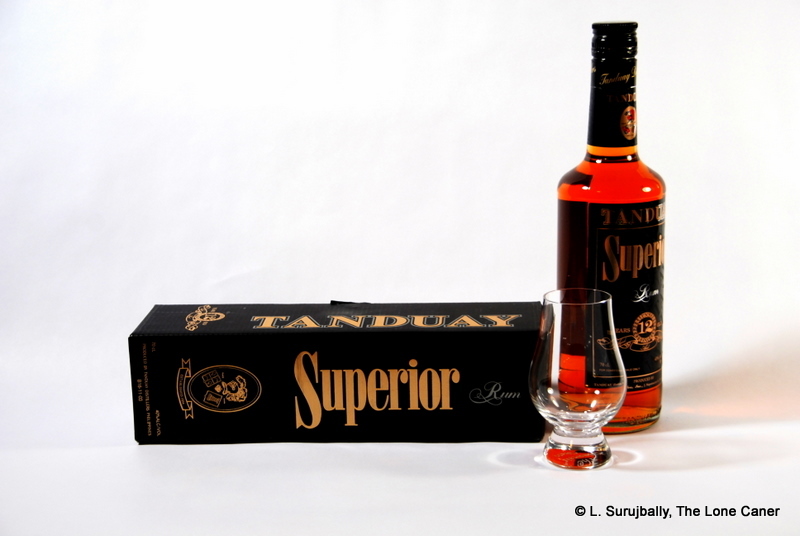
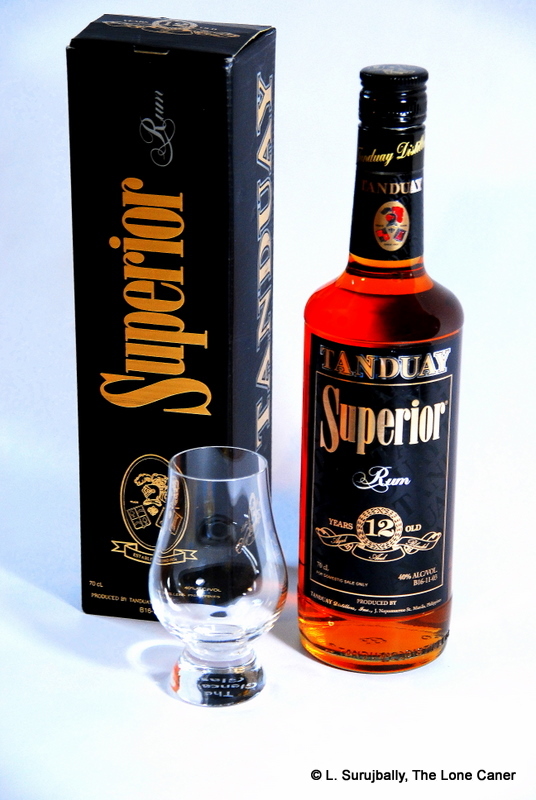
A dark brown rum of the same hue as the Bacardi 8 year old, the Tanduay 12 year old is an oak-aged product served up in a standard bottle emerging from a hard cardboard black box, and sporting a deceptive cheapo tinfoil cap. I looked askance at it and wondered whether this was a harbinger of things to come, but what the hell, I had asked for it and so dived right in.

On the nose the 12 year was spicy and immediately assertive with equal parts vanilla, caramel and lemon zest in some kind of crazy harmony, as if Michael Jackson suddenly joined up with the Bee Gees and they created a song of their own that just missed being nuts by some strange unknown alchemy. It was bold and immediate, but after allowing it to breathe, a sly delicate note of flowers came stealing around the more powerful notes. Yes there was some sting, but this died away after a while and the medicinal reek I so dislike in younger rums was utterly absent.

The rum took my hand and took me along with it: medium heavy body, coating the tongue with a sort of oiliness I have only had with DDL’s more aged rums.  There was just enough sweet to the Tanduay, and the caramel and vanilla notes were now joined by something softer, perhaps bananas or a tamed light citrus. It slides smoothly down the throat and let me tell you, the fade is simply awesome.  Long and smooth, with one last soft gasp of breathy fragrance wafting back up to remind you of what you just had, and inviting you to revisit the experience with another try.

Unless a distributor for this rum is found or whatever has stopped the importation of Tanduay to Canada is resolved, I doubt I’ll ever taste it again (though maybe I can ask Rainerio to bring another one back in a year or two). I’m glad I had a chance to try it: just when I thought I had a handle on the major brands of the world, this one came out of nowhere and smacked me upside the head.  If nothing else, it says that though I may have tasted and reviewed more rums than most, there are always gems from other places previously unconsidered that will just amaze, delight and please with their overall excellence.  This is the first one in my experience: I know there’ll be others, but Tanduay gives me hope that I’ll actually be able to find them, and share that delight with all those who one day read the reviews I put up about their quality.

(#056. 84/100) ⭐⭐⭐½


Other notes