Jan 122026
 

The practise of wine and spirits merchants releasing their own branded products is a long and storied one, going back more than a century (think of Berry Bros. and Rudd, Doorly’s, Goslings, or even Masters of Malt, as just a few examples). They acted, therefore, as progenitors and continuations of the indie bottling scene that has so defined the upscale market in the modern rumiverse.

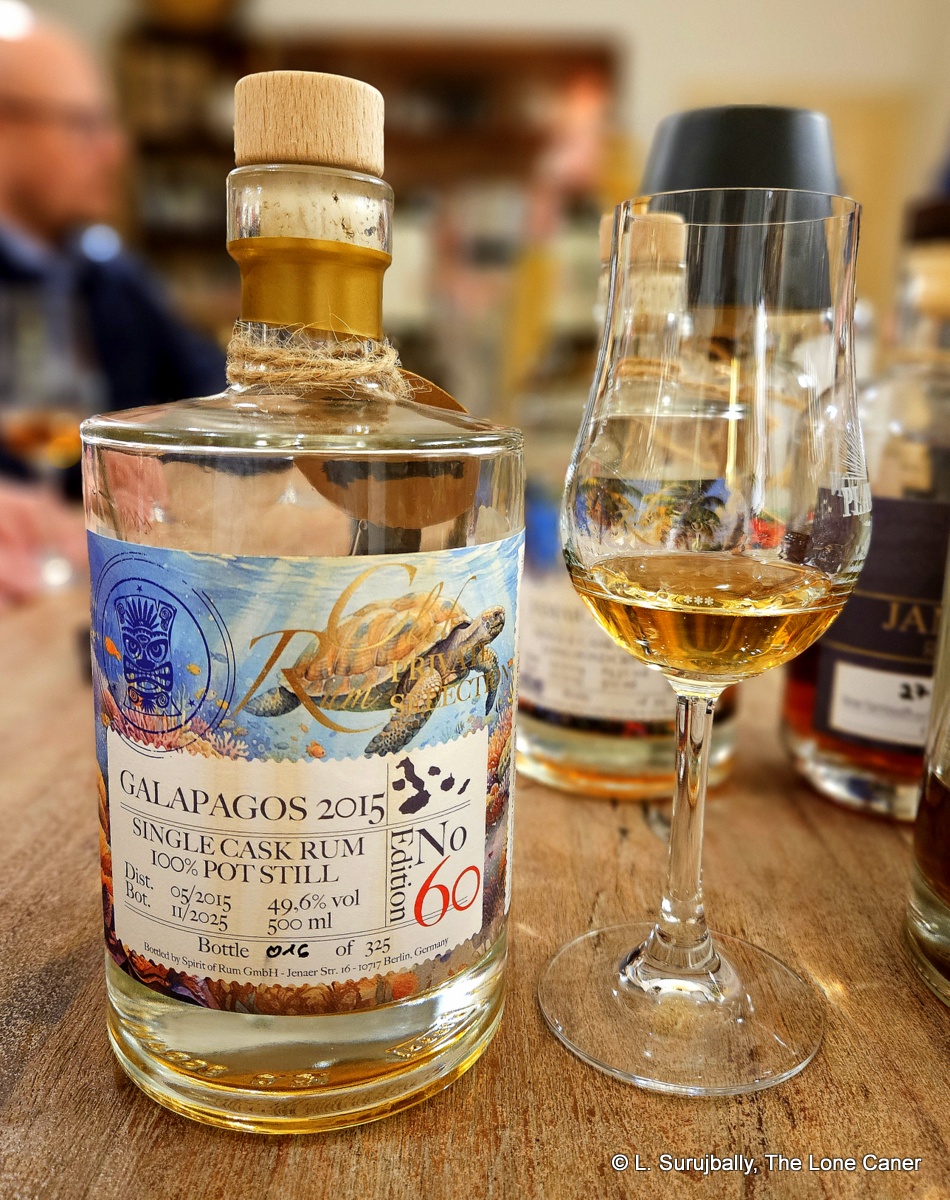
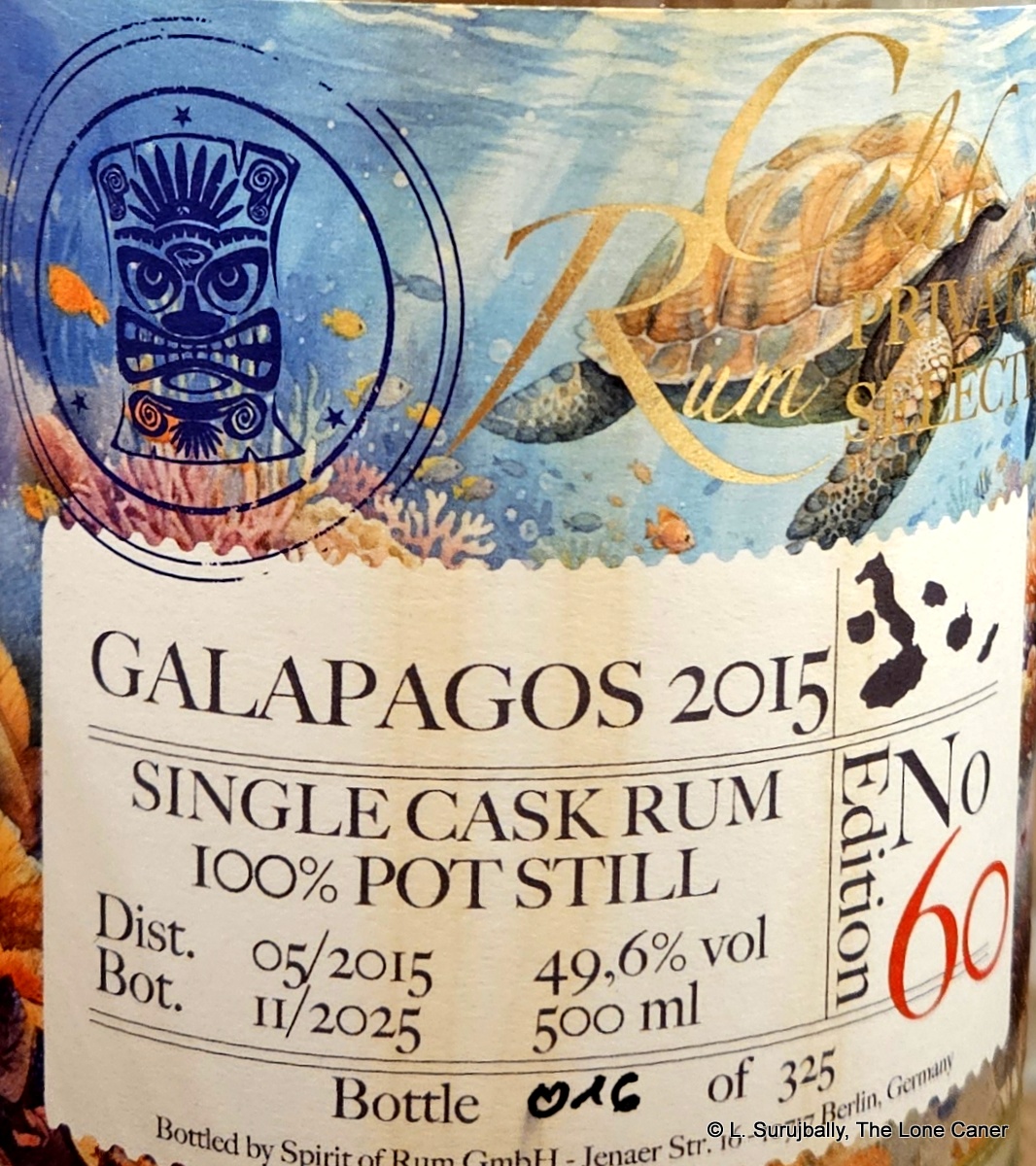
One of the best of such shops in Germany is undoubtedly Dirk Becker’s Rum Depot in Berlin, which I have been visiting on and off since 2012 and remains a favourite stopping place of mine. That same year, they began releasing single cask bottlings under their own brand called Rum Club Private Selection, and have steadily added to the stable until they just arrived at #60 in 2025, with this highly unusual bottling from – and yes, it really is – the Galapagos Islands in the Pacific Ocean, and I’ve provided a bit more in-depth background below the review for those who are interested and asking wtf? (as I did).

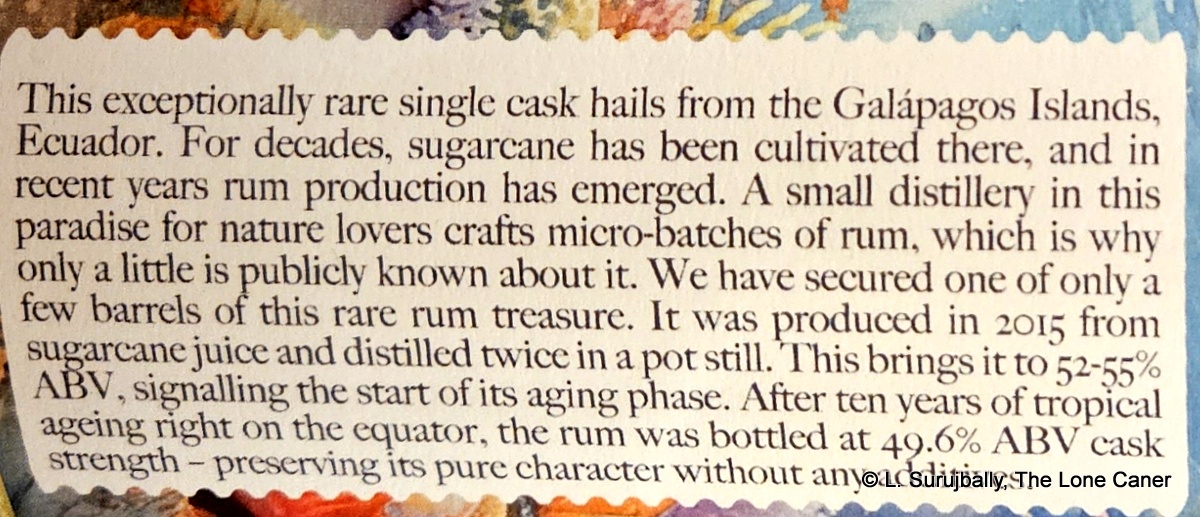
Stats: distilled in 2015 from sugar cane juice and double distilled in a pot still (it may actually be a trapiche), then set to age in situ for ten years — the barrels are not mentioned, though we can reasonably assume ex-bourbon. How precisely it got into Rum Depot’s stocks – whether a direct purchase on the island or via a broker as part of a batch, is unknown. The label makes mention of “one of a few barrels” which makes it unlikely to be a bulk sale (e.g. an iso-container that was later decanted), but whatever the case, the rum came from one barrel, and has an outturn of 325 bottles, at a solid 49.6%.

What I liked about it right off the bat is that it had that vaguely rough vibe of an artisanal back-country rum that’s not quite smoothened out by decades of commercial manufacturing experience. It immediately gave off fumes of dialled-down Jamaican funkiness – orange rind, overripe pineapples, gooseberries, pickled cabbage, glue and plastic – and here I think the middling strength worked well to tamp it down. It also presented vanilla, cinnamon, cardamom, a slight musky sweetness, like Indian kheer, leavened with the faint bitterness of black chocolate. And here I must point out that that the crisp vegetal tang of a true agricole really wasn’t very noticeable, which is somewhat surprising.

Tasting it confirmed that impression. It landed nice and firm, no sharp scratchiness here. Immediate notes of light citrus, soda-pop (say, 7-Up), cola, vanilla and the sour hint of both overripe fruits (gooseberries and pineapple and mango) and pickled cabbage. Once it opens up you can detect some brininess, tartness, funkiness, dark cherries, and a touch of honey. Not as complex as the nose suggests, yet it quietly shines in its own way, and if the finish is a little spicy and goes away too fast – final notes of caramel, vanilla, cinnamon, unsweetened chocolate again, light citrus and kefir – it’s by no means a slouch.

So what did I think?  Well, I’m a bit conflicted. Strictly speaking, this is an agricole style rum (off a pot still, no less), yet much of the grassy and herbal profile of rhums from Reunion or the Caribbean French Islands, is mostly AWOL. One would be hard pressed to call it for what it was if tasted blind, and this reinforces my belief that there is a diminishing return on cane juice rums once they are aged past a certain point, after which the barrel influence is simply too pervasive and the terroire and originality starts to go.

Taken on its own terms, it’s pretty good, though. The strength is solid, the tastes are a lovely amalgam of salt and sweet and sour with just a bit of green funk thrown in for good measure —  and if perhaps the terroire is not as clear as we might like, everything else is really well integrated into the alcohol and the overall texture and mouthfeel. It’s like a cross between a lightly-aged Jamaican, a young Guyanese without the lumber, and, yes, if one reaches, some sweet cane juice rhum notes too. For €65 or so, there is no reason not to get it, not least because… well, come on, the Galapagos?  Who else can lay claim to having something from there, right? It’s unusual and has great production specs, from a place we know little about, and is a damned enjoyable drink. Taking that  into consideration, I’d suggest that if you can, and if Dirk hasn’t sold out yet, go get yourself a bottle.

(#1136)(85/100) ⭐⭐⭐½


Other notes

  • Video review link
  • There aren’t many reviews out there for the rum – most of what I see is quick notes left on Rum-X or online stores. I guess that the limited release and its specialized nature make it more likely to appeal to collectors or serious geeks (or certifiable reviewers).
  • Given the ecological status of the islands, and since they are protected as part of Ecuador’s Galápagos National Park and Marine Reserve, it’s reasonable to ask – is there really a distillery there, or is it from Ecuador, of which the islands are a province? Well – yes. There is a outfit called El Trapiche Ecologico Galapagos, which is a tiny family-run artisanal farm and distillery located in the highlands of Santa Cruz Island, and is a popular tourist destination. But it seems to be more an organic operation that grows coffee, cocoa and sugar cane and does some distillation on the side. It was once known as Darwin’s Lab, Dirk told me, and research suggests it is now more involved with environmental and ecological matters than distillation proper. What is interesting about it is that Johan Romero, who does run a full fledged family-owned distillery in Quito (many independent bottlers’ Ecuadorean rums come from here), helped build that trapiche and advised on cane, fermentation and distillation. 
Feb 172023
 

Last year Chris Seale and I were talking at Paris’s WhiskyLive and he mentioned that he had read some of my earlier work on the Doorly’s line of rums and thought I had been unnecessarily rough on the brand. I responded that this was very true — it’s hardly something I could pretend was not — but it faithfully reflected my feelings and opinions from more than a decade ago and of course, I’ve moved on to developing a real appreciation for Foursquare in the many years between then and now – especially the new Habitation Velier LFT and pot still editions,  and the ECS series, to say nothing of the Collaborations.  That said, I did remark I just found the Doorly’s brand as a whole too lackluster – most are public-facing and mass-market: the low-cost components of the house. They’re too weak, too easy, to everyman-pleasing; they are therefore not aimed at me but at those who are closer to starting their journey.

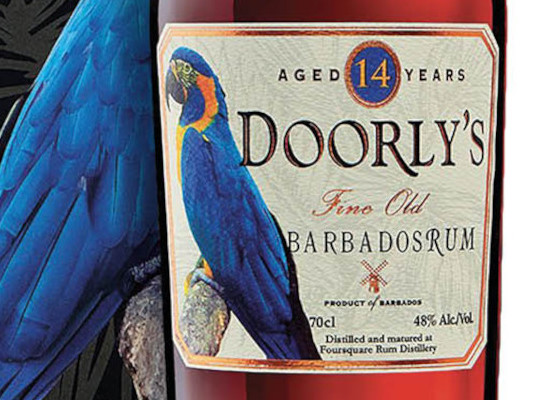
While completely acknowledging the house’s impact and importance, especially to the bourbon crossover crowd who I believe to be among the brand’s most fervent admirers (next to the Brits), I think it’s taken the Doorly’s 14 year old 48% pot-column blend (a part of the blend was aged in ex-Madeira, though specific details are lacking) released around 2019, to make me accept that finally there’s one of the line I can get serious about and introduce to my mommy.  It presses more buttons than all its siblings – it’s stronger, has a bit more pot-still oomph, more decisive tastes and is to me, at the perfect age for what it is. Close your eyes and you could be drinking any top flight indie bottling.

Consider how it opens: the nose begins with the attack of light skirmishers – varnish, glue and brine, quicky gone, not sharp or aggressive, just making themselves felt. Next comes the light cavalry on the flanks: green apples, grapes, papaya, watermelon, pears, a touch of soursop, and then the heavy infantry masses to take over, and here the more traditional aromas of caramel, vanilla, toffee, blancmange, molasses, supported by the spices of cumin, rosemary, and cinnamon.  

Once we start tasting the thing, the palate is where the battle is joined. Flavours vie for dominance – brine and olives and some nail polish duke it out with sweeter fruity notes of ripe red apples, pears and peaches in syrup, and very ripe dark cherries.  On the flanks the molasses, toasted coconut and musky port-infused tobacco are having their own separate argument with a miso soup and kimchi, but the key takeaway is that when all is considered together, the whole palate is well-balanced between sweet, salt and sour.  And the finish concludes this nicely by closing off the show with a spicy, long, dry, fruity and aromatic exhalation that somehow doesn’t give any side a win but shows off the best part of all of them.

This sounds like a lot, sure, but then, I tend to give Doorly’s more attention than most, precisely because thus far I’ve been less than impressed with the line. When the dust finally settles and the tally is made on the 14 YO, I consider this a very good sipping rum for us proles and the one Doorly’s I have no problem recommending to anyone, without resorting to a lazy and overworked references to bourbon or Pappy that just chases away those who have no interest in either. In fact, what this reminds me of quite closely is the ECS Criterion.

And yet, curiously, although my belief is that the rum is pretty damned fine not everyone agrees or goes that far. The rum garners positive reviews, yes, just not raves of the sort that more exclusive limited editions of the Collaborations or the ECS line get almost routinely (score aggregators cluster most user evaluations of the D14 at around the mid eighties with the others trending higher). Overall I think it’s a good rum, well made, well assembled, succeeding on every level without reaching for the moon, a sipper for every occasion for any income bracket, and frankly, I believe it’s an ECS edition in all but name. I call mine “Misnomer.”

(#973)(84/100)