First posted February 27, 2010 on Liquorature.
(#014)(Unscored)
Holy antipodean molasses, Batman: what the hell is this? Years from now, old farts will be discussing their first great love or hate of rum, and this one will surely make the short list. You either embrace this vile sipper or despise it for its difference, but you’ll never be indifferent, that’s for sure.
***
Full of hope and expectations, Keenan and I traded rums over the table yesterday – in his direction went the El Dorado 21 year old (I had really wanted him to sample it since his snoot is more highly attuned to quality than my more pedestrian schnoz), and in mine went the Bundie (plus a few others, in case you’re thinking that the exchange was not an equal one). Ever since we had had this at Bauer’s place some months ago when dodging his dog and scarfing pizza, I had wanted to write a review of this antipodal hooch, and to refresh my memory as to whether it was truly as bad a sipper as I recall. Or had I been too tipsy and despoiled by the whisky that night to have a clean palate?
The answer? Yes, no and no.
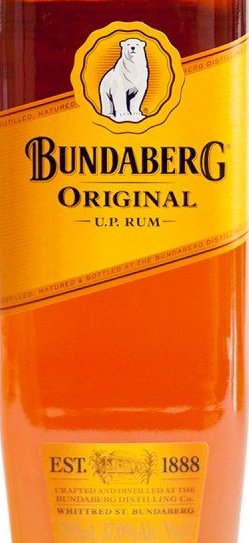
Bundaberg Rum is made in Bundaberg, Southern Queensland, Australia, and is something of a cult favourite down under – it’s said this is what coke and weekends were invented for. “Bundie’ as it’s called there, is practically a cultural institution and supposedly the most popular rum in Australia. I first heard of this 37% underproof when I read Wilbur Smith’s Hungry as the Sea (“Listen to me, you Bundaberg swilling galah” says the hero at one point to an Aussie engineer) and have kept it in the back of my mind ever since. It has been made since 1888 when local sugar plantations were trying to figure out what to do with their leftover molasses. With some interruptions, the rum has been in production ever since. In 1961 the polar bear was added to the labelling as a mascot to imply how well the rum could ward off the coldest chill. The Bundie that makes it over here is not the more expensive Reserve, Red or Overproof, but just the standard low-end stuff, coming off a wash and then a pot still. Even so, I think it costs in the $40-$50 range (which may be transport costs factored in).
One has to be clear that this is not meant to be a sipping rum. It’s absolutely meant to be mixed (preferably with ginger beer to create a highball known as the “Dark and Stormy”), and every review I’ve read says so, though one Aussie who commented here disputed the point and suggested it was more commonly mixed with coke. I agree. This is a cocktail base and not something to tempt the nose and the palate to indulgent, leisurely sips.
The problem was, I approached like I had all the others. Sniff, a sip neat and another one over ice. And I shuddered and just about knocked Keenan out of his chair in my haste to reach the coke. Keenan himself was blanching. “Turpentine,” he managed to squeak as he reached for the smelling salts.
Christ. This is not a rum. This is a tequila masquerading as a rum. It smells different from any rum I’ve ever tasted, harsher and cloyingly musky-salt-sweet (the very thing I hate about tequila) and the taste is sharp, violent on the tongue and is redolent of methylated spirits, match sulphur and new paint (I exaggerate for effect…but not by much). There’s no oak, no caramel sweetness, just hurt. As a sipper this may be the single vilest drink I’ve had since I made the mistake of trying my Uncle Ronald’s DDL five year old neat and lost my voice and sight for a fortnight (admittedly, some suggested it was an improvement and rushed to buy a few extra bottles). It certainly will warm the cockles of your tum, but my advice is to use it for what it was meant for: comforting exiled Aussies, mixing it with coke at least 3:1 in favour of the coke and appreciating that here is something that really is different. Keenan’s attitude was distinctly unflattering: “I’d rather eat a curried dingo sh*t than try that straight again.”
It may appeal to some who like drinking a rum that is off the reservation (and is as distant from the Caribbean caramel and fruit taste as it’s possible to get), and maybe with ginger beer (or coke) it really does lift your socks off. All I can say is that it doesn’t work for me, and after I helped The Bear back to his feet, we “ketch sum sense” and moved back to the safer ground of the West Indian nectars, rather than indulging further armchair sojourns to the south.