Publicity Photo (c) Appleton Estate
First posted May 17, 2010 on Liquorature.
A smooth, complex, warm, rich and all-round-awesome creation which fails ever so slightly on the back stretch because of excessive oakiness, just enough to defer sainthood for Joy Spence. Should be drunk in miniscule sips, with hat off, and head bowed reverentially down.
I’ve remarked before that there are only three ways of deciding whether to buy a rum you know nothing about and which you cannot taste to test in the shop: one, by price; two by information filtering through from others (i.e., word of mouth or one’s own research) and three, by age. One might also and reasonably concern oneself with the way it looks – both bottle and liquid – or whether the rum is old enough to have sex with itself or not, but since so many are blends, it’s not always easy to tell (and Rums have this irritating tendency not to be bound by whiskey’s strictures of stating the age of any blend as the youngest part of the blend).
Based on these admittedly half-assed standards, the best rum in the world right now might actually be the 40% English Harbour 1981, because it comes in a sturdy red-maroon cardboard box, the bottle cork is a real one, not the pissy little plastic nonsense, and is sealed with old-fashioned red sealing wax (gotta love those touches, man); and it has received rave reviews from all over, as well as having a dark look and strong legs of a rum that really means business. My imaginary friend Keenan has more than once observed (rather sourly) that he absolutely hates being dinged an extra ten bucks or more for a decidedly mediocre offering, simply because ten cents’ worth of extra whistles and bells was put on the bottle in an effort to “tart ‘er up”, as he so colourfully puts it.
So what can I say in a rum review of (hats off, and bow heads respectfully here) the Appleton Estate 30 year old? This is a rum which is arguably at the peak of the distillers art in Jamaica. It is the most expensive rum I have ever seen. It has a bottle shape different from all the other Appleton offerings, up to and including the decent 21-year old which – horrors! – still comes in the cheapskate cylindrical tin, still has that fat-ass bottle shape of the entry level V/X and still retains the ridiculous cheap metal cap (what are these people thinking?). Now the 30-year-old has a fat cork shaped like a grizzly’s d**k. The rum is burnished copper and within the bottle dance hams two dance-hall girls past their prime would weep with envy over. And yet, as if they heard Keenan’s grumbles, the makers put this pristine lass in the same piece-of-crap tin cylinder that embraces bottles a quarter of the price. I don’t know who does the marketing for these boys, truly.
If you see one of these, or hear of one for sale, then your whole drinking life to this moment comes into perfect perspective. To buy or not to buy, that is the question. In my youth, I would have said screw it and walked away, reasoning that my hard earned dollars were better off – and would go further, afford more enjoyment – in purchasing the equivalent fifteen bottles or so if SDR tipple. But in my dyspeptic old age, quality is so rarely seen that it almost seems a crime to let something at the top of the heap – pricewise and appearance-wise – get away just because one was being a cheapo. This line of reasoning is a little flawed, I’ll grant you, but it got me past last Friday with no problems.
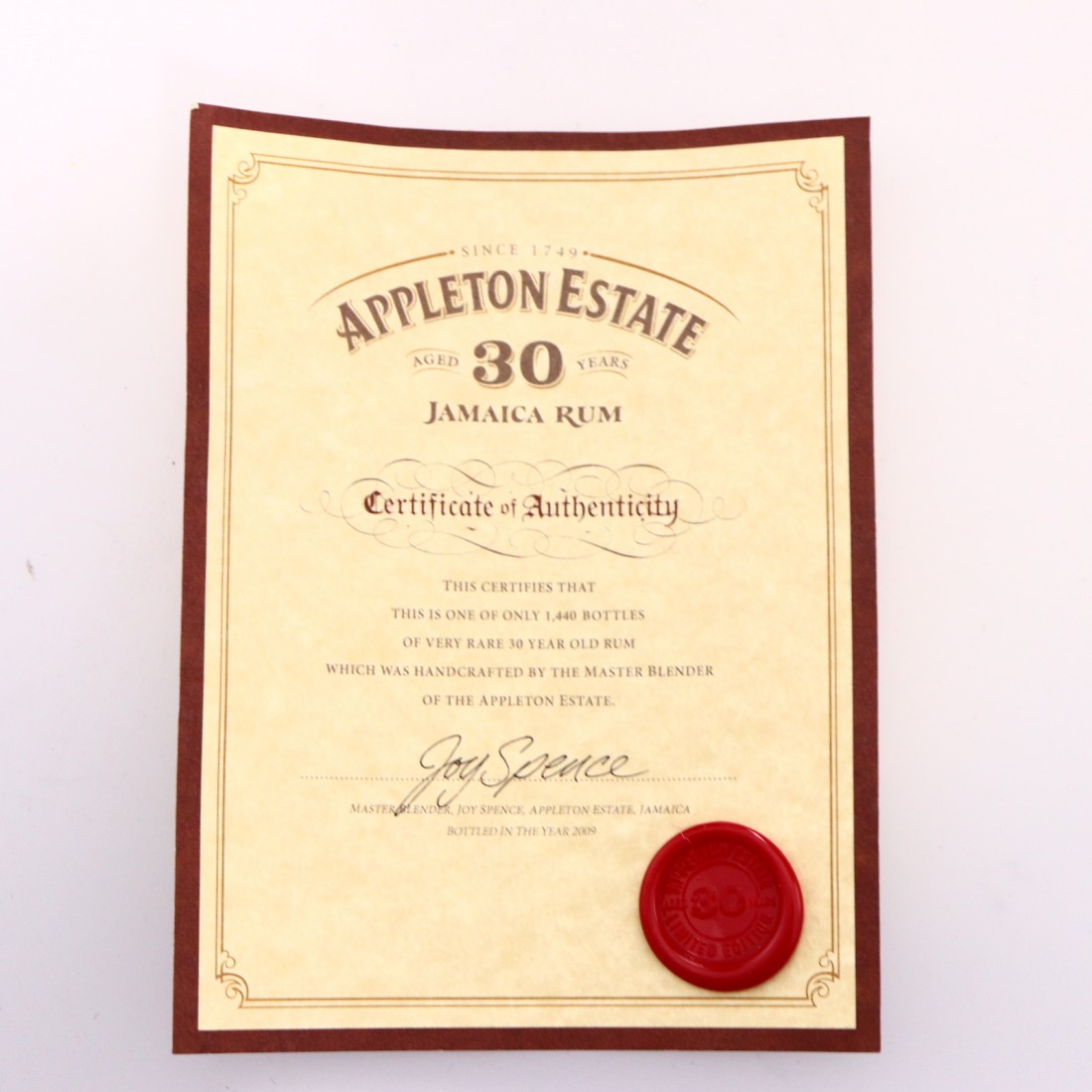
Only 1,440 bottles of the ultra-exclusive 30 year old 90-proof rum were produced from six casks. Of those, 744 went to the USA and 30 to New Zealand in 2009 (the year of issue), and the rest got scattered around the world. The resident rum guy at Willow Park, a gent by the name of Michael, noted that they had six in the cellar, and I saw another four at Co-op the other day, I read a post on the Ministry of Rum that 156 went to Ontario in May 2010… all of which makes one wonder where the other 500 in the world are being held. I shut my eyes tight, forked over my credit card, and one of the pricier rums ever seen by me to this point became mine.
The individual marques that make up the 30-year-old originate from small-batch copper pots and columnar stills, and were all aged a minimum of eight years, blended, and then aged for a further twenty-two years in oak barrels from Tennessee which once held Jack Daniels. After that length of time, the great fear of the drinker and the great challenge of the blender, is how to make the resultant not become so infused with the oak that you end up with something that is no longer a rum (but not quite a whiskey).
The Bear being unavailable (or my imagination not bringing him to life, depending on whether or not you believe the man exists), and I being unable to contain my desire to crack the bottle, I hustled over to the Last Hippie’s place, knowing he was out drowning his sorrows in cheap Scotch on his backyard deck in his daughter’s pilfered Barbie cup. Just as Dumbledore had to give blood to pass into Voldemort’s hiding place, I had to endure a dram of excellent whiskey which I had no appreciation for (sorry Curt, couldn’t resist). Then we reverently opened the 30-year-old, swirled, took a deep sniff and a sip so dainty the Queen of England would have been proud.
Wow.
The rum had real body. The colour was a burnished copper-bronze, and it had the fat, slow legs of an over-the-hill stripper. The nose was an exhilerating and subtly complex combination of orange peel (the Appleton signature), caramel, maple sugar (yes, maple), vanilla and baked pears. On the palate the smoothness of this baby was unbelievable. I was waiting with trepidation for the oak peg-leg to the face and a deep burn on the way down, but somehow Appleton have managed to take 30 years’ maturation in oak and de-fang the taste many might expect, to create a smooth, mellow sipper which is redolent of vanilla, caramel, burnt sugar and spices, but which lacks the sweetness some might want in their rums. Like Renegade’s offerings, there’s no getting around an oaken component some mislike for being too in-your-face (I said it was muted, not absent) but the smoothness of the overall blend made it a phenomenal drink. The finish is excellent, lingering in the throat, not overpowering you, just staying there and gradually dissipating with the hints of molasses and spices remaining, and a suggestion of tannins and oaken flavours that many may find excessive. But really, a masterful piece of work. For the record, I believe Curt thought so too – though rum isn’t really his thing, he’s generous enough to lend grudging appreciation to his friend’s madnesses when they deserve it (even if the reverse is not true).
With a rum costing this much (it is $500+ in Ontario, last time I checked), one has, after the fact, to be a little dispassionate – even cold – about one’s review. One cannot simply let one’s expenditure dictate a positive opinion. Fortunately, I didn’t have to: that it was a rum on par with the other elephant in the room is not under dispute. The questions is, would one buy it again – or recommend it to someone else who had the money but wasn’t sure. For example, with the $200 EH25, I would unhesitatingly say yes (and have). Was the smoothness, the subtlety of the taste, the exclusiveness of the issue, worth it? After all, if the EH25 was like having a slow love-in with your mistress, then the Appleton 30 should have been like a surprising mad romp in the sheets with a wife you’re crazy in love with. Was it?
The bottom line is both yes and no, and one of the reasons this review is so long is because in my own meandering way, I want to be honest about my feelings regarding it. It is a lovely rum. A lovely sipper. It’ll come out to be sampled rarely. It is one of the smoothest rums I’ve ever had, and one of the most complex. But in a way I can’t quite put my finger on, it falls short of true greatness. This could be because of the crap packaging; and the slight lack of sweetness, that final nip of bitterness, which, as I have said before, is what I want in a rum, and why I don’t care for whiskey. It has a lovely hue and colour and legs, and the body is excellent. But perhaps in ageing it that long too much oak ended up in the taste, subtle as it was, and too much effort placed into muting that, not entirely to the advantage of the finished product. (“Too smooth!” thundered Keenan, and quickly poured himself another shot to make sure he was right). Having said all of the above, let me say that I unhesitatingly and unreservedly recommend it above any of the other Appleton offerings, and I am really in awe of what Appleton have done, as I was with the English Harbour.
I just think for that price point, it should have bowled the EH-25 for duck, and instead, got nailed for two byes. I’m paying for a limited edition, not for the ultimate quality of the rum. The Jamaicans came in with a powerhouse cricket team and the Antiguans pipped the innings.
For a rum this exclusive, this hyped and this expensive, I cannot help but call that a defeat.
(#019)(88.5/100) ⭐⭐⭐⭐
Other notes
 First posted January 25, 2010 on Liquorature.