Ruminsky

Mar 202013
 

***


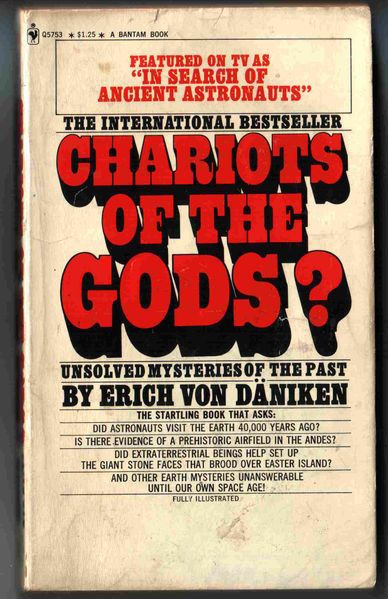
Chariots of the Gods (1968)

Before you wince, roll your eyes and question my hold on reality, hear me out. I’m aware of the stigma the subject matter has.

There were always books around me, lots of them: my mother was a librarian, and my father’s jampacked shelves were treasure troves to be unearthed at leisure (he promised me his entire collection “one day”, years ago, and I’m still waiting).  It was from these sources that I picked up “Steep Paths” by a now unknown Soviet writer called Vakhtang Ananyan; the Enid Blyton “Adventure” series, all of Willard Price’s short novels of Hal and Roger.  And some very obscure works by the likes of Andrew Tomas, Frederick W. Drake and Erich Von Daniken, which delved into unexplained and mysterious ancient artifacts and discoveries that in some (but not all) cases defy a reasonable explanation.

Stones at Sacsayhuaman – note the size and jointing


Erich Von Daniken could be argued to be the author who launched the seventies craze for ancient world weird stuff – he published in 1968, at a time when UFO research was still on people’s minds. In one book, he catalogued a list of frustratingly inexplicable – or fantastically coincidental – enigmas from the ancient world. Mysteries of construction like the ever-popular pyramids on two continents, the Easter Island statues and Stonehenge; the Nazca lines; the crystal skull; the Piri Reis Map; Antarctica, the Bible and Atlantis. I gobbled this stuff up, and have never lost my fascination for such matters, largely because, discredited as Von Daniken now is, however hokey the whole field has become, not all of what he brought to public attention has entirely been rationally or scientifically explained.  As Mulder once said in the X-Files: “The evidence against it is not entirely dissuasive.”  Amen to that.

Von Daniken tried to suggest that the ancient cultures of the world were connected with aliens; that all these strange monuments and artifacts represented contact with advanced extraterrestrial civilizations, and odd statuary and depictions of “Gods” were in fact expressions of how primitive people saw these divine personages.  Okay, fine, I’m the first to say that this is reaching a bit (a bit? I can hear you laugh). But the thing is, the artifacts that Von Daniken described and tried to explain are in themselves, real.  The Piri Reis map exists. The Nazca lines, the pyramids, the crystal skull, the cave painting and statuary – it’s all there.

Where I believe he fell down and brought disrepute into a genre much ignored before and since, is his rather dramatic interpretations.  Even at the young age when I first read the book, I thought he was not just swinging for the fences but the next ballpark altogether.  A round hole in a bison skull dated many thousands of years ago was, to him, not a natural occurrence (the thing ran into a sharp branch, maybe?) but evidence that there were guns in them thar days. The Bible’s accounts of Adam and Eve’s longevity suggested they were extraterrestrials (let’s not even discuss Ezekiel’s vision). And so on and on. You gotta kind of cringe when you read something so far out to left field – people can accept a decent premise, but one that’s that farfetched, with no real grounding?  Man, that’s pseudoscience with a vengeance. And it created problems for all who followed – Berlitz, Tomas, Hancock and others.

Graham Hancock, who wrote the much better researched and much less outlandish, but still critically reviled and controversial “Footprints of the Gods” (which I recommend just because he takes a more moderate approach to much of the same material) tried to revive interest in this subject in the 1990s, but I think he’s treading poisoned ground, no matter how fascinating (and it’s no coincidence that Mulder in the X-Files was never believed either, if you don’t mind me delving into pop culture for an analogy). People simply think it’s all crap.

As time went on, various other authors debunked a lot of Von Daniken’s theses, and he is, these days, sneered at, and mentioned in the same breath as “Little Green Men,” Atlantis, and various cults who believe in astral contact from some Lovecraftian universe.  His theories and the facts he brought to public attention are now fodder for mass entertainment: The “Hab Theory” by Allan W. Eckert tries to be serious but fails and is piss-poor writing to boot, Indiana Jones and the Crystal Skull took it to Hollywood; Clive Cussler’s Dirk Pitt, found (yup) a Crystal Skull in “Atlantis Found,” then came Stagate and its TV followers, and all those other novels and films which posit Atlantians, Lemurians, dudes from Mars, or Sirius or what have you. Sigh.  Take me to your leader indeed.

The Palenque tomb carving. Observe hands, nose and seated posture…what is it?


But the mysteries continue to tantalize and confound, holding us in a peculiar kind of thrall.  Science and historians have still not managed to come up with a convincing explanation of how the pyramids were built to such exacting specifications, let alone how old they really are (I leave it to you to decide whether the mathematics supposedly inherent in the dimensions is relevant or not), and to such gargantuan proportions; the Palenque tomb carving (above) does oddly resemble a man sitting in a device of some kind; what the hell was behind the Nazca lines, those huge drawings scraped into the Peruvian earth which cannot be seen except from the air? How did the meso-American and Egyptian civilizations move blocks of stone that weighed many tons (there’s a single block that is estimated to weigh 200 tons, an object our own largest cranes would have difficulty moving); and then build walls that had cunning joints with no mortar, following no rational pattern?

Von Daniken might have taken us for a grand ride, either through misguided ideas of his own or a desire to cash in on a fad he saw. I don’t really care, myself, long since having twigged to the weaknesses of the interpretations, and the theory.  But the objects themselves remain, their stories unanswered. Perhaps one day we will find the real truth behind such peculiarities in our history and culture.  For the moment they nag and tease and beg more questions than can be answered, fascinating us with a potential history we have thus far not bothered to address.

Mar 202013
 

The other day I was having a spirited discussion with a friend of mine in Toronto.  He cautiously started a sentence: “The fall of Constantinople in the 16th century…”

“1453.” I said

He gave me a doubtful look.  It’s not one of those facts you expect a half drunk guest to have at his fingertips, and I kinda feel for him there. It was sort of unexpected. “Are you sure?”

“1453, April to May, when the Ottoman Sultan Mehmet the 2nd laid siege to the city, then took it by storm. It marked the end of the Byzantine empire and the flood of émigrés to western Europe was supposed to have helped fuel the Rennaisance.”  And I buffed my nails complacently, had some more of the excellent rum I was filching from his stocks, and smiled like a cherub.

It takes more than guts to tackle some of the tomes in my library:  it requires a genuine love for good writing as well as an interest in the world.  By carefully parsing that sentence and the conversation above, you may gather that I’m not talking about fiction, but histories. I’ve got quite a few that handily exceed a thousand pages, and can be comfortably used to serve as foundation stones of your new house: A History of the World by J. M. Roberts, for one, and Europe: A History, for another. It was Europe that informed the discussion above.

Much of the blame (or credit, depending how you see it) for the accumulation of such massive works that take weeks, if not months, to get through, belongs to mon pere, who early on in my life suggested I never let a history class pass me by. Years – decades! – later, I still follow this dictum.  And of all the works of the human past I have read, Europe: A History by Norman Davies, stands out as one of the most original, complete and readable presentations in the genre. Yes it’s long, yes it is daunting, but as with all well written works, treasures are there for the tireless reader who perseveres.

Three things make Europe stand apart from the herd.  The first is the fact that here, for one of the few times I’ve ever seen, an author takes the time to go beyond the rather timid interpretations of what and where Europe actually is. Not limiting himself to those places where barbarians invaded – Britain, France, Germany plus a few extras —  Davies remarks “For some reason it has been the fashion among some historians to minimize the impact of the Magyars. All this means is that the Magyars did not reach Cambridge.” And so he takes for his canvas northern, southern, eastern and western Europe…the continent in totality.  What in effect this means is that previously ignored portions of the continent (or those that are the subject of specialist books on their own that do not integrate them into the larger canvas) are given equal weight with the more commonly written about countries.

Secondly, there is the oddity and charm of the “inserts” as I call them.  These are boxes, bordered small essays, on one particulary tiny detail that is of interest in the period he is discussing, like time capsules. One describes why cheeses are similar across Europe; another discusses the origins of the word “jeans”, and yet another talks about the history of printing.  These inserts help break up the admittedly monolithic text and keeps the narrative flow quirky and interesting.  In fact, if you ignore the text and just read the three hundred plus inserts, that alone (in sheer informational and entertainment value) might justify a read of the book.

Lastly there’s the quality of the writing. Davies has a subtly ironic and quietly humourous style that is actually very readable (as the above remark on the Magyars should illustrate).  He tends to take the overview, discussing mass movements, ideas, trends, and then delve in here and there for something more detailed.  He avoids the bias of “western civilization” in the central portion (giving equal weight to other parts of Europe), covers the prehistory to the fall of the Soviet Union in twelve dense chapters, but for all that volume, it’s an entertaining read, however limited in its own way, and the prose helps the mass go down. I may be a bit strange this way, but I’ve read it twice so far, and it looks like a reread is in the cards this or next year.

No one book, no matter how weighty or long, can possibly cover the entirety of the history of such a large area, over such a long period of time, without getting bogged down in minutae or detail or length.  That Davies has done as much as he has, is astonishing in itself, but he himself remarks that it’s an overview, and not much primary research was required. The book is best used as a sort of central point to gather all threads of other more detailed works into a cohesive whole, maybe as a research tool for students.

Professor Davies is a leading English historian who made his reputation with the book  God’s Playground (1981) where he comprehensively reviewed Polish history (he studied in Poland and his doctoral dissertation was about the Polish-Soviet war).  He has written much about Poland, also wrote The Isles: A History, much in the same vein as Europe, with numerous capsules dotting his pages and consistently writes for the mass media.  His interpretation of the Holocaust has been criticized by some (this led to Stanford controversially refusing him a tenured position in 1986).

At 1400 pages and weighing in at 1.6kg (3.5lbs) Europe: A History is absolutely not for the faint of heart: but those who delve into its depths and brave its scope, will surely not be disappointed…always assuming they ever get to the end. I’ve dived into the deep ocean of Davies’s work twice now, and have always emerged months later, dripping, exhausted and tired, but also enervated, and always educated by some new thing I overlooked the last time. It may not be your thing, but what the hell, I highly recommend it anyway. You may only want to read the capsules, or you may brave the whole book, but whatever you read, you will absolutely come out with more than you went in with.

Mar 202013
 

The Coming Plague is a book about disease in the modern world.  Not diseases that originated in the 20th century (though certainly this figures in the writing), but about how diseases in our  world – specifically during the 1950s to the 1990s – spread, were identified, fought, and in some cases, ultimately conquered. It may sound like a dry subject, but Laurie Garrett’s prose, eye for the quirky detail and the topicality of the theme in a world made fearful by SARS, swine flu and H1N1, make it a riveting read.

The book is divided up into chapters that focus on a series of individual tiles that gradually make up a more compelling mosaic.  Rather than solely concentrating on dry statistics and stultifying boring histories, it takes the point of view of the famous CDC  disease cowboys of the era: men and women from the US Centers for Disease Control with scientific degrees and a quest for adventure who roamed the world trying to identify and quell outbreaks of diseases that heretofore were small and localized, but which in an increasingly integrated and mobile age threatened to bloom into something much more serious.  Beginning in 1962, it explores the emergence of hemorrhagic fevers in South America and Africa, and gives us fascinating stories (I’m not trying to make light of the suffering of its victims, merely to say how well the narrative is presented) on the Bolivian hemorrhagic fever, Marburg virus, yellow fever, lassa fever, Ebola…and AIDS.

Interspersed with the major themes of increasingly virulent viral diseases are occasional side trips relevant to the whole, such as that of Legionaire’s disease, the resurgence of sexually transmitted diseases after the optimism of seeing penicillin-based drugs nearly eradicate them; feminine hygiene and the dangers of super-absorbent tampons. And then there are chapters on topics as important as recognizing the cities as centre points for the spread of diseases (particularly their poorest sections where drug use and needle sharing is rampant); the increase in drug-resistant super-bugs; and by far the most poignant series of chapters, on AIDS.

Several things occurred to me as I read this book in 1996, and again to write this review: Garrett correctly sounded the horn on how important it was to control disease by open communication between government, the people and the medical establishment (something that horribly failed in the case of AIDS); how superbugs were becoming more, not less common; how the optimism of eradicating smallpox was cruelly smashed by simple evolution and inconsistent global public health policy; and how correctly she noted that modern mass transit (national and international) coupled with crowded megalopolises and poor urban centers, created optimum conditions for efficient disease spread. It’s not the first time this had been posited: it’s the first time I had read it presented so well, though.

If I had a fault to find with the book it is that it presents, on some subjects, too little: malaria, for instance, could have been more comprehensively dealt with (especially how the banning of DDT promoted its resurgence) – and having had it many times myself I think it criminal how few resources are devoted to its suppression even now; the focus is on disease control from an overall American perspective, but there are fewer mentions about other nations’ efforts in the same areas. In other words, I wanted more, which is perhaps a bit shameless considering this thing is 750 pages as it is.

But I freely admit that modern history is catnip for me.  I like knowing how things developed, how the world I live in was formed by the decisions (good or ill) of those who went before.  I think that in our modern world of popular appeal, instant news and always-on hypermedia, we often lose sight of what’s really important, ignore more global themes and lose ourselves in a vacuous haze of noise. The Coming Plague was a dash of cold water on complacency — and to my mind the news of the last fifteen years regarding global pandemic scares could almost form the next chapters of this fascinating, informative and highly readable work of an often-neglected subject, by an author who knows how to make the case.

Mar 202013
 

I don’t know of anyone from my generation who did not at least hear of Doom.  This one game – first released in 1993 – was the single most eagerly awaited offering of any software company to that time, was a landmark event that crashed the servers of the hosting BBS one minute after the midnight “opening”, and was reputedly the second most common reason quoted for the loss of productivity in offices worldwide (solitaire being the first).

As a working pro who corrupted every team of auditors for three years into playing deathmatch games after hours in our darkened offices, I can testify to that game’s addiction, adrenaline pumping action and (for its time) absolutely stunning graphics in a fully realized, spatially coherent 3d world.  It went beyond the trials of its zany predecessor Wolfenstein, made shareware common, game software respectable and launched a thousand coders into the gameworld. Even its terms have entered the common speech: Deathmatch, BFG, frag, First Person Shooter…Doom started a tidal wave in popular techno-culture that is with us still.

Masters of Doom: How Two Guys Created an Empire and Transformed Pop Culture seeks to go behind the scenes and trace the origins and development of the geniuses behind the game:  John Romero and John Carmack .  They were two guys barely out of their teens, but had already amassed experience coding games, and were the first (together) to create games that scrolled smoothly from side to side.  The success they had with one of these – Commander Keene – led to another game which I obsessively played, Wolfenstein (long range thanks to John, who provided the 1.44mb diskettes which loaded it onto my computers all those years ago), that also enjoyed considerable popularity.

While Romero was the ideas man, it was Carmack who was the programmer who created the realistic 3d modelling engine that gave the games their realism and quasi-3d feel.

And then of course, there came Doom.

The book is a relatively short read at 300 pages, and while it covers the history of the founders, it also is a sort of introduction to the programming subculture made famous years later by the Google corporate ethos. A bunch of guys simply got together with some great ideas, programmed like crazy for weeks on end, living like hermits on pop and pizza and in the process created not only fantastic games but charted a course which all first person shooters subsequently followed. MoD discusses the role of the two egocentric and driven founders of id Software, the way they came up with ideas, the programming of the 3d engine that underlay Doom, and intersperses the lot with witty anecdotes about matters as varied as the reason for naming WAD files as such, what a BFG is, how the shareware concept evolved and the origin of the word Deathmatch.

As with all supernovas, things had to come to an end. Creative differences led to a dissolution of the friendship and business association between the two men and the team they had built up: MoD discusses this frankly and in surprising detail. In fact, the book could be seen as a sort of primer not only of programmers’ secret lives, but on how tech startups start great, develop some kind of killer-app, and then either fly high or flame out. It doesn’t stop with Doom either, but continues into the new century and gives weight to subsequent events like the development of Quake, and where the founders are now (well…then: it was published in 2003).

The reason I post this review is because I not only loved the game and am a bona fide trivia- and history nut, but because it is a remarkably tense, tight and interesting read (especially if the subject matter appeals to you). The chapters on how they posted the first shareware version on the University of Wisconsin – Madison server in December 1993, opened the file up for download at midnight and crashed one minute later due to overload; the section on how amazing the reception was, both by the gaming community and average office Joes the world over;  and the popularity of Deathmatch…they are well written, well paced and a wonderfully fun read.

In comparison with the white-hot writing style portrayed in this short book, I found “The Ultimate History of Video Games” which should have been a great piece of work, simply plodding, pedestrian and  plain boring. No such problems afflict Masters of Doom, and if you have an affinity and sneaking affection for behind-the-scenes work of software (games!) publication, then this book describing the early years of the industry will not disappoint.

Mar 202013
 

Henry Kissinger is both respected and reviled as one of the most powerful American Secretaries of State ever (he also concurrently held the post of National Security Advisor) but there’s little argument that as an author and analyst the man is in a class by himself.  Nowhere, in my not-so-humble opinion, is this more clearly to be seen than in his doorstopper of a book about statecraft, Diplomacy.

Diplomacy is not for the timid, and should be avoided by those whose taste runs into fiction or who have the adult equivalent of ADD.  Admittedly, we at the club have ploughed our way through Ayn Rand, and the running joke is always that we’ll get to War & Peace in the next century or so as long as we get enough notice, but we’ll have to really brush up our socks and burn the midnight oil to get through this one if we ever relaxed the non-fiction rule. At 900+ densely-crowded pages and 3lbs, here’s a book for men with hair on their chests.

Starting with the end of WW2, Kissinger jumps backwards to the origins of the European system of international relations which developed after the Peace of Westphalia (1648) and summarizes some three centuries of diplomacy between the western powers, giving generous time to France’s attempts to keep Germany disunited in the 17th and 18th centuries, the results of the post-Napoleonic-wars period, and the massive impact that Wilsonian idealism – so derided by a contemptuous Theodore Roosevelt who was a proponent of realpolitik if there ever was one – had on contemporary American foreign policy.  It is a vast and sweeping tapestry of history with characters as recognizable as Metternich, de Richelieu, Bismarck, Stalin, Hitler, Giap, Nasser and the 20th century American Presidents striding across the stage.

In its analysis and readability, it is, in most parts, masterful, I dare say brilliant.  Aside from George Kenan’s extraordinary essay “The Sources of Soviet Conduct” (also known as the ‘Long Telegram’) written in 1947, I doubt I’ve ever read its equal in a non fiction work for sheer incisiveness and clarity of prose. I particularly enjoyed Kissinger’s dissection of Metternich and Richelieu’s maneuverings, and how Stalin survived the invasion of his country, as well has the psychological portraits of the many world leaders figured in the book. Kissinger’s recounting and analysis of events in which he himself played a part – the Vietnam War, the Arab-Israeli conflict among others – are somewhat less compelling, listing slightly more towards an apologia or explanation for actions taken by him, than a straightforwardly objective breakdown.

I have read Diplomacy cover to cover at least three times since I obtained it, and my scribbles, highlights and jottings mark many pages.  It has informed my world view, shed light on historical events and charges my desire to read more about real events and real people, every time I crack the cover. It is dense, scholarly, long and not a light read, so reader, be warned: this is not a trivial intellectual exercise for the scholastically disadvantaged…a solid grounding in history is almost a prerequisite, and Kissinger makes no concessions to you. But for those who manage to dive in and swim to the other side of this sea of scholarship, I can almost guarantee that you’ll walk away with more than you went in with and possessing a greater respect for diplomats and their efforts worldwide.

*

NB. This is irrelevant but I wanted to mention it: the book was given to me by Ken Hermann from Vancouver, a good friend and professional colleague from my first overseas job in Central Asia, back in 1995.  He lent it to me as he was leaving for his turnaround, and died the very same day, along with ten other Canadian expats and three Russian pilots, when the MI-8 helicopter they were in crashed in the Tien Shan mountains. I keep it and look at his name on the flyleaf every year, and remember him and all the others.

Mar 202013


What an enormous, sprawling, wide-ranging, dense, tragic, magisterial narrative has Robert Fisk spun out of his journalistic experiences. I have read Edward Said’s works on the Middle East, Huntigndon’s “Clash of Civilizations,” and passed through many histories of that troubled part of the world, but it is my considered opinion that this outcome of thirty years’ reporting there is in a class by itself. Personal, compelling, well-researched and passionately written, it is on a par with “Bury My Heart at Wounded Knee” for unbridled emotional and intellectual impact.

Fisk’s writing is a tour of the modern history of the middle east (although he digresses to other points from time to time). He writes about his interviews with Osama bin Laden, the Armenian genocide (it was the Congressional recognition of this in 2010 that made me go back to the book), the Algerian civil war, and 20th century histories of Iraq, Iran, Palestine, Saudi Arabia and Kuwait.  Through it all you get the sense of his outrage at how, as the British Empire waned and shrank and the American one rose, whole populations were manipulated, used, killed and moved as pawns across a strategic board, with fear and hysteria as coercive weapons. Nowhere is this more clear than in the account of the Iraqi invasion and how, by deliberately manipulated intelligence and populations whipped into war frenzies of hatred and revenge, the Western Powers commandeered the oil in Iraq, and labelled anyone who disagreed as being on the side of the “terrorists.”

This brief account of the book does little justice to the sweeping arc of Fisk’s accounts of the Middle East.  Yes it’s a weighty read, and yes, it’s long – a book covering this much history can hardly be anything else.  But his personalized writing style and in-place observations of the events that shaped the region for over a century are a valuable counterpoint to the drier historical tomes written by more erudite historians, and there’s no denying is research, or his passion for the innocent dead.   Indeed, it is these accounts that inflate the book (a fact bemoaned by many). Fisks acts as a speaker for the dead, presuming to ask why.  And if he writes stridently and with too many words, I can only recall the Emperor’s whine to Mozart about too many notes. And Mozart’s reply…”Which ones should I cut?”

I reiterate that if history is not your thing, this book won’t do much for you.  But as year passes year and we are no closer to a Middle East peace, and nations continue to go to war in that region, then perhaps a book like this, unashamedly partisan and mourning the waste, is in itself, perhaps, a good thing to take hold of and read through, if only just once.

Mar 202013
 

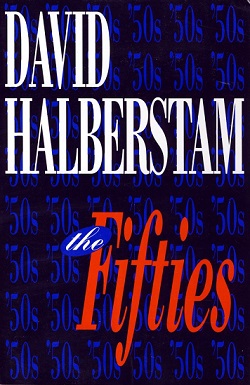
The Pulitzer-prize winning author David Halberstam’s study of the 1950s remains, after three readings, one of the most enjoyable works of history I ever picked up by accident. I was in a small bookstore on Yonge Street in Toronto and needed two more books to round out the $25 I was spending. The other one has long since been relegated to a shelf somewhere, but I keep picking this one up every year or two to go through it again.

Halberstam’s central thesis is that while the sixties was a seminal decade in American life – Vietnam, the counterculture, birth control, rock and roll, peace, love and what have you, all rocked the nation – the germination for many of the events that defined that decade actually originated before that, in the immediate post-war years.  More, many smaller, less visible, but not less impactful occurrences also happened during the fifties which arguably had more far-reaching effects: Levittowns, the Cold War, discount stores, the beginning of the black migration from the south to the northern industrial centres, the origins of the Beat generation, the changes in cinema, decline in radio, advertising, research on contraception, fast food (the chapter on MacDonalds’s is brilliant)…I can go on and on.

Halberstam’s masterstroke is to make his chapters short and tightly focussed instead of droning on for hundreds of pages on grand themes that would inevitably try the patience of a scholar.  Starting with the late 1940s, he sketches the main events from a political perspective.  Truman, MacArthur, the origins of the Cold War, atomic reasearch, the return of GIs from service, the nascent middle class, are all touched on briefly.  After that he ranges more widely, and not always chronologically, because his chapters tend to focus on one thing at a time.  In a book this large – okay, okay, it’s 800 pages long — I’m amazed that it contains as much as it does in 46 succint chapters.  And if the book has a weakness, it’s that the chapters are not labelled, only numbered, so one is not sure what one is getting into until halfway through a section (this is why my edition has my chapter titles inked in – “Rosa Parks and the advent of Civil Rights”, or “the 1952 Presidentials” and “The emerging impact of TV”…and we won’t even discuss the highlighting that is on almost every page).

David Halberstam was a journalist and author who cut his teeth reporting on the Viet Nam war, and wrote a seminal work on US hubris leading to that debacle and the subsequent influence of those policies and decisions called “The Best and the Brightest,”  which I also recommend highly. He first came to my attention when I read his book “War in a Time of Peace” which discussed the low intensity conflicts that raged following the end of the cold war and how the US dealt with them…in particular, Haiti, the Balkans and Somalia. He was a Pulitzer prize winner and loved baseball and sports, about which he also wrote several highly regarded books.

This glowingly positive review is probably not going to change anyone’s mind.  If you’re not into history or current affairs, well, then I doubt I can convince you to pick up a tome this large in between all your other concerns.  I myself usually take about a month to go through it.  But if you are at all interested in the history of the 20th century and the forces that shaped American society and culture – and by diffusion, that of much of the western world – then this book is well written, informative and one of the best of its kind.

Mar 202013
 

The Flood Tablet

Then came the flood, sent by gods’ intent…
And Ea [gave] this advice to me:
“Arise and hear my words:
Abandon your home and build a boat
Choose to live and choose to love…
Be moderate as you flee for survival
In a boat that has no place for riches
Take the seed of all you need aboard…”

Tablet XI, Column i, The Epic of Gilgamesh

Aside from historical and biblical scholars, not many people know about The Epic of Gilgamesh, though my research suggests that the character seems to be somewhat of a subterrannean cultural icon and is referenced quite often in the arts; those that do know the epic, came to it not as a classic in its own right but because they heard or read that it provided one of the first independent written records of The Flood (a fact not as startling as it may seem, since many creation myths from around the world have a destruction of man by gods in a titanic cataclysm as one the central theses).

But like Moll Flandersthe RamayanaHuck Finn or The Tale of Genji, it shares a unique genealogy: it is among the first of its kind, if not the first.  It may be the oldest tale ever written, and the earliest work of literature known to man.

The Epic is a Mesopotamian myth; it is a series of short episodic poems from the proto-kingdom of Sumer, which flourished around four thousand years ago (divorce and property rights were developed here, for the trivia nuts reading this). It describes the adventures of the King of Uruk, and his best friend Enkidu (in this it parallels the Kyrgyz hero-myth of Manas and his best friend Almanbet, though the legends are not strictly comparable), and is inscribed on twelve stone tablets found at the city of Nineveh, once part of Babylon, in 1849.  Various interpretations suggest that the oldest part of the tale is from Sumer itself, but later Akkaddian additions created the famous 12 cuneiform tablets which form the basis of most modern translations.

In the first part of the Epic, Gilgamesh is a king, two thirds god, one third man, who oppresses the citizens of Uruk by – among other things – indulging himself in the droit de siegneur (the “prima nocte” made famous by Braveheart).  They cry out to the gods, whose create a primitive man of the same power as Gilgamesh; he is Enkidu, covered in hair and living in the wild, until found; seduction by a temple prostitute is the first step in his civilization (an interesting twist on Rousseau’s thesis that it is civilization that corrupts the Eden-like state of primitive man).  He goes to Uruk to confront Gilgamesh and after a titanic battle, they become friends

The next tablets tell the various adventures the two friends have: the slaying of the demi-god Humbaba; the encounter with the goddess Ishtar after returning to Uruk, and Gilgamesh’s refusal of her advances (Ishtar is part of the the prototypical triumvirate of elder gods, corresponding to the Sumerian Innana, Egyptian Isis, semitic Astarte…and the (downgraded) greek and roman goddess of love); her petulant plea to her father Anu to avenge her humilation by sending the Bull of Heaven to wreak destruction on Uruk.  The heroes slay the bull, but the gods decide one must die for this affront to heaven, and after a short illness interspersed with many vividly recounted dreams, Enkidu dies.  Mad with grief, Gilgamesh seeks to find a legendary man called Utnapishtim who may be able to to provide him with the secret of immortality and of regenerating life…since he has been alive since the Great Flood.

And here we come to it.  Try and imagine the impact such a statement on a four thousand year old tablet must have made on a mostly secular but still religious culture which had not yet been exposed to Darwin. The description Utnapishtim gives Gilgamesh corresponds very closely with the Flood Myth of the bible (and with many other myths in world culture, but I won’t go into that here), most particularly how one family was given advance warning to build a boat to ride out the flood, and then, after the waters began receding, released a bird to see whether it returned.

In the event, Utnapishtim instructed Gilgamesh how to find the sacred flower that provides immortality, but after Gilamesh discovers and picks it, the bloom is stolen while he bathes by….what else?  A serpent. (I just love this stuff…even a modern novelist can hardly better this one)

Gilgamesh is one of those stories at the root of our memories and culture, so basic that we can’t see its murky outlines underneath our common notions of storytelling.  Much like Robert Johnson’s primitive licks which whisper from under the bedrock of current rock music, Gilgamesh is one of the prototypical tales without which none of the others can be properly understood.  He is the first Nietzschean superman, the most basic wandering hero like Rama, Hercules, Manas or Conan.  He calls to our unconscious mental picture of a Jungian first man with correspondences in Aboriginal, Lakota, semitic, Hindu, Greek, Inca, Polynesian and shinto mythology. He is the first recorded attempt in world letters to nail down the concept in a permanent form. The epic dealt with sex, religion and flawed beings in a realistic way not found again for literally millenia, questioned dogma and the gods themselves, and told a coherent story that actually had a point (though scholars feel it is still incomplete and not all tablets have been recovered)

And for a legend this old and this dusty, it’s actually still referenced a lot in modern art and historical forms.  Consider: Atlantis theorists refer to the Epic constantly as a secondary source for the Flood Myth they claim underlay the sinking of that fabled isle; Phillip Roth wrote a novel abut a baseball player Gil Gamesh, whose story arc followed the epic; it has been translated into Klingon for Star Trek fans (along with Hamlet) and been the focus of at least one episode in The Next Generation; at least three operas of that name have been written in the latter half of the 20th century; perhaps due to its oral backgrund, a variation of the legend has often been performed in theatre; and Japanese anime references it in Sword of Uruk and in Gurren Lagan (there’s this mecha called Enkidu…); even Hercules: The Legendary journeys, an American TV series, had Gilgamesh make an appearance. Think this is all?  In the Final Fantasy video games, there is usually a boss called Gilgamesh and his sidekick Enkidu; in Star Wars: X-Wing Alliance, there’s a Viraxo ship named Enkidu; in Civilization IV Beyond the Sword expansion pack, the leader of the Sumerian civ is called Gilgamesh.

Joseph Campbell’s powerful work The Hero With A Thousand Faces (which helped George Lucas fashion Star Wars, by the way) probably comes closest to allowing us to understand the peculiar longevity of a character in myth mostly forgotten and rarely read. The Hero on a Quest holds a fascination for us all because it is embdedded in our subconscious, part of our race memories of a wandering past.  We seek the unattainable both within and without our physical selves, seek a state of grace and strength over and beyond the mundane lives we live. Gilgamesh, strong, kingly, flawed, who lost his best friend and gained knowledge if not enlightment, speaks to that part of us that rises above the petty considerations of our world and searches for a more sublime state of mind.

Mar 202013
 

Book Review: Shogun – James Clavell

James Clavell was the real thing.  A prisoner of war in Changi (source of the inspiration of his first novel, King Rat) he somehow managed to rise above his experiences in war to write perhaps the definitive fictional account of pre-Tokugawa Japan in Shogun. Sure Christopher Nicole wrote a truer account in his novel Lord of the Golden Fan, but it lacked the snap and punch of Clavell’s creation, lacked the in-depth research, the feeling, the entire mentality of Japan. Let me put it this way: at the end of Shogun, you spoke some Japanese and had more than an inkling into the entire mindset of the culture.  Few novels I’ve ever read have such a sense of verisimilitude, or drew you so deep into the complex inner life of an entire people.

The story follows Jonathan Blackthorne, ship’s navigator, who is blown by a storm into a bay in the Japanese islands in the late 16th century.  The story follows him through his initial hostile reception by the local daimyo (feudal lord) and Portuguese priests, through to his secondment to the entourage of the daimyo Toranaga and his gradual assimilation into Japanese ways of life. And what an assimilation it is, because Clavell contrasts the western mind with that of the Japanese, makes us understand the utter foreignness of one to the other, the politics, obligations, dietary practices, and in Blackthorne’s learning, we learn alongside him.

Alongside this is a primer on history and politics of pre-Edo Japan. For those who know nothing of this, there was a period of many years where various powerful families and clans and feudal lords battled for overall supremacy in Japan (the late Warring period); in  the late 16th century one general managed to unite most of the four main  islands but could not take the title of shogun (regent for the emperor) because of his common birth: after a rash invasion of Korea and China, he died, and one of his regents finally took power and stabilized the empire for over two hundred years until Commodore Perry forced the islands open in the 19th century.  Shogun tells the tale of this interregnum and the steps leading up to the decisive battle of Sekigahara in 1600 (with foreshadowing of the taking of Osaka castle later…but I digress).

I know this sounds somewhat dry, but trust me, it is anything but. Strategy, tactics, political maneuvering, great battles, treachery most foul, love all tender, ninjas, samurai, madams, sex, violence, swords, guns, power and command, all wrapped up in a long, delicious serving of a novel that isn’t afraid to go where the story leads, without compromise. And in all that we meet characters not soon forgotten: Blackthorne, Toranaga, Mariko, Tsukku-san, Ishido…the list is long and distinguished.

This is the novel that introduced Japan to the average western reader. From battle ethics and seppukku to hygiene, diet and cha-no-yu, the interwoven narrative lines flow harmonically, like fish in a Zen rock garden pool. Beautiful, economical and seamless, Clavell’s insights on human nature have produced a masterwork of historical fiction, not to be missed by any.

And if that isn’t enough for you, well, there are always those ninjas.

NB The full TV miniseries is faithful to the book and is not a television event to be missed if you can get the entire thing.

Mar 202013
 

On the Road was the shot across the bow of an older generation, and heralded a new direction in American letters. Jack Kerouac pioneered the ‘stream of consciousness’ narrative style and dream worlds made flesh, flashbacks, flashforwards, plot departures and side trips, meandering soliloquies and sounded the first thrum of the counterculture. It is the Star Trek of the hippie sixties, presaging much of what came later, its uniqueness seen mostly in retrospect

At all times biographical, On the Road is a journey into the mental state and physical surroundings of Sal and his friends, who disdain the middle class existence they have (and about which not much is ever said) and who dare to do more than dream, by heading out on the great freeways and highways of America to discover themselves and sample what there is of life.

In form, On the Road is spare on plot (if one can even said to exist) and long on character. The various individuals who populate Sal’s life and travels are carefully drawn and in the structure of the observations about them – the novel is written in the first person – the only nod to development can be seem…that of Sal and how is growing maturity over a period of years leads to his gradual mental adulthood. Beyond that it’s just a series of vignettes about places visited, people met, things experienced, sights seen.

On the Road is a paean to the great new adventure of America – travel on the highways. The post war generation had no ‘good’ war to fight, no new territories to explore or conquer…what they had was a large sprawling land loosely connected by roads, and Kerouac himself travelled extensively on them (in a way he was like Steinbek), and the experiences he had germinated for years until he put it all down.

What sets On the Road apart is the narrative style. As Bob remarked in our discussion – “Where’s the damned plot?” It has none. Kerouac reputedly wrote the whole novel in three weeks fueled on coffee, and he typed where his thinking led him.  Like Catcher he talked frankly – if amorally, distantly – about sex, about drugs, about the lure of the road to the detriment of personal relationships, about women, homosexuality, music (jazz), and anything else that occurred to him as he was putting it all down. This leads to a casual style of writing which almost lets one see what Kerouac is seeing, and offended the purists of the day who labelled it lazy and anti-intellectual.

For the many others who read it – and that seems to have been a great part of the youth of America at one point or another, another similarity it has with Catcher – it was a book that resonated, captured their unease about their lives, its pointlessness now that their surroundings were safe and perhaps even affluent; it encapsulated their idealism about getting away from The System and life spent working for The Man, and living a purer, more innocent life where the rat race had no place.  It wrote about people not often written about, the Common Man (much like Peyton Place did). It was a major part of the works of the Beat poets (Ginsberg, Burroughs and Kerouac himself) who were the source of the whole Beat generation of the fifties, which developed into the hippie counterculture of the sixties, what with its characteristics of drug use, easy love, eastern religious sensibilities, and the desire to experience life in all its facets, with all its immediacy.

Seen now, at a remove of over half a century, it’s difficult to clearly grasp the world into which it detonated with such force. Race relations had not yet burst into the great movements of the sixties; it was still deemed safe to hitchhike and travel the highways alone; vast tracts of the continent were still  isolated from each other and a large part of the population remained rural, clinging to a more sedate, conservative lifestyle, ignoring the great social changes brewing underneath the deceptively calm exterior and behind the white picket fences. Drugs, sex (even less the seedier aspects of it), violence were seen as distant and never, ever written about.

Kerouac and the Beats changed all that. We live in the inner world they helped make. Cable, always-on computers, porn freely available, TV shows with graphic violence, sex and drug use, the infantilizing and numbing effects of popular culture (“pro” wrestling and reality shows are prime examples of this craziness), the baser side of man’s nature always on display, books written using any kind of language, on any kind of subject — the mental world which surrounds us, and the ability to write and watch and create fiction of this kind, of anything we please or can imagine, can all be traced to those crazies in the post war years who risked obscenity trials, jail time and contempt to realize an inner vision that proved to be more durable, and more freeing, than that of all those member of the Thought Police who sought to stop up the bottle and stuff the genie of free expression back in.

I may not like the writing style – I marked On the Road down savagely – but there’s no question in my mind of the debt modern society owes to the Beat poets like Kerouac and his generation.  Every time I use an obscenity in my own writing, or discuss sex frankly, it is to some extent  the Beats that I owe my right to do so. They fought the battles we don’t have to, and we eat the apples of the tree they helped water.*

For a discussion of the Beats and their effects, Halberstam’s The Fifties is a good reference, as, of course, is Wikipedia.

Mar 202013
 

A young woodsman called Richard Cypher (hint hint) is out in the woods, pondering the murder of his father, when he sees a beautiful woman (is there any other kind?) being stalked by four men. He intervenes, and rescues her from death. From this rather quick beginning, Terry Goodkind has spun the tale of “Wizard’s First Rule.” “When writing a short story,” Chekhov supposedly said, “Finish it, then chop the first three paragraphs.” We get dropped into the action so rapidly in “Wizard’s First Rule”, that one suspects Goodkind may have known the quote.

WFR (I’m a little too lazy to be typing the whole thing every time I refer to it), is, at first blush, a groaning retelling of Tolkien.  When you think about it, it has all the trappings: innocent youth going on quest to save world – a sylvan northern place, of course – from evil bad guy, aided by friends and (of course), old wizard.  It’s a bildungsroman from start to finish – though finish may be the wrong word, since this book is the first one of eleven equally weighty tomes. Why me God?, I groaned as I saw the stat: can these things not be afflicted with the Multiplicate Virus?  Was I gonna have to plow through millions of words in order to grasp what amounts to an introduction?

And Terry Goodkind, who published this work in 1997, doesn’t make the going easy either.  After a that rather lurching beginning that drops us so disconcertingly into the main events, he tediously sets up character and world and scene in what consists of half of a 900 page novel.  It’s like the journey to Rivendell took twice as long. He mixes elements of Middle Earth, the Quest, the numinous object and modern pop culture in a medieval setting in often intriguing ways. It’s quite a read.

This version of Middle Earth is a land divided into three spheres: Westland, without magic, Midland with it, and the more easterly realm of D’Hara, also with magic. The three lands are separated by a now-failing boundary which once prevented passage between them, set there by wizards long ago, but still within memory of the living. The ruler of D’Hara, an evil emperor (aren’t they all?) called Darth Vader – sorry, Darken Rahl –  is taking over Midland and possesses magic greater than even that wielded by the great wizards of old.  In a nutshell, it becomes Richard’s task to stop him, since Darken Rahl is bent not only on world domination, but actual world destruction.  One wonders what he’ll do with the wasteland he ends up with.

WFR is a self-contained story – much to my relief – and to some extent suffers from what I term “First Novel Syndrome” – which is that suspicious effluvium one finds in some first novels: occasional loose plotting, language that doesn’t ring true, motivations and interactions and events that occur just a little too conveniently. In this instance, these matters exist and can be spotted – the sudden appearance of Scarlet is a particularly egregious (and irritating)  example of the phenomenon in action – but are fortunately not always that obvious.  It’s sad that a novel this ambitious and this taut needs to resort to clumsy plot devices to get our boy out of a corner Goodkind has written him into.

I can go on about the world Goodkind has created, the characters he populated it with, and the backstory and history with which he fleshes things out, even the long narrative and intricate plot: but that would be pointless. In a series of this kind the crucial questions are always the same: is the world a unique one, populating our mental landscape with new images and distinctive characters? and are the old legends of our time woven in new and spellbinding ways?

And so I must be honest: once one gets past the issues I mention, slogs on past the halfway point when all is made clear (more or less), when one finally has a good grasp of the issues, the history and the culture of the world…then things really do take off.  And better yet, Goodkind clearly had his multiplicated stretch-limo of a series in mind from the beginning, since it is obvious he is setting things up for future novels (full disclosure: in researching WFR, I peeked at summaries of what comes later), and that gives this book a solid historical and cultural grounding and a richness and depth not always found in fantasy wannabees and pretenders to Tolkien’s throne. Stilted and choppy dialogue aside – too many conversations take place simply to inform the reader – the core relationships between Richard, Zed and Kahlan are solid (if straightforward), and required. And I have to admit: Goodkind enjoys springing surprises on us, he changes direction on a dime, and yet his plot makes good use of all previously supplied information – he does not cheat.

The fantasy books that stick with us are those that have a strong storyline, do not bore and have both environments and characters we care about. Martin’s Song of Ice and Fire, the worlds of Fionavar, Middle Earth, Earthsea, Discworld and Donaldson’s Land are all places that have colonized our imaginations and enriched our reading with their magic and heroic tales. Now here is the world of WFR – imperfect, intriguing, interesting and powerful. Not all will be enthused by having to read eleven books, and like Jordan’s epos The Wheel of Time, it may fail at the back stretch: but with this one work, Goodkind has created an entry that, if it avoids the pitfalls all too common inn the genre, may rise to share a table with the best of them.

I’d say that for a book I started out disliking, that’s no faint praise.

Mar 202013
 

“Catcher in the Rye” by J. D. Salinger, seems to be one of those books one either loves or hates.  Ostensibly the sory of one bored, directionless rich kid’s sojourn in New York, this short novel presaged the counterculture of the 1960s by over a decade, and arguably fired the imagination of an entire generation of post-war Americans like no other novel since. The reclusiveness of the author, and its being found in the effects of two high-profile American assassins, have merely raised public awareness of the book and enhanced the reputation surrounding it. People either despise its antihero or praise its carefully observed portrait of youthful alienation. Whatever your opinion, once you’ve read it, you always *have* an opinion.

***

The first-person narrative of Holden Caulfield, the protagonist of “Catcher” begins as he is expelled from Pencey Prep, a fictional preparatory school not unlike the one Salinger himself attended in his youth. He ignores the paternal advice of one of his teachers, gets into a fight with his roommate and departs for New York in the middle of the night.  Not wanting to return to his own family he books himself into a cheap hotel, and has varying encounters with three tourists, a prostitute (and her pimp) and generally wanders around for the next few days in a fog of loneliness, self-pity and a drunken haze. He sneaks into his parents’ apartment while they are away, in order to see his little sister Phoebe, for whom he has an idealized affection not unlike that of Travis Bickle for Iris, or Jake la Motta for Vickie (though she seems to have a similarly naive view of him at times). A key sequence takes place when Holden tells her about a fantasy he has in which he saves children running through a rye field — hence the title of the novel — which points up his immaturity and childish view of the world.

After leaving Phoebe, Holden visits a much-admired former teacher of his, Mr. Antolini. Mr. Antolini is another central figure in Holden’s journey, the one who dispels his grandiose fantasies by observing that it is the stronger man who lives humbly, rather than dies nobly, for a cause. This rebukes Holden’s ideas of becoming a godlike figure who symbolically saves children from “falling off a crazy cliff” and being exposed to the evils of adulthood. Holden’s subsequent response to Antolini’s apparent homosexual (“flitty”)advances sunders this relationship also, but it is unclear whether this has in fact occurred the way Holden tells it, and he himself wonders – in the first sign of growing mental maturity – whether his assessment was correct.

In the closing act, Holden decides to move out west, with about as much forethought and consideration as all his other actions, and at first decides to take Phoebe, then changes his mind, taking her to the zoo instead.  And while he makes up his mind to go home and “face the music” (whatever that may be in his context), it is unclear what he actually does, since it appears he closes his narration while staying in a mental asylum (or having just emerged from one) and then planning to re-ener school in the fall.

***

Many forests have been cut down to provide paper for the reams of analysis springing from critics’ pens on this novel. Is it as great or as influential as people say it is?  Like all art in literature, it boils down to a matter of opinion.  What seems clear is that it is one of the best-known, most-referenced, most-quoted books on alienation, childhood’s end, and teenage angst ever written. It was a shot across the bows of the staid early 1950s establishment that lived in a simpler, less complex mental environment where America had not yet taken the cutural centre stage of the world. It was heralded and decried in equal measure, villified often and banned frequently. Its narrative style, profanity and frank discussion of themes like religion, drugs and sexuality — which were still ruled by a more prudish morality in public discourse — ensured its immediate fame (and notoriety), and that of its author.

Salinger found his own, unique voice and went on to inspire a different school of American fiction. He reintroduced an emotional range and unsentimental candour to American writing which had all but disappeared with the terse masculinity of Hemingway’s spare prose. To this day, most American writers find their voices through an apprenticeship to one style or the other. Decades of close reading and analysis in classrooms have placed Salinger’s fiction on the same footing in the American literary canon as The Great Gatsby and Huckleberry Finn. So although he never published a second novel his work exerted an enduring, and wide-ranging influence over the style and content of modern American fiction.”Huckleberry Finn” had a similar impact on the readers of its time, and indeed, the two novels share many thematic elements.

The consensus of Liquoratures’ members is that while we admired the prescience of the author in addressing the aforementioned modern themes, and while we were intrigued by Holden’s progress throughout the book, we despised Caulfield himself: his constant whining, his judgemental behavior, his lack of vision and self-criticism, his uninformed narcissism and baseless opinions on everything. My 17-year old daughter read the book within a week of the Club, and interestingly, came to exactly the same conclusion. The irony of all this is that we decry Holden’s opinions and judging of others, while in order to do so, we do exactly what he did (though hopefully with more knowledge and critical thinking).

Two pieces of insight which came from our discussion are worth mentioning here.

One, we thought that for people possessing a certain mental maturity, achievers who are reasonably confident in who they are, probably don’t hold with Caulfield’s judgements and dislike him. But for the lost, the disconnected, the visionless and pathless, for those who lack a direction in their life – mostly the young, I suspect – “Catcher” would probably hold real meaning.

And two, how far is it to go from making snap judgements and formless, baseless assumptions about people one barely knows (and these judgements are almost always negative, it is interesting and sad to note), how difficult is it to move from saying “This person has an aspect I do not like” to saying “We must do something about him”?

That second point, encapsulating something of the intolerance of our times and the dreadful repercussions of people who take that step, perhaps hints at the enduring appeal of “Catcher in the Rye” and its buried power, which is still there, not dead, awaiting a call.

Mar 202013
 

The Namesake – Jhumpa Lahiri

The Namesake is a family drama that illuminates the author’s signature themes: the immigrant experience, the clash of cultures, the tangled ties between generations. The novel takes the Ganguli family from their tradition-bound life in Calcutta through their fraught transformation into Americans. On the heels of an arranged wedding, Ashoke and Ashima Ganguli settle in Cambridge, Massachusetts, where Ashoke does his best to adapt while his wife pines for home. When their son, Gogol, is born, the task of naming him betrays their hope of respecting old ways in a new world. And we watch as Gogol stumbles along the first-generation path, strewn with conflicting loyalties, comic detours, and wrenching love affairs. With empathy and insight, Lahiri explores the expectations bestowed on us by our parents and the means by which we come to define who we are.

What has made this book stand out is the quality of the writing (Lahiri won a Pulitzer for her previous book of short stories “The Interpreter of Maladies”), quite unlike most plot driven books we have read.  There is a certain voluptuousness to the prose, something about its elliptical style, that draws you into the mental world of each of the characters; and the evocative descriptions of everyday life, the small details of what it is like to see the western world through eastern eyes, resonates deeply.

To some extent, as an outsider to many cultures, I appreciate this level of storytelling — but on a reread, I found that what moved and interested me most was actually the interplay of relationships between generations, between father and son, child and parent (and indeed it is on this aspect that our discussion focused most intensely). And, as something at right angles to our previous reading, it proved a welcome challenge and stimulating topic by virtue of its difference and change of direction.

Mar 202013
 

“Red Mars” by Kim Stanley Robinson is probably the best hard science fiction tale of planetary colonization ever written, and is followed by two sequels, neither of which rise to the greatness of this first novel. It harks back to the Golden Age of science fiction in the forties and fifties, when John W. Campbell edited Astounding Stories and pioneered similar types of narrative, where real men and women dealt with the universe in logical, almost engineering-like ways.

“Red Mars” spans a period of some fifty years, and has elements of utopionaism, dystopianism, politics, engineering, technological futurism and interpersonal dynamics and psychology all woven into a dense tapestry. Focusing almost exclusively on certain key members of the First Hundred colonists, it details their initial landing, construction and habitat-building, and then moves off into the exploration of the planet in a search for water and resources. The ethical and ecological impacts of terraforming are not short changed and are discussed at length by these people.

The personal quirks and characters of the colonists is not neglected either. Frank Chalmers, Maya Toitovna, John Boone, Sax Russell form the romantic triage, while Arkady Bogdanov, Sax Russell and Ann Clayborne are the key colonists involved in the debate on terraforming Mars. Many other characters are given weight and time to develop, and we have a keen interest in the way people’s lives turn out. Even relatively minor charcters like Hiroko Ai, Michel Duval or Phyllis Boyle turn out to have subtle but profound impacts on the overall storyline.

Underlying all this is the planet Mars itself: its weather, its geography, its harshness and beauty, its deadliness and uniqueness. The planet is sensed everywhere, on every page, and permeates the background of the book both obviously when needed and inobtrusively when not. It’s one of the most atmospheric books about an utterly foreign and alien environment committed to print.

Not left out are the politics of Mars’s relationship with earth and how the mission was funded, developed and then deteriorates into political bickering and rebellion. As is often the case with colonies, once they reach a critical mass of people, sentiments of independence stir, while the home base, seeing such a place as a wealth generator and resource provider, seeks to hold on to its power and influence. In a time of tensions on earth as resources dwindle and nations are almost on the brink of war for what remains, Mars becomes another piece to be competed for in great power rivalry, and the hope it once held out for being a chance to start over gradually wanes.

For scope and depth and impressive knowledge of geography, engineering, futurism and psychology, it’s hard to top this novel. If it appears dense and packed with information, well, it is, even if that does on occasion detract from the narrative and plotline. Whatever the shortcomings, the fact is that “Red Mars” remains a triumph of science fiction writing and a tough, unsentimental look at the way we, as humans, will one day venture into habitats other than our own.

Mar 132013
 

Later this year (2010), a milestone in photographic history will be reached: the last produced roll of kodachrome print film and ektachrome slide film – Kodak’s famous workhorse of pro-photographers for three-quarters of a century – will be developed in the last lab still to process its demanding Ex chemistry (for those who are interested, it’s Dwayne’s Photo Service, in Parsons, Kansas).  Appropriately enough, that last roll will be shot by veteran National Geographic photographer Steve McCurry, who made that famous “Afghan Girl” photo.

Some herald it as a final nail in digital’s ascendancy over film.  As an enthusiastic amateur, it started me thinking: when indulging one’s predilection for photography, which is better, film or digital?  (I love these ridiculous what-ifs..they are so uselessly entertaining).

Let’s run through the pros and cons, and I’ll give my opinions at the end.

Pro Digital:

– Can anything beat the instant feedback of reviewing what you thought you shot after taking it?  No more messing arounbd with notes on shutter spped, aperture, filters or special film after the fact.  No missing the moment.  You shoot, you look (“chimping your shot” – isn’t that a great phrase?) you correct, shoot again.  There’s a reason amateurs are getting better – they can make corrections on the fly.

— Practically zero running costs once you buy your camera.  No more film or development costs.  These days, you can even dispense with the computer and edit your work in camera before you output directly to the printer.

— No loss due to accidentally opening the back or not rewinding your film properly.  I’m not saying I ever had that happen to em, but once film did stick in my camera and I had an interesting time trying to get it out without losing it.  No such issues afflict digital shooters

— No more investment in darkroom equipment or being at the mercy of the dropout Walmart technician who is using a big-ass automatic developer without a clue as to what it does or how it affects the final print.  If you know what you are doing with Gimp, Photoshop, Elements or Picasa, you can duplicate real pro effects with very little effort.

— Archive, storage and metadata. We use computers for all digital media, and we can get all our EXIF metadata stored alongside with our pictures in a way that makes retrieval a breeze. Workflow management is quite simply, easier. Add that to the fact you can still print your work for archiving, or simply upload it, burn it or store it, and you should have access as long as our techological age lasts. And instead of being limited to 36 exposures, my current card takes 1300+ 12mp JPEG pictures (about a quarter of that if I add RAW).

My all time favourite walkabout film camera…the light, flawless FM3a

— DSLRs are so good nowadays that the quality of lenses in the limiting factor in determining picture quality, not the sensor or the camera itself. Point and shoots are also getting good real fast, and while I don’t use them, I fully appreciate their utility.

— No problems running through airport x-ray scanners and having your film fogged

Pro-film

— Dynamic range of film is better.  Just take a look at this kodachrome shot of Picadilly circus done in the late forties (taken from Wikipedia).

File:London , Kodachrome by Chalmers Butterfield edit.jpg

— Older (film) cameras are entirely independent of power sources, and if you doubt me, feel free to review Nikon’s earlier F-series, all of which are brutally hewn blocks of metal with which you could brain an elephant, and entirely manual.

Nikon F2AS with MB1 motor drive. A big, ugly, heavy brick of a camera – mine still performs like a champ


Your experience and judgement count when using mastodons such as these, so what you gain in independence you lose in gratification of instant feedback. DSLRs have battery packs that make you feel you just added half a kilo to your camera bag, and you cannot function without them, but they are not required on film bodies, where for a generation they were screw-on optional attachments.

— Noise in film is prettier and more artisitc than digital noise. It’s better called grittiness, and is worlds removed from the rainbow speckled hues of digital crap that messes up long exposures or high-ISO pictures. I’ve heard that there are actually programs around that will alter a digital image to add the grain back in.

— Here’s the thing.  Film cameras are film cameras until the end of time.  I have a Nikon F2, F3, F4 and F5 (you can pick them up for a song nowadays and may even be good investments long term quite aside from the enjoyment of using them) and they work like swiss watches.  Their all metal construction and titanium shutters defy today’s use ’em and toss ’em mentality.  I’m an unabashed Nikon fan sure, but I started with a Canon A-1 and I tell you, that thing cranked film through for two decades without a single problem. Today’s crop of digital camera will not only be obsolete inside of a decade, but are actually decreasing in value…I bought a Nikon D40x the other day for under a hundred bucks, while my F2 from 1972 may actually be going *up* in value.

— You can scan film negatives or transparencies, and always have the maximum resolution of the scanner – in other words, your digital picture shot at 12mp will remain that way forever, but your 35mm negative can always be scanned at the maximum resolutuion of the technology today. Strictly speaking, 35mm film grain is about the same resolution as a 24mp JPEG, so all along film has been at resolutions which digital cameras areonly now approaching….and for a fraction of the cost.

— Film cameras were finger driven, not menu driven (the F5 excepted).  Instead of poking around with ten different menus and submenus and options, you just had to fiddle with two, maybe three knobs, all while peeking through the viewfinder.  And let me tell you, full frame film camera viewfinders are huge and bright in comparison to the smaller ones on today’s digitals rather tepid offerings.  I won’t even discuss point-and-shoots.

***

If I had a choice, I’d like to use film but have the instant feedback of digital.  I like the feeling of a precision mechanical instrument that does what it is supposed to do with no fuss, no bother and no friggin’ around. The D2x I use most often fits well in my hands, but for tactile delight and a sense that the camer is doing what it is engineered (superbly) to do, the F5 and F3 remain my favourites (and my god, the AF on the F5 is staggeringly fast). For any kind of indoor work, I’d say digital is probably better for assessing flash work, but then, I’m not very good at it, so maybe that’s just me.

In the end, it all boils down to your feeling as an artist if you are even remotely serious about photography. Do you do better work with digital in “post” or are you simply a perfectionist of the film world (there may be a generational divide here which I am not addressing – it’s my opinion that younger people are happier with digital because they are more comfortable around the core digital technology). I love film, but concede that digital does offer more flexibility, consistently better-exposed work, and, often, faster on-the-fly shooting. I do in fact do some post-processing work to punch up colours and contrast – mostly in Picasa or GIMP, since my demands are slight and the programs are free –  but I stand in awe of what people achieve with true pro-level digital image manipulation.

Be that as it may, there’s no “right” answer. What is a fact is that your equipment does not matter, and neither does your megapixel count.  At the end of the day, the best camera in the world is the one that you have on you, and nothing beats your imagination and skill when it comes to making a truly stunning picture.  All your camera and technology do is enable what your mind has already decided.

Very much like how a cheap piece of crap rum can enable the best conversation of your life. Or the best…well, you know what I mean.

Mar 132013
 

The El Dorado Problem is that pitiful state of affairs reached when a truly superior rum appears on the shelf, demurely winking at you to buy it….and you don’t have the cash because it’s just outside (or way outside) your price range. It comes from yours truly, who realized he had such a problem when attempting to buy the El Dorado 25 year old a few years ago.

Many of us netizens and lurkers in the rumiverse are at that stage where young families are the phase of life – children still in the single digits, a wife whose ring still has some sparkle and shine, and who might even still love you a little (instead of treating you with the sort of  gentle condescension reserved for congenital defectives).  First houses or starter homes (or rentals).  Pennies are watched, and we are slowly climbing over the bodies of our contemporaries in the quest to attain that dubious distinction of clerkdom —  the corner cubicle.

It is generally at this time in our lives that we cast around for time-wasters and hobbies to take our minds off the daily drag: for me, the club is something like that.  Some guys I know are into photography; others moonlight in bands; one friend has a thing for hats (I think he wants to be the Imelda Marcos of headwear, but with less expense and taste), another is into mountaineering, whisky and a book club. And some older folks have grandkids, a country home to maintain and a position in society to uphold in keeping with their dignified geriatricity. Ka-ching.

The thing is, this rum hobby of ours, or the side interests, involves – especially at the inception – a fair amount of expenditure. A good camera body or a guitar is probably close to a thousand bucks or more. Having seen friends’ whisky cabinets, I estimate many have got maybe two or three grand in there.  I myself have occasionally been overtaken by bouts of insanity and blown a few hundred on some choice (and not so choice) rums that caught my eye.

Our spouses mostly consider us as half-tamed hobos who, by dint of firm discipline, a smack or two and occasional love, can be tamed and house-broken from the vagabondage of our bachelor years (fifteen years with my significant other has not cured her of this delusion, which I am at pains to foster).  And nowhere is this more clearly shown than in the beady-eyed, cold glare with which they double check everything we buy. And given how carefully they monitor our expenditure, it’s a real chore to pass off our toys not  as wannabes or spur of the moment expenses we can casually shrug off, but as necessities.

However, my experience and anecdotal evidence suggests a few avenues we can explore to pretend we are doing mankind a service by buying the things we do. And this is the core of my essay that suggests how we poor slobs could possible address the El Dorado Problem

1. First and foremost, we can have a separate bank account.  This is frowned upon in more polite circles (my geriatric sire is aghast that my wife and I have our own accounts), but I find it invaluable. Stops long-nosed wives from checking up in things.  If you have internet banking with online statements, you can actually have an entirely private transaction record.  Spouses being who they are, they will inevitably be curious, but so long as you don’t have to borrow from her (definitely a no-no), all will be fine

2. If discovered, say the purchased object was on sale.  And not just any sale, but a sale to end all sales.  Make gargantuan (and hopefully unverifiable) claims like “the rum was 50% off, how could I resist, a deal like that will never come up again!”

3. Hint at gift-giving time that you would like a new velvet smoking jacket (or whatever).  And be creative about this – don’t limit yourself to standard birthdays and Christmas, but father’s day, valentine’s day, anniversary time, Halloween (“I need the thousand-buck rum to lend gravitas to our picture of Junior at Halloween, hon,” you can just hear someone saying plaintively) and whatever else you can think of.

4. Just shrug and refuse to answer niggling questions on why you  had to buy that $500 one-of-a-kind rum (or gold-plated classic Canon F1 film camera you know you’ll never use, but you had to have it because that thing went to space, man), but if you don’t want your bed to turn as cold as my new freezer, I’d recommend against this practice, which is usually only good for new arrivals whose wives haven’t cottoned on to local divorce laws yet.

5. Hide receipts, hide the evidence, and trot your hideously overpriced rum out casually months later with an “Oh this old thing? Always had it, dear…since last December I think.” I actually did this with the English Harbour 25, once. Can’t be tried too often, however…wives get suspicious and no matter what you think, they aren’t stupid.

6. For the wussies out there, run home crying and throw yourself at her mercy and beg forgiveness, saying “I don’t know what made me do it, honey.” Promise never to do it again (until next time). Incompatible with point number 3 or 4 .

7. Give your purchase to her as a present – the trick here is to actually give her something she might want but which you want more. I have given my wife bottles of wine I particularly like (rum would be a dead giveaway and way too obvious), a GPS I get to use, a small digital camera I take along when I don’t feel like schlepping a massive pro model and lens around, and TVs I assured her we absolutely needed for our bedroom. (I like to think I’m fooling her, but truth is, I think she sees through me like I was Saran wrap). This point is a case in plausible deniability – “It was all for you, hon.” And you smile winningly.

8. Make her give it to you.  This takes some skill, to be honest, because it is not only a matter of hinting around the edges of “oh I could really use a new Velier rum”, but making her say “Oh, you know, I think you really need a new bottle,” as if it was entirely her idea.  For a real touch of subtlety – artistry, really – you can protest a little at the expense and modestly claim you don’t deserve it. (Well, strictly speaking you don’t, but you must take one for the team once in a while and sacrifice your finer feelings for the good of the wife’s happiness).  And to add a touch of extravagance, make sure all your relatives with money are in on this so they can all chip in for you and upgrade.

9. Keep her informed.  And I really mean that — tell her as far as possible in advance that if Bottle X of Brand Y ever comes on the market, it’s one of those seminal moments in your drinker’s life, and you have to have it.  Not only does this dovetail neatly with point 8, but when you do, at some stage, walk into your home cradling this beauty like your newborn child, she may shed a happy tear for you.

These are the best ones, but the ones below are also pretty decent, if pedestrian: I mean, if you actually have to work at getting money together, it sort of defeats the purpose of having it handed to you, right?  But in a pinch, these are tried and true, so I have to be fair and list them

— My favourite method is to siphon off a little cash now and then from leftovers. Since I pay all bills online, I can also set up a small savings account  without paperwork and transfer a fifty or so every two weeks or so into it. After a few months, I have enough to afford a new lens, a two hundred dollar rum, or any other kind of frippery.  “Frippery” is a rather elastic term and fluctuates in quality.  Currently, it stands for “Mercedes”. Note that since my bank does not pay me to advertise for them, I won’t tell you which one it is.

 Cut out the crap! It really is amazing how seemingly insignificant steps can net you bucks that turn big in a hurry. Don’t buy coffee at Starbucks but bring a Thermos with your own vintage, don’t buy lunch but make one at home. That can save you maybe ten to fifteen dollars a day. Twice a week, and conservatively, you could ring up over a hundred a month…that’s one of the hippie’s bottles right there. Turn off lights you don’t use, don’t leave the sprinkler running, sell stuff you don’t need or use (Kijiji is great for this), pay off all credit cards on time, don’t have large lines of credit balances….I estimate that on average, I make maybe $350 per quarter or more on insignificant steps which result in no negative cash flow, and then I just siphon it off.

If you can, bank your overtime instead of getting paid for it immediately. It’s a nice nest egg.

If you’re single, move back in with your parents.  I’m sure they’d be glad to have you.  Offer rent below that which you currently pay and throw in some chores for free.  The difference is free money. Not really recommended, but it does work.

Now keep one thing in mind: do not spend money you don’t have, no matter how good the deal or the steal.  If a cask strength top-of-the-line 25-year-old rum comes up for sale at a price not commonly seen, but you don’t have the money and you know your credit card can just barely be paid off with next week’s paycheque – resist! Don’t do it!  You survived for 30+ years without this ambrosia….I know you won’t believe me, but you will and can live without it on your shelf.  It’s the fish that got away.  On the other hand, if you are connected like a Boss, get samples and maintain relations with people, and maybe they’ll lay it away for you…good luck with that.

There’s very little I can’t get if I save enough, and if I can’t save or don’t have it on hand, then I won’t buy it – it really is that simple.  My wife thinks I’m an absolute ass with money (when I absently mumble “I bought what last week? For how much? Oh. Okay.” it drives her bugsh*t), but the truth is, I actually have a really good idea of how much I need from one month to the next, and more importantly, where it’s going.  I have zero compunction about spending a few hundred dollars on three bottles of rum (or even more on just one)…but only as long as the needs of my family are met and nothing else is competing for my attention.

Granted, I may not be buying really expensive rums just now…but that’s just because I’m in full saving mode at this point.  After all, I can always buy the low-class crap, and review it as part of my commitment to the Single Digit Rums.  But I’ll tell you this – the day you see me pulling up to a RumFest somewhere in my spanking-new mid-life-crisis on Potenza tyres, well me boyos, that’s the day you’ll know I’ve solved the El Dorado Problem.

Mar 132013
 

(First posted on Liquorature, February 2010)

Are we all a bunch of elitist wannabe snobs?

I occasionally think we are. We can be as snooty as a veteran somelier at the Ritz watching a Hawaiian-shirted redneck walk in, and I say that because it ocurred to me the other day that while we — I!! — pay lip service to the “lesser rums” whose age is measured in single digits (or none at all, as if the maker were too ashamed to say how young the product is), the truth is that we all have a predilection for the older stuff.  I confess that sometimes merely the price will get me to take a second look. Just look at the reviews that are up: 12 year, 18 year, 21 year, 25 year. Of the eleven rum reviews that are up right now, only three are of rums less than ten years old, and the Bruichladdich is a marginal call, since it is a limited edition of a very good rum indeed (and its price reflected that).

And yet, that’s unfair.  The masses of the unwashed riff-raff and the hordes of the illiterate peasantry such as I, for many years drank nothing but the low-end stuff (and if you doubt me, just look at my nostalgic review of the XM5). We probably know the older stuff is so good precisely because we drank so much backwoods moonshine and low-class hooch in our disreputable and best-forgotten pasts, and therefore appreciate the good rums more by way of simple comparison.

But I don’t mind admitting this: in my pantry reposes, unashamed, a bottle — actually, a massive friggin’ jug — of the regular Appleton 5 year old (at least, I assume it’s a five…I’m not precisely sure) and when I drink on my own or with The Bear, I don’t bring out the velvet smoking jacket, light the candles and call for my hound while the faithful wife lights the fire and brings the slippers; neither do I trot out the expensive vintage, the cigars, mineral water and fancy glasses to taste the good stuff. I just sit my tail down in a pair of mouldy shorts that have seen better days, have a bowl of ice nearby (a bowl’ice in the vernacular) to take a handful from now and then, scratch my behind,  and have a damned drink.  If the Bear is boozing along, then we simply have a drink together, and not having the pressure to review something top of the line frees us up to actually talk.

My point being that these rums of unstellar vintage and uncertain provenance, are often the ones we turn to when we’re not being overly snooty and revert back to our more proletarian roots, or when we have forty people descending on our houses to imbibe (and we lock up the silverware next to the rarer vintages to prevent pilferage).  And more, on occasion these unprepossessing rums surprise, delight and wow us with their quality – the English Harbour 5-year immediately springs to mind.

I think I’ll therefore make it a point to go lowball and make a concerted effort to write reviews of the rums that crowd the shelves of Sobey’s and the backgrounds of us cheapos — and indeed, may even be better known than the high-falutin’ exclusive multi-decade and multi-dollar ambrosias which fill so many of the rum pages on the web. This has nothing to do with economics – this post is being written, after all, by a moron who blew two hundred bucks on a single bottle of rum once – but because I truly believe that not only is it interesting to see how the various blends and ages get more rarefied up the scale, but we develop a better palate for the good stuff when we drink more crap.

Being who I am, I must also confess that it’s a hell of a lot more fun to write about something bad than it is to be effusive about something good. To write about a superlative piece of craft requires no particular talent – everyone knows it’s good and you can’t add much to that.  But to vent one’s spleen on a liquid turd that you swear you’ll never touch again, and explain it in flowery prose…well now, that takes skill.

Mar 132013
 

So what exactly are pot stills or columnar stills, batch vs continuous stills, steam distillation, freezing distillation or fractional distillation in the production of rum (or that other scottish drink)?  And which one leads to better rum? I mean, I’ve made mention of “used the original pot stills” in my Pusser’s review, and in “Classifying rums” I noted that useage of pot- versus columnar-stills is to some extent geographic in nature and affects the output.  And there’s something traditional and evocative about the terms.  But what are they?

All stills (the word derives from old middle english ‘distilling’) are descendants of the ancient alembics, which were simple devices to capture vapours and  condense them. The word alembic comes from the Arabic, and the supreme richness of the irony that a people opposed to alcohol inventing the first stills is one of those things that makes history worth reading, to me. Those who remember their high school chemistry (or like me, simply like blowing up chem labs with weird concoctions), will recall that alcohols vapourize at a lower temperature than water — all stills are based on this fundamental property . (They also freeze at a lower temperature, which is why freeze distillation can be used in colder climes to produce alcohol by skimming off the unfrozen alcohol settling on the frozen water beneath it).

A pot still is a simple closed container containing the ‘wash’ or ‘wine’ or ‘mash’, to which heat is applied. Most are metal – copper supposedly gives the best results because of chemical interactions that enhance taste and also removes sulphur compounds – but I’ve heard of glass, clay and even wooden ones being used. Vapours arising at the top of the ‘pot’ as the boiling point is approached are drawn off via a tube or coil, which is run through a colder liquid, thereby condensing the alcohol rich mixture.  This mixture is about 25-30% alcohol by volume, and all alembics or moonshine stills usually stop here. However, more sophisticated pot stills take this primary result – the so-called ‘low wines’ – and run it into a secondary pot still for a second run, which produces a colourless ~70% ABV resultant. Moonshiners add ‘thumper kegs’ or ‘doublers’ to their stills to get precisely this effect. This is then drained off into casks or barrels for the final maturation period, and the ageing here produces the brown colours associated with rums or the scottish tipple.

A pot still is a good example of batch distillation: the pot is charged with one batch at a time, and when it is done, another one is introduced. It was and remains, therefore, comparatively energy inefficient and time consuming: but its prime disadvantages were its expense and the fact that each batch would taste different, and so quality see-sawed widely.

Several doublers can be added in series, each draining off the high proof alcohol mixture into the next thumper keg, boiling that, creaming off the higher proof vapours and sending that into the next keg in line, and so on. This is, however, very energy inefficient, and it was discovered that putting pots one above the other is more practical, faster and resulted in higher volumes, and a constantly circulating wash that could be recharged without pause. This is the basic principle of a columnar still, in a continuous distillation cycle.

File:Column still.svgA columnar still is a more complex series of vertically arranged pot stills, where, instead of real pots, there are varying levels filled with packing or ‘bubble plates’ in one of  two columns. The wash (sometimes known as ‘distiller’s beer’) is injected into this column, called an analyzer (A) and falls, while hot steam is introduced at the bottom (2), and rises. The rising hot vapour, low in alcohol, starts to condense as it rises to the cooler upper layers; since the temperature of each of the higher layers is successively lower then the one beneath it, the  vapour in equilibrium with the falling liquid is successively richer in alcohol (this has to do with partial vapour pressures and is more mathematically complex than I need to discuss: but the physics is sound).The highly enriched vapour is then taken off and drained (4) into the rectifier (B). The more volatile alcohol vapours rise to the top and are drawn off and condensed.  The remaining impurities and ‘lower’ alcohols condense by using the cooler wash itself (1) to liquify it.  The impurities are removed by filters and other reagents, and the  resultant joins the wash at stage 5, and is recycled into the analyzer.Because the vapours may have several different kinds of alcohols at (7), each with its own condensation point, the condensing vapours can be drawn off at any level in the rectifier, each giving a different fraction of alcohol (I have simplified the process for ease of expression), or strength: this is why the process is also called fractional distillation, andexactly the same process is used in petroleum refining to produce differing kinds of products from a single feedstock source (there is of course catalytic cracking as well, but doesn’t apply to likker and so I decline to go further in that direction).

This is the great advantage over pot-stills, because while a typical pot still can get a mixture that is 40-50% alcohol on a first or second pass, the columnar still can have a vapour alcohol content of close to 96% with less energy input. As well, feedstock (the wash) can be introduced continuously since enriched vapour is drawn off automatically on a constant basis. Columnar stills benefited because they offered speed, immense capacity, greater economies of scale, significantly lower unit rate costs and more consistent quality…but they did cost more, and so required a greater capital outlay of the kind only businesses could muster.

All of this is fine and dandy, I can hear the rummies and scotch-lovers grumble, but which one produces the better end product?  After all, pot-stills have a long and noble tradition and are still used (Pusser’s, for example). Quality control and chemistry have improved to the point where pot stills can make consistently high-tension hooch that isn’t noticeably different from one batch to the next.

Most light rums are produced from continuous stills, and are highly purified and blended, perhaps even aged for a few months, or charcoal filtered, in order to produce a smoother palate.  Heavier, darker rums are traditionally made in industrial-sized pot stills, which are less efficient and have carry-overs from congeners (additives both intended and not, such as caramel, esters, phenols or a “peat taste”). But there’s no hard and fast rule, as far as I can tell.

Most Caribbean islands and the South American mainland use columnar stills, with Guyana, Martinque and Barbados utilizing both kinds. Bundie is distilled in Australia using column stills, as are all Asian rums made in Thailand and the Phillipines.

Speaking for myself, I can honestly say I have no preference.  The distillation method, to me, is less important than that of the ageing the end product undergoes, and the additives put in.  The older rums have been the best I’ve had so far, with honourable mention going to that famous working class tipple, the EH5. The purpose of this article has not been to rank one method against the other, but simply to explain what they mean, and while some detail has been omitted in the interest of clarity, I hope that’s what I’ve managed to achieve here.


Mar 092013


Tintin is becoming a worldwide phenomenon (again) as a result of Jackson & Spielberg’s 2011 film adaptation (long overdue, in my opinion, and thank the Lord they didn’t do it in live action). Me, I’ve been a fan since my childhood, and have had the entire collection at several points in my life (they keep getting pinched by young friends and relatives, who are drawn to the adventures and Herge’s signature drawing style). I wanted to do a review of one of his adventures, even though, to purists, I imagine that it is not necessarily a book per se, but a comic. Well, maybe, but as literary works in their own right, comics have their own pride of place, and we cannot readily ignore them. And who is to say the primarily visual medium of Tintin is in some way less because of it?

Tintin in Tibet is to my mind one of the most straightforward and artistically rendered comic strip of the series, and possesses one of the strongest, simplest story lines. Tintin, after reading about a plane crash in Tibet, has a dream that his young Chinese friend Chang (first encountered in the much more politically aware The Blue Lotus created in 1934/1935) is still alive, and resolves to find him. Drawn in a minimalist style with much empty space and clear renderings of the harsh Himalayan mountains, the story follows Tintin and his two companions to the crash site, to the search in the forbiddingly desolate terrain and there isn’t a moment when you aren’t eagerly turning the pages to see what’s next. Here, for a wonder, supporting characters are minimal – no Calculus, no twins, no Castafiore, no Wagg, Abdullah, Rastapopulous, Alan or any villain. And indeed, none is needed – the story and its clarity of drawing are as as devoid of excess as a haiku. And, it might be added, as strong.

Herge created Tibet as an anodyne to his personal problems of the time: he was in love with a young woman in his office and did not know how to end his relationship with his wife of the past three decades; he had been having nightmares of white (a cartoonist’s writer’s block, maybe?) and wanted to put together something simpler, something starker. After some batting around of ideas he came up with this one, and it ended up being serialized in Le Journal de Tintin in 1958, and published in book form in 1960. For what it’s worth, his nightmares ceased, he chose the path of divorce, and Tibet is considered one of his finest works.

Tintin is a character thought up by the Belgian author in the 1920s.  Officially his profession is that of a reporter, though he really looks too young for the role – he’s usually referred to as a “boy reporter” — and doesn’t do much writing throughout the series of his adventures: he often seems more like a boy scout than a professional of any kind. His distinctive shock of upturned hair and his white fox-terrier Snowy first appeared in 1929 when Tintin in the Land of the Soviets appeared.  By the time Tintin in Tibet was released thirty years later, the character and his colorful supporting cast was already known the world over…and least recognized in that other great stable of comic book characters, the USA. He had never had a girlfriend, was still the same age, seemed to have no real source of income, was still able to jet off to have adventures in strange places at the drop of a hat…and remains popular to this day (and no, I won’t get into the gay motifs many have commented on).

There are several aspects to the perennial attraction of Tintin’s adventures.  First and foremost is the artwork.  Herge championed a drawing style from which American comics had long diverged (and continue to diverge) – that of clear lines which presented extraordinary detail in a single frame, without ever actually overcrowding it. Called ligne claire, the characteristics of such artwork are an absence of shading and hatching, which provide all elements within the frame equal importance, defined only by relative perspective.  Too, while the characters in the frame are somewhat cartoonish, the background detail is highly realistic.  It’s almost tailor-made to capture the young mind, and when you think about it, the early Superman and Batman comics from the thirties also displayed this kind of style, though with less background detailing and gradually increasing shadow and contrast.

Secondly, there is sly wit and humour throughout the entire series, embodied in vivid and memorable characters. The detectives Thompson and Thomson (they are specifically noted as not being twins on the official website), and their “to be precise” gags (note their mustaches, the only way they can be told apart). Cuthbert Calculus, the boffin who is hard of hearing and has that bizarre combination of brilliance and naivetee (and endearingly literal approach to conversation – Sheldon Cooper is his modern-day incarnation) that so characterizes the comic scientific cliché.  The cynical (but loveable) near-alcoholic whisky-loving, oath-uttering Captain Haddock, whose name the scatter-brained opera singer Bianca Castafiore can never quite remember.  Snowy himself, and his little side comments.  And all those other secondary characters who popped up here and there throughout the decades in one adventure or the other: Jolyon Wagg, Chang, General Alcazar, Abdullah and his doting father, Sir Francis Haddock, Red Rackham, Rastapopulous Rex, Olivera de Figuera, Zorrino. It’s a well-populated tapestry and aficionados know them all by heart. Tintin and his sidekicks may be a bit one-dimensional, but there’s no question that the richness of the storytelling and artwork carry you along past such complaints.


Those who are familiar with Tintin will recognize his similarity to a Boy’s Own story – a rip-snorting adventure yarn that takes you along with its young protagonist to exotic locales in order to solve dastardly crimes and make the world a safer place.  It’s really not meant to be taken too seriously. Still, for its time it was quite a bit ahead of American comics, and displayed a respect for other cultures which came about as a result of much controversy over previous editions of Tintin’s adventures (most notably Tintin in the Congo) which had embarrassed and affected Herge quite deeply.  Herge had often been seen as a collaborator with the Nazis in the post-war years, even though his work of the time was staunchly and deliberately apolitical – probably these experiences and the outcry over negative portrayals of indigenous people made him more sensitive to such perceptions in both his later work and the subsequent revisions of his earlier comic strips.

Tintin’s adventures encompass sci-fi, mystery, adventure, exploration, mysticism, horror, technology, bigotry and humour. I think everyone who likes Tintin has a favourite, not least because of the broadness of its themes. I like them all, and some less than others, but it’s a mark of its strength that the whole canon remains one of those pieces of my literate life which left such a mark that I keep buying and re-buying the series, even as I pass my own sell-by date. Hopefully, one day, my own boy and his in turn, will appreciate it as much as I do.


Jan 102013
 

(An abridged form of the Liquorature wrap up, posted January 2013)

2012 is drawing to a close, and many sites are beginning their top-however-many lists. The Hippie has drawn up a list of his favourite drams of the year on ATW, the Rum Howler has got his lists of top rums and whiskies he’s tried, film critics will put out their top ten lists as usual, and here I’ll join in and review how the year went from Liquorature’s perspective, including – of course! – my own discoveries of the year and my own take as a reviewer of rums.

The primus inter pares of all my varied interests. During 2012 I gamely struggled to hold my own in the face of the irredeemably stubborn obstinacy of my fellow Liquorites who insist on giving pride of place to the obscure Scottish drink. Added to that was my day job, my family, photography and other priorities, which led to 2012 seeing less than fifty new rum reviews. Aside from the division of my available time, part of the problem is undoubtedly my writing style, which tends to the lengthy and relates to my desire to tell as complete a story about each rum as I can, adding to that whatever ruminations (no pun intended) cross my mind as I write, and making each more an essay than a review…hopefully a unique one. This is a style that takes real effort and thought and time, and works for me both as a writer and a reviewer; but is, alas, too long for some (most, I would gather), with all the attendant disinterest it creates in people who prefer a McNugget-level synopsis as they stand, i-phone in hand, at a liquor store somewhere wondering what to buy. The important thing is that I enjoy it and it holds my interest – a more abbreviated style would be easier, I could churn out more reviews…but not nearly as much fun.

My tastes have gradually changed (I hesitate to say “improved”) to appreciate higher proof rums — I’m coming to the stated opinion that 40% is a really pronounced limiting factor for top quality rums of any kind. The Panamonte XXV, the Plantation XO 20th Anniversary and many others, would have benefited greatly from having the extra oomph of a few additional proof points.  Of course, the two rums that took this to ridiculous extremes were the beefcake SMWS Longpond 81.2% and the Stroh 80 both of which I sneakily kinda enjoyed in spite of their rage.

Another point of development for me is that I have quietly dispensed with three almost unconsciously held assumptions I realized I was harbouring: (a) that older rums are always better than younger ones (they often are, but not every time); (b) younger rums or cheap blends are only for mixing (often true, but certainly not every time) and (c) expensive is equivalent to quality (it often is, but, nope, not always). As I taste more and more rums and go back and forth between the earlier rums and the later ones and cross taste them in my spare time, I appreciate the subtleties that in many cases I missed the first time around, and learn to admire the artistry some makers bring to even their youngest creation. In order to chart my development, I leave my scores the way they were when I wrote them, but  I’m thinking of doing a”revisit reviews” of the older ones from 2009/10 which were shorter and not as intense as later work. As a point of interest, I review every rum neat – whether it makes a good cocktail or not is not part of my review process, though I usually mix myself one to test stuff I don’t like, on the assumption that it might fail as a sipping spirit, but not necessarily as a cocktail.

I’m also learning to appreciate the lighter bodies and complex profiles of agricoles and French-island rums more than when I started, and my discovery this year was undoubtedly the Courcelles 1972 58% which the co-manager of the Rum Depot in Berlin trotted out from his private stash and allowed me to share. I still hate the scoring mechanism, which for me results in rums scoring mostly between fifty and seventy, and I dread coming up with something new and having to go back over a hundred rums and recalibrating. However, at least it’s consistent. But readers should always be warned that it’s the words that tell the tale, not the score.  Oh yeah, I dropped the chart of the rum profiles…it was useful for a while, but didn’t see it adding any real value so I just shrugged and did away with it.

Kensington Wine Market in Calgary continues to hold two Rum tastings a year, which I faithfully attend and write about in a probably futile effort to raise the profile of the spirit in my obstinately whisky-loving area. A high point for me this year was undoubtedly the cracking of the 58 Year Old Longpond, which snarkily showed the Appleton 50 the door (the latter will be on show for the February 8th 2013 Tasting at KWM). Andrew, the co-owner, maintains his generous habit of alerting me to new and interesting rums coming through the door, even if I can’t afford them all. And though I am aware that in his eyes rum simply doesn’t class with whisky (hence his online moniker which I continually gripe about), he treats me with the courtesy due any autistic, rum-loving mutt who may growl at any moment.

The rums tasted that stood out this year (equivalent to ATW’s “Drams of the Year” post)

  • Appleton Estate 50 year old: I see that Co-op in Calgary has a bottle for $4500.  Too rich.  But what a great rum it was, correcting as it did many deficiencies of the 30 year old.
  • Courcelles 1972 58%:  Renewed my interest in agricoles…lovely and rich and tasty.  I have the 47% variation to review.
  • Rum Nation Demerara 1989-2012 23 year old 45% Anyone wants to know why I’m a Rum Nation fanboy, this is it.
  • Plantation Barbados XO 20th Anniversary: Lovely, coconut-kissed breath of Bajan sunshine from Cognac Ferrand
  • Rum Nation Panama 21 year old. Best of the Panamanians. This may be considered heresy, but I believe it outclasses the Panamonte XXV by a whisker.
  • G&M Longpond 1941 58 year old: Grandpappy of all rums I’ve ever tasted, and excellent too. Held on to this for two years before reverently opening it…
  • Secret Treasures Enmore 1989 14 year old: Secret is right – never even heard about Fassbind until I went to Berlin. But what a lovely rum this was. Finished it neat in two nights with my mother at her dacha in north Germany by a fireside under the stars.

What is evident from this brief listing is that I’m deliberately moving away from the “one size fits all” commercial rums that we can find almost anywhere, towards costlier, rarer, more unique rums that are edging me to an average price of close to a hundred bucks per bottle (yes, with very rare exceptions and to the horror of my wife, I buy everything I review – the exceptions are my friends’ samples which *they* buy). My choices are becoming more finicky, and I seek out older and obscure offerings for the same reason I write the way I do…because it’s more interesting that way, and because there are enough reviews of the commonly available rums out there (does anyone really need me to put up a tenth review of the Mount Gay XO except as a site-hits driver?). This is not to say I don’t look at, say, a Myer’s Planter’s Punch…I just don’t do it as often (though I always will), or as assiduously – it would undoubtedly be cheaper, though, wouldn’t it? To my mind, a person who likes Old Sam’s won’t care in the slightest what I write about it (if he even looks for a review), but anyone seeking to check out the Rum Nation Jamaica 25 Year old probably will, before he drops close to two hundred bucks on it.

***

Summing up, it’s been a slower than expected year for reviews, but both the Hippie with his 2013 Islay tour and myself with the trip to Germany, made discoveries beyond price. The Liquorature meetings are fixtures and high points of our gentlemanly social lives, and look to continue far into the future. And as we bring 2012 to a close, I must say that 2013 promises to be a year full of new books, new spirits, new friends and more rambunctious get-togethers than ever before.

All the very best to all of you who have had the patience to read this far, and have a great New Year.